





1. Introduction
In their daily lives, bilinguals commonly switch between languages because they, for example, accommodate to an addressee, provide translations, fill lexical gaps or shift the topic within a conversation (Ritchie & Bhatia, Reference Ritchie, Bhatia, Bhatia and Ritchie2004; see Sczepurek et al., Reference Sczepurek, Aalberse and Verhagen2022 for an overview of factors). Conversational settings provide rich and insightful contexts to study the factors that underlie bilinguals' language switching, but experimental settings can be more suited for detecting potential influences of participant characteristics such as language dominance. In experimental settings, language switching is typically assessed through the cued language switching (CLS) paradigm, where language selection is explicitly cued during a digit- or picture-naming task (Blanco-Elorrieta & Pylkkänen, Reference Blanco-Elorrieta and Pylkkänen2018). Previous studies investigating effects of language dominance using CLS have largely focused on adult bilinguals. Few studies have investigated children (Gross & Kaushanskaya, Reference Gross and Kaushanskaya2018; Kubota et al., Reference Kubota, Chevalier and Sorace2019) and, to our knowledge, no study has included children with DLD. To fill this gap, the present study examined language switching longitudinally in bilingual Turkish–Dutch children. Using a CLS picture-naming task, we studied effects of language dominance on children's ability to name pictures in single-language and mixed-language conditions, and on the costs associated with switching between languages (Gade et al., Reference Gade, Declerck, Philipp, Rey-Mermet and Koch2021). In addition to typically developing (TD) children, our sample included children with DLD, who were hypothesized to experience difficulties with CLS and to show larger effects of dominance (Greene et al., Reference Greene, Peña and Bedore2012).
1.1. CLS task and effects of dominance
In the CLS paradigm, bilingual participants are asked to name stimuli in one of their languages, usually digits or pictures. Each trial consists of a stimulus with an explicit cue that informs participants which language to use in that trial (e.g., a color, flag or picture of a person). A CLS task typically consist of blocks of trials, where some blocks require the participant to name all stimuli in a single language (i.e., single-language block) and other blocks require the participant to alternate between their languages (i.e., mixed-language block).
Language selection and language switching in this paradigm are likely supported by domain-general cognitive control (Green & Abutalebi, Reference Green and Abutalebi2013). When engaging in the task, participants activate words from both languages, which consequently compete for selection (Colomé, Reference Colomé2001; Hermans et al., Reference Hermans, Bongaerts, de Bot and Schreuder1998), especially when both languages are highly active as in a mixed-language block (Costa et al., Reference Costa, Miozzo and Caramazza1999). In such a mixed-language block, switching between languages may provoke costs because participants have to suppress one language to allow selection of another language (Green & Abutalebi, Reference Green and Abutalebi2013). Switching costs (i.e., the effort it takes to suppress one language and select the other) are estimated by looking at the mixed-language block and calculating the difference in reaction time (RT) to trials where participants switch from one language to the other (i.e., switch trials) and trials without a language switch (i.e., repeat trials). These costs are viewed as more local and indicative of one's reactive control abilities (i.e., resolution of interference in response to a non-target language cue; Braver, Reference Braver2012; Braver et al., Reference Braver, Reynolds and Donaldson2003). The more global mixing costs (i.e., the effort it takes to monitor multiple languages) are estimated by calculating the difference in RT to trials in a single-language block and repeat trials in a mixed-language block. Mixing costs are related to proactive control processes (i.e., the maintenance of a goal in anticipation of a non-target language cue; Braver, Reference Braver2012; Braver et al., Reference Braver, Reynolds and Donaldson2003). While accuracy is generally high across blocks and trial types, bilingual adults make more errors (Prior & Gollan, Reference Prior and Gollan2011), and have longer RTs (Christoffels et al., Reference Christoffels, Firk and Schiller2007; Prior & Gollan, Reference Prior and Gollan2011) in mixed-language blocks, and specifically for switch trials. A similar pattern of findings has been reported for children (Kubota et al., Reference Kubota, Chevalier and Sorace2019).Footnote 1
Performance in CLS tasks may be influenced by participants' dominance in the target language of the trial. Most importantly, when accessing the non-dominant language, the dominant language needs to be strongly inhibited (Green & Abutalebi, Reference Green and Abutalebi2013). Consequently, a CLS task may require increased effort to overcome the suppression of the dominant language in subsequent switch trials, resulting in higher switching costs when switching to the dominant, rather than the non-dominant, language (Gade et al., Reference Gade, Declerck, Philipp, Rey-Mermet and Koch2021; Green, Reference Green1998). This phenomenon is referred to as the asymmetrical switching cost effect and has been related to reactive or transient language control (Declerck, Reference Declerck2020). A second dominance-related phenomenon is the so-called reversed dominance effect, which refers to generally worse performance in the dominant than in the non-dominant language in the mixed-language block. Third, asymmetrical mixing costs may occur (i.e., mixing costs are larger in the dominant than non-dominant language). These two effects have been related to proactive or sustained language control (Declerck, Reference Declerck2020). The reversed dominance effect assumes that performance in a mixed-language block is best when both languages are activated equally (Declerck et al., Reference Declerck, Kleinman and Gollan2020). To ensure equal activation, participants may ‘overinhibit’ the dominant language. As a result, the non-dominant language may be more activated than the dominant language. Due to easier lexical access to the non-dominant language, bilinguals may be able to select the correct word faster in the non-dominant language than in the dominant language during a mixed-language block, resulting in the reversed dominance effect. Asymmetrical mixing costs may be linked to proactive language monitoring processes: in the single-language block targeting the non-dominant language, the language monitoring needed to prevent cross-language interference may be higher than in the single-language block targeting the dominant language (Declerck, Reference Declerck2020). Bilinguals may therefore be slower in the non-dominant language during single-language blocks. As a result, performance differences between mixed-language and single-language blocks may be smaller for the non-dominant than the dominant language, resulting in asymmetrical mixing costs.
Although some adult studies found the asymmetrical switching cost effect and the reversed dominance effect (Bonfieni et al., Reference Bonfieni, Branigan, Pickering and Sorace2019; Christoffels et al., Reference Christoffels, Firk and Schiller2007; Kaufmann et al., Reference Kaufmann, Mittelbeg, Koch and Philipp2018; Meuter & Allport, Reference Meuter and Allport1999), a recent meta-analysis showed no robust evidence for either phenomenon (Gade et al., Reference Gade, Declerck, Philipp, Rey-Mermet and Koch2021). Similarly, evidence for asymmetrical mixing costs is not firmly established (Declerck, Reference Declerck2020). For both switching and mixing costs, most studies have considered adult populations (Declerck, Reference Declerck2020; Gade et al., Reference Gade, Declerck, Philipp, Rey-Mermet and Koch2021). A longitudinal study with children may inform us on whether these phenomena occur in a population where both languages, and dominance patterns, are still developing (Kohnert et al., Reference Kohnert, Bates and Hernandez1999).
1.2. Language switching and effects of dominance in bilingual children
Previous research has shown that language dominance is related to language switching behavior in children in different settings. Research on CLS, where participants are explicitly stimulated to switch languages, in children is scarce, but there is some child research on voluntary language switching at the word-level, or at the sentence-level during longer stretches of discourse. For example, language switching in single-language settings mainly occurs from children's non-dominant language to the dominant language in early childhood (Gross & Kaushanskaya, Reference Gross and Kaushanskaya2020; Lam & Matthews, Reference Lam and Matthews2020; Montanari et al., Reference Montanari, Ochoa and Subrahmanyam2019; Yow et al., Reference Yow, Tan and Flynn2018). Further, in single-language picture-naming tasks, 3- to 7-year-old children performed more accurately and faster in their dominant language than their non-dominant language (Gatt et al., Reference Gatt, Attard, Łuniewska and Haman2017; Gross & Kaushanskaya, Reference Gross and Kaushanskaya2018; Hurtado et al., Reference Hurtado, Grüter, Marchman and Fernald2014). So far, two studies have looked at CLS in bilingual children. In a mixed-language block of a CLS task, 5- to 7-year-old children were more accurate and had faster RTs in naming pictures in their dominant language than in their non-dominant language (Gross & Kaushanskaya, Reference Gross and Kaushanskaya2018). In the same study, children were more accurate and had faster RTs in the single-language compared to the mixed-language block, but no interaction with language dominance was found (Gross & Kaushanskaya, Reference Gross and Kaushanskaya2018). In another study, 7- to 13-year-old children with longer L2 exposure performed more accurately in a mixed-language block of a CLS task (Kubota et al., Reference Kubota, Chevalier and Sorace2019). However, children only showed mixing costs in the dominant language, while a mixing benefit was revealed in the non-dominant language. Language dominance thus seems to alter the way in which children select their target language and inhibit their non-target language during picture-naming tasks. These previous results do not support the reversed dominance effect in children (Gross & Kaushanskaya, Reference Gross and Kaushanskaya2018), and it remains unclear how switching and mixing costs specifically are affected by dominance in children (Gross & Kaushanskaya, Reference Gross and Kaushanskaya2018; Kubota et al., Reference Kubota, Chevalier and Sorace2019).
Importantly, particularly during childhood, language dominance is dynamic. For example, migrant children typically shift from being dominant in their first language (L1), i.e., the minority language spoken at home, to being dominant in their second language (L2), i.e., the majority language spoken in the wider society and at school (Benmamoun et al., Reference Benmamoun, Montrul and Polinsky2013; Dubiel & Guilfoyle, Reference Dubiel and Guilfoyle2017). Although dominance shifts from L1 to L2, proficiency in both languages continues to increase until middle childhood (Dubiel & Guilfoyle, Reference Dubiel and Guilfoyle2017, Reference Dubiel and Guilfoyle2021). Further, Dubiel and Guilfoyle found that RTs to naming words in L1 increased as children became more dominant in L2. This same pattern was found in the mixed-language block of a CLS task (Kohnert et al., Reference Kohnert, Bates and Hernandez1999). In this study, Spanish–English bilingual children of different age cohorts (ranging from 5 to young adults) participated. Accuracy in both Spanish (L1) and English (L2) increased, and RTs decreased, as age increased. However, the increase in accuracy and decrease in RTs was greater in English than in Spanish. This matches with the overall pattern of dominance development: the youngest children showed clear L1 dominance, followed by relative balanced language skills in the middle age groups, and L2 dominance in the older age groups. Thus, as dominance shifted to L2, children made greater performance gains on the CLS task in L2 than in L1.
1.3. Language switching in bilingual children with DLD
Children with DLD have severe difficulties with learning language without a known physical, neurological, intellectual or environmental cause (Bishop, Reference Bishop2017; Leonard, Reference Leonard2014). Between 5 and 7% of the population has DLD (Norbury et al., Reference Norbury, Gooch, Wray, Baird, Charman, Simonoff, Vamvakas and Pickles2016; Tomblin et al., Reference Tomblin, Records, Buckwalter, Zhang, Smith and O'Brien1997). The language problems associated with DLD affect children's daily communication and broader functioning, such as social and academic achievement (Bishop et al., Reference Bishop, Snowling, Thompson and Greenhalgh2017). Language problems in DLD may co-occur with impairments in cognitive development, including cognitive control (Boerma et al., Reference Boerma, Wijnen and Blom2022a; for recent reviews, see Kapa & Plante, Reference Kapa and Plante2015; Marton et al., Reference Marton, Gehebe and Pazuelo2019; Pauls & Archibald, Reference Pauls and Archibald2016). To our knowledge, no studies to date have assessed CLS in bilingual children with DLD. There are, however, several studies that have assessed language switching in other contexts. In a narrative and dialogue single-language task using wordless picture books, it was shown that 6-year-old children with and without DLD were more likely to switch in their non-dominant language (Gutiérrez-Clellen et al., Reference Gutiérrez-Clellen, Simon-Cereijido and Leone2009). There were no differences between children with and without DLD. In a digitalized version of a scripted confederate dialogue task, 4- to 6-year-old children with DLD were more likely than TD children to switch to English when addressed in Spanish in both single- and dual-language contexts with monolingual speakers (Gross & Kaushanskaya, Reference Gross and Kaushanskaya2022). This effect persisted when controlling for language proficiency. During a single-language narrative story retell task, 5- to 7-year-old children with DLD only switched languages more often than TD children when their proficiency in the target language was low (Kapantzoglou et al., Reference Kapantzoglou, Brown, Cycyk and Fergadiotis2021). Results on language switching in retell and dialogue tasks in children with DLD are thus mixed.
One previous study has assessed language switching behavior in a single-language picture-naming task in children at-risk for DLD (Greene et al., Reference Greene, Peña and Bedore2012). Language dominance and DLD risk status were both related to language switching behavior during an English picture-naming task in Spanish–English 5-year-olds and showed an interaction: balanced bilingual children at-risk for DLD were most likely to switch languages. When considering only the trials in which language switching occurred, TD children switched to the non-target language to respond as correctly as possible to the stimulus (i.e., naming the equivalent target word in Spanish in the English language block). At-risk children were more likely to switch inaccurately (i.e., naming an incorrect word in Spanish in the English language block; Greene et al., Reference Greene, Peña and Bedore2012). Language switching behavior thus seems to depend on both language impairment status and language dominance, and effects of language dominance may be different in the DLD group.
1.4. The present study
Costs associated with language switching remain an understudied phenomenon in multilingual children, especially in children with DLD. Previous research highlights that children's language dominance may be related to language switching and mixing and switching costs, but it is unclear in what way. Moreover, although language dominance is likely to change, no previous study has assessed the relation between language dominance and mixing and switching costs over time. Therefore, using a CLS task, we investigated the relationship between language dominance and language switching in Turkish–Dutch bilingual children over time. We assessed language switching behavior at three waves, specifically considering asymmetrical switching and mixing costs and the reversed dominance effect, to shed light on the development of language switching in general, and these effects specifically, in children (Declerck & Koch, Reference Declerck and Koch2022).
Children were 5 or 6 years old at the first wave and were subsequently tested 1 and 2 years later. Before starting primary school at 4 years old, Turkish is the dominant language in the homes of many Turkish–Dutch bilingual children (Extra et al., Reference Extra, Aarts, van der Avoird, Broeder and Yagmur2002). Spending time at Dutch-speaking schools may result in a shift in language dominance toward more Dutch-dominant by age 8–9 years (Extra et al., Reference Extra, Aarts, van der Avoird, Broeder and Yagmur2002, but see Verhoeven et al., Reference Verhoeven, Steenge and van Balkom2012). As we analyze data across three waves from approximately 5 to 8 years of age in the present study, a shift in dominance within this group may be expected. Our longitudinal design allows us to address whether effects of dominance on language switching change over time. It should be noted that there is ongoing discussion on how language dominance should be measured in the literature (Treffers-Daller, Reference Treffers-Daller2019; see Appendix A). We operationalized language dominance using two distinct and continuous measures of dominance; exposure dominance (relative language exposure and use as obtained from a parental questionnaire) and proficiency dominance (relative performance on receptive vocabulary tests). Our hypotheses are as follows:
(1) Mixing and switching costs
a. Mixing cost: children show more errors and longer RTs on repeat trials in the mixed-language block than in the single-language blocks (Gross & Kaushanskaya, Reference Gross and Kaushanskaya2015).
b. Switching cost: children show more errors (e.g., cross-language errors) and longer RTs for switch trials than for repeat trials in the mixed-language block (Kubota et al., Reference Kubota, Chevalier and Sorace2019).
(2) Effects of dominance on language switching
a. The reversed dominance effect: in the mixed-language block, RTs to the dominant language are longer, and accuracy is lower, than to the non-dominant language (Gade et al., Reference Gade, Declerck, Philipp, Rey-Mermet and Koch2021).
b. Asymmetrical mixing cost: mixing costs are larger for the dominant language than for the non-dominant language (Declerck, Reference Declerck2020).
c. Asymmetrical switching cost: switching costs are larger for switching from the non-dominant to the dominant language than for switching from the dominant to the non-dominant language (Gade et al., Reference Gade, Declerck, Philipp, Rey-Mermet and Koch2021).
(3) The effects of dominance on language switching (H2) may change over time since dominance is expected to shift from Turkish to Dutch over the course of the longitudinal study (Extra et al., Reference Extra, Aarts, van der Avoird, Broeder and Yagmur2002).
Besides providing a detailed analysis of TD children, we included children with DLD. It has been hypothesized that language switching is related to cognitive control in both adults (Declerck et al., Reference Declerck, Lemhöfer and Grainger2017; Festman & Münte, Reference Festman and Münte2012; Prior & Gollan, Reference Prior and Gollan2011; Rodriguez-Fornells et al., Reference Rodriguez-Fornells, van der Lugt, Rotte, Britti, Heinze and Münte2005), and children (Gross & Kaushanskaya, Reference Gross and Kaushanskaya2018; Timmermeister et al., Reference Timmermeister, Leseman, Wijnen and Blom2020). Children with DLD have been shown to perform lower on cognitive control tasks (Pauls & Archibald, Reference Pauls and Archibald2016), especially in more challenging contexts (Marton et al., Reference Marton, Gehebe and Pazuelo2019), and these cognitive control difficulties could impact their language switching performance. Moreover, previous research has demonstrated that bilingual children with DLD tend to switch more in a picture-naming task than their TD peers (Greene et al., Reference Greene, Peña and Bedore2012). In a CLS picture-naming task, we assess switching behavior in a way that mirrors cognitive control tasks, which may enhance the demands of cognitive control mechanisms underlying language switching. As children with DLD often have issues with both, effects of language impairment status and language dominance may be enhanced in children with DLD. We have formulated the following hypotheses:
(4) Children with DLD make more errors and have longer RTs than TD children. Children with DLD experience larger mixing cost and switching cost effects than TD children in terms of accuracy and/or RTs (Pauls & Archibald, Reference Pauls and Archibald2016).
(5) Effects of dominance on language switching (H2) may be stronger in the DLD group (Greene et al., Reference Greene, Peña and Bedore2012), as it is likely more effortful to access the lexicon for children with DLD in a task that reflects high cognitive control demands (Marton et al., Reference Marton, Gehebe and Pazuelo2019).
We had no specific predictions regarding differences between the two dominance measures or between the development of children in the TD and DLD groups.
2. Materials and methods
2.1. Participants
The data were collected in the context of a project that included bilingual children in the Netherlands with and without a diagnosis of DLD (Boerma et al., Reference Boerma, van Witteloostuijn and Blom2022b; Timmermeister et al., Reference Timmermeister, Leseman, Wijnen and Blom2020). For this study, we included 41 Turkish–Dutch children between 54 and 84 months old at the first wave of data collection. Two groups were compared: children with (n = 11) and without (n = 30) a prior diagnosis of DLD.Footnote 2 One additional TD child was excluded due to missing data. The two groups did not differ significantly in chronological age (F[1,39] = .192, p = .664, ηp 2 = .005), and socio-economic status (SES, F[1,33] = .247, p = .622, ηp 2 = .007; see Table 1). However, nonverbal intelligence (NVIQ) differed significantly between groups (F[1,39] = 9.708, p = .003, ηp 2 = .199), reflecting that, on average, the children with DLD had a lower NVIQ than the children without DLD (in line with Gallinat & Spaulding, Reference Gallinat and Spaulding2014). In the current study, NVIQ and SES were included as covariates in the analyses. NVIQ was assessed at wave 1 using the Wechsler Nonverbal-NL (Wechsler & Naglieri, Reference Wechsler and Naglieri2008). SES was estimated at wave 1 through the average education of the parents (Questionnaire for Parents of Bilingual Children; PaBiQ; Tuller, Reference Tuller, Armon-Lotem, de Jong and Meir2015).
Background characteristics of TD and DLD groups

a Socio-economic status was measured on a scale from 1 (no education) to 9 (university degree). A value of 5 corresponds to intermediate vocational education.
To be included in the study, one or both parents had to be native speakers of Turkish and had to speak Turkish with the child at a regular basis. All children lived in the Netherlands, and thus learned Dutch (i.e., the majority language) either at the start of primary school at age 4, or before that at daycare or preschool. At wave 1, all children had attended primary school in the Netherlands for at least six months. Turkish–Dutch families in the Netherlands commonly use both languages in their home environment, while in school, children are in a Dutch single-language environment. Table 1 presents an overview of the proportions of language use in the home environment, along with receptive language proficiency in both languages. Information about language use at home was collected using the parental questionnaire (PaBiQ; Tuller, Reference Tuller, Armon-Lotem, de Jong and Meir2015), while receptive vocabulary was measured using the Dutch Peabody Picture Vocabulary Task (PPVT-III-NL; Schlichting, Reference Sczepurek, Aalberse and Verhagen2005) and a Turkish translation (see Section 2.2). The proportion of Dutch and Turkish use differed significantly between children with and without DLD (F[1,34] = 8.258, p = .007, ηp 2 = .195), with Turkish being used relatively more and Dutch relatively less in the homes of children with DLD. Although there was no difference between groups in Turkish vocabulary at wave 1 (F[1,37] = 1.405, p = .243, ηp 2 = .037), there was a significant difference in Dutch (F[1,34] = 20.275, p < .001, ηp 2 = .367), with TD children outperforming children with DLD. At wave 2, this pattern was the same (Turkish, F[1,37] = 3.953, p = .054, ηp 2 = .097; Dutch, F[1,37] = 7.372, p = .010, ηp 2 = .166). At wave 3, TD children had larger vocabularies than children with DLD in both Turkish (F[1,33] = 4.448, p = .043, ηp 2 = .119) and Dutch (F[1,33] = 4.936, p = .033, ηp 2 = .130).
All participants had a nonverbal intelligence of 70 or higher. None of the children had hearing or severe articulatory problems, autism spectrum disorder or behavioral disorders. The TD participants had no reported language problems and attended regular primary schools. TD children were recruited through their schools. Participants with a diagnosis of DLD were recruited through two national organizations (Royal Dutch Kentalis, Royal Auris Group) that provide diagnostic, care and educational services for children with language difficulties. All children with DLD were either in special education or received specialist care in regular primary schools. Prior to data collection, participants with DLD had received a formal diagnosis by a certified clinician. In line with Dutch national policy, this means that they scored at least 1.5 SD below the mean on two out of four subscales of a standardized language assessment battery or at least 2 SD below the mean on the overall score (Boerma et al., Reference Boerma, Wijnen and Blom2022a; Stichting Siméa, 2016). If possible, children with DLD were assessed in both languages in accordance with the national guidelines (Stichting Siméa, 2016). Additionally, a bilingual anamnesis was part of the diagnostic procedures, in which parents are asked whether language difficulties occur in both languages and whether these difficulties are persistent.
2.2. Instruments
2.2.1. Language switching
Language switching was assessed with a cued picture-naming task. The task used in the present study is identical to the one described in Timmermeister et al. (Reference Timmermeister, Leseman, Wijnen and Blom2020). Each trial consisted of a colored picture of an object on the screen and children were cued to name the picture. The language switching task consisted of two single-language blocks (Dutch and Turkish; order counterbalanced) and one mixed-language block. Two avatars were used to cue children into responding either in Dutch or in Turkish. One avatar was introduced as a monolingual speaker of Dutch (a girl), while the other was introduced as a monolingual speaker of Turkish (a boy). The two avatars gave the instructions in the corresponding single-language block, and both avatars gave instructions in the mixed-language block. The avatar was then used as a cue of the target response language, during the picture-naming task. In the single-language blocks, the language cue was constant. In the mixed-language block, children had to respond either in Dutch or Turkish according to the language cue that was located at the top of the screen. Further details on the task are available on the Open Science Framework (OSF; https://osf.io/2mdc7/).
2.2.2. Language dominance
Proficiency dominance was calculated using the receptive vocabulary scores assessed at all three waves. Receptive vocabulary in Dutch was measured using the standardized Dutch PPVT-III-NL (Schlichting, Reference Schlichting2005). The task consists of 204 items divided over 17 sets of increasing difficulty (i.e., 12 items per set). For each item, the test assistant would say a word and the child had to choose the correct referent out of four pictures. The PPVT-III-NL was administered and scored in accordance with the official guidelines, which meant scores were based on the application of a stopping rule after 9 or more out of 12 incorrect responses within a set. For Turkish, a Turkish–Dutch bilingual speaker translated the Dutch task (Blom, Reference Blom2019). If a Turkish item was a cognate or if the Turkish equivalent differed from the Dutch item in the level of difficulty, the Turkish item was removed. Cognates were removed because including cognates would possibly test knowledge of Dutch instead of Turkish. Since the PPVT-III is a receptive task, children may be able to guess the answer on a Turkish item based on their Dutch receptive vocabulary. This resulted in a task with twelve sets containing eight items each (i.e., maximum score of 96), and no stopping rule was applied. Receptive vocabulary Dutch standard scores and Turkish percentage scores were obtained at all three waves of testing (see Table 2).
Receptive vocabulary skills and language use (percentage of time) in Dutch and Turkish of TD and DLD groups
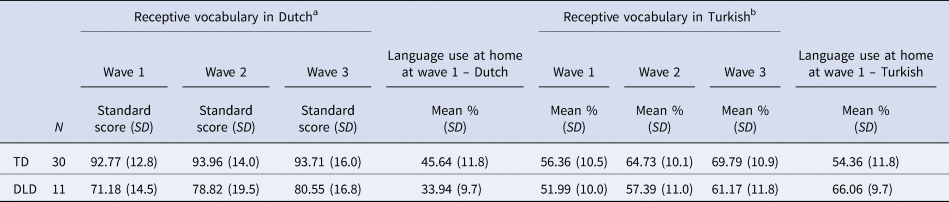
a Receptive vocabulary in Dutch is presented as the standard score (M = 100, SD = 15) on the Dutch version of the standardized Peabody Picture Vocabulary Test (PPVT-III-NL; Schlichting, Reference Smolak, de Anda, Enriquez, Poulin-Dubois and Friend2005).
b Receptive vocabulary in Turkish was measured as the percentage of accurate responses in an unstandardized Turkish picture-naming task (Turkish adaptation of the PPVT-III-NL).
The raw scores on the task were standardized to be able to make a comparison between the Turkish and Dutch versions of the task, given the different number of items and different application of stopping rules in the two versions of the task. To do so, we calculated t-scores for both Dutch and Turkish receptive vocabulary outcomes per wave. The t-scores were calculated including both children with and without DLD. From these standardized scores, a score for relative proficiency dominance was calculated by subtracting the Turkish t-score from Dutch t-score per wave (see Table 3).
Relative proficiency dominance and exposure dominance of TD and DLD groups

a Scores below 0 indicate Turkish dominance and scores above 0 indicate Dutch dominance.
Exposure dominance was calculated using information on language exposure and use from the parental questionnaire (PaBiQ; Tuller, Reference Tuller, Armon-Lotem, de Jong and Meir2015) administered at wave 1. The questionnaire was administered by Turkish–Dutch bilingual test assistants through a telephone interview with one of the child's parents. Questions included information on the early language history, concerning both the amount and diversity of contexts of exposure to each language at home or elsewhere. From this information, children's language exposure scores were calculated for both Dutch and Turkish, using frequency of early exposure (/4), diversity of early contexts of exposure (/7), language spoken in the home with the mother (/4) and father (/4), language spoken with siblings (/4), language spoken with another caregiver (if relevant) (/4), language spoken with other children (/4), language spoken with family friends (/4), weekly language activities (reading, television and telling stories; /6) and the child's preferred language (1 for either Dutch or Turkish). We transformed these sum scores into t-scores. Based on these t-scores of children's language input and output (/42), we calculated a score for relative exposure dominance in each language: the language dominance index (LDI; de Almeida et al., Reference de Almeida, Ferré, Morin, Prévost, dos Santos, Tuller, Zebib and Barthez2017). The LDI was obtained by subtracting the Turkish language input/output sum score from the Dutch language input/output sum score. Almost all children showed exposure dominance in Turkish (n = 36), while only one child, without DLD, showed dominance in Dutch at wave 1 (see Table 3).
The measures of proficiency dominance and exposure dominance at wave 1 were significantly correlated (r = .63, p < .001).
2.3. Procedure
The research project was approved by the Ethics Review Board of the Faculty of Social and Behavioral Sciences at Utrecht University. Prior to testing, all parents signed a written informed consent form. Data collection consisted of three waves, with three sessions at wave 1 and two sessions at waves 2 and 3. The CLS task and Turkish receptive vocabulary task were administered during the first session, and the Dutch vocabulary task was administered during the second session. The CLS task and Dutch and Turkish receptive vocabulary tasks were administered at all three waves, while the NVIQ and parental questionnaire were only administered at wave 1. Children were tested individually in a quiet room at their school by a trained test assistant or researcher.
2.4. Data preparation
Trained assistants used the audio recordings to score the trials of the language switching task. Trials with RTs below 200 ms were excluded from the data (6.0%). Moreover, the first trial of the mixed-language block was excluded from analysis as this trial could not be considered a repeat or a switch trial. Finally, in the analysis of RTs, inaccurate trials were removed, resulting in the exclusion of 10.2% of trials in the single-language blocks (DLD Dutch 8.2%, Turkish 25.6% and TD Dutch 2%, Turkish 13.7%) and 12.2% of trials in the mixed-language block (DLD 19.6% and TD 9.3%).
2.5. Data analysis
In our analyses, we examined children's performance in the CLS task. For mixing costs, we compared the accuracy and RTs in single-language blocks with the repeat trials in the mixed-language block. For switching costs, we analyzed the difference between trial types (i.e., switch and repeat trials) in the mixed-language block. To investigate effects of dominance, we included trial language (i.e., Dutch and Turkish) and continuous measures of proficiency and exposure dominance as factors in our models. We inspected effects of the trial language overall, which may be indicative of effects of the majority language Dutch versus the minority language Turkish on performance. Further, we examined additional effects of children's individual dominance profiles. Since exposure dominance was only administered at wave 1, we performed separate analyses including exposure dominance for wave 1. Analyses with proficiency dominance were conducted for all three waves. The reversed dominance effect would be evidenced by an interaction effect of trial language and dominance on the responses in the mixed-language block, while asymmetrical mixing and switching costs would be evidenced by an interaction between trial language, dominance and block (single-language and mixed-language, mixing cost) or trial type (i.e., switch and repeat trials, switching cost). Further, analyses included effects of time (wave) and group. All analyses were conducted with NVIQ and SES as covariates.
Accuracy data were analyzed with generalized linear mixed effects models using the lme4 package (Bates et al., Reference Bates, Mächler, Bolker and Walker2015a) for R software (R Development Core Team, 2008). Similarly, the lme4 package for R was used to build linear mixed effects models to analyze the RT data. Mixed effects models are powerful and can deal well with unbalanced designs (e.g., different numbers of participants per group; Baayen et al., Reference Baayen, Davidson and Bates2008). RTs were log-transformed prior to analysis, but, for ease of interpretation, raw RTs are used in the descriptive statistics (i.e., tables and figures). Continuous predictors were centered and scaled, while categorical predictors were coded as orthogonal contrasts. For example, wave was coded so that we compare wave 1, marked as −.5, with wave 3, marked with +.5 and, as a secondary contrast, wave 2, marked with +.67, with waves 1 and 3, marked with −.33, and group is always coded such that the group of TD children is marked as −.5 and the DLD group is marked as +.5. Models included the maximal random effect structure, following the ‘keep it maximal’ approach (Barr et al., Reference Barr, Levy, Scheepers and Tily2013). This means that models included by-subject and by-item (i.e., the target answer for the item) random intercepts and by-subject and by-item random slopes for all fixed main effects. Due to overparameterization in the accuracy models, and following Bates et al. (Reference Bates, Kliegl, Vasishth and Baayen2015b), we removed the interaction terms in the by-subject and by-item random slopes. Due to overparameterization in the RT models, we removed the by-item random slopes for group and wave. Significance was assessed through the t-value (or z-value in case of the accuracy data): values above 1.96 were considered significant (p < .05), while values between 1.65 and 1.96 were considered marginally significant (Gollan et al., Reference Gollan, Kleinman and Wierenga2014).
Raw data, as well as R Markdown and html files that detail the data preparation and analyses as described above, including full model results and Supplementary tables, are available on OSF.
3. Results
3.1. Mixing and switching costs (hypothesis 1) and effects of time (hypothesis 3) and DLD (hypothesis 4)
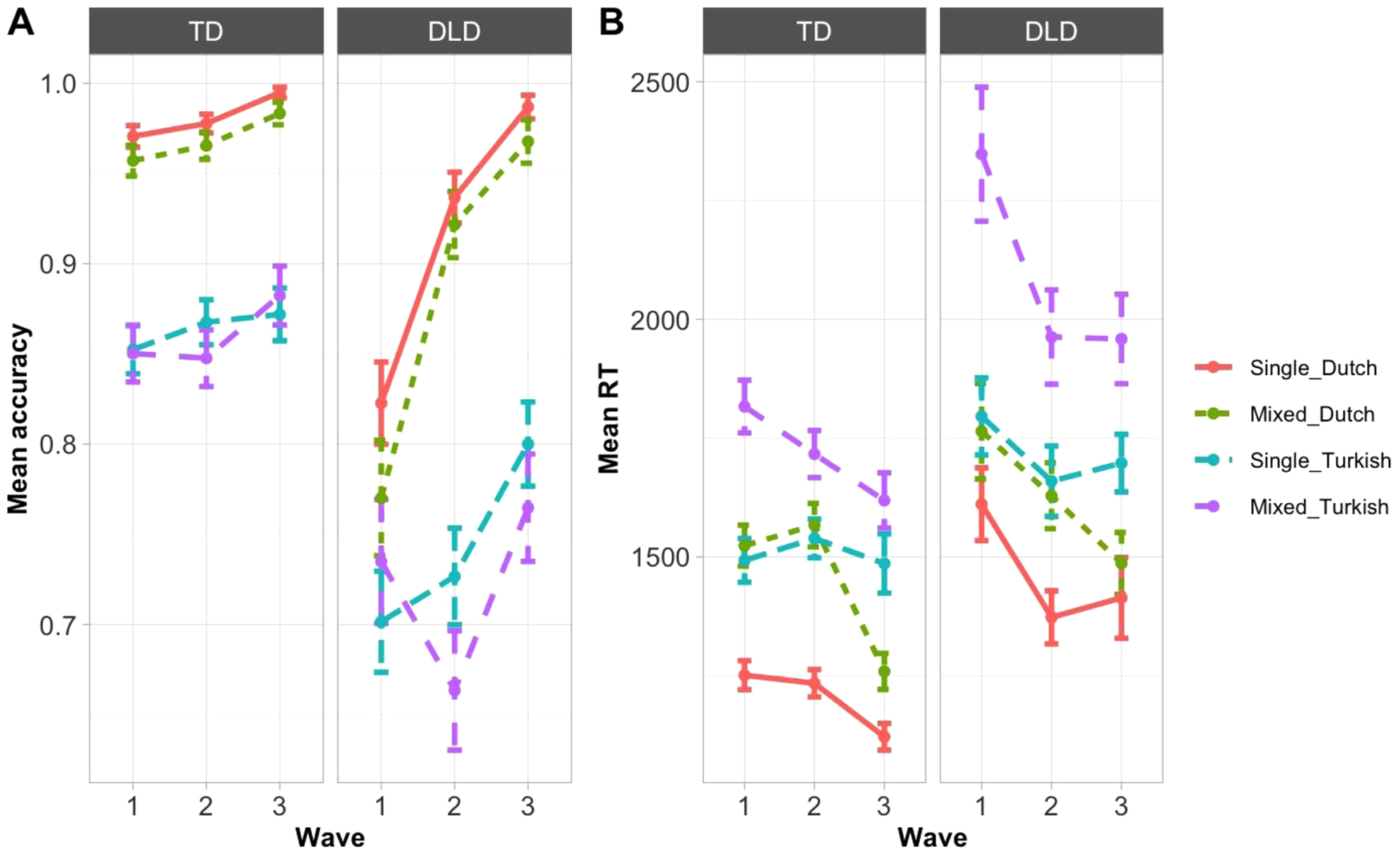
We find no evidence of mixing costs in accuracy, i.e., no difference in accuracy is found between repeat trials in the mixed-language block and trials in the single-language blocks (estimate = −.082, z = −.465, p = .64; Figure 1A). The RT model, however, does show mixing costs: RTs to repeat trials in the mixed-language block are slower than RTs in the single-language blocks (estimate = .151, t = 10.821, p < .001; Figure 1B). Regarding switching costs, we find no evidence of an effect of trial type on children's accuracy in the mixed-language block (estimate = .105, z = .126, p = .90; Figure 2A), suggesting that there is no difference in the number of errors between switch and repeat trials. Further, we find no evidence to suggest that RTs are significantly longer to switch trials as opposed to repeat trials overall (estimate = .023, t = 1.015, p = .31), although the interaction with wave approaches significance (estimate = .093, t = 1.732, p = .083). As can be seen in Figure 2B, the difference in RTs between switch and repeat trials increases with time. Importantly, this effect is carried by the Dutch trials, which we will get back to in the following section.
(A) Mean accuracy (±1 SE), and (B) mean reaction times (RT; ±1 SE) in the single- and mixed-language blocks. Data are presented across waves of data collection for participants with TD (left graphs) and DLD (right graphs). Only repeat trials in the mixed-language block are included.
(A) Mean accuracy (±1 SE), and (B) mean reaction times (RT; ±1 SE) in the switching block. Data are presented across waves of data collection for participants with TD (top graphs) and DLD (bottom graphs) and for Dutch (left graphs) and Turkish (right graphs) trials separately. Repeat trials are represented by a red, solid line; switch trials are represented by a blue, dashed line.

As for potential effects of group on performance in language switching (H4), the accuracy of children with DLD was lower than that of TD children overall (estimate = −1.267, z = −2.169, p = .030), which was also found in the separate analysis of the mixed-language block (estimate = −1.266, z = −2.231, p = .026), indicating more errors in children with DLD (Figures 1A and 2A, respectively). Also as hypothesized, children with DLD have longer RTs than TD children overall (estimate = .165, t = 2.506, p = .017) and in the mixed-language block specifically (estimate = .191, t = 2.435, p = .020; see Figures 1B and 2B, respectively). There is a significant interaction between group and wave on RTs overall and in the mixed-language block analysis (estimate = −.207, t = −4.999, p < .001 and estimate = −.137, t = −2.221, p = .026, respectively), suggesting that the decrease in RTs across waves is larger in children with DLD than in TD children. The interaction between block and group approaches significance, suggesting that the found mixing costs in RTs are slightly larger for DLD children than for TD children (estimate = .054, t = 1.815, p = .070). Regarding switching costs, there are no significant interactions between trial type and group, indicating that we find no evidence of a difference between groups (H4). The three-way interaction including wave in the switching costs RT model approaches significance (estimate = .201, t = 1.752, p = .080). This interaction reflects the finding that, in children with DLD, the switching costs observed at wave 1 are in the opposite direction as expected and as observed in TD children, while the switching costs observed at wave 3 are in the expected direction (see Figure 1B). Note that these complex interactions involving group status should be interpreted with caution given the low number of DLD participants.
3.2. Effects of dominance on language switching (H2) and the influence of having DLD (H5)
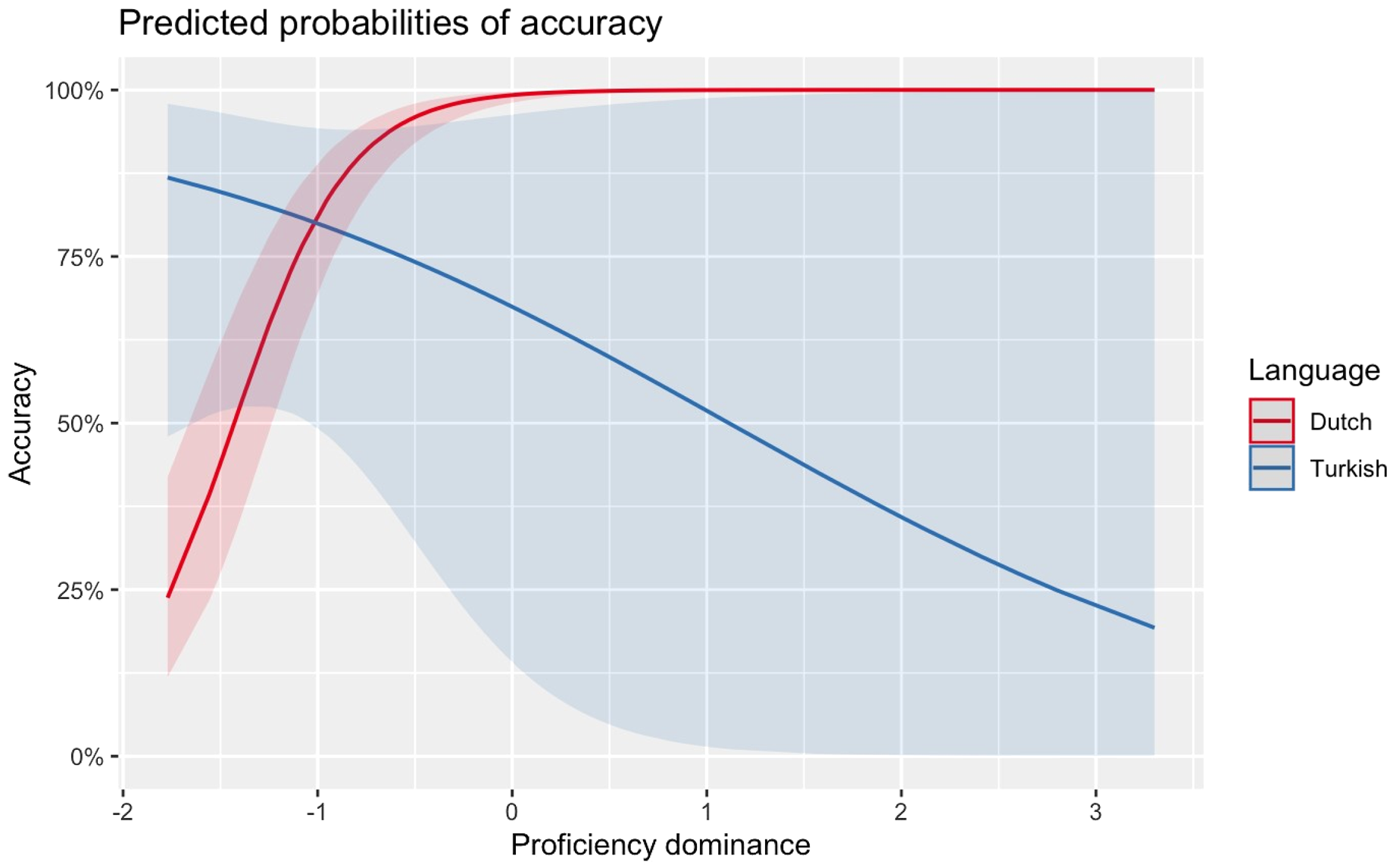
H2a: Reversed dominance effect. Overall, we see higher levels of accuracy for Dutch than for Turkish in the mixed-language block (estimate = 3.103, z = 3.645, p < .001; Supplementary tables on OSF), reflecting that participants overall perform more accurately on Dutch than on Turkish trials. This main effect of trial language interacts with our measure of proficiency dominance (estimate = 2.167, z = 3.217, p = .0013). This interaction effect shows the opposite pattern as predicted by the reversed dominance effect: accuracy in the mixed-language block is higher for the dominant language (see Figure 3). Moreover, the effect of dominance is larger in the Dutch trials: accuracy in Dutch trials is higher at relatively more Turkish-dominant proficiency dominance scores. There is no three-way interaction with wave of data collection to indicate that this effect changes over time (H3; estimate = .919, z = .699, p = .48), or with group to indicate differences between children with and without DLD (H5; estimate = −.217, z = −.226, p = .82).
Visualization of model estimates for the interaction between trial language (Dutch and Turkish) and proficiency dominance on accuracy in the mixed-language block. A proficiency dominance score below 0 indicates Turkish-dominance, whereas scores above 0 indicate Dutch-dominance.
RTs to Dutch trials in the mixed-language block were shorter than to Turkish trials (estimate = −.121, t = −4.639, p < .001; see also Supplementary tables on OSF), suggesting faster performance in Dutch than in Turkish in the mixed-language block. This effect did not interact with our measure of proficiency dominance (estimate = −.026, t = −.833, p = .41). Further, there are no three-way interactions with wave of data collection or group (estimate = .106, t = 1.438, p = .15, and estimate = .012, t = .199, p = .84, respectively). We thus find no evidence for a reversed dominance effect in RTs that involves individual children's dominance level.
As in the analysis of proficiency dominance, the analysis of effects of exposure dominance at wave 1 on accuracy shows a main effect of trial language (estimate = 1.741, z = 3.907, p < .001) and an interaction with exposure dominance in the same direction: accuracy is higher for the dominant language and this effect is stronger for Dutch trials as opposed to Turkish trials (estimate = 1.589, z = 2.989, p = .0028). There is no three-way interaction with the group. Similarly, the RTs analysis of exposure dominance mirrors the results above, revealing a main effect of trial language (estimate = −.138, t = −2.836, p = .0068) and no evidence of an interaction with exposure dominance or group.
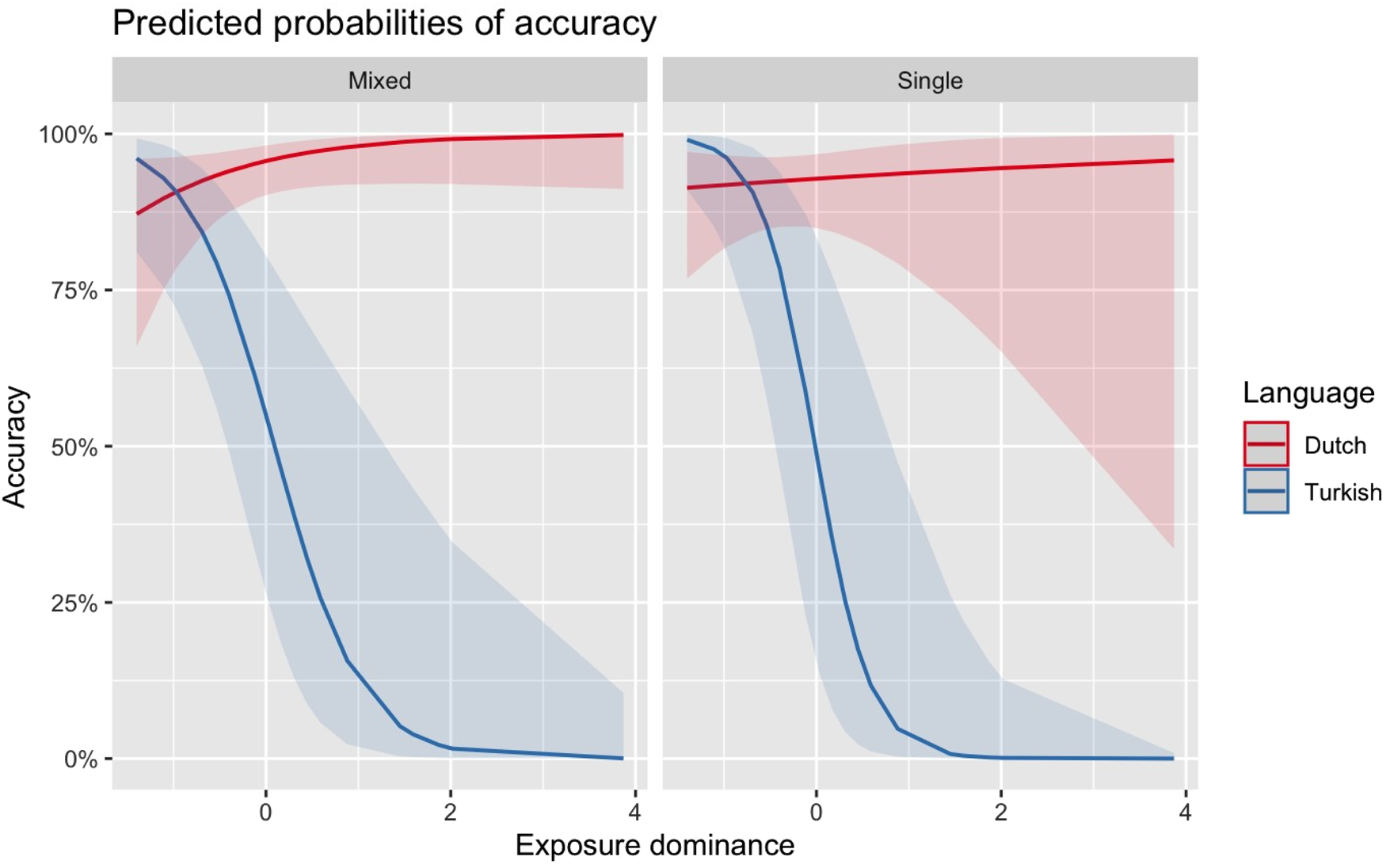
H2b: Asymmetrical mixing cost. In models including proficiency dominance, we find no evidence for an asymmetry between Dutch and Turkish in terms of mixing costs (accuracy: estimate = −.355, z = −1.053, p = .29; RTs: estimate = .018, t = .632, p = .53) or an interaction with proficiency dominance (accuracy: estimate = −.338, z = −.848, p = .40; RTs: estimate = .005, t = 1.245, p = .21), or further interactions with group or wave. When looking at exposure dominance, we do find evidence of asymmetrical mixing costs that relates to children's dominance profile in accuracy (i.e., three-way interaction between trial language, block, and exposure dominance: estimate = −1.200, z = −2.065, p = .039), but not in RTs (estimate = .003, t = .476, p = .63), and there is no interaction with group and/or wave. We find no two-way interactions between trial language and block (accuracy: estimate = −.351, z = −.789, p = .43; RTs: estimate = −.006, t = −1.086, p = .28). Thus, only the accuracy model looking at exposure dominance finds evidence of asymmetrical mixing costs depending on trial language and individual dominance, although the effect appears to be small and, once again, in the opposite direction (Figure 4).
Visualization of model estimates for the interaction between trial language (Dutch and Turkish), block (mixed-language on the left and single-language on the right) and exposure dominance on accuracy. An exposure dominance score below 0 indicates Turkish-dominance, whereas scores above 0 indicate Dutch-dominance.
H2c: Asymmetrical switching cost. Results show that trial language interacts with trial type in our RT model (switch versus repeat trials: estimate = .189, t = 4.488, p < .001): switching costs are larger for Dutch than for Turkish (mean RT switching costs Dutch = 165 ms, Turkish = −52 ms). We do not find such an effect of trial language on switching costs in the accuracy data (estimate = 1.156, z = .692, p = .49). We find no evidence for interactions with our measures of dominance to indicate asymmetrical switching costs that relate to individual children's dominance profile (all p's > .40), or interactions with group and/or wave. To summarize, we find no evidence for asymmetrical switching costs depending on children's level of dominance, but we did find larger RT switching costs for Dutch than Turkish overall.
3.3. Exploratory findings
Although we do not find evidence of the reversed dominance effect or asymmetrical switching cost effect in RT data of the mixed-language block, the RT model of switching costs does present us with some exploratory findings regarding effects of dominance on performance in the mixed-language block (i.e., findings that do not directly answer our research questions, cf. Wagenmakers et al., Reference Wagenmaker, Wetzels, Borsboom, van der Maas and Kievit2012). Specifically, we find an interaction between proficiency dominance and trial type (estimate = −.062, t = −2.330, p = .020). This effect does not interact further with wave or with group. In other words, we find that higher scores on proficiency dominance (i.e., scores that reflect that children are more Dutch-dominant) are associated with smaller switching costs overall. We find no evidence of such an effect in our analysis of mixing costs.
4. Discussion
This study longitudinally examined CLS in Turkish–Dutch bilingual children with and without developmental language disorder (DLD). We explored the overall performance on CLS (H1), and effects of dominance on language switching behavior by including effects of the trial language and continuous measures of individual dominance profiles based on vocabulary scores in both languages (proficiency dominance) and on the relative amount of exposure to both languages (exposure dominance). We were specifically interested to see whether Turkish–Dutch bilingual children would show asymmetrical mixing or switching costs and/or the reversed dominance effect (H2). Children were tested at three waves of data collection, thereby following them from age 5 to 8. Thus, we were able to study effects of dominance on language switching longitudinally in a timeframe that included the first years of primary school, which has previously been shown to influence dominance patterns in Turkish–Dutch children (Extra et al., Reference Extra, Aarts, van der Avoird, Broeder and Yagmur2002; H3). The present study is the first study of CLS to include children with DLD, who we hypothesized would experience difficulties with CLS (H4) and to show larger effects of dominance (Greene et al., Reference Greene, Peña and Bedore2012; H5).
4.1. Language switching in bilingual children
With regard to overall performance on the CLS task (H1), we found no evidence for a difference between switch and repeat trials in Turkish–Dutch bilingual children; not in terms of errors or RTs. Although switching costs were consistently present in adult studies included in the meta-analyses by Gade et al. (Reference Gade, Declerck, Philipp, Rey-Mermet and Koch2021), we did not find the same results in the current study. Our findings are furthermore not in line with a previous study that assessed CLS in children (Kubota et al., Reference Kubota, Chevalier and Sorace2019). However, the children in our study are tested in a different context (i.e., second and third migration generation or combinations thereof versus returnee migrants in Kubota et al., Reference Kubota, Chevalier and Sorace2019). Parents of our participants report to be at least somewhat proficient in both languages, and that language mixing occurs in their homes (based on the parental questionnaire). The children in our sample may therefore be used to switching between languages in naturalistic settings (Backus & Demirçay, Reference Backus and Demirçay2021). Conversely, the returnee children in the study by Kubota et al. (Reference Kubota, Chevalier and Sorace2019), who were tested upon return in Japan, may have had less exposure to naturalistic language switching. In adult research, studies that do find switching cost effects often involved sequential bilinguals (e.g., Christoffels et al., Reference Christoffels, Firk and Schiller2007) or participants who report to use mostly one language in their daily lives (Prior & Gollan, Reference Prior and Gollan2011). Bilinguals who switch habitually in their daily conversations may require less cognitive control to switch between languages (Green & Abutalebi, Reference Green and Abutalebi2013). Thus, the children in our sample may have required relatively limited cognitive control to switch languages, resulting in small cognitive costs for switching from one language to the other. It should be noted that this is surprising, considering the inclusion of children with DLD who generally have trouble with cognitive control (Pauls & Archibald, Reference Pauls and Archibald2016). Importantly, the lack of evidence for switching costs in our study highlights the importance of taking into account this heterogeneity in bilingual research (Baker, Reference Baker2011; Francot et al., Reference Francot, Blom, Broekhuizen and Leseman2021; Montanari et al., Reference Montanari, Ochoa and Subrahmanyam2019).
We did, however, find evidence for mixing costs in the RT model: children were slower to respond to repeat trials in the mixed-language block than to trials in the single-language blocks. This is in line with previous studies that have reported mixing costs in bilingual adults (Christoffels et al., Reference Christoffels, Firk and Schiller2007; Prior & Gollan, Reference Prior and Gollan2011) and children (Kubota et al., Reference Kubota, Chevalier and Sorace2019). Together, these findings suggest that school-aged children, like adults, make use of proactive control processes to anticipate and prevent interference during CLS (Braver, Reference Braver2012; Braver et al., Reference Braver, Reynolds and Donaldson2003).
4.2. Language switching and effects of dominance
When considering children's language dominance profiles, we did not find support for the reversed dominance effect (H2a). In both the exposure and proficiency dominance analyses, we found a dominance effect in the opposite direction. That is, accuracy in the mixed-language block is higher for the dominant language than for the non-dominant language. This finding is in line with several studies (Ma et al., Reference Ma, Li and Guo2016; Prior & Gollan, Reference Prior and Gollan2013) included in the meta-analysis on the reversed dominance effect (Gade et al., Reference Gade, Declerck, Philipp, Rey-Mermet and Koch2021). The effect of language dominance in our accuracy data did not extend to our RT data, in line with Gade et al. (Reference Gade, Declerck, Philipp, Rey-Mermet and Koch2021). It has been suggested that the reversed dominance effect may be more likely to be elicited in highly proficient than in less proficient bilinguals. This may be because they are able to rely on inhibition after fewer trials than less proficient bilinguals (Kleinman & Gollan, Reference Kleinman and Gollan2018). Highly proficient bilinguals have similar activation levels for both languages, and, as a result, they may ‘overshoot’ inhibition when accessing their slightly less-dominant language, resulting in the reversed dominance effect (Declerck et al., Reference Declerck, Kleinman and Gollan2020). Less proficient bilinguals may require more time to familiarize themselves with the items assessed during mixed-language blocks. Children in our sample are still actively learning both languages (Blom et al., Reference Blom, Boerma, Karaca, de Jong and Küntay2022) and thus lack high proficiency in both languages (see, e.g., vocabulary growth in Tables 2 and 3 for Dutch and Turkish, respectively). This may explain the absence of the reversed dominance effect in the current study.
Moreover, we found no evidence for asymmetrical switching costs related to individual children's language dominance (H2c). As argued by Gade et al. (Reference Gade, Declerck, Philipp, Rey-Mermet and Koch2021), the absence of the asymmetrical cost effect may be due to pragmatic aspects of language use. In bilinguals, language use may depend on situational demands for a specific language (Marian & Hayakawa, Reference Marian and Hayakawa2021). Children in our sample are transitioning into a formal schooling setting where the use of Dutch is stimulated and the use of the home language is sometimes actively discouraged (Kuiken & van der Linden, Reference Kuiken and van der Linden2013). Consequently, Dutch may increase in status which in turn may lead to an overall preference for using Dutch in this sample of Turkish–Dutch bilingual children (Sevinç, Reference Sevinç2016). If so, then asymmetrical costs would not show, as children switch to the majority language regardless of dominance. This is supported by the finding that accuracy was higher, and RTs were longer, in Turkish trials in the mixed-language block, and that switching costs were larger for Dutch than for Turkish trials. Indeed, previous studies with Spanish–English bilingual children have also shown that children tend to choose the majority language (Montanari et al., Reference Montanari, Ochoa and Subrahmanyam2019) and therefore switch more in minority language contexts during longer stretches of discourse (i.e., Spanish to English; Gross & Kaushanskaya, Reference Gross and Kaushanskaya2022; Kapantzoglou et al. Reference Kapantzoglou, Brown, Cycyk and Fergadiotis2021; Smolak et al. Reference Smolak, de Anda, Enriquez, Poulin-Dubois and Friend2019). The importance of the majority language reflects language dominance at the societal level which may lead children to opt for the majority language, even when the majority language is not their individual dominant language (Treffers-Daller, Reference Treffers-Daller2019). All in all, while the effects of language dominance were not in line with our hypotheses, language status (i.e., societal language dominance) had important contributions to CLS beyond effects of individual language dominance. It remains unclear what underlying mechanisms can explain effects of societal language dominance.
We did find limited evidence for a dominance asymmetry in mixing costs when considering exposure dominance at wave 1 and accuracy data (H2b). Figure 3 suggest that this asymmetry is explained by greater variance in accuracy in Dutch trials in the single-language block at higher levels of dominance. Moreover, this three-way interaction is only found for exposure dominance and therefore one wave, but not in other waves with proficiency dominance. These results should therefore be interpreted with caution.
One important aspect of our study was that we studied effects of language dominance longitudinally. Contrary to our expectations, we did not find that effects of dominance shifted over time (H3). Specifically, we found no evidence for the expected shift in dominance from Turkish to Dutch as children enter primary school (Extra et al., Reference Extra, Aarts, van der Avoird, Broeder and Yagmur2002). It might be that, on average, the TD children in our sample were already Dutch-dominant at wave 1 (based on receptive vocabulary scores, Table 2). Although the children in our sample receive a lot of Turkish exposure and are still developing their Turkish skills (Blom et al., Reference Blom, Boerma, Karaca, de Jong and Küntay2022; see receptive vocabulary scores in Table 2), previous studies have indicated that Turkish development is under pressure (Akoğlu & Yağmur, Reference Akoğlu and Yağmur2016; Backus & Yağmur, Reference Backus and Yağmur2017). The parents of children in our sample are likely of a next generation compared to those in the study by Extra et al. (Reference Extra, Aarts, van der Avoird, Broeder and Yagmur2002), and may already have had increased Dutch proficiency, compared to their own parents (Sevinç, Reference Sevinç2016). In turn, these parents may have provided children with more Dutch exposure, resulting in a larger number of children already being Dutch-dominant around the time they enter primary school. Further, not only the quantity but also the quality of the input matters for language development (Anderson et al., Reference Anderson, Graham, Prime, Jenkins and Madigan2021), and the input in the majority language (i.e., Dutch) is known to be more varied and of higher quality than input in the minority language (De Houwer, Reference De Houwer, Schalle and Eisenchlas2020; De Houwer et al., Reference De Houwer, Bar-On, Ravid, Bar-On and Ravid2018).
4.3. Language switching in DLD
This study was the first to explore differences in language switching behavior between children with and without DLD in a CLS task. Children with DLD generally have trouble with cognitive control (Pauls & Archibald, Reference Pauls and Archibald2016), which could lead to trouble with CLS and enhanced dominance effects. We found support for H4: children with DLD made more errors (e.g., cross-language errors, wrong-word errors, and ‘I don't know’ responses) and had longer RTs than children without DLD. As hypothesized, children with DLD experienced slightly larger mixing costs than their TD peers in terms of their RTs. This finding is in line with previous studies that have shown that children with DLD perform lower on cognitive control tasks (Pauls & Archibald, Reference Pauls and Archibald2016), and suggests that these cognitive control difficulties impact their CLS performance. There was, however, no significant interaction between trial type and group: children with DLD did not make significantly more errors on switch or repeat trials than children without DLD. In children with DLD, the switching costs observed at wave 1 were in the opposite direction as expected and as observed in TD children. Switching costs at wave 3 were in the expected direction. Children with DLD may develop the typical switching cost pattern at a later age than children without DLD. This may reflect that children with DLD have difficulties with word retrieval in general (Sheng & McGregor, Reference Sheng and McGregor2010; Spaulding, Reference Spaulding2010). These difficulties may not be enhanced when presented with more cognitively challenging situations (i.e., switch trials) compared to children without DLD. Finally, we did not find enhanced effects of dominance in children with DLD, and therefore, no support for H5.
Notably, some of the results reported for the DLD group may partially be explained by the fact that DLD children showed very slow responses to Turkish trials at wave 1 of data collection (see Figures 1B and 2B). Although we do not know the exact reason for this finding (e.g., removal of incorrect trials, an accuracy-RT trade-off), these slow responses may partially drive the slightly larger mixing costs that we observed in DLD children. Together with the fact that we only considered a small sample of children with DLD, our results require replication.
4.4. Limitations and future directions
We would like to note several limitations to the present study. First, our measure of proficiency dominance was based on a receptive measure whereas our measure of language switching was based on an expressive measure. Effects of dominance may have been different if we had used expressive vocabulary to indicate proficiency dominance. However, research using a large and diverse sample of English-speaking children has suggested that receptive and expressive vocabulary measure the same underlying construct in preschoolers and school-aged children (Lonigan & Milburn, Reference Lonigan and Milburn2017), which suggests that our findings may generalize to expressive vocabulary. Second, we were only able to measure exposure dominance at wave 1. Since (relative) language exposure may change over time, our measure of exposure dominance may not reflect dominance patterns at later waves. However, we do not expect large changes in exposure because at wave 1 the children were already in primary school where Dutch is the language of instruction. Finally, we only considered a small sample of children with DLD (n = 11), and any findings regarding the DLD group require replication.
Despite these limitations, our study is the first to longitudinally examine CLS in bilingual children with and without DLD. Future research could explore relationships between language switching in naturalistic settings and language switching in a CLS experiment. Furthermore, they could shed light on the (cognitive) mechanisms underlying performance on CLS tasks and dominance effects in young bilingual children. Moreover, future research should examine the role of age in effects of dominance in relation to language proficiency and explore the role of language status. Finally, given evolutions in language dominance patterns, future studies should re-examine shifting dominance patterns in Turkish–Dutch bilingual children across early childhood.
5. Conclusions
The current study found no evidence of switching costs in Turkish–Dutch bilingual children with and without DLD on a CLS task, which may be explained by their experience with language switching in naturalistic settings. Additionally, we find evidence for mixing costs in Turkish–Dutch bilingual children with and without DLD, and limited evidence that these mixing costs are asymmetrical, in line with previous studies. Regarding effects of dominance, we find no evidence for the reversed dominance effect or the asymmetrical switching costs effect, which is in line with previous work that has indicated that these effects are not robust and may depend on moderating factors (Gade et al., Reference Gade, Declerck, Philipp, Rey-Mermet and Koch2021). These results highlight the special status of the majority language, also in the context of CLS. Finally, despite the small sample, our results suggest that children with DLD experience difficulties with CLS, as evidenced by poorer picture-naming overall and larger mixing costs.
Supplementary material
The supplementary material for this article can be found at https://doi.org/10.1017/S1366728924000427.
Data availability statement
The data that support the findings of this study are openly available on the Open Science Framework at https://osf.io/2mdc7/.
Acknowledgments
We thankfully acknowledge all participating children, parents, and schools. This research is funded by VIDI and VICI grants awarded to Elma Blom by the Netherlands Organization for Scientific Research (NWO; grant numbers 016.124.369 and VI.C.191.042).
Competing interests
None.
Ethical standards
The authors assert that all procedures contributing to this work comply with the ethical standards of the relevant national and institutional committees on human experimentation and with the Helsinki Declaration of 1975, as revised in 2008.
Appendix A. Measuring language dominance in bilinguals
Two key dimensions in the literature on language dominance are language proficiency and language exposure (Treffers-Daller, Reference Treffers-Daller2019). Studies that consider language proficiency as an indicator of language dominance, interpret language dominance as a product of relative strength of proficiency in each language. The language with highest proficiency is considered the dominant language. Language proficiency tests tap into language knowledge directly, but they may measure (slightly) different constructs in both languages (Treffers-Daller, Reference Treffers-Daller2019). Furthermore, proficiency measures do not take into account a child's exposure to each language. Alternatively, language dominance is assessed as a product of language exposure and use of both languages through parental questionnaires (Gatt et al., Reference Gatt, Attard, Łuniewska and Haman2017; Greene et al., Reference Greene, Peña and Bedore2012). Under the assumption that language dominance is, first and foremost, a property of the mind (Yip & Matthews, Reference Yip and Matthews2006), language exposure may provide a more indirect indicator of language dominance than language proficiency.
Because operationalizing language dominance through either language proficiency or language exposure may both be incomplete, some studies have used combined measures. Gutiérrez-Clellen et al. (Reference Gutiérrez-Clellen, Simon-Cereijido and Leone2009) used a combination of morphosyntactic subtests (tapping into proficiency dominance) and parent- and teacher-questionnaires (tapping into exposure dominance). Gross and Kaushanskaya (Reference Gross and Kaushanskaya2020, Reference Gross and Kaushanskaya2022) determined language dominance using seven indicators, including current exposure, parent-reported dominance, child preference, expressive vocabulary, expressive morphosyntax, receptive language and broad language skills. These multidimensional approaches provide a more complete overview of language dominance, yet assess language dominance categorically. Continuous measures of dominance may be more sensitive to variability in dominance patterns, especially when detecting small differences over time.


 Open access

