 Ag
Ag





1. Introduction
Let S be a normal quasi-projective variety defined over a number field K with the function field F, and let $\pi:\mathcal{A}\rightarrow S$
be an abelian scheme with generic fiber A.
$\pi:\mathcal{A}\rightarrow S$
be an abelian scheme with generic fiber A.
1.1 Scenario one
Consider the specialization map for the Mordell–Weil group
 \[\mathrm{sp}_s:\mathcal{A}(S)\rightarrow \mathcal{A}_s \]
defined by restricting a section to the fiber $\mathcal{A}_s$
over any
$\mathcal{A}_s$
over any $s\in S$
. A well-known result of Silverman [Reference SilvermanSil83, Theorem C] states that when S is a curve and A has no constant part, the specialization maps are injective for all closed points of S, except for a set of bounded height. Naturally, this raises the question of whether analogous results hold for higher-dimensional bases.
$s\in S$
. A well-known result of Silverman [Reference SilvermanSil83, Theorem C] states that when S is a curve and A has no constant part, the specialization maps are injective for all closed points of S, except for a set of bounded height. Naturally, this raises the question of whether analogous results hold for higher-dimensional bases.
By the Lang–Néron theorem [Reference Lang and NéronLN59], the group A(F) is finitely generated. Let $\sigma_1,\ldots,\sigma_r\in \mathcal{A}(S)\subseteq A(F)$
be linearly independent generators for
$\sigma_1,\ldots,\sigma_r\in \mathcal{A}(S)\subseteq A(F)$
be linearly independent generators for $\mathcal{A}(S)_{\mathbb{Q}}$
. Consider the section
$\mathcal{A}(S)_{\mathbb{Q}}$
. Consider the section $\underline{\sigma}:=(\sigma_1,\ldots,\sigma_r)$
embedded in the fibered power
$\underline{\sigma}:=(\sigma_1,\ldots,\sigma_r)$
embedded in the fibered power $\mathcal{A}^r_S$
. For
$\mathcal{A}^r_S$
. For $\underline{\lambda}:=(\lambda_1,\ldots,\lambda_r)\in \mathbb{Z}^r$
, denote by
$\underline{\lambda}:=(\lambda_1,\ldots,\lambda_r)\in \mathbb{Z}^r$
, denote by $\mathcal{H}_{\underline{\lambda}}$
the flat group subscheme of
$\mathcal{H}_{\underline{\lambda}}$
the flat group subscheme of $\mathcal{A}^r_S$
given as the kernel of
$\mathcal{A}^r_S$
given as the kernel of
 \[\mathcal{A}^r_S \rightarrow \mathcal{A},\quad \underline{x}=(x_1,\ldots,x_r)\mapsto \underline{\lambda}\cdot\underline{x}=\lambda_1 x_1+\cdots +\lambda_r x_r. \]
Observe that a linear relation $\underline{\lambda}\cdot\underline{\sigma}(s)=0$
corresponds to an intersection
$\underline{\lambda}\cdot\underline{\sigma}(s)=0$
corresponds to an intersection $\underline{\sigma}\cap\mathcal{H}_{\underline\lambda}$
over
$\underline{\sigma}\cap\mathcal{H}_{\underline\lambda}$
over $s\in S$
. In other words, nontrivial linear relations among
$s\in S$
. In other words, nontrivial linear relations among $\sigma_1,\ldots,\sigma_r$
are encoded in the intersection
$\sigma_1,\ldots,\sigma_r$
are encoded in the intersection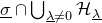 $\underline{\sigma}\cap \bigcup_{\underline{\lambda}\neq 0}\mathcal{H}_{\underline{\lambda}}$
. In general, one cannot expect the intersections to be rare. The following is our first result, which recovers Silverman’s theorem in the curve case.
$\underline{\sigma}\cap \bigcup_{\underline{\lambda}\neq 0}\mathcal{H}_{\underline{\lambda}}$
. In general, one cannot expect the intersections to be rare. The following is our first result, which recovers Silverman’s theorem in the curve case.
Theorem A (Theorem 10.4). If all nontrivial simple abelian subvarieties of $A_{F^{\mathrm{alg}}}$
have maximal variation (i.e. the period maps are generically finite) and dimension at least
$A_{F^{\mathrm{alg}}}$
have maximal variation (i.e. the period maps are generically finite) and dimension at least $\dim S$
, then the set of closed points
$\dim S$
, then the set of closed points $s\in S$
where
$s\in S$
where $\mathrm{sp}_s$
fails to be injective or, equivalently, the set of closed points of the intersection
$\mathrm{sp}_s$
fails to be injective or, equivalently, the set of closed points of the intersection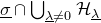 $\underline{\sigma}\cap \bigcup_{\underline{\lambda}\neq 0}\mathcal{H}_{\underline{\lambda}}$
, is contained in the union of a strict Zariski-closed subset and a set of bounded height of S.
$\underline{\sigma}\cap \bigcup_{\underline{\lambda}\neq 0}\mathcal{H}_{\underline{\lambda}}$
, is contained in the union of a strict Zariski-closed subset and a set of bounded height of S.
We will see that the maximal variation assumption ensures that the subvariety $\underline{\sigma}$
is optimally nondegenerate, while the dimension assumption restricts the intersection to being, at most, just likely. Notably, the above theorem represents a specific instance of a broader phenomenon applicable to sufficiently nondegenerate subvarieties.
$\underline{\sigma}$
is optimally nondegenerate, while the dimension assumption restricts the intersection to being, at most, just likely. Notably, the above theorem represents a specific instance of a broader phenomenon applicable to sufficiently nondegenerate subvarieties.
1.2 Scenario two
For this subsection, we assume $S=C$
is a curve. Let
$S=C$
is a curve. Let $\langle\cdot,\cdot \rangle$
be the canonical height pairing associated to a relatively ample line bundle
$\langle\cdot,\cdot \rangle$
be the canonical height pairing associated to a relatively ample line bundle $\mathcal{L}$
on
$\mathcal{L}$
on $\mathcal{A}/C$
. Take a finitely generated torsion-free subgroup
$\mathcal{A}/C$
. Take a finitely generated torsion-free subgroup $\Lambda\subseteq \mathcal{A}(C)$
with linearly independent generators
$\Lambda\subseteq \mathcal{A}(C)$
with linearly independent generators $\sigma_1,\ldots, \sigma_r$
. Define the following function
$\sigma_1,\ldots, \sigma_r$
. Define the following function
 \[h_{\Lambda}(s):=\det ( \langle \sigma_i(s),\sigma_j(s)\rangle_{i,j}) \]
for any $s\in C(K^{\mathrm{alg}})$
. In his ICM notes [Reference ZhangZha98], Zhang made the following conjecture.
$s\in C(K^{\mathrm{alg}})$
. In his ICM notes [Reference ZhangZha98], Zhang made the following conjecture.
Conjecture 1.1 (Zhang [Reference ZhangZha98]). Let $\mathcal{A}\rightarrow C$
be an abelian scheme on a curve over a number field K whose generic fiber is geometrically simple of dimension
$\mathcal{A}\rightarrow C$
be an abelian scheme on a curve over a number field K whose generic fiber is geometrically simple of dimension $\geq 2$
. Let
$\geq 2$
. Let $\Lambda\subseteq \mathcal{A}(C)$
be a finitely generated torsion-free subgroup. There is
$\Lambda\subseteq \mathcal{A}(C)$
be a finitely generated torsion-free subgroup. There is $\epsilon \gt 0$
such that
$\epsilon \gt 0$
such that
 \[ \{s\in C(K^{\mathrm{alg}}) \mid h_\Lambda(s)<\epsilon\} \]
is finite.
As observed by Poonen, Conjecture 1.1 is not true without the dimension assumption, since a section of an elliptic surface can easily have infinitely many torsion points. Nevertheless, we can obtain the following bounded height result with no restriction on the dimension of abelian varieties in the nonconstant case.
Theorem B (Theorem 10.5). Let $\pi:\mathcal{A}\rightarrow C$
be an abelian scheme on a curve C defined over a number field K, and assume
$\pi:\mathcal{A}\rightarrow C$
be an abelian scheme on a curve C defined over a number field K, and assume $\mathcal{A}/C$
has no constant part. Let
$\mathcal{A}/C$
has no constant part. Let $\Lambda\subseteq \mathcal{A}(C)$
be a finitely generated torsion-free subgroup. There is
$\Lambda\subseteq \mathcal{A}(C)$
be a finitely generated torsion-free subgroup. There is $\epsilon \gt 0$
such that
$\epsilon \gt 0$
such that
 \[ \{s\in C(K^{\mathrm{alg}})\mid h_{\Lambda}(s)<\epsilon\} \]
is a set of bounded height. In particular, there are only finitely many points $s\in C(K^{\mathrm{alg}})$
of bounded degree with
$s\in C(K^{\mathrm{alg}})$
of bounded degree with $h_{\Lambda}(s)<\epsilon$
.
$h_{\Lambda}(s)<\epsilon$
.
For the proof, we shall reduce the question by linear algebra to study the intersection of $\underline{\sigma}=(\sigma_1,\ldots,\sigma_r)\subseteq\mathcal{A}_C^r$
with a certain
$\underline{\sigma}=(\sigma_1,\ldots,\sigma_r)\subseteq\mathcal{A}_C^r$
with a certain $\epsilon$
-height neighborhood of
$\epsilon$
-height neighborhood of $\bigcup_{\underline{\lambda}\neq 0}\mathcal{H}_{\underline{\lambda}}$
.
$\bigcup_{\underline{\lambda}\neq 0}\mathcal{H}_{\underline{\lambda}}$
.
1.3 Scenario three
Now, assume S is a point so that A is an abelian variety over K. Consider a subvariety $X\subseteq A$
. For
$X\subseteq A$
. For $t\in \mathbb{N}$
, let
$t\in \mathbb{N}$
, let $A_{\leq t}$
denote the union of all group subschemes
$A_{\leq t}$
denote the union of all group subschemes $H\subseteq A$
with dimension
$H\subseteq A$
with dimension $\leq t$
. One would like to understand when the closed points of
$\leq t$
. One would like to understand when the closed points of
 \[X\cap A_{\leq t} \]
are contained in the union of a strict Zariski-closed subset and a set of bounded height in X. Guided by the general principle of unlikely intersection, we should remove those positive-dimensional subvarieties $Y\subseteq X$
if Y has codimension
$Y\subseteq X$
if Y has codimension $<t$
inside a coset (i.e. translate of a group subvariety). Such Y are expected to result in an unbounded height for the dimension reasons, at least when A is a power of elliptic curves as verified by Viada [Reference ViadaVia09]. The union of all such Y is called the t-anomalous locus of X, which is shown to be Zariski closed by Rémond [Rém09]. Denote the locally closed subvariety deprived of the t-anomalous locus by
$<t$
inside a coset (i.e. translate of a group subvariety). Such Y are expected to result in an unbounded height for the dimension reasons, at least when A is a power of elliptic curves as verified by Viada [Reference ViadaVia09]. The union of all such Y is called the t-anomalous locus of X, which is shown to be Zariski closed by Rémond [Rém09]. Denote the locally closed subvariety deprived of the t-anomalous locus by $X^{\circ,t}$
. Fix a Néron–Tate height function
$X^{\circ,t}$
. Fix a Néron–Tate height function $\hat h$
on A and let the
$\hat h$
on A and let the $\epsilon$
-height neighborhood of
$\epsilon$
-height neighborhood of $A_{\leq t}$
be
$A_{\leq t}$
be
 \[ C(\epsilon,A_{\leq t}):=\{x+y\mid x\in A_{\leq t}(K^{\mathrm{alg}}), y\in A(K^{\mathrm{alg}}),\hat h(y)<\epsilon\max\{1,\hat h(x)\} \}.\]
Habegger established the following bounded height theorem [Reference HabeggerHab09a] on abelian varieties.
Theorem 1.2 (Habegger [Reference HabeggerHab09a]). Let A be an abelian variety over a number field K with a fixed Néron–Tate height and let X be a subvariety of A. There exists $\epsilon \gt 0$
such that the closed points of the intersection
$\epsilon \gt 0$
such that the closed points of the intersection $X^{\circ,t}\cap C(\epsilon,A_{\leq t})$
form a set of bounded height.
$X^{\circ,t}\cap C(\epsilon,A_{\leq t})$
form a set of bounded height.
Our main result is a family version of Habegger’s theorem, implying the three scenarios above, which we now describe.
1.4 Main result
Let S be a normal quasi-projective variety over a number field K and let $\pi:\mathcal{A}\rightarrow S$
be an abelian scheme, with its relative dimension denoted by g. For
$\pi:\mathcal{A}\rightarrow S$
be an abelian scheme, with its relative dimension denoted by g. For $t\in \mathbb{N}$
, let
$t\in \mathbb{N}$
, let $\mathcal{A}_{\leq t}$
denote the union of all flat group subschemes
$\mathcal{A}_{\leq t}$
denote the union of all flat group subschemes $\mathcal{H}\subseteq \mathcal{A}$
with relative dimension
$\mathcal{H}\subseteq \mathcal{A}$
with relative dimension $\leq t$
. Consider an embedding of
$\leq t$
. Consider an embedding of $\mathcal{A}$
in a projective space. The induced nave height function h on the closed points of
$\mathcal{A}$
in a projective space. The induced nave height function h on the closed points of $\mathcal{A}$
is called a total height. Fix a fiber-wise Néron–Tate height
$\mathcal{A}$
is called a total height. Fix a fiber-wise Néron–Tate height $\hat h$
on
$\hat h$
on $\mathcal{A}/S$
. Define, for
$\mathcal{A}/S$
. Define, for $\epsilon \gt 0$
, the
$\epsilon \gt 0$
, the $\epsilon$
-height neighborhood of
$\epsilon$
-height neighborhood of $\mathcal{A}_{\leq t}$
as
$\mathcal{A}_{\leq t}$
as
 \[C(\epsilon,\mathcal{A}_{\leq t}):=\{x+y\mid x\in \mathcal{A}_{\leq t}(K^{\mathrm{alg}}), y\in \mathcal{A}_{\pi(x)}(K^{\mathrm{alg}}), \hat h(y)<\epsilon\max\{1,h(x)\}\}. \]
We are interested in understanding for a subvariety $\mathcal{X}\subseteq\mathcal{A}$
when the following intersection
$\mathcal{X}\subseteq\mathcal{A}$
when the following intersection
 \[\mathcal{X}\cap C(\epsilon,\mathcal{A}_{\leq t}) \]
is sparse for sufficiently small $\epsilon$
. Now it seems less transparent in this family setting on what is anomalous; for instance, a horizontal constant section could also lead to unbounded height. Nonetheless, the analogue of a coset in this mixed setting is called a weakly special subvariety, defined in Definition 4.2, which is, roughly speaking, a translate of a (not necessarily dominant-over-S component of) group subscheme by a constant section.
$\epsilon$
. Now it seems less transparent in this family setting on what is anomalous; for instance, a horizontal constant section could also lead to unbounded height. Nonetheless, the analogue of a coset in this mixed setting is called a weakly special subvariety, defined in Definition 4.2, which is, roughly speaking, a translate of a (not necessarily dominant-over-S component of) group subscheme by a constant section.
To present the result concisely, we adopt an alternative approach compared to the main body of the paper.
Definition 1.3. For simplicity, assume that $\mathrm{End}(A)=\mathrm{End}(A_{F^{\mathrm{alg}}})$
, and consider a subvariety
$\mathrm{End}(A)=\mathrm{End}(A_{F^{\mathrm{alg}}})$
, and consider a subvariety $\mathcal{X}$
of
$\mathcal{X}$
of $\mathcal{A}$
which is not contained in any strict group subscheme of
$\mathcal{A}$
which is not contained in any strict group subscheme of $\mathcal{A}$
.Footnote
1
$\mathcal{A}$
.Footnote
1
For $t\in \mathbb{Z}$
, the subvariety
$t\in \mathbb{Z}$
, the subvariety $\mathcal{X}$
is called t-nondegenerate if, for any abelian subscheme
$\mathcal{X}$
is called t-nondegenerate if, for any abelian subscheme $\mathcal{B}$
with relative dimension
$\mathcal{B}$
with relative dimension $g_{\mathcal{B}}$
, the composition
$g_{\mathcal{B}}$
, the composition
 \[\varphi_{/\mathcal{B}}:\mathcal{A}\rightarrow \mathcal{A}/\mathcal{B} \rightarrow \mathfrak{A}_{g-g_{\mathcal{B}}},\]
where the first map is the quotient, and the second map is a mixed period map to the universal abelian variety, satisfies
 \[\dim\mathcal{X}- \dim\varphi_{/\mathcal{B}}(\mathcal{X})\leq\max \{0,g_{\mathcal{B}}-t\}.\]
Moreover, define the degeneracy threshold of $\mathcal{X}$
to be
$\mathcal{X}$
to be
 \[\tau(\mathcal{X}):=\min_{\mathcal{B}}\{g_{\mathcal{B}}-(\dim\mathcal{X}-\dim\varphi_{/\mathcal{B}}(\mathcal{X}))\}\]
where the minimum is taken over all abelian subschemes $\mathcal{B}$
of
$\mathcal{B}$
of $\mathcal{A}$
with the property that
$\mathcal{A}$
with the property that $\dim\mathcal{X}-\dim\varphi_{/\mathcal{B}}(\mathcal{X}) \gt 0$
. It is immediate to check that
$\dim\mathcal{X}-\dim\varphi_{/\mathcal{B}}(\mathcal{X}) \gt 0$
. It is immediate to check that $\mathcal{X}$
is
$\mathcal{X}$
is $\tau(\mathcal{X})$
-nondegenerate but
$\tau(\mathcal{X})$
-nondegenerate but $(\tau(\mathcal{X})+1)$
-degenerate. By taking
$(\tau(\mathcal{X})+1)$
-degenerate. By taking $\mathcal{B}=\mathcal{A}$
, we see that
$\mathcal{B}=\mathcal{A}$
, we see that $\tau(\mathcal{X})\leq g-\dim\mathcal{X}$
.
$\tau(\mathcal{X})\leq g-\dim\mathcal{X}$
.
We remark that the fibers of $\varphi_{/\mathcal{B}}$
are weakly special of relative dimension
$\varphi_{/\mathcal{B}}$
are weakly special of relative dimension $g_{\mathcal{B}}$
by Lemma 4.5. Indeed, the t-nondegeneracy condition above ensures that the union of those positive-dimensional subvarieties
$g_{\mathcal{B}}$
by Lemma 4.5. Indeed, the t-nondegeneracy condition above ensures that the union of those positive-dimensional subvarieties $\mathcal{Y}\subseteq\mathcal{X}$
which have codimension
$\mathcal{Y}\subseteq\mathcal{X}$
which have codimension $<t$
inside a weakly special subvariety is not Zariski dense in
$<t$
inside a weakly special subvariety is not Zariski dense in $\mathcal{X}$
. Such
$\mathcal{X}$
. Such $\mathcal{Y}$
have the potential to lead to unbounded height when intersected with
$\mathcal{Y}$
have the potential to lead to unbounded height when intersected with $\mathcal{A}_{\leq t}$
for dimension reasons. We have the following main result, as a consequence of our main Theorem 9.4 and the criterion Theorem 6.7.
$\mathcal{A}_{\leq t}$
for dimension reasons. We have the following main result, as a consequence of our main Theorem 9.4 and the criterion Theorem 6.7.
Theorem C. Let S be a normal quasi-projective variety over a number field K, and let $\pi:\mathcal{A}\rightarrow S$
be an abelian scheme equipped with a fixed fiber-wise Néron–Tate height
$\pi:\mathcal{A}\rightarrow S$
be an abelian scheme equipped with a fixed fiber-wise Néron–Tate height $\hat h$
and a total height h. Let
$\hat h$
and a total height h. Let $\mathcal{X}$
be a subvariety of
$\mathcal{X}$
be a subvariety of $\mathcal{A}$
with
$\mathcal{A}$
with $\tau(\mathcal{X})\geq0$
. There exists
$\tau(\mathcal{X})\geq0$
. There exists $\epsilon \gt 0$
and a Zariski-dense open subset
$\epsilon \gt 0$
and a Zariski-dense open subset $\mathcal{U}\subseteq\mathcal{X}$
such that the closed points of
$\mathcal{U}\subseteq\mathcal{X}$
such that the closed points of $\mathcal{U}\cap C(\epsilon,\mathcal{A}_{\leq \tau(\mathcal{X})})$
form a set of bounded total height.
$\mathcal{U}\cap C(\epsilon,\mathcal{A}_{\leq \tau(\mathcal{X})})$
form a set of bounded total height.
In fact, we may take $\mathcal{U}$
as the complement of the degeneracy locus
$\mathcal{U}$
as the complement of the degeneracy locus $\mathcal{X}^{\mathrm{deg}}(t)$
for
$\mathcal{X}^{\mathrm{deg}}(t)$
for $t=\tau(\mathcal{X})$
, first introduced and studied by Gao [Reference GaoGao20a, Definition 1.6], which is the union of those ‘t-anomalous’ subvarieties
$t=\tau(\mathcal{X})$
, first introduced and studied by Gao [Reference GaoGao20a, Definition 1.6], which is the union of those ‘t-anomalous’ subvarieties $\mathcal{Y}$
. For a precise statement, we refer to Theorem 9.4. In addition, Theorem 6.7 establishes the connection between nondegeneracy and the degeneracy locus. When the base S is a point, Theorem 9.4 is exactly Habegger’s Theorem 1.2. This work builds upon and extends his ideas to the relative setting.
$\mathcal{Y}$
. For a precise statement, we refer to Theorem 9.4. In addition, Theorem 6.7 establishes the connection between nondegeneracy and the degeneracy locus. When the base S is a point, Theorem 9.4 is exactly Habegger’s Theorem 1.2. This work builds upon and extends his ideas to the relative setting.
1.5 Previous work and Pink’s conjecture
The study of bounded height results for the intersection of subvarieties with subgroups traces back to 1999, with the work of Bombieri, Masser, and Zannier [Reference Bombieri, Masser and ZannierBMZ99]. They demonstrated that the intersection of a curve C in the algebraic torus $\mathbb{G}_m^r$
with all algebraic subgroups of codimension
$\mathbb{G}_m^r$
with all algebraic subgroups of codimension $\geq 1$
, though not finite, is of bounded height, provided C is not contained within a strict coset. Intersections where the dimensions of the involved varieties complement each other will hereafter be referred to as just likely. Their height upper bound is used in combination with Lehmer-type lower bounds in the same paper to further show that if the intersection is altered to an unlikely situation, i.e. where C intersects algebraic subgroups of codimension
$\geq 1$
, though not finite, is of bounded height, provided C is not contained within a strict coset. Intersections where the dimensions of the involved varieties complement each other will hereafter be referred to as just likely. Their height upper bound is used in combination with Lehmer-type lower bounds in the same paper to further show that if the intersection is altered to an unlikely situation, i.e. where C intersects algebraic subgroups of codimension $\geq 2$
, then the result is finite.
$\geq 2$
, then the result is finite.
In subsequent work [Reference Bombieri, Masser and ZannierBMZ07], Bombieri, Masser, and Zannier proposed a general bounded height conjecture on $\mathbb{G}_m^r$
, suggesting that the bounded height analogue in the just likely setting still holds if C is replaced by a more general variety X, excluding its anomalous locus. They demonstrated the Zariski-closed nature of the anomalous locus in the same work. Moreover, [Reference Bombieri, Masser and ZannierBMZ08] showed that in the unlikely setting, the bounded height conjecture leads to finiteness, even in scenarios analogous to the curve case.
$\mathbb{G}_m^r$
, suggesting that the bounded height analogue in the just likely setting still holds if C is replaced by a more general variety X, excluding its anomalous locus. They demonstrated the Zariski-closed nature of the anomalous locus in the same work. Moreover, [Reference Bombieri, Masser and ZannierBMZ08] showed that in the unlikely setting, the bounded height conjecture leads to finiteness, even in scenarios analogous to the curve case.
The bounded height conjecture was later resolved by Habegger [Reference HabeggerHab09b] in an innovative way. In parallel to the case of tori, related questions have been explored for (semi-)abelian varieties. Notably, in a separate paper [Reference HabeggerHab09a], Habegger established the bounded height theorem (Theorem 1.2) for abelian varieties. Kühne [Küh20] extended this result further to cover general semiabelian varieties.
Now consider the abelian scheme $\mathcal{A}/S$
as before. For
$\mathcal{A}/S$
as before. For $d\in \mathbb{N}$
, denote by
$d\in \mathbb{N}$
, denote by $\mathcal{A}^{[\gt d]}$
the union of all codimension
$\mathcal{A}^{[\gt d]}$
the union of all codimension $\gt d$
group subschemes of the fibers of
$\gt d$
group subschemes of the fibers of $\mathcal{A}\rightarrow S$
. A conjecture of Pink in the preprint [Reference PinkPin05b, Conjecture 6.1], as an implication of his general conjecture on mixed Shimura varieties in the same paper, predicted the following in the unlikely situation.
$\mathcal{A}\rightarrow S$
. A conjecture of Pink in the preprint [Reference PinkPin05b, Conjecture 6.1], as an implication of his general conjecture on mixed Shimura varieties in the same paper, predicted the following in the unlikely situation.
Conjecture 1.4 (Pink [Reference PinkPin05b]). Consider an abelian scheme $\mathcal{A}\rightarrow S$
over a number field K and an irreducible closed subvariety
$\mathcal{A}\rightarrow S$
over a number field K and an irreducible closed subvariety $\mathcal{X}$
of dimension d that is not contained in any strict group subscheme of
$\mathcal{X}$
of dimension d that is not contained in any strict group subscheme of $\mathcal{A}$
. Then
$\mathcal{A}$
. Then $\mathcal{X} \cap \mathcal{A}^{[\gt d]}$
is not Zariski dense in
$\mathcal{X} \cap \mathcal{A}^{[\gt d]}$
is not Zariski dense in $\mathcal{X}$
.
$\mathcal{X}$
.
Conjecture 1.4 is a profound and widely open problem in general. It is known to imply various arithmetic results, including Faltings’ theorem [Reference FaltingsFal91] in the special case where S is a point; see Zilber [Reference ZilberZil02, Proposition 3] and Pink [Reference PinkPin05a, Theorem 5.4]. Several known cases for the nonconstant setting of $\mathcal{A}/S$
are as follows.
$\mathcal{A}/S$
are as follows.
-
(1) The relative Manin–Mumford conjecture, which focuses on torsion points. This conjecture was initially investigated by Masser and Zannier [Reference Masser and ZannierMZ08] and has recently been proven in full generality by Gao and Habegger [Reference Gao and HabeggerGH23].
-
(2) The case where S is a curve over a number field, and the curve $\mathcal{X}\subseteq\mathcal{A}$
intersects with the union of flat group subschemes of relative codimension at least 2. This is a combined result of works by Rémond [Rém07], Habegger and Pila [Reference Habegger and PilaHP16], and a series of papers by Barroero and Capuano [Reference Barroero and CapuanoBC16, Reference Barroero and CapuanoBC17, Reference Barroero and CapuanoBC20].
$\mathcal{X}\subseteq\mathcal{A}$
intersects with the union of flat group subschemes of relative codimension at least 2. This is a combined result of works by Rémond [Rém07], Habegger and Pila [Reference Habegger and PilaHP16], and a series of papers by Barroero and Capuano [Reference Barroero and CapuanoBC16, Reference Barroero and CapuanoBC17, Reference Barroero and CapuanoBC20].

In both cases, establishing height upper bounds is crucial. The cited works of Masser and Zannier and Barroero and Capuano rely on Silverman’s specialization theorem [Reference SilvermanSil83, Theorem C] as a key input for deriving the height bounds. While in the cited work of Gao and Habegger, the height bound comes from the height inequality of their joint work with Dimitrov [Reference Dimitrov, Gao and HabeggerDGH21]. The robust Pila–Zannier method [Reference Pila and ZannierPZ08] serves as a replacement for Lehmer-type height lower bounds to ensure finiteness.
The main theorem in this paper studies the just likely setting, focusing on the portion of group subschemes arising from the generic fiber of $\mathcal{A}/S$
as in the above two cases. We formulate a more general Conjecture 10.6 at the conclusion of this paper, complementing Pink’s Conjecture 1.4.
$\mathcal{A}/S$
as in the above two cases. We formulate a more general Conjecture 10.6 at the conclusion of this paper, complementing Pink’s Conjecture 1.4.
1.6 Outline of the strategy
We now provide an overview of the proof of the main results. In § 3, we introduce the pullback of symmetric $\mathbb{R}$
-line bundles via
$\mathbb{R}$
-line bundles via $\mathbb{R}$
-homomorphisms between two abelian schemes, laying the groundwork for continuity arguments.
$\mathbb{R}$
-homomorphisms between two abelian schemes, laying the groundwork for continuity arguments.
In the first part (§§ 4–6) of the paper, we establish several geometric results using functional transcendence. We begin by defining Gao’s degeneracy locus in the complex analytic setting. We include for completeness the proof of the algebraicity of the degeneracy locus [Reference GaoGao20a, Theorem 1.8] in a general abelian scheme $\mathcal{A}/S$
, following Gao’s idea in his proof of the universal abelian variety case. We establish the finiteness result for types of vertically optimal subvarieties (Theorem 6.5). The algebraicity (Theorem 6.6) follows immediately as a consequence of upper semi-continuity. Along the path, we derive Theorem 6.7 as a robust equivalent criterion for (non)degeneracy.
$\mathcal{A}/S$
, following Gao’s idea in his proof of the universal abelian variety case. We establish the finiteness result for types of vertically optimal subvarieties (Theorem 6.5). The algebraicity (Theorem 6.6) follows immediately as a consequence of upper semi-continuity. Along the path, we derive Theorem 6.7 as a robust equivalent criterion for (non)degeneracy.
Furthermore, we apply the Ax–Schanuel theorem to establish a necessary condition (Theorem 6.9) for a subvariety $\mathcal{X}\subseteq\mathcal{A}$
to achieve vanishing of the volume form associated with the pullback of a Betti form by a surjective
$\mathcal{X}\subseteq\mathcal{A}$
to achieve vanishing of the volume form associated with the pullback of a Betti form by a surjective $\mathbb{R}$
-homomorphism
$\mathbb{R}$
-homomorphism $f:\mathcal{A}\dashrightarrow \mathcal{B}$
of abelian schemes. Specifically, if the tth degeneracy locus of a subvariety
$f:\mathcal{A}\dashrightarrow \mathcal{B}$
of abelian schemes. Specifically, if the tth degeneracy locus of a subvariety $\mathcal{X}$
is not Zariski dense, we deduce positivity for any f of relative dimension
$\mathcal{X}$
is not Zariski dense, we deduce positivity for any f of relative dimension $\leq t$
. These positivity results are interpreted later as the positivity of the self-intersection number of a geometric invariant adelic line bundle. We emphasize that it would be crucial to allow
$\leq t$
. These positivity results are interpreted later as the positivity of the self-intersection number of a geometric invariant adelic line bundle. We emphasize that it would be crucial to allow $\mathbb{R}$
-homomorphisms and
$\mathbb{R}$
-homomorphisms and $\mathbb{R}$
-line bundles, and it seems necessary to use Ax–Schanuel-type results. In the second part (§§ 7–9), we prove the main theorem using intersection theory. While drawing inspiration from Habegger’s approach, generalizing his ideas presents notable challenges. These difficulties stem from addressing the subtleties and complexities involved in extending the methods beyond abelian varieties to this broader framework. To overcome one of these issues, we use the intersection theory of adelic line bundles over quasi-projective varieties, as developed by Yuan and Zhang [Reference Yuan and ZhangYZ26]. This allows us to avoid unnecessary and unnatural compactifications, which often arise when working on noncomplete general abelian schemes. After recalling the invariant adelic line bundles on abelian schemes, we connect the Betti forms to the Monge–Ampère measure. This connection helps us relate the self-intersection of the invariant adelic line bundle in Corollary 7.14.
$\mathbb{R}$
-line bundles, and it seems necessary to use Ax–Schanuel-type results. In the second part (§§ 7–9), we prove the main theorem using intersection theory. While drawing inspiration from Habegger’s approach, generalizing his ideas presents notable challenges. These difficulties stem from addressing the subtleties and complexities involved in extending the methods beyond abelian varieties to this broader framework. To overcome one of these issues, we use the intersection theory of adelic line bundles over quasi-projective varieties, as developed by Yuan and Zhang [Reference Yuan and ZhangYZ26]. This allows us to avoid unnecessary and unnatural compactifications, which often arise when working on noncomplete general abelian schemes. After recalling the invariant adelic line bundles on abelian schemes, we connect the Betti forms to the Monge–Ampère measure. This connection helps us relate the self-intersection of the invariant adelic line bundle in Corollary 7.14.
For the proof, the starting observation is that flat group subschemes of relative dimension $\leq t$
are contracted by surjective homomorphisms
$\leq t$
are contracted by surjective homomorphisms $\varphi:\mathcal{A}\rightarrow \mathcal{B}$
of relative dimension
$\varphi:\mathcal{A}\rightarrow \mathcal{B}$
of relative dimension $\leq t$
. By Poincaré’s complete reducibility, there are finitely many possible choices of
$\leq t$
. By Poincaré’s complete reducibility, there are finitely many possible choices of $\mathcal{B}$
up to isogeny. Consider one such
$\mathcal{B}$
up to isogeny. Consider one such $\mathcal{B}$
. A key result (Proposition 3.7), motivated by Habegger’s Lemma 2 [Reference HabeggerHab09a], states that there exists a compact subspace
$\mathcal{B}$
. A key result (Proposition 3.7), motivated by Habegger’s Lemma 2 [Reference HabeggerHab09a], states that there exists a compact subspace $\mathcal{K}(\mathcal{A},\mathcal{B})$
of the open locus of surjective
$\mathcal{K}(\mathcal{A},\mathcal{B})$
of the open locus of surjective $\mathbb{R}$
-homomorphisms in
$\mathbb{R}$
-homomorphisms in $\mathrm{Hom}(\mathcal{A},\mathcal{B})_{\mathbb{R}}$
. This subspace includes a set of representatives under the left action of
$\mathrm{Hom}(\mathcal{A},\mathcal{B})_{\mathbb{R}}$
. This subspace includes a set of representatives under the left action of $\mathrm{End}(\mathcal{B})_{\mathbb{R}}$
. Using this compact subspace, we derive uniform upper bounds (8.3) and lower bounds (8.4) for intersection numbers on pullback adelic line bundles by continuity. These bounds on intersections, combined with Siu and Yuan’s bigness theorem, give a height upper bound (Proposition 8.5) for the total height of a general point of
$\mathrm{End}(\mathcal{B})_{\mathbb{R}}$
. Using this compact subspace, we derive uniform upper bounds (8.3) and lower bounds (8.4) for intersection numbers on pullback adelic line bundles by continuity. These bounds on intersections, combined with Siu and Yuan’s bigness theorem, give a height upper bound (Proposition 8.5) for the total height of a general point of $\mathcal{X}$
under the positivity assumption. On the other hand, the total height of a
$\mathcal{X}$
under the positivity assumption. On the other hand, the total height of a $\mathcal{B}$
-null point, that is, a point that can be killed by a surjective homomorphism
$\mathcal{B}$
-null point, that is, a point that can be killed by a surjective homomorphism $\mathcal{A}\rightarrow \mathcal{B}$
, has a lower bound (Proposition 8.3) by height properties. When taking the intersection and choosing constants properly, these two height bounds compete with each other and give the desired height bound (Theorem 8.2), over a Zariski-dense open subset of
$\mathcal{A}\rightarrow \mathcal{B}$
, has a lower bound (Proposition 8.3) by height properties. When taking the intersection and choosing constants properly, these two height bounds compete with each other and give the desired height bound (Theorem 8.2), over a Zariski-dense open subset of $\mathcal{X}$
.
$\mathcal{X}$
.
To complete the proof of Theorem 9.4, we need first to show that the degeneracy locus, initially defined over $\mathbb{C}$
, is defined over the base number field. Using the positivity properties of the t-nondegenerate subvariety
$\mathbb{C}$
, is defined over the base number field. Using the positivity properties of the t-nondegenerate subvariety $\mathcal{X}$
, we apply Theorem 8.2 to the finitely many possible
$\mathcal{X}$
, we apply Theorem 8.2 to the finitely many possible $\mathcal{B}$
’s. A Noetherian induction argument then enlarges the Zariski-open subset to include the complement of the tth degeneracy locus.
$\mathcal{B}$
’s. A Noetherian induction argument then enlarges the Zariski-open subset to include the complement of the tth degeneracy locus.
1.7 Plan of the paper
In §§ 4–6, we work within the complex analytic category. For the remaining sections, we use the scheme-theoretic language.
-
– Section 3: We collect general facts about abelian schemes and make some basic deductions. Pullbacks by
$\mathbb{R}$
-homomorphisms are discussed. -
– Section 4: We review the setup of bi-algebraic geometry for the universal abelian variety, following [Reference GaoGao20b]. Some notions are slightly rephrased for clarity. We also present the weak Ax–Schanuel theorem and a finiteness à la Bogomolov–Ullmo result of Gao, both of which will be used later.
-
– Section 5: Betti forms are constructed carefully. Compared with the available literature, we are also interested in Betti forms associated with general nef line bundles. An integrability property of those Betti forms arising from pullbacks is given at the end.
-
– Section 6: Gao’s notion of degeneracy locus over
$\mathbb{C}$
is defined here. We include a proof of the Zariski closedness for the degeneracy locus on general abelian schemes. Along the way, we obtain the criterion for degeneracy. Finally, the Ax–Schanuel theorem is applied to derive the necessary condition for the vanishing of the volume measure attached to the pullback Betti form. -
– Section 7: We briefly introduce the language of adelic line bundles on quasi-projective varieties [Reference Yuan and ZhangYZ26]. The properties of intersection theory and heights are discussed.
-
– Section 8: We show the main arithmetic result by intersection theory.
-
– Section 9: The degeneracy loci are shown to be defined over the base field, and the main theorem is proved using all previous results.
-
– Section 10: The applications to Theorems A and B are discussed in detail. At the end, we state a conjecture as a potential strengthening of the main theorem.


2. Notation and conventions
-
(1) We work in characteristic zero exclusively. Unless otherwise stated, K denotes either a number field or
$\mathbb{C}$
, and
$K^{\mathrm{alg}}$
denotes an algebraic closure of K. -
(2) Schemes are Noetherian. Varieties are separated, geometrically irreducible, and reduced schemes of finite type over the field. Subvarieties are Zariski closed unless otherwise specified, such as locally closed subvarieties, which are open subsets of subvarieties. Images of varieties under a morphism are taken in the scheme-theoretic sense.
-
(3) An inclusion
$X\subseteq Y$
is called strict if
$X\neq Y$
. -
(4) We follow the standard definition of abelian schemes and group schemes. Abelian schemes are by definition flat over the base. Group schemes may have components that are not dominant over the base. Group subschemes (or subgroup schemes) are assumed to be Zariski closed throughout. Note that each component of flat group subschemes of abelian schemes is dominant over the base variety by properness and flatness.
-
(5) Tensor products of (adelic) line bundles are written additively, e.g.
$2\mathcal{L}:=\mathcal{L}^{\otimes 2}$
. -
(6) Intersection products of adelic line bundles are written multiplicatively with a square bracket and subscript, e.g.
$[\mkern 1.5mu\overline{\mkern-1.5muL\mkern-1.5mu}\mkern 1.5mu^d]_X$
means the dth self-intersection of
$\mkern 1.5mu\overline{\mkern-1.5muL\mkern-1.5mu}\mkern 1.5mu$
on X. -
(7) For an abelian group V and a ring
$R=\mathbb{Q} \text{ or }\mathbb{R}$
, we write
$V_{R}:=V\otimes_{\mathbb{Z}} R$
. For a variety X over S and
$T\rightarrow S$
, we write
$X_{T}:=X\times_S {T}$
. -
(8) The symbols
$\mathcal{A},\mathcal{B}$
are reserved for abelian schemes. The symbols S,T are reserved for the base varieties, which are normal and quasi-projective over the field. -
(9) The symbols
$\mathcal{X},\mathcal{Y},\mathcal{U}$
are reserved for (locally closed) analytic or algebraic subvarieties of abelian schemes. When
$\mathcal{X}$
is equipped with a natural projection map
$\pi$
, denote the relative dimension by
$\mathrm{rel. dim} \mathcal{X}:=\dim \mathcal{X}-\dim\pi(\mathcal{X})$
. -
(10) Finite-dimensional real vector spaces such as
$\mathrm{Hom}(\mathcal{A},\mathcal{B})_{\mathbb{R}}$
are equipped with the Euclidean topology and a fixed norm
$|\cdot|$
. -
(11) For a complex manifold Y, the real (respectively, holomorphic) tangent bundle is denoted by TY (respectively, T’Y).










3. Preliminaries on abelian schemes
In this section, we define basic terminology and fix notation in the language of schemes. Let S be a normal variety over a field K of characteristic 0 with generic point $\eta$
. An abelian scheme
$\eta$
. An abelian scheme $\pi: \mathcal{A}\rightarrow S$
is a group scheme which is smooth and proper with geometrically connected fibers. The zero section of
$\pi: \mathcal{A}\rightarrow S$
is a group scheme which is smooth and proper with geometrically connected fibers. The zero section of $\mathcal{A}$
is denoted by
$\mathcal{A}$
is denoted by $e:S\rightarrow \mathcal{A}$
. The relative dimension of
$e:S\rightarrow \mathcal{A}$
. The relative dimension of $\mathcal{A}/S$
is denoted by g. For any
$\mathcal{A}/S$
is denoted by g. For any $l\in \mathbb{Z}$
, let
$l\in \mathbb{Z}$
, let $[l]:\mathcal{A}\rightarrow\mathcal{A}$
be the multiplication by l. For
$[l]:\mathcal{A}\rightarrow\mathcal{A}$
be the multiplication by l. For $s\in S$
, let
$s\in S$
, let $\mathcal{A}_s$
be the fiber of
$\mathcal{A}_s$
be the fiber of $\mathcal{A}$
over s.
$\mathcal{A}$
over s.
3.1 Picard group
The Picard functor $\mathrm{\mathcal{P}ic}(\mathcal{A}/S)$
of
$\mathrm{\mathcal{P}ic}(\mathcal{A}/S)$
of $\mathcal{A}/S$
is a functor from the category of schemes over S to the category of groups defined by
$\mathcal{A}/S$
is a functor from the category of schemes over S to the category of groups defined by
 \[\mathrm{\mathcal{P}ic}(\mathcal{A}/S)(T):=\mathrm{Pic}(\mathcal{A}_T)/\pi_T^*\mathrm{Pic}(T) \]
for any S-scheme T. We define the Picard group for $\mathcal{A}/S$
as
$\mathcal{A}/S$
as
 \[\mathrm{Pic}(\mathcal{A}/S):=\mathrm{\mathcal{P}ic}(\mathcal{A}/S)(S)=\mathrm{Pic}(\mathcal{A})/\pi^*\mathrm{Pic}(S). \]
A rigidified line bundle on $\mathcal{A}/S$
is a pair
$\mathcal{A}/S$
is a pair $(\mathcal{L},e^*\mathcal{L}\cong \mathcal{O}_S)$
with
$(\mathcal{L},e^*\mathcal{L}\cong \mathcal{O}_S)$
with $\mathcal{L}\in \mathrm{Pic}(\mathcal{A})$
such that
$\mathcal{L}\in \mathrm{Pic}(\mathcal{A})$
such that $e^*\mathcal{L}\in \mathrm{Pic}(S)$
is trivial and the fixed rigidification
$e^*\mathcal{L}\in \mathrm{Pic}(S)$
is trivial and the fixed rigidification $e^*\mathcal{L}\cong \mathcal{O}_S$
is an isomorphism of line bundles. We usually leave out the rigidification when there is no ambiguity. An isomorphism of rigidified line bundles is an isomorphism of line bundles that is compatible with the rigidification. One checks immediately:
$e^*\mathcal{L}\cong \mathcal{O}_S$
is an isomorphism of line bundles. We usually leave out the rigidification when there is no ambiguity. An isomorphism of rigidified line bundles is an isomorphism of line bundles that is compatible with the rigidification. One checks immediately:
 \[\mathrm{Pic}(\mathcal{A}/S)\cong \{\text{Rigidified line bundles on }\mathcal{A}/S\}/\sim_{\mathrm{isom}}. \]
Thus, we shall regard an element in $\mathrm{Pic}(\mathcal{A}/S)$
as a rigidified line bundle up to isomorphism.
$\mathrm{Pic}(\mathcal{A}/S)$
as a rigidified line bundle up to isomorphism.
Two $\mathbb{R}$
-line bundles
$\mathbb{R}$
-line bundles $\mathcal{L}_1,\mathcal{L}_2\in \mathrm{Pic}(\mathcal{A}/S)_{\mathbb{R}}$
are said to be numerically equivalent, denoted as
$\mathcal{L}_1,\mathcal{L}_2\in \mathrm{Pic}(\mathcal{A}/S)_{\mathbb{R}}$
are said to be numerically equivalent, denoted as $\mathcal{L}_1\equiv\mathcal{L}_2$
, if
$\mathcal{L}_1\equiv\mathcal{L}_2$
, if $\deg(\mathcal{L}_1|_C)=\deg(\mathcal{L}_2|_C)$
for any curve C in a fiber of
$\deg(\mathcal{L}_1|_C)=\deg(\mathcal{L}_2|_C)$
for any curve C in a fiber of $\mathcal{A}\rightarrow S$
. If
$\mathcal{A}\rightarrow S$
. If $\mathcal{L}\in \mathrm{Pic}(\mathcal{A}/S)_{\mathbb{R}}$
is numerically equivalent to
$\mathcal{L}\in \mathrm{Pic}(\mathcal{A}/S)_{\mathbb{R}}$
is numerically equivalent to $\mathcal{O}_{\mathcal{A}}$
, we say
$\mathcal{O}_{\mathcal{A}}$
, we say $\mathcal{L}$
is numerically trivial. The Néron–Severi group of
$\mathcal{L}$
is numerically trivial. The Néron–Severi group of $\mathcal{A}/S$
is defined as
$\mathcal{A}/S$
is defined as
 \[\mathrm{NS}(\mathcal{A}/S):=\mathrm{Pic}(\mathcal{A}/S)/{\equiv}. \]
A rigidified line bundle $\mathcal{L}\in \mathrm{Pic}(\mathcal{A}/S)$
is called symmetric if
$\mathcal{L}\in \mathrm{Pic}(\mathcal{A}/S)$
is called symmetric if $[-1]^*\mathcal{L}\cong \mathcal{L}$
. Let
$[-1]^*\mathcal{L}\cong \mathcal{L}$
. Let $\mathrm{Pic}_0(\mathcal{A}/S)$
be the subgroup of
$\mathrm{Pic}_0(\mathcal{A}/S)$
be the subgroup of $\mathrm{Pic}(\mathcal{A}/S)$
consisting of the rigidified symmetric line bundles on
$\mathrm{Pic}(\mathcal{A}/S)$
consisting of the rigidified symmetric line bundles on $\mathcal{A}$
. Any
$\mathcal{A}$
. Any $\mathbb{Q}$
-line bundle
$\mathbb{Q}$
-line bundle $\mathcal{L}$
can be written as the sum of a symmetric line bundle
$\mathcal{L}$
can be written as the sum of a symmetric line bundle ${1}/{2}(\mathcal{L}+[-1]^*\mathcal{L})$
with a numerically trivial line bundle
${1}/{2}(\mathcal{L}+[-1]^*\mathcal{L})$
with a numerically trivial line bundle ${1}/{2}(\mathcal{L}-[-1]^*\mathcal{L})$
. Thus, we may equivalently define
${1}/{2}(\mathcal{L}-[-1]^*\mathcal{L})$
. Thus, we may equivalently define $\mathrm{NS}(\mathcal{A}/S)_{\mathbb{Q}}$
as the quotient
$\mathrm{NS}(\mathcal{A}/S)_{\mathbb{Q}}$
as the quotient $\mathrm{Pic}_0(\mathcal{A}/S)_{\mathbb{Q}}/\equiv$
.
$\mathrm{Pic}_0(\mathcal{A}/S)_{\mathbb{Q}}/\equiv$
.
An $\mathbb{R}$
-line bundle on a projective variety is called ample if it is a positive linear combination of ample line bundles.
$\mathbb{R}$
-line bundle on a projective variety is called ample if it is a positive linear combination of ample line bundles. $\mathbb{R}$
-ampleness is a numerical property; see [Reference LazarsfeldLaz04, Proposition 1.3.13]. An
$\mathbb{R}$
-ampleness is a numerical property; see [Reference LazarsfeldLaz04, Proposition 1.3.13]. An $\mathbb{R}$
-line bundle
$\mathbb{R}$
-line bundle $\mathcal{L}\in \mathrm{Pic}(\mathcal{A}/S)_{\mathbb{R}}$
is defined to be ample,Footnote
2
respectively, nef, if
$\mathcal{L}\in \mathrm{Pic}(\mathcal{A}/S)_{\mathbb{R}}$
is defined to be ample,Footnote
2
respectively, nef, if $\mathcal{L}_s:=\mathcal{L}|_{\mathcal{A}_s}$
is ample, respectively, nef, for any
$\mathcal{L}_s:=\mathcal{L}|_{\mathcal{A}_s}$
is ample, respectively, nef, for any $s\in S$
. Since ampleness and nefness are numerical, such definitions also make sense for a class in
$s\in S$
. Since ampleness and nefness are numerical, such definitions also make sense for a class in $\mathrm{NS}(\mathcal{A}/S)_{\mathbb{R}}$
. We use the notation
$\mathrm{NS}(\mathcal{A}/S)_{\mathbb{R}}$
. We use the notation $\mathcal{L}\geq0$
to mean
$\mathcal{L}\geq0$
to mean $\mathcal{L}$
is nef.
$\mathcal{L}$
is nef.
According to Raynaud [Reference RaynaudRay70, Corollary VIII.7], a line bundle $\mathcal{L}\in \mathrm{Pic}(\mathcal{A}/S)$
is ample if
$\mathcal{L}\in \mathrm{Pic}(\mathcal{A}/S)$
is ample if $\mathcal{L}_s$
is ample for one point
$\mathcal{L}_s$
is ample for one point $s\in S$
. Since S is a normal variety, by a result of Grothendieck [Reference RaynaudRay70, Theorem XI.1.4], given any ample line bundle
$s\in S$
. Since S is a normal variety, by a result of Grothendieck [Reference RaynaudRay70, Theorem XI.1.4], given any ample line bundle $\mathcal{L}_\eta\in \mathrm{Pic}(\mathcal{A}_\eta)$
, there is a symmetric line bundle
$\mathcal{L}_\eta\in \mathrm{Pic}(\mathcal{A}_\eta)$
, there is a symmetric line bundle $\mathcal{M}\in \mathrm{Pic}_0(\mathcal{A}/S)$
such that
$\mathcal{M}\in \mathrm{Pic}_0(\mathcal{A}/S)$
such that $\mathcal{M}_\eta\equiv 2\mathcal{L}_\eta$
. Then
$\mathcal{M}_\eta\equiv 2\mathcal{L}_\eta$
. Then $\mathcal{M}$
is ample. In particular, the abelian scheme
$\mathcal{M}$
is ample. In particular, the abelian scheme $\mathcal{A}/S$
is projective.
$\mathcal{A}/S$
is projective.
The following proposition summarizes some basic numerical properties of the rigidified line bundles on abelian schemes.
Proposition 3.1. The following hold true.
-
(1) The specialization map
$\mathrm{sp}_s:\mathrm{NS}(\mathcal{A}/S)\rightarrow \mathrm{NS}(\mathcal{A}_s)$
is injective for any
$s\in S$
. Moreover,
$\mathrm{sp}_{\eta,\mathbb{Q}}:\mathrm{NS}(\mathcal{A}/S)_{\mathbb{Q}}\rightarrow\mathrm{NS}(\mathcal{A}_\eta)_{\mathbb{Q}}$
is an isomorphism.
-
(2) An
$\mathbb{R}$
-line bundle
$\mathcal{L}\in \mathrm{Pic}(\mathcal{A}/S)_{\mathbb{R}}$
is ample, respectively, nef, if
$\mathcal{L}_s$
is ample, respectively, nef for one point
$s\in S$
. -
(3) A numerically trivial
$\mathbb{R}$
-line bundle
$\mathcal{L}\in \mathrm{Pic}(\mathcal{A}/S)_{\mathbb{R}}$
can be written as a linear combination of numerically trivial integral line bundles. In other words, there is a natural isomorphism
\[ (\mathrm{Pic}(\mathcal{A}/S)/\equiv)\otimes_{\mathbb{Z}}\mathbb{R}=:\mathrm{NS}(\mathcal{A}/S)_{\mathbb{R}}\xrightarrow{\cong} \mathrm{Pic}(\mathcal{A}/S)_{\mathbb{R}}/\equiv. \]
-
(4) An ample
$\mathbb{R}$
-line bundle
$\mathcal{L}\in \mathrm{Pic}(\mathcal{A}/S)_{\mathbb{R}}$
can be written as a positive linear combination of ample integral line bundles.











Proof. (1) Assume $\mathcal{L}\in \mathrm{Pic}(\mathcal{A}/S)$
with
$\mathcal{L}\in \mathrm{Pic}(\mathcal{A}/S)$
with $\mathcal{L}_s$
numerically trivial. Since
$\mathcal{L}_s$
numerically trivial. Since $\mathcal{A}/S$
is projective, there exists an ample
$\mathcal{A}/S$
is projective, there exists an ample $\mathcal{L}_0\in \mathrm{Pic}(\mathcal{A}/S)$
. For any rational number
$\mathcal{L}_0\in \mathrm{Pic}(\mathcal{A}/S)$
. For any rational number $\epsilon \gt 0$
, the
$\epsilon \gt 0$
, the $\mathbb{Q}$
-line bundle
$\mathbb{Q}$
-line bundle $\mathcal{L}+\epsilon\mathcal{L}_0$
restricted to the fiber
$\mathcal{L}+\epsilon\mathcal{L}_0$
restricted to the fiber $\mathcal{A}_s$
is ample. Then
$\mathcal{A}_s$
is ample. Then $\mathcal{L}+\epsilon\mathcal{L}_0$
is ample by the result of Raynaud. Thus,
$\mathcal{L}+\epsilon\mathcal{L}_0$
is ample by the result of Raynaud. Thus, $\mathcal{L}$
, being the limit of
$\mathcal{L}$
, being the limit of $\mathcal{L}+\epsilon \mathcal{L}_0$
as
$\mathcal{L}+\epsilon \mathcal{L}_0$
as $\epsilon\rightarrow 0$
, is nef. Similarly,
$\epsilon\rightarrow 0$
, is nef. Similarly, $-\mathcal{L}$
is nef. Thus,
$-\mathcal{L}$
is nef. Thus, $\mathcal{L}$
is numerically trivial. The ‘moreover’ part follows from the extension result of Grothendieck, since any line bundle can be expressed as a difference of two ample line bundles.
$\mathcal{L}$
is numerically trivial. The ‘moreover’ part follows from the extension result of Grothendieck, since any line bundle can be expressed as a difference of two ample line bundles.
(2) Assume $\mathcal{L}\in \mathrm{Pic}(\mathcal{A}/S)_{\mathbb{R}}$
such that
$\mathcal{L}\in \mathrm{Pic}(\mathcal{A}/S)_{\mathbb{R}}$
such that $\mathcal{L}_s$
is ample for
$\mathcal{L}_s$
is ample for $s\in S$
. Then the Néron–Severi class
$s\in S$
. Then the Néron–Severi class $[\mathcal{L}_s]$
lies in the open convex ample cone
$[\mathcal{L}_s]$
lies in the open convex ample cone $\mathrm{Amp}(\mathcal{A}_s)$
of
$\mathrm{Amp}(\mathcal{A}_s)$
of $\mathcal{A}_s$
. In addition,
$\mathcal{A}_s$
. In addition, $[\mathcal{L}_s]$
is in the
$[\mathcal{L}_s]$
is in the $\mathbb{R}$
-vector subspace
$\mathbb{R}$
-vector subspace $\mathrm{sp}_{s}(\mathrm{NS}(\mathcal{A}/S))_{\mathbb{R}}$
. Thus,
$\mathrm{sp}_{s}(\mathrm{NS}(\mathcal{A}/S))_{\mathbb{R}}$
. Thus,
 \[ \mathrm{Amp}(\mathcal{A}_s)\cap\mathrm{sp}_{s}(\mathrm{NS}(\mathcal{A}/S))_{\mathbb{R}} \]
is a nonempty open convex subset of $\mathrm{sp}_{s,\mathbb{R}}(\mathrm{NS}(\mathcal{A}/S)_{\mathbb{R}})$
containing
$\mathrm{sp}_{s,\mathbb{R}}(\mathrm{NS}(\mathcal{A}/S)_{\mathbb{R}})$
containing $[\mathcal{L}_s]$
. By openness, there exists
$[\mathcal{L}_s]$
. By openness, there exists $[\mathcal{L}_1],[\mathcal{L}_2]\in \mathrm{NS}(\mathcal{A}/S)$
such that
$[\mathcal{L}_1],[\mathcal{L}_2]\in \mathrm{NS}(\mathcal{A}/S)$
such that $[\mathcal{L}_s]=c_1[\mathcal{L}_{1,s}]+c_2[\mathcal{L}_{2,s}]$
for
$[\mathcal{L}_s]=c_1[\mathcal{L}_{1,s}]+c_2[\mathcal{L}_{2,s}]$
for $c_1,c_2 \gt 0$
. By part (1), we have
$c_1,c_2 \gt 0$
. By part (1), we have $[\mathcal{L}]=c_1[\mathcal{L}_1]+c_2[\mathcal{L}_2]$
. Note that
$[\mathcal{L}]=c_1[\mathcal{L}_1]+c_2[\mathcal{L}_2]$
. Note that $\mathcal{L}_1,\mathcal{L}_2$
are ample by Raynaud’s result. Thus,
$\mathcal{L}_1,\mathcal{L}_2$
are ample by Raynaud’s result. Thus, $\mathcal{L}$
is ample.
$\mathcal{L}$
is ample.
For nefness, one can use the same limit argument as in part (1).
(3) Assume $\mathcal{L}=\sum_i c_i \mathcal{L}_i$
is numerically trivial with
$\mathcal{L}=\sum_i c_i \mathcal{L}_i$
is numerically trivial with $\mathcal{L}_i\in \mathrm{Pic}(\mathcal{A}/S)$
and
$\mathcal{L}_i\in \mathrm{Pic}(\mathcal{A}/S)$
and $c_i\in \mathbb{R}$
. By part (2), this is equivalent to the condition that
$c_i\in \mathbb{R}$
. By part (2), this is equivalent to the condition that $\mathcal{L}_s$
is numerically trivial for a point
$\mathcal{L}_s$
is numerically trivial for a point $s\in S$
. The condition that
$s\in S$
. The condition that $\sum_i c_i \mathcal{L}_{i,s}$
is numerically trivial, is given by finitely many integer-coefficient linear homogeneous equations in
$\sum_i c_i \mathcal{L}_{i,s}$
is numerically trivial, is given by finitely many integer-coefficient linear homogeneous equations in $c_i$
, determined by intersecting with a set of generators of the subgroup of
$c_i$
, determined by intersecting with a set of generators of the subgroup of $H_2(\mathcal{A}_s,\mathbb{Z})$
spanned by algebraic 1-cycles. It follows from linear algebra that the solution space is generated by vectors with integer coefficients. Hence, we can formally rewrite
$H_2(\mathcal{A}_s,\mathbb{Z})$
spanned by algebraic 1-cycles. It follows from linear algebra that the solution space is generated by vectors with integer coefficients. Hence, we can formally rewrite $\sum_i c_i\mathcal{L}_{i,s}=\sum_j c_j' \mathcal{L}_{j,s}'$
where
$\sum_i c_i\mathcal{L}_{i,s}=\sum_j c_j' \mathcal{L}_{j,s}'$
where $\mathcal{L}_{j}'$
is an integer linear combination of
$\mathcal{L}_{j}'$
is an integer linear combination of $\mathcal{L}_{i}$
and
$\mathcal{L}_{i}$
and $\mathcal{L}_{j,s}'$
is numerically trivial. By part (2) again,
$\mathcal{L}_{j,s}'$
is numerically trivial. By part (2) again, $\mathcal{L}_{j}'$
is numerically trivial. Thus,
$\mathcal{L}_{j}'$
is numerically trivial. Thus, $\mathcal{L}=\sum_j c_j'\mathcal{L}_j'$
is a linear combination of numerically trivial integral line bundles.
$\mathcal{L}=\sum_j c_j'\mathcal{L}_j'$
is a linear combination of numerically trivial integral line bundles.
(4) The basic observation is that for any real number c and two line bundles $\mathcal{M}_1,\mathcal{M}_2$
, letting c’,c” be rationals with
$\mathcal{M}_1,\mathcal{M}_2$
, letting c’,c” be rationals with $c'<c<c''$
, there exists
$c'<c<c''$
, there exists $0<t<1$
such that
$0<t<1$
such that
 \[ \mathcal{M}_1+c\mathcal{M}_2=t(\mathcal{M}_1+c'\mathcal{M}_2)+(1-t)(\mathcal{M}_1+c''\mathcal{M}_2). \]
We first use the proof of part (2) to express $\mathcal{L}\equiv c_1\mathcal{L}_1+c_2\mathcal{L}_2$
with ample
$\mathcal{L}\equiv c_1\mathcal{L}_1+c_2\mathcal{L}_2$
with ample $\mathcal{L}_1,\mathcal{L}_2\in \mathrm{Pic}(\mathcal{A}/S)$
and
$\mathcal{L}_1,\mathcal{L}_2\in \mathrm{Pic}(\mathcal{A}/S)$
and $c_1,c_2 \gt 0$
. Now by part (3), we can write
$c_1,c_2 \gt 0$
. Now by part (3), we can write $\mathcal{L}-c_1\mathcal{L}_1-c_2\mathcal{L}_2$
as a linear combination of numerically trivial integral line bundles. The observation allows us to merge those with
$\mathcal{L}-c_1\mathcal{L}_1-c_2\mathcal{L}_2$
as a linear combination of numerically trivial integral line bundles. The observation allows us to merge those with $c_1\mathcal{L}_1$
and conclude.
$c_1\mathcal{L}_1$
and conclude.
3.2 Polarization and level structure
The identity component $\mathrm{\mathcal{P}ic}^0(\mathcal{A}/S)$
of the Picard functor
$\mathrm{\mathcal{P}ic}^0(\mathcal{A}/S)$
of the Picard functor $\mathrm{\mathcal{P}ic}(\mathcal{A}/S)$
is representable by an abelian scheme
$\mathrm{\mathcal{P}ic}(\mathcal{A}/S)$
is representable by an abelian scheme $\mathcal{A}^\vee/S$
, known as the dual abelian scheme to
$\mathcal{A}^\vee/S$
, known as the dual abelian scheme to $\mathcal{A}/S$
. Given
$\mathcal{A}/S$
. Given $\mathcal{L}\in \mathrm{Pic}(\mathcal{A}/S)$
, define
$\mathcal{L}\in \mathrm{Pic}(\mathcal{A}/S)$
, define $\Lambda(\mathcal{L}):\mathcal{A}\rightarrow \mathrm{\mathcal{P}ic}(\mathcal{A}/S)$
as
$\Lambda(\mathcal{L}):\mathcal{A}\rightarrow \mathrm{\mathcal{P}ic}(\mathcal{A}/S)$
as
 \[\mu^*\mathcal{L} -p_1^*\mathcal{L} -p_2^*\mathcal{L} \in \mathrm{\mathcal{P}ic}(\mathcal{A}/S)(\mathcal{A})=\mathrm{Pic}(\mathcal{A}\times_S\mathcal{A}/\mathcal{A}), \]
where $\mu,p_1,p_2:\mathcal{A}\times_S\mathcal{A}\rightarrow \mathcal{A}$
are the addition map, the first projection, and the second projection, respectively. One readily checks that the image is in the identity component; that is,
$\mu,p_1,p_2:\mathcal{A}\times_S\mathcal{A}\rightarrow \mathcal{A}$
are the addition map, the first projection, and the second projection, respectively. One readily checks that the image is in the identity component; that is, $\Lambda(\mathcal{L})$
is a homomorphism from
$\Lambda(\mathcal{L})$
is a homomorphism from $\mathcal{A}$
to
$\mathcal{A}$
to $\mathcal{A}^\vee$
.
$\mathcal{A}^\vee$
.
A polarization of an abelian scheme is defined as a homomorphism $\lambda:\mathcal{A}\rightarrow \mathcal{A}^\vee$
such that for any geometric point
$\lambda:\mathcal{A}\rightarrow \mathcal{A}^\vee$
such that for any geometric point $\bar{s}$
of S,
$\bar{s}$
of S, $\lambda_{\bar{s}}=\Lambda(\mathcal{L}_{\bar{s}})$
for some ample line bundle
$\lambda_{\bar{s}}=\Lambda(\mathcal{L}_{\bar{s}})$
for some ample line bundle $\mathcal{L}_{\bar{s}}$
on
$\mathcal{L}_{\bar{s}}$
on $\mathcal{A}_{\bar{s}}$
. Any ample line bundle
$\mathcal{A}_{\bar{s}}$
. Any ample line bundle $\mathcal{L}\in \mathrm{Pic}(\mathcal{A}/S)$
defines a polarization
$\mathcal{L}\in \mathrm{Pic}(\mathcal{A}/S)$
defines a polarization $\Lambda(\mathcal{L})$
. Conversely,
$\Lambda(\mathcal{L})$
. Conversely, $\lambda$
is not in general of the form
$\lambda$
is not in general of the form $\Lambda(\mathcal{L})$
. However,
$\Lambda(\mathcal{L})$
. However, $2\lambda=\Lambda(\mathcal{L})$
for some ample
$2\lambda=\Lambda(\mathcal{L})$
for some ample $\mathcal{L}\in \mathrm{Pic}(\mathcal{A}/S)$
by [Reference Mumford, Fogarty and KirwanMFK94, Proposition 6.10]. The polarization is called principal if it is an isomorphism. In general, the kernel of a polarization is a finite étale group subscheme over S, which over any geometric point, is isomorphic to
$\mathcal{L}\in \mathrm{Pic}(\mathcal{A}/S)$
by [Reference Mumford, Fogarty and KirwanMFK94, Proposition 6.10]. The polarization is called principal if it is an isomorphism. In general, the kernel of a polarization is a finite étale group subscheme over S, which over any geometric point, is isomorphic to
 \[(\mathbb{Z}/d_1\mathbb{Z}\times \cdots\times \mathbb{Z}/d_g\mathbb{Z})^2 \]
for fixed positive integers $d_1|\cdots|d_g$
. The diagonal matrix
$d_1|\cdots|d_g$
. The diagonal matrix $D:=\mathrm{diag}(d_1,\ldots,d_g)$
is called the type of the polarization. Observe that polarization types are stable under base change. Because any abelian scheme over the normal base S is projective, polarization always exists in our setting.
$D:=\mathrm{diag}(d_1,\ldots,d_g)$
is called the type of the polarization. Observe that polarization types are stable under base change. Because any abelian scheme over the normal base S is projective, polarization always exists in our setting.
A level-n-structure on an abelian scheme in this article means a principal level-n-structure, i.e. an isomorphism $\alpha:(\mathbb{Z}/n\mathbb{Z})^{2g}\xrightarrow{\sim}\mathcal{A}[n]$
, where
$\alpha:(\mathbb{Z}/n\mathbb{Z})^{2g}\xrightarrow{\sim}\mathcal{A}[n]$
, where $n\in \mathbb{N}$
. Its existence thus requires all n-torsion points of
$n\in \mathbb{N}$
. Its existence thus requires all n-torsion points of $\mathcal{A}_\eta$
to be rational, and the converse clearly holds as well. In particular, if
$\mathcal{A}_\eta$
to be rational, and the converse clearly holds as well. In particular, if $\mathcal{A}/S$
has a level-n-structure, then so does any abelian subscheme
$\mathcal{A}/S$
has a level-n-structure, then so does any abelian subscheme $\mathcal{B}\subseteq\mathcal{A}$
, or the quotient abelian scheme
$\mathcal{B}\subseteq\mathcal{A}$
, or the quotient abelian scheme $\mathcal{A}/\mathcal{B}$
. We have the following convenient lemma for later use.
$\mathcal{A}/\mathcal{B}$
. We have the following convenient lemma for later use.
Lemma 3.2. For an abelian scheme $\mathcal{A}/S$
and any
$\mathcal{A}/S$
and any $n\in \mathbb{N}$
, there exists a finite étale cover
$n\in \mathbb{N}$
, there exists a finite étale cover $S'\rightarrow S$
such that
$S'\rightarrow S$
such that $\mathcal{A}':=\mathcal{A}\times_S S'$
has a level-n-structure.
$\mathcal{A}':=\mathcal{A}\times_S S'$
has a level-n-structure.
Proof. Indeed, let T be an irreducible component of $\mathcal{A}[n]$
which is not a section. Then T is finite étale over S, of degree
$\mathcal{A}[n]$
which is not a section. Then T is finite étale over S, of degree $\gt 1$
. Then
$\gt 1$
. Then $\mathcal{A}_T$
has an n-torsion section given by the natural map
$\mathcal{A}_T$
has an n-torsion section given by the natural map $T\rightarrow \mathcal{A}_T$
. After repeating this finitely many times, we can get a finite étale cover
$T\rightarrow \mathcal{A}_T$
. After repeating this finitely many times, we can get a finite étale cover $S'\rightarrow S$
, such that all irreducible components of
$S'\rightarrow S$
, such that all irreducible components of $\mathcal{A}'[n]$
are sections.
$\mathcal{A}'[n]$
are sections.
3.3 Homomorphisms
Let $\mathcal{B}$
be another abelian scheme over S. A homomorphism of abelian schemes
$\mathcal{B}$
be another abelian scheme over S. A homomorphism of abelian schemes $\mathcal{A}\rightarrow \mathcal{B}$
restricts to a homomorphism of abelian varieties on the generic fiber
$\mathcal{A}\rightarrow \mathcal{B}$
restricts to a homomorphism of abelian varieties on the generic fiber $\mathcal{A}_\eta\rightarrow \mathcal{B}_\eta$
. Conversely, a homomorphism
$\mathcal{A}_\eta\rightarrow \mathcal{B}_\eta$
. Conversely, a homomorphism $\mathcal{A}_\eta\rightarrow \mathcal{B}_\eta$
spreads out uniquely to a homomorphism
$\mathcal{A}_\eta\rightarrow \mathcal{B}_\eta$
spreads out uniquely to a homomorphism $\mathcal{A}\rightarrow\mathcal{B}$
by normality of S; cf. [Reference Faltings and ChaiFC90, Proposition I.2.7]. Thus, there is a natural isomorphism of homomorphism groups
$\mathcal{A}\rightarrow\mathcal{B}$
by normality of S; cf. [Reference Faltings and ChaiFC90, Proposition I.2.7]. Thus, there is a natural isomorphism of homomorphism groups
 \[\mathrm{Hom}(\mathcal{A},\mathcal{B})\cong \mathrm{Hom}(\mathcal{A}_\eta,\mathcal{B}_\eta). \]
In particular, $\mathrm{End}(\mathcal{A})\cong\mathrm{End}(\mathcal{A}_\eta)$
.
$\mathrm{End}(\mathcal{A})\cong\mathrm{End}(\mathcal{A}_\eta)$
.
We sometimes make the following innocuous extra assumption in the later discussion
 \begin{equation} \mathrm{End}(\mathcal{A}_\eta)=\mathrm{End}(\mathcal{A}_{\bar\eta}).\end{equation}
This ensures that all abelian subvarieties of $\mathcal{A}_{\bar{\eta}}$
are defined over K(S). Since
$\mathcal{A}_{\bar{\eta}}$
are defined over K(S). Since $\mathrm{End}(\mathcal{A}_{\bar\eta})$
is finitely generated, the assumption can be achieved by base changing
$\mathrm{End}(\mathcal{A}_{\bar\eta})$
is finitely generated, the assumption can be achieved by base changing $\mathcal{A}_\eta$
to a finite extension of K(S), which corresponds to taking a finite cover of S. Alternatively, one can apply a more precise result of Silverberg [Reference SilverbergSil92, Theorem 2.4] to say it suffices to assume that there exists a level-n-structure on
$\mathcal{A}_\eta$
to a finite extension of K(S), which corresponds to taking a finite cover of S. Alternatively, one can apply a more precise result of Silverberg [Reference SilverbergSil92, Theorem 2.4] to say it suffices to assume that there exists a level-n-structure on $\mathcal{A}/S$
for some
$\mathcal{A}/S$
for some $n\geq3$
. By Lemma 3.2, we may achieve (3.1) by base changing to a finite étale cover of S.
$n\geq3$
. By Lemma 3.2, we may achieve (3.1) by base changing to a finite étale cover of S.
Now suppose B is an abelian subvariety of $\mathcal{A}_\eta$
. Then by Poincaré’s complete reducibility [Reference MilneMil86, Proposition 12.1], there exists another abelian variety B’ and an isogeny
$\mathcal{A}_\eta$
. Then by Poincaré’s complete reducibility [Reference MilneMil86, Proposition 12.1], there exists another abelian variety B’ and an isogeny $\mathcal{A}_\eta\rightarrow B\times B'$
. By composition with the projection and embedding, we get an endomorphism
$\mathcal{A}_\eta\rightarrow B\times B'$
. By composition with the projection and embedding, we get an endomorphism $\varphi_\eta:\mathcal{A}_\eta\rightarrow\mathcal{A}_\eta$
with
$\varphi_\eta:\mathcal{A}_\eta\rightarrow\mathcal{A}_\eta$
with $\varphi_\eta(\mathcal{A}_\eta)=B$
. Consider the corresponding homomorphism
$\varphi_\eta(\mathcal{A}_\eta)=B$
. Consider the corresponding homomorphism $\varphi\in \mathrm{End}(\mathcal{A})$
. Note that, for any
$\varphi\in \mathrm{End}(\mathcal{A})$
. Note that, for any $\varphi\in \mathrm{End}(\mathcal{A})$
, the image of
$\varphi\in \mathrm{End}(\mathcal{A})$
, the image of $\varphi$
is an abelian subscheme of
$\varphi$
is an abelian subscheme of $\mathcal{A}$
; see [Reference Achter, Casalaina-Martin and WiseACMW24] for a very general recent result. Thus,
$\mathcal{A}$
; see [Reference Achter, Casalaina-Martin and WiseACMW24] for a very general recent result. Thus, $\varphi(\mathcal{A})$
is an abelian subscheme of
$\varphi(\mathcal{A})$
is an abelian subscheme of $\mathcal{A}$
with generic fiber B. As an immediate consequence, there is a bijection between
$\mathcal{A}$
with generic fiber B. As an immediate consequence, there is a bijection between
 \[\{\text{abelian subschemes of }\mathcal{A}\}\leftrightarrow\{\text{abelian subvarieties of }\mathcal{A}_\eta\}.\]
By the complete reducibility of $\mathcal{A}_\eta$
, we have an isogeny decomposition
$\mathcal{A}_\eta$
, we have an isogeny decomposition
 \[\mathcal{A}\sim \mathcal{A}_1^{r_1}\times_S\cdots\times_S \mathcal{A}_k^{r_k},\]
where $\mathcal{A}_i$
are simple abelian subschemes of
$\mathcal{A}_i$
are simple abelian subschemes of $\mathcal{A}$
which are pairwise nonisogenous with
$\mathcal{A}$
which are pairwise nonisogenous with $r_1,\ldots,r_k\in \mathbb{N}\setminus\{0\}$
. Here,
$r_1,\ldots,r_k\in \mathbb{N}\setminus\{0\}$
. Here, $\mathcal{A}_i^{r_i}$
denotes the
$\mathcal{A}_i^{r_i}$
denotes the $r_i$
th fibered power over S. If we assume (3.1), then each
$r_i$
th fibered power over S. If we assume (3.1), then each $\mathcal{A}_i$
is also geometrically simple.
$\mathcal{A}_i$
is also geometrically simple.
A significant portion to us is the fixed part (or constant part) of $\mathcal{A}_\eta$
. Denote the function field of S by F.
$\mathcal{A}_\eta$
. Denote the function field of S by F.
Definition 3.3. Let A be an abelian variety over F. The $F/K$
-trace of A is a final object
$F/K$
-trace of A is a final object $(\mathrm{tr}_{F/K}(A),\tau)$
in the category of pairs (B,f) where B is an abelian variety over K and
$(\mathrm{tr}_{F/K}(A),\tau)$
in the category of pairs (B,f) where B is an abelian variety over K and $f:B_F\rightarrow A$
is a homomorphism.
$f:B_F\rightarrow A$
is a homomorphism.
Since varieties are assumed to be geometrically connected, the extension $F/K$
is primary. The trace exists for the primary extension
$F/K$
is primary. The trace exists for the primary extension $F/K$
, and in characteristic 0, the homomorphism
$F/K$
, and in characteristic 0, the homomorphism $\tau$
is an embedding; cf. [Reference ConradCon06, § 6]. Denote by
$\tau$
is an embedding; cf. [Reference ConradCon06, § 6]. Denote by $\mathcal{A}_0$
the abelian subscheme of
$\mathcal{A}_0$
the abelian subscheme of $\mathcal{A}$
corresponding to
$\mathcal{A}$
corresponding to $\tau(\mathrm{tr}_{F/K}(\mathcal{A}_\eta)_F)$
. Note that
$\tau(\mathrm{tr}_{F/K}(\mathcal{A}_\eta)_F)$
. Note that $\mathcal{A}_0\cong \mathrm{tr}_{F/K}(\mathcal{A}_\eta)\times_K S$
. The following definition is for later use.
$\mathcal{A}_0\cong \mathrm{tr}_{F/K}(\mathcal{A}_\eta)\times_K S$
. The following definition is for later use.
Definition 3.4. A constant generic point is defined to be a closed point $x\in \mathcal{A}_\eta$
such that there exists a closed point
$x\in \mathcal{A}_\eta$
such that there exists a closed point $x'\in \mathrm{tr}_{F/K}(\mathcal{A}_\eta)$
, with base change still denoted by
$x'\in \mathrm{tr}_{F/K}(\mathcal{A}_\eta)$
, with base change still denoted by $x'\in \mathrm{tr}_{F/K}(\mathcal{A}_\eta)_F$
, and
$x'\in \mathrm{tr}_{F/K}(\mathcal{A}_\eta)_F$
, and $N\in \mathbb{N}\setminus\{0\}$
with
$N\in \mathbb{N}\setminus\{0\}$
with $[N]x=\tau(x')$
. If
$[N]x=\tau(x')$
. If $x'=0$
, such a constant generic point is called a torsion generic point. A constant (respectively, torsion) multi-section is defined as the Zariski closure in
$x'=0$
, such a constant generic point is called a torsion generic point. A constant (respectively, torsion) multi-section is defined as the Zariski closure in $\mathcal{A}$
of a constant (respectively, torsion) generic point in
$\mathcal{A}$
of a constant (respectively, torsion) generic point in $\mathcal{A}_\eta$
.
$\mathcal{A}_\eta$
.
If the constant (respectively, torsion) generic point is F-rational, then the corresponding constant (respectively, torsion) multi-section is called a constant (respectively, torsion) section.
For later purposes, we are mostly interested in surjective homomorphisms. Suppose $\varphi:\mathcal{A}\rightarrow\mathcal{B}$
is a surjective homomorphism. Then
$\varphi:\mathcal{A}\rightarrow\mathcal{B}$
is a surjective homomorphism. Then $\mathcal{B}$
is isogenous to
$\mathcal{B}$
is isogenous to $\mathcal{A}_1^{r_1'}\times_S\cdots\times_S\mathcal{A}_k^{r_k'}$
with
$\mathcal{A}_1^{r_1'}\times_S\cdots\times_S\mathcal{A}_k^{r_k'}$
with $0\leq r_i'\leq r_i$
. In particular, we get the following lemma, which allows us to consider only finitely many targets eventually.
$0\leq r_i'\leq r_i$
. In particular, we get the following lemma, which allows us to consider only finitely many targets eventually.
Lemma 3.5. There are only finitely many isogeny classes of abelian schemes $\mathcal{B}$
over S which admit a surjective homomorphism from
$\mathcal{B}$
over S which admit a surjective homomorphism from $\mathcal{A}$
to
$\mathcal{A}$
to $\mathcal{B}$
.
$\mathcal{B}$
.
For the rest of the section, we fix $\mathcal{B}$
to be an abelian subscheme of
$\mathcal{B}$
to be an abelian subscheme of $\mathcal{A}$
from one of the isogeny classes in Lemma 3.5. Let
$\mathcal{A}$
from one of the isogeny classes in Lemma 3.5. Let $\mathrm{Hom}(\mathcal{A},\mathcal{B})^\circ \subseteq \mathrm{Hom}(\mathcal{A},\mathcal{B})$
be the subset of surjective homomorphisms. Let
$\mathrm{Hom}(\mathcal{A},\mathcal{B})^\circ \subseteq \mathrm{Hom}(\mathcal{A},\mathcal{B})$
be the subset of surjective homomorphisms. Let $\mathrm{Hom}(\mathcal{A},\mathcal{B})^\circ_{\mathbb{Q}}\subseteq\mathrm{Hom}(\mathcal{A},\mathcal{B})_{\mathbb{Q}}$
be the subset of f such that N f is a surjective homomorphism for some integer
$\mathrm{Hom}(\mathcal{A},\mathcal{B})^\circ_{\mathbb{Q}}\subseteq\mathrm{Hom}(\mathcal{A},\mathcal{B})_{\mathbb{Q}}$
be the subset of f such that N f is a surjective homomorphism for some integer $N\in \mathbb{Z}$
. To use continuity arguments later, we also need a more general notion of surjective
$N\in \mathbb{Z}$
. To use continuity arguments later, we also need a more general notion of surjective $\mathbb{R}$
-homomorphisms in
$\mathbb{R}$
-homomorphisms in $\mathrm{Hom}(\mathcal{A},\mathcal{B})_{\mathbb{R}}$
.
$\mathrm{Hom}(\mathcal{A},\mathcal{B})_{\mathbb{R}}$
.
Note first that the composition of homomorphisms extends linearly to a pairing
 \begin{align*} \mathrm{Hom}(\mathcal{B},\mathcal{A})_{\mathbb{R}} \times \mathrm{Hom}(\mathcal{A},\mathcal{B})_{\mathbb{R}}&\longrightarrow \mathrm{End}(\mathcal{B})_{\mathbb{R}}\nonumber\\ (\theta,f)&\longmapsto f\circ \theta.\end{align*}
Define the subset of surjective $\mathbb{R}$
-homomorphisms algebraically as
$\mathbb{R}$
-homomorphisms algebraically as
 \[\mathrm{Hom}(\mathcal{A},\mathcal{B})_{\mathbb{R}}^\circ:=\{f\in \mathrm{Hom}(\mathcal{A},\mathcal{B})_{\mathbb{R}}\mid \exists \theta\in \mathrm{Hom}(\mathcal{B},\mathcal{A})_{\mathbb{R}}\text{ s.t. }f\circ \theta=\mathrm{id}_{\mathcal{B}}\}.\]
This is consistent with the previous definition of surjective $\mathbb{Q}$
-homomorphisms due to complete reducibility.
$\mathbb{Q}$
-homomorphisms due to complete reducibility.
We would like to study the union $\cup\ker\varphi$
for all
$\cup\ker\varphi$
for all $\varphi\in \mathrm{Hom}(\mathcal{A},\mathcal{B})^\circ$
, which is equivalently the union of torsion translates of abelian subschemes of
$\varphi\in \mathrm{Hom}(\mathcal{A},\mathcal{B})^\circ$
, which is equivalently the union of torsion translates of abelian subschemes of $\mathcal{A}$
of fixed-type isogenous to
$\mathcal{A}$
of fixed-type isogenous to $\mathcal{A}/\mathcal{B}$
.
$\mathcal{A}/\mathcal{B}$
.
Definition 3.6. A point $x\in \mathcal{A}$
is called
$x\in \mathcal{A}$
is called $\mathcal{B}$
-null, if there exists a surjective homomorphism
$\mathcal{B}$
-null, if there exists a surjective homomorphism $\varphi:\mathcal{A}\rightarrow \mathcal{B}$
that sends x into the zero section.
$\varphi:\mathcal{A}\rightarrow \mathcal{B}$
that sends x into the zero section.
Equip the finite-dimensional vector space $\mathrm{Hom}(\mathcal{A},\mathcal{B})_{\mathbb{R}}$
with the usual Euclidean topology. The following compactness result is one of the key ingredients to our main theorem, motivated by the analogous result of Habegger [Reference HabeggerHab09a, Lemma 2] on abelian varieties. We assume K is a number field below for simplicity.
$\mathrm{Hom}(\mathcal{A},\mathcal{B})_{\mathbb{R}}$
with the usual Euclidean topology. The following compactness result is one of the key ingredients to our main theorem, motivated by the analogous result of Habegger [Reference HabeggerHab09a, Lemma 2] on abelian varieties. We assume K is a number field below for simplicity.
Proposition 3.7. Assume the hypothesis (3.1). There exists a compact subset $\mathcal{K}(\mathcal{A},\mathcal{B})$
of
$\mathcal{K}(\mathcal{A},\mathcal{B})$
of $\mathrm{Hom}(\mathcal{A},\mathcal{B})^\circ_{\mathbb{R}}$
with the property that for any
$\mathrm{Hom}(\mathcal{A},\mathcal{B})^\circ_{\mathbb{R}}$
with the property that for any $\mathcal{B}$
-null point
$\mathcal{B}$
-null point $x\in \mathcal{A}$
, there is a
$x\in \mathcal{A}$
, there is a $\mathbb{Q}$
-homomorphism
$\mathbb{Q}$
-homomorphism $f\in \mathcal{K}(\mathcal{A},\mathcal{B})$
and a nonzero
$f\in \mathcal{K}(\mathcal{A},\mathcal{B})$
and a nonzero $N\in \mathbb{N}$
such that x lies in the kernel of Nf.
$N\in \mathbb{N}$
such that x lies in the kernel of Nf.
Proof. For any $ s\in S(K^{\mathrm{alg}})$
, specialization gives an injection
$ s\in S(K^{\mathrm{alg}})$
, specialization gives an injection $\mathrm{End}(\mathcal{A})\hookrightarrow\mathrm{End}(\mathcal{A}_s)$
. Under the assumption (3.1), such specialization is indeed an isomorphism for ‘most’ of
$\mathrm{End}(\mathcal{A})\hookrightarrow\mathrm{End}(\mathcal{A}_s)$
. Under the assumption (3.1), such specialization is indeed an isomorphism for ‘most’ of $s\in S(K^{\mathrm{alg}})$
by the main result of [Reference MasserMas96] (or by Hodge theory). We still denote such a point by
$s\in S(K^{\mathrm{alg}})$
by the main result of [Reference MasserMas96] (or by Hodge theory). We still denote such a point by $s\in S(K^{\mathrm{alg}})$
. By our assumption,
$s\in S(K^{\mathrm{alg}})$
. By our assumption, $\mathcal{B}\subseteq\mathcal{A}$
. The isomorphism
$\mathcal{B}\subseteq\mathcal{A}$
. The isomorphism $\mathrm{End}(\mathcal{A})\cong\mathrm{End}(\mathcal{A}_{s})$
also implies that
$\mathrm{End}(\mathcal{A})\cong\mathrm{End}(\mathcal{A}_{s})$
also implies that $\mathrm{End}(\mathcal{B})\cong\mathrm{End}(\mathcal{B}_{s})$
,
$\mathrm{End}(\mathcal{B})\cong\mathrm{End}(\mathcal{B}_{s})$
, $\mathrm{Hom}(\mathcal{A},\mathcal{B})\cong\mathrm{Hom}(\mathcal{A}_{s},\mathcal{B}_{s})$
and
$\mathrm{Hom}(\mathcal{A},\mathcal{B})\cong\mathrm{Hom}(\mathcal{A}_{s},\mathcal{B}_{s})$
and $\mathrm{Hom}(\mathcal{B},\mathcal{A})\cong\mathrm{Hom}(\mathcal{B}_s,\mathcal{A}_s)$
. By the purely algebraic definition of surjective
$\mathrm{Hom}(\mathcal{B},\mathcal{A})\cong\mathrm{Hom}(\mathcal{B}_s,\mathcal{A}_s)$
. By the purely algebraic definition of surjective $\mathbb{R}$
-homomorphisms, this means that we can identify
$\mathbb{R}$
-homomorphisms, this means that we can identify
 \[\mathrm{Hom}(\mathcal{A},\mathcal{B})_{\mathbb{R}}^\circ=\mathrm{Hom}(\mathcal{A}_{s},\mathcal{B}_{s})_{\mathbb{R}}^\circ. \]
Now by [Reference HabeggerHab09a, Lemma 2] and its proof, there is a compact set $\mathcal{K}(\mathcal{A}_{s},\mathcal{B}_{s})\subseteq \mathrm{Hom}(\mathcal{A}_{ s},\mathcal{B}_{ s})_{\mathbb{R}}^\circ$
with the property that for any
$\mathcal{K}(\mathcal{A}_{s},\mathcal{B}_{s})\subseteq \mathrm{Hom}(\mathcal{A}_{ s},\mathcal{B}_{ s})_{\mathbb{R}}^\circ$
with the property that for any $f_s\in \mathrm{Hom}(\mathcal{A}_{s},\mathcal{B}_{ s})_{\mathbb{Q}}^\circ$
, there exists
$f_s\in \mathrm{Hom}(\mathcal{A}_{s},\mathcal{B}_{ s})_{\mathbb{Q}}^\circ$
, there exists $\theta_s\in \mathrm{End}(\mathcal{B}_{ s})_{\mathbb{Q}}^\circ$
such that
$\theta_s\in \mathrm{End}(\mathcal{B}_{ s})_{\mathbb{Q}}^\circ$
such that $\theta_s \circ f_s\in \mathcal{K}(\mathcal{A}_s,\mathcal{B}_s)$
. Here, the rationality of
$\theta_s \circ f_s\in \mathcal{K}(\mathcal{A}_s,\mathcal{B}_s)$
. Here, the rationality of $\theta_s$
follows from the construction of
$\theta_s$
follows from the construction of $\theta$
in the proof of [Reference HabeggerHab09a, Lemma 1]. Let
$\theta$
in the proof of [Reference HabeggerHab09a, Lemma 1]. Let $\mathcal{K}(\mathcal{A},\mathcal{B})$
be the corresponding set in
$\mathcal{K}(\mathcal{A},\mathcal{B})$
be the corresponding set in $\mathrm{Hom}(\mathcal{A},\mathcal{B})_{\mathbb{R}}^\circ$
. If x is
$\mathrm{Hom}(\mathcal{A},\mathcal{B})_{\mathbb{R}}^\circ$
. If x is $\mathcal{B}$
-null, there exists a surjective homomorphism
$\mathcal{B}$
-null, there exists a surjective homomorphism $\varphi:\mathcal{A}\rightarrow \mathcal{B}$
which kills x. Let
$\varphi:\mathcal{A}\rightarrow \mathcal{B}$
which kills x. Let $\theta\in \mathrm{End}(\mathcal{B})_{\mathbb{Q}}^\circ$
with
$\theta\in \mathrm{End}(\mathcal{B})_{\mathbb{Q}}^\circ$
with $f:=\theta\circ \varphi\in \mathcal{K}(\mathcal{A},\mathcal{B})$
. Then for any nonzero
$f:=\theta\circ \varphi\in \mathcal{K}(\mathcal{A},\mathcal{B})$
. Then for any nonzero $N\in \mathbb{N}$
such that
$N\in \mathbb{N}$
such that $N\theta$
is a homomorphism,
$N\theta$
is a homomorphism, $Nf=N\theta \circ \varphi$
kills x.
$Nf=N\theta \circ \varphi$
kills x.
3.4 Pullback by
$\mathbb{R}$
-homomorphisms

For any $\varphi\in \mathrm{Hom}(\mathcal{A},\mathcal{B})$
, there is a pullback map
$\varphi\in \mathrm{Hom}(\mathcal{A},\mathcal{B})$
, there is a pullback map $\varphi^*:\mathrm{Pic}(\mathcal{B}/S)_{\mathbb{R}}\rightarrow \mathrm{Pic}(\mathcal{A}/S)_{\mathbb{R}}$
which is a linear map preserving symmetry of line bundles. By abuse of notation, we also write
$\varphi^*:\mathrm{Pic}(\mathcal{B}/S)_{\mathbb{R}}\rightarrow \mathrm{Pic}(\mathcal{A}/S)_{\mathbb{R}}$
which is a linear map preserving symmetry of line bundles. By abuse of notation, we also write $\varphi^*:\mathrm{Pic}_0(\mathcal{B}/S)_{\mathbb{R}}\rightarrow \mathrm{Pic}_0(\mathcal{A}/S)_{\mathbb{R}}$
for the map restricted to symmetric line bundles. First, we extend it to
$\varphi^*:\mathrm{Pic}_0(\mathcal{B}/S)_{\mathbb{R}}\rightarrow \mathrm{Pic}_0(\mathcal{A}/S)_{\mathbb{R}}$
for the map restricted to symmetric line bundles. First, we extend it to $\mathbb{Q}$
-homomorphisms. Let
$\mathbb{Q}$
-homomorphisms. Let $f\in \mathrm{Hom}(\mathcal{A},\mathcal{B})_{\mathbb{Q}}$
. Suppose
$f\in \mathrm{Hom}(\mathcal{A},\mathcal{B})_{\mathbb{Q}}$
. Suppose $Nf\in \mathrm{Hom}(\mathcal{A},\mathcal{B})$
for nonzero
$Nf\in \mathrm{Hom}(\mathcal{A},\mathcal{B})$
for nonzero $N\in \mathbb{N}$
. Define the pullback
$N\in \mathbb{N}$
. Define the pullback
 \[f^*:\mathrm{Pic}_0(\mathcal{B}/S)_{\mathbb{R}}\rightarrow \mathrm{Pic}_0(\mathcal{A}/S)_{\mathbb{R}}\]
as $(Nf)^*/N^2$
. This is well-defined since
$(Nf)^*/N^2$
. This is well-defined since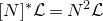 $[N]^*\mathcal{L}=N^2\mathcal{L}$
for a symmetric line bundle
$[N]^*\mathcal{L}=N^2\mathcal{L}$
for a symmetric line bundle $\mathcal{L}$
on an abelian scheme. Therefore, we have
$\mathcal{L}$
on an abelian scheme. Therefore, we have
 \[ \star_{\mathbb{Q}}: \mathrm{Hom}(\mathcal{A},\mathcal{B})_{\mathbb{Q}}\times \mathrm{Pic}_{0}(\mathcal{B}/S)_{\mathbb{R}} \rightarrow \mathrm{Pic}_{0}(\mathcal{A}/S)_{\mathbb{R}} \]
sending $(f,\mathcal{L})$
to
$(f,\mathcal{L})$
to $f^*\mathcal{L}$
.
$f^*\mathcal{L}$
.
Lemma 3.8. The mapping $\star_{\mathbb{Q}}$
is a
$\star_{\mathbb{Q}}$
is a $\mathbb{Q}$
-quadratic form on
$\mathbb{Q}$
-quadratic form on $\mathrm{Hom}(\mathcal{A},\mathcal{B})_{\mathbb{Q}}$
. Specifically, for any
$\mathrm{Hom}(\mathcal{A},\mathcal{B})_{\mathbb{Q}}$
. Specifically, for any $f_1,f_2\in \mathrm{Hom}(\mathcal{A},\mathcal{B})_{\mathbb{Q}}$
,
$f_1,f_2\in \mathrm{Hom}(\mathcal{A},\mathcal{B})_{\mathbb{Q}}$
, $\mathcal{L}\in \mathrm{Pic}_{0}(\mathcal{B}/S)_{\mathbb{R}}$
and
$\mathcal{L}\in \mathrm{Pic}_{0}(\mathcal{B}/S)_{\mathbb{R}}$
and $t\in \mathbb{Q}$
, it is:
$t\in \mathbb{Q}$
, it is:
-
(1) homogeneous, i.e.
$(t f_1)^*\mathcal{L}=t^2 f_1^*\mathcal{L}$
; and
-
(2) quadratic, i.e.
$(f_1+t f_2)^*\mathcal{L}$
is a quadratic polynomial in t with coefficients from
$\mathrm{Pic}_0(\mathcal{A}/S)$
.



Proof. It is clearly homogeneous of degree 2. We show by induction that
 \begin{equation} (f_1+n f_2)^*\mathcal{L}=(n^2-n)f_2^*\mathcal{L} + n(f_1+f_2)^*\mathcal{L} - (n-1)f_1^*\mathcal{L} \end{equation}
for any $n\in \mathbb{N}$
. It holds trivially for
$n\in \mathbb{N}$
. It holds trivially for $n=0,1$
. Assume it holds for n. By the theorem of the cube [Reference Faltings and ChaiFC90, Theorem I.1.3], there is linear equivalence:
$n=0,1$
. Assume it holds for n. By the theorem of the cube [Reference Faltings and ChaiFC90, Theorem I.1.3], there is linear equivalence:
 \[ (f_1+nf_2+f_2)^*\mathcal{L}= (f_1+nf_2)^*\mathcal{L} + (nf_2+f_2)^*\mathcal{L} + (f_1+f_2)^*\mathcal{L} - f_1^*\mathcal{L} - (nf_2)^*\mathcal{L} - f_2^*\mathcal{L}+ 0^*\mathcal{L}. \]
Note that $0^*\mathcal{L}=\pi^*e^*\mathcal{L}$
is trivial. Using the induction hypothesis and the symmetry of
$0^*\mathcal{L}=\pi^*e^*\mathcal{L}$
is trivial. Using the induction hypothesis and the symmetry of $\mathcal{L}$
, it is immediate to verify that
$\mathcal{L}$
, it is immediate to verify that
 \[ (f_1+(n+1)f_2)^*\mathcal{L}=(n^2+n)f_2^*\mathcal{L}+(n+1)(f_1+f_2)^*\mathcal{L}-nf_1^*\mathcal{L}. \]
Meanwhile, we have
 \[ (f_1-nf_2)^*\mathcal{L}=[(f_1+f_2)+(n+1)(-f_2)]^*\mathcal{L}=(n^2+n)f_2^*\mathcal{L}+(n+1)f_1^*\mathcal{L}-n(f_1+f_2)^*\mathcal{L}. \]
Thus, (3.2) holds for any $n\in \mathbb{Z}$
, or
$n\in \mathbb{Z}$
, or $n\in \mathbb{Q}$
by homogeneity.
$n\in \mathbb{Q}$
by homogeneity.
As a consequence, we have the following proposition.
Proposition 3.9. There is a unique map
 \begin{equation} \star: \mathrm{Hom}(\mathcal{A},\mathcal{B})_{\mathbb{R}}\times \mathrm{Pic}_{0}(\mathcal{B}/S)_{\mathbb{R}} \rightarrow \mathrm{Pic}_{0}(\mathcal{A}/S)_{\mathbb{R}}\end{equation}
sending $(f,\mathcal{L})$
to
$(f,\mathcal{L})$
to $f^*\mathcal{L}$
extending the pullback
$f^*\mathcal{L}$
extending the pullback $\star_{\mathbb{Q}}$
, which is a real quadratic form in the first input and linear in the second input. Moreover, if
$\star_{\mathbb{Q}}$
, which is a real quadratic form in the first input and linear in the second input. Moreover, if $\mathcal{L}\in \mathrm{Pic}_0(\mathcal{B}/S)_{\mathbb{R}}$
is nef, then
$\mathcal{L}\in \mathrm{Pic}_0(\mathcal{B}/S)_{\mathbb{R}}$
is nef, then $f^*\mathcal{L}$
is nef for any
$f^*\mathcal{L}$
is nef for any $f\in \mathrm{Hom}(\mathcal{A},\mathcal{B})_{\mathbb{R}}$
. In particular,
$f\in \mathrm{Hom}(\mathcal{A},\mathcal{B})_{\mathbb{R}}$
. In particular, $\star$
descends to
$\star$
descends to
 \begin{equation} \star:\mathrm{Hom}(\mathcal{A},\mathcal{B})_{\mathbb{R}}\times \mathrm{NS}(\mathcal{B}/S)_{\mathbb{R}}\rightarrow \mathrm{NS}(\mathcal{A}/S)_{\mathbb{R}}.\end{equation}
Proof. Let $\mathcal{L}\in \mathrm{Pic}_0(\mathcal{B}/S)_{\mathbb{R}}$
. Let
$\mathcal{L}\in \mathrm{Pic}_0(\mathcal{B}/S)_{\mathbb{R}}$
. Let $f_1,\ldots,f_r\in \mathrm{Hom}(\mathcal{A},\mathcal{B})_{\mathbb{Q}}$
and
$f_1,\ldots,f_r\in \mathrm{Hom}(\mathcal{A},\mathcal{B})_{\mathbb{Q}}$
and $n_1,\ldots,n_r\in \mathbb{Q}$
. We use induction on r to show that a quadratic form satisfies the following generalization of (3.2):
$n_1,\ldots,n_r\in \mathbb{Q}$
. We use induction on r to show that a quadratic form satisfies the following generalization of (3.2):
 \begin{equation} \bigg(\sum_{i=1}^r n_i f_i\bigg)^{\!\!*}\mathcal{L} =\frac{1}{2}\sum_{i,j=1}^r n_i n_j [(f_i+f_j)^*\mathcal{L}-f_i^*\mathcal{L}-f_j^*\mathcal{L}].\end{equation}
Indeed, the cases with $r=1,2$
follow from homogeneity and (3.2). Assuming (3.5) holds for r, to prove it for
$r=1,2$
follow from homogeneity and (3.2). Assuming (3.5) holds for r, to prove it for $(r+1)$
, it is easy to check that by (3.2) and homogeneity, we only need to show (3.5) for the situation where
$(r+1)$
, it is easy to check that by (3.2) and homogeneity, we only need to show (3.5) for the situation where $n_1=\cdots=n_{r+1}=1$
. By taking
$n_1=\cdots=n_{r+1}=1$
. By taking $n=-1$
in (3.2), we have the identity
$n=-1$
in (3.2), we have the identity
 \[(f_1+f_2)^*\mathcal{L}-f_1^*\mathcal{L}-f_2^*\mathcal{L}=-(f_1-f_2)^*\mathcal{L}+f_1^*\mathcal{L}+f_2^*\mathcal{L}. \]
Thus, the induction hypothesis gives
 \begin{align*} \bigg(\sum_{i=1}^{r+1} f_i\bigg)^{\!\!*}\mathcal{L}&=\bigg(\sum_{i=1}^{r} \bigg(f_i+\frac{1}{r}f_{r+1}\bigg)\bigg)^{\!\!*}\mathcal{L}\nonumber\\ &=\frac{1}{2}\sum_{i,j=1}^r \bigg[-(f_i-f_j)^{\!\!*}\mathcal{L}+\bigg(f_i+\frac{1}{r}f_{r+1}\bigg)^{\!\!*}\mathcal{L} +\bigg(f_j+\frac{1}{r}f_{r+1}\bigg)^{\!\!*}\mathcal{L}\bigg].\end{align*}
Finally, the desired equation follows by applying (3.2) several times to expand the terms above. This completes the induction.
Now, $\star$
can be uniquely defined by taking
$\star$
can be uniquely defined by taking $f_1,\ldots,f_r$
as a
$f_1,\ldots,f_r$
as a $\mathbb{Q}$
-basis of the finite-dimensional space
$\mathbb{Q}$
-basis of the finite-dimensional space $\mathrm{Hom}(\mathcal{A},\mathcal{B})_{\mathbb{Q}}$
and allowing
$\mathrm{Hom}(\mathcal{A},\mathcal{B})_{\mathbb{Q}}$
and allowing $n_i\in \mathbb{R}$
. One checks that (3.5) implies
$n_i\in \mathbb{R}$
. One checks that (3.5) implies $\star$
is a real quadratic form in the first input. The ‘moreover’ part follows from continuity, since
$\star$
is a real quadratic form in the first input. The ‘moreover’ part follows from continuity, since $f^*\mathcal{L}$
is nef for any
$f^*\mathcal{L}$
is nef for any $f\in \mathrm{Hom}(\mathcal{A},\mathcal{B})_{\mathbb{Q}}$
.
$f\in \mathrm{Hom}(\mathcal{A},\mathcal{B})_{\mathbb{Q}}$
.
4. Bi-algebraic geometry of
$\mathfrak{A}_g$

In this section, we present the framework of bi-algebraic geometry for the universal abelian variety and the associated functional transcendence result. The primary goal is to introduce the necessary notations for subsequent sections. For an elegant introduction to bi-algebraic geometry, we refer to the survey by Klingler, Ullmo, and Yafaev [Reference Klingler, Ullmo and YafaevKUY18]. For a detailed account of the Ax–Schanuel theorem in this context, we refer to Gao’s original paper [Reference GaoGao20b].
4.1 Universal abelian variety and its uniformization
Let $g,n\geq 1$
be integers. Let
$g,n\geq 1$
be integers. Let $D:=\mathrm{diag}(d_1,\ldots,d_g)$
denote a polarization type with positive integers
$D:=\mathrm{diag}(d_1,\ldots,d_g)$
denote a polarization type with positive integers $d_1|\cdots|d_g$
. Denote by
$d_1|\cdots|d_g$
. Denote by $\mathbb{A}_{g,D,n}$
the moduli space of complex abelian varieties of dimension g of polarization type D with level-n-structures, which admits a uniformization map from the Siegel upper half-space
$\mathbb{A}_{g,D,n}$
the moduli space of complex abelian varieties of dimension g of polarization type D with level-n-structures, which admits a uniformization map from the Siegel upper half-space
 \[\mathfrak{H}_g:=\{Z\in M_{g}(\mathbb{C}) \mid Z=Z^t, \mathrm{Im}(Z) \gt 0\}\]
denoted by $u_{g,D,n}:\mathfrak{H}_g\rightarrow \mathbb{A}_{g,D,n}$
. When
$u_{g,D,n}:\mathfrak{H}_g\rightarrow \mathbb{A}_{g,D,n}$
. When $n\geq 3$
, the moduli space
$n\geq 3$
, the moduli space $\mathbb{A}_{g,D,n}$
is a fine moduli space, that is, there exists a universal abelian variety
$\mathbb{A}_{g,D,n}$
is a fine moduli space, that is, there exists a universal abelian variety $\pi_{g,D,n}:\mathfrak{A}_{g,D,n}\rightarrow \mathbb{A}_{g,D,n}$
; see [Reference Mumford, Fogarty and KirwanMFK94, Theorem 7.9] and its remark. We note that
$\pi_{g,D,n}:\mathfrak{A}_{g,D,n}\rightarrow \mathbb{A}_{g,D,n}$
; see [Reference Mumford, Fogarty and KirwanMFK94, Theorem 7.9] and its remark. We note that $\mathfrak{A}_{g,D,n}$
and
$\mathfrak{A}_{g,D,n}$
and $\mathbb{A}_{g,D,n}$
are defined over
$\mathbb{A}_{g,D,n}$
are defined over $\mathbb{Q}^{\mathrm{alg}}$
.
$\mathbb{Q}^{\mathrm{alg}}$
.
The fiber product in the category of complex analytic varieties gives the following diagram.

The fiber of $\mathcal{A}_{\mathfrak{H}_g}$
over
$\mathcal{A}_{\mathfrak{H}_g}$
over $Z\in \mathfrak{H}_g$
is the complex abelian variety
$Z\in \mathfrak{H}_g$
is the complex abelian variety $\mathbb{C}^g/(D\mathbb{Z}^g+Z\mathbb{Z}^g)$
with the obvious polarization and level structure. There is a natural uniformization of
$\mathbb{C}^g/(D\mathbb{Z}^g+Z\mathbb{Z}^g)$
with the obvious polarization and level structure. There is a natural uniformization of $\mathcal{A}_{\mathfrak{H}_g}$
given by
$\mathcal{A}_{\mathfrak{H}_g}$
given by $\mathbb{C}^g\times\mathfrak{H}_g \rightarrow \mathcal{A}_{\mathfrak{H}_g}$
, such that, over
$\mathbb{C}^g\times\mathfrak{H}_g \rightarrow \mathcal{A}_{\mathfrak{H}_g}$
, such that, over $Z\in \mathfrak{H}_g$
, the map reduces to
$Z\in \mathfrak{H}_g$
, the map reduces to $\exp:\mathbb{C}^g\rightarrow \mathbb{C}^g/(D\mathbb{Z}^g+Z\mathbb{Z}^g)$
. The composed map
$\exp:\mathbb{C}^g\rightarrow \mathbb{C}^g/(D\mathbb{Z}^g+Z\mathbb{Z}^g)$
. The composed map
 \[u_{g,D,n,a}:\mathbb{C}^g\times \mathfrak{H}_g\rightarrow \mathcal{A}_{\mathfrak{H}_g}\rightarrow \mathfrak{A}_{g,D,n}\]
is a uniformization of the universal abelian variety.
The polarization and level structure are not central to our discussion, as our primary focus is on dimension theory, which is stable under finite coverings. While some flexibility in polarization is needed to handle abelian subschemes or quotients, the specific choice of polarization is not crucial. Therefore, for the rest of this paper, we fix $n=n_0\geq 3$
and omit the indices of polarization and level structure from the notation.
$n=n_0\geq 3$
and omit the indices of polarization and level structure from the notation.
The uniformization maps $u_g$
and
$u_g$
and $u_{g,a}$
are complex analytic and transcendental. However, the targets have natural algebraic structures, as do the sources, which we now describe. For
$u_{g,a}$
are complex analytic and transcendental. However, the targets have natural algebraic structures, as do the sources, which we now describe. For $\mathfrak{H}_g$
, the embedding
$\mathfrak{H}_g$
, the embedding
 \[\mathfrak{H}_g\hookrightarrow \{Z\in M_g(\mathbb{C}) \mid Z=Z^t\}\cong \mathbb{C}^{g(g+1)/2}\]
realizes $\mathfrak{H}_g$
as an unbounded semi-algebraic subset of the algebraic variety
$\mathfrak{H}_g$
as an unbounded semi-algebraic subset of the algebraic variety $\mathbb{C}^{g(g+1)/2}$
. A closed analytic subset
$\mathbb{C}^{g(g+1)/2}$
. A closed analytic subset $Y\subseteq \mathfrak{H}_g$
is said to be irreducible algebraic if Y is a component of the intersection of an algebraic subvariety of
$Y\subseteq \mathfrak{H}_g$
is said to be irreducible algebraic if Y is a component of the intersection of an algebraic subvariety of $\mathbb{C}^{g(g+1)/2}$
with
$\mathbb{C}^{g(g+1)/2}$
with $\mathfrak{H}_g$
. Similarly, we define the algebraic structure on
$\mathfrak{H}_g$
. Similarly, we define the algebraic structure on $\mathbb{C}^g\times \mathfrak{H}_g$
by inheriting algebraic structure from
$\mathbb{C}^g\times \mathfrak{H}_g$
by inheriting algebraic structure from $\mathbb{C}^{g}\times \mathbb{C}^{g(g+1)/2}$
. One goal of bi-algebraic geometry is to understand the interplay between the two algebraic structures of the source and the target for such uniformization maps. The closed analytic subsets that are algebraic both on the source and the target, are of particular importance.
$\mathbb{C}^{g}\times \mathbb{C}^{g(g+1)/2}$
. One goal of bi-algebraic geometry is to understand the interplay between the two algebraic structures of the source and the target for such uniformization maps. The closed analytic subsets that are algebraic both on the source and the target, are of particular importance.
Definition 4.1. A closed analytic subset $U\subseteq \mathfrak{H}_g$
(respectively,
$U\subseteq \mathfrak{H}_g$
(respectively, $\mathcal{U}\subseteq \mathbb{C}^g\times \mathfrak{H}_g$
) is called bi-algebraic if U (respectively,
$\mathcal{U}\subseteq \mathbb{C}^g\times \mathfrak{H}_g$
) is called bi-algebraic if U (respectively, $\mathcal{U}$
) is irreducible algebraic and
$\mathcal{U}$
) is irreducible algebraic and $u_g(U)$
(respectively,
$u_g(U)$
(respectively, $u_{g,a}(\mathcal{U})$
) is algebraic. In this case, we also say
$u_{g,a}(\mathcal{U})$
) is algebraic. In this case, we also say $u_g(U)\subseteq \mathbb{A}_g$
(respectively,
$u_g(U)\subseteq \mathbb{A}_g$
(respectively, $u_{g,a}(\mathcal{U})\subseteq\mathfrak{A}_g$
) is bi-algebraic.
$u_{g,a}(\mathcal{U})\subseteq\mathfrak{A}_g$
) is bi-algebraic.
4.2 Weakly special subvarieties
Let $\pi:\mathcal{A}\rightarrow S$
be an abelian scheme over a normal complex algebraic variety S. We also assume
$\pi:\mathcal{A}\rightarrow S$
be an abelian scheme over a normal complex algebraic variety S. We also assume $\mathcal{A}$
has a level-
$\mathcal{A}$
has a level- $n_0$
-structure and, hence, (3.1). Since
$n_0$
-structure and, hence, (3.1). Since $\mathbb{C}(S)/\mathbb{C}$
is a primary extension, the trace
$\mathbb{C}(S)/\mathbb{C}$
is a primary extension, the trace $(\mathrm{tr}_{\mathbb{C}(S)/\mathbb{C}}(\mathcal{A}_\eta),\tau)$
exists and constant multi-sections as defined in Definition 3.4 make sense.
$(\mathrm{tr}_{\mathbb{C}(S)/\mathbb{C}}(\mathcal{A}_\eta),\tau)$
exists and constant multi-sections as defined in Definition 3.4 make sense.
Definition 4.2. Let $\mathcal{Y}\subseteq \mathcal{A}$
be a subvariety.
$\mathcal{Y}\subseteq \mathcal{A}$
be a subvariety.
-
(1) We say
$\mathcal{Y}$
is generically weakly special (respectively, generically special) if
$\mathcal{Y}=\mathcal{B}+\sigma$
where
$\mathcal{B}\subseteq\mathcal{A}$
is an abelian subscheme and
$\sigma$
is a constant (respectively, torsion) multi-section. -
(2) We say
$\mathcal{Y}$
is weakly special (respectively, special), if
$\mathcal{Y}$
is generically weakly special (respectively, generically special) as a subvariety of the abelian scheme
$\mathcal{A}_{\pi(\mathcal{Y})}$
.


Our definition of weakly special subvarieties differs slightly from the definition of weakly special subvarieties in the context of mixed Shimura varieties by Pink, but is in conformity with Klingler’s convention [Reference KlinglerKli17] in the context of variation of mixed Hodge structures; see Proposition 4.7. Note that generically weakly special subvariety is called ‘generically special subvariety of sg type’ in Gao [Reference GaoGao20a, Definition 1.5].
Lemma 4.3. Let $\varphi:\mathcal{A}'\rightarrow \mathcal{A}$
be a base change corresponding to
$\varphi:\mathcal{A}'\rightarrow \mathcal{A}$
be a base change corresponding to $S'\rightarrow S$
. We have the following.
$S'\rightarrow S$
. We have the following.
-
(1) If
$\mathcal{Y}'$
is weakly special in
$\mathcal{A}'$
, then
$\varphi(\mathcal{Y}')$
is weakly special in
$\mathcal{A}$
. -
(2) If
$\mathcal{Y}$
is weakly special in
$\mathcal{A}$
, then any irreducible component of
$\varphi^{-1}(\mathcal{Y})$
is weakly special in
$\mathcal{A}'$
.


Proof. Part (2) is clear by definition. We prove part (1). Suppose, without loss of generality, that $S'\rightarrow S$
is dominant and
$S'\rightarrow S$
is dominant and $\mathcal{Y}'=\mathcal{B}'+\sigma'$
is generically weakly special in
$\mathcal{Y}'=\mathcal{B}'+\sigma'$
is generically weakly special in $\mathcal{A}'$
. Let A,A’,B’,Y’ be the respective generic fibers of
$\mathcal{A}'$
. Let A,A’,B’,Y’ be the respective generic fibers of $\mathcal{A},\mathcal{A}',\mathcal{B}',\mathcal{Y}'$
. By Chow’s theorem [Reference ConradCon06, Corollary 3.21], the abelian subvariety
$\mathcal{A},\mathcal{A}',\mathcal{B}',\mathcal{Y}'$
. By Chow’s theorem [Reference ConradCon06, Corollary 3.21], the abelian subvariety $B'\times_{\mathbb{C}(S)}\mathbb{C}(S)^{\mathrm{alg}}$
is the base change of an abelian subvariety
$B'\times_{\mathbb{C}(S)}\mathbb{C}(S)^{\mathrm{alg}}$
is the base change of an abelian subvariety $B_1\subseteq A_{\mathbb{C}(S)^{\mathrm{alg}}}$
. By assumption (3.1),
$B_1\subseteq A_{\mathbb{C}(S)^{\mathrm{alg}}}$
. By assumption (3.1), $B_1=B_{\mathbb{C}(S)^{\mathrm{alg}}}$
for some abelian variety
$B_1=B_{\mathbb{C}(S)^{\mathrm{alg}}}$
for some abelian variety $B\subseteq A$
. Let
$B\subseteq A$
. Let $\mathcal{B}$
be the abelian subscheme of
$\mathcal{B}$
be the abelian subscheme of $\mathcal{A}$
with generic fiber B. By a similar argument, the fixed part of A’ is mapped to the fixed part of A, and the constant generic point of
$\mathcal{A}$
with generic fiber B. By a similar argument, the fixed part of A’ is mapped to the fixed part of A, and the constant generic point of $\sigma'$
is mapped to a constant generic point, which gives a constant multi-section
$\sigma'$
is mapped to a constant generic point, which gives a constant multi-section $\sigma$
. Then
$\sigma$
. Then $\varphi(\mathcal{Y}')=\mathcal{B}+\sigma$
is weakly special.
$\varphi(\mathcal{Y}')=\mathcal{B}+\sigma$
is weakly special.
Before proceeding, let us introduce the following terminology to avoid mentioning the specific choice of polarization and level structure.
Definition 4.4. Let $g=\dim(\mathcal{A}/S)$
. A moduli sieve (or mixed period map) for
$g=\dim(\mathcal{A}/S)$
. A moduli sieve (or mixed period map) for $\mathcal{A}/S$
is a morphism
$\mathcal{A}/S$
is a morphism $\mathcal{A}\rightarrow \mathfrak{A}_g=\mathfrak{A}_{g,D,n_0}$
induced from the period map
$\mathcal{A}\rightarrow \mathfrak{A}_g=\mathfrak{A}_{g,D,n_0}$
induced from the period map $S\rightarrow \mathbb{A}_{g,D,n_0}$
.
$S\rightarrow \mathbb{A}_{g,D,n_0}$
.
The following lemma describes weakly special subvarieties as those that can be contracted by quotients followed by moduli sieves.
Lemma 4.5. Assume $\mathcal{A}/S$
has a level-
$\mathcal{A}/S$
has a level- $n_0$
-structure.
$n_0$
-structure.
-
(1) Let
$\mathcal{B}\subseteq \mathcal{A}$
be an abelian subscheme with
$\dim(\mathcal{B}/S)=g'$
. Let
$\mathcal{A}/\mathcal{B}\rightarrow \mathfrak{A}_{g-g'}$
be a moduli sieve of the quotient abelian scheme. Then an irreducible component
$\mathcal{Y}$
of any fiber of the composition
$\mathcal{A}\rightarrow \mathcal{A}/\mathcal{B}\rightarrow \mathfrak{A}_{g-g'}$
is weakly special of relative dimension g’.
-
(2) Conversely, if
$\mathcal{Y}\subseteq\mathcal{A}$
is a weakly special subvariety, then there exist abelian subschemes
$\mathcal{B}_1\subseteq \mathcal{A}_1\subseteq\mathcal{A}|_{\pi(\mathcal{Y})}$
together with a positive integer N, such that
$[N]\mathcal{Y}\subseteq\mathcal{A}_1$
and
$[N]\mathcal{Y}$
is an irreducible component of a fiber of the composition
$\mathcal{A}_1\rightarrow \mathcal{A}_1/\mathcal{B}_1\rightarrow \mathfrak{A}_{g_1-g_1'}$
, where
$g_1,g_1'$
are the relative dimensions of
$\mathcal{A}_1,\mathcal{B}_1$
, respectively, and
$\mathcal{A}_1/\mathcal{B}_1\rightarrow \mathfrak{A}_{g_1-g_1'}$
is a moduli sieve.













Proof. Indeed, we have the following diagram.

Note that for any $t\in \iota(S)$
, an irreducible component T of
$t\in \iota(S)$
, an irreducible component T of $\iota^{-1}(t)\subseteq S$
gives rise to an isotrivial abelian scheme
$\iota^{-1}(t)\subseteq S$
gives rise to an isotrivial abelian scheme $\mathcal{A}/\mathcal{B}\times_S T\rightarrow T$
. Suppose
$\mathcal{A}/\mathcal{B}\times_S T\rightarrow T$
. Suppose $x\in \mathfrak{A}_{g-g'}$
is a point over t. Then
$x\in \mathfrak{A}_{g-g'}$
is a point over t. Then $\iota_a^{-1}(x)|_T$
is a constant section of the above isotrivial abelian scheme. By Poincaré’s complete reducibility § 3.3, there exists a homomorphism
$\iota_a^{-1}(x)|_T$
is a constant section of the above isotrivial abelian scheme. By Poincaré’s complete reducibility § 3.3, there exists a homomorphism $\varphi:\mathcal{A}/\mathcal{B}\rightarrow \mathcal{A}$
such that
$\varphi:\mathcal{A}/\mathcal{B}\rightarrow \mathcal{A}$
such that $q\varphi$
is an isogeny. Then
$q\varphi$
is an isogeny. Then $q^{-1}(\iota_a^{-1}(x)|_T)$
is the translate of
$q^{-1}(\iota_a^{-1}(x)|_T)$
is the translate of $\mathcal{B}\times_S T$
by the constant section
$\mathcal{B}\times_S T$
by the constant section $\varphi(\iota_a^{-1}(x)|_T)$
. Therefore, any irreducible component of
$\varphi(\iota_a^{-1}(x)|_T)$
. Therefore, any irreducible component of $q^{-1}(\iota_a^{-1}(x)|_T)$
, which is also an irreducible component of
$q^{-1}(\iota_a^{-1}(x)|_T)$
, which is also an irreducible component of $(\iota_a\circ q)^{-1}(x)$
, is weakly special. We stress that it is, in general, not generically weakly special.
$(\iota_a\circ q)^{-1}(x)$
, is weakly special. We stress that it is, in general, not generically weakly special.
Conversely, if $\mathcal{Y}\subseteq\mathcal{A}$
is weakly special, by definition, there exists a positive integer N such that
$\mathcal{Y}\subseteq\mathcal{A}$
is weakly special, by definition, there exists a positive integer N such that $[N]\mathcal{Y}$
is a translate of an abelian subscheme
$[N]\mathcal{Y}$
is a translate of an abelian subscheme $\mathcal{B}_1\subseteq \mathcal{A}|_{\pi(\mathcal{Y})}$
by a constant section
$\mathcal{B}_1\subseteq \mathcal{A}|_{\pi(\mathcal{Y})}$
by a constant section $\sigma_c$
. Let
$\sigma_c$
. Let $\mathcal{A}_1$
be the abelian scheme which is the sum of
$\mathcal{A}_1$
be the abelian scheme which is the sum of $\mathcal{B}_1$
and the constant abelian subscheme in
$\mathcal{B}_1$
and the constant abelian subscheme in $\mathcal{A}|_{\pi(\mathcal{Y})}$
generated by
$\mathcal{A}|_{\pi(\mathcal{Y})}$
generated by $\sigma_c$
. Then it is clear that
$\sigma_c$
. Then it is clear that $\mathcal{A}_1,\mathcal{B}_1,N$
satisfy the requirement.
$\mathcal{A}_1,\mathcal{B}_1,N$
satisfy the requirement.
4.3 Characterization and the Ax–Schanuel theorem
First, we note that an arbitrary intersection of algebraic subvarieties is algebraic. It follows formally that any intersection of bi-algebraic subvarieties is bi-algebraic.
Definition 4.6. Suppose $\mathcal{U}\subseteq \mathbb{C}^g\times \mathfrak{H}_g$
(respectively,
$\mathcal{U}\subseteq \mathbb{C}^g\times \mathfrak{H}_g$
(respectively, $\mathcal{Y}\subseteq \mathfrak{A}_g$
) is a closed analytic irreducible subset.
$\mathcal{Y}\subseteq \mathfrak{A}_g$
) is a closed analytic irreducible subset.
-
(1) The Zariski closure
$\mathcal{U}^{\mathrm{Zar}}\subseteq \mathbb{C}^g\times \mathfrak{H}_g$
(respectively,
$\mathcal{Y}^{\mathrm{Zar}}\subseteq \mathfrak{A}_g$
) is defined to be the smallest algebraic subvariety containing
$\mathcal{U}$
(respectively,
$\mathcal{Y}$
). -
(2) The bi-algebraic closure
$\mathcal{U}^{\mathrm{biZar}}\subseteq \mathbb{C}^g\times \mathfrak{H}_g$
(respectively,
$\mathcal{Y}^{\mathrm{biZar}}\subseteq \mathfrak{A}_g$
) is defined to be the smallest bi-algebraic subvariety containing
$\mathcal{U}$
(respectively,
$\mathcal{Y}$
).






The relevant bi-algebraic subvarieties for $u_g$
(respectively,
$u_g$
(respectively, $u_{g,a}$
) are characterized in [Reference Ullmo and YafaevUY11] (respectively, [Reference GaoGao17a, Reference GaoGao17b]). We have the following characterization of the bi-algebraic subvarieties by Gao in terms of the weakly special subvarieties.
$u_{g,a}$
) are characterized in [Reference Ullmo and YafaevUY11] (respectively, [Reference GaoGao17a, Reference GaoGao17b]). We have the following characterization of the bi-algebraic subvarieties by Gao in terms of the weakly special subvarieties.
Proposition 4.7. The bi-algebraic subvarieties of $\mathfrak{A}_g$
are exactly those weakly special subvarieties of
$\mathfrak{A}_g$
are exactly those weakly special subvarieties of $\mathfrak{A}_g/\mathbb{A}_g$
which dominate bi-algebraic subvarieties of
$\mathfrak{A}_g/\mathbb{A}_g$
which dominate bi-algebraic subvarieties of $\mathbb{A}_g$
. Moreover, if
$\mathbb{A}_g$
. Moreover, if $S\subseteq\mathbb{A}_g$
and
$S\subseteq\mathbb{A}_g$
and $\mathcal{A}=\mathfrak{A}_{g,S}:=\mathfrak{A}_g|_S$
, then the weakly special subvarieties of
$\mathcal{A}=\mathfrak{A}_{g,S}:=\mathfrak{A}_g|_S$
, then the weakly special subvarieties of $\mathcal{A}/S$
come from restriction of bi-algebraic subvarieties, i.e.
$\mathcal{A}/S$
come from restriction of bi-algebraic subvarieties, i.e.
 \[ \{\mathcal{Y}\subseteq\mathcal{A}\mid \mathcal{Y} \text{ is weakly special}\}=\{\mathcal{Y}\subseteq\mathcal{A}\mid \mathcal{Y} \text{ is an irreducible component of }\mathcal{Y}^{\mathrm{biZar}}\cap\mathcal{A}\}. \]
Proof. The first statement follows from [Reference GaoGao17a, Proposition 1.1]. Note that a weakly special subvariety has a different meaning in [Reference GaoGao17a, Proposition 1.1] and is equivalent to a bi-algebraic subvariety by [Reference GaoGao17b, Corollary 8.3]. The second is [Reference GaoGao17a, Proposition 3.3].
One of the most powerful tools in studying bi-algebraic geometry is a functional transcendence result called the Ax–Schanuel theorem. Here, we recall a weak version [Reference GaoGao20b, Theorem 3.5] of the Ax–Schanuel theorem in the context of the universal abelian variety, which is sufficient for our purpose.
Theorem 4.8. Let $u_{g,a}:\mathbb{C}^g\times \mathfrak{H}_g\rightarrow \mathfrak{A}_g$
be the uniformization map, and let
$u_{g,a}:\mathbb{C}^g\times \mathfrak{H}_g\rightarrow \mathfrak{A}_g$
be the uniformization map, and let $\mathcal{U}\subseteq \mathbb{C}^g\times\mathfrak{H}_g$
be a closed analytic irreducible subset. Then
$\mathcal{U}\subseteq \mathbb{C}^g\times\mathfrak{H}_g$
be a closed analytic irreducible subset. Then
 \[ \dim \mathcal{U}^{\mathrm{Zar}} -\dim \mathcal{U} \geq \dim u_{g,a}(\mathcal{U})^{\mathrm{biZar}}-\dim u_{g,a}(\mathcal{U})^\mathrm{Zar}. \]
Since $\pi_g(u_{g,a}(\mathcal{U})^{\mathrm{biZar}})$
contains
$\pi_g(u_{g,a}(\mathcal{U})^{\mathrm{biZar}})$
contains $u_g(p(\mathcal{U}^{\mathrm{Zar}}))$
, where
$u_g(p(\mathcal{U}^{\mathrm{Zar}}))$
, where $p:\mathbb{C}^g\times\mathfrak{H}_g\rightarrow \mathfrak{H}_g$
is the projection, we immediately have the following consequence.
$p:\mathbb{C}^g\times\mathfrak{H}_g\rightarrow \mathfrak{H}_g$
is the projection, we immediately have the following consequence.
Corollary 4.9. Let $u_{g,a}:\mathbb{C}^g\times \mathfrak{H}_g\rightarrow \mathfrak{A}_g$
be the uniformization map, and let
$u_{g,a}:\mathbb{C}^g\times \mathfrak{H}_g\rightarrow \mathfrak{A}_g$
be the uniformization map, and let $\mathcal{U}\subseteq \mathbb{C}^g\times\mathfrak{H}_g$
be a closed analytic irreducible subset. Then
$\mathcal{U}\subseteq \mathbb{C}^g\times\mathfrak{H}_g$
be a closed analytic irreducible subset. Then
 \[ \mathrm{rel. dim} \mathcal{U}^{\mathrm{Zar}} -\dim \mathcal{U} \geq \mathrm{rel. dim} u_{g,a}(\mathcal{U})^{\mathrm{biZar}}-\dim u_{g,a}(\mathcal{U})^\mathrm{Zar}. \]
4.4 Finiteness à la Bogomolov–Ullmo
The weakly defect of a locally closed subvariety $\mathcal{Y}\subseteq \mathfrak{A}_g$
is defined as
$\mathcal{Y}\subseteq \mathfrak{A}_g$
is defined as
 \[\delta_{ws}(\mathcal{Y}):=\dim \mathcal{Y}^{\mathrm{biZar}} -\dim \mathcal{Y}. \]
Let $\mathcal{X}\subseteq\mathfrak{A}_g$
be a locally closed subvariety. A subvariety
$\mathcal{X}\subseteq\mathfrak{A}_g$
be a locally closed subvariety. A subvariety $\mathcal{Y}\subseteq\mathcal{X}$
is called weakly optimal in
$\mathcal{Y}\subseteq\mathcal{X}$
is called weakly optimal in $\mathcal{X}$
if, for any subvariety
$\mathcal{X}$
if, for any subvariety $\mathcal{Y}'\subseteq\mathcal{X}$
strictly containing
$\mathcal{Y}'\subseteq\mathcal{X}$
strictly containing $\mathcal{Y}$
, one has
$\mathcal{Y}$
, one has $\delta_{ws}(\mathcal{Y}')\gt \delta_{ws}(\mathcal{Y})$
.
$\delta_{ws}(\mathcal{Y}')\gt \delta_{ws}(\mathcal{Y})$
.
Later we need the following finiteness à la Bogomolov–UllmoFootnote 3 result of Gao for weakly optimal subvarieties, which is itself an application of Ax–Schanuel, reformulated into our language as follows.
Theorem 4.10. Suppose $\mathcal{X}\subseteq\mathfrak{A}_g$
is a locally closed subvariety. There exists a finite set
$\mathcal{X}\subseteq\mathfrak{A}_g$
is a locally closed subvariety. There exists a finite set $\Sigma=\Sigma(\mathcal{X})$
of triples
$\Sigma=\Sigma(\mathcal{X})$
of triples $(\mathcal{A}_1,\mathcal{B}_1,N)$
with abelian schemes
$(\mathcal{A}_1,\mathcal{B}_1,N)$
with abelian schemes $\mathcal{B}_1\subseteq\mathcal{A}_1\subseteq\mathfrak{A}_g|_{\pi(\mathcal{A}_1)}$
and a positive integer N with the following property.
$\mathcal{B}_1\subseteq\mathcal{A}_1\subseteq\mathfrak{A}_g|_{\pi(\mathcal{A}_1)}$
and a positive integer N with the following property.
For any weakly optimal subvariety $\mathcal{Z}$
of
$\mathcal{Z}$
of $\mathcal{X}$
, there is a triple
$\mathcal{X}$
, there is a triple $(\mathcal{A}_1,\mathcal{B}_1,N)\in \Sigma(\mathcal{X})$
such that
$(\mathcal{A}_1,\mathcal{B}_1,N)\in \Sigma(\mathcal{X})$
such that $[N]\mathcal{Z}\subseteq\mathcal{A}_1$
and
$[N]\mathcal{Z}\subseteq\mathcal{A}_1$
and $([N]\mathcal{Z})^{\mathrm{biZar}}$
is an irreducible component of a fiber of the composition
$([N]\mathcal{Z})^{\mathrm{biZar}}$
is an irreducible component of a fiber of the composition
 \[ \mathcal{A}_1\rightarrow \mathcal{A}_1/\mathcal{B}_1\rightarrow \mathfrak{A}_{g_1-g_1'}, \]
where the first map is the quotient map and the second is a moduli sieve with $g_1,g_1'$
being the relative dimensions of
$g_1,g_1'$
being the relative dimensions of $\mathcal{A}_1,\mathcal{B}_1$
.Footnote
4
$\mathcal{A}_1,\mathcal{B}_1$
.Footnote
4
Proof. The result [Reference GaoGao20b, Theorem 1.4] (or [Reference GaoGao21, Theorem 3.2.4]) claims that there are finitely many pairs
 \[ ((Q,\mathcal{Y}^+),H)\in \Sigma'=\Sigma'(\mathcal{X}), \]
where $(Q,\mathcal{Y}^+)$
is a connected mixed Shimura subdatum and H is a normal subgroup of Q with semi-simple reductive part, such that the bi-algebraic closure of any weakly optimal subvariety
$(Q,\mathcal{Y}^+)$
is a connected mixed Shimura subdatum and H is a normal subgroup of Q with semi-simple reductive part, such that the bi-algebraic closure of any weakly optimal subvariety $\mathcal{Z}$
is equal to
$\mathcal{Z}$
is equal to $u_{g,a}(H(\mathbb{R})^+\tilde y)$
for one of the triples with some
$u_{g,a}(H(\mathbb{R})^+\tilde y)$
for one of the triples with some $\tilde y\in \mathcal{Y}^+$
. By [Reference GaoGao20a, Proposition 5.6], a connected mixed Shimura subdatum
$\tilde y\in \mathcal{Y}^+$
. By [Reference GaoGao20a, Proposition 5.6], a connected mixed Shimura subdatum $(Q,\mathcal{Y}^+)$
corresponds to a torsion translate of an abelian subscheme
$(Q,\mathcal{Y}^+)$
corresponds to a torsion translate of an abelian subscheme $\mathcal{A}_1$
over a special subvariety of
$\mathcal{A}_1$
over a special subvariety of $\mathbb{A}_g$
. Let
$\mathbb{A}_g$
. Let $N\in \mathbb{N}$
be an integer that kills the torsion. By § 5.4 of [Reference GaoGao20a], H gives rise to an abelian subscheme
$N\in \mathbb{N}$
be an integer that kills the torsion. By § 5.4 of [Reference GaoGao20a], H gives rise to an abelian subscheme $\mathcal{B}_1\subseteq\mathcal{A}_1$
such that the quotient of
$\mathcal{B}_1\subseteq\mathcal{A}_1$
such that the quotient of $(Q,\mathcal{Y}^+)$
by H corresponds to a moduli sieve of the quotient
$(Q,\mathcal{Y}^+)$
by H corresponds to a moduli sieve of the quotient $\mathcal{A}_1/\mathcal{B}_1$
. The fact that
$\mathcal{A}_1/\mathcal{B}_1$
. The fact that $\mathcal{Z}^{\mathrm{biZar}}=u_{g,a}(H(\mathbb{R})^+\tilde y)$
means that
$\mathcal{Z}^{\mathrm{biZar}}=u_{g,a}(H(\mathbb{R})^+\tilde y)$
means that $([N]\mathcal{Z})^{\mathrm{biZar}}$
is an irreducible component of a fiber of
$([N]\mathcal{Z})^{\mathrm{biZar}}$
is an irreducible component of a fiber of $\mathcal{A}_1\rightarrow \mathcal{A}_1/\mathcal{B}_1\rightarrow \mathfrak{A}_{g_1-g_1'}$
. Thus, we are done.
$\mathcal{A}_1\rightarrow \mathcal{A}_1/\mathcal{B}_1\rightarrow \mathfrak{A}_{g_1-g_1'}$
. Thus, we are done.
5. Betti foliation and Betti form
In this section, we define the notions of Betti foliation and Betti forms, and establish basic relations between them. A good supplement to our exposition is [Reference Cantat, Gao, Habegger and XieCGH+21, 2]. Here, S is a smooth complex quasi-projective variety viewed as a complex manifold, and $\pi:\mathcal{A}\rightarrow S$
is an abelian scheme.
$\pi:\mathcal{A}\rightarrow S$
is an abelian scheme.
5.1 Betti map and Betti foliation
Let $ \Delta\subseteq S$
be a simply connected analytic open neighborhood of
$ \Delta\subseteq S$
be a simply connected analytic open neighborhood of $s\in S$
. The local system
$s\in S$
. The local system $\mathbb{V}_{\mathbb{Z}}:=(R^1\pi_*\mathbb{Z})^\vee$
is trivial on
$\mathbb{V}_{\mathbb{Z}}:=(R^1\pi_*\mathbb{Z})^\vee$
is trivial on $\Delta$
and there are trivializations
$\Delta$
and there are trivializations $\mathbb{V}_{\mathbb{Z},\Delta}\cong \mathbb{Z}^{2g}\times \Delta$
, and
$\mathbb{V}_{\mathbb{Z},\Delta}\cong \mathbb{Z}^{2g}\times \Delta$
, and $\mathcal{V}_{\Delta}\cong \mathbb{C}^{2g}\times \Delta$
as holomorphic vector bundles. Denote the induced Hodge filtration on
$\mathcal{V}_{\Delta}\cong \mathbb{C}^{2g}\times \Delta$
as holomorphic vector bundles. Denote the induced Hodge filtration on $\mathbb{C}^{2g}\times \Delta$
by
$\mathbb{C}^{2g}\times \Delta$
by $\mathcal{F}^{\prime \bullet}$
. The composition map
$\mathcal{F}^{\prime \bullet}$
. The composition map
 \[ \mathbb{R}^{2g}\times \Delta\rightarrow \mathbb{C}^{2g}\times \Delta\rightarrow \mathbb{C}^{2g}\times \Delta/\mathcal{F}^{\prime 0} \]
is a real analytic diffeomorphism which restricts to a group isomorphism over any $s\in \Delta$
. Taking the quotient by
$s\in \Delta$
. Taking the quotient by $\mathbb{Z}^{2g}\times \Delta$
, it induces a real analytic diffeomorphism
$\mathbb{Z}^{2g}\times \Delta$
, it induces a real analytic diffeomorphism
 \begin{equation} \mathbb{T}^{2g}\times \Delta\cong \mathcal{A}_\Delta, \end{equation}
which restricts to a real Lie group isomorphism of tori $\mathbb{T}^{2g}\cong\mathcal{A}_s$
for any
$\mathbb{T}^{2g}\cong\mathcal{A}_s$
for any $s\in \Delta$
. The composition of its inverse with the projection
$s\in \Delta$
. The composition of its inverse with the projection
 \[ \beta_\Delta:\mathcal{A}_\Delta\cong \mathbb{T}^{2g}\times \Delta \rightarrow \mathbb{T}^{2g} \]
is called a Betti map associated to the data $(\mathcal{A}/S,\Delta)$
. The Betti map
$(\mathcal{A}/S,\Delta)$
. The Betti map $\beta_\Delta$
is uniquely determined up to an action of
$\beta_\Delta$
is uniquely determined up to an action of $\mathrm{GL}_{2g}(\mathbb{Z})$
on the target. To further remove the ambiguity, we can use the isomorphism
$\mathrm{GL}_{2g}(\mathbb{Z})$
on the target. To further remove the ambiguity, we can use the isomorphism $\beta_\Delta|_{\mathcal{A}_{s}}:\mathcal{A}_s\rightarrow \mathbb{T}^{2g}$
to define the composition
$\beta_\Delta|_{\mathcal{A}_{s}}:\mathcal{A}_s\rightarrow \mathbb{T}^{2g}$
to define the composition
 \[ \beta_{\Delta,s}:\mathcal{A}_\Delta\xrightarrow{\beta_\Delta} \mathbb{T}^{2g}\xrightarrow {(\beta_{\Delta}|_{\mathcal{A}_s})^{-1}} \mathcal{A}_s \]
which is called the Betti map associated to the data $(\mathcal{A}/S,\Delta,s)$
.
$(\mathcal{A}/S,\Delta,s)$
.
The Betti map is real analytic but, in general, not holomorphic. On the other hand, any fiber of $\beta_\Delta$
, being the image of
$\beta_\Delta$
, being the image of
 \[ \{c\}\times \Delta\subseteq \mathbb{C}^{2g}\times \Delta\rightarrow (\mathbb{Z}^{2g}\times \Delta)\backslash(\mathbb{C}^{2g}\times \Delta)/\mathcal{F}'^0 \]
for some $c\in \mathbb{C}^{2g}$
, is complex analytic, and gives rise to a local complex analytic foliation on
$c\in \mathbb{C}^{2g}$
, is complex analytic, and gives rise to a local complex analytic foliation on $\mathcal{A}_\Delta$
. These local foliations patch together to a global foliation
$\mathcal{A}_\Delta$
. These local foliations patch together to a global foliation $\mathcal{F}_{\text{Betti}}$
on
$\mathcal{F}_{\text{Betti}}$
on $\mathcal{A}$
, which is called the Betti foliation. A Betti leaf is a path-connected piece of the Betti foliation, and a path-connected component in the Betti foliation is called a maximal Betti leaf. We denote the maximal Betti leaf passing through x by
$\mathcal{A}$
, which is called the Betti foliation. A Betti leaf is a path-connected piece of the Betti foliation, and a path-connected component in the Betti foliation is called a maximal Betti leaf. We denote the maximal Betti leaf passing through x by $\mathcal{F}_{\text{Betti},x}$
. For instance, a constant multi-section is a finite union of maximal Betti leaves. In general, a Betti leaf can be dense in
$\mathcal{F}_{\text{Betti},x}$
. For instance, a constant multi-section is a finite union of maximal Betti leaves. In general, a Betti leaf can be dense in $\mathcal{A}$
under the analytic topology. The Betti foliation induces a splitting of the holomorphic tangent space
$\mathcal{A}$
under the analytic topology. The Betti foliation induces a splitting of the holomorphic tangent space
 \begin{equation} T_x'\mathcal{A}= T_x'\mathcal{F}_{\text{Betti}} \oplus T_x'\mathcal{A}_s \end{equation}
at a point $x\in \mathcal{A}_s$
with
$x\in \mathcal{A}_s$
with $s\in S$
. Pulling back via the identity section, the splitting gives
$s\in S$
. Pulling back via the identity section, the splitting gives
 \begin{equation} T'\mathcal{A}|_S:=e^*T'\mathcal{A}=T' S\oplus \mathrm{Lie}(\mathcal{A}/S)\end{equation}
where $\mathrm{Lie}(\mathcal{A}/S)$
represents the Lie algebra of
$\mathrm{Lie}(\mathcal{A}/S)$
represents the Lie algebra of $\mathcal{A}/S$
.
$\mathcal{A}/S$
.
5.2 An interlude to complex geometry
Before defining Betti forms, let us quickly review a few concepts from complex geometry. Let Y be a complex manifold and let $\omega$
be a real
$\omega$
be a real $C^\in fty$
(1, 1)-form on Y. One way of thinking about the real
$C^\in fty$
(1, 1)-form on Y. One way of thinking about the real $C^\in fty$
(1,1)-form
$C^\in fty$
(1,1)-form $\omega$
is as an alternating
$\omega$
is as an alternating $\mathbb{R}$
-bilinear pairing
$\mathbb{R}$
-bilinear pairing $\omega_y:T_{y}Y \otimes_{\mathbb{R}} T_{y}Y\rightarrow \mathbb{R}$
on the real tangent bundle T Y of Y, varying smoothly in
$\omega_y:T_{y}Y \otimes_{\mathbb{R}} T_{y}Y\rightarrow \mathbb{R}$
on the real tangent bundle T Y of Y, varying smoothly in $y\in Y$
, which satisfies
$y\in Y$
, which satisfies $\omega_{y}(Jv,Jv')=\omega_y(v,v')$
for any
$\omega_{y}(Jv,Jv')=\omega_y(v,v')$
for any $v,v'\in T_{y} Y$
with
$v,v'\in T_{y} Y$
with $J:T Y\rightarrow T Y$
the almost complex structure. If we view
$J:T Y\rightarrow T Y$
the almost complex structure. If we view $\omega$
as a
$\omega$
as a $C^\in fty$
map of vector bundles
$C^\in fty$
map of vector bundles $TY\rightarrow T^*Y$
, then its kernel
$TY\rightarrow T^*Y$
, then its kernel $\ker\omega$
is given by
$\ker\omega$
is given by
 \[(\ker\omega)_y:=\ker\omega_y:=\{v\in T_y Y: \omega_y(v,v')=0\text{ for any }v'\in T_yY\}.\]
Clearly, $\ker \omega$
is stable under J. The kernel
$\ker \omega$
is stable under J. The kernel $\ker\omega$
is a vector bundle if and only if the rank of
$\ker\omega$
is a vector bundle if and only if the rank of $\ker\omega$
is locally constant. Assume, moreover, that
$\ker\omega$
is locally constant. Assume, moreover, that $\omega$
is semipositive, i.e.
$\omega$
is semipositive, i.e. $\omega(v,Jv)\geq0$
for any
$\omega(v,Jv)\geq0$
for any $v\in TY$
. Then
$v\in TY$
. Then
 \[\ker\omega_y=\{v\in T_{y} Y: \omega(v,Jv)=0\}. \]
Indeed, for the less obvious direction with $\omega(v,Jv)=0$
, note that for
$\omega(v,Jv)=0$
, note that for $v'\in T_{y} Y$
, we have
$v'\in T_{y} Y$
, we have
 \[\omega_y(v+kv',J(v+kv'))=k^2\omega_y(v',Jv')+2k\omega_y(v,Jv')\geq 0 \quad (\forall k\in \mathbb{R}) \]
from which we derive $\omega_y(v,Jv')=0$
. If
$\omega_y(v,Jv')=0$
. If $Z\subseteq Y$
is a complex submanifold and
$Z\subseteq Y$
is a complex submanifold and $z\in Z$
, then the volume form
$z\in Z$
, then the volume form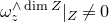 $\omega_z^{\wedge \dim Z}|_Z\neq 0$
if and only if
$\omega_z^{\wedge \dim Z}|_Z\neq 0$
if and only if $\omega_z$
is positive on
$\omega_z$
is positive on $T_z Z$
, if and only if
$T_z Z$
, if and only if $ \ker\omega_z \cap T_z Z=\{0\}$
.
$ \ker\omega_z \cap T_z Z=\{0\}$
.
The next thing we recall is the first Chern class of line bundles. It is well-known that there is a first Chern class map for holomorphic line bundles
 \[c_1: \mathrm{Pic}(Y)= H^1(Y,\mathcal{O}_Y^*)\rightarrow H^2(Y,\mathbb{Z}).\]
There is an analogous map for $C^\in fty$
complex line bundles. The exact sequence
$C^\in fty$
complex line bundles. The exact sequence
 \[0\rightarrow \mathbb{Z}\rightarrow \mathcal{R}_Y\xrightarrow{\exp} \mathcal{R}_Y^*\rightarrow 0, \]
where $\mathcal{R}_Y$
(respectively,
$\mathcal{R}_Y$
(respectively, $\mathcal{R}_Y^*$
) is the sheaf of
$\mathcal{R}_Y^*$
) is the sheaf of $C^\in fty$
complex functions (respectively, nonzero
$C^\in fty$
complex functions (respectively, nonzero $C^\in fty$
complex functions), gives rise to an injective homomorphism
$C^\in fty$
complex functions), gives rise to an injective homomorphism
 \begin{equation}c_1': H^1(Y,\mathcal{R}_Y^*)\hookrightarrow H^2(Y,\mathbb{Z})\end{equation}
such that $c_1$
factors through
$c_1$
factors through $c_1'$
; cf. [Reference Griffiths and HarrisGH94, p. 140]. Here
$c_1'$
; cf. [Reference Griffiths and HarrisGH94, p. 140]. Here $H^1(Y,\mathcal{R}_Y^*)$
is canonically identified as the group of
$H^1(Y,\mathcal{R}_Y^*)$
is canonically identified as the group of $C^\in fty$
complex line bundles L up to isomorphism using transition functions. Via the de Rham theory, we also regard the first Chern class
$C^\in fty$
complex line bundles L up to isomorphism using transition functions. Via the de Rham theory, we also regard the first Chern class $c_1'(L)$
as an integral class of real 2-forms in
$c_1'(L)$
as an integral class of real 2-forms in $H^2(Y,\mathbb{R})\cong H^2_{\mathrm{dR}}(Y,\mathbb{R})$
; a representative in the class can be given by
$H^2(Y,\mathbb{R})\cong H^2_{\mathrm{dR}}(Y,\mathbb{R})$
; a representative in the class can be given by ${\sqrt{-1}}/{2\pi}\Theta(D)$
, called the Chern form of (L,D), where
${\sqrt{-1}}/{2\pi}\Theta(D)$
, called the Chern form of (L,D), where $\Theta(D)$
is the curvature form of a hermitian connection D with respect to a hermitian metric on L; see [Reference DemaillyDem12, V.9].
$\Theta(D)$
is the curvature form of a hermitian connection D with respect to a hermitian metric on L; see [Reference DemaillyDem12, V.9].
5.3 Betti form
Now let $\mathcal{L}\in \mathrm{Pic}(\mathcal{A}/S)$
. For
$\mathcal{L}\in \mathrm{Pic}(\mathcal{A}/S)$
. For $s\in S$
, there is a unique translation-invariant closed (1,1)-form
$s\in S$
, there is a unique translation-invariant closed (1,1)-form $\omega_s$
on
$\omega_s$
on $\mathcal{A}_s$
representing the Chern class
$\mathcal{A}_s$
representing the Chern class $c_1(\mathcal{L}_s)$
on
$c_1(\mathcal{L}_s)$
on $\mathcal{A}_s$
. The Betti form associated to
$\mathcal{A}_s$
. The Betti form associated to $\mathcal{L}$
is the (1,1)-form
$\mathcal{L}$
is the (1,1)-form $\omega=\omega(\mathcal{L})$
on
$\omega=\omega(\mathcal{L})$
on $\mathcal{A}$
such that:
$\mathcal{A}$
such that:
-
(1) for any
$s\in S$
, the restriction
$\omega|_{T\mathcal{A}_s}=\omega_s$
; and -
(2) the form
$\omega$
is rigidified along the Betti foliation, namely,
$\omega|_{T\mathcal{F}_{\text{Betti}}}=0$
.


This uniquely determines $\omega$
since it specifies the pairing
$\omega$
since it specifies the pairing $\omega_x:T_x\mathcal{A}\times T_x\mathcal{A}\rightarrow \mathbb{R}$
at any point
$\omega_x:T_x\mathcal{A}\times T_x\mathcal{A}\rightarrow \mathbb{R}$
at any point $x\in \mathcal{A}$
by the splitting (5.2).
$x\in \mathcal{A}$
by the splitting (5.2).
To see the continuous structure of Betti forms, we give a local construction. Let $\beta_{\Delta,s_0}:\mathcal{A}_\Delta \rightarrow \mathcal{A}_{s_0}$
be a Betti map and let
$\beta_{\Delta,s_0}:\mathcal{A}_\Delta \rightarrow \mathcal{A}_{s_0}$
be a Betti map and let $\omega_\Delta:=\beta_{\Delta,s_0}^*\omega_{s_0}$
. By definition,
$\omega_\Delta:=\beta_{\Delta,s_0}^*\omega_{s_0}$
. By definition, $\omega_\Delta$
satisfies part (2) as fibers of
$\omega_\Delta$
satisfies part (2) as fibers of $\beta_{\Delta,s_0}$
are the Betti leaves. To see part (1), we regard
$\beta_{\Delta,s_0}$
are the Betti leaves. To see part (1), we regard $\mathcal{L}_\Delta$
as a
$\mathcal{L}_\Delta$
as a $C^\in fty$
complex line bundle on
$C^\in fty$
complex line bundle on $\mathcal{A}_\Delta$
, and consider the corresponding line bundle
$\mathcal{A}_\Delta$
, and consider the corresponding line bundle $\mathcal{L}_{\Delta}'$
on
$\mathcal{L}_{\Delta}'$
on $\mathbb{T}^{2g}\times \Delta$
via the
$\mathbb{T}^{2g}\times \Delta$
via the $C^\in fty$
diffeomorphism (5.1). Given any hermitian metric on
$C^\in fty$
diffeomorphism (5.1). Given any hermitian metric on $\mathcal{L}'_\Delta$
and a hermitian connection D, the association of Chern forms on
$\mathcal{L}'_\Delta$
and a hermitian connection D, the association of Chern forms on $\mathcal{L}'_\Delta$
restricted to
$\mathcal{L}'_\Delta$
restricted to $\mathbb{T}^{2g}\times \{s\}$
induces a continuous map
$\mathbb{T}^{2g}\times \{s\}$
induces a continuous map
 \[\Delta\rightarrow H^2_{\mathrm{dR}}(\mathbb{T}^{2g},\mathbb{R})\cong H^2(\mathbb{T}^{2g},\mathbb{R}). \]
It factors through the lattice $H^2(\mathbb{T}^{2g},\mathbb{Z})$
and hence must be constant. This implies that for any
$H^2(\mathbb{T}^{2g},\mathbb{Z})$
and hence must be constant. This implies that for any $s\in \Delta$
, the invariant form
$s\in \Delta$
, the invariant form $\omega_s$
when viewed on
$\omega_s$
when viewed on $\mathbb{T}^{2g}$
is independent of s. In particular,
$\mathbb{T}^{2g}$
is independent of s. In particular, $\omega_{\Delta}|_{T\mathcal{A}_s}=\omega_s$
for any
$\omega_{\Delta}|_{T\mathcal{A}_s}=\omega_s$
for any $s\in \Delta$
. Patching together by uniqueness, we obtain the desired Betti form.
$s\in \Delta$
. Patching together by uniqueness, we obtain the desired Betti form.
By definition, the Betti form of $\mathcal{L}$
only depends on its class
$\mathcal{L}$
only depends on its class $[\mathcal{L}]\in \mathrm{NS}(\mathcal{A}/S)$
. Linearity allows us to extend the definition to
$[\mathcal{L}]\in \mathrm{NS}(\mathcal{A}/S)$
. Linearity allows us to extend the definition to $\mathrm{NS}(\mathcal{A}/S)_{\mathbb{R}}$
. It is not hard to establish the following properties of Betti forms.
$\mathrm{NS}(\mathcal{A}/S)_{\mathbb{R}}$
. It is not hard to establish the following properties of Betti forms.
Proposition 5.1. The association of Betti forms
 \[ \omega:\mathrm{NS}(\mathcal{A}/S)_{\mathbb{R}}\rightarrow \Gamma(\Lambda^2 T^*\mathcal{A}) \]
is an injective linear map. Here, $\Gamma(\Lambda^2 T^*\mathcal{A})$
denotes the set of global sections of alternating 2-forms on
$\Gamma(\Lambda^2 T^*\mathcal{A})$
denotes the set of global sections of alternating 2-forms on $\mathcal{A}$
. For
$\mathcal{A}$
. For $[\mathcal{L}]\in \mathrm{NS}(\mathcal{A}/S)_{\mathbb{R}}$
, we have:
$[\mathcal{L}]\in \mathrm{NS}(\mathcal{A}/S)_{\mathbb{R}}$
, we have:
-
(1)
$\omega(\mathcal{L})$
is a closed, real
$C^\in fty$
(1,1)-form; -
(2)
$\omega(\mathcal{L})$
is semipositive if
$\mathcal{L}$
is nef; -
(3)
$[N]^*\omega(\mathcal{L})=N^2\omega(\mathcal{L})$
; -
(4)
$\ker\omega(\mathcal{L})$
is a
$C^\in fty$
complex vector bundle on
$\mathcal{A}$
.





Proof. Injectivity of $\omega$
follows from the fact that the Chern class
$\omega$
follows from the fact that the Chern class $c_1(\mathcal{L}_s)=0$
if and only if
$c_1(\mathcal{L}_s)=0$
if and only if $\mathcal{L}_s$
is numerically trivial. All the listed properties are immediate consequences of the local description of
$\mathcal{L}_s$
is numerically trivial. All the listed properties are immediate consequences of the local description of $\omega(\mathcal{L})$
.
$\omega(\mathcal{L})$
.
Next, we discuss pullback of Betti forms under $\mathbb{R}$
-homomorphisms. One concrete way to understand
$\mathbb{R}$
-homomorphisms. One concrete way to understand $\mathbb{R}$
-homomorphisms in the complex analytic setting is via Hodge theory. Let
$\mathbb{R}$
-homomorphisms in the complex analytic setting is via Hodge theory. Let $\mathbb{V}_{\mathbb{Z}}=\mathbb{V}_{\mathbb{Z},\mathcal{A}}:=(R^1\pi_{*}\mathbb{Z})^\vee$
be the
$\mathbb{V}_{\mathbb{Z}}=\mathbb{V}_{\mathbb{Z},\mathcal{A}}:=(R^1\pi_{*}\mathbb{Z})^\vee$
be the $\mathbb{Z}\mathrm{VHS}$
induced by
$\mathbb{Z}\mathrm{VHS}$
induced by $\pi:\mathcal{A}\rightarrow S$
. Let
$\pi:\mathcal{A}\rightarrow S$
. Let $\mathcal{V}$
be the associated holomorphic vector bundle to
$\mathcal{V}$
be the associated holomorphic vector bundle to $\mathbb{V}_{\mathbb{C}}$
with Hodge filtration
$\mathbb{V}_{\mathbb{C}}$
with Hodge filtration $F^\bullet \mathcal{V}$
. Then we can identify
$F^\bullet \mathcal{V}$
. Then we can identify
 \[\mathrm{Lie}(\mathcal{A}/S)=\mathcal{V}/F^0\mathcal{V}\text{ and }\mathcal{A}=\mathbb{V}_{\mathbb{Z}}\backslash\mathcal{V}/F^0\mathcal{V}.\]
The quotient map $\exp:\mathrm{Lie}(\mathcal{A}/S)\rightarrow \mathcal{A}$
is called the exponential map.
$\exp:\mathrm{Lie}(\mathcal{A}/S)\rightarrow \mathcal{A}$
is called the exponential map.
Now an $\mathbb{R}$
-homomorphism
$\mathbb{R}$
-homomorphism $f:\mathcal{A}\dashrightarrow \mathcal{B}$
can be regarded as a map of
$f:\mathcal{A}\dashrightarrow \mathcal{B}$
can be regarded as a map of $\mathbb{R}\mathrm{VHS}$
 \[f_{\mathbb{R}}:\mathbb{V}_{\mathbb{R},\mathcal{A}}\rightarrow \mathbb{V}_{\mathbb{R},\mathcal{B}}. \]
Note that f is integral if and only if $f_{\mathbb{R}}$
maps
$f_{\mathbb{R}}$
maps $\mathbb{V}_{\mathbb{Z},\mathcal{A}}$
to
$\mathbb{V}_{\mathbb{Z},\mathcal{A}}$
to $V_{\mathbb{Z},\mathcal{B}}$
. Taking into account the Hodge filtration, we have the following commutative diagram.
$V_{\mathbb{Z},\mathcal{B}}$
. Taking into account the Hodge filtration, we have the following commutative diagram.

This defines a functorial embedding
 \begin{equation}d:\mathrm{Hom}(\mathcal{A},\mathcal{B})_{\mathbb{R}}\hookrightarrow \mathrm{Hom}(\mathrm{Lie}(\mathcal{A}/S), \mathrm{Lie}(\mathcal{B}/S))\end{equation}
into the group of global sections of the Hom-bundle. If f is surjective, then df is surjective since a left inverse exists by functoriality.
Alternatively, we can regard df as the essential component of the differential map of f on tangent spaces over the identity sections. Namely, under the decomposition (5.3), the differential of f is identity on T’S and df on the Lie algebras.
Define the pullback of a Betti form $\omega(\mathcal{L})$
for
$\omega(\mathcal{L})$
for $[\mathcal{L}]\in \mathrm{NS}(\mathcal{B}/S)_{\mathbb{R}}$
by
$[\mathcal{L}]\in \mathrm{NS}(\mathcal{B}/S)_{\mathbb{R}}$
by $f\in \mathrm{Hom}(\mathcal{A},\mathcal{B})_{\mathbb{R}}$
as
$f\in \mathrm{Hom}(\mathcal{A},\mathcal{B})_{\mathbb{R}}$
as
 \[f^*\omega(\mathcal{L}):=\omega(f^*\mathcal{L})\]
with $f^*\mathcal{L}$
defined in (3.4). This is consistent with the usual pullback of differential forms when f is integral. By continuity, we have
$f^*\mathcal{L}$
defined in (3.4). This is consistent with the usual pullback of differential forms when f is integral. By continuity, we have $(df)^*\exp^*\omega(\mathcal{L})=\exp^*f^*\omega(\mathcal{L})$
.
$(df)^*\exp^*\omega(\mathcal{L})=\exp^*f^*\omega(\mathcal{L})$
.
Definition 5.2. An analytic subgroup $\mathcal{H}/S$
of
$\mathcal{H}/S$
of $\mathcal{A}/S$
is defined as the image of a flat
$\mathcal{A}/S$
is defined as the image of a flat $C^{\in fty}$
complex vector subbundle
$C^{\in fty}$
complex vector subbundle $\mathcal{W}\subseteq \mathrm{Lie}(\mathcal{A}/S)$
on S under
$\mathcal{W}\subseteq \mathrm{Lie}(\mathcal{A}/S)$
on S under $\exp:\mathrm{Lie}(\mathcal{A}/S)\rightarrow \mathcal{A}$
.
$\exp:\mathrm{Lie}(\mathcal{A}/S)\rightarrow \mathcal{A}$
.
Proposition 5.3. Let $[\mathcal{L}]\in \mathrm{NS}(\mathcal{B}/S)_{\mathbb{R}}$
be ample, let
$[\mathcal{L}]\in \mathrm{NS}(\mathcal{B}/S)_{\mathbb{R}}$
be ample, let $f\in \mathrm{Hom}(\mathcal{A},\mathcal{B})_{\mathbb{R}}^\circ$
. There exists an analytic subgroup
$f\in \mathrm{Hom}(\mathcal{A},\mathcal{B})_{\mathbb{R}}^\circ$
. There exists an analytic subgroup $\mathcal{H}$
such that for any
$\mathcal{H}$
such that for any $x\in \mathcal{A}$
, the complex manifold
$x\in \mathcal{A}$
, the complex manifold $\mathcal{H}_x$
obtained from translating
$\mathcal{H}_x$
obtained from translating $\mathcal{H}$
by
$\mathcal{H}$
by $\mathcal{F}_{\text{Betti},x}$
is an integral manifold of
$\mathcal{F}_{\text{Betti},x}$
is an integral manifold of $\ker f^*\omega(\mathcal{L})$
at x. Indeed,
$\ker f^*\omega(\mathcal{L})$
at x. Indeed, $\mathcal{H}$
is given by
$\mathcal{H}$
is given by $\exp(\ker(df))$
, where
$\exp(\ker(df))$
, where $df:\mathrm{Lie}(\mathcal{A}/S)\rightarrow \mathrm{Lie}(\mathcal{B}/S)$
is the lift of f by (5.5).
$df:\mathrm{Lie}(\mathcal{A}/S)\rightarrow \mathrm{Lie}(\mathcal{B}/S)$
is the lift of f by (5.5).
Proof. Let $\mathcal{W}:=\ker(df)$
. Then
$\mathcal{W}:=\ker(df)$
. Then $\mathcal{W}$
is a
$\mathcal{W}$
is a $C^\in fty$
complex vector bundle since df has constant rank by surjectivity. Moreover,
$C^\in fty$
complex vector bundle since df has constant rank by surjectivity. Moreover, $\mathcal{W}$
is flat by the identification
$\mathcal{W}$
is flat by the identification $\mathcal{W}\cong \ker(f_{\mathbb{R}})$
forgetting the complex structure, as
$\mathcal{W}\cong \ker(f_{\mathbb{R}})$
forgetting the complex structure, as $f_{\mathbb{R}}$
is a map of local systems. We check that the analytic subgroup
$f_{\mathbb{R}}$
is a map of local systems. We check that the analytic subgroup $\mathcal{H}:=\exp\mathcal{W}$
has the required property. Because of the translation-invariance of Betti form, it suffices to compare the tangent space of
$\mathcal{H}:=\exp\mathcal{W}$
has the required property. Because of the translation-invariance of Betti form, it suffices to compare the tangent space of $\mathcal{H}$
and
$\mathcal{H}$
and $\ker f^*\omega(\mathcal{L})$
over the zero section of
$\ker f^*\omega(\mathcal{L})$
over the zero section of $\mathcal{A}$
.
$\mathcal{A}$
.
Note first $\ker\omega(\mathcal{L})|_S=T'S$
on the identity section of
$\ker\omega(\mathcal{L})|_S=T'S$
on the identity section of $\mathcal{B}$
by ampleness. Then
$\mathcal{B}$
by ampleness. Then $\ker f^*\omega(\mathcal{L})|_S$
consists of the tangent vectors which are mapped to T’S by the differential of f. But the differential of f is identity on T’S and df on the Lie algebras under (5.3). Hence,
$\ker f^*\omega(\mathcal{L})|_S$
consists of the tangent vectors which are mapped to T’S by the differential of f. But the differential of f is identity on T’S and df on the Lie algebras under (5.3). Hence,
 \[\ker f^*\omega(\mathcal{L})|_S=T'S\oplus \mathcal{W}\]
is identical to the tangent space of $\mathcal{W}$
or
$\mathcal{W}$
or $\mathcal{H}$
on the zero section, and we are done.
$\mathcal{H}$
on the zero section, and we are done.
6. Nondegeneracy
We continue the discussion within the complex analytic category. Let $\mathcal{A}, \mathcal{B}$
be abelian schemes over a normal complex quasi-projective variety S of relative dimension g,g’, and let
$\mathcal{A}, \mathcal{B}$
be abelian schemes over a normal complex quasi-projective variety S of relative dimension g,g’, and let $f\in \mathrm{Hom}(\mathcal{A},\mathcal{B})^\circ_{\mathbb{R}}$
. Denote by
$f\in \mathrm{Hom}(\mathcal{A},\mathcal{B})^\circ_{\mathbb{R}}$
. Denote by $\omega:=\omega(f^*\mathcal{L}_{\mathcal{B}})$
the Betti form of the pullback of a fixed ample line bundle
$\omega:=\omega(f^*\mathcal{L}_{\mathcal{B}})$
the Betti form of the pullback of a fixed ample line bundle $\mathcal{L}_{\mathcal{B}}\in \mathrm{Pic}_0(\mathcal{B}/S)$
. Let
$\mathcal{L}_{\mathcal{B}}\in \mathrm{Pic}_0(\mathcal{B}/S)$
. Let $\mathcal{X}\subseteq\mathcal{A}$
be a locally closed algebraic subvariety of dimension d. The wedge product
$\mathcal{X}\subseteq\mathcal{A}$
be a locally closed algebraic subvariety of dimension d. The wedge product $\omega^{\wedge d}|_{\mathcal{X}}$
is a volume form on
$\omega^{\wedge d}|_{\mathcal{X}}$
is a volume form on $\mathcal{X}$
. Since
$\mathcal{X}$
. Since $\omega$
is semipositive, the volume form induces a nonnegative measure.
$\omega$
is semipositive, the volume form induces a nonnegative measure.
The main objective of this section is to provide a geometric criterion, utilizing the Ax–Schanuel theorem, for determining when this measure is nontrivial, i.e. when the following nondegeneracy condition holds on $\mathcal{X}$
:
$\mathcal{X}$
:
 \begin{equation} \omega^{\wedge d}|_{\mathcal{X}} \not\equiv 0.\end{equation}
For simplicity, we assume $\mathcal{A}$
has a level-
$\mathcal{A}$
has a level- $n_0$
-structure and, hence, (3.1).
$n_0$
-structure and, hence, (3.1).
6.1 Degeneracy loci
We defined earlier in Definition 4.2 the notion of a weakly special (respectively, special) subvariety of $\mathcal{A}/S$
. Components of intersections of (weakly) special subvarieties are (weakly) special.
$\mathcal{A}/S$
. Components of intersections of (weakly) special subvarieties are (weakly) special.
Definition 6.1. Let $\mathcal{Y}\subseteq \mathcal{A}$
be a locally closed subvariety.
$\mathcal{Y}\subseteq \mathcal{A}$
be a locally closed subvariety.
-
(1) The weakly special closure
$\langle \mathcal{Y} \rangle$
(respectively, special closure) of
$\mathcal{Y}$
is defined as the smallest weakly special (respectively, special) subvariety containing
$\mathcal{Y}$
. -
(2) The vertical defect
$\delta_v(\mathcal{Y})$
is defined as the difference of the relative dimension of its weakly special closure
$\langle\mathcal{Y}\rangle$
with the dimension of
$\mathcal{Y}$
. That is,
\[ \delta_v(\mathcal{Y}):=\mathrm{rel. dim} \langle\mathcal{Y}\rangle -\dim\mathcal{Y}. \]


We have the following lemma.
Lemma 6.2. Let $\iota_a:\mathcal{A}\rightarrow \mathfrak{A}_g$
be a moduli sieve. For a subvariety
$\iota_a:\mathcal{A}\rightarrow \mathfrak{A}_g$
be a moduli sieve. For a subvariety $\mathcal{Y}\subseteq \mathcal{A}$
, we have
$\mathcal{Y}\subseteq \mathcal{A}$
, we have
 \[ \mathrm{rel. dim} \langle \mathcal{Y}\rangle =\mathrm{rel. dim}\langle \iota_a(\mathcal{Y})\rangle. \]
Proof. The pullback of $\langle\iota_a(\mathcal{Y})\rangle$
is weakly special and contains
$\langle\iota_a(\mathcal{Y})\rangle$
is weakly special and contains $\mathcal{Y}$
. Thus,
$\mathcal{Y}$
. Thus,
 \[ \mathrm{rel. dim} \langle \mathcal{Y}\rangle \leq \mathrm{rel. dim}\langle \iota_a(\mathcal{Y})\rangle. \]
The reverse inequality follows from Lemma 4.3.
The following definition was introduced by Gao [Reference GaoGao20a] to study Betti maps.
Definition 6.3. For $t\in \mathbb{Z}$
, the tth degeneracy locus of a locally closed subvariety
$t\in \mathbb{Z}$
, the tth degeneracy locus of a locally closed subvariety $\mathcal{X}\subseteq\mathcal{A}$
, denoted by
$\mathcal{X}\subseteq\mathcal{A}$
, denoted by $\mathcal{X}^{\mathrm{deg}}(t)$
, is defined to be the union of all positive-dimensional subvarieties
$\mathcal{X}^{\mathrm{deg}}(t)$
, is defined to be the union of all positive-dimensional subvarieties $\mathcal{Y} \subseteq \mathcal{X}$
with
$\mathcal{Y} \subseteq \mathcal{X}$
with $\delta_v(\mathcal{Y})<t$
.
$\delta_v(\mathcal{Y})<t$
.
A subvariety $\mathcal{Z}\subseteq\mathcal{X}$
is said to be vertically optimal in
$\mathcal{Z}\subseteq\mathcal{X}$
is said to be vertically optimal in $\mathcal{X}$
if, for any subvariety
$\mathcal{X}$
if, for any subvariety $\mathcal{Y}\subseteq\mathcal{X}$
strictly containing
$\mathcal{Y}\subseteq\mathcal{X}$
strictly containing $\mathcal{Z}$
, one has
$\mathcal{Z}$
, one has $\delta_v(\mathcal{Y})\gt\delta_v(\mathcal{Z})$
. Note that the degeneracy locus
$\delta_v(\mathcal{Y})\gt\delta_v(\mathcal{Z})$
. Note that the degeneracy locus $\mathcal{X}^{\mathrm{deg}}(t)$
can be viewed as the union of positive-dimensional vertically optimal subvarieties with vertical defect
$\mathcal{X}^{\mathrm{deg}}(t)$
can be viewed as the union of positive-dimensional vertically optimal subvarieties with vertical defect $<t$
.
$<t$
.
As a possibly infinite union of subvarieties, the degeneracy locus is indeed algebraic by [Reference GaoGao20a, Theorem 1.8]. Gao’s proof works for subvarieties of $\mathfrak{A}_g$
. For the reader’s convenience, we give a proof below following a similar idea. First, we make a convenient definition.
$\mathfrak{A}_g$
. For the reader’s convenience, we give a proof below following a similar idea. First, we make a convenient definition.
Definition 6.4. Let $\mathcal{Y}\subseteq\mathcal{A}$
be a locally closed subvariety. A type of
$\mathcal{Y}\subseteq\mathcal{A}$
be a locally closed subvariety. A type of $\mathcal{Y}$
is a triple
$\mathcal{Y}$
is a triple $(\mathcal{A}_1,\mathcal{B}_1,N)$
consisting of abelian subschemes
$(\mathcal{A}_1,\mathcal{B}_1,N)$
consisting of abelian subschemes $\mathcal{B}_1\subseteq\mathcal{A}_1\subseteq\mathcal{A}|_{\pi(\mathcal{B}_1)}$
and
$\mathcal{B}_1\subseteq\mathcal{A}_1\subseteq\mathcal{A}|_{\pi(\mathcal{B}_1)}$
and $N\in \mathbb{N}_{\geq1}$
such that:
$N\in \mathbb{N}_{\geq1}$
such that:
-
(1)
$[N]\mathcal{Y} \subseteq \mathcal{A}_1$
; and -
(2)
$\langle [N]\mathcal{Y}\rangle=\mathcal{B}_1|_{\pi(\mathcal{Y})}+\sigma_1$
for a constant multi-section
$\sigma_1\subseteq \mathcal{A}_1|_{\pi(\mathcal{Y})}$
.



In this case, we shall say $\mathcal{Y}$
belongs to the type
$\mathcal{Y}$
belongs to the type $(\mathcal{A}_1,\mathcal{B}_1,N)$
.
$(\mathcal{A}_1,\mathcal{B}_1,N)$
.
The idea is to first generalize the finiteness result in Theorem 4.10 to the finiteness of types of vertically optimal subvarieties.
Theorem 6.5. Let $\mathcal{X}\subseteq\mathcal{A}$
be a locally closed subvariety. There exists a finite set
$\mathcal{X}\subseteq\mathcal{A}$
be a locally closed subvariety. There exists a finite set $\Sigma(\mathcal{X})$
of types such that every vertically optimal subvariety
$\Sigma(\mathcal{X})$
of types such that every vertically optimal subvariety $\mathcal{Z}$
of
$\mathcal{Z}$
of $\mathcal{X}$
belongs to a type in
$\mathcal{X}$
belongs to a type in $\Sigma(\mathcal{X})$
.
$\Sigma(\mathcal{X})$
.
Proof. ${\textit{Case }\mathcal{A}=\mathfrak{A}_g}.$
We claim that vertically optimal implies weakly optimal. Assuming the claim, the result follows directly from Theorem 4.10. To prove the claim, if
${\textit{Case }\mathcal{A}=\mathfrak{A}_g}.$
We claim that vertically optimal implies weakly optimal. Assuming the claim, the result follows directly from Theorem 4.10. To prove the claim, if $\mathcal{Z}\subseteq\mathcal{X}$
is vertically optimal, and let
$\mathcal{Z}\subseteq\mathcal{X}$
is vertically optimal, and let $\mathcal{Y}\subseteq\mathcal{X}$
contain
$\mathcal{Y}\subseteq\mathcal{X}$
contain $\mathcal{Z}$
, by definition and Proposition 4.7, we have
$\mathcal{Z}$
, by definition and Proposition 4.7, we have
 \[ \mathrm{rel. dim}\mathcal{Y}^{\mathrm{biZar}}-\dim \mathcal{Y}\gt\mathrm{rel. dim}\mathcal{Z}^{\mathrm{biZar}}-\dim \mathcal{Z}. \]
Since $\pi(\mathcal{Z}^{\mathrm{biZar}})=\pi(\mathcal{Z})^{\mathrm{biZar}}$
and similarly for
$\pi(\mathcal{Z}^{\mathrm{biZar}})=\pi(\mathcal{Z})^{\mathrm{biZar}}$
and similarly for $\mathcal{Y}'$
, we derive from
$\mathcal{Y}'$
, we derive from $\pi(\mathcal{Y})\supseteq\pi(\mathcal{Z})$
that
$\pi(\mathcal{Y})\supseteq\pi(\mathcal{Z})$
that
 \[ \dim \pi(\mathcal{Y}^{\mathrm{biZar}})\geq\dim \pi(\mathcal{Z}^{\mathrm{biZar}}). \]
Combining the two inequalities, we see that $\delta_{\mathrm{ws}}(\mathcal{Y})\gt\delta_{\mathrm{ws}}(\mathcal{Z})$
.
$\delta_{\mathrm{ws}}(\mathcal{Y})\gt\delta_{\mathrm{ws}}(\mathcal{Z})$
. ${\textit{General Case}}$
. We claim that if
${\textit{General Case}}$
. We claim that if $\mathcal{X}=\mathcal{U}\sqcup\mathcal{X}_1$
with
$\mathcal{X}=\mathcal{U}\sqcup\mathcal{X}_1$
with $\mathcal{U}$
Zariski open, and the result holds for
$\mathcal{U}$
Zariski open, and the result holds for $\mathcal{U},\mathcal{X}_1$
, then we can take
$\mathcal{U},\mathcal{X}_1$
, then we can take $\Sigma(\mathcal{X}):=\Sigma(\mathcal{U})\cup\Sigma(\mathcal{X}_1)$
. To show this, if
$\Sigma(\mathcal{X}):=\Sigma(\mathcal{U})\cup\Sigma(\mathcal{X}_1)$
. To show this, if $\mathcal{Z}$
is a vertically optimal subvariety of
$\mathcal{Z}$
is a vertically optimal subvariety of $\mathcal{X}$
, then
$\mathcal{X}$
, then $\mathcal{Z}$
must be Zariski closed. If
$\mathcal{Z}$
must be Zariski closed. If $\mathcal{Z}\subseteq\mathcal{X}_1$
, then
$\mathcal{Z}\subseteq\mathcal{X}_1$
, then $\mathcal{Z}$
is vertically optimal in
$\mathcal{Z}$
is vertically optimal in $\mathcal{X}_1$
by definition. Otherwise,
$\mathcal{X}_1$
by definition. Otherwise, $\mathcal{Z}\cap \mathcal{U}$
is vertically optimal in
$\mathcal{Z}\cap \mathcal{U}$
is vertically optimal in $\mathcal{U}$
. Thus, the union
$\mathcal{U}$
. Thus, the union $\Sigma(\mathcal{U})\cup\Sigma(\mathcal{X}_1)$
takes into account all possible vertically optimal subvarieties of
$\Sigma(\mathcal{U})\cup\Sigma(\mathcal{X}_1)$
takes into account all possible vertically optimal subvarieties of $\mathcal{X}$
.
$\mathcal{X}$
.
Now take a moduli sieve $\iota:\mathcal{A}\rightarrow \mathfrak{A}_{g}$
. By Chevalley’s upper semi-continuity theorem [Reference GrothendieckGro66, Theorem 13.1.3], there exists a nonempty open subset of
$\iota:\mathcal{A}\rightarrow \mathfrak{A}_{g}$
. By Chevalley’s upper semi-continuity theorem [Reference GrothendieckGro66, Theorem 13.1.3], there exists a nonempty open subset of $\mathcal{U}\subseteq \mathcal{X}$
such that for any scheme-theoretic point
$\mathcal{U}\subseteq \mathcal{X}$
such that for any scheme-theoretic point $x\in \mathcal{U}$
, the fiber of
$x\in \mathcal{U}$
, the fiber of $\iota|_{\mathcal{X}}$
over
$\iota|_{\mathcal{X}}$
over $\iota(x)$
has pure dimension
$\iota(x)$
has pure dimension $\dim \mathcal{X}-\dim\iota(\mathcal{X})$
. By the claim, it suffices to work on
$\dim \mathcal{X}-\dim\iota(\mathcal{X})$
. By the claim, it suffices to work on $\mathcal{U}$
using Noetherian induction. Without loss of generality, we assume
$\mathcal{U}$
using Noetherian induction. Without loss of generality, we assume $\iota|_{\mathcal{X}}$
has pure dimension r over any point of
$\iota|_{\mathcal{X}}$
has pure dimension r over any point of $\iota(\mathcal{X})$
. In particular, if
$\iota(\mathcal{X})$
. In particular, if $\mathcal{Y}'$
is a subvariety of
$\mathcal{Y}'$
is a subvariety of $\iota(\mathcal{X})$
and
$\iota(\mathcal{X})$
and $\mathcal{Y}$
is an irreducible component of
$\mathcal{Y}$
is an irreducible component of $\iota|_{\mathcal{X}}^{-1}(\mathcal{Y}')$
, then using Lemma 6.2,
$\iota|_{\mathcal{X}}^{-1}(\mathcal{Y}')$
, then using Lemma 6.2,
 \[ \delta_v(\mathcal{Y})=\mathrm{rel. dim}\langle \mathcal{Y}\rangle -\dim\mathcal{Y} =\mathrm{rel. dim}\langle \mathcal{Y}'\rangle-\dim\mathcal{Y}'-r=\delta_v(\mathcal{Y}')-r. \]
Next, we observe that if $\mathcal{Z}$
is vertically optimal in
$\mathcal{Z}$
is vertically optimal in $\mathcal{X}$
, then
$\mathcal{X}$
, then $\mathcal{Z}$
must be a component of
$\mathcal{Z}$
must be a component of $\iota|_{\mathcal{X}}^{-1}(\iota(\mathcal{Z}))$
. Indeed, let
$\iota|_{\mathcal{X}}^{-1}(\iota(\mathcal{Z}))$
. Indeed, let $\mathcal{Y}$
be a component of
$\mathcal{Y}$
be a component of $\iota|_{\mathcal{X}}^{-1}(\iota(\mathcal{Z}))$
containing
$\iota|_{\mathcal{X}}^{-1}(\iota(\mathcal{Z}))$
containing $\mathcal{Z}$
. By Lemma 6.2,
$\mathcal{Z}$
. By Lemma 6.2,
 \[ \mathrm{rel. dim}\langle \mathcal{Z} \rangle =\mathrm{rel. dim}\langle \iota(\mathcal{Z}) \rangle =\mathrm{rel. dim}\langle \mathcal{Y}\rangle.\]
Since $\delta_v(\mathcal{Y})\geq \delta_v(\mathcal{Z})$
, we must have
$\delta_v(\mathcal{Y})\geq \delta_v(\mathcal{Z})$
, we must have $\dim \mathcal{Y}=\dim\mathcal{Z}$
and
$\dim \mathcal{Y}=\dim\mathcal{Z}$
and $\mathcal{Y}=\mathcal{Z}$
.
$\mathcal{Y}=\mathcal{Z}$
.
As a consequence, the vertically optimal subvarieties of $\mathcal{X}$
correspond to those of
$\mathcal{X}$
correspond to those of $\iota(\mathcal{X})$
in the following way.
$\iota(\mathcal{X})$
in the following way.
-
(1) If
$\mathcal{Z}$
is vertically optimal in
$\mathcal{X}$
, then
$\iota(\mathcal{Z})$
is vertically optimal in
$\iota(\mathcal{X})$
. -
(2) If
$\mathcal{Z}'$
is vertically optimal in
$\iota(\mathcal{X})$
, then any irreducible component of
$\iota|_{\mathcal{X}}^{-1}(\mathcal{Z}')$
is vertically optimal in
$\iota(\mathcal{X})$
.


Finally, we construct $\Sigma(\mathcal{X})$
by pulling back the triples in the set
$\Sigma(\mathcal{X})$
by pulling back the triples in the set $\Sigma(\iota(\mathcal{X}))$
, which is defined in the case
$\Sigma(\iota(\mathcal{X}))$
, which is defined in the case $\mathcal{A}=\mathfrak{A}_g$
. More precisely, let
$\mathcal{A}=\mathfrak{A}_g$
. More precisely, let $\Sigma(\mathcal{X})$
be the set of
$\Sigma(\mathcal{X})$
be the set of $(\mathcal{A}_1,\mathcal{B}_1,N)$
with the property that
$(\mathcal{A}_1,\mathcal{B}_1,N)$
with the property that $(\iota(\mathcal{A}_1),\iota(\mathcal{B}_1),N)\in \Sigma(\iota(\mathcal{X}))$
and
$(\iota(\mathcal{A}_1),\iota(\mathcal{B}_1),N)\in \Sigma(\iota(\mathcal{X}))$
and $\mathcal{A}_1$
is a component of
$\mathcal{A}_1$
is a component of $\iota^{-1}(\iota(\mathcal{A}_1))$
. Then it is immediate to check that
$\iota^{-1}(\iota(\mathcal{A}_1))$
. Then it is immediate to check that $\Sigma(\mathcal{X})$
has the required property. This completes the Noetherian induction.
$\Sigma(\mathcal{X})$
has the required property. This completes the Noetherian induction.
With the above result, we can conclude the proof as in [Reference GaoGao20a, § 7.2].
Theorem 6.6. For $t\in \mathbb{Z}$
, the degeneracy locus
$t\in \mathbb{Z}$
, the degeneracy locus $\mathcal{X}^{\mathrm{deg}}(t)$
for a locally closed subvariety
$\mathcal{X}^{\mathrm{deg}}(t)$
for a locally closed subvariety $\mathcal{X}\subseteq\mathcal{A}$
is Zariski closed in
$\mathcal{X}\subseteq\mathcal{A}$
is Zariski closed in $\mathcal{X}$
.
$\mathcal{X}$
.
Proof. Take a type $(\mathcal{A}_1,\mathcal{B}_1,N)\in \Sigma(\mathcal{X})$
as defined in Theorem 6.5. Consider the composition
$(\mathcal{A}_1,\mathcal{B}_1,N)\in \Sigma(\mathcal{X})$
as defined in Theorem 6.5. Consider the composition
 \[\varphi:[N]^{-1}\mathcal{A}_1\xrightarrow{[N]} \mathcal{A}_1\rightarrow \mathcal{A}_1/\mathcal{B}_1 \rightarrow \mathfrak{A}_{g_1-g'_1},\]
where $[N]^{-1}\mathcal{A}_1$
is the preimage of
$[N]^{-1}\mathcal{A}_1$
is the preimage of $\mathcal{A}_1$
under
$\mathcal{A}_1$
under $[N]:\mathcal{A}\rightarrow \mathcal{A}$
,
$[N]:\mathcal{A}\rightarrow \mathcal{A}$
, $g_1,g_1'$
are the respective relative dimensions of
$g_1,g_1'$
are the respective relative dimensions of $\mathcal{A}_1,\mathcal{B}_1$
, and the last morphism is a moduli sieve. Irreducible components of fibers of
$\mathcal{A}_1,\mathcal{B}_1$
, and the last morphism is a moduli sieve. Irreducible components of fibers of $\varphi$
are weakly special of relative dimension
$\varphi$
are weakly special of relative dimension $g_1'$
by Lemma 4.5. Denote the restriction of
$g_1'$
by Lemma 4.5. Denote the restriction of $\varphi$
onto
$\varphi$
onto $\mathcal{X}\cap[N]^{-1}\mathcal{A}_1$
as
$\mathcal{X}\cap[N]^{-1}\mathcal{A}_1$
as $\varphi|_{\mathcal{X}}$
. Let
$\varphi|_{\mathcal{X}}$
. Let
 \[Z=Z(\mathcal{A}_1,\mathcal{B}_1,N):=\{x\in \mathcal{X}\cap[N]^{-1}\mathcal{A}_1 \mid \dim_x \varphi|_{\mathcal{X}}^{-1}(\varphi(x))\gt\max \{0, g_1'-t\}\},\]
which is Zariski closed by Chevalley’s upper semi-continuity theorem [Reference GrothendieckGro66, Theorem 13.1.3]. Then $Z\subseteq \mathcal{X}^{\mathrm{deg}}(t)$
since the vertical defect of any (positive-dimensional) irreducible component of fiber
$Z\subseteq \mathcal{X}^{\mathrm{deg}}(t)$
since the vertical defect of any (positive-dimensional) irreducible component of fiber $\varphi|_{\mathcal{X}}^{-1}(\varphi(x))$
is less than
$\varphi|_{\mathcal{X}}^{-1}(\varphi(x))$
is less than
 \[g_1'-\max\{0,g_1'-t\}\leq \min\{g_1',t\}\leq t.\]
Now the union of such Z for the finitely many triples $(\mathcal{A}_1,\mathcal{B}_1,N)\in \Sigma(\mathcal{X})$
is also Zariski closed, and is indeed
$(\mathcal{A}_1,\mathcal{B}_1,N)\in \Sigma(\mathcal{X})$
is also Zariski closed, and is indeed $\mathcal{X}^{\mathrm{deg}}(t)$
since all vertically optimal subvarieties have been taken into account.
$\mathcal{X}^{\mathrm{deg}}(t)$
since all vertically optimal subvarieties have been taken into account.
Along the path, we obtain the following natural generalization of Gao’s criterion [Reference GaoGao20a, Theorem 8.1] for the case $t\leq 0$
and [Reference GaoGao24, Theorem 2.4] for the case
$t\leq 0$
and [Reference GaoGao24, Theorem 2.4] for the case $\mathcal{A}=\mathfrak{A}_g$
.
$\mathcal{A}=\mathfrak{A}_g$
.
Theorem 6.7. Suppose $\mathcal{X}$
is not contained in a strict group subscheme of
$\mathcal{X}$
is not contained in a strict group subscheme of $\mathcal{A}$
. The following are equivalent:
$\mathcal{A}$
. The following are equivalent:
-
(1)
$\mathcal{X}=\mathcal{X}^{\deg}(t)$
; -
(2) there exists an abelian subscheme
$\mathcal{B}$
of relative dimension g’ such that the composition where
\[ \varphi: \mathcal{A}\rightarrow \mathcal{A}/\mathcal{B} \rightarrow \mathfrak{A}_{g-g'}, \]
$\mathcal{A}\rightarrow\mathcal{A}/\mathcal{B}$
is the quotient map and
$\mathcal{A}/\mathcal{B}\rightarrow \mathfrak{A}_{g-g'}$
is a moduli sieve, satisfies
\[ \dim\varphi(\mathcal{X})<\dim \mathcal{X} -\max \{0,g'-t\}. \]




Proof. For sufficiency, note that irreducible components of the fibers of $\varphi$
are weakly special of relative dimension g’ by Lemma 4.5. By assumption, any irreducible component
$\varphi$
are weakly special of relative dimension g’ by Lemma 4.5. By assumption, any irreducible component $\mathcal{Y}$
of a fiber of
$\mathcal{Y}$
of a fiber of $\varphi|_{\mathcal{X}}$
has dimension
$\varphi|_{\mathcal{X}}$
has dimension $\dim \mathcal{Y}\gt\max\{0,g'-t\}$
. Thus,
$\dim \mathcal{Y}\gt\max\{0,g'-t\}$
. Thus, $\mathcal{Y}$
is positive-dimensional and
$\mathcal{Y}$
is positive-dimensional and
 \[ \delta_v(\mathcal{Y})=\dim\langle \mathcal{Y}\rangle -\dim \mathcal{Y}<g'-\max\{0,g'-t\}=\min\{g',t\}\leq t,\]
which means $\mathcal{Y}\subseteq \mathcal{X}^{\mathrm{deg}}(t)$
.
$\mathcal{Y}\subseteq \mathcal{X}^{\mathrm{deg}}(t)$
.
To prove necessity, by the proof of Theorem 6.6, we can express $\mathcal{X}^{\deg}(t)$
as a finite union of Zariski-closed sets of the form
$\mathcal{X}^{\deg}(t)$
as a finite union of Zariski-closed sets of the form $Z(\mathcal{A}_1,\mathcal{B}_1,N)$
. If
$Z(\mathcal{A}_1,\mathcal{B}_1,N)$
. If $\mathcal{X}^{\deg}(t)=\mathcal{X}$
, then there is one
$\mathcal{X}^{\deg}(t)=\mathcal{X}$
, then there is one $(\mathcal{A}_1,\mathcal{B}_1,N)\in \Sigma(\mathcal{X})$
with
$(\mathcal{A}_1,\mathcal{B}_1,N)\in \Sigma(\mathcal{X})$
with $Z(\mathcal{A}_1,\mathcal{B}_1,N)=\mathcal{X}$
. In particular, we have
$Z(\mathcal{A}_1,\mathcal{B}_1,N)=\mathcal{X}$
. In particular, we have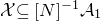 $\mathcal{X}\subseteq[N]^{-1}\mathcal{A}_1$
, which implies
$\mathcal{X}\subseteq[N]^{-1}\mathcal{A}_1$
, which implies $\mathcal{A}_1=\mathcal{A}$
by assumption. Moreover, by definition of
$\mathcal{A}_1=\mathcal{A}$
by assumption. Moreover, by definition of $Z(\mathcal{A}_1,\mathcal{B}_1,N)$
, the fiber dimension of
$Z(\mathcal{A}_1,\mathcal{B}_1,N)$
, the fiber dimension of $\varphi|_{\mathcal{X}}$
is greater than
$\varphi|_{\mathcal{X}}$
is greater than $\max \{0,g'-t\}$
at any point
$\max \{0,g'-t\}$
at any point $x\in \mathcal{X}$
. Hence, we have
$x\in \mathcal{X}$
. Hence, we have
 \[ \dim \varphi(\mathcal{X})<\dim \mathcal{X} -\max \{0,g'-t\}. \]
Thus, we are done.
We remark that the assumption above ensures that $\mathcal{X}$
is necessarily dominant over S, since the union of
$\mathcal{X}$
is necessarily dominant over S, since the union of $\mathcal{A}|_{\pi(\mathcal{X})}$
with the zero section of
$\mathcal{A}|_{\pi(\mathcal{X})}$
with the zero section of $\mathcal{A}$
is a group subscheme of
$\mathcal{A}$
is a group subscheme of $\mathcal{A}$
. On the other hand, such an assumption is minor as in Pink’s Conjecture 1.4. In defining the degeneracy locus, the choice of the ambient abelian scheme is immaterial, and we may replace
$\mathcal{A}$
. On the other hand, such an assumption is minor as in Pink’s Conjecture 1.4. In defining the degeneracy locus, the choice of the ambient abelian scheme is immaterial, and we may replace $\mathcal{A}$
with the smallest group subscheme of
$\mathcal{A}$
with the smallest group subscheme of $\mathcal{A}|_{\pi(\mathcal{X})}$
containing
$\mathcal{A}|_{\pi(\mathcal{X})}$
containing $\mathcal{X}$
. This will yield an abelian subscheme
$\mathcal{X}$
. This will yield an abelian subscheme $\mathcal{A}'$
of
$\mathcal{A}'$
of $\mathcal{A}|_{\pi(\mathcal{X})}$
if we further replace
$\mathcal{A}|_{\pi(\mathcal{X})}$
if we further replace $\mathcal{X}$
with
$\mathcal{X}$
with $[N]\mathcal{X}$
for some positive integer N. Then Theorem 6.7 applies in the setting
$[N]\mathcal{X}$
for some positive integer N. Then Theorem 6.7 applies in the setting $[N]\mathcal{X}\subseteq\mathcal{A}'$
.
$[N]\mathcal{X}\subseteq\mathcal{A}'$
.
6.2 The criterion
We keep our setup and notation from the beginning of the current section. Let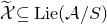 $\widetilde{\mathcal{X}}\subseteq \mathrm{Lie}(\mathcal{A}/S)$
be a connected component of
$\widetilde{\mathcal{X}}\subseteq \mathrm{Lie}(\mathcal{A}/S)$
be a connected component of $\exp^{-1}(\mathcal{X})$
. We have the following diagram.
$\exp^{-1}(\mathcal{X})$
. We have the following diagram.

Let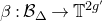 $\beta:\mathcal{B}_\Delta\rightarrow \mathbb{T}^{2g'}$
be a Betti map on
$\beta:\mathcal{B}_\Delta\rightarrow \mathbb{T}^{2g'}$
be a Betti map on $\mathcal{B}$
associated to the simply connected open neighborhood
$\mathcal{B}$
associated to the simply connected open neighborhood $\Delta\subseteq S$
. Consider the composition
$\Delta\subseteq S$
. Consider the composition
 \[\psi_\Delta: \mathrm{Lie}(\mathcal{A}_\Delta/\Delta)\xrightarrow{df}\mathrm{Lie}(\mathcal{B}_\Delta/\Delta)\xrightarrow{\exp}\mathcal{B}_\Delta\xrightarrow{\beta_\Delta}\mathbb{T}^{2g'}.\]
Note that $\psi_\Delta$
has complex analytic fibers.
$\psi_\Delta$
has complex analytic fibers.
Lemma 6.8. The volume form $\omega^{\wedge d}|_{\mathcal{X}}$
is nonzero at
$\omega^{\wedge d}|_{\mathcal{X}}$
is nonzero at $x\in \mathcal{X}^{\mathrm{sm}}\cap \mathcal{A}_\Delta$
if and only if
$x\in \mathcal{X}^{\mathrm{sm}}\cap \mathcal{A}_\Delta$
if and only if
 \[ \psi_\Delta|_{\widetilde{\mathcal{X}}}:\widetilde{\mathcal{X}}\longrightarrow \mathbb{T}^{2g'} \]
is an immersion at $\tilde x$
, where
$\tilde x$
, where $\tilde x\in \widetilde{\mathcal{X}}$
is a point above x.
$\tilde x\in \widetilde{\mathcal{X}}$
is a point above x.
Recall that a $C^\in fty$
-map
$C^\in fty$
-map $\varphi:\mathcal{M}\rightarrow \mathcal{N}$
between two differentiable manifolds is an immersion at p if the differential
$\varphi:\mathcal{M}\rightarrow \mathcal{N}$
between two differentiable manifolds is an immersion at p if the differential $d\varphi_p:T_p\mathcal{M}\rightarrow T_{\varphi(p)}\mathcal{N}$
is injective.
$d\varphi_p:T_p\mathcal{M}\rightarrow T_{\varphi(p)}\mathcal{N}$
is injective.
Proof. Note that $\ker (d\psi_\Delta)_{\tilde x}$
is exactly the lift of
$\ker (d\psi_\Delta)_{\tilde x}$
is exactly the lift of $\ker\omega_x$
. Thus,
$\ker\omega_x$
. Thus,
 \[ \ker(d\psi_\Delta|_{\widetilde{\mathcal{X}}})_{\tilde x}=\ker (d\psi_\Delta)_{\tilde x}\cap T_{\tilde x}\widetilde{\mathcal{X}} \]
is isomorphic to $\ker\omega_x\cap T_x\mathcal{X}$
. The equivalence follows by the discussion in § 5.2, since we know
$\ker\omega_x\cap T_x\mathcal{X}$
. The equivalence follows by the discussion in § 5.2, since we know $\omega^{\wedge d}_x|_{\mathcal{X}}\neq 0$
precisely when
$\omega^{\wedge d}_x|_{\mathcal{X}}\neq 0$
precisely when $\ker\omega_x\cap T_x\mathcal{X}=0.$
Now we can give a necessary condition for the vanishing of the volume form.
Theorem 6.9. Let $\mathcal{X}\subseteq \mathcal{A}$
be a subvariety of dimension d, and
$\mathcal{X}\subseteq \mathcal{A}$
be a subvariety of dimension d, and $\omega=\omega(f^*\mathcal{L}_{\mathcal{B}})$
as above. If
$\omega=\omega(f^*\mathcal{L}_{\mathcal{B}})$
as above. If $\omega^{\wedge d}|_{\mathcal{X}}\equiv 0$
, then
$\omega^{\wedge d}|_{\mathcal{X}}\equiv 0$
, then $\mathcal{X}^{\mathrm{deg}}(g-g')=\mathcal{X}$
.
$\mathcal{X}^{\mathrm{deg}}(g-g')=\mathcal{X}$
.
Proof. First assume $S\subseteq \mathbb{A}_g$
and
$S\subseteq \mathbb{A}_g$
and $\mathcal{A}=\mathfrak{A}_g|_S$
. Let
$\mathcal{A}=\mathfrak{A}_g|_S$
. Let $\mathcal{W}:=\ker(df)$
, and let
$\mathcal{W}:=\ker(df)$
, and let $\widetilde{\mathcal{W}}$
be the pullback of
$\widetilde{\mathcal{W}}$
be the pullback of $\mathcal{W}$
to
$\mathcal{W}$
to $\widetilde S$
, where
$\widetilde S$
, where $\widetilde S$
is a component of
$\widetilde S$
is a component of $u_g^{-1}(S)$
. We need the following algebraicity lemma.
$u_g^{-1}(S)$
. We need the following algebraicity lemma.
Lemma 6.10. If S is bi-algebraic, then the flat $C^\in fty$
complex vector bundle
$C^\in fty$
complex vector bundle $\widetilde{\mathcal{W}}$
viewed as a subset of
$\widetilde{\mathcal{W}}$
viewed as a subset of $\mathbb{C}^g\times \mathfrak{H}_g$
is algebraic. In general, the vector bundle
$\mathbb{C}^g\times \mathfrak{H}_g$
is algebraic. In general, the vector bundle $\widetilde{\mathcal{W}}$
is the restriction onto
$\widetilde{\mathcal{W}}$
is the restriction onto $\widetilde S$
of an algebraic vector bundle of the same rank.
$\widetilde S$
of an algebraic vector bundle of the same rank.
Proof. For the first statement, by the o-minimal Chow’s theorem [Reference Peterzil and StarchenkoPS09, Corollary 4.5], it suffices to show that $\widetilde{\mathcal{W}}$
is definable in
$\widetilde{\mathcal{W}}$
is definable in $\mathbb{R}_{\mathrm{an,exp}}$
(or any o-minimal structure). This follows from the algebraicity of
$\mathbb{R}_{\mathrm{an,exp}}$
(or any o-minimal structure). This follows from the algebraicity of $\widetilde S$
and local triviality of
$\widetilde S$
and local triviality of $\widetilde{\mathcal{W}}$
by Proposition 5.3 over the simply connected definable open subsets of
$\widetilde{\mathcal{W}}$
by Proposition 5.3 over the simply connected definable open subsets of $\widetilde S$
. For the second statement, Proposition 4.7 implies that the endomorphism groups of
$\widetilde S$
. For the second statement, Proposition 4.7 implies that the endomorphism groups of $\mathcal{A}$
and
$\mathcal{A}$
and $\mathcal{A}^{\mathrm{biZar}}$
coincide. In particular, the
$\mathcal{A}^{\mathrm{biZar}}$
coincide. In particular, the $\mathbb{R}$
-homomorphism
$\mathbb{R}$
-homomorphism $\mathcal{A}\dashrightarrow \mathcal{B}$
can be extended to an
$\mathcal{A}\dashrightarrow \mathcal{B}$
can be extended to an $\mathbb{R}$
-homomorphism of abelian schemes
$\mathbb{R}$
-homomorphism of abelian schemes $f_1:\mathcal{A}_1\dashrightarrow \mathcal{B}_1$
over
$f_1:\mathcal{A}_1\dashrightarrow \mathcal{B}_1$
over $S^{\mathrm{biZar}}$
and we have
$S^{\mathrm{biZar}}$
and we have
 \[ \mathcal{W}=\ker(df)= \ker (df_1)|_S. \]
The conclusion follows.
For $x\in \mathcal{X}^{\mathrm{sm}}$
, the fiber of
$x\in \mathcal{X}^{\mathrm{sm}}$
, the fiber of $\psi_\Delta|_{\widetilde{\mathcal{X}}}$
over
$\psi_\Delta|_{\widetilde{\mathcal{X}}}$
over $\psi_\Delta(\tilde x)$
is positive-dimensional by Lemma 6.8, and complex analytic. Let
$\psi_\Delta(\tilde x)$
is positive-dimensional by Lemma 6.8, and complex analytic. Let $\widetilde F$
be a connected component of the fiber containing
$\widetilde F$
be a connected component of the fiber containing $\tilde x$
and
$\tilde x$
and $F:=\exp(\widetilde F)\subseteq \mathcal{A}$
. We lift F to an analytic irreducible subset of
$F:=\exp(\widetilde F)\subseteq \mathcal{A}$
. We lift F to an analytic irreducible subset of $\mathbb{C}^g\times \mathfrak{H}_g$
by lifting
$\mathbb{C}^g\times \mathfrak{H}_g$
by lifting $\Delta\subseteq S$
to
$\Delta\subseteq S$
to $\widetilde\Delta\subseteq\widetilde S$
, and by slight abuse of notation, still denote it by
$\widetilde\Delta\subseteq\widetilde S$
, and by slight abuse of notation, still denote it by $\widetilde F$
. By Corollary 4.9, we get
$\widetilde F$
. By Corollary 4.9, we get
 \[ \delta_{v}(F^{\mathrm{Zar}})\leq \mathrm{rel. dim}\widetilde{F}^{\mathrm{Zar}} -\dim \widetilde{F}. \]
But $\widetilde F$
is contained in
$\widetilde F$
is contained in $\widetilde{\mathcal{W}}+\sigma$
for some horizontal section
$\widetilde{\mathcal{W}}+\sigma$
for some horizontal section $\sigma=(r_0,s)\in \mathbb{R}^{2g}\times \widetilde S\cong \mathbb{C}^g\times \widetilde S$
with
$\sigma=(r_0,s)\in \mathbb{R}^{2g}\times \widetilde S\cong \mathbb{C}^g\times \widetilde S$
with $r_0$
fixed. Since
$r_0$
fixed. Since $\widetilde{\mathcal{W}}$
is algebraic by Lemma 6.10, we get
$\widetilde{\mathcal{W}}$
is algebraic by Lemma 6.10, we get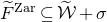 $\widetilde{F}^{\mathrm{Zar}}\subseteq \widetilde{\mathcal{W}}+\sigma$
. This implies
$\widetilde{F}^{\mathrm{Zar}}\subseteq \widetilde{\mathcal{W}}+\sigma$
. This implies
 \[ \mathrm{rel. dim}\widetilde{F}^{\mathrm{Zar}}\leq \mathrm{rank} \mathcal{W}=g-g'. \]
Thus, $\delta_v(F^{\mathrm{Zar}})<g-g'$
and
$\delta_v(F^{\mathrm{Zar}})<g-g'$
and $x\in F^{\mathrm{Zar}}\subseteq \mathcal{X}^{\mathrm{deg}}(g-g')$
. Therefore
$x\in F^{\mathrm{Zar}}\subseteq \mathcal{X}^{\mathrm{deg}}(g-g')$
. Therefore $\mathcal{X}^{\mathrm{sm}}\subseteq\mathcal{X}^{\mathrm{deg}}(g-g')$
and by Theorem 6.6, we conclude that
$\mathcal{X}^{\mathrm{sm}}\subseteq\mathcal{X}^{\mathrm{deg}}(g-g')$
and by Theorem 6.6, we conclude that $\mathcal{X}^{\mathrm{deg}}(g-g')=\mathcal{X}$
.
$\mathcal{X}^{\mathrm{deg}}(g-g')=\mathcal{X}$
.
For a general abelian scheme $\mathcal{A}/S$
, take a moduli sieve
$\mathcal{A}/S$
, take a moduli sieve $\iota:\mathcal{A}\rightarrow \mathfrak{A}_g$
. If
$\iota:\mathcal{A}\rightarrow \mathfrak{A}_g$
. If $\iota|_{\mathcal{X}}$
is not generically finite, then
$\iota|_{\mathcal{X}}$
is not generically finite, then $\mathcal{X}^{\mathrm{deg}}(0)=\mathcal{X}$
and, hence,
$\mathcal{X}^{\mathrm{deg}}(0)=\mathcal{X}$
and, hence, $\mathcal{X}^{\mathrm{deg}}(g-g')=\mathcal{X}$
. Assume without loss of generality that
$\mathcal{X}^{\mathrm{deg}}(g-g')=\mathcal{X}$
. Assume without loss of generality that $\iota|_{\mathcal{X}}$
is quasi-finite. Consider the corresponding abelian schemes
$\iota|_{\mathcal{X}}$
is quasi-finite. Consider the corresponding abelian schemes $\iota(\mathcal{A}),\iota(\mathcal{B})$
. It is easy to see that the particular choice of ample
$\iota(\mathcal{A}),\iota(\mathcal{B})$
. It is easy to see that the particular choice of ample $\mathcal{L}_{\mathcal{B}}$
does not matter. Thus, we take a relatively ample
$\mathcal{L}_{\mathcal{B}}$
does not matter. Thus, we take a relatively ample $\mathcal{L}_{\iota(\mathcal{B})}$
on
$\mathcal{L}_{\iota(\mathcal{B})}$
on $\iota(\mathcal{B})$
and use
$\iota(\mathcal{B})$
and use $\mathcal{L}_{\mathcal{B}}:=\iota^*\mathcal{L}_{\iota(\mathcal{B})}$
. Then the corresponding Betti form on
$\mathcal{L}_{\mathcal{B}}:=\iota^*\mathcal{L}_{\iota(\mathcal{B})}$
. Then the corresponding Betti form on $\iota(\mathcal{A})$
pulls back to the Betti form
$\iota(\mathcal{A})$
pulls back to the Betti form $\omega$
on
$\omega$
on $\mathcal{A}$
. The measure
$\mathcal{A}$
. The measure $\omega^{\wedge d}|_{\mathcal{X}}\equiv 0$
implies the same for the corresponding measure on
$\omega^{\wedge d}|_{\mathcal{X}}\equiv 0$
implies the same for the corresponding measure on $\iota(\mathcal{X})$
. Thus, we get
$\iota(\mathcal{X})$
. Thus, we get $\iota(\mathcal{X})^{\mathrm{deg}}(g-g')=\iota(\mathcal{X})$
. As in the proof of Theorem 6.5, we have that for a vertically optimal
$\iota(\mathcal{X})^{\mathrm{deg}}(g-g')=\iota(\mathcal{X})$
. As in the proof of Theorem 6.5, we have that for a vertically optimal $\mathcal{Z}'$
of
$\mathcal{Z}'$
of $\iota(\mathcal{X})$
, any irreducible component of
$\iota(\mathcal{X})$
, any irreducible component of $\iota|_{\mathcal{X}}^{-1}(\mathcal{Z}')$
is vertically optimal of the same vertical defect. From this we conclude that
$\iota|_{\mathcal{X}}^{-1}(\mathcal{Z}')$
is vertically optimal of the same vertical defect. From this we conclude that $\mathcal{X}^{\mathrm{deg}}(g-g')=\mathcal{X}$
.
$\mathcal{X}^{\mathrm{deg}}(g-g')=\mathcal{X}$
.
7. Adelic line bundles on abelian schemes
In this section, we give a brief account of adelic line bundles in the sense of Yuan and Zhang [Reference Yuan and ZhangYZ26], with a focus on abelian schemes, to introduce the notations for the sequel. We refer to their foundational paper for definitions and more details.
7.1 Overview
The Yuan–Zhang theory, which builds upon classical Arakelov theory, provides a unified framework for intersection theory on line bundles over general quasi-projective varieties defined over a field. It begins with the category of metrized line bundles on the Berkovich analytic space associated with a quasi-projective variety over a field equipped with a set of valuations, and then trims this eventually to the subcategory of integrable adelic line bundles. Specifically, metrized line bundles that arise directly from geometric models, such as hermitian line bundles on projective arithmetic varieties, are referred to as model adelic line bundles. In general, adelic line bundles are conceived as limits of model adelic line bundles, with the limits taken in an appropriate boundary topology. The most important subcategory of integrable adelic line bundles consists of those adelic line bundles that are applicable in intersection theory. These are defined as the difference between two nef adelic line bundles, analogous to the construction of Lebesgue integrals, where nef adelic line bundles play a role similar to that of nonnegative functions. Furthermore, the association of the category of adelic line bundles to the quasi-projective variety has natural functoriality under morphisms of the underlying varieties, maintaining compatibility with all relevant substructures.
Now let us delve into more details. Let $\bar{K}:=(K,\Sigma)$
denote a pair consisting of a field K and a set
$\bar{K}:=(K,\Sigma)$
denote a pair consisting of a field K and a set $\Sigma$
of valuations on K in one of the following cases.
$\Sigma$
of valuations on K in one of the following cases.
-
(1) Geometric: K is a field and
$\Sigma$
consists of one element, the trivial valuation on K. -
(2) Archimedean local: K is the field
$\mathbb{C}$
of complex numbers and
$\Sigma$
consists of one element, the usual norm on
$\mathbb{C}$
. -
(3) Arithmetic: K is a number field and
$\Sigma$
is the set of all normalized valuations of K, including the trivial valuation.


Let X be a quasi-projective variety over the field K and let L be a usual line bundle on X. For a pair $\bar{K}=(K,\Sigma)$
as above, there is an associated Berkovich analytic space
$\bar{K}=(K,\Sigma)$
as above, there is an associated Berkovich analytic space $X^{\mathrm{an}}=X^{\mathrm{an}}_{\Sigma}$
and the natural extension of L to
$X^{\mathrm{an}}=X^{\mathrm{an}}_{\Sigma}$
and the natural extension of L to $L^{\mathrm{an}}$
on
$L^{\mathrm{an}}$
on $X^{\mathrm{an}}$
. A metrized line bundle is a pair
$X^{\mathrm{an}}$
. A metrized line bundle is a pair $(L,\lVert\cdot\rVert)$
with a continuous metric
$(L,\lVert\cdot\rVert)$
with a continuous metric $\lVert\cdot\rVert$
on
$\lVert\cdot\rVert$
on $L^{\mathrm{an}}$
. We shall not give a precise definition of adelic line bundles here. Roughly speaking, an adelic line bundle extending L is a metrized line bundle which can be regarded as a suitable completion of L at various places in
$L^{\mathrm{an}}$
. We shall not give a precise definition of adelic line bundles here. Roughly speaking, an adelic line bundle extending L is a metrized line bundle which can be regarded as a suitable completion of L at various places in $\Sigma$
. If there is no ambiguity, such an extension is denoted by
$\Sigma$
. If there is no ambiguity, such an extension is denoted by $\mkern 1.5mu\overline{\mkern-1.5muL\mkern-1.5mu}\mkern 1.5mu$
. The group of isomorphism classes of adelic line bundles is denoted by
$\mkern 1.5mu\overline{\mkern-1.5muL\mkern-1.5mu}\mkern 1.5mu$
. The group of isomorphism classes of adelic line bundles is denoted by $\mathrm{\widehat{Pic}}(X/\bar{K})$
, with group law given by tensor products and written additively. The subset consisting of nef (respectively, integrable) adelic line bundles is denoted by
$\mathrm{\widehat{Pic}}(X/\bar{K})$
, with group law given by tensor products and written additively. The subset consisting of nef (respectively, integrable) adelic line bundles is denoted by $\mathrm{\widehat{Pic}}_{\mathrm{nef}}(X/\bar{K})$
(respectively,
$\mathrm{\widehat{Pic}}_{\mathrm{nef}}(X/\bar{K})$
(respectively, $\mathrm{\widehat{Pic}}_{\mathrm{int}}(X/\bar{K})$
). Given a morphism
$\mathrm{\widehat{Pic}}_{\mathrm{int}}(X/\bar{K})$
). Given a morphism $f:X\rightarrow Y$
over K, the pullback map
$f:X\rightarrow Y$
over K, the pullback map $f^*: \mathrm{\widehat{Pic}}(Y/\bar{K})\rightarrow \mathrm{\widehat{Pic}}(X/\bar{K})$
is naturally defined and preserves nefness and integrability.
$f^*: \mathrm{\widehat{Pic}}(Y/\bar{K})\rightarrow \mathrm{\widehat{Pic}}(X/\bar{K})$
is naturally defined and preserves nefness and integrability.
There are also natural relations among three cases above. To introduce these, we need to be more careful with the notation for $\bar{K}$
. By slight abuse of notation, we simplify the pair
$\bar{K}$
. By slight abuse of notation, we simplify the pair $(K,\Sigma)$
in three cases as K (geometric),
$(K,\Sigma)$
in three cases as K (geometric), $\mathcal{O}_{\mathbb{C}}$
(archimedean local),
$\mathcal{O}_{\mathbb{C}}$
(archimedean local), $\mathcal{O}_K$
(arithmetic), respectively. There are natural localization maps from arithmetic to archimedean local (
$\mathcal{O}_K$
(arithmetic), respectively. There are natural localization maps from arithmetic to archimedean local ( $K=\text{number field}$
and
$K=\text{number field}$
and $\sigma:K\rightarrow \mathbb{C}$
is an embedding)
$\sigma:K\rightarrow \mathbb{C}$
is an embedding)
 \[\mathrm{\widehat{Pic}}(X/\mathcal{O}_K)\xrightarrow{\text{loc.}} \mathrm{\widehat{Pic}}(X_\sigma/\mathcal{O}_{\mathbb{C}}) \]
and from arithmetic/archimedean local to geometric ( $K=\text{number field/}\mathbb{C}$
)
$K=\text{number field/}\mathbb{C}$
)
 \[\mathrm{\widehat{Pic}}(X/\mathcal{O}_K)\xrightarrow{\text{loc.}} \mathrm{\widehat{Pic}}(X/K) \]
given by forgetting the metrics over the irrelevant places. There is a base change map in the geometric setting ( $K=\text{number field}$
and
$K=\text{number field}$
and $\sigma:K\rightarrow \mathbb{C}$
is an embedding)
$\sigma:K\rightarrow \mathbb{C}$
is an embedding)
 \[\mathrm{\widehat{Pic}}(X/K)\rightarrow \mathrm{\widehat{Pic}}(X_\sigma/\mathbb{C}).\]
In the rest of the article, we shall only use the notation $\bar{K}$
if a uniform treatment is possible.
$\bar{K}$
if a uniform treatment is possible.
Intersection theory is developed in the geometric and arithmetic contexts.
-
(1) Geometric: In this case, adelic line bundles arise as limits of ordinary line bundles on projective models of X over K. The intersection number is obtained via this limiting process. This framework generalizes the traditional intersection theory of line bundles in algebraic geometry to a quasi-projective setting.
-
(2) Arithmetic: Here, adelic line bundles are limits of hermitian line bundles on projective models of X over
$\mathcal{O}_K$
. The intersection number is similarly derived through a limiting process. This theory extends Arakelov’s intersection theory of arithmetic line bundles to a quasi-projective context.

Denote the dimension of a relevant model of X by d, whence in the geometric (respectively, arithmetic) case, we have $d=\dim X$
(respectively,
$d=\dim X$
(respectively, $d=\dim X+1$
). We call d the model dimension of X. By extending
$d=\dim X+1$
). We call d the model dimension of X. By extending $\mathbb{R}$
-linearly, intersection theory gives a symmetric multi-linear pairing
$\mathbb{R}$
-linearly, intersection theory gives a symmetric multi-linear pairing
 \begin{align*} [\cdot]_X:\mathrm{\widehat{Pic}}_{\mathrm{int}}(X/\bar{K})^d_{\mathbb{R}} &\longrightarrow \mathbb{R}\nonumber\\ (\mkern 1.5mu\overline{\mkern-1.5muL\mkern-1.5mu}\mkern 1.5mu_1,\ldots,\mkern 1.5mu\overline{\mkern-1.5muL\mkern-1.5mu}\mkern 1.5mu_d) &\longmapsto [\mkern 1.5mu\overline{\mkern-1.5muL\mkern-1.5mu}\mkern 1.5mu_1\cdots \mkern 1.5mu\overline{\mkern-1.5muL\mkern-1.5mu}\mkern 1.5mu_d]_X.\end{align*}
The pairing satisfies the following basic properties.
-
(1) If
$\mkern 1.5mu\overline{\mkern-1.5muL\mkern-1.5mu}\mkern 1.5mu_1,\ldots,\mkern 1.5mu\overline{\mkern-1.5muL\mkern-1.5mu}\mkern 1.5mu_d\in \mathrm{\widehat{Pic}}_{\mathrm{nef}}(X/\bar{K})$
, then
$[\mkern 1.5mu\overline{\mkern-1.5muL\mkern-1.5mu}\mkern 1.5mu_1\cdots \mkern 1.5mu\overline{\mkern-1.5muL\mkern-1.5mu}\mkern 1.5mu_d]_X\geq 0$
. -
(2) When K is a number field and
$\sigma:K\rightarrow \mathbb{C}$
is an embedding, geometric intersection theory on
$\mathrm{\widehat{Pic}}_{\mathrm{int}}(X/K)$
agrees with that on
$\mathrm{\widehat{Pic}}_{\mathrm{int}}(X_\sigma/\mathbb{C})$
through base change. -
(3) Projection formula [Reference Yuan and ZhangYZ26, Proposition 4.1.2]: Let
$f:X\rightarrow Y$
be a dominant morphism of quasi-projective varieties over K. Let
$\mkern 1.5mu\overline{\mkern-1.5muL\mkern-1.5mu}\mkern 1.5mu_1,\ldots,\mkern 1.5mu\overline{\mkern-1.5muL\mkern-1.5mu}\mkern 1.5mu_d\in \mathrm{\widehat{Pic}}_{\mathrm{int}}(Y/\bar{K})$
. Then (7.1)Here, if f is generically finite,
\begin{equation} [f^*\mkern 1.5mu\overline{\mkern-1.5muL\mkern-1.5mu}\mkern 1.5mu_1\cdots f^*\mkern 1.5mu\overline{\mkern-1.5muL\mkern-1.5mu}\mkern 1.5mu_d]_X=\deg f\cdot [\mkern 1.5mu\overline{\mkern-1.5muL\mkern-1.5mu}\mkern 1.5mu_1\cdots \mkern 1.5mu\overline{\mkern-1.5muL\mkern-1.5mu}\mkern 1.5mu_d]_Y.\end{equation}
$\deg f$
is the degree of the extension of the function fields of X and Y; otherwise,
$\deg f=0$
.




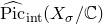




When $f:X\rightarrow Y$
is clear in the context, and
$f:X\rightarrow Y$
is clear in the context, and $\mkern 1.5mu\overline{\mkern-1.5muL\mkern-1.5mu}\mkern 1.5mu_1,\ldots, \mkern 1.5mu\overline{\mkern-1.5muL\mkern-1.5mu}\mkern 1.5mu_d\in \mathrm{\widehat{Pic}}_{\mathrm{int}}(Y/\bar{K})$
, we shall write
$\mkern 1.5mu\overline{\mkern-1.5muL\mkern-1.5mu}\mkern 1.5mu_1,\ldots, \mkern 1.5mu\overline{\mkern-1.5muL\mkern-1.5mu}\mkern 1.5mu_d\in \mathrm{\widehat{Pic}}_{\mathrm{int}}(Y/\bar{K})$
, we shall write $[\mkern 1.5mu\overline{\mkern-1.5muL\mkern-1.5mu}\mkern 1.5mu_1\cdots \mkern 1.5mu\overline{\mkern-1.5muL\mkern-1.5mu}\mkern 1.5mu_d]_X$
for
$[\mkern 1.5mu\overline{\mkern-1.5muL\mkern-1.5mu}\mkern 1.5mu_1\cdots \mkern 1.5mu\overline{\mkern-1.5muL\mkern-1.5mu}\mkern 1.5mu_d]_X$
for $[f^*\mkern 1.5mu\overline{\mkern-1.5muL\mkern-1.5mu}\mkern 1.5mu_1\cdots f^*\mkern 1.5mu\overline{\mkern-1.5muL\mkern-1.5mu}\mkern 1.5mu_d]_X$
.
$[f^*\mkern 1.5mu\overline{\mkern-1.5muL\mkern-1.5mu}\mkern 1.5mu_1\cdots f^*\mkern 1.5mu\overline{\mkern-1.5muL\mkern-1.5mu}\mkern 1.5mu_d]_X$
.
Definition 7.1. Let K be a number field. The height function associated with an arithmetic adelic line bundle $\mkern 1.5mu\overline{\mkern-1.5muL\mkern-1.5mu}\mkern 1.5mu\in \mathrm{\widehat{Pic}}_{\mathrm{int}}(X/\mathcal{O}_K)_{\mathbb{R}}$
is a function
$\mkern 1.5mu\overline{\mkern-1.5muL\mkern-1.5mu}\mkern 1.5mu\in \mathrm{\widehat{Pic}}_{\mathrm{int}}(X/\mathcal{O}_K)_{\mathbb{R}}$
is a function $h_{\mkern 1.5mu\overline{\mkern-1.5muL\mkern-1.5mu}\mkern 1.5mu}:X(K^{\mathrm{alg}})\rightarrow \mathbb{R}$
defined by
$h_{\mkern 1.5mu\overline{\mkern-1.5muL\mkern-1.5mu}\mkern 1.5mu}:X(K^{\mathrm{alg}})\rightarrow \mathbb{R}$
defined by
 \[ h_{\mkern 1.5mu\overline{\mkern-1.5muL\mkern-1.5mu}\mkern 1.5mu}(x):=\frac{[\mkern 1.5mu\overline{\mkern-1.5muL\mkern-1.5mu}\mkern 1.5mu]_{x'}}{[\kappa(x'):K]},\]
where $x\in X(K^{\mathrm{alg}})$
is an algebraic point and
$x\in X(K^{\mathrm{alg}})$
is an algebraic point and $x'\in X$
is the scheme-theoretic point of x.
$x'\in X$
is the scheme-theoretic point of x.
For instance, on a projective space $\mathbb{P}^N$
over a number field K, the nave adelic line bundle
$\mathbb{P}^N$
over a number field K, the nave adelic line bundle $\mkern 1.5mu\overline{\mkern-1.5mu\mathcal{O}(1)\mkern-1.5mu}\mkern 1.5mu$
is the adelic metric on
$\mkern 1.5mu\overline{\mkern-1.5mu\mathcal{O}(1)\mkern-1.5mu}\mkern 1.5mu$
is the adelic metric on $\mathcal{O}(1)$
whose associated height function
$\mathcal{O}(1)$
whose associated height function $h_{\mkern 1.5mu\overline{\mkern-1.5mu\mathcal{O}(1)\mkern-1.5mu}\mkern 1.5mu}$
is the usual nave height function.
$h_{\mkern 1.5mu\overline{\mkern-1.5mu\mathcal{O}(1)\mkern-1.5mu}\mkern 1.5mu}$
is the usual nave height function.
7.2 Volume and bigness
We work in the geometric/arithmetic setting for this subsection. Let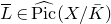 $\mkern 1.5mu\overline{\mkern-1.5muL\mkern-1.5mu}\mkern 1.5mu\in \mathrm{\widehat{Pic}}(X/\bar{K})$
and let
$\mkern 1.5mu\overline{\mkern-1.5muL\mkern-1.5mu}\mkern 1.5mu\in \mathrm{\widehat{Pic}}(X/\bar{K})$
and let $\lVert\cdot\rVert$
be the associated metric on
$\lVert\cdot\rVert$
be the associated metric on $L^{\mathrm{an}}$
.
$L^{\mathrm{an}}$
.
Definition 7.2. The set of effective sections, denoted by $\widehat{H}^0(X,\mkern 1.5mu\overline{\mkern-1.5muL\mkern-1.5mu}\mkern 1.5mu)$
, is defined to be the subset of global sections
$\widehat{H}^0(X,\mkern 1.5mu\overline{\mkern-1.5muL\mkern-1.5mu}\mkern 1.5mu)$
, is defined to be the subset of global sections $s\in H^0(X, L)$
such that
$s\in H^0(X, L)$
such that $\lVert s^{\mathrm{an}}(x)\rVert\leq 1$
for any
$\lVert s^{\mathrm{an}}(x)\rVert\leq 1$
for any $x\in X^{\mathrm{an}}$
, where
$x\in X^{\mathrm{an}}$
, where $s^{\mathrm{an}}$
is the section on
$s^{\mathrm{an}}$
is the section on $L^{\mathrm{an}}$
corresponding to s. Define the quantity
$L^{\mathrm{an}}$
corresponding to s. Define the quantity
 \begin{equation*} \hat h^0(X,\mkern 1.5mu\overline{\mkern-1.5muL\mkern-1.5mu}\mkern 1.5mu):=\begin{cases} \dim_K \widehat H^0(X,\mkern 1.5mu\overline{\mkern-1.5muL\mkern-1.5mu}\mkern 1.5mu) & \text{in a geometric setting,}\\ \log\#\widehat H^0(X,\mkern 1.5mu\overline{\mkern-1.5muL\mkern-1.5mu}\mkern 1.5mu) & \text{in a arithmetic setting.} \end{cases} \end{equation*}
The existence of nontrivial effective sections has the following implication on height.
Lemma 7.3. Let K be a number field and let $\mkern 1.5mu\overline{\mkern-1.5muL\mkern-1.5mu}\mkern 1.5mu\in \mathrm{\widehat{Pic}}_{\mathrm{int}}(X/\mathcal{O}_K)$
. If there is a nonzero effective section
$\mkern 1.5mu\overline{\mkern-1.5muL\mkern-1.5mu}\mkern 1.5mu\in \mathrm{\widehat{Pic}}_{\mathrm{int}}(X/\mathcal{O}_K)$
. If there is a nonzero effective section $s\in \widehat H^0(X,m\mkern 1.5mu\overline{\mkern-1.5muL\mkern-1.5mu}\mkern 1.5mu)$
for nonzero
$s\in \widehat H^0(X,m\mkern 1.5mu\overline{\mkern-1.5muL\mkern-1.5mu}\mkern 1.5mu)$
for nonzero $m\in \mathbb{N}$
, then
$m\in \mathbb{N}$
, then $h_{\mkern 1.5mu\overline{\mkern-1.5muL\mkern-1.5mu}\mkern 1.5mu}(x)\geq 0$
for any
$h_{\mkern 1.5mu\overline{\mkern-1.5muL\mkern-1.5mu}\mkern 1.5mu}(x)\geq 0$
for any $x\in X(K^{\mathrm{alg}})$
with
$x\in X(K^{\mathrm{alg}})$
with $s(x)\neq 0$
.
$s(x)\neq 0$
.
Proof. Let $x\in X(K^{\mathrm{alg}})$
be a point with
$x\in X(K^{\mathrm{alg}})$
be a point with $s(x)\neq0$
and let
$s(x)\neq0$
and let $x'\in X$
be the scheme-theoretic point of x. By definition, we have
$x'\in X$
be the scheme-theoretic point of x. By definition, we have
 \[ mh_{\mkern 1.5mu\overline{\mkern-1.5muL\mkern-1.5mu}\mkern 1.5mu}(x)=\frac{[m\mkern 1.5mu\overline{\mkern-1.5muL\mkern-1.5mu}\mkern 1.5mu]_{x'}}{[\kappa(x'):K]}=\frac{1}{[\kappa(x'):K]}\sum_{v\in \Sigma_K}\sum_{y\in x'_v}-[\kappa(y):K_v]\log\lVert s(y)\rVert \]
where $\Sigma_K$
denotes all the places of K and
$\Sigma_K$
denotes all the places of K and $x'_v$
is the finite set of points of
$x'_v$
is the finite set of points of $X^{\mathrm{an}}$
given by the image of
$X^{\mathrm{an}}$
given by the image of $x'\times_{\mathrm{Spec} K} \mathrm{Spec} K_v$
in
$x'\times_{\mathrm{Spec} K} \mathrm{Spec} K_v$
in $X_{K_v}$
. Then we have
$X_{K_v}$
. Then we have $h_{\mkern 1.5mu\overline{\mkern-1.5muL\mkern-1.5mu}\mkern 1.5mu}(x)\geq0$
since
$h_{\mkern 1.5mu\overline{\mkern-1.5muL\mkern-1.5mu}\mkern 1.5mu}(x)\geq0$
since $\lVert s(y) \rVert\leq 1$
.
$\lVert s(y) \rVert\leq 1$
.
Definition 7.4. The volume of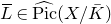 $\mkern 1.5mu\overline{\mkern-1.5muL\mkern-1.5mu}\mkern 1.5mu\in \mathrm{\widehat{Pic}}(X/\bar{K})$
is defined as
$\mkern 1.5mu\overline{\mkern-1.5muL\mkern-1.5mu}\mkern 1.5mu\in \mathrm{\widehat{Pic}}(X/\bar{K})$
is defined as
 \[\widehat{\mathrm{vol}}(X,\mkern 1.5mu\overline{\mkern-1.5muL\mkern-1.5mu}\mkern 1.5mu):=\lim_{m\rightarrow \in fty}\frac{d!}{m^d}\widehat h^0(X,m\mkern 1.5mu\overline{\mkern-1.5muL\mkern-1.5mu}\mkern 1.5mu), \]
where the limit exists by [Reference Yuan and ZhangYZ26, Theorem 5.2.1]. More generally, the volume of a $\mathbb{Q}$
-adelic line bundle
$\mathbb{Q}$
-adelic line bundle $\mkern 1.5mu\overline{\mkern-1.5muL\mkern-1.5mu}\mkern 1.5mu\in \mathrm{\widehat{Pic}}(X/\bar{K})_{\mathbb{Q}}$
is defined as
$\mkern 1.5mu\overline{\mkern-1.5muL\mkern-1.5mu}\mkern 1.5mu\in \mathrm{\widehat{Pic}}(X/\bar{K})_{\mathbb{Q}}$
is defined as ${1}/{N^d}\widehat{\mathrm{vol}}(X,N\mkern 1.5mu\overline{\mkern-1.5muL\mkern-1.5mu}\mkern 1.5mu)$
for any
${1}/{N^d}\widehat{\mathrm{vol}}(X,N\mkern 1.5mu\overline{\mkern-1.5muL\mkern-1.5mu}\mkern 1.5mu)$
for any $N\in \mathbb{N}$
such that
$N\in \mathbb{N}$
such that $N\mkern 1.5mu\overline{\mkern-1.5muL\mkern-1.5mu}\mkern 1.5mu\in \mathrm{\widehat{Pic}}(X/\bar{K})$
.
$N\mkern 1.5mu\overline{\mkern-1.5muL\mkern-1.5mu}\mkern 1.5mu\in \mathrm{\widehat{Pic}}(X/\bar{K})$
.
If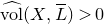 $\widehat{\mathrm{vol}}(X,\mkern 1.5mu\overline{\mkern-1.5muL\mkern-1.5mu}\mkern 1.5mu) \gt 0$
, we say
$\widehat{\mathrm{vol}}(X,\mkern 1.5mu\overline{\mkern-1.5muL\mkern-1.5mu}\mkern 1.5mu) \gt 0$
, we say $\mkern 1.5mu\overline{\mkern-1.5muL\mkern-1.5mu}\mkern 1.5mu$
is big.
$\mkern 1.5mu\overline{\mkern-1.5muL\mkern-1.5mu}\mkern 1.5mu$
is big.
For integrable adelic line bundles, volume is closely related to intersection theory in the following way by [Reference Yuan and ZhangYZ26, Theorem 5.2.2].
Theorem 7.5. For $\mkern 1.5mu\overline{\mkern-1.5muL\mkern-1.5mu}\mkern 1.5mu,\mkern 1.5mu\overline{\mkern-1.5muM\mkern-1.5mu}\mkern 1.5mu\in \mathrm{\widehat{Pic}}_{\mathrm{nef}}(X/\bar{K})_{\mathbb{Q}}$
, the following hold.
$\mkern 1.5mu\overline{\mkern-1.5muL\mkern-1.5mu}\mkern 1.5mu,\mkern 1.5mu\overline{\mkern-1.5muM\mkern-1.5mu}\mkern 1.5mu\in \mathrm{\widehat{Pic}}_{\mathrm{nef}}(X/\bar{K})_{\mathbb{Q}}$
, the following hold.
-
(1) The arithmetic Hilbert–Samuel theorem:
$\widehat{\mathrm{vol}}(X,\mkern 1.5mu\overline{\mkern-1.5muL\mkern-1.5mu}\mkern 1.5mu)=[\mkern 1.5mu\overline{\mkern-1.5muL\mkern-1.5mu}\mkern 1.5mu^{d}]_X$
. -
(2) Siu–Yuan bigness theorem:
$\widehat{\mathrm{vol}}(X,\mkern 1.5mu\overline{\mkern-1.5muL\mkern-1.5mu}\mkern 1.5mu-\mkern 1.5mu\overline{\mkern-1.5muM\mkern-1.5mu}\mkern 1.5mu)\geq [\mkern 1.5mu\overline{\mkern-1.5muL\mkern-1.5mu}\mkern 1.5mu^{d}]_X-d[\mkern 1.5mu\overline{\mkern-1.5muL\mkern-1.5mu}\mkern 1.5mu^{d-1}\mkern 1.5mu\overline{\mkern-1.5muM\mkern-1.5mu}\mkern 1.5mu]_X$
.


Corollary 7.6. Let $f:X\rightarrow Y$
be a dominant morphism of quasi-projective varieties over K. For
$f:X\rightarrow Y$
be a dominant morphism of quasi-projective varieties over K. For $\mkern 1.5mu\overline{\mkern-1.5muL\mkern-1.5mu}\mkern 1.5mu\in \mathrm{\widehat{Pic}}_{\mathrm{nef}}(Y/\bar{K})$
, the pullback
$\mkern 1.5mu\overline{\mkern-1.5muL\mkern-1.5mu}\mkern 1.5mu\in \mathrm{\widehat{Pic}}_{\mathrm{nef}}(Y/\bar{K})$
, the pullback $f^*\mkern 1.5mu\overline{\mkern-1.5muL\mkern-1.5mu}\mkern 1.5mu$
is big if and only if f is generically finite and
$f^*\mkern 1.5mu\overline{\mkern-1.5muL\mkern-1.5mu}\mkern 1.5mu$
is big if and only if f is generically finite and $\mkern 1.5mu\overline{\mkern-1.5muL\mkern-1.5mu}\mkern 1.5mu$
is big on Y.
$\mkern 1.5mu\overline{\mkern-1.5muL\mkern-1.5mu}\mkern 1.5mu$
is big on Y.
Proof. This follows directly from the arithmetic Hilbert–Samuel theorem and the projection formula (7.1).
7.3 Invariant metrics
Now let $\mathcal{A}/S$
be an abelian scheme over a quasi-projective normal variety S over K. We are interested in a certain metric on symmetric line bundles that is invariant under the group structure. The starting point is the following existence result.
$\mathcal{A}/S$
be an abelian scheme over a quasi-projective normal variety S over K. We are interested in a certain metric on symmetric line bundles that is invariant under the group structure. The starting point is the following existence result.
Theorem 7.7. For any $\mathcal{L}\in \mathrm{Pic}_{0}(\mathcal{A}/S)$
, there is a unique integrable adelic line bundle
$\mathcal{L}\in \mathrm{Pic}_{0}(\mathcal{A}/S)$
, there is a unique integrable adelic line bundle $\mkern 1.5mu\overline{\mkern-1.5mu\mathcal{L}\mkern-1.5mu}\mkern 1.5mu\in \mathrm{\widehat{Pic}}_{\mathrm{int}}(\mathcal{A}/\bar{K})$
extending
$\mkern 1.5mu\overline{\mkern-1.5mu\mathcal{L}\mkern-1.5mu}\mkern 1.5mu\in \mathrm{\widehat{Pic}}_{\mathrm{int}}(\mathcal{A}/\bar{K})$
extending $\mathcal{L}$
such that
$\mathcal{L}$
such that $[l]^*{\mkern 1.5mu\overline{\mkern-1.5mu\mathcal{L}\mkern-1.5mu}\mkern 1.5mu}\cong l^2\mkern 1.5mu\overline{\mkern-1.5mu\mathcal{L}\mkern-1.5mu}\mkern 1.5mu$
. If
$[l]^*{\mkern 1.5mu\overline{\mkern-1.5mu\mathcal{L}\mkern-1.5mu}\mkern 1.5mu}\cong l^2\mkern 1.5mu\overline{\mkern-1.5mu\mathcal{L}\mkern-1.5mu}\mkern 1.5mu$
. If $\mathcal{L}$
is ample, then
$\mathcal{L}$
is ample, then $\mkern 1.5mu\overline{\mkern-1.5mu\mathcal{L}\mkern-1.5mu}\mkern 1.5mu$
is nef as an adelic line bundle.
$\mkern 1.5mu\overline{\mkern-1.5mu\mathcal{L}\mkern-1.5mu}\mkern 1.5mu$
is nef as an adelic line bundle.
Proof. In the geometric/arithmetic case, the existence and uniqueness are stated in [Reference Yuan and ZhangYZ26, Theorem 6.1.3] with $\epsilon=1$
. It is proved by Tate’s limiting argument, and the second statement is given in Theorem 6.1.1 of [Reference Yuan and ZhangYZ26]. Localization gives the archimedean local case.
$\epsilon=1$
. It is proved by Tate’s limiting argument, and the second statement is given in Theorem 6.1.1 of [Reference Yuan and ZhangYZ26]. Localization gives the archimedean local case.
By extending linearly, we can associate a unique invariant integrable $\mathbb{R}$
-adelic line bundle to any symmetric
$\mathbb{R}$
-adelic line bundle to any symmetric $\mathbb{R}$
-line bundle
$\mathbb{R}$
-line bundle $\mathcal{L}\in \mathrm{Pic}_{0}(\mathcal{A}/S)_{\mathbb{R}}$
. If
$\mathcal{L}\in \mathrm{Pic}_{0}(\mathcal{A}/S)_{\mathbb{R}}$
. If $\mathcal{B}/S$
is another abelian scheme and
$\mathcal{B}/S$
is another abelian scheme and $f\in \mathrm{Hom}(\mathcal{A},\mathcal{B})_{\mathbb{R}}$
, define
$f\in \mathrm{Hom}(\mathcal{A},\mathcal{B})_{\mathbb{R}}$
, define $f^*\mkern 1.5mu\overline{\mkern-1.5mu\mathcal{L}\mkern-1.5mu}\mkern 1.5mu:=\mkern 1.5mu\overline{\mkern-1.5muf^*\mathcal{L}\mkern-1.5mu}\mkern 1.5mu$
. The following lemma concerning the continuity of intersection numbers with respect to
$f^*\mkern 1.5mu\overline{\mkern-1.5mu\mathcal{L}\mkern-1.5mu}\mkern 1.5mu:=\mkern 1.5mu\overline{\mkern-1.5muf^*\mathcal{L}\mkern-1.5mu}\mkern 1.5mu$
. The following lemma concerning the continuity of intersection numbers with respect to $\mathbb{R}$
-pullbacks will be useful to us.
$\mathbb{R}$
-pullbacks will be useful to us.
Lemma 7.8. Let $\mathcal{X}\subseteq \mathcal{A}$
be a subvariety of model dimension d. Let
$\mathcal{X}\subseteq \mathcal{A}$
be a subvariety of model dimension d. Let $\mathcal{L}_1,\ldots,\mathcal{L}_i\in \mathrm{Pic}_{0}(\mathcal{B}/S)_{\mathbb{R}}$
and
$\mathcal{L}_1,\ldots,\mathcal{L}_i\in \mathrm{Pic}_{0}(\mathcal{B}/S)_{\mathbb{R}}$
and $\mkern 1.5mu\overline{\mkern-1.5mu\mathcal{M}\mkern-1.5mu}\mkern 1.5mu_1,\ldots,\mkern 1.5mu\overline{\mkern-1.5mu\mathcal{M}\mkern-1.5mu}\mkern 1.5mu_j\in \mathrm{\widehat{Pic}}_{\mathrm{int}}(\mathcal{A}/\bar{K})_{\mathbb{R}}$
with
$\mkern 1.5mu\overline{\mkern-1.5mu\mathcal{M}\mkern-1.5mu}\mkern 1.5mu_1,\ldots,\mkern 1.5mu\overline{\mkern-1.5mu\mathcal{M}\mkern-1.5mu}\mkern 1.5mu_j\in \mathrm{\widehat{Pic}}_{\mathrm{int}}(\mathcal{A}/\bar{K})_{\mathbb{R}}$
with $i+j=d$
. In the geometric/arithmetic setting, the function given by intersection numbers
$i+j=d$
. In the geometric/arithmetic setting, the function given by intersection numbers
 \begin{align*} \mathrm{Hom}(\mathcal{A},\mathcal{B})_{\mathbb{R}}&\longrightarrow \mathbb{R}\nonumber\\ f&\longmapsto [(f^*\mkern 1.5mu\overline{\mkern-1.5mu\mathcal{L}\mkern-1.5mu}\mkern 1.5mu_1)\cdots (f^*\mkern 1.5mu\overline{\mkern-1.5mu\mathcal{L}\mkern-1.5mu}\mkern 1.5mu_i) \mkern 1.5mu\overline{\mkern-1.5mu\mathcal{M}\mkern-1.5mu}\mkern 1.5mu_1\cdots\mkern 1.5mu\overline{\mkern-1.5mu\mathcal{M}\mkern-1.5mu}\mkern 1.5mu_j]_{\mathcal{X}} \end{align*}
is continuous and homogeneous of degree 2i.
Proof. The intersection pairings are continuous by definition when restricted to the subspace spanned by $\{f^*\mkern 1.5mu\overline{\mkern-1.5mu\mathcal{L}\mkern-1.5mu}\mkern 1.5mu_i,\mkern 1.5mu\overline{\mkern-1.5mu\mathcal{M}\mkern-1.5mu}\mkern 1.5mu_j:f,i,j\}$
, which is finite dimensional by (3.5). Thus, the result follows from the continuity of the pullback map as a quadratic form (3.3). It is homogeneous of degree 2i since
$\{f^*\mkern 1.5mu\overline{\mkern-1.5mu\mathcal{L}\mkern-1.5mu}\mkern 1.5mu_i,\mkern 1.5mu\overline{\mkern-1.5mu\mathcal{M}\mkern-1.5mu}\mkern 1.5mu_j:f,i,j\}$
, which is finite dimensional by (3.5). Thus, the result follows from the continuity of the pullback map as a quadratic form (3.3). It is homogeneous of degree 2i since $(nf)^*\mkern 1.5mu\overline{\mkern-1.5mu\mathcal{L}\mkern-1.5mu}\mkern 1.5mu_i=n^2 f^*\mkern 1.5mu\overline{\mkern-1.5mu\mathcal{L}\mkern-1.5mu}\mkern 1.5mu_i$
for any
$(nf)^*\mkern 1.5mu\overline{\mkern-1.5mu\mathcal{L}\mkern-1.5mu}\mkern 1.5mu_i=n^2 f^*\mkern 1.5mu\overline{\mkern-1.5mu\mathcal{L}\mkern-1.5mu}\mkern 1.5mu_i$
for any $n\in \mathbb{R}$
.
$n\in \mathbb{R}$
.
For later purposes, we use the following convention to avoid ambiguity.
-
(1) Geometric: the invariant adelic line bundle is denoted by
$\widetilde{\mathcal{L}}\in \mathrm{\widehat{Pic}}(\mathcal{A}/K)_{\mathbb{R}}$
. -
(2) Archimedean local/arithmetic: the invariant adelic line bundle is denoted by
$\mkern 1.5mu\overline{\mkern-1.5mu\mathcal{L}\mkern-1.5mu}\mkern 1.5mu \in \mathrm{\widehat{Pic}}(\mathcal{A}/\mathcal{O}_K)_{\mathbb{R}}$
.
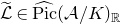

In the arithmetic case, the height $h_{\mkern 1.5mu\overline{\mkern-1.5mu\mathcal{L}\mkern-1.5mu}\mkern 1.5mu}$
is the fiber-wise Néron–Tate height associated to
$h_{\mkern 1.5mu\overline{\mkern-1.5mu\mathcal{L}\mkern-1.5mu}\mkern 1.5mu}$
is the fiber-wise Néron–Tate height associated to $\mathcal{L}$
, and can be equivalently defined by Tate’s limit argument. Specifically, if
$\mathcal{L}$
, and can be equivalently defined by Tate’s limit argument. Specifically, if $\mathcal{L}\in \mathrm{Pic}_0(\mathcal{A}/S)$
is ample, embedding
$\mathcal{L}\in \mathrm{Pic}_0(\mathcal{A}/S)$
is ample, embedding $\mathcal{A}$
in some projective space
$\mathcal{A}$
in some projective space $\mathbb{P}^N$
such that
$\mathbb{P}^N$
such that $[\mathcal{O}(1)|_{\mathcal{A}}]=[\mathcal{L}]^n\in \mathrm{Pic}_0(\mathcal{A}/S)$
for some
$[\mathcal{O}(1)|_{\mathcal{A}}]=[\mathcal{L}]^n\in \mathrm{Pic}_0(\mathcal{A}/S)$
for some $n\in \mathbb{N}$
, then
$n\in \mathbb{N}$
, then
 \[n\cdot h_{\mkern 1.5mu\overline{\mkern-1.5mu\mathcal{L}\mkern-1.5mu}\mkern 1.5mu}(x)=\lim_{l\rightarrow \in fty}l^{-2}\cdot h_{\mathbb{P}^N}([l]x),\]
where $h_{\mathbb{P}^N}$
is the nave height and
$h_{\mathbb{P}^N}$
is the nave height and $x\in \mathcal{A}(K^{\mathrm{alg}})$
. Extending linearly gives the definition for general
$x\in \mathcal{A}(K^{\mathrm{alg}})$
. Extending linearly gives the definition for general $\mathcal{L}$
. We have the following convenient lemma.
$\mathcal{L}$
. We have the following convenient lemma.
Lemma 7.9. For $\mathcal{L}\in \mathrm{Pic}_{0}(\mathcal{A}/S)_{\mathbb{R}}$
,
$\mathcal{L}\in \mathrm{Pic}_{0}(\mathcal{A}/S)_{\mathbb{R}}$
, $\mathcal{L}\geq 0$
if and only if
$\mathcal{L}\geq 0$
if and only if $h_{\mkern 1.5mu\overline{\mkern-1.5mu\mathcal{L}\mkern-1.5mu}\mkern 1.5mu}\geq0$
.
$h_{\mkern 1.5mu\overline{\mkern-1.5mu\mathcal{L}\mkern-1.5mu}\mkern 1.5mu}\geq0$
.
Proof. If $\mathcal{L}$
is nef, taking an ample
$\mathcal{L}$
is nef, taking an ample $\mathcal{L}_0\in \mathrm{Pic}_0(\mathcal{A}/S)$
, then
$\mathcal{L}_0\in \mathrm{Pic}_0(\mathcal{A}/S)$
, then $\mathcal{L}_\epsilon:=\mathcal{L}+\epsilon \mathcal{L}_0$
is ample for any
$\mathcal{L}_\epsilon:=\mathcal{L}+\epsilon \mathcal{L}_0$
is ample for any $\epsilon \gt 0$
, and hence can be written as a positive linear combination of ample integral line bundles by Proposition 3.1(4). Then
$\epsilon \gt 0$
, and hence can be written as a positive linear combination of ample integral line bundles by Proposition 3.1(4). Then $ h_{\mkern 1.5mu\overline{\mkern-1.5mu\mathcal{L}\mkern-1.5mu}\mkern 1.5mu_\epsilon}\geq 0$
. Letting
$ h_{\mkern 1.5mu\overline{\mkern-1.5mu\mathcal{L}\mkern-1.5mu}\mkern 1.5mu_\epsilon}\geq 0$
. Letting $\epsilon\rightarrow 0$
, we get
$\epsilon\rightarrow 0$
, we get $h_{\mkern 1.5mu\overline{\mkern-1.5mu\mathcal{L}\mkern-1.5mu}\mkern 1.5mu}\geq 0$
.
$h_{\mkern 1.5mu\overline{\mkern-1.5mu\mathcal{L}\mkern-1.5mu}\mkern 1.5mu}\geq 0$
.
Conversely, if $\mathcal{L}$
is not nef, then there is a curve C on a fiber such that
$\mathcal{L}$
is not nef, then there is a curve C on a fiber such that $\deg(\mathcal{L}|_C) \lt 0$
. Then the height
$\deg(\mathcal{L}|_C) \lt 0$
. Then the height $ h_{\mkern 1.5mu\overline{\mkern-1.5mu\mathcal{L}\mkern-1.5mu}\mkern 1.5mu}|_C= h_{\mkern 1.5mu\overline{\mkern-1.5mu\mathcal{L}\mkern-1.5mu}\mkern 1.5mu|_C}$
on C can be arbitrarily negative since
$ h_{\mkern 1.5mu\overline{\mkern-1.5mu\mathcal{L}\mkern-1.5mu}\mkern 1.5mu}|_C= h_{\mkern 1.5mu\overline{\mkern-1.5mu\mathcal{L}\mkern-1.5mu}\mkern 1.5mu|_C}$
on C can be arbitrarily negative since $-\mathcal{L}|_C$
is ample.
$-\mathcal{L}|_C$
is ample.
As a consequence, if $\mathcal{L}\equiv\mathcal{L}'$
for
$\mathcal{L}\equiv\mathcal{L}'$
for $\mathcal{L}'\in \mathrm{Pic}_0(\mathcal{A}/S)_{\mathbb{R}}$
, then
$\mathcal{L}'\in \mathrm{Pic}_0(\mathcal{A}/S)_{\mathbb{R}}$
, then $\hat h_{\mathcal{L}}=\hat h_{\mathcal{L}'}$
. In other words, the association of Néron–Tate height function to
$\hat h_{\mathcal{L}}=\hat h_{\mathcal{L}'}$
. In other words, the association of Néron–Tate height function to $\mathrm{Pic}_0(\mathcal{A}/S)_{\mathbb{R}}$
factors through
$\mathrm{Pic}_0(\mathcal{A}/S)_{\mathbb{R}}$
factors through $\mathrm{NS}(\mathcal{A}/S)_{\mathbb{R}}$
.
$\mathrm{NS}(\mathcal{A}/S)_{\mathbb{R}}$
.
In the next lemma, we show that a total height function on $\mathcal{A}$
dominates other height functions in a suitable sense.
$\mathcal{A}$
dominates other height functions in a suitable sense.
Lemma 7.10. Let $\iota:\mathcal{A}\hookrightarrow \mathbb{P}^{N}$
be an embedding and denote the nave height function restricted to
$\iota:\mathcal{A}\hookrightarrow \mathbb{P}^{N}$
be an embedding and denote the nave height function restricted to $\mathcal{A}$
by h. For
$\mathcal{A}$
by h. For $\mkern 1.5mu\overline{\mkern-1.5mu\mathcal{M}\mkern-1.5mu}\mkern 1.5mu\in \mathrm{\widehat{Pic}}_{\mathrm{int}}(\mathcal{A}/\mathcal{O}_K)$
, there exists
$\mkern 1.5mu\overline{\mkern-1.5mu\mathcal{M}\mkern-1.5mu}\mkern 1.5mu\in \mathrm{\widehat{Pic}}_{\mathrm{int}}(\mathcal{A}/\mathcal{O}_K)$
, there exists $c \gt 0$
such that
$c \gt 0$
such that $h_{\mkern 1.5mu\overline{\mkern-1.5mu\mathcal{M}\mkern-1.5mu}\mkern 1.5mu}\leq c\max\{1,h\}$
.
$h_{\mkern 1.5mu\overline{\mkern-1.5mu\mathcal{M}\mkern-1.5mu}\mkern 1.5mu}\leq c\max\{1,h\}$
.
Proof. We give a proof in the case where $\mkern 1.5mu\overline{\mkern-1.5mu\mathcal{M}\mkern-1.5mu}\mkern 1.5mu$
is model adelic line bundle. The general case follows by a limit argument. Let
$\mkern 1.5mu\overline{\mkern-1.5mu\mathcal{M}\mkern-1.5mu}\mkern 1.5mu$
is model adelic line bundle. The general case follows by a limit argument. Let $\mathcal{A}_0$
be the generic fiber of a projective model of
$\mathcal{A}_0$
be the generic fiber of a projective model of $\mathcal{A}$
over
$\mathcal{A}$
over $\mathcal{O}_K$
where both
$\mathcal{O}_K$
where both $\iota^*\mkern 1.5mu\overline{\mkern-1.5mu\mathcal{O}(1)\mkern-1.5mu}\mkern 1.5mu$
and
$\iota^*\mkern 1.5mu\overline{\mkern-1.5mu\mathcal{O}(1)\mkern-1.5mu}\mkern 1.5mu$
and $\mkern 1.5mu\overline{\mkern-1.5mu\mathcal{M}\mkern-1.5mu}\mkern 1.5mu$
are realized. The divisor on the generic fiber for
$\mkern 1.5mu\overline{\mkern-1.5mu\mathcal{M}\mkern-1.5mu}\mkern 1.5mu$
are realized. The divisor on the generic fiber for $\iota^*\mkern 1.5mu\overline{\mkern-1.5mu\mathcal{O}(1)\mkern-1.5mu}\mkern 1.5mu$
can be taken as
$\iota^*\mkern 1.5mu\overline{\mkern-1.5mu\mathcal{O}(1)\mkern-1.5mu}\mkern 1.5mu$
can be taken as $D+E$
where D is ample and E is an effective divisor supported away from
$D+E$
where D is ample and E is an effective divisor supported away from $\mathcal{A}$
. Let
$\mathcal{A}$
. Let $D_1$
be a divisor for
$D_1$
be a divisor for $\mkern 1.5mu\overline{\mkern-1.5mu\mathcal{M}\mkern-1.5mu}\mkern 1.5mu$
. Then for sufficiently small
$\mkern 1.5mu\overline{\mkern-1.5mu\mathcal{M}\mkern-1.5mu}\mkern 1.5mu$
. Then for sufficiently small $\epsilon \gt 0$
,
$\epsilon \gt 0$
, $D-\epsilon D_1$
is ample. In particular, the base locus of
$D-\epsilon D_1$
is ample. In particular, the base locus of $\mathcal{O}(D-\epsilon D_1+E)$
is in the complement of
$\mathcal{O}(D-\epsilon D_1+E)$
is in the complement of $\mathcal{A}$
. Thus,
$\mathcal{A}$
. Thus, $h-\epsilon h_{\mkern 1.5mu\overline{\mkern-1.5mu\mathcal{M}\mkern-1.5mu}\mkern 1.5mu}$
is bounded below by a constant on
$h-\epsilon h_{\mkern 1.5mu\overline{\mkern-1.5mu\mathcal{M}\mkern-1.5mu}\mkern 1.5mu}$
is bounded below by a constant on $\mathcal{A}$
. This concludes the proof.
$\mathcal{A}$
. This concludes the proof.
As an immediate corollary, we see that the choice of total height functions is irrelevant for our purpose of bounded height results.
Corollary 7.11. For $i=1,2$
, let
$i=1,2$
, let $h_{i}$
be the restricted nave height functions on
$h_{i}$
be the restricted nave height functions on $\mathcal{A}$
induced by embedding into projective spaces. There exists
$\mathcal{A}$
induced by embedding into projective spaces. There exists $c \gt 0$
such that
$c \gt 0$
such that
 \[ c^{-1}\max\{1,h_1\}\leq \max\{1,h_2\}\leq c\max\{1,h_1\}. \]
Moreover, we can equivalently use a sum of the fiber-wise Néron–Tate height with an ample height on the base as the total height, if we use a result of Silverman and Tate [Reference SilvermanSil83, Theorem A].
7.4 Monge–Ampère measure
We work over $K=\mathbb{C}$
in this subsection. Classically, when X is a complex projective variety of dimension d and
$K=\mathbb{C}$
in this subsection. Classically, when X is a complex projective variety of dimension d and $\mkern 1.5mu\overline{\mkern-1.5muL\mkern-1.5mu}\mkern 1.5mu_1,\ldots,\mkern 1.5mu\overline{\mkern-1.5muL\mkern-1.5mu}\mkern 1.5mu_d$
are smooth hermitian line bundles, the intersection number
$\mkern 1.5mu\overline{\mkern-1.5muL\mkern-1.5mu}\mkern 1.5mu_1,\ldots,\mkern 1.5mu\overline{\mkern-1.5muL\mkern-1.5mu}\mkern 1.5mu_d$
are smooth hermitian line bundles, the intersection number $[L_1\cdots L_d]_X$
is equal to the integral over
$[L_1\cdots L_d]_X$
is equal to the integral over $X^{\mathrm{an}}$
of
$X^{\mathrm{an}}$
of $c_1(\mkern 1.5mu\overline{\mkern-1.5muL\mkern-1.5mu}\mkern 1.5mu_1)\wedge\cdots\wedge c_1(\mkern 1.5mu\overline{\mkern-1.5muL\mkern-1.5mu}\mkern 1.5mu_d)$
, where
$c_1(\mkern 1.5mu\overline{\mkern-1.5muL\mkern-1.5mu}\mkern 1.5mu_1)\wedge\cdots\wedge c_1(\mkern 1.5mu\overline{\mkern-1.5muL\mkern-1.5mu}\mkern 1.5mu_d)$
, where $c_1(\bar{L})$
denotes the Chern form of
$c_1(\bar{L})$
denotes the Chern form of $\bar{L}$
, as a special case of the fact that the intersection of cycles in homology is Poincaré dual to the wedge product in cohomology. In general, for quasi-projective X, there is a canonical Radon measure associated to any
$\bar{L}$
, as a special case of the fact that the intersection of cycles in homology is Poincaré dual to the wedge product in cohomology. In general, for quasi-projective X, there is a canonical Radon measure associated to any $(\mkern 1.5mu\overline{\mkern-1.5muL\mkern-1.5mu}\mkern 1.5mu_1,\ldots,\mkern 1.5mu\overline{\mkern-1.5muL\mkern-1.5mu}\mkern 1.5mu_d)\in \mathrm{\widehat{Pic}}_{\mathrm{int}}(X/\mathcal{O}_{\mathbb{C}})^d$
, called the Monge–Ampère measure, on the complex analytic variety
$(\mkern 1.5mu\overline{\mkern-1.5muL\mkern-1.5mu}\mkern 1.5mu_1,\ldots,\mkern 1.5mu\overline{\mkern-1.5muL\mkern-1.5mu}\mkern 1.5mu_d)\in \mathrm{\widehat{Pic}}_{\mathrm{int}}(X/\mathcal{O}_{\mathbb{C}})^d$
, called the Monge–Ampère measure, on the complex analytic variety $X^{\mathrm{an}}$
, denoted by
$X^{\mathrm{an}}$
, denoted by $c_1(\mkern 1.5mu\overline{\mkern-1.5muL\mkern-1.5mu}\mkern 1.5mu_1)\cdots c_1(\mkern 1.5mu\overline{\mkern-1.5muL\mkern-1.5mu}\mkern 1.5mu_d)$
, which can be defined by a limit process using [Reference Bedford and TaylorBT82, Theorem 2.1]. A basic property is that the integral of
$c_1(\mkern 1.5mu\overline{\mkern-1.5muL\mkern-1.5mu}\mkern 1.5mu_1)\cdots c_1(\mkern 1.5mu\overline{\mkern-1.5muL\mkern-1.5mu}\mkern 1.5mu_d)$
, which can be defined by a limit process using [Reference Bedford and TaylorBT82, Theorem 2.1]. A basic property is that the integral of $c_1(\mkern 1.5mu\overline{\mkern-1.5muL\mkern-1.5mu}\mkern 1.5mu_1)\cdots c_1(\mkern 1.5mu\overline{\mkern-1.5muL\mkern-1.5mu}\mkern 1.5mu_d)$
over any strict Zariski-closed subvariety of
$c_1(\mkern 1.5mu\overline{\mkern-1.5muL\mkern-1.5mu}\mkern 1.5mu_1)\cdots c_1(\mkern 1.5mu\overline{\mkern-1.5muL\mkern-1.5mu}\mkern 1.5mu_d)$
over any strict Zariski-closed subvariety of $X^{\mathrm{an}}$
is 0. We refer to [Reference Yuan and ZhangYZ26, § 3.6] for more details and a discussion of the more general Chambert-Loir measure over any complete field with nontrivial valuation.
$X^{\mathrm{an}}$
is 0. We refer to [Reference Yuan and ZhangYZ26, § 3.6] for more details and a discussion of the more general Chambert-Loir measure over any complete field with nontrivial valuation.
The following allows us to compute the geometric intersection number via integration by the Monge–Ampère measure.
Theorem 7.12. Let $\mkern 1.5mu\overline{\mkern-1.5mu L\mkern-1.5mu}\mkern 1.5mu_1,\ldots,\mkern 1.5mu\overline{\mkern-1.5mu L\mkern-1.5mu}\mkern 1.5mu_d\in \mathrm{\widehat{Pic}}_{\mathrm{int}}(X/\mathcal{O}_{\mathbb{C}})$
and let
$\mkern 1.5mu\overline{\mkern-1.5mu L\mkern-1.5mu}\mkern 1.5mu_1,\ldots,\mkern 1.5mu\overline{\mkern-1.5mu L\mkern-1.5mu}\mkern 1.5mu_d\in \mathrm{\widehat{Pic}}_{\mathrm{int}}(X/\mathcal{O}_{\mathbb{C}})$
and let $\widetilde L_1,\ldots,\widetilde L_d\in \mathrm{\widetilde{Pic}}_{\mathrm{int}}(X/\mathbb{C})$
be the localization image. Then
$\widetilde L_1,\ldots,\widetilde L_d\in \mathrm{\widetilde{Pic}}_{\mathrm{int}}(X/\mathbb{C})$
be the localization image. Then
 \[ [\widetilde L_1\cdots\widetilde L_d]_X= \in t_{X^{\mathrm{an}}}c_1(\mkern 1.5mu\overline{\mkern-1.5muL\mkern-1.5mu}\mkern 1.5mu_1)\cdots c_1(\mkern 1.5mu\overline{\mkern-1.5muL\mkern-1.5mu}\mkern 1.5mu_d). \]
Proof. For the current general version, see Guo [Reference GuoGuo23]. See also [Reference Yuan and ZhangYZ26, Lemma 5.5.4] for the special case when the involved adelic line bundles are localized from a number field.
Now let $\mathcal{L}_1,\ldots,\mathcal{L}_d\in \mathrm{Pic}_{0}(\mathcal{A}/S)$
. Let
$\mathcal{L}_1,\ldots,\mathcal{L}_d\in \mathrm{Pic}_{0}(\mathcal{A}/S)$
. Let $\mathcal{X}\subseteq\mathcal{A}$
be a subvariety of dimension d. The Monge–Ampère measure
$\mathcal{X}\subseteq\mathcal{A}$
be a subvariety of dimension d. The Monge–Ampère measure $c_1(\mkern 1.5mu\overline{\mkern-1.5mu\mathcal{L}_d\mkern-1.5mu}\mkern 1.5mu|_{\mathcal{X}})\cdots c_1(\mkern 1.5mu\overline{\mkern-1.5mu\mathcal{L}_d\mkern-1.5mu}\mkern 1.5mu|_{\mathcal{X}})$
has a particularly nice description in terms of the Betti forms.
$c_1(\mkern 1.5mu\overline{\mkern-1.5mu\mathcal{L}_d\mkern-1.5mu}\mkern 1.5mu|_{\mathcal{X}})\cdots c_1(\mkern 1.5mu\overline{\mkern-1.5mu\mathcal{L}_d\mkern-1.5mu}\mkern 1.5mu|_{\mathcal{X}})$
has a particularly nice description in terms of the Betti forms.
Theorem 7.13. For $\mathcal{L}_1,\ldots,\mathcal{L}_d\in \mathrm{Pic}_0(\mathcal{A}/S)$
and a subvariety
$\mathcal{L}_1,\ldots,\mathcal{L}_d\in \mathrm{Pic}_0(\mathcal{A}/S)$
and a subvariety $\mathcal{X}\subseteq\mathcal{A}$
of dimension d,
$\mathcal{X}\subseteq\mathcal{A}$
of dimension d,
 \[ c_1(\mkern 1.5mu\overline{\mkern-1.5mu\mathcal{L}_1\mkern-1.5mu}\mkern 1.5mu|_{\mathcal{X}})\cdots c_1(\mkern 1.5mu\overline{\mkern-1.5mu\mathcal{L}_d\mkern-1.5mu}\mkern 1.5mu|_{\mathcal{X}})=\omega(\mathcal{L}_1)\wedge \cdots\wedge \omega(\mathcal{L}_d) \]
as measures on $\mathcal{X}^{\mathrm{an}}$
.
$\mathcal{X}^{\mathrm{an}}$
.
Proof. The result is stated without proof in [Reference Yuan and ZhangYZ26, § 6.2.2]. We assume that $\mathcal{L}_i$
’s are ample; the general case follows by linearity. We also assume that S is smooth since the measure is zero on the strict Zariski-closed nonsmooth part. The idea is to go back to the construction of the invariant metrics by Tate’s limiting argument. Start with any hermitian metric
$\mathcal{L}_i$
’s are ample; the general case follows by linearity. We also assume that S is smooth since the measure is zero on the strict Zariski-closed nonsmooth part. The idea is to go back to the construction of the invariant metrics by Tate’s limiting argument. Start with any hermitian metric $\lVert \cdot\rVert_{i,0}$
on
$\lVert \cdot\rVert_{i,0}$
on $\mathcal{L}_i$
and construct inductively
$\mathcal{L}_i$
and construct inductively $\lVert \cdot \rVert_{i,k}$
on
$\lVert \cdot \rVert_{i,k}$
on $\mathcal{L}_i$
for
$\mathcal{L}_i$
for $k\geq 1$
by the following rule:
$k\geq 1$
by the following rule:
 \[ [2]^*(\mathcal{L}_i,\lVert\cdot\rVert_{i,k-1})\cong (\mathcal{L}_i,\lVert \cdot \rVert_{i,k})^{\otimes 4}. \]
Then $(\mathcal{L}_i,\lVert \cdot \rVert_{i,k})$
tends to
$(\mathcal{L}_i,\lVert \cdot \rVert_{i,k})$
tends to $\mathcal{L}_i$
with the invariant metric
$\mathcal{L}_i$
with the invariant metric $\lVert \cdot \rVert$
. Take nonzero rational sections
$\lVert \cdot \rVert$
. Take nonzero rational sections $s_i$
of
$s_i$
of $\mathcal{L}_i$
. By ampleness,
$\mathcal{L}_i$
. By ampleness, $g_{i,k}:=-\log\lVert s_i \rVert_{i,k}^2$
are sequences of pluri-subharmonic (psh) functions converging locally uniformly to
$g_{i,k}:=-\log\lVert s_i \rVert_{i,k}^2$
are sequences of pluri-subharmonic (psh) functions converging locally uniformly to $g_i:=-\log\lVert s_i \rVert^2$
. By [Reference DemaillyDem93, Corollary 2.6], we know the weak limit
$g_i:=-\log\lVert s_i \rVert^2$
. By [Reference DemaillyDem93, Corollary 2.6], we know the weak limit
 \[ c_1(\mkern 1.5mu\overline{\mkern-1.5mu\mathcal{L}_1\mkern-1.5mu}\mkern 1.5mu|_{\mathcal{X}})\cdots c_1(\mkern 1.5mu\overline{\mkern-1.5mu\mathcal{L}_d\mkern-1.5mu}\mkern 1.5mu|_{\mathcal{X}}):=\lim_{k\rightarrow \in fty}\frac{\sqrt{-1}}{2\pi}\partial\bar\partial(g_{1,k}) \wedge\cdots\wedge \frac{\sqrt{-1}}{2\pi}\partial\bar\partial(g_{d,k}) \]
as a measure on $\mathcal{X}^{\mathrm{an}}$
can be given by the form
$\mathcal{X}^{\mathrm{an}}$
can be given by the form
 \[ \frac{\sqrt{-1}}{2\pi}\partial\bar\partial(g_{1}) \wedge\cdots\wedge \frac{\sqrt{-1}}{2\pi}\partial\bar\partial(g_{d}) \]
restricted to $\mathcal{X}^{\mathrm{an}}$
. On the other hand, the Chern form
$\mathcal{X}^{\mathrm{an}}$
. On the other hand, the Chern form ${\sqrt{-1}}/{2\pi}\partial\bar\partial(g_{i})$
of
${\sqrt{-1}}/{2\pi}\partial\bar\partial(g_{i})$
of $(\mathcal{L}_i,\lVert\cdot\rVert)$
is the unique invariant form
$(\mathcal{L}_i,\lVert\cdot\rVert)$
is the unique invariant form $\omega(\mathcal{L}_i)$
. Thus, we are done.
$\omega(\mathcal{L}_i)$
. Thus, we are done.
Corollary 7.14. For a nef $\mathcal{L}\in \mathrm{Pic}_0(\mathcal{A}/S)_{\mathbb{R}}$
and a subvariety
$\mathcal{L}\in \mathrm{Pic}_0(\mathcal{A}/S)_{\mathbb{R}}$
and a subvariety $\mathcal{X}\subseteq\mathcal{A}$
of dimension d, the self-intersection number
$\mathcal{X}\subseteq\mathcal{A}$
of dimension d, the self-intersection number $[\widetilde{\mathcal{L}}^d]_{\mathcal{X}} \gt 0$
if and only if
$[\widetilde{\mathcal{L}}^d]_{\mathcal{X}} \gt 0$
if and only if $\omega(\mathcal{L})^{\wedge d}|_{\mathcal{X}^{\mathrm{an}}}\not \equiv 0$
.
$\omega(\mathcal{L})^{\wedge d}|_{\mathcal{X}^{\mathrm{an}}}\not \equiv 0$
.
Proof. According to Theorems 7.12 and 7.13, we have
 \[ [\widetilde{\mathcal{L}}^d]_{\mathcal{X}}=\in t_{\mathcal{X}^{\mathrm{an}}}\omega(\mathcal{L})^{\wedge d}|_{\mathcal{X}^{\mathrm{an}}}.\]
By nefness of $\mathcal{L}$
, we know
$\mathcal{L}$
, we know $\omega(\mathcal{L})^{\wedge d}|_{\mathcal{X}^{\mathrm{an}}}$
is semipositive. Hence, the above is positive if and only if the form is nontrivial as a measure.
$\omega(\mathcal{L})^{\wedge d}|_{\mathcal{X}^{\mathrm{an}}}$
is semipositive. Hence, the above is positive if and only if the form is nontrivial as a measure.
8. Homomorphism approximation
In this section, $\mathcal{B}\subseteq \mathcal{A}$
are nontrivial abelian schemes, of respective relative dimension g,g’, over a normal quasi-projective variety S defined over a number field K. We fix ample line bundles
$\mathcal{B}\subseteq \mathcal{A}$
are nontrivial abelian schemes, of respective relative dimension g,g’, over a normal quasi-projective variety S defined over a number field K. We fix ample line bundles $\mathcal{L}_{\mathcal{A}}\in \mathrm{Pic}_{0}(\mathcal{A}/S)$
and
$\mathcal{L}_{\mathcal{A}}\in \mathrm{Pic}_{0}(\mathcal{A}/S)$
and $\mathcal{L}_{\mathcal{B}}\in \mathrm{Pic}_{0}(\mathcal{B}/S)$
. Fix
$\mathcal{L}_{\mathcal{B}}\in \mathrm{Pic}_{0}(\mathcal{B}/S)$
. Fix $\mkern 1.5mu\overline{\mkern-1.5muM\mkern-1.5mu}\mkern 1.5mu_S\in \mathrm{\widehat{Pic}}_{\mathrm{nef}}(S/\mathcal{O}_K)$
and let
$\mkern 1.5mu\overline{\mkern-1.5muM\mkern-1.5mu}\mkern 1.5mu_S\in \mathrm{\widehat{Pic}}_{\mathrm{nef}}(S/\mathcal{O}_K)$
and let $\mkern 1.5mu\overline{\mkern-1.5mu\mathcal{M}\mkern-1.5mu}\mkern 1.5mu:=\mkern 1.5mu\overline{\mkern-1.5mu\mathcal{L}\mkern-1.5mu}\mkern 1.5mu_{\mathcal{A}}+\pi^*\mkern 1.5mu\overline{\mkern-1.5muM\mkern-1.5mu}\mkern 1.5mu_S\in \mathrm{\widehat{Pic}}_{\mathrm{nef}}(\mathcal{A}/\mathcal{O}_K)$
. In particular,
$\mkern 1.5mu\overline{\mkern-1.5mu\mathcal{M}\mkern-1.5mu}\mkern 1.5mu:=\mkern 1.5mu\overline{\mkern-1.5mu\mathcal{L}\mkern-1.5mu}\mkern 1.5mu_{\mathcal{A}}+\pi^*\mkern 1.5mu\overline{\mkern-1.5muM\mkern-1.5mu}\mkern 1.5mu_S\in \mathrm{\widehat{Pic}}_{\mathrm{nef}}(\mathcal{A}/\mathcal{O}_K)$
. In particular, $h_{\mkern 1.5mu\overline{\mkern-1.5mu\mathcal{M}\mkern-1.5mu}\mkern 1.5mu}(x)= h_{\mkern 1.5mu\overline{\mkern-1.5mu\mathcal{L}\mkern-1.5mu}\mkern 1.5mu_{\mathcal{A}}}(x)+h_{\mkern 1.5mu\overline{\mkern-1.5muM\mkern-1.5mu}\mkern 1.5mu_S}(\pi(x))$
, for any
$h_{\mkern 1.5mu\overline{\mkern-1.5mu\mathcal{M}\mkern-1.5mu}\mkern 1.5mu}(x)= h_{\mkern 1.5mu\overline{\mkern-1.5mu\mathcal{L}\mkern-1.5mu}\mkern 1.5mu_{\mathcal{A}}}(x)+h_{\mkern 1.5mu\overline{\mkern-1.5muM\mkern-1.5mu}\mkern 1.5mu_S}(\pi(x))$
, for any $x\in \mathcal{A}(K^{\mathrm{alg}})$
. We refer to
$x\in \mathcal{A}(K^{\mathrm{alg}})$
. We refer to $ h_{\mkern 1.5mu\overline{\mkern-1.5mu\mathcal{L}\mkern-1.5mu}\mkern 1.5mu_{\mathcal{A}}}$
as the relative height and
$ h_{\mkern 1.5mu\overline{\mkern-1.5mu\mathcal{L}\mkern-1.5mu}\mkern 1.5mu_{\mathcal{A}}}$
as the relative height and $h_{\mkern 1.5mu\overline{\mkern-1.5mu\mathcal{M}\mkern-1.5mu}\mkern 1.5mu}$
as the total height.
$h_{\mkern 1.5mu\overline{\mkern-1.5mu\mathcal{M}\mkern-1.5mu}\mkern 1.5mu}$
as the total height.
Definition 8.1. Let $0<\epsilon<{1}/{3}$
. The
$0<\epsilon<{1}/{3}$
. The $\epsilon$
-neighborhood of a point
$\epsilon$
-neighborhood of a point $x\in \mathcal{A}(K^{\mathrm{alg}})$
is defined by
$x\in \mathcal{A}(K^{\mathrm{alg}})$
is defined by
 \[C(\epsilon,x):=\{x+y\in \mathcal{A}(K^{\mathrm{alg}}) \mid h_{\mkern 1.5mu\overline{\mkern-1.5mu\mathcal{L}\mkern-1.5mu}\mkern 1.5mu_{\mathcal{A}}}(y)< \epsilon \max\{1,h_{\mkern 1.5mu\overline{\mkern-1.5mu\mathcal{M}\mkern-1.5mu}\mkern 1.5mu}(x) \}\}.\]
The $\epsilon$
-neighborhood of a subset
$\epsilon$
-neighborhood of a subset $\Sigma\subseteq\mathcal{A}$
is defined by
$\Sigma\subseteq\mathcal{A}$
is defined by $C(\epsilon,\Sigma):=\bigcup_{x\in \Sigma(K^{\mathrm{alg}})}C(\epsilon,x).$
The set of all $\mathcal{B}$
-null
$\mathcal{B}$
-null $K^{\mathrm{alg}}$
-points in
$K^{\mathrm{alg}}$
-points in $\mathcal{A}$
is denoted as
$\mathcal{A}$
is denoted as $\mathrm{\mathfrak{N}}(\mathcal{B})$
. The main result of this section is as follows.
$\mathrm{\mathfrak{N}}(\mathcal{B})$
. The main result of this section is as follows.
Theorem 8.2. Let $\mathcal{X}\subseteq\mathcal{A}$
be a subvariety of dimension d. Assume that
$\mathcal{X}\subseteq\mathcal{A}$
be a subvariety of dimension d. Assume that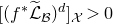 $[(f^*\widetilde{\mathcal{L}}_{\mathcal{B}})^d]_{\mathcal{X}} \gt 0$
for any
$[(f^*\widetilde{\mathcal{L}}_{\mathcal{B}})^d]_{\mathcal{X}} \gt 0$
for any $f\in \mathrm{Hom}(\mathcal{A},\mathcal{B})^\circ_{\mathbb{R}}$
. Then there exists
$f\in \mathrm{Hom}(\mathcal{A},\mathcal{B})^\circ_{\mathbb{R}}$
. Then there exists $\epsilon,c \gt 0$
and an open dense subset
$\epsilon,c \gt 0$
and an open dense subset $\mathcal{U}\subseteq\mathcal{X}$
such that for any
$\mathcal{U}\subseteq\mathcal{X}$
such that for any $p\in \mathcal{U}(K^{\mathrm{alg}})\cap C(\epsilon,\mathrm{\mathfrak{N}}(\mathcal{B}))$
, its total height
$p\in \mathcal{U}(K^{\mathrm{alg}})\cap C(\epsilon,\mathrm{\mathfrak{N}}(\mathcal{B}))$
, its total height $h_{\mkern 1.5mu\overline{\mkern-1.5mu\mathcal{M}\mkern-1.5mu}\mkern 1.5mu}(p)\leq c$
.
$h_{\mkern 1.5mu\overline{\mkern-1.5mu\mathcal{M}\mkern-1.5mu}\mkern 1.5mu}(p)\leq c$
.
It is shown later in Theorem 9.3 that the hypothesis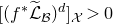 $[(f^*\widetilde{\mathcal{L}}_{\mathcal{B}})^d]_{\mathcal{X}} \gt 0$
holds under some generic conditions on the nondegeneracy of
$[(f^*\widetilde{\mathcal{L}}_{\mathcal{B}})^d]_{\mathcal{X}} \gt 0$
holds under some generic conditions on the nondegeneracy of $\mathcal{X}$
.
$\mathcal{X}$
.
Note that we can and do assume (3.1) without loss of generality by possibly passing to an étale cover of S using Lemma 3.2.
8.1. Height lower bound
In this subsection, we shall establish a lower bound for the total height of a point $p\in \mathcal{A}(K^{\mathrm{alg}})$
that is close to being
$p\in \mathcal{A}(K^{\mathrm{alg}})$
that is close to being $\mathcal{B}$
-null. We need to approximate the general
$\mathcal{B}$
-null. We need to approximate the general $\mathbb{Q}$
-homomorphisms in the compact set
$\mathbb{Q}$
-homomorphisms in the compact set $\mathcal{K}(\mathcal{A},\mathcal{B})$
from Proposition 3.7 by finitely many
$\mathcal{K}(\mathcal{A},\mathcal{B})$
from Proposition 3.7 by finitely many $\mathbb{Q}$
-homomorphisms. Denote the subset of
$\mathbb{Q}$
-homomorphisms. Denote the subset of $\mathcal{K}(\mathcal{A},\mathcal{B})$
consisting of
$\mathcal{K}(\mathcal{A},\mathcal{B})$
consisting of $\mathbb{Q}$
-homomorphisms by
$\mathbb{Q}$
-homomorphisms by
 \[\mathcal{K}_{\mathbb{N}}(\mathcal{A},\mathcal{B}):=\mathcal{K}(\mathcal{A},\mathcal{B})\cap\mathrm{Hom}(\mathcal{A},\mathcal{B})_{\mathbb{Q}}.\]
Denote the finite subset consisting of $\mathbb{Q}$
-homomorphisms with denominator
$\mathbb{Q}$
-homomorphisms with denominator $N\in \mathbb{N}$
by
$N\in \mathbb{N}$
by
 \[\mathcal{K}_N(\mathcal{A},\mathcal{B}):=\mathcal{K}(\mathcal{A},\mathcal{B})\cap N^{-1}\mathrm{Hom}(\mathcal{A},\mathcal{B})=\{f\in \mathcal{K}(\mathcal{A},\mathcal{B})\mid Nf\in \mathrm{Hom}(\mathcal{A},\mathcal{B})\}. \]
Fix any (equivalent) norm $|\cdot|$
on the finite-dimensional vector space
$|\cdot|$
on the finite-dimensional vector space $\mathrm{Hom}(\mathcal{A},\mathcal{B})_{\mathbb{R}}$
. We observe three basic facts.
$\mathrm{Hom}(\mathcal{A},\mathcal{B})_{\mathbb{R}}$
. We observe three basic facts.
-
(1) By compactness, there is
$\gamma \gt 0$
such that
$\gamma^{-1}\leq |f|\leq \gamma$
for any
$f\in \mathcal{K}(\mathcal{A},\mathcal{B})$
. -
(2) Let
$\delta \gt 0$
. By compactness, there exists
$N_\delta\in \mathbb{N}$
such that the
$\delta$
-neighborhood of the set
$\mathcal{K}_{N_\delta}(\mathcal{A},\mathcal{B})$
covers
$\mathcal{K}(\mathcal{A},\mathcal{B})$
. -
(3) There exists
$\lambda \gt 0$
, such that
$f^*\mathcal{L}_{\mathcal{B}} \leq \lambda^2|f|^2\mathcal{L}_{\mathcal{A}} $
for any
$f\in \mathrm{Hom}(\mathcal{A},\mathcal{B})_{\mathbb{R}}$
. Here, we use the notation
$\mathcal{L}_1\leq\mathcal{L}_2$
to mean that
$\mathcal{L}_2-\mathcal{L}_1$
is nef.

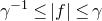






We give a proof of fact (3). By continuity of (3.4), there exists an open neighborhood $\Delta$
of
$\Delta$
of $0\in \mathrm{Hom}(\mathcal{A},\mathcal{B})_{\mathbb{R}}$
such that
$0\in \mathrm{Hom}(\mathcal{A},\mathcal{B})_{\mathbb{R}}$
such that $[\mathcal{L}_{\mathcal{A}}-f^*\mathcal{L}_{\mathcal{B}}]\in \mathrm{Amp}(\mathcal{A}/S)\subseteq\mathrm{NS}(\mathcal{A}/S)_{\mathbb{R}}$
for any
$[\mathcal{L}_{\mathcal{A}}-f^*\mathcal{L}_{\mathcal{B}}]\in \mathrm{Amp}(\mathcal{A}/S)\subseteq\mathrm{NS}(\mathcal{A}/S)_{\mathbb{R}}$
for any $f\in \Delta$
. Take
$f\in \Delta$
. Take $\lambda \gt 0$
such that
$\lambda \gt 0$
such that $ \Delta$
contains the ball centered at 0 of radius
$ \Delta$
contains the ball centered at 0 of radius $\lambda^{-1}$
. Then
$\lambda^{-1}$
. Then $(\lambda |f|)^{-1}f\in \bar{\Delta}$
for any
$(\lambda |f|)^{-1}f\in \bar{\Delta}$
for any $f\in \mathrm{Hom}(\mathcal{A},\mathcal{B})_{\mathbb{R}}$
and the required property follows from quadraticity.
$f\in \mathrm{Hom}(\mathcal{A},\mathcal{B})_{\mathbb{R}}$
and the required property follows from quadraticity.
We shall fix the meaning of $\gamma,\lambda,\delta,N_\delta$
as above for the rest of the section and the exact choice of
$\gamma,\lambda,\delta,N_\delta$
as above for the rest of the section and the exact choice of $\delta$
is given later.
$\delta$
is given later.
Proposition 8.3. Let $x\in \mathcal{A}(K^{\mathrm{alg}})$
be a
$x\in \mathcal{A}(K^{\mathrm{alg}})$
be a $\mathcal{B}$
-null point. There exists
$\mathcal{B}$
-null point. There exists $f\in \mathcal{K}_{N_\delta}(\mathcal{A},\mathcal{B})$
such that
$f\in \mathcal{K}_{N_\delta}(\mathcal{A},\mathcal{B})$
such that $h_{f^*\mkern 1.5mu\overline{\mkern-1.5mu\mathcal{L}\mkern-1.5mu}\mkern 1.5mu_{\mathcal{B}}}(x)\leq \lambda^2\delta^2 h_{\mkern 1.5mu\overline{\mkern-1.5mu\mathcal{L}\mkern-1.5mu}\mkern 1.5mu_{\mathcal{A}}}(x)$
.
$h_{f^*\mkern 1.5mu\overline{\mkern-1.5mu\mathcal{L}\mkern-1.5mu}\mkern 1.5mu_{\mathcal{B}}}(x)\leq \lambda^2\delta^2 h_{\mkern 1.5mu\overline{\mkern-1.5mu\mathcal{L}\mkern-1.5mu}\mkern 1.5mu_{\mathcal{A}}}(x)$
.
Proof. By Proposition 3.7, let $f'\in \mathcal{K}_{\mathbb{N}}(\mathcal{A},\mathcal{B})$
with
$f'\in \mathcal{K}_{\mathbb{N}}(\mathcal{A},\mathcal{B})$
with $Nf'\in \mathrm{Hom}(\mathcal{A},\mathcal{B})$
such that
$Nf'\in \mathrm{Hom}(\mathcal{A},\mathcal{B})$
such that $(Nf') (x)=0$
. Let
$(Nf') (x)=0$
. Let $f\in \mathcal{K}_{N_\delta}(\mathcal{A},\mathcal{B})$
such that
$f\in \mathcal{K}_{N_\delta}(\mathcal{A},\mathcal{B})$
such that $|f-f'|\leq \delta$
. Note that
$|f-f'|\leq \delta$
. Note that $NN_\delta$
is a common denominator for f,f’. Write
$NN_\delta$
is a common denominator for f,f’. Write $\varphi:=NN_\delta(f-f')$
. Then
$\varphi:=NN_\delta(f-f')$
. Then $\varphi(x)=(NN_\delta f)(x)$
and
$\varphi(x)=(NN_\delta f)(x)$
and $|\varphi|<NN_\delta \delta$
. By fact (3) above, we have
$|\varphi|<NN_\delta \delta$
. By fact (3) above, we have
 \[ \varphi^*\mathcal{L}_{\mathcal{B}}\leq \lambda^2 |\varphi|^2\mathcal{L}_{\mathcal{A}} \leq \lambda^2 (NN_\delta \delta)^2\mathcal{L}_{\mathcal{A}}. \]
This implies by Lemma 7.9 that $h_{\varphi^*\mkern 1.5mu\overline{\mkern-1.5mu\mathcal{L}\mkern-1.5mu}\mkern 1.5mu_{\mathcal{B}}}(x)\leq \lambda^2(NN_\delta \delta)^2 h_{\mkern 1.5mu\overline{\mkern-1.5mu\mathcal{L}\mkern-1.5mu}\mkern 1.5mu_{\mathcal{A}}}(x).$
Since
$h_{\varphi^*\mkern 1.5mu\overline{\mkern-1.5mu\mathcal{L}\mkern-1.5mu}\mkern 1.5mu_{\mathcal{B}}}(x)\leq \lambda^2(NN_\delta \delta)^2 h_{\mkern 1.5mu\overline{\mkern-1.5mu\mathcal{L}\mkern-1.5mu}\mkern 1.5mu_{\mathcal{A}}}(x).$
Since
 \[ (NN_\delta)^2 h_{f^*\mkern 1.5mu\overline{\mkern-1.5mu\mathcal{L}\mkern-1.5mu}\mkern 1.5mu_{\mathcal{B}}}(x)=h_{\mkern 1.5mu\overline{\mkern-1.5mu\mathcal{L}\mkern-1.5mu}\mkern 1.5mu_{\mathcal{B}}}((NN_\delta f)(x))=h_{\mkern 1.5mu\overline{\mkern-1.5mu\mathcal{L}\mkern-1.5mu}\mkern 1.5mu_{\mathcal{B}}}(\varphi(x))= h_{\varphi^*\mkern 1.5mu\overline{\mkern-1.5mu\mathcal{L}\mkern-1.5mu}\mkern 1.5mu_{\mathcal{B}}}(x)\leq \lambda^2(NN_\delta \delta)^2 h_{\mkern 1.5mu\overline{\mkern-1.5mu\mathcal{L}\mkern-1.5mu}\mkern 1.5mu_{\mathcal{A}}}(x), \]
we are done by canceling $(NN_\delta)^2$
on both sides.
$(NN_\delta)^2$
on both sides.
We can relax the condition on x and get a height bound for points that are merely close to be $\mathcal{B}$
-null. Fix
$\mathcal{B}$
-null. Fix $0<\epsilon<{1}/{3}$
to be determined later.
$0<\epsilon<{1}/{3}$
to be determined later.
Corollary 8.4. Let $x\in \mathcal{A}(K^{\mathrm{alg}})$
be a
$x\in \mathcal{A}(K^{\mathrm{alg}})$
be a $\mathcal{B}$
-null point. Let
$\mathcal{B}$
-null point. Let $p=x+y\in C(\epsilon,x)$
. There exists
$p=x+y\in C(\epsilon,x)$
. There exists $f\in \mathcal{K}_{N_\delta}(\mathcal{A},\mathcal{B})$
such that
$f\in \mathcal{K}_{N_\delta}(\mathcal{A},\mathcal{B})$
such that $ h_{f^*\mkern 1.5mu\overline{\mkern-1.5mu\mathcal{L}\mkern-1.5mu}\mkern 1.5mu_{\mathcal{B}}}(p)\leq 12\lambda^2 (\delta^2+\epsilon\gamma^2)( 1 + h_{\mkern 1.5mu\overline{\mkern-1.5mu\mathcal{M}\mkern-1.5mu}\mkern 1.5mu}(p))$
.
$ h_{f^*\mkern 1.5mu\overline{\mkern-1.5mu\mathcal{L}\mkern-1.5mu}\mkern 1.5mu_{\mathcal{B}}}(p)\leq 12\lambda^2 (\delta^2+\epsilon\gamma^2)( 1 + h_{\mkern 1.5mu\overline{\mkern-1.5mu\mathcal{M}\mkern-1.5mu}\mkern 1.5mu}(p))$
.
Proof. Take f as in Proposition 8.3. We apply the quadraticity of Néron–Tate heights multiple times. First of all, we have
 \[ h_{\mkern 1.5mu\overline{\mkern-1.5mu\mathcal{L}\mkern-1.5mu}\mkern 1.5mu_{\mathcal{A}}}(x)\leq 2 h_{\mkern 1.5mu\overline{\mkern-1.5mu\mathcal{L}\mkern-1.5mu}\mkern 1.5mu_{\mathcal{A}}}(p)+ 2 h_{\mkern 1.5mu\overline{\mkern-1.5mu\mathcal{L}\mkern-1.5mu}\mkern 1.5mu_{\mathcal{A}}}(y)\leq 2 h_{\mkern 1.5mu\overline{\mkern-1.5mu\mathcal{L}\mkern-1.5mu}\mkern 1.5mu_{\mathcal{A}}}(p)+ 2\epsilon + 2\epsilon h_{\mkern 1.5mu\overline{\mkern-1.5mu\mathcal{M}\mkern-1.5mu}\mkern 1.5mu}(x). \]
Since $\epsilon<{1}/{3}$
, we deduce that
$\epsilon<{1}/{3}$
, we deduce that
 \begin{equation} h_{\mkern 1.5mu\overline{\mkern-1.5mu\mathcal{L}\mkern-1.5mu}\mkern 1.5mu_{\mathcal{A}}}(x)<6 h_{\mkern 1.5mu\overline{\mkern-1.5mu\mathcal{L}\mkern-1.5mu}\mkern 1.5mu_{\mathcal{A}}}(p)+ 2 + 2 h_{\mkern 1.5mu\overline{\mkern-1.5muM\mkern-1.5mu}\mkern 1.5mu_S}(\pi(p))\leq 6(h_{\bar{\mathcal{M}}}(p)+1). \end{equation}
By definition, we also get
 \begin{equation} h_{\mkern 1.5mu\overline{\mkern-1.5mu\mathcal{L}\mkern-1.5mu}\mkern 1.5mu_{\mathcal{A}}}(y)<\epsilon(6 h_{\mkern 1.5mu\overline{\mkern-1.5mu\mathcal{L}\mkern-1.5mu}\mkern 1.5mu_{\mathcal{A}}}(p)+ 2 + 3h_{\mkern 1.5mu\overline{\mkern-1.5muM\mkern-1.5mu}\mkern 1.5mu_S}(\pi(p))) <6\epsilon(h_{\bar{\mathcal{M}}}(p)+1). \end{equation}
Now, by Proposition 8.3 and facts (1) and (3) we have
 \begin{align*} h_{f^*\mkern 1.5mu\overline{\mkern-1.5mu\mathcal{L}\mkern-1.5mu}\mkern 1.5mu_{\mathcal{B}}}(p)&\leq 2 h_{f^*\mkern 1.5mu\overline{\mkern-1.5mu\mathcal{L}\mkern-1.5mu}\mkern 1.5mu_{\mathcal{B}}}(x)+2 h_{f^*\mkern 1.5mu\overline{\mkern-1.5mu\mathcal{L}\mkern-1.5mu}\mkern 1.5mu_{\mathcal{B}}}(y)\nonumber\\ &\leq 2\lambda^2\delta^2 h_{\mkern 1.5mu\overline{\mkern-1.5mu\mathcal{L}\mkern-1.5mu}\mkern 1.5mu_{\mathcal{A}}}(x)+2\lambda^2\gamma^2 h_{\mkern 1.5mu\overline{\mkern-1.5mu\mathcal{L}\mkern-1.5mu}\mkern 1.5mu_{\mathcal{A}}}(y). \end{align*}
Combining it with the other two inequalities (8.1) and (8.2), we are done.
8.2 Height upper bound
Let $\mathcal{X}$
be a subvariety of
$\mathcal{X}$
be a subvariety of $\mathcal{A}$
of dimension d. We are going to establish a height upper bound in this subsection for the total height of a general point on
$\mathcal{A}$
of dimension d. We are going to establish a height upper bound in this subsection for the total height of a general point on $\mathcal{X}$
. By Lemma 7.8, we derive two immediate consequences on intersection numbers.
$\mathcal{X}$
. By Lemma 7.8, we derive two immediate consequences on intersection numbers.
-
(1) There exists
$c_1,c_2 \gt 0$
such that for any
$f\in \mathcal{K}(\mathcal{A},\mathcal{B})$
, we have (8.3)
\begin{equation} [(f^*\mkern 1.5mu\overline{\mkern-1.5mu\mathcal{L}\mkern-1.5mu}\mkern 1.5mu_{\mathcal{B}})^d\cdot \mkern 1.5mu\overline{\mkern-1.5mu\mathcal{M}\mkern-1.5mu}\mkern 1.5mu]_{\mathcal{X}}\leq c_1 \text{ and } [(f^*\widetilde{\mathcal{L}}_{\mathcal{B}})^{d-1}\cdot\widetilde{\mathcal{M}}]_{\mathcal{X}}\leq c_2. \end{equation}
-
(2) Assuming that
$[(f^*\widetilde{\mathcal{L}}_{\mathcal{B}})^d]_{\mathcal{X}} \gt 0$
for any
$f\in \mathrm{Hom}(\mathcal{A},\mathcal{B})^\circ_{\mathbb{R}}$
, there exists
$c_3 \gt 0$
such that for any
$f\in \mathcal{K}(\mathcal{A},\mathcal{B})$
, we have (8.4)
\begin{equation} [(f^*\widetilde{\mathcal{L}}_{\mathcal{B}})^d]_{\mathcal{X}}\geq c_3. \end{equation}


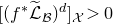



Using these, we have the following uniform height inequality.
Proposition 8.5. Let $\mathcal{X}\subseteq\mathcal{A}$
be a subvariety of dimension d. Assume that
$\mathcal{X}\subseteq\mathcal{A}$
be a subvariety of dimension d. Assume that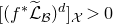 $[(f^*\widetilde{\mathcal{L}}_{\mathcal{B}})^d]_{\mathcal{X}} \gt 0$
for any
$[(f^*\widetilde{\mathcal{L}}_{\mathcal{B}})^d]_{\mathcal{X}} \gt 0$
for any $f\in \mathrm{Hom}(\mathcal{A},\mathcal{B})^\circ_{\mathbb{R}}$
. Then there exist
$f\in \mathrm{Hom}(\mathcal{A},\mathcal{B})^\circ_{\mathbb{R}}$
. Then there exist $\alpha,\beta \gt 0$
such that for any
$\alpha,\beta \gt 0$
such that for any $f\in \mathcal{K}_{\mathbb{N}}(\mathcal{A},\mathcal{B})$
, there is a dense open subset
$f\in \mathcal{K}_{\mathbb{N}}(\mathcal{A},\mathcal{B})$
, there is a dense open subset $\mathcal{U}_f\subseteq\mathcal{X}$
satisfying
$\mathcal{U}_f\subseteq\mathcal{X}$
satisfying
 \[ h_{f^*\mkern 1.5mu\overline{\mkern-1.5mu\mathcal{L}\mkern-1.5mu}\mkern 1.5mu_{\mathcal{B}}}(p)\geq \alpha h_{\mkern 1.5mu\overline{\mkern-1.5mu\mathcal{M}\mkern-1.5mu}\mkern 1.5mu}(p)-\beta\]
for any $p\in \mathcal{U}_f(K^{\mathrm{alg}})$
.
$p\in \mathcal{U}_f(K^{\mathrm{alg}})$
.
Proof. Take any rational numbers $\beta \gt 0$
and
$\beta \gt 0$
and
 \[ 0<\alpha<\frac{c_3\beta}{d(c_1+dc_2\beta)}. \]
Let $f\in \mathcal{K}_{\mathbb{N}}(\mathcal{A},\mathcal{B})$
. Let
$f\in \mathcal{K}_{\mathbb{N}}(\mathcal{A},\mathcal{B})$
. Let $\mkern 1.5mu\overline{\mkern-1.5mu\mathcal{N}\mkern-1.5mu}\mkern 1.5mu$
be a hermitian line bundle on
$\mkern 1.5mu\overline{\mkern-1.5mu\mathcal{N}\mkern-1.5mu}\mkern 1.5mu$
be a hermitian line bundle on $\mathrm{Spec}\mathcal{O}_K$
with
$\mathrm{Spec}\mathcal{O}_K$
with $\widehat\deg(\mkern 1.5mu\overline{\mkern-1.5mu\mathcal{N}\mkern-1.5mu}\mkern 1.5mu)=1$
. By slight abuse of notation, we view
$\widehat\deg(\mkern 1.5mu\overline{\mkern-1.5mu\mathcal{N}\mkern-1.5mu}\mkern 1.5mu)=1$
. By slight abuse of notation, we view $\mkern 1.5mu\overline{\mkern-1.5mu\mathcal{N}\mkern-1.5mu}\mkern 1.5mu$
as an adelic line bundle on
$\mkern 1.5mu\overline{\mkern-1.5mu\mathcal{N}\mkern-1.5mu}\mkern 1.5mu$
as an adelic line bundle on $\mathcal{A}$
via pullback. One basic property of
$\mathcal{A}$
via pullback. One basic property of $\mkern 1.5mu\overline{\mkern-1.5mu\mathcal{N}\mkern-1.5mu}\mkern 1.5mu$
is that if
$\mkern 1.5mu\overline{\mkern-1.5mu\mathcal{N}\mkern-1.5mu}\mkern 1.5mu$
is that if $\mkern 1.5mu\overline{\mkern-1.5mu\mathcal{L}\mkern-1.5mu}\mkern 1.5mu_1,\ldots,\mkern 1.5mu\overline{\mkern-1.5mu\mathcal{L}\mkern-1.5mu}\mkern 1.5mu_d\in \mathrm{\widehat{Pic}}_{\mathrm{int}}(\mathcal{A}/\mathcal{O}_K)$
, then
$\mkern 1.5mu\overline{\mkern-1.5mu\mathcal{L}\mkern-1.5mu}\mkern 1.5mu_1,\ldots,\mkern 1.5mu\overline{\mkern-1.5mu\mathcal{L}\mkern-1.5mu}\mkern 1.5mu_d\in \mathrm{\widehat{Pic}}_{\mathrm{int}}(\mathcal{A}/\mathcal{O}_K)$
, then
 \begin{equation} [\mkern 1.5mu\overline{\mkern-1.5mu\mathcal{L}\mkern-1.5mu}\mkern 1.5mu_1\cdots \mkern 1.5mu\overline{\mkern-1.5mu\mathcal{L}\mkern-1.5mu}\mkern 1.5mu_d\cdot\mkern 1.5mu\overline{\mkern-1.5mu\mathcal{N}\mkern-1.5mu}\mkern 1.5mu]_{\mathcal{X}}=[\widetilde{\mathcal{L}}_1\cdots\widetilde{\mathcal{L}}_d]_{\mathcal{X}}, \end{equation}
where $\widetilde{\mathcal{L}}_i$
is the localization of
$\widetilde{\mathcal{L}}_i$
is the localization of $\mkern 1.5mu\overline{\mkern-1.5mu\mathcal{L}\mkern-1.5mu}\mkern 1.5mu_i$
in
$\mkern 1.5mu\overline{\mkern-1.5mu\mathcal{L}\mkern-1.5mu}\mkern 1.5mu_i$
in $\mathrm{\widehat{Pic}}_{\mathrm{int}}(\mathcal{A}/K)$
; cf. [Reference Yuan and ZhangYZ26, Lemma 4.4.4].
$\mathrm{\widehat{Pic}}_{\mathrm{int}}(\mathcal{A}/K)$
; cf. [Reference Yuan and ZhangYZ26, Lemma 4.4.4].
Let $\mkern 1.5mu\overline{\mkern-1.5mu\mathcal{L}\mkern-1.5mu}\mkern 1.5mu':=f^*\mkern 1.5mu\overline{\mkern-1.5mu\mathcal{L}\mkern-1.5mu}\mkern 1.5mu_{\mathcal{B}}+\beta\mkern 1.5mu\overline{\mkern-1.5mu\mathcal{N}\mkern-1.5mu}\mkern 1.5mu\in \mathrm{\widehat{Pic}}_{\mathrm{nef}}(\mathcal{A}/\mathcal{O}_K)_{\mathbb{Q}}$
. We claim that
$\mkern 1.5mu\overline{\mkern-1.5mu\mathcal{L}\mkern-1.5mu}\mkern 1.5mu':=f^*\mkern 1.5mu\overline{\mkern-1.5mu\mathcal{L}\mkern-1.5mu}\mkern 1.5mu_{\mathcal{B}}+\beta\mkern 1.5mu\overline{\mkern-1.5mu\mathcal{N}\mkern-1.5mu}\mkern 1.5mu\in \mathrm{\widehat{Pic}}_{\mathrm{nef}}(\mathcal{A}/\mathcal{O}_K)_{\mathbb{Q}}$
. We claim that
 \begin{equation} \widehat{\mathrm{vol}}(\mathcal{X}, \mkern 1.5mu\overline{\mkern-1.5mu\mathcal{L}\mkern-1.5mu}\mkern 1.5mu'-\alpha \mkern 1.5mu\overline{\mkern-1.5mu\mathcal{M}\mkern-1.5mu}\mkern 1.5mu) \gt 0. \end{equation}
As a consequence, it implies the existence of a nonzero $\mathbb{Q}$
-effective section
$\mathbb{Q}$
-effective section $s_f$
of
$s_f$
of $\mkern 1.5mu\overline{\mkern-1.5mu\mathcal{L}\mkern-1.5mu}\mkern 1.5mu'-\alpha \mkern 1.5mu\overline{\mkern-1.5mu\mathcal{M}\mkern-1.5mu}\mkern 1.5mu$
, whence by Lemma 7.3, we have
$\mkern 1.5mu\overline{\mkern-1.5mu\mathcal{L}\mkern-1.5mu}\mkern 1.5mu'-\alpha \mkern 1.5mu\overline{\mkern-1.5mu\mathcal{M}\mkern-1.5mu}\mkern 1.5mu$
, whence by Lemma 7.3, we have
 \[ 0\leq h_{\mkern 1.5mu\overline{\mkern-1.5mu\mathcal{L}\mkern-1.5mu}\mkern 1.5mu'-\alpha \mkern 1.5mu\overline{\mkern-1.5mu\mathcal{M}\mkern-1.5mu}\mkern 1.5mu}(p) = h_{f^*\mkern 1.5mu\overline{\mkern-1.5mu\mathcal{L}\mkern-1.5mu}\mkern 1.5mu_{\mathcal{B}}}(p)-\alpha h_{\mkern 1.5mu\overline{\mkern-1.5mu\mathcal{M}\mkern-1.5mu}\mkern 1.5mu}(p)+h_{\beta\mkern 1.5mu\overline{\mkern-1.5mu\mathcal{N}\mkern-1.5mu}\mkern 1.5mu}(p)=h_{f^*\mkern 1.5mu\overline{\mkern-1.5mu\mathcal{L}\mkern-1.5mu}\mkern 1.5mu_{\mathcal{B}}}(p)-\alpha h_{\mkern 1.5mu\overline{\mkern-1.5mu\mathcal{M}\mkern-1.5mu}\mkern 1.5mu}(p) +\beta \]
for any $p\in \mathcal{U}_f(K^{\mathrm{alg}})$
with
$p\in \mathcal{U}_f(K^{\mathrm{alg}})$
with $\mathcal{U}_f:=\mathcal{X}\setminus\mathrm{div}(s_f)$
, as required.
$\mathcal{U}_f:=\mathcal{X}\setminus\mathrm{div}(s_f)$
, as required.
To prove the claim (8.6), we apply first Siu and Yuan’s bigness theorem 7.5:
 \begin{equation} \widehat{\mathrm{vol}}(\mathcal{X}, \mkern 1.5mu\overline{\mkern-1.5mu\mathcal{L}\mkern-1.5mu}\mkern 1.5mu'-\alpha \mkern 1.5mu\overline{\mkern-1.5mu\mathcal{M}\mkern-1.5mu}\mkern 1.5mu) \geq [\mkern 1.5mu\overline{\mkern-1.5mu\mathcal{L}\mkern-1.5mu}\mkern 1.5mu'^{d+1}]_{\mathcal{X}} - (d+1)\alpha[\mkern 1.5mu\overline{\mkern-1.5mu\mathcal{L}\mkern-1.5mu}\mkern 1.5mu'^d\mkern 1.5mu\overline{\mkern-1.5mu\mathcal{M}\mkern-1.5mu}\mkern 1.5mu]_{\mathcal{X}}. \end{equation}
Note that using (8.5) with the lower bound (8.4), we have
![Displayed inequality derivation showing [Ld+1]x expressed as [(fLB)d+1]x plus (d+1) beta times [(fLB)d·N]x, rewritten in an equivalent form and concluding with a lower bound greater than or equal to (d+1) beta c3.](https://static.cambridge.org/binary/version/id/urn:cambridge.org:id:binary:20260704090412932-0043:S0010437X26103066:S0010437X26103066_eqnU107.png?pub-status=live)
Meanwhile, for a similar reason, we have by (8.3) that
![Displayed inequality showing [(L tilde)d dot M tilde]x equals [(fLB)d M tilde]x plus d beta[(fL tildeB)d-1 dot N tilde dot M tilde]x, rewritten equivalently and bounded above by c1 plus dc2 beta.](https://static.cambridge.org/binary/version/id/urn:cambridge.org:id:binary:20260704090412932-0043:S0010437X26103066:S0010437X26103066_eqnU108.png?pub-status=live)
Combine the inequalities into (8.7) and we are done.
8.3 Proof of Theorem 8.2
Now we are ready to prove the main result of this section. The idea is to let $\delta,\epsilon$
tend to 0 so that the height bounds in Corollary 8.4 and Proposition 8.5 lead to constraints on the total height of p in the intersection. Specifically, pick sufficiently small
$\delta,\epsilon$
tend to 0 so that the height bounds in Corollary 8.4 and Proposition 8.5 lead to constraints on the total height of p in the intersection. Specifically, pick sufficiently small $\delta, \epsilon \gt 0$
such that
$\delta, \epsilon \gt 0$
such that
 \[\alpha':=12\lambda^2(\delta^2+\epsilon\gamma^2)<\alpha.\]
Since $\mathcal{K}_{N_{\delta}}(\mathcal{A},\mathcal{B})$
is a finite set, let
$\mathcal{K}_{N_{\delta}}(\mathcal{A},\mathcal{B})$
is a finite set, let
 \[\mathcal{U}:=\cap_{f\in \mathcal{K}_{N_{\delta}}(\mathcal{A},\mathcal{B})}\mathcal{U}_f\subseteq \mathcal{X}.\]
Then for any $p\in \mathcal{U}(K^{\mathrm{alg}})\cap C(\epsilon,\mathrm{\mathfrak{N}}(\mathcal{B}))$
, we have
$p\in \mathcal{U}(K^{\mathrm{alg}})\cap C(\epsilon,\mathrm{\mathfrak{N}}(\mathcal{B}))$
, we have
 \[\alpha h_{\mkern 1.5mu\overline{\mkern-1.5mu\mathcal{M}\mkern-1.5mu}\mkern 1.5mu}(p)-\beta \leq h_{f^*\mkern 1.5mu\overline{\mkern-1.5mu\mathcal{L}\mkern-1.5mu}\mkern 1.5mu_{\mathcal{B}}}(p)\leq \alpha'h_{\mkern 1.5mu\overline{\mkern-1.5mu\mathcal{M}\mkern-1.5mu}\mkern 1.5mu}(p)+\alpha'.\]
Therefore, we get $h_{\mkern 1.5mu\overline{\mkern-1.5mu\mathcal{M}\mkern-1.5mu}\mkern 1.5mu}(p)\leq c$
with
$h_{\mkern 1.5mu\overline{\mkern-1.5mu\mathcal{M}\mkern-1.5mu}\mkern 1.5mu}(p)\leq c$
with $c=(\alpha'+\beta)/(\alpha-\alpha').$
Hence, we are done.
$c=(\alpha'+\beta)/(\alpha-\alpha').$
Hence, we are done.
9. Proof of the main theorem
In this section, we assemble various parts to finish the proof of the main theorem. Let S be a normal quasi-projective geometrically connected variety over a number field K and let $\mathcal{A}/S$
be an abelian scheme of relative dimension g. Let
$\mathcal{A}/S$
be an abelian scheme of relative dimension g. Let $\mathcal{X}\subseteq\mathcal{A}$
be a subvariety of dimension d. Fix an embedding
$\mathcal{X}\subseteq\mathcal{A}$
be a subvariety of dimension d. Fix an embedding $K^{\mathrm{alg}}\subseteq \mathbb{C}$
.
$K^{\mathrm{alg}}\subseteq \mathbb{C}$
.
9.1 Descent of degeneracy loci
The following is a consequence of Chow’s theorem.
Proposition 9.1. Assume $\mathcal{A}/S$
has a level-
$\mathcal{A}/S$
has a level- $n_0$
-structure. For
$n_0$
-structure. For $t\in \mathbb{Z}$
, the degeneracy locus
$t\in \mathbb{Z}$
, the degeneracy locus $\mathcal{X}_{\mathbb{C}}^{\mathrm{deg}}(t)$
is defined over K. Namely, there exists a Zariski-closed subset
$\mathcal{X}_{\mathbb{C}}^{\mathrm{deg}}(t)$
is defined over K. Namely, there exists a Zariski-closed subset $\mathcal{X}^{\mathrm{deg}}(t)\subseteq\mathcal{X}$
such that
$\mathcal{X}^{\mathrm{deg}}(t)\subseteq\mathcal{X}$
such that $\mathcal{X}_{\mathbb{C}}^{\mathrm{deg}}(t)=\mathcal{X}^{\mathrm{deg}}(t)_{\mathbb{C}}$
.
$\mathcal{X}_{\mathbb{C}}^{\mathrm{deg}}(t)=\mathcal{X}^{\mathrm{deg}}(t)_{\mathbb{C}}$
.
Proof. By Theorem 6.5, there exists a finite set $\Sigma(\mathcal{X}_{\mathbb{C}})$
of triples
$\Sigma(\mathcal{X}_{\mathbb{C}})$
of triples $(\mathcal{A}_1,\mathcal{B}_1,N)$
. By Chow’s theorem [Reference ConradCon06, Corollary 3.21] for the primary extension
$(\mathcal{A}_1,\mathcal{B}_1,N)$
. By Chow’s theorem [Reference ConradCon06, Corollary 3.21] for the primary extension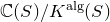 $\mathbb{C}(S)/K^{\mathrm{alg}}(S)$
, the generic fibers of abelian schemes
$\mathbb{C}(S)/K^{\mathrm{alg}}(S)$
, the generic fibers of abelian schemes $\mathcal{A}_1,\mathcal{B}_1$
are defined over
$\mathcal{A}_1,\mathcal{B}_1$
are defined over $K^{\mathrm{alg}}(S)$
. Meanwhile, by assumption, all abelian subvarieties of the generic fiber of
$K^{\mathrm{alg}}(S)$
. Meanwhile, by assumption, all abelian subvarieties of the generic fiber of $\mathcal{A}$
are defined over K(S), whence all abelian subschemes of
$\mathcal{A}$
are defined over K(S), whence all abelian subschemes of $\mathcal{A}$
are defined over K; cf. § 3.3. Thus, in the proof of Theorem 6.6, each set
$\mathcal{A}$
are defined over K; cf. § 3.3. Thus, in the proof of Theorem 6.6, each set $Z(\mathcal{A}_1,\mathcal{B}_1,N)$
is defined over
$Z(\mathcal{A}_1,\mathcal{B}_1,N)$
is defined over $K^{\mathrm{alg}}$
since the quotient map is defined over K and the moduli sieve is defined over a field containing the reflex field and K, whence
$K^{\mathrm{alg}}$
since the quotient map is defined over K and the moduli sieve is defined over a field containing the reflex field and K, whence $K^{\mathrm{alg}}$
. So
$K^{\mathrm{alg}}$
. So $\mathcal{X}^{\mathrm{deg}}(t)$
is defined over
$\mathcal{X}^{\mathrm{deg}}(t)$
is defined over $K^{\mathrm{alg}}$
. Note that if
$K^{\mathrm{alg}}$
. Note that if $\mathcal{Y}\subseteq \mathcal{A}_{K^{\mathrm{alg}}}$
and
$\mathcal{Y}\subseteq \mathcal{A}_{K^{\mathrm{alg}}}$
and $\sigma\in \mathrm{Gal}(K^{\mathrm{alg}}/K)$
, then
$\sigma\in \mathrm{Gal}(K^{\mathrm{alg}}/K)$
, then $\sigma(\mathcal{Y})$
and
$\sigma(\mathcal{Y})$
and $\mathcal{Y}$
have the same vertical defect. So
$\mathcal{Y}$
have the same vertical defect. So $\mathcal{X}^{\mathrm{deg}}(t)$
is stable under the action of
$\mathcal{X}^{\mathrm{deg}}(t)$
is stable under the action of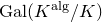 $\mathrm{Gal}(K^{\mathrm{alg}}/K)$
. This concludes the proof.
$\mathrm{Gal}(K^{\mathrm{alg}}/K)$
. This concludes the proof.
We make the general definition of degeneracy loci over a number field as follows.
Definition 9.2. Take a finite étale cover $S'\rightarrow S$
by Lemma 3.2 such that the base change
$S'\rightarrow S$
by Lemma 3.2 such that the base change $\mathcal{A}'\rightarrow S'$
has a level-
$\mathcal{A}'\rightarrow S'$
has a level- $n_0$
-structure. Let
$n_0$
-structure. Let $\mathcal{X}\subseteq\mathcal{A}$
be a subvariety and
$\mathcal{X}\subseteq\mathcal{A}$
be a subvariety and $t\in \mathbb{Z}$
.
$t\in \mathbb{Z}$
.
-
(1) The tth degeneracy locus
$\mathcal{X}^{\mathrm{deg}}(t)$
is defined as the image of
$\mathcal{X}^{\prime \mathrm{deg}}(t)$
, given in Proposition 9.1, under the natural map
$\mathcal{A}'\rightarrow \mathcal{A}$
. It is independent of the choice of the cover. -
(2) The subvariety
$\mathcal{X}$
is said to be nondegenerate (respectively, t-nondegenerate), if
$\mathcal{X}^{\mathrm{deg}}(0)\neq\mathcal{X}$
(respectively,
$\mathcal{X}^{\mathrm{deg}}(t)\neq\mathcal{X}$
).


Define $\tau(\mathcal{X})$
to be the largest integer t such that
$\tau(\mathcal{X})$
to be the largest integer t such that $\mathcal{X}$
is t-nondegenerate. If the vertical defect of
$\mathcal{X}$
is t-nondegenerate. If the vertical defect of $\mathcal{X}$
is
$\mathcal{X}$
is $t_0$
, then
$t_0$
, then $\tau(\mathcal{X})\leq t_0$
. When the equality holds, we say
$\tau(\mathcal{X})\leq t_0$
. When the equality holds, we say $\mathcal{X}$
is optimally nondegenerate.
$\mathcal{X}$
is optimally nondegenerate.
9.2 Main theorem and its proof
We can now reap the fruits of our labor from the previous sections. Combining Theorem 6.7, Theorem 6.9, and Corollary 7.14, we obtain the positivity of the geometric self-intersection number of a class of invariant adelic line bundles assuming nondegeneracy.
Theorem 9.3. Let $t\in \mathbb{N}$
. Given any:
$t\in \mathbb{N}$
. Given any:
-
(1) abelian scheme
$\mathcal{B}/S$
of relative dimension
$g'\geq g-t$
;
-
(2) ample
$\mathcal{L}_{\mathcal{B}}\in \mathrm{Pic}_0(\mathcal{B}/S)$
; and
-
(3)
$f\in \mathrm{Hom}(\mathcal{A},\mathcal{B})_{\mathbb{R}}^{\circ}$
, i.e. a surjective
$\mathbb{R}$
-homomorphism
$f:\mathcal{A}\dashrightarrow \mathcal{B}$
.






If $\mathcal{X}\subseteq\mathcal{A}$
is a t-nondegenerate subvariety of dimension d, then
$\mathcal{X}\subseteq\mathcal{A}$
is a t-nondegenerate subvariety of dimension d, then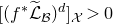 $[(f^*\widetilde{\mathcal{L}}_{\mathcal{B}})^d]_{\mathcal{X}} \gt 0$
.
$[(f^*\widetilde{\mathcal{L}}_{\mathcal{B}})^d]_{\mathcal{X}} \gt 0$
.
The main theorem of this paper is deduced as follows.
Theorem 9.4. Let $\pi:\mathcal{A}\rightarrow S$
be an abelian scheme on a normal quasi-projective variety S defined over a number field K. Let
$\pi:\mathcal{A}\rightarrow S$
be an abelian scheme on a normal quasi-projective variety S defined over a number field K. Let $\mathcal{L}_{\mathcal{A}}\in \mathrm{Pic}_0(\mathcal{A}/S)$
be ample and let
$\mathcal{L}_{\mathcal{A}}\in \mathrm{Pic}_0(\mathcal{A}/S)$
be ample and let $\mkern 1.5mu\overline{\mkern-1.5mu\mathcal{M}\mkern-1.5mu}\mkern 1.5mu:=\mkern 1.5mu\overline{\mkern-1.5mu\mathcal{L}\mkern-1.5mu}\mkern 1.5mu_{\mathcal{A}}+\pi^*\mkern 1.5mu\overline{\mkern-1.5muM\mkern-1.5mu}\mkern 1.5mu_S\in \mathrm{\widehat{Pic}}_{\mathrm{nef}}(\mathcal{A}/\mathcal{O}_K)$
with
$\mkern 1.5mu\overline{\mkern-1.5mu\mathcal{M}\mkern-1.5mu}\mkern 1.5mu:=\mkern 1.5mu\overline{\mkern-1.5mu\mathcal{L}\mkern-1.5mu}\mkern 1.5mu_{\mathcal{A}}+\pi^*\mkern 1.5mu\overline{\mkern-1.5muM\mkern-1.5mu}\mkern 1.5mu_S\in \mathrm{\widehat{Pic}}_{\mathrm{nef}}(\mathcal{A}/\mathcal{O}_K)$
with $\mkern 1.5mu\overline{\mkern-1.5muM\mkern-1.5mu}\mkern 1.5mu_S\in \mathrm{\widehat{Pic}}_{\mathrm{nef}}(S/\mathcal{O}_K)$
. For
$\mkern 1.5mu\overline{\mkern-1.5muM\mkern-1.5mu}\mkern 1.5mu_S\in \mathrm{\widehat{Pic}}_{\mathrm{nef}}(S/\mathcal{O}_K)$
. For $t\in \mathbb{N}$
and a subvariety
$t\in \mathbb{N}$
and a subvariety $\mathcal{X}\subseteq\mathcal{A}$
, there exist
$\mathcal{X}\subseteq\mathcal{A}$
, there exist $\epsilon,c \gt 0$
such that for any
$\epsilon,c \gt 0$
such that for any $K^{\mathrm{alg}}$
-point
$K^{\mathrm{alg}}$
-point
 \[ p\in (\mathcal{X}\setminus \mathcal{X}^{\mathrm{deg}}(t))\cap C(\epsilon,\mathcal{A}_{\leq t}) \]
the total height $h_{\mkern 1.5mu\overline{\mkern-1.5mu\mathcal{M}\mkern-1.5mu}\mkern 1.5mu}(p)\leq c$
.
$h_{\mkern 1.5mu\overline{\mkern-1.5mu\mathcal{M}\mkern-1.5mu}\mkern 1.5mu}(p)\leq c$
.
As explained in Corollary 7.11, we may replace the height $h_{\mkern 1.5mu\overline{\mkern-1.5mu\mathcal{M}\mkern-1.5mu}\mkern 1.5mu}$
by another arbitrary total height.
$h_{\mkern 1.5mu\overline{\mkern-1.5mu\mathcal{M}\mkern-1.5mu}\mkern 1.5mu}$
by another arbitrary total height.
Proof. Assume without loss of generality that $\mathcal{X}$
is t-nondegenerate. By Lemma 3.5, there are finitely many possible abelian schemes
$\mathcal{X}$
is t-nondegenerate. By Lemma 3.5, there are finitely many possible abelian schemes $\mathcal{B}_1,\ldots,\mathcal{B}_r$
of
$\mathcal{B}_1,\ldots,\mathcal{B}_r$
of $\mathcal{A}$
that admit surjective homomorphisms from
$\mathcal{A}$
that admit surjective homomorphisms from $\mathcal{A}$
and have relative dimension
$\mathcal{A}$
and have relative dimension $\geq g-t$
. By Theorem 9.3, the conditions in Theorem 8.2 are satisfied for any
$\geq g-t$
. By Theorem 9.3, the conditions in Theorem 8.2 are satisfied for any $\mathcal{B}\in \{\mathcal{B}_1,\ldots,\mathcal{B}_r\}$
. Thus, for each
$\mathcal{B}\in \{\mathcal{B}_1,\ldots,\mathcal{B}_r\}$
. Thus, for each $1\leq i\leq r$
, we find
$1\leq i\leq r$
, we find $\epsilon_i,c_i \gt 0$
and open dense subsets
$\epsilon_i,c_i \gt 0$
and open dense subsets $\mathcal{U}_i\subseteq\mathcal{X}$
such that the total height of
$\mathcal{U}_i\subseteq\mathcal{X}$
such that the total height of $K^{\mathrm{alg}}$
-points in
$K^{\mathrm{alg}}$
-points in $\mathcal{U}_i\cap C(\epsilon_i,\mathrm{\mathfrak{N}}(\mathcal{B}_i))$
is bounded by
$\mathcal{U}_i\cap C(\epsilon_i,\mathrm{\mathfrak{N}}(\mathcal{B}_i))$
is bounded by $c_i$
.
$c_i$
.
If $\mathcal{H}$
is a flat group subscheme of
$\mathcal{H}$
is a flat group subscheme of $\mathcal{A}$
of relative dimension
$\mathcal{A}$
of relative dimension $\leq t$
, there exists
$\leq t$
, there exists $N\in \mathbb{N}$
such that
$N\in \mathbb{N}$
such that $N\mathcal{H}$
is an abelian subscheme. The quotient
$N\mathcal{H}$
is an abelian subscheme. The quotient $\mathcal{A}/N\mathcal{H}$
is an abelian scheme of relative dimension
$\mathcal{A}/N\mathcal{H}$
is an abelian scheme of relative dimension $\geq g-t$
, which is hence isogenous to some
$\geq g-t$
, which is hence isogenous to some $\mathcal{B}$
from
$\mathcal{B}$
from $\{\mathcal{B}_1,\ldots,\mathcal{B}_r\}$
. Then
$\{\mathcal{B}_1,\ldots,\mathcal{B}_r\}$
. Then $\mathcal{H}\subseteq\mathrm{\mathfrak{N}}(\mathcal{B})$
. Thus,
$\mathcal{H}\subseteq\mathrm{\mathfrak{N}}(\mathcal{B})$
. Thus, $\mathcal{A}_{\leq t}=\bigcup_{1\leq i\leq r}\mathrm{\mathfrak{N}}(\mathcal{B}_i).$
Let $\mathcal{U}:=\bigcap_{i}\mathcal{U}_i$
,
$\mathcal{U}:=\bigcap_{i}\mathcal{U}_i$
, $\epsilon:=\min\{\epsilon_i\}_i$
and
$\epsilon:=\min\{\epsilon_i\}_i$
and $c:=\max\{c_i\}_i$
. Then we get that the total height of
$c:=\max\{c_i\}_i$
. Then we get that the total height of $K^{\mathrm{alg}}$
-points in
$K^{\mathrm{alg}}$
-points in $\mathcal{U}\cap C(\epsilon,\mathcal{A}_{\leq t})$
is bounded by c.
$\mathcal{U}\cap C(\epsilon,\mathcal{A}_{\leq t})$
is bounded by c.
For the rest, we show that we can enlarge $\mathcal{U}$
to contain
$\mathcal{U}$
to contain $\mathcal{X}\setminus\mathcal{X}^{\mathrm{deg}}(t)$
. Indeed, if
$\mathcal{X}\setminus\mathcal{X}^{\mathrm{deg}}(t)$
. Indeed, if $\mathcal{X}'$
is a closed subvariety of
$\mathcal{X}'$
is a closed subvariety of $\mathcal{X}$
, then
$\mathcal{X}$
, then $\mathcal{X}^{\prime \mathrm{deg}}(t)\subseteq\mathcal{X}^{\mathrm{deg}}(t)$
by definition. In particular, if
$\mathcal{X}^{\prime \mathrm{deg}}(t)\subseteq\mathcal{X}^{\mathrm{deg}}(t)$
by definition. In particular, if $\mathcal{X}'$
is not contained in
$\mathcal{X}'$
is not contained in $\mathcal{X}^{\mathrm{deg}}(t)$
, then
$\mathcal{X}^{\mathrm{deg}}(t)$
, then $\mathcal{X}'\neq\mathcal{X}^{\prime \mathrm{deg}}(t)$
and
$\mathcal{X}'\neq\mathcal{X}^{\prime \mathrm{deg}}(t)$
and $\mathcal{X}'$
is t-nondegenerate. Now suppose
$\mathcal{X}'$
is t-nondegenerate. Now suppose $\mathcal{X}':=\mathcal{X}\setminus\mathcal{U}$
is not contained in
$\mathcal{X}':=\mathcal{X}\setminus\mathcal{U}$
is not contained in $\mathcal{X}^{\mathrm{deg}}(t)$
, then replacing
$\mathcal{X}^{\mathrm{deg}}(t)$
, then replacing $\mathcal{X}$
by
$\mathcal{X}$
by $\mathcal{X}'$
, we can find
$\mathcal{X}'$
, we can find $\mathcal{U}',\epsilon',c'$
as above with the required property. We can enlarge
$\mathcal{U}',\epsilon',c'$
as above with the required property. We can enlarge $\mathcal{U}$
to
$\mathcal{U}$
to $\mathcal{U}'\cup\mathcal{U}$
after replacing
$\mathcal{U}'\cup\mathcal{U}$
after replacing $\epsilon$
by
$\epsilon$
by $\min\{\epsilon,\epsilon'\}$
and c by
$\min\{\epsilon,\epsilon'\}$
and c by $\max\{c,c'\}$
. By Noetherian induction, we can thus assume
$\max\{c,c'\}$
. By Noetherian induction, we can thus assume $\mathcal{X}\setminus\mathcal{X}^{\mathrm{deg}}(t)\subseteq\mathcal{U}$
. The proof is now complete.
$\mathcal{X}\setminus\mathcal{X}^{\mathrm{deg}}(t)\subseteq\mathcal{U}$
. The proof is now complete.
10. Applications
In the first part, we apply the main theorem and criterion to study the specialization of Mordell–Weil groups. After some simple observation, we restrict attention to a particular case, and present a specialization theorem generalizing Silverman’s theorem [Reference SilvermanSil83, Theorem C]. In the second part, we establish a bounded height analogue of Conjecture 1.1 using basic linear algebra on quadratic forms.
In the end, we propose a conjecture aligned with the philosophy of Pink’s Conjecture 1.4, as an optimal hope to generalize the main theorem.
10.1 Specialization theorem
Let S be a normal quasi-projective variety over a number field K with function field F, and let $\mathcal{A}/S$
be an abelian scheme with generic fiber A. The group of sections
$\mathcal{A}/S$
be an abelian scheme with generic fiber A. The group of sections $\mathcal{A}(S)$
is identified with the group A(F), which is finitely generated by the Lang–Néron theorem [Reference Lang and NéronLN59]. For any
$\mathcal{A}(S)$
is identified with the group A(F), which is finitely generated by the Lang–Néron theorem [Reference Lang and NéronLN59]. For any $s\in S$
, we have a specialization map
$s\in S$
, we have a specialization map
 \[\mathrm{sp}_s:A(F)\rightarrow \mathcal{A}_s,\]
which associates to any section $\sigma\in A(F)$
the point
$\sigma\in A(F)$
the point $\sigma(s)\in \mathcal{A}_s$
. If
$\sigma(s)\in \mathcal{A}_s$
. If $S'\rightarrow S$
is an étale cover and s’ is a point above s, then
$S'\rightarrow S$
is an étale cover and s’ is a point above s, then $\mathcal{A}_{s'}=\mathcal{A}_s$
and
$\mathcal{A}_{s'}=\mathcal{A}_s$
and $\mathrm{sp}_s$
factors through
$\mathrm{sp}_s$
factors through $\mathrm{sp}_{s'}$
.
$\mathrm{sp}_{s'}$
.
Note that $\mathrm{sp}_s$
is injective on the subgroup of constant sections. One can ask the following general question.
$\mathrm{sp}_s$
is injective on the subgroup of constant sections. One can ask the following general question.
Question 10.1. Given a subgroup $\Lambda\subseteq A(F)$
, what can be said about the set of closed points
$\Lambda\subseteq A(F)$
, what can be said about the set of closed points $s\in S$
where
$s\in S$
where $\mathrm{sp}_s:\Lambda\rightarrow \mathcal{A}_s$
fails to be injective?
$\mathrm{sp}_s:\Lambda\rightarrow \mathcal{A}_s$
fails to be injective?
For the abelian variety $A/F$
and a subgroup
$A/F$
and a subgroup $\Lambda\subseteq A(F)$
, define
$\Lambda\subseteq A(F)$
, define
 \[ \Sigma(A,\Lambda):=\{s\in S(K^{\mathrm{alg}})\mid \mathrm{sp}_s:\Lambda \rightarrow \mathcal{A}_s \text{ is not injective}\}. \]
We start with the following basic observation.
Lemma 10.2. Let $A,B,A_1,A_2$
be the generic fibers of respective abelian schemes
$A,B,A_1,A_2$
be the generic fibers of respective abelian schemes $\mathcal{A},\mathcal{B},\mathcal{A}_1,\mathcal{A}_2$
over S. Suppose
$\mathcal{A},\mathcal{B},\mathcal{A}_1,\mathcal{A}_2$
over S. Suppose $\Lambda\subseteq A(F),\Lambda'\subseteq B(F)$
are subgroups. The following hold true:
$\Lambda\subseteq A(F),\Lambda'\subseteq B(F)$
are subgroups. The following hold true:
-
(1)
$\Sigma(A,\bar\Lambda)=\Sigma(A,\Lambda)$
, where
\[ \bar\Lambda:=\{\sigma\in A(F) \mid \exists N\in \mathbb{N}\setminus\{0\}, N\sigma\in \Lambda\}; \]
-
(2) if
$\varphi:A\rightarrow B$
is an isogeny, then
$\Sigma(A,\Lambda)=\Sigma(B,\varphi(\Lambda))$
; -
(3)
$\Sigma(A\times B,\Lambda\times \Lambda')=\Sigma(A,\Lambda)\cup \Sigma(B,\Lambda')$
; -
(4) if
$(p_1,p_2):A \rightarrow A_1\times A_2$
is an isogeny, then
\[ \Sigma(A,\Lambda)\subseteq\Sigma(A_1,p_1(\Lambda))\cup \Sigma(A_2,p_2(\Lambda)). \]







Proof.
-
(1) Suppose
$\mathrm{sp}_s:\bar\Lambda\rightarrow \mathcal{A}_s$
is not injective for a closed point
$s\in S$
, and
$\sigma$
is a nonzero section in the kernel. Then
$\sigma$
is nontorsion. Let
$N\in \mathbb{N}\setminus\{0\}$
with
$N\sigma\in \Lambda$
. Then
$N\sigma$
is nonzero and in the kernel of
$\mathrm{sp}_s:\Lambda\rightarrow \mathcal{A}_s$
. -
(2) We clearly have
$\Sigma(A,\Lambda)\subseteq\Sigma(B,\varphi(\Lambda))$
. For the other direction, take an isogeny
$\psi:B\rightarrow A$
such that
$\psi\circ\varphi=[N]$
and use part (1). -
(3) This follows by definition.
-
(4) It suffices to assume
$A=A_1\times A_2$
by part (2). Note that
$\Lambda \subseteq p_1(\Lambda)\times p_2(\Lambda)$
. The result hence follows from part (3).






Due to part (4), it is essential to study the case where A is simple. In the following, we consider a particular case.
Definition 10.3. An abelian variety $A/F$
is said to have maximal variation if the induced period map
$A/F$
is said to have maximal variation if the induced period map $S\rightarrow \mathbb{A}_g$
is generically finite.
$S\rightarrow \mathbb{A}_g$
is generically finite.
Theorem 10.4. If all nontrivial simple abelian subvarieties of $A_{F^{\mathrm{alg}}}$
have maximal variation and dimension at least
$A_{F^{\mathrm{alg}}}$
have maximal variation and dimension at least $\dim S$
, then
$\dim S$
, then $\Sigma(A,A(F))$
is contained in the union of a strict Zariski-closed subset and a set of bounded height in
$\Sigma(A,A(F))$
is contained in the union of a strict Zariski-closed subset and a set of bounded height in $S(K^{\mathrm{alg}})$
.
$S(K^{\mathrm{alg}})$
.
The maximal variation assumption on the simple components is equivalent to A having no constant part if $\dim S=1$
; so the above result implies Silverman’s theorem in the number field case. The dimension assumption ensures the intersection is at most just likely.
$\dim S=1$
; so the above result implies Silverman’s theorem in the number field case. The dimension assumption ensures the intersection is at most just likely.
Proof. Without loss of generality, we assume (3.1) by possibly passing to a finite étale cover using Lemma 3.2. Let $\sigma_1,\ldots,\sigma_r\in A(F)$
be a basis of
$\sigma_1,\ldots,\sigma_r\in A(F)$
be a basis of $A(F)_{\mathbb{Q}}$
and let
$A(F)_{\mathbb{Q}}$
and let $\mathcal{X}$
be the image of
$\mathcal{X}$
be the image of $\underline{\sigma}=(\sigma_1,\ldots,\sigma_r):S\rightarrow \mathcal{A}_S^{r}$
. Let
$\underline{\sigma}=(\sigma_1,\ldots,\sigma_r):S\rightarrow \mathcal{A}_S^{r}$
. Let $\mathcal{B}$
be the smallest (necessarily flat) group subscheme containing
$\mathcal{B}$
be the smallest (necessarily flat) group subscheme containing $\underline{\sigma}$
. Replacing
$\underline{\sigma}$
. Replacing $\sigma_1,\ldots,\sigma_r$
by
$\sigma_1,\ldots,\sigma_r$
by $N\sigma_1,\ldots,N\sigma_r$
if necessary, we can and do assume
$N\sigma_1,\ldots,N\sigma_r$
if necessary, we can and do assume $\mathcal{B}$
is an abelian subscheme of
$\mathcal{B}$
is an abelian subscheme of $\mathcal{A}_S^r$
. Write
$\mathcal{A}_S^r$
. Write
 \[g:=\mathrm{rel. dim}\mathcal{B}, \quad d:=\dim S, \quad t:=g-d. \]
Claim: $\mathcal{X}$
is t-nondegenerate (or optimally nondegenerate). Indeed, take any nonzero abelian subscheme
$\mathcal{X}$
is t-nondegenerate (or optimally nondegenerate). Indeed, take any nonzero abelian subscheme $\mathcal{B}_1$
of
$\mathcal{B}_1$
of $\mathcal{B}$
and any surjective homomorphism
$\mathcal{B}$
and any surjective homomorphism $\varphi:\mathcal{B}\rightarrow\mathcal{B}_1$
. Let
$\varphi:\mathcal{B}\rightarrow\mathcal{B}_1$
. Let $\iota_a:\mathcal{B}_1\rightarrow \mathfrak{A}_{g'}$
be a moduli sieve with base map
$\iota_a:\mathcal{B}_1\rightarrow \mathfrak{A}_{g'}$
be a moduli sieve with base map $\iota:S\rightarrow \mathbb{A}_{g'}$
. Since
$\iota:S\rightarrow \mathbb{A}_{g'}$
. Since $\mathcal{B}_1$
has maximal variation,
$\mathcal{B}_1$
has maximal variation, $\iota$
is generically finite. Thus,
$\iota$
is generically finite. Thus,
 \begin{equation} \dim \iota_a(\varphi(\mathcal{X})=\dim\mathcal{X}\geq \dim \mathcal{X}-\max\{0,g-g'-t\}.\end{equation}
For the zero map $\mathcal{B}\rightarrow 0$
, we also have
$\mathcal{B}\rightarrow 0$
, we also have
 \[0\geq \dim \mathcal{X} -\max\{0,g-t\}=0. \]
By Theorem 6.7, these imply that $\mathcal{X}$
is t-nondegenerate.
$\mathcal{X}$
is t-nondegenerate.
Now we consider the following types of flat subgroup schemes of $\mathcal{A}^r_S$
:
$\mathcal{A}^r_S$
:
 \[\mathcal{H}_{\underline{\lambda}}:=\bigg\{(x_1,\ldots,x_r)\in \mathcal{A}^r_S\,\bigg|\, \sum_i\lambda_ix_i=0\bigg\}, \]
where $\underline{\lambda}=(\lambda_1,\ldots,\lambda_r)$
is a nonzero sequence of integers. Note that
$\underline{\lambda}=(\lambda_1,\ldots,\lambda_r)$
is a nonzero sequence of integers. Note that $\mathcal{X}$
is not contained in
$\mathcal{X}$
is not contained in $\mathcal{H}_{\lambda}$
by the choices of
$\mathcal{H}_{\lambda}$
by the choices of $\sigma_i$
. Thus,
$\sigma_i$
. Thus, $\mathcal{H}_\lambda\cap\mathcal{B}$
is a strict flat group subscheme of
$\mathcal{H}_\lambda\cap\mathcal{B}$
is a strict flat group subscheme of $\mathcal{B}$
. The assumption on dimension of the simple factors ensures that the relative dimension of
$\mathcal{B}$
. The assumption on dimension of the simple factors ensures that the relative dimension of $\mathcal{H}_\lambda\cap\mathcal{B}$
is at most
$\mathcal{H}_\lambda\cap\mathcal{B}$
is at most $g-d$
. Hence, Theorem 9.4 tells us that the
$g-d$
. Hence, Theorem 9.4 tells us that the $K^{\mathrm{alg}}$
-points of
$K^{\mathrm{alg}}$
-points of
 \[\Sigma_1:=(\mathcal{X}\setminus\mathcal{X}^{\mathrm{deg}}(t))\cap \cup_{\lambda}\mathcal{H}_\lambda\]
form a set of bounded total height.
If the specialization map $\mathrm{sp}_s:A(F)\rightarrow \mathcal{A}_s(K^{\mathrm{alg}})$
is not injective, then there exists a nonzero
$\mathrm{sp}_s:A(F)\rightarrow \mathcal{A}_s(K^{\mathrm{alg}})$
is not injective, then there exists a nonzero $\underline{\lambda}\in \mathbb{N}^r$
such that
$\underline{\lambda}\in \mathbb{N}^r$
such that $\sum_i\lambda_i\sigma_i$
specializes to
$\sum_i\lambda_i\sigma_i$
specializes to $0\in \mathcal{A}_s(K^{\mathrm{alg}})$
for
$0\in \mathcal{A}_s(K^{\mathrm{alg}})$
for $s\in S(K^{\mathrm{alg}})$
, which means
$s\in S(K^{\mathrm{alg}})$
, which means
 \[(\sigma_1,\ldots,\sigma_r)_s\in \mathcal{X}\cap\mathcal{H}_\lambda.\]
Let $\pi:\mathcal{A}^r_S\rightarrow S$
be the structure map. Then
$\pi:\mathcal{A}^r_S\rightarrow S$
be the structure map. Then
 \[\Sigma(A,A(F))\subseteq \pi( \mathcal{X}^{\mathrm{deg}}(t) )\cup \pi(\Sigma_1).\]
Here $\pi(\Sigma_1)$
is a set of bounded height. The proof is now complete.
$\pi(\Sigma_1)$
is a set of bounded height. The proof is now complete.
10.2 Towards Zhang’s conjecture
Let us first recall the setup of the Zhang conjecture. Let $\mathcal{A}\rightarrow C$
be an abelian scheme on a curve C defined over a number field K. Let
$\mathcal{A}\rightarrow C$
be an abelian scheme on a curve C defined over a number field K. Let $\langle\cdot ,\cdot \rangle$
denote the Néron–Tate height pairing associated to an ample line bundle
$\langle\cdot ,\cdot \rangle$
denote the Néron–Tate height pairing associated to an ample line bundle $\mathcal{L}\in \mathrm{Pic}_0(\mathcal{A}/C)$
. Consider a finitely generated torsion-free subgroup
$\mathcal{L}\in \mathrm{Pic}_0(\mathcal{A}/C)$
. Consider a finitely generated torsion-free subgroup $\Lambda\subseteq \mathcal{A}(C)$
with linearly independent generators
$\Lambda\subseteq \mathcal{A}(C)$
with linearly independent generators $\sigma_1,\ldots, \sigma_r$
. In his 1998 ICM talk, Zhang [Reference ZhangZha98] defined the function
$\sigma_1,\ldots, \sigma_r$
. In his 1998 ICM talk, Zhang [Reference ZhangZha98] defined the function
 \[h_{\Lambda}(s):=\det ( \langle \sigma_i(s),\sigma_j(s)\rangle_{i,j}) \]
for any $s\in C(K^{\mathrm{alg}})$
, and proposed Conjecture 1.1. This conjecture, in the case of a constant abelian scheme, is particularly noteworthy as it implies both the Mordell conjecture and the Bogomolov conjecture for curves. We discuss the nonconstant case below. It is also worth mentioning that the so-called relative Bogomolov conjecture [Reference Dimitrov, Gao and HabeggerDGH22] originates from Conjecture 1.1 in the special case where
$s\in C(K^{\mathrm{alg}})$
, and proposed Conjecture 1.1. This conjecture, in the case of a constant abelian scheme, is particularly noteworthy as it implies both the Mordell conjecture and the Bogomolov conjecture for curves. We discuss the nonconstant case below. It is also worth mentioning that the so-called relative Bogomolov conjecture [Reference Dimitrov, Gao and HabeggerDGH22] originates from Conjecture 1.1 in the special case where $\mathrm{rank}\Lambda=1$
.
$\mathrm{rank}\Lambda=1$
.
As noted in the ICM address, Zhang’s conjecture was initially stated without a dimension assumption. However, Poonen soon found a counterexample involving a section of an elliptic surface. In this example, the section could possess infinitely many torsion points, yielding infinitely many points with $h_\Lambda(s)=0$
. The picture here nowadays is clear: the dimensions of the section and the torsion sections add up to the total ambient dimension, which made the intersection more than unlikely. From this perspective, the bounded height result that follows is seen as optimal.
$h_\Lambda(s)=0$
. The picture here nowadays is clear: the dimensions of the section and the torsion sections add up to the total ambient dimension, which made the intersection more than unlikely. From this perspective, the bounded height result that follows is seen as optimal.
Theorem 10.5. Let $\pi:\mathcal{A}\rightarrow C$
be an abelian scheme on a curve C defined over a number field K, and assume
$\pi:\mathcal{A}\rightarrow C$
be an abelian scheme on a curve C defined over a number field K, and assume $\mathcal{A}/C$
has no constant part. Let
$\mathcal{A}/C$
has no constant part. Let $\Lambda\subseteq \mathcal{A}(C)$
be a finitely generated torsion-free subgroup. There is
$\Lambda\subseteq \mathcal{A}(C)$
be a finitely generated torsion-free subgroup. There is $\epsilon \gt 0$
such that
$\epsilon \gt 0$
such that
 \[ \{s\in C(K^{\mathrm{alg}})\mid h_{\Lambda}(s)<\epsilon\} \]
is a set of bounded height.
In particular, by the Northcott property, there are only finitely many closed points $s\in C$
with
$s\in C$
with $[\kappa(s):K]\leq d$
and
$[\kappa(s):K]\leq d$
and $h_\Lambda(s)<\epsilon$
.
$h_\Lambda(s)<\epsilon$
.
Proof. Let $\sigma_1,\ldots,\sigma_r$
be linearly independent generators of
$\sigma_1,\ldots,\sigma_r$
be linearly independent generators of $\Lambda$
, and let
$\Lambda$
, and let $\underline{\sigma}$
be the image of
$\underline{\sigma}$
be the image of $(\sigma_1,\ldots,\sigma_r):S\rightarrow \mathcal{A}_C^{r}$
. Let
$(\sigma_1,\ldots,\sigma_r):S\rightarrow \mathcal{A}_C^{r}$
. Let $\mathcal{B}$
be the smallest (necessarily flat) group subscheme containing
$\mathcal{B}$
be the smallest (necessarily flat) group subscheme containing $\underline{\sigma}$
. Replacing
$\underline{\sigma}$
. Replacing $\sigma_1,\ldots,\sigma_r$
by
$\sigma_1,\ldots,\sigma_r$
by $N\sigma_1,\ldots,N\sigma_r$
if necessary, we can and do assume
$N\sigma_1,\ldots,N\sigma_r$
if necessary, we can and do assume $\mathcal{B}$
is an abelian subscheme of
$\mathcal{B}$
is an abelian subscheme of $\mathcal{A}_S^r$
, with relative dimension denoted by g. We also fix an isogeny decomposition
$\mathcal{A}_S^r$
, with relative dimension denoted by g. We also fix an isogeny decomposition $\varphi:\mathcal{A}\rightarrow \mathcal{B}\times \mathcal{B}'$
such that
$\varphi:\mathcal{A}\rightarrow \mathcal{B}\times \mathcal{B}'$
such that $p_1\circ\varphi|_{\mathcal{B}}$
is the identity map where
$p_1\circ\varphi|_{\mathcal{B}}$
is the identity map where $p_1:\mathcal{B}\times \mathcal{B}'\rightarrow \mathcal{B}$
is the projection. For convenience, we take the fiber-wise Néron–Tate height on
$p_1:\mathcal{B}\times \mathcal{B}'\rightarrow \mathcal{B}$
is the projection. For convenience, we take the fiber-wise Néron–Tate height on $\mathcal{A}$
to be induced from two fiber-wise Néron–Tate heights on
$\mathcal{A}$
to be induced from two fiber-wise Néron–Tate heights on $\mathcal{B},\mathcal{B}'$
through pullback by
$\mathcal{B},\mathcal{B}'$
through pullback by $\varphi$
. By abuse of notation, all Néron–Tate heights are denoted by
$\varphi$
. By abuse of notation, all Néron–Tate heights are denoted by $\hat h$
.
$\hat h$
.
As in the proof of Theorem 10.4, the curve $\underline{\sigma}$
is optimally nondegenerate. Therefore, by Theorem 9.4, there exists
$\underline{\sigma}$
is optimally nondegenerate. Therefore, by Theorem 9.4, there exists $\epsilon_0 \gt 0$
such that the closed points of
$\epsilon_0 \gt 0$
such that the closed points of
 \[ \Sigma:=\pi(\underline{\sigma}\cap C(\epsilon_0,\mathcal{B}_{\leq g-1})) \]
have bounded height.
Set $\epsilon:=(\epsilon_0/2\sqrt{r})^r$
. Claim: if
$\epsilon:=(\epsilon_0/2\sqrt{r})^r$
. Claim: if $s\in C(K^{\mathrm{alg}})$
with
$s\in C(K^{\mathrm{alg}})$
with $\hat h_\Lambda(s)<\epsilon$
, then
$\hat h_\Lambda(s)<\epsilon$
, then $s\in \Sigma$
. Let s be such a point. To simplify notation, denote the matrix
$s\in \Sigma$
. Let s be such a point. To simplify notation, denote the matrix $(\langle \sigma_i(s),\sigma_j(s)\rangle)_{i,j}$
by
$(\langle \sigma_i(s),\sigma_j(s)\rangle)_{i,j}$
by $M_s$
. Consider the quadratic form
$M_s$
. Consider the quadratic form $q(\underline{x}):=\underline{x}M_s\underline{x}^t$
for
$q(\underline{x}):=\underline{x}M_s\underline{x}^t$
for $\underline{x}\in \mathbb{R}^r$
. For any
$\underline{x}\in \mathbb{R}^r$
. For any $\underline{\lambda}=(\lambda_1,\ldots,\lambda_r)\in \mathbb{Z}^r$
, note that
$\underline{\lambda}=(\lambda_1,\ldots,\lambda_r)\in \mathbb{Z}^r$
, note that
 \[ q(\underline{\lambda})=\langle \underline{\lambda}\cdot\underline{\sigma}(s),\underline{\lambda}\cdot\underline{\sigma}(s)\rangle=\hat h\bigg(\sum_i \lambda_i \sigma_i(s)\bigg)\geq 0. \]
Hence, $q(\underline{x})$
is positive semi-definite by continuity.
$q(\underline{x})$
is positive semi-definite by continuity.
By linear algebra, we know that if $\lVert \underline{x}\rVert=1$
where
$\lVert \underline{x}\rVert=1$
where $\lVert\cdot\rVert$
is the standard norm, then
$\lVert\cdot\rVert$
is the standard norm, then $q(\underline{x})$
has a minimum equal to the smallest eigenvalue (or equally singular value)
$q(\underline{x})$
has a minimum equal to the smallest eigenvalue (or equally singular value) $t_0$
of
$t_0$
of $M_s$
, achieved by a corresponding eigenvector
$M_s$
, achieved by a corresponding eigenvector $\underline{x_0}\in \mathbb{R}^r$
. Since
$\underline{x_0}\in \mathbb{R}^r$
. Since $t_0^r\leq h_\Lambda(s)<\epsilon$
, we derive
$t_0^r\leq h_\Lambda(s)<\epsilon$
, we derive $t_0<\epsilon_0/2\sqrt{r}$
. By approximating
$t_0<\epsilon_0/2\sqrt{r}$
. By approximating $\underline{x_0}$
using vectors in
$\underline{x_0}$
using vectors in $\mathbb{Q}^r$
, we can at least find
$\mathbb{Q}^r$
, we can at least find $\underline{\mu}\in \mathbb{Z}^r\setminus\{0\}$
such that
$\underline{\mu}\in \mathbb{Z}^r\setminus\{0\}$
such that
 \[q(\underline{\mu})< \frac{\epsilon_0}{\sqrt{r}} \lVert\underline{\mu}\rVert^2\leq \epsilon_0\max_{i}\{\mu_i\}^2.\]
Without loss of generality, assume $\max_{i}\{\mu_i\}=\mu_1$
. This implies that the point
$\max_{i}\{\mu_i\}=\mu_1$
. This implies that the point
 \[P_1=\bigg(\sum_i \mu_i \sigma_i(s)\bigg/\mu_1,0,\ldots,0\bigg)\in \mathcal{A}^r_s\]
has height $\hat h(P_1)<\epsilon_0$
. Define
$\hat h(P_1)<\epsilon_0$
. Define $Q_1:=p_1\circ\varphi(P_1)\in \mathcal{B}$
. Then
$Q_1:=p_1\circ\varphi(P_1)\in \mathcal{B}$
. Then $\hat h(Q_1)<\epsilon_0$
.
$\hat h(Q_1)<\epsilon_0$
.
Consider the flat subgroup scheme
 \[\mathcal{H}_{\underline{\mu}}:=\bigg\{(a_1,\ldots,a_r)\in \mathcal{A}_S^r\,\bigg|\, \sum_i\mu_i a_i=0\bigg\}. \]
Since $\sigma_1,\ldots,\sigma_r$
are linearly independent,
$\sigma_1,\ldots,\sigma_r$
are linearly independent, $\underline{\sigma}$
is not contained in
$\underline{\sigma}$
is not contained in $\mathcal{H}_{\underline{\mu}}$
. Hence,
$\mathcal{H}_{\underline{\mu}}$
. Hence, $\mathcal{H}_{\underline{\mu}}\cap\mathcal{B}$
is a strict group subscheme in
$\mathcal{H}_{\underline{\mu}}\cap\mathcal{B}$
is a strict group subscheme in $\mathcal{B}$
. In particular,
$\mathcal{B}$
. In particular, $\mathcal{H}_{\underline{\mu}}\subseteq\mathcal{B}_{\leq g-1}$
. Note that
$\mathcal{H}_{\underline{\mu}}\subseteq\mathcal{B}_{\leq g-1}$
. Note that $P_2:=\underline{\sigma}(s)-P_1\in \mathcal{H}_{\underline{\mu}}$
. Consider the projection
$P_2:=\underline{\sigma}(s)-P_1\in \mathcal{H}_{\underline{\mu}}$
. Consider the projection $Q_2:=p_1\circ\varphi(P_2)=\underline{\sigma}(s)-Q_1\in \mathcal{H}_{\underline{\mu}}\cap\mathcal{B}$
. Then we see that
$Q_2:=p_1\circ\varphi(P_2)=\underline{\sigma}(s)-Q_1\in \mathcal{H}_{\underline{\mu}}\cap\mathcal{B}$
. Then we see that
 \[\underline{\sigma}(s)=Q_2+Q_1\in C(\epsilon_0,\mathcal{H}_{\underline{\mu}}\cap\mathcal{B})\subseteq C(\epsilon_0,\mathcal{B}_{\leq g-1}). \]
In particular, $s\in \Sigma$
. The proof is now complete.
$s\in \Sigma$
. The proof is now complete.
After the initial draft was publicized, N. M. Mavraki kindly brought to our attention that a similar linear algebra technique had already been employed in her collaborative work with L. DeMarco [Reference DeMarco and MavrakiDM24, Proposition 4.3]. Moreover, Theorem 10.5 also follows from Silverman’s result [Reference SilvermanSil83, Theorem B]. One advantage of the proof presented here is therefore that it does not rely on Silverman’s result and allows an extension to higher-dimensional bases under assumptions analogous to those in Theorem 10.4.
10.3 A conjecture
The general Conjecture 1.4 of Pink suggests considering not only flat group subschemes of $\mathcal{A}$
. Denote by
$\mathcal{A}$
. Denote by
 \[\mathcal{A}_{(\leq t)}:=\bigcup_{s\in S}\bigcup_{\substack{H\subseteq \mathcal{A}_s \\ \dim H\leq r}}H \]
with the union taken over all points $s\in S$
and all group subschemes
$s\in S$
and all group subschemes $H\subseteq\mathcal{A}_s$
of dimension at most r. Note that
$H\subseteq\mathcal{A}_s$
of dimension at most r. Note that $\mathcal{A}_{\leq t}\subseteq\mathcal{A}_{(\leq t)}$
and the inclusion is strict in general. We propose the following conjecture, which is an idealistic extension of Theorem 9.4.
$\mathcal{A}_{\leq t}\subseteq\mathcal{A}_{(\leq t)}$
and the inclusion is strict in general. We propose the following conjecture, which is an idealistic extension of Theorem 9.4.
Conjecture 10.6. For $t\in \mathbb{N}$
and a subvariety
$t\in \mathbb{N}$
and a subvariety $\mathcal{X}\subseteq\mathcal{A}$
, the closed points of
$\mathcal{X}\subseteq\mathcal{A}$
, the closed points of
 \[ (\mathcal{X}\setminus \mathcal{X}^{\mathrm{deg}}(t))\cap \mathcal{A}_{(\leq t)} \]
form a set of bounded total height.
An analogue containing an $\epsilon$
-neighborhood can be stated as well. One heuristic reason for the conjecture is that
$\epsilon$
-neighborhood can be stated as well. One heuristic reason for the conjecture is that $\mathcal{X}^{\mathrm{deg}}(t)$
already takes into account all the group subscheme structure in
$\mathcal{X}^{\mathrm{deg}}(t)$
already takes into account all the group subscheme structure in $\mathcal{A}$
. For instance, in Theorem 9.4, it is totally valid to consider a subvariety
$\mathcal{A}$
. For instance, in Theorem 9.4, it is totally valid to consider a subvariety $\mathcal{X}$
in a fiber of
$\mathcal{X}$
in a fiber of $\mathcal{A}/S$
, and the theorem in this form provides a weaker result, since only the more coarse subgroup structure of
$\mathcal{A}/S$
, and the theorem in this form provides a weaker result, since only the more coarse subgroup structure of $\mathcal{A}_\eta$
is considered. We expect a certain generalization of the compactness result in Proposition 3.7 to be a key step towards the conjecture.
$\mathcal{A}_\eta$
is considered. We expect a certain generalization of the compactness result in Proposition 3.7 to be a key step towards the conjecture.
Acknowledgements
The author would like to thank Ziyang Gao and Shou-Wu Zhang for constant discussions, for their encouragement, and for the comments on the first draft; Dan Abramovich and Joseph Silverman for reading the first draft and for their suggestions; Philipp Habegger for answering a related question and for his beautiful work [Reference HabeggerHab09a], which motivates this result; Laura DeMarco for explaining Silverman’s proof to the author; and Niki Myrto Mavraki for bringing [Reference DeMarco and MavrakiDM24] and another proof of Theorem B to the author’s attention.
Conflicts of interest
None.
Journal information
Compositio Mathematica is owned by the Foundation Compositio Mathematica and published by the London Mathematical Society in partnership with Cambridge University Press. All surplus income from the publication of Compositio Mathematica is returned to mathematics and higher education through the charitable activities of the Foundation, the London Mathematical Society and Cambridge University Press.


 Open access

