

Introduction
In the context of increasingly fierce industrial competition and growing labour costs, more employers are adopting overtime policies to maintain business competitiveness (Oaxaca Reference Oaxaca2020). Overtime is defined as the actual working hours per period that exceed the standard contractual hours (Bell and Hart Reference Bell and Hart1999). Reasonable overtime is an effective management tool to address fluctuations in labour demand. However, prolonged overtime is explicitly prohibited by labour laws in many countries due to its harmful effects on workers’ physical and mental health, such as fatigue and burnout (Van der Hulst Reference Van der Hulst2003). Employers have strong motivations to circumvent the law and implement overtime policies to control labour costs. In such a context, it is important to address how to steadily improve labour efficiency while effectively ensuring the basic rights and interests of workers.
From a theoretical and practical point of view, unions have played an important role in protecting workers’ working hour rights. Given the importance of unions on safeguarding workers’ labour rights, many scholars have studied the ways in which unions have affected workers’ working hours and overtime. Extensive literature on unions and labour welfare has discussed how unions help to reduce workers’ working hours, especially those of union members (Campbell Reference Campbell2002; Earle and Pencavel Reference Earle and Pencavel1990; Perloff and Sickles Reference Perloff and Sickles1987; Scheuer Reference Scheuer1999). For example, previous studies have found that in some developed countries such as the United States, unions reduce the probability of overtime and the length of overtime hours (Trejo Reference Trejo1993) while some studies find that unions influence the distribution of paid overtime in favour of their members (Chiang Reference Chiang2012; Miller and Mulvey Reference Miller and Mulvey1991). However, while the findings are extensive and insightful, little is known about the impacts of unions on overtime in China.
Under the leadership of the Communist Party of China (CPC), unions in China represent the interests of workers, emphasising cooperation with the management of enterprises and organisations to improve production efficiency, and jointly protecting the rights and interests of workers by ‘organising employees to participate in democratic management and democratic supervision, and establishing a consultation system with the administration’ according to ‘the Constitution of the All-China Federation of Trade Unions’ (ACFTU). Since the market-oriented reforms in China, the Chinese government has sought to bring all workers into the labour law system based on labour contracts, so as to realise the individualisation of labour relations and use legal channels to protect the rights and interests of individual workers (Friedman and Lee Reference Friedman and Kwan Lee2010). However, there are a few significant differences between unions in China and those in Western countries (Budd et al Reference Budd, Chi, Wang and Xie2014). First, unlike unions having various organisational structures in Western countries, Chinese unions have a single hierarchical structure, and all unions are affiliated to the ACFTU. There is no competition between unions in China. Second, Chinese unions are led by the CPC, and partly funded by the company and the government. Third, the Trade Union Law of the People’s Republic of China does not provide workers for a right to strike, which is a powerful tool for workers in Western countries. But it is worth noting that since the beginning of the 21st century, the role of Chinese unions in safeguarding the legitimate rights and interests of employees seems to have increased (Liu et al Reference Liu, Li, Kim, Sheldon, Kim, Li and Warner2011). Therefore, because of the significant differences between unions in China and other countries, it is of more practical significance to study the role of Chinese unions in protecting workers’ labour rights and interests, especially the impact on workers’ overtime.
In China, overtime has become increasingly common in the workplace in the last decades. A surveyFootnote 1 released in 2022 reports that 91.6% of employees work overtime in China, and 40.5% of these employees do not receive any forms of compensation (overtime pay, leave in lieu). Indeed, some scholars state that overtime has become the ‘new normal’ of work and a ‘new culture’ of the workplace (Dong and Yan Reference Dong and Yan2022). The Labor Contract Law of China (2008) clearly stipulates that ‘the upper limit of daily overtime is 3 hours, and the monthly limit is 36 hours’; it also explicitly states that ‘compensation for employees’ overtime must be paid’. However, working overtime exceeding legal limits, i.e. working overtime exceeding maximum overtime hours of law limits and working overtime without any compensation, are still widespread practices in China (Wang Reference Wang2020). Meanwhile, in order to protect the working hour rights of workers, unions in China have taken some actions including setting up overtime allowances and helping workers resolve labour disputes related to overtime work and overtime compensation. Therefore, it is important to investigate what unions do to help workers in China in terms of the impacts of unions on workers’ overtime.
Unlike studies on unions in developed countries, there are relatively few studies in the existing literature that examine the impacts of Chinese unions on overtime and overtime compensation. Previous studies on unions and overtime in China have yielded conflicting results and the conclusions have been inconsistent (Qing and Liu Reference Qing and Liu2014; Yao and Zhong Reference Yao and Zhong2013). Moreover, in the literature, there is limited research specifically discussing the impacts of unions on workers’ engagement in overtime exceeding maximum overtime hours of law limits. For instance, Kim and Chung (Reference Kim and Chung2016) found a negative association between union presence and illegal overtime, drawing on the ‘voice face’ of unions – a core concept in classic union theory (Freeman and Medoff Reference Freeman and Medoff1984). The ‘voice face’ refers to unions acting as collective channels for workers to voice demands (e.g. opposing excessive overtime) through consultation, rather than resorting to ‘exit’ (i.e. resignation) as a response to dissatisfaction. Nevertheless, there is still a lack of in-depth research on the role of Chinese unions in reducing workers’ overtime, especially overtime exceeding legal limits, and ensuring overtime compensation.
This paper, therefore, conducts a comprehensive analysis and discussion of the impacts of unions in China on overtime. First, theoretically, this paper proposes that the unique characteristics of Chinese unions emphasise their capacity to prevent excessive overtime. The underlying mechanism between the relationship of unions and overtime is built upon the ‘party-state face’ of unions in China, rather than the ‘monopoly face’ and ‘voice face’ of unions, due to the significant differences between unions in China and other countries. This paper provides evidence of unions protecting workers from engaging in overtime based on the ‘party-state face’ of unions in China.
Secondly, empirically, using the three waves of the 2012, 2014, and 2016 China Labor-force Dynamics Survey (CLDS) data, this paper examines and analyses the extent to which Chinese unions contribute to the reduction of workers’ overtime, especially overtime exceeding legal limits. This paper also examines the relationship between unions and overtime compensation vis à vis uncompensated overtime. In addition to providing evidence on the effectiveness of unions on overtime, this paper offers empirical evidence on the effectiveness of unions in China on protecting workers’ welfare, a topic which has long been a subject of controversy. While the Trade Union Law of the People’s Republic of China clearly states that protecting the legitimate rights and interests of workers are the fundamental responsibilities of unions, there is scepticism about unions’ ability to fulfil this role (Guo and Laroche Reference Guo and Laroche2021). Therefore, this paper aims to contribute further empirical evidence to the literature.
Thirdly, this paper conducts further exploration into the heterogeneous effects of Chinese unions in preventing overtime. Previous research has indicated that Chinese unions have distinct impacts on various worker groups, including workers in state-owned enterprises (SOEs) compared to those in private or foreign firms (Lu et al Reference Lu, Tao and Wang2010), as well as migrant workers versus urban workers (Ji and Lai Reference Ji and Lai2019). However, it is still necessary to examine whether there are heterogeneous effects of unions on overtime for different types of workers. Thus, this paper analyses the impacts of unions on overtime for privileged and unprivileged workers. This provides empirical evidence on the heterogeneous effects of unions.
The remainder of the paper proceeds as follows: The next section presents the literature review and theoretical framework discussing the impacts of unions on overtime. This is followed by a description of the CLDS data used in this paper and the measures of key variables. That is followed by the empirical model, empirical results and some possible explanations of the results, and then the article’s conclusion.
Literature review and theoretical framework
Institutional characteristics of Chinese unions
The institutional characteristics of Chinese unions are shaped by the historical evolution of China’s labour relations and national governance framework, with a core positioning rooted in serving workers and advancing national development – reflecting both historical logic and realistic demands. In the pre-1978 planned economy era, unions embedded in SOEs acted as a key link between management and workers, focusing on mobilising production and distributing welfare (e.g. housing, medical care) to ensure basic living security. With working hours uniformly regulated by state plans, overtime management was not a core task. The 1978 reform and opening-up triggered profound changes in labour relations. With SOE restructuring, the emergence of private/foreign-invested enterprises, and labour market decentralisation, many enterprises began using overtime to control costs, leading to widespread uncompensated overtime and excessive working hours. In response, Chinese unions – under the leadership of the CPC and guidance of the ACFTU – gradually shifted from ‘production mobilisation’ to ‘rights protection’. This transformation was legally solidified, especially the 2008 Labor Contract Law and 2021 revised Trade Union Law provided specific guarantees for overtime regulation. Notably, workers’ union establishment applications are supported by local ACFTU branches with professional guidance, differing from Western bottom-up models (Fan et al Reference Fan, Dong, Hu and Luo2018).
Three core pillars shape the operational characteristics of contemporary Chinese unions. First, CPC leadership ensures alignment with national goals, making unions a bridge between the Party and workers, – their overtime regulation balances individual rights, enterprise development, and social stability. Second, legalisation provides clear standards: Labor Law of the People’s Republic of China (Revised in 2018) stipulates tiered overtime pay (150% of base wage for weekdays, 200% for rest days without compensatory leave, and 300% for statutory holidays); Trade Union Law of the People’s Republic of China (Amended in 2021) mandates independent unions for enterprises with ≥25 employees, while smaller firms may form joint committees or appoint organisers (Ge Reference Ge2014). Third, flexible models (e.g. specialised unions for platform workers) expand coverage, with our sample’s 57.42% union presence tied to policy implementation.
In practice, unions offer targeted services: collective negotiation for labour-intensive sectors such as manufacturing and construction workers to safeguard overtime rights (Budd et al Reference Budd, Chi, Wang and Xie2014); hidden overtime prevention and mental health counselling for professionals in knowledge-intensive industries, such as finance and IT (Tsai et al Reference Tsai, Nitta, Kim and Wang2016); and focused support for migrant workers – laying the groundwork for the discussion below on heterogeneous analysis. Unlike Western unions centred on collective bargaining autonomy, Chinese unions prioritise ‘interest coordination and harmony’, embodying their unique institutional value in labour governance.
The ‘party-state face’ of unions in China and its impacts on overtime
Concept and institutional foundation of ‘party-state face’
The ‘party-state face’ of Chinese unions, a core analytical concept proposed by Ge (Reference Ge2014), refers to their institutionalised dual attributes embedded in China’s governance framework and the ACFTU system. Legally anchored in the Trade Union Law of the People’s Republic of China (2021 Amendment), this positioning mandates unions to operate under the leadership of the CPC and fulfil the statutory mission of promoting harmonious labour relations and social stability (Article 4) – distinguishing them from Western industrial unions positioned as independent labour representatives.
Historically, this institutional foundation originated in the pre-1978 planned economy era, when unions were integral to the operation of SOEs as part of the national governance system. Post-reform, while adapting to market-oriented labour relations, unions retained their role as a bridging mechanism between state policy objectives, enterprise interests, and worker demands. This structural positioning fundamentally shapes how unions prioritise and balance conflicting interests between workers and enterprises.
Dual objectives of unions: economic vitality and social stability
Guided by their ‘party-state face’, Chinese unions pursue two complementary objectives aligned with national development priorities:
The first objective is facilitating economic vitality. Unions accommodate the legitimate operational needs of enterprises, such as temporary overtime for production deadlines or supply chain demands – particularly for small- and medium-sized enterprises (SMEs) pivotal to employment stability and industrial resilience. They do not intervene in voluntary, legally compliant overtime that supports enterprise development.
The second objective is safeguarding social stability. Unions supervise enterprises’ compliance with labour regulations (e.g. the 36-hour monthly overtime cap, tiered compensation standards) to prevent labour dissatisfaction from escalating into collective disputes. This addresses the public nature of labour relations, as unaddressed issues among unprivileged worker groups (e.g. migrant workers, short-term contractors) may affect social stability (Qian et al Reference Qian, Li, Song and Wang2020).
While these objectives are complementary in the long term, they may generate contextual tensions in practice. For instance, enterprises may pursue short-term efficiency through illegal overtime, which conflicts with workers’ legal right to rest. Resolving such tensions requires clear prioritisation criteria and institutionalised conflict-resolution mechanisms.
Prioritisation criteria for labour protection and non-antagonistic conflict resolution
Chinese unions prioritise labour protection over corporate interests in three institutional scenarios, aligned with their ‘party-state face’ and the state’s core priorities of development and stability. First, in cases of illegal or uncompensated overtime targeting vulnerable groups such as migrant workers and short-term contractors – who have limited bargaining power – disputes are prone to escalation, so unions prioritise intervention to uphold social stability (Qian et al Reference Qian, Li, Song and Wang2020). Second, unions enforce compliance for gross labour law violations, including exceeding the 36-hour monthly overtime cap or withholding statutory tiered pay (150% for weekdays, 200% for rest days, and 300% for statutory holidays), as mandated by the Trade Union Law of the People’s Republic of China (2021 Amendment), Article 35. Third, unions align their work priorities with state-led special campaigns to strengthen labour rights protection, focusing on regulating excessive overtime and safeguarding workers’ legitimate right to rest.
To resolve tensions between facilitating enterprise development and protecting workers’ rights, unions adopt three non-antagonistic mechanisms aligned with their institutional positioning. The first mechanism is government-coordinated tripartite mediation, a system legally established by the Trade Union Law of the People’s Republic of China (2021 Amendment), Article 34 and aligned with International Labour Organization Convention No. 144. Unions lead the convening of local human resources and social security departments (government representatives) and enterprise associations (employer representatives) to mediate disputes. In this process, they balance enterprises’ legitimate needs – such as approving temporary overtime within statutory limits – with workers’ rights to full overtime compensation (Ge Reference Ge2014).
The second mechanism focuses on incentive-aligned conciliation, which links enterprises’ overtime compliance to the ‘Harmonious Labor Relations Enterprise Certification’ jointly assessed by local ACFTU branches and government authorities. Enterprises that meet compliance requirements – including negotiating with unions in advance, adhering to legal overtime limits, and paying full wages – gain tangible benefits such as priority access to government procurement and preferential financing terms. These incentives foster voluntary compliance by aligning labour protection with corporate interests.
The third mechanism targets capacity building for SMEs facing operational pressures. Unions provide practical technical support, such as optimising workforce scheduling through staggered shifts or intelligent task allocation, to reduce excessive overtime while maintaining productivity. This approach reduces enterprises’ reliance on illegal overtime while safeguarding workers’ rest rights, embodying the state’s guiding principle of balancing labour fairness and operational efficiency.
Mechanisms of unions’ overtime-reducing effects in China
Within the ACFTU framework and guided by the orientation of harmonious labour relations (as mandated by relevant laws), Chinese unions reduce overtime through three context-specific, non-confrontational mechanisms rooted in legal provisions and grassroots practices:
Compliance monitoring: Legal supervision and remediation
As mandated by the Trade Union Law of the People’s Republic of China and local labour supervision rules, unions conduct routine checks on enterprises’ working hour records. The focus is on whether overtime exceeds the statutory limits of ≤3 hours/day and ≤36 hours/month, and whether compensation meets the required standards (150% for weekdays, 200% for rest days, 300% for statutory holidays). For potential violations, unions issue ‘rectification suggestions’ and track improvements; for unaddressed issues, they collaborate with local human resources and social security departments to initiate joint inspections, strengthening deterrence against illegal overtime. This mechanism is particularly critical for unprivileged workers such as short-term contract staff, who lack the ability to report violations independently.
Informal consultation: labour-management mediation
Unions resolve overtime disputes through flexible ‘collective consultation meetings’ – a channel mandated by the 2008 Labor Contract Law. For issues like uncompensated overtime or excessive shift hours, unions summarise workers’ demands (e.g. back payment of overtime wages, shift adjustments) and mediate with management, supported by evidence such as attendance records and legal clauses. In practice, local unions deploy ‘collective consultation instructors’ (professionals certified by local ACFTU branches) to provide professional support to workers with weak bargaining power, facilitating agreements balancing worker rights and enterprise operations.
Policy signalling: Aligning compliance with enterprise interests
Unions transmit government priorities such as curbing excessive overtime to protect workers’ health and rest rights to enterprises, noting that illegal overtime may harm their relationship with local authorities or employer brand reputation. Unions also promote the ‘Harmonious Labor Relations Enterprise Certification’, where compliance with overtime rules is a prerequisite for preferential government support such as access to public procurement projects. This incentivises enterprises to proactively regulate overtime.
The protection effects of unions for unprivileged workers
Unprivileged workers are those who hold low job status, have poor job stability, and possess lower bargaining power within an organisation (Tsai et al Reference Tsai, Nitta, Kim and Wang2016). They are often short-term temporary employees or individuals in low-skilled positions, making them more easily replaceable. In China, these workers are primarily concentrated in the private sector due to labour market segregation. Unfortunately, their lower bargaining power leaves them vulnerable to exploitation, such as being pressured to accept longer overtime working hours without proper compensation, as documented by Yu (Reference Yu2008).
This paper argues that unions in China are inclined to provide more protection for unprivileged workers, particularly in addressing illegal overtime practices. This is because Chinese unions prioritise social stability. Yet, unprivileged workers are more prone to conflicts and dissatisfaction due to their low work status, low income, heavy workload, job instability, and limited advancement opportunities (Qian et al Reference Qian, Li, Song and Wang2020). From this perspective, unions have a strong incentive to safeguard the rights and interests of unprivileged workers, including protecting them from overtime beyond legal limits. This not only addresses their grievances but also contributes to social stability. In contrast, for workers with stable job positions and less replaceable skills, companies may adopt other measures, such as higher pay and future job promotions, to maintain their job satisfaction. As a result, unions focused on stability may be less motivated to prioritise protecting these workers from overtime issues.
Therefore, this paper proposes that Chinese unions provide stronger protection against overtime, especially overtime beyond legal limits for unprivileged workers, compared to workers with more secure long-term contracts and lower job substitutability. This proposition aligns with previous research indicating that Chinese unions primarily concentrate on improving the ‘bottom-line welfare’ of workers, especially migrant workers. In so doing, unions seek to ensure that they receive minimum wages, obtain social benefits, and are protected from forced labour (Zhu Reference Zhu2004). These efforts reflect the role of Chinese unions in safeguarding the fundamental interests of vulnerable workers in order to maintain social stability.
Data, variables, and descriptive statistics
Data
This paper undertakes an empirical analysis using data from the CLDS. The CLDS dataset is derived from a nationwide multi-year survey that employs a stratified random sampling approach. It comprehensively captures information on respondents’ educational attainment, employment status, migration patterns, health conditions, social engagement, and economic activities, among other aspects.
The labour-related information provided by the CLDS, including data on labour unions and overtime work, allows us to conduct a viable empirical study. Specifically, this paper uses the pooled data from three waves of the CLDS (2012, 2014, and 2016) for the analysis. The initial sample size was 61,293.
To ensure the comparability of the workers in the sample, we imposed several restrictions. First, we limited the sample to individuals aged between 16 and 65 years. As defined by the Labor Contract Law of the People’s Republic of China, this age group has the legal qualification to establish labour relations.Footnote 2 This restriction led to the exclusion of 12,131 respondents. Second, we excluded those engaged in self-employed agricultural work (in China, most farming is carried out on a family or individual basis), self-employed business activities (such as a sandwich vendor), freelancing (such as a freelance writer), those working in non-profit organisations, and those identifying themselves as employers. Finally, we removed 11,825 observations with missing values of control variables, most notably workplace type, education, organisational ownership type, and industry.Footnote 3 As a result, the final sample for this analysis comprises 13,929 observations.
Variables
Union-related variables: Consistent with previous studies, this paper measures the union using three variables: ‘union’, ‘union efficacy’, and ‘union member’. These three variables collectively provide a comprehensive understanding of the union in the context of our study. They allow us to assess union establishment, perceived efficacy, and union membership, enabling a comprehensive examination of the relationship between unions and overtime in the analysis. The three union-related variables are constructed as follows:
-
(1) Union. This variable is created from the survey question, ‘Does your institute/company have a union?’ If the respondent answers affirmatively, then it assigns a value of 1 to the union variable, 0 otherwise. In the sample of this analysis, 57.42% of the employers’ units have a union established
-
(2) Union efficacy. This variable is a dummy variable, created from the survey question ‘Do you think the union is helpful to you?’. If the respondent answers affirmatively, then it assigns a value of 1 to the union efficacy variable, 0 otherwise. 70.08% of workers in this sample believe the union is useful.
-
(3) Union member. This variable is created from the survey question ‘Do you join the union?’ If the respondent answers affirmatively, then it assigns a value of 1 to the union member variable, 0 otherwise. Only the 2016 survey included a question on individual union membership, which limits our ability to generalise the findings across all three waves.
Overtime-related variables: Overtime is measured by three dummy variables: overtime, overtime exceeding legal limits, and uncompensated overtime. These variables collectively provide a comprehensive understanding of the various aspects of illegal overtime work in the context of this study. The overtime-related variables are constructed as follows:
-
(1) Overtime. This dummy variable indicates whether a worker has worked overtime or not. It takes a value of 1 if the worker has worked overtime in the last month and 0 otherwise. In the sample of this analysis, 33.87% of workers reported that they worked overtime.
-
(2) Overtime exceeding legal limits. This dummy variable determines whether the worker has worked overtime beyond the legal limits, i.e. work overtime maximum overtime hours of law limits. In this analysis, the legal limits of overtime are set as 3 hours per day or 36 hours per month, as specified by China’s Labor Contract Law. This variable takes a value of 1 if the worker has exceeded the legal limits in the last month, and 0 otherwise. In the sample of this analysis, 8.31% of the workers’ overtime exceeds the legal limits.
-
(3) Uncompensated overtime. This dummy variable identifies whether the worker has received compensation for their overtime work. The CLDS questionnaire asks respondents: ‘How many hours of overtime did you work last month? How many of those hours were compensated? (If no compensation, please enter 0 hours.)’ We identify respondents who report 0 compensated hours in the last month as having performed uncompensated overtime and assign a value of 1, while 0 indicates they have been compensated. In the sample, 14.16% of workers reported that their overtime work is uncompensated.
Instrumental variables: To control for the endogeneity issue in this analysis, two instrumental variables (IVs) ‘union committee’ and ‘union committee members more than 25’ are created. The instrumental variables are constructed as follows:
-
(1) Union committee. This variable is based on the union policy requirements of each province in 1998 in China. A value of 1 is assigned if the province mandates the establishment of a union committee within the organisation, and 0 otherwise.
-
(2) Union committee members more than 25. This variable takes a value of 1 if the province requires the number of union committee members to be greater than 25 and 0 if such a requirement is not specified.
These two IVs are derived from provincial-level regulatory documents formulated in 1998 to implement China’s 1992 Trade Union Law, with clear practical requirements and enforcement mechanisms that underpin their validity as instruments. Specifically, these 1998 provincial regulations include two core provisions: (1) Mandatory scope: Enterprises with 25 or more employees are legally required to establish a grassroots union committee; enterprises with fewer than 25 employees may form a joint union committee or set up union groups – consistent with the national standard for trade union organisation building at the time. (2) Enforcement mechanism: Local labour departments and provincial branches of the ACFTU jointly conduct compliance inspections. Enterprises failing to meet the requirements face administrative reminders, rectification orders, or restricted access to government procurement and policy subsidies.
In practice, these regulations create heterogeneous compliance pressure across regions (e.g. variations in enforcement intensity between provinces) and directly drive union establishment at the firm level. Eligible enterprises (≥25 employees) are significantly more likely to form union committees to avoid regulatory risks and access policy incentives. This ensures the IVs satisfy two key validity conditions: (1) Relevance: Variation in policy implementation (e.g. whether a province mandates union committees, or requires ≥25 committee members) is positively correlated with firm-level union presence – the endogenous explanatory variable. (2) Exogeneity: As macro-level institutional arrangements, these 1998 provincial policies were formulated based on regional labour market governance needs, not influenced by individual firms’ illegal overtime practices (the dependent variable). This eliminates reverse causality concerns, as single enterprises cannot alter provincial regulatory frameworks.
Unprivileged Workers: Two variables ‘short-term labour contract’ and ‘task replaceability’ are used to identify workers who are considered unprivileged due to the nature of their short labour contracts and the ease of their replaceability within the organisation. The two unprivileged workers variables are constructed as follows:
-
(1) Short-term labour contract. This variable is defined as 1 if the worker has signed a short-term or temporary contract with the company. It is defined as 0 if the worker has a long-term labour contract.
-
(2) Task replaceability. This variable reflects whether the tasks performed by a worker can be easily carried out by others. It is assigned a value of 1 if the worker takes less than a year to master the required skills or does not have a subordinate within the organisation, and 0 otherwise (Ge Reference Ge2014; Tsai et al Reference Tsai, Nitta, Kim and Wang2016). This 1-year cut-off aligns with academic consensus on Chinese labour markets and practical labour regulations, effectively capturing the skill cycle feature of high-replaceability roles.
In addition, this analysis controls for individual demographic characteristics that may influence the effects of unions on overtime, including age, gender, hukou (China’s household registration system, which formally distinguishes rural from urban residents and affects access to local social services – such as healthcare, housing – and labour protection), and education level. The analysis also controls for the impacts of different skill levels on the worker’s overtime by including whether the individual receives occupational training and whether the individual obtains an occupational certificate.
To capture the effects of job tasks on the worker’s overtime behaviour, this analysis controls for whether the worker is monthly paid, the organisation type, and income level. Moreover, this analysis uses the number of times the worker has signed a labour contract with the same employer to reflect job stability and controls for its effect on illegal overtime.
Furthermore, the analysis integrates organisation-type dummies, industry dummies, and year dummies as control variables. The organisation-type dummies serve to indicate the ownership and administrative forms of the employer, reflecting whether the employer is state-owned, privately-owned, foreign-invested, or a public institute. The industry dummies are employed to account for the sector of activity in which the employers operate, such as in manufacturing or services.
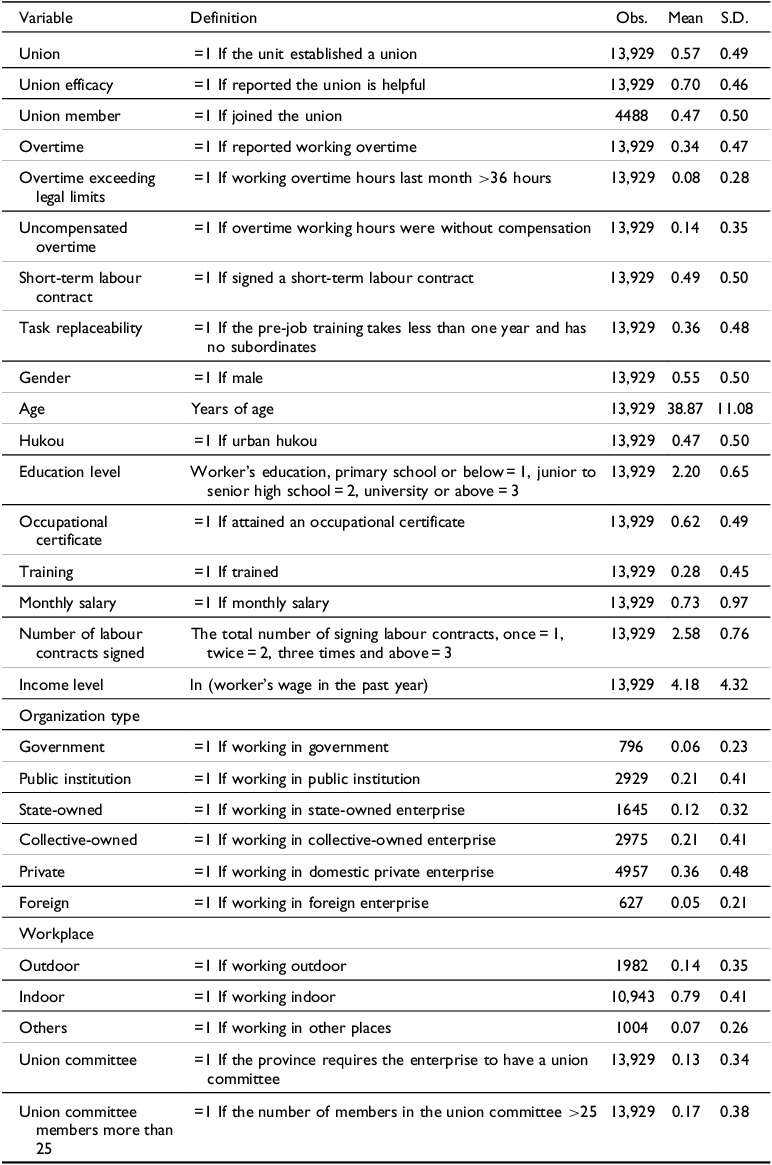
The variable definitions and descriptive statistics for the CLDS sample in 2012, 2014, and 2016 used in the analysis are shown in Table 1.
Variable definitions and descriptive statistics (Year 2012, 2014, 2016)
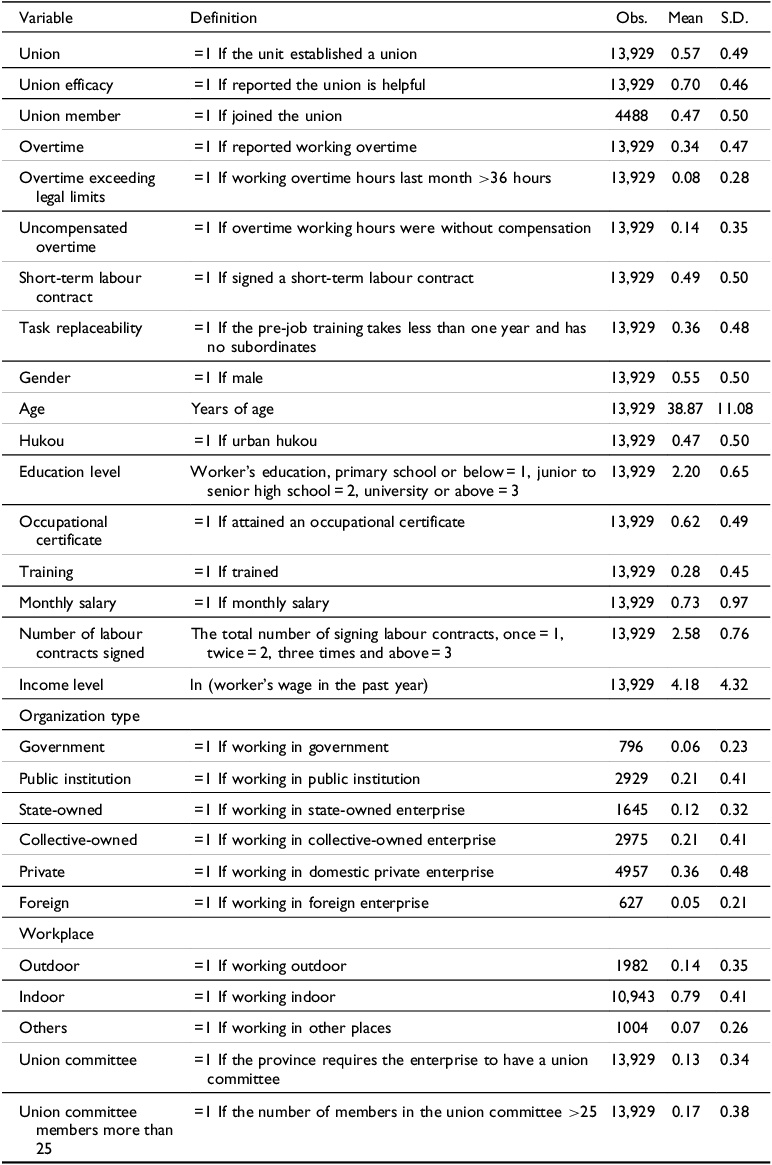
Note: The union membership information is only reported by CLDS in year 2016, therefore, the sample size for this variable is 4488.
Empirical results
Empirical models
The Probit model used in this paper to estimate the effects of Chinese unions on overtime is constructed as follows: ${\rm{\;\;\;\;\;\;\;\;\;\;\;\;\;\;\;\;\;\;\;\;\;\;\;\;\;\;prob}}\left( {{\rm{o}}{{\rm{t}}_i} = 1} \right) = {\rm{\Phi }}({{\rm{\alpha }}_{\rm{i}}} + {{\rm{\beta }}_1}unio{n_i} + {\beta _2}yea{r_i} + {\rm{\gamma }}{{\rm{X}}_{\rm{i}}} + {{\rm{\varepsilon }}_{\rm{i}}})$
where ${\rm{o}}{{\rm{t}}_i}$
represents whether the respondent
${\rm{o}}{{\rm{t}}_i}$
represents whether the respondent $i\;$
had overtime/overtime exceeding legal limits/uncompensated overtime last month.
$i\;$
had overtime/overtime exceeding legal limits/uncompensated overtime last month. $unio{n_i}$
represents union membership or union efficacy.
$unio{n_i}$
represents union membership or union efficacy. $yea{r_i}$
are the year dummies.
$yea{r_i}$
are the year dummies. ${X_i}$
, a vector of control variables, consists of individual and their employer’s characteristics, including age, hukou, education level, workplace dummies, industry dummies, and ownership dummies. A detailed description of the control variables is shown in Table 1.
${X_i}$
, a vector of control variables, consists of individual and their employer’s characteristics, including age, hukou, education level, workplace dummies, industry dummies, and ownership dummies. A detailed description of the control variables is shown in Table 1.
Moreover, recognising the potential endogeneity issue, this paper employs an instrumental variables (IV) estimation strategy and applies the two-stage least squares (2SLS) method using Heckman’s (Reference Heckman1979) two-stage model to estimate the effects of unions on overtime. The estimation model is as follows: $union_i^{\rm{*}} = \partial polic{y_i} + {\rm{\alpha }}yea{r_i} + {\rm{\beta }}{{\rm{X}}_{\rm{i}}} + {{\rm{\varepsilon }}_{\rm{i}}}$ ${\rm{prob}}(o{t_i} = 1) = {{\rm{\beta }}_{\rm{i}}}\widetilde {{\rm{unio}}{{\rm{n}}_{\rm{i}}}} + {\rm{\alpha }}yea{r_i} + {\rm{\gamma }}{{\rm{X}}_{\rm{i}}} + {{\rm{\varepsilon }}_{\rm{i}}}$
where $polic{y_i}$
in Equation (2) represents two instrumental variables: union committee and union committee members more than 25. The endogenous variable – union – is represented as
$polic{y_i}$
in Equation (2) represents two instrumental variables: union committee and union committee members more than 25. The endogenous variable – union – is represented as $union_i^*$
. The dependent variable
$union_i^*$
. The dependent variable $o{t_i}$
in Equation (3) is the same as in Equation (1).
$o{t_i}$
in Equation (3) is the same as in Equation (1).
To further investigate the heterogeneous effects of Chinese unions on workers’ overtime, the analysis includes the interaction term between unions and the moderating variables, i.e. labour contract and task replaceability. Then, the analysis utilises the Probit model to estimate as follows: ${\rm{prob}}(o{t_i} = 1) = {{\rm{\alpha }}_{\rm{i}}} + {\rm{\theta }}\left( {unio{n_i} \times {M_i}} \right) + {{\rm{\beta }}_1}unio{n_i} + {{\rm{\beta }}_2}{M_i} + {\rm{\alpha }}yea{r_i} + {\rm{\gamma }}{{\rm{X}}_{\rm{i}}} + {{\rm{\varepsilon }}_{\rm{i}}}$
where $o{t_i}$
and
$o{t_i}$
and $unio{n_i}$
are the same as in Equation (1).
$unio{n_i}$
are the same as in Equation (1). ${M_i}$
represents two variables related to heterogeneity effects: short labour contract and task replaceability.
${M_i}$
represents two variables related to heterogeneity effects: short labour contract and task replaceability. $unio{n_i} \times {M_i}$
denotes the interaction term of independent variable and these two variables, which captures the heterogeneous effects of the union on preventing overtime across various groups of workers, including workers in the standard or nonstandard workers, workers with or without task replaceability.
$unio{n_i} \times {M_i}$
denotes the interaction term of independent variable and these two variables, which captures the heterogeneous effects of the union on preventing overtime across various groups of workers, including workers in the standard or nonstandard workers, workers with or without task replaceability. $yea{r_i}$
and
$yea{r_i}$
and ${X_i}$
are the same as in Equation (1).
${X_i}$
are the same as in Equation (1).
Baseline results
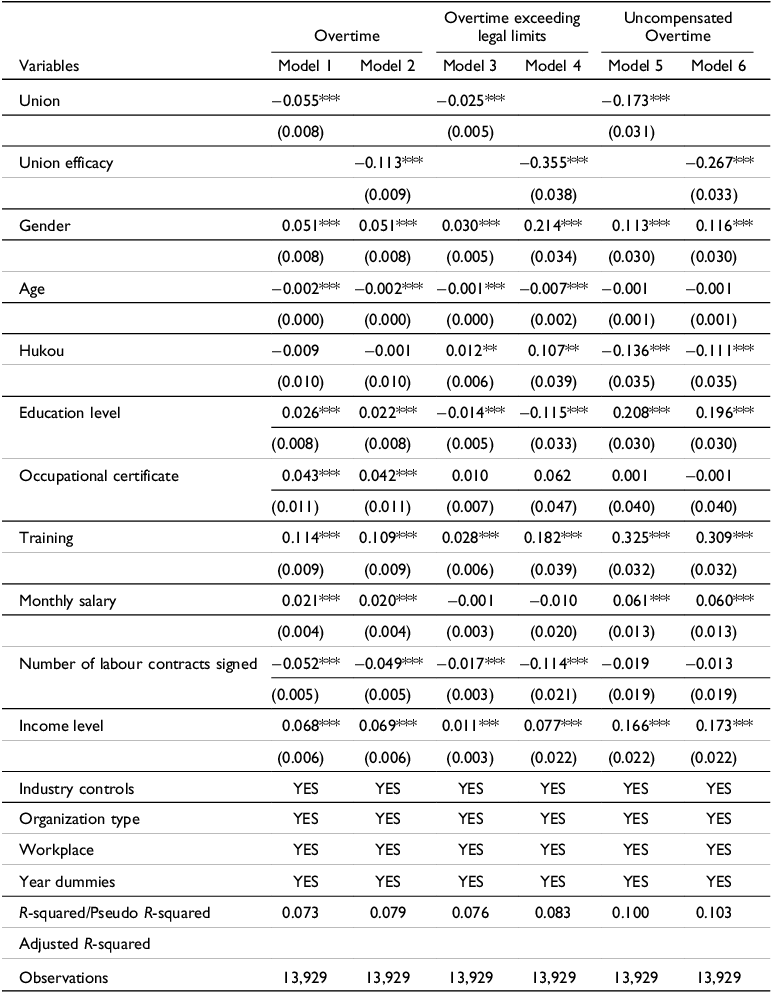
Table 2 presents the Probit and Ordinary Least Squares (OLS) estimations of the relationship between Chinese unions and overtime. The results of Table 2 show that in models (1) to (6), the estimated coefficients of union and union efficacy on workers’ overtime experiences are all significantly negative. This indicates that the establishment of a union in an organisation and the degree of union efficacy can significantly reduce workers’ overtime experiences, including overtime exceeding maximum overtime hours of law limits and uncompensated overtime. Specifically, the estimated marginal effects of unions on overtime exceeding legal limits and uncompensated overtime are −0.025 and −0.173, respectively. This means that the establishment of a union can reduce the likelihood of workers experiencing overlong overtime work and overtime work without compensation by 2.5% and 17.3% (relative to the sample mean), respectively, compared to those without a union.
The effects of unions on workers’ overtime (Year 2012, 2014, 2016)
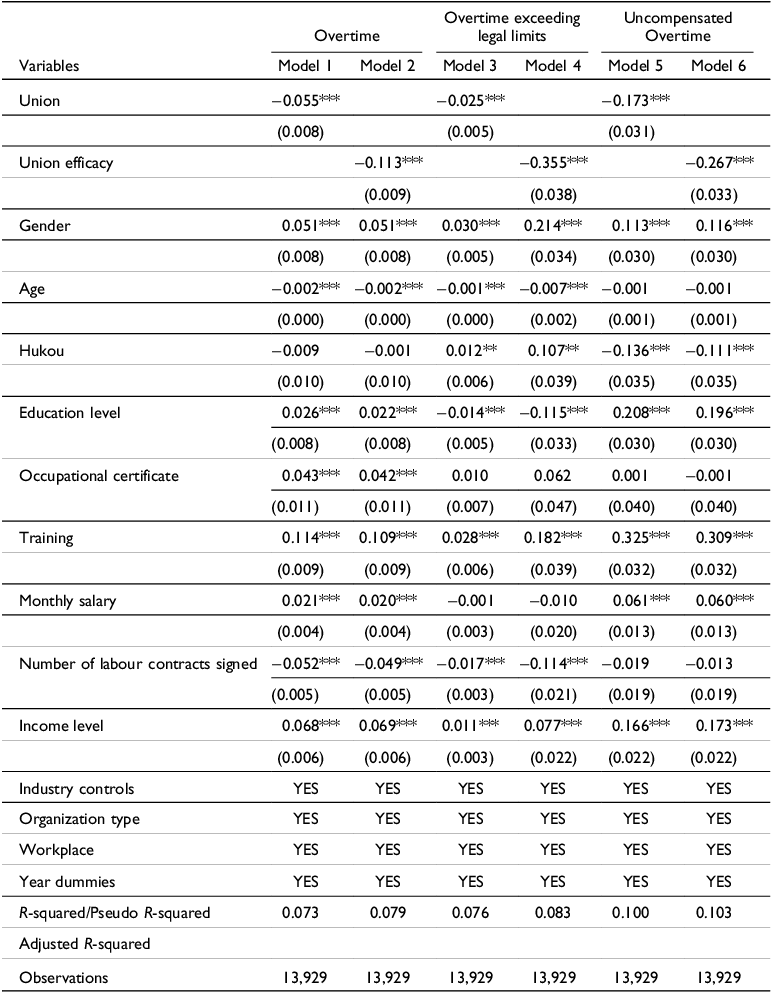
Note: The marginal effects of Probit regression are estimated at the sample means and reported. Standard errors in parentheses. ***Significant at 1%; **significant at 5%; *significant at 10%. We also tested the effects on voluntary overtime and found results consistent with those for total overtime. The dependent variable – overtime exceeding legal limits – is defined solely based on exceeding the monthly limit of 36 hours.
Comparing union efficacy and union coefficients, union efficacy (worker-evaluated) shows stronger negative effects on overtime, especially beyond legal limits and uncompensated overtime. If workers perceive the union as effective, the probability of overtime exceeding legal limits drops by 35.5% and uncompensated overtime by 26.7%.
In addition, the estimated coefficients of control variables in Table 2 indicate that the presence of overtime exceeding legal limits is more common among groups with low education levels and rural hukou. However, these groups are less likely to engage in uncompensated overtime work, and the uncompensated overtime working hours are also shorter.
Robustness checks
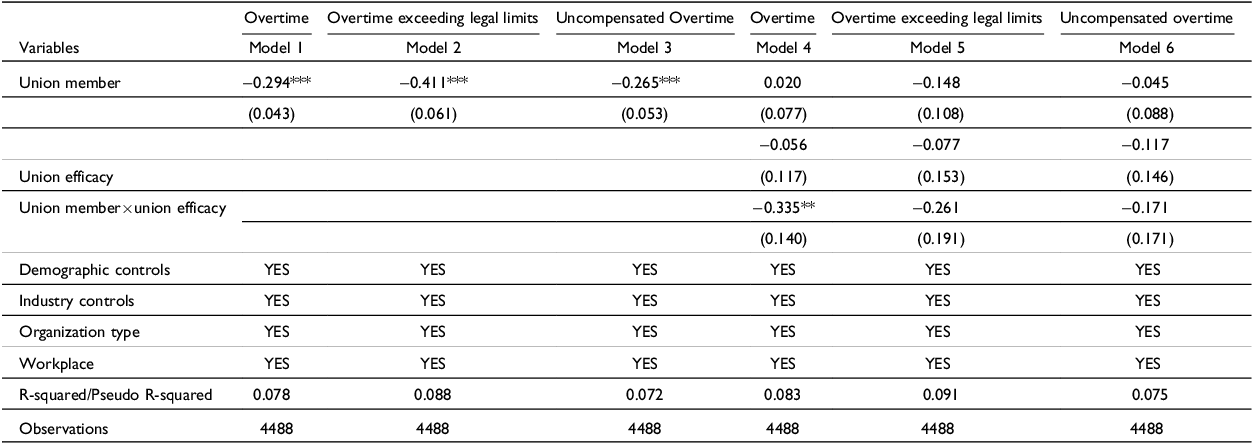
The analysis conducts a robustness check by using union membership as a measure to further investigate the effects of Chinese unions on overtime. Since the CLDS only reported union membership information in the 2016 wave, this paper utilises the 2016 data for the analysis. The results are reported in Table 3. As shown in Models 1 to 3, the estimated coefficients of union membership are significantly negative for overtime, overtime exceeding legal limits, and uncompensated overtime. This indicates that unions can protect their members from engaging in overtime, which is consistent with the findings from Table 2. However, comparing the magnitudes of the coefficients of union membership in Table 3 with those of union and union efficacy in Table 2, the results show that the protection effects of union membership are much stronger.
The effects of union membership on workers’ overtime (Year 2016)
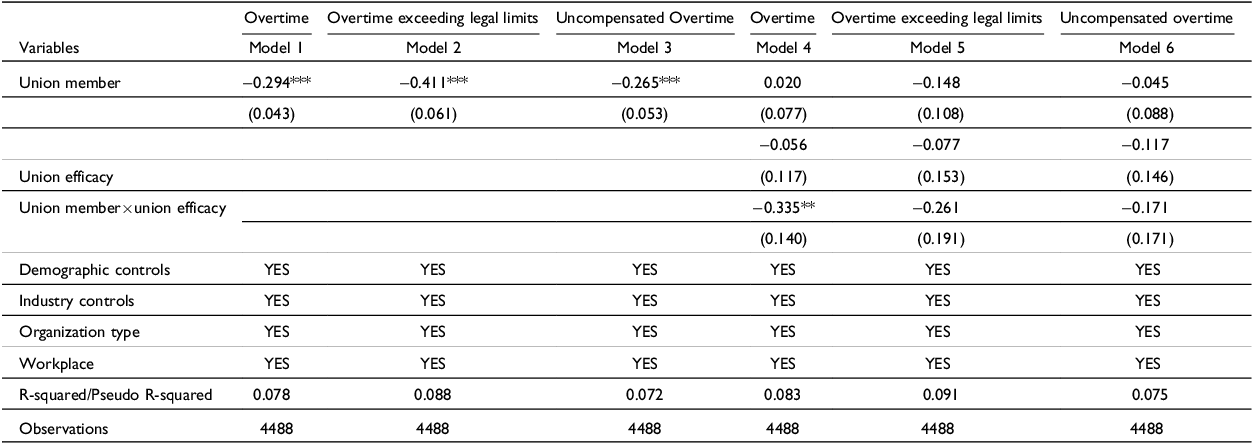
Note: Due to a space limitation, the estimations of control variables same as Table 2 are not reported. Standard errors in parentheses. ***Significant at 1%; **Significant at 5%; *Significant at 10%.
The analysis also estimates the effects of the interaction term between union membership and union efficacy on overtime to examine the additional effects of union membership beyond union efficacy. Results of Models 4 to 6 in Table 3 demonstrate that for workers who believe their unions are efficient, being union members can provide extra protection against overtime possibilities. However, there is no such additional effects on overtime exceeding legal limits and uncompensated overtime, indicating that an efficient union offers the same level of protection for both union members and non-union members.
We further verify the robustness of core findings through subgroup regressions across gender, hukou status, and occupation type (see Appendix Table 1). Results show unions exert significant protective effects on overtime, illegal overtime, and uncompensated overtime across all subgroups. Notably, union effects are consistent between men and women (union coefficient: −0.089 for males and −0.082 for females), with a slightly stronger union efficacy effect for women (−0.135 vs. −0.103), potentially due to gender differences in industry distribution. Additionally, unions provide stronger protection for rural-hukou and blue-collar workers – aligning with our core finding that unions prioritise unprivileged groups.
IV Estimations: Potential endogeneity of unions
The effects of unions on overtime may suffer from an endogeneity issue. For example, workers who establish unions may be more inclined to obey the law or value employee welfare, leading to less overtime working. To address this issue, this paper utilises the instrumental variable (IV) method to estimate the effects of unions on overtime.
Two dummy variables, ‘union committee’ and ‘union committee members more than 25’, are constructed as the instrumental variables for the endogenous variable ‘union’. Provincial union regulations concerning union committee formation differ across provinces: some mandate that all organisations establish a local union committee, while others impose this requirement only when the organisation has more than 25 union members. These regulatory variations serve as potential instrumental variables for union establishment, as they are likely correlated with union formation but exogenous to workers’ overtime.
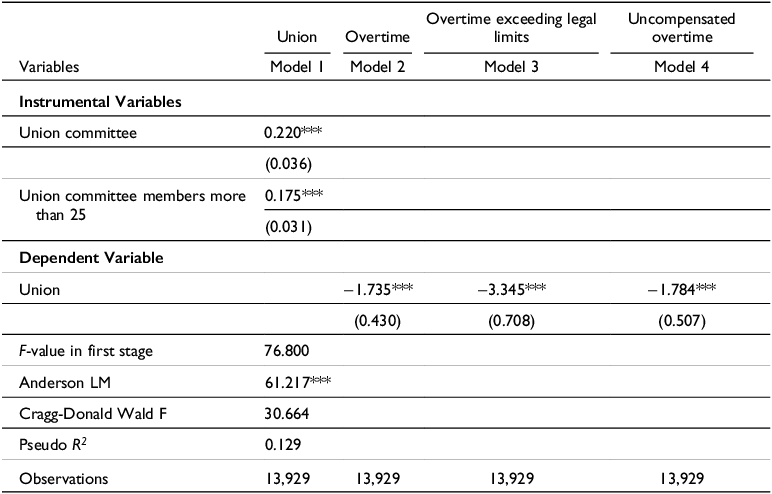
These two policy variables satisfy the key validity requirements of instrumental variables. First, the regression estimates demonstrate a significant correlation between the union committee and union committee members more than 25 with the union. Second, they show a minimal correlation with the random disturbance term in the model. The IVs have passed the under-identification test and the weak identification test, as indicated by the statistics of Anderson LM and Cragg-Donald Wald F in Model 1 of Table 4.
The effects of unions on overtime based on IV-Probit Model (Year 2012, 2014, 2016)
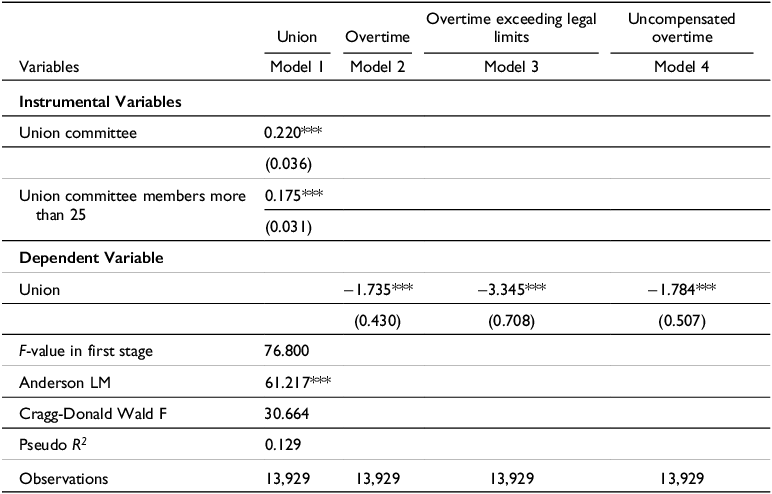
Note: The estimations of control variables same as Table 2 are not reported. Standard errors in parentheses. ***Significant at 1%; **Significant at 5%; *Significant at 10%. Marginal effects are not reported due to literature suggesting that IV-Probit models are sensitive to covariate distributions (Evdokimov et al Reference Evdokimov, Kalnina and Zeleneev2025; Rivers and Vuong Reference Rivers and Vuong1988). Compared to Probit model, IV estimation in IV-probit inflates variance, increasing uncertainty (Andrews et al Reference Andrews, Stock and Sun2019).
In the second-stage regression, the coefficient estimates for unions are significantly higher than the corresponding baseline estimates in columns (2) to (4) of Table 2. These results indicate that the endogeneity issue leads the baseline regression to underestimate the negative impacts of unions on workers’ overtime. This confirms that Chinese unions are effective in reducing overtime, including overtime exceeding legal limits and uncompensated overtime. In other words, the results remain robust when using the IV estimation.
The heterogeneous effects of unions in preventing excessive overtime
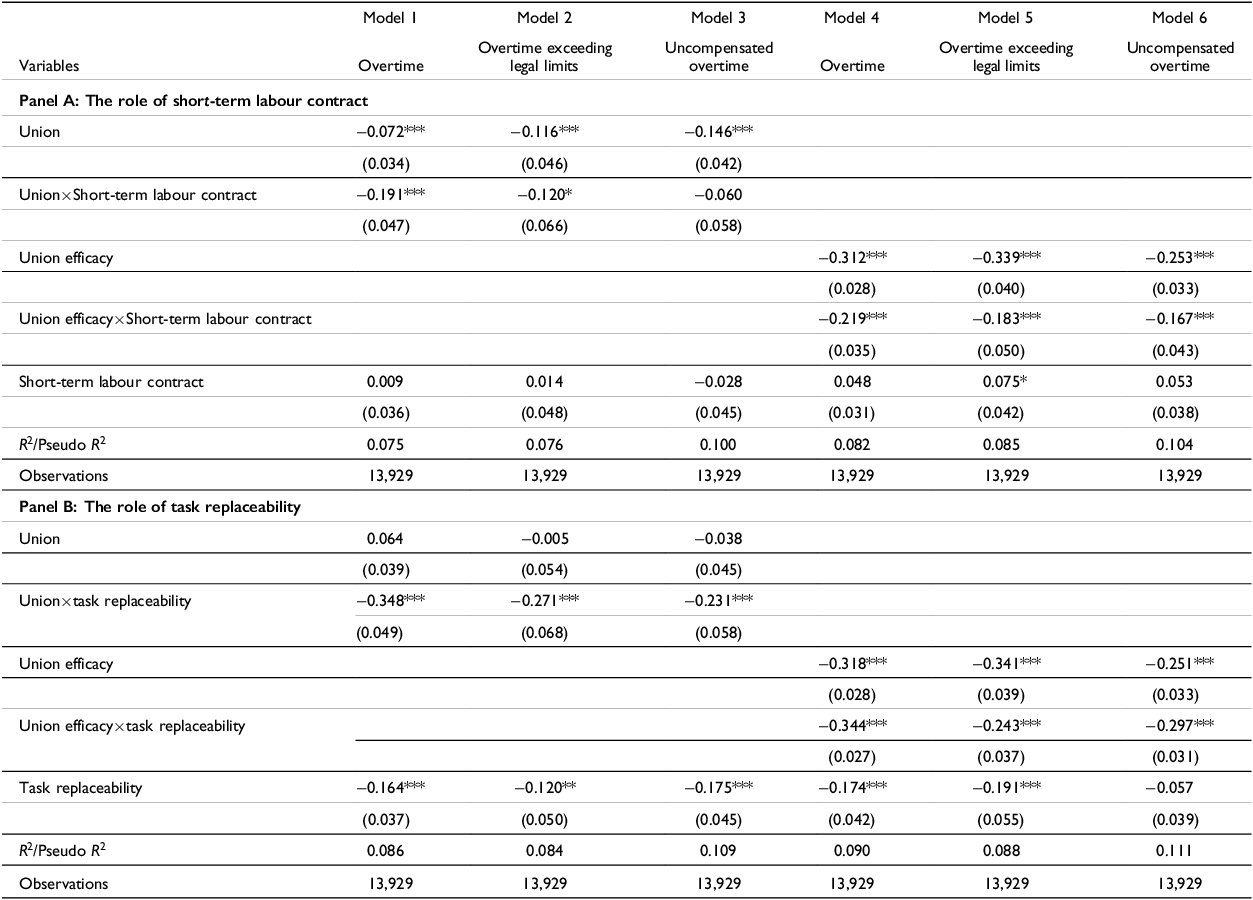
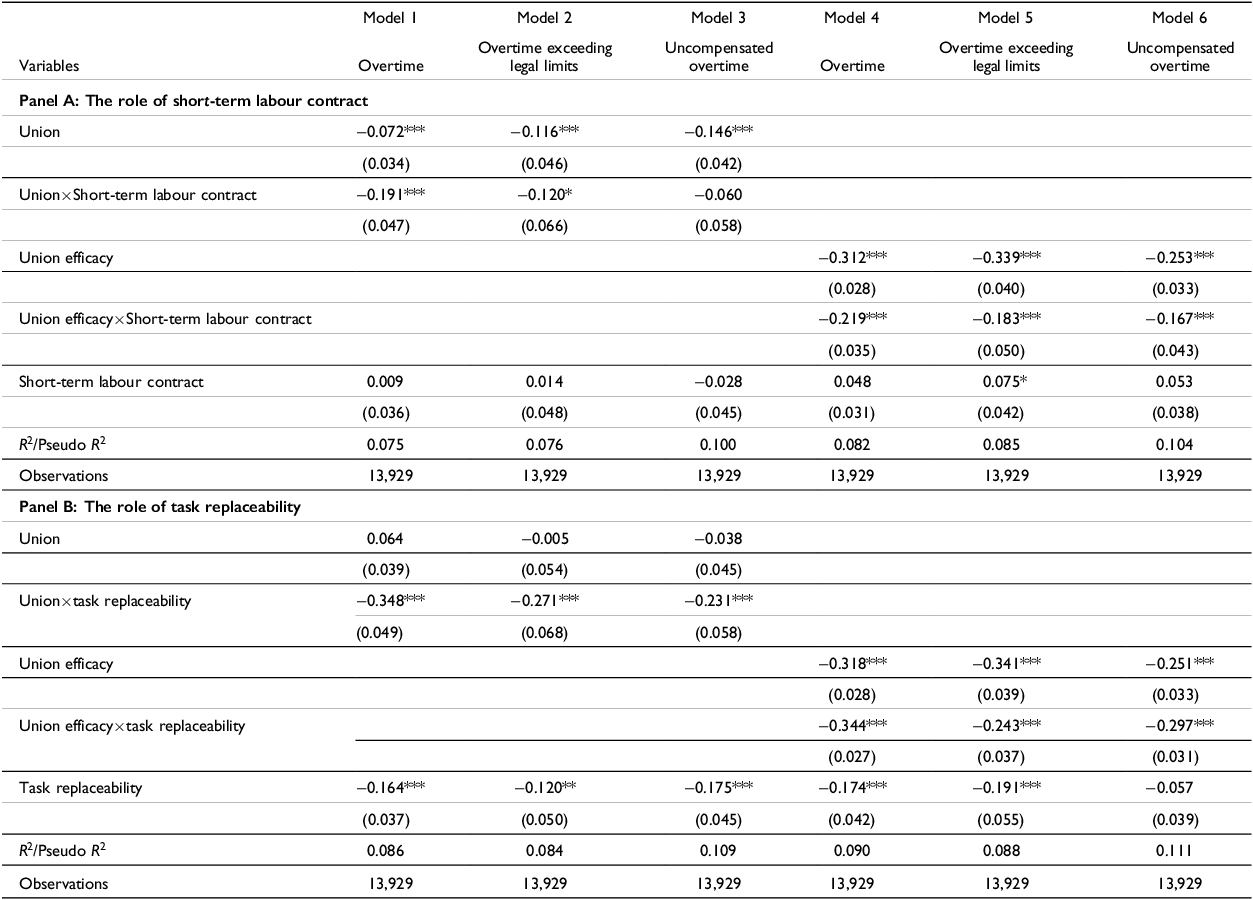
To examine the heterogeneous effects of Chinese unions, this paper introduced two variables: short-term labour contract and task replaceability, to measure the unprivileged workers in the analysis. By including the interaction terms of union/union efficacy with these two variables, the analysis estimates the different protection effects of unions on these two different worker groups – privileged and unprivileged workers. The estimation results of the interactive effects of unions and short-term labour contract and task replaceability are reported in Table 5.
Heterogeneous effects of unions in preventing overtime (Year 2012, 2014, 2016)
Note: Due to space limitations, the estimations of control variables same as Table 2 are not reported. Standard errors in parentheses. *** Significant at 1%; ** significant at 5%; * significant at 10%.
First, the results of Model 1 to Model 6 in Table 5 show that the interaction terms between unprivileged workers and unions/union efficacy are generally negatively significant in predicting overtime, overtime exceeding legal limits, and uncompensated overtime. This indicates that unions are more protective of unprivileged workers. Unprivileged workers whose employers have established a union reported a much lower probability of overtime (b = −0.191, p < 0.01 in panel A, b = −0.348, p < 0.01 in panel B), overtime exceeding legal limits (b = −0.120, p < 0.1 in panel A, b = −0.271, p < 0.01 in panel B), and uncompensated overtime (b = −0.231, p < 0.01 in panel B). Moreover, those who reported high union efficacy also experienced a lower probability of overtime, overtime exceeding legal limits, and uncompensated overtime.
Second, comparing the two measures of unprivileged workers, the magnitude of estimated coefficients of interaction terms (task replaceability with unions/union efficacy) in Panel B (ranging from −0.231 to −0.348) is higher than those (short-term labour contract with unions/union efficacy) in Panel A (ranging from −0.060 to −0.219). These results suggest that the union protection effects for unprivileged workers are strongest for those who are in easily replaceable jobs. In comparison, for those who have short-term labour contracts, although unions can provide additional protection against overtime, the protection effects are relatively smaller.
Third, when comparing the estimates between union interactions and union efficacy interactions, we find notable differences in the heterogeneous protection effects. Specifically, the heterogeneous protection effects of union efficacy (Models 4 to 6 in Table 5) are far more significant than those of union establishment (Models 1 to 3 in Table 5). To be more precise, both the magnitude and significance of the coefficients for union interactions are substantially smaller than those for union efficacy interactions. In Panel A, the estimated coefficients of the union interaction term in Models 2 and 3 turn out to be insignificant. This lack of significance is revealing that while an efficiently-operated union can offer stronger protection to unprivileged workers, merely establishing a union may not necessarily provide additional protection for workers with unstable employment relationships.
Propensity score matching estimations
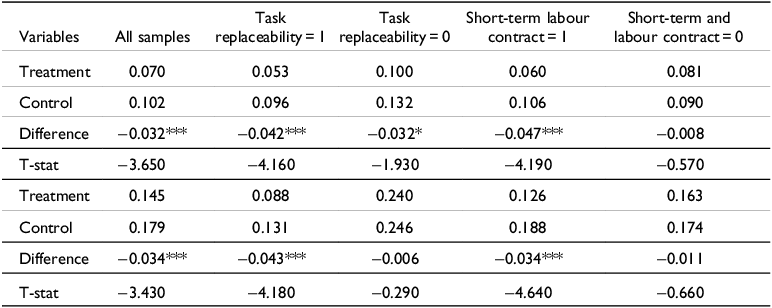
Furthermore, to address self-selection biases, this paper adopts propensity score matching (PSM) method to explore the unions’ prevention effects against overtime among privileged and unprivileged workers. The first step is to calculate the propensity score for each worker using a logit model. The second step is to match the employers where workers work with/without the union according to the obtained propensity scores and to compare the differentials of overtime exceeding legal limits and uncompensated overtime between the two groups of workers with similar propensity scores. This two-step procedure is undertaken for workers having long-term or short-term labour contracts, for workers having easily replaceable jobs or not, as well as for workers employed in the private sector or public sector. The analysis verifies the overlap condition to ensure that the propensity scores for employers with and without a union lie in a common support and conduct balancing tests to determine whether there are significant differences between the two worker groups after matching.
We employed a nearest-neighbour PSM approach. Each treated unit was matched to one control unit with the closest propensity score, subject to a calliper restriction that limited matches to pairs whose scores differed by no more than 0.05. This ensured that treated and control observations were only compared when they were sufficiently similar in terms of their predicted probability of treatment. To avoid extrapolation, the analysis was restricted to the common support region, meaning that treated units without comparable controls (and vice versa) were excluded. When multiple controls were equally close, ties were resolved randomly. Uniform weights were applied to matched controls, and the resulting estimates reflect the average treatment effect across the matched sample. Common support region and balance tests are all conducted to confirm effective balancing.
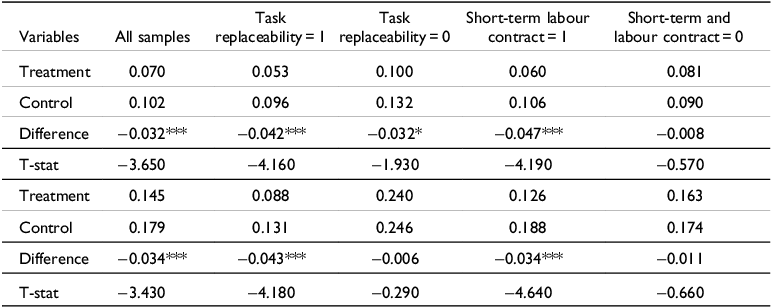
Following the approach of Smith and Todd (Reference Smith and Todd2005), this paper uses a set of t-tests of equal means between the employers with/without a union. The previous conclusions hold for all samples and different subgroup samples. For all samples, the results of Table 6 show that there are significant differences between employers with a union and without a union regarding overtime exceeding legal limits (b = −0.032, p < 0.001). This indicates that unions do have a significant impact on reducing overtime.
PSM with different subsamples: Union as the treatment
Note: Due to space limitations, the results regarding union efficacy as the treatment variable are not reported. *** Significant at 1%; ** significant at 5%; * significant at 10%. Common support region, balance tests, Rosenbaum bounds sensitivity analysis are also conducted.
Moreover, for subgroups divided according to privileged and unprivileged working status, the differences in overtime outcomes between workers employed by employers with and without a union vary. For instance, in Panel A of Table 6, for workers with short-term labour contracts, the difference between employers with/without a union is significant (−0.047, p < 0.05), while for workers with long-term labour contracts, the difference is not significant (−0.008, p > 0.1). This suggests that the unions’ prevention effects against overtime exceeding legal limits only apply to short-term contract workers. Similarly, in Panel B of Table 6, for workers with easily replaceable tasks, the difference between employers with/without a union is significant (−0.043, p < 0.01), while for workers with tasks that are difficult to replace, the difference is not significant (−0.006, p > 0.1). This suggests that the unions’ prevention effects against uncompensated overtime only applies to workers with easily replaceable job tasks. Rosenbaum bounds sensitivity analysis is also conducted.
The analysis also examines the effects of union efficacy using PSM. The results are consistent with the findings reported in Tables 2 and 5.
Conclusions
This paper has examined the relationship between unions and overtime using three waves of China Labor-force Dynamics Survey (CLDS) data in 2012, 2014, and 2016. The results of the analysis in this paper suggest that Chinese unions can effectively protect workers from engaging in overtime work including overtime exceeding legal limits and uncompensated overtime, particularly those with unprivileged working status. The main findings of this paper are as follows:
First, the paper provides evidence that the establishment of unions and unions’ efficacy significantly reduce workers’ overtime. Specifically, unions play a crucial role in mitigating instances where workers are required to work beyond legal limits and/or work overtime without receiving proper compensation. This finding challenges the notion of the limited effectiveness of Chinese unions and aims to emphasise their role in influencing organisational behaviour and advocating for workers’ rights. Other concerns have arisen regarding the effectiveness of unions in China due to legal and regulatory constraints (Budd et al Reference Budd, Chi, Wang and Xie2014; Ge Reference Ge2007). Some research suggests that Chinese unions are unlike Western unions (Fang and Ge Reference Fang and Ge2012) and are consequently limited in their ability to protect workers and primarily serve the interests of employers (Wei et al Reference Wei, Dong and Jin2015; Yao and Zhong Reference Yao and Zhong2013). However, the findings of this paper indicate that the unique ‘party-state face’ of Chinese unions actually plays an effective role. Functioning as a micro institutional design embedded within organisations, Chinese unions encourage microeconomic entities to align with national policy goals, monitor and curb employers’ engagement in illegal overtime practices, and protect workers’ welfare (Taylor and Li Reference Taylor and Li2007). By doing so, they ultimately contribute to the macro goals of social stability and economic development.
Second, this paper finds that unions in China provide additional protection for unprivileged workers, including those with short-term contracts and engaged in easily replaceable job tasks. The protection effects are particularly strong for workers with easily replaceable job tasks. Previous findings have shown that unions in private firms play a more prominent role (Lu et al Reference Lu, Tao and Wang2010) and provide more protection for temporary workers (Pulignano et al Reference Pulignano, Meardi and Doerflinger2015). These findings have been shown here. Indeed, the article has demonstrated that while employers may seek to engage in management practices that go against the law, unions can provide additional protection for vulnerable (unprivileged) employees.
The findings of this paper have several policy implications. First, in the context of China, illegal overtime work is prevalent, and unions can be valuable tools in curbing this phenomenon. There is thus ample room for enhancing the effectiveness of unions in addressing overtime and illegal overtime practices, particularly in the private sector. We recommend strengthening legal provisions to empower unions in supervising employers’ overtime practices – for example, mandating regular overtime record inspections and expanding unions’ access to labour dispute mediation resources. This would enhance unions’ capacity to safeguard workers’ rights, particularly for unprivileged/vulnerable groups such as short-term contract workers and rural-hukou migrants. In addition, since this paper finds that union efficacy has a greater impact on preventing overtime compared to mere union establishment, it is important to identify and promote good practices that enhance union efficacy among employers.
This study has several limitations. First, overtime and union efficacy are self-reported, introducing potential biases: differential reporting (e.g. white-collar underreporting overtime) and perception-reality gaps – union efficacy may reflect satisfaction rather than actual performance. Future research could use firm-level objective data (e.g. union activity records) to refine measurement. Second, CLDS data cannot distinguish ‘no compensation’ from ‘below-legal compensation’ for overtime, affecting estimate precision. Future studies could adopt employer–employee matched data to capture detailed compensation information. Third, excluding observations due to missing values may slightly reduce generalisability. While such absence is random and core results are robust, future research could optimise data collection or use advanced imputation methods.
Funding statement
This research is supported by the National Social Science Fund of China (grant no. 25BGL167).
Competing interests
All authors declare that there is no competing interest related to this work.

 Open access

