




This article addresses early modern women's power through an object study of the wedding girdle, a thickly embellished belt that was the most costly, emblematic, and intimate item in a Renaissance burgher bride's trousseau. No respectable burgher started her married life without a lavish set of clothes and jewellery, folded lovingly into a large chest. This collection of things constituted the ornamental apparatus of a marriage. Given to the bride on her entry into a new home as wife, often perceived to be the point at which her ‘womanhood’ began, these gifts marked a transformative moment. Reflecting the auspiciousness of such an occasion, individual burghers took pains to make sure that their daughter's trousseaux were well filled. In 1577, for instance, the Prague resident Martha Smichlová carefully outfitted her newly engaged daughter Anna. Hurrying back and forth between local traders and pawnbrokers, Smichlová ordered a grape-coloured cloak striped with black velvet, a marten-fur cloak lined with damask, a golden cap, a wreath of silver wire, golden rings, a coral rosary, and a silver girdle. Together with copious quantities of bed linen and tin dishes, these clothes were packed into handsome wooden chests and transported to the house of Anna's new husband, Jakub Prunar. According to a female friend, once the arrangements were finished, Anna's mother released her daughter from her family with the statement: ‘so, my dear child, now you can live well…now you won't be ours’.Footnote 1 Anna's mother did not exaggerate when she said that her daughter needed these things in order to ‘live’. A trousseau was integral to an early modern woman's self-representation, the daily routines of her household, and, as a transfer of wealth across the generations, it amounted to a substantial asset. Easily pawned for cash or credit, these goods ensured her financial security in a period in which women's rights over land or money were limited.
Over the past decades, women's history has pushed back against the assumption that early modern women were passive victims of the patriarchy. Countless studies have argued that early modern women found freedom and companionship in home and work, that male authority was limited by law and custom, and that some women found themselves empowered by patriarchal frameworks.Footnote 2 These findings have challenged historical assurances of patriarchal hegemony. In 2018, Allyson Poska expressed doubt about the very usefulness of ‘patriarchy’ as a term, proposing that women's agency should be considered the norm, taken as the historical ‘starting premise’.Footnote 3 Historians must, she argued, move beyond the ‘juxtaposition of patriarchal impediments and exceptional female success’ and accept that women's scope for action was broad and varied.Footnote 4 These interventions make clear that the potential for women's agency was built into the early modern patriarchal system, and that this system shaped their possibilities for action. However, recognition of this fact should not cause us to abandon the patriarchy – traditionally understood through the family household structure – as a way of understanding women's lives. Poska rightly pointed out the multiple examples of those who carved out existences outside of convention, including women who gained power in work, whether in professions, such as women who became famed painters, or, less exceptionally, the widows who carried on their husband's business without remarrying.Footnote 5 However, it cannot be ignored that households headed by fathers and husbands defined the lives of most women.Footnote 6 This statement holds especially true for burghers, the citizen classes of cities, for whom the household was the centre of their cultural, social, and economic activity. While burghers made up just one part of the social fabric, they were nonetheless extremely influential. As a status group, they drove many of the developments that characterize the Renaissance and Reformations, namely, rapid urbanization, the consolidation of a consumer society, moral codes, and the slow, piecemeal, and bidirectional process of state formation. If we are to understand the expectations on middle-class women, and how these shaped the forms of agency that they expressed, the household must be at the centre of interpretation.
In this article, I bring a new material culture approach to the question of early modern women's power in the household. While numerous studies have discussed the significance of the trousseau, very few have looked closely at the individual objects it contained.Footnote 7 Focusing particularly on the bridal girdle, I argue that traditional ideas around the household as the moral centre of the ‘patriarchy’ provided a mechanism for certain women to claim power. Burgher preoccupations, specifically the desire to display the prosperity, industry, and piety of their households, created distinct, albeit socially specific, opportunities for women to assert themselves in opposition to others. To argue this point, I examine the central and interlocking structures of the burgher household: feminine roles and representations, the legal property system, and the moral discourses that surrounded marriage. By taking an object history approach, I will freshly illuminate how women lived within these abstract frameworks, revealing the ordinary, everyday, and routine. Objects provide unique access to private spaces, reveal the quality of intimate and affective relationships, and speak to hidden, embodied cultural practices – all of which are particularly important in researching women's lives; lives which so often go unrecorded.Footnote 8 A material culture approach to the question of women's power has particular utility for the Renaissance period, in which the proliferation of objects in the households of ‘ordinary’ people rose in tandem with the emergence of an increasingly formalized legal culture, designed to delineate more clearly people's increasing possessions. An exceptionally showy and valuable adornment worn tightly bound around the body, the bridal girdle sat on the interface between the individual woman and the broad patriarchal structures of the household. It therefore provides a unique case-study in how early modern burgher women navigated gender, sex, and marriage in the homes they shared with parents, lovers, and families. In their relationships, both public and private, the women of Renaissance Prague were able to express power through the very same structures that constrained them, drawing on the ideals of the burgher household.
My study of the bridal girdle and burgher women's power relies on manuscript records from the Prague City Archives, combined with surviving objects and images from the period. While conventional sources for the study of marriage (marriage contracts and wills) from the period are light on detail, the bridal girdle often appeared in both probate inventories and criminal court records. Inventories listed an individual's possessions at their death.Footnote 9 Many of the inventories sampled are those of men, as only widows had their goods listed separately from their partner. However, even in a man's estate, it is possible to find evidence of women's lives. Women's things occasionally appear parcelled up together, or their voices are heard in annotations, adding information that was dutifully noted down by the city's scribes. When working with men's estates, I have assumed that girdles that were heavily embellished or decorated with gendered accessories belonged to their wives or daughters. In Prague's criminal court, women spoke more directly through depositions, preparatory testaments intended to collect evidence ahead of a trial (unfortunately, records of the trials themselves do not survive). These witness statements provide information as to how objects were embedded in the lives of individuals, the conscious and unconscious behaviours that surrounded them, and the social relationships through which objects moved.Footnote 10 These archival records are combined with a close, hands-on study of a surviving girdle from the Grassi Museum in Leipzig, which uncovered layers of symbolism not communicated by the textual record. Of course, not every girdle that appears in the sources would have been given at marriage, but, much like the modern-day engagement ring, these objects had a strong customary association with betrothal.Footnote 11 For example, in 1620, the estate of the valet Pavel Libičar included a silver girdle, which the scribes noted he had given to his wife ‘for the promise’.Footnote 12
Prague, the capital of the Kingdom of Bohemia, provides the ideal setting in which to explore burgher women's power. The city was profoundly shaped by both the Renaissance and the Reformation, dual processes that remade the institutions of marriage and rapidly shifted gender roles across the lands of the Holy Roman Empire.Footnote 13 I look at the city from Maximilian II's coronation as king of Bohemia in 1562 until the Second Prague Defenestration in 1618, which began the Thirty Years War. Maximilian's successor Rudolf II transferred his court from Vienna to Prague in 1583, making Prague the seat of the Habsburg Monarchy and the centre of the Holy Roman Empire. As a result, Prague's population grew rapidly from 40,000 in 1583 to 70,000 by 1600.Footnote 14 Artists and artisans flocked to the court of Rudolf II, and burghers enthusiastically responded to new offerings at the city's markets, investing in home improvements, books, paintings, art objects, jewellery, and dress.Footnote 15 This booming population was extraordinarily diverse. Protected by Maximilian II's verbal assent for religious toleration at the 1575 Land Diet, Protestants of all kinds – conservative Utraquists, Lutherans, Calvinists, and radical Anabaptists – lived alongside a substantial minority of Catholics and Jews.Footnote 16 The distinct confessional make-up of Prague offers an alternative perspective on the materiality of early modern marriage, which has more often been looked at through the lens of the Catholic faith.Footnote 17
While Prague was unusual in being so confessionally tolerant, its municipal council nonetheless expended considerable energy in attempting to regulate the city's gendered, sexual, and proprietorial order. Moralists – clerics, schoolteachers, and preachers of all confessions – tried to set clear standards for the behaviour of the couple in wedlock. In the late sixteenth century, marriage manuals outlining the duties expected of wives proliferated across the Holy Roman Empire.Footnote 18 In 1579, Koldín's Code set out clear rules for those who entered into betrothal, with a particular emphasis on systematizing and publicizing the marriage act.Footnote 19 The Code also unified Bohemia's laws in line with Roman civil law, clearly defining women's rights over their property and creating a highly gendered legal culture of ownership that was similar to much of Europe.Footnote 20 The most substantial inheritance that a woman received was at her wedding. The value of the dowry and trousseau was subtracted from the inheritance that a daughter was due once her parents died, the remainder of which would be claimed in ‘moveable’ goods (household objects, rather than money or land).Footnote 21 Given that the trousseau made up a substantial part of a woman's wealth, once married, women were not obliged to hand over their goods to their husband, and men were not permitted to sell their wife's goods.Footnote 22 On her husband's death, the wife would receive one third of her husband's estate in either moveable goods or money, and she could also retain the goods she had brought to the marriage in her trousseau.Footnote 23 Having outlined the structures that shaped women's possibilities for action, I will now explore how early modern burgher women in Prague exerted power within, and as part of, these systems, leveraging burgher ideals of the household in order to do so. I begin by exploring women's self-representations, before turning to women's use of the property system, and conclude with the moral code that shaped adornment.
I
The object of the bridal girdle offers a unique insight into the ways that burgher women found agency by drawing on feminine stereotypes. Strict cultural expectations surrounded the behaviour of the bride. Yet, as I will show, women claimed, renegotiated, and displayed these ideals, using them as a cultural resource to distinguish themselves and to claim power. The newly married woman became part of a household, a state that, in partnership with her husband, bestowed significant social and economic status.Footnote 24 Families’ attempts to engage in conspicuous consumption to show off this status at the marriage ceremony explains why, historically, Bohemia's sumptuary legislation often imposed limits on the weight of girdles (although it should be noted that no similar legislation survives for the Renaissance period).Footnote 25 After the ceremony, burgher couples often had themselves painted, immortalizing the finery in which they were decked. Despite such intentions, very few of these portraits survive in Prague. My analysis therefore begins with a portrait from Augsburg, produced in the first half of the sixteenth century. Prague and Augsburg shared a similar culture of adornment. This related to their shared membership of the Holy Roman Empire, their physical proximity to Bohemia's silver mines, and the fluid movement of artisans between the cities. In the years that this portrait was painted, Augsburg was experiencing an economic boom that would be echoed in Prague during the century's later decades.Footnote 26
In 1538 in Augsburg, Barbara Mangold married Matthäus Schwarz, the head accountant of the merchant Fugger company. Four years later, Matthäus had a pair of portraits commissioned: one of himself, newly granted a coat of arms by Charles V, and one depicting his new wife, shown in Figure 1. Viewing the painting, the eye is drawn to Barbara's girdle, rather than her face, which has been rendered in less detail than her jewellery.Footnote 27 The item is made of a twisted rope of silver wire, along which, at regular points, are threaded cylindrical silver beads. Zig-zag engravings on the beads break the fall of light and create lustre. In an artificial composition, the seated Barbara holds up the tasselled girdle end with both of her hands. Without this deliberate gesture, the heavy girdle end would have naturally fallen to the floor. Such a considered pose reveals the deportment necessitated by the wearing of a girdle. Standing, the wearer would have to move with the pendant so that it would not knock against her legs; sitting, she would have to position the pendant so it would not roll on the floor. These careful movements displayed poise and physical self-control, both of which were desirable qualities of a high-status woman who wished to adopt ‘courtly’ social styles.Footnote 28 The physical restriction of having to adapt her body to her jewellery's movement did not curtail a burgher woman's agency. Rather, it highlighted her status in opposition to other, less refined women, marking out her rank and, therefore, her relative power.
Christoph Amberger, Portrait of Barbara Schwarz, oil on panel. Commissioned in 1542. With Colnagi's, London.
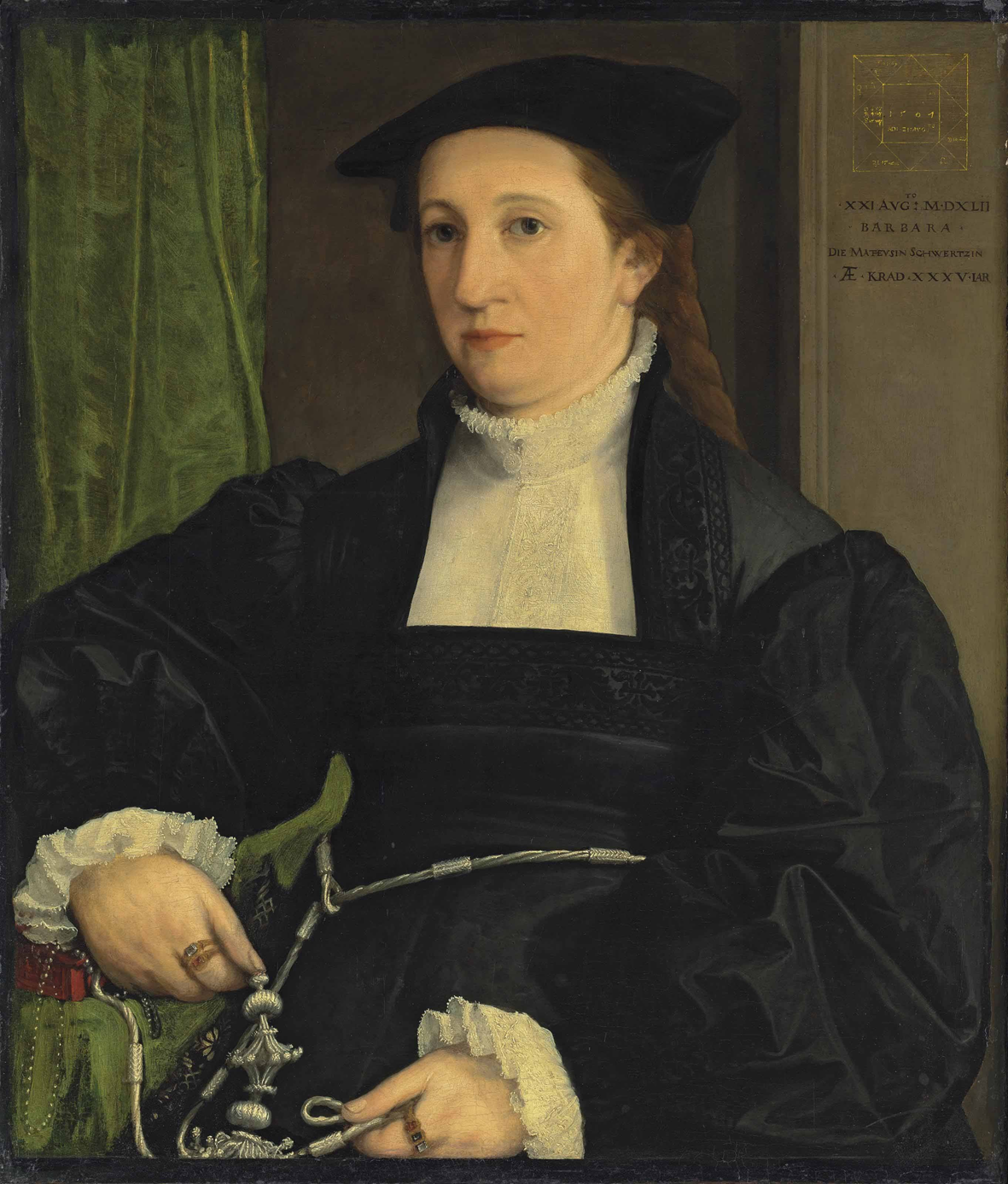
Once learnt, these embodied behaviours would have become relatively unconscious. Yet, in this image, there is intention behind the placement of the girdle's end in Barbara's hands. The pictorial strategy invites the viewer to concentrate on the gleaming girdle and, in looking, to admire every aspect of its maker's complicated work. The lability of silver, which could easily be melted and recast, meant that girdle's design was extremely receptive to changing fashion trends. Rapid innovation in the techniques and styles of silversmithing across Europe meant that girdles could be reworked in novel and attractive ways.Footnote 29 As in Augsburg, consumers in Prague also appreciated innovation in design. Goldsmith's inventories from the city show that girdles were often taken to be mended or disassembled and refashioned in the latest styles. For example, in 1616, the inventory of the workshop of the Prague goldsmith Jiřźik Wild included ‘seven pieces from a silver belt. And a piece of silver to be laid on the bottom.’Footnote 30 Depicting a particularly stylishly produced girdle, the portrait of Barbara showed off the couple's wealth. Yet, as with Barbara's graceful handling of her heavy jewellery, the portrait is also a record of social capital. The thick rope of silver wire displayed the couple's knowledge of fashionable trends and their connections to the most skilled of artisans. A lavish silver girdle appears to have been a crucial part of the deliberate display of a prosperous, well-connected, and high-status couple.
A burgher woman's role as a wife placed her in a potentially powerful, high-status partnership. When viewed closely, the complex designs of bridal girdles reveal not just the status of the couple, but how women navigated expectations of their role within their union. Sexuality, reproduction, and domestic industry were all integral to a bride's self-representation. These strict gendered expectations nonetheless allowed women to assert a degree of power. Produced in German-speaking lands for a burgher customer in the sixteenth century, a surviving girdle shown in Figure 2 bears a striking similarity to those listed in inventories from Renaissance Prague. For example, in 1613, Ludmilla Lexerynová, a widow who lived opposite the church of St Haštala in the Old Town, owned a large silver girdle that was set with precious stones, engraved with angels, and hung with a large pomander on a chain, all produced in a ‘masterly fashion’.Footnote 31 Like Lexerynová's girdle, the jewellery in Figure 2 would have been an expensive and carefully commissioned gift. The metalwork is made up of seventeen rectangular silver links, all gilded with gold, creating a lustrous shine. Punch marks on the four corners of each link suggest that the girdle's metal would have once been backed by colourful silk or velvet fabric, since removed or decayed. Given that Central Europe's population was majority Protestant, it is highly likely that this girdle would have been owned by a Protestant woman, an assumption reinforced by its iconography.
Silver-gilt girdle with pearls, turquoise, garnets, and glass doublets. German-speaking lands, sixteenth century. GRASSI Museum für Angewandte Kunst, Leipzig. Foto: Christoph Sandig.
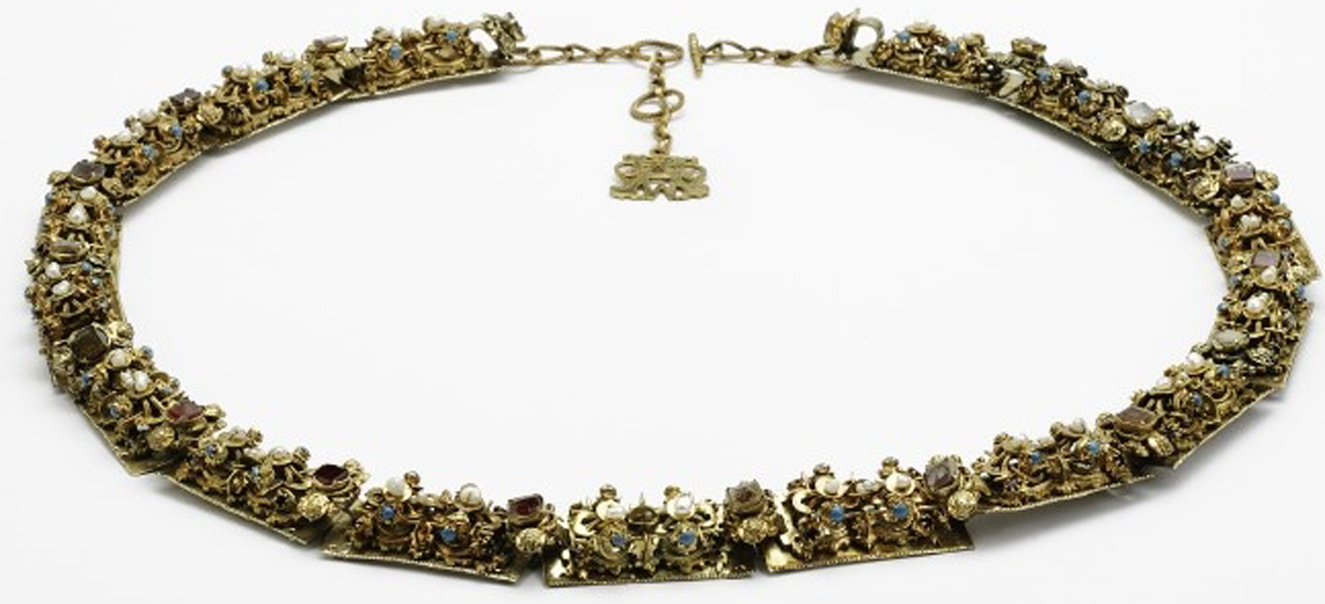
A devout burgher bride made a great display of her chastity, a gendered virtue that constrained women's behaviours, but simultaneously allowed them to establish power through a display of honour. While the Reformation had removed marriage as a sacrament, Protestants of all branches saw marriage as a social institution to control sexual desire. Contemporary moral writings devoted considerable energy to the topic of regulating women's sexual appetites.Footnote 32 Reflecting such ideas, the bridal girdle showed off its wearer's self-control. The hoop of the girdle in Figure 2 is dotted with freshwater pearls, conventionally associated with purity.Footnote 33 The pearls appear alongside large imitation rubies, a gem perceived to control lust.Footnote 34 The body of the hoop, which is made of densely foliated metalwork, uses botanical themes that were common on girdles from Renaissance Prague. In 1595, the estate of the noble Jan Horsky z Brynffeldu included a ‘silver girdle in the style of a rose’, while in 1609, the furrier Prokop Hanß had among his goods a ‘girdle with gold-gilt and silver roses mixed together’ and a ‘silver girdle gilded with gold with wide roses’.Footnote 35 This design can be connected to Bohemian courtship traditions in which women wore wreaths of fresh plants as a sign of their purity.Footnote 36
The bride also displayed her loyalty to her husband through the accessories that hung from the girdle's hoop closure. It was a nineteenth-century owner that added their initials, ‘AW’, to the girdle end in Figure 2. Its sixteenth-century owner would have chosen a different decoration. In 1599, Ludwik Koralek's estate included a girdle with locks, as well as a number of lock pendants; in 1607, the estate of Jan Retle from Brno included two silver girdles, both of which were decorated with gold-gilt locks, and in 1616 Adolf Myslych's estate included a silver girdle with an accompanying silver lock.Footnote 37 The locking up of the woman's body was a prominent theme within the learned Renaissance imagination. In his summary of the origins of marriage, the famed Italian humanist Polydore Vergil recorded that ‘it was the custom among the Greek and Romans virgins to fasten with a girdle their genitals until the day of marriage’.Footnote 38 Keeping the body ‘under lock and key’ before marriage, a lock pendant referenced the woman's virginity and her control of her lust. In marriage, it showed her husband's possession and ownership of her body, a display of her obedience. The expectation of sexual restraint was a limit on the freedom of an early modern woman. However, as a display of virtue that was intended to distinguish the bride from other women, such a show of control simultaneously conferred a degree of power.
While the early modern bride made a virtue of her purity, once married, sex and reproduction was of the utmost importance. The design of bridal girdles reveals an otherwise unrecorded, Protestant female piety centred on motherhood, one that suggests that women adapted confessional boundaries to create a sense of control over reproduction. Made up of a chain that tightly encircled the waist, the girdle – while it might be hung with locks that referenced chastity – enhanced the curves of the waist and the hips (the effect of which is shown by the v shape created on Barbara Schwarz's waist in Figure 1). Early modern women took considerable pains to protect as well as project the fecundity of their bodies. The dense material culture intended to aid conception and to protect women at birth has received much attention from historians of Catholic Europe.Footnote 39 For example, in Italy, the girdle took a prominent place amongst the enormous range of prophylactic objects intended to secure women's safety. The cult of the Virgin of Prato, located in Tuscany, centred on the Virgin Mary's girdle, with similar relics venerated in Assisi, Siena, Paris, and London.Footnote 40 These holy girdles were loaned out to European queens to protect them during childbirth, while other, less high-status, women wore paper or fabric girdles inscribed with prayers to aid conception and to ensure the safe delivery of their child.Footnote 41
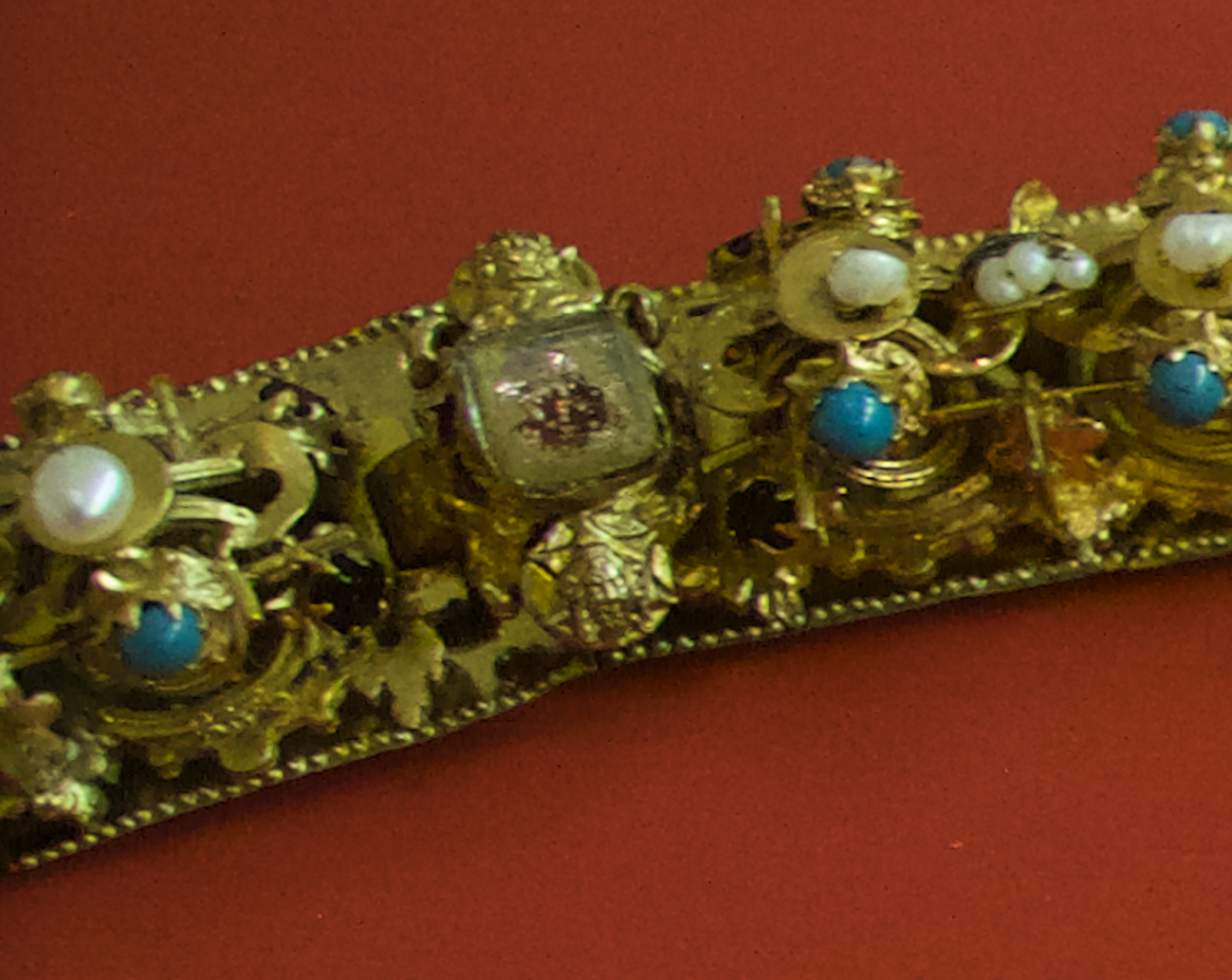
Regardless of denomination – whether Utraquist, Lutheran, or Calvinist – the ornamental motifs used on girdles from Prague suggest that women used their girdles in similar ways, adapting religion to meet their needs. In Figure 2, the floral metalwork that makes up the belt loop is interspersed with reliefs of Christ's face, shown in detail in Figure 3. Such religious motifs were common. In 1584, the estate of the cloth merchant Zymund Kropace included a girdle with ‘angels’ and in 1599, the goods of Ludwik Koralek included a girdle ‘with silver gold-gilt angels’.Footnote 42 Cherubs or putti are a symbol traditionally associated with fecundity.Footnote 43 Other materials enhanced the power of these spiritual figures. Silver pomanders, filled with aromatic musks or protective herbs, were often listed as hung from the girdle's loop. On the girdle in Figure 2, Christ's face is complemented by turquoise, a precious stone that was widely believed to protect the wearer from harm. In his 1609 text Gemmarum et lapidum historia (History of gems and stones), the mineralogist Anselmus de Boodt, who was based at Rudolf II's court from 1583 to 1612, described how, wearing a turquoise ring, he had survived two accidents.Footnote 44 The girdle's hoop closure secured these protectives close around the abdomen, and the belt's loop could be extended to maintain this proximity during the stages of pregnancy. As well as binding these protective materials to the womb, the weight of the metal belt may have exerted a comforting pressure against the body.
Detail of Christ's face surrounded by a nimbus. GRASSI Museum für Angewandte Kunst, Leipzig. Photo my own.
The presence of Christ and angels, combined with efficacious stones and fragrant pomanders, shows that, while Protestantism sought to reform the ‘cult of saints’, women continued to seek intercession in everyday life. In particular, the presence of angel motifs attests to Peter Marshall and Alexandra Walsham's argument that Protestant reformers’ ‘ambivalent’ attitudes towards these celestial figures allowed them to become a ‘pastoral resource’ that met individual desires for protection.Footnote 45 Women's need for protection against the anxieties of pregnancy and childbirth, as well as the subsequent perils of child-rearing, adds evidence to Lyndal Roper's argument that the reformed marriage, and the practices surrounding it, were not immediately secularized.Footnote 46 Instead, women sought to protect themselves, reaching beyond confessional boundaries to find a sense of agency in the face of real vulnerability.Footnote 47
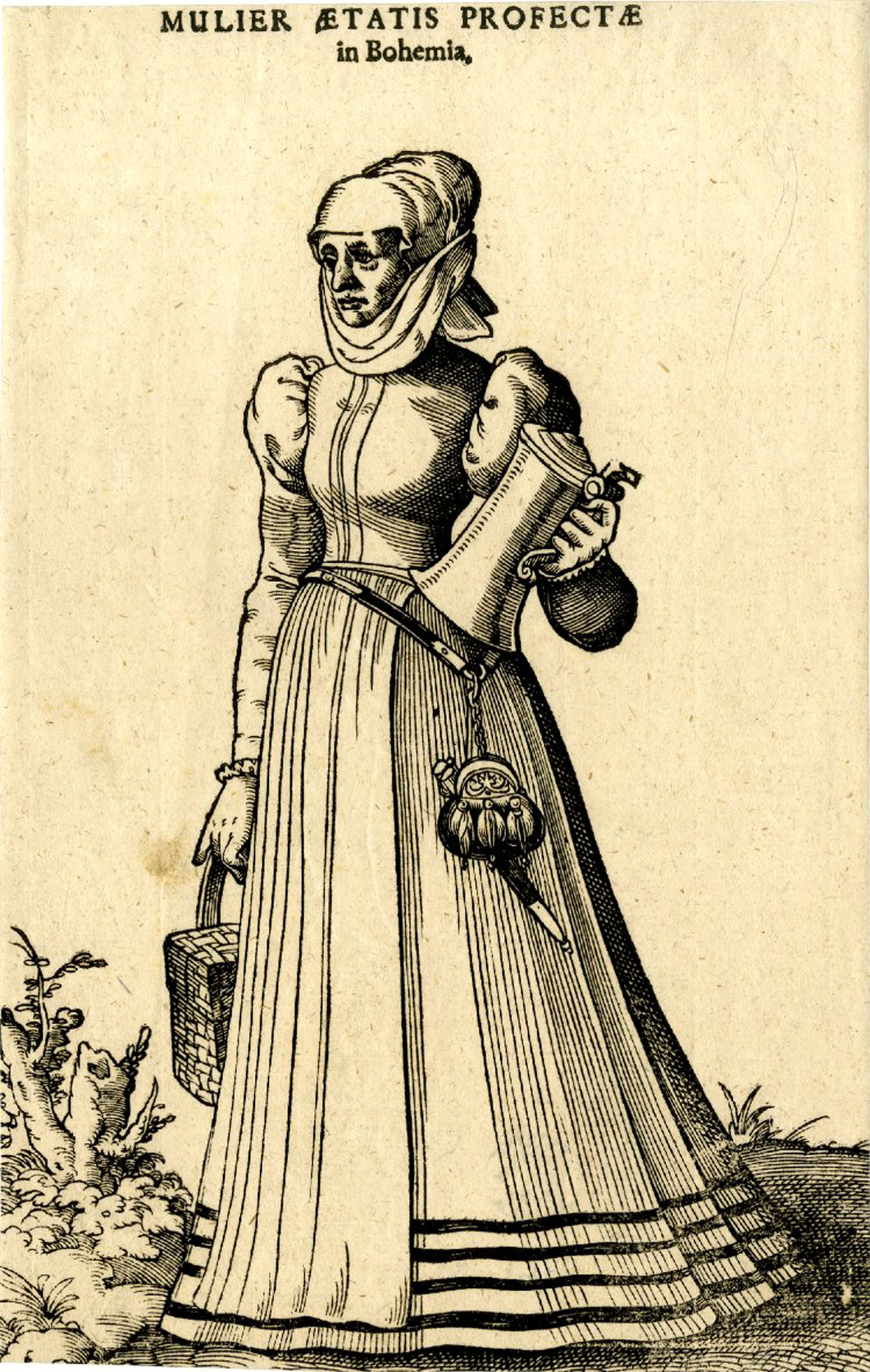
The care of children was just one of the activities expected of the burgher wife. Women's household work was an additional route through which they could express their power. Figure 4 shows an ‘old’ Bohemian woman going to market. She wears a gleaming girdle, from which is hung a pouch and a knife. This image is part of the Trachtenbuch (Costume book) by the German artist Hans Weigel, a record of the dress of different nations first published in 1577. This book made visual the expectations placed on women. Ulinka Rublack has described Weigel's costume book as an attempt to ‘construct a positively patriotic sense of civilized German behaviour’ for women living across the Holy Roman Empire.Footnote 48 Across Central Europe, ‘civilized’ women were expected to ensure the running of a successful household. In the case of Prague's neighbouring city of Augsburg, Roper has described the sixteenth century as a period in which craft and workshop values were deliberately aligned to those of the domestic space.Footnote 49 In contrast to the richly jewelled example in Figure 2, the girdle in Figure 4 is relatively modest, depicted on the body of a woman who is presented as a respectable feminine archetype. Her hair is veiled, she wears simple clothes of plain cloth, and she carries a basket and jug, diligently going about her work.
Hans Weigel (block cut), Balthasar Kühn (printer), Johann Görlin the Elder (publisher), ‘An old Bohemian woman going to market’, woodcut. Plate 45 of Hans Weigel's Habitus praecipuorum populorum…das ist Trachtenbuch (2nd edn, Ulm: Kühn for Görlin, 1639 [1577]). British Museum, London. © The Trustees of the British Museum.
In Bohemia's urban centre, burgher women undertook daily work of a different kind. The most common girdle accessory was a pair of silver scissors, often encased in a silver holder. In 1609, the barber Petr Wanček had a girdle with silver scissors; in 1614, Jan Sfostulov possessed a silver girdle, listed next to a silver scissor case with three pairs of scissors; while in 1615, Ludmilla Bletnerová, the wife of a clockmaker, stored two silver girdles and two scissor holders in a chest alongside her clothes.Footnote 50 Scissors clearly displayed women's abilities: they were the objects through which they participated in the creative and accomplished work of sewing, and through which they cared for their household. The production and maintenance of the family's textiles and linens was considered a virtuous task, as described by the contemporary moralist Jiřík Strejc Zábřežský in his Zrcadlo poctivé a šlechetné ženy a hospodyně (The mirror of the virtuous and noble wife and housewife), published in 1610. One verse read: ‘sometimes she winds, sometimes she spins, sometimes she bleaches, sometimes she washes, sometimes she takes a needle in her hand’.Footnote 51 By suspending domestic tools close at hand, the burgher wife enabled and displayed her endless skill and industry, a public assertion of her importance to her household.
II
In their self-representation, Prague's burgher women navigated the cultural codes of femininity, incorporating elements of both agency and oppression. By adopting these codes, they distinguished themselves from other women, seeking power by displaying their own virtuousness, piety, and constraint. As well as a form of display, the weighty girdle was also a valuable asset. This brings us into contact with another central framework that underpinned the patriarchal household: the legal system, under which the goods of the house were divided up between husband and wife. In this section, I show how women routinely used this system to assert their power in the home. Following the trajectory of one object, the girdle, through this system, I show how women navigated a legal system of which they were skilled and vocal users; how they upheld their rights over goods, and the strategies they used to claim their things.
When early modern women married, the goods that they received at their nuptials were, essentially, the inheritance that, by contrast, their brothers received at their parents’ death. This was made clear in 1587, when the children of Old Town burgher Vavřinec Goliáš gathered in court to discuss the division of his estate.Footnote 52 The case was brought by his son, an apothecary named Jakub, who complained that he had not received his fair share. His brothers and sisters offered evidence about their father's inheritance preparations. Among them, Magdalena attested to what had been given to her sister Anna, who had since died. Magdalena described how Goliáš had purchased Anna a girdle, possibly on the occasion of her betrothal. Beforehand, he had approached Anna, and stated ‘my dear Anna, I would like to have a beautiful girdle made for you’. This loving address reveals the deep and warm affection that existed between this particular father and his children. Yet, when Goliáš devised to give Anna a ‘beautiful’ girdle, he also made plans for her inheritance, transferring a substantial portion of the family's wealth to his daughter.
Under Koldín's Code, the girdle would have been categorized as a ‘moveable’ good, but it was an object of great and calculated worth. After stating that it was to be ‘beautiful’, Goliáš went on to discuss its silver content. He described how he had ‘taken advice’ from a goldsmith named Jaroslav, who had told him that ‘the best silver’ was ‘of the plain groš…then the Prague groš’. It is likely that, given they were described as the ‘best’, these coins were recommended for their high silver content. The groš was a large silver coin that weighed 4.22 grammes when it was first minted in 1266.Footnote 53 The ‘Prague groš’ was issued in 1300 by Václav II and again in 1520 by Ludvík II, and it was minted at Bohemia's main silver mine in Kutná Hora until 1564.Footnote 54 Goliáš's consideration of these coins demonstrates a desire to count out and calibrate the girdle's value. Anna knew silver's graduations well, reportedly replying to her father's fussing with a short ‘oh, I know’. Such a confident assertion suggests that women could use their knowledge of materials to participate in, even direct, preparations for their own inheritance or marriage gifts.Footnote 55
In Anna's case, coins made up the jewellery's raw matter, but all bridal girdles were considerable investments. Valuations in inventories reveal the precise cost of such goods: in 1606, the burgher Katerźina Wildergová owned three girdles valued at 8 gold Rhenish gulden, 15 kop groš (a kop is an accounting term for 60 groš), while ten years later, in 1616, the goldsmith Jirźik Wild was working on a silver-gilt girdle valued at 51 kop groš.Footnote 56 Women were familiar with the exact worth of their things: in 1582, when Anna z Vrato prosecuted a friend for losing a girdle she had lent her, she recalled perfectly that the missing item had weighed 16 lot.Footnote 57
Unlike Anna, Goliáš's son Jakub received his portion of wealth in cash. Jakub evidently felt like he had lost out as a result of this decision, choosing to take his siblings to court in order to gain what he believed should be his full inheritance. According to witnesses, Jakub had been given 70 kop groš, the coins having been delivered by carriage in eight sacks and placed in a small chest for safekeeping.Footnote 58 Previously, the early modern distinction between ‘ready money’ given to sons and ‘moveable goods’ given to daughters had been seen to disadvantage women. Yet, in the case of early modern England, which also had a Roman Law system, Amy Erickson's analysis of wills, inventories, and court records showed that although sons and daughters received capital in different forms, there often was an equivalence in what was apportioned.Footnote 59 This was the case in 1587 in Prague: to make Anna's girdle, Goliáš borrowed directly from his son. According to Magdalena, Goliáš proposed to take some silver intended for Jakub in order to make Anna's girdle, stating he would pay him back later with some different coin. In this case, Anna took financial precedence over her brother. The girdle that Anna was given, one that had been created directly out of her brother's coins, would have been integral to her future stability. As a valuable ‘moveable’ good, it was her inheritance carried on her body.
Early modern women actively used the property system to protect their inheritances. Given the mobility of ‘moveable’ goods, the risks to women's security were very real. Prague's criminal court often heard marital disputes over property. Under Koldín's Code, men were only permitted to sell their wives’ things from the trousseau for a ‘good reason’, like extreme poverty.Footnote 60 The finer points of this ‘good reason’ were vigorously debated. Despite her mother's optimism, the marriage of Anna Smichlová to Jakub Prunar in 1577, with which this article opened, did not go well.Footnote 61 Prunar was called to court, where he was accused of selling the same possessions that Anna's mother had bought her. Although this case took place just before the introduction of Koldín's Code, similar customs dictated marriage relations. Katerina Belna, the wife of a papermaker, described how Anna's goods had been relentlessly stolen from her one by one. When Anna had married Prunar, Belna noted that she ‘saw a silver girdle with her. Also [the] silver scissors’, which would have hung from it. This wedding gift quickly disappeared: Jakub sold it to pawnbrokers in the Jewish ghetto. Other of Anna's goods followed the same route. A bonnet, tin dishes, even the ‘rough sheet’ that had covered the window of their marital home were among the goods listed as sold. Belna argued strongly for the unreasonableness of Prunar's behaviour, stating ‘when she took it off he took it and sold it’, an attempt to convince the court of the lack of ‘good reason’ for Prunar's actions. The tragic outcome of Anna's wedding makes clear the dangers of a life lived while financially dependent on a collection of invitingly portable household possessions.
To protect their assets from husbands like Prunar, women adopted deliberate strategies to safeguard their precious girdles. In 1589, the lawyer Pavel Kristían from Koldín (who authored Koldín's Code) owned a small, locked chest that the municipal scribes could not open.Footnote 62 Kateržina, Pavel's wife who was present during the inventorying, informed them that inside was stored a silver belt with a chain and gold-gilt pomanders that had once belonged to Marketa Suksová, Kristían's previous wife, now deceased. The placement of this girdle is telling. It is separated from the rest of the possessions, in a ‘locked’ box to which perhaps only Marketa had access. The scribes then moved on to a green painted chest. Kateržina stated that the silver and velvet girdle that was inside belonged to her. Other women were less upfront. The inventory of Baltzar Raffaël, taken in 1585, ends with a note that a silver girdle and a string of pearls ‘were both found under one bed’, where they were presumably placed out of the way of opportunistic relatives.Footnote 63 In their study of British early modern women's tie-on pockets, Barbara Burman and Ariane Fennetaux argue that the strategies that women used to organize the goods that they kept in their pockets, including wrapping, boxes, and the ‘nesting’ of items in one another, reveal how women exerted control over their possessions in a context in which their property rights were limited.Footnote 64 Prague's burgher women did the same across the chests, boxes, and beds in their homes, using storage and concealment to carve out private space in busy households, and to sequester their most precious item away from the hands of husbands, children, and servants.
When their husbands died, Prague's burgher women confidently asserted their rights over their jewellery, actively claiming, and policing the implementation of, their legal protections. Notations made in inventories show that widows followed the city's scribes as they went from room to room recording the possessions of their deceased husbands. These interjections reveal women to be active, vocal participants in the management of their husband's estates. In particular, women intervened to ensure that their jewellery was rightfully identified as theirs and kept separate from their husband's goods. In 1595, Lidmilla, the widow of Jan Horský, made it known to the scribes that a silver chain girdle hung with gold-gilt pomanders belonged to her.Footnote 65 In 1607, the wife of the barber Petr Wanček claimed a silver girdle hung with scissors, the scribes recording that ‘the widow stated that this was given to her by the deceased’.Footnote 66 A year later, in the inventory of the apothecary Jakub Melzer in 1608, a silver gold-gilt girdle, a pair of golden bracelets, and a silver jug were portioned off from the list.Footnote 67 An annotation recorded that ‘the Mrs Maudalen [Jakub's wife] stated that the deceased gifted her everything’. These interventions show that early modern women were highly effective users of the property system, deliberately preserving control over their goods.
As well as occluding the power of their husbands, women used the property system to direct the movement of their own things. Prague's burghers expressed considerable control and choice over how their goods were to be passed on after their death. Under Koldín's Code, when the wife died, her husband was to respect her wishes with regards to the contents of her trousseau, rather than absorbing it back into the shared estate. In 1606, Jan Koch was accused of unfairly appropriating his wife's goods after her death, distributing her possessions without the expected consideration for his wife's intentions.Footnote 68 According to the observer Jindřich Reinhard, Koch claimed back ‘silver for a girdle’ that his wife Anna had given to a goldsmith. He also harassed a pawnbroker in the New Town, demanding the return of a chain that his wife had pawned for 100 kop groš before her death. Other cases suggest that – as between Goliáš and Anna – the expected trajectory of the girdle was from parent to child. For example, in 1592, Anna Hošková called her daughter Eva into the chamber and gave her a choice between two silver girdles, laying them out on the table for her to pick from.Footnote 69 This example provides compelling evidence of early modern women's management of their intimate relationships, in which they could use the passing on of property to strengthen established affective ties and to create powerful emotional communities.
III
The legal property system was at the centre of the patriarchal household. Within it, however, women were able to maintain power over their most precious things, a power that they enhanced through strategies that served to safeguard their rights. In this final section, I turn to the moral framework that surrounded women and marriage. Inescapably public by nature, dress was closely bound to Renaissance questions of morality, and its consumption required careful navigation.Footnote 70 Unexpectedly, contemporary Protestant writings did not forbid women from asserting their power and status through their dress. In fact, carefully calibrated luxury was a central part of the display of the successful and prosperous burgher household. These expectations, however, created a persistent cultural anxiety about whether women's clothing was a sign of a powerful and unified household, or of the dissolution of the ‘proper’ power dynamics of the home. The prominence of these male anxieties show that burgher women were, at points, able to gain considerable power within marriage.
Although Protestantism has often been associated with visual austerity, in Prague, devout burgher women were encouraged to display their household's power through beautiful clothing. In the Abeceda pobožné manželky a rozšafané hospodyně (ABC of the pious wife and honest housekeeper), published in 1585, the Utraquist preacher Jan Kocín from Kocinétu set out a moral discourse that attempted to frame readers’ attitudes to the material world. Kocín argued that beautiful clothing worn by the ‘good and virtuous’ housewife reflected the success of the household, and thus glorified and respected God.Footnote 71 He wrote that ‘the good and virtuous housewife may have the most beautiful things for adornment, so that she can righteously go out amongst people’.Footnote 72 This celebration of the ‘beautiful’ was integral to the genre of moral writing in this period. Male writers often visualized women's virtues by evoking the beauty of precious metals, jewellery, and flowers. For example, the Saxony pastor Lucas Martini's Der christlichen Jungfrauen Ehrenkränzlein (The maiden's wreath of honour), written for a Lutheran audience and published in Prague in 1580–1, celebrated the importance of chastity using an extended metaphor about the bridal wreath.Footnote 73
There were, however, limits to the ‘beautiful things’ a woman could wear. Kocín warned women against adorning themselves ‘with curled hair, with gold, with pearls, or with expensive clothes’, advice that, judging from inventories, appears to have been roundly ignored by Prague's burghers.Footnote 74 He went on to argue that, while women could own limited beautiful things, they should be prepared to liquidize them if the household needed cash. Kocín wrote that, ‘she [the wife] must always be able to sell something with enjoyment, this will surely make the household more prosperous and day after day improve it’.Footnote 75 It was her willingness to part from her ‘beautiful things’ that marked the ‘good and virtuous’ housewife from the woman ‘who everyday brought some kind of good not out of need but for her own adornment’.Footnote 76 In this text, the wearing of splendid, but somehow also modest, clothing and jewellery had a clear purpose in displaying the success of the household. Like the Schwarz painting in Figure 1, it made the couple's mutual affluence visible. The jewellery on the body of the virtuous woman showed off the capital that the couple had at their disposal and acted as a safeguard for the financial security of the household. By binding her glittering girdle about herself, the burgher woman could be seen to project the gift of prosperity granted to a godly couple.
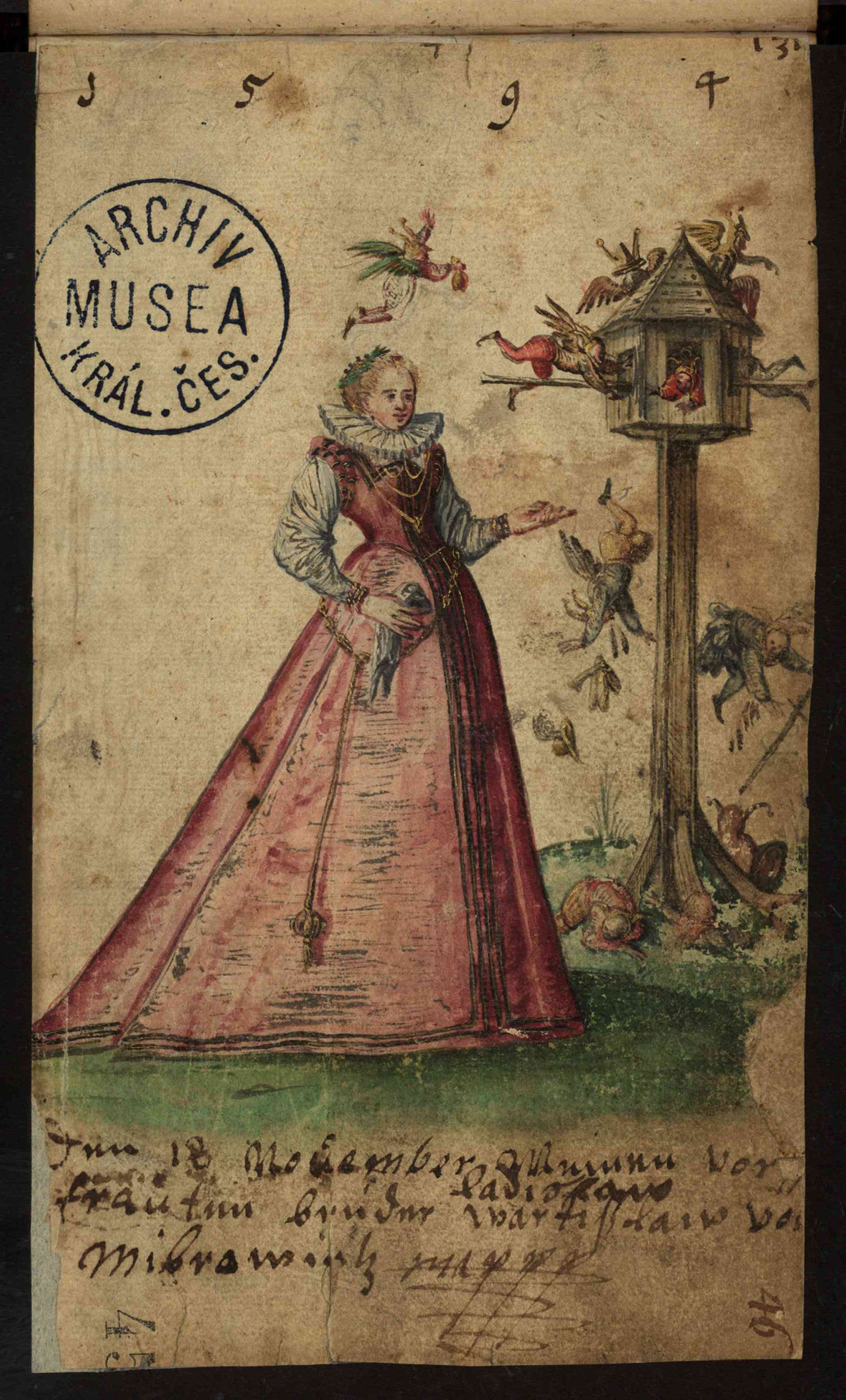
The Protestant moral framework therefore contained space for women to assert their household's power through their luxury clothing. However, the Renaissance was also defined by concern that women held too much power within the household. The source of this fear was, no doubt, a sense that some women did indeed hold power over their husbands, despite strict patriarchal expectations surrounding each partner's behaviour. In the sixteenth century, the trope of a power-crazed woman with a weak, emasculated husband was a recurring feature across print and image, a reoccurrence that was probably due to the real sting behind the character.Footnote 77 Heavy jewellery and fine clothes were a prominent way in which writers imagined these women. The risks to men began in courtship. While expenditure during courtship and marriage served to illustrate social status, it had to be done carefully. As well as economic ruination, overspending to impress a lover came with a significant cultural cost. Figure 5 shows a 1594 image from the Bohemian painter Jan Vojtech Kulík's památník (friendship album), titled ‘Man's insanity’. It satirizes courtship practices, a common trope in friendship albums at this time. Standing at the centre is a beautifully attired young woman wearing the gifts of courtship. Luminous golden chains hang from her neck, while an enormous golden girdle of large loop links hangs around her hips, descending invitingly into a weighty and intricate tassel. In a symbol of her purity, she wears a wreath of fresh green leaves around her head. But all is not well. Tiny winged suitors sporting disproportionately large codpieces flock around her. One hopeful, flying just above the woman's head, holds a plump bag of money. The other candidates fall, or perhaps throw themselves, to the ground as they attempt to feed on the crumbs – a meagre offering – in her proffered hand. In their efforts to impress their potential wife, suitors were seen to lose their reason and self-preservation, a reversal in the gendered hierarchy that, in this image, is happily exploited by the greedy, well-attired woman. The warning is clear: to limit the power of women, men must maintain control over their own behaviour, modifying their actions to protect the proper dynamics of the household.
Jan Vojtech Kulík, památník, paint on paper, 1594. Čislo: ANM, st. sign. II A 4, fo. 176. Archive of the Czech National Museum, Prague. Published under CC BY-NC 4.0.
Even once married, early modern men were perceived to face risks to their authority. Although, as I have shown, women were expected to maintain control over their wedding girdles, they were, as Kocín hoped, to share their wealth with the household when necessary. Yet, contemporary observers warned that women bought clothes and jewellery in an unrestrained fashion, depleting the household's resources through their covetousness, rather than contributing to the home by generously sharing the contents of their trousseau. The English traveller John Taylor recorded a visit to Prague in 1620, two years after the Kingdom's Protestant-leaning Estates had rebelled against the militant Catholic Ferdinand II. The tensions between the Protestant Estates and Catholic ruling elites that would define the Thirty Years War were rapidly building, and as Taylor knew, his readers at home in Protestant England were keen for ‘newes of battells’.Footnote 78 He composed a ditty aimed to entertain and titillate with its account of the disorder of a foreign city. Taylor described a ‘Chimney sweepers wife…habilimented like the diamond Queene’.Footnote 79 This chimney sweep was under the power of his wife, who spent everything he earned on her own adornment. This included an impressive silver girdle: ‘she's fur'd, she's fring'd, she's lac'd and at her wast,/She's with a massie chaine of silver brac'd.’Footnote 80
The invented figures of the ‘brac'd’ wife and the emasculated husband serve as a comment on the perversity of Prague's society as a whole. Taylor concluded that, in Prague, ‘(by a kind of topsie turuy use),/The women weare the bootes, the men the shooes,/I know not if't be profit, or else pride,/But sure th'are oft'ner riden then they ride.’Footnote 81 Here, again, the established order has been inverted. The power of the husband has been superseded by that of the wife, who purchases and wears a ‘massie chaine of silver’ as she pleases, a prominent and grotesque display of wealth. While Taylor's account is heavily fictionalized and primarily intended to show readers just how alien Prague's society was, this ditty nonetheless demonstrates that the vain, greedy, and over-adorned woman was a rhetorical tool with power, striking to the heart of real fears. In this account, the massive girdle is used to reveal the lack of the patriarch's authority over his wife and household, and to show that, instead, driven by feminine caprice, rapacity rules the home. Like the friendship album image, this account blames men for failing adequately to police and protect the gendered hierarchy. The ambivalent balance of authority between husband and wife was a prominent and anxiety-inducing uncertainty at the heart of the early modern burgher marriage. In the eyes of moralists, women could easily gain power over their husbands. This required men to be alert to their authority, and to change or modify their behaviours in order to maintain their fragile power within the household.
IV
Most accounts of early modern marriage start, rather than end, with the concerns of moralists. In this article, I have attempted to flip the focus, using an object study of the most valuable and intimate possession in the burgher's trousseau in order to foreground the lives of women, and to consider the everyday ways in which they found power within patriarchal frameworks. For the middle-class women of Renaissance Prague, burgher ideals of the household, as well as the particular gendered anxieties, ambivalences, and uncertainties that accompanied these values, created considerable opportunities for agency. The bridal girdle, given at marriage, makes visual these ideals. Prague's burgher women sought to show off particular virtues: namely, fidelity, reproduction, care for children, and productivity in the household economy. These virtues marked out women from one another, allowing female burghers to display their social status and moral virtue in opposition to those around them. The object of the bridal girdle presents, therefore, a vivid example of how early women were able to find power within the institutions that constrained them, following paths that, for burgher women, wove in and around the household. This study therefore shows that social rank was integral to the ways in which early modern women expressed their agency. Further research must be done to unpick these dynamics more extensively: for example, looking at non-elite city-dwelling women would, no doubt, reveal alternative strategies and more commonplace means of finding power. Nonetheless, despite its social specificity, the Renaissance woman's girdled body can be seen as a broader touchpoint for understanding familiar tensions between freedom and constraint, authority and instability, and structure and individual, conflicts which shape gender history. It was the interplay of these opposing dynamics that created space for Prague's burgher women to express agency. These routes often reinforced, rather than undermined, the broader framework of power in which they lived. Indeed, this duality might be said to constitute the nature of patriarchy itself. The degree of flexibility built into the patriarchy certainly offers an explanation for the resilience of this particular social system.
Acknowledgements
My thanks to my supervisors, Ulinka Rublack and Mary Laven. I am also grateful to the two anonymous readers, the 2019 Vienna Seminar Fellows, the Early Modern Work in Progress group, Max Long, George Morris, Lizzie Hibbert, and Andrew Parker for their insightful readings, comments, and suggestions. Martina Parker generously provided assistance with translations, although any errors are, of course, my own.
Funding Statement
The research for this article was enabled by financial support from the Arts and Humanities Research Council, the Pasold Research Fund, Pembroke College Cambridge, and a History Faculty Lightfoot Grant.


 Open access

