





There has been a rising demand for eating disorder services and hospital admissions across the UK over the past two decades, which accelerated during and after the COVID-19 pandemic. This was highlighted by the eating disorder charity Beat 1 and NHS Digital, 2 and reflected the international situation. Reference Hansen, Stephan and Menkes3–Reference Haripersad, Kannegiesser-Bailey, Morton, Skeldon, Shipton and Edwards5 Hospital admission poses significant risks for young people, including disruption to normal life and development and the potential for ‘contagion’ – the adoption of unhelpful behaviours or relationships that can reinforce an eating disorder identity. Reference Edwards, Evans, Gillen, Longo, Pryjmachuk and Trainor6 There is also a considerable difference between the intensity of treatment offered by in-patient and community-based eating disorder services, which can limit the flow in and out of in-patient services. The resulting fragmentation of the care pathway can contribute to deterioration and relapse following discharge. Reference Hayes, Tweedy and Chapman7
The 10 Year Health Plan for England, 2025 set out the UK government’s vision to reinvent the National Health Service (NHS). The intention was to shift care from hospital to community by delivering more urgent care in people’s homes, and from analogue to digital. Hospital at Home (H@H) services were named as one way of securing the financial sustainability of the NHS, with the aim to expand these programmes in the first 3 years. 8
Previous reviews of day patient and home treatment services for adolescent eating disorders found that they were effective at restoring body weight, reducing eating disorder symptoms, addressing comorbid mental health concerns and maintaining symptom remission. Reference Krishnamoorthy, Shin and Rees9–Reference Herpertz-Dahlmann, Schwarte, Krei, Egberts, Warnke and Wewetzer11 A 2019 Cochrane review found no clear difference in weight gain between a partial hospital setting and specialist in-patient care, and there was insufficient evidence to conclude whether either treatment setting was superior for treating people with moderately severe eating disorders. Reference Hay, Touyz, Claudino, Lujic, Smith and Madden12
Virtual delivery of family-based treatment for anorexia was first evaluated in 2017 by Anderson et al. Reference Anderson, Byrne, Crosby and Le Grange13 Since then, several studies have evaluated the ways in which services have moved online since the COVID-19 pandemic, and recommendations made based on these experiences. Reference Datta, Derenne, Sanders and Lock14–Reference Stewart, Konstantellou, Kassamali, McLaughlin, Cutinha and Bryant-Waugh20 A study evaluating feedback from 22 978 participants accessing the NHS Wales Video Consulting Service demonstrated that this method of service delivery was highly satisfactory, well accepted and clinically suitable, yielding many benefits. Patient ‘positivity’ and ‘appreciation’ towards their clinicians were particularly evident across specialties such as mental health and therapies. Reference Johns, Whistance, Khalil, Whistance, Thomas and Ogonovsky21
In exploring the perspectives of service leads operating intensive out-patient programmes for children and adolescents with eating disorders, Cini et al found that staff-to-patient ratios, commutes and transportation costs for both staff and patients were barriers to accessibility, particularly in rural areas with limited provider availability. Reference Cini and Salucci22 Sauerwein et al highlighted a need for adapted, family-based treatment approaches to improve access and engagement for diverse families facing the social determinants of health-related barriers, and recommended virtual sessions as one solution to this. Reference Sauerwein, Austin, Singh, Pedram, Allan and Bruett23
The H@H service
H@H was designed in 2020 during the COVID-19 pandemic, specifically for the purpose of intensive virtual treatment for adolescents with eating disorders. The combination of rapidly reducing numbers of in-patient beds in the south of England due to multiple hospital closures and the rising numbers of young people with eating disorders meant that innovative solutions needed to be found at speed to meet the needs of these young people. The virtual delivery of the H@H model enabled all young people and their families within the provider collaborative footprint to access intensive treatment, irrespective of where they lived.
The service covered five English counties, collectively known as the Thames Valley Provider Collaborative: (a) Bath and north-east Somerset, Swindon and Wiltshire, (b) Berkshire, (c) Buckinghamshire, (d) Gloucestershire and (e) Oxfordshire, with a total population of 4.2 million.
Aims
The primary aim of this study was to describe the service innovation model and evaluate its effectiveness at preventing hospital admissions. Additional aims included assessing the service’s impact on weight restoration, eating disorder symptoms and functioning in young people, as well as evaluating its acceptability to young people, families and staff.
H@H was the first regionally led, hospital-level virtual service for children and adolescents with eating disorders in the UK, and therefore the present study was also the first evaluation of a service of this kind in the UK.
Method
A mixed-methods approach was used, incorporating both a prospective quantitative cohort study and a qualitative analysis.
H@H programme description
The service commenced in October 2021 as a pilot study with a caseload of 6, and was expanded to 12 from May 2023.
The team consisted of a consultant psychiatrist, nursing staff and support workers, as well as a clinical psychologist, assistant psychologist, art therapist, dietitian and administrator. There was also funding for a family therapist, but this post remained unfilled for most of the evaluation period. The team also benefited from a family ambassador who had a parent advocacy role.
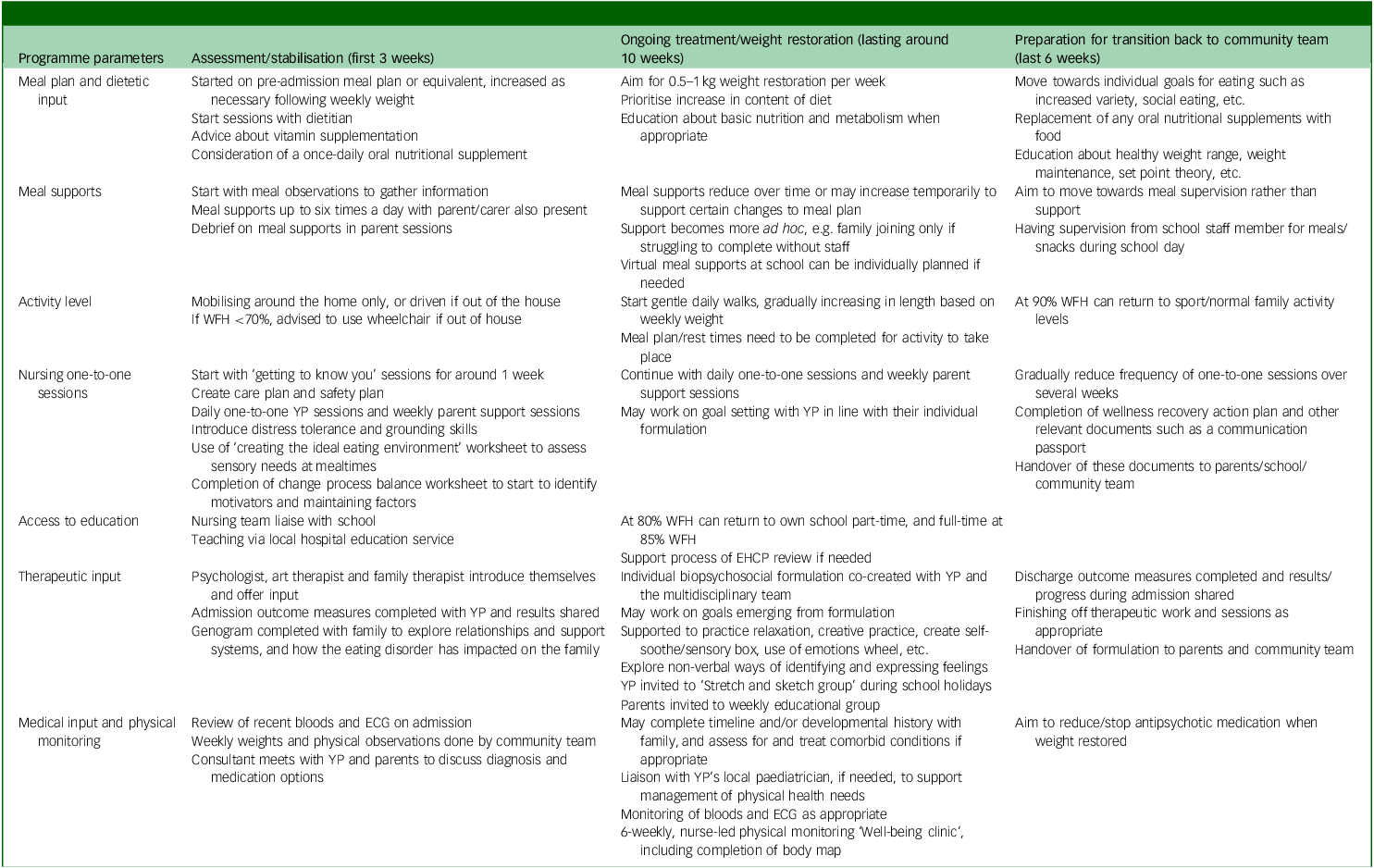
Treatment followed the Maudsley Family Therapy for Anorexia Nervosa model principles. It was highly personalised and included daily one-to-one sessions with the young person (either with the nursing or multidisciplinary team, or both), individual meal support sessions up to five times a day, weekly individual parent sessions and a weekly parent group (see Table 1). Parents were supported by the team to take time off work if needed, via letters of support to their employers and/or applying for any benefits to which they were entitled. The team also helped to ‘upskill’ other family members such as grandparents to support single parents who couldn’t afford to take time off work.
Summary of the treatment programme

WFH, weight for height; YP, young person; EHCP, Education Health and Care Plan; ECG, electrocardiogram.
For example, a family could be seen six times a day in the early part of their admission, reducing to a few times a week towards the end of their admission. Between sessions, the young person or their parents could contact the team to request ad hoc appointments so that they could be supported at times of distress.
A young people’s skills group and a creative group also took place for several months, but these were not well attended; therefore, the groups were stopped and coping skills were subsequently taught within their individual sessions instead. The local community eating disorder team continued to offer weekly appointments for in-person weighing and physical observation. There was a build-up to the start of treatment with a care-planning session, followed by 15 min ‘getting to know you’ sessions with different members of the team for the first week. The service operated from Monday to Friday, 08.00 to 20.00 h on a fully virtual basis, and staff handovers occurred three times a day.
Eligibility criteria, referral and discharge process
Young people under the age of 18 with an eating disorder and who met the threshold for hospital-level care could be referred by their community eating disorder team (within the provider collaborative region) to the Thames Valley Single Point of Access. H@H could be named directly on the generic Tier 4 referral form, or referrals requesting in-patient care could be diverted to the service when appropriate.
The referral was then triaged concurrently by both the hospital and H@H teams. This triage determined the level of acuity, risk and urgency of the referral; the capacity of each service to admit; the requirement for nasogastric feeding; and the potential capacity/availability of parents or carers to manage the young person at home.
For full admissions inclusion and exclusion criteria for H@H, see Appendix 1. Young people were generally excluded from admission to H@H only if they did not consent to H@H, they required ongoing nasogastric feeding or their level of acuity was above that which could be managed at home. They were not excluded by any diagnosis or comorbidity.
Alternatively, Child and Adolescent Mental Health Services in-patient units could refer to H@H those young people who needed further intensive support and treatment outside a hospital setting for the final part of their admission. Brief admissions to the paediatric ward could be used for initial refeeding to manage risks if required. If there was a lack of sufficient progress or deterioration with H@H, a referral was made for in-patient treatment.
Treatment with H@H was complete when the clinical teams and family had sufficient confidence that the young person could manage to continue progress with weight restoration despite a reduction to weekly support from their community team.
Meal support
Meal support was delivered virtually, and started after a period of observation of meals and following discussion with the young person and their family about the most useful time for staff to be present (i.e. before, during or after meals). Staff often used quizzes and games to engage and distract the young person during meals, and may have had their camera on or off or may have talked or not, depending on what was felt to be appropriate for that individual. Parents were also asked to be present during meal support so that the staff could role model or act as supporters of parents.
Separate parent sessions could be used to debrief and provide advice and coaching for future meals. Staff could also be present during meal preparation to support the serving of appropriate portion sizes, and to minimise any negotiation that occurred during this time.
If there were any difficulties in determining portions during mealtimes, the team asked parents to take photos of the meal served. Parents completed a weekly food diary including the amounts offered and consumed. Families could also be offered daily check-ins to discuss the intake that day and agree a plan for the following day (e.g. any amendments to activity levels or any outstanding diet that needed to be made up).
Education
Young people were supported to access education during their admission. This was usually provided initially through their local hospital education service, followed by reintegration into their own school when clinically appropriate. If needed, meal support could be provided in schools to support this transition.
Data collection and selection criteria
Demographic and clinical data were prospectively collected for all admissions between 1 October 2021 and 1 December 2024. Because the data collected by the team expanded over time as the service and team developed, some outcomes had more entries than others. A combination of clinician- and patient-rated outcome measures was included to account for responder bias.
Measures
Demographic data were collected, including age, gender, diagnosis, length of stay and admission and discharge destinations. A central database recording all Tier 4 (in-patient) referrals and admissions in the provider collaborative was reviewed for any readmissions to Tier 4 within 6 months of discharge from H@H.
The following outcome measures were obtained on admission and discharge: percentage median body mass index (%mBMI), Children’s Global Assessment Scale (CGAS), Reference Shaffer, Gould, Brasic, Ambrosini, Fisher and Bird24 Health of the Nation Outcome Scales for Children and Adolescents (HoNOSCA), Reference Gowers, Harrington, Whitton, Lelliott, Beevor and Wing25 Eating Disorder Examination Questionnaire (EDE-Q) Reference Aardoom, Dingemans, Slof Opt Landt and Van Furth26 and Clinical Impairment Assessment (CIA). Reference Bohn, Doll, Cooper, OConnor, Palmer and Fairburn27 CGAS is a single global score ranging from 1 to 100, with a lower score indicating worse symptoms and functioning. HoNOSCA is a 15-item scale with scores ranging from 0 to 52; conversely on this scale, a higher score indicates worse symptoms and functioning. EDE-Q is a 28-item, self-report measure of the severity of symptoms of anorexia or bulimia; the average global score can range from 0 to 6, with a higher score being indicative of more severe symptoms. CIA is a 16-item, self-report measure of the severity of psychosocial impairment due to eating disorder features; scores range from 0 to 48, with a higher score being indicative of a higher level of impairment.
Alternative measures to EDE-Q were used in the eight young people who were under 13 years of age and/or had a diagnosis of avoidant restrictive food intake disorder (ARFID) or unspecified feeding or eating disorder. These included the Eating Disorders in Youth Questionnaire, Reference Hilbert and van Dyck28 the Children’s Eating Attitude Test Reference Lommi, Viljakainen, Weiderpass and de Oliveira Figueiredo29 and the Nine Item ARFID Screen. Reference Zickgraf and Ellis30 The decision to use these measures was informed by international consensus. Reference Austin, De Silva, Ilesanmi, Likitabhorn, Miller and Sousa Fialho31 Owing to the small number of patients, these measures were not included in the analysis.
Ethical standards
This project was registered with the Oxford Health Audit Department, and no ethics approval was required. All procedures performed in studies involving human participants were in accordance with the ethical standards of the institutional and/or national research committee, and with the 1964 Helsinki Declaration and its later amendments or comparable ethical standards.
Statistics
The data were analysed with Excel, using descriptive statistics and paired t-testing, to compare continuous variables between admission and discharge. Missing data were excluded pairwise.
Qualitative feedback from staff and families
A 60 min staff focus group was held in December 2022, to which all members of the H@H team were invited. In March 2023 questionnaires were sent to all patients who had been admitted between 1 September 2022 and 1 March 2023 (including their parents), asking about their experience of being treated in the service, totalling 30 questionnaires.
The questions were developed in line with the aims of the service evaluation, and similar questions were asked of both the families and staff (see Appendix 2). Families were given the opportunity to provide written or verbal feedback. They were also informed that their feedback may be published anonymously as part of the service evaluation and that, in giving feedback, they provided consent for this. A reflexive thematic analysis was performed according to the framework outlined by Braun and Clarke, Reference Braun and Clarke32 with themes generated inductively and agreed within the author group.
Results
Journey through the service and beyond
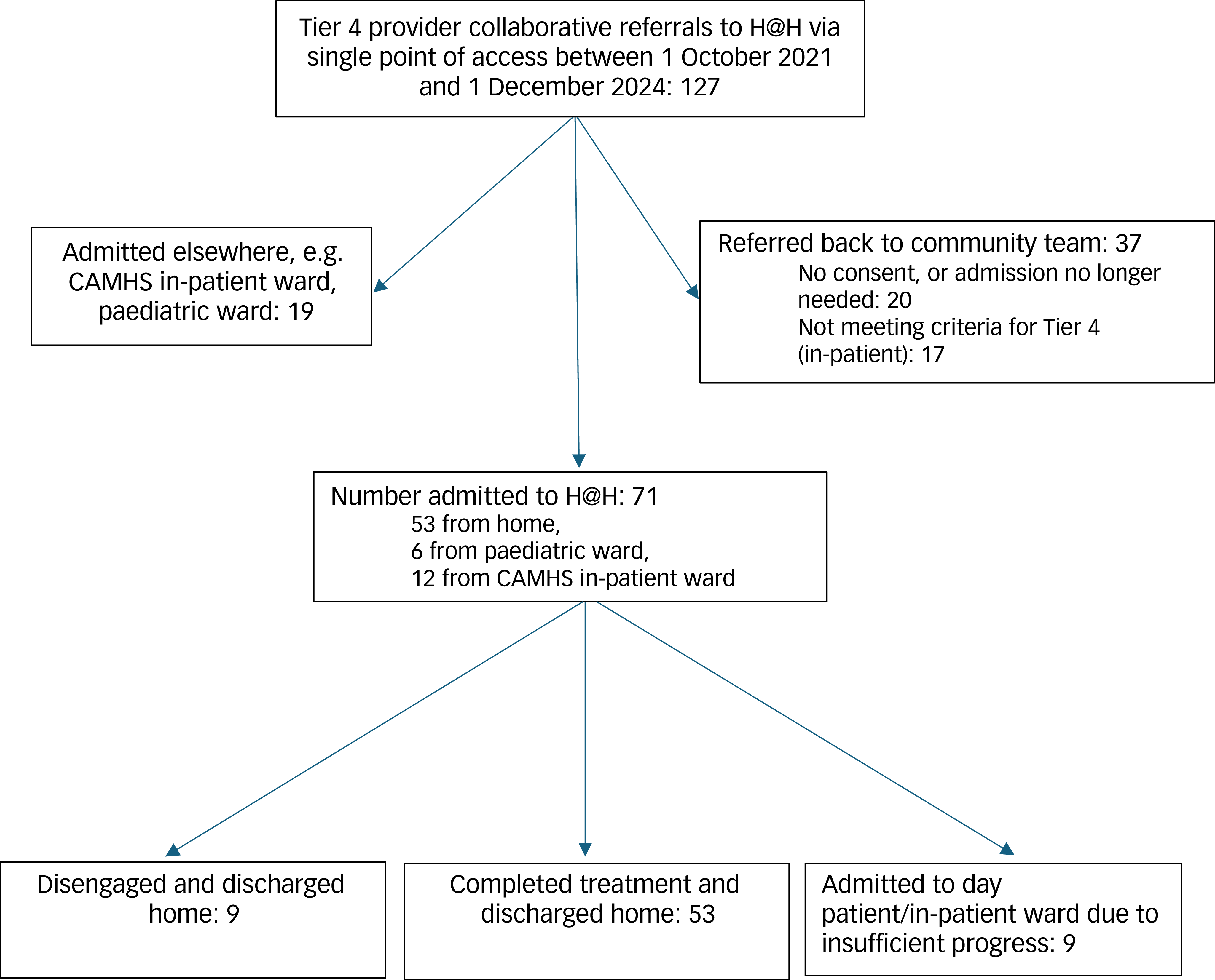
The length of treatment ranged between 24 and 282 days, with a mean of 134 days (s.d. 61) and a median of 136 days (interquartile range 93–179). Figure 1 illustrates the study flow, detailing the numbers of referrals and admissions to H@H as well as admission and discharge destinations.
Flow diagram of the study analysis. H@H, Hospital at Home; CAMHS, Child and Adolescent Mental Health Services.

Of 127 Tier 4 provider collaborative referrals to H@H between 1 October 2021 and 1 December 2024, 19 (15%) were admitted to in-patient units, 37 (29%) were referred back to community teams and 71 (56%) were admitted to H@H. Of the 71 admissions to H@H, 62 (87%) completed treatment and 9 (13%) were transferred to in-patient treatment. At 6-month follow-up, 2 of the 62 (3%) patients discharged home from H@H were readmitted to in-patient units.
Participants
Seventy-one patients were admitted, with an average age of 15 years and ranging between 9 and 17 years; 70 were female and 68 White British. For context, of the 127 referrals, 125 were female and 120 were White British. Of this total, according to DSM-5 criteria, 56 had a diagnosis of anorexia nervosa, 4 atypical anorexia, 5 ARFID and 6 unspecified feeding or eating disorder. Twenty seven (38%) had at least 1 comorbid diagnosis alongside their eating disorder, including 20 with autism, 6 with attention-deficit hyperactivity disorder, 6 with obsessive−compulsive disorder, 2 with post-traumatic stress disorder, 1 with Tourette syndrome, 1 with coeliac disease and 1 with type 1 diabetes. Thirty (42%) were prescribed an antipsychotic medication (usually low-dose olanzapine) and 36 (51%) were prescribed an antidepressant medication.
Changes in clinical outcomes from admission to discharge are summarised in Table 2. Across all clinician-rated and patient-reported measures, outcomes moved in the direction of clinical improvement. Weight restoration was observed in the majority of patients, with a significant increase in %mBMI over the course of treatment: 58 patients (82%) gained weight. The average change in %mBMI was 7.64% (p < 0.001, 95% CI 5.67 to 9.61), ranging between −13.1 and 29%. Appendix 3 shows changes in the average subscales of EDE-Q. Clinician-rated functioning and symptom severity, assessed using CGAS and HoNOSCA, respectively, also improved substantially during H@H admission.
Patient demographics and change in clinical outcomes during H@H

H@H, Hospital at home; %mBMI, percentage median body mass index; EDE-Q, Eating Disorder Examination Questionnaire; CIA, Clinical Impairment Assessment; CGAS, Children’s Global Assessment Scale; HoNOSCA, Health of the Nation Outcome Scales for Children and Adolescents.
Impact on eating disorder hospital admissions
Figure 2 shows the increased number of eating disorder admissions to H@H per year as the service started and expanded (from 8 in 2021–2022 to 23 in 2023–2024). Alongside this, each year the number of admissions for eating disorders reduced to both general adolescent units (GAUs; 69 in 2020–2021 to 34 in 2023–2024) and specialist eating disorder units (27 in 2020–2021 to 7 in 2023–2024) (data provided by the Thames Valley Provider Collaborative; see the Data Availability statement).
Number of referrals with an eating disorder diagnosis in the Thames Valley Provider Collaborative that resulted in admission to either Hospital at Home (H@H), a General Adolescent Unit (GAU) or a Specialist Eating Disorder Unit (SEDU), by financial year.

Cost of the service
The annual cost of H@H operating with 12 patients was £1 270 000 compared with that of a 12-bedded GAU within the provider collaborative (£3 289 380); this equates to an occupied bed-day rate of £290 for H@H and £751 for GAU (data provided by the Thames Valley Provider Collaborative; see the Data Availability statement).
Qualitative feedback from staff and families
Seven staff members from a variety of roles attended the focus group, and the following six themes were generated.
Avoiding the negative impact of in-patient admission
Several staff had previously worked in in-patient settings and were able to make some comparisons of their experiences of supporting young people and working in the two different environments. They commented that avoiding in-patient admission would help reduce exposure to potential risks in hospitals:
‘The competition to be the thinnest or the most unwell, and to be the one on an NG [nasogastric] tube. There’s none of that really.’
They also discussed the level of trauma to young people, their families and staff that can result in a hospital setting, and that when keeping young people in their own homes, this was greatly reduced:
‘There’s a lot less trauma all round, I think, …. in the nurses because we’re seeing a lot less contagion of behaviour and I think a lot less trauma in the patients and the families as well as they’re not being taken away from home.’
Virtual service
They talked about the benefits of working from home and not having to commute, and were surprised at how they were able to effectively adapt their work to the virtual setting:
‘‘I’ve been questioned a lot. Can you really do art therapy online and you can actually, and I’ve been surprised at how the young people have embraced doing artwork even though they might not be talking or even looking at the camera, but they’ve managed to produce work and a conversation has come from there.’
The staff also discussed the challenges of virtual working, including difficulties in assessing and managing risk online, working with young people who struggle to engage, being less active and the potential for internet connection issues:
‘‘If there’s internet issues that takes away from time. Potentially the physical risk side of things is a little bit different, more difficult to manage, e.g. delays with getting weight information and blood results. It’s harder when young people struggle to engage. It has definitely affected my physical energy, the sitting.’
Collaborative working
Staff members commented on the regular check-ins built into the day, which helped them feel more connected with each other when working from home. They also talked about how they felt able to work collaboratively with families by seeing them frequently during the day, which enabled them to be flexible and responsive to their needs:
‘‘It feels more patient-centred being able to respond more easily to patients.’
They also talked about how working more closely with parents really benefits the treatment:
‘‘I think our outcomes are definitely better for patients when they feel like their parents are supportive alongside us.’
Developing skills for young people and parents
The staff talked about how keeping young people at home with regular meal support helped parents develop confidence in managing mealtimes earlier in treatment:
‘From the beginning, the parents have that day-to-day practice and responsibility of meals.’
Maintaining family life
Staff fed back how treatment at home had helped maintain a more normal family life, which was something that was really appreciated by young people:
‘A couple of the young people I’ve been speaking to who’ve been in in-patients, they’ve commented how they are feeling so much better actually being at home with their families.’
Staff observed that, generally, weight restoration was more consistent when the young person was at home full-time compared with seeing a pattern of weight gain during the week followed by weight loss during the weekend when someone is an in-patient and only at home during the weekend:
‘The biggest advantage feels like managing real-life home situations for patients and families. I think the benefits of staying at home and doing it at home far outweigh the extra few weeks that it takes to get physically to the healthy weight range.’
Effectiveness
The staff reported a good level of job satisfaction and were able to work consistently with other members of the team:
‘‘I am providing care in the way I want. I’ve got a huge amount of job satisfaction because we get such good feedback from parents and young people at the end of their admissions, and I get a lot of satisfaction from that and working with them … and with the parents and … seeing the changes for them as well through the process. If I meet someone individually for psychology, I know much more what the rest of the team are doing in individual support sessions.’
They thought that continuing the weekly weigh-ins with the community team during the admission helped the young person remain more connected with them, which ultimately helped with the transition back to out-patient treatment:
‘They do have to keep seeing the community team partly because of the physical health … monitoring. It doesn’t feel like there’s so much of a loss or change when you’re trying to end as well.’
Five questionnaire responses were received from young people and parents, and the following four themes were generated from this feedback.
Virtual service
Families talked about the benefits of the service as being convenient and less disruptive to their lives:
‘Less traumatic than being in hospital. Able to stay at home. Not as time consuming as travelling to and from a place.’
They also discussed the downside of difficulties with connecting and engaging in online treatment:
‘You don’t get the real connection that you make with someone you meet in person.’
Parent support
Families talked about how support for parents helped them become more skilled and provided a space for them to offload and get their own support:
‘Have helped my parents learn different strategies to manage and respond to problems around my eating and self-harm. Some of the parent sessions really helped me to support my daughter emotionally and with weight restoration.’
Effectiveness
Families commented on the skills of the staff, and appreciated the multidisciplinary approach and range of therapeutic interventions they received:
‘All staff are so caring, knowledgeable and sensitive. The organisation of the service is great and the continuity of care is fantastic. Great team members who are great at listening and asking the right questions. The team … all think about things in slightly different ways so we got a wide range of help from lots of different perspectives.’
Families also appreciated how the support enabled them to feel ready to manage the transition back to community care:
‘H@H offered a buffering transition between admission to a unit and community care. H@H helped get us in a good place to carry on treatment in the community by looking at different ways to tackle fear foods, how to cope with the anxiety and distress around eating food, certainly in public.’
Collaborative working
Families specifically found that the frequency and routine of appointments, and the responsiveness and flexibility of the team, were helpful:
‘The routine of meal supports and appointments was really helpful and clarified expectations. The responsiveness of requests for help either by e-mail or phone was invaluable. The adaptiveness of meal supports staff were really good and joining meal supports with games, etc. to distract my daughter.’
Discussion
Summary of key findings
H@H intensive treatment successfully prevented (or reduced) in-patient admission for 62 out of 71 (87%) of patients admitted to the service. Between 2020 and 2024, hospitalisations for eating disorders declined contemporaneously with H@H expansion; however, system-level changes may also have contributed.
During admission, patients showed significant improvements in both physical and psychological outcomes. There was an increase in %mBMI, a reduction in eating disorder symptoms as measured by the global EDE-Q score and an improvement in functioning, as reflected in CGAS and HoNOSCA scores. Notably, the average EDE-Q score at admission had decreased to below the clinical cut-off level by discharge. Reference Sauerwein, Austin, Singh, Pedram, Allan and Bruett23 H@H cost 60% less per day than admission to a local GAU, with the same minimum thresholds for admission and an average length of stay of 134 days, compared with 122 days for eating disorder admissions to the GAU over the same time period (data provided by the Thames Valley Provider Collaborative; see the Data Availability statement).
Comparison with previous studies
These findings provide much-needed evidence of a new approach to stepped care for eating disorders to help inform future guidance on alternatives to hospital admission. They are consistent with previous studies demonstrating that partial hospitalisation or intensive out-patient programmes can be as effective in treating most young people requiring hospital-level treatment, and that these effects are maintained even when treatment is delivered virtually. Reference Van Huysse, Prohaska, Miller, Jary, Sturza and Etsell33,Reference Ortiz, Cusack, Billman and Essayli34 Van Huysse et al’s virtual intensive out-patient programme (lasting an average of 51 days) had a similar average %mBMI at baseline of 84%, and a comparable admission rate during treatment of 9.4%. The admission rate within 6 months of discharge was much higher than for H@H (15% compared with 3%), although %mBMI at 6-month follow-up was not available for H@H participants. H@H participants also had more severe symptoms at baseline than those in the virtual programme of Ortiz et al (average global EDE-Q of 3.17).
Our results are also comparable to those from the study by Hayes et al, Reference Hayes, Tweedy and Chapman7 who showed that when they modified their traditional in-person, group-based adolescent eating disorder day programme (EDIC) to a more individualised, family-based programme that was mostly virtual, they were able to significantly reduce both the length of intensive treatment and number of transfers to in-patient services. Patients in this study had similar average admission and discharge %mBMI (80.89 and 89.08%, respectively) to those treated by H@H, and 10% of admissions to EDIC were transferred to in-patient treatment, which was similar for H@H (12%). The EDIC service had a shorter average length of stay at 97 days – which may partly be attributed to the service being integrated within the out-patient eating disorder team.
Acceptability
Qualitative feedback from staff working in the service, and from families accessing the service, demonstrated a good level of acceptability of the service, and that any limitations of working virtually were outweighed by the high level of flexibility and responsiveness provided by the service. The level of acceptability appears to be greater when a service is delivered virtually from the start rather than when families start with in-person treatment before moving online. Brothwood et al Reference Brothwood, Baudinet, Stewart and Simic19 found, in that case, that families prefer in-person treatment. Of note, the H@H service was also offered as an alternative to hospital admission rather than as an alternative to face-to-face intensive out-patient treatment.
Strengths and limitations
This study was a longitudinal cohort evaluation of a service innovation without a comparison group. Complete data were available for weight change and clinician-rated outcomes. Improvements in patient-reported eating disorder psychopathology and functional impairment were observed among those with complete paired EDE-Q and CIA data; however, completion of patient-reported outcome measures was incomplete and not random. Missingness was associated with treatment non-completion and clinical deterioration requiring escalation to in-patient care, and these patients showed smaller gains in %mBMI compared with those with complete EDE-Q and CIA data. Accordingly, patient-rated outcome measure findings probably overestimated change at the cohort level and should be interpreted as indicative of change among treatment completers rather than as population-level effectiveness. Other missing paired EDE-Q data included 12 individuals who were ineligible due to diagnosis and/or age, 10 who refused and 2 who were admitted prior to initiation of EDE-Q.
The ethnicities of the participants were relatively homogeneous in comparison with other intensive community and home-based treatment services, which will have implications for the generalisability of the findings. Reference İnce, Austin, Phillips, Fordham, Cini and Schmidt35
The return rate for qualitative feedback from families was low, with an imbalance between staff and family input, ultimately limiting the strength and transferability of the themes discussed. This may have been influenced by families being asked for feedback from multiple sources, including routine monthly questionnaires required by the Trust. Additionally, families of young people admitted before the study timeframe had already provided feedback at various points to support service development. However, the questions asked at those times were not consistent with those used in this evaluation, making it difficult to include their responses in the analysis.
Follow-up data were limited to hospital readmission rates within 6 months of discharge. Further follow-up, particularly of patient-rated outcomes, would be valuable in assessing the long-term effects of the treatment. Because this was a service evaluation, no comparison group was included; however, future research could compare outcomes with in-patient and day-patient services within the region.
The service was not suitable for young people who refused to attend appointments or engage meaningfully in treatment. It also required parents to be able to tolerate challenging their child’s eating disorder and to provide sufficient meal support and supervision. The presence of significant risks, such as active suicidal intent or other significant safety issues that could not be managed by parents at home and required nursing observations, also necessitated admission to an in-patient unit rather than H@H. Additionally, the service was unable to manage young people requiring nasogastric feeding, partly due to the challenges of covering a large geographical area and working across multiple paediatric services.
Implications and future directions
These results indicate that there are effective alternatives to in-patient beds for many young people with eating disorders. However, they also highlight that some in-patient beds will always be needed, and consideration should be given to the resulting higher level of acuity that is created in in-patient units as a result of being able to manage more people at home. Being able to provide care outside of the hospital setting should also bring financial benefits. and therefore further formal economic analysis comparing H@H with in-patient care would be welcomed.
This model could be generalisable to other populations across the UK and in other countries; however, further pilots of similar services in other areas are warranted and would also improve confidence for others looking to adopt a similar service.
Supplementary material
The supplementary material is available online at https://doi.org/10.1192/bjo.2026.12038
Data availability
The data supporting the findings of this study – including data from the Thames Valley Provider Collaborative – are available from the corresponding author, L.C., upon reasonable request.
Acknowledgements
The authors thank everyone on the H@H team for being part of the development of this novel service. They also thank Emma Pallister, Beris Cumming, Michael Baxter, Rosie Hay, Lauren Blackstock, Emilie Morgan, Sally Hill, Sam White and Rohan Borschmann for their support in completing this service evaluation.
Author contributions
L.C.: conceptualisation, methodology, formal analysis, investigation, writing – original draft. G.C.: conceptualisation, methodology, writing – review and editing. L.M.: conceptualisation, investigation, formal analysis. A.A.: formal analysis, writing – review and editing.
Funding
This research received no specific grant from any funding agency, commercial or not-for-profit sectors.
Declaration of interest
None.
Transparency declaration
The manuscript is an honest, accurate and transparent account of the study being reported; no important aspects of the study have been omitted, and any discrepancies from the study as planned have been explained.



 Open access


eLetters
No eLetters have been published for this article.