


Obesity represents a major public health challenge worldwide( Reference Kleinert and Horton 1 ), with a reduction of the obesity epidemic being the main target for the prevention and control of non-communicable diseases by the WHO( 2 ). Therefore, detecting populations at high risk for obesity is an important task, as is understanding the possible factors leading to the increased susceptibility of these populations.
In high-income countries, obesity affects all ages and both sexes( 3 ). In the USA, the highest prevalence is observed among Black and Hispanic women, who are also the most poor and least educated populations( Reference Wong, Chou and Ahmed 4 – Reference Wang, Monteiro and Popkin 6 ). In Brazil, although obesity is more pronounced among women and wealthy people, in the last 40 years, the prevalence has increased more among men and low-income women( Reference Conde and Monteiro 7 , Reference Monteiro, Moura and Conde 8 ). Although several Brazilian studies have focused on the socio-economic disparities in obesity prevalence, little attention has been given to racial disparities. One possible explanation is because in Brazil, as well as in other countries, race is generally treated as a proxy of socio-economic status (SES) due to the well-known association between race and SES.
Some studies have suggested that racial differences in weight status cannot be completely explained by SES, and the associations of both race and SES with obesity are sex-dependent( Reference Wong, Chou and Ahmed 4 , Reference May, Freedman and Sherry 9 – Reference Chor, Faerstein and Kaplan 12 ). One of the few Brazilian studies that investigated these interrelationships verified an excessive weight gain among Black and Brown women compared with Whites. However, this association was only partially explained by low lifetime SES, and no association between race and weight gain was observed among men( Reference Chor, Faerstein and Kaplan 12 ).
Under the hypothesis that there are some racial aspects related to obesity not explained by SES, in the present study we aimed to verify the association of race, independent of SES, with obesity among Brazilian adults. To our knowledge, the present study is the first to investigate the relationship between race and obesity independent of SES in a nationwide sample from a middle-income country.
Methods
Population
The present study analysed data obtained from the 2008–2009 Household Budget Survey (HBS) conducted by the Brazilian Institute of Geography and Statistics. The Brazilian HBS sample was selected using a two-stage cluster sampling design. In the first stage, census tracts, the primary sampling units, were selected by systematic sampling with a probability proportional to the number of households. The census tracts were stratified to include representatives of all Brazilian regions, including both urban and rural areas, as well as different socio-economic levels. In the second stage, households were selected by simple random sampling. The 2008–2009 HBS included 4694 census tracts with 68 373 households. Interviews were conducted for 55 970 households and 190 159 individuals of all ages and both sexes were investigated. In the present study, we included individuals aged 20–65 years living in urban areas, with the exception of pregnant women (n 1052) and a total of 2 % of missing data (n 1651), yielding a final sample of 80 702 Brazilian adults( 13 ).
The 2008–2009 HBS data are secondary data and are available for public online access. The Brazilian Institute of Geography and Statistics follows the Brazilian Government law (number 73 177 of 20 November 1973) by respecting the ethical aspects of the individuals; the database information is confidential, with no subject identification, address or telephone number available.
Data collection
Body weight was measured using a portable electronic scale with a capacity of 150 kg and graduations of 100 g. Height was assessed using a portable stadiometer. BMI was calculated as [weight (kg)]/[height (m)]2 and obesity was defined according to the WHO BMI classification as BMI ≥30 kg/m2 ( 14 ).
Racial classification was based on self-reported skin colour and was divided into five categories: White, Black, ‘Pardo’, Asian and Indigenous. In Brazil, ‘Pardo’ indicates an admixture of races, mainly White and Black. In our analysis, we hereafter use the word Brown to refer to ‘Pardo’ individuals. Since Asian and Indigenous people represented less than 1·2 % of the included Brazilian adults, we excluded them from the present analysis.
SES characteristics were recorded during the household interviews and included one question related to education, one about income and three questions about perception of the family’s living conditions. Education was estimated as the number of full years of study. Income was estimated as monthly household income, including all monetary and non-monetary sources of income (including gifts, donations). The total household income was divided by the number of members in the household to calculate the per capita income, which was classified into eight categories: < ¼, ¼–½, ½–1, 1–2, 2–5 and >5 times the Brazilian minimum wage. The official minimum monthly wage in Brazil during the study time was $US 174·40 (conversion rate at that time: 1 US dollar=2·38 Brazilian Real). The family’s living conditions was based on one question related to the perception of how their monthly total income allows covering the needs of the family, divided into six categories: ‘great difficulty’, ‘difficulty’, ‘some difficulty’, ‘slightly easy’, ‘easy’ and ‘very easy’. The other two questions were related to the sufficiency of foods and the quality of the foods afforded by the family. Both these questions were categorized into three options: ‘rarely’, ‘sometimes’ and ‘always’. Trained interviewers were responsible for entering the data obtained during the household survey into a computer database.
Data analyses
Factor analysis with principal component extraction was used to derive a SES index using the five variables. The Kaiser–Meyer–Olkin test (>0·6) and Bartlett’s test of sphericity (≤0·05) were used to determine whether correlations among the variables were sufficiently strong for factor analysis. Orthogonal Varimax rotation was used to simplify the interpretation of the factors. The factor explaining most of the variance was used as the SES index.
The association between obesity (dependent variable) and race (main explanatory variable) was estimated using multiple logistic regression stratified by sex. Model 1 evaluated the association adjusted for age (as a continuous variable) and region (North, Northeast, Midwest, South and Southeast Brazil). Model 2 considered Model 1 adjusted by the SES factor (estimated as a continuous variable by individual factor scores) and the interaction term of race and SES factor. OR of obesity were estimated for each sex, taking account of the contrasts between the races and interaction terms. In addition, OR were estimated for each sex and race considering the SES-level effects.
All statistical analyses were weighted and performed using the statistical software package SAS version 9.3, taking the sample design effect into account. Weighting factors were used to correct for non-responses, thus allowing population estimates.
Results
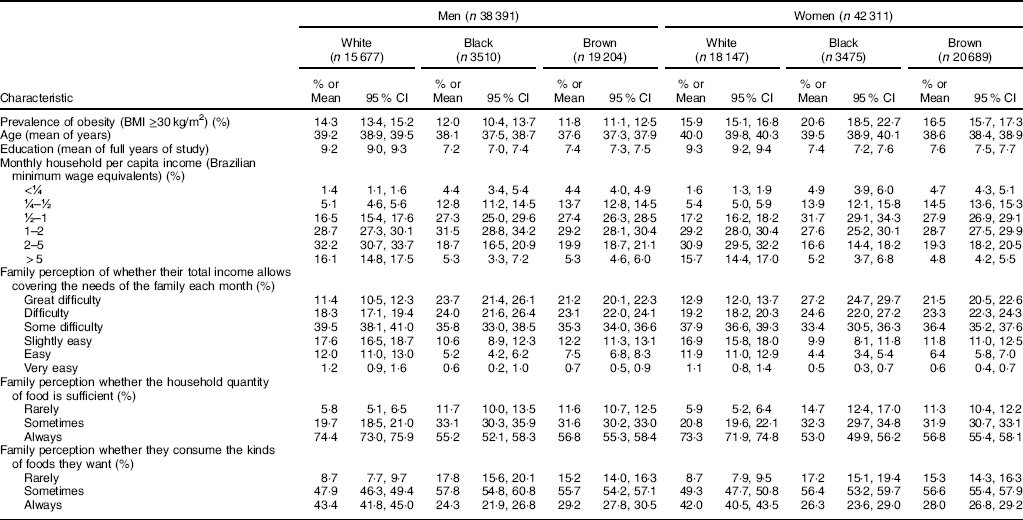
The study population comprised 51·4 % Whites, 8·6 % Blacks and 40·0 % Brown individuals. Similar racial proportions were observed when analysed according to sex. The overall prevalence of obesity was 14·9 % (males, 13·1 %; females, 16·5 %). The prevalence rates of obesity among Blacks, Whites and Browns were 16·4, 15·1 and 14·2 %, respectively. The highest prevalence of obesity was found among Black women (20·6 %).
Important socio-economic disparities were observed when analysed according to race. For both sexes, Whites had greater education (years of school), greater income and better family perception of quality of life (measured by two proxy variables: whether the household quantity of food is sufficient and whether they consumed the kinds of foods they wanted) compared with Blacks and Browns. While 16 % of White men received more than five times the minimum wage, only about 5 % of Black and Brown men belonged to this income category. In addition, 74·4 % of White men reported that the household quantity of food was always sufficient, compared with 55·2 and 56·8 % of Black and Brown men, respectively. In contrast, 17·8 % of Black and 15·2 % of Brown men reported that they rarely consumed the kinds of foods they wanted, compared with 8·7 % of White men. Similar results were observed among women (Table 1).
Prevalence of obesity according to demographic, socio-economic and food access characteristics among Brazilian adults from urban areas (n 80 702): 2008–2009 Brazilian Household Budget Survey
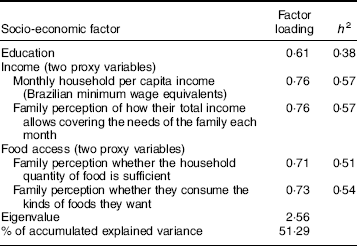
In the SES factor analysis, both the Kaiser–Meyer–Olkin index (0·79) and Bartlett’s test (P<0·01) indicated that the correlations among the five variables were sufficiently strong for factor analysis. The eigenvalue criterion (2·5) allowed for the identification of one factor of SES (51 % of the explained variance). The factor loadings and commonalities were the greatest for income (Table 2).
Socio-economic factors, factor loads and communalities (h 2) resulting from the factor analysis among Brazilian adults from urban areas (n 80 702): 2008–2009 Brazilian Household Budget Survey)
As seen in Table 3, Model 1, the OR of obesity among Brown men was significantly lower than among White men, while there were no significant differences between Black and White men or between Brown and Black men. In contrast, Black and Brown women had 49 and 17 % increased odds of obesity compared with White women, respectively. In Model 2, adjusted for socio-economic factors (individual factor scores), the interaction between race and SES factor was statistically significant (P<0·02). The association between obesity and race was different according to SES factor level in both sexes. At lower SES level (−2 sd), Black and Brown men had 35 and 27 % decreased odds of obesity compared with White men, respectively. No significant associations for other SES levels or for Brown v. Black were observed. In addition, Black women compared with White women had 30 % decreased odds of obesity at lower SES level (−2 sd) and a threefold increased odds at higher SES level (+2 sd), whereas Brown women had 35 % increased and 59 % decreased odds of obesity compared with Black at lower (−2 sd) and higher SES level (+2 sd), respectively. There were no significant differences between Brown and White women in any SES level (Table 3).
Multiple survey logistic regression analysis of the effect of race on obesity among Brazilian adults from urban areas (n 80 702): 2008–2009 Brazilian Household Budget Survey

SES, socio-economic status.
* Odds ratios of obesity estimated for each sex (stratified analysis) taking account of the contrasts between races and interaction term.
† Interaction term tested was statistically significant (P<0·02).
‡ The estimates were calculated for three SES factor levels: a lower level (−2 standard deviations of the SES factor); middle level (0 standard deviations) and an upper level (+2 standard deviations).
For men, the odds of obesity increased with increasing SES. White, Black and Brown men presented OR of obesity of 1·12, 1·37 and 1·26 per 1 sd increase in the SES factor, respectively. However, among women, only Blacks showed increased odds of obesity with increasing SES factor, whereas White and Brown women conversely showed decreases of 19 and 13 %, respectively (Table 4).
Effects of the socio-economic status (SES) factor on obesity according to race and sex among Brazilian adults from urban areas (n 80 702): 2008–2009 Brazilian Household Budget Survey

* Odds ratios of obesity were estimated for each sex (stratified analysis) and race by taking account of race+age (years)+region+SES factor (individual factor scores)+interaction term race×SES factor.
Discussion
The Brazilian adult population comprises an important admixture of Blacks and Whites; however, the socio-economic disparities between races are great. In the present study, although the socio-economic disparities by racial category were similar between the sexes, the results related to the prevalence of obesity were not. Especially, among women, Blacks had the highest prevalence of obesity, while among men, Whites did. The association between obesity and race was clearly modified according to SES, mainly among women. Compared with White women, Black women had threefold increased odds of obesity at higher SES level and decreased odds of obesity at lower SES level. Moreover, the odds of obesity increased with increasing SES factor level in all racial categories among men, especially among Black men.
The positive relationship between income and obesity among men but not among women has already been documented in national Brazilian data( 15 ) and in a large Brazilian cohort( Reference Gigante, Minten and Horta 16 ). In developing countries, obesity has historically been a problem for wealthy people( Reference Sobal and Stunkard 17 ). However, some studies have shown that obesity is becoming increasingly frequent among the poor, particularly among women( Reference Monteiro, Moura and Conde 8 , Reference Dinsa, Goryakin and Fumagalli 18 , Reference Schmidt, Duncan and Silva 19 ). Our study showed an important interaction of this association with SES, with Black women showing 17 % increased odds of obesity with each increase of the SES factor, while for White and Brown women, the odds conversely decreased.
Some authors have suggested that the racial disparities in obesity independent of SES could be explained by physiological, psychological, cultural and environmental effects. Stress due to racial discrimination can have harmful health consequences, including negative mental outcomes( Reference Paradies 20 , Reference Williams, Neighbors and Jackson 21 ), and may contribute to excessive BMI and body fat( Reference Gee, Ro and Gavin 22 ). Such a physiological pathway could be explained by hormonal changes produced by stressors, which would activate the hypothalamic–pituitary–adrenal axis, resulting in imbalanced levels of insulin, cortisol and other glucocorticoids, which increase fat retention and may stimulate appetite and suppress the satiety system( Reference Rosmond 23 – Reference Rosmond, Dallman and Björntorp 26 ). Overeating related to psychological distress also increases the risk of weight gain over time( Reference Womble, Williamson and Martin 27 , Reference Yanovski 28 ). Furthermore, some authors have verified positive associations of racism with BMI, waist circumference and measures of metabolic risk among Black women, suggesting that the effects of psychosocial stress on metabolic risk may be more pronounced in women than in men( Reference Chambers, Tull and Fraser 29 – Reference Butler, Tull and Chambers 31 ).
In addition, cultural differences such as greater body size satisfaction among Black women compared with Whites( Reference Millstein, Carlson and Fulton 32 ) and a preference for larger body sizes may also explain the racial disparities( Reference Kumanyika 33 , Reference Powell and Kahn 34 ). Greater consumption of fast foods( Reference Kwate, Yau and Loh 35 ), higher rates of obesity in areas of high concentrations of Black people( Reference Lim and Harris 36 ) and also a lower rate of breast-feeding among racial minorities are additional aspects promoting obesogenic environments( 37 ). These findings suggesting physiological, psychological and cultural differences among Black and White Brazilian women indicate the need for more in-depth explorations of these pathways to obesity in Brazil. One limitation of our study was that we could not quantify the contribution of these factors in our analysis.
A limitation of the database was that the survey lacked information on some proximal factors determining obesity. Food intake information was available only for less than 20 % of the total HBS sample and physical activity was not measured. In addition, the cross-sectional study design limited us not to evaluate changes of factors related to SES and development of obesity. On the other hand, the study conducted the analysis in a large national probabilistic sample with a great admixture of races and well-documented and measured variables.
Few studies have explored the association of obesity and race by SES level in Brazil. Chor et al.( Reference Chor, Faerstein and Kaplan 12 ) showed that the excessive weight gain among Black and Brown Brazilian women compared with Whites could be only partially explained by their life-course low socio-economic position, while no association was verified among men. Robert and Reither( Reference Robert and Reither 38 ), using multilevel analysis, observed that higher BMI among Black American women persisted even after considering individual SES and community socio-economic disadvantages; no association was observed for men. In an American population-based study, Jackson et al.( Reference Jackson, Szklo and Yeh 10 ) verified that Blacks, particularly women, experienced higher increases in BMI from 1997 to 2008 than Whites, for whom the obesity trends and racial disparities were more noticeable among individuals with higher education levels. Baltrus et al.( Reference Baltrus, Lynch and Everson-Rose 39 ) observed that weight gain over 34 years in adulthood was greater in Blacks than in Whites among women only. However, the association of race with weight gain largely resulted from the use of a cumulative socio-economic position score. Moreover, previous studies have revealed racial disparities in obesity since early childhood and adolescence, with Black children having higher BMI compared with Whites( Reference Kwate, Yau and Loh 35 , Reference Kenney, Wang and Iannotti 40 , Reference Weden, Brownell and Rendall 41 ); these differences cannot be explained by socio-economic variations between the examined groups( Reference Wang, Monteiro and Popkin 6 , Reference Karlsen, Morris and Kinra 42 ).
Despite studies on American males showing quite different results, with Blacks and those with lower SES having a higher prevalence of obesity( Reference Wong, Chou and Ahmed 4 , Reference Zhang and Rodriguez-Monguio 43 ), in our study we observed that White men and those with greater SES level had the highest odds of obesity. Further, among men, American national data revealed limited differences in the prevalence of obesity from 1999 to 2010 according to race, whereas the prevalence among non-Hispanic Black women was 20 percentage points higher than that among non-Hispanic White women( Reference May, Freedman and Sherry 9 ). Gigante et al.( Reference Gigante, Minten and Horta 16 ) identified no difference in obesity by race in Brazilian men, while Black or mixed women had a greater prevalence of obesity and overweight status compared with Whites.
In the present study, the associations of obesity and race were statistically significant for men only at lower SES levels, in which Black and Brown men had lower odds of obesity compared with White men. In addition, the odds of obesity among men increased with an increase in the SES factor among all racial categories, especially for Black men. These results indicate that the effect of increasing SES factor level on obesity was more evident among Black people, both for men and women.
In summary, the present population-based study suggests that racial disparities in obesity are SES level- and sex-dependent. The role of race in obesity was markedly evident in women, for whom the current Brazilian strategies exclusively targeting reductions in SES disparities probably will not be effective for decreasing racial disparities in obesity. The complex patterns in the association between race and obesity and the complexity of variables involved in the pathways of this relationship suggest the need for further studies including other variables allowing improved measurements of latent constructs, such as SES and discrimination, and the need for analysing the interactions and mediations among these constructs. Such an approach would be more appropriate for establishing guidelines for the prevention of obesity in countries with highly heterogeneous populations, such as in Brazil.
Acknowledgements
Financial support: This research received no specific grant from any funding agency in the public, commercial or not-for-profit sectors. M.C.A. received a postdoctoral fellowship from the Brazilian Federal Agency for the Improvement of Higher Education (Coordenação de Aperfeiçoamento de Pessoal de Nível Superior – CAPES). CAPES had no role in the design, analysis or writing of this article. Conflict of interest: None of the authors has conflicts of interest. Authorship: M.C.A., R.S. and V.T.B. contributed to the design of the study, analysis and interpretation of the data and the drafting of the manuscript; E.M.Y. contributed to the interpretation of the data and the drafting of the manuscript. All authors read and approved the final manuscript. Ethics of human subject participation: This study is a secondary analysis of 2008–2009 HBS data available for public online access from the Brazilian Institute of Geography and Statistics, which respects the confidentiality and ethical aspects of individuals under Brazilian Government law (number 73 177 of 20 November 1973).



