



Over the past decades, a potential interactive association between diet, lifestyle and genetics and the risk of many chronic diseases has been suggested. Accurate dietary intake assessment is important not only to find real associations between diet and health-related outcomes but also for nutritional monitoring/surveillance and for assessing compliance to dietary guidelines or to a dietary intervention in clinical/food intervention trials(Reference Willett1,Reference Kipnis, Subar and Midthune2) .
Overall, the methods and procedures used in national dietary surveys have been developed with the main aims of monitoring the nutritional status of a population, that is, analyses focusing on the intake of energy, macronutrients and micronutrients and developing tools and methods to obtain valid estimates of these intakes. The availability of detailed, harmonised and high-quality food consumption data from all European Union Member States had been recognised as a long-term objective of the European Food Safety Authority(3). In 2014, the ‘Guidance on the EU Menu methodology’ was published(4), aiming to update the previously published guidance on ‘General principles for the collection of national food consumption data in the view of a pan-European dietary survey’(3) and to cover the pan-European food consumption survey (‘EU Menu’) methodology. This guidance provides recommendations for the collection of food consumption, including the principal characteristics of the dietary software used to collect all the dietary data. In Portugal, a new electronic dietary assessment tool (eAT24) was specifically developed for the National Food, Nutrition and Physical Activity Survey (IAN-AF) conducted during 2015 and 2016(Reference Lopes, Torres and Oliveira5), but validation studies of its application are still missing.
Regarding food intake assessment, the 24-h dietary recall (24-HDR) method, carried out on two non-consecutive days, was recommended for the adult population as it was considered the most cost-effective method(3). Given the multi-factorial complexity of diet, it is well recognised that all dietary assessment instruments are associated, with random and systematic measurement errors, although with different magnitudes, which affect dietary estimates and may obscure disease risk associations(Reference Kipnis, Subar and Midthune2). Assessing the validity of dietary self-report instruments is therefore needed to reliably interpret the results. The underlying assumption of this validation approach requires that the measurement error of the test method will be independent of the measurement error of the reference method(Reference Willett1). The measurement of nutritional biomarkers in human biofluids has become increasingly used as reference instruments in dietary validation studies, since errors for biochemical markers and reporting methods appear to be independent(Reference Jenab, Slimani and Bictash6–Reference Ocke and Kaaks9). Recovery biomarkers, which are a subclass of nutrition biomarkers, can provide accurate assessments of short-term food exposure and are not substantially affected by determinants other than intake.
However, recovery biomarkers are currently only available for four dietary components: energy, protein, K and Na, providing information on limited aspects of diet(Reference Willett1,Reference Freedman, Commins and Moler10,Reference Freedman, Commins and Moler11) . Urinary N can be used to estimate absolute protein intakes and is the most widely used recovery biomarker. When there is no gain or loss in body protein, the body is in N balance and dietary N intake is highly correlated with N loss(Reference Bingham7). A meta-analysis of metabolic studies estimated that approximately 80 % of N atoms from ingested protein are excreted in urine(Reference Kipnis, Midthune and Freedman12).
Although K is more widespread in food than N, urinary K excretion can be used as a recovery biomarker with accuracy similar to that of urinary N. In a metabolic study with thirteen volunteers, during 30 d, high correlation between urinary K and intake was observed (0·89). Dietary potassium was mostly recovered in urine (77 %) and stools (17·5 %)(Reference Tasevska, Runswick and Bingham13). High correlations between estimated K intakes from diet records and 24-h urine samples over the same period have also been described under free-living conditions(Reference Bingham and Day14,Reference Caggiula, Wing and Nowalk15) .
Urinary Na is a good measure of short-term intake since sodium excretion is determined by recent intake and is almost as variable as intake itself(Reference Willett1). The reproducibility of 24-h urinary Na has consistently been lower than for urinary K, probably reflecting greater within-person variation in Na intake as compared with K intake(Reference Espeland, Kumanyika and Wilson16).
The aim of the current study was to assess the accuracy of the software eAT24, used in the IAN-AF, against three independent urinary biomarkers of intake: N, K and Na.
Subjects and methods
Study design and participant recruitment
Participants (n 95) were a sub-sample from the same IAN-AF sampling frame, whose aims and methods had been described in detail previously(Reference Lopes, Torres and Oliveira5,Reference Lopes, Torres and Oliveira17) . The sample size was calculated to detect correlation coefficients ≥0·3 at the 5 % significance level and with 80 % power, being sixty-six participants needed. Considering a non-compliance rate for 24-h urine completeness of 30 %, ninety-five eligible individuals were needed. Between May and December 2016, healthy men and women aged 18–84 years from the same IAN-AF sampling frame were invited, by telephone or during the first face-to-face interview, to take part in a more detailed validation study. They were assessed for suitability by a short screening questionnaire which included the following exclusion criteria: taking diuretics; being pregnant or lactating; having diabetes or kidney disease, haemophilia or any condition requiring supplemental O2; donating blood or plasma during or <4 weeks before the study; following prescribed dietary therapy and/or having had a urinary tract infection within 1 month of commencing the study.
Briefly, data were collected during two interviews, separated by between 8 and 15 d and conducted by trained nutritionists. At the first interview, dietary intake and physical activity questionnaires were applied and the participants received detailed written and oral instructions on the technique of collecting urine samples. Anthropometric assessment, including body weight and height, was also performed according to the standard procedures, previously described(Reference Lopes, Torres and Oliveira5). At the second interview, participants were asked to bring the urine samples and a second 24-HDR was applied. This second 24-HDR is referred as ‘1-d recall’ in the following sections.
Dietary assessment
The dietary intake data were obtained using the eAT24 software, a new electronic dietary assessment tool, based on a client–server architecture, specifically developed for the IAN-AF, which allowed the collection and description of food consumption data by 24-h recalls, according to a procedure based on the automated multiple-pass method for 24-HDR(Reference Raper, Perloff and Ingwersen18), as described elsewhere(Reference Lopes, Torres and Oliveira17).
All foods, including beverages and dietary supplements, consumed were recorded per eating occasion and quantified and described as eaten. This description required the utilisation of several facets and respective descriptors, through the FoodEx2 classification system(19) The place and time of meal consumption were also recorded for each eating occasion.
The software allowed subsequent conversion of foods into nutrients, using by default the Portuguese food composition table(20), which was continuously adapted and updated, ending with 2037 food items. A recipe module was also created, in which the recipes were disaggregated into raw ingredients allowing the description and quantification of each item.
Additionally, the software was able to include new food items or new recipes during the data collection process. For quantification, different methods were available: (i) weight or volume, (ii) standard units, (iii) photographs (food picture book including a 186 food photograph series (with six portions/food per recipe) and a household measures photograph series(Reference Torres, Faria and Sousa21)), (iv) household measures and (v) default portions(Reference Lopes, Torres and Oliveira5). For quality control, the software provided, at the end of the interview, the individual energy and macronutrient intakes for the corresponding evaluated day.
Urine collection and processing
Participants were asked to collect urine samples on the day before the second interview. Urine samples were collected in two separate containers. The first one (a 2700-ml container identified as container A) was used to collect all urine passed during the day before the interview, except the first void of that morning. A second one (a 500-ml container identified as container B) was used to collect only the first void urine of the day of the second interview (urine sample identified as ‘first morning void’). No preservatives were added to the urine containers, and the participants were asked to keep the samples refrigerated (4°C) throughout the collection period.
Participants were asked to fill in a questionnaire during the day of urine collection that included information on the time of the beginning and the end of collection, details of any medication, and whether or not they had any problems or missed urine collection.
At the laboratory, urine samples were weighed and mixed. The weights of urine from containers A and B were quantified separately, and a proportionally pooled 24-h urine sample (identified as ‘24-h urine’) was prepared by using samples A and B.
From each participant, both urine samples (‘first morning void’ and ‘24-h urine’) were aliquoted: 1 × 45 ml (in 50-ml Falcon pre-labelled tube) + 10 × 1·5 ml (in 2 ml-pre-labelled microtubes). These aliquots were refrigerated immediately before being moved to −80°C storage, within 24 h, for further analysis. In the current study, only the analysis of ‘24-h urine’ samples was presented.
Chemical analysis
Quantification of total N in urine samples was performed using the Kjeldahl method (Foss Tecator). To estimate protein intake from urine analysis, it was assumed that excreted nitrogen accounts for 81 % of the ingested protein due to extra-renal nitrogen losses(Reference Freedman, Commins and Moler11). Thus, urinary N concentration was converted to protein intake according to the following expression: protein intake (g/d) = (N concentration in urine (g/l) × 24-h urine volume (l) × 6·25)/0·81(Reference Bingham and Cummings22).
Na and K excretions were assessed using an ion-selective electrode Na+ and K+ assay (Beckman Coulter). Further adjustments were made to reflect extra-renal losses of Na and K estimated at 0·86 and 0·80, respectively(Reference Freedman, Commins and Moler10).
The 24-h urine volume as adjusted for self-reported collection time according to the expression: 24-h urine volume (ml) = total volume collected (ml)/self-reported collection time (h) × 24(Reference Wang, Cogswell and Loria23). Urine density was assumed to be approximately 1·0 g/ml. Urinary creatinine was measured by the Jaffe method (Beckman Coulter). The completeness of the 24-h urine was assessed through a combination of two criteria: the 24-h urinary creatinine excretion (mg/d) in relation to body weight (kg) (creatinine coefficients between 14·4–33·6 in men and 10·8–25·2 in women were considered sufficient to ensure that the samples corresponded to a 24-h period as recommended)(24) and total 24-h urine volume (≥500 ml)(Reference Wang, Cogswell and Loria23), and only data from complete collections were used for analysis(Reference Murakami, Sasaki and Takahashi25,Reference John, Cogswell and Campbell26) .
Statistics
Means and sd or frequencies and percentages were used to describe the study sample.
Mean dietary intake estimated from 24-HDR was compared with mean dietary intake estimated from urinary biomarkers using a pairwise t test. Mean differences and sd were calculated to allow conclusions on a group level about the absolute extent of under or overestimation of intake by 24-HDR.
Crude Pearson correlation coefficient between dietary intake, using either 1-d recall or the mean of 2-d recall, and urinary biomarkers was estimated. The deattenuated correlations were also calculated to remove within-subject variance(Reference Willett, Lenart, Kelsey, Manmot and Stoppey27). The within-subject variance estimated from 2 d of dietary recall was also used to deattenuate the correlation between the 1-d recall and urinary biomarkers.
By means of cross-classification, participants were classified into either the same tertile of intake by both methods or misclassified into the opposite tertile. Linear weighted Kappa coefficient was computed to assess the strength of agreement. The Bland–Altman plots were used to illustrate the difference between the two methods against the mean of the two methods.
Multiple linear regression was used to evaluate associations between the difference in protein, K and Na measures and covariates (gender, age (years) and BMI (kg/m2), 24-h urine volume (ml) and energy intake (kJ)).
The significance level was fixed in 0·05. All statistical analyses were carried out using software R version 3.5.0.
Results
From a total of ninety-five urinary specimens, nine were determined to be incomplete according to the previously mentioned coefficient creatinine-based criteria, resulting in eighty-six complete samples. Demographic and anthropometric characteristics and the energy intake of the participants are presented in Table 1. Half of the participants (50 %) were women and 12 % aged 65 years or more. Approximately, 72 % of men and 61 % of women were overweight or obese.
Demographic and anthropometric characteristics and energy intake of the analytic sample by gender (n 86)

* BMI category (kg/m2): normal weight (18·5 to <25·0), overweight (25·0 to <30·0) and obesity (≥30·0).
The geometric means and sd for protein, K and Na intakes as estimated by urinary biomarkers and as self-reported from the 24-HDR are shown in Table 2.
Protein, K and Na reported dietary intake and urinary biomarkers for all participants (mean values with their standard errors)
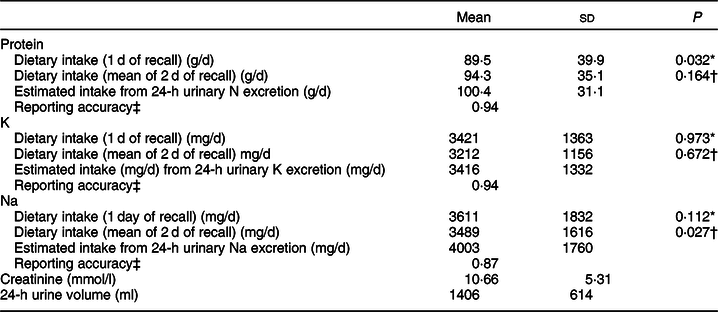
* Derived by pairwise t test for differences in means between dietary intake estimated from 1 d of dietary recall and dietary intake estimated from urinary biomarker.
† Derived by pairwise t test for differences in means between dietary intake estimated from 2 d of dietary recall and dietary intake estimated from urinary biomarker.
‡ Reporting accuracy: ratio of mean reported intake (estimated from 2-d dietary recalls) to that estimated from urinary biomarkers.
Mean protein intake, estimated from N urinary excretion (100·4 g/d), was significantly higher than the protein intake calculated using the single-day 24-HDR data (89·5 g/d) (P = 0·032). When considering the mean of 2 d of recall (94·3 g/d), mean protein intake was also higher but not significantly (P = 0·164). For K, mean intake estimated from urinary excretion (3416 mg/d) was slightly lower than the mean estimated from 1 d (3421 mg/d) and higher considering two 24-HDR (3212 mg/d); however, the differences were not significant (P = 0·973 and P = 0·672, respectively). The mean Na intake estimated from urinary excretion (4003 mg/d) was higher than the mean intake calculated from one (3611 mg/d) or two 24-HDR (3489 mg/d), but significant only when 2 d were considered (P = 0·027).
Cumulative percentiles for urinary excretion and estimated dietary intake of protein, K and Na are shown in Fig. 1. For protein, a clear tendency to underestimate the reported intake in relation to urinary excretion was observed, except for larger intake above 130 g (approximately). Below 3000 mg, urinary K excretion was lower than the reported intake, suggesting that individuals who consumed less food sources containing K were more prone to overestimate its dietary intake. Above that value, the differences between reported intake and excretion were less evident. For Na, a tendency to underestimate the reported intake in relation to urinary excretion was observed for values above 2500 mg, suggesting that individuals who consumed more Na-high products were more likely to underestimate the dietary intake.
Cumulative percentiles of estimates of dietary intake from 2 d of dietary recall ( ) and urinary excretion (
 ) for (a) protein, (b) K and (c) Na

Raw and deattenuated correlations between intake estimated from urinary biomarkers and from 1- or 2-d dietary recalls are reported in Table 3. For protein, K and Na, the deattenuated correlations between intake estimated from urinary biomarkers and from a single day dietary recall were 0·27, 0·57 and 0·26, respectively. Considering the mean intakes calculated using the 2 d of recall, both crude and deattenuated correlation coefficients improved, except for Na. For protein and K, the deattenuated correlations increased to 0·33 and 0·64, respectively. A similar trend was observed on cross-classification results (Table 4). The agreement (k coefficient) between protein or K intake estimated from urinary biomarkers and from dietary recall slightly increased when the mean of 2 d of recall was used.
Pearson’s correlation coefficient (r) between dietary intake and urinary excretion

Cross-classifications into tertiles for agreement

k, Kappa coefficient.
The Bland–Altman graphs for assessing bias between dietary intake and urinary biomarkers are presented in Fig. 2(a)–(c) for protein, K and Na, respectively. The protein plot indicated systematic underestimation of intake and a large scatter of the differences. Nevertheless, the measurement error seems to be similar across all the observed intake levels, indicating an acceptable estimation. In relation to K, there is almost no systematic bias between dietary intake and urinary excretion. In contrast, Fig. 2(c) shows a systematic underestimation of Na intakes and a larger scatter of the differences due to wider confidence limits. The scattering range of differences tends to be higher at higher Na intake.
The Bland–Altman graphs for assessing bias between nutrient estimation by self-reported dietary intake (mean of 2 d) and nutrient estimation by nutritional biomarkers for protein (a), K (b) and Na (c). The horizontal dashed line indicates the mean of the differences. The upper and lower dotted lines represent the upper and lower 95 % CI of agreement, which should comprise 95 % of the values in the range of the 2-fold sd (d ± 1·96 × sd) of the mean differences

Demographic and anthropometric characteristics (gender, age and BMI), energy intake and 24-h urine volume associations with the difference between nutrient intakes estimated from self-reported dietary data and from urinary biomarkers are presented in Table 5. For protein, differences varied according to BMI (β = −1·96, P = 0·017) but not by gender or age. No significant differences according to BMI, gender or age were observed for K and Na. The energy intake was positively associated, and 24-h urine volume was negatively associated with the difference between self-reported dietary intake and intake estimated from urinary biomarkers for protein (β = 0·007, P < 0·001 and β = −0·02, P = 0·002, respectively), K (β = 0·170, P < 0·001 and β = −0·42, P = 0·040, respectively) and Na (β = 0·371, P < 0·001 and β = −0·81, P = 0·011, respectively).
Association between nutrient estimation by dietary intake from 2 d of dietary recall and nutrient estimation by nutritional urinary biomarkers according to sociodemographic, dietary and urinary covariates

* The multivariate analysis model was one linear regression model (difference between estimates = dietary intake – urinary excretion as dependent variable) with all covariates included.
† The gender variable was categorised with male being the referent group.
‡ Continuous forms of age and BMI were used in the regression analysis.
Discussion
In the current study, we assessed the validity of protein, K and Na intakes estimated from two non-consecutive 24-HDR against 1-d urinary excretion, where the day of urine collection corresponded to the second day of dietary recall.
When compared with the estimated protein intake from 24-h N excretion, the estimated intake of protein (recorded by 24-HDR) was considerably underestimated, which has been observed in other studies(Reference Crispim, de Vries and Geelen28–Reference Lassale, Castetbon and Laporte37). Considering just 1 d of recall, we found an under-reporting around 10%, which was similar to values found in other studies, such as the European Food Consumption Validation Project (12·1 % in men and 12·8% in women)(Reference Crispim, de Vries and Geelen28) and the American Observing Protein and Energy Nutrition Study (11–12 %)(Reference Subar, Kipnis and Troiano29). However, when the mean of 2 d of recall was considered, protein under-reporting decreased to 6 %. Correlation coefficients between protein intake estimated from self-reported data and from urinary N were low but comparable with values reported in other validation studies including short-term instruments (24-HDR), such as the American Observing Protein and Energy Nutrition Study (r = 0·41 for men and r = 0·26 for women)(Reference Subar, Kipnis and Troiano29), the Dietary Evaluation and Attenuation of Relative Risk study (r = 0·29)(Reference Shai, Rosner and Shahar38) and the UK arm of European Prospective Investigation into Cancer and Nutrition (r = 0·10 for one 24-HDR)(Reference Bingham, Gill and Welch39). However, our results are slightly lower than those found in the European Food Consumption Validation Study (r = 0·65 in men and r = 0·46 in women)(Reference Crispim, de Vries and Geelen28) and in a recent study which evaluate the relative validity of multiple self-reported dietary assessment methods over a 15-month period (r = 0·67 for 7-d dietary records)(Reference Yuan, Spiegelman and Rimm40).
A meta-analysis of a large set of data has confirmed that urine N should be approximately 80 % of dietary intake on average(Reference Kipnis, Midthune and Freedman12); however, it could be argued that the use of inappropriate assumptions for protein extra-renal losses may have contributed to a different validity for assessment of protein intake.
For K and Na, in line with some other studies, intake estimates from a 24-HDR were expected to be lower than from urine biomarkers due to the well-described under-reporting bias(Reference Mercado, Cogswell and Valderrama41,Reference Rumpler, Kramer and Rhodes42) . Considering 2 d of dietary recalls, a significant under-reporting was observed for Na (3489 v. 4003 mg/d, P = 0·027) but not for K (3212 v. 3416 mg/d, P = 0·672). Correlation coefficients between K intake estimated from self-reported data and from urinary excretion were similar or even higher than those reported by other authors(Reference Freedman, Commins and Moler10,Reference Crispim, de Vries and Geelen28,Reference Mercado, Cogswell and Valderrama41,Reference McKeown, Day and Welch43) . For Na, correlations were low, but comparable with those reported by other authors(Reference Freedman, Commins and Moler10,Reference Mercado, Cogswell and Valderrama41,Reference Kelly, Geaney and Fitzgerald44) . McKeown et al. (Reference McKeown, Day and Welch43) reported correlation coefficients in women similar to those we indicated in the current study but higher in men. This weak association between Na intake and excretion is not surprising, assuming that some authors suggest that a minimum of eight urine collections is needed to gain precision in the estimate of individuals’ mean Na intake(Reference Liu and Stamler45). Bingham et al. (Reference Bingham, Cassidy and Cole46) showed that even when the mean of six urine collections and 16 d of weighed records were used to estimate Na intake, the correlation was only moderate.
Correlation and agreement values for K were higher than those observed for Na and protein. As suggested by other authors, this differential reporting of nutrients is possibly related to differential reporting of its food sources(Reference Freedman, Commins and Moler10,Reference Freedman, Commins and Moler11,Reference Lassale, Castetbon and Laporte37,Reference Mercado, Cogswell and Valderrama41,Reference Pryer, Vrijheid and Nichols47) . The main food sources for K from diet, such as fruits and vegetables, seem to be less susceptible to under-reporting than the food sources for protein or Na(Reference Freisling, van Bakel and Biessy48). It is widely recognised that the observed weak relation between dietary and urinary Na is attributed to the poor assessment of salt intake by dietary assessment methods, the lack of inclusion of foods prepared with salt in food composition tables and the high within-person variability of urinary Na(Reference McKeown, Day and Welch43). Additionally, the use of table and cooking salt and the variation in the Na content of manufactured foods make it difficult to rely on food tables in estimating Na intake. It should also be noted that the food composition data used for calculating nutrient intakes might also introduce bias. In fact, the constant changes in food marketplace and the dynamic nature of the food supply present issues and challenges for maintain food composition databases completed and updated(Reference Pennington, Stumbo and Murphy49).
Overall, we observed that correlation coefficients (crude or deattenuated) and agreement (k coefficient) between self-reported data and urinary biomarkers were higher when calculated, considering the mean of 2 d of recall than when only 1 d of recall was considered for N and K, but not for Na. For Na, in which half-life is approximately 24 h, these findings may be explained since we expect Na in the 24-h urine (comprising all excretions until the following morning) to reflect mainly the Na ingested during that day(Reference Mercado, Cogswell and Valderrama41). The higher K half-life in the body (approximately 16 d) may explain better correlations when 2 d of recall were considered(Reference Rahola and Suomela50).
Reporting error has been attributed to both physical (e.g. BMI) and sociodemographic characteristics, such as gender and socio-economic status(Reference Freedman, Commins and Moler10,Reference Freedman, Commins and Moler11,Reference Subar, Kipnis and Troiano29,Reference Heerstrass, Ocke and Bueno-de-Mesquita51) . In the current study, BMI significantly influenced the differences in protein measures but not in K and Na. Freedman et al. (Reference Freedman, Commins and Moler11) pooled data from five large validation studies of dietary self-reported instruments and also showed that a higher BMI was consistently associated with under-reporting of both energy and protein intakes, using both FFQ and 24-HDR. Other studies reported this BMI effect(Reference Freedman, Commins and Moler11,Reference Crispim, de Vries and Geelen28,Reference Neuhouser, Tinker and Shaw30,Reference Crispim, Geelen and de Vries36,Reference Freisling, van Bakel and Biessy48,Reference Lissner, Troiano and Midthune52,Reference Ferrari, Slimani and Ciampi53) . For K and Na, BMI did not seem to influence misreporting, which is in line with a recent study(Reference Lassale, Castetbon and Laporte37,Reference Rhodes, Murayi and Clemens54) . Interestingly, Freedman et al. (Reference Freedman, Commins and Moler10) reported that under-reporting for Na was strongly associated with higher BMI, being black, being male and having a high school education, but no associations were consistently reported for K intake.
Gender appeared to have no impact on the differences between measures in any of the three studied biomarkers. Several authors had studied the effect of gender on under-reporting of energy consumption and suggested that women are more likely, consciously or unconsciously, to under-report their diet than men(Reference Slimani, Bingham and Runswick32,Reference Ferrari, Slimani and Ciampi53,Reference Novotny, Rumpler and Riddick55) . However, when considering Na and K estimates, our findings are in line with Espeland et al. (Reference Espeland, Kumanyika and Wilson16), who reported no gender effect on the relative bias of diet- v. urine-based measures.
Our results suggest that as the energy intake increased, greater were the differences found between the reported intake and the urinary excretion. Subar et al. (Reference Subar, Kipnis and Troiano29) found that under-reporting tends to increase with increased exposure. The authors suggested that as the intake increased, the greater was the difficulty in reporting consumption accurately, perhaps because remembering more foods or bigger portion sizes is challenging and/or because of societal pressure to consume less(Reference Subar, Kipnis and Troiano29). These results are in accordance with our expectations since another recent study had revealed that total energy intake was independently associated with the difference between diet and urine estimates of Na and K intakes(Reference Mercado, Cogswell and Valderrama41).
We found the difference between protein, K and Na estimates to be lower as 24-h urine volume increased. In spite of our efforts to assess the completeness of 24-h urine samples, we cannot exclude the possibility of considering incomplete samples as valid. We suggest that this may be a reason to observe higher differences between estimates for lower volumes of urine collected.
The main strength of the current study is the use of objective nutritional biomarkers, namely urinary N, K and Na, collected on one of the days of dietary recall, allowing to understand how well the urinary excretion reflects the acute intake.
Regarding the data collection, the protocol deserves to be mentioned. Interviews were carried out by highly trained nutritionists, according to the standardised procedures. Objectively measured anthropometry was performed using the same equipment model submitted to regular calibration procedures. Data inclusion was easier and accurate due to the use of the e-platform, specifically designed for this project. The multiple-pass dietary interviews minimised the omission of possible forgotten foods. Also, this method standardised the level of detail for describing foods including the portion size estimation by photographs of different portions.
To our knowledge, the current study is the first to validate protein, K and Na intakes reported from 24-HDR against N, K and Na urinary excretion, in a sub-sample of healthy Portuguese adults. Additionally, the current study is the first one to validate the new software eAT24, supporting its suitability in further food intake assessment studies.
Among the limitations of the current study are that our sub-sample was not recruited from all geographic areas of the IAN-AF. Thus, caution should be taken in the extrapolation of the data to the general population. However, it is not expected a different performance of the tool in the IAN-AF general sample. The small sample size (n 86) has also to be mentioned, but it seems to be sufficient to show the differences when they exist.
Despite our efforts to select only valid/complete 24-h urinary samples, the application of other criteria deserves further investigation, in order to evaluate results with or without the exclusion of potential incomplete urine collections and determine its impact on validity outcomes. The use of 24-h urine sampling has been considered the gold standard and the most reliable method to estimate N, K and Na excretions. Although urinary measures are inherently more objective than measures based on self-reported dietary intake, the applicability of 24-h urine samples for validity has been questioned because there is no procedure to estimate with certainly the completeness of each 24-h urine collection(Reference John, Cogswell and Campbell26,Reference Dennis, Stamler and Buzzard56) . It has been recognised that no single method, or even a combination of methods, accurately identifies incomplete urine collections(Reference John, Cogswell and Campbell26). Urinary para-aminobenzoic acid, used in some national surveys, has been widely recommended as an objective and exogenous marker to assess completeness of 24-h urine collection because, in theory, it seems less affected by participants’ characteristics and diet(Reference John, Cogswell and Campbell26,Reference Cogswell, Maalouf and Elliott57) . However, even this method has its limitations, namely related to an increased burden on participants, and it has been suggested that para-aminobenzoic acid check may not be required in large population-based biomarker studies(Reference Subar, Midthune and Tasevska58). In our study, in the absence of the para-aminobenzoic acid method, urine completeness was assessed using a widely used criteria based on creatinine excretion(24) in combination with total urine volume(Reference Wang, Cogswell and Loria23,Reference Murakami, Sasaki and Takahashi25) .
We share the general limitation of one single 24-h urine collection while measuring the daily N, K and Na excretions. Only a single 24-h urine sample may not be optimal for characterising individual habitual dietary intake and may introduce random errors. Additional 24-h urine collections may be needed for individual assessment due to day-to-day within-person variability(Reference Bingham and Cummings22,Reference Bingham59) . In addition, we should reflect about the precision of the correction factors used for estimating dietary intake from 24-h urine. Many factors may influence the percentage of N, K and Na excreted in the urine, such as absolute level of dietary intake, the seasons during which urine samples are collected and race(Reference Zhang, Temme and Sasaki60). We used the factors observed in previous studies(Reference Freedman, Commins and Moler10,Reference Freedman, Commins and Moler11) ; however, the use of other correction factors, or no correction factors, may influence the magnitude of the error(Reference Rhodes, Murayi and Clemens54,Reference Murakami, Sasaki and Takahashi61,Reference Holbrook, Patterson and Bodner62) .
Conclusion
We assessed the validity of a dietary self-report method, using a new software – eAT24, with biomarker measurements. At a population level, we showed that two non-consecutive 24-HDR performed well in estimating protein and K intakes but lesser so in estimating Na intake. Our results confirmed that misreporting is selective to certain nutrients, which may have implications for how we deal with the misreporting often seen in nutritional epidemiological studies. Research to develop further intake biomarkers should be strongly encouraged.
Acknowledgements
Acknowledgements: The IAN-AF 2015–2016 was developed by a consortium: Carla Lopes, Andreia Oliveira, Milton Severo, Faculty of Medicine, University of Porto; Duarte Torres, Sara Rodrigues, Faculty of Nutrition and Food Sciences, University of Porto; Elisabete Ramos, Sofia Vilela, EPIUnit, Institute of Public Health, University of Porto; Sofia Guiomar, Luísa Oliveira, National Health Institute Doutor Ricardo Jorge; Violeta Alarcão, Paulo Nicola, Institute of Preventive Medicine and Public Health, Faculty of Medicine, University of Lisbon; Jorge Mota, CIAFEL, Faculty of Sports, University of Porto; Pedro Teixeira, Faculty of Human Kinetics, CIPER, University of Lisbon; Simão Soares, SilicoLife, Lda, Portugal; Lene Frost Andersen, Faculty of Medicine, University of Oslo. The current study had institutional support from the General Directorate of Health, the Regional Health Administration Departments, the Central Administration of the Health System and from the European Food Safety Authority (CFT/EFSA/DCM/2012/01-C03). The researchers acknowledge all these institutions and persons involved in all phases of the survey, as well as participants. Financial support: The current study has received funding from the EEA Grants Program, Public Health Initiatives (PT06 – 000088SI3). The EEA Grant Program had no role in the design, analysis or writing of the current article. Conflict of interest: There are no conflicts of interest. Authorship: A.C.L.G. conceived the present idea, analysed and interpreted this data with M.S. support; M.S. verified the analytical methods, supervised the statistical analysis and gave additional inputs to the study design; A.J.L. and V.P.L.M. collaborated on the planning of data collection and in the interpretation of results; C.L. and D.T. coordinated the IAN-AF 2015–2016 investigation, formulating the main research questions and were also involved in the design of the current study; A.C.L.G. wrote the manuscript, and all authors discussed the results, contributing to the final document and had primary responsibility for final content; All authors read and approved the final manuscript. Ethics of human subject participation: The current study was conducted according to the guidelines laid down in the Declaration of Helsinki, and all procedures involving study participants were approved by the National Commission for Data Protection, the Ethical Committee of the Institute of Public Health of the University of Porto and from the Ethical Commissions of each one of the Regional Administrations of Health. Written informed consent was obtained from all subjects.



