





Introduction
There is growing interest in the study of alexithymia as it is a subclinical trait that explains some of the co-occurring emotional difficulties seen across a range of psychiatric and neurodevelopmental conditions, including those that develop in childhood and adolescence, such as in Autism Spectrum Disorder (hereafter, autism; Kinnaird et al., Reference Kinnaird, Stewart and Tchanturia2019; Milosavljevic et al., Reference Milosavljevic, Carter Leno, Simonoff, Baird, Pickles, Jones, Erskine, Charman and Happé2016) and Feeding and Eating Disorders (Westwood et al., Reference Westwood, Kerr-Gaffney, Stahl and Tchanturia2017). Alexithymia is a condition in which individuals struggle to identify and express their own feelings with an externally oriented style of thinking (Bagby et al., Reference Bagby, Parker and Taylor2020; Nemiah et al., Reference Nemiah, Freyberger and Sifneos1976). Despite its consequences for mental health, the psychological predictors of, and mechanisms underlying, alexithymia are understudied. While a large body of research on adults has been dedicated to understanding the relationship between alexithymia and interoception – the perception of internal bodily signals (e.g., heartbeat and breathing) – this single approach may not capture the full range of ways in which alexithymia may develop, which include factors relevant to early development (Brewer et al., Reference Brewer, Murphy and Bird2021; Murphy et al., Reference Murphy, Brewer, Catmur and Bird2017; Weissman et al., Reference Weissman, Nook, Dews, Miller, Lambert, Sasse, Somerville and McLaughlin2020). It is therefore possible that some adult findings would not be generalizable to specific populations of children and adolescents. The predominance of adult research may also be due to the fact that there is heavy reliance on self-report measures of alexithymia, which can be challenging to use in developmental populations.
As part of the multi-route model of alexithymia, the language hypothesis of alexithymia posits that individuals with language impairments are at elevated risk of developing alexithymia (Hobson et al., Reference Hobson, Brewer, Catmur and Bird2019). For instance, children aged 9 to 16 years with developmental language disorder (DLD) – those who showed widespread deficits in their native language(s) that persist from the beginning of formal education and who often experience nonverbal cognitive and socioemotional difficulties (Norbury & Sonuga-Barke, Reference Norbury and Sonuga-Barke2017) – showed elevated levels of parent-reported alexithymia compared to children with typical language abilities (Hobson & van den Bedem, Reference Hobson and van den Bedem2021). From the constructionist perspective, language impairments may hinder the acquisition and development of discrete emotion categories (Hoemann et al., Reference Hoemann, Xu and Barrett2019, Reference Hoemann, Wu, LoBue, Oakes, Xu and Barrett2020). These theories are supported by a recent meta-analysis which demonstrated that alexithymia was associated with language impairments (r = −.14) and a less fine-grained perception of emotion experiences (r = −.10), and that individuals with language impairments/disorder had elevated alexithymic traits as compared to individuals with typical language function (Lee et al., Reference Lee, Murphy, Catmur, Bird and Hobson2022).
However, most existing studies on language impairments and alexithymia are cross-sectional and do not inform as to the direction of cause and effect, that is, whether language impairments predispose some individuals to developing alexithymia. This limitation should be urgently addressed as it would enable the characteristics of early language processes that underpin alexithymia to be identified (Hobson & van den Bedem, Reference Hobson and van den Bedem2021). Two studies using longitudinal designs in developmental populations are of particular relevance to this issue. In a study of 723 school children in southwestern Finland (Karukivi et al., Reference Karukivi, Joukamaa, Hautala, Kaleva, Haapasalo-Pesu, Liuksila and Saarijärvi2012), receptive language impairment (the ability to comprehend and follow multi-part instructions in particular) assessed by nurses at the age of 5 years was prospectively associated with self-reported alexithymia on the 20-item Toronto Alexithymia Scale (TAS-20) (Parker et al., Reference Parker, Taylor and Bagby2003) at the age of 19 years. This association was more prominent in male than female adolescents when adjusting for confounds including early socioemotional symptoms and subjective health. Similar findings were reported in a Finnish birth cohort study (Kokkonen et al., Reference Kokkonen, Veijola, Karvonen, Läksy, Jokelainen, Järvelin and Joukamaa2003, N = 2,556), where early speakers (those who were able to utter three or more “words” in the first year of life) were found to have the lowest mean score on the TAS-20 when they reached 30 years old, with a stronger effect found in males than females. However, it remains unclear if the stronger associations in boys indeed reflect a male-specific risk of developing alexithymia via the language pathway.
The scant body of longitudinal studies may be due to the lack of alexithymia measures with validity for use in large-scale cohort studies in developmental populations. Although this may not be an issue in the two studies above, which only measured alexithymia in adulthood using the TAS-20, more intensive language assessments are needed to test for any temporal changes in the prospective relationship between early language development and later alexithymia. Critically, while both studies above utilized medical screening tools to assess speech development, it is unclear if children who displayed some of those speech deficits constitute a clinically meaningful subgroup that corresponds to the current diagnostic criteria for childhood language disorders. This group approach is of theoretical importance as if emotional awareness is dependent on good language ability, alexithymia should characterize children with language impairments/disorders. For developmental groups where language ability is highly heterogenous, such as in autism, alexithymia and language ability would instead covary in these groups (Hobson et al., Reference Hobson, Brewer, Catmur and Bird2019). Relatedly, the use of binary screening items (pass/fail; yes/no) lacks a dimensional perspective that could characterize more clearly the relationship between early language and later alexithymia, given the vast individual differences in early language development (Kidd et al., Reference Kidd, Donnelly and Christiansen2018). Altogether, these methodological considerations may help specify the developmental period during which, and among whom, language interventions are most needed to prevent alexithymia and its related negative socioemotional outcomes (Way et al., Reference Way, Yelsma, Van Meter and Black-Pond2007).
Furthermore, it has been suggested that different domains of language impairments may underpin different pathways to alexithymia. For instance, while children with DLD showed high rates of alexithymia, alexithymia was contemporaneously associated with pragmatic but not structural language difficulties rated by parents (Hobson & van den Bedem, Reference Hobson and van den Bedem2021). The authors therefore suggested a disrupted social learning pathway that restricts children with DLD from communicating emotional difficulties effectively in social situations. Nevertheless, the meta-analysis mentioned previously found a similar magnitude of correlation between alexithymia and each of speech, pragmatic, and structural language abilities (Lee et al., Reference Lee, Murphy, Catmur, Bird and Hobson2022). Further investigation is warranted to clarify if differential associations exist between specific language domains and alexithymic traits, especially from a prospective point of view.
To address the above research gaps, the current study tested the prospective relationship between early language function between the ages of 4–5 years and alexithymic traits at the age of 12–13 years using data from the Surrey Communication and Language in Education Study (SCALES) (Norbury et al., Reference Norbury, Gooch, Wray, Baird, Charman, Simonoff, Vamvakas and Pickles2016). SCALES is one of the few longitudinal studies that collected intensive data on child language development and alexithymic traits from early childhood to early adolescence, which would allow for testing differences in later alexithymia between language groups identified at early time points, as well as evaluating the directional relationship from early language impairments to later alexithymia within a reasonable timespan. Moreover, taking advantage of the longitudinal data, this study was the first to apply latent profile techniques to extract potential patterns of language development that might not be detected by conventional diagnostic criteria for language disorders, such as those with subclinical levels of language impairments and those with language difficulties that are specific to structural but not pragmatic language domains. The use of latent growth curve analysis is also more advantageous than detecting language difficulties at a single time point alone, as the latter may simply reflect transient variations in early language development instead of a robust language marker that is diagnostic of future alexithymia.
We hypothesized that there would be significant differences in later alexithymic traits between children with language impairments and peers with typical language abilities. We expected that early language function would be prospectively associated with later alexithymic traits. Due to the dearth of longitudinal studies in the field, we did not hold specific hypotheses regarding the directionality of these group differences and associations. We also explored sex differences in these dimensional relationships.
Method
Participants
Participants were drawn from the SCALES, a longitudinal cohort study of language development and disorder recruiting 7,267 children from the age of 4 and 5 years in Surrey, a county in the south of the UK (Norbury et al., Reference Norbury, Gooch, Wray, Baird, Charman, Simonoff, Vamvakas and Pickles2016). Briefly, following the initial screening phase (T1), 529 children and their parents were selected to form an in-depth cohort for longitudinal language and mental health assessments over the course of 8 years (T2 to T5). Note that all children who attended special schools were excluded from the in-depth cohort, due to the fact that their pervasive developmental impairments would impose significant challenges on completing the test battery (n = 31, 19 with no phrase speech). Children who spoke English as an additional language at the time of data collection were excluded to form another study cohort. For the purpose of this study, we included all children (N = 229, 43.3% of the in-depth cohort) (mean age at T1 = 5.32 years, SD = 0.29, 51.1% female) who completed the Emotion Awareness Questionnaire (EAQ) (Rieffe et al., Reference Rieffe, Oosterveld, Miers, Meerum Terwogt and Ly2008), which measures multiple domains of alexithymic traits in children and adolescents (see below), amid the COVID-19 pandemic at T5 (12 to 13 years old). The study design and further recruitment procedures of the SCALES were detailed in the original report (Norbury et al., Reference Norbury, Gooch, Wray, Baird, Charman, Simonoff, Vamvakas and Pickles2016). The SCALES project was approved by the research ethics committees at Royal Holloway, University of London (T1 to T3), and University College London (T4 to T5) (9733/002). Parents provided written informed consent, while children provided verbal and written assent throughout the project.
Measures
Child language development at T1 to T3
The Children’s Communication Checklist 2 (CCC-2) (Bishop, Reference Bishop2003) is a well-established assessment of child language and communication skills and is commonly used to screen for communication difficulties in children aged 4 to 16 years. Due to practicalities and participation burden, different versions of the CCC-2 were used in the SCALES. At T1 (4 to 5 years old), teachers completed the short 13-item version of CCC-2 (Norbury et al., Reference Norbury, Nash, Baird and Bishop2004). At T2 (5 to 6 years old), parents completed the full 70-item version of CCC-2. At T3 (7 to 8 years old), parents completed the short CCC-2. At T2 and T3, we prioritized the use of parent reports due to the considerations that parents have the most contact with their children at this developmental period and that parent ratings have a lower rater-to-child ratio than teacher reports based in classroom settings (Bishop & Baird, Reference Bishop and Baird2001; Norbury et al., Reference Norbury, Nash, Baird and Bishop2004). These considerations suggest parent ratings provide more reliable and specific observations of child communication behaviors, especially for identifying latent language profiles (see Statistical Analyses). The attrition rates for teacher reports in children with complete parent reports of CCC-2 and EAQ data were also relatively high (> 25%), which was not compatible with the intention to model language development over time. In the current sample, T1 teacher reports were moderately correlated with parent reports (T2 = .47, T3 = .54). We did not use T4 CCC-2 data due to high attrition rates for both reporters (> 40%).
For both versions of the CCC-2, teachers and parents reported the frequency with which the child displayed certain language and/or communication behaviors. An example item is “Mixes up words that sound similar, e.g., might say ‘telephone’ for ‘television’ or ‘magician’ for ‘musician’.” Responses were rated on a four-point Likert scale (0 = less than once a week; 3 = several times (more than twice a day) or always). Items that describe language strengths were reverse-scored such that higher scores reflect more language difficulties. The full CCC-2 comprises eight communication subscales (seven items each), namely speech, syntax, semantics, coherence, inappropriate initiation, stereotyped language, use of context, nonverbal communication; and two additional subscales – social relations and interests – for calculating the social interaction deviance composite in children with autism (not applicable to this study as only four children were diagnosed with autism in the T2 analytic sample, see Statistical Analyses). The short CCC-2 consists of 13 items that best discriminated children with language difficulties from peers with typically developing language skills (Norbury et al., Reference Norbury, Nash, Baird and Bishop2004). The CCC-2 subscales and the short CCC-2 showed high internal consistency (Cronbach’s alphas = .65 and .87, respectively), while the short CCC-2 is strongly correlated with CCC-2 total scores, r(515) = .88. We analyzed the short CCC-2 z-scores at T1. In the SCALES data set, these had been previously z-transformed by season of birth and sex. Since season of birth information was not available due to data protection requirements, we z-transformed the CCC-2 total and subscale raw scores at T2 and the short CCC-2 total raw scores at T3 by sex to approximate the initial standardization at T1.
Child alexithymic traits at T5
Children completed the EAQ (Rieffe et al., Reference Rieffe, Oosterveld, Miers, Meerum Terwogt and Ly2008), which was added to the SCALES protocol for data collection at T5. Items were rated on a three-point Likert scale (Not true, Sometimes true, Often true), where higher scores indicate higher levels of emotion awareness. The six EAQ subscales (Cronbach’s alphas reported in brackets) were differentiating emotions (.84), verbal sharing of emotions (.75), not hiding emotions (.80), bodily awareness of emotions (.78), attention to others’ emotions (.60), and analyses of emotions (.72). The EAQ showed acceptable to good internal consistency for the six subscales, consistent with previous validation in large developmental samples (e.g., Hobson & van den Bedem, Reference Hobson and van den Bedem2021, Rieffe et al., Reference Rieffe, Oosterveld, Miers, Meerum Terwogt and Ly2008, Rieffe & De Rooij, Reference Rieffe and De Rooij2012). The raw scores of the subscales were analyzed.
Co-occurring socioemotional symptoms at T1
Teachers completed the Strengths and Difficulties Questionnaire (SDQ) (Goodman, Reference Goodman1997) as part of the initial screening at T1. The SDQ (25 items) assesses five domains of socioemotional and behavioral symptoms in children aged 3 to 16 years, including emotional symptoms, conduct problems, hyperactivity/inattention, peer relationship problems, and prosocial behavior. Items were rated on a three-point Likert scale (Not true, Somewhat true, Certainly true). Higher scores indicate higher levels of symptoms (Goodman & Goodman, Reference Goodman and Goodman2009). Considering that socioemotional difficulties are common in children with language impairments (e.g., Goh et al., Reference Goh, Griffiths and Norbury2021), we entered the SDQ total difficulties scores at T1 as covariates of no interest in our subsequent analyses to clarify the unique prospective relationship between early language function and later alexithymia.
Nonverbal reasoning at T2
Children completed the Block Design subset of the Wechsler Preschool and Primary Scale of Intelligence (WPPSI-III) (Wechsler, Reference Wechsler2003) as a measure of nonverbal reasoning at T2. Children were required to recreate patterns as shown on the test demonstration and pictures using colored cubes. The assessment was terminated when scoring no marks for three consecutive items. As developmental studies have shown varying nonverbal reasoning abilities in children with language disorders/impairments (Botting, Reference Botting2005; Henry et al., Reference Henry, Messer and Nash2012; Norbury et al., Reference Norbury, Gooch, Wray, Baird, Charman, Simonoff, Vamvakas and Pickles2016), the total accuracy scores were treated as covariates of no interest in subsequent analyses, such that any associations between language function and alexithymia would be specific to language rather than broader cognitive abilities. Higher scores reflect higher accuracy.
Statistical analyses
We first characterized the developmental profiles of our full sample by summarizing their sociodemographic information. This included the child’s ethnicity (white/other), parental education level, deprivation quintile (determined by the Income Deprivation Affecting Children Index using household postcodes), whether the child had an autism diagnosis, number of immediate family members (parents and siblings) diagnosed with autism/attention-deficit hyperactivity disorder/conduct disorder/dyspraxia, and the level of speech therapy and special education support the child received at school. These variables were ascertained from the background survey completed by parents and teachers at T1 and T2.
To examine the relationship between the presence of language impairments and later alexithymia, children with and without language impairments were compared on later alexithymia scores. The categorization of language-impaired vs. non-impaired groups took different forms at the different time points (see Supplementary Materials for a summary). For T1, we first conducted nonparametric Wilcoxon tests to compare differences in T5 alexithymic traits between high and low language functioning groups at T1 separately for girls and boys. Group membership was predetermined by children’s short CCC-2 scores at T1 screening, where children scoring below the 14th percentile by season of birth and sex were classified as having low language function and at risk of DLD (Norbury et al., Reference Norbury, Vamvakas, Gooch, Baird, Charman, Simonoff and Pickles2017). Next, we performed Spearman correlation to test the dimensional relationship between T1 language function and T5 alexithymic traits in the full sample. Significant tests were further evaluated by robust linear regressions adjusted for nonverbal reasoning and co-occurring socioemotional symptoms with age entered as a control variable.
A similar group approach was applied to the T2 data. We first conducted Wilcoxon tests to compare differences in alexithymic traits between (i) children diagnosed with language disorder (scoring -1.5 standard deviations on at least two out of five language composite scores, computed based on a language assessment battery in the SCALES, see Supplementary Materials) and peers with typically developing language, and (ii) children diagnosed with and without DLD (meeting criteria for language disorder, and neither having a biomedical condition, such as Down syndrome and epilepsy, nor a nonverbal ability composite score of -2 standard deviations suggesting an intellectual disability). These group membership variables were predetermined and available in the data set.
Next, taking advantage of the in-depth information acquired by the full CCC-2 at T2, we performed a latent profile analysis (LPA) to empirically categorize children into distinct language profiles based on their eight subscale scores that assess specific language domain skills. This consisted of a subset of 139 children (mean age = 5.34 years, 58.3% female) with sufficient data on the CCC-2 at T2 and EAQ at T5 for the modeling. These children were from similar sociodemographic background as the excluded children, but showed better language function on the short CCC-2 at T1 (Cohen’s d = 0.59) and lower levels of co-occurring socioemotional symptoms on the SDQ (Cohen’s d = 0.52) than the excluded peers (see Limitations). The sample characteristics of this selected sample are presented in Table S1. Specifically, a manual Bolck–Croon–Hagenaars approach was used to estimate the most probable language profile a child belonged to while adjusting for the effects of sociodemographic variables and covariates as listed above (Asparouhov & Muthén, Reference Asparouhov and Muthén2014). A one-profile solution was first fitted to the data, followed by solutions with one additional profile than the previous one until the best solution was identified, which was indexed by: (i) the greatest relative reduction in the Akaike information criterion, Bayesian information criteria, and sample-size-adjusted Bayesian information criteria, (ii) entropy > .90, (iii) statistically significant Vuong–Lo–Mendell–Rubin likelihood ratio test, Lo–Mendell–Rubin adjusted likelihood ratio test, and parametric bootstrapped likelihood ratio test with ps < .05, and (iv) reasonable subgroup sizes (∼10%) for subsequent comparisons (Nylund-Gibson and Choi, Reference Nylund-Gibson and Choi2018). Differences in alexithymic traits were compared between the latent profiles using the Kruskal–Wallis test. We then conducted the same correlation and regression tests to evaluate the prospective relationships between T2 multi-domain language functions and T5 alexithymic traits in this selected sample. For these correlation tests, we used a Bonferroni correction of .05/6 EAQ outcomes at T5 = .008 to correct for multiple tests.
Finally, adding T3 data to the analyses (n = 139), we performed a latent growth curve analysis to categorize children into distinct trajectories of global language development based on their CCC-2 total scores from T1 to T3. The same modeling procedures and model fit indices were applied as described above for the LPA using T2 data alone (Jung & Wickrama, Reference Jung and Wickrama2008). In the case of LCGA, we specifically relaxed the assumption of linearity by estimating the trajectories between each time point separately as this approach has higher ecological validity than assuming a constant growth rate in language development across T1 to T3 (Deserno et al., Reference Deserno, Fuhrmann, Begeer, Borsboom, Geurts and Kievit2023). Similarly, we conducted the same group comparisons for alexithymic traits between the latent trajectories and tested the prospective relationship between T3 language function and T5 alexithymic traits in this selected sample.
The analyses described above were to test the primary research question that early language impairments would predispose children to developing alexithymia in later years. All statistical tests were conducted in R (R Core Team, 2021), except for the LPA and LCGA, which were conducted in Mplus version 8.3 (Muthén & Muthén, Reference Muthén and Muthén1998-2017). Statistical tests were significant at alpha = .05, two-tailed, unless otherwise specified.
Missing data
We used missForest to impute missing items on the CCC-2 at T2 (0.7 to 1.4%) and short CCC-2 total scores at T3 (21.6%), which is a random-forest-based machine learning algorithm that iteratively samples and predicts missing items without conventional statistical assumptions (Stekhoven & Bühlmann, Reference Stekhoven and Bühlmann2012; Stekhoven, Reference Stekhoven2022). The algorithm returned a normalized root mean square error of 0.03, suggesting the imputation was robust and that the original and imputed data sets were highly comparable.
Results
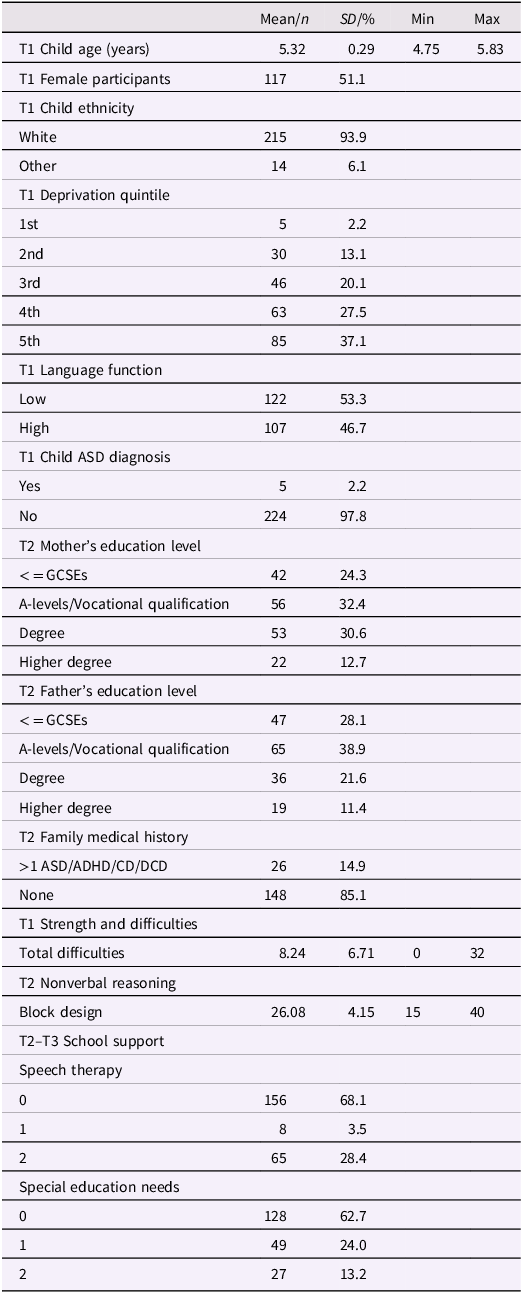
Table 1 summarizes the sample characteristics of the full sample. Briefly, the majority of children were white (93.9%), from the least deprived quintile (37.1%), and with parents attaining A-levels or similar vocational qualifications (mothers: 32.4%; fathers: 38.9%). The mean raw score on the nonverbal reasoning test was 26.08 (SD = 4.15), while the mean total difficulties score on the SDQ was 8.24 (SD = 6.71). In terms of school support, 28.4% and 13.2% children received continuous speech therapy and special education support, respectively, over T2 and T3. The mean total score on the short CCC-2 at T1 was 15.83 (SD = 11.73, range = 0 to 39).
Sample characteristics (N = 229)
Note. ASD = autism spectrum disorder; ADHD = attention-deficit hyperactivity disorder; CD = conduct disorder; DCD = dyspraxia.
T1 group comparisons and prospective relationships with T5 alexithymia
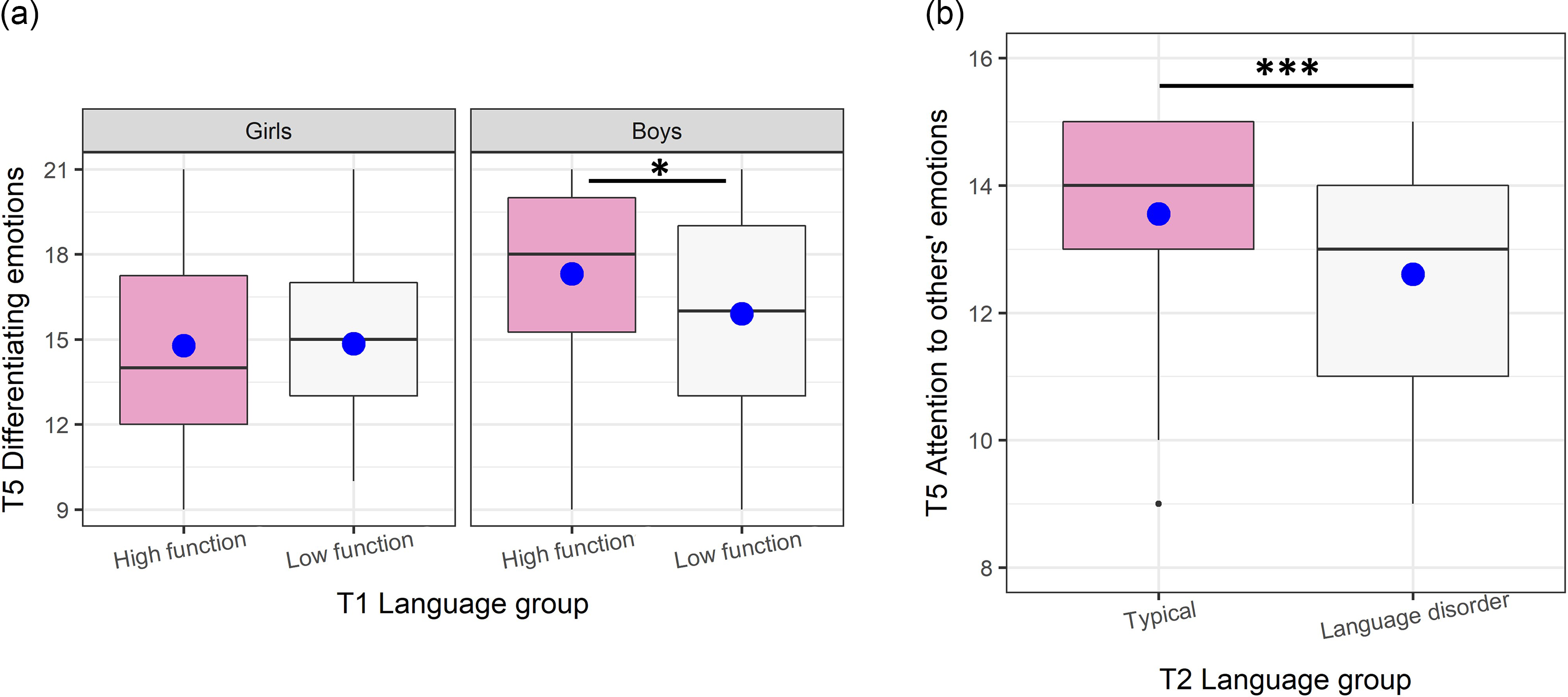
Table 2 summarizes the comparisons of T5 alexithymic traits between girls and boys with high and low language function at T1 (4 to 5 years old). Specifically, boys with low language function reported more difficulties differentiating emotions at T5 (mean = 15.90, SD = 3.55) than boys with high language function (mean = 17.32, SD = 2.93), although this effect was small to medium (W = 1908.5, p = .04, effect size r = 0.20) (Figure 1a). No other significant group differences in T5 alexithymic traits were found for boys (Ws = 1510.5 to 1647.5, ps = .56 to .89) and girls (Ws = 1503.5 to 1971.5, ps = .14 to .69).
Comparison of T5 alexithymic traits between language groups identified at T1 and T2 (N = 229). Notes. (a) Comparison between boys and girls with high and low language function at T1 screening. (b) Comparison between children who met the diagnostic criteria for language disorder and peers with typically developing language skills at T2. Blue dots denote the mean values of groups. *p < .05 ***p < .001 (two-tailed).
Comparison of T5 alexithymic trait domains between language groups identified at T1 (N = 229)
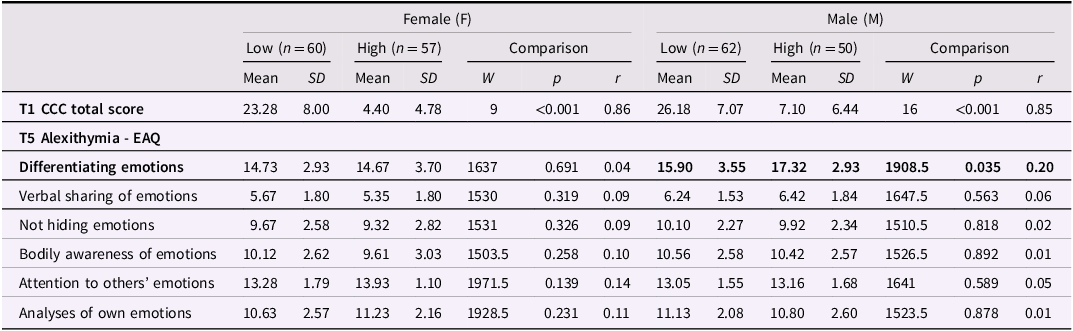
Note. CCC-2 = children’s communication checklist 2; EAQ = emotion awareness questionnaire; High/Low = high/low language functioning.
From a dimensional perspective, more language difficulties at T1 were significantly correlated with paying less attention to others’ emotions at T5 in the full sample, r(227) = −.16, p = .02. This correlation, however, did not survive the robust linear regression when adjusting for nonverbal reasoning and co-occurring socioemotional symptoms (Estimate = −0.09 [−0.31; 0.13], SE = 0.11, t = −0.80, p = .43). No correlations were observed for other EAQ domains, rs = −.03 to .10.
T2 group differences in T5 alexithymia
Table 3 summarizes the comparisons of T5 alexithymic traits between children who fulfilled the diagnostic criteria for language disorder (n = 48) and peers with typically developing language function at T2 (5 to 6 years old). Among the EAQ domains, the language disorder group reported paying significantly less attention to others’ emotions at T5 (mean = 13.55, SD = 1.52) than their peers (mean = 12.60, SD = 1.59), W = 5878, p < .001, effect size r = 0.26 (Figure 1b, page 160). No other group differences were observed, Ws = 4292 to 4902, ps = .17 to .90.
Comparison of T5 alexithymic trait domains between T2 language disorder groups and typically developing group (N = 229)
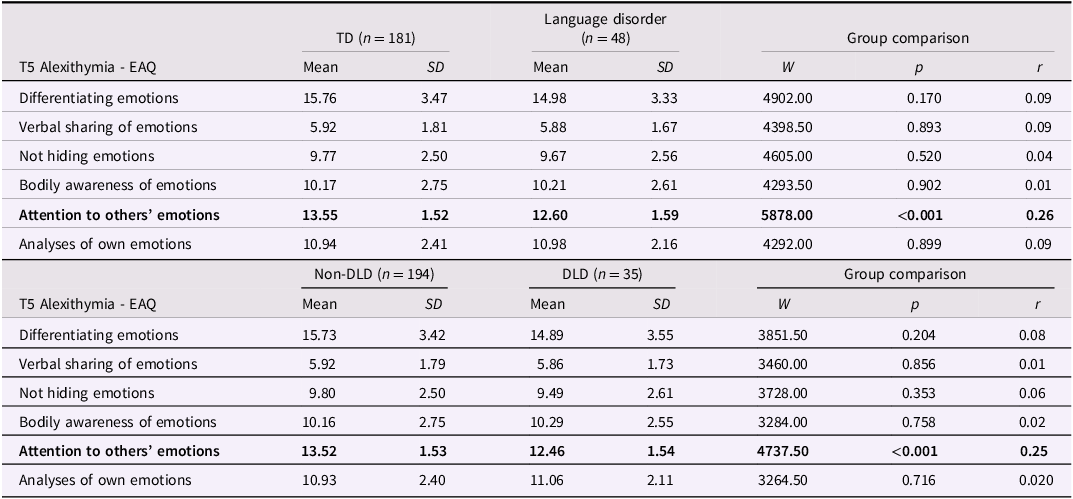
Note. CCC-2 = children’s communication checklist 2; DLD = developmental language Disorder; EAQ = emotion awareness questionnaire; TD = typically developing children.
We then compared differences in T5 alexithymic traits between children who further fulfilled the diagnostic criteria for DLD (n = 35) and peers who did not meet diagnostic criteria (Table 3). Children in the DLD group reported paying slightly less attention to others’ emotions at T5 (mean = 13.52, SD = 1.53) than their peers (mean = 12.46, SD = 1.54), W = 4737.50, p < .001, effect size r = 0.25. No other group differences were found, Ws = 3264.50 to 3851.50, ps = .20 to .86.
T2 latent profiles and prospective relationships with T5 alexithymia
Next, utilizing the selected sample (n = 139), the LPA suggested a three-profile solution based on children’s parent-reported CCC-2 scores on the eight language subscales at T2 (Figure S1). This consisted of children with typically developing language function (n = 90) (CCC-2 mean = 13.83, SD = 9.63), children with moderate language difficulties (n = 37) (CCC-2 mean = 48.02, SD = 12.73), and children with severe language impairments across all language domains (n = 12, 10 of whom were in the low language functioning group at T1) (CCC-2 mean = 83.37, SD = 16.25). Model fit indices and a descriptive summary of the subgroup sample characteristics are presented in Tables S2-3. Sex ratio was relatively balanced within each LPA group, suggesting that sex had a negligible effect on classification. Subsequent group comparisons suggested no significant differences in alexithymic traits between these empirically derived language groups, χ2 = 0.13 to 3.43, ps = .18 to .94 (Table S4).
From a dimensional perspective, Spearman correlations suggested that poorer syntax and speech at T2 were correlated with more difficulties differentiating emotions at T5 (Figure 2a). Poorer syntax was also correlated with less verbal sharing of emotions at T5 (Figure 2b). Using robust linear regressions, poorer syntax at T2 significantly predicted more difficulties differentiating emotions (Estimate = −0.84 [−1.48; -0.20] SE = 0.33, t = −2.56, p = .01, partial r = −.22) and less verbal sharing of emotions at T5 (Estimate = −0.42 [−0.76; −0.07], SE = 0.18, t = −2.36, p = .02, partial r = −.20) when adjusting for nonverbal reasoning and co-occurring socioemotional symptoms and controlling for age differences. The association between T2 speech and T5 differentiating emotions was no longer significant after the adjustments (Estimate = −.042 [−1.10; 0.27], SE = 0.35, t = −1.19, p = .24).
Dimensional relationships between early language function and T5 alexithymic traits. Notes. The dimensional relationship between (a) T2 syntax difficulties and T5 differentiating emotions, (b) T2 syntax difficulties and T5 verbal sharing of emotions.
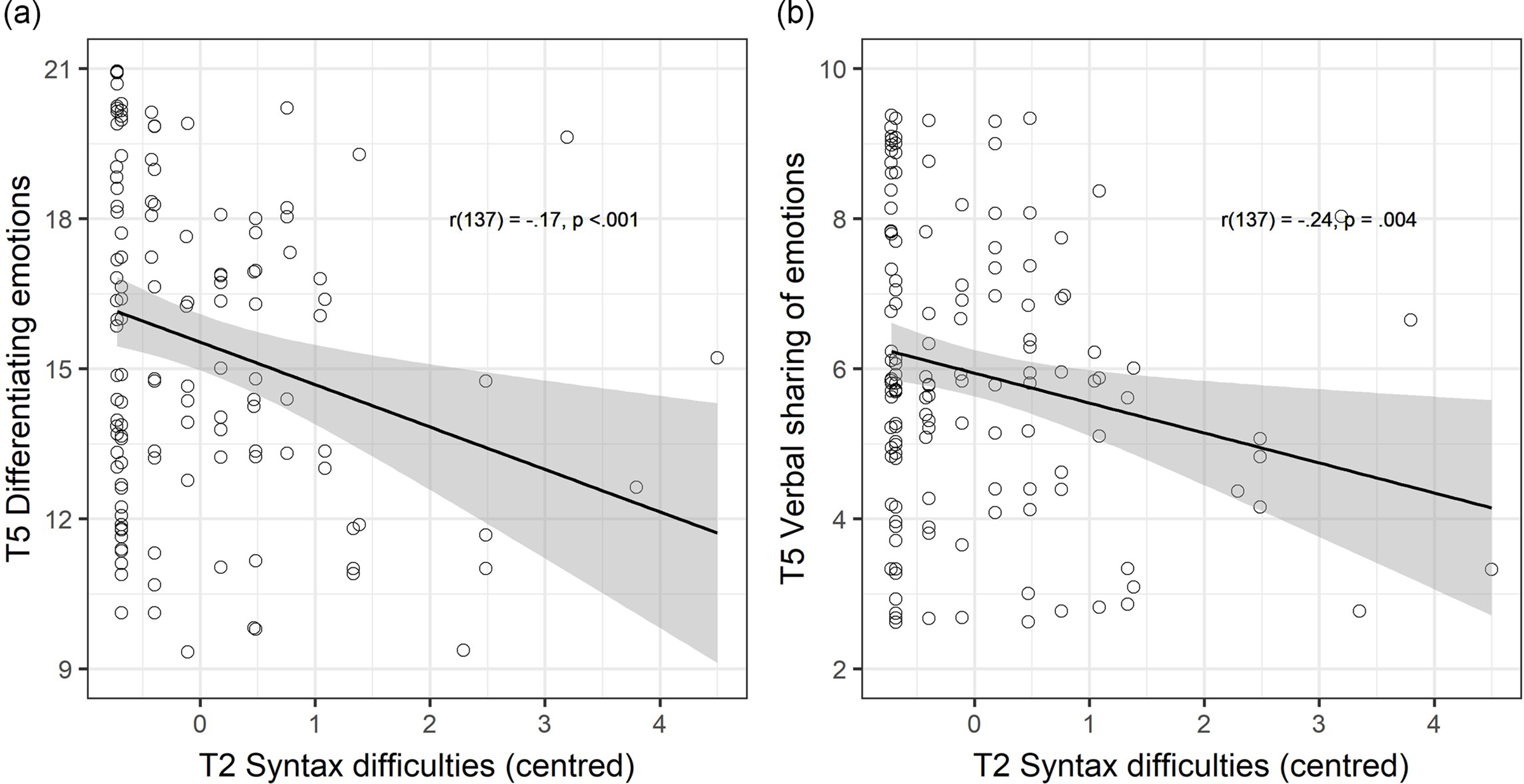
Similar regression analyses were performed with the behavioral language assessment items used for identifying children with language disorder at T2. Prospective relationships were mainly found between receptive and expressive language domains that demand syntax skills and difficulties differentiating emotions at T5 (see Supplementary Materials).
T1 to T3 latent trajectories and prospective relationships with T5 alexithymia
The LCGA suggested a four-trajectory solution using children’s CCC-2 total scores from T1 to T3 (4/5 years old to 7/8 years old), which captured distinct trajectories of global language development from the age of 4 to 8 years old (Figure S2). These included children with minimal language concerns throughout (n = 46), children who showed persistent language impairments (n = 15, 13 of whom were in the low language functioning group at T1), children with steady improvement who attained typical language over the years (n = 60), and children who showed less improvement with moderate language concerns (n = 18). Sex ratio was generally balanced within each trajectory group. Model fit indices and the sample characteristics of these trajectory groups are presented in Tables S5-6. Similar to the LPA results at T2, no significant differences in alexithymic traits were found between these language development trajectories, χ2 = 0.26 to 5.26, ps = .15 to .97 (Table S7).
In the dimensional analyses, lower global language function at T3 was correlated with more difficulties differentiating emotions, r(137) = −.19, p = .03, but this relationship did not survive Bonferroni correction. No other significant correlations were found, rs = −.11 to .02.
Supplementary analyses
To explore potential sex differences in the dimensional relationships between early language function and alexithymia, we repeated the same correlational tests in boys and girls separately. In line with the two longitudinal studies (Karukivi et al., Reference Karukivi, Joukamaa, Hautala, Kaleva, Haapasalo-Pesu, Liuksila and Saarijärvi2012; Kokkonen et al., Reference Kokkonen, Veijola, Karvonen, Läksy, Jokelainen, Järvelin and Joukamaa2003), these associations were found to be stronger in boys than girls (see Supplementary Materials).
Discussion
The present study provides supporting evidence for the language hypothesis of alexithymia, which predicts that children with language difficulties and disorders are at elevated risks of developing alexithymia (Hobson et al., Reference Hobson, Brewer, Catmur and Bird2019). Specifically, we found that boys with lower language function at 4 to 5 years old reported having more difficulties differentiating emotions when they reached 12 to 13 years old, while children who later met the diagnostic criteria for language disorder at 5 to 6 years old reported paying less attention to others’ emotions at ages 12 to 13 years. From a dimensional point of view, childhood language difficulties were prospectively associated with higher alexithymic traits in early adolescence. These associations emerged after 1 year of formal education (5 to 6 years old).
Our group comparisons serve as a primary test of the language hypothesis of alexithymia. Although difficulties differentiating emotions assessed by the EAQ seem to correspond closely to the key alexithymia construct measured by the TAS-20 in adults (Rieffe et al., Reference Rieffe, Oosterveld and Terwogt2006, Reference Rieffe, Terwogt, Petrides, Cowan, Miers and Tolland2007), such a group difference was only found in boys with low language function when comparing to boys with high language function at 4 to 5 years old. Moreover, children who met the diagnostic criteria for language disorder and DLD at 5 to 6 years old reported having a lower tendency to attend to others’ emotions instead at ages 12 to 13 years (e.g., “it is important to know how my friends are feeling”), which is a social motivation construct that correlates with but does not define alexithymia (see reviews by Luminet et al., Reference Luminet, Nielson and Ridout2021; Pisani et al., Reference Pisani, Murphy, Conway, Millgate, Catmur and Bird2021). This highlights two important conceptual issues: (i) children up to the age of 13 years old may not have developed the full adult form of alexithymia, and (ii) it may be more appropriate to conceptualize this reduced tendency to attend to others’ emotions as a developmental correlate suggestive of a high risk of developing alexithymia in later years among these children (e.g., mid-adolescence: Hobson & van den Bedem, Reference Hobson and van den Bedem2021, although see the discussion on informant disagreement below; adulthood: Karukivi et al., Reference Karukivi, Joukamaa, Hautala, Kaleva, Haapasalo-Pesu, Liuksila and Saarijärvi2012; Kokkonen et al., Reference Kokkonen, Veijola, Karvonen, Läksy, Jokelainen, Järvelin and Joukamaa2003).
Relevant to the above conceptualization is the evidence from the same SCALES sample that children with DLD were less accurate in recognizing emotions from facial and vocal cues at ages 10 to 12 years (Griffiths et al., Reference Griffiths, Goh and Norbury2020), another plausible developmental correlate of alexithymia (Trevisan & Birmingham, Reference Trevisan and Birmingham2016). Nevertheless, there is as yet the need to demonstrate if low emotion recognition accuracy is a product of reduced motivation to understand others’ emotions, atypical perceptual processing of emotional cues (e.g., atypical visual attention and reduced eye gaze; Bird et al., Reference Bird, Press and Richardson2011; Cuve et al., Reference Cuve, Castiello, Shiferaw, Ichijo, Catmur and Bird2021), or a combination of both that reflects some global atypicalities in emotional state inference in these children (Pisani et al., Reference Pisani, Murphy, Conway, Millgate, Catmur and Bird2021). From a social perspective, a lower tendency to attend to peers’ emotions may be related to the high rate of social rejection and victimization in children with language disorders (e.g., Rowley et al., Reference Rowley, Chandler, Baird, Simonoff, Pickles, Loucas and Charman2012; van den Bedem et al., Reference van den Bedem, Dockrell, van Alphen, Kalicharan and Rieffe2018), as these negative experiences render the communication of emotional experiences with peers less rewarding, which further compromises the quality and quantity of social learning opportunities (Hobson & van den Bedem, Reference Hobson and van den Bedem2021). However, it must be noted that the effect sizes of these group differences are small to medium, which suggest that language is likely a contributor to, rather than the sole cause of, the development of alexithymia.
We found no evidence that children with language impairments had worse bodily awareness of their own negative emotions than peers with typically developing language. However, a larger sample is needed to conduct further equivalence tests, which is an important next step to confirm if interoception indeed has little direct involvement in the development of alexithymia in these children (Hobson et al., Reference Hobson, Brewer, Catmur and Bird2019). If language-impaired groups are able to perceive internal bodily signals and use them to infer their emotional state, then it is likely that these children struggle to apply discrete and specific linguistic labels to describe and communicate these emotions with others. This has to be tested by allowing participants to apply their own emotion labels to their internal bodily signals as these labels were provided on the EAQ items in the current study (e.g., “When I am scared or nervous, I feel something in my tummy”).
The dimensional analyses reveal that syntax difficulties (indicating structural language problems) are more consistently associated with higher alexithymic traits in early adolescence than domains that concern pragmatics. According to the constructionist theories, syntax abilities, including the use and understanding of grammar and structurally correct sentences, support children’s extraction of emotional information in written texts and conversations, which facilitates the acquisition and understanding of emotion categories (and their associated emotion concepts) over development (Hoemann et al., Reference Hoemann, Xu and Barrett2019; Majid, Reference Majid2012). Indeed, there is preliminary evidence demonstrating that young children (3 to 5 years old) make use of syntactic features (e.g., word forms that denote parts of speech and the number of sentence arguments) to infer the meaning of unfamiliar adjectives that signal the emotional state of a fictional character alongside contextual cues (Shablack et al., Reference Shablack, Becker and Lindquist2020). This supports the idea that not only do syntax abilities facilitate children’s understanding and use of language structures per se, but these abilities also serve as linguistic pointers to emotional information for children, which are crucial in the early years of expanding their repertoire of emotion concepts and vocabulary (Majid, Reference Majid2012). With regard to the constructionist view that emotion concepts are an instance of abstract concepts in general (Hoemann et al., Reference Hoemann, Xu and Barrett2019, Reference Hoemann, Wu, LoBue, Oakes, Xu and Barrett2020), syntax abilities may potentially support the development and/or acquisition of other domains of abstract concepts, such as internal physiological/bodily states (e.g., hunger and pain). Past studies have primarily tested self-reported interceptive abilities, however, making it crucial to conduct objective tests of interoception in language-impaired groups. Some smartphone-based technologies now allow for sending sampling triggers based on multi-modal biological signals (e.g., electrocardiography and impedance cardiography), which would help capture meaningful changes in emotional experiences alongside real-time interoceptive signals outside the laboratory (Hoemann et al., Reference Hoemann, Wormwood, Barrett and Quigley2023).
Speech coherence and semantics did not reveal any significant relationships with alexithymia. This is perhaps surprising as it is intuitive to hypothesize that a child who struggles to communicate in an orderly and coherent manner would experience difficulty communicating their own feelings, a process that requires a reasonable level of speech coherence to articulate complex emotional experiences. One explanation might be that the CCC coherence items primarily focus on the child’s general ability to explain and give information about an event, which does not specifically require the use of abstract emotion concepts and related situational information. For semantics, mixed results were found when further analyzing behavioral assessments that specifically tested lexical access, suggesting that the null results of parent reports may be due to variance introduced by a wider range of semantic skills on the CCC and that children may also display different language abilities when observed in research settings and with caregivers (Kang et al., Reference Kang, Lerner and Gadow2023; Lindsay et al., Reference Lindsay, Dockrell, Desforges, Law and Peacey2010). Future studies may wish to focus specifically on the particular aspects of speech coherence and semantic skills that are directly related to emotional self-awareness and consider the contexts in which these language behaviors are assessed.
The above findings seem to contrast with the cross-sectional study that only found an association between parent reports of pragmatic difficulties and alexithymia in children with DLD (Hobson & van den Bedem, Reference Hobson and van den Bedem2021). Here, the only significant pragmatic difficulty was that boys with more inappropriate initiations at 5 to 6 years old were less able to differentiate emotions at 12 to 13 years old than boys with fewer inappropriate initiations. However, a direct comparison between the Hobson and van den Bedem (Reference Hobson and van den Bedem2021) data and the current data is not possible as the structural language ratings in Hobson and van den Bedem (Reference Hobson and van den Bedem2021)’s typically developing participants were not analyzed due to low reliability. Importantly, the Hobson and van den Bedem (Reference Hobson and van den Bedem2021) study sample was from an older age range (9 to 16 years old), which may in fact allude to potential differences in the language–alexithymia relationship in mid-/later adolescence when emotional awareness undergoes rapid development and is closely linked to psychopathology (Weissman et al., Reference Weissman, Nook, Dews, Miller, Lambert, Sasse, Somerville and McLaughlin2020). In contrast, the present results are drawn from a longitudinal cohort of children (from 4–5 to 12–13 years old) and backed by convergent relationships between behavioral language assessments that demand similar syntax abilities (such as grammar and reproducing structurally correct sentences) and difficulties differentiating emotions. The current findings are therefore robust to assessment methods.
The language–alexithymia associations observed were more pronounced in boys than girls, a finding that is consistent with the two longitudinal studies (Karukivi et al., Reference Karukivi, Joukamaa, Hautala, Kaleva, Haapasalo-Pesu, Liuksila and Saarijärvi2012; Kokkonen et al., Reference Kokkonen, Veijola, Karvonen, Läksy, Jokelainen, Järvelin and Joukamaa2003), although are based on a relatively small sample size for validating sex differences. Further inspection of the sex-specific associations (which mostly involve the differentiating emotions domain) suggests that despite having reported a comparable range of scores, there were in fact more boys than girls who reported being very able to differentiate emotions at 12 to 13 years old, suggesting the need for more variance in girls to test these small associations. In terms of emotion development more broadly, sex and gender differences in emotion expression are context-dependent and closely related to the sex and gender norms of emotional display rules in a given culture (see a meta-analytic review by Chaplin & Aldao, Reference Chaplin and Aldao2013). Hypothetically, if boys were more discouraged to express fear than girls in a certain culture, it would be reasonable to suggest that boys with language impairments would be disproportionately disadvantaged to develop the skills needed to identify and communicate their emotional distress with others, leading to low emotional self-awareness in later years. Preliminary support for this prediction was demonstrated by one study in both British and Spanish samples that 8 to 10-year-old boys had a lower tendency than girls to choose adaptive communicative strategies to help regulate fear expressed by a game character (López-Pérez & Pacella, Reference López-Pérez and Pacella2021). A longitudinal assessment of this gender effect in problems identifying and describing fear in boys would provide information on the potential contribution of Western gender norms to our UK findings.
Limitations
While the present study is one of the few that investigates the prospective relationship between early language function and alexithymia, it is not without limitations. First, only a subset of children provided sufficient CCC data at T2 and T3, and this subset also happened to have lower levels of language difficulties and socioemotional symptoms as compared to peers with insufficient data. This results in a potential loss of language variance for testing the dimensional relationship with alexithymia and partly contributing to the unequal and small subgroups extracted by the latent profile analyses. Second, alexithymia was measured with child self-reports only, which precluded us from assessing any discrepancy in results when analyzing parent-reports (e.g., Griffin et al., Reference Griffin, Lombardo and Auyeung2016). Indeed, Hobson and van den Bedem (Reference Hobson and van den Bedem2021)’s cross-sectional study reported no significant group differences when analyzing child self-reported alexithymic traits, but the reasons contributing to the lack of agreement with their parent-reported results are unclear. From a measurement perspective, parent-reports are primarily based on observable child behaviors, while child self-reports may provide a more reliable and nuanced assessment of one’s own emotional traits as children get older and develop better emotional abilities (Lumley et al., Reference Lumley, Neely and Burger2007). Relatedly, there remains the question of whether children struggle to report their own alexithymic traits was due to their inherent language deficits and/or alexithymia itself (Gaigg et al., Reference Gaigg, Cornell and Bird2018; Hobson et al., Reference Hobson, Brewer, Catmur and Bird2019). Third, the long CCC was not administered at all time points and nor was the EAQ which was analyzed as a distal outcome at T5. Future cross-panel studies are an important next step to investigate if between- and within-person level changes in language function exert bidirectional influences on alexithymic traits over time. Finally, the current sample comprises language profiles and trajectories that are relatively homogenous. A study design that specifically captures more diverse types of language abilities in larger samples (e.g., high structural language abilities but low social language skills) may allow for disentangling the contribution of specific language domains to alexithymia using latent profile techniques. An example would be the use of administrative data that allow linkages to participants’ school and/or medical records that document any relevant diagnoses of language disorders and language-related outcomes. As compared to data sets curated by smaller independent laboratories, these large data sources provide a better buffer to high attrition rates in clinical samples and reduce sample selection bias based on researcher-imposed criteria.
Clinical implications
Given the novelty of our findings, it is too early to conclude that language interventions, such as speech therapy, would significantly reduce the risk of developing alexithymia in children with language impairments and disorders. We provide three recommendations for clinical considerations: (i) children with language impairments and disorders are at risks of developing alexithymia. These developmental correlates are specific to certain alexithymic trait domains (here, difficulty differentiating emotions and paying less attention to others’ emotions) but not a global alexithymia construct as defined in adult research; (ii) syntax difficulties may play a particularly important role in the development of alexithymia. Interventions focusing on improving the understanding and use of syntactic features may help children identify and extract emotional information from language, fostering emotion understanding over development; (iii) clinicians should be mindful of the potential influences of multi-informant assessments (parent-report vs. child-report) and assessment modality (self-report vs. clinic-based behavioral assessments) on clinical decision-making.
Conclusion
In sum, the present study finds supporting longitudinal evidence for the language hypothesis of alexithymia whereby children with language impairments and language disorders are at increased risk of developing alexithymia. Early language function, lower syntax abilities in particular, is prospectively associated with alexithymic traits in early adolescence. To better identify treatment opportunities, greater specificity regarding which alexithymic trait domains these language group differences are present in, and exploration of the potential sources of informant and assessment method discrepancies is warranted.
Supplementary material
The supplementary material for this article can be found at https://doi.org/10.1017/S0954579424001007
Acknowledgements
We thank Dr Sarah Griffiths at University College London and members of the SCALES team for kindly sharing the data.
Funding statement
KSL was supported by a doctoral student scholarship awarded by the Hong Kong Jockey Club Charities Trust and University of Oxford. GB was supported by the Baily Thomas Trust. These funding sources had no involvement in the conduct of the research and/or preparation of the article.
Competing interests
None.


 Open access

