


Introduction
Once distributed throughout South-east Asia to the foothills of the Himalayas (Corbett & Hill, Reference Corbett and Hill1992), the Sumatran rhinoceros Dicerorhinus sumatrensis is now confined to isolated parts of Indonesia and Malaysia: D. sumatrensis sumatrensis is confined to Sumatra and Peninsular Malaysia and D. sumatrensis harrissoni is endemic to Borneo. In 1995 the estimate of the total number of D. sumatrensis in these range states was c. 320 (Table 1). There may be < 250 mature individuals globally and the species is categorized as Critically Endangered on the IUCN Red List (IUCN, 2010). However, researchers and NGOs involved in monitoring and protection indicate there may only be c. 216 wild individuals remaining (Table 1). Even this estimate is contentious given the species’ patchy distribution and secretive nature (Payne, Reference Payne1990) coupled with the lack of reliable and comparable field data.
Summary information for Sumatran rhinoceros Dicerorhinus sumatrensis populations from government agencies, researchers and NGOs in Sumatra, Peninsular Malaysia and Sabah.

1 Occupancy refers to the proportion of an area that is occupied by D. sumatrensis
2 Extremely low track encounter rates do not appear concordant with latest population estimates
Sixteen years ago Rabinowitz (1994) claimed that much of the resources for the conservation of D. sumatrensis went into politically favourable initiatives that did not mitigate the real threats responsible for the species’ decline: habitat loss and poaching. It is disconcerting that even after Rabinowitz (1994) chastised the international conservation community for not doing enough to address the species’ plight, its population remains perilously low 16 years on. Here, we review the conservation status of D. sumatrensis across its range states and the threats facing the species. We call on conservation NGOs and governments of range states to focus on two core strategies, for which we provide estimates of the annual implementation cost. This turns out to be a relatively small price to pay for saving a Critically Endangered species.
Conservation status
Sumatra
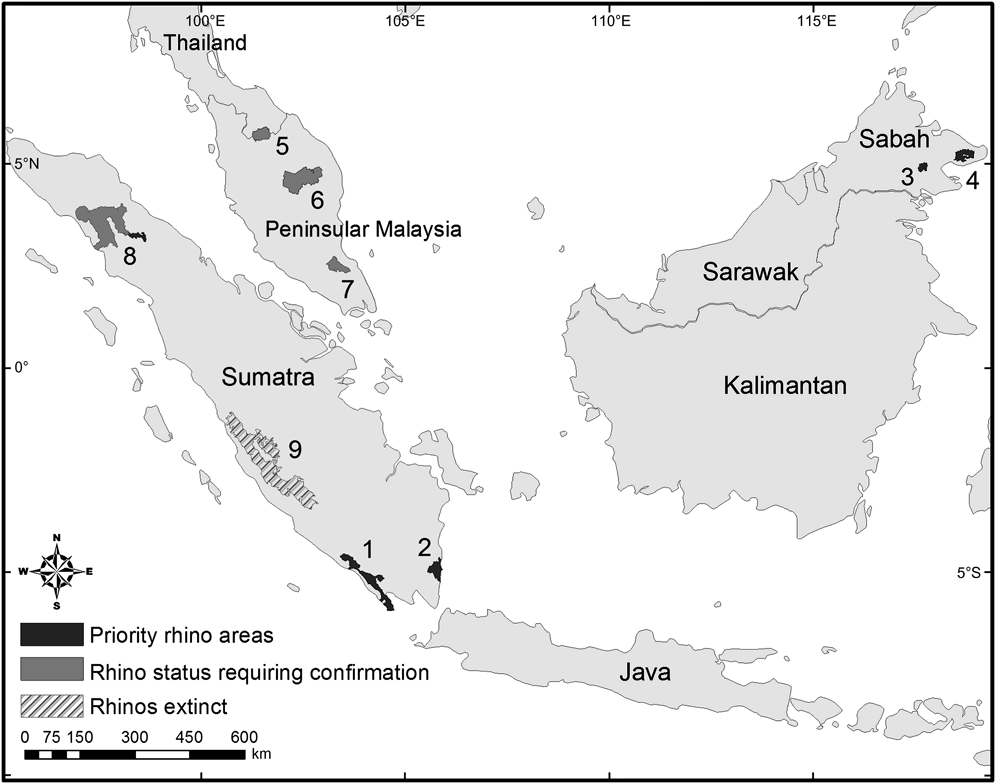
D. sumatrensis formerly occurred in all eight provinces of the Indonesian island of Sumatra (van Strien, Reference van Strien1974) but now remains in only three (Aceh, Lampung and South Sumatra). Eight populations have been extirpated over the last 15 years including that in Kerinci Seblat National Park (Uryu et al., Reference Uryu, Purastuti, Laumonier, Setiabudi and Stuwe2010; Fig. 1), which once comprised 28 individuals (Foose & van Strien, Reference Foose and van Strien1997). According to the Ministry of Forestry (MOF, 2007) current island-wide population estimates are 145–200 and the species mainly persists in three protected areas: Gunung Leuser, Bukit Barisan Selatan and Way Kambas National Parks (Fig. 1, Table 1). However, reports suggest that the Gunung Leuser population, which was the best studied in Sumatra (van Strien, Reference van Strien1985), could now be much lower, although there is little information on its status (W.S. Ramono, pers. obs.). The species persists in Bukit Barisan Selatan and Way Kambas National Parks, with reasonably high track encounter rates and photo-captures. Kinnaird et al. (Reference Kinnaird, Sanderson, O’Brien, Wibisono and Woolmer2003) obtained 10 photo-captures of D. sumatrensis from 4,967 trap days in 140 km2 in Bukit Barisan Selatan National Park even though their surveys were not targeting the species. Despite habitat loss from fires and expanding coffee plantations in and around this Park (Kinnaird et al., Reference Kinnaird, Sanderson, O’Brien, Wibisono and Woolmer2003), monitoring and enforcement efforts by government-backed Rhino Protection Units have helped maintain what is one of Sumatra’s largest populations of D. sumatrensis. In Way Kambas, where a relatively smaller population is being protected, a semi-in situ breeding centre for D. sumatrensis was established in 1998 as a last-ditch attempt to save the Indonesian population from extinction.
Priority Sumatran rhinoceros Dicerorhinus sumatrensis areas: 1, Bukit Barisan Selatan National Park; 2, Way Kambas National Park; 3, Danum Valley Conservation Area; 4, Tabin Wildlife Reserve. Areas identified by the IUCN Asian Rhino Specialist Group (AsRSG) as requiring scientifically defensible population estimates to confirm conservation status: 5, Royal Belum State Park; 6, Taman Negara National Park; 7, Endau Rompin National Park; 8, Gunung Leuser National Park. Area identified by the AsRSG where D. sumatrensis has been extirpated: 9, Kerinci Seblat National Park.
Peninsular Malaysia
The Malay Peninsula probably provides the last hope for D. sumatrensis on mainland South-east Asia in terms of habitat availability, yet the species’ viability and conservation status remains uncertain because of extremely low densities and a paucity of reliable population estimates (Clements et al., Reference Clements, Darmaraj, Ahmad Zafir, Venkataraman, Alfred and Payne2010). Low numbers and declining population trends have been reported since the 1930s (Hubback, Reference Hubback1939) and, up to 1994, estimates of the population have varied between 10 and 130 (Metcalfe, Reference Metcalfe, Wyatt-Smith and Whycherlry1961; Stevens, Reference Stevens1968; Mohd. Khan et al., Reference Mohd. Khan, Elagupillay, Zolkifli, Mittermeier and Konstant1982; Mohd. Khan, Reference Mohd. Khan1987, Reference Mohd. Khan1989). Subsequently, Zainal Zahari (Reference Zainal Zahari1995) reported a drastic decline from 77–130 individuals in 1993 to c. 28–30. Since then population estimates from the Department of Wildlife and National Parks (DWNP) have continued to fluctuate, with the latest published figure being 69–94 (Table 1). However, the survey techniques used to derive these estimates are unknown and since 1994 no further individuals have been physically captured and no sightings have been documented (Tan, Reference Tan2003).
We focus our summary on three of Peninsula Malaysia’s largest protected areas, which are considered priority areas for conservation of D. sumatrensis (Foose & van Strien, Reference Foose and van Strien1997): Taman Negara, Endau Rompin National Park and Royal Belum State Park (Fig. 1, Table 1). Taman Negara, which is the country’s largest protected area, was regarded as one of Malaysia’s strongholds for D. sumatrensis (Flynn & Abdullah, Reference Flynn and Abdullah1984). Surveys by Kawanishi & Sunquist (Reference Kawanishi and Sunquist2004), which were the most scientifically robust large mammal surveys in this Park so far, covered c. 15% (600 km2) of the Park and yielded 4,533 wildlife photos from 14,054 trap nights across forests overlapping the species’ known altitudinal range. However, there were no photo-captures of D. sumatrensis. Track encounter rates were also relatively low (Table 1) compared to six other large ungulate species recorded in the same study. Although not targeting D. sumatrensis specifically, these surveys suggest an extremely small population in Taman Negara (Kawanishi et al., Reference Kawanishi, Sunquist and Abdul Malik2003) inconsistent with it purportedly having the largest D. sumatrensis population in Peninsular Malaysia (Foose & van Strien, Reference Foose and van Strien1997). In Endau Rompin National Park 20–25 individuals were estimated to be present in the 1980s (Flynn & Abdullah, Reference Flynn and Abdullah1984) but surveys in the 1990s failed to detect fresh tracks and found numerous signs of poaching (M.T. Abdullah, pers. comm.). Since 2008 tiger prey occupancy surveys conducted by the Wildlife Conservation Society (Malaysia) in this Park have yet to detect signs of D. sumatrensis along transects totalling more than 2,500 km (M. Gumal, pers. comm.).
Royal Belum State Park, which was identified as another protected area with viable populations (IUCN, 1997), has yielded similar results. Since February 2007 extensive surveys have been conducted in suitable habitats (e.g. major rivers, valleys, salt licks, old wallows and ridges) and localities where indigenous people claimed to have seen D. sumatrensis recently but only one possible footprint has been detected. To date, camera-trapping surveys have not photo-captured D. sumatrensis despite yielding 2,124 wildlife photos over 844 trap nights and track encounter rates are extremely low (Table 1). In interviews with 297 people frequently entering forests (indigenous communities, hunters, loggers and villagers extracting forest products) only 2% of interviewees claimed to have seen D. sumatrensis within the last 5 years. In addition, no active rhinoceros wallows have been recorded in the Park since intensive surveys began in 2007.
Sabah
When the distribution of D. sumatrensis in Sabah was reviewed in the 1990s (Payne, Reference Payne1990; Boonratana, Reference Boonratana1997; Foose & van Strien, Reference Foose and van Strien1997) the population was estimated to be c. 40–70 (Table 1). Danum Valley Conservation Area (438 km2) and Tabin Wildlife Reserve (1,225 km2) now support the State’s largest D. sumatrensis populations (Fig. 1, Table 1). Track encounter rates in monitoring surveys in Danum have been comparable to those of protected areas in Sumatra with sizeable D. sumatrensis populations (Table 1). In Tabin surveys over the past 3 decades involved simultaneous sweeps to estimate the size of the population (which is similar to Danum’s) but systematic surveys have been difficult to implement because of the rugged terrain, frequent heavy rain and insufficient field capacity (J. Payne, pers. obs.). Apart from these strongholds, other sites across Sabah (whose localities remain undisclosed for security reasons) still support isolated individuals. One of these isolated individuals was spotted in an oil palm plantation adjacent to a forest patch and was subsequently rescued and translocated to Tabin (NST, 2008). Although populations in Sabah have not shown any signs of increase (c. 37 individuals; Table 1), evidence of breeding in the form of fresh footprints of immature individuals was recorded in both Danum and Tabin in 2006.
Threats and challenges
Prior to 1950 numbers of D. sumatrensis were probably already low as there were major gaps in the species’ distribution in apparently suitable habitats (Hubback, Reference Hubback1939). The species is now probably confined to protected lowland forests or high-altitude forests that are largely inaccessible to conversion. Therefore, habitat loss, especially in the lowlands, is no longer the most significant threat to the conservation of the species in Sumatra (Uryu et al., Reference Uryu, Purastuti, Laumonier, Setiabudi and Stuwe2010) and Malaysia.
The small population size is now the most significant threat to the species. Various factors associated with very low numbers (e.g. narrow genetic base, difficulty in finding a fertile mate) are likely to drive populations to the point where death rates will exceed birth rates even with suitable habitat and zero offtake (Courchamp et al., Reference Courchamp, Berec and Gascoigne2008). Rhinoceroses have a long inter-birth interval and small increases in juvenile mortality can suppress recruitment rates below levels needed to replace breeding adults (Johnson, Reference Johnson2006; Cranbrook, Reference Cranbrook2009). The only information on the inter-birth interval of D. sumatrensis comes from Cincinnati Zoo where calves have been born at 34-month intervals (Foose, Reference Foose2006; T. Roth, pers. comm.). In the wild birth intervals are likely to have grown further apart, especially as the probability of males meeting receptive females decreased. If Danum and Tabin protected areas are each assumed to contain 15 individuals, that c. 50% are females, and that some of these are too old or too young to reproduce, only three or four individuals are likely to be reproductively active in each site. With a birth interval of 3 years under optimum wild conditions, a maximum of only one D. sumatrensis will be born into each population annually. Furthermore, at least half of all the females caught between 1984 and 1995 in Sumatra, Peninsular Malaysia and Sabah had reproductive tract pathology (Schaffer et al., Reference Schaffer, Agil, Bosi, Schwammer, Foose, Fouraker and Olson2001), a phenomenon associated with no pregnancies, which reflects a lack of breeding opportunities. Another consequence of low population sizes is an increased likelihood of skewed sex ratios, a phenomenon revealed during trapping operations in the 1980s and 1990s. Of 10 D. sumatrensis captured in Sabah between March 1987 and November 1995 eight were mature males; because females are potentially easier to locate than males because of their smaller home ranges, the females may have been selectively taken by poachers.
Poaching is the second significant risk to the survival of D. sumatrensis, although it was the primary threat in the early 20th century (Hubback, Reference Hubback1939; Medway, Reference Medway1977). Rabinowitz (1994) similarly identified poaching (for horns, hooves and other body parts for traditional Chinese medicine) and habitat loss as the two main drivers of the species’ decline. In Sumatra the government reported that poaching was brought under control after 1997 (MOF, 2007). In Bukit Barisan Selatan and Way Kambas National Parks, however, anti-poaching data revealed that D. sumatrensis was still being targeted during 2002–2009 (Table 2). Eight populations went extinct during 1997–2007 (Uryu et al., Reference Uryu, Purastuti, Laumonier, Setiabudi and Stuwe2010). In Peninsular Malaysia, DWNP (2006) estimated that c. 30 individuals were poached during 1975–2005; horns from at least eight individuals and a piece of skin were discovered in pharmacies in the states of Penang and Johor, respectively (DWNP, 2005). The world’s largest wildlife trader was still trading horns of D. sumatrensis after 1995 (Christy, Reference Christy2010). Interviews with hunters during 2007–2008 in Peninsular Malaysia indicated that there was still a demand for rhinoceros horns (TRAFFIC, unpubl. data), which can fetch up to USD 45,000 kg-1. Dinerstein (Reference Dinerstein2003) reported that Asian rhinoceros horn could be sold for USD 30,000 kg-1, triple the mean price for that of the African rhinoceros Diceros bicornis (USD 10,000 kg-1).
Anti-poaching statistics from the Rhino Protection Unit in Bukit Barisan Selatan (BBS) and Way Kambas (WK) National Parks, Sumatra, Indonesia, for 2002–2009.
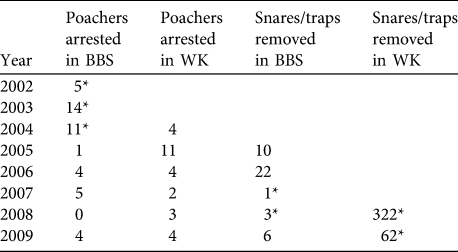
* Indicates some targeted rhinoceroses (source: Yayasan Badak Indonesia, unpubl. data)
Two core conservation strategies
Maguire et al. (Reference Maguire, Seal, Brussard and Soule1987) suggested several measures to save D. sumatrensis from extinction (anti-poaching efforts, fencing, translocation and captive breeding). These mitigation measures have been implemented with varying degrees of success and failure over the last 16 years in Indonesia, Malaysia and the USA. We believe only two of these measures are relevant to ensure the survival of the species.
Translocate isolated individuals into semi–in situ captive breeding programmes
Mohd. Khan (Reference Mohd. Khan1989) suggested that c. 50 individuals could sustain 5–10 generations of the the Sumatran rhinoceros, whereas a recent meta-analysis showed that any mammal species generally requires a minimum of 3,876 individuals to maintain population viability (Traill et al., Reference Traill, Bradshaw and Brook2007). Current Sumatran rhinoceros populations number less than these thresholds and in some areas only isolated individuals remain. While in situ captive breeding programmes could theoretically help augment wild populations via reintroductions, Rabinowitz (1994) was critical of the magnitude of resources invested in these programmes and labelled them expensive failures; 42 D. sumatrensis were caught for this purpose and 34 died during 1984–2006 (Foose, Reference Foose2006). Captive breeding programmes have suffered significantly more setbacks than successes but we argue that some form of captive breeding is still necessary. Without specific actions to bring Sumatran rhinoceroses together to boost production it is likely that the species will go extinct even if protection of suitable habitat increases. Only 10 individuals remain in captivity (AP, 2009) and successful births have only occurred in the Cincinnati Zoo. A female named Emi produced three calves at the zoo, the youngest of which was the first Sumatran rhinoceros bred and born in captivity since 1889. However, Emi died in 2009 at c. 21 years; her eggs were rescued for possible in-vitro fertilization (AP, 2009).
Captive D. sumatrensis held in their range states require forest habitats and natural conditions to improve chances of breeding, and carefully managed captive breeding centres in native habitats (semi-in situ captive breeding) were deemed necessary almost a decade ago (van Strien, Reference van Strien, Schwammer, Foose, Fouraker and Olson2001). We still concur with van Strien’s recommendation despite the absence of reproductive success so far. Three breeding facilities were created to receive translocated D. sumatrensis: Way Kambas (Sumatra), Sungai Dusun (Peninsular Malaysia) and Sepilok (Sabah) but all three failed to breed the species. The latter two facilities no longer hold any living D. sumatrensis (Tan, Reference Tan2003); an old female from Sepilok which was recently transferred to Tabin. The semi-in situ Sumatran Rhino Sanctuary in Way Kambas, however, is the most promising model for captive management. This sanctuary currently supports five D. sumatrensis and only one death, of an unproductive old female, has occurred. Constructed within the 1,250 km2 Way Kambas National Park in 1997 this sanctuary comprises 100 ha of forest habitat surrounded by an electrified fence. Circa 20 ha of forest habitat is provided for each individual (monitored continuously during daylight hours and breeding periods) and the design of the paddocks allows mixing and separation when necessary (Agil et al., Reference Agil, Riyanto, Sumampau, Hodges, van Strien, Schwammer, Foose, Fouraker and Olson2002). D. sumatrensis were repatriated to this facility from zoos in January 1998 and they have adapted well (Anon., 2000). In 2007 the Sumatran Rhino Sanctuary received Andalas (the calf borne from Emi) to be paired with the resident females, two of which are young mature individuals brought to the Sanctuary after 2000. Andalas recently impregnated another female, Ratu, in the sanctuary (Hance, Reference Hance2010a). This success is attributable not only to the natural settings of the sanctuary but also to the use of monitoring techniques (e.g. hormonal assays and ultrasound techniques) initially introduced from Cincinnati Zoo to determine the optimal time for introducing males and females (IRF, 2010). Although Ratu lost her pregnancy a few months later, there is optimism for a successful birth as it was her first pregnancy; Emi had five failed pregnancies before she gave birth to Andalas (Hance, Reference Hance2010b). Annual operating costs for the Sumatran Rhino Sanctuary are at least USD 184,724 (YABI, 2009).
Based on this model the Sabah government launched a rescue programme for D. sumatrensis in 2009 that endorses the establishment of a semi-in situ captive breeding facility within Tabin similar to the Way Kambas model of individual small paddocks within a large fenced forest area. This facility, the Borneo Rhino Sanctuary (Cheang, Reference Cheang2009), will function as a breeding area for reproductively isolated D. sumatrensis translocated from other sites. Borneo Rhino Alliance (BORA, 2010), a non-profit company, will continue the role of the now defunct SOS-Rhino Borneo to assist the Sabah government in the development and management of this sanctuary. The annual operating costs of this sanctuary, once fully established, could be at least USD 334,000, excluding costs of capture and translocation.
Secure priority areas with enhanced monitoring capacities
Rabinowitz (1994) lambasted the international conservation community for not providing enough resources to protect rhinoceroses in the wild. Anti-poaching patrols, which increase the chances of poachers being caught, are the greatest disincentive to hunting of D. bicornis in Africa (Milner-Gulland & Leader-Williams, Reference Milner-Gulland and Leader-Williams1992), the full protection of which required one guard per 20 km2 of protected area. In April 1995 an anti-poaching initiative known as Conservation Strategy for Rhinos in South-east Asia (Indonesia and Malaysia) was organized. It received funding from the Global Environment Facility through the UN Development Programme. The Asian Rhino Specialist Group and International Rhino Foundation, which operated as the financial and administrative agent, jointly coordinated and facilitated this initiative (van Strien, Reference van Strien, Schwammer, Foose, Fouraker and Olson2001). The main objective was to establish units to protect and monitor D. sumatrensis populations, destroy snares and traps and arrest poachers in core D. sumatrensis areas (van Strien, Reference van Strien, Schwammer, Foose, Fouraker and Olson2001). In Peninsular Malaysia protection units have been in operation in key D. sumatrensis habitats since 1995 (Abdul Kadir, Reference Abdul Kadir, Talukdar, Crosbie, Ellis, Ramono, Williams and Sectionov2009). In Sumatra, eight and five protection units operate in Bukit Barisan Selatan and Way Kambas, respectively (Isnan et al., Reference Isnan, Subrata and van Strien2006).
Key features that set D. sumatrensis protection units in Indonesia apart from those in other regions include an intelligence and law enforcement unit to gather information on poacher identities, and that rangers from the Ministry of Forestry are seconded to the units to facilitate the arrest of suspected poachers. While the persistence of D. sumatrensis in Bukit Barisan Selatan and Way Kambas has been credited to intensive anti-poaching work by the protection units (MOF, 2007), their effectiveness has been difficult to evaluate. For example, the protection units in both areas reported an absence of poachers targeting D. sumatrensis since 2004 (Table 2) but this could be part of a trend associated with decreasing numbers of D. sumatrensis. Protection units were unable to prevent the extirpation of D. sumatrensis from Kerinci Seblat (Table 1). Additional data (e.g. number of snares removed each year in relation to law enforcement effort and occupancy estimates of D. sumatrensis, number of poaching cases detected by patrol- and intelligence-based efforts) need to be obtained to evaluate the effectiveness of enforcement interventions (Linkie et al. Reference Linkie, Rood and Smith2010). Nevertheless, more resources must be provided to improve existing law enforcement coverage and monitoring capacities if we want to determine the conservation status of D. sumatrensis in priority areas (Fig. 1). In Sumatra annual support for protection units and intelligence and law enforcement units operating in Bukit Barisan Selatan and Way Kambas (i.e. operational costs excluding technical, administrative and communication support; YABI, 2009) amounts to at least USD 397,423.
In Peninsular Malaysia protection units initiated by the federal government have focused their daily patrols in D. sumatrensis habitat within Taman Negara and have arrested 72 encroachers up to 2009 (Abdul Kadir, Reference Abdul Kadir, Talukdar, Crosbie, Ellis, Ramono, Williams and Sectionov2009). To our knowledge, however, only one person has ever been prosecuted for rhinoceros poaching in Peninsular Malaysia, in 1985 (Abdullah et al., Reference Abdullah, Zainuddin and Suri1989). However, the Malaysian government recently passed a new wildlife conservation law to be enforced in December 2010 (Kuppusamy, Reference Kuppusamy2010); at least 13 new provisions are being suggested, including a significant enhancement of penalties for wildlife crimes involving protected species such as D. sumatrensis (e.g. fines of USD 30,000–150,000 coupled with mandatory prison sentences of up to 5 years). To complement the government’s enforcement work NGOs initiated anti-poaching units that patrol together with government agencies in D. sumatrensis habitat within Peninsular Malaysia and Sabah. In the former, WWF–Malaysia formed a wildlife protection unit to patrol in and around Royal Belum, a priority area identified by the Asian Rhino Specialist Group (Foose & van Strien, Reference Foose and van Strien1997). In conjunction with government enforcement authorities the wildlife protection unit has removed 141 snares and apprehended 11 poachers since January 2009 (WWF–Malaysia, unpubl. data). However, no evidence of D. sumatrensis or poaching of the species was recorded by active patrols and intelligence networks during that period.
In Sabah both WWF–Malaysia and Borneo Rhino Alliance operate protection units for the populations in Danum, Tabin and other areas in the lower Segama-Kinabatangan landscape. The Sabah State government granted the status of honorary wardens to some members of these protection units, who have powers of investigation and arrest. Given these enabling conditions, more resources need to be allocated to protect the two priority areas in Sabah by augmenting existing law enforcement coverage and the capacity to monitor effectiveness. Currently in Sabah annual financial support for protection units amounts to a total of USD 332,221: USD 111,221 at Danum (according to WWF–Malaysia) and USD 216,000 at Tabin (according to Borneo Rhino Alliance), with protection unit staff also involved in care of captive D. sumatrensis and rescue work.
Conclusions
Some of Rabinowitz’s (1994) warnings were heeded: protection of wild D. sumatrensis in some areas did increase and the removal of wild individuals into ex situ captive conditions soon ceased. Yet, since 1995, the population of D. sumatrensis appears to have declined by c. 32% to a lower bound estimate of c. 216 wild individuals. The prognosis for the survival of the species is not good and the situation will worsen unless there is more political support, better enforcement of wildlife laws, improved cooperation among stakeholders, and funds available to implement the two best available conservation strategies: (1) translocation of isolated wild D. sumatrensis into existing semi-in situ captive breeding programmes, to maximize reproductive success, and (2) securing priority areas (Bukit Barisan Selatan, Way Kambas, Danum and Tabin) with improved law enforcement coverage and monitoring capacities.
If decision makers in Indonesian and Malaysian governments do not commit to this approach we may never have another chance to reverse the decline of this species. Given that the remaining wild D. sumatrensis populations have not shown signs of recovery under the current funding scenario, potential donors could help strengthen the capacities of conservation agencies in the four priority areas, as well as support efforts to obtain scientifically defensible population estimates for other areas (e.g. Gunung Leuser and Taman Negara). The annual amount that is currently spent to sustain the bulk of conservation efforts for D. sumatrensis in the four priority areas is at least USD 1,245,368, similar to the price of a 1939-edition Batman comic book auctioned off at Heritage Auctions of Dallas, Texas, USA in February 2010. Surely the future of the world’s remaining Sumatran rhinoceroses is worth more than a piece of historical paraphernalia?
Acknowledgements
We dedicate this paper to Emi and N. van Strien. We are grateful to the governments of Indonesia and Malaysia, non-governmental conservation staff striving to keep the Sumatran rhinoceros alive (Program Konservasi Harimau Sumatera, WCS Indonesia Programme, WWF–Malaysia and WWF–Indonesia, Borneo Rhino Alliance, Yayasan Badak Indonesia), Universiti Malaysia Sabah for housing the Borneo Rhino Alliance, and donors (Sime Darby Foundation, Honda [Malaysia] Sdn Bhd, WWF network offices, the International Rhino Foundation, US Fish & Wildlife Service, and the Asian Rhino Project), all of whom are raising invaluable funds for conservation. We also thank Department of Wildlife and National Parks (Peninsular Malaysia), M.T. Abdullah, A. Campos-Arceiz, Suratman, W. Isnan, W.F. Laurance, W. Pusparini and A. Rubianto, for their helpful comments, and Matthew Linkie and an anonymous referee for their constructive reviews.
Biographical sketches
Abdul Wahab Ahmad Zafir, Azlan Mohamed, Ching Fong Lau and Gopalasamy Reuben Clements have been involved in WWF–Malaysia’s rhinoceros monitoring and protection in Royal Belum, Peninsular Malaysia, and Raymond Alfred and Junaidi Payne currently lead the conservation efforts of WWF–Malaysia and BORA for D. sumatrensis, respectively, in Sabah. Dionysius Shankar Kumar Sharma is the Chief Executive Officer of WWF–Malaysia and Amirtharaj Christy Williams is in charge of WWF’s Asian Rhino conservation strategies. Senthival Nathan oversees the husbandry of captive D. sumatrensis in Sabah on behalf of the Government of Sabah through the Sabah Wildlife Department. Widodo S. Ramono leads Indonesian conservation efforts for D. sumatrensis as executive director of Yayasan Badak Indonesia in Sumatra.



