

The traditional view that US domestic politics stops at the water’s edge applies poorly when foreign policy initiatives require resources and so give veto power to Congress. This limitation may shape the administration’s choice of policy instrument,Footnote 1 either to avoid the need for Congressional consent or to hide its actions from Congress altogether.Footnote 2
We theorize that US administrations weigh these considerations when exercising soft power by using development finance to advance their foreign policy goals. An example of this is the choice between using bilateral aid and World Bank loans as instruments of US foreign policy. The need for Congressional consent limits the administration’s control over bilateral aid.Footnote 3 As an alternative, US administrations can exercise influence over World Bank lending, but this may require trading favors with other major shareholders and is limited by the need to maintain a degree of World Bank institutional independence.Footnote 4 Taking advantage of newly available data, we explore this choice between bilateral and multilateral instruments empirically in the context of United Nations Security Council (UNSC) voting.Footnote 5 We expect the United States to seek UNSC votes from allied countries using bilateral aid when the president’s party controls Congress but to pursue UNSC votes from non-allied countries via influence over World Bank loans when the US government is divided.
Previous work by Dreher and colleagues on UNSC voting explores the “dirty work” hypothesis that the United States uses its control over international financial institutions’ lending to influence the votes of non-allied governments when a more transparent, direct approach (via bilateral aid) would be problematic.Footnote 6 Another line of research explores the impact of a different domestic political constraint: partisan divisions between the administration and Congress.Footnote 7 In this scenario, the administration uses multilateral loans as a substitute for bilateral aid when the effective price of bilateral aid is too high because of an uncooperative Congress.
The theory we advance subsumes these two explanations, focusing on the struggle between the White House and Congress as a key determinant of the modality of foreign policy interventions and providing a richer, more complete set of predictions to test empirically. Bilateral aid wins votes from allies when Congress is cooperative (when it and the administration are controlled by the same party). World Bank lending wins votes from non-allies (“dirty work”) but only when the US government is divided so that the use of the World Bank as an instrument of US foreign policy remains the exception.Footnote 8
The next section reviews previous related work on the political economy of aid and international financial institutions (IFIs). The third section presents our theoretical contribution to this literature and to the understanding of how and why the US government exerts influence in IFIs. The fourth section sets the background for our empirical analysis, and the fifth section presents our findings with extensive robustness checks provided in an appendix. We conclude with a discussion of implications, focusing on what to expect in international organizations (IOs) where the United States plays a less central role.
Geopolitics and Development Finance
We build on the widely held and empirically supported view that donors’ objectives in providing aid, both directly and via IOs, are not solely to promote development and humanitarian efforts. Aid is also a highly politicized foreign policy instrument used to advance donor government foreign policy objectives.Footnote 9 Governments give more bilateral aid to strategically important countries;Footnote 10 US objectives have shifted over time with the end of the Cold WarFootnote 11 and the War on Terror.Footnote 12 Governments also use influence in IFIs to promote their foreign policy goals. IFIs such as the World Bank and the International Monetary Fund (IMF) depend on support from major shareholder governments to operate and to fund lending to low- and middle-income countries. These major shareholder governments (particularly the United States) use their influence—including informal influence—to promote favorable treatment for countries they deem strategically important.Footnote 13 Favored countries can borrow more with less conditionality from IFIs.Footnote 14 Studies of regional development banks find similar patterns of lending that reflect the economic and political interests of major shareholders.Footnote 15
The UNSC plays an important role in world politics;Footnote 16 its decisions are generally more geopolitically consequential than those of other international bodies, including the UN General Assembly (UNGA). Favorable votes in the UNSC can be strategically important for the United States, in particular. One reason is US domestic politics. UNSC support of American use of force abroad can significantly boost the president’s popular support at home,Footnote 17 reflecting the informational role for domestic audiences of such endorsements.Footnote 18 Likely related to this, when countries serve as nonpermanent members of the UNSC they see a substantial but transitory increase in bilateral aid from the United States.Footnote 19 The same holds for loans from IFIs such as the IMF and World Bank.Footnote 20 Dreher and colleagues look beyond membership to examine UNSC voting patterns and demonstrate that the above increases in bilateral and multilateral assistance flow only to those countries that vote in line with the United States during their time on the UNSC.Footnote 21
This evidence that the US government employs both bilateral and multilateral aid as foreign policy tools raises an important question: What drives the US government’s choice between these two instruments? Recent empirical research explores two theories. First, the US government uses its influence over IFI funding rather than its own bilateral aid when it seeks to conceal potentially unpopular aid decisions, such as providing funding to unfriendly regimes. This indirect approach provides a degree of separation between the aid decision and the US administration. Second, the US executive branch’s ability to shape bilateral aid allocation depends on which party controls Congress. This view suggests that when facing an uncooperative Congress, the administration exercises influence over IOs as a workaround to further its foreign policy objectives.
The first explanation builds upon the “dirty work” hypothesis.Footnote 22 This public choice theory posits that one function of IOs is to do things for which government officials do not want to take the blame, that is, to do their dirty work. To avoid direct responsibility for questionable and/or unpopular foreign policy decisions, politicians of powerful nations use IOs such as the IMF and World Bank to protect themselves from public backlash. For instance, currying favor from governments not considered US allies via US bilateral aid could prove unpopular and might damage the administration politically. Operating through an IO obscures the administration’s actions if voters are “rationally ignorant.”Footnote 23 This arrangement also serves the interests of recipient country government officials who may accede to US requests only if they can be shielded from scrutiny. Governments are known to turn down proffered aid,Footnote 24 and receiving aid from “the wrong donor” can decrease public support for the political status quo in recipient nations.Footnote 25 Thus either party in the exchange might require an IO to launder the transaction.
Dreher and colleagues explore this dirty work hypothesis in the context of UNSC voting.Footnote 26 They demonstrate that increases in US bilateral aid and improved access to World Bank and IMF resources for nonpermanent UNSC members are contingent on those countries voting in line with the United States while serving on the UNSC. Furthermore, Dreher and colleagues find that the flow of these funds follows the dirty work hypothesis: When relations are good, US funding is direct; US allies that vote with the United States in the UNSC see increases in US bilateral aid but no change in their access to IMF and World Bank resources.Footnote 27 In other cases, the United States uses its influence in IOs; non-allies that vote with the US in the UNSC get improved access to IMF and World Bank resources but see no change in US bilateral aid.
These findings are consistent with earlier research on US bilateral aid and multilateral lending. US administrations use bilateral aid to buy support for US positions on important UNGA votes from democratic regimes but not from autocracies.Footnote 28 This pattern emerges because the political cost in Congress would be too high to manipulate aid to autocracies. Countries not aligned with the United States in UNGA voting (rather than those that are) receive preferential IMF treatment, both in terms of the scope of loan conditionalityFootnote 29 and the enforcement of those conditions.Footnote 30 Similarly, countries that are not aligned with the United States receive less intrusive labor market reform conditions in IMF letters of intent.Footnote 31 Finally, there is less evidence of World Bank loan conditionality enforcement for countries that make concessions to the United States on UNGA votes the US designates as important than for countries that do not make such concessions.Footnote 32 Since only countries not already aligned with the United States are in a position to make concessions, this group corresponds to the “less friendly countries” identified by Dreher and colleagues.Footnote 33
The second explanation views US foreign policy decisions through the lens of the political makeup of the US government. When the executive branch faces an uncooperative Congress, its ability to use certain foreign policy instruments is limited.Footnote 34 The strained relationship between the administration and Congress leads to situations where domestic politics, rather than fit-for-purpose, drive the choice of foreign policy instruments. In particular, the relationship between the administration and Congress can impact the choice between using bilateral or multilateral aid to advance executive branch foreign policy goals. There is substantially more evidence of the United States exercising its geopolitical influence in the World Bank when the US government is divided than when the president’s party controls both chambers of Congress.Footnote 35 This divided government effect is evident when re-examining prior studies that find US influence in the World Bank; their results are driven by the years when the US government was divided.Footnote 36
Anecdotally, the literature provides some clear examples of multilateral support substituting for US bilateral support when the Congress baulks at requests from the administration. In the 1970s, multilateral lending to Chile compensated for reductions in US bilateral aid when Nixon and then Ford faced a Democratic Congress.Footnote 37 In the 1995 Mexican bailout, the refusal of the Republican Congress to fund the Clinton administration’s guarantee package led US Treasury Secretary Robert Rubin to pressure IMF Managing Director Michel Camdessus to double the IMF loan to Mexico.Footnote 38
Domestic Politics of Aid
These two explanations—the dirty work hypothesis and the divided government effect—are not mutually exclusive. Considered together, they provide a richer picture of the factors that drive an administration’s choice of foreign policy instruments and, thus, when and why a hegemon exerts informal influence over an IO. Stone’s notion that a hegemon intervenes when it has an overriding interest in doing so applies here—this overriding interest may be domestic, may hinge on the non-unitary nature of the hegemonic government, and may operate through informal channels due to a need to obscure the hegemon’s role.Footnote 39 Thus the characteristics of the dominant power in the IO shape how that power exerts influence within the organization.
The overriding interest may be domestic. The divided government effect points directly to a domestic factor that may drive the exercise of informal influence over an IO. In our case, an uncooperative legislature raises the administration’s cost of using bilateral aid, potentially ruling out this avenue. (Consider the months-long refusal of the US Congress to support the Biden administration’s goal to send more aid to Ukraine in 2024, during which time the World Bank approved USD 4.7 billion in new lending and the IMF approved a new USD 15.6 billion Extended Fund Facility arrangement for Ukraine). Thus the hegemon’s interest in using the IO is overriding in two dimensions: the objective is a high priority to the executive branch, and alternative instruments are unavailable.
The dirty work hypothesis also illuminates a domestic dimension: Work can be “dirty” from either the donor side or from the recipient side (or both). From the donor’s perspective, the domestic interest is to hide executive branch involvement from other political elites (for example, members of opposition parties in the legislative branch) or from the broader public.
The overriding interest may hinge on the non-unitary nature of the hegemonic government. This is at the core of the divided government effect.Footnote 40 Divided government can also play a key role in determining what work is considered “dirty work” domestically. When the government is divided, the opposition has a ready-made platform to highlight questionable actions by the executive branch. Executive branch actions that might not snowball to become political liabilities when the opposition has limited power could easily do so when the opposition can use its position in the legislature to highlight perceived misdeeds, for example, by holding hearings or launching an investigation. In short, even if legislative approval is not needed—or not withheld—the domestic political costs of direct bilateral aid may be significantly higher when the government is divided.
The overriding interest may operate through informal channels due to a need to obscure the hegemon’s role. The discussion of dirty work highlights the importance to the administration of using informal IFI channels rather than relying directly on decision making via formal and therefore easily observable IFI channels such as board votes. The divided government effect by itself posits only that the legislative branch controlled by the opposition party may be unwilling to approve requested bilateral aid (or may set too high a political price for approval). However, a workaround such as openly leading a coalition to provide assistance via an IO might perfectly align with the executive branch’s public position. Legislative resistance to bilateral funding might, for example, reflect a preference for fiscal austerity instead of a sharp division on foreign policy, or the different positions may already be well known. Rather than divided government on its own, the notion of dirty work within the context of divided government places the largest premium on using informal channels.
Many such informal channels within IFIs are used in practice. For example, past research shows loans are brought before the World Bank’s board of executive directors on an expedited basis for borrowing governments friendly with the United StatesFootnote 41 and, conversely, disbursement of already approved World Bank loans dries up in the run-up to elections when the incumbent government is not friendly with the US.Footnote 42 Neither of these reflect official decisions by the World Bank’s board of directors but rather are the outcomes of informal influence.
The arguments reflect Stone’s observation that the hegemon intervenes when it has an overriding interest in doing so. What still needs emphasizing is that this happens only when there is an overriding interest. The implicit bargain Stone identifies between the hegemon and other IO members rests on such interventions being the exception to the normal rules-based operation of the IO. For the IO to have value to all its members, the bar for a major deviation from the rules—such as a substantial increase in funding to reward countries for UNSC votes—must be high. This implies that the dirty work done by the IO must be particularly valuable for the hegemon. In the case of the United States, this means that it is both a deal with foreign governments not viewed as friendly with the US and at a time when the US executive branch is particularly vulnerable, that is, during a period of divided government.
This last point deserves some elaboration. Divided government limits the administration’s ability to use bilateral aid as a foreign policy tool. In our context that suggests the administration might not be able to provide substantial sums to friendly countries (for example, those that historically vote with the United States in the UNGA) nor additional sums when a subset of those countries vote with the United States in the UNSC. In the World Bank, the United States needs to limit its exercise of influence. In times of divided government, the United States may apply pressure to increase World Bank lending to friendly governments to make up for shortfalls in terms of bilateral aid.Footnote 43 But there are limits to this as resistance from World Bank management and other shareholders is likely to increase if favoritism is too transparent, for example, when the added payment is too high. This argues against using World Bank funds to sway UNSC voting by US friends because the friend premium plus the UNSC premium would be transparently out of line with World Bank lending norms. Conversely, it argues in favor of using World Bank funds to influence UNSC voting by countries not friendly with the United States since the nonfriend deficit plus the UNSC premium would not be substantially out of line with World Bank lending norms. In short, given the starting baseline in the World Bank, additional payments to nonfriends are less politically costly than additional payments to friends.
Figure 1 summarizes the implications of this theory in a two-by-two-by-two representation. The dimensions are the type of aid (bilateral or multilateral), the US government configuration (divided or undivided), and public perceptions about the other country (traditional ally or not). The rows of Figure 1 enumerate the eight resulting cases. We summarize the theory via four factors that can rule out increased aid/lending in particular cases: divided government effect; dirty work; no overriding interest; and high baseline. As the figure shows, these exclude six of the eight cases. In short, theory points to positive effects in just two situations, bilateral aid/undivided government/allies (row 2) and multilateral lending/divided government/non-allies (row 7). Our hypotheses are:
Two-by-two-by-two representation

FIGURE 1 Long description
A table with eight columns and eight rows compares bilateral and multilateral scenarios for influencings UNSC voting under different conditions. The first 4 columns identify the scenario. Column 1 labels the scenarios 1 to 8. Column 2 identifies the type of development finance, either bilateral or multilateral. Column 3 identifies whether the U.S. government is undivided or divided. Column 4 indicates the relationship between the U.S. and the recipient government, either non-ally or ally. The final 4 columns indicate factors that could block the use of that type of development finance (bilateral or multilateral) from being used under the particular circumstances. These factors are Divided government effect (Column 5), Dirty work (Column 6), No overriding interest (Column 7), and High baseline (Column 8). The rows are categorized by combinations of the factors in Columns 2 to 4: bilateral or multilateral development finance; undivided or divided government; and non-ally or ally status. Each cell in Columns 5 to 8 contains an x to indicate if that factor would block use of that type of development finance in the given circumstances. The following have an x: Row 1 (Bilateral, Undivided, Non-ally) has an x under "Dirty work" (Column 6). Row 3 (Bilateral, Divided, Non-ally) has an x under "Divided government effect" (Column 5) and an x under "Dirty work" (Column 6). Row 4 (Bilateral, Divided, Ally) has an x under "Divided government effect" (Column 5). Row 5 (Multilateral, Undivided, Non-ally) has an x under "No overriding interest" (Column 7). Row 6 (Multilateral, Undivided, Ally) has an x under "No overriding interest" (Column 7) and an x under "High baseline" (Column 8). Row 8 (Multilateral, Divided, Ally) has an x under "High baseline" (Column 8). Only Row 2 (Bilateral, Undivided, Ally) and Row 7 (Multilateral, Divided, Non-ally) do not have an x. This indicates that these are the only two circumstances in which the U.S. uses development finance to influence or reward UNSC voting.
H1 The United States uses bilateral aid to reward friendly governments for UNSC votes when the US government is not divided.
H2 The United States uses its influence in IFIs to reward other governments for UNSC votes when the US government is divided.
Note that our theory implies only these two relationships. Looking at bilateral aid, we do not expect the United States to reward friendly governments for votes when the US government is divided (row 4; because of the obstacles caused by divided government) or to reward other governments for votes whether the US government is divided or not (rows 1 and 3; because this is “dirty work”). Looking at multilateral aid, we do not expect the United States to use its influence in IFIs to reward other governments for votes when the US government is not divided (row 5; because the interest is not overriding) or to further reward friendly governments for votes whether the US government is divided or not (rows 6 and 8; because such payments would result in large deviations from standard lending levels). This last expectation is based again on the implicit deal between the hegemon and other IO members.
Empirical Setup
We adopt a relatively straightforward empirical approach to test these hypotheses and implications. Like Dreher and colleagues, we exploit data on UNSC voting to identify the activity the US administration seeks to reward—voting in line with the United States in the UNSC.Footnote 44 We limit our attention to US bilateral aid and World Bank lending to test our hypotheses, as these are close substitutes. We examine years with undivided and divided US government separately; for comparability with previous research, we use the same sample period as Dreher and colleagues but include improved data on United Nations voting to assess which countries are US friends.Footnote 45
Dreher and colleagues consider IMF programs and World Bank lending as alternatives to US bilateral aid. However, the argument that IMF programs can substitute for US bilateral aid is more complex. Countries receive IMF program commitments more sporadically than US aid. For countries with such programs, IMF commitments tend to be substantially larger than US aid flows, finance very different activities, and can include stringent conditionality. In the estimation sample, 78 percent of observations include positive US bilateral aid values, whereas the figure is only 31 percent for IMF programs. For nonzero values, both the average and maximum IMF program amounts are triple the corresponding US aid values.Footnote 46 Furthermore, IMF programs are intended to respond to major macroeconomic imbalances; there is a debate over whether such programs act as a negative signal to financial markets,Footnote 47 with evidence of worse bond market response for countries expected to receive favorable treatment from the United States.Footnote 48 Given this, it is unlikely that governments would want such loans unless they face major macroeconomic crises.
Recognizing these issues, analysis of IMF lending needs to differentiate between vulnerable countries (at risk of sudden capital flight) and others.Footnote 49 However, because UNSC membership and high capital flight vulnerability are rare events, there are too few observations to support our analysis. There are only two cases with highly vulnerable countriesFootnote 50 on the UNSC during periods of undivided US government (Panama 1977 and the Slovak Republic 2006). For these reasons, our analysis excludes the IMF.
Our dependent variables are the log of US bilateral official development assistance (ODA) disbursements and the log of World Bank loan commitments.Footnote 51 The unit of observation is the country-year. The sample is restricted to countries eligible to receive ODA and to borrow from the World Bank in the given year; we use the same time period as Dreher and colleagues (1961 to 2015).Footnote 52 The sample is restricted to countries that are not permanent members of the UNSC.
The key explanatory variable for testing hypotheses H1 and H2 is the interaction of UNSC voting and past alignment with the United States in the UNGA. While earlier research simply measured UNSC membership, we follow Dreher and colleagues to examine voting while on the UNSC via two dummy variables, “UNSC member, voted all with US” and “UNSC member, voted not all with US.” Looking at our larger sample (for US aid), we have 5,287 observations for countries not serving on the UNSC in the given year and 344 observations for countries serving as nonpermanent UNSC members that year. In the latter case, for 161 observations, the country never voted against the US position that year, and for 183 observations, the country voted against the US position at least once that year.Footnote 53 For these latter cases, agreement with the United States is still heavily skewed to the right. The majority of votes (88 percent) are still with the US, with observations ranging as low as 58 percent agreement (Bulgaria, Congo, Ghana, Madagascar, and Trinidad and Tobago in 1986) and as high as 99 percent (Peru 2006). Thus distinguishing between “all” and “not all” is clearly meaningful and also required to get reasonably similar sized groups.
We use UNGA voting alignment to assess when giving aid would fall into the “dirty work” category. Countries voting with the United States in the UNGA in recent years are in the “US camp” and thus bilateral aid to these countries is unproblematic. In contrast, aid to countries that routinely voted against the United States in the UNGA is more likely to attract negative attention. We calculate UNGA voting alignment using roll call data on all resolution-related measures during a calendar year. The measure of US friendship is based on recent past values to avoid possible reverse causation. Except as noted earlier, this mirrors Dreher and colleagues.Footnote 54
US vote buying implies payments to countries voting with the United States while they hold a seat on the UNSC and thus a positive coefficient on the “UNSC member, voted all with the US” variable. However, the dirty work hypothesis indicates this is mediated by the country’s prior relationship with the United States; it should hold for US bilateral aid when considering closely aligned countries and for World Bank lending when considering others. The following (partial) equations present this mediating effect more precisely:
 $$USAi{d_{it}} = {\beta _1}All{\rm{\_}}with{\rm{\_}}U{S_{it}} + {\beta _2}PriorUNG{A_{it}} \times All{\rm{\_}}with{\rm{\_}}U{S_{it}} + \ldots $$
 $$WBlen{d_{it}} = {\delta _1}All{\rm{\_}}with{\rm{\_}}U{S_{it}} + {\delta _2}PriorUNG{A_{it}} \times All{\rm{\_}}with{\rm{\_}}U{S_{it}} + \ldots $$
We expect that supporting the United States in the UNSC increases US bilateral aid only for countries aligned with the US, namely, ${\beta _1} = 0,\;{\beta _2} \gt 0$
. Conversely, supporting the United States in the UNSC increases World Bank lending only for countries not aligned with the US, that is,
${\beta _1} = 0,\;{\beta _2} \gt 0$
. Conversely, supporting the United States in the UNSC increases World Bank lending only for countries not aligned with the US, that is, ${\delta _1} \gt 0,\;{\delta _2} \lt 0$
.Footnote
55
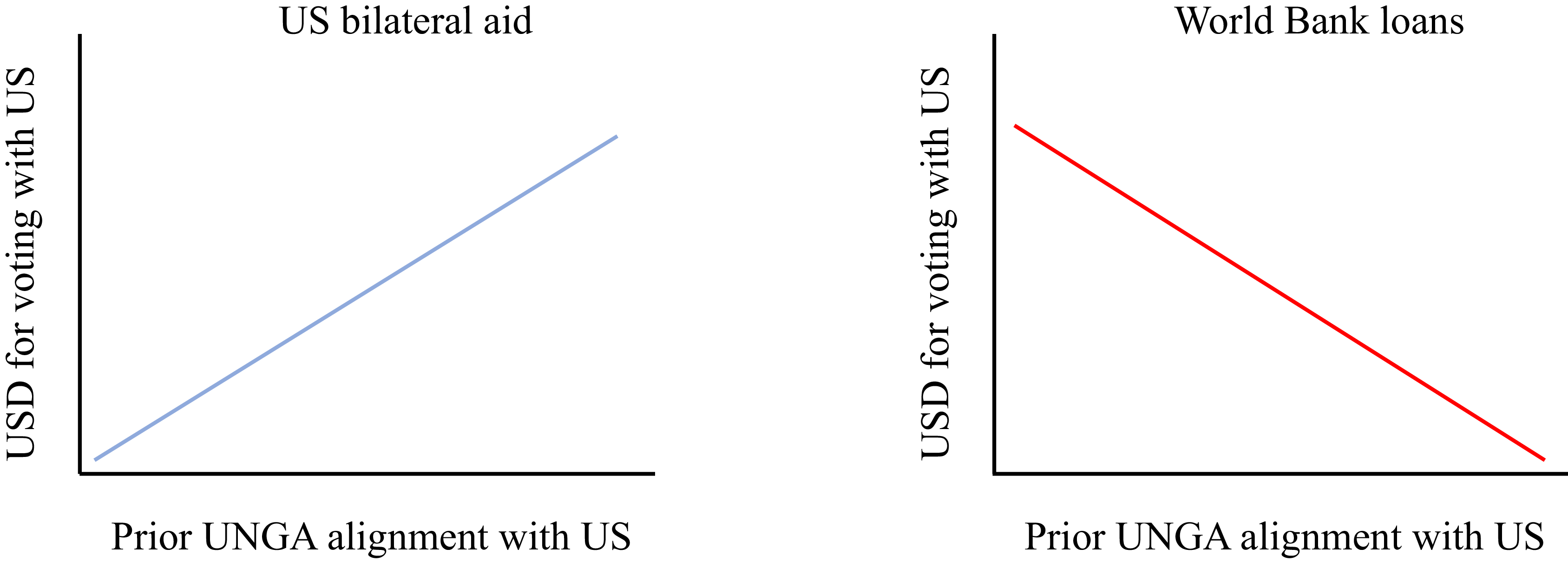
In terms of graphs (see Figure 2), this implies no effect of UNSC voting on US aid when prior UNGA alignment is low and a positive effect on US aid when prior UNGA alignment is high, for example, a line sloping upward as prior UNGA alignment increases. Furthermore, it implies a positive effect of UNSC voting on World Bank lending when prior UNGA alignment is low and no effect on World Bank lending when prior UNGA alignment is high, for example, a line sloping downward as prior UNGA alignment increases.
${\delta _1} \gt 0,\;{\delta _2} \lt 0$
.Footnote
55
In terms of graphs (see Figure 2), this implies no effect of UNSC voting on US aid when prior UNGA alignment is low and a positive effect on US aid when prior UNGA alignment is high, for example, a line sloping upward as prior UNGA alignment increases. Furthermore, it implies a positive effect of UNSC voting on World Bank lending when prior UNGA alignment is low and no effect on World Bank lending when prior UNGA alignment is high, for example, a line sloping downward as prior UNGA alignment increases.
Implications of dirty work hypothesis

FIGURE 2 Long description
Two line graphs compare US bilateral aid and World Bank loans with prior UNGA alignment with US. The first graph on the left shows a positive correlation between US bilateral aid and prior UNGA alignment with the US. The x-axis represents prior UNGA alignment with the US, and the y-axis represents USD for voting with the US. The line graph starts at zero and shows an upward trend, indicating no US bilateral aid for countries not aligned with the US but that as prior UNGA alignment with the US increases, US bilateral aid also increases. The second graph on the right shows a negative correlation between World Bank loans and prior UNGA alignment with the US. The x-axis represents prior UNGA alignment with the US, and the y-axis represents USD for voting with the US. The line graph shows a downward trend ending at zero, indicating that as prior UNGA alignment with the US increases, World Bank loans decrease so that World Bank loans are not used to buy UNSC votes from countries with high alignment with the US.
The extension to also consider the divided government effect is straightforward. Define $DivGo{v_t} = 0$
if the same party controls the executive branch and both chambers of Congress; and
$DivGo{v_t} = 0$
if the same party controls the executive branch and both chambers of Congress; and $DivGo{v_t} = 1$
otherwise. Then the above equations can be rewritten as:
$DivGo{v_t} = 1$
otherwise. Then the above equations can be rewritten as:
 $$\small{US\;Ai{d_{it}} = \beta _1^0All{\rm{\_}}with{\rm{\_}}U{S_{it}} + \beta _2^0PriorUNG{A_{it}} \times All{\rm{\_}}with{\rm{\_}}U{S_{it}} + \ldots {\rm{\;if\;}}DivGo{v_t} = 0}$$
 $$\small{US\;Ai{d_{it}} = \beta _1^1All{\rm{\_}}with{\rm{\_}}U{S_i} + \beta _2^1PriorUNG{A_{it}} \times All{\rm{\_}}with{\rm{\_}}U{S_{it}} + \ldots {\rm{\;if\;}}DivGo{v_t} = 1}$$
 $$\small{WB\;len{d_{it}} = \delta _1^0All{\rm{\_}}with{\rm{\_}}U{S_{it}} + \delta _2^0PriorUNG{A_{it}} \times All{\rm{\_}}with{\rm{\_}}U{S_{it}} + \ldots \;{\rm{if\;}}DivGo{v_t} = 0}$$
 $$\small{WB\;len{d_{it}} = \delta _1^1All{\rm{\_}}with{\rm{\_}}U{S_{it}} + \delta _2^1PriorUNG{A_{it}} \times All{\rm{\_}}with{\rm{\_}}U{S_{it}} + \ldots {\rm{\;if\;}}DivGo{v_t} = 1}$$
The previous hypotheses can then be refined to the following:
 $$H1\!\!:\;\beta _1^0 = 0,\;\beta _2^0 \gt 0{\rm{\;and\;\;}}H2\!\!:\delta _1^1 \gt 0,\;\delta _2^1 \lt 0$$
and, by extension, $\beta _1^1 = 0,\;\beta _2^1 = 0,\;\delta _1^0 = 0,\;{\rm{and\;}}\delta _2^0 = 0$
. That is, the increase in the marginal effect on US aid of UNSC voting as prior UNGA alignment goes up holds only during periods of undivided government and the decrease in the marginal effect of UNSC voting on World Bank lending as prior UNGA alignment goes up holds only during periods of divided government.Footnote
56
$\beta _1^1 = 0,\;\beta _2^1 = 0,\;\delta _1^0 = 0,\;{\rm{and\;}}\delta _2^0 = 0$
. That is, the increase in the marginal effect on US aid of UNSC voting as prior UNGA alignment goes up holds only during periods of undivided government and the decrease in the marginal effect of UNSC voting on World Bank lending as prior UNGA alignment goes up holds only during periods of divided government.Footnote
56
The full specification includes country and year fixed effects, GDP, and population (logged). We include the latter two because, in addition to an exogenous norm of turn taking, election to the UNSC in the group of aid-receiving countries we analyze depends on income and population.Footnote 57 So that the key variables identified are compared against appropriate alternatives, we also include prior UNGA alignment with the United States (uninteracted), a dummy variable reflecting UNSC membership when the country voted against the US at least once during the year, and the interaction of these two variables. All specifications cluster standard errors by country to account for possible within-country correlations and heteroskedasticity.Footnote 58
Our methodology deliberately follows the literature we build on. However, we also explore matching methods to assure identification using appropriate counterfactuals.Footnote 59 Specifically, we create a data set of observations exactly matched on year and two lags of treatment history (a dichotomous measure indicating high UNGA alignment with the United States) and repeat the analysis on this sample (see Appendix C).
With this empirical framework mapped out, it is important to consider how other governments might respond strategically to US administration actions and what implications such strategic responses have for our empirical framework. If the US administration uses different channels of influence during periods of divided and undivided US government in ways that generate differential impacts depending on a country’s UNGA voting, might member states select their UNGA votes strategically to gain access to their preferred type of financing, either US aid or World Bank loans? Might this US pattern influence when countries seek a seat on the UNSC?
There are several reasons to think this is not the case. First, UNGA voting is likely to reflect friendship with the United States but UNGA votes are not the basis for the US government knowing friend from foe. It is our basis for measuring this across a wide range of countries and years but one should not expect US State Department country analysts to be duped by a simple voting gambit.Footnote 60 Such strategic voting would weaken our empirical strategy (making it harder for us to differentiate between friend and foe) but is unlikely to have a meaningful impact on US-country relations. Second, the alignment we measure is based on a historical record of voting with the United States in the UNGA going back five years; gaming that requires considerable foresight.
Even if altering UNGA voting did influence whether a country is treated as friendly or unfriendly, governments would be hard pressed to know that far in advance whether they would face a divided or undivided US government during their time on the UNSC (and hence whether they would prefer to be viewed as friend or foe). Likewise, membership in the UNSC follows a norm of turn taking with a substantial lead period.Footnote 61 Although some UNSC elections are hotly contested (with a record of 155 rounds of voting), most are “clean slates” with only one candidate.Footnote 62 It is unlikely that a country could observe whether the US government is divided and then get itself elected to the UNSC when that would be advantageous. Finally, the implications of being a US ally extend well beyond US aid and World Bank loans; the calculus of alignment is not this simple.
In short, it is unlikely that governments would attempt to “game the system” by altering their UNGA voting or timing their UNSC membership accordingly. If they did, the attempt would likely be ineffective and thus would not introduce endogeneity. The only threat to identification would be to introduce noise in our measure (not the State Department’s assessment) of which countries are US allies.
Findings
Our empirical results support the hypotheses laid out earlier. Concerning the role of divided government, the findings confirm the pattern reported previously.Footnote 63 Looking at the aggregate results in Dreher and colleagues, years with undivided US government drive them for US bilateral aid and years with divided US government drive them for World Bank lending.Footnote 64 Furthermore, the mediated effects predicted by the dirty work hypothesis unfold as the divided government effect predicts. There is evidence that the United States delivers additional bilateral aid to US friends that vote with the US in the UNSC when the same party controls the US executive branch and both chambers of Congress; there is no evidence of such additional bilateral aid when the US government is divided. Conversely, there is evidence that World Bank provides additional funding to countries not friendly with the United States that nonetheless vote with the US on the UNSC when the US government is divided; there is no evidence of such additional World Bank funding when the US government is unified.
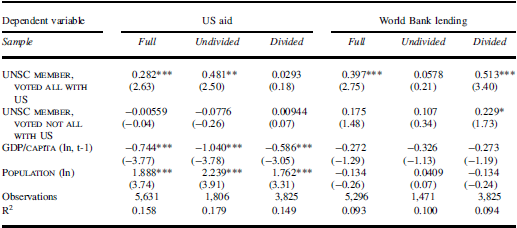
Table 1 presents the first set of results. These do not yet distinguish between types of countries (US friends versus others). In columns 1 to 3, the dependent variable is US bilateral aid. Column 1 reports full sample results (equivalent to Dreher and colleagues, Table 1, column 3).Footnote 65 The positive and statistically significant coefficient on voting all with the United States indicates that, ceteris paribus, a country receives 33 percent more US bilateral aid than normal when it both holds a UNSC seat and does not vote against the US position.Footnote 66 For years with undivided US government (column 2), the effect is 62 percent more US bilateral aid than normal, again statistically significant. Conversely, when the US government is divided (column 3), the effect is small (3 percent) and not statistically significant. This is consistent with the hypothesis that the US executive branch faces greater obstacles to using bilateral aid for geopolitical purposes when it faces strong Congressional opposition.
UNSC voting and divided government

TABLE 1 Long description
The table presents estimated allocation equations for US aid and World Bank lending, focusing on the impact of UN Security Council (UNSC) voting alignment with the United States and the division of the US government. It includes six main columns: US aid (Full, Undivided, Divided) and World Bank lending (Full, Undivided, Divided). The columns present estimation results for different dependent variables (US aid and World Bank lending) and different year samples (all years, years of undivided US government, and years of divided US government). The rows represent different explanatory variables such as UNSC member status, GDP per capita, and population. Key findings include a significant increase in US aid for countries that vote with the US when the US government is undivided, and a smaller, non-significant effect when the US government is divided. World Bank lending shows the opposite pattern, with notable increases in lending for countries voting with the US in the UNSC when the US government is divided, and a smaller, non-significant effect when the US government is undivided. The table highlights that the geopolitical influence on aid and lending decisions depends on whether the US government is divided or not.
Notes: t statistics in parentheses based on country clustered SEs. All specifications include country- and year-fixed effects, as well as lagged UNGA alignment variable. *p < .10; **p < .05; ***p < .01.
Columns 4 to 6 repeat the analysis for World Bank lending. Column 4 indicates that, ceteris paribus, a country receives 49 percent more World Bank funding than normal when it votes in line with the United States in the UNSC; this effect is again statistically significant. For years with undivided US government (column 5), the effect falls to 6 percent and is not statistically significant. Looking instead at years where the US government is divided, the effect increases to 67 percent and is again statistically significant. As with US bilateral aid, this difference across years, depending on whether the US government is divided, follows the pattern predicted by the divided government effect.
Turning to the mediating effect of prior UNGA alignment with the United States (the core of the dirty work hypothesis), we use graphs to present both the marginal impact and its level of statistical significance as prior UNGA alignment with the US ranges from zero to one.Footnote 67 Figure 3 examines US bilateral aid. The specification estimated is the same as in Table 1, except that the UNSC voting variables now interact with the mediating variable, prior UNGA alignment with the United States. This interaction distinguishes between countries that historically are not close to the United States (low values of prior UNGA alignment) and countries that historically are close to the US (high values of prior UNGA alignment). It is the former group where providing aid is “dirty work” that we expect the US administration to delegate to an IFI (the World Bank, in this case).
US aid, dirty work, and divided government

FIGURE 3 Long description
The image contains three line graphs that illustrate the effect of UN Security Council (UNSC) alignment with the United States (US) on bilateral aid distribution. The top graph, labeled ‘US Aid-all years,’ shows the overall effect of UNSC alignment with the US across all years. The x-axis represents prior UNGA alignment with the US, ranging from 0.0 to 1.0, while the y-axis represents the effect of UNSC alignment with the US on the log of US bilateral aid, ranging from -2 to 2. The blue line indicates the trend, with a shaded area representing the 95% confidence interval. The line is upward sloping, starting below zero at the left and ending above zero at the right. The shade area indicates that the effect is not statistically different from zero until 0.45 on the x-axis, after which the effect is significantly greater than zero. The graph also includes a histogram reflecting the distribution of prior UNGA alignment with the US in the sample. This shows that the effect is statistically significant for the upper 36% of the observations. The bottom left graph, labeled ‘US Aid-undivided years,’ focuses on years when the US government was undivided, showing a similar trend. The histogram on this graph indicates the effect is significantly different from zero for the upper 40% of the observations. The bottom right graph, labeled ‘US Aid-divided years,’ focuses on years when the US government was divided, also showing a much less pronounced upward trend such that the effect is never statistically different from zero. Each graph includes a red dashed line at y=0 indicates the baseline effect. The graphs collectively suggest that the effect of UNSC alignment with the US on aid distribution varies based on prior UNGA alignment with the US, with different trends observed for undivided and divided government years. All values are are derived from the estimated model.
The top panel of Figure 3 presents results for US bilateral aid across the full sample. As predicted by the dirty work hypothesis (and pictured in Dreher and colleagues),Footnote 68 when countries vote with the United States in the UNSC, we see additional US bilateral aid flows, but only to countries that historically are close to the US, namely, in cases only where such payments would not appear “dirty.” The histogram indicates the distribution of observations according to their historical alignment with the United States; the effect is statistically significant for alignment values above 0.45, 36 percent of the sample.
The bottom two panels separate years by whether the US government was undivided (left) or divided (right). The graph for undivided government closely resembles the overall graph, though with a slightly larger effect and slightly wider confidence intervals, partly reflecting that fewer than half the years were undivided rule. The marginal effect is again not significantly different from zero for those countries that do not traditionally align with the United States but is significantly greater than zero for those countries that do traditionally align with the US. The higher level of US bilateral aid is statistically significant when prior alignment is greater than 0.5, about 40 percent of the sample.
The graph for divided government (bottom right) is markedly different. The marginal effect is substantially smaller across the range of prior alignment values and never approaches statistical significance. In short, during periods of divided government we do not see an increase in US bilateral aid for countries voting with the United States in the UNSC, even when those countries are close US allies.Footnote 69
Figure 4 examines lending by the World Bank. The top panel uses all years. Again, consistent with the dirty work hypothesis and Dreher and colleagues, when countries vote with the United States on the UNSC, we see additional World Bank commitments, but only to countries not historically aligned with the US.Footnote 70 The effect is statistically significant for alignment values below 0.45, about two-thirds of the sample.
World Bank lending, dirty work, and divided government

FIGURE 4 Long description
The image contains three line graphs. The top graph shows the effect of UNSC alignment with the US on World Bank loans. The x-axis represents prior UNGA alignment with the US, ranging from 0.0 to 1.0. The y-axis represents the effect of UNSC alignment with the US on the log of World Bank lending, ranging from -2 to 2. The blue line indicates the trend, with a shaded area representing the 95% confidence intervals. The line is downward sloping, starting above zero at the left and ending above zero at the right. The shade area indicates that the effect is not statistically different from zero at values of prior UNGA alignment with the US above 0.45. The graph also includes a histogram reflecting the distribution of prior UNGA alignment with the US in the sample. This shows that the effect is statistically significant for the lower two-thirds of the observations. The bottom left graph shows the effect of UNSC alignment with the US on World Bank loans for undivided years. The bottom right graph shows the effect of UNSC alignment with the US on World Bank loans for divided years. Both bottom graphs have the same x-axis and y-axis as the top graph. The blue line in each graph indicates the trend, with a shaded area representing confidence intervals. The histograms at the bottom of each graph show the distribution of prior UNGA alignment with the US. For the graph on the left (undivided years), the shaded area always includes zero indicating the effect is never statistically different from zero. For the graph on the right (divided years), the line is somewhat higher, and the shaded area does not include zero for values of prior UNGA alignment with the US below 0.47. According to the histogram at the bottom of the graph, 70% of observations fall below 0.47.
The bottom left panel is the graph for undivided government. In this case, the effect disappears, dropping substantially in magnitude and never significantly different from zero regardless of the country’s ties with the United States. In short, there is no clear evidence of the World Bank doing the US’s dirty work during years when the same party controls both the White House and the Congress.
Finally, the bottom right panel of Figure 4 presents results for divided government. The graph closely resembles the overall graph, with a statistically significant response to voting with the United States in the UNSC for the 70 percent of observations where prior UNGA alignment with the US falls below 0.47.
These empirical patterns are fully consistent with the hypotheses and expectations derived from simultaneously accounting for IOs’ dirty work function and the impact of divided government. The US administration uses bilateral aid to reward UNSC votes from friends but only when it has the ability to do so because its party also controls Congress. When an uncooperative legislature blocks this channel, the administration instead uses informal influence in the World Bank to reward UNSC votes from otherwise unfriendly countries.
An important caveat is that during this time period (1961 to 2015) there is only one stretch of undivided government under Republican leadership (2003 to 2006). Thus differentiating between the effects of unified Democratic control and unified Republican control is difficult. During undivided Republic governments, there are only nine observations in the “voted all with US” category, too few to determine if Democratic control has a different influence than Republican control.
Despite this data limitation, there is good reason to look more carefully at partisanship. Past research finds differences across parties in citizen attitudes toward multilateralismFootnote 71 and in the level of and allocation criteria for aid.Footnote 72 We explore differentiating more broadly by party of the president (keeping in mind the limitations we mentioned). The dirty work hypothesis holds for both parties, with similar size effects though reaching statistical significance only for Democratic administrations. Differentiating between divided and undivided government, there is some heterogeneity between Democratic and Republican administrations, but the effects are statistically different from zero only for a small fraction of observations. In short, partisan considerations have limited value added.
Appendix B explores placebo tests and other robustness checks (many parallel to Dreher and colleagues).Footnote 73 Placebo tests using the Islamic Development Bank and the EBRD, institutions where US influence is low, show null results (Table B1; Figures B1 and B2). Conversely, previous results hold when we consider differences in UNSC salient across years or issues (based on the number of New York Times stories,Footnote 74 Google searches, or votes about Israel; Tables B2 and B3; Figure B3), when we exclude various resolution categories (Table B4), or when we include additional controls (Table B5; Figure B4). Results are unchanged using ideal point distance (Figure B5). This is important because construction of ideal points uses “bridging” votes that repeat across years to account for changes in the UNGA agenda;Footnote 75 voting alignment makes no such adjustment. Finally, given that some past work on geopolitics and aid/IFIs shows a drop in influence with the end of the Cold WarFootnote 76 and some does not,Footnote 77 we investigate whether the World Bank effect is evident in the post-Cold War period. Figure B6 presents the results, showing the same pattern as in the overall sample. Supplementary work suggests no clear change around the end of the Cold War, perhaps because the fundamentals (the importance of issues before the UNSC, the nature of US politics, and the dirty work function of IOs) persist. In short, the pattern shown here is remarkably stable.Footnote 78
A final robustness check in Appendix C uses the panel matching approach discussed later. Results with the matched sample largely mirror our main results but with somewhat reduced power due to smaller sample size. Looking at the specification without the interaction terms (Table C1), voting all with the US results in bilateral aid 53 percent above the country average during undivided government, ceteris paribus, but has no discernable impact during divided government. Voting all with the US results in World Bank lending 70 percent above average during divided government, ceteris paribus, but has no discernable impact during undivided government. The interaction terms (depicted in Figures C1 and C2) also mirror the earlier findings. US bilateral aid is higher when US friends vote all with the United States but only under undivided government; World Bank lending is higher when nonfriends vote all with the United States but only under divided government.
Additional Implications
While we focus on how divided government and dirty work jointly shape the US administration’s choice between bilateral aid and multilateral lending as a tool to influence UNSC voting, the theory also has implications for the outcomes of these votes.Footnote 79 When the US government is divided, aid is not used to influence the votes of UNSC members traditionally allied with the United States (“friends”). Congress blocks (or greatly reduces) such payments via bilateral aid and US friends’ high baseline of World Bank borrowing blocks that alternative channel (because these payments would raise these countries’ borrowing levels so far above World Bank guidelines as explained earlier). If such payments are needed to garner full support from these countries (as the theory presumes), the number of UNSC votes from US friends against US positions should be higher in years with divided government. If we also assume that bilateral aid to friends is more effective at winning support than multilateral loans to nonfriends (both because aid grants are more valuable to recipients than loans and because the value of payments needed to sway friends should be smaller than those needed to sway nonfriends given more similar foreign policy preferences of the former), we expect worse UNSC outcomes for the United States during periods of divided government.
Appendix Table C2 presents a simple empirical analysis of UNSC votes to assess whether we see these patterns. The dependent variable is the number of votes against the US position each year from 1946 to 2024. During divided US government, we find an average of thirteen additional votes against the US position (column 1), ten if we restrict the sample to nonpermanent members (column 2). These differences are statistically significant, even controlling for the number of UNSC roll call votes that year, the number of voters, a time trend, Cold War and US presidential party dummies, and a lagged dependent variable. See columns (3) and (4).
The last four columns look at UNSC voting by US friends. We define friends as in the main analysis but using a dummy variable, with friends being countries with US UNGA alignment above the annual median. Column (5) examines votes by all friends on the UNSC; column (6) narrows the group to non-P5 friends. In both, we see significantly more friends voting against the US position in years when the US government is divided. This pattern again survives controlling for potential confounders (columns 7 and 8).
Voting in the UNSC and US strategy regarding winning those votes is obviously more complex than simply counting votes against the United States in a given year.Footnote 80 The P5 veto,Footnote 81 the value of unanimity for domestic and international audiences,Footnote 82 what drives the agenda,Footnote 83 some votes being more important to the United States than othersFootnote 84 —all of these factors point to the complexity of the UNSC that has long been studied. This analysis merely demonstrates that the additional implications of the theory presented are consistent with UNSC voting patterns.
Conclusion
We combine two theories to understand why (equivalently when) hegemonic powers choose to exert informal influence over international organizations. Stone explains informal influence as the outcome of an implicit bargain between the hegemon and other IO members; the success of the IO requires the hegemon to participate, which the hegemon is willing to do only if it can ignore the strictures of IO governance on the rare occasions when it has an overriding interest to do so.Footnote 85 In the context of IFIs, Dreher and colleagues explore one such overriding interest, “dirty work.”Footnote 86 For reasons of domestic or international politics, some foreign policy actions are viewed as inappropriate for the government to undertake and so the executive branch instead tasks the IFI with these actions. In the same IFI context, the executive branch cannot act directly when it lacks the requisite support from the legislative branch due to political divisions. Again, it tasks the IFI to act in its stead.Footnote 87
Taken together, these considerations imply the hegemon will intervene to override normal IO governance only when other avenues are closed off, that is, to do dirty work when faced with domestic political divisions. We test this hypothesis in the case of US bilateral aid and World Bank lending. We select the World Bank because there is already substantial evidence of US influence over World Bank lending and because its loans (unlike IMF loans) are close substitutes for bilateral aid.Footnote 88 Following Dreher and colleagues, we examine how countries that vote with the United States in the UNSC are rewarded, either with bilateral aid or with World Bank loans.Footnote 89 Here, dirty work is conceived of as providing aid to countries that are not historically close to the United States. We compare these outcomes under divided and undivided US governments. Our empirical results support the joint hypothesis. When the US government is undivided, there is evidence that voting with the United States in the UNSC increases US bilateral aid but only for countries historically close to the US; there is no such empirical evidence when the US government is divided. Conversely when the US government is divided, there is evidence that voting with the United States in the UNSC increases World Bank lending but only for countries historically distant from the US; there is no such evidence when the US government is undivided. These results confirm an implication of informal governance theory that had not yet been tested empirically.Footnote 90
Understanding when the US administration uses different forms of development finance as a foreign policy tool is important because it helps to illuminate what drives this behavior. The key determinant for both channels (in whole or in part) is domestic politics. The United States exercises informal influence in this setting when bilateral aid is ruled out, because it is inappropriate (“dirty”) and because it is unavailable. This domestic linkage is interesting theoretically as well as empirically. These mechanisms can explain variation over time, as both are impacted by the degree of political polarization. They also suggest variation in the degree of informal influence across IOs. Where IOs act as close substitutes for bilateral policy instruments (for example, multilateral development banks), we can expect to see informal influence exercised more regularly and in ways linked to the hegemon’s domestic politics.
In addition, we should expect differences across IOs based on the characteristics of the dominant member. In the case of the Asian Development Bank, there is considerable evidence of Japanese domination and China clearly leads the Asian Infrastructure Investment Bank (which was founded by China, has a Chinese president, gives China formal veto power in the selection of the president and is located in Beijing, and where China holds nearly a 30 percent share).Footnote 91 Differences between these countries may well impact when and whether they choose to exercise informal influence. Japan’s parliamentary system implies a very different domestic political dynamic. As for Japan’s foreign policy, its imperial legacy and “historical baggage” result in the very act of exercising geopolitical influence to be seen as “dirty work.” Not only does that all but remove overt bilateral pressure from the menu of options, even when operating within multinational development banks, Japan tends to choose a quiet and subtle approach.Footnote 92 China’s one-party rule eliminates the divided government scenario altogether. Its tightly controlled domestic political environment and limited public information about foreign aid commitments narrow the range of activities that might be considered “dirty work,” at least from the domestic perspective.Footnote 93 In both cases, dominant shareholder informal influence is likely to be less frequent than in the US case.
Most recently, the international rules-based system has been challenged by populist, nationalist, and globalization-skeptical politicians and administrations.Footnote 94 Ongoing US support for institutions that the United States itself created is openly questioned. What do our results imply for the future of IOs, and especially those that fulfill similar tasks to bilateral alternatives, such as the IFIs? According to Keohane, international regimes will persist even after hegemonic decline, and, perhaps even more importantly, self-interest on the part of nation-states does not result in the collapse of the international regimes.Footnote 95 If polarization implies a higher likelihood of nondivided government, we expect more emphasis on bilateral deals and actions and less support for multilateral solutions to global problems. In addition, the degree of sensitivity to the “dirtiness” of certain foreign policy work appears to have declined significantly (see, for example, US President Trump’s acceptance of a USD 400 million private jet gifted by a foreign power, or the open demand for resources in exchange for security assistance for Ukraine). Following the “dirty work” hypothesis, that would also suggest less US enthusiasm for IOs in the future.
Data Availability Statement
Replication files for this research note may be found at <https://doi.org/10.7910/DVN/SAKWCX>.
Supplementary Material
Supplementary material for this research note is available at <https://doi.org/10.1017/S0020818326101404>.
Acknowledgments
The authors thank seminar participants at the University of Heidelberg and conference participants at the 2024 Political Economy of Aid Society meetings and the 2025 Political Economy of International Organizations conference for insightful comments and helpful feedback.
Authors
Santi Foncillas is an Associate Consultant at PwC. He can be reached at Santiago.foncillas01@gmail.com.
Erasmus Kersting is Professor of Economics at Villanova University. He can be reached at Erasmus.kersting@villanova.edu.
Christopher Kilby is Professor of Economics at Villanova University. He can be reached at chkilby@yahoo.com.




 Open access

