


1 Introduction
A single child fallen down a well or dying of starvation stirs our hearts and moves our hands (and wallets) to action (Reference Jenni and LoewensteinJenni & Loewenstein, 1997). Yet as soon as the number of victims increases to two, compassion—both affective and behavioral—begins to wane (Reference Västfjäll, Peters and SlovicVastfjall, Peters & Slovic, 2012). Such compassion fade (i.e., decreases in helping behavior or support for it) has been widely documented in the humanitarian domain (Reference SlovicSlovic, 2007) and is troubling for at least three reasons. First, it defies our normative beliefs about how we should value the lives of those in need (Reference MacLean and MacLeanMacLean, 1986). Second, it contradicts our intuitions about how we ourselves would react when asked to aid others (Reference Dunn and Ashton-JamesDunn & Ashton-James, 2008). Third, it suggests that confronting large-scale humanitarian and (perhaps) environmental crises—from mass starvation to climate change—may not only involve overcoming political and economic hurdles but also insidious psychological ones as well (Reference GiffordGifford, 2011).
Nearly all extant research on compassion fade has focused on humanitarian causes (e.g., starving children; see for example Reference Cameron and PayneCameron & Payne, 2011; Reference Small, Loewenstein and SlovicSmall, Loewenstein & Slovic, 2007). As a result, it is not yet known whether, to what extent, and among which individuals compassion fade emerges when victims are non-human animals. However, because the environmental challenges we face involve millions of unidentified victims, there is a distinct possibility that compassion fade occurs in this domain, hampering policymakers’ and environmental advocates’ efforts to allocate sufficient resources to protect non-human animal species. Here, we extend research on compassion fade into this previously unstudied domain. We also contribute to the broader psychological literature on compassion fade by examining a novel moderator variable, i.e., personal commitment to a cause.
1.1 Compassion fade and the provision of aid
Past research has found that decision-makers are often insensitive to the scope of humanitarian and environmental crises (Reference Kahneman and KnetschKahneman & Knetsch, 1992), providing similar levels of aid regardless of the number of victims in need. For example, Reference Devousges, Johnson, Dunford, Hudson, Wilson, Boyle and HausmanDevousges et al. (1993) demonstrated that willingness to pay to protect migrating birds from preventable, human-caused deaths varied little whether the number of birds affected was 2,000 or 200,000. These and other findings suggest that compassion towards others (e.g., providing financial or other aid) quickly reaches a horizontal asymptote as the number of victims increases. However, as noted above, findings from a number of distinct yet related lines of inquiry suggest that in some cases compassion does not merely flatten, but actually decreases—fades—as the number of victims increases.
Three overlapping yet distinct sets of findings speak to the existence of compassion fade. First, when asked to provide aid, individuals are highly sensitive to the proportion of victims that can be helped: As the total population of those in need (including victims who cannot be helped) increases, people show less willingness to help the same absolute number of victims (Reference BartelsBartels, 2006; Reference Fetherstonhaugh, Slovic, Johnson and FriedrichFetherstonhaugh, Slovic, Johnson & Friedrich, 1997; Reference Jenni and LoewensteinJenni & Loewenstein, 1997). Such “proportion dominance effects” are non-normative (Reference BaronBaron, 1997), as knowledge about those who cannot be helped should not de-motivate provision of aid to those who can be aided (Reference SlovicSlovic, 2007). Second, numerous studies have demonstrated that (many) individuals respond more compassionately to requests for aid that describe a single, identified victim (e.g., a starving child) than they do to requests that statistically describe the scope of a humanitarian crisis (e.g., Reference Friedrich and McGuireFriedrich & McGuire, 2010; Reference Small, Loewenstein and SlovicSmall et al., 2007) or to requests that combine both types of appeals; this finding is often referred to as the “identifiable victim effect”. Third, greater compassion is shown towards a single, identified victim than towards two (Reference Västfjäll, Peters and SlovicVästfjäll et al., 2012), three (Reference Schmidt and WilsonSchmidt & Wilson, 2011) or eight victims (e.g., Reference Kogut and RitovKogut & Ritov, 2005); these findings are often labeled as either “identifiable victim” or “singularity” effects. Although it is possible (and indeed likely) that a number of distinct underlying mechanisms are responsible for driving these effects (see next section), past and recent findings suggest that they are closely related to one another (e.g., Reference Jenni and LoewensteinJenni and Loewenstein, 1997 found that proportion dominance was in fact one key driver of observed identifiable victim effects). Thus, compassion fade is a robust (and diverse) phenomenon that emerges under numerous eliciting conditions.
1.2 Explaining compassion fade
Numerous affective, cognitive and motivational mechanisms have been proposed to account for compassion fade. For example, decision-makers may show greater compassion towards a single victim in part because a single individual elicits an inherently stronger affective response than does a group (Reference Kogut and RitovKogut & Ritov, 2005; Reference SlovicSlovic, 2007). Reference Smith, Faro and BursonSmith, Faro and Burson (2013) suggest this may be the case in part because groups of individuals are perceived as less cohesive (i.e., they lack entitativity). Compassion fade may also occur in part because, although humans are well-practiced at taking another person’s perspective (which generally increases altruistic behavior), taking the perspective of a group is relatively difficult (Reference Batson, Polycarpou, Harmon-Jones, Imhoff, Mitchener, Bednar and HighbergerBatson et al., 1997). In a different vein, overreliance on proportional reasoning may lead to perceptions of inefficacy as the reference group to which victims belong increases in size (so-called “drop-in-the-bucket” effects; Reference BaronBaron, 1997). And from a motivational perspective, Reference Cameron and PayneCameron and Payne (2011) have argued that individuals preemptively down-regulate their emotional response in helping situations when they know they will be asked to aid multiple individuals (in order to avoid being overwhelmed by the scope of the aid request). These various accounts are not mutually exclusive, and each likely plays a role in shaping individuals’ compassionate behavior.
Critically, although much of the past research on compassion fade has treated the phenomenon as a “main effect” (Reference Friedrich and McGuireFriedrich & McGuire, 2010), recent work has demonstrated that some individuals are more susceptible than others. For example, Reference Cameron and PayneCameron and Payne (2011) showed that sympathy for one victim was greater than for eight victims only among subjects who were relatively skilled at emotion-regulation. Reference Friedrich and McGuireFriedrich and McGuire (2010) found that compassion fade emerged only among individuals who scored relatively low on a measure of rational (as opposed to experiential) processing style (Reference Pacini and EpsteinPacini & Epstein, 1999; see also Reference Friedrich, Barnes, Chapin, Dawson, Garst and KerrFriedrich et al., 1999 for related findings). Reference Fetherstonhaugh, Slovic, Johnson and FriedrichFetherstonhaugh et al. (1997) reported that people who place higher value on saving lives in general did not show proportion dominance effects. And Reference Smith, Faro and BursonSmith et al. (2013) have suggested that compassion fade is more likely to occur among individuals who perceive groups of victims as lacking entitativity.
1.3 Compassion fade in the environmental domain
Whether or not compassion fade will emerge when the individuals in need of aid are non-human animals is presently unknown. On the one hand, both the contingent valuation findings discussed above as well as anecdotal evidence suggest that the effect may occur in the environmental domain (e.g., Reference SongSong, 2002). Moreover, Reference Smith, Faro and BursonSmith et al.’s (2013) entitativity studies, which included animals as targets of aid, provide indirect evidence that processes related to compassion fade in the humanitarian domain may translate to the environmental context.
Other findings, however, raise doubts. For example, Reference HartHart (2011) found that information about the negative effects of climate change on all polar bears produced stronger support for ameliorative environmental policies than did information about negative effects on a single bear; however, this study did not examine individuals’ willingness to help the polar bear(s) specifically. Reference Hsee and RottenstreichHsee and Rottenstreich (2004) found that donations to help one versus four pandas were not significantly different when photos of the animals were shown to subjects; however, the use of the same photo copied four times to represent multiple pandas may simply have failed to make salient the existence of multiple individuals. And Reference Kogut and RitovKogut and Ritov (2007) found that compassion fade occurred (with human victims) only when decision-makers learned about in-group members in need of aid (i.e., greater helping for a single in-group victim than for multiple in-group victims); helping behavior directed at out-group members was similar regardless of how many victims were presented. However, in a more recent set of studies, Reference Ritov and KogutRitov and Kogut (2011) demonstrated identifiable victim effects only when helping out-group members (i.e., more aid provided to an identified victim than to a non-identified victim) and reverse effects with in-group members (i.e., less aid provided to an identified versus non-identified victim); these (potentially) conflicting findings and their implications for the present research are discussed further below. Regardless of the direction of the group membership effect, both sets of studies by Kogut and Ritov appear to suggest that the emergence and degree of environmental compassion fade may differ across individuals as a function of whether non-human animals are viewed as in-group versus out-group members.
Given these conflicting findings as well as the moderation effects discussed above, it is unclear whether compassion fade will emerge in the environmental domain and, if so, whether individual differences factors might moderate the effect. For example, Reference Kogut and RitovKogut and Ritov’s earlier (2007) findings appear to suggest that, when victims are animals, individuals who are not highly concerned about environmental issues (i.e., non-environmentalists) may demonstrate relatively weak compassion fade effects (because animals are likely to be perceived as out-group members).
However, our primary prediction was that the opposite pattern of results would obtain in the environmental domain: greater levels of compassion fade among non-environmentalists than among environmentalists. Consideration of a number of distinct yet complimentary mechanisms leads us to this hypothesis. First, compassion fade appears to be affected by an individual’s prior knowledge about and/or commitment to an issue or targeted outcome (e.g., environmental protection, humanitarian aid): individuals who highly value an outcome (e.g., saving lives) appear to be less susceptible to compassion fade (e.g., Reference Fetherstonhaugh, Slovic, Johnson and FriedrichFetherstonhaugh et al., 1997). Thus, we expect environmentalists—who are more aware of, educated about and concerned with environmental issues (Reference Clayton, Clayton and OpotowClayton, 2003)—to demonstrate relatively little or perhaps no compassion fade. For such individuals, hearing about animals in need—be it a single victim or thousands—may simply serve as a reminder of the widespread problem that exists, a problem they have previously thought about and are already committed to confronting. In contrast, non-environmentalists lack a broader framework for interpreting information about a specific aid request and are likely to be relatively less interested in the problem at hand. As a result, these individuals may rely more heavily on affective and cognitive heuristics—which have previously been shown to produce compassion fade (e.g., Reference Friedrich and DoodFriedrich & Dood, 2009)—when deciding whether and how much aid to provide, leading to greater compassion fade.
An alternative yet compatible explanation draws on Reference Ritov and KogutRitov and Kogut’s (2011) recent finding that, in the context of inter-group conflict, helping behavior is enhanced when considering identified (vs. non-identified) out-group members and reduced when considering identified in-group members. As suggested above, to the extent that individuals view non-human animals and humans as being in conflict (which seems plausible)—and that non-environmentalists tend to treat animals as out-group members and environmentalists view them as in-group members—Reference Ritov and KogutRitov and Kogut’s (2011) findings similarly support our prediction that compassion fade will emerge only (or more strongly) among non-environmentalists (although it is important to note that Ritov and Kogut’s recent studies specifically examined the interaction between group dynamics and identifiability, not the interaction between group membership and the number of victims in need of aid, as we explore in the present work). We directly tested these hypotheses in a series of three studies.
2 Study 1
Past research has established that individuals are sensitive to the relative proportion of victims that can be helped: as the ratio of those helped to those who are “unreachable” decreases, individuals’ willingness to provide aid decreases (Reference Fetherstonhaugh, Slovic, Johnson and FriedrichFetherstonhaugh et al., 1997). This is the case even when the actual number of victims being helped does not change. As indicated above, this “proportion dominance effect” has been hypothesized and shown to be an important contributor to compassion fade. In Study 1, we thus examined whether this important mechanism occurs when the victims are non-human animals.
2.1 Methods
2.1.1 Subjects
Subjects were 181 undergraduate students (128 females; mean age = 20.38 years, SD = 4.20; 76% Caucasian) from a public university in the northwestern U.S. who participated in return for course credit. Fifty-seven (31.5%) self-identified as environmentalists (as described shortly).
2.1.2 Procedure and measures
Subjects completed all measures as part of an omnibus study conducted online; exposure to the experimental manipulation (manipulated between subjects) and dependent measures occurred at the beginning of the study. Subjects in both conditions were told that a recent hurricane had destroyed breeding platforms used by an at-risk population of wood storks. Subjects were then told that local groups were raising funds to reconstruct 450 platforms to help the birds; they were also told that those local groups were seeking volunteers to help build the platforms. In the “large proportion helped” condition (N = 92), the total population was said to consist of 1,100 wood storks; in the “small proportion helped” condition (N= 89), the population consisted of 25,000 storks.
After reading the information, subjects were asked two questions which served as our dependent variables. First, we asked, “Assuming the volunteering were to take place during the summer when you didn’t have any classes, how likely would you be to travel to the affected area and volunteer to build and install the breeding platforms?” Subjects responded using a 5-point scale (1 = not at all likely, 5 = extremely likely). Second, we measured donation intention by asking, “How much would you consider donating to help this cause?” Subjects responded using a 6-point scale divided into $10 increments ($0 to $50). After completing a number of unrelated measures, subjects’ environmental identity was measured with a single yes/no item: “I consider myself to be an environmentalist.” (This simple yet robust measure of environmentalism was used in all three studies reported in this paper).
2.2 Results and discussion
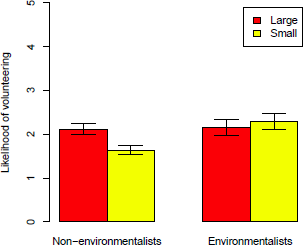
Subjects’ responses to the volunteering and donation items served as the dependent variables. Responses to the volunteering item were entered into a 2 (large vs. small proportion) × 2 (environmentalist vs. non-environmentalist) between-subjects analysis of variance, which yielded a significant main-effect of environmentalism, F(1, 176) = 5.05, p = .03, reffect= .17, and the predicted interaction between environmentalism and condition, F(1, 176) = 4.38, p = .04, reffect = .16; there was no significant main effect of condition, F(1, 176) = 1.19, p = .28, reffect = −.08. Planned simple effects analyses revealed an effect of condition among non-environmentalists, F(1, 122) = 8.07, p = .01, reffect = −.25, but not among environmentalists, F(1, 54) = .36, p = .55, reffect = .08. As shown in Figure 1, non-environmentalists were more willing to volunteer in the “large proportion” condition (M = 2.12, SD = 1.02) than in the “small proportion” condition (M = 1.64, SD = .85); in contrast, environmentalists were equally willing to volunteer in the “large proportion” (M = 2.15, SD = .91) and “small proportion” conditions (M = 2.30, SD = .99).
Shows results from Study 1, likelihood of volunteering: non-environmentalists were significantly less willing to volunteer to help the same number of wood storks (450) when the total proportion of animals helped was small rather than large. Environmentalists’ willingness to volunteer was similar in the two conditions. Error bars show ± 1 standard error.
Responses to the donation item were similarly analyzed. Across the entire sample, there was no significant main effect of condition on hypothetical donation behavior, F(1, 176) = 2.26, p = .14, reffect = −.08. A main-effect of environmentalism emerged, F(1, 176) = 11.30, p = .001, reffect = .25, as did a non-significant interaction between condition and environmentalism, F(1, 176) = 2.28, p = .13, reffect = .11. As shown in Figure 2, the pattern of results closely mirrored those of the volunteering item: planned simple effects analyses revealed that non-environmentalists in the “large proportion” condition reported larger hypothetical donations (M = 14.46, SD = 14.58) than did those in the “small proportion” condition (M = 9.49, SD = 8.60), F(1, 122) = 5.21, p = .02, reffect = −.20, supporting the compassion fade hypothesis. In contrast, environmentalists donated similar amounts in the “large proportion” (M = 18.08, SD = 11.32) and “small proportion” conditions (M = 19.00, SD = 12.69), F(1, 54) = .08, p = .78, reffect = .04.
Shows results from Study 1, donation intention: non-environmentalists donated significantly less to help the same number of wood storks (450) when the total proportion of animals helped was small rather than large. Environmentalists donated similar amounts in the two conditions. Error bars show ± 1 standard error.

Thus, Study 1 provided initial evidence that compassion fade (in the form of proportion dominance) emerges in the environmental domain, but only among individuals who are relatively less interested in and engaged with environmental issues (i.e., non-environmentalists); moreover, Study 1 demonstrated that these effects emerge in the context of donating both time and money. These findings suggest that, for individuals who are relatively less practiced and interested in thinking about the scope of environmental issues (and/or who perhaps view animals as out-group members in conflict with humans), secondary features of the helping situation may play an outsized role in driving compassionate decision-making. We attempted to replicate and extend these findings in a second study using a different paradigm.
3 Study 2
In Study 2, subjects were either told about the plight of a single, identified animal or else given information about the challenges facing an entire population of threatened animals. Past research has demonstrated that information about a single, identified (human) individual generates greater levels of affective and behavioral compassion than does statistical information about a group (e.g., Reference Small, Loewenstein and SlovicSmall et al., 2007); however, the possible moderating role of commitment to environmentalism has not been examined in this context.
3.1 Methods
3.1.1 Subjects
The sample consisted of 212 undergraduate students (149 females; mean age = 19.72 years, SD = 2.88; 82% Caucasian) from a U.S. public university who participated in return for course credit. Seventy-six (35.8%) self-identified as environmentalists.
3.1.2 Procedure and methods
As in Study 1, the manipulation and dependent variables were the first measures presented as part of a larger omnibus survey conducted online. In both conditions (between-subjects design), subjects were told to imagine that after unexpectedly finding $10, an individual working with the group “Save the Polar Bears” handed them a letter asking if they would consider donating to help protect the bears. In the “population” condition (N = 101), subjects were shown a montage of polar bear pictures and given some facts about the challenges currently facing the world’s polar bear populations (e.g., the lack of food and habitat); in the “identified” condition (N = 111), subjects saw a picture of a single adult bear and were given similar information as in the “population” condition, except that the information was about the single bear (who was given a name).
After reading the donation request letter, subjects were asked two questions that served as the dependent variables of interest. First, we asked, “How likely would you be to donate to this cause?” Subjects responded using a 5-point scale (1 = not at all likely, 5 = extremely likely). Second, we measured donation intention by asking, “How much of your recently discovered $10 would you consider donating?” Subjects responded using an 11-point scale ($0-10). As in Study 1, subjects indicated their environmental identity at a later point (using the same measure described above).
3.2 Results and discussion
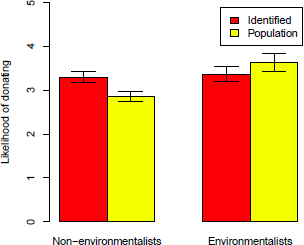
As shown in Figures 3 and 4, the pattern of results for both measures of donation intention was nearly identical to the one that emerged in Study 1. Responses to the likelihood of donation item were entered into a 2 (identified vs. population) × 2 (environmentalist vs. non-environmentalist) between-subjects analysis of variance, which yielded a significant main-effect of environmentalism, F(1, 207) = 7.62, p = .01, reffect= .19, and the predicted interaction between environmentalism and condition, F(1, 207) = 5.56, p = .02, reffect = .16; there was no significant main effect of condition, F(1, 207) = .38, p = .54, reffect = −.04. Planned simple effects analyses revealed an effect of condition among non-environmentalists, F(1, 133) = 7.01, p = .01, reffect = −.22, but not among environmentalists, F(1, 74) = .98, p = .33, reffect = .11. As shown in Figure 3, non-environmentalists reported stronger intentions to donate in the “identified” condition (M = 3.30, SD = .99) than in the “population” condition (M = 2.86, SD = .97); in contrast, environmentalists reported equally strong intentions to donate in the “identified” (M = 3.36, SD = 1.12) and “population” conditions (M = 3.63, SD = 1.16).
Shows results from Study 2, likelihood of donation: non-environmentalists were significantly less likely to donate to help all remaining polar bears than to help a single polar bear. Environmentalists’ likelihood of donation was similar in the two conditions. Error bars show ± 1 standard error.
Shows results from Study 2, donation intention: non-environmentalists donated significantly less to help all remaining polar bears than they did to help a single polar bear. Environmentalists donated similar amounts in the two conditions. Error bars show ± 1 standard error.
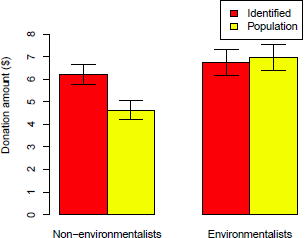
Similar results emerged for the donation amount item. A 2 (identified vs. population) × 2 (environmentalist vs. non-environmentalist) between-subjects analysis of variance revealed a significant main-effect of environmentalism, F(1, 208) = 7.58, p = .01, reffect = .19, and a marginally significant interaction between environmentalism and condition, F(1, 208) = 3.07, p = .08, reffect = .12; there was no significant main-effect of condition, F(1, 208) = 1.65, p = .20, reffect = −.09. Results of planned simple effects tests showed that non-environmentalists donated more to help a single polar bear (M = 6.21, SD = 3.66) than they did to help all of the polar bears (M = 4.64, SD = 3.55), F(1, 134) = 6.47, p = .01, reffect = −.22. In contrast, the amounts environmentalists said they would donate were similar in the “identified” (M = 6.73, SD = 3.82) and “population” conditions (M = 6.97, SD = 3.15), F(1, 74) = .09, p = .77, reffect = .03.
Results of Study 2 conceptually replicated and extended findings from Study 1. Thus, the study provided further evidence that compassion fade emerges in the environmental domain, but only among non-environmentalists (again supporting our primary hypotheses). However, the conclusions that we can draw from these first two studies are tempered by the fact that the measures of compassionate decision-making used were hypothetical and involved intentions to act rather than actual action. We rectified this shortcoming in Study 3.
4 Study 3
In Study 3, we held both the proportion of animals helped and the identifiability of the victims constant across conditions and examined how quickly the drop-off in compassion occurs as the number of animals in need of aid increases (i.e., singularity effect). Based on past findings (e.g., Reference Kogut and RitovKogut & Ritov, 2005) and the results of Studies 1 and 2, we predicted that helping behavior among non-environmentalists would begin to decrease as soon as there are two animals in need and continue to decrease as the number of animals increases.
4.1 Methods
4.1.1 Subjects
We recruited 171 undergraduate students (110 females; 74% Caucasian) seated in public areas on the campus of a public northwestern U.S. university. Individuals participated in return for $5. Eighty-seven (50.9%) self-identified as environmentalists.
4.1.2 Procedure and methods
Subjects were approached in various public spaces on a university campus. After determining their eligibility, subjects completed a brief, unrelated decision-making task in exchange for $5. Subjects were then paid in single-dollar bills and told that the research team was collecting donations to support panda conservation on behalf of the World Wildlife Fund (WWF). Subjects were then given one of three donation request letters and a blank envelope in which they were instructed to place any donations. After handing the request letter and envelope to the subject, the experimenter walked approximately 15-20 feet away in order to minimize possible social desirability effects.
Request letters provided information about a single panda, two pandas, or eight pandas; all pandas were named and given ages, and photos were provided. The total monetary need was kept constant across the three between-subjects conditions (all Ns = 57). After subjects made their donation decision, they signaled the experimenter to return and handed him or her the sealed envelope; the amount found in the envelope ($0-5) served as the dependent variable. Finally, subjects filled out a very brief post-decision questionnaire, during which they indicated whether or not they identified as an environmentalist (using the same measure described above). All donations made by subjects were in fact passed along to WWF.
4.2 Results and discussion
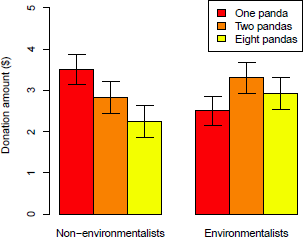
On average, subjects donated $2.87 to help the pandas; this average included the 16% of the sample who donated nothing. We conducted a 3 (one vs. two vs. eight pandas) × 2 (environmentalist vs. non-environmentalist) between-subjects analysis of variance, and explicitly tested the hypothesis that donations would decrease as the number of pandas in need of aid increased. There were no main-effects of environmentalism or condition, both Fs < 1. However, our analysis revealed a statistically significant interaction between environmentalism and the linear trend in the condition variable, F(1, 165) = 4.93, p = .03, reffect = .17, as predicted. As shown in Figure 5, differences again emerged between non-environmentalists and environmentalists. Among non-environmentalists, subjects donated more to help one panda (M = 3.50, SD = 1.84) than they did to help two (M = 2.83, SD = 2.07), or eight (M = 2.25, SD = 2.08). Planned contrasts revealed a significant linear effect of condition among non-environmentalists, F(1, 82) = 5.29, p = .02, reffect = −.25; there was no quadratic effect present, F(1, 82) = .01, p = .93, reffect = .01. In contrast, donations to one (M = 2.50, SD = 2.01), two (M = 3.30, SD = 1.94), or eight (M = 2.93, SD = 2.12) pandas did not significantly differ among environmentalists. No significant linear, F(1, 85) = .68, p = .41, reffect = −.09, or quadratic, F(1, 85) = 1.53, p = .22, reffect = .13, effects emerged.
Shows results from Study 3: As the number of pandas in need of aid increased, non-environmentalists provided significantly smaller donations to a charitable group working on their behalf. Environmentalists’ donations did not differ significantly as a function of the number of animals in need. Error bars show ± 1 standard error.
Thus, Study 3 again replicated and extended the findings from Studies 1 and 2, demonstrating that compassion fade (here in the form of a singularity effect) emerges in the environmental domain only among non-environmentalists even when real monetary costs are at stake. Moreover, Study 3 provided a strong test of the environmental compassion fade hypothesis by demonstrating a drop-off in compassionate behavior as soon as the number of animals in need of aid increased beyond one. In addition, by keeping the number of victims small, maintaining the proportion of animals being helped constant (i.e., 100% of those mentioned), and identifying victims in all conditions, Study 3 also helped rule out alternative, “rational” explanations of the observed decreases in compassion across the three studies (e.g., “drop-in-the-bucket” effects).
5 General discussion
Across three studies and five analyses (out of six), we found consistent empirical evidence of environmental compassion fade—compassion shown towards animals in need of aid decreased as the number of victims increased, identifiability of the victims decreased and the proportion of animals helped shrank. As predicted, however, the effect emerged only among self-identified non-environmentalists, people for whom environmental issues are relatively low in salience and personal resonance (Reference Clayton, Clayton and OpotowClayton, 2003); moreover, the magnitude of the effect among these individuals was remarkably consistent across the diverse set of experimental paradigms and dependent variables (all r’s between .20 and .25). In contrast, individuals who reported a previously held, personally significant commitment to environmental protection displayed similar levels of compassion regardless of the proportion (Study 1), identifiability (Study 2), or number (Study 3) of animals in need of aid.
The observed moderation effect of environmentalism is critically important and requires further consideration, in part because it suggests that previous accounts of compassion fade are incomplete and in need of further development. Previously proposed mechanisms and moderating factors—including motivated emotion regulation (Reference Cameron and PayneCameron & Payne, 2011), entitativity (Reference Smith, Faro and BursonSmith et al., 2013), and singularity effects (Reference Kogut and RitovKogut & Ritov, 2005)—do not predict that individual differences in commitment to a cause or personal identity should affect the emergence of compassion fade when helping victims is congruent with one’s preexisting commitments. However, as mentioned in the Introduction, previous findings may help explain the observed effect.
One possibility is that environmentalists’ and non-environmentalists’ differing levels of identification with the animals influenced their affective responses to the victims’ plight (which in turn affected donation behavior). Such an account appears to be supported by Kogut and Ritov’s previous work on group membership, identifiabiity and singularity effects (2007, 2011), which has revealed the interesting and often unintuitive ways in which victims’ in-group versus out-group status influences people’s willingness to help under various situations. For example, Reference Ritov and KogutRitov and Kogut’s (2011) finding of increased helping towards an identified (vs. non-identified) out-group member and reduced helping towards an identified (vs. non-identified) in-group member in the context of inter-group conflict (e.g., competing sports teams) may help explain the present findings. Our subjects (especially non-environmentalists) may have tended to view humans and non-human animals as being in conflict with one another (and animals as being out-group members). Given dominant (American) cultural framings regarding the zero-sum nature of natural resource consumption, such perceived “inter-group conflict” seems quite plausible (as does the possibility that non-environmentalists in particular tend to view animals as out-group members). At the very least, Ritov and Kogut’s findings (2011, 2007) point to the importance of further considering whether people differ in their perceptions of animals as in- or out-group members.
An alternative and, we believe, compatible explanation of our observed moderation effect is that while compassion fade effects may be the norm in low involvement settings (e.g., because individuals are reliant on heuristics, see Reference Friedrich and DoodFriedrich & Dood, 2009), people are relatively less likely to demonstrate such effects when they care deeply about the individuals, groups or outcomes that are at stake (thus explaining the lack of an effect among environmentalists when helping is directed at animals). In fact, a number of previous studies lend support to this “valuing” or “caring” conclusion. For example, Reference Fetherstonhaugh, Slovic, Johnson and FriedrichFetherstonhaugh et al. (1997) found that people who place higher value on saving lives in general did not show proportion dominance in the context of providing humanitarian aid. Similarly, Reference Friedrich, Barnes, Chapin, Dawson, Garst and KerrFriedrich et al. (1999) found that the people who placed the greatest value on saving lives were least likely to require more lives to be saved to justify increased costs (in the context of anti-lock brake regulations); consistent effects were also found by Reference Friedrich and DoodFriedrich and Dood (2009) in a study of willingness to tolerate war casualties.
Taking the pattern of moderation effects previously demonstrated by Fetherstonhaugh et al. and Friedrich et al. together with both Reference Ritov and KogutRitov and Kogut’s (2011) recent in-group/out-group result and our own findings, it seems plausible that it is specifically the value (or lack thereof) placed on the domain under consideration by the potential helper (e.g., environmental conservation; humanitarian aid) that moderates the emergence of compassion fade. Although this account still does not delineate the role that relatively “hotter” and “colder” (i.e., affective vs. cognitive) processes play in driving compassion fade (nor does it specify the specific psychological mechanisms involved in carrying the effects of “valuing,” e.g., differences in identity, knowledge or self-efficacy), it does seem to narrow the range of possibilities and thus help direct future research in this domain.
5.1 Broader implications
Given the scale of the environmental crises we currently face (NRC, 2010), the emergence of compassion fade in the environmental context poses a challenge to policymakers, environmental advocates and others working to protect wildlife. Although we are encouraged by environmentalists’ apparent resistance to the potentially de-motivating nature of environmental tragedies (Reference GiffordGifford, 2011), non-environmentalists’ susceptibility is worrisome. Effectively responding to the environmental challenges we face will require engaging a broad base of public support, one that extends beyond the core environmental or “green” community (Reference McKibbenMcKibben, 2010); because compassion fade works to de-motivate the very individuals and groups that remain un-engaged, it likely makes the task of building such coalitions that much more difficult.
The environmental problems we face involve large numbers of victims and this fact should not be hidden or downplayed by communicators. However, various strategies might be used to help individuals connect more effectively with these victims. For example, recent research suggests that compassion fade may be dampened by increasing individuals’ perceptions that multiple individuals belong to a single, cohesive group (see Reference Kahneman and RitovKahneman & Ritov, 1994; Reference Smith, Faro and BursonSmith et al., 2013). Other possible strategies include using narrative to prime environmentalist sentiments and individuate victims (Reference Slovic and SlovicSlovic & Slovic, 2004/2005), encouraging individuals to make initial low-cost commitments to environmental protection, and implementing interventions that increase direct contact with nature (Reference Nisbet, Zelenski and MurphyNisbet, Zelenski & Murphy, 2011).
5.2 Limitations
The present research has a number of limitations that should be addressed by future research. First, as discussed above, the present series of studies does not clearly help us distinguish between competing accounts of the compassion fade phenomenon (e.g., cognitive vs. affective mechanisms), although the failure of these proposed mechanisms to account for the present findings suggests that none yet provide sufficiently developed models of compassion fade. Second, we do not know whether our subjects considered the animals presented in each study to be in-group versus out-group members, a factor previously found to moderate helping behavior (e.g., Reference Kogut and RitovKogut & Ritov, 2007); future research should measure perceptions of group membership and explicitly test the effects of such perceptions on helping behavior. Third, in all three studies we measured environmentalism after subjects made their donation decisions; this was done in order to avoid possible (and plausible) contamination effects, but also leaves open the possibility that individuals’ self-identification as environmentalist or not was itself affected by the experimental manipulations. Future research should rule out this possibility by measuring environmental identity prior to providing subjects with the opportunity to donate to an environmental cause (ideally in a pre-testing session). Self-identification should also be supplemented with measures designed to quantify the affective, cognitive, and experiential aspects of an individual’s connection to nature (e.g., Reference Nisbet, Zelenski and MurphyNisbet, Zelenski & Murphy, 2009), along with questions designed to assess behavioral indicators such as membership in environmental organizations or activism on behalf of environmental causes.
Finally, despite making some progress towards explicating the observed moderation effect of environmental identity, further research is clearly warranted. The group- and value-based mechanisms explored above represent just two of numerous possible explanations for the observed effect. For example, it may be that the moderation effect was driven primarily by environmentalists’ greater knowledge of the challenges facing wildlife (i.e., expertise) or else by differences in the relationship between perceived self-efficacy and pro-social behavior (which is generally positive) as a function of how much one values the public good being provided or protected (which would of course fit nicely with the broader “valuing” mechanism proposed above); thus, environmentalists and non-environmentalists alike may have felt less efficacious as the number of victims increased, yet these feelings of inefficacy may have been demotivating only for people who did not strongly value the protection of wildlife (i.e., non-environmentalists). Future studies that explicitly measure and/or manipulate affective states (including valuing of outcomes), (environmental) identification and commitment, depth-of-processing, efficacy and other identified factors may go a long way towards clarifying the drivers of compassion fade more generally.
5.3 Conclusion
Compassion fade poses a significant challenge to our personal and collective capacity to respond effectively to the many humanitarian and environmental crises we presently face (Reference SlovicSlovic, 2007). Here, we have demonstrated that compassion fade emerges in the environmental domain, but only among those individuals who are less engaged with problems facing the environment. The present work highlights the critical need for further research into this disturbing yet potentially solvable barrier to greater compassion towards victims of circumstance and provides researchers in the field with a previously unstudied construct to explore. As we develop a better understanding of the underlying mechanisms that promote the emergence of compassion fade, our ability to effectively confront the phenomenon is similarly likely to grow.


 Open access

