





Introduction
Improvisation is a form of situated creative action by one individual or by a group of individuals. Ensemble improvisation is a defining characteristic of both jazz and improvisational theater. In my research, I study improvised theater dialogues by transcribing those dialogues and then analyzing the interactional patterns that emerge through time. My research questions include: How does one line of dialogue follow another and build on the previous line? What are the different mechanisms whereby this might happen? How do interactional frames emerge? For example, one actor’s line of dialogue might be relatively constraining, providing only a small range of creative possibilities for the next actor. Imagine this improvised scene first starting on an empty stage. The first actor pulls a chair to the center stage and sits in it quietly. A second actor walks toward him and asks, “Would you prefer still water or sparkling water?” Assuming shared social experiences and cultural norms, the audience and actors know that the speaker is a waiter and the scene is a restaurant. It’s probably an upscale restaurant. The seated actor has been projected as a diner and probably as an upper-middle-class person with money and taste. He has only two responses now available: still water or sparkling water. The standing actor has made a highly constraining conversational move.
For a contrasting initial action that provides a wide range of creative possibilities, imagine that the seated actor speaks first while the second actor is walking towards him. He loudly shouts, “Look out!” The second actor is constrained in the range of action, but that constraint is much less limiting than “still or sparkling.” He might be crossing a road with a car speeding towards him. Or the two might be on the front line of a battlefield. Perhaps it’s a medieval battlefield, and the object coming their way is an arrow. Perhaps he’s a boxer in the ring, and the seated man is his coach.
A dramatic frame appears as this dialogue’s speaking turns progress. It gradually takes on a structure that highly constrains all of the performers. In the fancy restaurant scenario, imagine that a third actor enters the scene and begins to perform the role of the wife of the other sitting actor. It’s their anniversary. They start to have an argument. The waiter turns out to be a psychotherapist and pulls up a chair to give the couple advice. A fourth actor comes on stage, playing the role of the manager of the restaurant, intending to berate the waiter for sitting down with customers. As it turns out, the manager recognizes the woman; they recently had an affair.
At this point, the emergent dramatic frame is highly articulated. But imagine the many possible alternative frames – equally possible, equally emergent, and equally articulated. This has been the focus of my research: What are the processes whereby the dramatic frame emerges? And what are the mechanisms whereby the emergent frame constrains the range of action of the performers?
I started this line of research as a linguistic anthropologist, studying under Michael Silverstein at the University of Chicago. My approach fell in the subfield of linguistic anthropology known as the ethnography of speaking. These researchers studied emergence and improvisation in culturally situated genres of speech around the world, such as marriage, argument, negotiation, toasting, and death. In preliterate cultures, there are no scripts, and yet, culturally situated performance genres emerge and take on a life of their own. They persist across the generations. Once these emergent genres perdure, they are no longer ephemeral. At the restaurant, with the revealed affair and a psychotherapist, this scene will disappear when the audience leaves the theater, never to return. I call this an ephemeral emergent. The culturally situated ritualized forms that persist from one interaction to another, and even across generations, I call stable emergents.
I wrote two books grounded in microsociology, linguistic anthropology, and the ethnomethodological technique of conversation analysis (Group Creativity, Sawyer Reference Sawyer2003a; Improvised Dialogues Reference Sawyer2003b). These traditions were in opposition to an older theoretical tradition in sociology – the study of the micro-macro link. Macrosociologists study the structures and institutions of large societies, such as economies, power relations, and status relations between social classes, capitalists versus labor. In contrast, my study of improvisational ensembles was a micro-level study. As I researched the history of the theoretical concept of emergence, I discovered that the term had been applied not only to small-group encounters, but also that there was a long tradition of applying this concept to the relationship between small-scale individual encounters and large-scale institutions.
Sociological theorists are deeply concerned with downward causation – mechanisms whereby institutions – like systems of class relations – constrain individual agency. This has been theoretically framed as the structure-agency debate: Do people have agency – do they have the potential for creative action? How much are their actions determined by their sociocultural context? What is the balance between creativity and constraint, agency and structure?
My research question then became, can these two theoretical traditions – micro and macro – be connected to each other? Might the interactional mechanisms of improvisational emergence be used to better understand the historical emergence of society, as well as the continued maintenance and reproduction of social forms? An example of an emergent social form is a marriage ritual. Even in preliterate cultures, ritual performances develop a stability over time, as documented in the ethnography of speaking. Inversely, might the downward causal processes of the dramatic frame be analogically applied to the role of institutions in constraining social life?
To address these theoretical questions, I propose the theory of improvisational emergence. This theory is grounded in central concepts in the contemporary philosophy of science, sociological theory, and semiotics. Drawing on sociological theory and on studies of symbolic interaction, this paper builds outward from the small-group improvisational encounter to provide an account of the relationship between individual action and collective action. I argue that social entities – collectives – exist and have causal power due to the semiotic interactions among members of those collectives. This account of improvisational emergence also allows us to provide an account of the relationship between the improvisational creativity of each participating individual and the collective improvisationality of the group.
I study ensemble improvisation as an empirical example of the dialectic of social emergence and downward causation. The empirical case of group improvisation can be used to argue for the causal autonomy of social entities and to argue against methodological individualism and psychological reductionism. As such, this is also an argument for the necessity of anthropology and of symbolic interaction for a full understanding of human thought and action.
Two defining characteristics of improvisation are that it is a contingent performance, with each moment emerging unpredictably from the prior flow of the performance, and it is a collective phenomenon, with individual performers influencing each other from moment to moment. Improvisational performance is similar in many respects to Mead’s (Reference Mead1932, Reference Mead1934) concept of the emergent: “The emergent, when it appears, is always found to follow from the past, but before it appears, it does not, by definition, follow from the past” (Reference Mead1932, 2). Mead was commenting on the contingency of improvisational interaction. Although a retrospective examination reveals a coherent interaction, at each moment a performer has a range of creative options, any one of which could result in a radically different performance. The emergent was the fundamental analytic category for Mead’s philosophy. He claimed it should be the paramount issue for social science as well: “It is the task of the philosophy of today to bring into congruence with each other this universality of determination, which is the text of modern science, and the emergence of the novel” (Reference Mead1932, 14). The difficulty, he continued, is that once the emergent appears, the analyst attempts to “rationalize” it, essentially transforming it into a static artifact. This takes place when, for example, the researcher transcribes the emergent performance and then analyzes it using the same methodologies used to study composed texts such as novels or play scripts. The problem is that this methodology often suggests that the explanation for the emergent that is active at each moment during the improvisation can be found “in the past that lay behind it” (Mead Reference Mead1932, 14), as if it had been composed and not improvised. Analyzing a transcript, using methods developed for studying a composition, imposes a “codification”; it elides the contingent nature of situated practice. Such a methodology neglects the contingency and collaboration that are the core definitional features of group improvisational performance.
Practice theory
In roughly the 1970s, we experienced a practice turn in social science theory, as exemplified by continental theorists like Pierre Bourdieu (Reference Bourdieu1972/1977). These theorists largely rejected macrosociological theoretical frames. This approach gradually led to theories of the structure-agency relation that completely rejected the premise of a separation between macrostructure and individual action. The inseparability claim obviated the need for a theory of emergence and for a theory of downward causation. Rooted in 1960s ethnomethodology (Garfinkel Reference Garfinkel1967), and later associated with Anthony Giddens (Reference Giddens1984) and other sociologists, the position implies that social science should be fully and completely the study of small-scale individual encounters.
This theoretical stance would seem quite compatible with the study of improvisational action, which is also a process through time fundamentally grounded in individual agency. But I find inseparability to be unsatisfactory because it seems clear that the emergent dramatic frame has its own distinct existence from the lines of dialogue of the individual performers. Contrary to the ethnomethodologists, none of us believes, or acts as if, we are reproducing class relations in each of our interpersonal encounters without being at all constrained by pre-existing class relations. In jazz and improv theater, the performers themselves perceive the frame to have its own reality and constrain their actions. As I studied small-group improvisation, it seemed that the best theoretical explanations were grounded in a separation of individual agency and emergent structure.
This led me to an exploration of the status of emergent frames and of social institutions. Did they exist, separate from people? Did these two levels of analysis have causal relations of upward emergence and downward causation? Or should we instead claim that there are not “levels” at all, but only practice, process, and collective action? Such questions must be resolved through empirical study, not only through theoretical argument. Perhaps the metaphysics of the social world contains nonreducible entities; perhaps it does not. Theory can only explain how either might be the case, and contemporary philosophy and sociology have done so for both.
Social ontology
The theory of improvisational emergence reconciles the analysis of the interactional processes in improvising groups with the existence of two distinct but related levels of analysis – the individual and the collective. Macrosociologists have neglected improvisational emergence, and practice theories have dismissed structural relations. Practice theories (e.g., Bourdieu’s habitus; ethnomethodology) and structuration theory (Giddens) fundamentally reject a separation of the individual from social structure. I reject the inseparability hypothesis, but I accept the need to focus on semiotic interaction, processes through time, and bottom-up emergence. Improvisational emergence is an account that suggests that both practice theories and structural theories are more compatible than they let on.
To address longstanding sociological oppositions between structure and agency or between micro and macro, improvisational emergence draws on several important concepts in social ontology, a branch of philosophy of science that studies what entities and processes might exist in the social world. This field explores the relationships between individuals and groups, including causation between them.
The first concept is levels of analysis. Although ethnomethodologists generally reject the existence of a macro level, instead arguing that it can be theorized through “demonstrable relevance” (Schegloff Reference Schegloff1992), and structuration theorists reject a separation of structure and agency (Giddens Reference Giddens1984), philosophers are generally in consensus that the physical world is organized into levels, from the smallest particles of matter to larger and larger aggregations of matter. This is often referred to as the unity of science hypothesis (Oppenheim and Putnam Reference Oppenheim, Putnam, Feigl, Scriven and Maxwell1958). This position is called naturalism or physicalism. Further, a majority position in the philosophy of mind and the philosophy of social science is that mind and society are fully material; that there is no “spooky substance” somehow floating above physical reality. The position that there may be some ontological sphere that is not material has traditionally been called dualism, and it is rare to find advocates of dualism in contemporary science or philosophy.
The second concept is the unit of analysis. A bounded entity, at a particular level of analysis, is said to be a “unit” of analysis. In the social sciences, these units would include collectives, groups, families, communities, and societies. In psychology, the fundamental unit of analysis is one individual’s mind, personality, or behavior. Cognitive psychologists study units of analysis within the mind, such as memories, intentions, and beliefs; personality psychologists study units of personality, such as specific traits; and behaviorists study the behaviors of individuals, such as actions or practices.
Each scientific discipline is defined, in part, by the level and unit of analysis it studies. In the simplest ontological model of reality, the foundational level of reality is the atom (or subatomic particles), and higher levels of analysis are combinations of fundamental units. This ontology is associated with physicalism, the claim that everything that exists is physical or is determined by the physical.
Levels of analysis are hierarchically organized, based on the size and composition of the units of analysis. For example, the neurons of the brain are said to be at a lower level of analysis than the mental entities studied by psychology, such as memory or cognition, which are at a higher level of analysis. Units of analysis at higher levels are said to be supervenient on, or realized in, combinations of smaller units at the next lower level. Supervenience means that a higher-level unit is composed of and determined by units at the lower level. In the philosophy of social science, the position that social entities are fully realized in combinations of individuals is called ontological individualism, and this is the dominant philosophical position (Ramstrom Reference Ramström2018).
If ontological individualism holds, it seems that there cannot be a micro-macro debate at all, because there is no “macro.” We no longer need to consider the inseparability claim of structuration theory, because there are only individuals, and there is no question of “separability” in the first place. Practice theories (e.g., Bourdieu) likewise become unnecessary. All that remains is the study of individual cognition and behavior and the study of interactions between individuals. From this reductionist perspective, structuration theory implicitly posits a vestigial conception of a higher level of analysis, if only to reject it.
There have been analogous debates in the philosophy of mind and the philosophy of social science, because both of them face the same challenge: to determine whether social entities, or psychological entities, have, in any sense, an autonomous existence above and beyond their level of analysis. Many argue that causation must fully reside in the lower level. For example, if a person’s belief causes them to take an action, it must be the case that the neurons in their brain that realize the belief are what, in fact, cause the action. And if so, the belief is epiphenomenal – it has no additional causal force. The claim is for the causal closure of the lower level, and when extended to the lowest level of reality (subatomic particles), it is called the causal closure of the physical. That is, all causation in the universe is fully explained by the movements and interactions of the most fundamental particles: eliminative physicalism.
Psychologists, sociologists, and anthropologists – at least, the ones that I know – do not believe that their disciplines will eventually be absorbed by physicists. And in everyday life, we operate as if social groups exist – and that groups like friendships, clubs, and communities can have causal power over their members. But it has been surprisingly difficult to develop a convincing ontological account for the autonomy of higher-level entities and for social causation. This is one reason for the appeal of inseparability and practice theories: it’s a satisfying theoretical move that seems to demonstrate that we no longer have to concern ourselves with pesky issues like reductionism and emergence. The theory of improvisational emergence connects social ontology with the semiotics of improvisation in hopes of moving beyond both reductionism and inseparability.
Philosophers of mind have studied the relation between mental states and the biological brain for over a century, extending at least to William James (Reference James1890). The study accelerated after the onset of brain imaging technologies and cognitive neuroscience in the 1980s and 1990s. There is still an active debate in the philosophy of mind about whether or not mental states have an autonomous reality from the biological brain, and specifically, whether mental states have autonomous causal power above and beyond the brain. If not, then potentially the discipline of cognitive psychology would eventually be superfluous, with all thought and behavior explained by biologists who study the brain. In the cognitive sciences, much of this discussion is framed around consciousness – whether subjective mental states can be reduced to their biological bases.
In the social sciences, the foundational unit of analysis – the lowest level – is the individual person. Individuals join together to form higher-level collectives such as a dyad, a small group, a community, an institution, and an organization. A large body of sociological theory has been devoted to an exploration of these two levels of analysis, extending back to the 19th century, at least to Durkheim (Reference Durkheim(1898) 1953, and as discussed by Sawyer Reference Sawyer2002). Do mental states like memories or beliefs have any causal effect on individual neurons in the brain? If not, then consciousness and free will do not exist. Similarly, social ontologists debate whether social collectives can have autonomous causal power. If not, science might potentially evolve to the point where all social laws and behaviors could be fully explained by psychology (which then reduces to neuroscience, of course), and the social sciences would become superfluous. However, to date, these reductions have not been accomplished by empirical science. It is not yet the case that all social phenomena can be explained by psychologists or by the interaction analysis of small groups.
Emergence is a process whereby a higher-level entity takes on an autonomous ontological status. Even though social entities are fully determined by their realizing groups of individuals, the emergence claim is that we cannot fully explain social phenomena by analyzing the realizing individuals and their relationships. The exact nature of the ontological status of social entities, including whether or not they have causal power, is a matter of continuing debate in philosophy. The process whereby emergence happens is one of complex interactions between the lower-level entities. Atoms combine to form molecules through atomic forces; neurons combine, through synapses, to form mental states; and individuals combine, through symbolic interaction, to form collective group phenomena. For example, in an improvised theater performance, the performance that the audience observes emerges from the successive verbal and nonverbal actions of the performers. These interactions can be empirically studied using the methods of interaction analysis (whether conversation analysis, symbolic interaction, ethnomethodology, or some other methodology).
Downward causation is a process where the higher-level entity has some causal force on the lower-level components of that entity. For example, in improvisational theater, the emergent improvised dramatic frame may be said to have “downward causal force” on the participating actors. That is, once the two actors have established that, for example, they are in a nice restaurant celebrating an anniversary, the actors are causally constrained from taking actions inconsistent with that dramatic frame. They are not able to suddenly start acting as if they are sitting in a car speeding to the hospital. If they did, this would result in a dramatic discontinuity that would destroy the coherence of the unfolding performance. If a higher-level entity has downward causal force that cannot be fully described by reduction to the lower-level units and their interactions, then philosophers agree that the entity is real. Only real things have causal power. But if a social entity is epiphenomenal – if it has no causal power – many philosophers question whether it is real at all. We think and act as if marriages and restaurants exist, but the reductionist holds that these are cognitive illusions; our beliefs that things exist are nothing more than epistemological conveniences to make everyday life simpler.
Culture
Culture is a set of properties, practices, beliefs, etc. associated with a collective of people. The collective (whether societies, social classes, ethnicities, or the New York jazz scene) is a higher-level unit of analysis that is composed of individuals, the lower-level unit of analysis. In improvisational emergence, the paradigmatic entity of culture is a socially situated performance, whether ritualized, such as prayer or negotiation, or fully improvised, such as everyday conversation. In the level conception above, “culture” is not itself a level of analysis. Culture is not composed of individuals in the same way that a family or a community might be. Rather, philosophers of science would say that a “culture” is a set of properties of a collective. Much of the discussion of levels of analysis, emergence, and supervenience is about properties of collectives rather than collectives themselves, and as such, it applies well to discussions of whether cultures exist apart from their representation in the minds of individual members.
These philosophers have not yet considered group improvisational performance. But these philosophical concepts can be readily applied. For the improvised performance at the restaurant, the emergent properties of the collective (the group of actors) are the roles of the individuals – the waiter, the couple, and the manager; their relationships – married, serving, and managing; and the location and socially situated context – what actions are appropriate for a very nice restaurant, including the types of water that might be available. All of these are macrosocial, structural roles, norms, and shared understandings that themselves do not emerge in the encounter but precede the encounter and constrain it. Waiters are expected to have certain types of relationships with both diners and with their managers, and those relationships are fixed structural elements of culture that constrain individual action. Roles, relationships, norms, and shared beliefs are properties of a social collective. These properties may have emerged from individuals in interaction at some point long ago (if they were not imposed by a single powerful individual), but today they are relatively static social facts.
In many conceptions of emergence, properties of a social entity can emerge and take on an ontological status distinct from properties of their constituting individuals, even though the social property is supervenient on, and realized by, those individual properties. If ontological individualism holds, then a property of a social entity must be realized in properties of the composing individuals. Supervenience holds for both collectives and properties of collectives. If ontological individualism is maintained, a property of a social group is composed of and determined by the properties of the individuals in that group.
This is the case with the improvised scene. The claim of improvisational emergence is that this dramatic frame – with an anniversary, a restaurant, an affair, and a psychotherapist waiter – has its own status as a real thing, distinct from the actions of any one individual and distinct from its cognitive representations in the minds of each performer. And if so, the dramatic frame cannot be reductively analyzed by psychologists or even by interaction analysts or practice theorists. This emergent dramatic frame is not a perduring collective feature of a shared culture; it did not exist before the performance began. As such, the dramatic frame cannot be explained using a purely social structural theory. The frame mediates between individual agency and shared culture.
These theoretical concepts can then be used to help resolve issues in the philosophy of science regarding levels of analysis, emergence, reduction, and supervenience.
When we study small group improvisation, we see in microcosm the emergence of (macro) culture from individuals. Many anthropologists claim that culture cannot be reduced to the study of the individuals in that culture. Or they might claim that it is a collection of practices – processes through time – not static entities. They may claim that processes/practices are ontologically primary and that there are no objects at all, such as societies or collectives. This is associated with the “inseparability” argument and the “practice turn” in anthropology. To reconcile the anti-reductionist conception of culture with ontological individualism, one must claim that even though culture is nothing more than the beliefs and practices of the culture’s members, culture as a unit of analysis cannot be fully explained solely in terms of those individual beliefs and actions.
In symbolic anthropology, culture is a collection of symbols that might be mentally represented, in part only or in some individuals only, but that are better conceived of as collectively possessed by the group (Geertz Reference Geertz1973). Following Durkheim (Reference Durkheim(1898) 1953), many social ontologists refer to collective properties as social facts. A “social fact” can be defined broadly; it can include any of the items in Tylor’s definition of culture: “Culture or civilization, taken in its broad, ethnographic sense, is that complex whole which includes knowledge, belief, art, morals, law, custom, and any other capabilities and habits acquired by man as a member of society” (Tylor Reference Tylor1889, 1).
When researchers study cultural differences, they generally focus on quite large collectives – entire nations or peoples. For example, there are many empirical studies of the cultural differences between the United States and China. In these studies, the unit of analysis is the entire society of that country. To take another example, there are quite a few studies of the cultural differences between ethnic groups or racial groups within a single country. In the United States, many scholars study the cultural characteristics of minority groups such as African Americans and explore in what ways this culture differs from that of Americans descended from European immigrants.
None of these aspects of culture is necessarily visible in material form.Footnote 1 They are realized in individual minds and actions. Analogously, psychological properties like memories and intentions are not visible in material form. And yet, even though cultural traits, national character, et cetera, are realized in the minds of individuals, anthropologists generally hold that these are irreducible collective properties of the group of individuals. They hold that culture has a distinct ontological status from the mental representations of that culture in any one member’s mind. Aspects of culture may be written down, or video recorded, or audio recorded from interviews, and this transforms them into a sort of material form. But the origin and the essence of culture are performatively emergent. To defend anthropology as an autonomous discipline, we need an emergence argument, one that accepts ontological individualism and supervenience. Otherwise, “culture” would be a spooky non-material substance, somehow floating in the epistemological air above individuals. We must argue that properties of a collective – the culture of a group, conceived of as meanings and symbols, for example – have autonomous ontological status from the properties of the individuals that compose the social entity, including mental properties and behaviors.
Improvisation as culturally emergent
If we accept ontological individualism – only individuals exist, and all social entities are composed of, and determined by, their realizing individuals – then for a social group to have emergent properties, such as the shared beliefs and practices of a culture, there must be interactions among the members of the social group. Social facts emerge from individuals interacting with each other. In human societies, these interactions are almost all symbolic and are heavily based on linguistic interaction, as well as nonverbal aspects of interaction such as eye gaze and body position, which can also be conceived of as symbolic in the semiotic sense. Any size of social group might have emergent properties, from a dyad (e.g., a married couple knowing how to enact a private joke) to a society (e.g., the belief that every individual should have an equal vote in important decisions).
My theory of collaborative emergence (Sawyer Reference Sawyer2003a) is an account of how collective group phenomena emerge from the actions and interactions of the members of the group. This is a version of the supervenience-and-emergence conception of the relationship between levels of analysis in the social sciences. My focus is on the emergence of the interactional frame, a collective phenomenon including meaning and symbols, organized into shared complex systems, and as studied by interaction analysis, linguistic anthropology, and the ethnography of speaking (Goffman Reference Goffman1974; Bauman and Briggs Reference Bauman and Briggs1990; Duranti and Goodwin Reference Duranti and Goodwin1992).
The theory of collaborative emergence is designed to explain the emergence of collective semiotic phenomena from the symbolic interactions of individuals, including interactional frames as well as macro phenomena such as language and culture. No one can look back in distant history to study the interactions of hundreds and thousands of people in a cultural group to see when and where, exactly, macro collective cultural phenomena emerged over the centuries, such as rituals, prayers, or even a language itself. This is the task of cultural history – to recreate those ephemeral interactions through an analysis of the written historical record. It is also the goal of material culture – the study of the artifacts identified by archeology and inferring from them how elements of culture might have emerged. Interaction analysts are microsociologists who study the process of emergence in small groups that we can observe.
An improvisational scene begins with the actors not knowing what will happen, including what location they are in, what genre of speech they will use, and what characters and relationships they will perform. As the dialogue begins to unfold, that dialogue quickly results in the emergence of a dramatic frame. The dramatic frame continues to emerge from successive individual actions, and although each individual has some internal cognitive representation of the frame, the frame is an emergent collective phenomenon that cannot be eliminatively reduced to the performers’ cognitive states. I have argued (Sawyer Reference Sawyer2003b) that this frame is ontologically autonomous from the mental representations of the individuals in the group. As such, collaborative emergence is a version of the nonreductive philosophical theories reviewed earlier. The study of group improvisation is an empirical application of those theories. And, in a very real sense, the study of group improvisation is an empirical test of those theories. If the emergent interactional frame can be shown to have autonomous properties, distinct from the individual cognitive representations of it, that would provide support for the emergentist claim of irreducibility.
I argue that an improvisational group performance is collaboratively emergent, and like many emergent phenomena, it is difficult and perhaps impossible to analyze using reductionist methods – that is, using the methods of cognitive psychology. For example, we can’t study the collaborative creation of the dramatic frame by focusing on the psychology of individual performers or the creativity that they display in single turns of dialogue. Instead, we need a theoretical framework and a methodology that allows us to study group interaction and collaborative creativity – a semiotics of symbolic interaction.
In most European classical performance genres, the performers follow a script or score that is usually created by someone other than the performers. Musicians perform from a score that was written by a composer; actors memorize lines from a script that was written by a playwright. As a result, we often think that the creativity in these domains originates from the solitary creator of the score or the script. Also in European performance, each performance is typically led or managed by a single individual – the theater director or the musical conductor. Thus, it is relatively easy to analyze those genres of group performance by focusing on one creative individual. When psychologists study performance creativity, they usually focus on these European genres.
However, outside of European performance traditions, most of the world’s performance genres are improvisational and collaborative. This is the focus of the ethnography of speaking. Most cultures do not have a tradition of notation – that is, they are oral cultures; and most of them do not have individuals equivalent to a “composer” or “playwright” – the creativity rests with the performers. In this situation, the creativity within the performance itself is just as important as the creativity that preceded the performance – the tradition or genre, or the song that is being performed. And in oral cultures, genres and songs themselves are collectively created, emerging over historical time (Sawyer Reference Sawyer1999). Improvisation always takes place in the space between pre-existing structures and the freedom of action granted to individual performers. In other words, the social entities that emerge vary in how long emergence takes. A single live performance takes a few hours in one night; the emergence of a new musical genre takes months or years. In both cases, a social entity emerges, but the genre’s emergence takes much longer than it does for the single performance to emerge. I refer to the frame that emerges in a single performance as an ephemeral emergent because it no longer exists after the performance ends. I refer to something like a genre, which emerges over longer periods of time, and across multiple performances, as a stable emergent.
In a theater performance, the dramatic frame contains the various elements that define the scene – the characters, their relationships, their presumed pasts, the plot moments as represented by specific actions or statements, the location of the action, the time period of the action, and the genre of the encounter (informal conversation between peers at a bar versus, for example, a boss and an employee in a business meeting). In scripted theater, these frame elements are created by the playwright. But in improvisation, all of these frame elements are collaboratively determined and emerge from interaction among the actors. These dramatic elements are collective properties of the theater ensemble. Certainly, those properties do not exist before the performance begins, and they cannot be known before the performance begins due to the ambiguity and contingency of the collective improvisational process. The properties – the interactional frame – no longer exist after the performance ends. The frame is ephemeral, but it is not epiphenomenal.Footnote 2
I argue that in improvisational theater, the dramatic frame must be treated as a distinct level of analysis, irreducible to participants’ mental representations or orientations towards it. If the emergent frame is an independent, irreducible level of analysis, there are several implications for how we study the creativity of individual participants. Where does the actor’s creativity come into the picture? What role does individual creativity play, and what are the constraints on individual creativity? What is the balance between individual creativity and group collaborative processes? What are the interactional processes that lead to collaborative emergence?
Improvisational action is processual and dynamic. But, like all human action, it is linked to perduring social facts. The individuals who participate in group improvisation possess cognitive representations of interactional norms that enable that improvisation. If an improvising theater group performs a scene with a husband and wife preparing dinner in the kitchen, the two actors must share quite a few beliefs and norms, and these are shared and relatively static social facts that precede the performance. These performers must know:
• What is a dinner
• How are dinners typically prepared: what events typically take place, and what sequence do those events occur in
• What is a husband, and what is a wife? What are the culturally appropriate ways for those roles to behave
• The same language (vocabulary, syntax, and semantics)
• In addition to that language, what are culturally recognized interactional patterns and speech styles associated with these roles (husband and wife) and with this interactional context (the kitchen, cooking, dinner)
Different cultures define these things in different ways, and improvisational performance is always culturally specific. Improvisation can only occur when the performers share many structuring elements like these. The stable emergents of a culture are structuring elements that guide improvisational emergence while allowing for individual creative action.
Interaction analysis
A psychologist might argue that improvisational performance should be studied using the methods of psychology, studying the mental states and behaviors of each performer. This is methodological individualism – the claim that social phenomena can be studied empirically and fully explained through the study of individuals, with no need for a study of collective entities or properties. After all, if one holds to ontological individualism, the individual actors’ beliefs and actions seem to fully explain the performance. Per ontological individualism, the collective is no more than the people in it and their interactions. And yet, in an improvisational performance, the emergent frame seems to have an autonomous identity from the psychological properties of the performers as solitary individuals. Jazz musicians and improv actors alike talk about the “group mind” as having a causal force over each of the ensemble members. The audience experiences a coherent dramatic performance; they perceive it to be a single phenomenon, and they generally don’t process it as a sequence of distinct individual actions. But the reductionist psychologist will still maintain that the true causal force of an emergent frame resides in the minds of the participating individuals – there is no additional causal power of the emergent dramatic frame. How can we defend the need for a methodology that studies group improvisation? How can we argue for the necessity of interaction analysis? The theory of improvisational emergence holds that we need a methodology that allows us to study group interaction and emergence. I believe that the study of group improvisational creativity cannot be reduced to psychology, but I also believe that this must be argued – it can’t be assumed. These are arguments about reductionism and emergence, and this is an active area of debate in the philosophy of the social sciences.
I argue that the improvised performance of the kitchen scene has a distinct ontological status from the two cognitive representations of it (those held by the wife and the husband). This is a fairly radical claim in the context of social ontology – that even with only two participants, the improvisation and contingency of interaction can lead to the emergence of an irreducible interactional frame that has autonomous causal power. But in what sense can we claim that the collective performance of the two actors – a set of properties of a social entity, the dyad – has a reality in addition to the internal mental representations of the unfolding performance that are held by the two actors? After all, at each moment in the improvisation, there is no doubt that each actor has a cognitive representation of what is happening. And there is no doubt that each actor himself makes gestures, speaks lines of dialogue, and walks around the stage with his own body – these are bounded individual actions. There is nothing else on the stage except for the two actors. There is not a spooky emergent entity floating above the stage. How could it be possible that the performance, collectively, is something distinct from the mental representations and the individual actions of those two performers? Answering this is the challenge facing the theory of improvisational emergence.
Collaborative emergence is an account of the emergence of the dramatic frame from the symbolic interaction between the two individuals. This is a fundamentally semiotic phenomenon. In the philosophy of science, entities at a higher level of analysis are said to be composed of smaller entities at the next lower level of analysis. Any argument for the ontological status of higher-level units of analysis has to be in terms of the combinations and the complex systems that are formed by the realized elements at the lower level of analysis.
A semiotic account of improvisational emergence
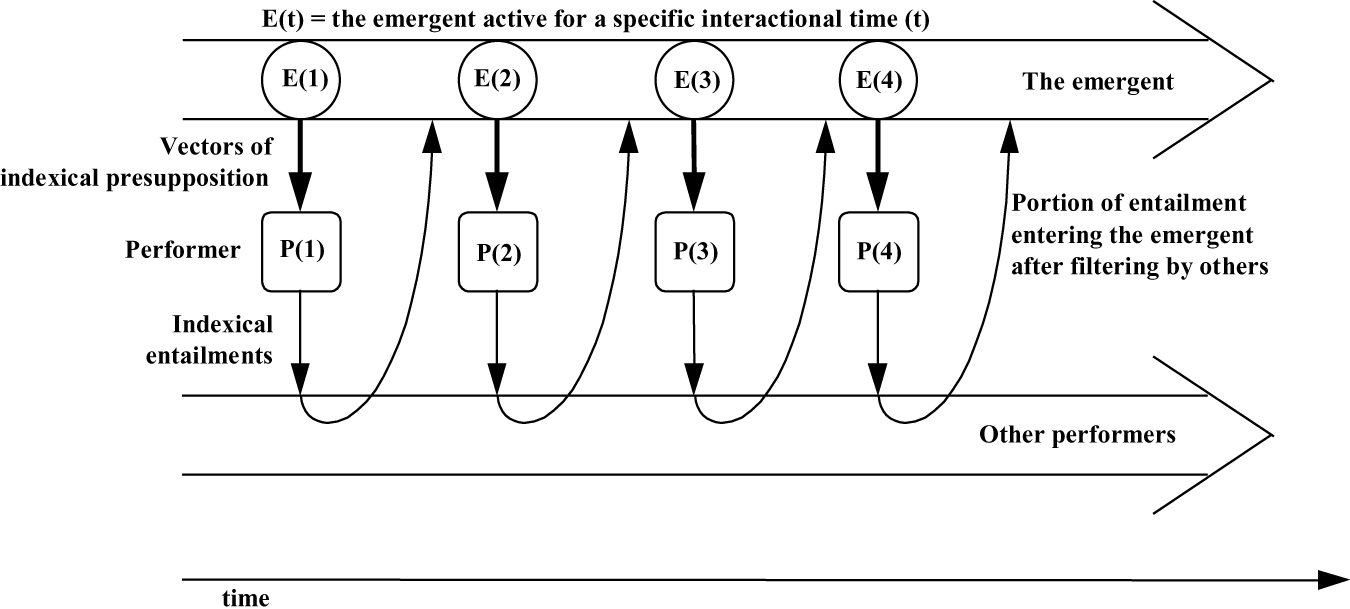
In the following, I draw on a semiotic theoretical framework that I developed in the 1990s and 2000s (see Figure 1; Sawyer Reference Sawyer1996, Reference Sawyer2003a). This project originated with my 1996 paper titled “The semiotics of improvisation” (that was a partial inspiration for this special issue). This theory emphasizes that the study of improvised dialogues can contribute to our understanding of two processes that are present in all linguistic interaction. The first is improvisational emergence – the process whereby participants in a conversation collaborate to create their interactional context, or frame. The frame should be treated as a higher level of analysis that emerges from dialogue, and we must consider the frame to be analytically distinct from any participating individual’s mental representation of it and distinct from any single turn of dialogue. The second interactional process is that whereby participants are constrained and enabled by the interactional frame that emerges from their dialogue. This is downward causation. It is a causal relation between the frame, a higher level of analysis, and individual discursive action, a lower level of analysis.
A model of improvisation.

Figure 1 Long description
The diagram illustrates the interaction between emergent elements and performers over time. At the top, a horizontal arrow labeled 'The emergent' points to the right, with circles labeled E(1), E(2), E(3) and E(4) aligned along it. Above these circles, the text 'E(t) equals the emergent active for a specific interactional time (t)' is displayed. Below each circle, arrows labeled 'Vectors of indexical presupposition' point downward to rectangles labeled P(1), P(2), P(3) and P(4), representing performers. From each rectangle, arrows labeled 'Indexical entailments' point downward and curve back up to the next circle, indicating a cyclical interaction. To the right of the rectangles, another arrow labeled 'Portion of entailment entering the emergent after filtering by others' points upward to the circles. Below the performers, a horizontal arrow labeled 'Other performers' runs parallel to the emergent arrow. At the bottom, a horizontal arrow labeled 'time' points to the right, indicating the progression of time across the diagram.
In an improvisational encounter, such as everyday conversation, interaction between participants is immediate, durationally constrained to the moment of creation, and is mediated by linguistic signs. The process of creation is coincident with the moment of reception and interpretation by other participants.
Each performance act is subject to a variety of interactional forces: (1) the performer of the act, who contributes something new to the flow of interaction through indexical entailment; (2) the other participants in interaction; (3) the definition/constraints of the performance genre; (4) the independent regimenting force operating on the act which derives from the flow of the prior interaction, and constitutes Mead’s emergent (Reference Mead1932).
In improvisation, as in everyday conversation, the emergent may contain multiple topics, subtopics, and idiosyncratic interpretations of “what is going on,” which are all in play and activated to varying degrees, the balance shifting with each performance act. The emergent is structured but ephemeral, changes with each performance act, and emerges from the indexical presuppositions accumulated through the prior collective interaction. It is an intersubjective, social entity; it is not determined by any single performer. For the interaction to continue as an intersubjective, shared activity, the performers must work together in creating the emergent. The cultural norm of maintaining intersubjectivity in social interaction constrains each participant to contribute utterances that retain coherence with the emergent. Through downward causation, the emergent constrains a performance act on all levels mentioned above simultaneously: topic structure, relative role and status assignments, invocations of prior interactions, and voicings of recognized social roles and characters.
Semiotic entities – units of analysis – emerge improvisationally at several semiotic levels of analysis. The higher levels take longer to emerge, and once they emerged, they have greater stability and continue to exist for longer. Each of these emergent phenomena provides data for semiotic analysis:
• Language (e.g., the English language)
• Genre (Chicago-style improvisational theater)
• Genre of the scene being performed (husband and wife talking while cooking)
• Relationships emergent in the scene (the husband and wife are arguing)
• Interactional sequences across lines of dialogue (the specific utterances and their presuppositions and entailments)
We can characterize the process of improvisational creativity as follows. At the highest level of analysis, performers are constrained by their language. Next, the highest level of analysis specific to stage acting is the performance genre; in this case, the genre is “improvisation in the Chicago style.” At the next lowest level, in the improvisations of socially situated language use, genres range from formal (a job interview) to informal (with friends at a bar). In improvisational genres, each performer is expected to contribute something original to the evolving emergent in each act, a rule that actors are taught called “Yes, And.” All of these social phenomena pre-exist an improvised performance.
As the performance unfolds, a given act is more narrowly constrained by the emergent elements of the performance. The nature of this constraint is unique and specific to the performance and the moment of interaction. In choosing their next action, performers are subject to the constraints of all of these emergent entities. In response to the performer’s action, the other participants evaluate the act, and the subsequent interaction determines to what extent the projected scene suggested by the act affects the emergent. This evaluation is often immediate and often not consciously goal-directed. A more skillful action is more likely to enter the emergent, thus operating with more force on subsequent performance acts.
Improvisation is a continuing process: a performer, constrained by the collectively created emergent, originates an action with implications for the unfolding scene; the other actors, through their responses in subsequent actions, collectively determine the extent to which this act enters the emergent; the new emergent then similarly constrains the subsequent performers. Improvisational creativity is the continued introduction of novelty in the form of a new topic or subtopic, or shifting the role relationships of the participants, while satisfying the downward constraints of the emergent. The collective frame is always emerging and evolving. Emergence is fundamental in collective human action; it never stops.
Conclusion
This paper has combined concepts from the philosophy of social science, semiotics, and interaction analysis to develop a theory of improvisational emergence. I argue that this theory provides an account of the relation between structure and agency, micro and macro levels of social reality, practice theories, and structural theories. Further, it claims a central theoretical role for group creativity and improvisational action. I began by defining ontological individualism as the position that all social entities are composed of people and material artifacts and nothing else. The foundational questions then are: What is social? Does the social exist? If so, how does it come to exist? Do social entities have causal force? If the social exists, and an ontological individual is granted, then social entities must emerge from interactions among individuals.
Once social entities have emerged, they take on causal force, and they constrain future individual action and interaction. All semiotic interaction takes place in the dialectic of structure and agency, the dialect of emergence and downward causation. The theory of improvisational emergence explains the relationships between psychology, symbolic interaction, and anthropology.
Competing interests
The author has no competing interests.

 Open access

