


Statement of Research Significance
Research Question(s) or Topic(s): Although the relationships between neurocognitive function, mental health, and concussive symptomatology have been studied among military members and Veterans, the causal structure underlying these constructs have not been tested explicitly. Using data collected from Canadian Armed Forces’ breachers and snipers and military controls, we specified causal assumptions through Directed Acyclic Graphs and tested them using Bayesian factor analysis models to estimate latent neurocognitive function and evaluate its relationship with mental health symptoms and concussion-related symptomatology. Main Findings: Compared to controls and breachers, snipers specifically exhibited lower neurocognitive performance. Both breachers and snipers exhibited better mental health status than controls. Study Contributions: Our novel finding is that when the focus is on repeated occupational exposure to low-level blast, its effect on neurocognitive status differs between breachers and snipers and is not mediated by mental health status. This dissociation can influence decisions about diagnosis, clinical interventions and rehabilitation.
Introduction
In the context of previous military conflicts such as Operation Enduring Freedom (OEF) and Operation Iraqi Freedom (OIF), there is growing appreciation of the effects of blast exposure on the health and performance in service members and Veterans (Belding et al., Reference Belding, Englert, Fitzmaurice, Jackson, Koenig, Hunter, Thomsen and da Silva2021a; Robinson-Freeman et al., Reference Robinson-Freeman, Collins, Garber, Terblanche, Risling, Vermetten, Besemann, Mistlin and Tsao2020; Swanson et al., Reference Swanson, Isaacson, Cyborski, French, Tsao and Pasquina2017). Much of the focus has been on head trauma, because 10 – 20% of service members and Veterans returning from those conflicts sustained a traumatic brain injury (TBI). Furthermore, the majority of those TBIs were the result of direct exposure to blast (Tanielian & Jaycox, Reference Tanielian and Jaycox2008). Specifically, according to US Department of Defense (DoD) records, more than 73% of OEF/OIF casualties were caused by explosives, and the majority of TBIs were as a result of improvised explosive devices (IEDs) (Galarneau et al., Reference Galarneau, Woodruff, Dye, Mohrle and Wade2008). Given that 10–15% of blast and/or impact-related TBI cases continue to report persistent post-concussive symptoms after the resolution of initial symptoms (Aldag et al., Reference Aldag, Armstrong, Bandak, Bellgowan, Bentley, Biggerstaff, Caravelli, Cmarik, Crowder, DeGraba, Dittmer, Ellenbogen, Greene, Gupta, Hicks, Hoffman, Latta, Leggieri, Marion and Zheng2017), there is a need to increase our understanding of this condition to improve the treatment and rehabilitation of the affected service members and Veterans (DePalma et al., Reference DePalma, Burris, Champion and Hodgson2005).
In studying the impact of blast-induced TBI on health and performance, an important question to ask is whether there is a unique mechanism of injury associated with blast-induced TBI compared to other sources of injury (e.g., blunt trauma) (Orr et al., Reference Orr, Lesha, Kramer, Cecia, Dugan, Schwartz and Einhaus2024).Footnote 1 Belding et al. (Reference Belding, Englert, Fitzmaurice, Jackson, Koenig, Hunter, Thomsen and da Silva2021a) noted that most OEF and OIF studies have typically focused on what they referred to as high-level blast – defined as overpressure resulting from incoming munitions (e.g., rocket-propelled grenades, explosive charges, and IEDs). As such, it is reasonable to consider whether the physical dynamics associated with high-level blast represent a different mechanism of injury than acceleration–deceleration injuries, given the effect that explosives can have on both air-filled organs and/or organs surrounded by fluid-filled cavities within the body (Elsayed, Reference Elsayed1997; Mayorga, Reference Mayorga1997). One way to examine this question is by comparing the effects of blast-induced vs. non-blast-induced TBI on outcomes of interest, such as neurocognitive function. To the extent that this comparison can reveal clinically relevant differences, one may conclude that the mechanism of injury is an important factor in the characterization of this type of TBI, which could in turn inform treatment and rehabilitation choices (Kim et al., Reference Kim, Yeh, Ollinger, Morris, Hood, Ho and Choi2023).
Toward that end, Belanger et al. (Reference Belanger, Kretzmer, Yoash-Gantz, Pickett and tupler2009) compared the performance of participants diagnosed with blast-induced TBI vs. participants diagnosed with non-blast-induced TBI (e.g., motor vehicle accident, fall, assault) on a set of neurocognitive measures.Footnote 2 The severity of their injuries ranged from mild to moderate to severe TBI. The results did not reveal any meaningful difference between the two groups on any measure of neurocognitive function, although participants with blast-induced TBI were more likely to report symptoms of posttraumatic stress disorder (PTSD) as measured by the PCL-5 (The PTSD Checklist, Weathers et al., Reference Weathers, Huska and Keane1991), with greater reporting of symptoms with passage of time. In a follow-up study, Belanger et al. (Reference Belanger, Proctor-Weber, Kretzmer, Kim, French and Vanderploeg2011) focused on participants with blast-induced vs. non-blast-induced mild TBI who were administered the Neurobehavioral Symptom Inventory (NSI, Cicerone & Kalmar, Reference Cicerone and Kalmar1995) and the PCL-5. The NSI is a self-report measure of post-concussive symptom complaints which are broken down into three different types of complaints (cognitive, affective, and somatic). Symptom reporting on the NSI did not differ between participants with blast-induced vs. non-blast-induced mild TBI, but it was greater for those with higher levels of PTSD symptomatology and those who had been injured more than one month prior to assessment compared to those injured within one month of assessment. Still, others have reported that it is a combination of blast-induced mild TBI coupled with PTSD that can cause the largest effects on neurocognitive function. For example, Pagulayan et al. (Reference Pagulayan, Rau, Madathil, Werhane, Millard, Petrie, Parmenter, Peterson, Sorg, Hendrickson, Mayer, Meabon, Huber, Raskind, Cook and Peskind2018) administered a set of prospective and retrospective memory measures to OEF/OIF/OND (Operation New Dawn) Veterans with a self-reported history of blast-related mild TBI, as well as Veterans with no history of blast exposures or TBI and no current PTSD (i.e., controls).Footnote 3 The results demonstrated that it was Veterans with blast-related mild TBI and current PTSD that performed worse on prospective memory tasks than Veterans with blast-related mild TBI without current PTSD or controls. In summary, studies assessing neurocognitive function did not provide support for the inference that blast-induced TBI is associated with a pathophysiological outcome that is different than non-blast-induced TBI. Rather, they suggest that PTSD symptomatology is elevated following blast exposure and that it could be a contributing factor to impairments in neurocognitive function (for review see, Bogdanova & Verfaellie, Reference Bogdanova and Verfaellie2012).
This conclusion is reinforced by other studies that have found that PTSD symptomatology can explain the bulk of neurocognitive effects observed following blast exposure – both objectively and subjectively. Storzbach et al. (Reference Storzbach, Twamley, Roost, Golshan, Williams, O’Neil, Jak, Turner, Kowalski, Pagulayan and Huckans2017) compared the performance of OEF/OIF Veterans with blast-induced mild TBI, Veterans with blast exposure but without a history of mild TBI, Veterans with no blast exposure or mild TBI, and matched civilian controls on a wide host of neuropsychological and neurocognitive measures.Footnote 4 When the two blast-exposed groups were compared to non-blast-exposed Veterans, no differences were found after adjusting for PTSD symptomatology. In turn, Karr et al. (2019) focused on subjective decline in executive functions among OEF/OIF/OND Veterans who had experienced blast-induced mild TBI. Specifically, the participants provided retrospective ratings of pre- and post-injury difficulties in executive functions using the Frontal Systems Behavior Scale (Grace & Malloy, Reference Grace and Malloy2001) and completed a battery of neuropsychological and neurocognitive measures.Footnote 5 As expected, the results demonstrated greater perceived difficulties in executive functions post-injury compared to pre-injury. Importantly, this subjective sense of decline in executive functions was predicted exclusively by self-reported PTSD symptomatology. This finding further suggests the role of mental health in neurocognitive functioning.
Several studies have since examined whether the effect of blast-induced TBI on neurocognitive function could be moderated by injury severity – measured via number of TBIs, physical proximity to the source of blast, or loss of consciousness (LOC). The basic assumption guiding this research is that more severe blast injuries will be related to worse neurocognitive outcomes. For example, Lippa et al. (Reference Lippa, Pastorek, Benge and Thornton2010) administered the NSI and the PCL-5 to Veterans with mild TBI who fell into one of three conditions (blast-induced, non-blast-induced, and an admixture of blast- and non-blast-induced injuries), while accounting for number of blast-related injuries as well as physical proximity to blast. Veterans with any blast-induced mild TBI reported higher PCL-5 scores but not NSI scores compared to those with non-blast-induced mild TBI, and this effect was not moderated by the number of blast-related injuries or proximity to blast. A meta-analysis based exclusively on data collected from athletes who had experienced single vs. multiple mild TBIs also found no effect for number of TBIs on neuropsychological functioning across many domains of cognition (Belanger et al., Reference Belanger, Spiegel and Vanderploeg2010). These findings cast doubt on the idea that injury severity, as measured by the number of mild TBIs, is a contributing factor to neurocognitive impairment. In turn, Verfaellie et al. (Reference Verfaellie, Lafleche, Spiro and Bousquet2014) administered a large battery of neurocognitive, neuropsychological, and motor function tests to blast-exposed OEF/OIF Veterans who had either experienced mild TBI with LOC, mild TBI without LOC, or no TBI at all.Footnote 6 They also took the number of blast events and physical proximity to blast into consideration. Mild TBI had no effect on outcomes, and neither did number of blast events or physical proximity to blast. In contrast, PTSD and depression scores predicted neurocognitive performance. In turn, Dunbar et al. (Reference Dunbar, Raboy, Kirby, Taylor and Roy2019) examined the effects of PTSD, depression and number of TBIs (ranging from 0 to 3+) on neurocognitive function as measured by the NIH Toolbox Cognitive Battery – a brief iPad-based assessment of cognitive domains deemed most relevant to daily functioning (Heaton et al., Reference Heaton, Akshoomoff, Tulsky, Mungas, Weintraub, Dikmen, Beaumont, Casaletto, Conway, Slotkin and Gershon2014; Weintraub et al., Reference Weintraub, Dikmen, Heaton, Tulsky, Zelazo, Bauer, Carlozzi, Slotkin, Blitz, Wallner-Allen, Fox, Beaumont, Mungas, Nowinski, Richler, Deocampo, Anderson, Manly, Borosh, Havlik, Conway, Edwards, Freund, King, Moy, Witt and Gershon2013). Although univariate analyses demonstrated that PTSD, depression, and number of TBIs were independently associated with impaired neurocognitive function, a multiple regression analysis identified PTSD symptom severity as the only driver of the effect. This prompted the authors to conclude that neurocognitive impairment following TBI is associated predominantly with the presence of PTSD symptomatology. To the best of our knowledge, the only study to have found that physical proximity to blast impacts neurocognitive function was conducted by Grande et al. (Reference Grande, Robinson, Radigan, Levin, Fortier, Milberg and McGlinchey2018) involving OEF/OIF/OND Veterans who were categorized as either close-range (i.e., at least one blast event within 10 m) or not.Footnote 7 However, Lu et al. (Reference Lu, Reid, Troyanskaya, Scheibel, Muncy and Kennedy2022) did not replicate this finding, based on data from OIF/OEF/OND blast-exposed Veterans who were categorized as close-range or non-close-range, as well as a comparison group of participants without any blast exposure.Footnote 8
Present study
The studies reviewed above suggest that there is some degree of comorbidity involving blast-induced mild TBI, post-concussive symptomatology, and mental health outcomes (Belding et al., Reference Belding, Englert, Fitzmaurice, Jackson, Koenig, Hunter, Thomsen and da Silva2021a-b; Carr et al., Reference Carr, Kelley, Toolin and Weber2020; see also Bryden et al., Reference Bryden, Tilghman and Hinds2019; Lange et al., Reference Lange, Pancholi, Brickell, Sakura, Bhagwat, Merritt and French2012; Leuthcke et al., Reference Leuthcke, Bryan, Morrow and Isler2011). However, to date, the causal relationships involving these constructs have not been tested explicitly. Here, we provided and tested a possible causal model using a directed acyclic graph (DAG) describing the effect of occupation-related exposure to repetitive low-level blast on neurocognitive function, while also considering the influence of mental health and concussion symptomology. We were particularly keen to determine whether membership in occupations that involve repetitive exposure to low-level blast would lead to poorer neurocognitive status and whether this effect would be mediated by mental health status. Note that the DAG provides a heuristic, not a definitive truth, by making all scientific and modeling assumptions explicit to the reader. While many alternative DAGs are possible – and variables can be added indefinitely – we focused on a simple model for a specific scientific question: Does neurocognitive status differ by occupational group, and does mental health symptomatology influence this relationship? In this sense the use of the term “causal” does not imply that we have provided a complete explanation of the phenomena under consideration. Rather, the term is used in the context of Pearl et al.’s (Reference Pearl, Glymour and Jewell2016) framework of causal inference, which provides the conditions under which valid effect estimation is possible given the data, conditional on the model being correct. To test this causal model, we collected data from Canadian Armed Forces’ (CAF) breachers and snipers, who by virtue of their occupations are exposed repeatedly to low-level blast overpressure in the course of training and operations, as well as sex- and age-matched active duty CAF members with substantially less exposure to blast as controls (i.e., military controls).
Although there is substantial evidence to suggest that both breachers and snipers are exposed to low-level blast in the course of their training and operations, the two occupations expose their members to varying physical forces. The key characteristics of the blast waves (i.e., peak overpressure and positive impulse) may differ slightly between explosive breaching and firing rifles (Kamimori et al., Reference Kamimori, Reilly, LaValle and Olaghere Da Silva2017; Lang et al., Reference Lang, Kamimori, Misistia, LaValle, Ramos, Ghebremedhin and Egnoto2018; Skotak et al., Reference Skotak, LaValle, Misistia, Egnoto, Chandra and Kamimori2019; Thangavelu et al., Reference Thangavelu, LaValle, Egnoto, Nemes, Boutté and Kamimori2020; Wiri et al., Reference Wiri, Massow, Reid, Whitty, Dunbar, Graves, Gonzales, Ortley, Longwell, Needham, Ziegle, Phan, Leonessa and Duckworth2023), depending on various factors such as charge sizes and standoff or weapon caliber and muzzle devices. More importantly, firing sniper rifles also applies recoil forces to the shoulder, which in turn can put the head into rapid motion. Previous studies have shown that the linear and rotational head kinematics induced from rifle recoil can be of the same order of magnitude as other repeated head kinematic events studied for their potential effects on brain health, such as heading balls in soccer (Seeburrun et al., Reference Seeburrun, Hartlen, Bustamante, Azar, Ouellet and Cronin2023, Reference Seeburrun, Bustamante, Hartlen, Azar, Ouellet and Cronin2024; see also Ouellet & St-Onge, Reference Ouellet and St-Onge2021). This evidence suggests that in terms of blast waves and recoil, breachers and snipers could be exposed to different physical forces acting on their brains and bodies, which could in turn impact our outcome measures of interest (i.e., neurocognitive function, mental health, and post-concussive symptomatology) to varying extents. For this reason, we examined differences between breachers and snipers vis-à-vis controls, as well as each other. By providing a simple heuristic scientific model that explicitly states the relationships involving these core constructs in the context of repetitive exposure to low-level blast, we aimed to facilitate our understanding of the potential effects of blast-exposed occupations on health, and to promote replicability and inferential clarity in future studies.
Method
Participants
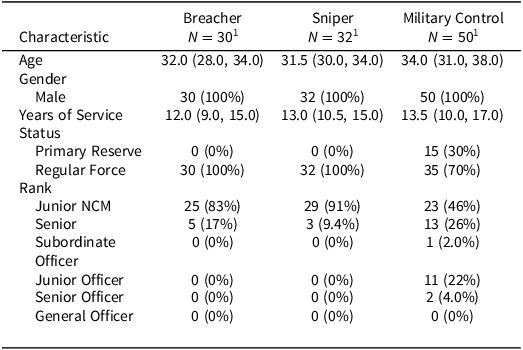
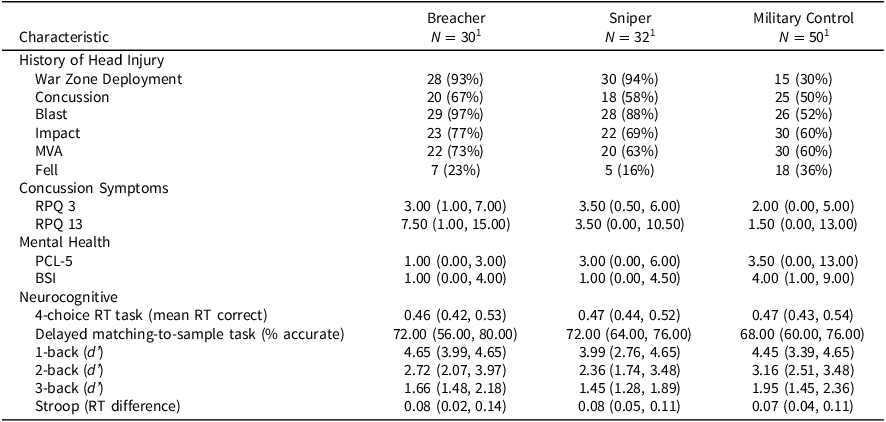
The protocol for this study was approved by Defence Research and Development Canada’s Humans Research Ethics Committee (DRDC HREC). The research was completed in accordance with the Helsinki Declaration, and all participants provided informed consent before taking part in the study. The participants consisted of CAF breachers (n = 30) and snipers (n = 32) with occupational exposure to repetitive low-level blast in the context of training and operations, as well as sex- and age-matched CAF military controls (n = 50) with no occupational history as breachers or snipers. All the breachers and snipers were recruited from a single CAF base located in Ontario. Information about the study was made available by various means (e.g., email, poster). If a member indicated interest in participating in the study, then further detailed information was provided by a member of the research team to enable informed consent. In turn, all sex- and age-matched CAF controls were recruited from various bases located throughout Ontario, using the same means (e.g., email, poster). Data collection from controls lagged data collection from breachers and snipers by a few months to enable us to match the sex and age of potential control participants with specific breachers and snipers already in the dataset. The demographics for the three groups are presented in Table 1. It is possible that military control participants might nevertheless have been exposed to some degree of low-level blast during their careers, which is why they were also asked about their history of blast exposure. Unlike high-level blast, low-level blast is defined as overpressure resulting from outgoing munitions, such as firing heavy weapons systems (e.g., artillery) and/or rifles (e.g., .50 caliber guns), and can also result in impairments in health and performance as measured by post-concussive symptomatology, hearing, musculoskeletal function, brain structure, and neurological biomarkers in blood (Belding et al., Reference Belding, Englert, Bonkowski and Thompson2021b, Miller et al., Reference Miller, DiBattista, Patel, Daley, Tenn, Nakashima, Rhind, Vartanian, Shiu, Caddy, Garrett, Saunders, Smith, Jetly and Fraser2022; Nakashima et al., Reference Nakashima, Vartanian, Rhind, King, Tenn and Jetly2022; Rhind et al., Reference Rhind, Shiu, Tenn, Nakashima, Jetly, Sajja, Long and Vartanian2025; Vartanian et al., Reference Vartanian, Tenn, Rhind, Nakashima, Di Battista, Sergio, Gorbet, Fraser, Colantonio, King, Lam, Saunders and Jetly2020, Reference Vartanian, Coady, Blackler, Fraser and Cheung2021, Reference Vartanian, Rhind, Nakashima, Tenn, Lam, Shiu, Caddy, King, Natale and Jetly2022). Similarly, it is possible that all groups could have been exposed to some degree of high-level blast (e.g., rocket-propelled grenades, explosive charges, and IEDs) during operations in theater. As such, we probed this possibility by asking them to report whether they had been deployed to a war zone or not (Table 2).
Participant demographics

1 Median (Q1, Q3); n (%).
Psychological, neurological and brain injury measures

MVA = motor vehicle accident; RPQ = rivermead post concussion symptoms questionnaire; PCL = Posttraumatic stress disorder checklist; BSI = Brief Symptom Inventory; RT = reaction time.
1 n (%); Median (Q1, Q3).
Materials and procedures
All participants completed the paper-and-pencil and computerized measures in a single sitting.Footnote 9 The paper-and-pencil measures included questions about one’s occupational history, such as years of service in the military, exposure to blast and warzone deployment. History of head injury was measured by asking each participant to indicate, via self-report, whether they had experienced a set of events associated with head injury in the past (yes/no), including concussion, impact to the head, motor vehicle accidents (MVA), and having fallen as a child (Table 2).
We administered the Rivermead Post Concussion Symptoms Questionnaire (RPQ, Eyres et al., Reference Eyres, Carey, Gilworth, Neumann and Tennant2005; King et al., Reference King, Crawford, Wenden, Moss and Wade1995) to measure post-concussive symptoms. The RPQ includes 16 items, each of which represents a symptom associated with concussion. For each symptom, participants were asked to indicate whether they had experienced it as a function of injury to the head using a 5-point scale (0 = not experienced at all, 4 = a severe problem).Footnote 10 The “early” post-concussive symptoms are typically measured using the first three items on the scale, including headache, feelings of dizziness, and nausea and/or vomiting (i.e., RPQ3). In turn, the “late” post-concussive symptoms are measured using the final thirteen items on the scale, including sleep disturbance and fatigue (i.e., RPQ13). In the present study we used a single aggregate score that included all sixteen items (i.e., RPQ).
We administered two measures for assessing mental health. Symptomatic criteria for PTSD were assessed using the PCL-5, according to the Diagnostic and Statistical Manual of Mental Disorders (DSM-5) (Weathers et al., Reference Weathers, Litz, Keane, Palmieri, Marx and Schnurr2013). The PCL-5 has 20 items. Participants are informed that each item represents a problem people sometimes have in response to a very stressful experience (e.g., repeated, disturbing dreams of the stressful experience) and are asked to indicate the extent to which they have been bothered by that problem using a 5-point scale in the past month (0 = not at all, 4 = extremely). Second, we administered the BSI-18 (Derogatis, Reference Derogatis2000). The BSI contains 18 items, each of which describes a symptom. The 18 items are broken down into three 6-item subscales for assessing somatization (e.g., numbness, faintness), anxiety (e.g., nervousness, spells of panic), and depression (e.g., feeling lonely, feeling blue) using a 5-point scale (0 = not at all, 4 = very much). The participants were instructed to indicate how much they have been bothered by the symptom in the prior week.
Neurocognitive functions were assessed using the Cognitive Test Software (Grushcow, Reference Grushcow2008). This involved the computerized administration of four measures in sequence. CAF norms for the four measures were developed by Nakashima et al. (Reference Nakashima, Vartanian, Bouak, Hofer, Aiken and Bélanger2011) for two tasks that measure elementary cognitive functions and two tasks that measure executive functions (i.e., working memory updating and inhibition): (1) Delayed matching-to-sample (dMTS): This test assessed short-term visual (iconic) memory and pattern recognition (Miller et al., Reference Miller, Erickson and Desimone1996; Shurtleff et al., Reference Shurtleff, Thomas, Schrot, Kowalski and Harford1994). For dMTS, the dependent variable was accuracy (i.e., percentage correct out of 25 trials). (2) Four-choice reaction time task (4-choice RT task): This test assessed the ability to respond rapidly and accurately to simple visual stimuli presented on a computer screen (Dollins et al., Reference Dollins, Lynch, Wurtman, Deng, Kischka, Gleason and Lieberman1993). For the 4-choice RT task, the dependent variable was the RT associated with correct responses. (3) n-back: This is a test of working memory performance and requires the maintenance and updating of dynamic rehearsal sets (Conway et al., Reference Conway, Kane, Bunting, Hambrick, Wilhelm and Engle2005; Kane et al., Reference Kane, Conway, Miura and Colflesh2007). In the present study, n had a range of 1 – 3. For the n-back, the dependent variable was d’ (i.e., sensitivity), calculated based on signal detection theory (Stanislaw & Todorov, Reference Stanislaw and Todorov1999). Specifically, higher d’ values reflect greater sensitivity, whereas a d’ nearing zero reflects chance performance. (4) Stroop: This is a test of executive functions, specifically inhibition (Stroop, Reference Stroop1935). For Stroop, the dependent variable was the difference in RT for correctly identifying the color of incongruent word trials (e.g., the word RED appearing in blue) vs. RT for correctly identifying the color of congruent word trials (e.g., the word RED appearing in red). The prediction is that there will be a penalty (i.e., greater RT) associated with processing incongruent vs. congruent word trials. The specific parameters for each of the four tasks within the Cognitive Test Software (i.e., number of trials, inter-trial interval, foils, etc.) were identical to those used in Vartanian et al. (Reference Vartanian, Tenn, Rhind, Nakashima, Di Battista, Sergio, Gorbet, Fraser, Colantonio, King, Lam, Saunders and Jetly2020) that examined the effects of blast exposure on neurocognitive performance in a sample of breachers and range staff and sex- and age-matched military controls.
Data analysis
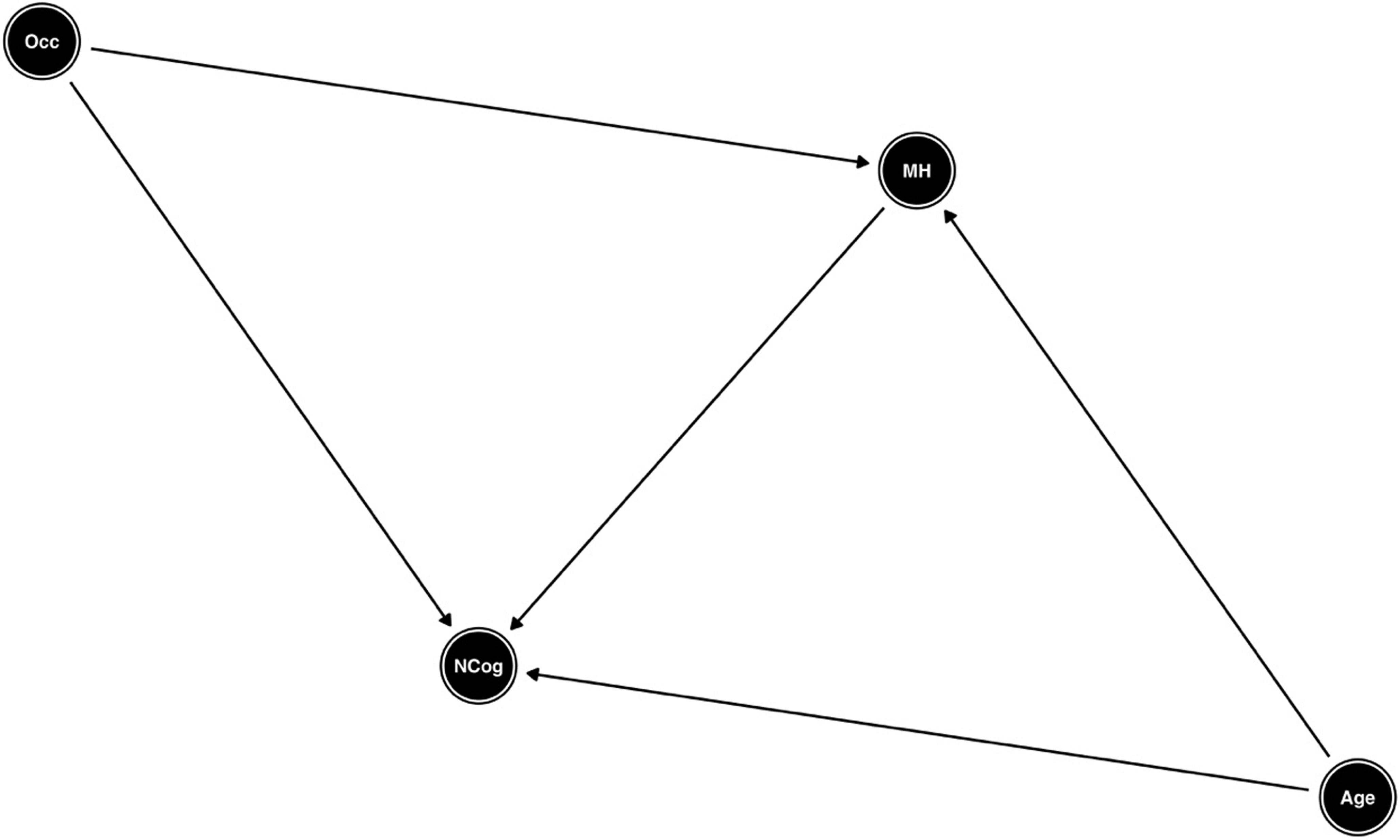
The primary aim of this study was to evaluate whether military occupations with higher repetitive exposure to low-level blast (i.e., breachers and snipers) display differences in neurocognitive status, and whether these differences are mediated by self-reported mental health symptoms. A secondary aim was to examine whether these occupations display differences in chronic concussion symptoms. These beliefs were motivated by prior research, specifically by findings to suggest that high-level and/or low-level blast exposure is associated with worse neurocognitive function (e.g., Cifu, Reference Cifu2022; Sheppard et al., Reference Sheppard, Rau, Trittschuh, Werhane, Schindler, Hendrickson, Peskind and Pagulayan2023), poor mental health (e.g., Belanger et al., Reference Belanger, Kretzmer, Yoash-Gantz, Pickett and tupler2009, Reference Belanger, Proctor-Weber, Kretzmer, Kim, French and Vanderploeg2011; Cifu, Reference Cifu2022), and greater post-concussive symptomatology (e.g., Vartanian et al., Reference Vartanian, Tenn, Rhind, Nakashima, Di Battista, Sergio, Gorbet, Fraser, Colantonio, King, Lam, Saunders and Jetly2020, Reference Vartanian, Coady, Blackler, Fraser and Cheung2021, Reference Vartanian, Rhind, Nakashima, Tenn, Lam, Shiu, Caddy, King, Natale and Jetly2022). Furthermore, there was reason to believe that mental health could mediate the relationship between blast exposure and neurocognitive function (see Belanger et al., Reference Belanger, Proctor-Weber, Kretzmer, Kim, French and Vanderploeg2011; Pagulayan et al., Reference Pagulayan, Rau, Madathil, Werhane, Millard, Petrie, Parmenter, Peterson, Sorg, Hendrickson, Mayer, Meabon, Huber, Raskind, Cook and Peskind2018; Bogdanova & Verfaellie, Reference Bogdanova and Verfaellie2012). As such, we believed that occupations with greater repetitive exposure to low-level blast – breachers and snipers in the current study – would have worse neurocognitive status compared to their military control counterparts. We also believed that these effects would be mediated, in part, by mental health symptoms and may vary by age (Figure 1).
Directed acyclic graph (DAG) of the effect of occupation on neurocognitive status and mental health outcomes.
Notes. occ = occupation (Breachers, snipers or military controls); NCog = neurocognitive status; MH = mental health symptoms. A heuristic scientific model in the form of a directed acyclic graph used to derive statistical models to estimate the effect of military occupations on neurocognitive status while adjusting for mental health symptom mediation.

Data
The dataset is a 112-row × 28-column matrix consisting of 1) neurocognitive measures (six variables): 4-choice Reaction Time, Delayed Matching-to-Sample, N-back (1-back, 2-back, 3-back), and Stroop tasks; 2) mental health measures (four variables): PCL-5 Total Symptom Severity and the BSI somatization, anxiety, and depression subscales; 3) concussion symptoms (16 items): measured via the RPQ; and 4) demographics (two variables): age and military occupation. Participants’ age was included as a covariate, following adjustment requirements from our causal model (see the directed acyclic graph [DAG], Figure 1). Military occupation was coded as a categorical variable with three levels: breachers (n = 30), snipers (n = 32), and CAF controls (n = 50). All other variables were either continuous (e.g., reaction time), ordinal (e.g., Likert-scale items from RPQ), or summated ordinal scores (e.g., BSI subscales). Neurocognitive function was modeled as a latent construct of the six neurocognitive measures mentioned above using Bayesian factor analysis. The Likert sums of the four mental health symptom variables were recoded into three ordered categories: none, low, and moderate to severe. These were derived as follows: “None” = score of 0, “Low” = ≤ median of non-zero values, “Moderate to severe” = > median of non-zero values. Concussion symptoms (RPQ items) were modeled as ordinal categorical outcomes without transformation.
Assumptions
Our modeling decisions were informed by the following assumptions:
-
1. Causal Structure: We assumed that occupational blast exposure affects neurocognitive status both directly and indirectly via mental health symptoms. We also allowed for occupation to influence mental health symptom severity. These assumptions are formalized in our heuristic DAG (Figure 1). While alternative models are possible, we selected this structure based on our primary study aim and used the DAG to transparently communicate and constrain model specification. The term “causal” is used to describe the assumed structure of the data-generating process and to justify covariate inclusion and adjustment based on the rules of causal inference (e.g., backdoor criteria) (Cinelli et al., Reference Cinelli, Forney and Pearl2020; Pearl et al., Reference Pearl, Glymour and Jewell2016).
-
2. Latent Variable Model: We assumed that neurocognitive status can be represented as a latent construct underlying six related but distinct neurocognitive tests.
-
3. Ordinal Treatment of Symptom Scales: The PCL-5 and BSI subscales were treated as ordered categorical variables with three severity levels, rather than continuous scores. RPQ items were likewise treated as ordered categorical variables comprising the Likert responses.
Estimands (quantities of interest)
To address the primary objective – whether occupational blast exposure is associated with neurocognitive status – and whether this is mediated by mental health symptoms, we estimated
-
1. The total effect of occupation on neurocognitive status.
-
2. The direct effect of occupation on neurocognitive status, adjusting for age and self-reported mental health symptoms.
For the secondary objective – whether concussion symptoms differ by occupational group – we estimated the difference in cumulative response probabilities for each RPQ item across the three occupational groups.
Estimators (models used)
Neurocognitive status was modeled using Bayesian factor analysis. The latent factor scores were then used as outcome variables in downstream student-t regression models. Student-t regression was used to estimate the effect of occupation on the a priori estimated latent neurocognitive scores. Ordinal logit models were used independently for the four mental health questionnaires (PCL-5, BSI subscales) as well as the sixteen RPQ items. For more detail, including the math stats notation for each model used in the manuscript, please refer to the Supplementary Methods.
Estimates (posterior inference)
Posterior densities were derived for all model parameters and relevant derived quantities using Hamiltonian Monte Carlo (HMC) implemented in Stan (Stan Development Team, 2023a). Estimates are reported as posterior means and 90% credible intervals with contrasts between groups framed as mean differences (for continuous outcomes) or mean differences in either cumulative or individual response probabilities (for ordinal outcomes).
For the primary aim, latent neurocognitive scores were first estimated via factor analysis. These posterior draws were then used as the outcome in a second-stage Student-t regression to estimate group differences in neurocognitive status. The total effect of occupational group on neurocognitive status was estimated without adjustment; the direct effect was estimated by including mental health symptoms and age as covariates in the regression model, as specified by the DAG adjustment set (Figure 1). Mental health symptoms were incorporated individually (PCL-5 and BSI subscales, not in the same model at once) and modeled as ordinal categorical covariates with three severity levels. In addition, to fully test our causal model and fulfill the DAG in its entirety, we modeled the four mental health symptom scales (PCL-5 and BSI subscales) as outcomes in separate ordinal logistic regression models. Each scale was categorized into three ordered severity levels (none, low, and moderate-to-severe), and group-level contrasts were computed to estimate the effect of occupational group on symptom severity level. In totality, these models represent the potential mediating paths from occupation to neurocognitive function via mental health symptoms.
For the secondary aim, group differences in RPQ responses were estimated using the ordinal regression model described earlier. Posterior cumulative response probabilities were computed for each RPQ item and occupational group. Group contrasts were calculated to summarize how occupational membership shifted the likelihood of reporting more (or less) severe symptoms.
Priors were specified through prior predictive simulation, ensuring that all parameters yielded scientifically plausible outcomes before conditioning on the data. In most figures, we display both prior and posterior distributions to illustrate the influence of the data on the inference. If not shown, full prior predictive diagnostics are available in the code repository. In addition, before data modeling, simulated data was used to evaluate model parameter recovery; simulation scripts can also be found in the code repository, with the exception of the factor model, for which the data and prior simulations are provided in our previous work (Di Battista et al., Reference Di Battista, Rhind, Shiu and Hutchison2024).
Model diagnostics included inspection of trace plots, R-hat statistics, and effective sample sizes. Posterior predictive checks were conducted for all outcome models to evaluate model fit.
Software
The software STAN provided the HMC engine (Stan Development Team, 2023a) which was interfaced through the RStan package (Stan Development Team, 2023b), run on R (Version 4.3) (R Development Core Team, 2023), using the RStudio integrated development environment. Model checks were aided by model checking and plotting utilities created by Michael Betancourt (https://betanalpha.github.io/code/). To help with post processing of the posterior samples, the R package “rethinking” was used (McElreath, Reference McElreath2020). Tables were made using the “gt” (Iannone et al., Reference Iannone, Cheng and Schloerke2021) and “gtsummary” (Sjoberg et al., Reference Sjoberg, Curry, Hannum, Larmarange, Whiting and Zabor2021) packages, and both latent factor and RPQ plots were created using the packages “ggplot2” (Wickham, Reference Wickham2016) and “tidybayes” (Kay, Reference Kay2021). The packages “ggdag” (Barret, Reference Barret2023) and “dagitty” (Textor et al., Reference Textor, van der Zander, Gilthorpe, Liskiewicz and Ellison2016) were used to create the DAG in Figure 1. Tidyverse packages (“dplyr” (Wickham et al., Reference Wickham, François, Henry and Müller2023), “tidyr” (Wickham & Henry, Reference Wickham and Henry2024) were also used to aid in posterior sample processing.
Reproducibility
Code used for all statistical modeling in this manuscript can be found in the following public GitHub repository: https://github.com/dibatti5/Di-Battista-et-al-Impact-of-Repetitive-Exposure-to-Low-level-Blast-on-Neurocognitive-Function-in-CAF. Data for the study will need to be requested formally from the CAF.
Results
Participant characteristics can be seen in Table 1. All groups were similar in age and were male; the groups were also similar in years of service (all ∼ 13 years). There were no officers among breachers and snipers, whereas 27% were officers among the controls.
However, the breachers and snipers were comprised of comparatively more junior non-commissioned members and fewer senior ranks. Psychological and neurological measures, as well as brain injury history can be found in Table 2. Briefly, compared to the military control group, the breachers and snipers had substantially more war zone deployment (93 and 94%, respectively vs 30%) and self-reported history of blast exposure (97 and 88%, respectively vs. 52%). The breachers and snipers also had a slightly higher reported history of concussion (67 and 58%, respectively vs. 50%).
Latent modeling of neurocognitive status
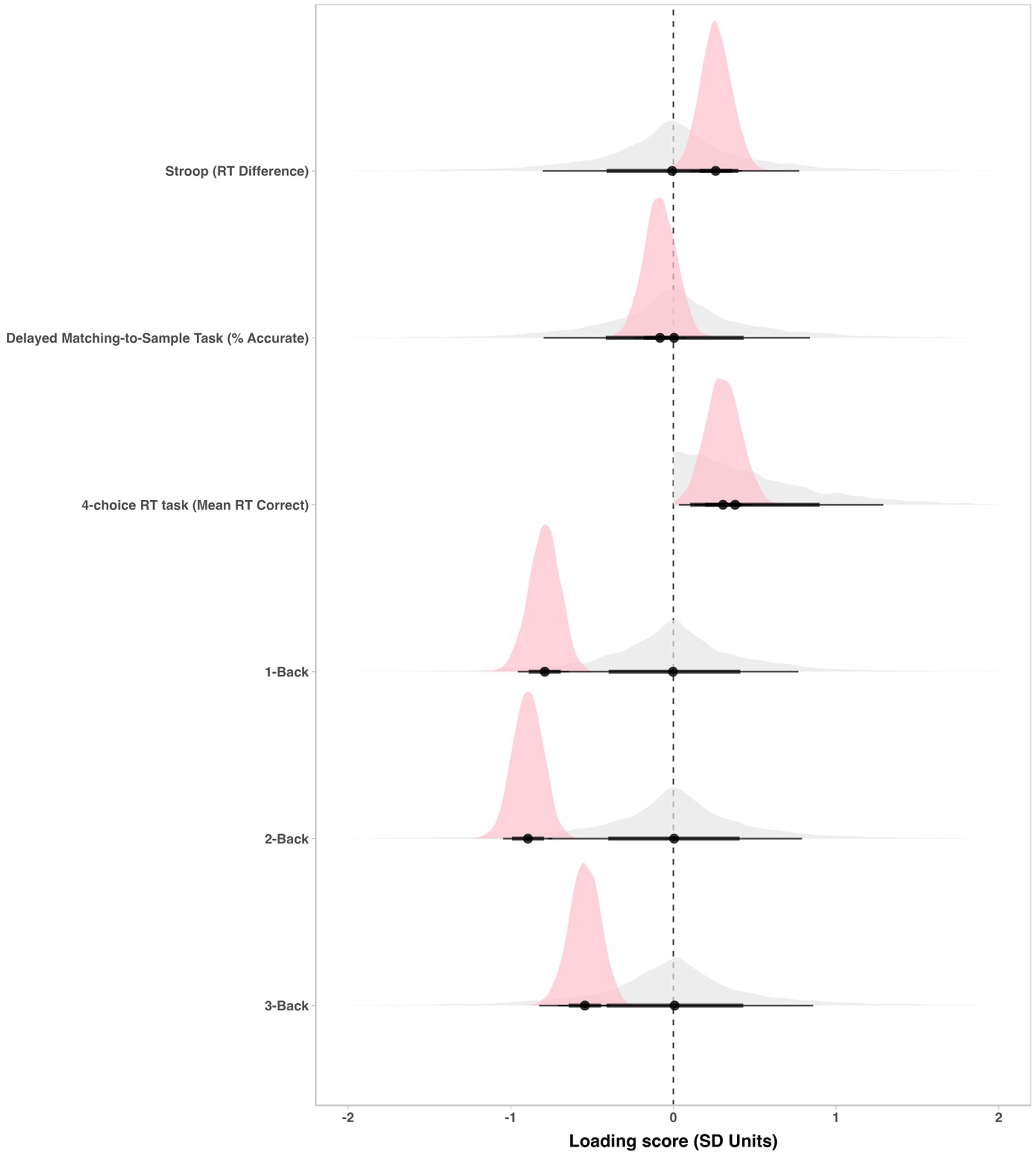
A latent variable of neurocognitive status was derived from the measures found under the heading “Neurocognitive” in Table 2. Positive loadings were seen for the 4-choice RT task and Stroop (RT Difference), although the strongest variable loadings were the negative loadings seen with the n-back tests (Figure 2). Hence, a higher latent variable score for neurocognitive status is correlated with slightly higher 4-choice RT task and Stroop values and more pronounced lower n-back and dMTS values, representing worse overall neurocognitive status.
Latent variable of neurocognitive status.
Notes. posterior densities of the loadings from each individual variable towards the latent measure of neurocognitive status in all military personnel (N = 112). The plots show the posterior densities of the correlation (x axis) of each individual measure to its respective latent variable while the grey densities represent the prior distributions. Plots were derived from 2000 posterior draws, dots represent the mean of the posterior densities, and the thick and thin lines represent the 70 and 90% intervals, respectively.

Effect of occupation on neurocognitive status
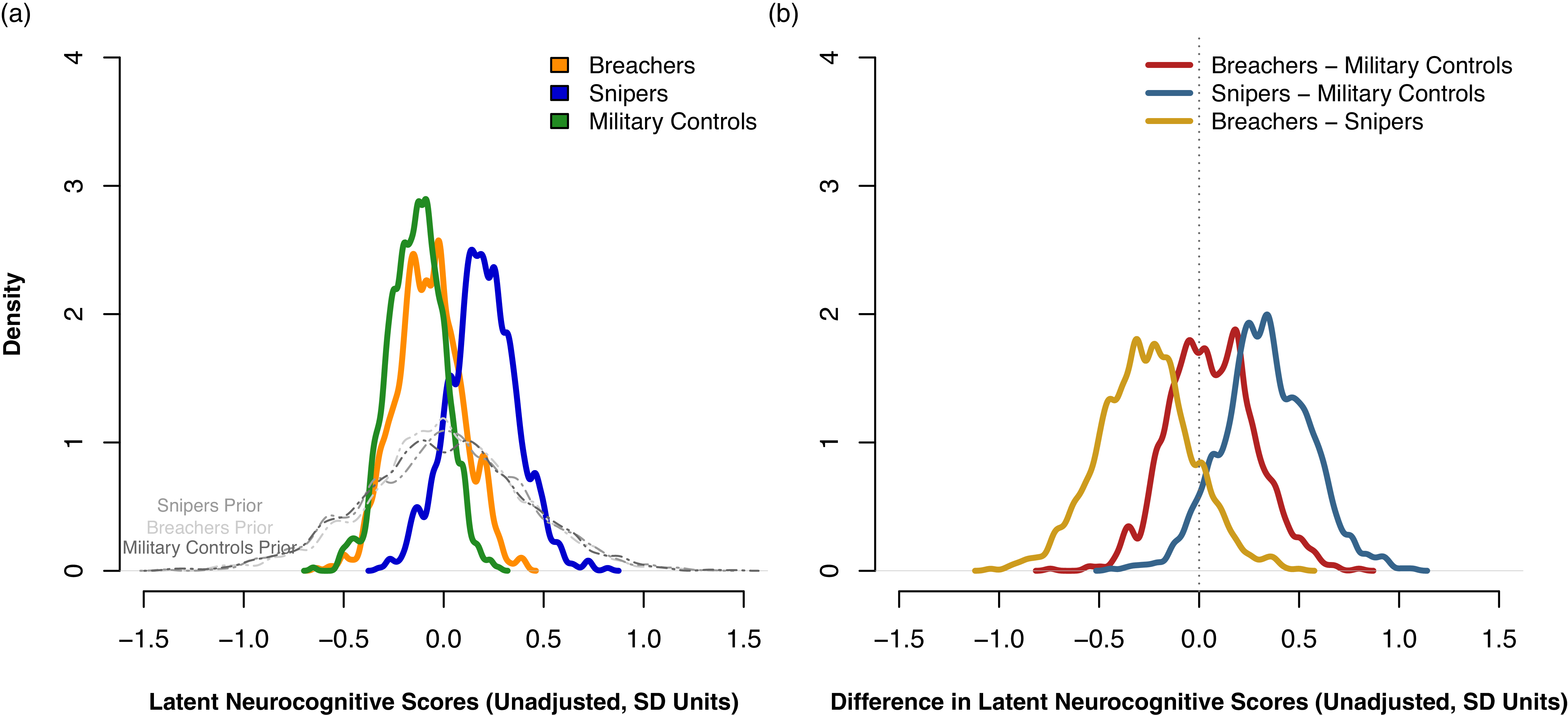
Estimates from student-t regression models on the effect of occupation on the latent variable representing neurocognitive status can be seen in Figure 3. Given the causal assumptions from our DAG (Figure 1), the total effect of occupation on neurocognitive status required no adjustments. We observed higher latent variable scores of neurocognitive status (i.e., worse performance) in snipers compared to both the military controls (estimated mean difference [emd] = 0.35 SD units, 90% CI = 0.01 – 0.7 SD units, posterior probability of the difference being greater than zero [pprob] = 96%) and breachers (emd = 0.28 SD units, 90% CI = -0.11 – 0.64 SD units, pprob = 89%). Breachers displayed similar neurocognitive function as military controls. Given that the latent variable of neurocognitive function was predominantly loaded by negative n-back performance, this suggests that snipers are performing worse on these metrics compared to both breachers and controls.
Effect of occupation on neurocognitive status.
Notes. posterior densities from student-t regression models evaluating the total effect of occupation (Breachers, snipers, military controls) on latent neurocognitive scores. Panel A shows posterior distributions of estimated neurocognitive scores by group; higher scores reflect worse cognitive performance. Panel B displays the posterior contrasts between groups. Regions to the right of zero indicate the posterior probability that a group had worse cognitive performance than the comparator. Distributions are based on 2,000 posterior draws: priors shown in grey.

Mediating effect of mental health symptoms
There was no evidence of a mediating effect of mental health symptoms on the relationship between occupation and neurocognitive status. Adjusting for the PCL-5, BSI somatization, anxiety, or depression subscales did not alter the group differences in latent neurocognitive status scores observed between groups. Please see Supplementary Figure 1 for an extended plot including all adjustments.
Effect of occupation on mental health symptoms
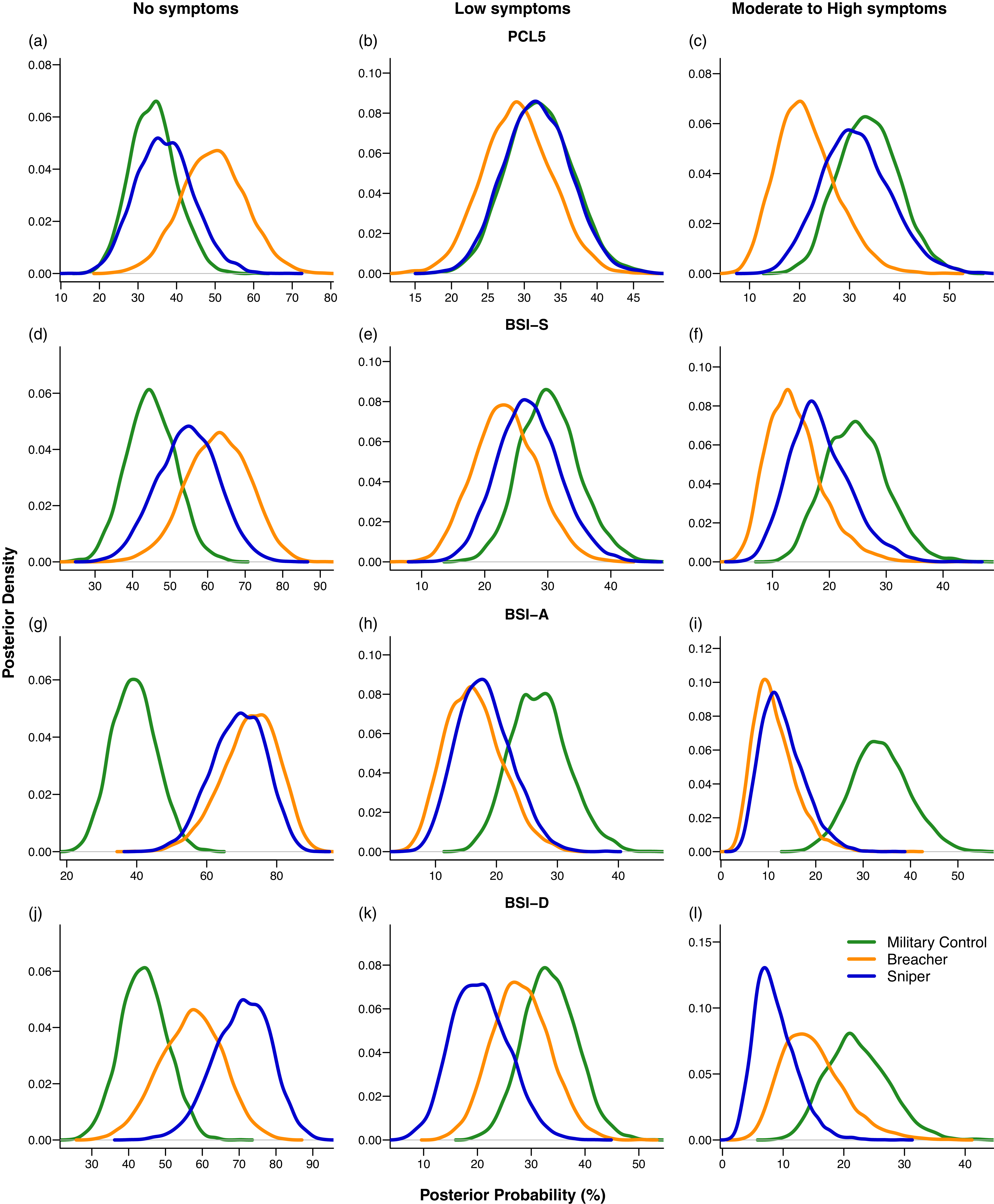
Posterior estimates from the ordinal logit models evaluating mental health symptom levels across occupations are shown in Figure 4. As specified by the DAG (Figure 1), no covariate adjustments were needed to estimate the total effect of occupation on mental health symptoms.
Posterior distributions of estimated symptom severity probabilities by occupation.
Notes. Posterior distributions of the estimated probability of falling into each of three mental health symptom severity levels - none, low, or moderate-to-high - for each occupational group, across four measures: PTSD (PCL-5), somatization (BSI-S), anxiety (BSI-A), and depression (BSI-D). Each panel displays group-specific probability distributions, where horizontal shifts between groups at a given severity level reflect differences in the likelihood of symptom endorsement. Distributions are based on 2,000 posterior draws; priors are omitted for clarity.

Military controls generally showed higher estimated probabilities of reporting moderate-to-high symptom levels compared to breachers and snipers (Figure 4, Panels C, F, I, and L). This difference was most pronounced in the BSI-Anxiety subscale: an estimated 33.5% (90% CI: 23.9% – 44%) of military controls were classified as moderate-to-high in BSI-A symptoms (> 3.5), compared to 11.2% (90% CI: 5.4% – 19.1%) for breachers and 13.2% (90% CI: 6.6% – 21.6%) for snipers (Figure 4, Panel I). The posterior probability (pprob) that these differences were greater than zero was 100% in both cases.
Conversely, breachers and snipers were more likely to report no symptoms compared to military controls across most questionnaires (Figure 4, Panels A, D, G, and J). While breachers and snipers showed similar symptom distributions in the BSI-A subscale, snipers had an estimated 10% higher probability (90% CI: –4% – 24%) of reporting moderate-to-high PTSD symptoms compared to breachers (PCL-5 > 5), with a pprob of 87%. In contrast, snipers had an estimated 6% lower probability (90% CI: –2.3% – 15.4%) of reporting moderate-to-high depression symptoms (BSI-D > 2) than breachers, with a posterior probability of 88%. For full posterior summaries and group-level contrasts across all categories, see Supplementary Table 1.
Effect of occupation on RPQ concussion symptoms
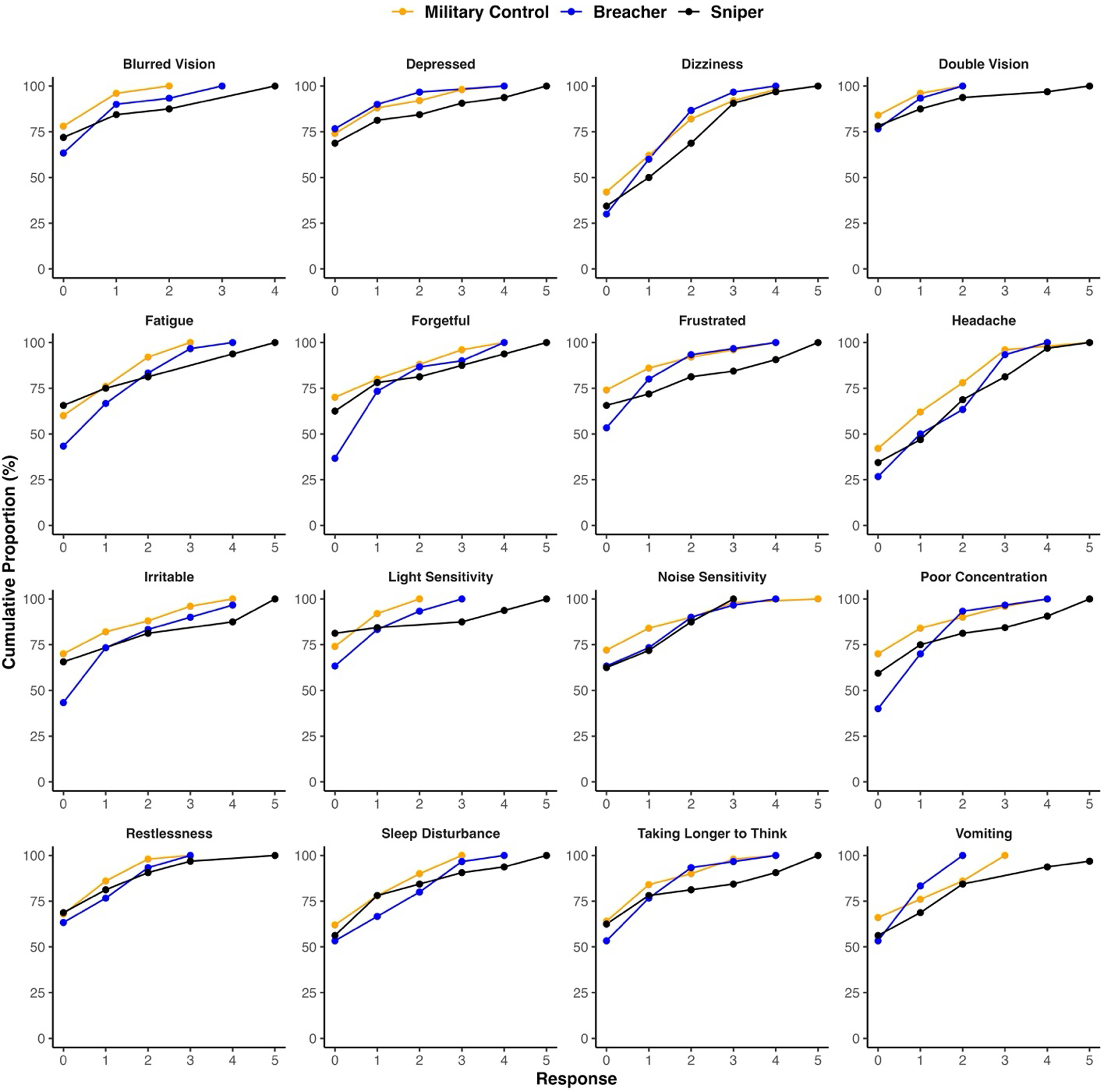
Each RPQ item was modeled independently as an ordinal outcome. Although posterior estimates were computed for all Likert responses, visualizing these for every item would create redundancy and obscure broader trends. Instead, we display the raw cumulative response distributions across occupational groups in Figure 5. Posterior summaries for group comparisons on each RPQ item are provided in Supplementary Tables 2 and 3.
Cumulative distributions of RPQ likert responses.
Notes. RPQ = Rivermead post concussion symptoms questionnaire. Line plots show the cumulative distribution of likert responses (x axis) for each of the 16 questions of the RPQ. Responses are shown for military controls (orange line), breachers (blue line), and snipers (black line). The y axis shows the cumulative proportion of participant responses across increasing values of the likert scale (0 – 5).

Breachers were generally more likely than military controls to report moderate-to-high symptom levels (RPQ ≥ 3), particularly for headache (estimated mean difference [EMD] = 8.4, 90% CI: –4.6% to 21.4%), forgetfulness (EMD = 10.0, 90% CI: 0.7% to 20.2%), poor concentration (EMD = 7.0, 90% CI: –0.7% to 16.9%), irritability (EMD = 7.4, 90% CI: –3.1% to 16.5%), and fatigue (EMD = 4.9, 90% CI: –3.9% to 15.1%). Each of these contrasts had a pprob of at least 80% of being greater than zero. In contrast, snipers reported higher symptoms relative to military controls only on headache (EMD = 8.0, 90% CI: –5.3% to 22.2%) and dizziness (EMD = 6.8, 90% CI: –4.5% to 19.0%). However, as observed with BSI-D scores, snipers were an estimated 4.4% less likely than breachers to report moderate-to-high symptoms on the depression item (90% CI: –3.9% to 13.1%, pprob = 81%). On the “light sensitivity” item, snipers had an estimated ∼ 10% higher probability of reporting no symptoms (score = 0) compared to both breachers and military controls, with posterior probabilities of approximately 85% in both comparisons.
Discussion
Our study was conducted with two primary aims in mind. First, we sought to examine whether repeated occupational exposure to low-level blast is associated with worse neurocognitive status, and whether this effect is mediated by mental health symptoms. We found that snipers exhibited worse neurocognitive status compared to both breachers and military controls with less blast exposure, driven primarily by poor n-back performance (i.e., working memory updating). In turn, the breachers displayed similar neurocognitive function as military controls. We also found that there was no evidence of a mediating effect of mental health symptoms on the relationship between occupation and neurocognitive status.
These novel findings add to and extend what has been observed in relation to high- and low-level blast in past studies in a number of ways. For example, Sheppard et al. (Reference Sheppard, Rau, Trittschuh, Werhane, Schindler, Hendrickson, Peskind and Pagulayan2023) recruited OEF/OIF/OND-era Veterans with a history of blast-induced mild TBI and OEF/OIF/OND-era participants with no lifetime history of TBI (i.e., Veteran controls). Correcting for age, education, depression, and PTSD symptomatology, OEF/OIF/OND-era Veterans with a history of blast-induced mild TBI performed worse on a test of prospective memory (i.e., Memory for Intentions Test) than did control Veterans with no lifetime history of TBI. Further evidence that high-level blast exposure has a deleterious effect on neurocognitive function has been provided by a series of studies funded by the US Department of Veterans Affairs and Department of Defense under the umbrellas of the Chronic Effects of Neurotrauma Consortium (CENC, 2013 – 2019) and the Long-term Impact of Military-relevant Brain Injury Consortium (LIMBIC, 2019 – 2024) (see Cifu, Reference Cifu2022). Specifically, Walker et al. (Reference Walker, Hirsch, Carne, Nolen, Cifu, Wilde, Levin, Brearly, Eapen and Williams2018) recruited a sample of post-9/11-era service members and Veterans who had experienced combat situation(s) and who fell on a spectrum of exposure to mild TBI. Their results demonstrated that service members and Veterans with a history of mild TBI had poorer scores on the Wechsler Adult Intelligence Scale-IV (WAIS IV) Coding, which is a measure of processing speed, as well as Trail Making Test-B, which is a test of visuomotor integration and executive functions. In turn, Martindale et al. (Reference Martindale, Ord and Rowland2020), focusing on Veterans with at least one OEF/OIF/OND deployment with combat exposure, demonstrated that participants with a history of mild TBI compared to those without a history of mild TBI had lower scores on the WAIS-IV Verbal Comprehension, Working Memory, and Processing Speed subscales, as well as lower scores on the Trail Making Test-A and -B. Furthermore, using an interview specifically designed to evaluate the severity of a blast exposure, they were able to show that blast pressure severity moderated the relationship between mild TBI and Trail Making Test-A scores. The observation in our study that neurocognitive function was not impaired in breachers runs counter to some previous reports of higher risk of neurocognitive impairment in that population, although to date the evidence is mixed. The variability in findings can be due to methodological issues, such as suboptimal control groups and lack of consideration of relevant covariates, among others (for review see Lippa, Reference Lippa2024).
Our results contribute to and extend this literature by demonstrating that certain blast-exposed occupations may be associated with worse neurocognitive outcomes than others. Specifically, we found that it was snipers specifically who exhibited worse neurocognitive function compared to both breachers and military controls. There could be a number of reasons for the specificity of the effects associated with snipers. To begin with, although both explosive breaching charges and sniper rifles generate low-level blast waves, the characteristics of the blast waves between the two sources may differ in terms of their peak pressure and positive impulse profiles (Kamimori et al., Reference Kamimori, Reilly, LaValle and Olaghere Da Silva2017; Lang et al., Reference Lang, Kamimori, Misistia, LaValle, Ramos, Ghebremedhin and Egnoto2018; Skotak et al., Reference Skotak, LaValle, Misistia, Egnoto, Chandra and Kamimori2019; Thangavelu et al., Reference Thangavelu, LaValle, Egnoto, Nemes, Boutté and Kamimori2020; Wiri et al., Reference Wiri, Massow, Reid, Whitty, Dunbar, Graves, Gonzales, Ortley, Longwell, Needham, Ziegle, Phan, Leonessa and Duckworth2023). Our observations actually suggest that the sniper group may have been mostly exposed to supressed firings, which generate an inherently lower blast exposure due to the presence of a blast-mitigating muzzle device. However, in addition to blast waves, sniper rifles apply recoil forces to the shoulder, which then put the head into rapid motion, a phenomenon enhanced by the use of suppressors. Indeed, it has been shown that head motion due to recoil can be on the same order of magnitude as other repeated head kinematic events such as soccer headings, putting strains of high magnitude on the brain (Ouellet & St-Onge, Reference Ouellet and St-Onge2021; Seeburrun et al., Reference Seeburrun, Hartlen, Bustamante, Azar, Ouellet and Cronin2023, Reference Seeburrun, Bustamante, Hartlen, Azar, Ouellet and Cronin2024). Furthermore, from a mechanistic perspective, blast waves and recoil appear to place qualitatively different physical forces on the brain. In terms of blast waves, the mechanism relates to the creation of small, rapid, local skull deformations (often called skull flexure) which sends pressure waves in the skull cavity and the brain, resulting in “flexure” of the skull. The brain regions that will likely be impacted the most will consist of those where these pressure waves are at their highest level. In contrast, for recoil, the mechanism is mostly linear and angular (i.e., rotational) head acceleration. When the head moves rapidly, the brain can “lag” due to its own inertia relative to the skull, which may cause shearing stresses in tissues. Also, because the brain is composed of soft tissue and does not consist of a homogeneous material, there can be differences in the magnitude of local strains generated internally as some parts of the brain move faster or to a greater extent than others. To summarize, whereas blast waves tend to result in transient and local changes in pressures, recoil is associated with generating a non-uniform displacement field. In combination, these factors have the potential to lead to poorer neurocognitive performance in snipers compared to breachers and/or military controls.
In terms of the mediation of the effects of blast exposure on neurocognitive outcomes, we found that there was no evidence of such mediation. Specifically, adjusting for the PCL-5, BSI somatization, anxiety, or depression subscales did not alter the group differences in latent neurocognitive status scores observed between groups. This finding is important because it suggests that membership in occupations with repetitive exposure to low-level blast can exert a direct negative impact on neurocognitive status regardless of its effect on mental health status, unlike what has been shown to be the case in relation to high-level blast in the past (e.g., Belanger et al., Reference Belanger, Proctor-Weber, Kretzmer, Kim, French and Vanderploeg2011; Pagulayan et al., Reference Pagulayan, Rau, Madathil, Werhane, Millard, Petrie, Parmenter, Peterson, Sorg, Hendrickson, Mayer, Meabon, Huber, Raskind, Cook and Peskind2018; Bogdanova & Verfaellie, Reference Bogdanova and Verfaellie2012).
Second, we sought to examine whether concussion symptoms differ by occupational group by examining differences in cumulative response probabilities for each RPQ item across the three occupational groups. The results demonstrated that breachers were more likely than military controls to report moderate-to-high symptom levels, particularly for headache, forgetfulness, poor concentration, irritability, and fatigue. In contrast, snipers reported higher symptoms relative to military controls only on headache and dizziness. These results suggest that both breachers as well as snipers are more likely to report concussion symptoms than military controls, but that the specific constellation of the reported symptoms is different and greater for breachers. These findings are largely consistent with earlier reports from our own lab linking occupational exposure to low-level blast as breachers and/or snipers to higher levels of concussion symptomology (Vartanian et al., Reference Vartanian, Tenn, Rhind, Nakashima, Di Battista, Sergio, Gorbet, Fraser, Colantonio, King, Lam, Saunders and Jetly2020, Reference Vartanian, Coady, Blackler, Fraser and Cheung2021, 2022), as well as evidence from service members and Veterans exposed to high-level blast in combat (see Aldag et al., Reference Aldag, Armstrong, Bandak, Bellgowan, Bentley, Biggerstaff, Caravelli, Cmarik, Crowder, DeGraba, Dittmer, Ellenbogen, Greene, Gupta, Hicks, Hoffman, Latta, Leggieri, Marion and Zheng2017; Belding et al., Reference Belding, Englert, Bonkowski and Thompson2021b). However, it also extends those findings by demonstrating that there may be occupation-specific effects on concussion symptoms associated with low-level blast exposure.
Age did not meaningfully alter any of our effects, which may seem surprising given the historical and well-established relationship between age and neurocognitive function (for reviews see Salthouse, Reference Salthouse2010, Reference Salthouse2012), as well as mental health (see American Association of Geriatric Psychiatry, 2008). However, it is important to note that our participants consisted of adult males within a relatively constrained age range compared to the general adult population (IQR of 29 – 38 years, Table 1). As such, despite our findings here, we believe that this variable is important to consider in future studies because of its relationship with neurocognitive function and mental health in the general population.
Although we observed supportive evidence of the general relationships between variables hypothesized in our DAG (Figure 1), contrary to our presumptions, mental health status was not worse in the breacher/sniper group. Rather, military controls generally showed higher estimated probabilities of reporting moderate-to-high symptom levels compared to breachers and snipers. There could be several reasons for better mental health among breachers and snipers. First, to be considered as a potential candidate to serve as a breacher and/or a sniper, members of CAF Regular Forces must volunteer for placement in such units. As such, members who are ultimately selected to work as breachers and/or snipers are by definition motivated to serve in those positions, which might very well work as a protective factor against mental health difficulties. Second, members of the CAF Regular Forces who volunteer to become breachers and/or snipers must undergo a rigorous selection process, which likely results in the recruitment of members who exhibit high levels of resilience and coping skills necessary for those occupations. The combination of those factors likely results in a group of service members who exhibit high levels of motivation, resilience, and coping skills – all of which can likely protect them against mental health difficulties. Here it is also important to note that relative to each other, breachers and snipers reported variable levels of PTSD and depression symptoms. Future studies should investigate occupation-specific stressors that can help explain differences in these symptoms between the two groups.
Our study had several limitations. First and foremost, while our focus was on repetitive (i.e., long-term) occupational exposure to low-level blast, we acknowledge that we did not have a direct measure of cumulative blast exposure, and the observed effects may have been caused by the interaction of the acute and chronic effects, as well as other unmeasured occupational health exposures specific to this population. In this sense, more work is needed to understand the unique and interactive effects of chronic vs. acute blast effects on health and performance (Belding et al., Reference Belding, Englert, Fitzmaurice, Jackson, Koenig, Hunter, Thomsen and da Silva2021a; Frueh et al., Reference Frueh, Madan, Fowler, Stomberg, Bradshaw, Kelly, Weinstein, Luttrell, Danner and Beidel2020). Indeed, in the future we would like to utilize a more explicit measure of blast overpressure (both acute and chronic) to quantify the actual number of blast events service members have been exposed to over their lifetime, such as the generalized blast exposure value (GBEV, Modica et al., Reference Modica, Egnoto, Statz, Carr and Ahlers2021; for review see Turner, Reference Turner, Sloley, Bailie, Babakhanyan and Gregory2022).Footnote 11 Second, we did not have a direct and/or detailed measure of brain injury. Although a gold standard diagnostic measure that captures brain injury in the form of blast-induced mild TBI is still lacking (Robinson-Freeman et al., Reference Robinson-Freeman, Collins, Garber, Terblanche, Risling, Vermetten, Besemann, Mistlin and Tsao2020), there are other useful tools such as semi-structured interviews for the diagnosis of blast-induced mild TBI that could be employed in future studies (e.g., Fortier et al., Reference Fortier, Amick, Grande, McGlynn, Kenna, Morra, Clark, Milberg and McGlinchey2014). Third, we assessed the constructs of mental health and neurocognitive function using a limited number of measures – both of which can be measured in much more depth and breadth than has been the case here. In addition, in the current study we did not have the ability to fully evaluate the complexities of war-zone deployment in terms of combat exposure and physical and psychological trauma. This is important because blast events in theater could have an emotional and traumatic aspect that can compound the effects of exposure to the physical aspects of the blast. Fourth, we acknowledge that the DAG presented in Figure 1 is overly simplistic. It is likely that the relationships between neurocognitive function, mental health status, and concussion symptomology are complex and may share several overlapping direct and indirect causes. Furthermore, we also acknowledge that from a theoretical perspective, the variables included in Figure 1 could be related in other ways than we have envisaged here. However, we believe that by using a simple heuristic like a DAG to explicitly model our scientific beliefs, our approach provides a transparent and reproducible way to help our peers validate, refute, and add to our assumptions and statistical models in ways that could be helpful in advancing the field. Fifth, although we have explicitly acknowledged the difference between high- and low-level blast exposure (Belding et al., Reference Belding, Englert, Fitzmaurice, Jackson, Koenig, Hunter, Thomsen and da Silva2021a), more research is needed to understand the physical mechanism(s) of injury associated with each type of blast event. Specifically, from a material perspective, it is likely that a single major event that takes biological material to failure will have a different signature than one that is progressively “fatiguing” the same material, thereby altering its qualities gradually over time. In the latter case, sensitive metrics will be required to quantify the dynamics of the change and their effects over time. Finally, longitudinal data will ultimately be necessary to test hypotheses regarding the causal effects of low-level blast on outcome measures of interest.
In conclusion, in this study we found that snipers exhibited worse neurocognitive performance compared to both breachers and military control counterparts. Before these findings can be generalized, it is necessary that they be replicated in independent samples to establish their reliability and validity – across measures and contexts. We propose that this occupation-specific vulnerability may stem from distinct physical force exposures inherent to sniper operations – particularly the combined repetitive effects of blast overpressure and weapon recoil forces acting on the brain. These unique mechanical stressors may underlie the observed neurocognitive impairments in this subgroup. Critically, this effect was not mediated by mental health status. In fact, contrary to our presumptions, breachers and snipers displayed better mental health status compared to the military controls, an effect that may even have been underestimated due to the increased concussion symptomology of the blast-exposed group. Our findings suggest that when the focus is on repetitive exposure to low-level blast, it may be possible to differentiate between its effects on neurocognitive status vs. mental health.
Supplementary material
The supplementary material for this article can be found at https://doi.org/10.1017/S1355617725101495.
Acknowledgements
We gratefully acknowledge the military personnel who volunteered to participate in this study, as well as the efforts of Mike Crouzat, John Crawford, Danielle Curry, Michelle Whitty, Kelly Walsh, and Melanie Gravel. Their commitment and contributions were essential to the success of this research.
Competing interests
We declare no real or apparent conflict of interest.
Sources of financial support
This research was supported by funding from Canada’s Department of National Defence (People Strategic Focus Area 026).


 Open access

