





Highlights
-
• Chinese bilinguals show enhanced executive and inhibitory control.
-
• Greater linguistic distance boosts domain-general cognitive control.
-
• Chinese script users excel in visual attention and mental rotation.
-
• English speakers outperform in auditory attentional switching.
-
• Language structure shapes domain-specific cognitive adaptations.
1. Introduction
As globalization and internationalization increase student mobility, the UK has become a popular destination for international students. In the 2021/2022 academic year, international students from European countries and China represented 22.31% and 17.67% of the total international student population in the UK, respectively (Studying-in-UK.org, 2023). This diverse linguistic composition presents a unique opportunity to examine how linguistic distance (LD) and language script influence cognitive functions. LD, which defines the degree of similarity between two languages, is a multidimensional construct encompassing overlaps in phonological, morphological, syntactic and orthographic systems (Richard & Schmidt, Reference Richards and Schmidt2013). It influences how bilinguals manage cross-linguistic interference and employ cognitive control during language processing and language control (Bialytok, Reference Bialystok2024; Gallo et al., Reference Gallo, Myachykov, Nelyubina, Shtyrov, Kubiak, Terekhina and Abutalebi2023). However, distinct components of LD may yield different cognitive effects. Specifically, the orthographic characteristics (language script) of written languages (e.g., logographic Chinese versus alphabetic English) engage unique visual and auditory attention (Bergen & Chan, Reference Bergen and Chan2005; Demetriou et al., Reference Demetriou, Kui, Spanoudis, Christou, Kyriakides and Platsidou2005). The present study thus distinguishes between the cognitive demands driven by general LD and domain-specific adaptations associated with sustained experience with distinct writing systems.
Language learning is a complex cognitive process involving multiple cognitive functions and the deployment of attentional control (Bialytok, Reference Bialystok2024; Bialystok & Craik, Reference Bialystok and Craik2022). Its development entails multiple fundamental and interactive components, such as visual (e.g., reading and writing), auditory (e.g., speaking and listening) and working memory system (e.g., language comprehension and production) (Grundy & Timmer, Reference Grundy and Timer2016; Xia et al., Reference Xia, Bak, Vega-Mendoza and Sorace2023). The cognitive demands of this process may vary based on LD, which shapes the cognitive adaptations bilinguals employ.
Written language presents another cognitive challenge. In alphabetic languages, literacy development relies heavily on phoneme–grapheme correspondence, strengthening auditory processing pathways (D’Angiulli et al., Reference D’Angiulli, Siegel and Serra2001). In contrast, logographic languages like Chinese lack this correspondence, emphasizing visual processing (Siok & Fletcher, Reference Siok and Fletcher2001). These script differences foster modality-specific adaptations: alphabetic language speakers may develop stronger auditory attention (Hung & Tzeng, Reference Hung and Tzeng1981), while logographic language speakers may excel in visuospatial processing (Schmitt et al., Reference Schmitt, Pan and Tavassoli1994). Such distinctions highlight how language script shapes domain-specific cognitive performance.
English and Chinese stand out as the two most widely spoken languages globally, with 1.5 billion and 1.3 billion speakers, respectively (Kenneth, Reference Kenneth2020). While the linguistic differences between the two languages – manifested in both spoken and written forms – have been well documented, their influence on specific effects of cognitive domains, such as executive functions, attentional control and working memory, remains less understood. This study examines how these linguistic distinctions shape cognitive processing by investigating: (1) the effects of LD in spoken language on executive functions and attentional control among bilinguals with Chinese versus Indo-European first languages and (2) the cognitive impact of language scripts in written language between native speakers of logographic Chinese and alphabetic English. By addressing these gaps, this study provides critical insights into the interplay between language and cognition, offering a more nuanced understanding of how linguistic diversity influences cognitive mechanisms.
1.1. Linguistic distance and domain-general control
LD is defined as the degree of similarity between two languages. Measuring LD is challenging due to the multidimensional nature of languages, which includes phonology, grammar, vocabulary, pragmatics and written forms. Existing tools for measuring LD often lack consensus, leading to inconsistent results across studies (Chiswick & Miller, Reference Chiswick and Miller2005; Wichmann et al., Reference Wichmann, Müller and Velupillai2010). For example, Levinson distance (Levinson, Reference Levinson, Bloom, Peterson, Nadel and Garrett1996) quantifies lexical similarity by calculating the minimum edits needed to transform one word into another, showing a smaller LD for cognate-rich languages like English and German than for distant pairs like English and Chinese. Wichmann et al. (Reference Wichmann, Müller and Velupillai2010) proposed an automated tool integrating lexicostatistics and geography, highlighting that LD is smaller within the same language family. Chiswick and Miller (Reference Chiswick and Miller2005) developed an LD measure based on language learning difficulty, ranking Japanese as the most distant from English and Scandinavian languages as the least. These approaches illustrate LD’s complexity, emphasizing the challenge of establishing a unified metric.
Understanding LD is essential for both linguistic studies and evaluating its impact on cognitive processes in bilinguals. Research has increasingly shown that the degree of LD between two languages can significantly influence bilingual cognitive effects, although results vary across studies (Antoniou & Wright, Reference Antoniou and Wright2017; Barac & Bialystok, Reference Barac and Bialystok2012; Gallo et al., Reference Gallo, Myachykov, Nelyubina, Shtyrov, Kubiak, Terekhina and Abutalebi2023). Specifically, LD is hypothesized to influence these cognitive effects through different stages of bilingualism. For instance, Gallo et al. (Reference Gallo, Myachykov, Nelyubina, Shtyrov, Kubiak, Terekhina and Abutalebi2023) suggested that a large LD has a pronounced impact during early language learning stages due to the increased cognitive demands imposed by substantial differences between languages. Conversely, at advanced stages of language control , a small LD becomes more relevant, as it simplifies language management and enhances cognitive control. This dynamic modulation of LD highlights its complex role in shaping bilingual cognitive performance over time.
During the initial language learning stage, distant language pairs (e.g., Chinese and English) require greater cognitive effort due to significant differences in phonology, vocabulary and grammar (Gallo et al., Reference Gallo, Myachykov, Nelyubina, Shtyrov, Kubiak, Terekhina and Abutalebi2023). Consistent with the processing complexity effect hypothesis (Antoniou & Wright, Reference Antoniou and Wright2017), this increased cognitive load may lead to broader cognitive benefits, particularly in working memory and domain-general executive function. As bilinguals progress in their language proficiency and start using both languages concurrently, the cognitive demands shift from basic language acquisition to language control (Gallo et al., Reference Gallo, Myachykov, Nelyubina, Shtyrov, Kubiak, Terekhina and Abutalebi2023). At this advanced stage (also called as the language control stage), the influence of LD on cognitive effort is critical for managing language interference. Bilinguals who speak linguistically similar languages (e.g., Spanish and Italian) face significant challenges in inhibiting one language while engaging with the other, due to overlapping phonological, syntactic and semantic features. This requires greater inhibitory control, especially during language switching and monitoring of working memory, as predicted by the cross-linguistic interference hypothesis (Oschwald et al., Reference Oschwald, Schättin, Von Bastian and Souza2018) and the interference inhibition effect hypothesis (Antoniou & Wright, Reference Antoniou and Wright2017). In contrast, managing typologically distant languages (e.g., Chinese and English) involves less interference but places greater demands on attentional control, task-switching and working memory due to the substantial differences between the languages. The cross-linguistic facilitation hypothesis (Oschwald et al., Reference Oschwald, Schättin, Von Bastian and Souza2018) further suggests that shared linguistic features can ease access and reduce cognitive effort for related languages, highlighting how LD differentially shapes cognitive engagement across these two stages.
Previous studies on the cognitive effects of LD in bilinguals have yielded highly mixed results, revealing a complex relationship between LD and executive functions. Some studies demonstrated that small LD enhances domain-general executive control, inhibition, switching and processing speed (Coderre & Van Heuven, Reference Coderre and Van Heuven2014; Morrison & Taler, Reference Morrison and Taler2023; Radman et al., Reference Radman, Jost, Dorood, Mancini and Annoni2021), as well as episodic memory (Ljungberg et al., Reference Ljungberg, Elbe and Sörman2020). Others argued that large LD benefits cognitive functions, including superior domain-general executive control (Bialystok et al., Reference Bialystok, Craik, Grady, Chau, Ishii, Gunji and Pantev2005; Perovic et al., Reference Perovic, Filipović Đurđević and Halupka-Rešetar2023), better inhibition (Yang & Lust, Reference Yang and Lust2007) and more efficient attention switching (Perovic et al., Reference Perovic, Filipović Đurđević and Halupka-Rešetar2023), a view supported by a systematic review of bilingual seniors (Carthery-Goulart et al., Reference Carthery-Goulart, Privitera and Weekes2023). Meanwhile, some studies reported no significant impact across age groups, including children (Barac & Bialystok, Reference Barac and Bialystok2012), young adults (Linck et al., Reference Linck, Hoshino and Kroll2008, Study 2) and elderly adults (Sörman et al., Reference Sörman, Hansson and Ljungberg2019), underscoring the need for further investigation. Clarifying this relationship is crucial for understanding the interplay between language and cognitive control in bilingualism and resolving inconsistencies in the literature.
1.2. Language script and modality-specific adaptations
A potential link between spoken and written language forms lies in the phoneme–grapheme correspondence. In alphabetic scripts, such as English, this correspondence is systematic but inconsistent; especially when contrasted with other alphabetic languages like Italian, a near one-to-one mapping exists (Aro & Wimmer, Reference Aro and Wimmer2003). In contrast, logographic scripts, such as Chinese, represent meaning through characters rather than phonetic components, posing distinct cognitive demands. Existing research has predominantly concentrated on Chinese and English, leading to a comparative analysis that has provided insights into how phoneme–grapheme correspondence affects cognitive processes. However, the focus of the current study aims to explore potential variations in cognitive performance resulting from linguistic differences in written language scripts beyond these traditional comparisons.
Logographic Chinese (hereafter Mandarin) contrasts distinctly with alphabetic English (see review in Pae & Wang, Reference Pae and Wang2022). One unique feature of Chinese is its writing unit, represented by characters, while the writing of English is based on 26 Roman letters. In Chinese characters, specific radicals form the component, and each radical takes a specific position within the character (Wang & Yang, Reference Wang, Yang, Koda and Zehler2008). More specifically, each radical is an individual unit comprised of strokes, and there are eight basic strokes: namely, dot, horizontal, vertical, slant, press down, hook, curve and raise (McBride, Reference McBride2016). Furthermore, Chinese characters possess two basic forms of radicals: phonological radicals, which indicate the sound of the character; and semantic radicals, which suggest the meaning of the character (Zhu, Reference Zhu and Yuan1988). The existence of semantic radicals is a unique characteristic of literacy acquisition in Chinese compared to alphabetic orthographies (McBride, Reference McBride2016). While phonological radicals might be comparable to larger or smaller letter units (e.g., rimes) in alphabetic orthographies to some extent (Ziegler & Goswami, Reference Ziegler and Goswami2006), there is no clear analogy in alphabetic orthographies to semantical radicals in Chinese (Tong & McBride-Chang, Reference Tong and McBride-Chang2010).
Another notable characteristic of the Chinese language is the complexity of writing form and the adaptability in writing orientation. A prominent feature is the visual complexity of Chinese characters. Each character is enclosed within a square-shaped area, with its visual features varying in terms of stroke count and construction (see Chen, Reference Chen1992, for a detailed description). This unique visual arrangement stands in sharp contrast to alphabetic English, where the visual complexity of printed words is determined solely by the number of letters, with no significant variations within a constant area (Tsang & Chen, Reference Tsang and Chen2012). Moreover, the flexibility in writing orientation is a defining characteristic of Chinese script. Chinese characters can be written in various orientations, including left to right, top to bottom and right to left, reflecting their nonlinear structure and complex construction (Li et al., Reference Li, Nuttall and Zhao1999). In contrast, English words are normally arranged horizontally and written from left to right, reflecting the relatively fixed nature of its writing orientation.
Consequently, the uniqueness and complexity of Chinese characters have resulted in the use of specific learning strategies in relation to reading and writing (Shu et al., Reference Shu, Chen, Anderson, Wu and Xuan2003). One predominant strategy for learning Chinese characters is through the intensive copying of each character, which emphasizes the visual aspects of characters and their radicals (Chan et al., Reference Chan, Ho, Tsang, Lee and Chung2006; Tan et al., Reference Tan, Laird, Li and Fox2005; Wu et al., Reference Wu, Li and Anderson1999). This approach helps learners discern the similarities and differences among characters, reinforcing meaningful memorization by focusing on the meanings of characters and radicals (Lin et al., Reference Lin, McBride-Chang, Aram, Shu, Levin and Cho2012). The visual complexity of Chinese characters plays a crucial role in differentiating and identifying characters, highlighting the preference for visual coding in learning (Tan et al., Reference Tan, Liu, Perfetti, Spinks, Fox and Gao2001; Zhang & Schmitt, Reference Zhang and Schmitt2001). The intricate nature of Chinese characters increases the demand for visual processing, as evidenced by the superior efficiency of processing visual information among Chinese native speakers compared to individuals with alphabetic languages as their first languages (Demetriou et al., Reference Demetriou, Kui, Spanoudis, Christou, Kyriakides and Platsidou2005). Moreover, evidence has shown that individuals’ orientation of spatial organization corresponds to the orientations of their writing systems, suggesting a significant effect of writing systems on mental rotation (Bergen & Chan, Reference Bergen and Chan2005). Collectively, these findings shed light on the multifaceted impact of Chinese characters on cognitive processes, underscoring the significance of the visual and cognitive domains involved in learning and using Chinese characters.
1.3. Neural networks’ activations in different languages
Linguistic differences between Chinese and English influence brain network activation during language processing. Kochunov et al. (Reference Kochunov, Fox, Lancaster, Tan, Amunts, Zilles and Gao2003) found anatomical differences in language-related brain regions: Chinese speakers exhibited larger left middle frontal gyrus (BA 9, 46, 10), left temporal lobe (BA 21) and right superior parietal lobule (BA 7), whereas English speakers had a larger left superior parietal lobule. This investigation provided neural evidence to support the notion that language processing in early infancy and early literacy is shaped by one’s native language (L1) exposure (Petitto et al., Reference Petitto, Holowka, Sergio and Ostry2001).
Subsequent neuroimaging studies have further demonstrated distinct neural substrates associated with visual and auditory information processing in Chinese and English speakers. In the visual processing of Chinese characters, both the left (associated with verbal/phonological processing) and right (associated with visuospatial processing) hemispheres are activated. This is in contrast to the predominantly left hemisphere activation observed during the processing of English (Bolger et al., Reference Bolger, Perfetti and Schneider2005; Tan et al., Reference Tan, Liu, Perfetti, Spinks, Fox and Gao2001, Reference Tan, Laird, Li and Fox2005). For auditory processing, Klein et al. (Reference Klein, Zatorre, Milner and Zhao2001) used positron emission tomography (PET) to determine the neural mechanisms activated in Chinese and English speakers during a tonal task. The results showed that Chinese speakers displayed more activation in the left hemisphere, including the frontal, parietal and parietal occipital regions. In contrast, English speakers displayed increased activation in the right inferior frontal cortex, a region implicated in pitch perception processing. These neuroimaging studies collectively contribute to the understanding of how linguistic differences shape the neural architecture involved in language processing across different modalities.
While neuroimaging evidence has consistently demonstrated distinct differences in brain structures and functions influenced by language scripts, it is essential to acknowledge the potential impact of other variables, such as cultural factors and educational systems. To better isolate the effects attributable specifically to language scripts, studies have been conducted with speakers proficient in two distinct writing scripts within a single language, exemplified by languages like Korean (logographic Hanja versus alphabetic Hangul) and Japanese (logographic Kanji versus syllabic Kana). For instance, Kim et al. (Reference Kim, Kim, Kang, Park, Lim, Kim and Bak2017) compared the performance of native Korean undergraduates on an implicit word reading task presented in both Hangul and Hanja with functional magnetic resonance imaging (fMRI). The fMRI measures showed differential pathways for processing information presented in the two scripts. Similarly, Coderre et al. (Reference Coderre, Filippi, Newhouse and Dumas2008) reported differential activation in the brain regions of healthy native Japanese speakers during the Stroop task presented in Japanese Kana and Kanji. Notably, studies involving patients with selective impairments in reading Hanja or Hangul words demonstrated a double dissociation between the processing of the two different scripts (Kwon et al., Reference Kwon, Kim, Lee, Sim, Nam and Park2005). Similar findings have been reported in Japanese patients (Sakurai et al., Reference Sakurai, Takeuchi, Takada, Horiuchi, Nakase and Sakuta2000). Collectively, these studies have provided compelling evidence supporting the existence of script-specific and script-independent regions in the brain during the processing of information presented in different scripts (Nakamura et al., Reference Nakamura, Dehaene, Jobert, Bihan and Kouider2005).
1.4. The current study
The cognitive consequences of linguistic differences have been well documented using both behavioral and neuroimaging methods, through either cross-language comparisons (e.g., Chinese versus English) or within-language comparisons (e.g., Korean Hangul versus Hanji). However, the influence of these linguistic differences on other cognitive domains, such as executive functions, attentional control and working memory, remains less explored. To address these questions, we conducted two experiments to examine the cognitive consequences of linguistic differences (i.e., LD ) and written languages (i.e., language script ) between Chinese and European populations.
Experiment 1 investigated the effects of LD on executive control, comparing two groups of bilinguals, each with distinct L1s possessing varying LDs to English (L2). LD was operationalized as the typological similarity between participants’ L1 and English, encompassing phonological, grammatical, lexical and script-related features. Given the absence of a unified quantitative LD metric (Chiswick & Miller, Reference Chiswick and Miller2005; Levinson, Reference Levinson, Bloom, Peterson, Nadel and Garrett1996; Wichmann et al., Reference Wichmann, Müller and Velupillai2010), participants were categorized into small and large LD groups based on established typological classifications and prior literature on language learning difficulty. The small LD group included Germanic and Romance languages, which share substantial overlaps with English, whereas the large LD group comprised typologically distant languages with distinct phonological systems and writing scripts (e.g., Chinese). Potential borderline cases within European languages were evaluated based on overall typological proximity to English; languages showing substantial overlap were consistently assigned to the small LD group. This experiment focused on the subcomponents of cognitive functions related to language learning and control, specifically domain-general executive control and inhibitory control. We hypothesized that large LD bilinguals would exhibit enhanced executive control , reflected in faster overall reaction times (i.e., global reaction time [RT] effect), as managing structurally distinct languages demands greater cognitive adaptation during language learning (Bialystok et al., Reference Bialystok, Craik, Grady, Chau, Ishii, Gunji and Pantev2005; Gallo et al., Reference Gallo, Myachykov, Nelyubina, Shtyrov, Kubiak, Terekhina and Abutalebi2023; Perovic et al., Reference Perovic, Filipović Đurđević and Halupka-Rešetar2023; Yang et al., Reference Yang, Yang and Hartanto2017). Conversely, small LD bilinguals would show stronger inhibitory control , reflected in smaller conflict effects, due to the need to suppress competing linguistic structures. This is particularly important because small LD languages (such as Romance and Germanic languages) share more similarities with English, making it necessary to suppress similar linguistic structures during language control (Antoniou & Wright, Reference Antoniou and Wright2017; Morrison & Taler, Reference Morrison and Taler2023).
Experiment 2 shifted to attention and spatial cognition, examining how different writing systems influence visual and auditory processing and mental rotation. We compared native speakers of Chinese and EnglishFootnote 1, focusing on how logographic and alphabetic scripts shape cognitive adaptations. We predicted that Chinese speakers would excel in visual attention tasks , given the spatial complexity of logographic characters, while English speakers would perform better in auditory attention tasks , reflecting the phonological emphasis of alphabetic writing (Demetriou et al., Reference Demetriou, Kui, Spanoudis, Christou, Kyriakides and Platsidou2005). Additionally, Chinese speakers were expected to outperform in mental rotation tasks , as processing logographic characters may enhance spatial reasoning (Bergen & Chan, Reference Bergen and Chan2005).
The construct of the two experiments reflects a conceptual distinction between two fundamentally different facets of language experience. Experiment 1 focuses on the dynamic, domain-general cognitive control mechanisms inherent in bilingual language processing, specifically assessing domain-general executive functions (e.g., inhibitory control) required to resolve conflict and interference between competing language systems. Complementing this, Experiment 2 examines the sustained, modality-specific cognitive adaptations resulting from long-term experience with distinct writing systems (i.e., language script). These adaptations involve the modulation of visual-perceptual and spatial attention systems due to differences in visual and auditory processing demands. Together, the two experiments provide a comprehensive assessment of how language experience modulates cognitive performance, moving from general interference control to specific perceptual tuning.
2. Experiment 1
2.1. Method
2.1.1. Participants
A total of 89 undergraduates from the XX University, UK, participated in this study for course credit. All participants were non-native English speakers, with English serving as their main L2 at the time of testing. Based on the LD between their L1 and English, they were categorized into two groups: the small LD group (n = 39) and the large LD group (n = 50). A sensitivity analysis showed that, given sample sizes of n = 39 and n = 50, the study had 80% power to detect a minimum effect size of Cohen’s d = 0.61 and 90% power to detect an effect size of d = 0.70.
The small LD group comprised individuals with L1s such as Afrikaans (1), Danish (2), Dutch (2), French (3), Spanish (5), German (6), Italian (6), Norwegian (7), Portuguese (3), Romanian (1) and Swedish (3). Four participantsFootnote 2 in this group grew up with two alphabetic languages (i.e., German and Spanish; Norwegian and Swedish), and English is their L3. The large LD group consisted of individuals with L1s including Cantonese (8) and Mandarin (42). Detailed information about participants’ additional language backgrounds is provided in Table S1 in Supplementary Material. Due to technical issues (e.g., computer malfunctions), data from three participants in the Simon task and one in the Stroop task were excluded. The study was approved by the Psychology Ethics Committee of the XX University. The authors assert that all procedures contributing to this work comply with the ethical standards of the relevant national and institutional committees on human experimentation and with the Helsinki Declaration of 1975, as revised in 2008.
2.1.2. Background measures
The Raven’s Advanced Progressive Matrices (APM): The Raven’s APM (Raven & Foulds, Reference Raven and Foulds1962) was administered as a measure of nonverbal general intelligence (Costa et al., Reference Costa, Hernández, Costa-Faidella and Sebastián-Gallés2009). Set I (i.e., Item 5 or Item 7) was adopted as practice, and Set II (36 items) was adopted as experimental testing. The design of the matrices ensures that the demand level gradually increases with the items. Participants were instructed to complete each matrix item in sequence without skipping any, within a 10-minute time limit.Footnote 3 They were also advised that if they encountered difficulty with a specific item, they could make a guess and proceed to the next one. The number of correct responses was recorded as participants’ APM score.
Background questionnaire: Participants completed a demographic and language background questionnaire. The demographic part collected basic information, such as age, gender and nationality. Additionally, information on other variables that have been suggested to highly correlate with cognitive functions was also collected, such as socioeconomic status (SES), musical experience and video-gaming experience. Consistent with previous studies (Xia et al., Reference Xia, Bak, Sorace and Vega-Mendoza2022, Reference Xia, Bak, Vega-Mendoza and Sorace2023), self-reported language proficiency was rated using a four-point scale (i.e., 1–4, marked from “poor” to “excellent”). Participants rated their speaking, understanding, reading and writing skills in every language they had learned.
2.1.3. Experimental tasks
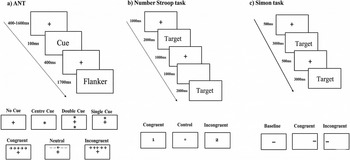
Five non-linguistic cognitive tasks were employed to measure different aspects of executive functions and attentional control. The attention network test (ANT) measured stimulus–stimulus conflict and attentional efficiency across alerting, orienting and executive components. The number Stroop task was used to minimize linguistic influences while capturing interference suppression and attentional control effects such as facilitation. The Simon task assessed stimulus–response conflict, providing a contrast to the ANT in terms of conflict type (Xia et al., Reference Xia, Bak, Sorace and Vega-Mendoza2022). The test of everyday attention (TEA) provided an ecologically valid measure of auditory attentional control. Finally, the Corsi tapping and mental rotation tasks evaluated visuospatial working memory and spatial transformation ability, with the latter included to examine potential script-related influences on spatial cognition (Bergen & Chan, Reference Bergen and Chan2005). In the computerized tasksFootnote 4, all stimuli were presented with E-Prime (version 2.0) on a 17-inch computer screen. A schematic representation of each task is depicted in Figure 1.
Schematic representation of the computerized tasks procedure: (A) attention network task (ANT); (B) number Stroop task; (C) Simon task.
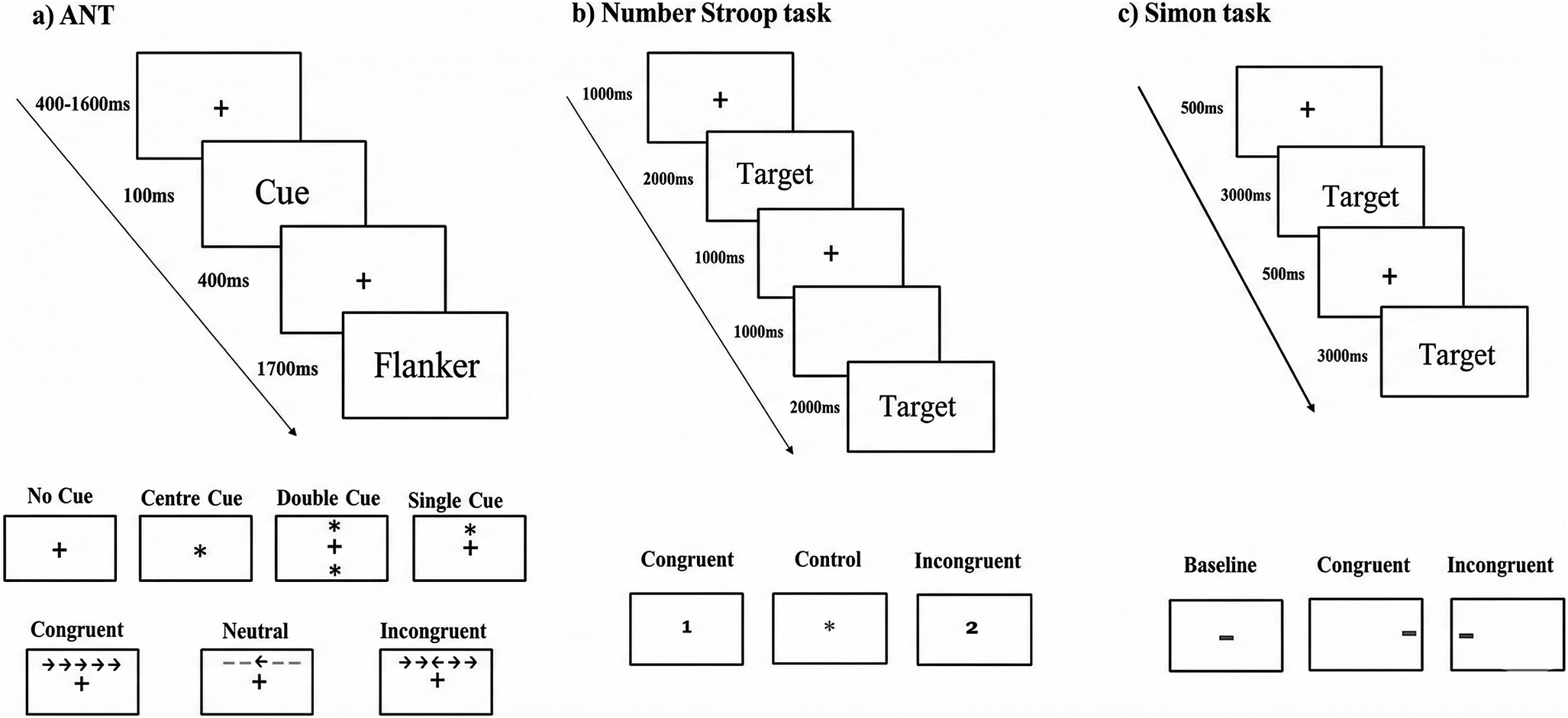
Attention Network Task: This task assesses attentional capacities, including alerting, orienting and inhibition (Fan et al., Reference Fan, McCandliss, Sommer, Raz and Posner2002). Participants identified the direction of a central arrow in a sequence of five arrows (congruent, incongruent or neutral) by pressing the “left” or “right” mouse button. Prior to the arrows, a cue (single, double, center or no cue) indicated information about location, appearance or timing. Attentional indices were derived from RT and accuracy differences between key trial types: conflict (congruent versus incongruent), alerting (double-cue versus no-cue) and orienting (center-cue versus single-cue). Participants completed a 24-trial practice block with feedback, followed by three experimental blocks of 96 randomized trials each, without feedback.
Number Stroop task: A numerical version of the Stroop task was adapted from Hernández et al. (Reference Hernández, Costa, Fuentes, Vivas and Sebastián-Gallés2010) to avoid any linguistic influence. This task assesses visual attentional abilities, including facilitation, interference and inhibition. Participants were asked to count digits or symbols presented at the center of the screen, pressing keys 1, 2 or 3 while ignoring the numerical value. There were three experimental conditions: congruent (e.g., 22), incongruent (e.g., 222) and control (e.g., **). Three attentional indices were assessed based on RTs/accuracy differences: Stroop effect (incongruent versus congruent), interference effect (incongruent versus control) and facilitation effect (control versus congruent). Participants completed a practice block with 18 trials, followed by two experimental blocks of 90 trials each, with feedback provided only in the practice block.
Simon task: In the arrow version of the Simon task, an arrow appeared in one of four screen locations (left, right, up or down) and pointed in one of four directions. Participants responded by pressing the corresponding arrow key. The task included three trial types: neutral (baseline), where the arrow’s direction was irrelevant; congruent, where the arrow’s direction matched the response key location; and incongruent, where the direction did not match the key location. Executive functioning was measured by comparing RTs/accuracy between incongruent and congruent trials (Simon effect). Participants completed a 10-trial practice block followed by three experimental blocks (60 trials each) in the order: baseline, congruent and incongruent, to reduce learning effects.
Test of Everyday Attention: The TEA (Robertson et al., Reference Robertson, Ward, Ridgeway and Nimmo-Smith1994) is a well-established clinical assessment of attention. Previous bilingualism studies have indicated that performance on the elevator with counting subtest often reaches ceiling levels (Xia et al., Reference Xia, Bak, Sorace and Vega-Mendoza2022, Reference Xia, Bak, Vega-Mendoza and Sorace2023, Reference Xia, Sorace, Vega-Mendoza, Deng and Bak2025). Therefore, this study focused on two subtests from the elevator task to examine how LD impacts auditory attention:
-
a) Elevator with Distraction (ED: 10 trials): Assesses auditory selective attention and inhibition. Participants count low tones while ignoring interspersed high tones, which serve as distractors.
-
b) Elevator with Reversal (ER: 10 trials): Assesses auditory attentional switching (auditory-verbal working memory). Participants count middle tones, while high and low tones indicate the counting direction (upwards for high tones and downwards for low tones).
Corsi Tapping Task (CTT): This task, adapted from the Wechsler Memory Scale-III (WMS-III, Wechsler, Reference Wechsler1997), measures working memory (Bialystok et al., Reference Bialystok, Craik and Luk2008). It involved a whiteboard (27.5 cm × 21 cm) and ten numbered blue cubes (3 cm × 3 cm, numbered 1–10). The board was placed between the experimenter and participant, with numbers visible only to the experimenter.
The task began with the forward condition, followed by the more challenging backward condition. The experimenter tapped sequences of blocks (2–9 blocks) at a rate of one per second. Participants reproduced the sequences in the same order for the forward condition and in the reverse order for the backward condition. The task continued until participants made errors on both sequences of a given length. In the mental rotation condition, two whiteboards were rotated 180° relative to each other. The experimenter tapped a sequence on one board, and participants replicated it on the rotated board. Sequence lengths ranged from one to five blocks, and the task continued until participants made errors on all sequences of a given length. Four one-block practice trials were included, but there were no practice trials for the forward/backward conditions. Scores were based on correct sequences, expressed as percentage accuracy.
2.1.4. Statistical analyses
All analyses were performed using linear mixed-effect models (LMMs) in R (version 3.6.1) from the lme4 package (Bates et al., Reference Bates, Mächler, Bolker and Walker2015). LMMs were chosen for their robustness to unbalanced data and missing values.
In the initial analysis, background measures were assessed for normality with the Shapiro–Wilk test. Normally distributed variables were analyzed using ANOVA, while non-normally distributed variables were analyzed using the Kruskal–Wallis test. Nominal variables were analyzed with the chi-squared test. Variables indicated that group differences were included in the main analysis models, with continuous variables standardized and nominal variables contrast-coded (0.5/−0.5).
Main analyses used LMMs with fixed effects for Group (large versus small LD) and Trial Type (e.g., congruent versus incongruent). Participants and items were treated as random variables. Trials with RTs outside 3 SD from each participant’s mean per trial type or incorrect responses were excluded (2.27% for ANT, 5.65% for Stroop, 4.75% for Simon tasks). Since accuracy rates were high (ANT: 98.10%; Stroop: 94.39%; Simon: 96.32%) and comparable across groups (all ps > .05), accuracy was not further analyzed. For the TEA and Corsi tapping task, the accuracy rate was obtained based on the number of correct responses. Linear regression models were used with the accuracy rate as a dependent variable, with the Group as a fixed variable.
Pseudo-R2 values were calculated using the r.squaredGLMM function from the MuMIn package for the LMMs, which provides a value for marginal R2 (variance explained by fixed effects) and a value for conditional R2 (variance explained by both fixed and random effects). R2 and adjusted R2 values were calculated using the r.squaredLR function based on likelihood ratio (LR) tests. Multicollinearity was assessed with the variance inflation factor (VIF).
2.2. Results
2.2.1. Initial analyses
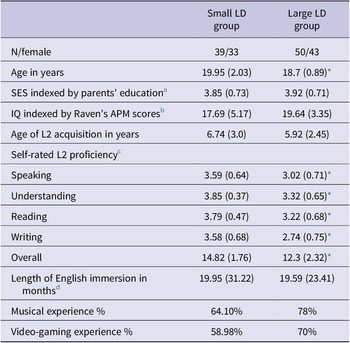
The VIF for all models was below 2, indicating that collinearity was not a concern. Analysis revealed no significant group differences in the APM (i.e., nonverbal intelligence), SES, age of acquisition (AoA), gender distribution, musical experience, video-gaming experience and length of English immersion (all ps > .05). However, a group difference was found in age (p < .001) and L2 proficiency (overall proficiency, speaking, understanding, reading and writing) (all ps < .05) (see Table 1). Consequently, both age and L2 proficiency were put into the models as fixed variables, indicating that the main effects of Group and Trial Type were interpreted as controlling for the effects of these background measures.
Participants’ demographic information and self-reported language proficiency. SDs are given in parentheses
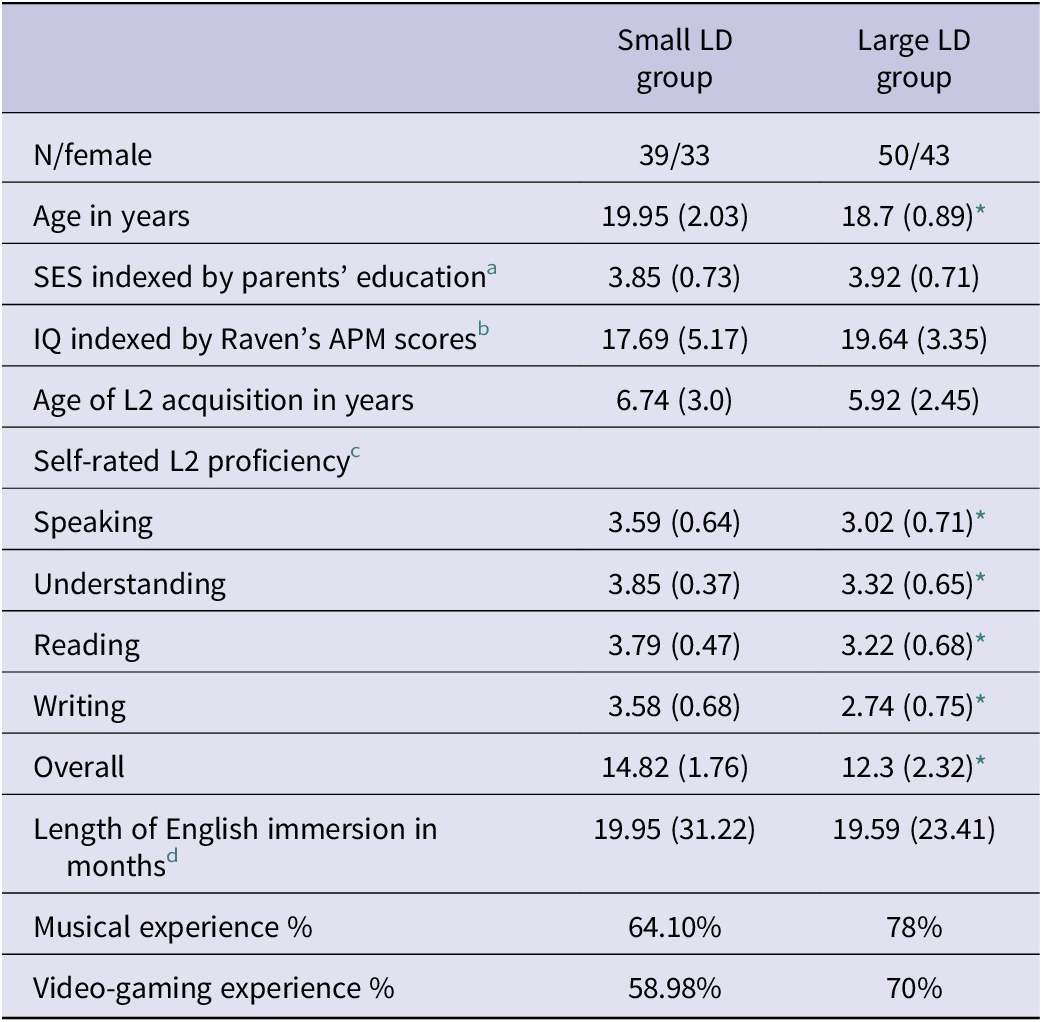
Note: The percentages indicate the proportion of participants reporting any musical or video-gaming experience.
a Averaged scores based on parental education level. The scale ranged from 1: primary school, 2: O level or equivalent to, 3: A level, 4: bachelor’s or equivalent to, 5: postgraduate, 6: PhD.
b APM scores were the number of correct items (the total number was 36).
c The scale is 1–4, marked by “poor” to “native/near native”.
d This is the length of participants’ immersion time in an English-speaking country.
* The difference between the two groups was statistically significant.
2.2.2. Main analyses
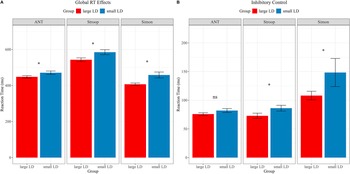
ANT : The overall performance (i.e., RTs) is illustrated in Figure 2. Mean RTs on the respective trial types are given in Table S2 in Supplementary Material.
Effects of linguistic distance on executive function. (A) Overall reaction times (global effects) across three RT-based tasks. (B) Inhibitory control in the visual domain. Error bars represent ±1 standard error of the mean (SE).
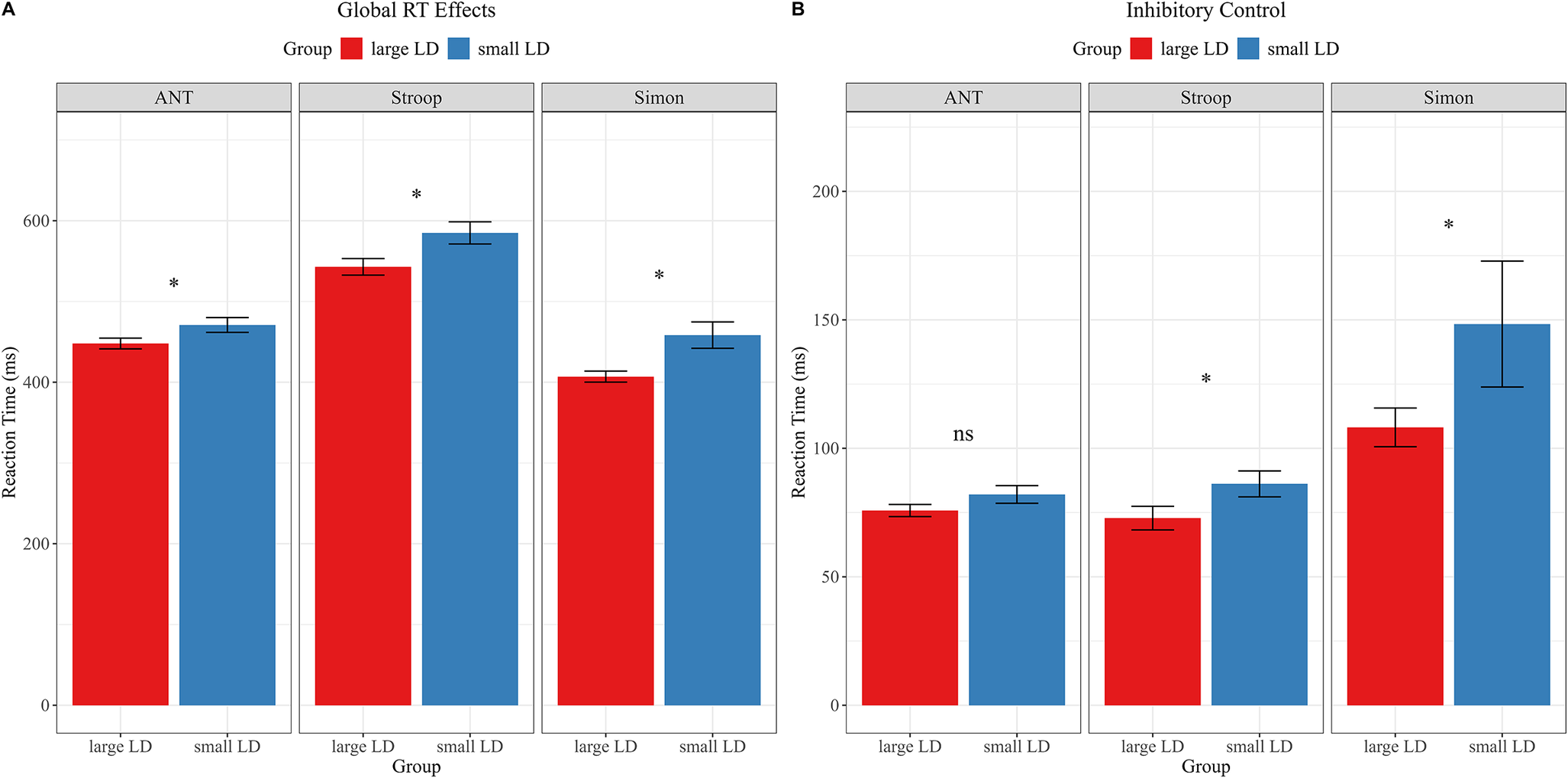
Overall performance: The large LD group showed a faster overall response than the small LD group (β = 29.40, 95%CI [2.74, 56.06], t = 2.161, p = .034). No other fixed effects were significant (marginal R 2 = 0.018, conditional R 2 = 0.434).
Alerting effect: The alerting effect was significant, with faster responses on the double-cue trials than on no-cue trials (β = 41.33, 95%CI [9.98, 72.69], t = 2.584, p = .017). The main effect of Group was significant: the large LD group showed a faster response than the small LD group (β = 32.84, 95%CI [5.87, 59.81], t = 2.387, p = .019). The main effect of L2 Proficiency was significant: higher L2 Proficiency predicts faster responses (β = −5.43, 95%CI [−10.41, −0.44], t = −2.132, p = .036). No other fixed or interaction effects were significant (marginal R 2 = 0.059, conditional R 2 = 0.436).
Orienting effect: The main effect of Group was significant: the large LD group showed faster responses than the small LD group (β = 28.88, 95%CI [2.73, 55.03], t = 2.165, p = .03). The interaction between Group and Orienting Effect was significant: larger Orienting Effect in the small LD group than in the large LD group (β = −9.22, 95%CI [−16.59, −1.85], t = −2.452, p = .016). Further analysis showed that the two groups had similar response times on single-cue trials (p = .07), but the large LD group responded significantly faster on center-cue trials than the small LD group (p = .016), thus leading to a smaller orienting effect. No other fixed or interaction effects were significant (marginal R 2 = 0.039, conditional R 2 = 0.437).
Conflict effect: The conflict effect was significant, with faster responses on congruent trials than on incongruent trials (β = 78.89, 95%CI [60.92, 96.86], t = 8.606, p < .001). No other fixed effects were significant (marginal R 2 = 0.145, conditional R 2 = 0.442) (see Figure 2). Full model outputs are presented in Table S3.
Number Stroop task : Overall performance is illustrated in Figure 2. Mean RTs on the respective trial types are given in Table S2 in Supplementary Material.
Overall performance: The large LD group showed a faster overall response than the small LD group (β = 46.91, 95%CI [6.20, 87.62], t = 2.259, p = .03). No other fixed effects were significant (marginal R 2 = 0.023, conditional R 2 = 0.418).
Stroop effect: The main effect of the Stroop effect was significant, indicating faster responses on congruent trials than on incongruent trials (β = 80.17, 95%CI [49.43, 110.92], t = 5.11, p = .001). The main effect of Group was significant: the large LD group showed faster responses than the small LD group (β = 50.47, 95%CI [9.28, 91.65], t = 2.40, p = .018). The interaction between Group and Stroop Effect was nearly significant: the small LD group tended to show a larger Stroop Effect than the large LD group (β = 13.39, 95%CI [0.14, 26.65], t = 1.98, p = .05). No other fixed or interaction effects were significant (marginal R 2 = 0.099, conditional R 2 = 0.441) (see Figure 2). Full model outputs are presented in Table S4.
Simon task : Overall performance is illustrated in Figure 2. Mean RTs on the respective trial types are given in Table S2 in Supplementary Material.
Overall performance: The large LD group showed a faster overall response than the small LD group (β = 47.66, 95%CI [9.12, 86.20], t = 2.424, p = .02). No other fixed effects were significant (marginal R 2 = 0.031, conditional R 2 = 0.461).
Simon effect: The Simon effect was significant, with faster responses on congruent trials than on incongruent trials (β = 127.31, 95%CI [99.37, 155.25], t = 8.931, p < .001). The main effect of Group was significant: the large LD group showed an overall faster response than the small LD group (β = 51.86, 95%CI [7.47, 96.26], t = 2.290, p = .025). Their interaction was significant: the large LD group exhibited a smaller Simon effect than the small LD group (β = 39.43, 95%CI [30.51, 48.35], t = 8.668, p < .001). No other fixed or interaction effects were significant (marginal R 2 = 0.189, conditional R 2 = 0.496) (see Figure 2). Full model outputs are presented in Table S5.
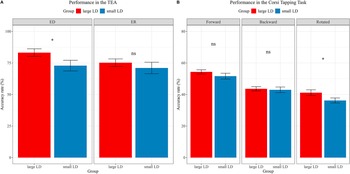
TEA : In the ED, a group difference was found (β = −16.23 [−28.42, −4.04], t = −2.65, p = 0.010), indicating better auditory inhibition in the large LD group than in the small LD group (see Figure 3). No other fixed effects were significant (R2 = 0.08, R2adjusted = 0.047). In the ER, no fixed effects were significant (R2 = 0.016, R2adjusted = −0.02). Full model outputs are presented in Table S6.
Effects of linguistic distance on attention, working memory and mental rotation. (A) Attention control in the auditory domain, including auditory inhibition and attentional switching. (B) Performance on working memory (forward and backward conditions) and mental rotation (rotated condition). Error bars represent ±1 standard error of the mean (SE).
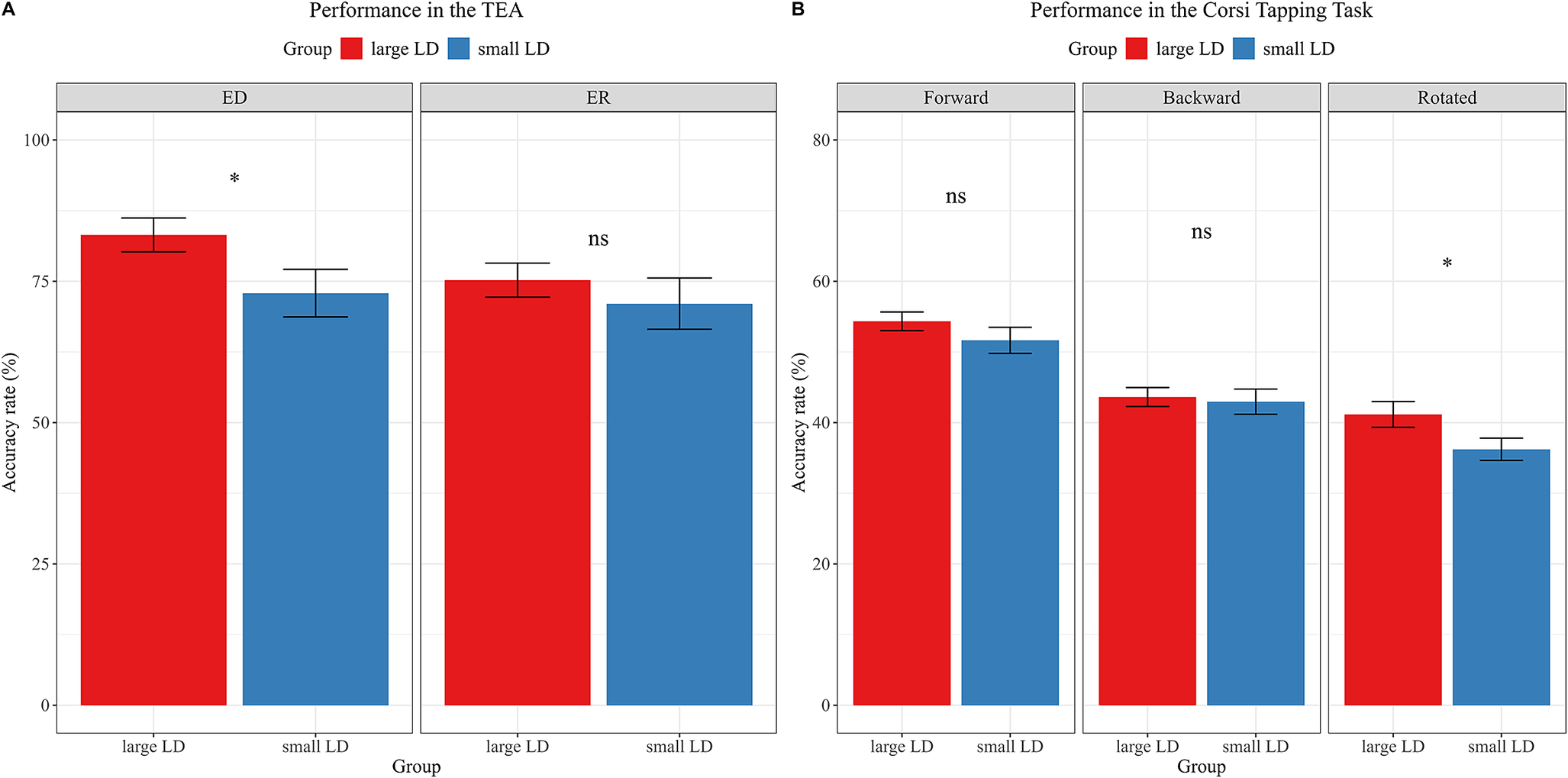
Corsi tapping task : In both the forward and backward conditions, no fixed effects were significant (R2 = 0.014, R2adjusted = −0.021) and (R2 = 0.009, R2adjusted = −0.027), respectively. In the rotated condition, the large LD group outperformed the small LD group (β = −6.23 [−12.32, −0.14], t = −2.03, p = 0.045) (see Figure 3). No other fixed effects were significant (R2 = 0.05, R2adjusted = 0.016). Full model outputs are presented in Table S7.
2.2.3. Additional analysis on multilingual experience control
Given that over half of the participants reported additional language experience, we examined whether multilingual experience influenced the observed LD effects. Table S1 provides detailed information on participants’ additional languages, including the number of languages, (AoA), self-reported proficiency and languages they learnt. The small LD group showed earlier L3 AoA and higher L3 proficiency, with no differences for L4 or L5. Regression analyses in participants reporting L3 experience, controlling for L3 variables (i.e., AoA and proficiency), demographics (age, sex, SES, Raven’s scores) and other cognitive-relevant experiences (musical and video gaming), revealed no group differences across all cognitive tasks. Earlier L3 AoA was associated with faster ANT and Stroop responses, but no significant effects of multilingualism were observed. These results indicate that multilingual experience did not confound the reported LD effects. All model outputs are reported in Table S8–11.
2.3. Discussion
Experiment 1 investigated the effects of LD between spoken languages on various aspects of cognitive functions in bilinguals, particularly domain-general executive control and inhibitory control. We hypothesized that bilinguals with large LD would exhibit enhanced executive control (Bialystok et al., Reference Bialystok, Craik, Grady, Chau, Ishii, Gunji and Pantev2005; Perovic et al., Reference Perovic, Filipović Đurđević and Halupka-Rešetar2023) and bilinguals with small LD were expected to show stronger inhibitory control (Antoniou & Wright, Reference Antoniou and Wright2017; Morrison & Taler, Reference Morrison and Taler2023).
In line with our initial predictions, the large LD group demonstrated enhanced executive control, as indicated by faster reaction times across all tasks. This supports the idea that managing structurally distinct languages requires more cognitive resources, potentially enhancing attentional efficiency and strengthening domain-general executive control. However, contrary to expectations, results for inhibitory control showed the opposite of what was predicted. Specifically, bilinguals with large LD exhibited smaller Simon and Stroop effects, as well as higher accuracy rates on the ED subtest of the TEA, suggesting better inhibitory control in both visual and auditory domains. This suggests that managing structurally distant languages may not only engage executive control but also enhance the ability to suppress irrelevant information and manage interference. This contrasts with the traditional view that similar languages impose greater inhibition demands. Additionally, working memory performance was comparable between the two groups, aligning with previous findings (Hedden et al., Reference Hedden, Park, Nisbett, Ji, Jing and Jiao2002). Notably, the large LD group outperformed the small LD group in mental rotation tasks, suggesting that the cognitive benefits associated with larger LDs may extend beyond language control to spatial cognition.
3. Experiment 2
3.1. Method
3.1.1. Participants
Sixty English native speakers and 61 Chinese native speakers were recruited from the UK and China, respectivelyFootnote 5. Both the Chinese and English education systems have integrated second language (L2) learning into their curricula, beginning at the primary or secondary education levels. Notably, there are regional variations in L2 teaching methods even within the same country, such as those between England and Scotland. In this study, all participants had undergone formal instruction in at least one foreign language, primarily within classroom settings. With sample sizes of n = 60 and n = 61, the sensitivity analysis indicated that the study had 80% power to detect a minimum effect size of Cohen’s d = 0.51 and 90% power to detect an effect size of d = 0.59.
For the English participants, the additional languages learned were predominantly alphabetic, encompassing French (48), German (26), Spanish (22), Italian (5), Latin (6), Norwegian (2), Danish (2), Swedish (1), Irish (1) and Portuguese (1). Beyond the Latin alphabet, participants also reported learning languages such as Ancient Greek (1), Arabic (1), Hebrew (1), Urdu (1), Japanese (2), Tibetan (1) and Mandarin (3). The average AoA for alphabetic language and other languages was 13.83 and 16.5 years, respectively. Their overall self-reported L2 proficiency was 5.56 and 5.51, based on composite scores from four subcategories of language proficiency (on a scale of 1 to 4 for each subcategory, with the maximum possible total score being 16), respectively. For the Chinese participants, English was the primary second language, with six participants having learned Japanese, one learning Korean, and another learning German in addition to English. The average AoA of the additional language was 9.81 years, and their overall self-reported L2 proficiency was 6.52. All participants identified themselves as “monolinguals” in the context of their primary language, meaning they could not hold a conversation in any other language besides their mother tongue.
3.1.2. Background measures and statistical analyses
These were the same as in Experiment 1.
3.1.3. Experimental tasks
The tasks and procedures in Experiment 2 were identical to those in Experiment 1, with the exception of the Simon task, which was excluded to reduce the length of the testing session.
3.2. Results
3.2.1. Initial analyses
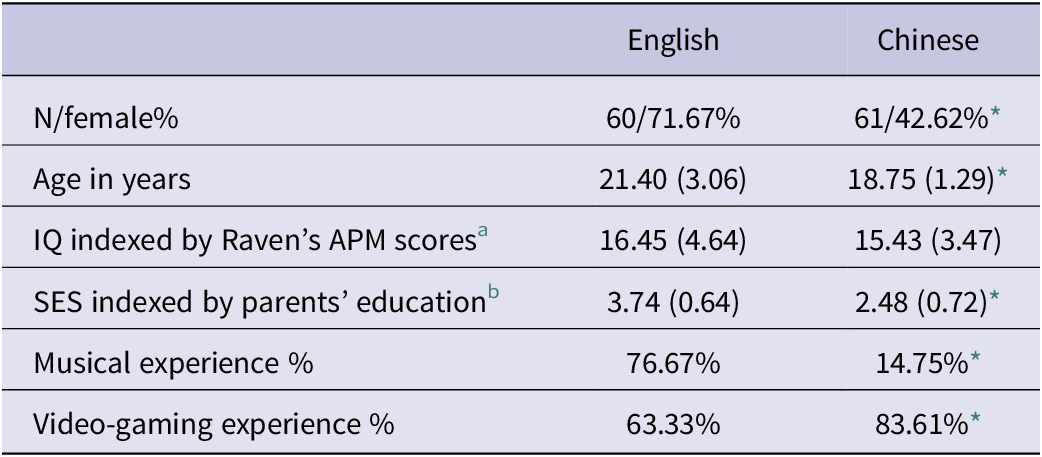
The scores on the APM did not differ between the two groups (p = .172), indicating comparable basic cognitive functions (i.e., nonverbal intelligence). Group differences were found for age, SES, gender distribution, musical experience and video-gaming experience (all ps < .05) (Table 2).
Participants’ demographic information
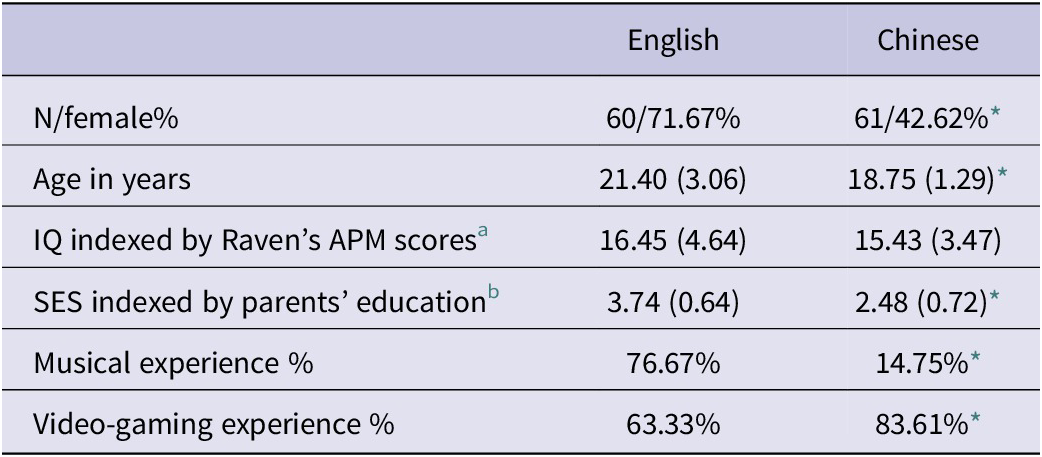
Note: SDs are given in parentheses.
a APM scores were the number of correct items (the total number is 36).
b Averaged score based on parental education level. The scale ranged from 1: primary school, 2: O level or equivalent to, 3: A level, 4: bachelor’s or equivalent to, 5: postgraduate, 6: PhD.
* The difference between the groups was statistically significant.
3.2.2. Main analyses
ANT : A total of 3.53% of trials were excluded. Mean RTs on the respective trial types are given in Table S12 in Supplementary Material.
Overall performance: The main effect of Ravens was significant, with higher scores of Ravens showing faster response (β = −5.34, 95%CI [−7.65, −3.02], t = −4.524, p < 0.01). No other fixed effects were significant (marginal R2 = 0.079, conditional R2 = 0.469).
Alerting effect: The main effect of SES and Ravens was significant, with higher scores of SES and Ravens associated with faster responses (β = −15.36, 95%CI [−29.59, −1.12], t = −2.114, p = .034) and (β = −5.37, 95%CI [−7.66, −3.08], t = −4.589, p < 0.001), respectively. No other fixed or interaction effects were significant (marginal R2 = 0.1, conditional R2 = 0.456).
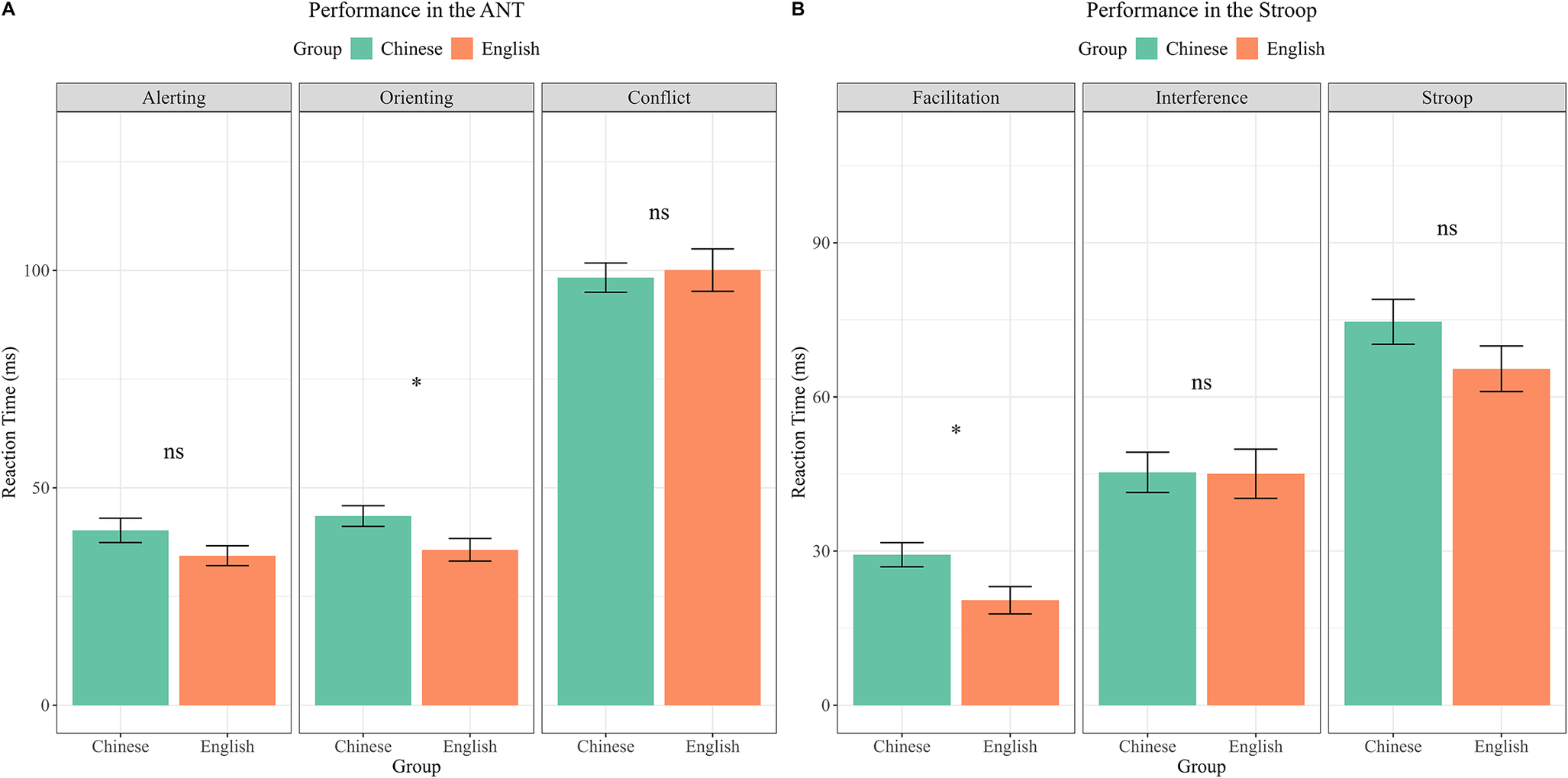
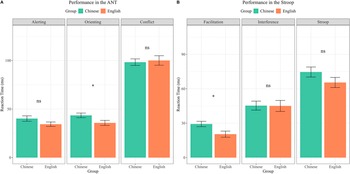
Orienting effect: Their interaction between Orienting Effect and Group was significant (β = 8.08, 95%CI [1.24, 14.92], t = 2.315, p = .021): Chinese speakers displayed a larger Orienting Effect than English speakers (see Figure 4). The main effect of Ravens was significant, with higher scores of Ravens showing faster response (β = −4.85, 95%CI [−7.15, −2.55], t = −4.14, p < 0.001). No other fixed or interaction effects were significant (marginal R2 = 0.108, conditional R2 = 0.482).
Effects of language script on executive function and attention. (A) Performance in the ANT. (B) Performance in the Stroop task. Error bars represent ±1 standard error of the mean (SE).
Conflict effect: The conflict effect was significant, with faster responses on congruent trials than on incongruent trials (β = 100.66, 95%CI [79.18, 122.14], t = 9.18, p < 0.001). The main effect of Ravens was significant, with higher scores of Ravens showing faster response (β = −5.15, 95%CI [−7.53, −2.76], t = −4.23, p < 0.001). No other fixed or interaction effects were significant (marginal R2 = 0.231, conditional R2 = 0.491). Full model outputs are presented in Table S13.
Number Stroop : A total of 5.80% of trials were excluded. Mean RTs on the respective trial types are given in Table S12 in Supplementary Material.
Overall performance: The main effect of SES and Ravens was significant, with higher scores of SES and Ravens associated with faster responses (β = −20.20, 95%CI [−40.24, −0.16], t = −1.98, p = .048) and (β = −7.11, 95%CI [−10.33, −3.88], t = −4.31, p < 0.001), respectively. No other fixed or interaction effects were significant (marginal R2 = 0.096, conditional R2 = 0.438).
Interference effect: The interference effect was significant, with faster responses on control trials than on incongruent trials (β = 47.07, 95%CI [5.68, 88.45], t = 2.23, p = .026). Both SES and Ravens scores were significant, with higher scores associated with faster responses (SES: β = −21.05, 95%CI [−38.05, −4.06], t = −2.43, p = .015; Ravens: β = −6.88, 95%CI [−9.62, −4.14], t = −4.92, p < 0.001). The main effect of gender was significant, with faster responses for male participants than for female participants (β = −26.87, 95%CI [−52.21, −1.53], t = −2.08, p = .038). No other fixed or interaction effects were significant (marginal R2 = 0.125, conditional R2 = 0.440).
Facilitation effect: The facilitation effect was significant: with faster responses on congruent trials than on control trials (β = 25.46, 95%CI [1.71, 49.21], t = 2.10, p = .036). The interaction between Facilitation and Group was significant (β = −9.88, 95%CI [−16.92, −2.84], t = −2.75, p = .007): Chinese speakers displayed a larger facilitation effect than English speakers (see Figure 4). Both SES and Ravens scores were significant, with higher scores linked to faster responses (SES: β = −21.27, 95%CI [−39.71, −2.83], t = −2.26, p = .024; Ravens: β = −7.36, 95%CI [−10.33, −4.39], t = −4.86, p < 0.001). No other fixed or interaction effects were significant (marginal R2 = 0.127, conditional R2 = 0.407).
Stroop effect: The Stroop effect was significant, with faster responses on congruent trials than on incongruent trials (β = 72.48, 95%CI [33.86, 111.10], t = 3.68, p < .001). The main effect of Ravens was significant, with higher scores of Ravens associated with faster responses (β = −5.75, 95%CI [−8.76, −2.74], t = −3.74, p < .001). No other fixed or interaction effects were significant (marginal R2 = 0.134, conditional R2 = 0.455). Full model outputs are presented in Table S14.
TEA : In the ED, gender was a significant factor, with males outperforming females (β = 12.19 [1.17, 23.2], t = 2.19, p = 0.030). No other fixed effects were significant (R2 = 0.055, R2adjusted = −0.005).
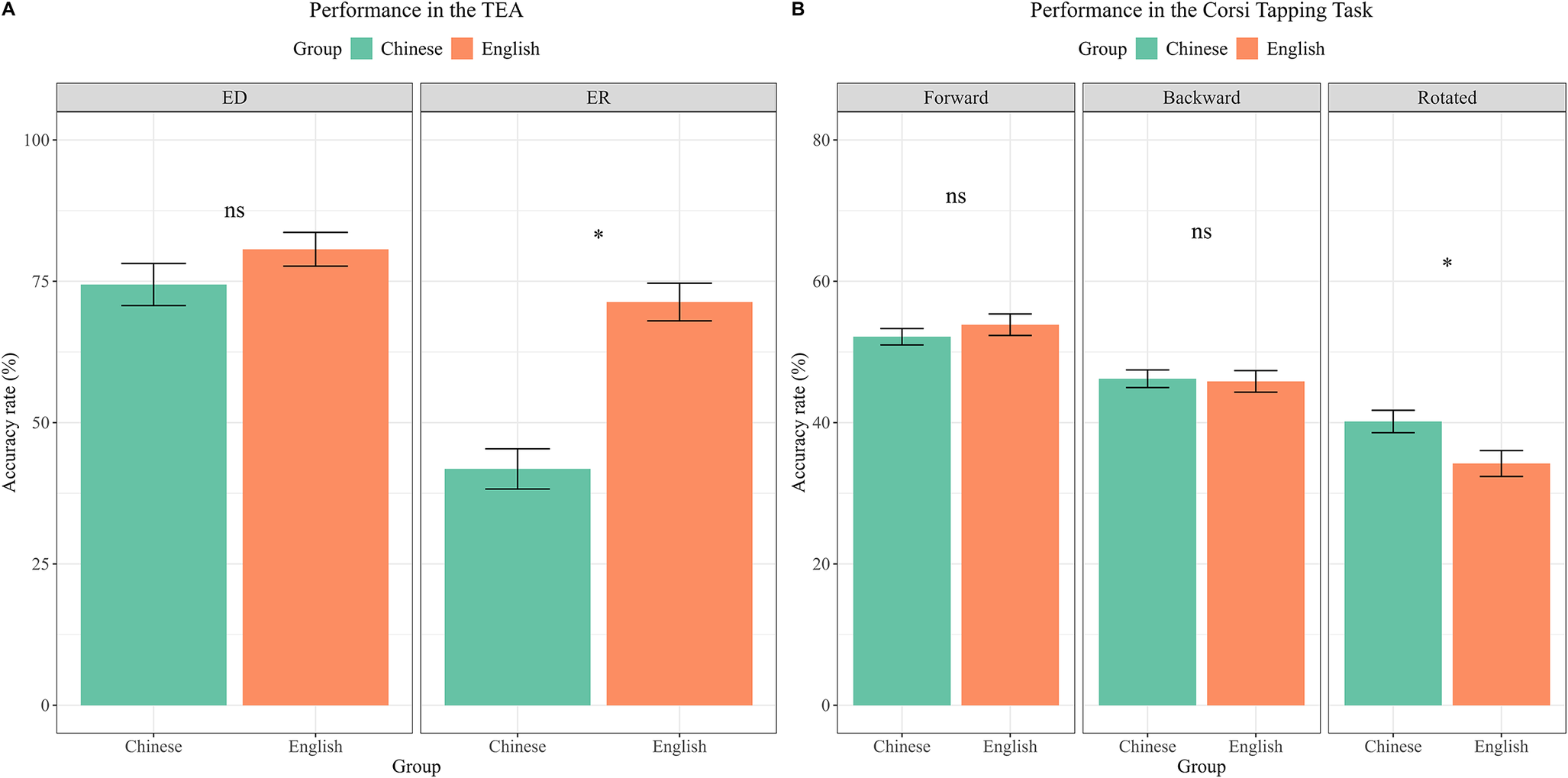
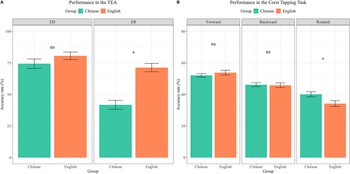
In the ER, English speakers tended to outperform Chinese speakers (β = 16.3 [−0.09, 32.68], t = 1.97, p = 0.051), indicating better attentional switching in English monolinguals (see Figure 5). Ravens scores also predicted better performance (β = 1.60 [0.44, 2.76], t = 2.73, p = 0.007). Participants with musical experience displayed better ability in attentional switching (β = 15.63 [3.18, 28.08], t = 2.49, p = 0.014). No other fixed effects were significant (R2 = 0.34, R2adjusted = 0.298). Full model outputs are presented in Table S15.
Effects of language script on working memory and mental rotation. (A)Attention control in the auditory domain, including auditory inhibition and attentional switching. (B) Performance on working memory (forward and backward conditions) and mental rotation (rotated condition). Error bars represent ±1 standard error of the mean (SE).
Corsi taping task : In the forward condition, higher Ravens were associated with better performance (β = 0.76 [0.34, 1.19], t = 3.54, p < 0.001), and participants with video-gaming experience showed superior attentional switching (β = 6.74 [2.62, 10.86], t = 3.24, p = 0.002) (R2 = 0.237, R2adjusted = 0.188). In the backward condition, both SES (β = 3.14 [0.19, 6.10], t = 2.11, p = 0.037) and Ravens (β = 0.54 [0.07, 1.02], t = 2.26, p = 0.026) positively predicted performance (R2 = 0.139, R2adjusted = 0.084). No other fixed effects were significant.
In the rotated condition, Chinese speakers performed better than English speakers (β = −9.95 [−18.1, −1.81], t = −2.42, p = 0.017) (see Figure 5). The main effect of SES and Ravens was significant, with higher scores of SES and Ravens associated with better performance (β = 4.13 [0.54, 7.72], t = 2.28, p = 0.024), (β = 0.98 [0.40, 1.56], t = 3.35, p = 0.001), respectively. No other fixed effects were significant (R2 = 0.201, R2adjusted = 0.151). Full model outputs are presented in Table S16.
3.3. Discussion
Experiment 2 examined the cognitive impact of language scripts on Chinese and English native speakers, focusing on visual and auditory attention and mental rotation. We predicted that Chinese native speakers would perform better in the visual domain and mental rotation and that English native speakers would demonstrate superior performance in the auditory domain. The results confirmed the predictions, suggesting that Chinese native speakers outperformed English native speakers in visual attention – namely, orienting in the ANT and facilitation in the Stroop task, while English native speakers exhibited enhanced performance in relation to auditory attention – namely, attentional switching in the TEA. In addition, both groups exhibited comparable proficiency in working memory; however, Chinese native speakers demonstrated superior performance in mental rotation tasks as assessed by the Corsi tapping task. Overall, these findings underscore the specific cognitive effects associated with distinct language scripts.
4. General discussion
There are striking differences between Europeans and non-Europeans, encompassing aspects such as culture, educational system and language, which might interact with each other and lead to differences in cognitive processing (Tsang & Chen, Reference Tsang and Chen2012; Yang et al., Reference Yang, Yang and Lust2011). This study specifically examined how linguistic characteristics influence cognitive functions related to language, contributing to a broader understanding of the relationship between linguistic diversity, language learning and cognitive control. Given the growing student mobility in general and the high number of Chinese and European students studying in the UK in particular, the comparisons between Chinese and European populations conducted in the current study are relevant to address these questions.
Experiment 1 compared international students from China and Europe studying at an English university, while Experiment 2 extended the analysis to local students in China and the UK. Results from Experiment 1 showed that Chinese-English bilinguals outperformed their European counterparts in domain-general executive control, inhibitory control and mental rotation. In Experiment 2, Chinese native speakers excelled in visual attention and mental rotation, whereas English native speakers demonstrated superior auditory attention. These findings suggest that cognitive differences may be influenced by linguistic factors, such as LD and language script. However, cultural and educational differences likely interact with these effects, requiring further investigation. Given the limited and inconclusive evidence on how LD and language script shape cognition, this study provides valuable insights into their role in cognitive control and language learning.
4.1. Effects of linguistic distance on executive control
Experiment 1 indicated that a larger LD predicts enhanced executive control, particularly domain-general executive control and inhibitory control in both visual and auditory domains. The results are consistent with previous findings (Bialystok et al., Reference Bialystok, Craik, Grady, Chau, Ishii, Gunji and Pantev2005; Carthery-Goulart et al., Reference Carthery-Goulart, Privitera and Weekes2023; Perovic et al., Reference Perovic, Filipović Đurđević and Halupka-Rešetar2023; Yang et al., Reference Yang, Yang and Hartanto2017; Yang & Lust, Reference Yang and Lust2007), supporting the notion that bilinguals employ domain-general executive control mechanisms to manage linguistic interference efficiently. The large LD group exhibited superior executive control, likely due to the greater cognitive demands of learning a distant language (Gallo et al., Reference Gallo, Myachykov, Nelyubina, Shtyrov, Kubiak, Terekhina and Abutalebi2023). Contrary to expectations, the large LD group also demonstrated stronger inhibitory control, challenging the traditional view that structurally similar languages require more inhibition (Antoniou & Wright, Reference Antoniou and Wright2017).
The unexpected enhancement of inhibitory control in the large LD group may be attributed to participants’ immersion in an L2-dominant environment at a UK university, which intensified the need for interference control, especially for those with lower L2 proficiency. Linck et al. (Reference Linck, Hoshino and Kroll2008) demonstrated that superior inhibitory control in Japanese-English bilinguals compared to Spanish-English bilinguals was evident only in an L2-dominant context, highlighting the critical role of immersion. According to the adaptive control hypothesis (Green & Abutalebi, Reference Green and Abutalebi2013), bilinguals in a single-language environment must exert greater control over their dominant L1 to facilitate L2 use. This is further supported by findings that inhibiting the dominant L1 demands more cognitive resources than suppressing the less-dominant L2 (Costa & Santesteban, Reference Costa and Santesteban2004). Given that the large LD group exhibited lower L2 proficiency than the small LD group, they likely faced stronger inhibitory demands to suppress their L1 and function effectively in the L2 environment (Xia et al., Reference Xia, Bak, Vega-Mendoza and Sorace2023). This increased inhibitory control effort may explain their superior performance in tasks assessing interference suppression.
As noticed, over half of the participants reported experience with additional languages beyond L2, raising the possibility that multilingualism could influence cognitive performance. To address this, we conducted targeted analyses in the subsample of multilingual participants, controlling for AoA, proficiency, demographics and other cognitively relevant experiences. These analyses revealed no group differences across all cognitive tasks, and although earlier L3 AoA was associated with faster ANT and Stroop responses, no other significant effects of multilingual experience were observed. These results suggest that the observed effects of LD on executive and attentional control are unlikely to be confounded by participants’ additional language experience or active language learning.
Collectively, the findings suggest that larger LD enhances cognitive control by imposing greater complexity and cognitive demands during both language learning and language control stages. The cognitive system may adapt to handle more pronounced differences in linguistic structures, reinforcing executive functions such as domain-general executive control and inhibitory control. Additionally, the persistent engagement with a distant L2 in an immersive environment may further amplify these effects, as bilinguals must continuously regulate cross-linguistic interference and allocate cognitive resources efficiently.
4.2. Effects of language script on executive control
The results of Experiment 2 underscore the notion that distinct language scripts may exert specific effects on cognitive performance, particularly the aspects that are closely associated with language learning – namely, visual and auditory attention, and mental rotation. The findings confirmed previous studies, indicating the specific cognitive effects of language scripts (Tavassoli & Han, Reference Tavassoli and Han2001, Reference Tavassoli and Han2002).
In the visual domain, our results demonstrated that Chinese native speakers outperformed their English counterparts in tasks measuring visual attention, showing enhanced orienting and facilitation effects. This may stem from the complex spatial configuration of Chinese characters, which require refined visual processing (Demetriou et al., Reference Demetriou, Kui, Spanoudis, Christou, Kyriakides and Platsidou2005; McBride-Chang et al., Reference McBride-Chang, Zhou, Cho, Aram, Levin and Tolchinsky2011). Conversely, in the auditory domain, English native speakers excelled in auditory attentional switching tasks, consistent with the phonological demands of alphabetic scripts (Hung & Tzeng, Reference Hung and Tzeng1981). The absence of group differences in the ED subtest may reflect its reliance on broader cognitive mechanisms, including selective inhibition, cue detection and attention shifting (Long et al., Reference Long, Vega-Mendoza, Rohde, Sorace and Bak2019). In contrast, the ER subtest demands more intricate multitasking and cognitive flexibility, which might explain the observed differences.
Mental rotation results further support the influence of script characteristics. Across both experiments, Chinese speakers outperformed their alphabetic-language counterparts, consistent with research linking logographic writing systems to enhanced spatial cognition (Bergen & Chen, 2005; Li et al., Reference Li, Nuttall and Zhao1999). The multi-orientational nature of Chinese characters and intensive character-learning practices likely strengthen spatial processing skills (Chan et al., Reference Chan, Ho, Tsang, Lee and Chung2006).
Collectively, this study compared Chinese with European languages, acknowledging potential confounds such as cultural differences and education systems. However, growing evidence has suggested that cognitive effects of bilingualism and language script can be discerned independently of confounding variables (Kim et al., Reference Kim, Kim, Kang, Park, Lim, Kim and Bak2017; Yang et al., Reference Yang, Yang and Lust2011). Thus, the observed cognitive differences in the current study likely stem from LD and script differences rather than from external influences. Nonetheless, cultural, educational and linguistic factors interact in complex ways, potentially exerting independent or combined effects on cognition. Future research should refine these variables by focusing on specific aspects such as schooling language, language characteristics (Barac & Bialystok, Reference Barac and Bialystok2012) and educational and parental practices (Lewis et al., Reference Lewis, Koyasu, Oh, Ogawa, Short and Huang2009).
Several limitations should be considered. First, our measure of SES was limited to parental education; future studies should include additional indicators, such as household income and parental occupation, which can independently influence cognitive outcomes (Hartanto et al., Reference Hartanto, Toh and Yang2019). Second, we relied on self-reported L2 proficiency, which may not fully reflect actual language competence despite prior support for its validity (Luk & Bialystok, Reference Luk and Bialystok2013). Objective, standardized assessments are recommended for future research. Third, we acknowledge a difference in L1 composition between groups: the large LD group was relatively homogeneous (predominantly Mandarin speakers), whereas the small LD group was heterogeneous (comprising various Indo-European backgrounds). Future research with larger samples should aim to parse specific L1 effects within the small-distance cluster. Finally, in Experiment 2, we acknowledge demographic differences in L2 history: the Chinese group reported an earlier L2 AoA compared to the English group. However, this difference in exposure duration did not translate into a functional divergence; both groups exhibited comparable, floor-level proficiency scores. This indicates that despite earlier classroom exposure, the Chinese group remained functionally distinct from active bilinguals, similar to the English group. Thus, while AoA differed, the lack of active bilingual competence in either group minimizes the likelihood that these variables drove the observed script-processing effects.
5. Conclusion
In conclusion, this study demonstrates that LD and script significantly shape cognitive functions, particularly in language learning and control. Early exposure and continuous language use influence executive control, highlighting the cognitive impact of linguistic diversity. Though preliminary, these findings underscore the need to consider linguistic factors in bilingual cognition research. Future studies should further explore how language characteristics interact with cognitive mechanisms across diverse contexts.
Supplementary material
The supplementary material for this article can be found at http://doi.org/10.1017/S136672892610114X.
Data availability statement
https://osf.io/wg27z/?view_only=7430d6eb7cb6452b866d076bee3de302.
Competing interests
The author(s) declare none.


 Open access

