More than 200 million children aged < 5 years fail to reach their potential in cognitive development because of poor nutrition, compounded by infections, poverty and deficient care(Reference Grantham-McGregor, Cheung and Cueto1). Evidence indicates that the adverse effects of early undernutrition on cognitive abilities are irreversible and remain apparent during childhood and adolescence(Reference Black, Allen and Bhutta2).
Several cross-sectional studies have reported that compared with non-stunted children, stunted children are less likely to enrol (Tanzania(Reference Beasley, Hall and Tomkins3)) or enrol late (Nepal(Reference Moock and Leslie4), Ghana and Tanzania(Reference Brooker, Hall and Bundy5)) in schools, attain lower grades for their age (China(Reference Jamison6), India(7), Philippines(Reference Steegmann, Datar and Steegmann8), Malaysia(Reference Shariff, Bond and Johnson9) and Vietnam(10)) and have poorer cognitive ability or achievement scores (Guatemala(Reference Johnston, Low and de Baessa11), Indonesia(Reference Webb, Horton and Katz12), India and Vietnam(13)). Associations between low weight-for-age z-scores (WAZ) and poor cognition or school achievement have also been noted, but these are less often found than those for stunting(Reference Grantham-McGregor and Baker-Henningham14). Victora et al. (Reference Victora, Adair and Fall15) have linked these poor levels of cognition to reduced productivity and, subsequently, to reduced income-earning capacity in adult life.
It is now well recognised by governments and other organisations that improving the nutrition of children during school years can contribute to educational achievement and, thereby, to an individual's and a country's socio-economic development in the long term(Reference Best, Neufingerl and van Geel16). Despite advocacy for nutrition services in primary schools, there is a clear lack of data on nutritional indicators and, particularly, on cognitive abilities for this age group in most developing countries and countries in transition(Reference Grantham-McGregor, Cheung and Cueto1, Reference Best, Neufingerl and van Geel16). There is, therefore, a need for additional studies to understand the link between undernutrition and poor cognitive abilities to facilitate the prioritisation and set-up of deliberate, evidence-based nutrition programmes for this age group.
Anthropometric indicators are reliable tools to identify nutritional problems such as under- and overnutrition and to pinpoint groups with specific nutritional needs to be addressed in policy development and programming. Their usefulness stems from the close correlation of anthropometry with the multiple dimensions of individuals' health, development, socio-economic and environmental determinants. Since growth in children and body dimensions at all ages reflect the overall health and welfare of individuals and populations, anthropometry may also be used to predict performance, health and survival(17, Reference Batty, Shipley and Gunnel18).
The present study, therefore, aimed to investigate the associations between anthropometric nutritional indicators and cognitive abilities (defined as non-verbal intelligence quotient (non-verbal IQ) here) in primary school-aged children participating in the South East Asian Nutrition Survey (SEANUTS).
Experimental methods
The SEANUTS is a randomised multi-centric survey carried out in Indonesia, Malaysia, Thailand and Vietnam to assess the nutritional status and lifestyles of over 16 700 children aged from 6 months to 12 years (in Vietnam, up to 11 years). A multi-stage cluster sampling, stratified for geographical location, sex and age, was carried out. Details of the SEANUTS have been described elsewhere in this supplement(Reference Schaafsma, Deurenberg and Calame19). The present paper discusses the associations between the height-for-age z-scores (HAZ), WAZ and BMI-for-age z-scores (BAZ) and cognitive performance. These anthropometric parameters were selected based on published literature(Reference Beasley, Hall and Tomkins3–Reference Grantham-McGregor and Baker-Henningham14) suggesting a relationship with children's mental development.
Subjects
Of the 8158 children in the primary school age group (≥6 years), 6949 children completed the cognitive test and 6746 had all the information relevant for the present paper. Thus, 6746 children were included in the analysis, leading to an overall response rate of 82·7 % of the measured population and 81 % of the targeted population (Table 1).
Sampling numbers and response rate in the four countries for the various parameters

IQ, intelligence quotient.
* Sex and urban/rural residence are known.
† Data collected only in about 50 % of the subsample.
Informed written consent was obtained from parents/legal guardian before the start of the survey. Children were included in the survey if they were apparently healthy, without any mental or physical handicap, genetic disorder and/or any chronic illness. The present study was conducted according to the guidelines laid down in the Declaration of Helsinki, and all procedures were approved by the ethics committees of Persatuan Ahli Gizi Indonesia (PERSAGI), Universiti Kebangsaan Malaysia (UKM), Mahidol University (Thailand) and National Institute of Nutrition (Vietnam). The present study is registered in the Netherlands Trial Registry as NTR2462.
Sociodemographic profile
Information on household composition, maternal education and income was collected from the parents or primary carers using a structured questionnaire.
Anthropometric measurements
All the anthropometric measurements were carried out in duplicate following standard techniques by trained research personnel. Height (barefooted) was recorded to the nearest 0·1 cm using a calibrated stadiometer, and weight was recorded to the nearest 0·1 kg in standard school clothing (without shoes) using a calibrated digital weighing scale. BMI was calculated as weight/height squared (kg/mReference Black, Allen and Bhutta2). HAZ, WAZ and BAZ were computed using sex-specific WHO growth reference data(Reference deOnis, Onyango and Borghi20). Children with HAZ, WAZ and BAZ < − 2 sd of the reference value were classified as stunted, underweight and thin, respectively. Cut-off values of BAZ >+1 sd and +2 sd were used to classify children as overweight and obese, respectively(Reference deOnis, Onyango and Borghi20). An additional category of severely obese children was defined at BAZ >+3 sd to avoid the misclassification of normal-weight but stunted children into the overweight/obese category. Weight-for-height z-scores were not included since there are no WHO reference data for children aged >5 years.
Cognitive performance
IQ (non-verbal IQ) was measured using age-appropriate, validated psychometric tests, administered by appropriate trained administrators, and supervised throughout the study by the study team. In Indonesia, Malaysia and Vietnam, non-verbal IQ was measured using Raven's Progressive Matrices (RPM) (for children aged 6–12 years). In Indonesia, information on cognition was only planned in a 50 % random subsample. The Test of Non-Verbal Intelligence, third edition (TONI-3) was used to assess non-verbal IQ in Thailand. Both RPM and TONI-3 are designed to measure non-verbal general intelligence using the progressive matrices technique. These tests are independent of language and formal schooling, making them comparable(Reference Bostantjopoulou, Kiosseoglou and Katsarou21–Reference Sroythong, Chulakdabba and Kowasint23) and relevant for field-based studies. The tests were administered to the children individually in a comfortable room that was well lit and free from noise. Based on the raw scores, the subjects were classified into one of the five non-verbal IQ categories: ≥ 120 (superior); 110–119 (high average); 90–109 (average), 80–89 (below average); 60–79 (low/borderline).
Statistical analyses
Data were weighted using age, sex and urban/rural weight factors to resemble the total primary school-aged population per country. The weight factors were based on data obtained from the relevant Statistical Offices in each country. Subject characteristics are presented as means and standard deviations, unless specified otherwise. Differences in subject characteristics between the countries were tested for significance using ANCOVA with the Bonferroni test. Distributions of children over non-verbal IQ groups per sex, area of residence and education level of the mother were tested using χ2 statistics. Correlation and partial correlation analyses were carried out using stepwise multiple regression with dummy variables where needed(Reference Kleinbaum, Kupper and Muller24). OR were calculated using binary logistic regression after correcting for confounders (age, sex, urban/rural residence, maternal education level and country). Significance was set at P< 0·05 using two-sided testing. All available data were analysed, and missing values were not replaced. All analyses were performed using SPSS (version 11.0.1; SPSS, Inc.).
Results
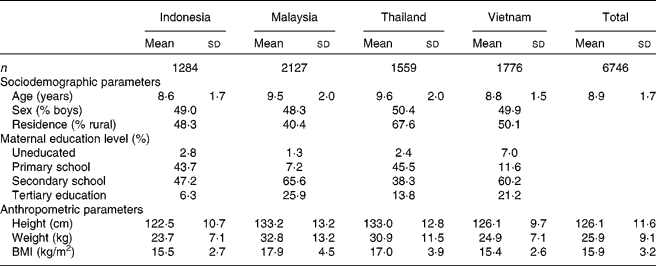
In all the four countries, sampling was representative of proportions by sex, age group and area of residence (urban/rural). The sociodemographic and anthropometric characteristics of the subjects per country are presented in Table 2. The mean age of the children was 8·9 (sd 1·7) years. Nearly half of the mothers in all the countries, except those in Thailand, completed at least secondary education. In Thailand, two-thirds of the children were from rural areas.
Characteristics of the study population (Weighted mean values, standard deviations and percentages)

In all the four Southeast Asian countries, 21 % of the children were underweight and 19 % were stunted (Table 3). The prevalence of malnutrition varied significantly between the countries, with undernutrition being prominent in Indonesia and Vietnam. In Malaysia and Thailand, the prevalence of overweight (14 and 9·7 %, respectively) and obesity (17·2 and 10·6 %, respectively) was more common. The prevalence of severe obesity was 0·5, 1·1, 3·4 and 4·6 % in Indonesia, Vietnam, Thailand and Malaysia, respectively.
Prevalence (%) of malnutrition in 6- to 12-year-old children

* Anthropometric measures were evaluated based on the WHO growth reference data(Reference Batty, Shipley and Gunnel18).
† Defined as BMI-for-age z-scores >+3.
Associations of covariates with non-verbal intelligence quotient
Almost 34 % of the total children had poor non-verbal IQ levels (below average and borderline), with the highest percentage being observed in Thailand. The distribution of children in various non-verbal IQ categories did not differ by sex (Table 4), but the area of residence was negatively related to non-verbal IQ (r − 0·23 and P< 0·0001). A greater percentage of children in rural areas had poor non-verbal IQ levels compared with their urban counterparts (Table 5). Maternal education level was positively related to the non-verbal IQ categories (r 0·26 and P< 0·0001). The higher the education level of the mother was, the higher the non-verbal IQ ranking of the child was (Table 6).
Distribution (%) of children in the various intelligence quotient (IQ) categories* by sex
* IQ categories: 60–79, low/borderline; 80–89, below average; 90–109, average; 110–119, high average; ≥ 120, superior.
* All values between urban and rural residence are different for each country (P< 0·001; χ2 test).
† IQ categories: 60–79, low/borderline; 80–89, below average; 90–109, average; 110–119, high average; ≥ 120, superior.
Distribution (%) of children in the various non-verbal intelligence quotient (IQ) categories† by education level of the mother*

* Values were significantly different (P< 0·001; χ2 test).
† IQ categories: 60–79, low/borderline; 80–89, below average; 90–109, average; 110–119, high average; ≥ 120, superior.
Associations between nutritional determinants and non-verbal intelligence quotient
Logistic regression analysis was performed to estimate the association between nutritional status parameters and non-verbal IQ categories for each individual country, adjusting for confounding variables. As there were fewer children with a ‘superior’ non-verbal IQ in Thailand, the ‘superior’ and ‘high-average’ groups were combined for the initial analyses to enable easier and powerful statistical comparisons between the countries (Fig. 1). Although there were differences in OR per country, the relationships between stunting, underweight, thinness and non-verbal IQ were comparable between the countries. A less favourable nutritional status was associated with a lower non-verbal IQ level (Fig. 1).
OR for (a) stunted, (b) underweight, (c) thin, and (d) overweight and obese children being in a certain intelligence quotient (IQ) category. The reference IQ category is ‘high average and superior combined’. ♦, Low and borderline IQ; ▲, below-average IQ; ■, average IQ.

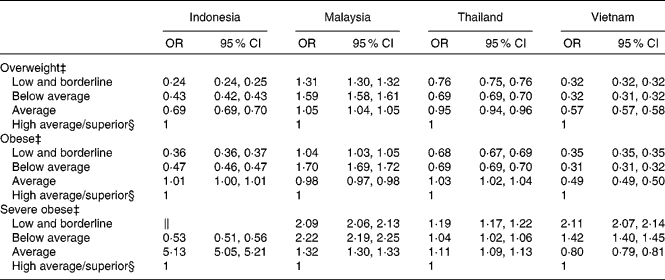
For overweight and obesity, Malaysia exhibited a different OR pattern compared with the other countries. Overweight, obesity and severe obesity increased the chances of Malaysian children being in a lower non-verbal IQ category. In Thailand and Vietnam, the odds of having an IQ < 89 were higher only with severe obesity (Table 7).
OR* for overweight and obese children being in a given intelligence quotient (IQ) categoryReference Johnston, Low and de Baessa† by country (Odds ratios and 95 % confidence intervals)
* Using a model adjusted for age, sex, urban/rural residence and maternal education level. R 2 values ranged from 0·02 (overweight, Thailand) to 0·27 (obesity, Vietnam).
† IQ categories: 60–79, low/borderline; 80–89, below average; 90–109, average; 110–119, high average; ≥ 120, superior.
‡ Reference category excludes thin children (BMI-for-age z-scores < − 2).
§ IQ category ‘high average plus superior combined’ is the reference category.
‖ Insufficient number to perform the statistics.
Given a similar pattern for stunting, underweight and thinness in the four countries, data were pooled and logistic regression analyses were repeated with ‘country’ as the confounding factor (dummy) and using all the five non-verbal IQ categories. The results are presented in Table 8. Underweight, thinness and stunting significantly increased the odds of children having a non-verbal IQ < 89.
OR* for children being in a given intelligence quotient (IQ) categoryReference Best, Neufingerl and van Geel† by nutritional status (Odds ratios and 95 % confidence intervals)

* Using a model adjusted for age, sex, urban/rural residence, maternal education level and country. R 2 values were 0·04 for thinness, 0·14 for underweight and 0·14 for stunting.
† IQ categories: 60–79, low/borderline; 80–89, below average; 90–109, average; 110–119, high average; ≥ 120, superior.
‡ Reference category excludes overweight (BMI-for-age z-scores (BAZ) >1) and obese (BAZ >2) children.
§ IQ category ‘superior’ is the reference category.
Discussion
The present study shows that anthropometric nutritional status indicators are significantly associated with cognitive performance (defined as non-verbal IQ). In the present study, school-aged children with low WAZ, HAZ and BAZ had a higher probability of having a below-average or low non-verbal IQ. The odds of having non-verbal IQ levels < 89 were also increased with severe obesity.
The strengths of the present cross-sectional study are the availability of anthropometric and non-verbal IQ data in addition to possible confounding variables for a large sample of 6746 school-aged children. The results are representative of the total school-aged population (by residence and sex) in the four participating countries based on weight factor adjustment. A limitation of the study is the inability for causal inference due to its cross-sectional design and the use of two different tests (RPM and TONI-3) to assess non-verbal IQ. However, studies with TONI-3 in Thai school-aged children(22, Reference Sroythong, Chulakdabba and Kowasint23) indicate a high correlation between RPM and TONI-3 and no significant difference in the mean values of IQ obtained from the two tests. A high comparability of the two test instruments has also been reported in a validity test conducted in subjects with Parkinson's disease(Reference Bostantjopoulou, Kiosseoglou and Katsarou21). In one study, a better performance of TONI-3 compared with RPM in the extreme lower and higher IQ levels has been indicated(Reference Sroythong, Chulakdabba and Kowasint23). Relatively low levels of ‘superior’ IQ levels in Thai school children have been reported recently(Reference Mongkol, Visanuyothin and Chanarong25).
Malnutrition is clearly an issue in school-aged children in Southeast Asia as has also been observed in the present study. It is well documented that suffering from undernutrition during the school years can inhibit a child's physical and mental development(Reference Best, Neufingerl and van Geel16). In line with the findings of the present study, a lower HAZ, reflecting long-term undernutrition, has been frequently associated with poorer cognitive performance, school achievement and enrolment in school-aged children(26, Reference Eilander, Muthayya and van der Knaap27). The present study also shows a significantly higher risk of developing a poor non-verbal IQ with low WAZ and low BAZ, after adjusting for covariates (age, sex, urban/rural residence and maternal education level).
Associations of non-verbal IQ with thinness (low BAZ) were analysed in the present study keeping in mind the WHO recommendations that BAZ is a more appropriate measure of undernourishment in school-aged children than underweight (WAZ). The BAZ acts as an indicator of relatively recent nutritional exposure while accounting for dramatic changes in height–weight relationship with maturational status during school age. A low HAZ in this age group is a reflection of early deficits in linear growth that were not recovered later in life(Reference Best, Neufingerl and van Geel16, Reference deOnis, Onyango and Borghi20, Reference Eilander, Muthayya and van der Knaap27, 28) and, therefore, is often not representative of recent nutritional status.
The link between undernutrition and non-verbal IQ is often multi-factorial in origin. A combination of factors including protein energy malnutrition, micronutrient deficiencies such as Fe and iodine deficiencies, and chronic and recurrent infections puts children at risk for significant impact on cognitive development(Reference Rosenberg29). Support for the role of undernourishment in non-verbal IQ can plausibly be explained by the functional isolation hypothesis(Reference Grantham-McGregor and Baker-Henningham14). According to this theory, undernourishment in children is associated with behavioural changes (apathy, reduced activity and exploration) that lead to reduced interaction with the environment, leading to poor developmental outcomes and, in longer term, cognitive performance. Additionally, reports have suggested that carers are less stimulating towards undernourished children, although it is unclear whether this precedes the development of undernutrition or is a reaction to the behaviour of undernourished children(Reference Grantham-McGregor and Baker-Henningham14). Furthermore, poverty, low level of maternal education and decreased stimulation are also likely to exist in the same household(Reference Rosenberg29). The influence of proximal environment (e.g. level of stimulation, learning opportunities, quality of maternal–child interaction and maternal education) and distal environment (e.g. culture, urban–rural residence and type of neighbourhood) is well accepted(Reference Grantham-McGregor and Baker-Henningham14, Reference Engle, Black and Behrman30, Reference Walker, Wachs and Gardner31). This influence of maternal education and area of residence was also confirmed in the present study as both parameters were strong confounders. The observed association between HAZ and non-verbal IQ confirms that nutrition in early life is important and, ideally, nutritional intervention should start earlier than during the school age period. However, if this window of opportunity is missed and when resources permit, targeted nutritional interventions for the school-aged group are favoured as these can contribute to linear growth potential and may prevent the continuation of the stunting process in older children(Reference Best, Neufingerl and van Geel16).
Addressing nutritional issues of school-aged children is, however, complicated by the increase in overweight/obesity, particularly as many developing countries are undergoing a so-called nutrition transition(32). Results from the SEANUTS confirm these reports(Reference Sandjaja, Budiman and Harahap33–Reference Le Thi and Nguyen Do36). The health risks associated with overweight/obesity are well known(Reference Best, Neufingerl and van Geel16). In addition, the present study shows that obesity (BAZ >+2) and especially severe obesity (BAZ >+3) had a negative effect on cognitive development. However, with the exception of Malaysia, overweight (1 < BAZ < +2) had a positive effect on cognitive development in other countries. Overweight indicates a relative abundance of food supply in the past, resulting in a positive effect on non-verbal IQ. However, it could also be that the children in Indonesia and Vietnam and, to a lesser extent, in Thailand are more easily misclassified as moderately overweight because of a lower height and a higher prevalence of stunting. However, the positive effects of overweight and obesity remained when the stunted children were excluded from the analyses. This suggests a role for both, a possible misclassification as well as a higher intake of food that sets these children apart.
Evidence suggests that higher levels of stimulation and learning opportunities are available to urban children as opposed to their rural counterparts(Reference Engle, Black and Behrman30, Reference Walker, Wachs and Gardner31). This may explain the higher percentage of children with a lower non-verbal IQ in Thailand despite the relatively high prevalence of overnutrition in Thailand. Furthermore, the relatively lower maternal education level and the use of a different tool (TONI-3) may also be contributing factors.
The findings of the present study suggest that the nutritional status of school-aged children in Southeast Asian countries warrants attention. Impaired and/or poor cognition is an epidemic in itself and is likely to contribute to the cycle of poverty and disease in many parts of the world(Reference Rosenberg29). The first UN Millennium Development Goal is to eradicate extreme poverty and hunger, and the second one is to ensure that all children complete at least primary schooling. Failure of children to achieve satisfactory education levels plays an important role in the national development(Reference Grantham-McGregor, Cheung and Cueto1). The clear and strong associations between undernutrition and non-verbal IQ in the present study highlight the importance of setting up strategies to target nutritional concerns in school-aged children.
Acknowledgements
The authors are indebted to the research teams of each of the countries involved as well as the parents/carers, infants and children involved in the study for their willingness to participate.
FrieslandCampina sponsored the SEANUTS, but it was not involved in the recruitment of the participants, assessments and the final set of the results.
S., B. K. P., N. R. and B. K. L. N. were involved in designing, protocol writing and execution of the study protocol and were the principal investigators. B. B., L. O. N., K. S. and H. T. X. made a substantial contribution to the local implementation of the study. P. P. and P. D. supervised the study and were involved in the evaluation of the study results. All authors critically reviewed the manuscript.
The results of the study will be used by FrieslandCampina, but it had no influence on the outcome of the study. None of the other authors or the research institutes has any conflicts of interest.
This paper was published as part of a supplement to the British Journal of Nutrition, the publication of which was supported by an unrestricted educational grant from Royal FrieslandCampina. The papers included in this supplement were invited by the Guest Editor and have undergone the standard journal formal review process. They may be cited. The Guest Editor appointed to this supplement is Dr Panam Parikh. The Guest Editor declares no conflict of interest.