Book contents
- Frontmatter
- Dedication
- Contents
- Acknowledgements
- Abbreviations
- Introduction: Common profit and charity in late medieval London
- 1 Radical London, 1376–86
- 2 Reconfiguring political authority
- 3 Civic ceremony and staging the limits of authority
- 4 The exemplary dead
- 5 Spiritual authority and the common profit
- 6 Print and the pursuit of the common profit
- Conclusion
- Bibliography
- Index
6 - Print and the pursuit of the common profit
Published online by Cambridge University Press: 04 April 2019
Book contents
- Frontmatter
- Dedication
- Contents
- Acknowledgements
- Abbreviations
- Introduction: Common profit and charity in late medieval London
- 1 Radical London, 1376–86
- 2 Reconfiguring political authority
- 3 Civic ceremony and staging the limits of authority
- 4 The exemplary dead
- 5 Spiritual authority and the common profit
- 6 Print and the pursuit of the common profit
- Conclusion
- Bibliography
- Index
Summary
Attending to the ‘comyn wele’
In fifteenth-century London, among certain of the city's governing merchants, professionals and clerks, the language of the ‘common profit’ had begun to acquire a specific set of values. These values imbued governors with a secular authority and legitimacy they lacked by birthright and a spiritual authority they lacked by vocation. London was portrayed in administrative documents and manuscripts disseminated by the city's ruling class as a Christian community that prospered when its citizens co-operated in business and loved one another in charity. Such ideas were interchangeable – citizens who contributed to civic infrastructure performed acts of charity, while those who worshipped strengthened polity. With John Carpenter as an important vector of transmission from earlier notions of the common profit he may have encountered in the documents within the London Guildhall, these values appear to have been communicated to scribes of the Guildhall, to circles of influential, wealthy and literate professionals and aldermen, as well as their friends and colleagues in the city's wealthiest parishes. Their common profit, while it shared a set of terms with older intellectual traditions and contemporary humanist discourse, remained distinctive, local. It helped forge a vernacular commonwealth and, as with other vernaculars, was concomitant with a strong sense of shared identity and tradition.
London's ruling class espoused a specific vision of governance in their control of the written word. The production of materials that articulated notions of the common profit went hand in hand with the sponsorship and dissemination of spiritual literature among members of the lay community and lower clergy – the ‘mighty men of good’. These materials endorsed the notion that moral edification was vital to polity; that those who ruled themselves were better placed to rule others. By linking spiritual welfare with economic prosperity, the status and legitimacy of those who espoused the values of the common profit became entrenched. The circulation and sponsorship of religious literature, for instance, as in the example of the Guildhall library, demonstrated that London's governing elite recognised the authority vested in shaping spiritual discourse; and the systematic remembrance of civic leaders in monumental epitaphs inscribed the values of the common profit into the very fabric of the city.
Information
- Type
- Chapter
- Information
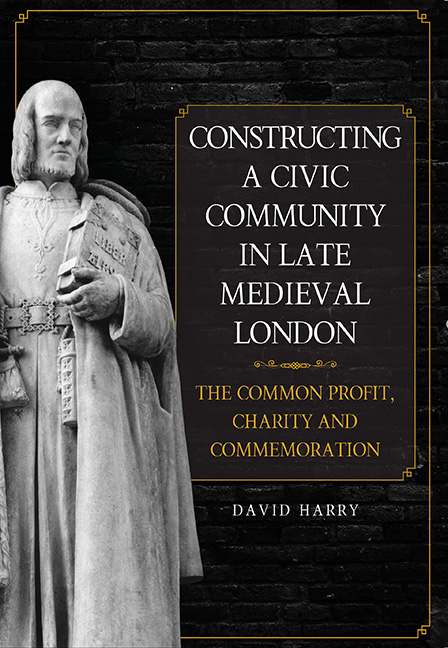
- Constructing a Civic Community in Late Medieval LondonThe Common Profit, Charity and Commemoration, pp. 149 - 174Publisher: Boydell & BrewerPrint publication year: 2019
Accessibility standard: Unknown
Why this information is here
This section outlines the accessibility features of this content - including support for screen readers, full keyboard navigation and high-contrast display options. This may not be relevant for you.Accessibility Information
Accessibility compliance for the PDF of this chapter is currently unknown
and may be updated in the future.