Book contents
- Frontmatter
- Dedication
- Contents
- Acknowledgements
- Abbreviations
- Introduction: Common profit and charity in late medieval London
- 1 Radical London, 1376–86
- 2 Reconfiguring political authority
- 3 Civic ceremony and staging the limits of authority
- 4 The exemplary dead
- 5 Spiritual authority and the common profit
- 6 Print and the pursuit of the common profit
- Conclusion
- Bibliography
- Index
3 - Civic ceremony and staging the limits of authority
Published online by Cambridge University Press: 04 April 2019
Book contents
- Frontmatter
- Dedication
- Contents
- Acknowledgements
- Abbreviations
- Introduction: Common profit and charity in late medieval London
- 1 Radical London, 1376–86
- 2 Reconfiguring political authority
- 3 Civic ceremony and staging the limits of authority
- 4 The exemplary dead
- 5 Spiritual authority and the common profit
- 6 Print and the pursuit of the common profit
- Conclusion
- Bibliography
- Index
Summary
The 1392 entry of Richard II
The ideal of peace, love and harmony upon which the prosperity of the city of London was said to be contingent was threatened by a series of crises in the concluding decades of the fourteenth century. In many respects, Andrew Horn's vision for the city, which was later asserted by John Carpenter, was compromised by the disobedience displayed by the citizens of London towards their governors, and in turn those governors towards the crown. This, at least, was the view of those whose administrative reforms of the late fourteenth and early fifteenth centuries sought to restate the parameters of civic authority. The governing elite sought to establish and enforce the accepted principles of rule through the public space of the court of the common council. John Carpenter compiled, in the Liber Albus, a series of documents that celebrated the role of law makers and governors and helped to disguise their fragile position at the mercy of the crown, the craft and artisan guilds and the citizens of London. Carpenter portrayed London's aldermen as essential mediators – without them the privileges necessary for the success of the city could not be obtained from the crown and could not be distributed for common profit. London's common profit, therefore, resembled less a series of ideals of good governance and increasingly a social contract; it was a transactional polity in which London's governors acted in the interest of their citizens in exchange for loyalty and service.
London's common profit predicated that the city's aldermen had privileged access to the crown and were in a unique position to defend the interests of the citizenry. In 1392 Richard II removed these privileges and appointed a warden to administer the city on his behalf. The lasting effect of this denial of power would be traumatic for London's ruling elite but, in 1392, they faced an immediate need: to restore the city's liberties. On 21 August, with the king's court now – shamefully – relocated to York, London organised a royal entry for their monarch. The most significant account of this occasion is a Latin poem of 546 lines attributed to a Carmelite friar, Richard de Maydiston (Maidstone), surviving in Oxford, Bodleian Library, MS Bodleian E. Museo 94. Maidstone, a graduate of Merton College, Oxford, died in 1396.
Information
- Type
- Chapter
- Information
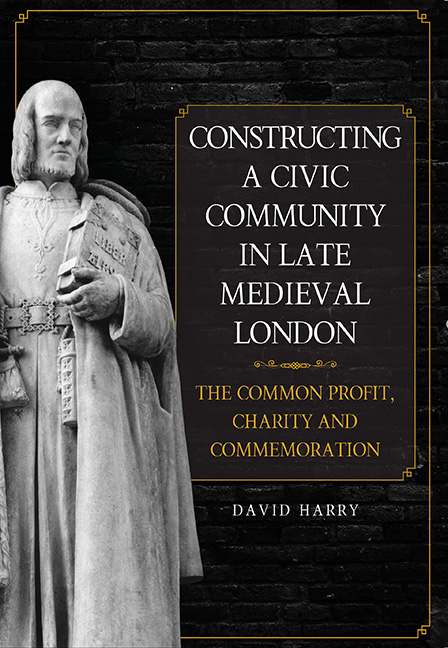
- Constructing a Civic Community in Late Medieval LondonThe Common Profit, Charity and Commemoration, pp. 65 - 90Publisher: Boydell & BrewerPrint publication year: 2019
Accessibility standard: Unknown
Why this information is here
This section outlines the accessibility features of this content - including support for screen readers, full keyboard navigation and high-contrast display options. This may not be relevant for you.Accessibility Information
Accessibility compliance for the PDF of this chapter is currently unknown
and may be updated in the future.