





Impact statement
Biomineralisation enables bacteria to bind loose materials into stone-like structures, yet it is typically treated as a specialised laboratory technique. This perception limits its presence in design education, where access to sterile infrastructure and microbiological expertise is often restricted. This study demonstrates that such biological processes can be introduced into design studios in structured and responsible ways.
Rather than replicating scientific optimisation, the approach shows how designers can shape the environmental conditions that influence biological activity. By working with containment, permeability and material configuration, students learn to interpret how living systems respond to spatial and material decisions. Biological behaviour becomes something that can be read, adjusted and understood through making.
The work offers a transferable strategy for integrating living systems into design education without full laboratory facilities. It supports a shift towards engaging materials as environmentally responsive processes rather than fixed products, encouraging sensitivity to temporality, interdependence and environmental regulation in creative practice.
Introduction
In recent years, biodesign has become increasingly prominent within architecture and design education, particularly through material-led explorations that challenge conventional notions of fabrication and production. With a growing community of designers seeking to integrate biology into their practice (Telhan Reference Telhan2016), early engagements focused primarily on biomaterials derived from once-living organisms, including bioplastics (Dunne Reference Dunne2018), and cellulose-based composites (Kääriäinen et al. Reference Kääriäinen, Tervinen, Vuorinen and Riutta2020). More recently, educational practices have expanded towards working directly with living organisms and their metabolic processes in dedicated biodesign courses (Nascimento and Heeman Reference Nascimento and Heeman2023).
Although the discipline has grown significantly over last decade and is increasingly recognised at an academic level, the novelty of the field still lacks a consolidated pedagogy (Roshko Reference Roshko2010; Vijayakumar et al. Reference Vijayakumar, Cogdell, Correa, Dade-Robertson, Danies, Edens, Forlano, George, Grushkin, Holbert, Hoover, Jalkh, Kisielewski, Obregon, Pirone, Polli, Scarpelli, Stukes, Ward, Wintermute, Balangue and Walker2024; Walker et al. Reference Walker, Barrera, Perez-Piza, Acquah, Grushkin and Vijayakumar2023) and dedicated methodologies (Camere and Karana Reference Camere and Karana2018; Esat and Ahmed-Kristensen Reference Esat and Ahmed-Kristensen2018; Karana et al. Reference Karana, Blauwhoff, Hultink and Camere2018). Beyond synthetic biology, the development of structured toolkits specifically tailored for biodesign education remains limited, and learning is frequently driven by do-it-yourself DIY practices and improvised tools shared through online communities (Correa and Holbert Reference Correa and Holbert2021). This landscape enables experimentation but also exposes a gap between laboratory research and scalable studio pedagogy.
Within studio environments, what becomes teachable is shaped by accessibility and infrastructural fit. Bacterial cellulose cultivated through kombucha or SCOBY-based processes popularised in design discourse by Susanne Lee (Lee Reference Lee2011), and mycelium-based composites made accessible through companies such as Ecovative (Grow.bio n.d.), have become dominant exemplars partly because they tolerate non-laboratory conditions and provide legible feedback through visible growth and material transformation. Their compatibility with hands-on experimentation aligns with a broader culture of exploratory, DIY material practice described by (Ayala-Garcia and Rognoli Reference Ayala-Garcia and Rognoli2017; Ayala-Garcia et al. Reference Ayala-Garcia, Rognoli, Karana, Karana, Giaccardi, Nimkulrat, Niedderer and Camere2017; Parisi et al. Reference Parisi, Rognoli and Sonneveld2017; Rognoli et al. Reference Rognoli, Bianchini, Maffei and Karana2015). These approaches support learning through situated experimentation and cross-disciplinary collaboration, resonating with calls for meaningful material experiences across design, engineering and social sciences (Brownell and Swackhamer Reference Brownell and Swackhamer2015). Other living systems, including algae and cyanobacteria (IAAC 2017), slime moulds (Adamatzky Reference Adamatzky2022) and pigment-producing bacteria (Shemakes n.d.), have also been extensively explored within a design and architecture context, though typically within more constrained or speculative pedagogical settings.
From an educational perspective, the significance of these practices lies less in the artefacts produced and more in the reconfiguration of material attitudes. Pasold (Reference Pasold, Ferraro and Pasold2020) argues that biologically grown materials reorient design processes towards material creation itself, integrating biological, chemical and environmental parameters from the outset. Rather than selecting materials based on predefined performance criteria, designers begin with formation processes. This bottom-up orientation, stimulated through the convergence of biotechnological and design tools, foregrounds circularity, resource awareness and low-energy manufacturing (Attias et al. Reference Attias, Danai, Abitbol, Tarazi, Ezov, Pereman and Grobman2020; Pasold Reference Pasold, Ferraro and Pasold2020).
Designing with living matter introduces substantial complexity, working within an open system in which matter, environment and design decisions co-determine form and performance. It also presents a number of structural challenges such as cross-disciplinary vocabulary gaps, lack of validated procedures, incomplete documentation of incubation periods and clarity in fabrication parameters (Ginsberg et al. Reference Ginsberg, Calvert, Schyfter, Elfick and Endy2017; Pasold Reference Pasold, Ferraro and Pasold2020), and the time lag between intervention and observable outcome. Which can complicate hands-on learning traditions central to design education (Mäkelä and Löytönen Reference Mäkelä and Löytönen2015; Sonneveld and Schifferstein Reference Sonneveld and Schifferstein2009; Temesi Reference Temesi2021). To make living material systems pedagogically workable, boundaries become essential. Roshko (Reference Roshko2010) argues that design learning requires defined experimental frames within which relationships between variables can be understood. And in educational settings, some reduction in the complexity of biological systems can serve as a strategy for making them more easily understood and workable without eliminating their function.
Despite a growing diversity in living material exploration, biomineralisation remains notably underrepresented in biodesign teaching, despite increasing interest within design contexts (Vekemans et al. Reference Vekemans, Parisi, Martins, Wu, Aubin-Tam, Karana, Mateus, Leonor and Paoliello2026). Microbially induced calcium carbonate precipitation (MICP) using Sporosarcina pasteurii, involves ureolytic metabolism that induces calcium carbonate precipitation, binding granular substrates such as sand into consolidated structures. Within engineering and materials science, MICP is predominantly framed as a technique to be optimised and executed with procedural precision, emphasising reproducibility, strength performance and process control (DeJong et al. Reference DeJong, Fritzges and Nüsslein2006; Phillips et al. Reference Phillips, Gerlach, Lauchnor, Mitchell, Cunningham and Spangler2013; Ramachandran et al. Reference Ramachandran, Ramakrishnan and Bang2001). The positioning casts biomineralisation as a technical intervention rather than as a material system open to exploratory formation within design practice. Although a small number of design education initiatives have engaged with MICP, for example: in textile-oriented workshops (Mosse et al. Reference Mosse, Zamora, Beyer, Thomsen, Ratti and Tamke2024) and community lab settings (Gonzalez Reference Gonzalez2024a), despite growing interest in living materials in design education, MICP remains marginal relative to systems such as mycelium or bacterial cellulose. Unlike these, MICP provides limited immediate visual feedback, depends on sustained metabolic activity, generates strong odour of the ammonia by-product and is typically associated with laboratory protocols requiring controlled environments and microbiological expertise. Consequently, biomineralisation is often introduced as a scientific procedure to be executed correctly rather than as a material system to be explored. This framing reinforces disciplinary boundaries and discourages experimentation. Yet material understanding in design education develops through iterative engagement and responsive making rather than procedural compliance alone (Ingold Reference Ingold2013; Seitamaa-Hakkarainen et al. Reference Seitamaa-Hakkarainen, Viilo and Hakkarainen2010). The question, therefore, is not whether MICP belongs in biodesign education, but how its complexity can be structured to enable meaningful engagement within studio contexts. This paper responds to that question by presenting a studio-based approach that deliberately adapts MICP for settings without full laboratory infrastructure and by proposing a Boundary Conditions Framework as a way of organising its biological complexity into design-operable terms. Developed iteratively across two workshops with master’s students who had little or no prior experience in microbiology, the framework reorganises the dependencies of MICP into three interdependent design variables, outer, permeability and material boundary conditions, that students can manipulate through fabrication.
The cocoon module
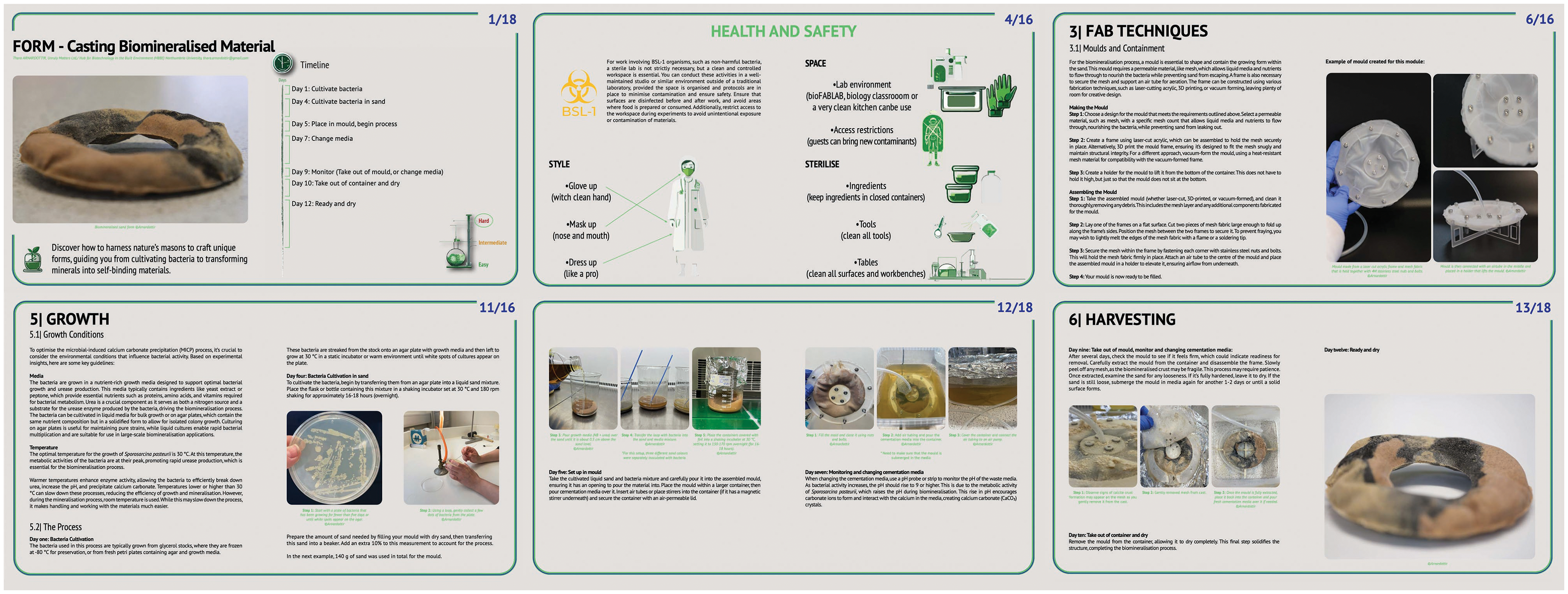
This work builds on the Form-Casting Biomineralised Material module (Arnardottir Reference Arnardottir2024) developed within the EU-funded CoCoon project, which sought to simplify MICP protocols for educational use (Figure 1). As part of a broader output of biodesign teaching modules aimed at supporting green skills and sustainable innovation through hands-on engagement with living systems. The CoCoon framework positioned biodesign modules as transferable educational units that combine theory and practice, enabling learners to prototype bio-based materials while developing ecological literacy and practical competencies. Within this context, the MICP module sought to introduce bacterial biomineralisation as a design-relevant material process rather than solely an engineering technique. The stated learning outcomes included:
-
• Understanding the principles of bacterial biomineralisation and its role in material production.
-
• Cultivating Sporosarcina pasteurii and optimising growth conditions for urease activity.
-
• Preparing nutrient and cementation media.
-
• Designing and fabricating moulds for microbial casting.
-
• Handling and disposing of biological and chemical materials in accordance with safety protocols.
Example pages from the form-casting biomineralised material module with CoCoon.

Figure 1. Long description
The collage consists of multiple elements: one photo, one diagram, and several illustrations. The main subject is the process of casting biomineralized material using CoCoon. The elements are arranged side-by-side and separate, each providing different aspects of the process. Panel 1: A photo showing a hand holding a biomineralized material. Panel 2: A diagram outlining health and safety guidelines, including style, SN2, and BSL. Panel 3: An illustration detailing fabrication techniques, including molds and containers. Panel 4: A photo showing the growth process of the biomineralized material. Panel 5: A photo showing the harvesting process of the biomineralized material. The purpose of combining these images is to provide a comprehensive overview of the entire process, from preparation to harvesting.
While the module translated biomineralisation into a simplified teachable format, it maintained a strong emphasis on laboratory-grade practice. Students were encouraged to work under sterile hoods, use autoclaves for equipment preparation and rely on incubators for controlled cultivation. Bacterial handling, media preparation and incubation were framed within established microbiological standards to ensure process reliability and safety. Although accessible, the module assumed access to some specialised infrastructure that is not universally available in design schools or Fab Lab environments. It functioned as a bridge between research protocols and design teaching, retaining laboratory discipline while introducing designers to biomineralisation.
Methodology
The workshops were conducted at Elisava Barcelona School of Design and Engineering and involved 21 students enrolled in the programme across two cohorts (December 2024 and October 2025), working in groups of 2–4. Participants were enrolled in the MA Design Through New Materials programme and had backgrounds primarily in design disciplines, with limited or no prior experience in microbiology. Participation was embedded within the existing structure of the MA programme, so the workshop functioned as part of students’ regular coursework rather than as a separately recruited user study.
Data collected during and after the workshops comprised three main elements: (1) photographic and microscopy documentation of moulds, set-ups and resulting artefacts captured by the facilitator and by students themselves; (2) observation notes taken by the facilitator during the in-person sessions, recording design decisions, technical difficulties and recurring questions; and (3) students’ own documentation, including slides and written reflections produced for the final group presentations, in which each group described their mould design, process, observed outcomes and interpretation. No formal surveys or semi-structured interviews were administered with student participants. In addition to the workshop documentation, the development of the teaching approach was informed by an external practitioner conversation with Laura Maria Gonzalez, whose experience teaching MICP in community lab contexts helped contextualise practical issues of access, safety, odour, time and process visibility.
Analysis was conducted iteratively. During and immediately after the first cohort (December 2024), the facilitator reviewed photographic documentation and student reflections to identify recurrent relationships between fabrication decisions and observed mineralisation behaviour. These preliminary themes of containment, permeability of the interface and aggregate composition, informed the brief and framing for the second cohort (October 2025). Following the second workshop, documentation and reflections from both cohorts were re-examined together, grouping observations around the three emerging themes and cross-checking them against what students themselves articulated in their presentations. The boundary-condition framework presented later in the paper was developed through this comparative process, and the student quotes included in the results sections were selected because they articulate, in participants’ own terms, the design–material relationships that the framework makes explicit. The reported findings reflect a combination of student-reported learning (from reflections and presentations) and the authors’ reading of the physical artefacts and process.
Teaching took place in a material studio environment typically used for experimental biomaterials such as bioplastics and Kombucha. While the space was not certified as a biosafety laboratory, it provided basic infrastructure including cleanable work surfaces (Figure 2), access to water, ventilation and optical microscopes.
Studio table setup where the workshop took place.

Protocol adaptation for studio conditions
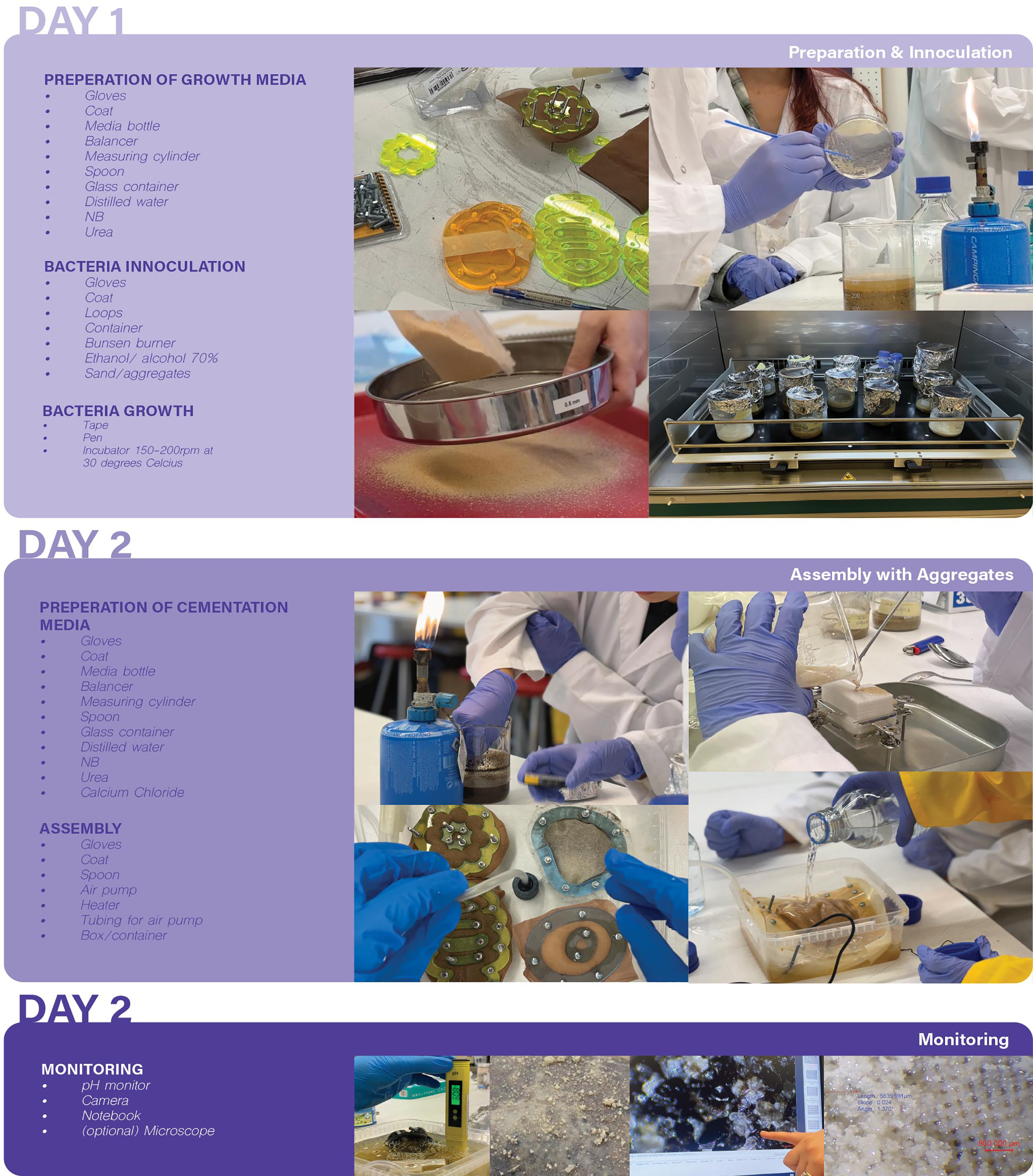
Standard laboratory procedures were selectively simplified to align with studio infrastructure. A complete list of equipment, biological materials, chemicals and fabrication tools is provided in Figure 3. Here, pre-cultured Sporosarcina pasteurii was prepared in advance and supplied to students, eliminating the need for sterile inoculation from stock. Students streaked bacteria from prepared petri plates into growth media consisting of 13 g/L Nutrient Broth (Formedium) supplemented with 0.3 M urea (Químics Dalmau S.L.) that was prepared by the students during the workshop. Bacterial activity was assessed qualitatively through ammonium odour and quantitatively through pH measurement instead of the more traditional measuring of optical density (OD600) to assess the bacterial quantity present in the media. Incubation occurred overnight at 150 rpm in a shaking incubator within both liquid growth medium and inoculated aggregates. Students also prepared the cementation media consisting of growth media and 0.3 M calcium chloride (Químics Dalmau S.L.). Cementation baths were maintained at 25–30°C using submerged aquarium heaters (Hygger) in plastic containers closed with foil (Arnardottir et al. Reference Arnardottir, Wang, Haystead, Eiriksdottir, Zhang and Dade-Robertson2026). Media preparation was carried out using digital kitchen scales and standard laboratory glassware, handled under a Bunsen burner. No autoclaving was used. Surfaces were disinfected with 70% alcohol prior to preparation and handling.
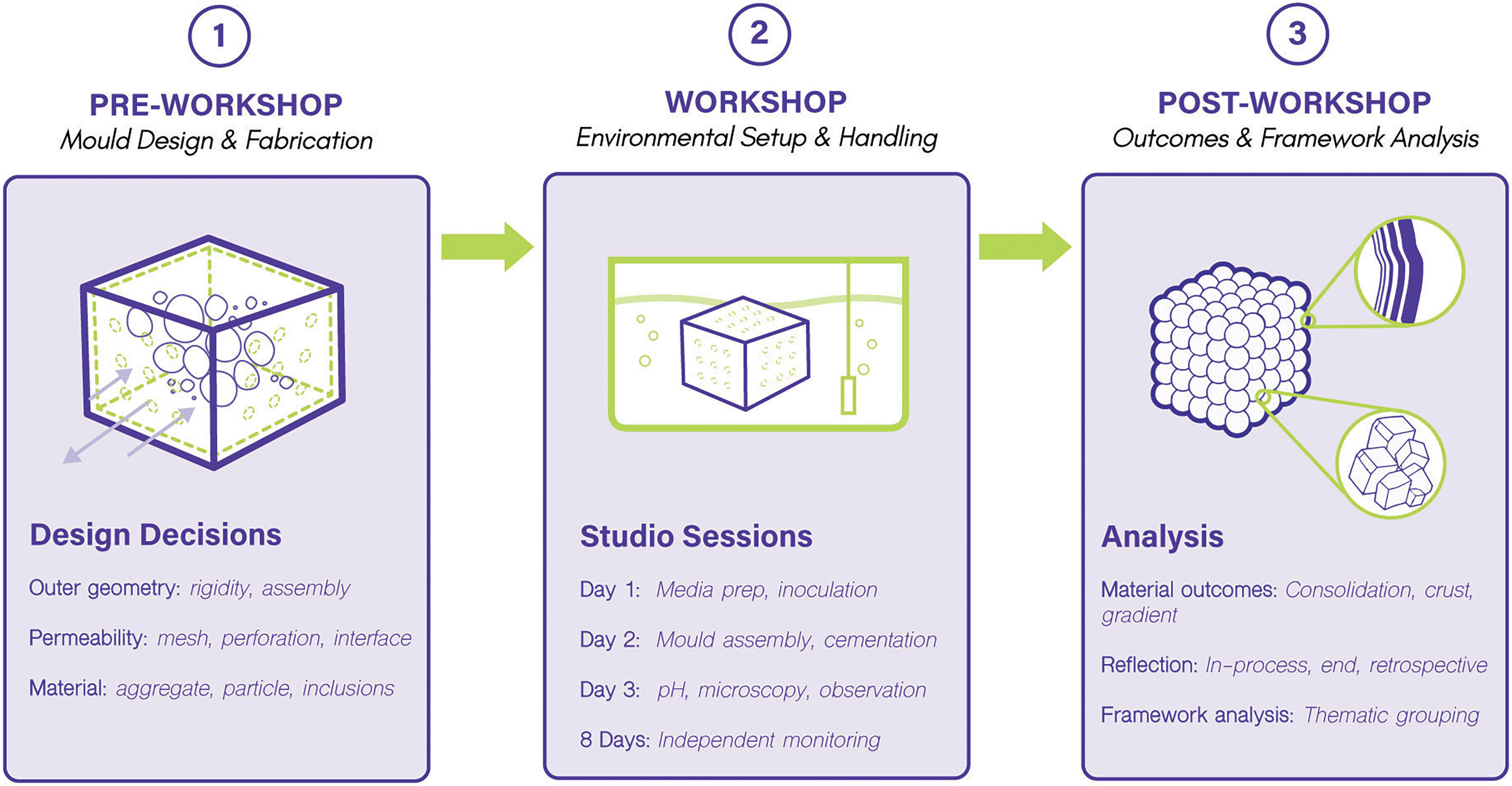
Three-phase workshop activity. Pre-workshop activities focused on mould design and fabrication, where students made decisions about outer geometry (rigidity, assembly), permeability (mesh, perforation, interface) and material composition (aggregate, particle, inclusions). In-person studio sessions covered media preparation and inoculation (Day 1), mould assembly and cementation (Day 2) and pH measurement, microscopy and observation (Day 3), followed by eight days of independent monitoring. Post-workshop analysis examined material outcomes (consolidation, crust formation, gradient behaviour), reflection at in-process, end-of-session and retrospective scales, and thematic grouping of results that informed the boundary condition framework.

Workshop Structure
Each workshop followed a condensed structure comprising of an online introductory lecture, three consecutive in-person evening workshop sessions, independent monitoring and online final presentation and reflection session. The introductory lecture covered biomineralisation principles, state of the art examples of MICP in research and design practice, safety considerations and the design brief. Students were asked to design and fabricate containment systems capable of supporting microbial mineralisation under studio conditions. Mould design and fabrication were undertaken in the weeks preceding the in-person workshop, so that the studio sessions could focus on environmental setup, microbial handling and observation of mineralisation. The sequence, spanning pre-workshop fabrication decisions, in-person studio sessions and post-workshop outcome and framework analysis, is summarised in Figure 3.
During the in-person workshop sessions, students worked in small groups to refine mould designs, prepared growth and cementation media, inoculated aggregates and initiated mineralisation while analysing how their design decisions influenced material outcomes. The workshop unfolded across three structured phases (Figure 4):
-
• Day 1: Mould review, preparation of growth media and bacterial inoculation of selected aggregates.
-
• Day 2: Assembly of moulds, packing of aggregates and submersion in cementation media with heaters and airpumps.
-
• Day 3: Monitoring and documentation, including pH measurements, visual inspection of mineral formation and microscopy.
List of equipment, materials and tools required for the workshop during the 3 days. Day 1 covers mould review and inoculation through cultivation of microbial material within selected aggregates. Day 2 focuses on assembly, including packing moulds with aggregates and mesh and submerging them in cementation solution. Day 3 centres on monitoring and documentation, including pH measurements of the cementation bath and observation of mineral formation by microscopy.

Figure 4. Long description
The image contains a combination of photos and text instructions detailing a biodesign workshop process over three days. Panel A: Day 1 Preparation and Inoculation. Panel B: Day 2 Assembly with Aggregates. Panel C: Day 2 Monitoring. Panel A: Day 1 Preparation and Inoculation. The first section shows the preparation of growth media with items like gloves, coat, media bottle, and distilled water. The second section shows bacteria inoculation with items like loops, Bunsen burner, and ethanol. The third section shows bacteria growth with items like tape, pen, and an incubator. Panel B: Day 2 Assembly with Aggregates. The first section shows the preparation of cementation media with items like gloves, coat, media bottle, and calcium chloride. The second section shows the assembly process with items like gloves, coat, spoon, air pump, and heater. Panel C: Day 2 Monitoring. The section shows monitoring with items like pH monitor, camera, and microscope.
Following the in-person sessions, students continued monitoring for up to eight days, including media replacement where required, extracting and drying of the resulting artefacts. The sequence concluded with group presentations reflecting on process, material behaviour and design decisions. These presentations functioned as structured reflection sessions, where students articulated relationships between design decisions and material outcomes. These reflections formed a key source for assessing learning. Reflection was distributed across three moments rather than concentrated in a single retrospective step. In-process reflection began once students had assembled their moulds and started filling them with aggregates, where the practical experience of packing the cavity revealed which designs were difficult to load and which shapes did not work well with the chosen material. Some groups responded by altering mould geometry or aggregate composition at this stage, while others recognised the limitation but persisted with the original form as a deliberate test. This situated mode of reflection continued through Day 3 of the in-person sessions and the subsequent monitoring period, as students recorded pH, observed the first instances of crystal formation and made decisions about when and how to demould. End-of-process reflection occurred in a final online session held approximately two to four weeks after the in-person workshop, where each group delivered a ten-minute presentation addressing five components: project aim and concept; mould and formwork design; aggregate selection; setup decisions; and results, observations and reflections. Prompts included how easy it was to remove the mould, and what they would do differently in a future iteration. Several groups proposed changes to mesh aperture, demoulding timing or aggregate chemistry in response to their own outcomes. Short written reflections submitted within these presentations provided a retrospective textual account of the same decisions and served as the primary written record used in analysis. Overall, the structure prioritised process legibility over optimisation, enabling students to engage with the formation process within the temporal constraints of studio teaching.
Data collection and analysis
Data was gathered through four complementary sources that together documented both process and outcome. First, facilitator observation notes recorded discussions, fabrication choices and complications during the in-person sessions. Second, students produced continuous visual documentation through photographs and microscopy imagery of aggregates and meshes, shared via a project Teams folder. Third, pH logs and qualitative visual assessments were kept throughout the cementation to track metabolic activity. Fourth, the final group presentations and written reflections provided verbalised interpretation of outcomes alongside proposals for future iteration.
Analysis proceeded in two stages. An initial descriptive one across photographs, microscopy images and reflection texts grouped observations by the fabrication decisions they addressed, such as mould geometry, mesh aperture and aggregate type. A second, cross-group thematic analysis, carried out iteratively alongside the second cohort, examined recurring relationships between specific design decisions and mineralisation behaviour. Three clusters emerged consistently: decisions concerning containment and enclosure; decisions concerning interface and exchange; and decisions concerning substrate and particle binding. These clusters were subsequently formalised as the outer, permeability and material boundary conditions that structure the framework presented below. Student quotations reproduced in the following sections are drawn verbatim from the final presentations and written reflections.
Design skills as mediators
Within the workshop, students were instructed to use existing design tools and fabrication skills to mediate biological parameters of the MICP process. CAD modelling, 3D printing, laser cutting, vacuum forming and craft-based assembly were employed to design and construct mould systems. Rather than treating moulds as form-imposing templates, they were defined in the brief as boundary-regulating environments. Here students were asked to address three operational questions through fabrication:
-
• how aggregates could be contained while maintaining fluid and oxygen exchange,
-
• how mould systems could be assembled and disassembled, without damaging partially mineralised structures,
-
• and how material selection and mesh density, would influence mineral adhesion and distribution.
Mould typologies included rigid frames, flexible fabric membranes and hybrid assemblies combining structural frames with permeable inserts. Fabrication choices were therefore directly linked to regulating permeability, containment and aggregate stability. During assembly and monitoring phases, students documented how variations in geometry, material stiffness, mesh aperture and aggregate composition affected mineral deposition patterns. Students were not required to optimise biological parameters at a microbiological level, instead, they manipulated spatial and material boundary conditions and evaluated resulting mineralisation behaviour. Observations included surface crust formation, heterogeneous consolidation and differential bonding at aggregate contact points.
Design framework: boundary conditions
MICP is not a process of form imposition but a reaction-dependent mineralisation process, a formation-finding approach (Arnardottir et al. Reference Arnardottir, Wang, Haystead, Eiriksdottir, Zhang and Dade-Robertson2026), where form is understood to emerge through interaction rather than imposition. In ureolytic systems such as Sporosarcina pasteurii, urea hydrolysis generates ammonium and carbonate ions (Zhang et al. Reference Zhang, Ju, Zong, Qi and Zhao2018), increasing local pH and promoting calcium carbonate precipitation in the presence of dissolved calcium (Konstantinou et al. Reference Konstantinou, Wang, Biscontin and Soga2021). Mineral formation emerges from metabolic activity operating within specific environmental constraints. Nutrient availability, oxygen diffusion, liquid exchange, particle contact, pH environment and time all condition consolidation. These variables are interdependent and environmentally mediated. Rather than attempting to reproduce laboratory-level control over each biochemical parameter of the system, the workshop reframed these dependencies spatially and materially. The central question became: how can biological requirements be translated into design-operable variables?
Following Chen and Crilly’s (Reference Chen and Crilly2016) account of rational design as parameter isolation and iterative testing, boundary conditions operate here as a mechanism for organising biological variables into design-relevant constraints. In physical systems, boundary conditions define the limits within which processes unfold. They do not determine outcomes directly, but they regulate the field of possible interactions. By establishing spatial, material or environmental constraints, boundary conditions shape system behaviour without prescribing it outright. From a systems perspective, Simon (Reference Simon1996) suggests that the behaviour of an artefact is not intrinsic but emerges through the interaction between its inner properties and the surrounding environment. In MICP, bacterial metabolism constitutes the inner environment, while mould geometry, permeability and aggregate configuration structure the outer environment through which mineralisation unfolds.
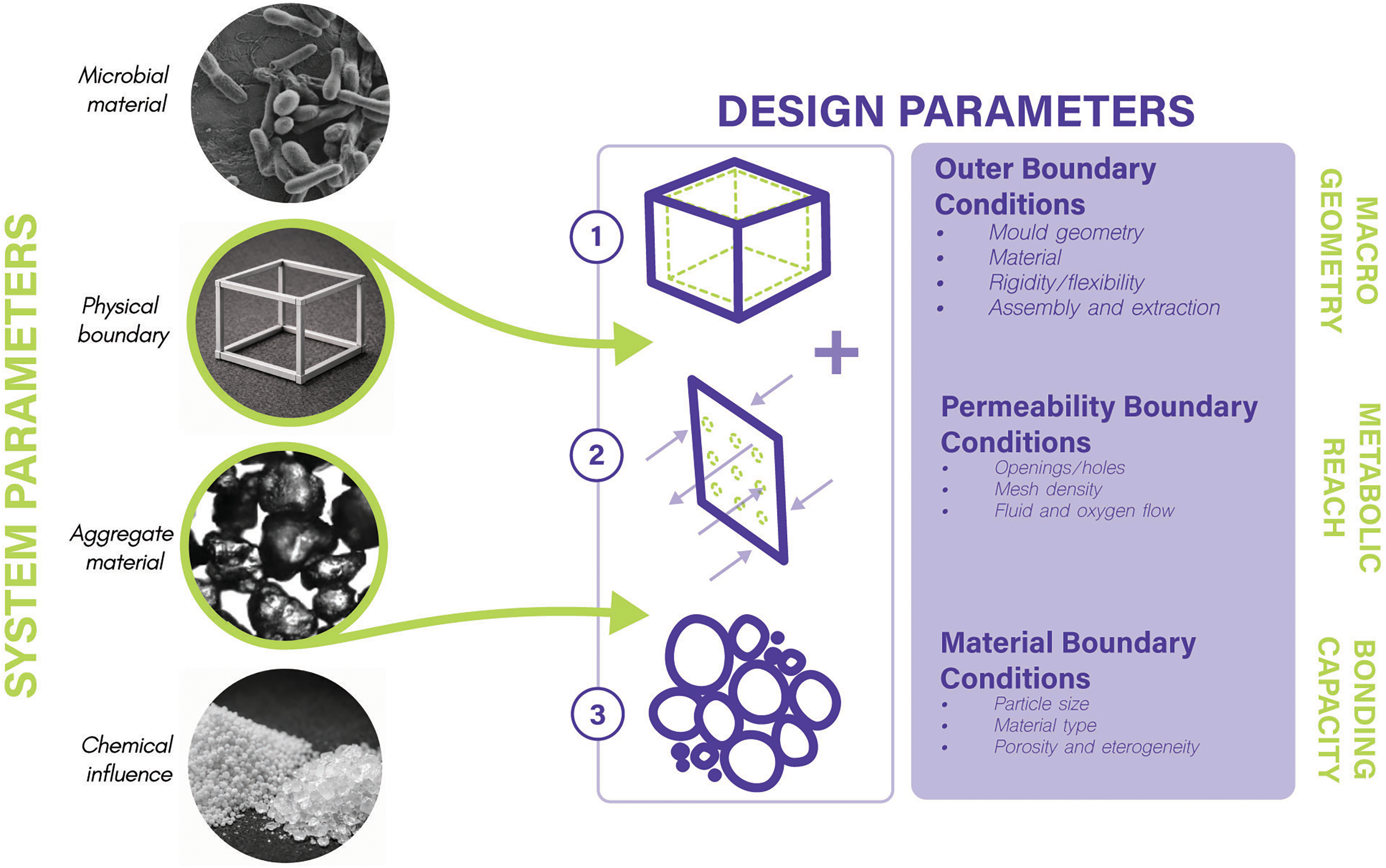
Applied to the studio context, boundary conditions describe how containment, permeability and material configuration structure metabolic reach and mineral formation. This framing shifts attention from optimising biological inputs towards designing the environments in which biological processes occur. This frames mould design as a controllable experimental variable within the workshop structure. Within the workshop, three main boundary conditions were identified (Figure 5):
-
1. Outer Boundary Conditions
Diagram of the MICP system parameters and the design parameters the students engaged in. 1. As Outer Boundary Conditions, 2. As Permeability Boundary Conditions and 3. As Material Boundary Conditions.

These govern containment and macro-geometry. Mould rigidity, enclosure, assembly logic and spatial configuration define the external limits within which mineralisation can occur. Outer boundaries regulate exposure to surrounding media and shape the spatial distribution of consolidation.
-
2. Permeability Boundary Conditions
These regulate fluid exchange, oxygen diffusion and nutrient access. Mesh aperture size, perforation patterns and interface flexibility determine how effectively cementation media circulates through aggregates and how metabolic activity penetrates the system.
-
3. Material Boundary Conditions
These define nucleation potential and bonding capacity. Aggregate type, particle morphology, porosity and contact density influence where calcium carbonate precipitates and how mineral bridges form between particles.
In this way, boundary conditions reconfigure biological complexity into spatial and material variables that can be intentionally designed and manipulated within the studio context. Here, students were encouraged to treat fabrication strategies, mesh interfaces and aggregate compositions as interdependent variables shaping formation. This boundary-condition model therefore functions as both an analytical and pedagogical structure. Analytically, it provides a lens for understanding how mineralisation distributes within a system. Pedagogically, it enables students to engage with biological processes and rather than controlling microbial optimisation directly, students design the conditions that regulate biological activity.
Boundary conditions in practice
Across both workshop iterations, the physical results varied in degree and distribution of mineralisation. Differences were observable in crust formation, internal consolidation, adhesion at interfaces and structural stability during extraction (Figure 6). These variations correlated with aggregate selection (Figure 6d), mesh aperture size, mould permeability (Figure 6g), geometric curvature (Figure 6f) and assembly method. Rather than producing uniform mineralisation, the majority of artefacts exhibited gradients, partial mineralisation (Figure 6b) or surface-dominant crystallisation (Figure 6c), making visible the environmental dependencies of the MICP process. Visible precipitation at aggregate contact points typically appeared between 48 and 72 hours after submersion. In several cases, surface crusts formed earlier than internal consolidation, especially where permeability was restricted. Extraction from moulds further revealed how fabrication decisions affected structural integrity, with some pieces maintaining coherence (Figure 6a and 6e) and others fragmenting along weakly mineralised zones (Figure 6b).
Outcome examples from the process. (a) Dense mineralised “desert rose” formed with fine sand (0.1–0.3 mm), demonstrating strong aggregate contact and uniform consolidation (by Guido Gorletta), (b) Surface-bound mineralisation within a mesh, illustrating permeability-regulated crust formation by Rosana Alcidia Gomes De Sousa, (c) Symbolic form in sand and sawdust, showing how outer geometry frames biological growth (by Baibua Nilsaard, Margherita Balossi Restelli, Matthew Puth and Vaani Kumar), (d) Sand and jute fibre composite consolidated into a doughnut geometry, with fraying indicating uneven filling and boundary instability (by Chiao-Chi Hsu, Ya-Chi Chen and Pei-Ling Jian), (e) Fabric curvature generating folds that supported heterogeneous but cohesive mineralisation in a sand–sawdust mix (by Isis Abouda, Camilla Salinas Rivera and Martina Gerardi), (f) Mineral formations fused to mesh, evidencing excessive surface nucleation and limited internal diffusion (by Chi-Yueh Tan), (g) Partial mineralisation in oystershell (top) and PLA waste (bottom) forms due to limited permeability of the 3D-printed containment (by Giulia De Franco).

Figure 6. Long description
Panel A: A dense mineralized desert rose formed with fine sand, demonstrating strong aggregate contact and uniform consolidation. Panel B: Surface-bound mineralization within a mesh, illustrating permeability-regulated crust formation. Panel C: A symbolic form in sand and sawdust, showing how outer geometry frames biological growth. Panel D: A sand and jute fiber composite consolidated into a doughnut geometry, with fraying indicating uneven filling and boundary instability. Panel E: Fabric curvature generating folds that supported heterogeneous but cohesive mineralization in a sand-sawdust mix. Panel F: Mineral formations fused to mesh, evidencing excessive surface nucleation and limited internal diffusion. Panel G: Partial mineralization in oyster shell and PLA waste forms due to limited permeability of the 3D-printed containment.
Outer boundary conditions: fabrication strategies
Fabrication strategies were approached as outer boundary conditions that define the spatial and environmental parameters within which microbial mineralisation can occur. Students explored different fabrication strategies: vacuum forming, laser cutting, 3D printing and mixed fabrication assemblies. Vacuum-formed moulds (Figure 7b) produced continuous external geometries but restricted fluid exchange. Mineralisation in these systems frequently concentrated along seams or openings, indicating limited metabolic reach within enclosed volumes.
Outer Boundary Conditions reflected in (a) 3D-printed moulds, (b) vacuum formed moulds and mixed fabrication with (c) 2D acrylic laser-cut sandwich frame and fabric mesh, (d) laser-cut frames expressed in 3D with fabric mesh, as well as (e) 3D-printed 6-sided frame with fabric mesh.

In contrast, 3D-printed moulds (Figure 7a) enabled the design of apertures, internal voids and controlled wall thickness. Although these moulds offered geometric precision and repeatability, mineral distribution often remained uneven, demonstrating that formal control did not directly translate into homogeneous consolidation. Laser cutting introduced a distinct outer boundary logic. Rather than generating enclosed volumes, students produced two-dimensional acrylic frames (Figure 7c) that defined perimeter conditions while leaving internal space open. These planar frames functioned as structural outlines, sandwich systems or stacked profiles that constrained aggregate placement without fully enclosing it.
Mixed fabrication approaches combined rigid frames with fabric meshes (Figure 7d and 7e), employing laser-cut acrylic or 3D-printed elements to tension, suspend or contain flexible interfaces. These assemblies proved particularly effective in supporting heterogeneous and gradient formations. Flexible interfaces deformed under aggregate weight and mineral accretion, resulting in forms shaped through interaction rather than imposition. Partial openness and hybrid materiality allowed biological activity to extend beyond fixed boundaries, reinforcing the understanding of moulds as environments for formation rather than as containers for form. Reflecting on a curved mould, one group noted: “The curved shape of the mould might have influenced how the mineral solution distributed, reinforcing certain zones while leaving others less covered.” Students explicitly recognised how formal and technical decisions influenced material behaviour: “This exercise showed us how small technical decisions, such as screw placement or curvature, strongly affected the overall process. It highlighted the need to balance formal intention with fabrication practicality.” These reflections corresponded with observable material outcomes in which curvature, joint placement and assembly tolerances affected both nutrient circulation and extraction stability.
Permeability boundary conditions: mesh interfaces
Meshes operated as permeability boundary conditions regulating fluid exchange and nutrient diffusion between bacterial activity, cementation media and aggregates. Aperture size and material flexibility significantly influenced mineral deposition patterns. Here, students explored 3D-printed perforations (Figure 8a), manual perforations into vacuum formed plastic (Figure 8b), as well as different mesh types and openings (Figure 8c–e). Denser meshes frequently supported rapid surface crust formation. In several cases, outer consolidation occurred while the internal aggregate remained poorly bonded. One group documented this phenomenon in detail: “The crystal had successfully formed around the aggregate in a crust, but the middle remained quite crumbly. Despite caution while removing the mesh, the outer layer of the ‘stone’ remained attached to the mesh, ruining the integrity of the stone. Reflection: The openings of the mesh were 149µm, compared to the ∼300µm openings used by other groups that had success. It’s possible that the fineness of the mesh increased the surface area for calcium carbonate crystals to form on, resulting in blocked openings. With nutrients and oxygen unable to penetrate, a crust formed on the outside while the centre remained brittle.” Here, reduced aperture size effectively limited metabolic reach, demonstrating how permeability directly regulates consolidation depth. Similarly, interface flexibility and demoulding timing influenced bonding continuity: “The socks mesh is too thin, causing it to stick to the filament during the crystallization process. Additionally, removing the mould while it is still wet can damage the model itself.” In contrast, more open and structurally stable meshes facilitated mineral bridging across voids, producing porous and heterogeneous formations. One group comparing technical mesh to softer stocking material observed: “The models created with technical mesh showed more printed patterns. The other with stocking mesh is speculated to be too soft to press against the mould effectively. As the soft material adapts to the shape of the filling without applying pressure, the mesh pattern is not visible under a microscope.”
Permeability Boundary Conditions reflected (a) 3D-printed perforations, (b) manual perforation into vacuum formed moulds, and microscoping imaging of different meshes used through both workshops, (c) stockings mesh (aperture size:0.270 × 0.238 mm), (d) technical mesh (aperture size: 0.318 × 0.281mm), (e) mesh (aperture size: 0.082 mm).

These outcomes demonstrate that permeability operates not only through aperture size but also through mechanical resistance and interface pressure. Meshes were therefore not passive containment devices but active mediators shaping nutrient circulation, contact density, mineral nucleation and pattern legibility. Through iterative comparison, students shifted attention away from overall form towards interface behaviour, recognising that small variations in permeability conditions significantly altered mineral distribution, structural continuity and extractability.
Material boundary conditions: aggregates and substrates
Aggregate selection functioned as a material boundary condition influencing nucleation sites and bonding potential. Students worked with engineered sand, beach sand, crushed glass waste, oyster shell waste, PLA fragments and combinations of sand with organic fibres (Figure 9). Engineered sand typically supported relatively uniform consolidation, enabling clearer interpretation of crust formation and bonding behaviour. In contrast, crushed glass introduced visible variability in particle size, angularity and translucency. In several samples, mineral deposition appeared uneven, with localised bridging and voids observable upon sectioning or breakage. These outcomes suggest that particle morphology and contact geometry influenced how mineral bridges formed across aggregates. Organic fibres and mixed substrates often produced partially bonded or friable structures. “Some fibre clusters absorbed more solution, creating local density variations in the final piece.” Rather than attributing failure to material incompatibility, these variations made visible how contact density, porosity and substrate heterogeneity condition mineral precipitation. Material boundary conditions also extended to chemical compatibility. In one case, grape seed powder aggregates resulted in bacterial inhibition: “The grape seed powder aggregate did not allow the bacteria to survive. pH was measured at 6, as opposed to the anticipated 8 or above… polyphenols are antibacterial… aggregates high in polyphenols should not be used for MICP as they will inhibit ureolysis.” Here, aggregate chemistry directly disrupted metabolic activity, demonstrating that material boundary conditions are not only physical but biochemical. The failure of ureolysis in low-pH conditions made visible the dependency of mineralisation on alkaline environments.
Material Boundary Conditions included (a) mix of sand and sawdust, (b) borosilicate glass powder, beach sand, (c) oystershell waste, (d) PLA waste, (e) mix of jute fibre and sand.

Students did not evaluate materials through mechanical testing, but through observation of structure, surface, internal bonding and extractability. Through this process, aggregate morphology, porosity and contact configuration became legible as variables shaping consolidation behaviour.
Observations across boundary conditions
Across all groups, mineralisation consistently reflected environmental regulation rather than geometric intention alone. More enclosed systems preserved macro-form but restricted metabolic reach. More open systems enabled greater internal precipitation yet introduced structural instability. Variations in mesh density, aperture size and interface stiffness altered consolidation depth and bonding continuity. One group working with textile interfaces observed “the mineral layer formed primarily along the raised or more exposed zones of the textile, where the liquid solution likely accumulated or evaporated more slowly. This resulted in distinct gradients of crystallization from dense, powdery deposits to thinner translucent layers.” Aggregate morphology further amplified gradients and partial bonding. Importantly, variability was not treated as failure but as material evidence. Students linked differences in consolidation to specific design decisions involving containment, permeability, assembly sequencing and demoulding timing. Through this comparative process, boundary conditions became legible not only as analytical categories but as operative variables shaping formation. The artefacts functioned as records of interaction between bacterial metabolism, and the students influence over the environmental constraint, and spatial configuration.
Discussion
This work demonstrates that MICP can be integrated into design studio teaching when biological complexity is reorganised through boundary conditions rather than laboratory optimisation and within mostly unsterile conditions. By translating metabolic dependencies into spatial, material and environmental variables, the workshop enabled students without prior biological training to engage with microbial mineralisation as a design material process. Mould geometry, permeability and aggregate configuration functioned as regulatory parameters shaping metabolic reach and mineral formation. Variations in consolidation were interpreted through fabrication decisions rather than biochemical calibration. Differences in mesh aperture, containment logic and substrate morphology became legible as environmental regulators rather than procedural errors. In this sense, boundary conditions operated as both analytical lens and pedagogical scaffold, providing a structured framework through which students could interpret uneven mineralisation, crust formation and structural discontinuities. Biological principles were encountered experientially through making and observation. Concepts such as metabolism, nutrient diffusion and pH change became interpretable through mineral gradients, delayed consolidation and extraction fragility. This mode of learning resonates with Schön and Bennett’s (Reference Schön, Bennett and Winograd1996) account of design as a “conversation with materials,” and with material-driven design research emphasising iterative engagement as a means of generating material understanding and as knowledge production rather than validation of predetermined outcomes (Ferraro Reference Ferraro, Ferraro, Kääriäinen, Morer-Camo and Pasold2023; Karana et al. Reference Karana, Rognoli, Barati and Van Der Laan2015; Laamanen and Kääriäinen Reference Laamanen and Kääriäinen2022).
The workshop responds to broader challenges in biodesign education concerning infrastructural access and disciplinary boundaries. Many design schools operate within material studios that enable biological experimentation but lack traditional laboratory facilities. Teaching with living systems therefore requires pragmatic adaptation and degrees of sterility calibrated to context (Naito and Botero Reference Naito and Botero2024). Students were introduced to sterile-adjacent handling practices sufficient for bacterial inoculation, while subsequent stages of cultivation and mineralisation were conducted under predominantly unsterile studio conditions. Laboratory-specific equipment was not treated as essential; instead, the process relied on tools and infrastructure already available within the school’s biomaterial studio environment, with the addition of some specific equipment for the submersion of the setup (airpums and heaters). This approach illustrates how laboratory protocols can be selectively adapted, retaining core requirements for bacterial viability while relaxing non-essential infrastructural dependencies.
MICP also introduces safety and waste management concerns uncommon in other studio-compatible living materials. Urea hydrolysis produces ammonia, raising issues of ventilation, odour and disposal. These factors influence not only technical setup but also perceived legitimacy. These challenges were reinforced through an external practitioner conversation with Laura Maria Gonzalez, conducted during the development of the workshop. Reflecting on teaching MICP in community lab contexts, Gonzalez emphasised the combined practical barriers of access, safety, odour, time and process visibility: “you cannot just get the bacteria… you have to address safety and disposal… it smells… and it takes longer… and you do not see it [mineralisation] happening” (Gonzalez, Reference Gonzalez2024b). Such observations highlight a key pedagogical distinction: biomineralisation lacks the immediate visual legibility associated with SCOBY or mycelium systems. Mineral formation unfolds through gradual biochemical shifts rather than visibly expressive growth, rendering the process less perceptible to novice designers. This limited visual feedback compounds a temporal challenge. Biomineralisation develops over days rather than hours, and consolidation may only become evident during drying or extraction. In studio cultures structured around rapid prototyping and critique cycles, delayed and partially invisible processes can appear opaque or unproductive. These sensory, temporal and regulatory frictions contribute to the marginal presence of biomineralisation within mainstream biodesign teaching, despite its conceptual relevance.
Although the framework was developed through MICP, it is worth considering the extent to which its three dimensions (outer, permeability and material boundary conditions) translate to other living material systems. For bacterial cellulose or SCOBY from kombucha, all three appear, though in different proportions. The outer boundary is set by the geometry of the vessel and its wall effect on pellicle attachment (Hornung et al. Reference Hornung, Ludwig, Gerrard and Schmauder2006). Permeability and material conditions are set in the liquid–air interface, and the introduction of scaffolds or inclusions (Heidari et al. Reference Heidari, Mahdavinejad, Zolotovsky and Bemanian2024; Hoenerloh et al. Reference Hoenerloh, Arnardottir, Bridges and Dade-Robertson2023; Loh et al. Reference Loh, Arnardottir, Gilmour, Zhang and Dade-Robertson2025) strongly shape pellicle thickness, attachment and form. For mycelium composites, the balance shifts: material boundary conditions dominate, with substrate particle size, nutrient content and contact density conditioning colonisation (Appels et al. Reference Appels, Camere, Montalti, Karana, Jansen, Dijksterhuis, Krijgsheld and Wösten2019; Elsacker et al. Reference Elsacker, Vandelook, Brancart, Peeters and De Laet2019). The outer boundary is imposed by the mould, which determines overall shape, while the permeability of the mould walls shapes moisture retention and where dense surface skins form on the part (Bitting et al. Reference Bitting, Derme, Lee, Van Mele, Dillenburger and Block2022). Across these systems, the three dimensions remain useful, but they describe only part of what makes a living material work as a fabrication system. The framework is deliberately limited to material interventions a designer can manipulate at the point of fabrication: the mould, the mesh, the substrate and the inclusions. Environmental conditions such as nutrient supply over time, temperature, humidity and the duration of cultivation sit outside this set. These are not additional boundary conditions to be folded into the framework but a categorically different layer of life-support parameters that surround it. The framework is best understood as a design-operable layer within a broader envelope of environmental conditions, and its transferability depends less on the organism than on whether its material interventions can be meaningfully isolated from its life-support requirements.
Several limitations remain. While the workshop demonstrated that MICP can be meaningfully integrated into studio teaching, the unsterile approach prioritised accessibility and pedagogical legibility over reproducibility and optimisation. Material outcomes varied across groups, and the process did not include mechanical testing or controlled parameter comparison. As such, this strategy is not suited to be used to compare material use and outcome but to structure biological complexity in ways that enable meaningful engagement within studio-based design education. Additionally, although the workshop reduced dependence on laboratory infrastructure, it did not eliminate the need for biological oversight. Basic knowledge of bacterial handling, safety considerations and waste management remains necessary. The approach therefore requires careful contextual adaptation and responsible facilitation, particularly when transferred to institutions with different regulatory proceedures.
Conclusion
This paper examined how MICP can be translated from laboratory protocol into studio-based biodesign pedagogy through a structured reframing of biological complexity. By relocating control from sterility and optimisation towards boundary conditions that designers can intentionally manipulate, the workshops demonstrated that microbial mineralisation could become materially legible within design education.
The core contribution is not a new biomineralisation technique, but a studio-aligned strategy for engaging with biological dependency. The boundary-condition framework identifies three interdependent domains through which living processes can be structured in studio contexts:
-
1. Outer boundary conditions such as mould geometry, rigidity and assembly logic.
-
2. Permeability conditions governing flow, oxygen exchange and interface design.
-
3. Material boundary conditions including aggregate type, particle morphology and porosity.
Together, these domains redistribute biological parameters into designerly decisions. Rather than reproducing laboratory optimisation, students engage with containment, interface and material configuration as operative sites through which mineralisation unfolds. Biological principles become understandable through structured spatial and material decisions.
Although developed through MICP, this framework is not limited to biomineralisation. Many living material systems introduced in biodesign education, including bacterial cellulose, mycelium composites, algae-based systems and pigment-producing bacteria, similarly depend on carefully structured environmental, material and spatial conditions. In each case, growth unfolds within designed constraints. By foregrounding boundary conditions as pedagogical anchors, biological complexity can be made accessible without full laboratory infrastructure. The approach therefore offers a transferable model for educators seeking to introduce living systems into design studios where sterility, instrumentation and biological expertise may be limited. It suggests that the integration of living matter into design education does not require complete replication of scientific protocol. Instead, it requires identifying which parameters must be stabilised and which can be opened to exploratory variation. More broadly, this work contributes to biodesign pedagogy by reframing the designer’s role as one of structuring conditions rather than controlling outcomes. In doing so, it aligns with inquiry-driven and material-led models of design education. As biodesign continues to expand within architecture and design curricula, such frameworks may support a more inclusive and scalable integration of living processes into studio practice.
Data availability statement
The authors confirm that the data supporting the findings of this study are available within the article.
Acknowledgements
Many thanks to Laura Freixas Conde for inviting me to teach on the Master in Design Through New Materials programme at Elisava Barcelona School of Design and Engineering, for her support in delivering the module. I also want to thank Laura Maria Gonzalez for the interview and for related conversations on teaching MICP to designers and makers. A big thanks goes to all the Elisava students who participated in 2024 (Anna Lazzaron, Zi Bardi Riera, Chi-Yueh Tan, Giulia De Franco, Guido Gorletta, He Chang, Rosana Alcidia Gomes De Sousa, Sineray Serin) and 2025 (Alexandra D’Oliveira, Baibua Nilsaard, Camilla Salinas Rivera, Chiao-Chi Hsu, Isis Abouda, Magdalena Muñoz García, Margherita Balossi Restelli, Martina Gerardi, Matthew Puth, Pei-Ling Jian, Taylor Seamans, Vaani Kumar, Ya-Chi Chen).
Thank you to the CoCoon consortium for their support, with particular thanks to Thora Oskarsdottir for initiating the request to develop an MICP module for designers and makers. Finally, thanks to Prof. Martyn Dade Robertson and Prof. Meng Zhang, the Living Construction group leads at Northumbria University, for their continued support and for enabling this work to be undertaken alongside, and within, the broader Living Construction research.
During the preparation of this manuscript, Claude AI was used to support language editing, including spelling, grammar, sentence structure and clarity. No AI-assisted tool was used to generate research data, conduct analysis or produce conclusions. The author reviewed and edited all outputs and accepts full responsibility for the content of the submitted manuscript.
Author contributions
Thora H. Arnardottir: Conceptualisation; Methodology; Investigation; Formal analysis; Data curation; Data visualisation; Writing – original draft; Writing – review and editing; Project administration.
Financial support
This work was supported in part by the European Union’s Erasmus + Forward-looking Projects programme through CoCoon: Co-Creating Greener Futures (Grant No. 101087204).
Competing interests
No financial or commercial interests influenced the research design, analysis or interpretation of the results.
Ethical standards
The research meets all ethical guidelines, including adherence to the legal requirements of the study country. The workshop formed part of regular studio teaching and did not require formal ethics committee review under Elisava’s institutional procedures. Participants were informed that selected workshop outcomes and documentation may be used for research and publication purposes. Consent was obtained for the inclusion of student work in this paper.






 Open access

