




1 Introduction
Let $f: X \to X$
be a continuous map on a compact metric space
$f: X \to X$
be a continuous map on a compact metric space $(X,d)$
and denote
$(X,d)$
and denote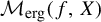 $\mathcal {M}_{\mathrm {erg}}(f, X)$
the set of f-ergodic probability measures. Let
$\mathcal {M}_{\mathrm {erg}}(f, X)$
the set of f-ergodic probability measures. Let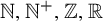 $\mathbb {N}, \mathbb {N}^+, \mathbb {Z}, \mathbb {R}$
denote the set of non-negative integers, positive integers, integers, and real numbers, respectively. We consider the set of well-approximable points
$\mathbb {N}, \mathbb {N}^+, \mathbb {Z}, \mathbb {R}$
denote the set of non-negative integers, positive integers, integers, and real numbers, respectively. We consider the set of well-approximable points
 $$ \begin{align*} W_\varphi(z) = \{x \in X : d (f^n x, z ) < \varphi(n) \mathrm{\ for\ infinite\ } n \in \mathbb{N}^+\} \end{align*} $$
for some fixed point $z \in X$
and
$z \in X$
and $\varphi : \mathbb {N}^+ \to \mathbb {R}^+$
defined by Hill and Velani in [Reference Hill and Velani13] in analogy to the classical theory of metric Diophantine approximations. These points’ trajectories hit a shrinking target infinitely often. A simple case is that
$\varphi : \mathbb {N}^+ \to \mathbb {R}^+$
defined by Hill and Velani in [Reference Hill and Velani13] in analogy to the classical theory of metric Diophantine approximations. These points’ trajectories hit a shrinking target infinitely often. A simple case is that $\varphi $
is a constant in the whole space and
$\varphi $
is a constant in the whole space and $z \in \mathrm {supp}(\mu ) $
where
$z \in \mathrm {supp}(\mu ) $
where
 $$ \begin{align*} \mathrm{supp}(\mu) = \{x \in X: \mu(B(x,\varepsilon))> 0 \mathrm{\ for\ any\ } \varepsilon > 0 \}. \end{align*} $$
For any $\varepsilon> 0$
, by Poincaré recurrence theorem, almost every
$\varepsilon> 0$
, by Poincaré recurrence theorem, almost every $x \in X$
hits the shrinking target
$x \in X$
hits the shrinking target $B(z,\varepsilon )$
infinitely often. However, what happens when
$B(z,\varepsilon )$
infinitely often. However, what happens when $\varphi $
is not a constant? Does
$\varphi $
is not a constant? Does $W_\varphi (z)$
exhibit strong dynamical complexity?
$W_\varphi (z)$
exhibit strong dynamical complexity?
From the viewpoint of measures, a direct result by the Borel–Cantelli lemma is that $\mu (W_\varphi (z)) = 0$
when
$\mu (W_\varphi (z)) = 0$
when $\sum _{n=1}^{\infty } \mu (B(z,\varphi (n)) ) < +\infty $
, and
$\sum _{n=1}^{\infty } \mu (B(z,\varphi (n)) ) < +\infty $
, and $\mu (W_\varphi (z)) = 1$
when
$\mu (W_\varphi (z)) = 1$
when $\sum _{n=1}^{\infty } \mu (B(z,\varphi (n)) ) = +\infty $
and
$\sum _{n=1}^{\infty } \mu (B(z,\varphi (n)) ) = +\infty $
and $B(z,\varphi (n))$
are independent. Unfortunately, the hypothesis of independence for the sets
$B(z,\varphi (n))$
are independent. Unfortunately, the hypothesis of independence for the sets $B(z,\varphi (n))$
is rarely satisfied in the field of dynamical systems. Therefore, researchers developed some weaker hypotheses to conclude
$B(z,\varphi (n))$
is rarely satisfied in the field of dynamical systems. Therefore, researchers developed some weaker hypotheses to conclude $\mu (W_\varphi (z)) = 1$
, called the ‘dynamical Borel–Cantelli lemma’. Previous results include uniformly hyperbolic systems [Reference Chernov and Kleinbock5], partially hyperbolic systems [Reference Dolgopyat9], interval maps [Reference Kim20], irrational rotations [Reference Kim21, Reference Tseng43], geodesic flows [Reference Maucourant26], and systems with some abstract conditions [Reference Fayad11, Reference Fernández, Melián and Pestana12, Reference Hussain, Li, Simmons and Wang18].
$\mu (W_\varphi (z)) = 1$
, called the ‘dynamical Borel–Cantelli lemma’. Previous results include uniformly hyperbolic systems [Reference Chernov and Kleinbock5], partially hyperbolic systems [Reference Dolgopyat9], interval maps [Reference Kim20], irrational rotations [Reference Kim21, Reference Tseng43], geodesic flows [Reference Maucourant26], and systems with some abstract conditions [Reference Fayad11, Reference Fernández, Melián and Pestana12, Reference Hussain, Li, Simmons and Wang18].
Another viewpoint is the Hausdorff dimension, which has a strong connection to Diophantine approximations. The Hausdorff dimension of $W_\varphi (z)$
was studied in many systems, including expanding rational maps of the Riemann sphere [Reference Hill and Velani13, Reference Hill and Velani14], actions on finite Kleinian groups [Reference Hill and Velani15], linear endomorphisms of the d-torus [Reference Hill and Velani16], parabolic rational maps [Reference Stratmann and Urbański39], conformal iterated function systems [Reference Urbański44], expanding Markov systems [Reference Fernández, Melián and Pestana12], irrational rotations on torus [Reference Bugeaud, Harrap, Kristensen and Velani3, Reference Dodson8, Reference Fan and Wu10, Reference Troubetzkoy and Schmeling42], and a dynamical system of continued fractions [Reference Li, Wang, Wu and Xu24].
$W_\varphi (z)$
was studied in many systems, including expanding rational maps of the Riemann sphere [Reference Hill and Velani13, Reference Hill and Velani14], actions on finite Kleinian groups [Reference Hill and Velani15], linear endomorphisms of the d-torus [Reference Hill and Velani16], parabolic rational maps [Reference Stratmann and Urbański39], conformal iterated function systems [Reference Urbański44], expanding Markov systems [Reference Fernández, Melián and Pestana12], irrational rotations on torus [Reference Bugeaud, Harrap, Kristensen and Velani3, Reference Dodson8, Reference Fan and Wu10, Reference Troubetzkoy and Schmeling42], and a dynamical system of continued fractions [Reference Li, Wang, Wu and Xu24].
The complexity of $W_\varphi (z)$
also can be measured from the viewpoint of chaos. Recall that Li–Yorke chaos focuses on the relatively complicated long-time behavior of pairs of two orbits, which first imported the concept of chaos to dynamical systems. Based on this, Schweizer and Smítal used ideas from the theory of probabilistic metric spaces to develop three versions of Li–Yorke chaos for maps of the interval in [Reference Schweizer and Smítal37] from a statistical viewpoint, which are collectively called distributional chaos and numbered in the order of decreasing strength (DC1, DC2, DC3). Those concepts of distributional chaos were generalized to the case of maps on a metric space in [Reference Schweizer, Sklar and Smítal36, Reference Schweizer and Smítal37]. In this article, we focus on the complexity of
$W_\varphi (z)$
also can be measured from the viewpoint of chaos. Recall that Li–Yorke chaos focuses on the relatively complicated long-time behavior of pairs of two orbits, which first imported the concept of chaos to dynamical systems. Based on this, Schweizer and Smítal used ideas from the theory of probabilistic metric spaces to develop three versions of Li–Yorke chaos for maps of the interval in [Reference Schweizer and Smítal37] from a statistical viewpoint, which are collectively called distributional chaos and numbered in the order of decreasing strength (DC1, DC2, DC3). Those concepts of distributional chaos were generalized to the case of maps on a metric space in [Reference Schweizer, Sklar and Smítal36, Reference Schweizer and Smítal37]. In this article, we focus on the complexity of $W_\varphi (z)$
from the viewpoint of distributional chaos.
$W_\varphi (z)$
from the viewpoint of distributional chaos.
1.1 Main results
In this article, we always assume a non-degenerate situation, which means that $\lvert X \rvert> 1$
. Denote
$\lvert X \rvert> 1$
. Denote $\mathcal {M}(X)$
as the set of probability measures and denote
$\mathcal {M}(X)$
as the set of probability measures and denote $\mathcal {M}(f, X)$
as the set of f-invariant probability measures. We denote the set of all transitive points in X with respect to f by
$\mathcal {M}(f, X)$
as the set of f-invariant probability measures. We denote the set of all transitive points in X with respect to f by $\mathrm {Trans}(f) = \{x \in X: \overline {\{f^nx : n \in \mathbb {N}^+\}} = X \}$
.
$\mathrm {Trans}(f) = \{x \in X: \overline {\{f^nx : n \in \mathbb {N}^+\}} = X \}$
.
Let $Z = \{z_n\}_{n=1}^{\infty } \subset X$
and
$Z = \{z_n\}_{n=1}^{\infty } \subset X$
and $\varphi : \mathbb {N}^+ \to \mathbb {R}^+$
. We call
$\varphi : \mathbb {N}^+ \to \mathbb {R}^+$
. We call
 $$ \begin{align*} W_\varphi(Z) = \{x \in X : d(f^n x, z_n) < \varphi(n) \mathrm{\ for\ infinite\ } n \in \mathbb{N}\} \end{align*} $$
the set of well-approximable points of Z with respect to $\varphi $
. We say Z is the target center. When
$\varphi $
. We say Z is the target center. When $z_n = z_m = z$
for any
$z_n = z_m = z$
for any $n, m \in \mathbb {N}^+$
, we also say that z is the target center and denote
$n, m \in \mathbb {N}^+$
, we also say that z is the target center and denote $W_\varphi (Z)$
by
$W_\varphi (Z)$
by $W_\varphi (z)$
. In addition, for infinite
$W_\varphi (z)$
. In addition, for infinite $T \subseteq \mathbb {N}^+$
, we call
$T \subseteq \mathbb {N}^+$
, we call
 $$ \begin{align*} W_\varphi(Z, T) = \{x \in X : d(f^n x, z_n) < \varphi(n) \mathrm{\ for\ infinite\ } n \in T\} \end{align*} $$
the set of well-approximable points of Z with index T with respect to $\varphi $
.
$\varphi $
.
Next, we recall some concepts of distributional chaos. For convenience, we recall the definitions of the distributional functions first. For any pair $(x,y)$
of points in X and any positive integer n, the distributional function
$(x,y)$
of points in X and any positive integer n, the distributional function $\Phi _{xy}^{(n)}:\mathbb {R} \to [0,1]$
is defined by
$\Phi _{xy}^{(n)}:\mathbb {R} \to [0,1]$
is defined by
 $$ \begin{align*} \Phi_{xy}^{(n)}(t,f) = \frac{1}{n}\lvert \{ 0 \leqslant i \leqslant n-1: d(f^ix,f^iy) < t \}\rvert. \end{align*} $$
The lower distributional function and the upper distributional function are defined by
 $$ \begin{align*}\Phi_{xy}(t,f) = \liminf_{n \to \infty}\Phi_{xy}^{(n)}(t,f),\end{align*} $$
 $$ \begin{align*}\Phi_{xy}^*(t,f) = \limsup_{n \to \infty}\Phi_{xy}^{(n)}(t,f).\end{align*} $$
Now, we recall the definition of distributional chaos of type 1 (DC1), which is stronger than DC2 and DC3. A pair $(x,y)$
of points in X is called DC1-scrambled (with respect to
$(x,y)$
of points in X is called DC1-scrambled (with respect to $f)$
if
$f)$
if
 $$ \begin{align*}\Phi_{xy}^*(t,f) &= 1 \quad \mathrm{for\ any\ } t> 0,\\\Phi_{xy}(t,f) &= 0 \quad \mathrm{for\ some\ } t> 0.\end{align*} $$
A set $K \subseteq X$
is called a DC1-scrambled set (with respect to
$K \subseteq X$
is called a DC1-scrambled set (with respect to $f)$
if any pair
$f)$
if any pair $(x,y)$
of points in K is DC1-scrambled (with respect to
$(x,y)$
of points in K is DC1-scrambled (with respect to $f)$
. A subset
$f)$
. A subset $K \subseteq X$
is said to be distributional chaotic of type 1(DC1) (with respect to f) if it has an uncountable DC1-scrambled subset (with respect to f).
$K \subseteq X$
is said to be distributional chaotic of type 1(DC1) (with respect to f) if it has an uncountable DC1-scrambled subset (with respect to f).
We want to investigate the distributional chaos property of the well-approximable points $W_\varphi (Z, T)$
. Since the distributional chaos property has a strong connection to the specification property (cf. [Reference Oprocha28, Reference Oprocha and Štefánková30]), we consider those systems with some form of the specification property. The main difficulty is to construct a set that is not only DC1, but also a subset of
$W_\varphi (Z, T)$
. Since the distributional chaos property has a strong connection to the specification property (cf. [Reference Oprocha28, Reference Oprocha and Štefánková30]), we consider those systems with some form of the specification property. The main difficulty is to construct a set that is not only DC1, but also a subset of $W_\varphi (Z, T)$
and the specification property may not work for the decreasing
$W_\varphi (Z, T)$
and the specification property may not work for the decreasing $\varphi (n)$
. Thus, we consider a strong form of the specification property, called the two-sided exponential specification property (see §2 for details), which appears in Axiom A systems and symbolic systems. It requires the shadowing to be exponential, which guarantees the existence of the well-approximable points. However, the uniformity of the gap is one of the most important properties in the (exponential) specification property. However, it does not play a significant role in the construction of chaos. Therefore, we consider new types of the specification property called the two-sided (one-sided) exponential specification property with non-uniform gap and conclude the following theorem.
$\varphi (n)$
. Thus, we consider a strong form of the specification property, called the two-sided exponential specification property (see §2 for details), which appears in Axiom A systems and symbolic systems. It requires the shadowing to be exponential, which guarantees the existence of the well-approximable points. However, the uniformity of the gap is one of the most important properties in the (exponential) specification property. However, it does not play a significant role in the construction of chaos. Therefore, we consider new types of the specification property called the two-sided (one-sided) exponential specification property with non-uniform gap and conclude the following theorem.
Theorem A. Let $f: X \to X$
be a continuous map on a compact metric space
$f: X \to X$
be a continuous map on a compact metric space $(X,d)$
and
$(X,d)$
and $T \subset \mathbb {N}^+$
be infinite. For any target center
$T \subset \mathbb {N}^+$
be infinite. For any target center $Z = \{z_n\}_{n=1}^{+\infty } \subset X$
:
$Z = \{z_n\}_{n=1}^{+\infty } \subset X$
:
-
(1) if f has the two-sided exponential specification property with a non-uniform gap with exponent $\unicode{x3bb}> 0$
and
$\varphi : \mathbb {N} \to \mathbb {R}^+$
satisfies then, for any non-empty open set
$$ \begin{align*} \liminf_{n \to +\infty, n \in T} \frac{e^{-n\unicode{x3bb}}}{\varphi(n)} = 0, \end{align*} $$
$U \subset X$
, the set
$W_\varphi (Z, T) \cap U \cap \mathrm {Trans}$
is DC1;
$\unicode{x3bb}> 0$
and
$\varphi : \mathbb {N} \to \mathbb {R}^+$
satisfies then, for any non-empty open set
$$ \begin{align*} \liminf_{n \to +\infty, n \in T} \frac{e^{-n\unicode{x3bb}}}{\varphi(n)} = 0, \end{align*} $$
$U \subset X$
, the set
$W_\varphi (Z, T) \cap U \cap \mathrm {Trans}$
is DC1;
-
(2) if f has the one-sided exponential non-uniformly specification property with exponent
$\unicode{x3bb}> 0$
and
$\varphi :\mathbb {N} \to \mathbb {R}^+$
, then for any non-empty open set
$U \subset X$
, the set
$W_\varphi (Z, T) \cap U \cap \mathrm {Trans}$
is DC1.


This theorem implies that the well-approximable points in systems with exponential specification properties exhibit strong dynamical complexity. Applications of the theorem include Axiom A systems, mixing subshifts of finite type, etc (see §4).
In particular, we can apply the theorem to the $\beta $
-shifts for any
$\beta $
-shifts for any $\beta> 1$
. One of the key distinctions between
$\beta> 1$
. One of the key distinctions between $\beta $
-shifts and ‘good’ shifts, such as topologically mixing subshifts of the finite type, is that
$\beta $
-shifts and ‘good’ shifts, such as topologically mixing subshifts of the finite type, is that $\beta $
-shifts do not satisfy the specification property for every
$\beta $
-shifts do not satisfy the specification property for every $\beta> 1$
. By [Reference Buzzi4],
$\beta> 1$
. By [Reference Buzzi4],
 $$ \begin{align*} \{\beta \in (1,+\infty) : (\Sigma_\beta, \sigma) \mathrm{\ has\ the\ specification\ property}\} \end{align*} $$
is dense in $(1,+\infty )$
but has zero Lebesgue measure. In [Reference Pfister and Sullivan32], Pfister and Sullivan proved that
$(1,+\infty )$
but has zero Lebesgue measure. In [Reference Pfister and Sullivan32], Pfister and Sullivan proved that $\beta $
-shifts satisfy a weak form of the specification property, called the approximate product property. This result was generalized to the g-almost product property in [Reference Pfister and Sullivan33] and the almost specification property in [Reference Thompson40]. In this article, we proved that the
$\beta $
-shifts satisfy a weak form of the specification property, called the approximate product property. This result was generalized to the g-almost product property in [Reference Pfister and Sullivan33] and the almost specification property in [Reference Thompson40]. In this article, we proved that the $\beta $
-shifts have the one-sided exponential specification property with a non-uniform gap, which not only implies
$\beta $
-shifts have the one-sided exponential specification property with a non-uniform gap, which not only implies $\beta $
-shifts satisfy Theorem A but also have independent interest of possibly playing important roles in other topics.
$\beta $
-shifts satisfy Theorem A but also have independent interest of possibly playing important roles in other topics.
Theorem B. Let $\beta> 1$
and
$\beta> 1$
and $(\Sigma _\beta , \sigma )$
be a
$(\Sigma _\beta , \sigma )$
be a $\beta $
-shift. Then, it has the one-sided exponential specification property with a non-uniform gap.
$\beta $
-shift. Then, it has the one-sided exponential specification property with a non-uniform gap.
1.2 Organization
In §2, we recall the definitions of some concepts to make precise statements of the theorems and their proofs and introduce some new forms of specification properties. In §3, we give some lemmas and prove Theorem A. In §4, we give some applications of Theorem A to symbolic systems and differential systems.
2 The specification-like properties
2.1 Specification property and exponential specification property
We first recall the definition of the specification property, which is weaker than the original definition given by Bowen. The latter is always called Bowen’s specification property or the periodic specification property now.
Let $f:X \to X$
be a continuous map on a compact metric space
$f:X \to X$
be a continuous map on a compact metric space $(X,d)$
.
$(X,d)$
.
Definition 2.1. We say that $f:X \to X$
has the specification property if for any
$f:X \to X$
has the specification property if for any $\varepsilon> 0$
, there exists an integer
$\varepsilon> 0$
, there exists an integer $M=M(\varepsilon )$
(called the gap) such that for any integer
$M=M(\varepsilon )$
(called the gap) such that for any integer $k \geqslant 2$
, any k points
$k \geqslant 2$
, any k points $\{x_j\}_{j=1}^k \subseteq X$
, and any
$\{x_j\}_{j=1}^k \subseteq X$
, and any $2k$
integers
$2k$
integers
 $$ \begin{align*} a_1 \leqslant b_1 < a_2 \leqslant b_2 < \cdots < a_k \leqslant b_k \quad\text{with } a_j - b_{j-1} \geqslant M \quad \text{for any } 2\leqslant j\leqslant k, \end{align*} $$
there exists a point $y \in X$
such that
$y \in X$
such that
 $$ \begin{align*}d(f^ny,f^nx_i) < \varepsilon\end{align*} $$
for any $a_i \leqslant n \leqslant b_i$
and any
$a_i \leqslant n \leqslant b_i$
and any $1 \leqslant i \leqslant k$
. We also say that
$1 \leqslant i \leqslant k$
. We also say that $y\ \varepsilon $
-shadows
$y\ \varepsilon $
-shadows $x_j$
on
$x_j$
on $[a_j, b_j]$
for any
$[a_j, b_j]$
for any $1 \leqslant j \leqslant k$
.
$1 \leqslant j \leqslant k$
.
Definition 2.2. Let $\unicode{x3bb}> 0$
. We say that
$\unicode{x3bb}> 0$
. We say that $f:X \to X$
has the two-sided exponential specification property with exponent
$f:X \to X$
has the two-sided exponential specification property with exponent $\unicode{x3bb} $
if for any
$\unicode{x3bb} $
if for any $\varepsilon> 0$
, there exists an integer
$\varepsilon> 0$
, there exists an integer $M=M(\varepsilon )$
such that for any integer
$M=M(\varepsilon )$
such that for any integer $k \geqslant 2$
, any k points
$k \geqslant 2$
, any k points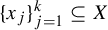 $\{x_j\}_{j=1}^k \subseteq X$
, and any
$\{x_j\}_{j=1}^k \subseteq X$
, and any $2k$
integers
$2k$
integers
 $$ \begin{align*} a_1 \leqslant b_1 < a_2 \leqslant b_2 < \cdots < a_k \leqslant b_k\quad \mathrm{with\ }a_j - b_{j-1} \geqslant M\quad\mathrm{for\ any\ }2\leqslant j\leqslant k, \end{align*} $$
there exists a point $y \in X$
such that
$y \in X$
such that
 $$ \begin{align*} d(f^ny,f^nx_i) < \varepsilon e^{-\unicode{x3bb}\min\{n-a_i,b_i-n\} } \end{align*} $$
for any $a_i \leqslant n \leqslant b_i$
and any
$a_i \leqslant n \leqslant b_i$
and any $1 \leqslant i \leqslant k$
. We also say that
$1 \leqslant i \leqslant k$
. We also say that $y \varepsilon $
-shadows
$y \varepsilon $
-shadows $x_j$
on
$x_j$
on $[a_j, b_j]$
with two-sided exponent
$[a_j, b_j]$
with two-sided exponent $\unicode{x3bb} $
for any
$\unicode{x3bb} $
for any $1 \leqslant j \leqslant k$
.
$1 \leqslant j \leqslant k$
.
Definition 2.3. Let $\unicode{x3bb}> 0$
. We say that
$\unicode{x3bb}> 0$
. We say that $f:X \to X$
has the one-sided exponential specification property with exponent
$f:X \to X$
has the one-sided exponential specification property with exponent $\unicode{x3bb} $
if for any
$\unicode{x3bb} $
if for any $\varepsilon> 0$
, there exists an integer
$\varepsilon> 0$
, there exists an integer $M=M(\varepsilon )$
such that for any integer
$M=M(\varepsilon )$
such that for any integer $k \geqslant 2$
, any k points
$k \geqslant 2$
, any k points $\{x_j\}_{j=1}^k \subseteq X$
, and any
$\{x_j\}_{j=1}^k \subseteq X$
, and any $2k$
integers
$2k$
integers
 $$ \begin{align*}a_1 \leqslant b_1 < a_2 \leqslant b_2 < \cdots < a_k \leqslant b_k\quad \mathrm{with\ }a_j - b_{j-1} \geqslant M\quad \mathrm{for\ any\ }2\leqslant j\leqslant k,\end{align*} $$
there exists a point $y \in X$
such that
$y \in X$
such that
 $$ \begin{align*} d(f^ny,f^nx_i) < \varepsilon e^{-\unicode{x3bb}(b_i-n) } \end{align*} $$
for any $a_i \leqslant n \leqslant b_i$
and any
$a_i \leqslant n \leqslant b_i$
and any $1 \leqslant i \leqslant k$
. We also say that
$1 \leqslant i \leqslant k$
. We also say that $y \varepsilon $
-shadows
$y \varepsilon $
-shadows $x_j$
on
$x_j$
on $[a_j, b_j]$
with one-sided exponent
$[a_j, b_j]$
with one-sided exponent $\unicode{x3bb} $
for any
$\unicode{x3bb} $
for any $1 \leqslant j \leqslant k$
.
$1 \leqslant j \leqslant k$
.
By the definition of the specification property and exponential specification property, we can easily check the relationship between them and get the following remark.
Remark 2.4. Let $f:X \to X$
be a continuous map on a compact metric space
$f:X \to X$
be a continuous map on a compact metric space $(X,d)$
.
$(X,d)$
.
-
• If f has the one-sided exponential specification property for some
$\unicode{x3bb}> 0$
, then f has the two-sided exponential specification property with exponent
$\unicode{x3bb} $
. -
• If f has the two-sided exponential specification property for some
$\unicode{x3bb}> 0$
, then f has the specification property.


In other words, the one-sided exponential specification property is stronger than the two-sided exponential specification property. The two-sided exponential specification property is stronger than the specification property.
2.2 Specification property and exponential specification property with a non-uniform gap
In this subsection, we introduce some new forms of the specification property. In non-uniformly hyperbolic systems and non-uniformly expanding maps, a weaker form of the specification property called the non-uniform (exponential) specification property, is considered in [Reference Oliveira and Tian27, Reference Tian and Varandas41]. One important requirement of it is that the gap M of the non-uniformly (exponential) specification property is non-uniform to x and sublinear to n, where n is the length of the shadowing interval. However, it is difficult to estimate the gap for some systems like $\beta $
-shifts. Therefore, we introduce a new form of the specification property, called the specification property with a non-uniform gap.
$\beta $
-shifts. Therefore, we introduce a new form of the specification property, called the specification property with a non-uniform gap.
Definition 2.5. We say that f has the specification property with a non-uniform gap if for any $x \in X$
,
$x \in X$
, $n \in \mathbb {N}$
, and
$n \in \mathbb {N}$
, and $\varepsilon> 0$
, there exists a positive integer
$\varepsilon> 0$
, there exists a positive integer $M(x, n, \varepsilon )$
such that for any integer
$M(x, n, \varepsilon )$
such that for any integer $k \geqslant 2$
, any k points
$k \geqslant 2$
, any k points $\{x_j\}_{j=1}^k \subseteq X$
, and any
$\{x_j\}_{j=1}^k \subseteq X$
, and any $2k$
integers
$2k$
integers
 $$ \begin{align*}0 \leqslant a_1 \leqslant b_1 < a_2 \leqslant b_2 < \cdots < a_k \leqslant b_k\end{align*} $$
with
 $$ \begin{align*}a_j - b_{j-1} \geqslant M(x_{j-1},b_{j-1}-a_{j-1},\varepsilon)\end{align*} $$
for any $2\leqslant j\leqslant k$
, there exists a point
$2\leqslant j\leqslant k$
, there exists a point $y \in X$
such that
$y \in X$
such that
 $$ \begin{align*}d(f^ny,f^{n-a_j}x_j) \leqslant \varepsilon\end{align*} $$
for any $a_j \leqslant n \leqslant b_j$
and any
$a_j \leqslant n \leqslant b_j$
and any $1 \leqslant j \leqslant k$
.
$1 \leqslant j \leqslant k$
.
The main difference between the specification property and the specification property with a non-uniform gap is that the gap of the specification property with a non-uniform gap $M(x, n, \varepsilon )$
is non-uniform with respect to x and n.
$M(x, n, \varepsilon )$
is non-uniform with respect to x and n.
Definition 2.6. Let $\unicode{x3bb}> 0$
. We say that f has the two-sided exponential specification property with a non-uniform gap with exponent
$\unicode{x3bb}> 0$
. We say that f has the two-sided exponential specification property with a non-uniform gap with exponent $\unicode{x3bb} $
if for any
$\unicode{x3bb} $
if for any $x \in X$
,
$x \in X$
, $n \in \mathbb {N}$
, and
$n \in \mathbb {N}$
, and $\varepsilon> 0$
, there exists an integer
$\varepsilon> 0$
, there exists an integer $M(x, n, \varepsilon )$
such that for any integer
$M(x, n, \varepsilon )$
such that for any integer $k \geqslant 2$
, any k points
$k \geqslant 2$
, any k points $\{x_j\}_{j=1}^k \subseteq X$
, and any
$\{x_j\}_{j=1}^k \subseteq X$
, and any $2k$
integers
$2k$
integers
 $$ \begin{align*}0 \leqslant a_1 \leqslant b_1 < a_2 \leqslant b_2 < \cdots < a_k \leqslant b_k\end{align*} $$
with
 $$ \begin{align*}a_j - b_{j-1} \geqslant M(x_{j-1},b_{j-1}-a_{j-1},\varepsilon)\end{align*} $$
for any $2\leqslant j\leqslant k$
, there exists a point
$2\leqslant j\leqslant k$
, there exists a point $y \in X$
such that
$y \in X$
such that
 $$ \begin{align*} d(f^ny,f^{n-a_j}x_j) \leqslant \varepsilon e^{-\unicode{x3bb}\min\{n-a_i,b_i-n\} } \end{align*} $$
for any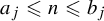 $a_j \leqslant n \leqslant b_j$
and any
$a_j \leqslant n \leqslant b_j$
and any $1 \leqslant j \leqslant k$
.
$1 \leqslant j \leqslant k$
.
Definition 2.7. Let $\unicode{x3bb}> 0$
. We say that f has the one-sided exponential specification property with a non-uniform gap with exponent
$\unicode{x3bb}> 0$
. We say that f has the one-sided exponential specification property with a non-uniform gap with exponent $\unicode{x3bb} $
if for any
$\unicode{x3bb} $
if for any $x \in X$
,
$x \in X$
, $n \in \mathbb {N}$
, and
$n \in \mathbb {N}$
, and $\varepsilon> 0$
, there exists an integer
$\varepsilon> 0$
, there exists an integer $M(x, n, \varepsilon )$
such that for any integer
$M(x, n, \varepsilon )$
such that for any integer $k \geqslant 2$
, any k points
$k \geqslant 2$
, any k points $\{x_j\}_{j=1}^k \subseteq X$
, and any
$\{x_j\}_{j=1}^k \subseteq X$
, and any $2k$
integers
$2k$
integers
 $$ \begin{align*}0 \leqslant a_1 \leqslant b_1 < a_2 \leqslant b_2 < \cdots < a_k \leqslant b_k\end{align*} $$
with
 $$ \begin{align*} a_j - b_{j-1} \geqslant M(x_{j-1},b_{j-1}-a_{j-1},\varepsilon) \end{align*} $$
for any $2\leqslant j\leqslant k$
, there exists a point
$2\leqslant j\leqslant k$
, there exists a point $y \in X$
such that
$y \in X$
such that
 $$ \begin{align*} d(f^ny,f^{n-a_j}x_j) \leqslant \varepsilon e^{-\unicode{x3bb}(b_i-n)} \end{align*} $$
for any $a_j \leqslant n \leqslant b_j$
and any
$a_j \leqslant n \leqslant b_j$
and any $1 \leqslant j \leqslant k$
.
$1 \leqslant j \leqslant k$
.
Remark 2.8. Let $f:X \to X$
be a continuous map on a compact metric space
$f:X \to X$
be a continuous map on a compact metric space $(X,d)$
.
$(X,d)$
.
-
• If f has the one-sided exponential specification property with a non-uniform gap for some
$\unicode{x3bb}> 0$
, then f has the two-sided exponential specification property with a non-uniform gap with exponent
$\unicode{x3bb} $
. -
• If f has the two-sided exponential specification property with a non-uniform gap for some
$\unicode{x3bb}> 0$
, then f has the specification property with a non-uniform gap.


In other words, the one-sided exponential specification property with a non-uniform gap is stronger than the two-sided exponential specification property with a non-uniform gap. The two-sided exponential specification property with a non-uniform gap is stronger than the specification property with a non-uniform gap.
One can easily check the following statement by [Reference Denker, Grillenberger and Sigmund7, Proposition 6.11].
Lemma 2.9. Let $f:X \to X$
be a continuous map on a compact metric space
$f:X \to X$
be a continuous map on a compact metric space $(X,d)$
. If f has the specification property with a non-uniform gap, then f is topologically transitive and, hence,
$(X,d)$
. If f has the specification property with a non-uniform gap, then f is topologically transitive and, hence, $\mathrm {Trans}$
is dense in X.
$\mathrm {Trans}$
is dense in X.
The following proposition implies that the specification property with a non-uniform gap can be extended to the case of infinite shadowing intervals. Similar results hold for the specification property with a non-uniform gap and the one-sided exponential specification property with a uniform gap.
Proposition 2.10. Let $\unicode{x3bb}> 0$
. If f has the two-sided exponential specification property with a non-uniform gap with exponent
$\unicode{x3bb}> 0$
. If f has the two-sided exponential specification property with a non-uniform gap with exponent $\unicode{x3bb} $
, then for any
$\unicode{x3bb} $
, then for any $x \in X$
,
$x \in X$
, $n \in \mathbb {N}$
, and
$n \in \mathbb {N}$
, and $\varepsilon> 0$
, there exists an integer
$\varepsilon> 0$
, there exists an integer $M(x, n, \varepsilon )$
such that for any sequence of points
$M(x, n, \varepsilon )$
such that for any sequence of points $\{x_j\}_{j=1}^{+\infty } \subseteq X$
, and any two sequences of integers
$\{x_j\}_{j=1}^{+\infty } \subseteq X$
, and any two sequences of integers $\{a_j\}_{j=1}^{+\infty }$
and
$\{a_j\}_{j=1}^{+\infty }$
and $\{b_j\}_{j=1}^{+\infty }$
, if
$\{b_j\}_{j=1}^{+\infty }$
, if
 $$ \begin{align*} 0 \leqslant a_1 \leqslant b_1 < a_2 \leqslant b_2 < \cdots < a_j \leqslant b_j < a_{j+1} \leqslant \cdots, \end{align*} $$
 $$ \begin{align*} a_j - b_{j-1} \geqslant M(x_{j-1},b_{j-1}-a_{j-1},\varepsilon)\quad \mathrm{for\ any\ } j \geqslant 2, \end{align*} $$
then, there exists a point $y \in X$
that
$y \in X$
that $\varepsilon $
-shadows
$\varepsilon $
-shadows $x_j$
on
$x_j$
on $[a_j, b_j]$
with exponent
$[a_j, b_j]$
with exponent $\unicode{x3bb} $
for any
$\unicode{x3bb} $
for any $j \geqslant 1$
.
$j \geqslant 1$
.
Proof. Since f has the two-sided exponential specification property with a non-uniform gap, for any $l \geqslant 2$
, there exists a point
$l \geqslant 2$
, there exists a point $y_l \in X$
that
$y_l \in X$
that $\varepsilon $
-shadows
$\varepsilon $
-shadows $x_j$
on
$x_j$
on $[a_j, b_j]$
with exponent
$[a_j, b_j]$
with exponent $\unicode{x3bb} $
for any
$\unicode{x3bb} $
for any $1 \leqslant j \leqslant l - 1$
and
$1 \leqslant j \leqslant l - 1$
and $\varepsilon $
-shadows
$\varepsilon $
-shadows $x_{l}$
on
$x_{l}$
on $[a_{l}, b_{l}]$
with exponent
$[a_{l}, b_{l}]$
with exponent $\unicode{x3bb} $
. Since f is a continuous map, any accumulation point of
$\unicode{x3bb} $
. Since f is a continuous map, any accumulation point of $\{y_l\}_{l=2}^\infty $
naturally
$\{y_l\}_{l=2}^\infty $
naturally $\varepsilon $
-shadows
$\varepsilon $
-shadows $x_j$
on
$x_j$
on $[a_j, b_j]$
with exponent
$[a_j, b_j]$
with exponent $\unicode{x3bb} $
for any
$\unicode{x3bb} $
for any $j \geqslant 1$
.
$j \geqslant 1$
.
2.3 g-almost product property
In this section, we recall the definition of the g-almost product property introduced by Pfister and Sullivan in [Reference Pfister and Sullivan33], and give some lemmas about the relationship between the g-almost product property and specification property.
Let $f:X \to X$
be a continuous map on a compact metric space
$f:X \to X$
be a continuous map on a compact metric space $(X,d)$
. For any
$(X,d)$
. For any ${n \in \mathbb {N}^+}$
,
${n \in \mathbb {N}^+}$
, $x \in X$
, and
$x \in X$
, and $\varepsilon> 0$
, the dynamical ball
$\varepsilon> 0$
, the dynamical ball $B_n(x,\varepsilon )$
is defined by
$B_n(x,\varepsilon )$
is defined by
 $$ \begin{align*} B_n(x,\varepsilon) = \{y\in X: d(f^jx,f^jy) < \varepsilon\mathrm{\ for\ any\ }0\leqslant j\leqslant n-1\}. \end{align*} $$
Definition 2.11. Let $g:\mathbb {N}^+ \to \mathbb {N}$
be a non-decreasing unbounded map such that
$g:\mathbb {N}^+ \to \mathbb {N}$
be a non-decreasing unbounded map such that
 $$ \begin{align*}g(n) < n \mathrm{\ and\ } \lim_{n \to \infty}\frac{g(n)}{n}=0.\end{align*} $$
Such g is called a blowup function.
Denote $\{0,1,2,\ldots ,n-1\}$
by
$\{0,1,2,\ldots ,n-1\}$
by $\Lambda _n$
.
$\Lambda _n$
.
Definition 2.12. Let $g:\mathbb {N}^+ \to \mathbb {N}$
be a blowup function. We say that
$g:\mathbb {N}^+ \to \mathbb {N}$
be a blowup function. We say that $(X,f)$
has the g-almost product property if there exists a function
$(X,f)$
has the g-almost product property if there exists a function $M:\mathbb {R}^+ \to \mathbb {N}$
such that for any integer
$M:\mathbb {R}^+ \to \mathbb {N}$
such that for any integer $k \geqslant 2$
, any k positive real numbers
$k \geqslant 2$
, any k positive real numbers $\{\varepsilon _j\}_{j=1}^k$
, any k points
$\{\varepsilon _j\}_{j=1}^k$
, any k points $\{x_j\}_{j=1}^k \subseteq X$
, and any
$\{x_j\}_{j=1}^k \subseteq X$
, and any $k+1$
integers
$k+1$
integers
 $$ \begin{align*}0 = a_0 \leqslant a_1 \leqslant a_2 \leqslant \cdots \leqslant a_k \quad \mathrm{with\ } a_j - a_{j-1} \geqslant M(\varepsilon_j)\quad \mathrm{for\ any\ }1 \leqslant j \leqslant k,\end{align*} $$
there exists a point $y \in X$
such that
$y \in X$
such that
 $$ \begin{align*} \#\{n \in [a_{j-1},a_j): d(f^ny,f^nx_j) \geqslant \varepsilon_j\} \leqslant g(a_j - a_{j-1}) \end{align*} $$
for any $1 \leqslant j \leqslant k$
.
$1 \leqslant j \leqslant k$
.
Intuitively, the g-almost product property means that for any k points $x_1,\ldots ,x_k \in X$
and k positive scales
$x_1,\ldots ,x_k \in X$
and k positive scales $\varepsilon _1, \ldots , \varepsilon _k$
, there exists a point
$\varepsilon _1, \ldots , \varepsilon _k$
, there exists a point $y \in X$
that
$y \in X$
that $\varepsilon _j$
-shadows
$\varepsilon _j$
-shadows $x_j$
on
$x_j$
on $[a_{j-1},a_j-1]$
with some ‘bad times’ if
$[a_{j-1},a_j-1]$
with some ‘bad times’ if $a_j - a_{j-1}$
is large enough. In addition, those ‘bad times’ account for up to the proportion of
$a_j - a_{j-1}$
is large enough. In addition, those ‘bad times’ account for up to the proportion of ${g(a_j - a_{j-1})}/{(a_j - a_{j-1})}$
on
${g(a_j - a_{j-1})}/{(a_j - a_{j-1})}$
on $[a_{j-1},a_j-1]$
.
$[a_{j-1},a_j-1]$
.
Remark 2.13. There are three main differences between the g-almost product property and the specification property.
-
• The g-almost product property allows different scales through shadowing different points, while the specification property requires the scales to be the same.
-
• The proportion of the ‘bad times’ of the g-almost product property is sublinear, while the proportion of the ‘bad times’ of the specification property is a constant.
-
• The distribution of ‘bad times’ of the g-almost product property is unknown, while the ‘bad times’ of the specification property is at the end of every shadowing interval.
There are three main differences between the g-almost product property and the specification property with a non-uniform gap.
-
• The g-almost product property allows different scales through shadowing different points, while the specification property with a non-uniform gap requires the scales to be the same.
-
• The proportion of the ‘bad times’ of the g-almost product property is sublinear, while the proportion of the ‘bad times’ of the specification property with a non-uniform gap is unknown.
-
• The distribution of ‘bad times’ of the g-almost product property is unknown, while the ‘bad times’ of the specification property with a non-uniform gap is at the end of every shadowing interval.
Figure 1 shows the relationship between those specification-like properties.

Figure 1 Relationship between different forms of specification-like properties.
3 Proof of Theorem A
In this section, we prove Theorem A. Before our proof, we recall some definitions and lemmas related to distributional chaos.
3.1 Strongly distributional chaos
In this subsection, we recall the definition of a new form of the distributional chaos property called strongly distributional chaos introduced in [Reference Hou and Tian17], which is stronger than DC1.
Definition 3.1. Let $\mathcal {A}$
be a set of maps defined by
$\mathcal {A}$
be a set of maps defined by
 $$ \begin{align*} \mathcal{A} = \bigg\{\alpha:\mathbb{N} \to [0,+\infty],\alpha \mathrm{\ is\ non\text{-}decreasing},\lim_{n\to\infty}\alpha(n)=+\infty \mathrm{\ and\ } \lim_{n\to\infty}\frac{\alpha(n)}{n}=0\bigg\}. \end{align*} $$
For any $\alpha \in \mathcal {A}$
, any pair
$\alpha \in \mathcal {A}$
, any pair $(x,y)$
of points in X, and any positive integer n, the
$(x,y)$
of points in X, and any positive integer n, the $\alpha $
-distributional function
$\alpha $
-distributional function $\Phi _{xy}^{(n)}(\cdot ,\alpha ):\mathbb {R} \to [0,1]$
is defined by
$\Phi _{xy}^{(n)}(\cdot ,\alpha ):\mathbb {R} \to [0,1]$
is defined by
 $$ \begin{align*} \Phi_{xy}^{(n)}(t,\alpha,f) = \frac{1}{n}\bigg\lvert \bigg\{1 \leqslant i \leqslant n: \sum_{j=0}^{i-1}d(f^jx,f^jy) < \alpha(i)t \bigg\}\bigg\rvert. \end{align*} $$
The upper $\alpha $
-distributional function is defined by
$\alpha $
-distributional function is defined by
 $$ \begin{align*}\Phi_{xy}^*(t,\alpha,f) = \limsup_{n \to \infty}\Phi_{xy}^{(n)}(t,\alpha,f).\end{align*} $$
A pair $(x,y)$
of points in X is called
$(x,y)$
of points in X is called $\alpha $
-DC1-scrambled (with respect to
$\alpha $
-DC1-scrambled (with respect to $f)$
if
$f)$
if
 $$ \begin{align*}\Phi_{xy}^*(t,\alpha,f) = 1 \quad \mathrm{for\ any\ } t> 0,\end{align*} $$
 $$ \begin{align*}\Phi_{xy}(t,f) = 0 \quad \mathrm{for\ some\ } t> 0.\end{align*} $$
A set $K \subseteq X$
is called a
$K \subseteq X$
is called a $\alpha $
-DC1-scrambled set (with respect to f) if any pair (
$\alpha $
-DC1-scrambled set (with respect to f) if any pair ( $x,y$
) of points in K is
$x,y$
) of points in K is $\alpha $
-DC1-scrambled (with respect to f). A subset
$\alpha $
-DC1-scrambled (with respect to f). A subset $K \subseteq X$
is said to be strongly distributional chaotic (with respect to f) if it has an uncountable
$K \subseteq X$
is said to be strongly distributional chaotic (with respect to f) if it has an uncountable $\alpha $
-DC1-scrambled subset (with respect to
$\alpha $
-DC1-scrambled subset (with respect to $f)$
for any
$f)$
for any $\alpha \in \mathcal {A}$
.
$\alpha \in \mathcal {A}$
.
It is easy to check the relationship between strong distributional chaotic sets and DC1 sets.
Remark 3.2. [Reference Hou and Tian17, Proposition 2.5] Any strongly distributional chaotic subset $K \subseteq X$
is DC1, which means that strongly distributional chaos is stronger than DC1.
$K \subseteq X$
is DC1, which means that strongly distributional chaos is stronger than DC1.
3.2 Existence of distal pairs
A pair $(x,y)$
of points in X is called a distal pair if
$(x,y)$
of points in X is called a distal pair if
 $$ \begin{align*}\liminf_{n\to\infty}d(f^nx,f^ny)> 0.\end{align*} $$
Otherwise, we call it a proximal pair. We say a continuous map $f:X \to X$
is proximal if there is no distal pair in X for f. Additionally, we say a subset
$f:X \to X$
is proximal if there is no distal pair in X for f. Additionally, we say a subset $B \subseteq X$
is minimal if B is compact, f-invariant, and has no proper subset that is non-empty, compact, and f-invariant.
$B \subseteq X$
is minimal if B is compact, f-invariant, and has no proper subset that is non-empty, compact, and f-invariant.
Oprocha gave an equivalent condition of systems to be proximal. The existence of distal pairs in systems with the two-sided exponential specification property is a direct consequence.
Lemma 3.3. [Reference Oprocha29, Lemma 18]
A continuous map $f:X \to X$
is proximal if and only if it has a fixed point which is the unique minimal subset of X.
$f:X \to X$
is proximal if and only if it has a fixed point which is the unique minimal subset of X.
Lemma 3.4. Let $f: X \to X$
be a continuous map on a compact metric space
$f: X \to X$
be a continuous map on a compact metric space $(X,d)$
with two-sided exponential specification property with a non-uniform gap. Then, f has a distal pair.
$(X,d)$
with two-sided exponential specification property with a non-uniform gap. Then, f has a distal pair.
Proof. Since $\lvert X\rvert> 1$
, fix x,
$\lvert X\rvert> 1$
, fix x, $y \in X$
with
$y \in X$
with $d(x,y)> 0$
. Let
$d(x,y)> 0$
. Let $\varepsilon = \tfrac 12d(x,y)$
. By the two-sided exponential specification property with a non-uniform gap and Proposition 2.10, there exists
$\varepsilon = \tfrac 12d(x,y)$
. By the two-sided exponential specification property with a non-uniform gap and Proposition 2.10, there exists $l \geqslant M(x,0,\varepsilon )$
and points that
$l \geqslant M(x,0,\varepsilon )$
and points that $\varepsilon $
-shadows x on
$\varepsilon $
-shadows x on $[il, il]$
for any
$[il, il]$
for any $i \in \mathbb {N}$
. Let
$i \in \mathbb {N}$
. Let $S(x)$
be the set of all points that satisfy the above condition. Then,
$S(x)$
be the set of all points that satisfy the above condition. Then, $\bigcup _{i=0}^{l-1} f^{-i}S(x)$
is proper, non-empty, compact, and f-invariant. Hence, it has a proper minimal subset
$\bigcup _{i=0}^{l-1} f^{-i}S(x)$
is proper, non-empty, compact, and f-invariant. Hence, it has a proper minimal subset $U(x)$
. Similarly, there exists a minimal set
$U(x)$
. Similarly, there exists a minimal set $U(y) \ne U(x)$
, which implies the conclusion by Lemma 3.3.
$U(y) \ne U(x)$
, which implies the conclusion by Lemma 3.3.
3.3 The case of the two-sided exponential specification property with a non-uniform gap
Term (1) of Theorem A is a direct corollary of the following theorem.
Theorem 3.5. Let $f: X \to X$
be a continuous map on a compact metric space
$f: X \to X$
be a continuous map on a compact metric space $(X,d)$
and
$(X,d)$
and $T \subset \mathbb {N}$
be infinite. For any target center
$T \subset \mathbb {N}$
be infinite. For any target center $Z = \{z_n\}_{n=1}^{+\infty } \subset X$
, if f has the two-sided exponential specification property with a non-uniform gap with exponent
$Z = \{z_n\}_{n=1}^{+\infty } \subset X$
, if f has the two-sided exponential specification property with a non-uniform gap with exponent $\unicode{x3bb}> 0$
and
$\unicode{x3bb}> 0$
and ${\varphi : \mathbb {N}^+ \to \mathbb {R}^+}$
satisfies
${\varphi : \mathbb {N}^+ \to \mathbb {R}^+}$
satisfies
 $$ \begin{align*}\liminf_{n \to +\infty, n \in T} \frac{e^{-n\unicode{x3bb}}}{\varphi(n)} = 0,\end{align*} $$
then for any non-empty open set $U \subset X$
and any
$U \subset X$
and any $\alpha \in \mathcal {A}$
, there exists an uncountable subset
$\alpha \in \mathcal {A}$
, there exists an uncountable subset $S_\alpha \subseteq W_\varphi (Z, T) \cap U \cap \mathrm {Trans}$
such that there exists
$S_\alpha \subseteq W_\varphi (Z, T) \cap U \cap \mathrm {Trans}$
such that there exists $t_0> 0$
such that for any
$t_0> 0$
such that for any $x, y \in S_\alpha $
with
$x, y \in S_\alpha $
with $x \ne y$
,
$x \ne y$
,
 $$ \begin{align*}\limsup_{n \to \infty}\frac{1}{n}\bigg\lvert \bigg\{ 1 \leqslant i \leqslant n: \sum_{j=0}^{i-1}d(f^jx,f^jy) < \alpha(i)t \bigg\}\bigg\rvert = 1 \quad\mathrm{\ for\ any\ } t> 0,\end{align*} $$
 $$ \begin{align*} \liminf_{n \to \infty}\frac{1}{n}\lvert \{ 0 \leqslant i \leqslant n-1:d(f^ix,f^iy) < t_0 \}\rvert = 0. \end{align*} $$
Therefore, $W_\varphi (Z, T) \cap U \cap \mathrm {Trans}$
is strongly distributional chaotic and, hence, distributional chaotic of type 1.
$W_\varphi (Z, T) \cap U \cap \mathrm {Trans}$
is strongly distributional chaotic and, hence, distributional chaotic of type 1.
Proof. Given $\alpha \in \mathcal {A}$
, non-empty open set
$\alpha \in \mathcal {A}$
, non-empty open set $U \subseteq X$
. By Lemma 2.9,
$U \subseteq X$
. By Lemma 2.9, $\mathrm {Trans}$
is dense in X. Fix some
$\mathrm {Trans}$
is dense in X. Fix some $z \in \mathrm {Trans} \cap U$
with
$z \in \mathrm {Trans} \cap U$
with $B(z,\varepsilon _0) \subseteq U$
for some
$B(z,\varepsilon _0) \subseteq U$
for some $0 < \varepsilon _0 < 1$
. Let
$0 < \varepsilon _0 < 1$
. Let $\varepsilon _{k+1} = \tfrac 12\varepsilon _k$
for any
$\varepsilon _{k+1} = \tfrac 12\varepsilon _k$
for any $k \in \mathbb {N}$
.
$k \in \mathbb {N}$
.
By Lemma 3.4, there exists a distal pair $(q_1,q_2)$
in X. Since
$(q_1,q_2)$
in X. Since $(q_1, q_2)$
is a distal pair, then by definition, there exists
$(q_1, q_2)$
is a distal pair, then by definition, there exists $\zeta> 0$
such that for any
$\zeta> 0$
such that for any $n \in \mathbb {N}^+$
,
$n \in \mathbb {N}^+$
,
 $$ \begin{align*} d(f^nq_1, f^nq_2)> \zeta. \end{align*} $$
Let $\{c_k\}_{k=1}^{+\infty } = \{c_k(\varepsilon _k,\unicode{x3bb} )\}_{k=1}^{+\infty }$
be a sequence of positive integers where
$\{c_k\}_{k=1}^{+\infty } = \{c_k(\varepsilon _k,\unicode{x3bb} )\}_{k=1}^{+\infty }$
be a sequence of positive integers where
 $$ \begin{align*} c_k = \min\{n \in \mathbb{N} : \varepsilon_0 e^{-n\unicode{x3bb}} < \varepsilon_k\} \end{align*} $$
for any $k \in \mathbb {N}^+$
.
$k \in \mathbb {N}^+$
.
We construct $\{a_n\}_{n=1}^{+\infty }$
and
$\{a_n\}_{n=1}^{+\infty }$
and $\{b_n\}_{n=1}^{+\infty }$
inductively. For any
$\{b_n\}_{n=1}^{+\infty }$
inductively. For any $n \in \mathbb {N}$
and
$n \in \mathbb {N}$
and $\varepsilon> 0$
, define
$\varepsilon> 0$
, define $M^*(n,\varepsilon ) := \max \{M(q_1,n,\varepsilon ), M(q_2,n,\varepsilon ) \}$
.
$M^*(n,\varepsilon ) := \max \{M(q_1,n,\varepsilon ), M(q_2,n,\varepsilon ) \}$
.
Step (1): construction of $\{a_n\}_{n=1}^{4}$
and
$\{a_n\}_{n=1}^{4}$
and $\{b_n\}_{n=1}^{4}$
. Let
$\{b_n\}_{n=1}^{4}$
. Let $a_1 = 0$
,
$a_1 = 0$
, $b_1 = 0$
,
$b_1 = 0$
, $a_2 = b_1 + M(z ,b_1 - a_1,\varepsilon _0)$
.
$a_2 = b_1 + M(z ,b_1 - a_1,\varepsilon _0)$
.
Since $\liminf _{n \to +\infty , n \in T} ({e^{-n\unicode{x3bb} }})/({\varphi (n)}) = 0$
and
$\liminf _{n \to +\infty , n \in T} ({e^{-n\unicode{x3bb} }})/({\varphi (n)}) = 0$
and $\lim _{n \to \infty } \alpha (n) = +\infty $
, there exists
$\lim _{n \to \infty } \alpha (n) = +\infty $
, there exists ${n_1 \in T}$
large enough such that
${n_1 \in T}$
large enough such that
 $$ \begin{align*} \varepsilon_0 e^{-\unicode{x3bb}(n_1-a_2)} < \varphi(n_1), \quad a_2 \mathrm{diam}(X) + \frac{4\varepsilon_0}{1-e^{-\unicode{x3bb}}} < \alpha(a_2+n_1)\varepsilon_1, \end{align*} $$
where $\mathrm {diam}(X):=\sup _{x_1\neq x_2\in X}d(x_1,x_2).$
Let
$\mathrm {diam}(X):=\sup _{x_1\neq x_2\in X}d(x_1,x_2).$
Let $b_2$
be large enough such that
$b_2$
be large enough such that
 $$ \begin{align*}\frac{a_2+2n_1+2c_1}{b_2} < \varepsilon_1\end{align*} $$
and $a_3 = b_2 + M(f^{-(n_1 - a_2)}z_{n_1}, b_2-a_2, \varepsilon _0)$
, and
$a_3 = b_2 + M(f^{-(n_1 - a_2)}z_{n_1}, b_2-a_2, \varepsilon _0)$
, and $b_3$
be large enough such that
$b_3$
be large enough such that
 $$ \begin{align*}\frac{a_3 + 2c_1}{b_3} < \varepsilon_1.\end{align*} $$
Let $a_4 = b_3 + M^*(b_3 - a_3, \varepsilon _0) $
and
$a_4 = b_3 + M^*(b_3 - a_3, \varepsilon _0) $
and $b_4 = a_4+1$
.
$b_4 = a_4+1$
. $\cdots $
Step (k): construction of $\{a_n\}_{n=k(k+3)/2}^{k(k+3)/2 + k + 1}$
and
$\{a_n\}_{n=k(k+3)/2}^{k(k+3)/2 + k + 1}$
and $\{b_n\}_{n=k(k+3)/2}^{k(k+3)/2 + k + 1}$
. Now,
$\{b_n\}_{n=k(k+3)/2}^{k(k+3)/2 + k + 1}$
. Now, $\{a_n\}_{n=1}^{k(k+3)/2 - 1}$
and
$\{a_n\}_{n=1}^{k(k+3)/2 - 1}$
and $\{b_n\}_{n=1}^{k(k+3)/2 - 1}$
have been defined. Let
$\{b_n\}_{n=1}^{k(k+3)/2 - 1}$
have been defined. Let
 $$ \begin{align*}a_{k(k+3)/2} = b_{k(k+3)/2-1} + M(f^{-k+1}z,b_{k(k+3)/2-1}-a_{k(k+3)/2-1},\varepsilon_0). \end{align*} $$
Since $\liminf _{n \to +\infty , n \in T} {e^{-n\unicode{x3bb} }})/({\varphi (n)}) = 0$
and
$\liminf _{n \to +\infty , n \in T} {e^{-n\unicode{x3bb} }})/({\varphi (n)}) = 0$
and $\lim _{n\to \infty } \alpha (n) =+\infty $
, there exists
$\lim _{n\to \infty } \alpha (n) =+\infty $
, there exists $n_k \in T$
large enough such that
$n_k \in T$
large enough such that
 $$ \begin{align} \kern-8pt\varepsilon_0 e^{-\unicode{x3bb}(n_k-a_{k(k+3)/2})} < \varphi(n_k), \end{align} $$
 $$ \begin{align}a_{k(k+3)/2} \mathrm{diam}(X) + \frac{4\varepsilon_0}{1-e^{-\unicode{x3bb}}} < \alpha(a_{k(k+3)/2} + n_k)\varepsilon_k. \end{align} $$
Let $b_{k(k+3)/2}$
be large enough such that
$b_{k(k+3)/2}$
be large enough such that
 $$ \begin{align} \frac{a_{k(k+3)/2} + 2n_k + 2c_k}{b_{k(k+3)/2}} < \varepsilon_k \end{align} $$
and $a_{k(k+3)/2 + 1} = b_{k(k+3)/2} + M (f^{-n_k + a_{k(k+3)/2}}z_{n_k}, b_{k(k+3)/2} - a_{k(k+3)/2},\varepsilon _0) $
.
$a_{k(k+3)/2 + 1} = b_{k(k+3)/2} + M (f^{-n_k + a_{k(k+3)/2}}z_{n_k}, b_{k(k+3)/2} - a_{k(k+3)/2},\varepsilon _0) $
.
For any $1 \leqslant i \leqslant k$
, we define
$1 \leqslant i \leqslant k$
, we define $\{b_n\}_{n=k(k+3)/2+1}^{k(k+3)/2 + k}$
and
$\{b_n\}_{n=k(k+3)/2+1}^{k(k+3)/2 + k}$
and $\{a_n\}_{n=k(k+3)/2+2}^{k(k+3)/2 + k + 1}$
in the following way inductively. Let
$\{a_n\}_{n=k(k+3)/2+2}^{k(k+3)/2 + k + 1}$
in the following way inductively. Let $b_{k(k+3)/2 + i}$
be large enough such that
$b_{k(k+3)/2 + i}$
be large enough such that
 $$ \begin{align} \frac{a_{k(k+3)/2 + i} + 2c_k}{b_{k(k+3)/2 + i}} < \varepsilon_k \end{align} $$
and let $a_{k(k+3)/2 + i + 1} = b_{k(k+3)/2 + i} + M^*(b_{k(k+3)/2 + i} - a_{k(k+3)/2 + i}, \varepsilon _0)$
. Finally, let
$a_{k(k+3)/2 + i + 1} = b_{k(k+3)/2 + i} + M^*(b_{k(k+3)/2 + i} - a_{k(k+3)/2 + i}, \varepsilon _0)$
. Finally, let $b_{k(k+3)/2 + k + 1} = a_{k(k+3)/2 + k + 1}+2k-1$
.
$b_{k(k+3)/2 + k + 1} = a_{k(k+3)/2 + k + 1}+2k-1$
. $\cdots $
Now, $\{a_i\}_{i=1}^{+\infty }$
and
$\{a_i\}_{i=1}^{+\infty }$
and $\{b_i\}_{i=1}^{+\infty }$
are already defined. By the two-sided exponential specification property with a non-uniform gap and Proposition 2.10, for any
$\{b_i\}_{i=1}^{+\infty }$
are already defined. By the two-sided exponential specification property with a non-uniform gap and Proposition 2.10, for any $\xi = (\xi _1\xi _2\cdots ) \in \{1,2\}^{+\infty }$
, there exists
$\xi = (\xi _1\xi _2\cdots ) \in \{1,2\}^{+\infty }$
, there exists $x_\xi \in X$
that
$x_\xi \in X$
that $\varepsilon _0$
-shadows
$\varepsilon _0$
-shadows
 $$ \begin{align*} & z & & \mathrm{on} & & [a_1, b_1],\\ & f^{-n_1+a_2}(z_{n_1}) & & \mathrm{on} & & [a_2, b_2],\\ & q_{\xi_1} & & \mathrm{on} & & [a_3, b_3],\\ & & & \cdots\\ & f^{-k+1}z & & \mathrm{on} & & [a_{k(k+3)/2-1}, b_{k(k+3)/2-1}],\\ & f^{-n_k + a_{k(k+3)/2}}(z_{n_k}) & & \mathrm{on} & & [a_{k(k+3)/2}, b_{k(k+3)/2}],\\ & q_{\xi_1} & & \mathrm{on} & & [a_{k(k+3)/2+1}, b_{k(k+3)/2+1}],\\ & q_{\xi_2} & & \mathrm{on} & & [a_{k(k+3)/2+2}, b_{k(k+3)/2+2}],\\ & & & \cdots\\ & q_{\xi_k} & & \mathrm{on} & & [a_{k(k+3)/2+k}, b_{k(k+3)/2+k}],\\ & f^{-k}z & & \mathrm{on} & & [a_{k(k+3)/2+k+1}, b_{k(k+3)/2+k+1}], \\ & & & \cdots \end{align*} $$
with two-sided exponent $\unicode{x3bb} $
, which implies that
$\unicode{x3bb} $
, which implies that $x_\xi \varepsilon _k$
-shadows
$x_\xi \varepsilon _k$
-shadows
 $$ \begin{align*} & f^{ -n_k+c_k + a_{k(k+3)/2}} (z_{n_k}) & & \mathrm{on} & & [a_{k(k+3)/2}+c_k, b_{k(k+3)/2}-c_k],\\ & f^{c_k} (q_{\xi_1}) & & \mathrm{on} & & [a_{k(k+3)/2 + 1}+c_k, b_{k(k+3)/2+1}-c_k], \\ & f^{c_k} (q_{\xi_2}) & & \mathrm{on} & & [a_{k(k+3)/2+2}+c_k, b_{k(k+3)/2+2}-c_k], \\ & & & \cdots\\ & f^{c_k} (q_{\xi_k}) & & \mathrm{on} & & [a_{k(k+3)/2+k}+c_k, b_{k(k+3)/2+k}-c_k] \end{align*} $$
with two-sided exponent $\unicode{x3bb} $
for any
$\unicode{x3bb} $
for any $k \in \mathbb {N}^+$
.
$k \in \mathbb {N}^+$
.
First, we prove that $\{x_\xi \}_{\xi \in \{1,2\}^{+\infty }} $
is an uncountable
$\{x_\xi \}_{\xi \in \{1,2\}^{+\infty }} $
is an uncountable $\alpha $
-DC1-scrambled set. Fixing
$\alpha $
-DC1-scrambled set. Fixing $\xi \ne \eta \in \{1,2\}^{+\infty }$
, we claim that
$\xi \ne \eta \in \{1,2\}^{+\infty }$
, we claim that $x_\xi $
and
$x_\xi $
and $x_\eta $
are an
$x_\eta $
are an $\alpha $
-DC1-scrambled pair. Suppose
$\alpha $
-DC1-scrambled pair. Suppose $\xi _s \ne \eta _s$
for some
$\xi _s \ne \eta _s$
for some $s \in \mathbb {N}^+$
, then
$s \in \mathbb {N}^+$
, then $x_\xi \varepsilon _k$
-shadows
$x_\xi \varepsilon _k$
-shadows $f^{c_k} (q_{\xi _s})$
on
$f^{c_k} (q_{\xi _s})$
on $[a_{k(k+3)/2+s}+c_k, b_{k(k+3)/2+s}-c_k]$
and
$[a_{k(k+3)/2+s}+c_k, b_{k(k+3)/2+s}-c_k]$
and $x_\eta \varepsilon _k$
-shadows
$x_\eta \varepsilon _k$
-shadows $f^{c_k}(q_{\eta _s})$
on
$f^{c_k}(q_{\eta _s})$
on $[a_{k(k+3)/2+s}+c_k, b_{k(k+3)/2+s}-c_k]$
for any
$[a_{k(k+3)/2+s}+c_k, b_{k(k+3)/2+s}-c_k]$
for any $k \geqslant s$
. For any
$k \geqslant s$
. For any $\kappa < \zeta $
, there exists an
$\kappa < \zeta $
, there exists an $M_\kappa \geqslant s$
such that
$M_\kappa \geqslant s$
such that $\zeta - \kappa> 2\varepsilon _k$
for any
$\zeta - \kappa> 2\varepsilon _k$
for any $k \geqslant M_\kappa $
. By (3.4), we have
$k \geqslant M_\kappa $
. By (3.4), we have
 $$ \begin{align*} & \frac{1}{b_{k(k+3)/2+s}}\lvert \{i \in [0, b_{k(k+3)/2+s}-1] : d(f^i x_\xi, f^i x_\eta)> \kappa \} \rvert \\ & \quad \geqslant \frac{b_{k(k+3)/2+s} - a_{k(k+3)/2+s} -2c_k}{b_{k(k+3)/2+s}}\\ & \quad > 1 - \varepsilon_k \end{align*} $$
for any $k \geqslant M_\kappa $
, which implies
$k \geqslant M_\kappa $
, which implies $x_\xi \ne x_\eta $
since
$x_\xi \ne x_\eta $
since $\lim _{n \to +\infty }\varepsilon _k = 0$
. Hence,
$\lim _{n \to +\infty }\varepsilon _k = 0$
. Hence, $\{x_\xi \}_{\xi \in \{1,2\}^{\infty }} $
is an uncountable set. Meanwhile,
$\{x_\xi \}_{\xi \in \{1,2\}^{\infty }} $
is an uncountable set. Meanwhile,
 $$ \begin{align*} & \liminf_{n \to +\infty} \frac{1}{n}\lvert \{j \in [0,n-1]:d(f^j x_\xi, f^j x_\eta) < \kappa\} \rvert\\ &\quad \leqslant \liminf_{k \geqslant M_\kappa \to +\infty} \frac{1}{b_{k(k+3)/2+s}}\lvert \{j \in [0,b_{k(k+3)/2+s}-1]:d(f^j x_\xi, f^j x_\eta) < \kappa\} \rvert \\ &\quad \leqslant \liminf_{k \geqslant M_\kappa \to +\infty} \frac{a_{k(k+3)/2+s} + 2c_k}{b_{k(k+3)/2+s}}\\ &\quad \leqslant \liminf_{k \geqslant M_\kappa \to +\infty} \varepsilon_k = 0. \end{align*} $$
However, for any $t> 0$
, we can choose
$t> 0$
, we can choose $K_t \in \mathbb {N}$
large enough such that
$K_t \in \mathbb {N}$
large enough such that $\varepsilon _k < t$
for any
$\varepsilon _k < t$
for any $k \geqslant K_t$
. Note that
$k \geqslant K_t$
. Note that $x_\xi $
and
$x_\xi $
and $x_\eta $
both
$x_\eta $
both $\varepsilon _0$
-shadow
$\varepsilon _0$
-shadow $f^{ -n_k+ a_{k(k+3)/2}} (z_k)$
on
$f^{ -n_k+ a_{k(k+3)/2}} (z_k)$
on $[a_{k(k+3)/2},b_{k(k+3)/2}] $
with two-sided exponent
$[a_{k(k+3)/2},b_{k(k+3)/2}] $
with two-sided exponent $\unicode{x3bb} $
for any
$\unicode{x3bb} $
for any $k \geqslant 1$
. For any
$k \geqslant 1$
. For any $i \in [a_{k(k+3)/2} + n_k,b_{k(k+3)/2}] $
and any
$i \in [a_{k(k+3)/2} + n_k,b_{k(k+3)/2}] $
and any $k \in \mathbb {N}^+$
, by (3.2),
$k \in \mathbb {N}^+$
, by (3.2),
 $$ \begin{align*} \sum_{j=0}^{i-1}d(f^j x_\xi, f^j x_\eta) \leqslant & \sum_{j=0}^{a_{k(k+3)/2}-1}d(f^j x_\xi, f^j x_\eta) + \sum_{j=a_{k(k+3)/2}}^{b_{k(k+3)/2}-1}d(f^j x_\xi, f^j x_\eta) \\ \leqslant & \ a_{k(k+3)/2} \mathrm{diam} X + 2 \cdot 2\varepsilon_0 \cdot \frac{1}{1-e^{-\unicode{x3bb}}} < \varepsilon_k \alpha(i). \end{align*} $$
Therefore, by (3.3), we have
 $$ \begin{align*} & \limsup_{n \to +\infty} \frac{1}{n}\bigg\lvert \bigg\{i \in [1,n]: \sum_{j=0}^{i-1}d(f^j x_\xi, f^j x_\eta) < \alpha(i)t\bigg\} \bigg\rvert\\ &\quad\geqslant \limsup_{n \to +\infty} \frac{1}{n}\bigg\lvert \bigg\{i \in [1,n]: \sum_{j=0}^{i-1}d(f^j x_\xi, f^j x_\eta) < \alpha(i)\varepsilon_k\bigg\} \bigg\rvert\\ &\quad\geqslant \limsup_{k \geqslant K_t \to +\infty} \frac{1}{b_{k(k+3)/2}}\bigg\lvert \bigg\{i \in [1,b_{k(k+3)/2}]: \sum_{j=0}^{i-1}d(f^j x_\xi, f^j x_\eta) < \alpha(i)\varepsilon_k\bigg\} \bigg\rvert \\ &\quad\geqslant \limsup_{k \geqslant K_t \to +\infty} \bigg(1 - \frac{a_{k(k+3)/2} + n_k}{b_{k(k+3)/2}}\bigg)\\ &\quad\geqslant \limsup_{k \geqslant K_t \to +\infty}(1-\varepsilon_k) =1. \end{align*} $$
So far, we have proved that $\{x_\xi \}_{\xi \in \{1,2\}^{+\infty }} $
is an uncountable
$\{x_\xi \}_{\xi \in \{1,2\}^{+\infty }} $
is an uncountable $\alpha $
-DC1-scrambled set. To complete the proof, we need to check that
$\alpha $
-DC1-scrambled set. To complete the proof, we need to check that $x_\xi \in W_\varphi (Z, T) \cap \mathrm {Trans}$
for any
$x_\xi \in W_\varphi (Z, T) \cap \mathrm {Trans}$
for any $\xi \in \{1,2\}^{+\infty }$
.
$\xi \in \{1,2\}^{+\infty }$
.
Since $x_\xi \varepsilon _0$
-shadows
$x_\xi \varepsilon _0$
-shadows $f^{-k+1}z$
on
$f^{-k+1}z$
on $[a_{k(k+3)/2-1}, b_{k(k+3)/2-1}]$
with two-sided exponent
$[a_{k(k+3)/2-1}, b_{k(k+3)/2-1}]$
with two-sided exponent $\unicode{x3bb} $
for any
$\unicode{x3bb} $
for any $k \in \mathbb {N}^+$
, the orbit of
$k \in \mathbb {N}^+$
, the orbit of $x_{\xi }$
shadows the orbit of z increasingly more closely. Then,
$x_{\xi }$
shadows the orbit of z increasingly more closely. Then, $\omega _f(z) \subseteq \omega _f(x_\xi )$
, which implies that
$\omega _f(z) \subseteq \omega _f(x_\xi )$
, which implies that $x_\xi $
is a transitive point.
$x_\xi $
is a transitive point.
Finally, we prove that $x_\xi \in W_\varphi (Z, T)$
. For any
$x_\xi \in W_\varphi (Z, T)$
. For any $k \in \mathbb {N}^+$
, one has that
$k \in \mathbb {N}^+$
, one has that $x_\xi \varepsilon _0$
-shadows
$x_\xi \varepsilon _0$
-shadows $f^{-n_k + a_{k(k+3)/2}}(z_{n_k})$
on
$f^{-n_k + a_{k(k+3)/2}}(z_{n_k})$
on $[a_{k(k+3)/2}, b_{k(k+3)/2}]$
with two-sided exponent
$[a_{k(k+3)/2}, b_{k(k+3)/2}]$
with two-sided exponent $\unicode{x3bb} $
, which implies that
$\unicode{x3bb} $
, which implies that
 $$ \begin{align*} d(f^{n_k} x_\xi, z_{n_k}) < \varepsilon_0 e^{-\unicode{x3bb} (n_k - a_{k(k+3)/2})} < \varphi(n_k) \end{align*} $$
by (3.1). This completes our proof.
3.4 The case of the one-sided exponential specification property with a non-uniform gap
Term (2) of Theorem A is a direct corollary of the following theorem.
Theorem 3.6. Let $f: X \to X$
be a continuous map on a compact metric space
$f: X \to X$
be a continuous map on a compact metric space $(X,d)$
and
$(X,d)$
and $T \subset \mathbb {N}$
be infinite. For any target center
$T \subset \mathbb {N}$
be infinite. For any target center $Z = \{z_n\}_{n=1}^{+\infty } \subset X$
, if f has the one-sided exponential specification property with a non-uniform gap with exponent
$Z = \{z_n\}_{n=1}^{+\infty } \subset X$
, if f has the one-sided exponential specification property with a non-uniform gap with exponent $\unicode{x3bb}> 0$
and
$\unicode{x3bb}> 0$
and $\varphi : \mathbb {N}^+ \to \mathbb {R}^+$
, then for any non-empty open set
$\varphi : \mathbb {N}^+ \to \mathbb {R}^+$
, then for any non-empty open set $U \subset X$
and any
$U \subset X$
and any $\alpha \in \mathcal {A}$
, there exists an uncountable subset
$\alpha \in \mathcal {A}$
, there exists an uncountable subset $S_\alpha \subseteq W_\varphi (Z, T) \cap U \cap \mathrm {Trans}$
such that there exists
$S_\alpha \subseteq W_\varphi (Z, T) \cap U \cap \mathrm {Trans}$
such that there exists $t_0> 0$
such that for any
$t_0> 0$
such that for any $x, y \in S_\alpha $
with
$x, y \in S_\alpha $
with $x \ne y$
,
$x \ne y$
,
 $$ \begin{gather*} \limsup_{n \to \infty}\frac{1}{n}\bigg\lvert \bigg\{ 1 \leqslant i \leqslant n: \sum_{j=0}^{i-1}d(f^j(x),f^j(y)) < \alpha(i)t \bigg\}\bigg\rvert = 1 \quad \mathrm{for\ any\ } t> 0, \\ \liminf_{n \to \infty}\frac{1}{n}\lvert \{ 0 \leqslant i \leqslant n-1:d(f^i(x),f^i(y)) < t_0 \}\rvert = 0. \end{gather*} $$
Therefore, $W_\varphi (Z, T) \cap U \cap \mathrm {Trans}$
is strongly distributional chaotic and, hence, distributional chaotic of type 1.
$W_\varphi (Z, T) \cap U \cap \mathrm {Trans}$
is strongly distributional chaotic and, hence, distributional chaotic of type 1.
Proof. Given $\alpha \in \mathcal {A}$
, non-empty open set
$\alpha \in \mathcal {A}$
, non-empty open set $U \subseteq X$
. By Lemma 2.9,
$U \subseteq X$
. By Lemma 2.9, $\mathrm {Trans}$
is dense in X. Fix some
$\mathrm {Trans}$
is dense in X. Fix some $z \in \mathrm {Trans} \cap U$
with
$z \in \mathrm {Trans} \cap U$
with $B(z,\varepsilon _0) \subseteq U$
for some
$B(z,\varepsilon _0) \subseteq U$
for some $0 < \varepsilon _0 < 1$
. Let
$0 < \varepsilon _0 < 1$
. Let $\varepsilon _{k+1} = \tfrac 12\varepsilon _k$
for any
$\varepsilon _{k+1} = \tfrac 12\varepsilon _k$
for any $k \in \mathbb {N}^+$
.
$k \in \mathbb {N}^+$
.
By Lemma 3.4, there exists a distal pair $(q_1,q_2)$
in X. Since
$(q_1,q_2)$
in X. Since $(q_1, q_2)$
is a distal pair, then by definition, there exists
$(q_1, q_2)$
is a distal pair, then by definition, there exists $\zeta> 0$
such that for any
$\zeta> 0$
such that for any $n \in \mathbb {N}^+$
,
$n \in \mathbb {N}^+$
,
 $$ \begin{align*} d(f^nq_1, f^nq_2)> \zeta. \end{align*} $$
Let $\{c_k\}_{k=1}^{+\infty } = \{c_k(\varepsilon _k,\unicode{x3bb} )\}_{k=1}^{+\infty }$
be a sequence of positive integers where
$\{c_k\}_{k=1}^{+\infty } = \{c_k(\varepsilon _k,\unicode{x3bb} )\}_{k=1}^{+\infty }$
be a sequence of positive integers where
 $$ \begin{align*} c_k = \min\{n \in \mathbb{N} : \varepsilon_0 e^{-n\unicode{x3bb}} < \varepsilon_k\} \end{align*} $$
for any $k \in \mathbb {N}^+$
.
$k \in \mathbb {N}^+$
.
We construct $\{a_n\}_{n=1}^{+\infty }$
and
$\{a_n\}_{n=1}^{+\infty }$
and $\{b_n\}_{n=1}^{+\infty }$
inductively. For any
$\{b_n\}_{n=1}^{+\infty }$
inductively. For any $n \in \mathbb {N}$
and
$n \in \mathbb {N}$
and $\varepsilon> 0$
, define
$\varepsilon> 0$
, define $M^*(n,\varepsilon ) := \max \{M(q_1,n,\varepsilon ), M(q_2,n,\varepsilon ) \}$
.
$M^*(n,\varepsilon ) := \max \{M(q_1,n,\varepsilon ), M(q_2,n,\varepsilon ) \}$
.
Step (1): construction of $\{a_n\}_{n=1}^{4}$
and
$\{a_n\}_{n=1}^{4}$
and $\{b_n\}_{n=1}^{4}$
. Let
$\{b_n\}_{n=1}^{4}$
. Let $a_1 = 0$
,
$a_1 = 0$
, $b_1 = 0$
, and
$b_1 = 0$
, and $a_2 \geqslant b_1 + M(z ,b_1 - a_1,\varepsilon _0)$
such that
$a_2 \geqslant b_1 + M(z ,b_1 - a_1,\varepsilon _0)$
such that $a_2 \in T$
. Since
$a_2 \in T$
. Since $\lim _{n \to \infty } \alpha (n) = +\infty $
, there exists
$\lim _{n \to \infty } \alpha (n) = +\infty $
, there exists $n_1$
large enough such that
$n_1$
large enough such that
 $$ \begin{align*} \quad a_2 \mathrm{diam}(X) + \frac{2\varepsilon_0}{1-e^{-\unicode{x3bb}}} < \alpha(a_2 + n_1)\varepsilon_1. \end{align*} $$
Let $b_2$
be large enough such that
$b_2$
be large enough such that
 $$ \begin{align*} \frac{a_2+n_1+c_1}{b_2} < \varepsilon_1, \quad \varepsilon_0 e^{-\unicode{x3bb}(b_2-a_2)} < \varphi(a_2), \end{align*} $$
and $a_3 = b_2 + M(z_{a_2}, b_2-a_2, \varepsilon _0)$
, and
$a_3 = b_2 + M(z_{a_2}, b_2-a_2, \varepsilon _0)$
, and $b_3$
be large enough such that
$b_3$
be large enough such that
 $$ \begin{align*} \frac{a_3 + c_1}{b_3} < \varepsilon_1. \end{align*} $$
Let $a_4 = b_3 + M^*(b_3 - a_3, \varepsilon _0) $
and
$a_4 = b_3 + M^*(b_3 - a_3, \varepsilon _0) $
and $b_4 = a_4 + 1$
.
$b_4 = a_4 + 1$
. $\cdots $
Step (k): construction of $\{a_n\}_{n=k(k+3)/2}^{k(k+3)/2 + k + 1}$
and
$\{a_n\}_{n=k(k+3)/2}^{k(k+3)/2 + k + 1}$
and $\{b_n\}_{n=k(k+3)/2}^{k(k+3)/2 + k + 1}$
. Now,
$\{b_n\}_{n=k(k+3)/2}^{k(k+3)/2 + k + 1}$
. Now, $\{a_n\}_{n=1}^{k(k+3)/2 - 1}$
and
$\{a_n\}_{n=1}^{k(k+3)/2 - 1}$
and $\{b_n\}_{n=1}^{k(k+3)/2 - 1}$
have been defined. Let
$\{b_n\}_{n=1}^{k(k+3)/2 - 1}$
have been defined. Let $a_{k(k+3)/2} \geqslant b_{k(k+3)/2-1} + M(z,b_{k(k+3)/2-1}-a_{k(k+3)/2-1},\varepsilon _0)$
such that
$a_{k(k+3)/2} \geqslant b_{k(k+3)/2-1} + M(z,b_{k(k+3)/2-1}-a_{k(k+3)/2-1},\varepsilon _0)$
such that $a_{k(k+3)/2} \in T$
. Since
$a_{k(k+3)/2} \in T$
. Since $\lim _{n\to \infty } \alpha (n) =+\infty $
, there exists
$\lim _{n\to \infty } \alpha (n) =+\infty $
, there exists $n_k$
large enough such that
$n_k$
large enough such that
 $$ \begin{align} a_{k(k+3)/2} \mathrm{diam}(X) + \frac{2\varepsilon_0}{1-e^{-\unicode{x3bb}}} < \alpha (a_{k(k+3)/2} + n_k) \varepsilon_k. \end{align} $$
Let $b_{k(k+3)/2}$
be large enough such that
$b_{k(k+3)/2}$
be large enough such that
 $$ \begin{align} \kern-28pt \frac{a_{k(k+3)/2} + n_k + c_k}{b_{k(k+3)/2}} < \varepsilon_k, \end{align} $$
 $$ \begin{align} \varepsilon_0 e^{-\unicode{x3bb}(b_{k(k+3)/2} - a_{k(k+3)/2} ) } < \varphi(a_{k(k+3)/2}), \end{align} $$
and $a_{k(k+3)/2 + 1} = b_{k(k+3)/2} + M (z_{a_{k(k+3)/2}}, b_{k(k+3)/2} - a_{k(k+3)/2},\varepsilon _0)$
.
$a_{k(k+3)/2 + 1} = b_{k(k+3)/2} + M (z_{a_{k(k+3)/2}}, b_{k(k+3)/2} - a_{k(k+3)/2},\varepsilon _0)$
.
For any $1 \leqslant i \leqslant k$
, we define
$1 \leqslant i \leqslant k$
, we define $\{b_n\}_{n=k(k+3)/2+1}^{k(k+3)/2 + k}$
and
$\{b_n\}_{n=k(k+3)/2+1}^{k(k+3)/2 + k}$
and $\{a_n\}_{n=k(k+3)/2+2}^{k(k+3)/2 + k + 1}$
in the following way inductively. Let
$\{a_n\}_{n=k(k+3)/2+2}^{k(k+3)/2 + k + 1}$
in the following way inductively. Let $b_{k(k+3)/2 + i}$
be large enough such that
$b_{k(k+3)/2 + i}$
be large enough such that
 $$ \begin{align} \frac{a_{k(k+3)/2 + i} + c_k}{b_{k(k+3)/2 + i}} < \varepsilon_k \end{align} $$
and let $a_{k(k+3)/2 + i + 1} = b_{k(k+3)/2 + i} + M^*(b_{k(k+3)/2 + i} - a_{k(k+3)/2 + i}, \varepsilon _0)$
. Finally, let
$a_{k(k+3)/2 + i + 1} = b_{k(k+3)/2 + i} + M^*(b_{k(k+3)/2 + i} - a_{k(k+3)/2 + i}, \varepsilon _0)$
. Finally, let $b_{k(k+3)/2 + k + 1} = a_{k(k+3)/2 + k + 1} + k$
.
$b_{k(k+3)/2 + k + 1} = a_{k(k+3)/2 + k + 1} + k$
. $\cdots $
Now, $\{a_i\}_{i=1}^{+\infty }$
and
$\{a_i\}_{i=1}^{+\infty }$
and $\{b_i\}_{i=1}^{+\infty }$
are already defined. By the one-sided exponential specification property with a non-uniform gap and Proposition 2.10, for any
$\{b_i\}_{i=1}^{+\infty }$
are already defined. By the one-sided exponential specification property with a non-uniform gap and Proposition 2.10, for any $\xi = (\xi _1\xi _2\cdots ) \in \{1,2\}^{+\infty }$
, there exists
$\xi = (\xi _1\xi _2\cdots ) \in \{1,2\}^{+\infty }$
, there exists $x_\xi \in X$
that
$x_\xi \in X$
that $\varepsilon _0$
-shadows
$\varepsilon _0$
-shadows
 $$ \begin{align*} & z & & \mathrm{on} & & [a_1, b_1],\\ & z_{a_2} & & \mathrm{on} & & [a_2, b_2],\\ & q_{\xi_1} & & \mathrm{on} & & [a_3, b_3],\\ & & & \cdots\\ & z & & \mathrm{on} & & [a_{k(k+3)/2-1}, b_{k(k+3)/2-1}],\\ & z_{a_{k(k+3)/2}} & & \mathrm{on} & & [a_{k(k+3)/2}, b_{k(k+3)/2}],\\ & q_{\xi_1} & & \mathrm{on} & & [a_{k(k+3)/2+1}, b_{k(k+3)/2+1}],\\ & q_{\xi_2} & & \mathrm{on} & & [a_{k(k+3)/2+2}, b_{k(k+3)/2+2}],\\ & & & \cdots\\ & q_{\xi_k} & & \mathrm{on} & & [a_{k(k+3)/2+k}, b_{k(k+3)/2+k}],\\ & z & & \mathrm{on} & & [a_{k(k+3)/2+k+1}, b_{k(k+3)/2+k+1}], \\ & & & \cdots \end{align*} $$
with one-sided exponent $\unicode{x3bb} $
, which implies that
$\unicode{x3bb} $
, which implies that $x_\xi \varepsilon _k$
-shadows
$x_\xi \varepsilon _k$
-shadows
 $$ \begin{align*} & z_{a_{k(k+3)/2}} & & \mathrm{on} & & [a_{k(k+3)/2}, b_{k(k+3)/2}-c_k],\\ & q_{\xi_1} & & \mathrm{on} & & [a_{k(k+3)/2 + 1}, b_{k(k+3)/2+1}-c_k], \\ & q_{\xi_2} & & \mathrm{on} & & [a_{k(k+3)/2+2}, b_{k(k+3)/2+2}-c_k], \\ & & & \cdots\\ & q_{\xi_k} & & \mathrm{on} & & [a_{k(k+3)/2+k}, b_{k(k+3)/2+k}-c_k] \end{align*} $$
with one-sided exponent $\unicode{x3bb} $
for any
$\unicode{x3bb} $
for any $k \in \mathbb {N}^+$
.
$k \in \mathbb {N}^+$
.
First, we prove that $\{x_\xi \}_{\xi \in \{1,2\}^{+\infty }} $
is an uncountable
$\{x_\xi \}_{\xi \in \{1,2\}^{+\infty }} $
is an uncountable $\alpha $
-DC1-scrambled set. Fix
$\alpha $
-DC1-scrambled set. Fix $\xi \ne \eta \in \{1,2\}^{+\infty }$
. We claim that
$\xi \ne \eta \in \{1,2\}^{+\infty }$
. We claim that $x_\xi $
and
$x_\xi $
and $x_\eta $
is an
$x_\eta $
is an $\alpha $
-DC1-scrambled pair. Suppose
$\alpha $
-DC1-scrambled pair. Suppose $\xi _s \ne \eta _s$
for some
$\xi _s \ne \eta _s$
for some $s \in \mathbb {N}^+$
, then
$s \in \mathbb {N}^+$
, then $x_\xi \varepsilon _k$
-shadows
$x_\xi \varepsilon _k$
-shadows $q_{\xi _s}$
on
$q_{\xi _s}$
on $[a_{k(k+3)/2+s}, b_{k(k+3)/2+s}-c_k]$
and
$[a_{k(k+3)/2+s}, b_{k(k+3)/2+s}-c_k]$
and $x_\eta \varepsilon _k$
-shadows
$x_\eta \varepsilon _k$
-shadows $q_{\eta _s}$
on
$q_{\eta _s}$
on $[a_{k(k+3)/2+s}, b_{k(k+3)/2+s}-c_k]$
for any
$[a_{k(k+3)/2+s}, b_{k(k+3)/2+s}-c_k]$
for any $k \geqslant s$
. For any
$k \geqslant s$
. For any $\kappa < \zeta $
, there exists an
$\kappa < \zeta $
, there exists an $M_\kappa \geqslant s$
such that
$M_\kappa \geqslant s$
such that $\zeta - \kappa> 2\varepsilon _k$
for any
$\zeta - \kappa> 2\varepsilon _k$
for any $k \geqslant M_\kappa $
. By (3.8), we have
$k \geqslant M_\kappa $
. By (3.8), we have
 $$ \begin{align*} & \frac{1}{b_{k(k+3)/2+s}}\lvert \{i \in [0, b_{k(k+3)/2+s}-1] :d(f^i (x_\xi), f^i (x_\eta))> \kappa \} \rvert \\ &\quad\geqslant \frac{b_{k(k+3)/2+s} - a_{k(k+3)/2+s} -c_k}{b_{k(k+3)/2+s}}\\ &\quad > 1 - \varepsilon_k \end{align*} $$
for any $k \geqslant M_\kappa $
, which implies
$k \geqslant M_\kappa $
, which implies $x_\xi \ne x_\eta $
since
$x_\xi \ne x_\eta $
since $\lim _{n \to +\infty }\varepsilon _k = 0$
. Hence,
$\lim _{n \to +\infty }\varepsilon _k = 0$
. Hence, $\{x_\xi \}_{\xi \in \{1,2\}^{\infty }} $
is an uncountable set. Meanwhile,
$\{x_\xi \}_{\xi \in \{1,2\}^{\infty }} $
is an uncountable set. Meanwhile,
 $$ \begin{align*} & \liminf_{n \to +\infty} \frac{1}{n}\lvert \{j \in [0,n-1]:d(f^j x_\xi, f^j x_\eta) < \kappa\} \rvert\\ & \quad \leqslant \liminf_{k \geqslant M_\kappa \to +\infty} \frac{1}{b_{k(k+3)/2+s}}\lvert \{j \in [0,b_{k(k+3)/2+s}-1]:d(f^j x_\xi, f^j x_\eta) < \kappa\} \rvert \\ & \quad \leqslant \liminf_{k \geqslant M_\kappa \to +\infty} \frac{a_{k(k+3)/2+s} + c_k}{b_{k(k+3)/2+s}}\\ & \quad \leqslant \liminf_{k \geqslant M_\kappa \to +\infty} \varepsilon_k = 0. \end{align*} $$
However, for any $t> 0$
, we can choose
$t> 0$
, we can choose $K_t \in \mathbb {N}$
large enough such that
$K_t \in \mathbb {N}$
large enough such that $\varepsilon _k < t$
for any
$\varepsilon _k < t$
for any $k \geqslant K_t$
. Note that
$k \geqslant K_t$
. Note that $x_\xi $
and
$x_\xi $
and $x_\eta $
both
$x_\eta $
both $\varepsilon _0$
-shadow
$\varepsilon _0$
-shadow $z_{a_{k(k+3)/2}}$
on
$z_{a_{k(k+3)/2}}$
on $[a_{k(k+3)/2},b_{k(k+3)/2}] $
with one-sided exponent
$[a_{k(k+3)/2},b_{k(k+3)/2}] $
with one-sided exponent $\unicode{x3bb} $
for any
$\unicode{x3bb} $
for any $k \geqslant 1$
. For any
$k \geqslant 1$
. For any $i \in [a_{k(k+3)/2} + n_k,b_{k(k+3)/2}] $
and any
$i \in [a_{k(k+3)/2} + n_k,b_{k(k+3)/2}] $
and any $k \in \mathbb {N}^+$
, by (3.5),
$k \in \mathbb {N}^+$
, by (3.5),
 $$ \begin{align*} \sum_{j=0}^{i-1}d(f^j x_\xi, f^j x_\eta) \leqslant & \sum_{j=0}^{a_{k(k+3)/2}-1}d(f^j x_\xi, f^j x_\eta) + \sum_{j=a_{k(k+3)/2}}^{b_{k(k+3)/2}-1}d(f^j x_\xi, f^j x_\eta) \\ \leqslant & a_{k(k+3)/2} \mathrm{diam} X + 2 \cdot \varepsilon_0 \cdot \frac{1}{1-e^{-\unicode{x3bb}}} < \varepsilon_k \alpha(i). \end{align*} $$
Therefore, by (3.6), we have
 $$ \begin{align*} & \limsup_{n \to +\infty} \frac{1}{n}\bigg\lvert \bigg\{i \in [1,n]: \sum_{j=0}^{i-1}d(f^j (x_\xi), f^j (x_\eta)) < \alpha(i)t\bigg\} \bigg\rvert\\ & \quad \geqslant \limsup_{n \to +\infty} \frac{1}{n}\bigg\lvert \bigg\{i \in [1,n]: \sum_{j=0}^{i-1}d(f^j (x_\xi), f^j (x_\eta)) < \alpha(i)\varepsilon_k\bigg\} \bigg\rvert\\ & \quad\geqslant \limsup_{k \geqslant K_t \to +\infty} \frac{1}{b_{k(k+3)/2}}\bigg\lvert \bigg\{i \in [1,b_{k(k+3)/2}]: \sum_{j=0}^{i-1}d(f^j (x_\xi), f^j (x_\eta)) < \alpha(i)\varepsilon_k\bigg\} \bigg\rvert \\ &\quad \geqslant \limsup_{k \geqslant K_t \to +\infty} \bigg(1 - \frac{a_{k(k+3)/2} + n_k}{b_{k(k+3)/2}}\bigg)\\ & \quad\geqslant \limsup_{k \geqslant K_t \to +\infty}(1-\varepsilon_k) =1. \end{align*} $$
So far, we have proved that $\{x_\xi \}_{\xi \in \{1,2\}^{+\infty }} $
is an uncountable
$\{x_\xi \}_{\xi \in \{1,2\}^{+\infty }} $
is an uncountable $\alpha $
-DC1-scrambled set. To complete the proof, we need to check that
$\alpha $
-DC1-scrambled set. To complete the proof, we need to check that $x_\xi \in W_\varphi (Z, T) \cap \mathrm {Trans}$
for any
$x_\xi \in W_\varphi (Z, T) \cap \mathrm {Trans}$
for any $\xi \in \{1,2\}^{+\infty }$
.
$\xi \in \{1,2\}^{+\infty }$
.
Since
 $$ \begin{align*} d(f^{a_{k(k+3)/2-1}}x_{\xi},z) \leqslant \varepsilon_0 e^{-\unicode{x3bb}(b_{k(k+3)/2-1} - a_{k(k+3)/2-1}) } = \varepsilon_0 e^{-(k-1) \unicode{x3bb}} \end{align*} $$
for any $k \in \mathbb {N}^+$
, the orbit of
$k \in \mathbb {N}^+$
, the orbit of $x_{\xi }$
shadows the orbit of z increasingly more closely. Then,
$x_{\xi }$
shadows the orbit of z increasingly more closely. Then, $\omega _f(z) \subseteq \omega _f(x_\xi )$
, which implies that
$\omega _f(z) \subseteq \omega _f(x_\xi )$
, which implies that $x_\xi $
is a transitive point.
$x_\xi $
is a transitive point.
Finally, we prove that $x_\xi \in W_\varphi (Z, T)$
. For any
$x_\xi \in W_\varphi (Z, T)$
. For any $k \in \mathbb {N}^+$
, one has that
$k \in \mathbb {N}^+$
, one has that
 $$ \begin{align*} d(f^{a_{k(k+3)/2}}x_{\xi},z) \leqslant \varepsilon_0 e^{-\unicode{x3bb}(b_{k(k+3)/2} - a_{k(k+3)/2}) } < \varphi(a_{k(k+3)/2}) \end{align*} $$
by (3.7). This completes our proof.
4 Applications
In this section, we give some applications of Theorem A.
4.1 Shifts
Before applying our theorem, we recall some basic concepts and results of symbolic systems. For any finite alphabet A, the full symbolic space is the set
 $$ \begin{align*} A^{\mathbb{Z}} = \{\ldots,x_{-1}x_0x_1\ldots : x_i \in A\}, \end{align*} $$
which is viewed as a compact topological space with the discrete product topology. The shift action on full symbolic space is defined by
 $$ \begin{align*} \sigma:A^{\mathbb{Z}} \to A^{\mathbb{Z}}, \quad \ldots x_{-1}x_{0}x_1\ldots \mapsto \ldots x_0x_1x_2\ldots. \end{align*} $$
Here, $(A^{\mathbb {Z}}, \sigma )$
forms a dynamical system under the discrete product topology and is called a two-sided shift. We equip
$(A^{\mathbb {Z}}, \sigma )$
forms a dynamical system under the discrete product topology and is called a two-sided shift. We equip $A^{\mathbb {Z}}$
with the following metric. Let
$A^{\mathbb {Z}}$
with the following metric. Let $n = \lvert A\rvert $
. For
$n = \lvert A\rvert $
. For $x = (\ldots x_{-1}x_0x_1\ldots ) $
and
$x = (\ldots x_{-1}x_0x_1\ldots ) $
and $y = (\ldots y_{-1}y_0y_1\ldots )$
with
$y = (\ldots y_{-1}y_0y_1\ldots )$
with $x \ne y$
, let
$x \ne y$
, let
 $$ \begin{align*} d(x,y) = n^{-\min\{\lvert i\rvert : i \in \mathbb{Z}, x_i \ne y_i \} }. \end{align*} $$
A closed subset $X \subseteq A^{\mathbb {Z}}$
is called a two-sided subshift if it is invariant under the shift action
$X \subseteq A^{\mathbb {Z}}$
is called a two-sided subshift if it is invariant under the shift action $\sigma $
. Define
$\sigma $
. Define $A^n = \{x_1x_2\ldots x_n: x_i \in A\} $
. Then,
$A^n = \{x_1x_2\ldots x_n: x_i \in A\} $
. Then, $w \in A^n$
is a word of the subshift X if there is an
$w \in A^n$
is a word of the subshift X if there is an $x \in X$
and
$x \in X$
and $k \in \mathbb {N}^+$
such that
$k \in \mathbb {N}^+$
such that $w = x_{k}x_{k+1}\cdots x_{k+n-1}$
. We say n is the length of w. The language of a subshift X, denoted by
$w = x_{k}x_{k+1}\cdots x_{k+n-1}$
. We say n is the length of w. The language of a subshift X, denoted by $\mathcal {L}(X)$
, is the set of all words of the subshift X. Denote
$\mathcal {L}(X)$
, is the set of all words of the subshift X. Denote $\mathcal {L}_n(X) := \mathcal {L}(X) \cap A^n$
, all words of X with length n.
$\mathcal {L}_n(X) := \mathcal {L}(X) \cap A^n$
, all words of X with length n.
Similarly, one can define the one-sided shifts. The set $A^{\mathbb {N}^+} = \{x_1\cdots : x_i \in A\} $
is called the one-sided full symbolic space. The shift action on one-sided full symbolic space is defined by
$A^{\mathbb {N}^+} = \{x_1\cdots : x_i \in A\} $
is called the one-sided full symbolic space. The shift action on one-sided full symbolic space is defined by
 $$ \begin{align*} \sigma:A^{\mathbb{N}^+} \to A^{\mathbb{N}^+}, \quad x_1x_2\cdots \mapsto x_2x_3\cdots. \end{align*} $$
Here, $(A^{\mathbb {N}^+}, \sigma )$
forms a dynamical system under the discrete product topology and is called a one-sided shift. We equip
$(A^{\mathbb {N}^+}, \sigma )$
forms a dynamical system under the discrete product topology and is called a one-sided shift. We equip $A^{\mathbb {N}^+}$
with the following metric. For
$A^{\mathbb {N}^+}$
with the following metric. For $x = (x_1x_2\cdots ) $
and
$x = (x_1x_2\cdots ) $
and ${y = (y_1y_2\cdots )}$
with
${y = (y_1y_2\cdots )}$
with $x \ne y$
, let
$x \ne y$
, let
 $$ \begin{align*} d(x,y) = n^{-\min\{i \in \mathbb{N}^+: x_i \ne y_i \} }. \end{align*} $$
Hou and Tian proved in [Reference Hou and Tian17, Lemma 6.3] that the ‘ $\varepsilon $
-shadow’ in a one-sided subshift must be a ‘
$\varepsilon $
-shadow’ in a one-sided subshift must be a ‘ $\varepsilon $
-shadow with exponent
$\varepsilon $
-shadow with exponent $\ln n$
’. It directly implies the following proposition.
$\ln n$
’. It directly implies the following proposition.
Proposition 4.1. If a one-sided (two-sided) subshift $(X,\sigma )$
with
$(X,\sigma )$
with $X \subseteq \{0,1,\ldots , n-1\}^{\mathbb {N}^+}$
(
$X \subseteq \{0,1,\ldots , n-1\}^{\mathbb {N}^+}$
( $X \subseteq {\{0,1,\ldots ,n-1\}}^{\mathbb {Z}}$
) has the specification property with a non-uniform gap, then it has the one-sided (two-sided) exponential specification property with a non-uniform gap.
$X \subseteq {\{0,1,\ldots ,n-1\}}^{\mathbb {Z}}$
) has the specification property with a non-uniform gap, then it has the one-sided (two-sided) exponential specification property with a non-uniform gap.
Next, we give the equivalent definition of the specification with a non-uniform gap in symbolic systems, described by words and letters. Note this lemma is for one-sided subshifts and can be easily generalized to two-sided subshifts.
Lemma 4.2. Let $(X,\sigma )$
be a one-sided subshift. It has the specification with a non-uniform gap if and only if for any
$(X,\sigma )$
be a one-sided subshift. It has the specification with a non-uniform gap if and only if for any $w^1, w^2, \ldots , w^m \in \mathcal {L}(X)$
, there exists a function
$w^1, w^2, \ldots , w^m \in \mathcal {L}(X)$
, there exists a function $L: \mathcal {L}(X) \to \mathbb {N}$
such that for any
$L: \mathcal {L}(X) \to \mathbb {N}$
such that for any $k_j \geqslant L(w^j)$
with
$k_j \geqslant L(w^j)$
with $1 \leqslant j \leqslant m-1$
, there exist
$1 \leqslant j \leqslant m-1$
, there exist $u^1, u^2,\ldots , u^{m-1} \in \mathcal {L}(X)$
such that
$u^1, u^2,\ldots , u^{m-1} \in \mathcal {L}(X)$
such that $w^1 u^1 w^2 u^2 \cdots w^{m-1} u^{m-1} w^m \in \mathcal {L}(X)$
and
$w^1 u^1 w^2 u^2 \cdots w^{m-1} u^{m-1} w^m \in \mathcal {L}(X)$
and $\lvert u^j\rvert = k_j$
for any
$\lvert u^j\rvert = k_j$
for any $1 \leqslant j \leqslant m-1$
.
$1 \leqslant j \leqslant m-1$
.
Proof. Let $N = \lvert A\rvert $
, where A is the alphabet of the subshift
$N = \lvert A\rvert $
, where A is the alphabet of the subshift $(X,\sigma )$
.
$(X,\sigma )$
.
First, we assume that $(X,\sigma )$
has the specification with a non-uniform gap. Let
$(X,\sigma )$
has the specification with a non-uniform gap. Let $L(w) = \min \{M(x, \lvert w\rvert , 1/(N+1)): x \in X, w = x_1 \cdots x_{\lvert w\rvert }\}$
in Definition 2.5. Fix
$L(w) = \min \{M(x, \lvert w\rvert , 1/(N+1)): x \in X, w = x_1 \cdots x_{\lvert w\rvert }\}$
in Definition 2.5. Fix $w^1, w^2,\ldots , w^m \in \mathcal {L}(X)$
. There exists
$w^1, w^2,\ldots , w^m \in \mathcal {L}(X)$
. There exists $x^j \in X$
such that
$x^j \in X$
such that $w^j = x_1^j \cdots x_{\lvert w\rvert }^j$
and
$w^j = x_1^j \cdots x_{\lvert w\rvert }^j$
and $L(w) = M(x^j, \lvert w^j\rvert , 1/(N+1))$
for any
$L(w) = M(x^j, \lvert w^j\rvert , 1/(N+1))$
for any $1 \leqslant j \leqslant m$
. Next, we prove that for any
$1 \leqslant j \leqslant m$
. Next, we prove that for any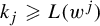 $k_j \geqslant L(w^j)$
with
$k_j \geqslant L(w^j)$
with $1 \leqslant j \leqslant m$
, there exist
$1 \leqslant j \leqslant m$
, there exist $u^1, u^2,\ldots , u^{m-1} \in \mathcal {L}(X)$
such that
$u^1, u^2,\ldots , u^{m-1} \in \mathcal {L}(X)$
such that $w^1 u^1 w^2 u^2 \cdots w^{m-1} u^{m-1} w^m \in \mathcal {L}(X)$
and
$w^1 u^1 w^2 u^2 \cdots w^{m-1} u^{m-1} w^m \in \mathcal {L}(X)$
and $\lvert u^j\rvert = k_j$
for any
$\lvert u^j\rvert = k_j$
for any $1 \leqslant j \leqslant m-1$
. Fix
$1 \leqslant j \leqslant m-1$
. Fix $k_1,\ldots , k_m$
. Let
$k_1,\ldots , k_m$
. Let $a_1 = 0$
and
$a_1 = 0$
and $a_j = \sum _{i = 1}^{j-1} (k_i + \lvert w^i\rvert ) $
for any
$a_j = \sum _{i = 1}^{j-1} (k_i + \lvert w^i\rvert ) $
for any $2 \leqslant j \leqslant m$
. Let
$2 \leqslant j \leqslant m$
. Let $b_j = \sum _{i = 1}^{j-1} k_i + \sum _{i = 1}^{j} \lvert w^i\rvert $
for any
$b_j = \sum _{i = 1}^{j-1} k_i + \sum _{i = 1}^{j} \lvert w^i\rvert $
for any $1 \leqslant j \leqslant m$
. Since
$1 \leqslant j \leqslant m$
. Since $(X,\sigma )$
has the specification with a non-uniform gap, there exists a point
$(X,\sigma )$
has the specification with a non-uniform gap, there exists a point $y \in X$
such that
$y \in X$
such that
 $$ \begin{align*}d(\sigma^ny,\sigma^{n-a_j}x^j) \leqslant \frac{1}{N+1}\end{align*} $$
for any $a_j \leqslant n \leqslant b_j$
and any
$a_j \leqslant n \leqslant b_j$
and any $1 \leqslant j \leqslant m$
. Then,
$1 \leqslant j \leqslant m$
. Then, $y_{n} = x^j_{n-a_j}$
for any
$y_{n} = x^j_{n-a_j}$
for any $a_j \leqslant n \leqslant b_j$
and any
$a_j \leqslant n \leqslant b_j$
and any $1 \leqslant j \leqslant m$
, which implies that
$1 \leqslant j \leqslant m$
, which implies that $y = w^1 u^1 w^2 u^2 \cdots w^{m-1} u^{m-1} w^my^0$
for some
$y = w^1 u^1 w^2 u^2 \cdots w^{m-1} u^{m-1} w^my^0$
for some $u^1, u^2,\ldots , u^{m-1} \in \mathcal {L}(X)$
with
$u^1, u^2,\ldots , u^{m-1} \in \mathcal {L}(X)$
with $\lvert u^j\rvert = k_j$
for any
$\lvert u^j\rvert = k_j$
for any $1 \leqslant j \leqslant m$
and some
$1 \leqslant j \leqslant m$
and some $y^0 \in X$
. Therefore,
$y^0 \in X$
. Therefore, $w^1 u^1 w^2 u^2 \cdots w^{m-1} u^{m-1} w^m \in \mathcal {L}(X)$
.
$w^1 u^1 w^2 u^2 \cdots w^{m-1} u^{m-1} w^m \in \mathcal {L}(X)$
.
Now, we assume the second half of this lemma holds. Let
 $$ \begin{align*} M(x,n,\varepsilon) = L(x_1\cdots x_{n+ \min\{k \in \mathbb{N}: N^{k+1}\varepsilon \geqslant 1\}}). \end{align*} $$
Next, we prove that $(X,\sigma )$
has the specification with a non-uniform gap. Fix
$(X,\sigma )$
has the specification with a non-uniform gap. Fix $k \in \mathbb {N}$
,
$k \in \mathbb {N}$
, $x^1,\ldots , x^k \in X$
, and
$x^1,\ldots , x^k \in X$
, and $2k$
integers
$2k$
integers
 $$ \begin{align*}0 \leqslant a_1 \leqslant b_1 < a_2 \leqslant b_2 < \cdots < a_k \leqslant b_k\end{align*} $$
with
 $$ \begin{align*}a_{j+1} - b_{j} \geqslant M(x^{j},b_{j}-a_{j},\varepsilon)\end{align*} $$
for any $1 \leqslant j \leqslant k-1$
. Let
$1 \leqslant j \leqslant k-1$
. Let $w^j = x^j_1 \cdots x^j_{b_j - a_j+\min \{k \in \mathbb {N}: N^{k+1}\varepsilon \geqslant 1\}}$
for any
$w^j = x^j_1 \cdots x^j_{b_j - a_j+\min \{k \in \mathbb {N}: N^{k+1}\varepsilon \geqslant 1\}}$
for any ${1 \leqslant j \leqslant k}$
. By the second half of this lemma, there exists
${1 \leqslant j \leqslant k}$
. By the second half of this lemma, there exists $u^1,\ldots , u^k \in \mathcal {L}(X)$
such that
$u^1,\ldots , u^k \in \mathcal {L}(X)$
such that $w^1 u^1 w^2 u^2 \cdots w^{k-1} u^{k-1} w^k \in \mathcal {L}(X)$
and
$w^1 u^1 w^2 u^2 \cdots w^{k-1} u^{k-1} w^k \in \mathcal {L}(X)$
and $\lvert u^j\rvert = a_{j+1} - b_{j}$
for any
$\lvert u^j\rvert = a_{j+1} - b_{j}$
for any $1 \leqslant j \leqslant k-1$
. Then, there exists
$1 \leqslant j \leqslant k-1$
. Then, there exists $y \in X$
with prefix
$y \in X$
with prefix $w^1 u^1 w^2 u^2 \cdots w^{k-1} u^{k-1} w^k$
. By the definition of the metric on
$w^1 u^1 w^2 u^2 \cdots w^{k-1} u^{k-1} w^k$
. By the definition of the metric on $A^{\mathbb {N}^+}$
, such y satisfies the requirement of the specification with a non-uniform gap.
$A^{\mathbb {N}^+}$
, such y satisfies the requirement of the specification with a non-uniform gap.
4.1.1 Shifts satisfying the specification-like properties
Since the specification property with a non-uniform gap is weaker than the specification property (and even weaker than the non-uniform specification property [Reference Lin, Tian and Yu25] and the weak specification property [Reference Kwietniak, Ła̧cka and Oprocha23, Definition 14]), shifts with the (non-uniform or weak) specification property satisfy the hypothesis of Theorem A. Here, we list some of them.
-
• One-sided (two-sided) full shifts, by [Reference Sigmund38, Example (A)].
-
• One-sided (two-sided) mixing subshifts of finite type (including mixing sofic shifts), by [Reference Sigmund38, Example (C)].
-
• Mixing cocyclic subshifts [Reference Kwapisz22], by [Reference Kwietniak, Ła̧cka and Oprocha23, Theorem 47].
-
• Mixing S-gap shifts for
$S = \{n_1,n_2,\ldots \} $
with
$\sup _{i \to \infty } (n_{i+1} - n_i) < +\infty $
, by [Reference Jung19, Example 3.4]. -
•
$\beta $
-shifts for a dense set of
$\beta \in (1,+\infty )$
, by [Reference Schmeling35].


4.1.2
$\beta $
-shifts

Here, we present one type of one-sided subshifts, $\beta $
-shifts, basically referring to [Reference de Melo e Maia6, Reference Pfister and Sullivan33–Reference Schmeling35]. We denote by
$\beta $
-shifts, basically referring to [Reference de Melo e Maia6, Reference Pfister and Sullivan33–Reference Schmeling35]. We denote by $[x]$
and
$[x]$
and $\{x\} $
the integer and fractional part of the real number x. For any
$\{x\} $
the integer and fractional part of the real number x. For any $\beta> 1$
, considering the
$\beta> 1$
, considering the $\beta $
-transformation
$\beta $
-transformation $f_\beta : [0,1) \to [0,1)$
given by
$f_\beta : [0,1) \to [0,1)$
given by
 $$ \begin{align*} f_\beta(x) = \beta x \ \mod 1, \end{align*} $$
let $b = [\beta ]$
for
$b = [\beta ]$
for $\beta \notin \mathbb {N}$
and
$\beta \notin \mathbb {N}$
and $b = \beta - 1$
for
$b = \beta - 1$
for $\beta \in \mathbb {N}^+$
. Then, we split the interval
$\beta \in \mathbb {N}^+$
. Then, we split the interval $[0,1)$
into
$[0,1)$
into $b+1$
parts as follows:
$b+1$
parts as follows:
 $$ \begin{align*} J_0 = \bigg[0, \frac{1}{\beta}\bigg);\quad J_1 = \bigg[\frac{1}{\beta}, \frac{2}{\beta}\bigg);\quad \ldots;\quad J_b = \bigg[\frac{b}{\beta}, 1\bigg). \end{align*} $$
For $x \in [0,1)$
, let
$x \in [0,1)$
, let $w(x,\beta ) = (w_j(x,\beta ))_{j=1}^{\infty }$
be the sequence given by
$w(x,\beta ) = (w_j(x,\beta ))_{j=1}^{\infty }$
be the sequence given by $w_j(x,\beta ) = i$
when
$w_j(x,\beta ) = i$
when $f_\beta ^{j-1}(x) \in J_i$
. We call
$f_\beta ^{j-1}(x) \in J_i$
. We call $i(x,\beta )$
the greedy
$i(x,\beta )$
the greedy $\beta $
-expansion of x and we have
$\beta $
-expansion of x and we have
 $$ \begin{align*} x = \sum_{j=1}^{\infty}w_j(x,\beta)\beta^{-j}. \end{align*} $$
We call $(\Sigma _\beta , \sigma ) $
the
$(\Sigma _\beta , \sigma ) $
the $\beta $
-shift, where
$\beta $
-shift, where $\sigma $
is the shift map and
$\sigma $
is the shift map and $\Sigma _\beta $
is the closure of
$\Sigma _\beta $
is the closure of $\{w(x,\beta )\}_{x \in [0,1)}$
in
$\{w(x,\beta )\}_{x \in [0,1)}$
in $\prod _{i=1}^{\infty } \{0,1,\ldots ,b\}$
. From the previous discussion, we can define the greedy
$\prod _{i=1}^{\infty } \{0,1,\ldots ,b\}$
. From the previous discussion, we can define the greedy $\beta $
-expansion of
$\beta $
-expansion of $1$
, denoted by
$1$
, denoted by $w(1,\beta )$
, as the lexicographic supremum over all
$w(1,\beta )$
, as the lexicographic supremum over all $\beta $
-expansions. It satisfies
$\beta $
-expansions. It satisfies
 $$ \begin{align*}1 = \sum_{j=1}^{\infty}w_j(1,\beta)\beta^{-j}.\end{align*} $$
Then, we can compute $w(1,\beta )$
by the algorithm in [Reference Pfister and Sullivan32, 5.2] as follows:
$w(1,\beta )$
by the algorithm in [Reference Pfister and Sullivan32, 5.2] as follows:
 $$ \begin{align*} r_0 := 1, \quad w_{j+1}(1,\beta) := \lceil \beta r_j\rceil - 1, \quad r_{j+1} := \beta r_j - w_{j+1}(1,\beta), \end{align*} $$
which ensures that $r_j> 0$
for all
$r_j> 0$
for all $j \in \mathbb {N}^+$
. Therefore, the sequence
$j \in \mathbb {N}^+$
. Therefore, the sequence $w(1,\beta ) = \{w_j(1,\beta )\}_{j=1}^{\infty }$
cannot end with zeros only. Parry showed that the set of sequences that belong to
$w(1,\beta ) = \{w_j(1,\beta )\}_{j=1}^{\infty }$
cannot end with zeros only. Parry showed that the set of sequences that belong to $\Sigma _\beta $
can be characterized as
$\Sigma _\beta $
can be characterized as
 $$ \begin{align*} x \in \Sigma_\beta \Leftrightarrow f^{n} x \leqslant w(1,\beta)\quad \mathrm{for\ all\ } n \geqslant 1, \end{align*} $$
where ‘ $\leqslant $
’ is taken in the lexicographic ordering [Reference Parry31]. By [Reference Buzzi4],
$\leqslant $
’ is taken in the lexicographic ordering [Reference Parry31]. By [Reference Buzzi4],
 $$ \begin{align*} \{\beta \in (1,+\infty) : (\Sigma_\beta, \sigma) \mathrm{\ has\ the\ specification\ property} \} \end{align*} $$
is dense in $(1,+\infty )$
, but has zero Lebesgue measure. Those
$(1,+\infty )$
, but has zero Lebesgue measure. Those $\beta $
terms are considered in §4.1.1. Here, we deal with other
$\beta $
terms are considered in §4.1.1. Here, we deal with other $\beta $
terms. By [Reference Bertrand-Mathis1], a
$\beta $
terms. By [Reference Bertrand-Mathis1], a $\beta $
-shift has the specification property if and only if the
$\beta $
-shift has the specification property if and only if the $w(1,\beta )$
does not contain arbitrarily long strings of zeroes. It implies that
$w(1,\beta )$
does not contain arbitrarily long strings of zeroes. It implies that $w(1,\beta )$
is not eventually periodic for those
$w(1,\beta )$
is not eventually periodic for those $\beta $
terms considered in this section.
$\beta $
terms considered in this section.
For those $\beta $
terms, Pfister and Sullivan proved that
$\beta $
terms, Pfister and Sullivan proved that $\beta $
-shifts have a weaker form of the specification, called the g-almost product property (see §2.3) for any
$\beta $
-shifts have a weaker form of the specification, called the g-almost product property (see §2.3) for any $\beta> 1$
in [Reference Pfister and Sullivan33, Example on p. 6]. The main observation of [Reference Pfister and Sullivan33, Example on p. 6] and [Reference Pfister and Sullivan32, Proposition 5.1] is that, given
$\beta> 1$
in [Reference Pfister and Sullivan33, Example on p. 6]. The main observation of [Reference Pfister and Sullivan33, Example on p. 6] and [Reference Pfister and Sullivan32, Proposition 5.1] is that, given $w \in \mathcal {L}(\Sigma _\beta )$
, one can find a word
$w \in \mathcal {L}(\Sigma _\beta )$
, one can find a word $\hat {w} \in \mathcal {L}(\Sigma _\beta )$
, which differs from w by at most one character, and such that for any
$\hat {w} \in \mathcal {L}(\Sigma _\beta )$
, which differs from w by at most one character, and such that for any $w' \in \Sigma _\beta $
, the concatenated word
$w' \in \Sigma _\beta $
, the concatenated word $\hat {w}w' \in \mathcal {L}(\Sigma _\beta )$
. More precisely, Thompson gave an explanation in [Reference Thompson40, §5.1]. The modified word
$\hat {w}w' \in \mathcal {L}(\Sigma _\beta )$
. More precisely, Thompson gave an explanation in [Reference Thompson40, §5.1]. The modified word $w'$
is given by replacing the last non-zero entry of the word w by a
$w'$
is given by replacing the last non-zero entry of the word w by a $0$
. With the same observation, we can prove Theorem B.
$0$
. With the same observation, we can prove Theorem B.
We use the presentation of $\Sigma _\beta $
by a labeled graph
$\Sigma _\beta $
by a labeled graph $\mathcal {G}_\beta $
introduced by Blanchard and Hansel in [Reference Blanchard and Hansel2]. Here, we discuss the case where the
$\mathcal {G}_\beta $
introduced by Blanchard and Hansel in [Reference Blanchard and Hansel2]. Here, we discuss the case where the $\beta $
-expansion of
$\beta $
-expansion of $1$
is not eventually periodic. Let
$1$
is not eventually periodic. Let $v_1, v_2, \ldots $
be a countable set of vertices. For any
$v_1, v_2, \ldots $
be a countable set of vertices. For any $j \geqslant 1$
, we draw some labeled edges with the following rules.
$j \geqslant 1$
, we draw some labeled edges with the following rules.
-
(1) Draw a directed edge from
$v_{j}$
to
$v_{j+1}$
and label it with the value
$w_j(1,\beta )$
. -
(2) If
$b> 1$
and
$w_j(1,\beta )> 0$
, for any
$0 \leqslant i < w_j(1,\beta )$
, draw a directed edge from
$v_{j}$
to
$v_{1}$
and label it with the value i.





We have $x \in \Sigma _{\beta }$
if and only if x labels an infinite path of directed edges of
$x \in \Sigma _{\beta }$
if and only if x labels an infinite path of directed edges of $\mathcal {G}_\beta $
which starts at the vertex
$\mathcal {G}_\beta $
which starts at the vertex $v_1$
. It follows that
$v_1$
. It follows that $w \in \mathcal {L}(\Sigma _\beta )$
corresponds to a finite path of directed edges of
$w \in \mathcal {L}(\Sigma _\beta )$
corresponds to a finite path of directed edges of $\mathcal {G}_\beta $
that starts at the vertex
$\mathcal {G}_\beta $
that starts at the vertex $v_1$
. Figure 2 depicts part of the graph
$v_1$
. Figure 2 depicts part of the graph $\mathcal {G}_\beta $
for a value of
$\mathcal {G}_\beta $
for a value of $\beta $
satisfying
$\beta $
satisfying $(w_j(1, \beta ))_{j=1}^6 = (2,0,2,1,0,1) $
.
$(w_j(1, \beta ))_{j=1}^6 = (2,0,2,1,0,1) $
.

Figure 2 The graph $\mathcal {G}_\beta $
for
$\mathcal {G}_\beta $
for $(w_j(1, \beta ))_{j=1}^6 = (2,0,2,1,0,1) $
.
$(w_j(1, \beta ))_{j=1}^6 = (2,0,2,1,0,1) $
.
Proof of Theorem B
By Proposition 4.1, it remains to prove that $(\Sigma _\beta , \sigma )$
has the specification property with a non-uniform gap. Here, we only prove the case that
$(\Sigma _\beta , \sigma )$
has the specification property with a non-uniform gap. Here, we only prove the case that $m = 2$
in Lemma 4.2 for convenience. Other cases are similar.
$m = 2$
in Lemma 4.2 for convenience. Other cases are similar.
The function $L:\mathcal {L}(X) \to \mathbb {N}$
is defined in the following way. Given w, let
$L:\mathcal {L}(X) \to \mathbb {N}$
is defined in the following way. Given w, let $l = \lvert w\rvert $
. There exists
$l = \lvert w\rvert $
. There exists $x \in \Sigma _\beta $
such that
$x \in \Sigma _\beta $
such that $x = (w, (x_{l+1}x_{l+2}\ldots ) ) $
, which means that
$x = (w, (x_{l+1}x_{l+2}\ldots ) ) $
, which means that $x_j = w_j$
for any
$x_j = w_j$
for any ${1 \leqslant j \leqslant l}$
.
${1 \leqslant j \leqslant l}$
.
-
(1) If
$x_{l+j} = 0$
for any
$j \in \mathbb {N}^+$
, then there exists
$p \in \mathbb {N}^+$
such that
$(w, x_{l+1},x_{l+2},\ldots , x_{l+p})$
can be regarded as a path of directed edges in
$G_{\beta }$
that ends with the vertex
$v_1$
since the
$\beta $
-expansion of
$1$
is not eventually periodic. -
(2) If there exists
$q \in \mathbb {N}^+$
such that
$x_{l+q}> 0$
, then
$(w, x_{l+1},x_{l+2},\ldots ,x_{l+q-1}, 0 )$
can be regarded as a path of directed edges in
$G_{\beta }$
that ends with the vertex
$v_1$
.


Therefore, there exists $L(w, x) \in \mathbb {N}^+$
such that
$L(w, x) \in \mathbb {N}^+$
such that $(w, x_{l+1},x_{l+2},\ldots ,x_{l+L(w, x)-1}, 0 )$
can be regarded as a path of directed edges in
$(w, x_{l+1},x_{l+2},\ldots ,x_{l+L(w, x)-1}, 0 )$
can be regarded as a path of directed edges in $G_{\beta }$
that ends with the vertex
$G_{\beta }$
that ends with the vertex $v_1$
. Let
$v_1$
. Let
 $$ \begin{align*} L(w) = \min\{L(w,x):x \in \Sigma_\beta, x_j = w_j \mathrm{\ for\ any\ } 1 \leqslant j \leqslant l\}. \end{align*} $$
Fix $w^1, w^2 \in \mathcal {L}(\Sigma _\beta )$
and
$w^1, w^2 \in \mathcal {L}(\Sigma _\beta )$
and $k_1 \geqslant L(w^1)$
. There exists
$k_1 \geqslant L(w^1)$
. There exists $x \in \Sigma _\beta $
with prefix
$x \in \Sigma _\beta $
with prefix $w^1$
such that
$w^1$
such that $(w^1, x_{l+1},x_{l+2},\ldots ,x_{l+L(w^1)-1}, 0 )$
can be regarded as a path of directed edges in
$(w^1, x_{l+1},x_{l+2},\ldots ,x_{l+L(w^1)-1}, 0 )$
can be regarded as a path of directed edges in $G_{\beta }$
that ends with the vertex
$G_{\beta }$
that ends with the vertex $v_1$
. By adding zeroes at the end of
$v_1$
. By adding zeroes at the end of $(w, x_{l+1},x_{l+2},\ldots ,x_{l+L(w)-1}, 0 )$
, there exists a word
$(w, x_{l+1},x_{l+2},\ldots ,x_{l+L(w)-1}, 0 )$
, there exists a word $u^1$
with
$u^1$
with $\lvert u^1\rvert = k_1$
such that
$\lvert u^1\rvert = k_1$
such that $w^1u^1$
can be regarded as a path of directed edges in
$w^1u^1$
can be regarded as a path of directed edges in $G_{\beta }$
that ends with the vertex
$G_{\beta }$
that ends with the vertex $v_1$
. Since
$v_1$
. Since $w^2$
can be regarded as a path of directed edges in
$w^2$
can be regarded as a path of directed edges in $G_{\beta }$
that starts with the vertex
$G_{\beta }$
that starts with the vertex $v_1$
, one has that
$v_1$
, one has that $w^1u^1w^2 \in \mathcal {L}(\Sigma _\beta )$
, which completes the proof.
$w^1u^1w^2 \in \mathcal {L}(\Sigma _\beta )$
, which completes the proof.
4.2 Applications to other systems
Finally, we recall other examples in dynamic systems that exhibit the exponential specification property.
-
• Uniformly hyperbolic systems: elementary parts of Axiom A systems, by [Reference Sigmund38, Proposition 23.20]; transitive Anosov diffeomorphisms, by [Reference Hou and Tian17, Proposition 2.11 and Theorem 6.2].
-
• Mixing expanding map on a compact manifold, by [Reference Hou and Tian17, Propositions 2.11 and 6.1].
Acknowledgements
The authors are supported by the Natural Science Foundation of China (No. 12471182) and Natural Science Foundation of Shanghai (No. 23ZR1405800). X.H. is supported by the National Natural Science Foundation of China No. 12401231, the Fundamental Research Funds for the Central Universities, China Postdoctoral Science Foundation No. 2023M740713, and the Postdoctoral Fellowship Program of CPSF under Grant No. GZB20240167.