



The 2015–2020 Dietary Guidelines for Americans recommend that adults consume at least 1·5–2 cups of fruits and 2–3 cups of vegetables daily( 1 ). Yet, a 2013 study found that only 13·1 % of American adult respondents meet fruit recommendations and only 8·9 % meet vegetable recommendations( Reference Moore and Thompson 2 ). Additionally, low-income residents in the USA are at an increased risk of not meeting national fruit and vegetable recommendations, due to neighbourhood food environment factors including reduced access to supermarkets that sell fresh produce and greater access to convince stores and fast-food restaurants( Reference Boone-Heinonen, Gordon-Larsen and Kiefe 3 – Reference Zenk, Schulz and Hollis-Neely 7 ).
Farmers’ market healthy food incentive programmes are growing in popularity as an opportunity to increase the ability of low-income residents to access fresh fruits and vegetables. However, there is limited research available on the characteristics of programme participants and whether participation is associated with higher fruit and vegetable intake compared with non-participants.
A study of the Philly Food Bucks programme has previously demonstrated that farmers’ market incentive programme participants were more likely than non-users to report increases in fruit and vegetable consumption( Reference Young, Aquilante and Solomon 8 ). A study of the Double Up Food Bucks™ (DUFB) programme in Michigan found that 78 % of participants reported that they increased the amount of fruits and vegetables they purchase as a result of the programme( 9 ). Additionally, a study from New York City’s Food Bucks Program demonstrated an increase in market spending by SNAP (Supplemental Assistance Nutrition Program) participants after programme implementation( Reference Baronberg, Dunn and Nonas 10 ). A better understanding of the factors influencing farmers’ market-based healthy food incentive programme participation is vital to ensure that funding and education efforts are appropriately targeted for maximum programme effectiveness.
The objective of the present study was to determine fruit and vegetable intake among participants in the Produce Plus Program, a farmers’ market-based healthy food incentive programme in Washington, DC, and identify demographic and behavioural factors associated with higher fruit and vegetable intake.
Methods
The present study was a cross-sectional survey that was conducted at farmers’ markets in Washington, DC with participants of the Produce Plus Program. The study was approved by the Institutional Review Board of George Washington University and the District of Columbia Department of Health.
The Produce Plus Program is funded by the District of Columbia and administered through its Department of Health in collaboration with DC Greens and the DC Farmers’ Market Collaborative. The aims of the programme include increasing access to healthful and nutritious food options for income-eligible DC residents as well as promoting the presence and benefits of farmers’ markets( 11 ). DC residents who participate in the Special Supplemental Nutrition Program for Women, Infants, and Children (WIC), Commodity Supplemental Foods Program (CSFP), Temporary Assistance for Needy Families (TANF), SNAP, Supplemental Security Income (SSI), Medicare and Medicaid are eligible to receive $US 10 per family/market per week.
To receive programme cheques, individuals must show a valid DC photo identification and proof of programme participation in SNAP, WIC, TANF, SSI, Medicare or Medicaid( 11 ). Cheques are available for pick-up at any of the fifty-three participating farmers’ markets across the district during regularly scheduled market hours and can be used towards the purchase of fresh fruits and vegetables only. In 2015, the Produce Plus Program distributed over $US 390 000 to low-income District residents and more than 90 % of programme cheques were redeemed( 11 ).
From June to September of 2015, surveys were administered at six farmers’ markets that participated in the Produce Plus Program. Participant demographic and economic data for the markets participating in the Produce Plus Program were not available to the research team. The six markets in which surveys were conducted were selected in an effort to sample participants residing in different wards of the city, and markets that operated on different times and days of the week, in order to have the widest possible representation from eligible Produce Plus Program participants. Markets that distributed the largest number of Produce Plus Program vouchers in the previous year were prioritized to reach the largest number of potential participants. The farmers’ markets in which surveys were conducted were located in Wards 1 (2009–2013 median income: $US 77 602), 6 (2009–2013 median income: $US 94 346), 7 (2009–2013 median income: $US 38 660) and 8 (2009–2013 median income: $US 30 263) of the District( 12 ). Produce Plus Program participants were able to receive and use the programme benefits at any participating farmers’ market in the city and were not restricted to markets within their ward of residence. Surveys were administered at the two largest farmers’ markets in the early season (June) and at six markets in the late season (August–September) of the 2015 Produce Plus Program season.
To be eligible to participate in the study, individuals had to be 18 years of age or older and be participants of the Produce Plus Program. Research staff informed Produce Plus Program participants about the availability of the survey while the participants were waiting in line to receive their Produce Plus vouchers. Participants who expressed interest in participating in the survey were instructed to meet with one of the interviewers either after they had finished shopping or prior to leaving the market (if they chose not to use their Produce Plus vouchers on that visit).
Prior to administering the survey, a researcher was available to answer questions about the study and the Produce Plus Program. As an incentive, a $US 5 token was provided to study participants for use at the farmers’ market in which the survey was being conducted. Completion of the survey constituted consent to participate in the study.
The one-page, twenty-two-item survey took approximately 5–10 min to complete. Trained interviewers collected the survey responses from the participants in one-on-one interviews. If the primary language of a survey participant was not English, a family member or other farmers’ market attendee served as the translator. Data on the total number of eligible Produce Plus Program participants attending the individual markets on the days of the survey were not available to the research team, so it was not possible to calculate survey response rates.
Survey questions were based on evaluation reports from other healthy food incentive programmes across the country( 12 , Reference Obadia and Porter 13 ). The survey included questions regarding the respondent’s ward of residence, number of members in the household, frequency of farmers’ market attendance and various food-shopping and eating patterns. Questions did not include identifying information or sociodemographic questions including age, marital status, race or education level.
Fruit and vegetable intake was measured by using the six-item validated fruit and vegetable intake module of the Behavioral Risk Factor Surveillance System (BRFSS)( 14 ). Respondents are asked to report the number of times they consumed items in each of the six fruit and vegetable categories (100 % pure fruit juice; fruit; cooked or canned beans; dark green vegetables; orange-coloured vegetables; other vegetables) over the past month as either never or a certain amount of times per day, per week or per month. Interviewers followed the BRFSS question administration protocol. The survey instrument is available from the corresponding author upon request.
Because the survey was conducted via trained interviewers, nearly complete data were collected from all participants. All participants answered at least one of the fruit and vegetable intake module questions. Any unanswered fruit and vegetable questions were assigned a score of 0 or ‘never’ according to BRFSS protocol( 14 ). Descriptive statistics including means, standard deviations, medians and interquartile ranges were calculated. Reported daily frequencies of fruit and vegetable intake from the fruit and vegetable module were calculated by dividing weekly frequencies by seven and monthly frequencies by thirty, which is consistent with procedure used to calculate frequency of fruit and vegetable intake within BRFSS( 14 ).
Additionally, we examined fruit and vegetable intake patterns stratified by: (i) timing within the farmers’ market season (beginning v. end); (ii) ward of residency; (iii) number of members in the household; (iv) frequency of eating home-cooked meals; and (v) frequency of shopping at farmers’ markets. If data on any of the above measures were missing, the participants’ responses were excluded from the analysis of that measure. Wilcoxon rank sum (Mann–Whitney U) tests were used to test for statistically significant differences in fruit and vegetable intake across these potential covariates.
For context, median fruit and vegetable intakes among 2013 DC BRFSS participants were also calculated. Raw data from the 2013 DC BRFSS set were extracted and weighting criteria were applied to create summary statistics. Only BRFSS data from residents reporting annual household incomes of ≤$US 35 000 (n 1134) was used to be comparable to income eligibility requirements for SNAP for a family of four( 15 ), as SNAP participants are eligible to participate in the Produce Plus Program. Differences between the Produce Plus Program survey data and the DC BRFSS data were not tested for statistical significance for several reasons, including differences in sample size and study designs. For example, DC BRFSS data are weighted to accurately reflect the general population and adjust for non-response bias. DC BRFSS interviews are conducted through an entire year, whereas our survey was conducted over four months.
All data analyses were conducted using the statistical software package SAS version 9.4. A P value of <0·05 was considered statistically significant.
Results
In total, 288 Produce Plus Program participants completed surveys. Forty-four (15·3 %) completed the survey in June (the first month of the programme for the 2015 season) and 244 participants (84·7 %) completed the survey in August/September. The survey included participants living in all eight wards of Washington, DC, with the highest percentage (28 %) of participants residing in Ward 8 (Table 1).
Characteristics of the Produce Plus Program participants surveyed (n 288), Washington, DC, USA, June–September 2015
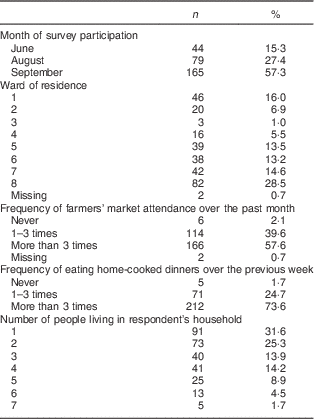
Among participants completing surveys, 82 % made purchases with Produce Plus Program vouchers at the market on the day of the survey, and 34 % spent additional money on top of the $US 10 voucher provided. A total of 58 % of survey respondents reported attending farmers’ markets over three times in the past month and 40 % reported attending farmers’ markets between one and three times in the past month (Table 1). A majority (74 %) of participants reported eating home-cooked dinners more than three times weekly and 25 % reported eating home-cooked dinners between one and three times weekly (Table 1).
Survey participants reported a median fruit intake of 2·0 times/d and a median vegetable intake of 2·0 times/d. For comparison, data from the 2013 DC BRFSS indicate that individuals with incomes ≤$US 35 000 reported a median fruit intake of 1·0 times/d and a median vegetable intake of 1·4 times/d. A higher percentage of Produce Plus Program survey participants (79 %) reported consuming fruit at least once daily compared with DC BRFSS respondents with similar income levels (59 %). Similarly, a higher percentage of Produce Plus Program participants reported eating vegetables at least once daily (84 %) compared with DC BRFSS respondents (70 %). No statistically significant differences in reported median fruit or vegetable intake were observed over the course of the farmers’ market season (June v. August/September; Table 2).
Fruit and vegetable intake among Produce Plus Program participants (n 288) by demographic and behavioural factors, Washington, DC, USA, June–September 2015

IQR, interquartile range; N/A, not applicable.
* From Wilcoxon rank sum (Mann–Whitney U) tests.
Statistically significant differences in reported fruit and vegetable intake were observed by frequency of home-cooked meals per week. Respondents who reported they ate three or more home-cooked meals weekly had higher mean fruit and vegetable servings compared with those who reported no home-cooked meals (Table 2). No statistically significant differences in fruit and vegetable intake related to ward of residence, frequency of farmers’ market attendance or number of household members were observed.
Discussion
In the present study, participants in the Produce Plus Program reported higher fruit and vegetable intake compared with DC BRFSS respondents with similar incomes, but still below recommended levels. Given that our study was cross-sectional, we are unable to determine whether programme participation resulted in higher fruit and vegetable intake, or whether individuals who shop at farmers’ markets or take advantage of healthy food incentive programmes are already more inclined to eat fruits and vegetables. Longitudinal studies with an appropriate comparison group are needed to address this question.
Additionally, frequency of eating home-cooked meals was positively associated with higher fruit and vegetable intake (P<0·01). A number of factors could explain this finding, including the possibility that home-cooked dinners may have included more fruits and vegetables than typical meals eaten outside the home, or that participants prepared more meals at home after purchasing fruits and vegetables from the farmers’ market. Individuals who are accustomed to preparing food at home may be more likely have the necessary kitchen equipment (e.g. cutting boards, knives, bakeware, functioning oven, stove top) for preparing fruits and vegetables. Similarly, people who cook at home regularly may be more likely to have greater knowledge and familiarity with how to store and prepare fruits and vegetables compared with individuals who do not regularly prepare foods at home. A previous study among WIC mothers in Atlanta, GA found that lack of knowledge on the preparation and spoilage of fruits and vegetables was associated with lower consumption( Reference Chen and Gazmararian 16 ).
Our findings are similar to previous reports on the effect of farmers’ market-based healthy food incentive programmes on fruit and vegetable intake( Reference Young, Aquilante and Solomon 8 , 9 , Reference Jilcott Pitts, Wu and Demarest 17 , Reference Savoie-Roskos, Durward and Jeweks 18 ). A previous study on the DUFB in Michigan found that 78 % of DUFB participants reported purchasing more fruits and vegetables as a result of programme participation( 9 ). Participants in the Philly Food Bucks Program were found to be more likely than non-users to report increasing fruit and vegetable consumption and trying new fruits and vegetables( Reference Young, Aquilante and Solomon 8 ). Additionally, a study of SNAP participants found that participation in a farmers’ market incentive programme that offered a dollar-per-dollar match of up to $US 10/week led to greater food security and increased intake of selected vegetables only among individuals receiving the incentive( Reference Savoie-Roskos, Durward and Jeweks 18 ).
Whereas most of the farmers’ market-based healthy food incentive programmes (including DUFB and Philly Food Bucks) are matching programmes which require that participants spend a portion of their nutrition assistance benefits on fruits and vegetables in order to receive the extra benefits, the Produce Plus Program is unique in that it is a flat-benefit programme. Produce Plus Program participants do not need to spend any nutrition assistance benefits or other money to receive the programme vouchers. Thus, the Produce Plus Program expands participants’ food purchasing ability specifically for fruits and vegetables rather than incentivizing use of nutrition assistance benefits for healthier food items.
Strengths and limitations
The strengths of our study include the use of a validated fruit and vegetable intake screener for dietary assessment, data collection using one-on-one interviews with nearly complete data collection from survey participants, and data collection across farmers’ markets in different wards of DC and at different times in the farmers’ market season.
Our findings however, come with several limitations. Participation in the Produce Plus survey was voluntary and respondents may not be representative of all Produce Plus Program participants. Data on the total number of eligible participants at each of the survey sites were not available to the research team, so it was not possible to calculate survey response rates. Second, the surveys were conducted only during the summer months (June to September), which makes comparisons with BRFSS data (which are collected year-round) difficult. Fruit and vegetable intake may change across seasons; therefore, findings from seasonal surveys such as ours may vary from those conducted throughout an entire year. Third, as no identifying information was taken from survey respondents, it is possible that a participant could take the survey more than once. Fourth, sociodemographic data were not collected from the Produce Plus Program survey participants, which limits our ability to determine the representativeness of our study population among all DC residents who are eligible for nutrition assistance programmes. We surveyed participants at six of the total fifty-three markets in Washington, DC, which may not fully demonstrate the variety of individuals using the programme. Additionally, we had a smaller number of individuals completing surveys in the early season (June) than in the late season (August/September).
Lastly, both the Produce Plus Program participant survey and the BRFSS fruit and vegetable module questions collect self-reported data. Respondents may over-report levels of fruit and vegetable consumption while in an environment surrounded by fresh foods and immediately after shopping.
Conclusion
The results of the present study suggest that low-income participants in a farmers’ market incentive programme have higher fruit and vegetable intake compared with individuals with similar income levels in the general population. Our study found that among healthy food incentive participants, home-cooked meals are associated with higher fruit and vegetable intake. This confirms earlier findings in other populations of an association between home-cooked meals and fruit and vegetable consumption( Reference Chen and Gazmararian 16 ). A prospective study is planned to assess the impact of the Produce Plus Program on participants’ fruit and vegetable intake more fully.
Acknowledgements
Financial support: This study was funded by discretionary funding provided to K.R. by her employer, the George Washington University. The university did not direct the research team on any aspect of the study, including the design, analysis or writing of this article. Conflict of interest: No conflict of interest exists for S.P., A.B., M.M., U.C.-R. or K.R. L.R. is an employee of DC Greens, which oversees the distribution of the Produce Plus Program, and A.P.-K. is an employee of the DC Department of Health, which oversees the Produce Plus Program. Authorship: S.P., M.M., A.B. and K.R. developed the research question and collected the data. K.R. performed data analysis. S.P. wrote the manuscript. A.B., M.M., K.R., U.C.-R., L.R. and A.P.K. reviewed and contributed to the manuscript drafts, and all authors approved the final version of the manuscript. Ethics of human subject participation: This study was approved by the Institutional Review Board of the George Washington University and the DC Department of Health.



