




1. Introduction
In the first edition of his influential Angelsächsische Grammatik, Eduard Sievers (Reference Sievers1882: 73) outlined a well-known and uncontroversial sound change that took place in the early history of English:
§218. I n l a u t e n d e s e i n f a c h e s h und altes hw vor vocalen schwindet. Treten dadurch vocale zusammen, so erfolgt meist contraction (§110 ff. 166). Beispiele: a) nach consonanten: feorh gen. feores u. ä. §242, -feolan §387 zu got. filhan; – b) nach vocalen: feoh, gen. feós §242, heáh pl. heá §295, anm. 1 etc.; ferner die verba contracta §373, wie seón sehen, got. saihwan, und vieles ähnliche.
Sievers here used an acute to mark vowel length: e, eo are short, é, eó long, etc. In this edition, in 1882, Sievers understood h-loss as involving quantitative changes only when it led to hiatus sequences that would be contracted. A few years later, in the second edition (Sievers Reference Sievers1886: 95), a further dimension of vowel lengthening had entered the picture (bold highlighting my own):
§218. I n l a u t e n d e s e i n f a c h e s h und altes hw vor vocalen schwindet. Geht dem h ein consonant voraus, so wird bei dem ausfalle des h der vorhergehende vocal gedehnt: feorh, mearh, gen. féores, méares u. ä., §242, snearh, gen. snéare §256, 4; -filhð inf. -féolan §387. Nur ausnahmsweise erscheint auch kürze, wie feores, wahrscheinlich durch anlehnung an feorh, oder þyrel loch, neben þýrel, aus þýrel – þyrles für *þyrhil –*þyrhles.
Aside from the purely notational change of now marking long diphthongs as éo, etc., instead of eó, this revised edition introduces a new sound change into Old English historical phonology: the compensatory lengthening of a short vowel in a *-V˘ChV- context (in simplexes the only C possible is *r or *l), caused by the loss of the post-consonantal *h. This sound change would go on to be enshrined in many of the standard historical grammars, including Luick (Reference Luick1921: 226–7), Campbell (Reference Campbell1983: 104–5), Hogg (Reference Hogg2011: 169–71, but see 171, 202 for reservations) and Ringe & Taylor (Reference Ringe and Taylor2014: 307–8). It has furthermore been accepted in a number of theoretical studies attempting to describe this intriguing type of compensatory lengthening using one or other phonological framework (Kim Reference Kim2005, with references; Beltzung Reference Beltzung2008: 187–8).
Something clearly took place in the fairly short space of time between the first and second editions of the Grammatik to give Sievers the idea that the vowels in féores, méares, etc. should be considered long. This something was his study of alliterative metrics. During the 1880s, Sievers was heavily occupied with working out a system for scanning alliterative verse forms in various early Germanic languages, with the main results appearing in a series of articles, especially Sievers (Reference Sievers1885a,Reference Sieversb,Reference Sieversc, Reference Sievers1887); this system would later be summarized and codified in his well-known monograph (Sievers Reference Sievers1893). Near the beginning of the first of these articles, Sievers (Reference Sievers1885b: 218) describes a ‘eureka moment’, so to speak, where he had a breakthrough in his understanding of the metrical form (bold highlighting again my own):
Freilich habe ich – wenn ich soviel von der genesis der folgenden untersuchungen erzählen darf – dabei immer das unbehagliche gefühl gehabt, dass trotz aller freiheit doch ein bestimmtes rhythmisches etwas beim lesen durchklang, das eine genauere bestimmung verlangte, ohne dass ich jedoch eine solche in festen sätzen hätte geben können. Endlich lenkte mich ein äusserer anlass, wie ich glaube, auf die richtige bahn. Eine mündliche mitteilung Kluge’s über vocaldehnungen nach ausfall von h in wörtern wie feorh – feóres, die ich glaubte durch metrische gründe in anknüpfung an Rieger stützen zu können, führte mich zu einer durchsicht der ags. dichtungen in bezug auf minimalverse, die über quantitäten und silbenzahl einzelner wortformen aufschluss geben könnten. Bei dieser zusammenhängenden scansionsarbeit traten mir nun gewisse früher wenig beachtete erscheinungen so lebhaft entgegen, dass ich nicht umhin konnte eine statistische untersuchung über den ags. versbau überhaupt anzuschliessen. Die resultate derselben ergaben denn, für mich überraschend genug, eine sehr nahe verwantschaft der ags. halbzeile mit dem nordischen viersilbler oder zeigen doch, wenn man das glaublicher findet, dass die freiheiten des ags. versbaues sich innerhalb weit engerer schranken bewegen, als man bisher angenommen.
This comment is of interest for at least three reasons. First, it pins down rather precisely the origin of the hypothesized sound change that I am primarily concerned with here, namely the compensatory lengthening upon loss of *h, to an oral comment by Kluge sometime in the early 1880s. Secondly, it also demonstrates how intertwined this theory of compensatory lengthening was with metrical analysis. Thirdly, and much more generally, it drives home the extent to which Sievers’ influential theory of metre was grounded in considerations of linguistic details of vowel quantity and syllable weight (Goering Reference Goering2023: 26–8).Footnote 1
In principle, a proposed quantitative sound change like this lengthening could be argued for using several sources of evidence. Best would be explicit and reliable indications of vowel length in contemporary texts (graphical or metalinguistic), but no such data is available for the present case. Failing that, later outcomes in either the ordinary lexicon or the onomasticon are often the most straightforward way to trace phonological developments. After a brief typological contextualization in section 2, these sources of information are reviewed in sections 3 and 4, but as we will see, they give little evidence of lengthening as a general process in Old English as a whole (though the onomastic evidence might suggest a limited regional development along these lines). The main source of evidence is still today, as it was for Sievers, metrical, and my main object in this piece is to reassess the verse data. In section 5 I review and affirm Sievers’ findings about what syllables need to scan as heavy, but I part ways with him in section 6 by arguing that the distribution of supposedly lengthened forms in the corpus closely matches the typical distribution of metrical archaisms in general. I suggest that the scansion of a form like feores with a heavy initial syllable does not point to real phonological lengthening, but to an entrenched licence that allowed the form to continue to scan with its prehistoric value, *feorhes, even once the *h had been lost in the contemporary language – much as a word like wundor can continue to scan as a monosyllable (cf. older *wundr) in verse.Footnote 2 If this analysis of the metrical evidence is accepted, then the evidence for this compensatory lengthening largely disappears. Some outstanding complications, chiefly involving the word sweora ‘neck’, are discussed at the end in section 7, before the data and argument are reviewed in the conclusion, section 8.
2. Typological context
Should Sievers’ lengthening be accepted, it would be an example of a type of change that, while clearly possible, seems to be rather rare in the languages of the world. Compensatory lengthenings in general are well known (see in particular Beltzung Reference Beltzung2008; Gess Reference Gess and van Oostendorp2011), but the usual sort involves loss of a consonant directly after a vowel. This variety of lengthening is exemplified repeatedly in the (pre)history of English, and a well-known example is the so-called Nasalspirantengesetz of the Ingvaeonic languages,Footnote 3 whereby a coda nasal before a voiceless fricative was lost, with compensatory lengthening of the preceding vowel:
Proto-Germanic *munþaz ‘mouth’ > Ingvaeonic *mūþ > Old English mūþ, Old Saxon mūð, Old Frisian mūth (contrast Old High German mund, Old Low Franconian munt, mund-)
The change Sievers proposed in the second edition of his grammar is different, in that the lost consonant is not immediately adjacent to the lengthened vowel. This sort of change seems to be fairly rare, with only a handful of apparent examples documented in the phonological literature. That the change is typologically possible has, however, never been in the slightest doubt, since it happens to be found in certain dialects of Ancient Greek (Kavitskaya Reference Kavitskaya2001: 47–52, with references):
*ksénwos ‘guest, stranger’ (cf. Mycenaean ke-se-nu-wo-) > Ionic ksẽinos, Doric ksenwos, ksēnos (contrast Attic ksĕ́nos, with no lengthening)
Given the prestige of Greek and its former familiarity to most Western linguists, the process is well documented and the possibility of such a change cannot be in doubt. A few other comparable examples have been gleaned over the years, including at least from Akkadian, Coptic, Kasem and Persian (H. H. Hock Reference Hock1986: 438–9; Beltzung Reference Beltzung2008: 182–5). Beltzung (Reference Beltzung2008: 187–8) would, on the strength of the standard grammars of Old English, add post-consonantal h-loss to this catalogue. Arguing against this change, as I do here, will not have any sweeping typological implications: the change already appears to be very rare (Beltzung Reference Beltzung2008: 5 and passim, labels it ‘exotique’), and rejecting it in Old English would merely make it slightly rarer still. The question is essentially about the particular case, not the general phenomenon.
3. Later English evidence
Dietz (Reference Dietz1970: 3) lists 39 simplex elements with probable *-V̆ChV- sequences either in some forms or throughout their paradigms. This list does not include former compounds, many of which are somewhat uncertain and may have behaved differently from simplexes.Footnote 4 Many of the relevant words simply do not survive into later English. Those that do generally show a short vowel.
Two examples can show the typical developments. First is sē̆olh ‘seal’, plural sē˘olas. The modern form of the word is based on the plural, with loss of *h, but the vocalism does not represent xsēolas. Old English ēo would have, via long [ø:], become close long ẹ̄ in Middle English (J. Wright & E. M. Wright Reference Wright and Wright1923: 32–3), but such evidence as is available, including the later orthography and Levins’ rhyme-listing (Wheatley Reference Wheatley1867: 207, line 19), points rather to an open ę̄..This suggests that when open-syllable lengthening took place in Middle English, the input was a short e, which regularly lengthened to open long ę̄ (J. Wright & E. M. Wright Reference Wright and Wright1923: 41). It is of course theoretically possible that the vocalism was taken from endingless seolh, and the consonantism from inflected sēolas, etc., but this kind of contradictory analogy is, while by no means impossible, a rather strained proposition.
In a second example, moru ‘carrot, root vegetable’, no analogical explanations seem to be available. This is a feminine ō-stem, from Proto-Germanic *morhō, with the *h evidenced by Old Saxon morha ‘parsnip’,Footnote 5 as well as by a variety of forms in later German. This word is never found with h in English, so if lengthening did take place, it ought to have affected the entire paradigm, yet the quality of the vowel in later English unambiguously points to a short o. In Middle English there were three distinct varieties of ō: close ọ̄ from Old English long ō, open ǭ1 from Old English long ā (this rounding did not occur in all dialects), and a distinct open ǭ2, from Old English short o via open-syllable lengthening (J. Wright & E. M. Wright Reference Wright and Wright1923: 27–8, 39–40). The modern form more shows clearly enough that it is not from close ọ̄, which would have given xmoor, and its quality as specifically secondarily lengthened ǭ2 is rather nicely seen in a stanza from Chaucer. In Troilus & Criseyde, book V, lines 22–6, Chaucer alternates ǭ 1 and ǭ 2 (the rhyme scheme is rigidly ABABB for these lines):Footnote 6
This Troilus, withouten reed or loore, [< lāre]Footnote 7
As man that hath his joies ek forlore, [< forlŏren]
Was waytyng on his lady evere more, [< māre]
As she that was the sothfast crop and more [< mŏru]
Of al his lust or joies heretofore. [< tōfŏran]
‘This Troilus, without counsel or instruction, like someone who has also lost his joys, was attending on his lady ever more, because she was true bloom and root [i.e. be all, end all] of all his pleasure and joys before this.’
Since more ‘root’ rhymes with the reflexes of forloren and beforan in a stanza carefully employing the finest of rhyme distinctions, the vowel would seem to be securely from Old English short ŏ, not old ō > ọ̄. If loss of *h caused early lengthening, whence this short vowel?
Among words in the ordinary lexicon, the only potential evidence for compensatory lengthening comes from swē˘ora ‘neck’, which interestingly also has an exceptional long vowel in Norse, where compensatory lengthening by and large demonstrably did not take place (Myrvoll Reference Myrvoll2015: 21). This special case will be discussed separately in section 7.
If only ordinary lexical evidence were considered, it seems highly unlikely that the idea of compensatory lengthening in this context would have been accepted. The evidence for it is very poor (consisting of a single, problematic word), while all other words for which any evidence exists point the other way. Although Dietz (Reference Dietz1970) argues in support of lengthening as a change, I would refer to his own careful review of the non-onomastic evidence for a detailed demonstration of how poorly it supports the idea of compensatory lengthening.
4. Onomastic evidence
By and large, place-name evidence points the same way as the ordinary lexical evidence: compensatory lengthening is almost entirely absent. This was noted by Smith (Reference Smith1956: 243–4), and largely confirmed in the exacting review by Dietz (Reference Dietz1970). Dietz (Reference Dietz1970: 6–25; see 25 for a summary), however, does find a very limited number of forms in place names that do seem to reflect lengthening, and his final paragraph argues in favour of Sievers’ sound change. I confess to finding his conclusion rather startling, particularly since most of his positive evidence (and all that would carry real conviction) comes from the Southwest, at best providing support for a regionally restricted lengthening.
The only example considered clear by Dietz (Reference Dietz1970: 22–4) from outside the Southwest is Snargate in Kent, which shows early spellings like Snergathe, Sneregate, etc.Footnote 8 This is often held to be the same word as English snare, attested once as Old English snearan, and with the *h securely shown by Old High German stnarchon (sic; cf. Seebold et al. Reference Seebold2008: 778), and related verbs such as insnerahan, but it is not clear that this Kentish place name actually contains this element. Other roots, such as snēr (attested as ‘string’, with the basic sense probably being something that is woven; cf. Gothic snōrjō* ‘(woven) basket’, Norse snǿri ‘twisted rope, fishing line’), might perhaps instead lie behind this name. And in general, caution is called for when dealing with essentially obscure name elements of this sort, where the semantics of all proposed etymons would seem to bear a rather strained and arbitrary relationship to the place in question. By contrast, the Southwestern evidence consists of much more normal and transparent elements, namely forms of healh and sealh that show fronted reflexes (as would be normal for ēa, but not for ĕa).
It is also worth emphasizing that the word Dietz chooses for the title of his article, Wē˘alas ‘the Welsh, Wales’, never once occurs with a clearly lengthened form, and must largely reflect a short vowel (Smith Reference Smith1956: 143; Dietz Reference Dietz1970: 25). Only with open-syllable lengthening in the Middle English period did Wăles finally become long-vowelled Wāles. One might imagine analogical influence from the singular Wealh, though as with seal, this would be accompanied by retention of the plural’s consonantism without h. As Smith (Reference Smith1956: 243) puts it, discussing Wales but with an eye towards the larger lexicon and onomasticon:
it is remarkable that this restoration of short vowels was everywhere so complete that nowhere in ME or ModE is there a single trace of this supposed lengthening.
Even if a regional qualification to the ‘nowhere’ is in order, following Dietz’s evidence, the short vowels of Wales and other place names speak largely against rather than for lengthening in the vast majority of English dialects.
5. Metrical evidence
If the lexical evidence for compensatory lengthening after post-consonantal h-loss is virtually nonexistent, with more and better examples against than for, and the onomastic evidence is almost entirely limited to a fairly small area in the Southwest, then why has this sound change found its way into well over a century’s worth of historical grammars? The answer lies in Sievers’ discussion quoted in section 1: metre. In particular, Sievers (Reference Sievers1885b: 218) noted that evidence for h-loss could, it would seem, be provided by minimalverse, half-lines with the minimum amount of linguistic material needed to be valid.Footnote 9
The metrical issues can be illustrated with Beowulf 1293a:Footnote 10
feore beorgan
‘to save (his) life’
This line is perfectly clear in the manuscript (folio 158v, line 6), and under no suspicion of being corrupt. At first glance, it might appear to be a rather typical sort of trochaic line that appears thousands of times in the poem, but if the vowel is taken to be short – fĕore beorgan – there is a problem: the first syllable, feo-, is light. A light syllable ends in a short vowel or a short diphthong,Footnote 11 while a heavy syllable ends in anything else: a consonant, a long vowel, or a long diphthong. Note that a single intervocalic consonant goes in the second syllable, not the first, hence feo-re. At least after short vowels, a consonant cluster is always split between syllables, as in beor-gan. For details and references, see Goering (Reference Goering2023: 7–11).
Instead of feo-, comparable trochaic verses of just four syllables – one of the ‘minimal’ patterns of the metrical form – almost always begin with a heavy syllable. A typical example is 1303a:
cūþe folme
‘the famous hand’
Here cū-þe, with its long root vowel, starts with a heavy syllable. Even without committing to a specific metrical formalism,Footnote 12 the generalization that so excited Sievers is clear: a metrically minimal verse in Old English must have four syllables, and the first of those four syllables to be stressed and take part in the alliteration must, as a strong rule, be a heavy syllable. Only a very few verses even superficially fail to conform to this generalization, and a large chunk of those that appear to violate it can be remedied by the assumption of compensatory lengthening. In this instance, feore is the very word Sievers (Reference Sievers1885b: 218, Reference Sievers1886: 95) used to illustrate the proposed sound change: it comes historically from *feorhǣ (Old Saxon ferhe, etc.), and if the vowel did indeed lengthen, then the resulting fēore would fit its metrical context without any problem:
fēore beorgan
There is no doubt that Sievers is broadly right in noting that feore, if understood as having a light syllable, would be unmetrical. He is also right that in 11 instances in Beowulf alone, similarly anomalous verses occur with words that all have a historical h after the medial consonant (see the appendix). Adopting his sound change would be one way to render all these verses metrical at a stroke.
An important complication, already described in detail by Sievers (Reference Sievers1885c: 487–9), comes not from any challenge to the metrical system, but from a clear variability in how words like feore are used metrically. Even though forms like feore often need to scan with a heavy syllable, there are verses where the metre demands a light syllable instead. Take, for example, Beowulf 1843a:
on swā geongum feore
‘in so young a life, at such a young stage of life’
Here the metre requires fĕore, not fēore. The rhythmical pattern wwSwSw (w = a weak syllable, S a heavy, stressed syllable) is strikingly avoided in Old English metre, with potential parallels being effectively limited to hypermetric passages.Footnote 13 This verse will only scan if the two syllables of feore are counted together as a single metrical element, equivalent to a single heavy syllable. This process, called resolution, is central to Sievers’ description of Old English metre, and remains a key part of all mainstream metrical formalisms to this day (Goering Reference Goering, Rodríguez-Puente, Pérez-Lorido and Prado-Alonso2020, Reference Goering2023: 26–8, 37–9).Footnote 14
With resolution, 1843a will scan as wwSwS˘w = wSwS, effectively identical to the pattern exemplified by 1844b:Footnote 15
and on mōde frōd
‘and wise in spirit’
Both half-lines are of Sievers’ type B, a very common and well-paralleled configuration of linguistic material in verse texts.
For Sievers, this double behaviour of forms of feorh would point to ongoing analogy. In 1293a, fēores would have its historically regular lengthened form, while in 1843a, fĕore would have restored the short root vowel on analogy with endingless feorh. To see both forms side-by-side would either mean that the analogical levelling was ongoing, or that poets actively exploited linguistic variability beyond its normal bounds for metrical convenience.
This last possibility – that poets retained linguistic variants for metrical convenience – is, I believe, on the right track, but it also suggests a simpler analysis of the situation that involves no linguistic lengthening at all. Sievers is certainly correct about when feore(s) and similar words need to have heavy initial syllables, and when they need to have light ones, but, I suggest, lengthening of the vowels is neither the only nor the best way of fitting in heavy syllables where they are needed.
6. Metrical archaisms
When looking at a verse like 1293a, feore beorgan, there are potentially two ways of characterizing the metrical problem. One is to say that feore needs to scan as if it had a long vowel. The other, more accurate way is to say that feore needs to scan as if it had a heavy initial syllable. As described in section 5, there are two ways for a syllable to be heavy in Old English: one is indeed for it to contain a long vowel, but the other is for it to end in a consonant. The latter option was the case in the pre-loss form of feore, namely *feor-hǣ, in which I have marked the syllable boundary with a hyphen. The initial syllable, *feor-, ends in a consonant, and so is heavy. In other words, a simpler way of describing 1293a is to just say that is scanned as if the older, pre-loss form were still present.
If the problem is reframed this way, it no longer appears as an isolated issue to be solved by proposing a new sound change, but instead aligns with the well-established phenomenon of metrical archaisms in Old English verse.Footnote 16 In the present context, a metrical archaism may be roughly defined as an older phonological form whose prosodic shape is optionally retained in poetry after it has become rare or obsolete in the spoken language. A relatively simple case concerns vowel epenthesis, where former monosyllables like *wundr, ending in a sequence of rising sonority, gain a second syllable to become disyllabic, in this case wundor. Footnote 17 In Beowulf, words like wundor must, regardless of how they are spelled in the late manuscript, scan 22 times as monosyllables, and 5 times as disyllables (Fulk Reference Fulk1992: 78–9, 83).
An even closer parallel comes from intervocalic h-loss. In words like *hēahan ‘high (weak oblique)’, the *h disappears very shortly after the earliest written texts in English, and the resulting hiatus sequence is usually contracted to monosyllabic hēan. In verse, hēan (and the many similar words) may scan either as one or two syllables.Footnote 18 A monosyllabic scansion is required, for instance, in Beowulf 713b (also 1984b; virtually identical too are 929b and 1016b):
in sele þām hēan
‘in that high hall’
This scans as wSwS (with sele resolved by rule), and taking hēan as disyllabic would spoil the metre. But in 116a, the contracted form found in the manuscript is unmetrical:
hēan hūses
‘the high building’
Here the more archaic *hēahan – a disyllable with a heavy root syllable – must be understood in order to obtain a metrically minimal verse.
It is already the standard view that uncontracted forms like *hēahan can retain their prehistoric shapes as metrical archaisms in poetry composed after h-loss and contraction had taken place (Sievers Reference Sievers1885c: 478–9, 1893: 123; Fulk Reference Fulk1992: 94–104; Hutcheson Reference Hutcheson1995: 41–5; Terasawa Reference Terasawa2011: 52–3). My suggestion is simply that there is no difference between intervocalic and post-consonantal h-loss in this regard.Footnote 19 In both cases, a linguistic change took place, but in poetry, we must sometimes (but not always) scan words as if it had not. In other words, I suggest that *feorhǣ linguistically became feore,Footnote 20 with no lengthening of the short root vowel, but that poets could continue to use it as if it still had an h, making the initial syllable heavy.
Even without going any further, this would seem to be a more economical suggestion than proposing a sound change that would have to be completely undone (sometimes by analogy, sometimes by obscure means, as in moru) by the time of Middle English. But it is possible to go further, and I will now try and show that the distribution in verse of where words like feore need to have heavy initial syllables is typical of where metrical archaisms are employed in Old English as a whole.
The bulk of Old English poetry is preserved in manuscripts from the later tenth and very early eleventh centuries.Footnote 21 It is clear, however, that most, probably all,Footnote 22 of the surviving poetry has been copied from earlier written versions. The poems preserved in these manuscripts are very likely of diverse origins, both chronologically and dialectally.
Instances of metrical archaisms – most frequently examples of non-epenthesis and non-contraction after intervocalic h-loss – are distributed unevenly across the corpus. Much of the relevant data is discussed by Amos (Reference Amos1980: 40–63, 70–91), and reviewed and corrected by Fulk (Reference Fulk1992: 66–121). Both examine poems one-by-one, but the important trends can be more clearly seen by dividing the corpus into three groups. Fulk (Reference Fulk1992: 61) adopts, and largely affirms (Fulk Reference Fulk1992: 348–51), a scheme of relative chronology from Cable (Reference Cable and Chase1981: 79–80) for a number of the longer and/or more securely dateable Old English poems, which can be roughly sorted into an early group (generally assumed to be from the later seventh or eighth century, though the details are not immediately relevant for my purposes), a middle group (perhaps roughly from the ninth century) and a late group (including several securely dateable poems from the tenth and eleventh centuries). The poems that Fulk places with reasonable confidence into these groups are as follows (separate discussions of poems in Fulk’s appendix are noted in brackets):
-
Early Group: Bede’s Death Song, Beowulf, Cædmon’s Hymn, Christ C (Fulk Reference Fulk1992: 397–9), Daniel, Exodus, Genesis A, Guthlac A (Fulk Reference Fulk1992: 399–400), Leiden Riddle.
-
Middle Group: Andreas, Guthlac B (Fulk Reference Fulk1992: 400–2), Phoenix (Fulk Reference Fulk1992: 402–4), the works of Cynewulf: Elene, Fates of the Apostles, Juliana, Christ B (Fulk Reference Fulk and Bjork1996: 15–19).
-
Late Group: Battle of Maldon, Durham, Judith, Metres of Boethius, Pastoral Care (Preface and Epilogue), the poems of the Old English Annals: Battle of Brunanburh, Capture of the Five Boroughs, Coronation of Edgar, Death of Edward. Footnote 23
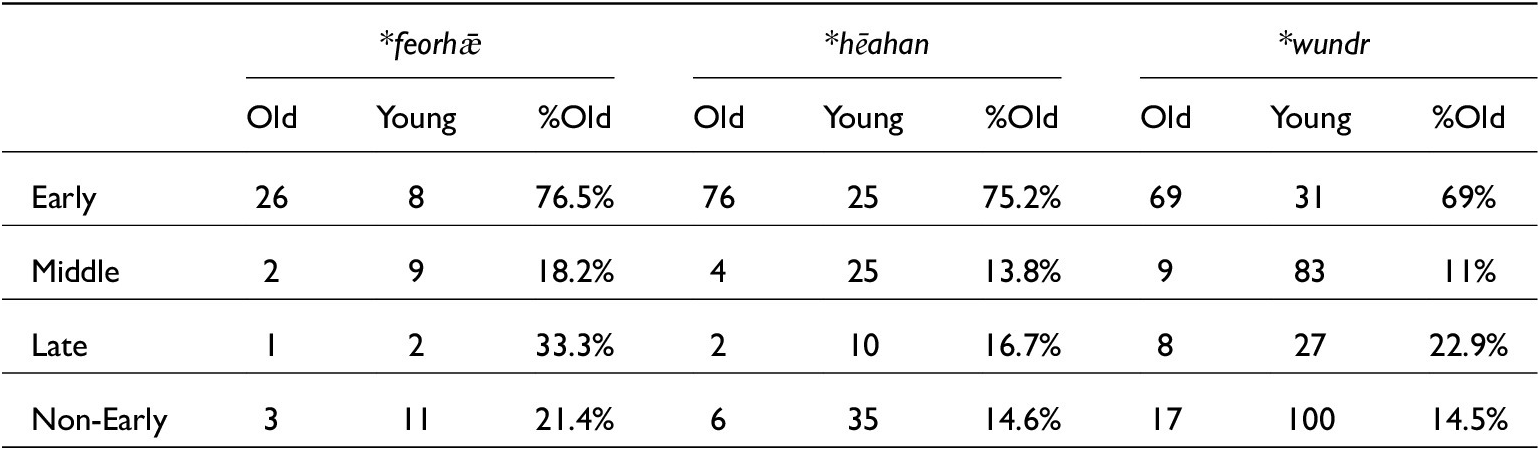
Table 1 draws on the work of Amos (Reference Amos1980: 37–9), as revised by Fulk (Reference Fulk1992: 141–5), to present an overview of the data on post-consonantal h-loss; the full data is provided in the appendix. The distribution of this phenomenon is compared with contraction after intervocalic h-loss and epenthesis. In each category, the column old counts instances where the linguistically more archaic scansion – as the types *feorhǣ, *hēahan and *wundr, respectively – is required, and the column young counts scansions with the linguistically innovative forms – the types of fĕore, hēan and wundor. Footnote 24 The column %old simply recalculates these two columns into percentages: the higher the percentage, the more that group of poems prefers the metrical archaisms for that category of word. Note that a fair number of forms are ambiguous, since the flexibility of Old English metre can often accommodate either an older or a younger form. These ambiguous cases are set aside. All numbers are, of course, approximations only, since editorial decisions (or improved knowledge of metrical nuances) can easily affect the scansion.
Metrical archaisms in Old English verse

Two general comments on the data are in order. Firstly, forms of fī˘ras ‘men’ were excluded by both Amos and Fulk, since this form is never clearly short anywhere in the corpus.Footnote 25 I would regard it as the most firmly entrenched of the metrical archaisms considered here. Secondly, following Fulk (Reference Fulk1992: 143–4), instances of the formula tō wīdan fĕore (and its closest variants) have been considered ambiguous, since they could represent a fairly trivial updating of a verse without the preposition.Footnote 26 If these verses were added back in, and scanned according to their apparent manuscript values, they would give the early group as having 12 young forms instead of 8 (70.3 per cent old),Footnote 27 and the middle group as having 15 young forms (11.2 per cent old).Footnote 28
There is a sharp and obvious dichotomy between, on the one hand, the early group, and on the other, the middle and late groups. As a whole, the early poems prefer to use metrical archaisms, at a rate of around 7 out of every 10 instances where the metre tells us which form is used. Individual poems vary more, unsurprisingly, but poems in the early group almost always prefer all three types of metrical archaism considered here at a rate of at least 50 per cent,Footnote 29 while among the middle and late groups, the use of metrical archaisms of any given type rarely rises above 1 in every 3 secure instances.Footnote 30 The picture for all three types of metrical archaism seems much the same: an early period where the archaisms were preferred (though younger forms were sometimes used),Footnote 31 giving way to a later period in which the more normal linguistic forms predominated and metrical archaisms became a minority option.Footnote 32
Under Sievers’ view of post-consonantal h-loss as causing a real lengthening of the preceding vowel, it would be surprising to see the distribution of lengthened forms matching that of poetic archaisms so well. We would have to assume one of two things. One possibility would be that the progress of the analogical spread of short-vowelled forms proceeded at essentially the same pace as the decline of poetic archaisms in verse. While not strictly impossible, this seems like an unlikely coincidence. The other possibility is that analogical shortening had fully run its course, leaving the lengthened forms as metrical archaisms retained in verse. But if so, then what is the evidence for lengthening in the first place? Why appeal to a supposed intermediate stage *fēore to justify scansions with a heavy syllable, instead of appealing directly to *feorhǣ, the same way that disyllabic scansions of hēan rest directly on old *hēahan?
The simpler explanation is that poets knew and remembered that feore could scan with its pre-loss form, as an optional metrical convention. They knew these archaic metrical values through, I would assume, exposure to other poems, creating a partly self-sustaining system of convention.Footnote 33 Before a certain point, poets strongly preferred the more archaic forms, but these eventually became a minority, preserved especially in set expressions. This kind of decline in the use of metrical archaisms is, of course, not surprising.Footnote 34
I leave it open how poets, especially older poets, actually pronounced the forms in question.Footnote 35 Did they simply retain the historical h-sounds (i.e. [x])? Did they substitute some other sound as a place holder, such as [ʔ] or [h]? Did they adopt an artificial syllabification, such as feor-es, for the sake of performance, as suggested by Hogg (Reference Hogg2011: 169)? Did they use the younger pronunciation, and simply understand the mismatch with metrical form to be a legitimate licence? Or, perhaps, did they actually lengthen the vowel of the root syllable, saying fēore, as a way of maintaining the proper syllable weight? I would emphasize that the last option is a reasonable possibility – but under the view argued for here it would be entirely limited to the recitation of poetry, a feature of performance, and never part of the ordinary language.
7. A nick in the neck: sweora
The word that, at first glance, might seem to provide the most consistent evidence for lengthening is sweora ‘neck’. This is often supposed to go back to a Proto-Germanic form *swerhijan-, with reflexes attested only in Norse svíri and its descendants, and in Old English sweora, swiora, swyra, swira, swura, also found in Middle English. Wider cognates usually adduced include German Schwirre ‘(fence) stake’, Latin sūrus ‘post, stake’, surculus ‘sprig, stick’ and Vedic sváru- ‘sacrificial stake’ (Holthausen Reference Holthausen1974: 537; Vries Reference Vries1977: 571; Ásgeir Blöndal Magnússon Reference Magnússon1989: 1005). Also possibly relevant is a distinct Old English word, swer, swyr, dative plural swiorum ‘column, pillar’.
The etymology of sweora is beset with problems. First is the English-internal evidence, which has been generally fully treated by Dietz (Reference Dietz1970: 19–22). There is metrical evidence from the Metres of Boethius for heaviness in two verses:
swāre on þā swyran (9 56a)
mid ēowrum swiran (10 19a)
There is one further possible example from the riddles:
and swiora smæl (73 18a)
This part of Riddle 73 is, however, badly damaged, so while a meaning ‘neck’ is likely enough, the lack of context makes interpretation difficult.
Length is also evidenced in early Middle English, in contexts where neither the dialect geography nor the vocalism of the rhyme makes a borrowing of long-vowelled Norse svíri likely (Dietz Reference Dietz1970: 19). One instance occurs in The Owl and the Nightingale, lines 1125–6:Footnote 36
an mid þīne atelīche s[w]ōre
biwerest manne corn urom dōre
‘and with your awful neck you defend people’s grain from animals’
Here s[w]ōre rhymes with dōre ‘animals’, from Old English dēore (with an old etymological long diphthong; cf. Gothic diuz-).Footnote 37 The same rhyme occurs in an even more telling metrical context in lines 145–6 of the Moral Ode (also called the Poema Morale and the Conduct of Life):Footnote 38
Swīnes brēde is swīðe swēte, swā is of wilde dōre;
al tō dōre hē i[t] abū[ð], þe ȝefð þērfore his swōre.
‘Swine’s flesh is very sweet, as is (that) of wild game; all too dearly does he purchase it, he who gives for it his neck.’
Here not only does the rhyme point to a long vowel, as also in The Owl and the Nightingale, but the metre demands it. In this poem (and in contrast to Owl), all lines must end in a heavy syllable followed by an unstressed syllable (Fulk Reference Fulk2002: 344–5). This evidence seems particularly important because the metrical tradition here is a new one, based on a Latinate model. It might be that the examples from the Metres of Boethius were metrical archaisms, but this seems highly unlikely to be the case for the Moral Ode. This can therefore be taken as good evidence for a real linguistic long vowel in this word, Old English swēora.
Speaking for shortness is the spelling swura found in late Old English, which shows a change paralleling that of sweord > swurd (Hogg Reference Hogg2011: 201–2). Since this change is not found with long diphthongs, it provides evidence that the root vowel was, or could be, short in this word. There is thus an internal contradiction in the English evidence which is not easy to resolve.
As far as cognates go, Norse svíri (length confirmed both metrically and by the qualitative outcome in later Icelandic) points unambiguously to a uniformly long vowel (Myrvoll Reference Myrvoll2015). No further Germanic cognates are attested, so the presence of Germanic *h is insecure, being largely a device to reconcile the different vocalisms of Norse (with a long í) and English (where most forms point to a diphthong). Breaking before *rh is one possibility for explaining this correspondence, but not the only option. Outside Germanic, the putative cognates generally lack any reflex of *ḱ (> Germanic *h), excepting only Latin surculus, where the velar would seem to be secondary.
The question naturally arises of whether a preform like *swirhijan- is really the only possible way to reconcile the English and Norse forms. Two recent investigators have thought not. Kroonen (Reference Kroonen2011: 252–4) suggests an ablauting pre-Proto-Germanic *swéirōn,Footnote 39 genitive *swirnós, yielding Proto-Germanic *swīrō, *swirraz,Footnote 40 with ensuing levelling and, eventually, a paradigm split with an a-stem *swiraz lying behind Old English swyr ‘column’ and Middle High German swir ‘mooring mast’. Within the n-stem forms, Kroonen adduces Middle High German swirre, also ‘mooring mast’ to support the reconstruction of a form with a geminate, Norse svíri and its descendants for the long vowel, and, for the short vowel with a singleton r (an analogical combination under Kroonen’s analysis), Visperterminen Swiss šwiro ‘post, stake’ as well as the Old English swĕora, swura ‘neck’ here under discussion. He does not address the evidence for long ēo/īo. The place of Old English swer is also unclear: it could perhaps be accounted for through a-umlaut, but this change very rarely affects *i in Old English, the only two reasonably clear examples being nest ‘nest’ and wer ‘man’ (Ringe & Taylor Reference Ringe and Taylor2014: 34).
Myrvoll (Reference Myrvoll2015: 21) takes a similar approach to Norse svíri, deriving the long vowel from older *éi. Like Kroonen, he considers the Old English reflexes to be short, and suggests that *sweirhan- > swīrhan- underwent pre-cluster shortening in prehistoric Old English,Footnote 41 to *swirhan-, which could then undergo breaking to *swiorhan-. With loss of *h, the reflex would still be short: sweora (with the merger, found in most dialects, of *io and *eo). As for Kroonen, the Middle English evidence for long diphthongs is a difficulty. More than the specific etymology, Myrvoll’s key observation is an important one: ‘I alle høve er det ikkje naudsynt å rekna med at norr. svíri hev fenge den lange vokalen sin ved vederlagslengjing.’Footnote 42 His rejection of lengthening before *rh in North Germanic is persuasive, so some other explanation of length there must be sought.
Neither of these approaches can explain the evidence for long diphthongs in English. An alternative explanation, which can explain the long reflexes but unfortunately not the short ones, might be to assume an *h, but before rather than after the *r: *swehr-ijan-, raising to Proto-Germanic *swihrijan-. The development in Norse is simple: loss of post-vocalic *h causes compensatory lengthening, as in stál ‘steel’ < *stahlan, cf. Old High German stahel; tár ‘tear (of the eyes)’ < *tahran, cf. Greek dákru. This gives svíri without complication.
In Old English, *swihrijan- would give *io by breaking, but this would be smoothed again to *ĭ in the Anglian dialects. With loss of coda *h and lengthening, Northumbrian suíra, Old Mercian swīr-bān ‘neck-bone’, West Midlands Early Middle English swīre, etc., all come straightforwardly. In dialects without smoothing, the outcome would depend on the details of i-umlaut: southeastern swīora, swēora and West Saxon *swīera, swȳra. The rhymes of The Owl and the Nightingale and the Moral Poem would reflect southeastern forms, rhyming with the outcome of dēore/dīore, which is not surprising for either work (Fulk Reference Fulk2012: 170, 262).
Looking further back, *swehrijan- would suggest a root *swek- (or *sweik-), which may have cognates in Balto-Slavic: Lithuanian sùkti ‘twist’, Old Church Slavonic sŭkati ‘wind, twine’, etc. (Kroonen Reference Kroonen2013: 496).Footnote 43 The *r would presumably be of adjectival origin: a *swekro- ‘turning’ (for the type, see Bammesberger Reference Bammesberger1990: 246–8) being substantivized as a jan-stem. The semantic change of ‘turner’ to ‘neck’ seems unproblematic.Footnote 44 This derivation would suggest that swer ‘column’ and the group of German Schwirre are unrelated to the ‘neck’ words, and should be compared instead to Sanskrit sváru-, etc., via *swer-, with no velar. This has the advantage of getting the e-vowel often found for swer straightforwardly.
There are two complications that I can see. The less problematic is that no by-forms with geminated *hh are found for this word, as they are for tēar ‘tear’ and ēar ‘ear (of grain)’. But then, h-forms are also absent in stȳl < *stahl-i-, so this can hardly be regarded as a major problem. The survival of such by-forms would just be a matter of chance. The more problematic is that swura, with its apparently short vowel, remains just as obscure under this hypothesis as it does under the traditional derivation from *swerh-ijan-. Lengthening before loss of coda *h should be uniform and exceptionless, just as the Sieversian lengthening upon loss of post-consonantal *h ought to have been. No really obvious mechanism for secondary shortening presents itself.
All in all, the etymology of sweora and its many forms in medieval English remains an unsolved problem. Of the four explanations reviewed here, Kroonen’s and Myrvoll’s can both account for swura, but not for the evidence of long forms. On the other hand explanations based either on *swirhijan- with Sievers’ lengthening, or on *swihrijan-, could account for the lengthened forms, but not the short swura. Footnote 45 For the present purposes, it is enough to set this word aside as problematic and contradictory in its testimony, and no current explanation seems able to account for the full range of variants actually attested. It cannot be used as evidence to support Sievers’ lengthening, since that view of the word’s etymology has no greater explanatory power than do any of the other hypotheses.
8. Conclusion
Ever since Sievers (Reference Sievers1886), the idea of a sound change *-V˘RhV- > *-V̄RV-, with the loss of post-consonantal *h triggering compensatory lengthening of the preceding short vowel, has featured regularly in historical grammars of Old English. While typologically possible, the linguistic evidence regarding the change is at best very weak, and to some extent speaks against it. Since the beginning, the idea has been tied up very closely with Sievers’ analysis of Old English metre, which has always provided the best support for sound change. I have here elaborated on the suggestion by Smith (Reference Smith1956: 243–4) that supposedly lengthened forms were, instead, purely part of the conventions of verse by showing that the distribution of more archaic and more innovative scansions of forms like feore parallels the distribution of well-known metrical archaisms. The simplest explanation for the metrical data is that the only elements at work were the traditional memory of scansion with a heavy syllable, based on *feorhǣ (with historical *h), and the contemporary, light form feore of daily speech. There is no basis for complicating the picture by invoking a supposed lengthened *fēore in the language as a whole.
With the poetic treatment of words like feore explained as metrical archaism rather than evidence of general lengthening, the chief support for Sievers’ sound change disappears. There remains only a small body of onomastic evidence from southwest Britain. These forms, discussed in detail by Dietz (Reference Dietz1970), do seem to provide evidence of a regionally restricted version of Sievers’ change, but there is no reason to generalize this to the majority of varieties of Old English. One might compare the dialectal variability of the similar sound change in Ancient Greek (section 2).
In closing, it may be worth noting that there is something ironic about understanding the heavy scansions of feore-type words as metrical archaisms. The identification of such archaisms depends thoroughly on an understanding of the quantitative regulation of Old English verse cogently articulated by Sievers, and the idea of lengthened fēore-forms was, by his own testimony, a key moment of insight for him in developing this system. The wider conclusions remain – Sievers’ overall descriptive system has been remarkably successful as a framework for understanding and explaining metrical phenomena in Old English, even if various theoretical nuances continue to be debated (see the references in note 1) – but I would reject the idea that helped give rise to it. To my mind, this is really an encouraging state of affairs. Assuming my own argument for these forms as metrical archaisms is correct, then it suggests we can begin with mistaken or imperfect premises, and still arrive at conclusions that are not only sound, but (in Sievers’ case) of considerable significance and lasting usefulness.
Acknowledgements
I would like to thank the attendees of the English Language and Corpus Linguistics Research talk series and the participates of the ILN onsdagslunsj at the University of Oslo for their feedback to presentations of this research. I am particularly grateful to Sverre Stausland for bringing Myrvoll (Reference Myrvoll2015) to my attention. The anonymous reviewers for English Language and Linguistics gave me many useful comments and saved me from several errors. This research was funded by FWO project 1281622N and by the European Commission through the MCSA funding scheme.
Appendix
This appendix lists forms with etymological post-consonantal *h in the longer Old English poems. Poems are sorted alphabetically within their chronological category. For each poem, lines of ambiguous scansion are listed first (labelled ‘Ambiguous’), followed by those scanning according to their younger, post-loss shapes (‘New’), followed by those scanning according to their older, pre-loss shapes (‘Old’). The Metrical Psalms are listed separately, due to their metrical peculiarities; chronologically, they belong with the late group. For further context and discussion, see section 6. Length marks have generally been added, except that the words here under examination have been left unmarked for length one way or the other.
Early Group
Beowulf 933b tō wīdan-feore (Ambiguous)
Beowulf 1843a on swā geongum feore (New)
Beowulf 73b and feorum gumena (New)
Beowulf 1035b eahta mearas (Old)
Beowulf 1152a fēonda feorum (Old)
Beowulf 1293a feore beorgan (Old)
Beowulf 1306a frēonda feorum (Old)
Beowulf 2163b fēower mearas (Old)
Beowulf 2664a swā ðū on geoguð-feore (Old)
Beowulf 3013b sylfes feore (Old)
Beowulf 537a on geogoð-feore (Old)
Beowulf 855b mearum rīdan (Old)
Beowulf 865b fealwe mearas (Old)
Beowulf 917a mearum mǣton (Old)
Christ C 952a fyllað mid feore (Ambiguous)
Christ C 1343a and þæs tō wīdan feore (New)
Christ C 1562b feores unwyrðe (New)
Christ C 1073a feores frætwe (Old)
Christ C 1573b sē-þe nū his feore nyle (Old)
Christ C 1592a fira feorum (Old)
Daniel 101b be feore dǣde (New)
Daniel 225a tō cwale cnihta feorum (Old)
Daniel 559a foldan befolen (Old)
Exodus 548b tō wīdan feore (Ambiguous)
Exodus 171b meara bōgum (Old)
Exodus 384b leofost feora (Old)
Exodus 404a feores frōfre (Old)
Genesis A 43a geondfolen fȳre (New)
Genesis A 1184b on fyore lifde (New)
Genesis A 1330a and feora fæsl (Old)
Genesis A 1342b feora wōcre (Old)
Guthlac A 626b dēaðe bifolene (Ambiguous)
Guthlac A 627b feores orwēnan (New)
Guthlac A 130b monnes feore (Old)
Guthlac A 13a and þǣr ā tō feore (Old)
Guthlac A 286a meara þrēatum (Old)
Guthlac A 291b gif ðū þīnes feore recce (Old)
Guthlac A 548a ealle hȳ þām feore (Old)
Middle Group
Andreas 106a tō wīdan feore (Ambiguous)
Andreas 1452a tō wīdan feore (Ambiguous)
Andreas 1096a on mearum mōdige (New)
Andreas 1107b feores orwēna (New)
Andreas 1130b þe him feores wolde (New)
Andreas 1538b woldon feore beorgan (New)
Andreas 284b þīne feore spilde (New)
Andreas 810a and þæs tō wīdan feore (New)
Christ B 668a bifolen on ferðe (Ambiguous)
Elene 196a befolen in fyrhþe (Ambiguous)
Elene 1288b on wīdan feore (Ambiguous)
Elene 1321b tō wīdan feore (Ambiguous)
Elene 211a tō wīdan feore (Ambiguous)
Elene 134b and feore burgon (New)
Elene 497a befolen fæste (New)
Elene 680b feores ingeþanc (New)
Guthlac B 840a tō wīdan feore (Ambiguous)
Juliana 417a bifolen in foldan (Ambiguous)
Juliana 191b gēn ic feores þē (Old)
Juliana 508b wīdan feore (Old)
Late Group
Brunanburh 72b Wealas ofercōmon (Ambiguous)
Maldon 260b feores hī ne rohton (Ambiguous)
Maldon 194b and hyra feore burgon (New)
Maldon 259b ne for feore murnan (New)
Maldon 239b þā hē on meare rād (Old)
Metrical Psalms
Psalms 68.10 1a þonne ic mīnum feore (Ambiguous)
Psalms 54.23 3a on middum feore (New)
Psalms 71.17 2a and tō wīdan feore (New)
Psalms 88.26 1a ic him tō wīdan feore (New)
Psalms 88.27 1a ic tō wīdan feore (New)
Psalms 106.8 3b tō feore syþþan (New)
Psalms 51.8 2b āwa to feore (Old)
Psalms 54.22 2b syððan tō feore (Old)
Psalms 60.3 1b āwa tō feore (Old)
Psalms 68.1 2a tō mīnum feore inn (Old)
Paris Psalter 72.14 1b yfel befæle (Old)
Psalms 101.25 3b syððan tō feore (Old)
Psalms 132.4 2b lange tō feore (Old)

 Open access

