





Introduction
Grey seals (Halichoerus grypus) and harbour seals (Phoca vitulina) are the 2 resident seal species in the German North- and Baltic Sea with numbers increasing over the last decades (Reijnders et al., Reference Reijnders, Abt, Brasseur, Camphuysen, Essink, Dettmann, Farke, Laursen, Lürßen, Marencic and Wiersinga2005; Galatius et al., Reference Galatius, Teilmann, Dähne, Ahola, Westphal, Kyhn, Pawliczka, Olsen and Dietz2020). In the last century grey and harbour seal populations had been depleted by hunting, habitat loss and contaminant exposure (Wolff, Reference Wolff2000; Lotze, Reference Lotze2007; Silva et al., Reference Silva, Bottagisio, Härkönen, Galatius, Olsen and Harding2021) in both the North- and Baltic Sea. Additionally, North Sea harbour seals were reduced by phocine distemper epidemics (1988 and 2002) (Härkönen et al., Reference Härkönen, Dietz, Reijnders, Teilmann, Harding, Hall, Brasseur, Siebert, Goodman, Jepson, Dau Rasmussen and Thompson2006) and influenza A virus, serotype H7N10 (2014) (Bodewes et al., Reference Bodewes, Bestebroer, van der Vries, Verhagen, Herfst, Koopmans, Fouchier, Pfankuche, Wohlsein, Siebert, Baumgärtner and Osterhaus2015). Seals are infected by a multitude of parasites consisting mostly of trophically transmitted endoparasitic helminths with multi-stage life cycles and varying prevalences, intensities and pathological impacts. The heartworm Acanthocheilonema (A.) spirocauda is a filarial nematode (Onchocercidae; Filarioidea) that was first described from the heart of harbour seals (Leidy, Reference Leidy1858; Anderson, Reference Anderson1959) and later from the heart and surrounding blood vessels of multiple seal species including ringed (Pusa hispida), harp (Phoca groenlandica) and hooded seals (Cristophora cristata) (Measures et al., Reference Measures, Gosselin and Bergeron1997) from Canada and North America (Dunn Reference Dunn1976). A. spirocauda is common in harbour seals along the coasts of The Netherlands (Van Den Broek and Wensvoort, Reference Van Den Broek and Wensvoort1959), Germany (Claussen et al., Reference Claussen, Strauss, Ising, Jäger, Schnieder and Stoye1991; Lehnert et al., Reference Lehnert, Schwanke, Hahn, Wohlsein and Siebert2015), Denmark and Sweden (Lunneryd, Reference Lunneryd1992); see also Leidenberger, S. et al. (Reference Leidenberger, Harding and Härkönen2007) for a review. Recently, A. spirocauda was recorded from monk seal (Monachus monachus) in the Mediterranean (Papadopoulos et al., Reference Papadopoulos, Loukopoulos, Komnenou, Androukaki and Karamanlidis2010). The seal louse Echinophthirius (E.) horridus (Anoplura; Insecta) has been hypothesized to be the intermediate host for heartworm filariae that are transmitted via the blood meal and undergo several moults in the insect vector (Geraci et al., Reference Geraci, Fortin, Aubin and Hicks1981; Lehnert et al., Reference Lehnert, Schwanke, Hahn, Wohlsein and Siebert2015; Ebmer et al., Reference Ebmer, Handschuh, Schwaha, Rubio-García, Gärtner, Glösmann, Taubert and Hermosilla2022) before becoming infective and being directly transmitted to a potential new host via infected louse vectors – transferred e.g. during haul-out on sandbanks between seal individuals. A. spirocauda was reported from the right chamber and atrium in harbour seals from the German Wadden Sea at 12% prevalence (Lehnert et al., Reference Lehnert, Schwanke, Hahn, Wohlsein and Siebert2015), while 25% (Borgsteede et al., Reference Borgsteede, Bus, Verplanke and Van Burg1991) and 32% prevalence (Claussen et al., Reference Claussen, Strauss, Ising, Jäger, Schnieder and Stoye1991) were found after the 1988 PDV epidemic. Around the same time, 11% A. spirocauda prevalence was reported from the Kattegat/Skagerrak and Baltic Sea region (Lunneryd, Reference Lunneryd1992). Heartworm usually does not cause severe health effects in harbour seals, although a perforated atrium and subsequent mortality was described in 1 case (Lehnert et al., Reference Lehnert, Schwanke, Hahn, Wohlsein and Siebert2015). So far it was assumed that grey seals do not get infected by A. spirocauda (Leidenberger et al., Reference Leidenberger, Harding and Härkönen2007) although 1 study suggested the potential presence of heartworm in grey seal hosts (Keroack et al., Reference Keroack, Williams, Fessler, DeAngelis, Tsekitsidou, Tozloski and Williams2018). This study reports A. spirocauda for the first time in the heart of 2 grey seals found stranded on the German coastline and complemented morphological identification of the specimens with molecular techniques for unambiguous species identity.
Materials and methods
Within a coordinated stranding network established in 1990, post-mortem investigations on marine mammals found on the coasts of the German Federal State of Schleswig-Holstein (S-H) were performed at the Institute for Terrestrial and Aquatic Wildlife Research (ITAW) (Siebert et al., Reference Siebert, Wohlsein, Lehnert and Baumgärtner2007). Dead stranded animals were retrieved and terminally sick animals were mercy-killed by licensed seal hunters for animal welfare reasons (Siebert et al., Reference Siebert, Wohlsein, Lehnert and Baumgärtner2007). Decomposition status (DCC), with DCC1 being very fresh animals, DCC2 fresh, DCC3 moderate decomposition, DCC 4 advanced decomposition and DCC 5 mummified animals (Ijsseldijk et al., Reference Ijsseldijk, Brownlow and Mazzariol2019) and nutritional status were assessed during necropsy which was performed in accordance to an established protocol (Ijsseldijk et al., Reference Ijsseldijk, Brownlow and Mazzariol2019). Age was determined using dental growth layers. Carcasses were screened for ecto- and endoparasites and histopathological and microbiological investigations were conducted (Siebert et al., Reference Siebert, Wünschmann, Weiss, Frank, Benke and Frese2001, Reference Siebert, Rademaker, Ulrich, Wohlsein, Ronnenberg and Prenger-Berninghoff2017). Prevalence and level of parasitic infections were determined during necropsy semi-quantitatively as none, mild, moderate or severe and associated lesions were preserved for subsequent histology (Lehnert et al., Reference Lehnert, Raga and Siebert2007; Siebert et al., Reference Siebert, Wohlsein, Lehnert and Baumgärtner2007). During post-mortem investigation, the heart of the animal was separated from the lung, weighed and opened starting with the atrium and continuing with the ventricle of the according side. Parasites were collected in water and cleaned from tissue before being preserved in 70% ethanol. Associated lesions were assessed macroscopically and archived in 10% buffered formalin for histology. Grey seal (n = 164) necropsy findings and archived tissue samples from 25 years of health monitoring seals on the coasts of Schleswig-Holstein were screened in the frame of a long-term study between 1996 and 2021. Two male grey seals exhibited unusual heart nematode infections. The carcass of the first case was frozen before necropsy, the carcass of the second case was necropsied freshly. Collected nematode specimens were identified with a stereomicroscope (Olympus SDX10 and SX61 with CD30, Olympus, Hamburg, Germany) based on their morphological characteristics (Leidenberger and Boström, Reference Leidenberger and Boström2008). One adult female and one damaged heartworm specimen from the 2 different hosts were measured using CellSensEntry V3.2 software (Olympus, Hamburg, Germany). Because some isolated nematodes did not have unambiguous characteristics for parasite differentiation, species identification was achieved using gene sequence data. Genomic DNA was isolated from 2 specimens from the 2 grey seal individuals using a QIAamp DNA Micro Kit (Qiagen, Hilden, Germany). DNA concentrations and purity were determined using a Nanodrop 2000c (Thermo Scientific) spectrophotometer. Approximately 500 bp of the mtDNA COI gene was amplified using oligonucleotide primers 5`-GGTCCTGGGAGTAGCTGAAC-3` (forward) and 5`-ATGATGGCCCCACACAGAAG −3′ (reverse) (Lehnert et al., Reference Lehnert, Schwanke, Hahn, Wohlsein and Siebert2015). Polymerase chain reactions were performed in 50 μL volume containing 25 μL MyTaq Red Mix, 2x (Bioline, Heidelberg, Germany), 1 μL of each primer (20 μM), 5 μL DNA template and distilled H2O to fill the volume. Cycling conditions were initial denaturation at 95°C for 1 min, followed by 40 cycles of denaturation at 95°C for 15 s, annealing at 60°C for 15 s and extension at 72°C for 10 s. PCR products were visualized on a 2.0% agarose gel using SYBRSafe DNA gel stain (Invitrogen, Germany). PCR products were Sanger sequenced at Microsynth (Göttingen, Germany). The closest match to the sequence was determined using BLASTN on GenBank.
Results
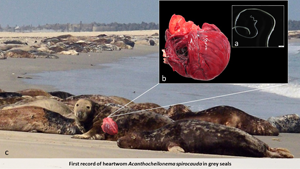
Of 164 grey seals necropsied including the opening of the heart, 6 had samples of nematode infections in the heart. Four samples consisted of lungworm Otostrongylus circumlitus (Crenosomatidae; Metastrongyloidea), but heartworm samples originating from 2 grey seals found along the German North Sea coast were identified as A. spirocauda, a filarial nematode belonging to the Onchocercidae (Filarioidea) (Fig. 1).
Heartworm Acanthocheilonema spirocauda with characteristic helical tail in adult male (a; inserted box) and in-situ right ventricle of seal heart (b; black box) found in grey seals (Halichoerus grypus) shown on haul-out on Helgoland (c).

The first heartworm sample originated from a 2-year-old male grey seal found in February 2018 on the island Heligoland. The animal was decomposition status grade 3 and in a good nutritional status with a body length of 147 cm. Due to predation the carcass displayed large wounds with missing skin, blubber and muscles and not all post mortem investigations could be performed. A moderate nematode infection of the left cardiac atrium and mild infections of the gastro-intestinal tract with anisakid nematodes and acanthocephalans were recorded at necropsy. A focal moderate granulomatous and eosinophilic mural enteritis with intralesional nematode larvae was observed histologically. Microbiological culture revealed no specific pathogens.
The second heartworm sample originated from a 17-year-old male grey seal found alive on a beach of the island of Sylt in January 2020. Due to its poor health condition, it was mercy-killed. The animal was in a moderate nutritional status with a total length of 194 cm and a body weight of 114 kg. At necropsy 1 day later (decomposition status 1) a single nematode was collected from the heart. Severe infections with gastric anisakid nematodes and Corynosoma spp. acanthocephalans in the small intestine as well as with respiratory mites Halarachne halichoeri were observed. In histology a moderate, granulomatous, mural gastritis with intralesional parasites as well as a marked eosinophilic and granulomatous enteritis accompanied by a similar lymphadenitis of the mesenteric lymph nodes were diagnosed. Additionally, pulmonary and gastric lymph nodes showed a mild follicular hyperplasia. A mild purulent valvular endocarditis was observed possibly indicating a septicaemic origin. Microbiological investigation revealed the presence of Streptococcus equi subspecies zooepidemicus in nearly every organ sample. Only single colonies were detected in the pulmonary lymph node, intestine and intestinal lymph node, low growth rates in spleen, kidney, stomach and lung and moderate growth rate in the central nervous system. Strong growth of Clostridium perfringens was demonstrated in the intestine.
In both samples from the heart the nematode individuals appeared slender and whitish with firm rounded shape of the cuticula. Posterior body ends of males with characteristic helical tail and spicules for unambiguous morphological identification were not observed. In 1 sample the length of an intact female specimen was 9.2 cm, with a width of 0.5 mm. Other specimens were incomplete and in some instances entangled. The second sample contained only 1 damaged specimen of undetermined sex with a length of at least 12.3 cm and a width of 0.9 mm. The 474 bp long mtDNA sequence derived from the nematodes after PCR was 99.79% identical with A. spirocauda published sequence of the COI gene for cytochrome oxidase subunit 1 when blasted in GenBank (accession no.: HF583266.1).
Discussion
Nematodes collected from the heart of 2 male grey seals found along the German North Sea coast were molecularly identified as A. spirocauda and comprise the first record of this species in grey seals during a decades-long monitoring of seal health along the German North- and Baltic Sea coast. Heartworms are common in harbour seals and frequently infect individuals found stranded along the German North- and Baltic Sea coasts (Claussen et al., Reference Claussen, Strauss, Ising, Jäger, Schnieder and Stoye1991; Lehnert et al., Reference Lehnert, Raga and Siebert2007, Reference Lehnert, Schwanke, Hahn, Wohlsein and Siebert2015) and adjacent waters (Lunneryd, Reference Lunneryd1992). However, they were so far not reported from grey seals which share their habitat, diet preferences and haul-outs with harbour seals (Brasseur, Reference Brasseur2017; Damseaux et al., Reference Damseaux, Siebert, Pomeroy, Lepoint and Das2021; Boyi et al., Reference Boyi, Heße, Rohner, Säurich, Siebert, Gilles and Lehnert2022). The insect seal louse Echinophthirius (E.) horridus infects both harbour and grey seals and occur regularly on both species throughout the study area (Zimmermann and Nebel, Reference Zimmermann and Nebel1975; Lehnert et al., Reference Lehnert, Schwanke, Hahn, Wohlsein and Siebert2015) and in adjacent waters (Thompson et al., Reference Thompson, Corpe and Reid1998; Morick et al., Reference Morick, Osinga, Gruys and Harrus2009). Although E. horridus is assumed to be an intermediate host and vector of the heartworm filariae (Geraci et al., Reference Geraci, Fortin, Aubin and Hicks1981; Leidenberger et al., Reference Leidenberger, Harding and Härkönen2007; Lehnert et al., Reference Lehnert, Schwanke, Hahn, Wohlsein and Siebert2015), it was believed that heartworms do not infect grey seals (Measures et al., Reference Measures, Gosselin and Bergeron1997; Leidenberger et al., Reference Leidenberger, Harding and Härkönen2007). A recent study found circumstantial evidence for A. spirocauda infecting grey seals by using a qPCR assay for heartworm infections, detecting a positive signal from a damaged nematode sampled from a seal carcass, assumed to be a grey seal but due to decomposition it was not possible to specify the host (Keroack et al., Reference Keroack, Williams, Fessler, DeAngelis, Tsekitsidou, Tozloski and Williams2018). However, this is the first study actually reporting heartworm individuals found in the heart of grey seals at necropsy.
Lungworms belonging to the Metastrongyloidea usually infect the respiratory tract (Measures, Reference Measures, Samuel, Pybus and Kocan2001) but are frequently found in the heart and surrounding blood vessels of seals at necropsy (Claussen et al., Reference Claussen, Strauss, Ising, Jäger, Schnieder and Stoye1991) and can be mistaken for A. spirocauda, necessitating a thorough morphological or molecular identification. Otostrongylus (O.) (Crenosomatidae) and Parafilaroides (P.) gymnurus (Filaroididae) are found more seldom in grey seals compared to harbour seals, where prevalences of 70% are common (Lehnert et al., Reference Lehnert, Raga and Siebert2007). The morphology of A. spirocauda (Onchocercidae) and 2 occurring lung nematode species O. circumlitus and P. gymnurus in grey seals is distinct. O. circumlitus lungworms are thicker, with their cuticula more crumpled and beige in coloration, P. gymnurus are significantly smaller and more fragile than A. spirocauda. Especially adult male nematodes of the mentioned species display clear species-specific morphological traits in the posterior body end. Length and width measurements of an adult A. spirocauda specimen found in grey seals in this study corresponded with previous measurements of A. spirocauda found in harbour seals (Leidy, Reference Leidy1858) also from the North Sea (Wipper, Reference Wipper1974; Van der Kamp, Reference Van der Kamp1987). However, it is challenging to differentiate damaged or larval nematode specimens. The emergence of molecular tools to differentiate between and speciate parasites without clear morphological traits enabled the identification of A. spirocauda with mitochondrial nucleotide data in this study. Based on the molecular data obtained, harbour and grey seals are infected by the same Acanthocheilonema species (A. spirocauda). Also, the lack of nucleotide difference between the grey and harbour seal heartworm shows that A. spirocauda of the same haplotype infects both species and the heartworm has not developed genetic adaptations to either species.
The low occurrence and intensity of A. spirocauda infections in grey seals in the study area over the last decades indicates a high species-specificity of heartworm as designated parasite of harbour seals. However, while seal populations have steadily increased over the last years (Olsen et al., Reference Olsen, Galatius and Härkönen2018) and grey seals have recolonized the German North- and Baltic Sea after almost becoming extinct in the last century (Reijnders et al., Reference Reijnders, Abt, Brasseur, Camphuysen, Essink, Dettmann, Farke, Laursen, Lürßen, Marencic and Wiersinga2005), inter-species contacts and density-dependent infection patterns may influence the prevalence and intensity of A. spirocauda in both host species (Reckendorf et al., Reference Reckendorf, Wohlsein, Lakemeyer, Stokholm, von Vietinghoff and Lehnert2019). In the investigated grey seals heartworm infections were mild and moderate and probably did not substantially contribute to the cause of death or disease. However, both individuals had gastro-intestinal parasite infections, in 1 grey seal severe gastro-intestinal helminth and respiratory mite infections which debilitated the animal and probably contributed to its generalized infection. The detection of S. equi subspecies zooepidemicus in various organ samples together with the diagnosis of an endocarditis indicate that septicaemia might have been the cause of severe disease in this grey seal. The single heartworm encountered could also have caused mechanical alteration of the endothelium of the valve and provoked acute endocarditis. Although heartworms have been described to cause obstructions (Dunn and Wolke, Reference Dunn and Wolke1976; Stroud and Dailey, Reference Stroud and Dailey1978) in harbour seals, mechanical alterations like a perforation of the right atrium severely infected by A. spirocauda are scarce (Lehnert et al., Reference Lehnert, Raga and Siebert2007).
The traumatic lesions in the first individual are assumedly caused by predation of another grey seal (Van Neer et al., Reference Van Neer, Gross, Kesselring, Grilo, Ludes-Wehrmeister, Roncon and Siebert2020). Microbiological findings in the lung need to be judged with caution as the thorax was opened due to the predation wound and thoracic organs were probably contaminated from the outside. Inflammatory alterations in the intestine observed in histology were possibly caused by the parasitic infection. The parasites in the intestinal wall of both grey seals diagnosed in histology indicate the somatic migration of nematode larvae, however, it remains unclear if this may be heartworm, gastro-intestinal or other parasite species. Although heartworms seem to have mild pathogenicity in harbour seals – with mild infections and no significant impact on health apart from some cases (Dunn and Wolke, Reference Dunn and Wolke1976; Stroud and Dailey, Reference Stroud and Dailey1978; Conlogue et al., Reference Conlogue, Ogden and Foreyt1980; Lehnert et al., Reference Lehnert, Raga and Siebert2007) their pathogenicity in grey seals remains to be evaluated pending on more cases. On both grey seals no seal lice (E. horridus) were found, although they are suspected to be vectors of heartworm filariae (Geraci et al., Reference Geraci, Fortin, Aubin and Hicks1981). However, ectoparasites can leave their host after death, or may get lost during stranding, drifting or transport of the carcass, therefore introducing a bias into ectoparasite prevalence. It remains striking that although harbour and grey seals are closely related, share the same ecosystem and many resources, grey seals are not similarly affected by certain infectious diseases, e. g. phocine distemper virus (PDV), lung nematode (Metastrongyloidea) (Osinga et al., Reference Osinga, Ferdous, Morick, Hartmann, Ulloa, Vedder, de Haes, Brakefield, Osterhaus and Kuiken2012) and heartworm infections. Heterozygosity has been suggested to cause varying susceptibility to infectious disease (McCarthy et al., Reference McCarthy, Shaw, Jepson, Brasseur, Reijnders and Goodman2011) including lung nematodes (Rijks et al., Reference Rijks, Hoffman, Kuiken, Osterhaus and Amos2008) within and among host species in natural harbour seal populations (Hoffman et al., Reference Hoffman, Simpson, David, Rijks, Kuiken, Thorne, Lacy and Dasmahapatra2014) when new approaches of uncovering heterozygosity fitness correlations for varying fitness within a population were investigated. Consequently heterozygosity could also be considered as possible factor explaining susceptibility to nematode infections in harbour and grey seals. Long term data sets and sample archives with preserved biological specimens and tissues collected over extended periods of time are especially valuable when investigating long-lived apex predators and effects of environmental change on their ecosystem (Reckendorf et al., Reference Reckendorf, Wohlsein, Lakemeyer, Stokholm, von Vietinghoff and Lehnert2019; Wood and Vanhove, Reference Wood and Vanhove2022). Parasites can serve as important bio indicators for the ecology of their hosts, reflecting behaviour, diet and distribution (Marcogliese, Reference Marcogliese2005; Hudson et al., Reference Hudson, Dobson and Lafferty2006), and, in the case of grey seals potentially their reestablishment and subsequent richer biodiversity in the North Sea ecosystem (Marcogliese, Reference Marcogliese2004). The intricate parasite-host relationships between heartworm and seals and the species-specificity of A. spirocauda as well as grey seal immune traits need to be investigated further.
Acknowledgements
The authors thank all individuals who report and collect marine mammals in Germany, in particular the Schleswig-Holstein national park rangers and seal hunters, as well as all ITAW colleagues and assistants for their support during necropsies, especially Kornelia Schmidt and Miriam Hillmann. The investigations were partly funded by the Ministry of Energy Transition, Climate Protection, the Environment and Nature (MEKUN S-H) and the National Park Service of Schleswig-Holstein.
Authors’ contributions
Conceptualization, K. L; Investigation, K. L., I. H., J. O. B., S. G., P. W., E. P.-B.; Methodology, K. L., J. O. B., I. H., S. G., P. W., E. P.-B., C. H., U. S. Funding acquisition, K. L. Resources, K. L. and U. S.; writing-original draft, K. L., I. H. and J. O. B.; writing – review and editing, K. L., I. H., J. O. B., S. G., P. W., E. P.-B. and U. S. All authors have read and agreed to the submitted version of the article.
Financial support
The investigations were partly funded by the Ministry of Energy, Agriculture Environment and Rural Affairs and the National Park Service of Schleswig-Holstein. This research received no specific grant from any funding agency, commercial or not-for-profit sectors. This Open Access publication was funded by the Deutsche Forschungsgemeinschaft (DFG, German Research Foundation) - 491094227 "Open Access Publication Funding" and the University of Veterinary Medicine Hannover, Foundation.
Conflict of interest
The authors declare there are no conflicts of interest.
Ethical standards
All marine mammals in our study were found dead, died naturally or were mercy-killed based on animal welfare grounds and none of the animals were killed for the purpose of this study.


 Open access

