


How does politics affect, and possibly distort, how resources are allocated? In a federal system like the United States, the central government provides public goods, income security, and other resources by allocating grants to subnational governments (Chubb Reference Chubb1985; Ervin Reference Ervin1965). These programs, also known as grants-in-aid, primarily allocate funding to states using formulas based on demographic characteristics. In total, grants-in-aid account for over a quarter of federal domestic spending and nearly 40% of state and local government funding (Office of Management and Budget 2022; Dilger and Cecire Reference Dilger and Cecire2019). However, theories of distributive politics have largely ignored this aspect of the policymaking process. As a result, we know little about the politics of grants-in-aid and the consequences of allocating resources within a federal system.
I develop a theory of allocating grants-in-aid that emphasizes the role of political geography. Drawing on existing work on distributive politics, I argue that areas represented by members of committees, and particularly committee chairs, receive a disproportionate share of funding. This logic is consistent with a large literature arguing that members of key congressional committees direct more funding to their constituents to improve their chances of reelection (Mayhew Reference Mayhew1974; Shepsle and Weingast Reference Shepsle and Weingast1987; Weingast and Marshall Reference Weingast and Marshall1988). However, allocating funding via formula also impacts the distribution of grants. When a grant program is altered to benefit one state, other states with similar characteristics also benefit because funds are allocated based on state characteristics. Applying this logic to committees means that, for example, when committee chairs represent high-poverty states, programs should allocate funding based on poverty to direct more resources to committee chair’s states. However, all states with high poverty—not just those represented by committee chairs—would benefit from the program. More broadly, the benefit to states represented by committee chairs should spill over to states with similar characteristics. Thus, where the federal government provides public goods and financial assistance depends not only on who has power within Congress but also on the characteristics of their constituents.
To test this theory, I compile a dataset of all education grant programs from fiscal years (FY) 1980 to 2020. Education is a particularly important policy area because investments in schools are thought to produce more economic equality and greater civic participation (Paulsen, Scheve, and Stasavage Reference Paulsen, Scheve and Stasavage2023). First, I estimate the benefit to states represented by committee chairs using a matched difference-in-differences design. I use variation in the timing of program reauthorizations to measure how much grant additional funding a state receives when its member of Congress becomes chair of the committee with jurisdiction over the program. Second, I use a similar design to examine whether that benefit spills over to states with similar characteristics. Third, I consider a case study of funding for teachers and principals to explore possible mechanisms for committee influence.
I find that allocating funding based on demographic characteristics complicates existing theories of distributive politics. I show that states represented by Senate committee members, and particularly committee chairs, disproportionately benefit from grants-in-aid. However, other states with similar characteristics also benefit, sometimes more than the states represented on the committee. These findings join a growing literature that shows that allocating funding based on state characteristics limits legislators’ abilities to target funding to specific places (Martin Reference Martin2018; Rosenstiel Reference Rosenstiel2023). Moreover, if scholars do not account for these spillovers, they will not accurately characterize the influence of congressional committees. Because committee members cannot capture the entire budget, the benefit of committee membership is substantially less than existing theories predict. Additionally, when states not represented by committee members receive a disproportionate share of grants-in-aid, it can appear as though there is no committee benefit. This may explain why existing research on grants-in-aid often fails to find any evidence of committee influence (e.g., Berry, Burden, and Howell Reference Berry, Burden and Howell2010; Berry and Fowler Reference Berry and Fowler2016; Levitt and Snyder Reference Levitt and Snyder1995).
Unlike the Senate, I find no evidence of a committee benefit in the House. This suggests that the committee-led particularistic politics governing grants-in-aid is confined to the Senate. Moreover, any biases in Senate representation are likely more pronounced in grants-in-aid than in other types of government spending. For example, scholars and observers have long been concerned about a small-state bias in the Senate. While a small-state bias exists across many policies (Lee and Oppenheimer Reference Lee and Oppenheimer1999), it may be more pronounced for grants-in-aid because the House is not serving as a counterbalance to the Senate.
Spillover effects may further magnify the Senate’s small-state bias because including one small state in the winning coalition means that all small states likely benefit. That is, a program that benefits one small state should benefit other small states. In line with this claim, I show that when committee chairs represent small states, small states receive substantially more grant funding.
CONGRESS AND THE DISTRIBUTION OF FUNDING
A long literature explores how congressional committees influence the distribution of federal funding. The underlying assumption in much of this work is that legislators are motivated by reelection (Evans Reference Evans, Edwards, Lee and Schickler2011; Ferejohn Reference Ferejohn1974; Mayhew Reference Mayhew1974; Shepsle and Weingast Reference Shepsle and Weingast1981; Weingast and Marshall Reference Weingast and Marshall1988). To help their reelection chances, legislators try to bring government benefits back to their states or districts—often in the form of government funding. And, this process is facilitated by the congressional committee system. Through the committee assignment process, legislators select onto committees with jurisdiction over policy areas for which their constituents have high demand. Then, these high demanders or preference outliers use their agenda-setting power (Knight Reference Knight2005; Weingast and Marshall Reference Weingast and Marshall1988) and veto power (Shepsle and Weingast Reference Shepsle and Weingast1987) within the chamber to procure a disproportionate share of benefits for their states and districts.
The relationship between congressional committees and funding has been subject to substantial empirical testing. There is evidence that high demanders, measured using constituency characteristics, make up certain committees (Adler and Lapinski Reference Adler and Lapinski1997; Cormack Reference Cormack2021; Hurwitz, Moiles, and Rohde Reference Hurwitz, Moiles and Rohde2001; Sprague Reference Sprague2008) and subcommittees (Adler Reference Adler2000). There is also evidence that members of key committees and subcommittees are able to procure more transportation funding for their districts (Evans Reference Evans1994; Knight Reference Knight2005; Lee Reference Lee2003), research funding for universities in their states (Payne Reference Payne2003), and military construction funding for military bases in their states and districts (Hammond and Rosenstiel Reference Hammond and Rosenstiel2020). Looking across multiple policy areas, Clemens, Crespin, and Finocchiaro (Reference Clemens, Crespin and Finocchiaro2015) find that members of Appropriations subcommittees are able to procure more earmarks for their districts. Relatedly, Grimmer and Powell (Reference Grimmer and Powell2013) find that members who lose key committee seats spend more time in their districts, suggesting that committee membership provides an electoral subsidy.
However, not all committee members have equal power in the policymaking process. Committee chairs set the committee’s agenda, hire and fire committee staff, and generally act as the floor managers for bills. As a result, committee chairs should procure more benefits than other committee members. In line with this expectation, committee chairs procure more funding for their constituents, are more effective legislators, receive more campaign contributions, and have more value as lobbyists when they leave Congress (Berry and Fowler Reference Berry and Fowler2018; Volden and Wiseman Reference Volden and Wiseman2014).
Despite the long literature on congressional committees and the prevalence of grants-in-aid, scholars have yet to examine how demographic characteristics interact with committee influence. Grants-in-aid are unique from other types of federal spending because funds are primarily allocated using statutory formulas based on state characteristics, such as population and poverty. For example, grants for adult education are allocated in proportion to each state’s relative share of adults who do not have a high school diploma and who are not enrolled in school. Grants for the education of the disadvantaged use a slightly more complicated formula. Grants are allocated to states in proportion to school-age poverty levels multiplied by state average per pupil expenditures. Under this formula, weights are applied to the counts of children in poverty so that places with higher poverty levels and rates receive more funding per child.Footnote 1
There are several reasons why Congress chooses to allocate grants using statutory formulas. Instead of using a formula, Congress sometimes has federal agencies allocate grants on a competitive basis. However, because grant recipients are chosen by the bureaucracy, Congress has less control over the distribution of funding (Napolio Reference Napolio2023). Additionally, certain places may be less able to compete for funds. In particular, members of Congress have expressed concern that rural areas do not have the capacity to effectively compete for grants.Footnote 2 Lastly, unlike formula grants, not all eligible recipients receive funding when grants are allocation using a competition. Because of this uncertainty over funding, competitive grants are not well suited for paying employee salaries, running an annual program, or other activities that need a consistent source of funding. This may explain why Congress chooses to allocate the majority of grants-in-aid via formula as opposed to a competition.
Existing theoretical work on grants-in-aid focuses on the consequences of allocating funding via formula for bargaining and coalition formation (Martin Reference Martin2018; Rosenstiel Reference Rosenstiel2023). A common theme in these models is that allocating funding via formula substantially constrains members of Congress. In particular, how members form coalitions—and thus who benefits from grants-in-aid—depends on state characteristics. For example, the same groups of states repeatedly appear in coalitions together (Martin Reference Martin2018) and senators proposing amendments to formulas form coalitions with senators representing states with similar characteristics to their own state (Rosenstiel Reference Rosenstiel2023). Certain types of states—such as smaller states and states with slower population growth—also disproportionately benefit from grants-in-aid (Larcinese, Rizzo, and Testa Reference Larcinese, Rizzo and Testa2013; Lee and Oppenheimer Reference Lee and Oppenheimer1999), further suggesting that demographic characteristics are an important factor shaping government assistance.
Another consequence of the federal system is that Congress allocates funding to state governments. As a result, Lee (Reference Lee2003, Reference Lee2004) argues that senators are more likely to amend formula grants than members of the House. Specifically, because formulas do not allocate grants to congressional districts, it is difficult for House members to claim credit for formula changes and know how a formula change will affect funding for their district. While much of the existing work on congressional committees focuses on the House, this suggests that Senate committees should exert more influence over grants-in-aid than their House counterparts.
In this article, I seek to bring together insights from the literature on congressional committees with the additional constraints that a formula imposes. Following the literature on distributive politics, I argue that committee members and committee chairs are able to use their positions in the policymaking process to procure more funding for their states. However, these benefits spill over to other similar states. For example, a senator from New York might alter a grant program so that funding is entirely allocated in proportion to population. This formula benefits New York as it is one of the most populous states and will thus receive a large share of funding. However, other populous states, such as California, also benefit from this formula. This logic yields two hypotheses.
Committee Benefits Hypothesis: States represented by committee members, and particularly committee chairs, disproportionately benefit from grants-in-aid.
Committee Spillover Hypothesis: States with similar characteristics to states represented by committee chairs disproportionately benefit from grants-in-aid.
While the Committee Benefits Hypothesis follows directly from existing theories of committee influence (e.g., Weingast and Marshall Reference Weingast and Marshall1988), the Committee Spillover Hypothesis is an important departure. Weingast and Marshall (Reference Weingast and Marshall1988) argue that members of congressional committees capture the entire budget under their jurisdiction. That is, for example, all federal agriculture funding allocated by Congress would go to states and districts represented by members of the House and Senate agriculture committees. However, the Committee Spillover Hypothesis posits that, when funding is allocated via formula, states with similar characteristics to the committee chair’s state also benefit. If true, then the benefits of committee membership are substantially less than existing theories predict because committee members are not able to capture all of the resources within their jurisdiction. This distinction is important because it highlights how the U.S. federal system constrains committee members’ ability to engage in particularistic policymaking.
There are two alternatives to my committee-centered theory of grants-in-aid worth mentioning. First, scholars have argued that a norm of universalism governs distributive politics in Congress (e.g., Stein and Bickers Reference Stein and Bickers1994; Weingast Reference Weingast1994). These theories generally posit that coalitions are unanimous or near-unanimous rather than narrow or minimum-winning coalitions. Second, Levitt and Snyder (Reference Levitt and Snyder1995) argue that parties—rather than committees—determine the distribution of federal grants. In particular, Democrats in Congress target funding to Democratic voters. In other words, while it may appear as though funds spill over to states with similar characteristics, parties design programs to benefit all states with similar partisanship. Like the theory I put forth in this article, both of these alternatives suggest that states other than those represented by committee members should benefit from grants-in-aid.
In this article, I provide evidence that neither of these alternatives explains the distribution of grants-in-aid. First, states with similar demographic characteristics to the committee chair’s state disproportionately benefit from grants-in-aid. This suggests that the goal is to benefit the committee chair’s state, not to benefit all, or a large number, of states. Additionally, I show that when Congress alters allocation formulas, there are winners and losers. The existence of states that lose funding when a formula is changed is not in line with a norm of universalism. With regards to partisanship, I do not find any differences between Democratic and Republican members of Congress, suggesting that both Democrats and Republicans try to target funding to their constituents. Additionally, states with similar partisanship to the committee chair see no extra benefit from grants-in-aid. This further suggests that it is congressional committees and demographic characteristics, rather than partisanship, that explains the distribution of grants-in-aid.
DATA
To test my hypotheses, I compile a dataset of all formula grant programs administered by the Department of Education (ED) from FY1980 to FY2020. Education is a useful test case for my theory because there are a large number of education formula grant programs. Moreover, education programs are authorized by different bills that get reauthorized at different times. Senators have the opportunity to amend allocation formulas when grant programs come up for reauthorization and, as I discuss in the next section, this variation in reauthorization timing allows me to make within-state comparisons of similar programs to quantify the benefits of committee membership and serving as committee chair. Additionally, unlike many other federal agencies, ED provides data on state grant amounts going back to 1980 and these grant amounts are comparable over time.
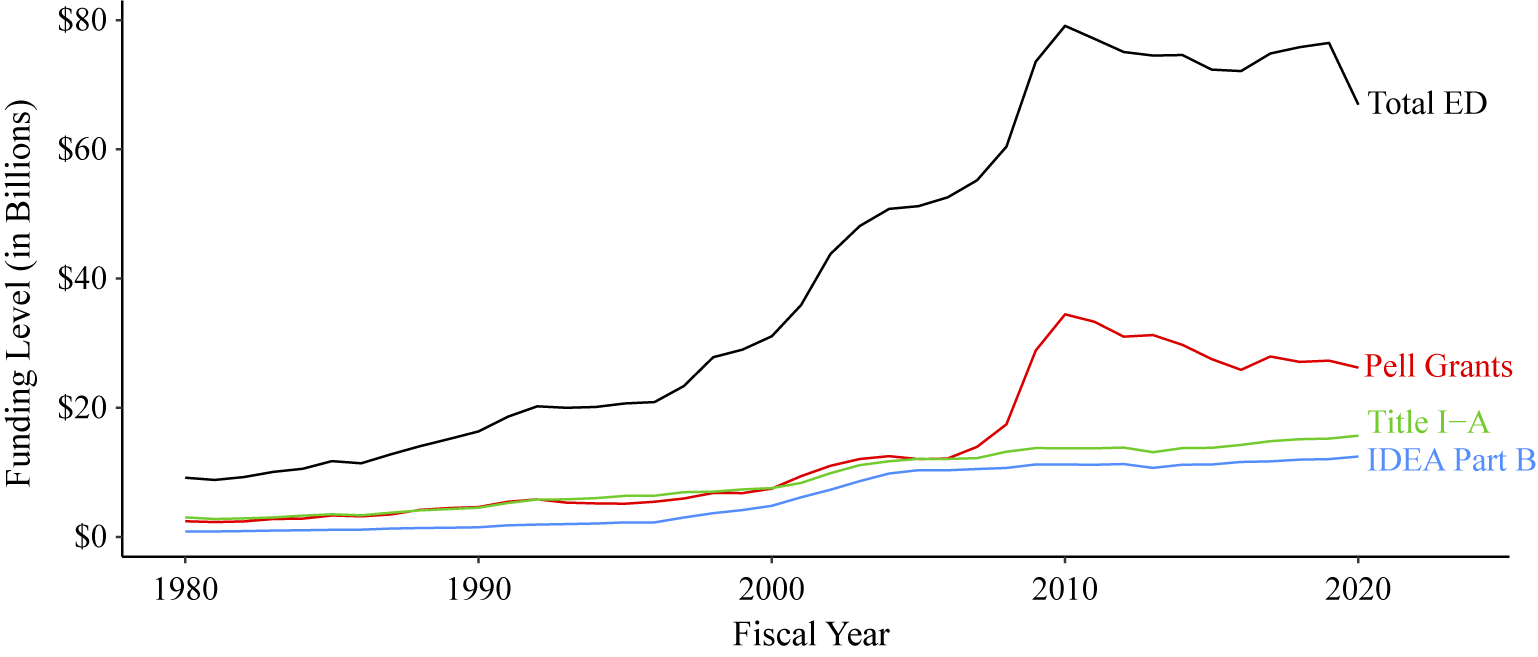
From 1980 to 2020, ED administered 37 formula grant programs, the largest of which are Pell Grants, Title I-A of the Elementary and Secondary Education Act (ESEA), and Part B of the Individuals with Disabilities Education Act (IDEA).Footnote 3 For every program, I have data on how much each state received each year. Figure 1 shows the total funding level for each year. In general, federal funding for education increased from 1980 to 2010 and has remained relatively constant since then.
Funding Levels for Education Grants Allocated via Formula
Note: This figure shows the total funding level for all programs included in the dataset as well as the funding levels for the three largest programs: Pell Grants (Title IV of the Higher Education Act), Title I-A of the Elementary and Secondary Education Act (ESEA), and the Individuals with Disabilities Education Act (IDEA) Part B.
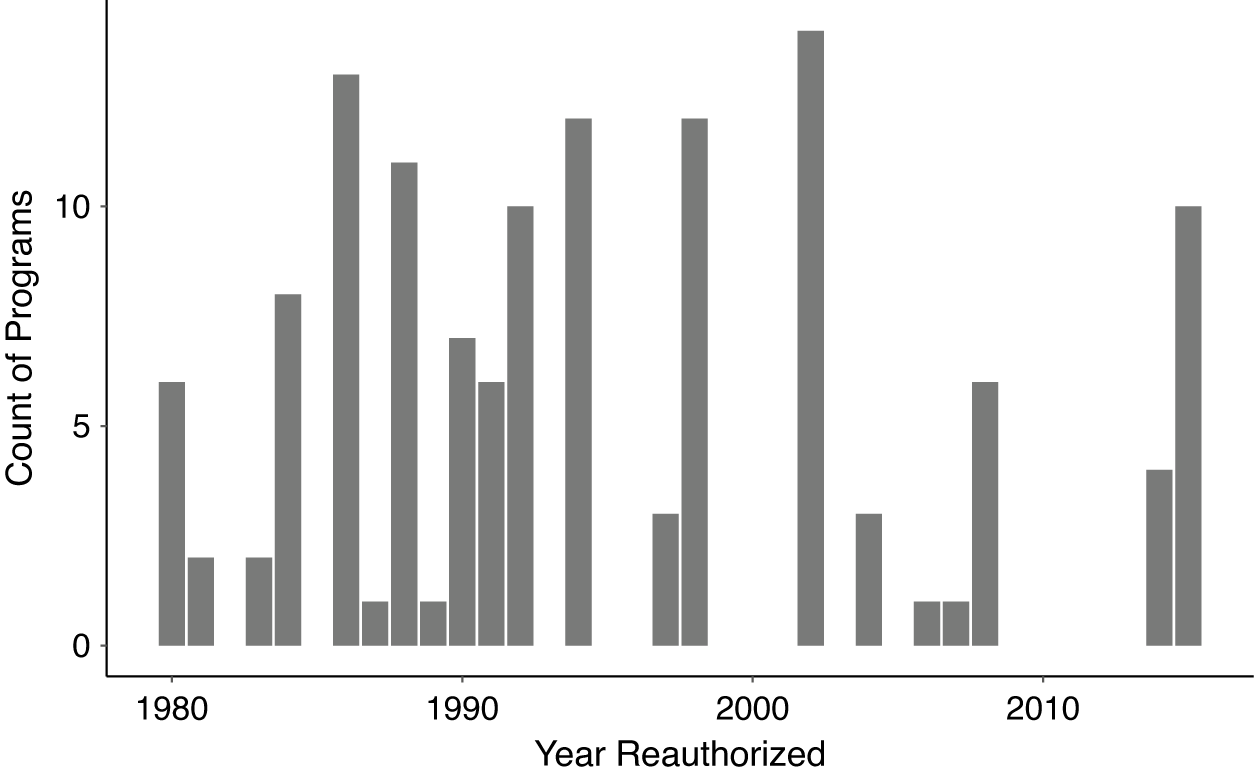
For each program in each year, I hand code when the program was last reauthorized. Programs typically come up for reauthorization every 5 years. However, if the authorization of appropriations for a given program expires, Congress will typically continue to appropriate funding for that program.Footnote 4 Figure 2 shows the number of programs reauthorized in each year. Reauthorizations appear to happen more frequently at the beginning of the panel, but there are still some reauthorizations at the end of the panel. I match each of these reauthorizations to Stewart and Woon’s (Reference Stewart and Woon2017) and Nelson’s (Reference Nelson1993) congressional databases to determine authorizing committee membership. As all of the programs in the dataset are education programs, they all fall under the jurisdiction of the Senate Health, Education, Labor, and Pensions (HELP) Committee and the House Education and Labor Committee.Footnote 5
Number of Education Formula Grant Programs Reauthorized
Members of Congress increasingly enact bills through unorthodox processes that both bypass initial committee consideration and a formal conference (Sinclair Reference Sinclair2012). Members of Congress also package multiple pieces of legislation into omnibus bills. The majority of bills in my dataset follow a more orthodox policymaking process. Within my dataset, about a fifth of the reauthorizations did not have a formal conference and two were packaged into an omnibus.Footnote 6 In the Supplementary Material, I show that my results hold within the subset of reauthorizations where there was no formal conference.
Because there may be differences between the chambers, I measure committee membership separately for the House and the Senate. One concern is that a state may benefit from having representation on both the House and Senate committees. I estimate this effect in Supplementary Table A5 and find no evidence of an additional benefit to bicameral representation.
MEASURING STATE SIMILARITY
To test the committee spillover hypothesis, I measure a state’s similarity to the chair’s state. I examine similarity across the following state characteristics: population level, population change,Footnote 7 poverty level, poverty rate, population density, land area, racial and ethnic makeup,Footnote 8 number of immigrants, and per capita income. I use principal components analysis to reduce this multidimensional measure to a single score for each state.Footnote 9
I estimate similarity to the committee chair’s state by breaking up states into six groups based on their scores.Footnote 10 If a state is in the same group as the committee chair, then I count them as similar. Figure 3 shows the score and similarity group for each state in 2020.Footnote 11 The color and shape of each point denote which group the state belongs to. In the Supplementary Material, I show that my results are robust to five groups instead of six groups.
State Similarity, 2020

The committee spillover hypothesis suggests that state demographic characteristics should impact which states benefit from grants-in-aid as opposed to other factors. An alternative explanation is that members of Congress target different states because of partisanship. To test this alternative hypothesis, I also look at partisan similarity—measured using presidential Democratic vote share—to committee chairs.Footnote 12 As with the analysis of demographic characteristics, I break up states into six groups based on their Democratic vote share.Footnote 13 If a state is in the same group as the committee chair, then I count them as similar. Figure 4 shows the vote share and similarity group for each state in 2020. The color and shape of each point denote which group the state belongs to.
State Partisan Similarity, 2020

IDENTIFICATION STRATEGY
I assess the impact of committees on grants-in-aid in three steps. First, I estimate the impact of joining a committee on grant amounts. Second, I estimate the additional benefit of being the committee chair. The overall benefit for states represented by committee chairs compared to states with no representation on committee is the sum of these two effects. Third, I estimate the additional funding states with similar characteristics to the committee chairs’ state receive.
For all of the analyses, I use a difference-in-differences design that compares grant amounts within the same state and within the same year. Specifically, I exploit the fact that programs do not come up for reauthorization at the same time. That is, at the beginning of a legislator’s tenure as chair, there will be some programs that she has reauthorized (and thus had the ability to change the formulas) and others she has not. Therefore, I can compare how a state does under a program that the current chair has reauthorized to a similar program that has yet to come up for reauthorization. Put differently, each treated observation has its own control set made up of grant amounts in the same year for the same state under similar programs. The assumption required for identification is that, absent program reauthorization, both treated and control units would have continued along the same pretreatment trajectories. In the Supplementary Material, I examine pre-reauthorization trends and find the trends for treated and control units are similar.
To illustrate this identification strategy, consider Senator Ted Kennedy from Massachusetts. Senator Kennedy became chair of the HELP Committee in 2007. In 2008, Congress reauthorized the Higher Education Act (HEA), which is under the jurisdiction of the HELP Committee. However, the Workforce Investment Act (WIA), which is also under HELP’s jurisdiction, had yet to be reauthorized while Senator Kennedy was chair. To estimate the additional formula funding Senator Kennedy was able to bring to Massachusetts, I compare the change in Massachusetts’s HEA grant amounts between 2008 and 2009 to the change in Massachusetts’s WIA grant amounts over the same time period.
This difference-in-differences design overcomes three potential issues for identification. First, a state’s grant amount depends on its formula factors or observable attributes (Martin Reference Martin2018; Rosenstiel Reference Rosenstiel2023). Comparing the same state in the same year holds state attributes, such as population and poverty, constant. Second, as others have noted, a challenge in measuring the committee advantage is constructing the counterfactual as certain legislators may be more likely than others to select onto a committee (e.g., Berry and Fowler Reference Berry and Fowler2016; Grimmer and Powell Reference Grimmer and Powell2013). Thus, I cannot compare a committee member’s state to all other states. This design sidesteps this issue by exploiting the plausibly exogenous variation in program reauthorizations, as opposed to which state is represented by the chair, to make within-state comparisons. Third, recent work suggests that two-way fixed effects regression models may produce biased estimates in cases where observations are treated at different times and there are heterogeneous treatment effects (Goodman-Bacon Reference Goodman-Bacon2018). Imai, Kim, and Wang (Reference Imai, Kim and Wang2023) demonstrate that the type of matched difference-in-differences design used here—constructing a control group for each treated unit in the same time period with the same treatment history—is robust to these issues.
More specifically, my analyses use microlevel data in which rows index a state-program-year observation. Treated units are those where the program was reauthorized in that year and the state is represented on the committee, is represented by the committee chair, or is similar to the committee chair’s state. Each treated observation is matched to a control set made up of observations for the same state and year but where the program has yet to be reauthorized.Footnote
14 I only include observations in the treatment group in year t where the treatment status does not change prior to year $ t+4 $
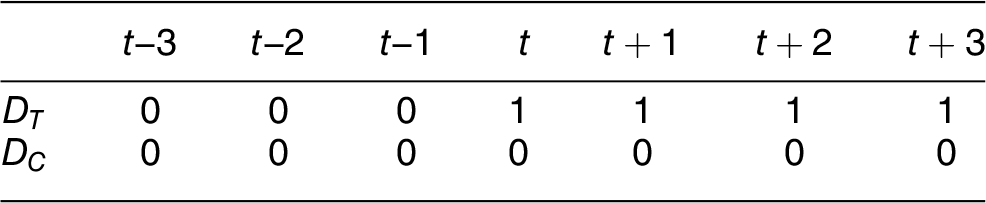
. I also only include observations that remained untreated for at least 3 years prior to reauthorization. More formally, let
$ t+4 $
. I also only include observations that remained untreated for at least 3 years prior to reauthorization. More formally, let $ {D}_{ipt}\in \{0,1\} $
represent the treatment status of state i for program p at time t. Thus, the vector
$ {D}_{ipt}\in \{0,1\} $
represent the treatment status of state i for program p at time t. Thus, the vector $ \mathbf{D} $
for the treatment (T) and control (C) groups is the following:
$ \mathbf{D} $
for the treatment (T) and control (C) groups is the following:
As Congress often phases in formula changes over time, I estimate the effect of joining the committee and becoming chair immediately following a formula change and for each of the three subsequent years. To estimate the treatment effect j years after reauthorization, I compare the change in each treated observation’s logged grant amount between $ t-1 $
and
$ t-1 $
and $ t+j $
to that of its matched control set. I then compute the means within each time bin from
$ t+j $
to that of its matched control set. I then compute the means within each time bin from $ j=0 $
to
$ j=0 $
to $ j=3 $
. To account for the fact that the same observation may be used in the control group for multiple observations in the treatment group (matching with replacement), I estimate standard errors using a weighted bootstrap (Otsu and Rai Reference Otsu and Rai2017). To accommodate the panel structure of the data, I cluster the standard errors by state-program (Imai, Kim, and Wang Reference Imai, Kim and Wang2023). A more detailed discussion of the estimation of effect sizes and standard errors can be found in the Supplementary Material.
$ j=3 $
. To account for the fact that the same observation may be used in the control group for multiple observations in the treatment group (matching with replacement), I estimate standard errors using a weighted bootstrap (Otsu and Rai Reference Otsu and Rai2017). To accommodate the panel structure of the data, I cluster the standard errors by state-program (Imai, Kim, and Wang Reference Imai, Kim and Wang2023). A more detailed discussion of the estimation of effect sizes and standard errors can be found in the Supplementary Material.
RESULTS
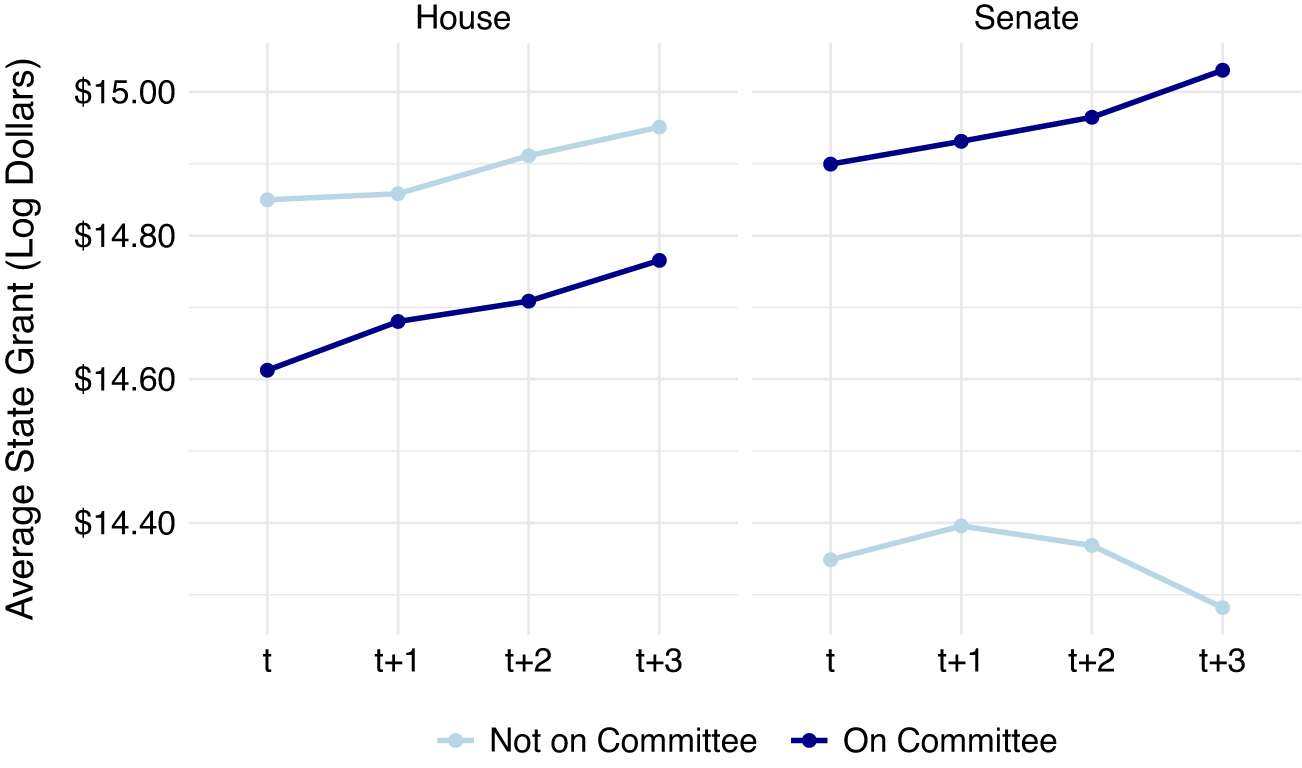
To begin, Figure 5 shows the average grant amount for states when they are and are not represented by committee members. In the House, states receive less funding when represented by committee members compared to noncommittee members. However, in the Senate, there is a committee advantage: states receive more funding when represented by committee members compared to noncommittee members.
Grants for Committee Members versus Noncommittee Members
Note: Averages are weighted so that each treated unit is matched to its control set.
To estimate the size of the committee advantage, Table 1 presents the results of the difference-in-differences analysis. Consistent with the first hypothesis, states represented by Senate committee members receive more formula grant funding and this benefit is not just due to committee members being high demanders.Footnote 15 In the first year following a reauthorization, committee members’ states receive about 15% more education funding. For the Title I-A program, this means that states represented by committee members receive, on average, an additional $46 million.Footnote 16
Effect of Committee Position on Formula Grants, Difference-in-Differences Estimates

Note: Standard errors computed based on one thousand weighted bootstrap samples in parentheses. Unit of analysis is state program. Units are matched based on state and year. * $ p<0.05 $
, **
$ p<0.05 $
, ** $ p<0.01 $
, ***
$ p<0.01 $
, *** $ p<0.001 $
.
$ p<0.001 $
.
Further, there is an additional benefit of becoming the Senate committee chair on top of committee membership.Footnote 17 In the first year following a reauthorization, committee chairs’ states receive an additional 7% on top of the 15% committee advantage. For the Title I-A program, this means that committee chairs’ states receive, on average, another $22 million.
While states represented by senators on the HELP Committee disproportionately benefit from grants-in-aid, I do not find the same effects in the House. I find no evidence of House Education and Labor Committee influence over education formula grants. These results are in line with existing research that suggests that senators are more likely to amend formula grants than members of the House (Lee Reference Lee2003; Reference Lee2004).
In the Supplementary Material, I present an additional set of analyses replicating those in Table 1 but broken out by party. I do not find significant differences between states represented by Democratic and Republican committee members. Rather, states represented by both parties disproportionately benefit from grants-in-aid. This suggests that it is particularistic motivations rather than partisanship that shape grants-in-aid.
Because grants-in-aid are allocated via formula, states with similar characteristics to the committee chair’s state should also benefit. Table 2 presents estimates of the relationship between having similar characteristics to the committee chair and a state’s grant amount. Consistent with the second hypothesis, states similar to the committee chair’s state see an increase in their grant amounts following reauthorization. Specifically, in the first year after a program is reauthorized, states with similar characteristics to the Senate committee chair’s state see a 6% increase in their grant amounts. However, as shown in Table 1, I do not find any evidence of House committee influence over grants-in-aid.
Effect of Committee Chair Similarity on Grants, Difference-in-Differences Estimates
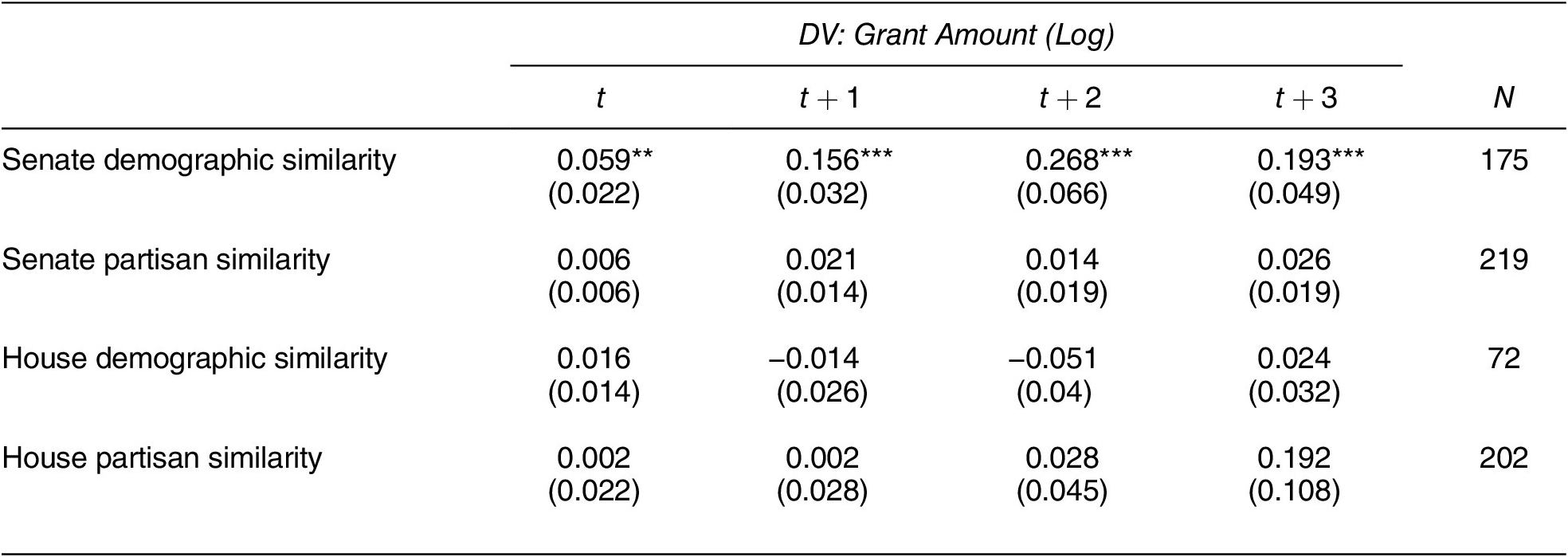
Note: Standard errors computed based on one thousand weighted bootstrap samples in parentheses. Unit of analysis is state program. Units are matched based on state and year. Analyses exclude committee members. * $ p<0.05 $
, **
$ p<0.05 $
, ** $ p<0.01 $
, ***
$ p<0.01 $
, *** $ p<0.001 $
.
$ p<0.001 $
.
An alternative explanation for the politics surrounding grants-in-aid is that members of Congress target funding to Democratic or Republican states. To test this, I reestimate the analysis using Democratic presidential vote share to measure state similarity. Table 2 presents the results of this analysis. In line with my hypotheses, I do not find a relationship between partisan similarity and state grant amounts.
SPILLOVERS AND SENATE MALAPPORTIONMENT
The Senate’s small-state bias is a well-documented phenomenon (e.g., Dahl Reference Dahl1956; Lee and Oppenheimer Reference Lee and Oppenheimer1999). Specifically, the equal representation of unequally populated states means that residents of less populated states have more seats in the chamber than residents of more populated states. This malapportionment biases policy in favor of smaller states over larger states (Lee Reference Lee2000; Lee and Oppenheimer Reference Lee and Oppenheimer1999) and results in the underrepresentation of ethnic and racial minorities (Griffin Reference Griffin2006).
The spillover effects I document may exacerbate the Senate’s small-state bias. A formula benefiting one small state should benefit all small states. So, for example, when the HELP Committee chair represents a small state, Congress should enact programs that benefit all small states. This is a particularly important point because committee chairs tend to be senators representing small states (Lee and Oppenheimer Reference Lee and Oppenheimer1999). Thus, grants-in-aid should disproportionately benefit small states.
To illustrate this point, Table 3 shows how much additional funding small states receive when the HELP Committee chair represents a small state. For this analysis, I divide states into six groups based on their population levels.Footnote 18 Using the same difference-in-differences design as the previous analyses, I estimate how much additional funding states in the smallest population group receive when the committee chair also represents a state in the smallest population group.Footnote 19 I find that when the committee chair represents a small state, all small states receive more funding. Specifically, in the first year after a program is reauthorized, small states receive about 7% more funding than they would if the committee chair did not represent a small state. Four years after reauthorization, this benefit increases to about 38%.
Effect of Committee Chair Similarity on Grants, Difference-in-Differences Estimates

Note: Standard errors computed based on one thousand weighted bootstrap samples in parentheses. Unit of analysis is state program. Units are matched based on state and year. Analyses exclude committee members. * $ p<0.05 $
, **
$ p<0.05 $
, ** $ p<0.01 $
, ***
$ p<0.01 $
, *** $ p<0.001 $
.
$ p<0.001 $
.
CASE STUDY: FUNDING FOR TEACHERS AND PRINCIPALS
To explore possible mechanisms for how the congressional committee system shapes grants-in-aid, I consider the reauthorization of Title II-A of ESEA. This program provides funding for preparing, training, and recruiting teachers and principals in elementary and secondary schools. Prior to 2015, funding under Title II-A was allocated using a two-step process. First, each state received the grant amount it received in 2001. Of the remaining funds, 35% were allocated in proportion to current state population and 65% were allocated in proportion to current state poverty.
The effect of this Title II-A funding formula is twofold. First, allocating funding in proportion to population and poverty levels benefits larger states. Second, allocating funding based on 2001 grant amounts means that a substantial portion of Title II-A funding is allocated based on state demographic characteristics in 2001. As a result, states with large increases in population and poverty levels receive less per capita funding than other states.
When the Title II-A program came up for reauthorization in 2015, Congress substantially revised the formula. The Senate bill was drafted by Senators Lamar Alexander (R-TN) and Patty Murray (D-WA), the chair and ranking member of the Senate HELP Committee, respectively (Camera Reference Camera2015). Included in this bill was the removal of the 2001 grant provisions from the formula. Both Tennessee and Washington have seen relatively high population growth since 2001. Thus, this change increased the grant amounts for both states (Kuenzi Reference Kuenzi2015).
After being introduced, the bill was referred to and considered by HELP. Senator Alexander closely managed the committee markup to prevent controversial amendments that would jeopardize the bill’s prospects of passage (Camera Reference Camera2015; Teach the Vote 2015). Because of the control he exercised over markup, it is unsurprising that all of the amendments offered to the Title II-A formula increased Tennessee’s grant amount (Kuenzi Reference Kuenzi2015). For example, Senator Burr of North Carolina proposed an additional amendment to the allocation formula to change the weights on population and poverty from 35% and 65% to 20% and 80%, respectively (C-Span 2015). Under these changes, a majority of committee members—including Senator Alexander—would see increases in their states’ grant amounts (Kuenzi Reference Kuenzi2015). Senator Alexander also asked Senator Burr for a spreadsheet detailing how every state would fare under the proposed changes (Camera Reference Camera2015), indicating that he and other senators were concerned about the distribution of funding under the amendment. Ultimately, the bill reported by the HELP Committee and passed by the Senate contained both the Burr amendment as well as the removal of the 2001 provision included in the original bill.
As committee chair, Senator Alexander also had the ability to shape the bill at the very end of the legislative process. Typically, the House and Senate committee chairs play an influential role in the conference process (Oleszek et al. Reference Oleszek, Oleszek, Rybicki and Heniff2016). And, the Every Student Succeed Act in 2015 was no exception. Media reports suggest that the lead House negotiators were Representatives John Kline and Bobby Scott, the chair and ranking member of the House Education and Labor Committee (Klein Reference Klein2015). Similarly, the lead Senate negotiators were Senators Alexander and Murray (Klein Reference Klein2015). While the House bill did not make any changes to the Title II-A formula, the conference committee chose to retain the Senate formula changes (House of Representatives 2015), and these were ultimately enacted into law.
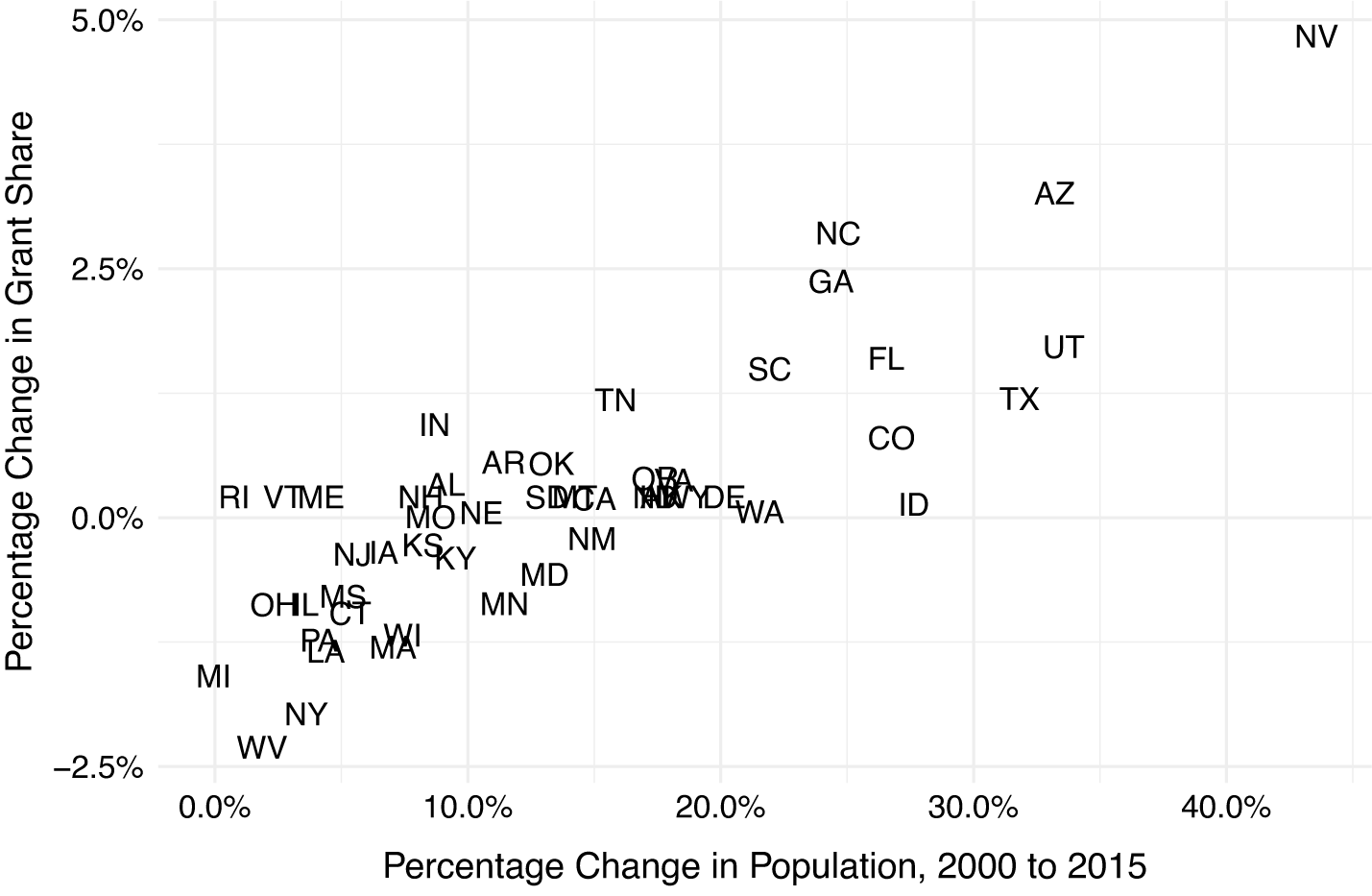
Figure 6 summarizes the impact of the Title II-A formula changes. The big winners are states that saw rapid population growth between 2001 and 2015. Notably, the change does not just benefit Senator Alexander’s constituents in Tennessee, it benefits all states with large population growth.
Impact of Title II-A Formula Changes
Note: Data on grants are from the U.S. Department of Education and population data are from the U.S. Census Bureau.
As this example illustrates, an important source of power for committee members and particularly chairs is procedure. Senator Alexander’s influence comes during both the committee markup and conference, which are steps in the policymaking process controlled by the committee chair. This is in line with existing theories of distributive politics, which tie committee influence to the agenda-setting and veto power of committees (e.g., Shepsle and Weingast Reference Shepsle and Weingast1987; Weingast and Marshall Reference Weingast and Marshall1988).
But, procedure is not the only possible source of committee power. Another avenue for committee influence is knowledge and expertise. Members of Congress have long recognized the expertise of their colleagues on different committees (Curry Reference Curry2019; Kingdon Reference Kingdon1989). In fact, the need for specialization is one of the reasons the standing committee system was created (Gamm and Shepsle Reference Gamm and Shepsle1989). Committee members can use this advantage to more effectively amend grant programs to benefit their states. This mechanism may even be more pronounced for grants-in-aid than other policies because of the complexity of many formulas.
In sum, there are multiple mechanisms through which committee members—and particularly committee chairs—can influence grants-in-aid. There are likely multiple mechanisms at play for each reauthorization and these mechanisms may vary by reauthorization. Additionally, the effectiveness of these mechanisms may be mediated by other factors such as the relationship between the chair and the ranking member.
CONCLUDING DISCUSSION
In the United States, the federal government provides assistance to state and local governments across a wide range of policy areas, including health care, transportation, education, income security, community development, and environmental protection. These programs constitute over a quarter of federal domestic spending (Office of Management and Budget 2022) and account for over half of state and local government funding for health care and public assistance (Dilger and Cecire Reference Dilger and Cecire2019). And, unlike other types of federal spending, grants are primarily allocated based on state characteristics.
The findings in this article illustrate how the congressional committee system shapes the distribution of federal assistance. In line with existing research, I find that committee members, and particularly committee chairs, are able to direct more grant funding to their states. However, the influence of committees is complicated by the distribution of population, poverty, and other characteristics across states. In addition to benefiting committee members, I find that grants-in-aid also disproportionately benefit states with similar characteristics to committee chairs. For example, when committee chairs represent small states, Congress enacts formulas that benefit all small states. This is an important finding because it suggests that allocating resources within a federal system changes who receives government assistance. Moreover, allocating funding via formula substantially reduces the benefit to committee members. And, because of the prevalence of formula grants, this suggests that the value of committee seats is substantially less than previously thought.
Taken together, these findings have important implications for how well grants-in-aid get resources to the places that need them the most. The results suggest that who benefits from grants-in-aid, be it places with high poverty or small states, depends on the characteristics of the committee chair’s state. Thus, how well allocation formulas target need depends on whether the committee chair represents a state with high need. If Congress is reauthorizing a redistributive formula grant program and the committee chair’s state has high poverty, then the resulting allocation formula should place more weight on poverty. As a result, other high-poverty states should also benefit from the program.
These spillovers may also influence which committees’ members of Congress join. If a senator representing California chairs the Senate HELP Committee, then a senator from Texas knows that their constituents will likely benefit from programs reauthorized by HELP. Thus, the senator from Texas may join a different committee that is not already biased toward more populous states. In this way, the composition of committees may be both a cause and a consequence of how funding is allocated.
One implication of these findings is that the congressional committee system may actually improve how well formulas target need, which is a necessary—albeit not sufficient—condition for effective federal programs. Weingast and Marshall (Reference Weingast and Marshall1988) show how the committee system in Congress facilitates decision-making because it allows for the enforcement of legislative bargains. This is due to both committees’ agenda-setting power and the fact that committees are made up of high demanders. That is, legislators select onto committees with jurisdiction over policy areas for which their constituents have high demand and then exert disproportionate influence over those policy areas. By a similar argument committee, chairs can enact and protect formulas that most benefit their states through their agenda-setting power. And, if committee chairs have high need for a program (i.e., they are high demanders), then the formulas they enact and protect are likely to be formulas that target funding toward areas with the greatest need.
However, these spillover effects can also exacerbate existing biases within the Senate. For example, I show that when committee chairs represent small states, Congress enacts programs that disproportionately benefit small states. Senate malapportionment makes this result particularly important because the majority of senators represent small states. Thus, when members of Congress amend formulas, it is likely that at least one member of the winning coalition represents a small state. And, because of the spillover effects, the formula used to distribute grants should disproportionately benefit all small states.
My analyses provide an important update to the literature on distributive politics as well as the literature on federalism. However, more work is needed to assess the generalizability of these findings beyond education programs and the HELP Committee. I think that is it reasonable to assume that the politics may be similar in other policy areas. For example, more than 90% of federal highway assistance is distributed to states via formula. Since its creation in 1916, Congress has changed this formula several times. Generally, the debates over the formula center on how much each state is receiving, and members of Congress argue against changes that reduce funding for their states.Footnote 20 Thus, as with education, members of Congress seem to be designing highway assistance programs to benefit their constituents. Moreover, Lee (Reference Lee2004) demonstrates that particularistic politics influenced reauthorizations of the surface transportation program. However, transportation programs fall under the jurisdiction of a different congressional committee. As members of the HELP Committee tend to be more policy-oriented than their counterparts on other committees, the dynamics in other policy areas may differ.Footnote 21 Therefore, more work is needed to assess whether the politics of other Senate committees are similar to those of the HELP Committee.
SUPPLEMENTARY MATERIAL
The supplementary material for this article can be found at https://doi.org/10.1017/S000305542400011X.
DATA AVAILABILITY STATEMENT
Research documentation and data that support the findings of this study are openly available at the American Political Science Review Dataverse: https://doi.org/10.7910/DVN/OM2N3X.
ACKNOWLEDGMENTS
I am grateful to Brandice Canes-Wrone, Josh Clinton, James Curry, Nathan Gibson, Ben Hammond, Christina Kinane, Patricia Kirkland, Frances Lee, Naijia Liu, Asya Magazinnik, Nolan McCarty, Eleanor Neff Powell, Molly Reynolds, Molly Ritchie, Alan Wiseman, and three anonymous reviewers.
CONFLICT OF INTEREST
The author declares no ethical issues or conflicts of interest in this research.
ETHICAL STANDARDS
The author affirms this research did not involve human participants.


 Open access


Comments
No Comments have been published for this article.