


Introduction
Gazelles from the Farasan Islands have been known to scientists since at least 1825, when the first specimens were collected there by the explorers Hemprich and Ehrenberg (Groves, Reference Groves1983), and are now recognized as the Farasan gazelle Gazella gazella farasani (Thouless & Al Bassri, Reference Thouless and Al Bassri1991). Until 1988, when the first official survey was conducted on the Islands (Thouless et al., Reference Thouless, Flamand, Tatwany and Asmodé1988a), nothing was known regarding the status of this subspecies. The 1988 survey not only estimated a population of > 500 but also noted that this was the largest free-ranging population of Gazella gazella (mountain gazelle, or idmi in Arabic) in Saudi Arabia (Flamand et al., Reference Flamand, Thouless, Tatwany and Asmodé1988). The high numbers of Farasan gazelle were surprising because all species of Arabian gazelle have been drastically affected by hunting, habitat degradation and competition for food with domestic livestock in unfenced protected areas (Dunham et al., Reference Dunham, Williamson, Joubert, Mallon and Kingswood2001; Thouless et al., Reference Thouless, Grainger, Shobrak and Habibi1991, Reference Thouless, Habibi, Magin, Wacher, Habibi, Abuzinada and Nader1997).
Historical data on the gazelle populations of Saudi Arabia are few, with the Arabian Peninsula always having been a little visited and understudied part of the world. Historically, G. gazella occurred across most of the Arabian Peninsula to northern Syria and Turkey and westwards into Sinai (Gentry, Reference Gentry1968; Davis, Reference Davis1980; Kasparek, Reference Kasparek1986; Tchernov et al., Reference Tchernov, Dayan and Yom-Tov1986). The species is probably extinct in Egypt, Turkey, Syria, Lebanon and Jordan, although occasional sightings are still reported (Kingswood & Khairallah, Reference Kingswood, Khairallah, Mallon and Kingswood2001; Saleh, Reference Saleh, Mallon and Kingswood2001; Masseti, Reference Masseti2004). The species’ current range includes Israel, Oman, the United Arab Emirates, Yemen and Saudi Arabia. In the latter the species occurs in four protected areas, At Tubaiq, Al Khunfah, Uruq Bani Mu’Arid and the Ibex Reserve, and as scattered populations in the western Asir Mountains and on Farasan Island (Child & Grainger, Reference Child and Grainger1990; Magin, Reference Magin, Greth, Magin and Ancrenaz1997; IUCN, 2009).
The numbers of G. gazella in Saudi Arabia, although once widespread and abundant, have diminished throughout their range since the middle of the twentieth century (Nader, Reference Nader, Abuzinada, Goriup and Nader1989), and Ghandour (Reference Ghandour, Abuzinada, Goriup and Nader1989) regarded the species as threatened with extinction. Since the mid 1940s motorized hunting has decimated the species, and artificial water and fodder supply for domestic stock have allowed them to increase their range and numbers and consequently their competition with gazelle for food (Williamson & Tatwany, Reference Williamson, Tatwany, Greth, Wiliamson and Abuzinada1996). The precarious future of G. gazella was highlighted by Wilfred Thesiger during his trek through the Empty Quarter of Saudi Arabia in 1947–1948:
In Saudi Arabia during the last few years even gazelle have become rare. Hunting parties scour the plains in cars, returning with lorry-loads of gazelle which they have run down and butchered.
(Thesiger, Reference Thesiger1994)G. gazella is categorized as Vulnerable on the IUCN Red List (IUCN SSC ANTELOPE Specialist Group, 2009). The total population, which exhibits a downward trend, is estimated to be < 15,000, with 1,500–1,700 in Saudi Arabia (c. 1,000 of which occur on the Farasan Islands; IUCN, 2009). Other protected areas have estimated populations ranging from only c. 10 (Al Khunfah; Wacher, Reference Wacher1993) to c. 30 (Ibex Reserve; Wronski, Reference Wronski2010) and c. 121 (Uruq Bani M’arid; Cunningham, Reference Cunningham2008). Here we examine the distribution, abundance and status of G. g. farasani on the Farasan Islands based on a review of unpublished data from the last 20 years and the most recent surveys.
Study area
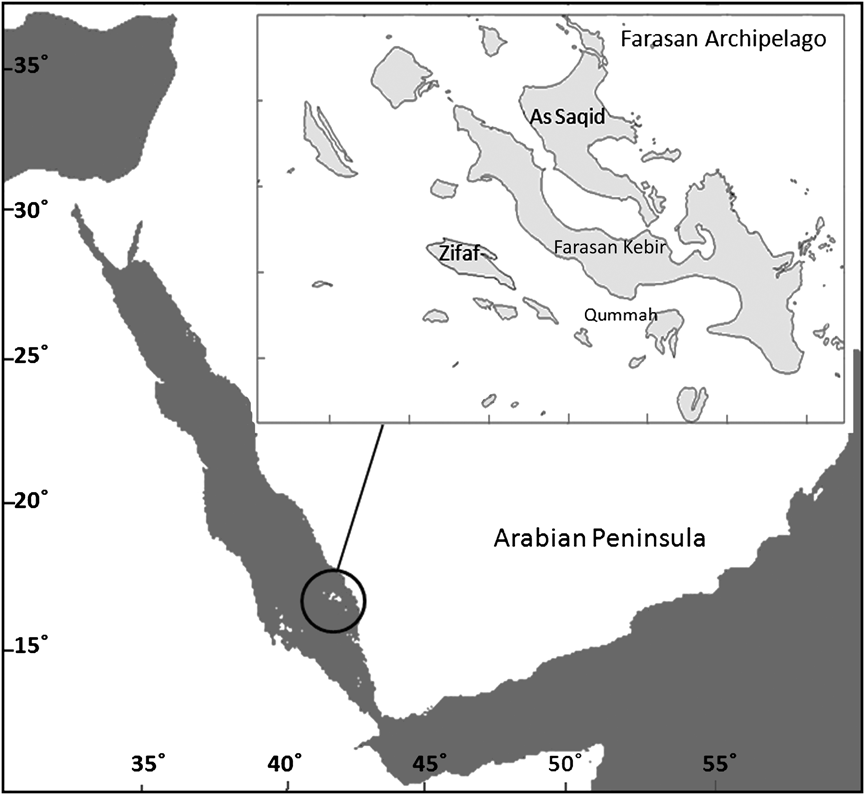
The Farasan Islands are an assemblage of islands formed of raised fossil coral reefs at altitudes of 0–30 m in the Red Sea c. 80 km off the coast of Saudi Arabia (Flamand et al., Reference Flamand, Thouless, Tatwany and Asmodé1988; Child & Grainger, Reference Child and Grainger1990). Although there are more than 300 islets and shoals (Anon., 2000), only three, Farasan Kebir (400 km2), As Saqid (160 km2) and Qummah (25 km2), are permanently inhabited (Flamand et al., Reference Flamand, Thouless, Tatwany and Asmodé1988; Fig. 1). Large parts of the islands are weathered flat gravel plains incised by often well-vegetated wadis and other broken terrain formed when the fossil reef was raised by underlying salt domes (Flamand et al., Reference Flamand, Thouless, Tatwany and Asmodé1988; Habibi & Thouless, Reference Habibi, Thouless, Habibi, Abuzinada and Nader1997). The climate is arid with a highly variable annual rainfall of 50–100 mm (Child & Grainger, Reference Child and Grainger1990) and there is no permanent surface water (Flamand et al., Reference Flamand, Thouless, Tatwany and Asmodé1988). The combined human population of Farasan Kebir, As Saqid and Qummah Islands is > 20,000 (J. Grainger, pers. comm.). Other islands, such as Zifaf Island, have coastguard stations.
The Arabian Peninsula, indicating the location of the Farasan Islands in the Red Sea. The inset shows the Farasan Archipelago and the locations of the islands As Saqid, Zifaf, Qummah and Farasan Kebir.
Isolated thickets of Acacia ehrenbergiana occur on the gravel plains and the vegetation in the wadis consists of a variety of grasses, shrubs and trees, including A. ehrenbergiana, Capparis decidua and Commiphora gileadensis (Flamand et al., Reference Flamand, Thouless, Tatwany and Asmodé1988). The Farasan Islands are protected for the conservation of G. gazella, the islands outstanding biological value and as a marine reserve, and are designated a special nature reserve, natural reserve, resource use reserve and controlled hunting reserve (Child & Grainger, Reference Child and Grainger1990).
Methods
Data from surveys since 1988 were collected by a search of the literature published on the Farasan Islands, including unpublished census reports (Table 1). These include actual sightings (not extrapolated, i.e. minimum numbers seen) and extrapolated results. The various reports provide data collected during foot, vehicle and/or aerial surveys, following predetermined or random transects, and covering the entire area or only sections. The surveyors’ involved and monitoring techniques applied varied between years and methods were not standardized, and thus direct comparisons between years cannot be made. Because of the various techniques used we do not describe them in detail here.
Gazella gazella farasani numbers (actual or extrapolated) from 1988 to 2009 for Farasan Kebir, As Saqid, Zifaf and Qummah Islands in the Farasan Islands Protected Area (Fig. 1).
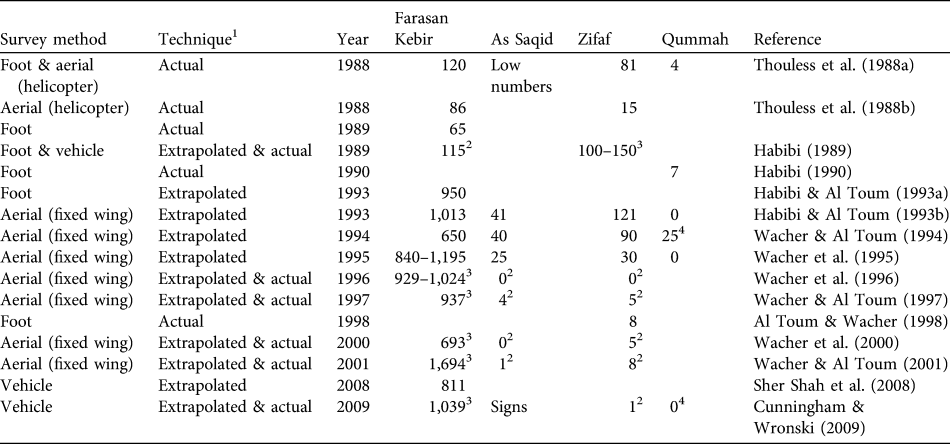
1 Actual sightings (i.e. minimum numbers seen); Extrapolated, based on extrapolation of sightings within a fixed area to the total area
2 Actual
3 Extrapolated
4 Estimated numbers (i.e. anecdotal)
The most recent, 2009, estimates are based on extrapolations of actual sightings during a standardized vehicle count using the road strip count technique (see Bothma, Reference Bothma1989, for an in-depth explanation of the technique and the formula used for extrapolating numbers from actual sightings). Farasan Kebir was demarcated into five sections known to have Farasan gazelle populations. These sections correspond to a large extent with those defined by Thouless et al. (Reference Thouless, Tatwany, Al Bassri, Habibi and Al Toum1988b; names in parentheses below) and also used by Wacher & Al Toum (Reference Wacher and Al Toum2001): Seir/West (the Jabals), Central and North (Broken Country), Harbour/East (Rough Coral Rocks) and Wadi Matr/South (Acacia Grove). We used this demarcation to facilitate a comparison with these earlier surveys. A total of 163 km were driven along existing tracks covering most of the potential Farasan gazelle habitat on Farasan Kebir and As Saqid Islands. The area sampled on Farasan Kebir was 97.8 km2 (total sampling time: 15 hours and 8 minutes) and the area sampled on As Saqid was 22.1 km2 (2 hours and 7 minutes). Counts were carried out either during the early morning (from 05.30) or late afternoon (from 17.30), when gazelles are most active, using a vehicle at a speed of 20–40 km h-1 depending on the terrain. The length of the various road strips varied according to the area and terrain surveyed. A fixed strip width of 300 m each side of the vehicle, based on the average visibility, determined in the field prior to the actual count, was used for extrapolation purposes.
Results
The highest gazelle densities (3.2 km-2) were observed in southern Farasan Kebir (Wadi Matr/South), followed by the eastern section (Harbour/East; 0.69 km-2). The overall mean density on Farasan Kebir, calculated using the actual number of gazelles sighted, was 0.64 km-2. The extrapolated gazelle numbers were highest in the western (Seir/West) and central (Central) sections, with an estimated total of 1,039 for the island (Table 2).
Summary of Farasan gazelle densities and estimated numbers (extrapolated) for the five sections surveyed on Farasan Kebir (Fig. 1) during June 2009.
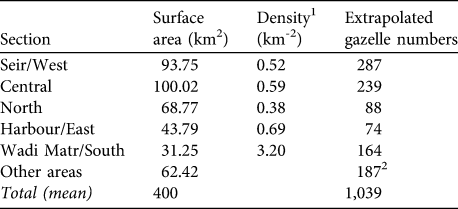
1 Actual numbers observed were used for density estimates
2 These individuals potentially occur in sections not surveyed or in areas surveyed but not sighted because of terrain restrictions; the value was estimated using the actual number of gazelles sighted elsewhere
Although we surveyed 22.1 km2 on As Saqid Island, no gazelles were observed. Thickets of A. ehrenbergiana, and other likely places, were searched for evidence of gazelles and fresh tracks were located in the southern part of the island, along with four dung middens, one recently used, indicating the persistence of gazelles, albeit in low numbers.
In a brief visit to Zifaf Island on 18 April 2009 two people walked 9 km between 08.00 and 11.00. One female gazelle was observed and four active dung middens were found, along with many fresh tracks. In a short visit to Qummah Island on 11 April 2009 we determined, after discussions with local inhabitants, that no gazelles remain on the island and that the last had been killed for food a long time previously.
Discussion
On Farasan Kebir the Farasan gazelle is widely distributed in suitable habitat, with the highest densities estimated for Wadi Matr in the south, which is dominated by extensive A. ehrenbergiana thicket. The eastern section, adjacent to the harbour, consists of rugged, broken terrain and has the second highest estimated densities. The lowest densities were observed in the north. The occurrence of A. ehrenbergiana and broken terrain appear to be the key factors influencing gazelle density. Densities of 4–10 km-2 were originally estimated (Thouless et al., Reference Thouless, Flamand, Tatwany and Asmodé1988a) in the northern section adjacent to the harbour. This is much higher than our estimate of 0.69 km-2 for the same area and higher than our maximum estimate (3.2 km-2), for the southern section. It is likely that differences in survey methods (aerial vs vehicle), seasonal differences (spring 1988 vs summer 2009) and size of areas surveyed account for these differences. That seasonal differences occur was confirmed during an autumn aerial survey in the same year in which a density of 4.3 km-2 was estimated for the harbour area (Thouless et al., Reference Thouless, Tatwany, Al Bassri, Habibi and Al Toum1988b). Areas of broken terrain have much higher densities of gazelles (Thouless et al., Reference Thouless, Flamand, Tatwany and Asmodé1988a,Reference Thouless, Tatwany, Al Bassri, Habibi and Al Toumb; Habibi & Al Toum, Reference Habibi and Al Toum1993a), at least during daylight hours, indicating that this habitat is preferred for food and shelter or that the terrain provides better protection against people.
Gazelle population densities tend to increase with higher rainfall (Martin, Reference Martin2000), and Baharav (Reference Baharav1983) indicated that the increased range of available food plants after rain results in higher gazelle densities. However, decreased food availability after extended periods of drought seems not to influence gazelle densities on the Farasan Islands; the vegetation is varied, with gazelles utilizing a wide range of plant species (T. Wronski, unpubl. data). Gazelle densities in two wadis in the Ibex Reserve in central Saudi Arabia can reach 7.1–15.1 km-2 under favourable environmental conditions (Dunham, Reference Dunham1997) but fall to 1.4–2.8 km-2 under less favourable conditions (Wronski, Reference Wronski2010). Gazelle densities elsewhere on the Arabian Peninsula are 0.2 km-2 in central Oman (Strauss et al., Reference Strauss, Al Kharousi and Spalton2009) and, in Israel, 2.5 km-2 (northern Negev; Walther et al., Reference Walther, Mungall and Grau1983), < 15 km-2 (Golan; Mendelssohn et al., Reference Mendelssohn, Yom-Tov and Groves1995), 12–20 km-2 (Upper Galilee; Baharav, Reference Baharav1983), and 23–37 km-2 (Baharav, Reference Baharav1974) and 30–40 km-2 (D. Baharav, pers. comm., in Mendelssohn et al., Reference Mendelssohn, Yom-Tov and Groves1995) in Lower Galilee.
The total number of gazelles on Farasan Kebir seems to have remained relatively stable since 1993, with the current population estimate of 1,039 similar to that of a number of authors (Table 1). This stability can probably be attributed to the fishing culture of the residents and thus the absence of traditional hunting of gazelles.
In the 1988 survey no gazelles were sighted on As Saqid, although signs of gazelles were observed (Thouless et al., Reference Thouless, Flamand, Tatwany and Asmodé1988a) and surveys in the early 1990s estimated 25–40 gazelles (Table 1). It appears there has been a major decline of the gazelle on this island, especially after 1995, although the causes are unclear. The terrain, being flat, does not protect gazelles from human persecution and there is probably intense competition with goats and feral donkeys (Wacher & Al Toum, Reference Wacher and Al Toum1994; Wacher et al., Reference Wacher, Al Aqeel and Al Toum1996; Robinson et al., Reference Robinson, Wacher, Al Toum, Al Mathami, Al Assaf, Al Huneish and Moustapha2001). Reintroducing gazelles from Farasan Kebir would be feasible as there is suitable habitat available. Adequate protection would have to be ensured, however, before any reintroduction could be contemplated.
The gazelle population on Zifaf Island also appears to have undergone a major decline, with an apparent population crash after 1995 (Table 1). This may be attributed to hunting by the coastguards stationed on the island. A detailed survey is required to determine the current status of gazelles on the island and the possible reasons for the apparent decline.
The last sighting of gazelles on Qummah Island was in 1990, when seven individuals were observed (Habibi, Reference Habibi1990). None were seen in 1993 (Habibi & Al Toum, Reference Habibi and Al Toum1993b). Wacher & Al Toum (Reference Wacher and Al Toum1994) indicated that local inhabitants estimated 25 gazelle remained, although none were actually observed. Information obtained during our survey confirmed they were hunted to extinction ‘years ago’ according to local inhabitants. The island’s small size and limited suitable gazelle habitat probably makes this island unsuitable for any reintroduction.
Continued protection of the Farasan gazelles is imperative as these animals are not only potentially unique genetically (Hundertmark et al., Reference Hundertmark, Mohammed, Macasero and Omer2004) but occur in higher numbers than elsewhere in Saudi Arabia. Protection in the form of regular patrols, especially at night, is effective, and should be continued, as population densities have been shown to increase under protection (Habibi & Al Toum, Reference Habibi and Al Toum1993a; Dunham, Reference Dunham1997). Although illegal hunting (predominantly fuelled by a demand from mainland Saudi Arabia) has always occurred, and continues, any excessive hunting could eradicate the Farasan gazelle, as has occurred with other gazelle species elsewhere in the Middle East and North Africa (Saleh, Reference Saleh1987; Newby, Reference Newby1990; Cloudsley-Thompson, Reference Cloudsley-Thompson1992; Thesiger, Reference Thesiger1994). To ensure the survival of the Farasan gazelle any development on the islands (e.g. the construction of an airport) should be coordinated with the Saudi Wildlife Commission to maintain gazelle movement corridors and not isolate the existing pockets of gazelle on Farasan Kebir. These islands are the stronghold of the Saudi Arabia gazelle population and need to be prioritized for protection to ensure the continued survival of this subspecies.
Acknowledgements
We thank H.H. Prince Bandar bin Saud bin Mohammed Al Saud, Secretary General, NCWCD, for his support of conservation in Saudi Arabia, the pilots, rangers, field staff and colleagues in the various protected areas without whose support the surveys would not have been possible, and Ernest Robinson (Director, King Khalid Wildlife Research Centre) for commenting on an earlier draft of this article.
Biographical sketches
Peter Cunningham studied the feeding ecology of the sand gazelle Gazella subgutturosa marica in protected areas in Saudi Arabia, where he assisted with the management of the species during 2008–2009. He currently runs an environmental consultancy company in Namibia. Torsten Wronski is studying the ecology of wild and reintroduced mountain gazelles in several protected areas in Saudi Arabia. Previously he worked in Uganda, where he researched the behavioural ecology and social organization of the bushbuck Tragelaphus scriptus, and he recently worked on the biogeography of East and Central African land snails.



