





The adolescent transition is characterized by a host of normative changes, including changes in trait affective experience (Griffith et al., Reference Griffith, Clark, Haraden, Young and Hankin2021a) and socioemotional sensitivity (Guyer et al., Reference Guyer, Silk and Nelson2016). Early adolescence, specifically, may be a key inflection point in terms of youth risk for psychopathology in general (Dahl & Gunnar, Reference Dahl and Gunnar2009) and depression in particular (Saluja et al., Reference Saluja, Iachan, Scheidt, Overpeck, Sun and Giedd2004), as youth begin to experience more turbulent emotions (Coe-Odess et al., Reference Coe-Odess, Narr, Allen, LoBue, Pérez-Edgar and Buss2019) in the context of declining emotion regulation strategy use (Zimmermann & Iwanski, Reference Zimmermann and Iwanski2014). Thus, identifying factors contributing to risk and resilience across the early adolescent transition is a considerable public health priority.
Individual differences in positive affect may be one such factor contributing to risk for mental and physical health concerns as well as resilience to stress across the adolescent transition (Davis & Suveg, Reference Davis and Suveg2014; Heininga & Kuppens, Reference Heininga and Kuppens2021; Pressman et al., Reference Pressman, Jenkins and Moskowitz2019). Understanding the development and function of youth positive affect in the context of the parent-adolescent relationship may be particularly important, as parents are potent socializers of adolescent emotional experience (Eisenberg et al., Reference Eisenberg, Cumberland and Spinrad1998; Morris et al., Reference Morris, Silk, Steinberg, Myers and Robinson2007). Parental responses to youth positive affect, specifically, may have implications for youth emotional experience, as well as risk for psychopathology, across development (e.g., Fredrick et al., Reference Fredrick, Mancini and Luebbe2019; Gentzler & Root, Reference Gentzler and Root2019; Nelis et al., Reference Nelis, Bastin, Raes and Bijttebier2019; Peters et al., Reference Peters, Reis and Gable2018; Raval et al., Reference Raval, Luebbe and Sathiyaseelan2019). Moreover, models of youth emotion socialization and development propose that parent and adolescent emotional functioning demonstrate bidirectional patterns of relations over time such that parents and their adolescent youth may become entrenched in self-sustaining feedback loops, with implications for both parent and adolescent socioemotional outcomes (Eisenberg, Reference Eisenberg2020; Lougheed, Reference Lougheed2020). That is, micro-level interactional processes occurring in the context of the parent-adolescent relationship may become instantiated in enduring patterns of both individual and relational wellbeing. To date, however, limited work has married both micro- and macro-level foci to provide nuanced insight into adolescent emotional development as it occurs in its naturalistic social context.
The present work aimed to advance knowledge of bidirectional processes of parent and adolescent affect socialization as it occurs along both micro- and macro- level timescales. The present work specifically aimed to evaluate the role of these bidirectional micro- and macro- level positive affect-related processes in contributing to the longitudinal coupling of affective (dys)function in parent-adolescent dyads.
Adolescence as a key period of positive affective development and socialization
Theories of emotional development converge to suggest that adolescence may be a particularly important period of reorganization in positive and negative affective systems (see Coe-Odess et al., Reference Coe-Odess, Narr, Allen, LoBue, Pérez-Edgar and Buss2019), and a period during which risk for psychopathology begins to crystallize (e.g., Dahl & Gunnar, Reference Dahl and Gunnar2009; Sawyer et al., Reference Sawyer, Afifi, Bearinger, Blakemore, Dick, Ezeh and Patton2012). Positive affective systems, in particular, undergo change and development during early adolescence. Longitudinal research using repeated-measures ESM shows that early to middle adolescence is characterized by normative decreases in youth daily life positive affect, whereas normative daily life experiences of negative affect remain relatively stable across this period (Weinstein et al., Reference Weinstein, Mermelstein, Hankin, Hedeker and Flay2007). Further, in a study examining normative patterns of positive and negative affective development from middle childhood through late adolescence, Griffith and colleagues (2021a) showed that mean-level trait positive affect declined during early adolescence, with decreasing trajectories of positive affect persisting through emerging adulthood.
Morover, available research suggests relatively specific associations between parent-level factors and youth positive (compared to negative) valence systems and experiences across the adolescent transition. For example, using a multimethod behavioral observation and ESM design, Griffith and colleagues (2018) found that observed negative parental affective expression was related to individual differences in youth subjective positive affect, but not negative affect, in daily life settings. Further, trajectories of youth positive affect, but not negative affect, demonstrate co-occurring growth with trajectories of parent-adolescent relationship quality across adolescence (Griffith et al., Reference Griffith, Young and Hankin2021b). Together, such work suggests that the quality and affective tenor of the parent-adolescent relationship may be especially salient to youth positive affective experience and development across this vulnerable period of the lifespan.
Parental responses to youth positive affect: Conceptual models and existing research
Parental responses to youth positive affect can be broadly categorized into behaviors that maintain and/or reinforce youth positive affect (i.e., enhancing responses) and behaviors that reduce and/or minimize youth positive affect (i.e., dampening responses) (e.g., Gentzler & Root, Reference Gentzler and Root2019; Katz et al., Reference Katz, Shortt, Allen, Davis, Hunter, Leve and Sheeber2014; Ladouceur et al., Reference Ladouceur, Reid and Jacques2002; Yap et al., Reference Yap, Allen and Ladouceur2008). Enhancing responses are conceptualized as encompassing parental active engagement with, and encouragement of, youth positive emotions (e.g., capitalization; Gable et al., Reference Gable, Reis, Impett and Asher2004), as well as parental validation of youth positive emotions and demonstrations of interest in youth joyful experiences. Parental enhancing might be expressed, for example, as parents sharing in their child’s enthusiasm and asking curious, interested, and encouraging questions regarding the events that have elicited positive emotions in the child. In contrast, parental dampening responses encompass behaviors that minimize or invalidate youth positive emotional experiences, and may include acts such as pointing out the downsides to a positive event, ignoring or withdrawing from the child, downplaying the importance of the child’s positive experience, or discouraging the child’s expressions of positive affect.
Past cross-sectional research demonstrates concurrent associations between parental dampening behaviors and youth emotional outcomes. Several studies show that parental dampening responses to youth positive affect are positively concurrently associated with depressive symptoms and emotional dysregulation (Katz et al., Reference Katz, Shortt, Allen, Davis, Hunter, Leve and Sheeber2014; Nelis et al., Reference Nelis, Bastin, Raes and Bijttebier2019; Raval et al., Reference Raval, Luebbe and Sathiyaseelan2019; Yap et al., Reference Yap, Allen and Ladouceur2008), as well as internalizing and externalizing psychopathology (Yi et al., Reference Yi, Gentzler, Ramsey and Root2016) among youth. A relatively smaller number of studies also demonstrate associations between parental enhancing and youth emotional wellbeing. Concurrent associations have been shown between youth-reported parental enhancing behaviors and youth implementation of intrapersonal enhancing regulation as well as youth symptoms of depression and anhedonia (Nelis et al., Reference Nelis, Bastin, Raes and Bijttebier2019). Observed parental enhancing behaviors are also associated with youth self-reported effective positive affect regulation (Fredrick et al., Reference Fredrick, Mancini and Luebbe2019). Finally, fathers (but not mothers) of clinically depressed teenagers (aged 14–18) were found to engage in fewer enhancing behaviors in response to youth positive affect relative to parents of healthy controls (Katz et al., Reference Katz, Shortt, Allen, Davis, Hunter, Leve and Sheeber2014).
Although this literature suggests that parental responses to youth positive affect, and parental dampening responses in particular, are associated with adolescent emotional functioning and psychopathology, relatively little is known regarding factors that contribute to individual differences in parents’ tendency to respond to youth positive affect in an enhancing or dampening manner. Parental depressive symptoms may interfere with a host of motivational, cognitive, and behavioral processes relevant to parenting (Dix & Meunier, Reference Dix and Meunier2009), and thus could serve as one factor that influences parents’ tendency to respond to youth emotions in adaptive versus maladaptive ways. A large body of research demonstrates robust associations between parental depression and negative psychosocial outcomes among youth (e.g., Goodman et al., Reference Goodman, Rouse, Connell, Broth, Hall and Heyward2011; Goodman, Reference Goodman2007; Weissman et al., Reference Weissman, Wickramaratne, Nomura, Warner, Pilowsky and Verdeli2006). The ways in which parental depressive symptoms influence micro-social interactional processes (e.g., parental responses to youth positive emotions) within the parent-child dyad, however, are less well studied. Isolating effects of parental depressive symptoms on parental responses to youth positive emotions may help to inform targeted prevention efforts among children of depressed caregivers, as such micro-social interactions processes are behaviorally specific, relatively tractable intervention targets.
Dix and Meunier’s (Reference Dix and Meunier2009) action-control model of depressed parenting proposes that depressive symptoms can undermine parenting via a number of mechanisms, spanning cognitive, attentional, motivational, and affective domains. In the context of parental responsiveness to youth positive affect, specifically, it is hypothesized that depressive symptoms may be associated with reductions in parental attunement to and encouragement of youth expression of positive emotions (i.e., enhancing responses), as well as increases in parental expressions of irritability or invalidation (i.e., dampening responses). Available research to date supports aspects of this model. Maternal self-reported depressive symptoms negatively correlated with observed parental enhancing responses to youth positive affect in a behavioral observation study of 92 mother-adolescent (ages 11–18) dyads (Fredrick et al., Reference Fredrick, Mancini and Luebbe2019). Additionally, parental self-reported depressive symptoms positively associated with parental self-reported dampening, but not enhancing, responses to youth positive affect among adolescents (ages 10–17; Nyquist & Luebbe Reference Nyquist and Luebbe2022). Among a sample of 7–12 year old youth, maternal depressive symptoms predicted less observed maternal enhancing and greater maternal ignoring of youth positive affect (Moran et al., Reference Moran, Root, Vizy, Wilson and Gentzler2019). Moreover, prospective work indicates that parental depressive symptoms associate with decreased family savoring and increased parental dampening as assessed using parent-report questionnaire measures across 5 months (Freeman et al., Reference Freeman, Sathiyaseelan, Luebbe and Raval2022).
Parent-child relationships are bidirectional and transactional, as parent’ experiences are also influenced by the qualities and behaviors of their children (e.g., Eisenberg et al., Reference Eisenberg, Cumberland and Spinrad1998; Pardini, Reference Pardini2008; Steinberg, Reference Steinberg2001). Trajectories of youth adjustment and affective experience may contribute to changes in parental emotions and behavior over time, potentiating a positive feedback loop in which parental maladjustment promotes adolescent emotional dysfunction, which itself contributes to further parental maladjustment and so on across time. Dynamic systems theories (Granic, Reference Granic2005; Hollenstein & Tsui, Reference Hollenstein, Tsui, Kunnen, Ruiter-Wilcox, Gaag and Jeronimus2019; Morris et al., Reference Morris, Cui, Criss, Simmons, Cole and Hollenstein2018) and temporal interpersonal emotion systems (TIES; Butler, Reference Butler2011; Lougheed, Reference Lougheed, Kunnen, Gaag, Ruiter-Wilcox and Jeronimus2019, Reference Lougheed2020) offer conceptual models to understand potential mechanisms of longitudinal coupling in parent and adolescent adjustment. TIES models of the parent-adolescent relationship emphasize the need to attend to processes occurring at both micro- and macro- level timescales and to account for bidirectional and reciprocal processes of parent-adolescent influence. For example, in the context of high levels of parental depressive symptoms, adolescent attempts to engage their parent in their daily positive experiences may be met with indifferent or punishing responses (micro-level). Over time, lack of parental responsiveness and/or parental negative affective expression may contribute to poor parent-adolescent relationship quality and blunting in youth’s trait level positive affect (macro-level). Together, these macro-level changes may reduce opportunities for parents and adolescents to engage in positive interactions with each other and thus share in each other’s positive emotions (micro-level), reinforcing parental depressive symptoms.
Gaps and understudied areas: Depression heterogeneity and parenting in context
Most research investigating associations between parental depression and parenting behaviors has treated depression as a singular, unidimensional construct (see Goodman, Reference Goodman2020). Yet, depression is known to be heterogeneous. Anhedonia is one facet of the broader depressive syndrome that merits particular attention with respect to understanding adolescent risk, broadly, and parental responses to youth positive affect, specifically. For example, parental anhedonia demonstrates unique associations with youth depressive symptoms even after accounting for parental non-anhedonic depressive symptoms (Griffith et al., Reference Griffith, Young and Hankin2023). Based on Dix and Meuneir's (Reference Dix and Meunier2009) model, it can be hypothesized that parents experiencing elevated anhedonia may demonstrate particularly impaired patterns of parenting characterized by greater disengagement and reduced responsiveness to children’s positive affective cues relative to parents experiencing symptoms of depressed mood more generally.
Also, most past research has relied upon self-report questionnaire or laboratory-based behavioral observation methods to assess parental responses to youth positive affect, yet these methods are less well-suited to measure parenting in context. Assessing parenting in real-world contexts is important to enhance ecological validity and reduce susceptibility to particular biases (e.g., retrospective recall bias for self-report questionnaires; demand characteristics for laboratory-based behavioral observation; Shiffman et al., Reference Shiffman, Stone and Hufford2008; Trull & Ebner-Priemer, Reference Trull and Ebner-Priemer2013). Ambulatory assessment techniques, such as experience sampling methods (ESM), can capture phenomena in a temporally sensitive manner as it unfolds in individuals’ naturalistic daily life settings (Shiffman et al., Reference Shiffman, Stone and Hufford2008; Trull & Ebner-Priemer, Reference Trull and Ebner-Priemer2013). Thus, using methods such as ESM can advance knowledge of parental responses to youth positive affect as they unfold in everyday environents.
The Current Study
The present work addressed three complementary aims: (1) examine predictors of parental responses to adolescent positive affect in daily life settings, (2) examine associations between micro-level parental socialization behaviors and macro-level patterns of youth adjustment across one year, and (3) examine implications of macro-level patterns of youth adjustment for parental subsequent micro-level socialization behaviors and macro-level parental adjustment. Specifically, we examined associations between parental depressive symptoms and trait anhedonia and parental daily-life enhancing and dampening as assessed via a dyadic ESM design (Aim 1). We then evaluated the role of parental daily-life enhancing and dampening in predicting trajectories of youth positive affect, negative affect, and depressive symptoms across one year (Aim 2). Finally, we investigated prospective relations between youth developmental trajectories and parental subsequent daily-life enhancing and dampening, as well as parental depressive symptoms and anhedonia (Aim 3). A conceptual model depicting the interrelation of these series of aims is presented in Figure 1.
Conceptual model depicting the interrelated, complementary aims of the present work.
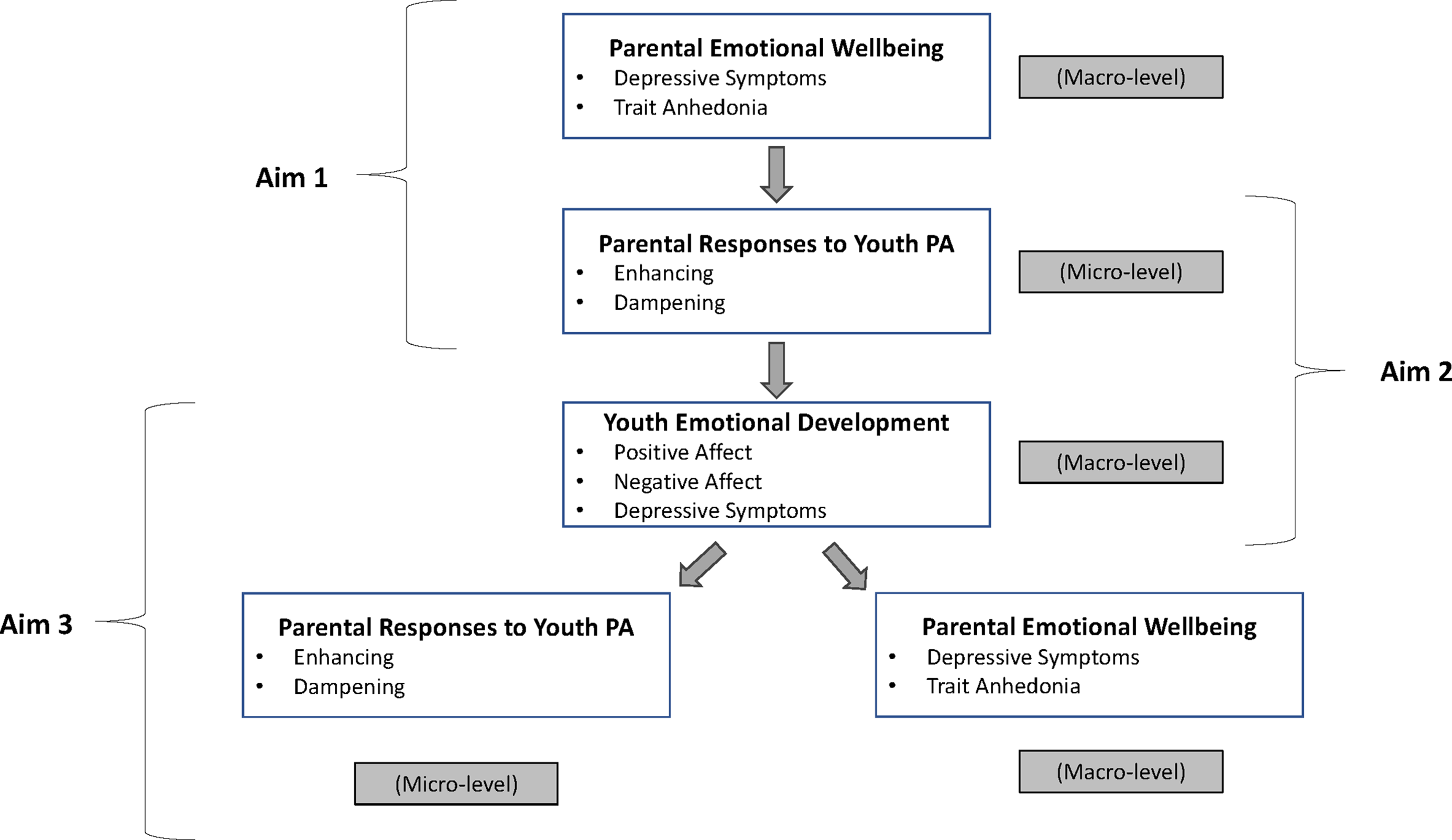
With respect to Aim 1, we hypothesized that parental depressive symptoms would be positively associated with parental dampening and negatively associated with parental enhancing behaviors in daily-life settings. Moreover, we tentatively hypothesized that parental anhedonia would demonstrate negative associations with parental daily-life enhancing. With respect to Aim 2, we hypothesized that parental enhancing responses would predict higher initial levels (intercepts) and less rapid declines (slopes) in positive affect, and lower initial levels and less rapid increases in negative affect. We hypothesized the opposite effect for parental dampening responses such that parental dampening would predict lower initial levels and more rapid decreases in positive affect, as well as higher initial levels and more rapid increases in negative affect. Regarding effects on depressive symptom trajectories, we hypothesized that parental enhancing responses would predict lower initial levels and blunted increases in depressive symptoms across the follow-up period, and parental dampening responses would predict higher initial levels and more rapid increases in depressive symptoms across this same period. With respect to Aim 3, we expected that youth developmental trajectories would be associated with patterns of macro-level parental adjustment and micro-level socialization processes; however, we made no a priori hypotheses regarding the strength or direction of these associations.
Methods
Participants and procedures
Participants included 146 early adolescents (52.1% girls, 47.9% boys; Mage[SD] = 12.71[.86])Footnote 1 and their parents (N = 139; 78.7% mothers; Mage[SD] = 44.11[5.08]) recruited using community advertisements, newsletter postings, and emails distributed to parents of children enrolled in public middle schools in association with the Real-Life Investigation of Feelings and Experiences in Parent-Adolescent Dyads (R-LIFE) Study (see Griffith & Hankin, Reference Griffith and Hankin2021). Enrollment occurred on a rolling basis between January 2019 and March 2020. Inclusion criteria included child enrollment in grades 6–8, and parent and child access to a personal internet- and app-enabled smartphone device (e.g., iPhone, iPod Touch, Android). Participants predominantly identified as white/European American (71.2%), with smaller numbers identifying as multiracial (13.7%), Asian (7.5%), Black/African American (2.7%), and of another racial background (4.8%). 5.5% of the sample identified as Latine/x. Adolescent participants were relatively evenly distributed between 6th (n = 52; 35.6%), 7th (n = 49; 33.6%), and 8th (n = 45, 30.8%) grades. Of participating parents, 83.9% had completed a 4-year bachelor’s degree or higher, and median family income range was in the range of $90,000–$179,999. Further details regarding recruitment and sample characteristics are reported in Griffith and Hankin (Reference Griffith and Hankin2021).
All study procedures were approved by the Institutional Review Board prior to data collection. Upon enrollment in the study, participating dyads were invited to attend a 1–1.5 hour laboratory visit at which time parental consent and adolescent assent were obtained. Following receipt of informed consent and assent, dyads were trained on the study ESM procedure. During the ESM training, research staff explained the details of the ESM assessment schedule, prepared participant devices to receive surveys, and guided participating parents and adolescents through their respective training surveys. Participants were encouraged to ask questions and seek clarification regarding any items they found confusing or difficult to answer. Following the ESM training, participants were asked to complete a battery of online questionnaires. Parents and adolescents completed their respective survey batteries independently. Following this initial study visit, dyads completed a 9-day ESM procedure, as described in greater detail below.
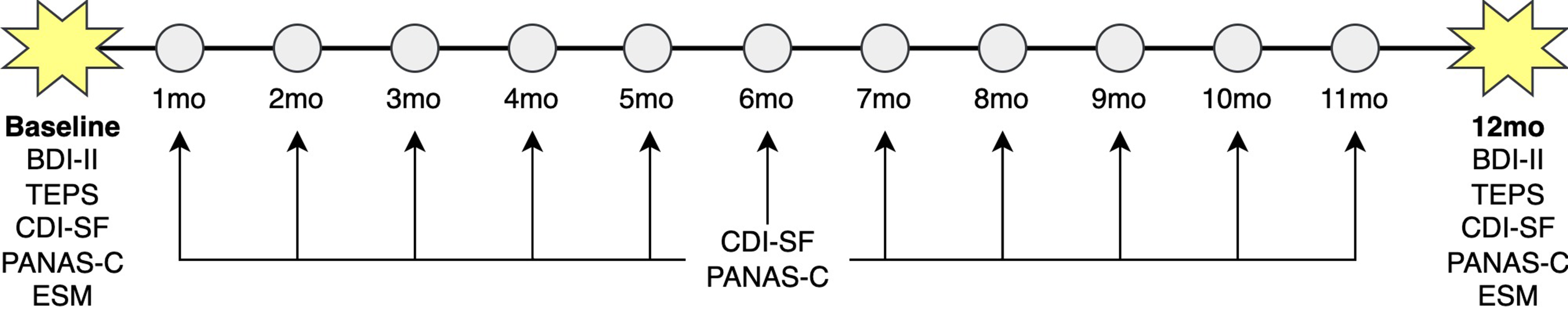
Adolescents were subsequently assessed via self-report questionnaire measures on a monthly basis for a period of 12 months following the initial laboratory assessment (13 total assessments). Figure 2 illustrates the longitudinal study design. Self-report questionnaires were administered via Qualtrics and were designed to take approximately 10-15 minutes to complete. At the 12-month follow-up assessment, participating adolescents and their parents were asked to complete a longer battery of questionnaires, identical to the battery presented at the initial baseline assessment, as well as another 9-day ESM procedure, identical to the procedure administered at baseline. Details regarding participant compensation are reported in Supplemental Materials. A total of 94.2% of enrolled parent-adolescent dyads were retained across the 12-month follow-up period. Attrition (5.8%) is expected in longitudinal studies, and the relatively high retention rate exceeds retention rates in similar samples assessed repeatedly over time (e.g., Hughes & Gullone, Reference Hughes and Gullone2010; Rogers et al., Reference Rogers, Buchanan and Winchell2003; Weinstein et al., 2006). Examination of missing data indicated that number of assessment points completed was negatively correlated with parental depressive symptoms at baseline (r = −.22, p = .007). Number of assessment points completed was not related to parental anhedonia, youth depressive symptoms, positive affect, negative affect, or age at baseline (r’s<|.06|, p’s > .05).
Diagram depicting the longitudinal assessment structure characterizing the R-LIFE study. BDI-II = Beck Depression Inventory, Second Edition (Beck et al., Reference Beck, Steer and Brown1996); TEPS = Temporal Experiences of Pleasure Scale (Gard et al., Reference Gard, Gard, Kring and John2006); CDI-SF = Children’s Depression Inventory, Short Form (Kovacs, Reference Kovacs2010); PANAS-C = Positive and Negative Affect Scale for Children (Laurent et al., Reference Laurent, Catanzaro, Joiner, Rudolph, Potter, Lambert, Osborne and Gathright1999); ESM = experience sampling method procedure.
ESM
On the first Saturday following their initial laboratory visit (as well as on the corresponding Saturday approximately 12-months later) participating parents and adolescents began a 9-day ESM procedure administered using the commercially available LifeData RealLife Exp app (www.lifedatacorp.com). Participants were emailed the afternoon before they were scheduled to begin their ESM surveys with reminders of information reviewed during their initial training session and an encouragement to contact study staff should they have further questions. Study staff were available via email for troubleshooting 7 days per week.
Survey alerts were pushed to participants at semi-random times throughout the day via the RealLife Exp app. On weekends, participants received four surveys at semi-random times between 10am and 8pm, spaced at least 60 minutes apart from one another. On weekdays, participants received one study survey at 7am, prior to the beginning of the school day, and two study surveys at semi-random times between 4pm and 8pm to minimize interference with youths’ academic schedules. Across the 9 days, this sampling strategy yielded a roughly equivalent number of weekend (n = 16) and weekday (n = 15) surveys. With the exception of the weekday morning survey, parent and adolescent survey deliveries were independent from one another (i.e., parent and adolescent surveys were delivered at separate times from one another). Upon receipt of a survey alert, participants were given 1 hour to complete the survey. Survey reminders were delivered via push notification every 15 minutes until the survey was completed or the 1-hour response window had elapsed (maximum 3 reminders). Surveys were designed to take 3–5 minutes to complete, and included items assessing participant momentary affect, as well as items related to adolescents’ most positive experience in the preceding hour, based on prior ESM studies implemented among youth (e.g., Silk et al., Reference Silk, Forbes, Whalen, Jakubcak, Thompson, Ryan and Dahl2011; see below).
Measures
ESM-measured parental responses to youth positive affect
Parental responses to youth positive affect were assessed via both child- and parent-report ESM at baseline and 12-month assessments. On each survey, participants were prompted to identify the time during which they (or the child) felt the best in the past hour (“Think about a time when you felt the best in the last hour, even if you only felt a little bit good”). If participants were unable to identify a specific event, they received an additional prompt providing examples of common, everyday positive events, such as eating a desired food or watching television. Youth and parents were then asked to report whether they (or the child) told the participating parent about the most positive event they experienced in the past hour (“Did you tell your parent about this event? [in person or via text, email, or other digital communication]”). For shared events in which members of the dyad were participating together, participants were instructed to respond “yes” if youth expressly indicated their positive thoughts and/or feelings regarding the event to their parents (e.g., “I am having so much fun!” or “spending time with you made me so happy”). Affirmative responses to this item triggered additional questions regarding parental responses to youth positive affect, adapted from the Perceived Responses to Capitalization Attempts Scale (PRCA; Gable et al., Reference Gable, Reis, Impett and Asher2004). Specifically, participants were asked to report on the extent to which the parent reacted in a number of ways using a 0–100 visual analog scale. Youth-reported parental enhancing responses were represented in the present work using participants’ 0–100 rating of the extent to which the parent “reacted enthusiastically.” Parental dampening responses were represented using the mean of participant ratings of the extent to which their parent “pointed out potential problems or down sides to what had happened,” “seemed disinterested,” and “told you it wasn't a big deal or asked you to calm down.”Footnote 2 Previous research supports the validity of such ESM measures of responses to positive affect (Gable et al., Reference Gable, Reis, Impett and Asher2004; Griffith & Hankin, Reference Griffith and Hankin2021).
Parental depressive symptoms
Parental depressive symptoms were assessed at the baseline and 12-month assessments using self-report on the Beck Depression Inventory – Second Edition (BDI-II; Beck et al., Reference Beck, Steer and Brown1996). The version of the BDI-II administered in this study included 20 total items. One item assessing suicidal ideation was removed due to ethical considerations (e.g., availability of clinically-trained study staff to provide thorough suicide assessments) and virtual/remote administration of the BDI-II at follow-up. Items are scored on a 4-point Likert scale (0–3), with total scores ranging from 0 to 60, with higher scores indicating higher levels of depression. The BDI-II demonstrates strong psychometric properties, including reliability and validity, in diverse samples of adults (Beck et al., Reference Beck, Steer and Brown1996). Internal reliability in the present sample was adequate (Cronbach’s α =.80–90).
Parental trait anhedonia
Parental trait anhedonia was assessed at the baseline and 12-month assessments using self-report on the Temporal Experience of Pleasure Scale (TEPS; Gard et al., Reference Gard, Gard, Kring and John2006). The TEPS comprises 18 items assessing anticipatory (wanting; 10 items) and consummatory (liking; 8 items) anhedonia. Specifically, parents were instructed to indicate the extent to which a series of statements were true of them on a 6-point Likert scale (1 = very false to 6 = very true). Statements included items such as “I look forward to a lot of things in my life,” “I enjoy taking a deep breath of fresh air when I walk outside,” and “When something exciting is coming up in my life, I really look forward to it.” Previous work has found that the TEPS demonstrates strong psychometric properties. Regarding convergent validity, the TEPS correlates with other measures of anhedonia, behavioral activation, and positive affect (Gard et al., Reference Gard, Gard, Kring and John2006), and with respect to discriminant validity, it modestly associates with measures of general depression, negative affect, and neuroticism (Gard et al., Reference Gard, Gard, Kring and John2006). Internal reliability for the total scale in the present sample was adequate (α =.75–.79). Cronbach’s alphas for the anticipatory and consummatory subscales were .75–.77 and .63–.67, respectively.
Adolescent trait affect
Adolescent trait positive and negative affect were assessed on a monthly basis from baseline through the 12-month follow-up assessment using adolescent self-report on an abbreviated version of the Positive and Negative Affect Scale for Children (PANAS-C; Ebesutani et al., Reference Ebesutani, Regan, Smith, Reise, Higa-McMillan and Chorpita2012; Laurent et al., Reference Laurent, Catanzaro, Joiner, Rudolph, Potter, Lambert, Osborne and Gathright1999). The version of the PANAS-C used in the present study prompted participants to reflect on how much they have experienced each of a number of emotions in “the past few weeks” on a 5-point Likert scale (1 = very slightly or not at all to 5 = extremely). The positive affect subscale comprised seven items assessing adolescents’ experience of such positive emotion as “happy,” “calm,” and “cheerful.” The negative affect subscale comprised five analogous items assessing adolescents’ experience of such emotions as “sad,” “scared,” and “miserable.” The positive affect and negative affect subscales of the PANAS-C demonstrate strong psychometric properties among adolescent samples and evidence good convergent and discriminant validity in both clinical (Hughes & Kendall, Reference Hughes and Kendall2009) and community samples (Laurent et al., Reference Laurent, Catanzaro, Joiner, Rudolph, Potter, Lambert, Osborne and Gathright1999). The specific version of the PANAS-C used in the present work was based on the validated 10-item version of the scale (Ebesutani et al., Reference Ebesutani, Regan, Smith, Reise, Higa-McMillan and Chorpita2012), amended to include two additional items assessing low-arousal positive emotions (i.e., “interested” and “calm”). The addition of these items was based on theory and empirical research grounded in the circumplex model of affect (Posner et al., Reference Posner, Russell and Peterson2005). Internal reliability was satisfactory across assessment points in the present sample (α =.84–.92 for PA subscale, α =.74–.83 for NA subscale).
Adolescent depressive symptoms
Adolescent depressive symptoms were assessed on a monthly basis from baseline through the 12-month follow-up assessment using adolescent self-report on the Children’s Depression Inventory Second Edition Short Form (CDI-SF; Kovacs, Reference Kovacs2010). The CDI-SF comprises 12 items assessing youth experience of depression. Each item is rated on a three-point Likert scale (0–2), with higher scores indicating greater levels of depression. Widely used in child and adolescent samples, it demonstrates good reliability and validity (Klein et al., Reference Klein, Dougherty and Olino2005). Internal reliability in the present sample was adequate (α =.75–.88).
Data analytic plan
All hypotheses and full data analytic plan were pre-registered prior to analysis using the Open Science Framework (OSF; https://osf.io/zun2e/).
Aim 1: Examining predictors of parental responses to adolescent positive affect in daily life settings
To account for the hierarchical structure of ESM data in which individual observations (Level 1) are nested within persons (Level 2), Aim 1 was evaluated using a series of mixed effects multilevel models implemented using the “nlme” package in R (Pinheiro et al., Reference Pinheiro and Bates2022; R Core Team, 2013) using restricted maximum likelihood estimation (REML). REML has been found to produce more reliable estimates relative to traditional maximum likelihood estimation for multilevel models, particularly under conditions of modest sample size (see McNeish & Stapleton, Reference McNeish and Stapleton2016; McNeish, Reference McNeish2017). Predictors (i.e., parental depressive symptoms and parental anhedonia) were grand-mean centered prior to analyses to evaluate the extent to which parental factors associated with individual differences in parental enhancing and dampening responses to youth positive affect in daily life settings. In instances in which the same parent participated in the study with two children (i.e., siblings), data pertaining to one child was randomly selected for inclusion in the present study. Separate models were conducted using child- and parent- report scores of parental response behavior. Specifically, to evaluate effects of parental depressive symptoms and trait anhedonia, respectively, on parental response behaviors, parental enhancing and dampening responses were each separately regressed on parental depressive symptom scores and parental trait anhedonia scores. Sample equations are included in Supplemental Materials.
Aim 2: Examining associations between micro-level parental socialization behaviors and macro-level patterns of youth adjustment across one year
Analyses associated with Aim 2 were conducted using a multilevel structural equation modeling (MSEM) approach implemented in Mplus v8.6 (Muthén & Muthén, Reference Muthén and Muthén2021) to account for the nesting of level 1 predictors (i.e., parental response behaviors as measured via ESM) within individuals. MSEM represents a more flexible alternative to traditional multilevel modeling appropriate for the analysis of nested data (Preacher et al., Reference Preacher, Zhang and Zyphur2011). Of particular relevance to the present work, MSEM decomposes variance into within- and between- person components in a model-driven manner using a latent variable approach and accommodates analyses of level 1 predictors on level 2 outcomes.
First, best fitting univariate growth trajectories characterizing longitudinal change in adolescent positive affect, negative affect, and depressive symptoms were identified using latent growth curve analyses using full-information maximum likelihood (FIML) estimation to account for missing data. Goodness of fit was evaluated using convergence across multiple fit indices, including Root Mean Square Error of Approximation (RMSEA), Standardized Root Mean Square Residual (SRMR), and Comparative Fit Index (CFI), consistent with recommendations proposed by Hu and Bentler (Reference Hu and Bentler1999). Specifically, good fit was indicated by RMSEA ≤ .06, SRMR ≤ .08, and CFI ≥ .95 (Hu & Bentler, Reference Hu and Bentler1999). Acceptable fit was indicated by RMSEA ≤ .08 and CFI ≥ .90. Convergence across indices was prioritized over reliance on any one particular measure of fit (Barrett, 2007; Kenny, Reference Kenny2015). To avoid temporal overlap in the measurement of predictors and outcomes, only youth affect and depressive symptom data for months 1 through 12 were included in analyses (i.e., the baseline assessment was not used), yielding 12 timepoints of data with which to model growth. For each trait/symptom domain, we first fit an unconditional means (no-growth) model to the data, followed by a model including a linear slope, and finally a model including a quadratic slope. Models were compared to one another based on fit indices (i.e., RMSEA, CFI), as well as Akaike Information Criteria (AIC) and Bayesian Information Criteria (BIC) in order to determine the best fitting model, with lower AIC and BIC values indicating better fit.
Results of these model comparisons indicated that trajectories of youth positive affect, negative affect, and depression were each characterized by a pattern of quadratic growth (see Supplemental Table S1). Thus, a quadratic model for each domain was retained for all subsequent analyses.Footnote 3
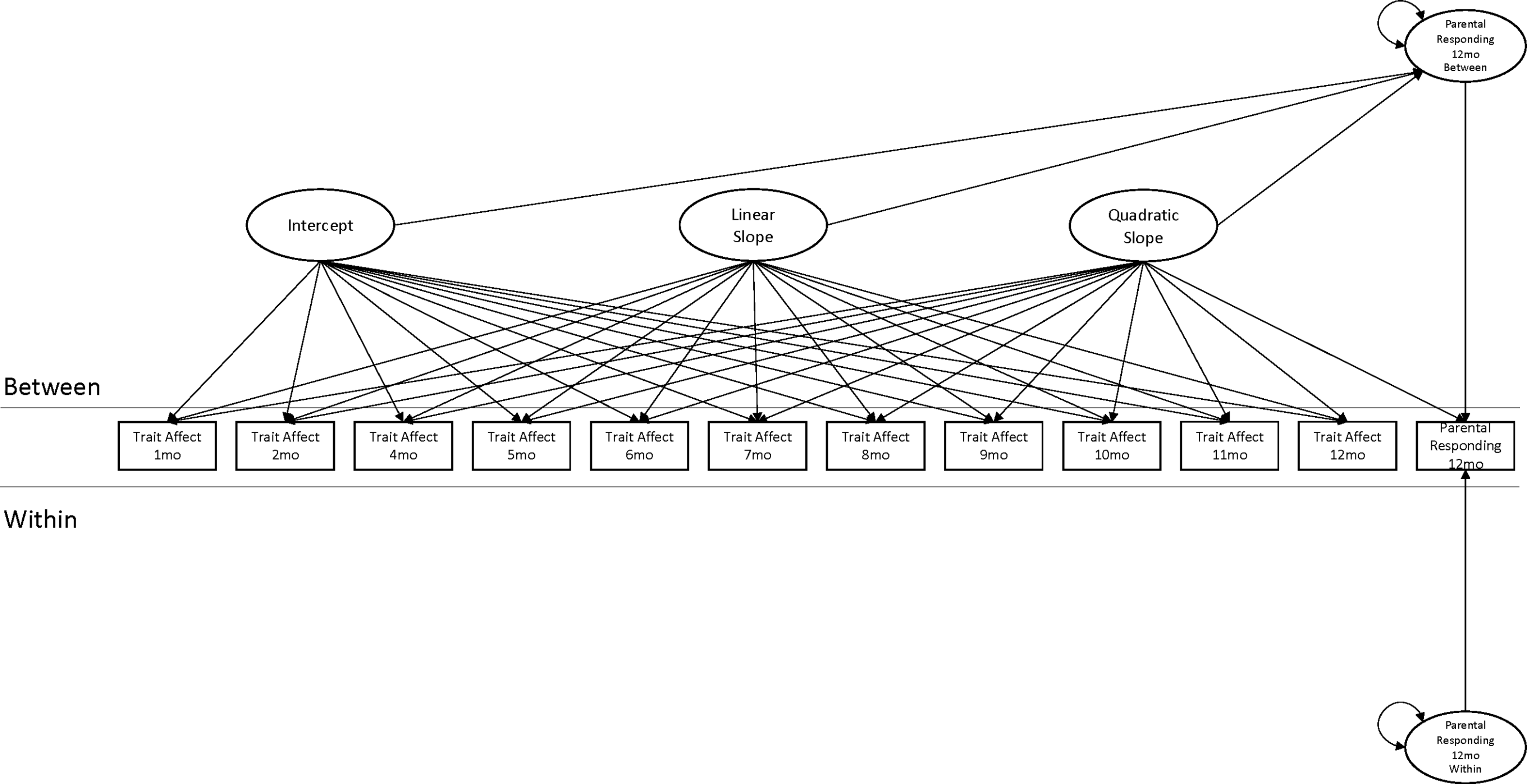
Hypotheses corresponding with Aim 2 were then evaluated using a series of MSEMs in which growth factors corresponding to the best fitting quadratic model describing trajectories of each domain were regressed on parental enhancing and dampening, respectively, as reported via both child- and parent- report ESM. Separate models were conducted for each outcome domain, as well as for parental enhancing and dampening. See Figure 3 for a sample structural model.
Sample structural diagram corresponding to basic conceptual model for Aim 2 MSEM analyses. Variance and covariance parameters were modeled for all latent growth factors, although they have been removed from the present figure to enhance readability. The sample diagram depicts analyses regarding trait affect for illustrative purposes; however, conceptually identical models were used to examine associations between parental enhancing and dampening responses to youth positive affect and youth depressive symptom trajectories. The most complex model, a quadratic model, is depicted for ease of interpretation.

Aim 3: Examining implications of macro-level patterns of youth adjustment for parental subsequent micro-level socialization behaviors and macro-level parental adjustment
Analyses associated with Aim 3 were conducted using a series of MSEM and SEM models for micro-level and macro-level outcomes, respectively.
Effects of adolescent developmental trajectories on individual differences in micro-level socialization processes
A series of multilevel logistic regressions implemented using an MSEM approach were used to examine: (1) associations between youth trajectories of positive affect, negative affect, and depressive symptoms and (2) the odds that youth engage their parents in their positive emotions. The odds of youth engaging their parents in their positive emotions were represented in these analyses using participants’ dichotomous rating of whether youth shared their most positive event with their parent on each survey. As described previously, separate models were conducted using child- and parent- report ESM data. Associations between adolescent developmental trajectories and parental enhancing and dampening responses to adolescent positive affect were similarly evaluated using an MSEM approach (Muthén & Muthén, Reference Muthén and Muthén2021). Associations between each domain of development (i.e., positive affect, negative affect, and depressive symptoms) and individual differences in each aspect of parent response behavior (i.e., enhancing versus dampening) were again modeled separately in the interest of power (see Fig. 4 for sample structural diagram).
Sample structural model for Aim 3 analyses examining associations between adolescent developmental trajectories and parental daily-life responses to positive affect. Variance and covariance parameters were modeled for all latent growth factors, although they have been removed from the present figure to enhance readability. The sample diagram depicts analyses regarding trait affect for illustrative purposes; however, conceptually identical models were used to examine associations between youth depressive symptom trajectories and parental responses to positive affect.
Effects of adolescent developmental trajectories on change in macro-level parental adjustment
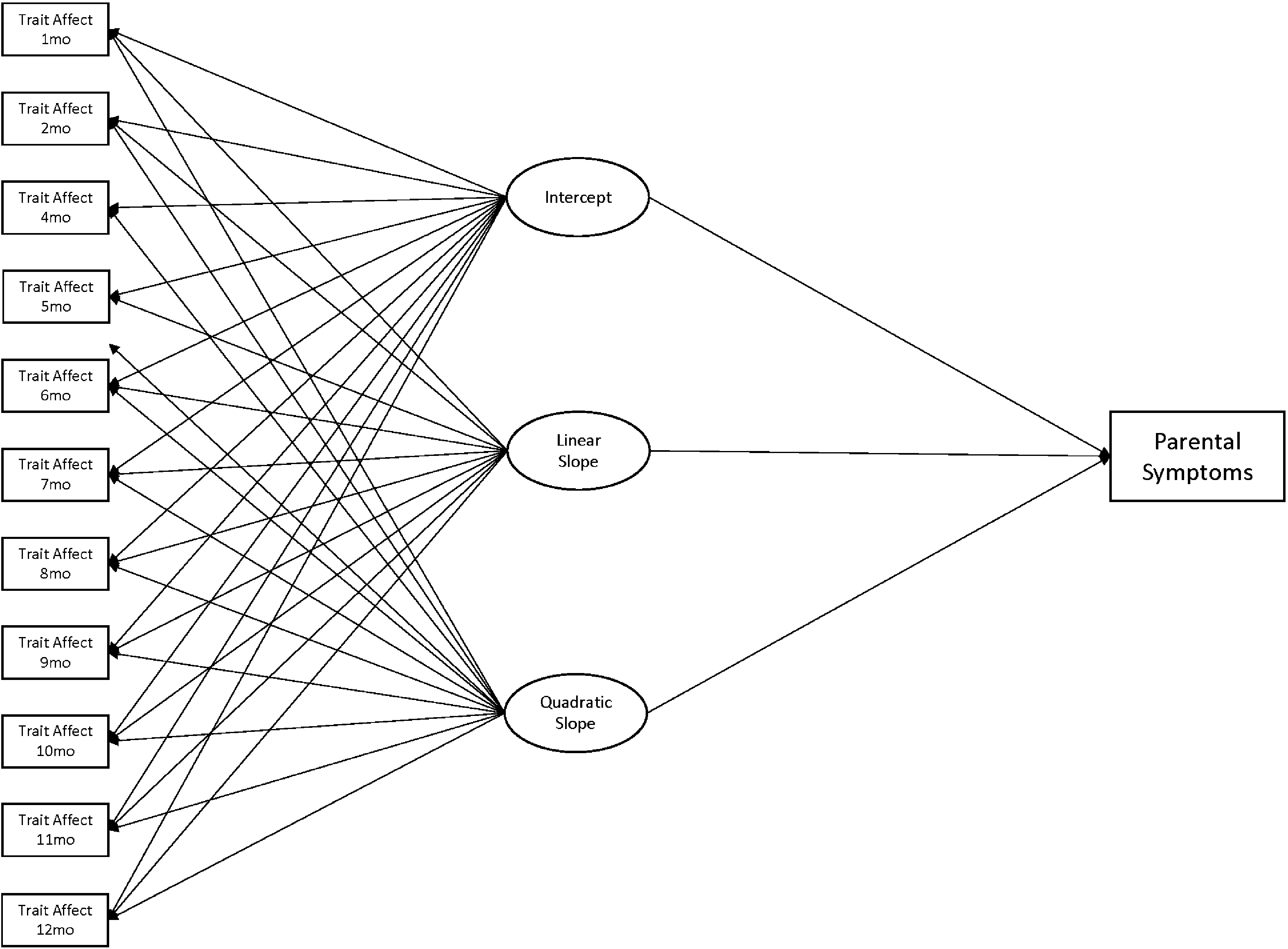
Associations between youth trajectories of positive affect, negative affect, and depressive symptoms and parental symptoms of depression and anhedonia were examined using an SEM approach implemented in Mplus v8.6 (Muthén & Muthén, Reference Muthén and Muthén2021) using full-information maximum likelihood (FIML) estimation given missing data. Goodness of fit was evaluated using convergence across multiple fit indices, as described above. To evaluate associations between youth developmental trajectories and change in parental emotional functioning, parental symptoms of depression and trait anhedonia as assessed at the 12-month follow-up were separately regressed on the best fitting growth factors describing trajectories of adolescent positive affect, negative affect, and depressive symptoms, as well as parental symptoms at baseline, in a series of separate structural models (see Figure 5 for sample diagram).Footnote 4
Sample structural model for Aim 3 analyses examining associations between adolescent trajectories and parental symptoms. Variance and covariance parameters were modeled for all latent growth factors, although they have been removed from the present figure to enhance readability. The sample diagram depicts analyses regarding trait affect for illustrative purposes; however, conceptually identical models were used to examine associations between youth depressive symptom trajectories and parental symptoms. Parental depressive symptoms and trait anhedonia outcomes were modeled independently.
Results
Preliminary descriptive analyses
Descriptive statistics, including means and standard deviations, describing primary variables of interest are reported in Table 1. For descriptive purposes, repeated-measures of parental socialization behaviors were averaged across surveys to yield mean enhancing and dampening scores for each participant. Parental depressive symptom and trait anhedonia scores were comparable to scores observed in other samples of adults recruited from the general community (e.g., Geaney et al., Reference Geaney, Treadway and Smillie2015; Gooding et al., Reference Gooding, Winston, Pflum and Burgin2015; Griffith et al., Reference Griffith, Young and Hankin2021c). Observed means of youth positive affect, negative affect, and depression were similar to those observed in other longitudinal studies of adolescent youth (e.g., Griffith et al., Reference Griffith, Clark, Haraden, Young and Hankin2021a, Reference Griffith and Hankin2021c). Overall, girls tended to report higher levels of depression and negative affect relative to boys; levels of positive affect were relatively similar across genders (see Table 1).
Descriptive statistics for primary variables of interest for the sample overall and by gender
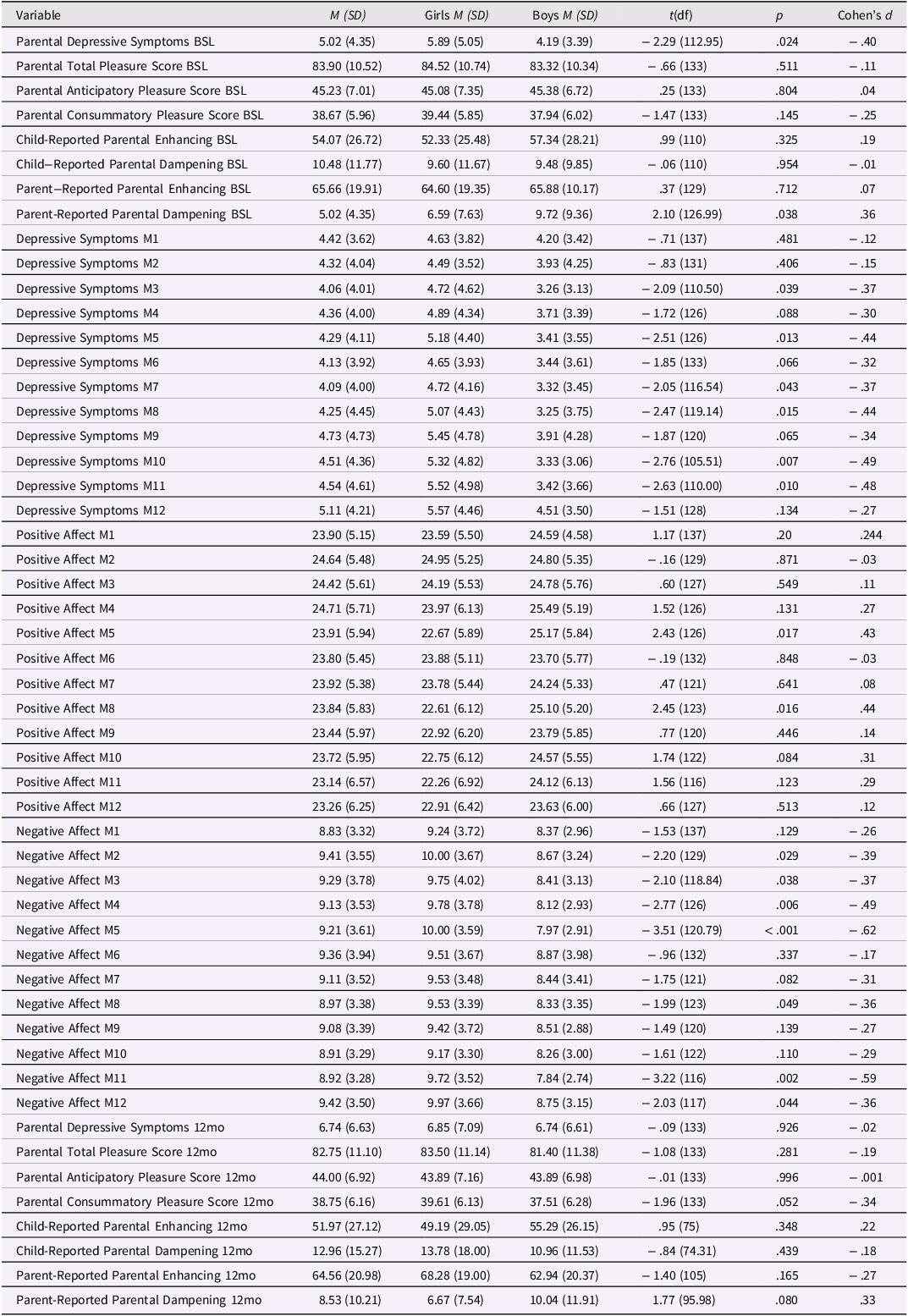
Non-integer degrees of freedom correspond to cases in which Levene’s test indicated inequality of variances between groups. BSL = baseline; M = month; 12mo = 12-month follow-up assessment.
A full correlation matrix reporting all bivariate correlations between variables of interest across the 12-month assessment period is available on OSF (https://osf.io/zun2e/). For descriptive purposes, repeated-measures of parental socializations behaviors were again averaged across surveys. All correlations were in expected directions based on prior theory and research.
Multilevel logistic regression models found that child age and gender did not predict youth odds of sharing a positive event with their parent according to either child- or parent- report at the baseline assessment (all p’s > .05). Adolescents’ own depressive symptoms as assessed at the baseline laboratory visit via self-report on the CDI-SF were also unrelated to their odds of sharing a positive event with their parent at baseline according to both child- (b = −.03, SE = .04, p = .433, OR = .97) and parent- report (b = −.02, SE = .04, p = .563, OR = .98).
Aim 1: Examining predictors of parental responses to adolescent positive affect in daily life settings
Complete results of all MLM analyses evaluating associations between baseline parental depressive symptoms and trait anhedonia and parental daily-life enhancing and dampening according to both child- and parent- report ESM are reported in Table 2. Parental anhedonia at baseline was significantly related to parent-reported use of enhancing socialization at baseline, such that parents reporting higher total pleasure (i.e., lower anhedonia) endorsed greater use of enhancing in response to their children’s positive affect in daily life (b = .53, SE = .14, p < .001, Cohen’s d = .63). Sensitivity analyses indicated that patterns of results were consistent across anticipatory and consummatory facets of anhedonia (see Supplemental Table S3). Parent-reported depressive symptoms at baseline were not significantly concurrently related to either child- or parent-reported parental use of enhancing or dampening socialization in daily life. Parental trait anhedonia at baseline was not significantly related to baseline child-reported parental use of enhancing or dampening socialization in daily-life, nor was parental anhedonia at baseline significantly related to baseline parent-reported use of dampening.Footnote 5
Results of multilevel models relevant to Aim 1 for evaluating associations between parental depressive symptoms and trait anhedonia and parental daily-life responses to positive affect
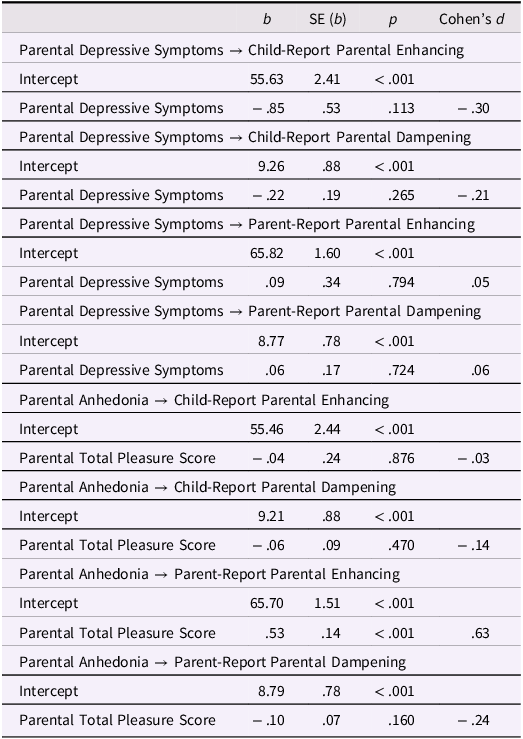
b = unstandardized effect size; SE = standard error of the unstandardized effect size.
Aim 2: Examining associations between micro-level parental socialization behaviors and macro-level patterns of youth adjustment across one year
All MSEMs demonstrated adequate fit for models evaluating associations between parental daily-life responses to youth positive affect at baseline and youth growth trajectories between months 1 and 12 (see Supplemental Table S4). Results are reported in Table 3.
Results of multilevel structural equation models relevant to Aim 2 for evaluating associations between parental daily−life responses to positive affect and youth growth trajectories
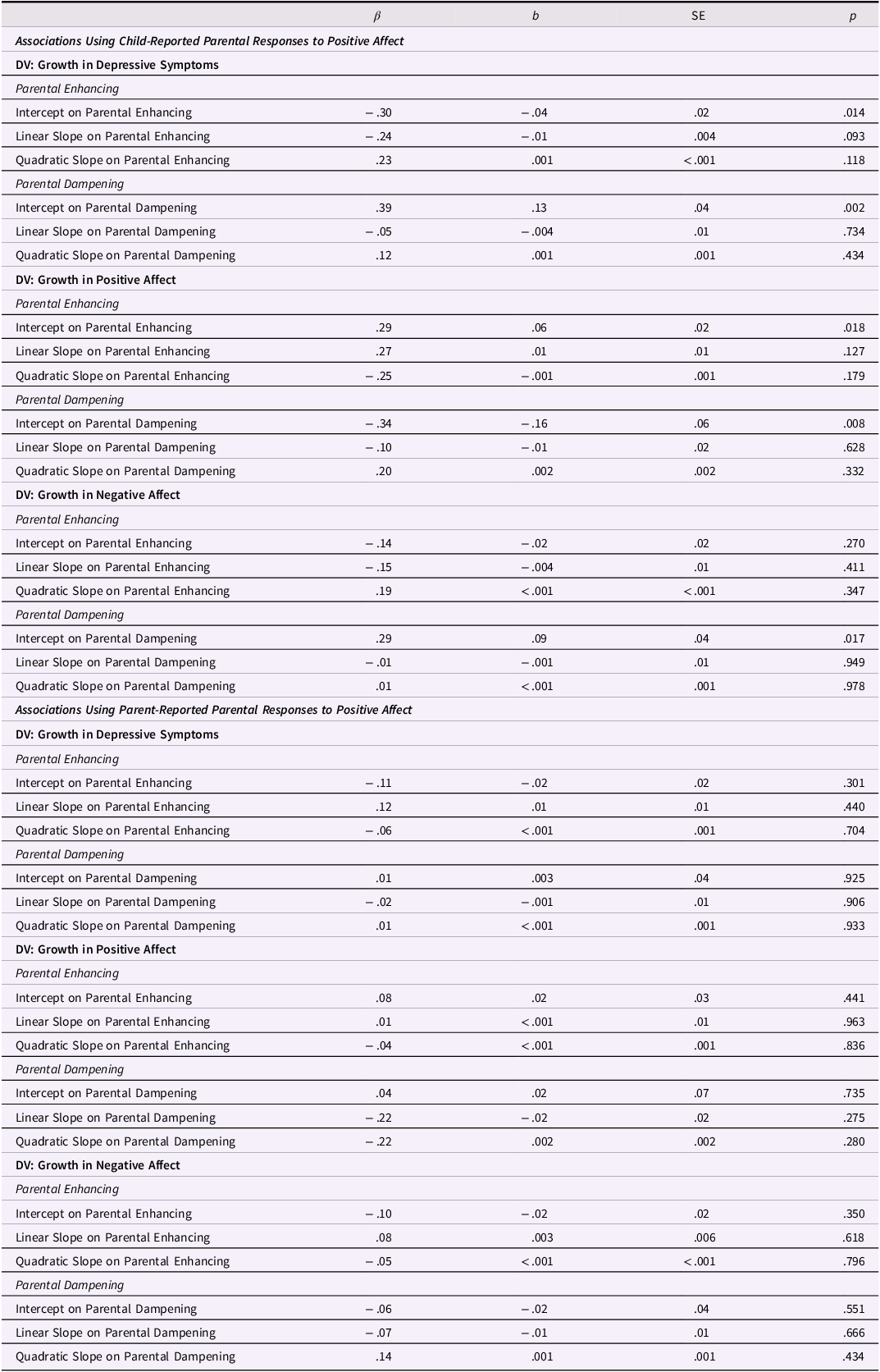
β = standardized effect size; b = unstandardized effect size; SE = standard error of the unstandardized effect size.
Child-reported parental enhancing at baseline predicted the intercept of youth depressive symptoms (β = −.30, b = −.04, SE = .02, p = .014) and positive affect (β = .29, b = .06, SE = .02, p = .018) at one-month follow-up. Adolescents who perceived their parents as providing more enhancing started lower in depression and higher in positive affect relative to adolescents who perceived their parents as providing less enhancing. Child-reported parental dampening at baseline predicted the intercept of youth depressive symptoms (β =.39, b = .13, SE = .04, p = .002), positive affect (β = −.34, b = −.16, SE = .06, p = .008), and negative affect (β = .29, b = .09, SE = .04, p = .017) at one month. Adolescents who perceived their parents as providing more dampening started higher in depressive symptoms and negative affect and lower in positive affect relative to adolescents who perceived their parents as providing less dampening.Footnote 6 No effects were found for parental responses on slopes of youth growth trajectories. No effects were observed using parent-report of daily-life enhancing and dampening at baseline.
Additional sensitivity analyses were conducted in which youth baseline symptom/affect scores were entered as covariates. These analyses aimed to evaluate the extent to which parental enhancing and dampening responses at baseline predicted unique variance in the starting levels of youth depressive symptoms, positive affect, and negative affect at one-month follow-up above and beyond youths’ own baseline symptom/trait affect levels. Results indicated that after controlling for baseline depressive symptoms, parental dampening at baseline continued to predict the intercept of youth depressive symptom trajectories at one-month follow-up (β =.19, b = .06, SE = .03, p = .030). Similarly, after controlling for baseline positive affect, parental dampening at baseline continued to predict the intercept of youth positive affect trajectories at one-month (β = −.23, b = −.11, SE = .05, p = .017). Effects of baseline parental enhancing were no longer significant after controlling for youth baseline symptom/affect levels, nor were effects of baseline parental dampening on youth negative affect intercepts retained after controlling for youth baseline negative affect.
Further, to investigate the durability of effects, models were respecified to center each of the respective model intercepts at the 12-month follow-up assessment. That is, rather than representing initial starting levels, the intercept was modeled to represent the expected mean at 12-months (i.e., ending levels). Results indicated that controlling for baseline depressive symptoms, youth-reported parental daily-life dampening at baseline predicted ending levels of youth depressive symptoms at 12-months (β = .26, b = .11, SE = .05, p = .020). Controlling for youth positive affect at baseline, effects of parental dampening at baseline on youth ending levels of positive affect at 12-month follow-up were not significant (β = −.03, b = -.02, SE = .07, p = .763).
Aim 3: Examining implications of macro-level patterns of youth adjustment for parental subsequent micro-level socialization behaviors and macro-level parental adjustment
Youth developmental trajectories and parental responses to youth positive affect
Fit statistics for MSEM models evaluating associations between youth developmental trajectories and prospective parental responses to youth positive affect are reported in Supplemental Table S5. Trajectories of youth positive affect, negative affect, and depressive symptoms over the 12-month follow-up period were unrelated to youth odds of sharing a positive event with their parent at 12-months according to both youth and parent reports (all p’s > .05). Table 4 provides results of structural regressions evaluating associations between youth developmental trajectories and parental daily-life enhancing and dampening at 12-months per child -and parent- report.
Results of multilevel structural equation models relevant to Aim 3 for evaluating associations between youth growth trajectories and prospective parental responses to positive affect
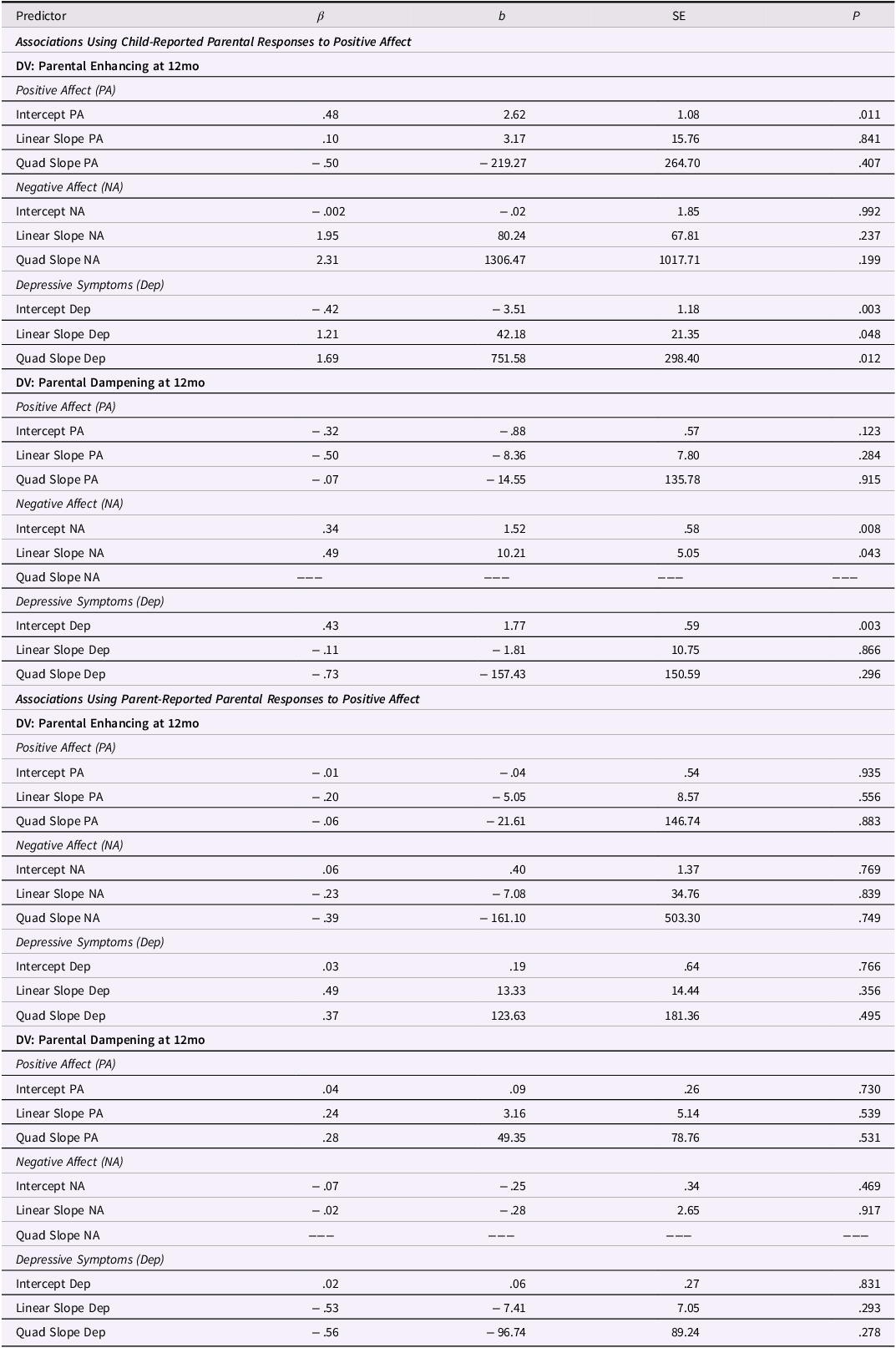
Due to issues with model convergence, parameters corresponding to the regression of parental dampening on the quadratic slope of youth depressive symptom trajectories was fixed to zero for models using both adolescent- and parent- report data. With this constraint applied, models converged successfully with fit indices indicating adequate model fit (CFI = .93, RMSEA = .02, SRMR(w) = .01, SRMR(b) = .07 and CFI = .95, RMSEA = .01, SRMR(w) = .01, SRMR(b) = .06 for adolescent- and parent- report models, respectively). β = standardized effect size; b = unstandardized effect size; SE = standard error of the unstandardized effect size; quad=quadratic.
The intercept of youth positive affect trajectories was positively associated with prospective parental enhancing (β = .48, b = 2.62, SE = 1.08, p = .011). Youth who started higher in positive affect at 1-month perceived their parents as providing greater enhancing responses to their positive affect at the 12-month follow-up. Intercept (β = −.42, b = −3.51, SE = 1.18, p = .003) and slope terms (β linear = 1.21, b linear = 42.18, SE = 21.35, p = .048; β quad = 1.69, b quad = 751.58, SE = 298.40, p = .012) describing growth in youth depressive symptoms between months 1 and 12 also prospectively predicted parental enhancing. Youth who started lower in depressive symptoms and demonstrated greater quadratic change in depressive symptoms over time perceived their parents are providing greater enhancing at 12-months. No effects were observed for youth negative affect trajectories on parental enhancing at 12-months.
With respect to parental dampening, the intercept (β = .34, b = 1.52, SE = .58, p = .008) and linear slope terms (β = .49, b = 10.21, SE = 5.05, p = .043) describing growth in youth-reported negative affect between months 1 and 12 prospectively associated with youth-reported parental dampening at 12-months. Youth who started higher and decreased more slowly in negative affect perceived their parents as providing greater dampening at 12-months relative to youth who started lower and decreased faster in negative affect over time. The intercept of youth depressive symptoms also predicted youth-reported parental dampening at 12-months (β = .43, b = 1.77, SE = .59, p = .003). Youth who started higher in depressive symptoms at 1 month perceived their parents are providing greater dampening at 12-month follow-up. No effects were observed using parent-report of parental daily-life enhancing and dampening responses at 12-months.
Youth developmental trajectories and parental mood
Fit statistics for SEM models are reported in Supplemental Table S6. All models demonstrated adequate fit. Results of structural regressions evaluating associations between youth developmental trajectories and parental depressive symptoms and trait anhedonia at 12-months, respectively, are reported in Table 5. Findings demonstrated that the slope terms (but not intercept terms) describing adolescent growth in self-reported trait positive affect over the 12-month follow-up period predicted parental depressive symptoms at 12-months, controlling for parental depressive symptoms at baseline (β linear = −.62, b linear = −4.90, SE = 2.32, p = .035; β quad = −.57, b quad = −54.95, SE = 26.94, p = .041). Youth who decreased faster in positive affect had parents who reported greater depressive symptoms at 12-months relative to youth who decreased slower in positive affect. Slope terms (but not intercept terms) describing adolescent growth in self-reported depressive symptoms across the 12-month follow-up period also predicted parental depressive symptoms at 12-months (β linear = 1.27, b linear = 11.97, SE = 4.66, p = .010; β quad = 1.63, b quad = 148.07, SE = 57.67, p = .010). Youth with a more extreme rate of quadradic change in depressive symptoms over the follow-up period had parents who demonstrated greater increases in depressive symptoms at the 12-month follow-up. No effects of youth developmental trajectories on parental trait anhedonia at 12-months were observed.Footnote 7 Sensitivity analyses indicated that patterns of results were consistent across anticipatory and consummatory facets of anhedonia (see Supplemental Table S7).
Results of structural equation models relevant to Aim 3 for evaluating associations between youth growth trajectories and prospective parental symptoms
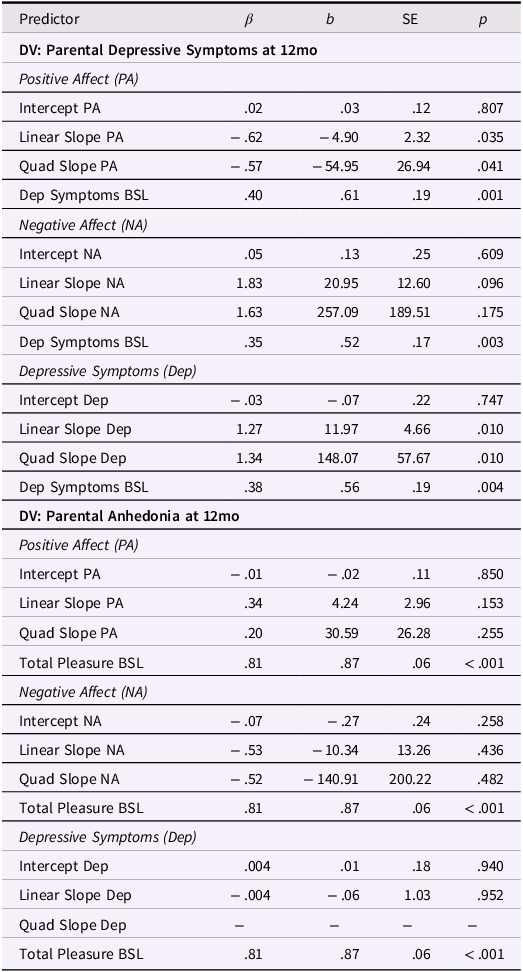
Due to issues with model convergence, parameter corresponding to the regression of parental trait anhedonia on the quadratic slope of youth depressive symptom trajectory was fixed to zero. With this constraint applied, the model converged successfully with fit indices indicating good model fit (CFI = .97, RMSEA = .05, SRMR − .06). β = standardized effect size; b = unstandardized effect size; SE = standard error of the unstandardized effect size; quad=quadratic; dep=depressive symptoms; BSL = baseline.
Discussion
Individual differences in positive affect and related experiences may be especially salient during early adolescence (Coe-Odess et al., Reference Coe-Odess, Narr, Allen, LoBue, Pérez-Edgar and Buss2019; Dahl & Gunnar, Reference Dahl and Gunnar2009), as parents function as potent socializers of adolescents’ positive affective experience (Eisenberg et al., Reference Eisenberg, Cumberland and Spinrad1998; Eisenberg, Reference Eisenberg2020; Morris et al., Reference Morris, Silk, Steinberg, Myers and Robinson2007), and parental responses to youth positive affect can influence their adolescents’ emotional development (e.g., Fredrick et al., Reference Fredrick, Mancini and Luebbe2019; Nelis et al., Reference Nelis, Bastin, Raes and Bijttebier2019; Raval et al., Reference Raval, Luebbe and Sathiyaseelan2019; Root & Gentzler, 2019). Parent and adolescent emotional functioning are theorized to relate bidirectionally and reciprocally, such that over time, parents and their adolescent youth become entrenched in feedback loops with reverberating and enduring impacts for both parents and their adolescent offspring (Eisenberg, Reference Eisenberg2020; Lougheed, Reference Lougheed2020). Using a measurement-burst design including repeated-measures dyadic ESM and monthly self-report questionnaires implemented across one year, the present study found that youth’s experiences of parental enhancing and dampening in response to commonplace, everyday events has enduring implications for youth positive affect and depression, with downstream implications for parental depression and parental positive affect socialization behaviors. Considered together, findings provide insight into the ways in which parents’ and children’s emotional experiences interplay with one another across early adolescent development, with implications for understanding both intra- and inter- personal processes of risk and resilience.
Parental responses to youth positive affect and youth emotional development
Using multiple reporters and a prospective, repeated-measures design, the present work found that that adolescents’ experience of their parents’ positive emotion socialization behavior in daily-life settings was associated with youths’ emotional development across a one-year period. Distinct patterns of effects were observed for parental enhancing and parental dampening. Specifically, youths’ report of their parents’ enhancing responses to everyday positive events was negatively associated with starting levels of youth depressive symptoms and positively associated with starting levels of youth positive affect one month later. Moreover, youth report of parental dampening responses was positively associated with youth starting levels of depressive symptoms and negative affect, and negatively associated with youth starting levels of positive affect at one-month follow-up. These effects of parental dampening on starting levels of youth depressive symptoms and positive affect were retained even after controlling for youth depressive symptoms and positive affect, respectively, measured one month prior.
Moreover, youth-report of parental dampening at baseline continued to positively predict mean-levels of youth depressive symptoms at 12-month follow-up, controlling for baseline symptom levels. These additional findings show that parental dampening is associated with relatively enduring risk for increased mean-level depression across one year (i.e., at baseline and 12 months later). However, contrary to hypotheses, neither form of parental response behavior predicted youths’ rates of change (i.e., slopes) for depression symptoms or trait affects across the one-year follow-up period. This suggests that overall rates of growth characterizing youth trajectories of positive affect, negative affect, and depressive symptoms are relatively independent of parental responses to youth positive affect during early adolescence.
Parental dampening emerged as a relatively stronger predictor of youth depression and affect trajectories compared with parental enhancing. Several studies implicate parental dampening in concurrent risk for affective dysfunction (e.g., Katz et al., Reference Katz, Shortt, Allen, Davis, Hunter, Leve and Sheeber2014; Morgan et al., Reference Morgan, Eckstrand, Silk, Olino, Ladouceur and Forbes2022; Nelis et al., Reference Nelis, Bastin, Raes and Bijttebier2019; Raval et al., Reference Raval, Luebbe and Sathiyaseelan2019; Whittle et al., Reference Whittle, Yap, Yücel, Sheeber, Simmons, Pantelis and Allen2009; Yi et al., Reference Yi, Gentzler, Ramsey and Root2016), whereas evidence for associations between parental enhancing and youth emotional dysfunction has been limited and somewhat mixed (Fredrick et al., Reference Fredrick, Mancini and Luebbe2019; Katz et al., Reference Katz, Shortt, Allen, Davis, Hunter, Leve and Sheeber2014; Moran et al., Reference Moran, Root, Vizy, Wilson and Gentzler2019 Nelis et al., Reference Nelis, Bastin, Raes and Bijttebier2019; Yi et al., Reference Yi, Gentzler, Ramsey and Root2016). Other past research using behavioral observation designs demonstrated that observed parental negative affective expression, but not observed parental positive affective expression, is related to youth contemporaneous daily life positive affect (Griffith et al., Reference Griffith, Silk, Oppenheimer, Morgan, Ladouceur, Forbes and Dahl2018), as well as prospective risk for the onset of youths’ depressive disorder over time (Griffith et al., Reference Griffith, Crawford, Oppenheimer, Young and Hankin2019). Taken together, this suggest that adolescents may be particularly attuned to parental negative affective feedback, with implications for risk for psychopathology and trait affect development.
Consistent with hypotheses, negative associations were observed between parental anhedonia and parent-reported enhancing at baseline; however, no associations between parental depressive symptoms and individual differences in parental responses to youth positive affect were observed. This pattern of results may reflect that anhedonia-specific deficits in motivation, reinforcement learning, and reward-based decision making (Pizzagalli, 2014), rather than increases in parental negative emotionality per se, exert outsized impacts on parents’ ability to actively and constructively engage with their children’s everyday positive emotions.
Evidence for bidirectionality: Adolescent emotional development and subsequent parental emotions and behaviors
Trajectories of youth self-reported positive affect and depressive symptom development longitudinally predicted changes in parental self-reported depressive symptoms across one year. These effects were observed for linear and quadratic slope terms describing rate of affective and symptom change across one year, but not for the intercept term representing mean-level starting points. More specifically, results indicate that youth who decreased faster in positive affect or demonstrated more extreme quadratic change in depressive symptoms had parents who reported greater increases in depressive symptoms over the 1-year follow-up, regardless of the initial level of youths’ self-reported depression symptoms and/or positive affect. Thus, the ways in which youth mood changes over time appear to be a more salient predictor of parental distress than the mean-level amount of their adolescents’ trait positive affect or symptom experience, per se. These results were specific to youths’ positive affect trajectories (relative to negative affect trajectories) as well as depressive symptoms: Parents may be especially attuned to observed declines in indicators of their children’s positive affect, including changes in youth interest, energy, and joy. This interpretation is well-aligned with previous research indicating that trajectories of youth positive affect, but not trajectories of youth negative affect, are related to trajectories of parent-adolescent relationship quality over time (Griffith et al., Reference Griffith, Young and Hankin2021b). Together, these results suggest that as adolescents demonstrate increasing patterns of withdrawal and apathy (i.e., decreasing positive affect) and escalating changes in symptoms of depression, parents become increasingly distressed, resulting in elevated symptoms of parental depression.
Zooming in on the ways in which youth developmental trajectories prospectively associate with parental responses to youth positive affect in daily life, the present work revealed a complex pattern of associations that differed across parent and youth report. Whereas parents did not report differences in their perceptions of their enhancing and dampening at follow-up based on youth emotional trajectories, youth who started higher in positive affect and those who started lower and demonstrated more extreme change in depressive symptoms perceived their parents as engaging in greater enhancing in daily life at 12-months. Youth who demonstrated greater quadratic change in depression also perceived their parents as providing greater enhancing. This finding was not expected and somewhat curious. It is possible that parents of youth who demonstrate increasing signs of internalizing distress may respond in a compensatory fashion, upregulating their children’s positive affect when provided the opportunity to do so. Research is needed to explore this and other possibilities.
Youth-reported parental dampening at the 12-month follow-up was positively associated with both youth starting levels of depressive symptoms as well as youth trajectories of negative affect across the one-year follow-up period. In other words, early adolescents who perceived their parents as providing greater dampening responses a year later tended to be those adolescents who initially reported higher mean depression and negative affect levels at baseline. Similarly, youth perceiving parents as providing more dampening at 12-months also demonstrated relatively stable or increasing trajectories of negative affect over the one-year follow-up. This pattern aligns with prior work finding prospective associations between adolescent depressive symptoms and later maternal dampening (Nelis et al., Reference Nelis, Bastin, Raes and Bijttebier2019) and parental rejection (Johnco et al., Reference Johnco, Magson, Fardouly, Oar, Forbes, Richardson and Rapee2021).
No prospective associations between youth emotional trajectories and parental trait anhedonia were observed. Parental trait anhedonia demonstrated high levels of stability across the follow-up period, leaving little remaining variance to predict. It is worth noting that the TEPS is conceptualized as capturing what scale authors term “anhedonic predispositions,” or stable, trait-like individual differences in the propensity for pleasure (Gard et al., Reference Gard, Gard, Kring and John2006). It is perhaps unsurprising, then, that the present work did not predict meaningful change in these dispositions over one-year. Future work can evaluate the extent to which child-level predictors of change in parents’ anhedonia can be detected using different, more sensitive measures.
Interpreting differences based on reporter
One consistent result across analyses was that patterns of associations depended on whether parent- or child- report of parental socialization behaviors was used. That is, youth-reported parental responses were more consistently related to youth outcomes relative to parent-reported parental responses. Parent-child reporting discrepancies are a common finding in the developmental literature, and prior research has demonstrated that these discrepancies are often meaningful and may be related to both child- and parent- related factors (De Los Reyes, Reference De Los Reyes2011; De Los Reyes & Ohannessian, Reference De Los Reyes and Ohannessian2016; Fan et al., Reference Fan, Ni, Wang, Qian, Li and Geng2023; Hou et al., Reference Hou, Kim and Benner2018). Unfortunately, in the present sample we could not rigorously examine these reporter discrepancies as a predictor of parent and youth outcomes. At the same time, the pattern of findings from this study may inform intriguing hypotheses to be tested in future, well-powered research to evaluate these questions. For example, differences in parent and child perceptions of their interactions with one another might be associated with disruptions in parent-child communication and relationship quality that contribute to, and are exacerbated by, youths’ depressive symptoms.
Strengths and limitations
The present work demonstrated several strengths. First, the use of dyadic ESM to assess parental responses to youth positive affect in ordinary, daily life settings from both parent- and adolescent- perspectives builds on and extends previous literature that largely relied upon single reporter questionnaire methods (e.g., Nelis et al., Reference Nelis, Bastin, Raes and Bijttebier2019; Nyquist & Luebbe, Reference Nyquist and Luebbe2022). Second, the use of LGCM and MSEM analyses allowed the present work to evaluate prospective associations between parental enhancing and dampening as assessed repeatedly in daily life, and youth trajectories of emotional development. This approach yields new insights into the way in which these emotion socialization experiences relate to both mean-levels of youth symptoms and trait affects, as well as the rates at which youth symptoms and trait affects change over time.
This work also demonstrates several limitations that provide directions for future research. First, the present sample size was relatively limited for conducting additional, more complex analyses (e.g., moderators), although the study was sufficiently powered for current main aims, and the sample size is similar to or exceeds that of comparable recent work using ESM amongst adolescents (e.g., Aldrich et al., Reference Aldrich, Lisitsa, Chun and Mezulis2019; Egbert et al., Reference Egbert, Smith, Ranzenhofer, Goldschmidt and Hilbert2022; Janssen et al., Reference Janssen, Kullberg, Verkuil, van Zwieten, Wever, van Houtum and Elzinga2020). Due to limited sample size, the present work was unable to meaningfully evaluate and interpret gender- and age- based differences in trajectories of growth, as well as associations between parental responses and youth trajectories of growth over time. Future work should aim to replicate findings in larger samples in order to increase confidence in results and further investigate potential moderation by age and gender. Similarly, participating parents were predominantly mothers, limiting our ability to evaluate differences in mean-level parental socialization behaviors or patterns of effects based on parental gender. Moreover, this sample comprised predominantly white, relatively high-SES dyads, limiting the generalizability of findings. Past work shows that associations between interpersonal responses to positive affect and relationship outcomes meaningfully vary across cultural contexts (Reis et al., Reference Reis, Li, Ruan, de Jong and Tsai2022). Future work should include more diverse samples, including caregivers of multiple genders, and evaluate possible differences within and across cultural groups.
Several features of the study methods may have also influenced observed patterns of results. Parental enhancing was measured via a single-item ESM measure (cf., Gable et al., Reference Gable, Reis, Impett and Asher2004). This decision was based on concerns for balancing psychometric rigor with minimizing overall participant burden when completing many items every day over time (see Song et al., Reference Song, Howe, Oltmanns and Fisher2023 for further discussion of the validity of single-item measures in ESM research). Nevertheless, it is possible that salient parental enhancing behaviors were not adequately captured in the present work. Future work should aim to assess multiple specific enhancing behaviors (e.g., celebrating with food, helping the child to savor) to more holistically characterize parental daily-life enhancing. Finally, observed patterns of results may be influenced by shared method variance (Podsakoff et al., Reference Podsakoff, MacKenzie, Lee and Podsakoff2003). Future work may wish to implement ambulatory behavioral observation methods to complement parent- and child- reports.
Conclusions
Results of the present work indicate that youths’ perception of their parents’ responses to their positive affect in daily life settings are reciprocally related to their emotional development over time. Additionally, findings demonstrate that parents’ symptoms of depression are prospectively influenced by the emotional development and wellbeing of their adolescent youth. Moreover, results indicate that parental dampening is a particularly robust predictor of youth levels of depression over time, with cascading effects for parents’ depressive symptoms and daily-life socialization behaviors across one year. Findings align with interpersonal theories of depression, as well as TIES models of the parent-adolescent relationship, which emphasize the importance of everyday emotional exchanges for potentiating enduring patterns of both intrapersonal and relational wellbeing. Overall, findings suggest that intervening on youth’s experience of parental dampening may be a promising means by which to reduce both individual- and dyadic- risk and promote affective wellbeing.
Supplementary material
The supplementary material for this article can be found at https://doi.org/10.1017/S0954579423001633.
Acknowledgments
We also wish to acknowledge the contributions of Drs. Joseph Cohen, Karen Rudolph, Thomas Kwapil, and Amanda Sheffield Morris, who provided invaluable feedback on previous versions of the present work.
Funding statement
This material is based upon work supported by the National Science Foundation Graduate Research Fellowship Program under Grant No. DGE – 1746047.
Competing interests
None.


 Open access

