




Reimagining early childhood environmental education for planetary justice
The accelerating ecological crises demand close attention to the entangled material, ethical and political conditions of life on a rapidly changing planet, particularly within educational research and practice. In Earth system science, the Anthropocene names the unprecedented scale of human-driven disturbances to planetary dynamics, while the planetary boundaries framework identifies biophysical thresholds for a safe operating space for humanity and, more recently, a safe and just space for sustaining the biosphere and human wellbeing (Gupta et al., Reference Gupta, Liverman, Prodani, Aldunce, Bai, Broadgate and Verburg2023; Rockström et al., Reference Rockström, Gupta, Qin, Lade, Abrams, Andersen, Armstrong McKay, Bai, Bala, Bunn, Ciobanu, DeClerck, Ebi, Gifford, Gordon, Hasan, Kanie, Lenton, Loriani and Liverman2023; Steffen et al., Reference Steffen, Richardson, Rockström, Cornell, Fetzer, Bennett and Sörlin2015). These models powerfully explain the magnitude and systemic nature of the changes now underway. Yet for early childhood education (ECE), concrete, developmentally responsive methods that make these dynamics sensible in everyday practice, without reverting to individualised moral scripts, remain thin and uneven. As a result, the relational, multispecies, and materially situated conditions that characterise the Anthropocene rarely become legible within everyday educational settings or are taken up in ways that resonate with young children’s lived worlds.
Across early childhood learning environments, child-centred stewardship narratives remain common, positioning children as autonomous moral actors responsible for caring for a passive environment. Although well intentioned, such framings risk reinstating human exceptionalism and nature–culture binaries and they often obscure the structural drivers of degradation shaping children’s everyday lives (Elliott & Davis, Reference Elliott, Ärlemalm-Hagsér and Davis2020). Unlike stewardship or nature-play approaches that frequently return to personal behaviour, and distinct from broader Common Worlds orientations, dust pedagogies foreground particulate agencies as “scale devices” that connect the felt and the planetary while relocating responsibility beyond the individual. To work toward planetary justice, this article argues for pedagogies that learn with more-than-human agencies, that attune to matter and that make planetary politics sensible in everyday early childhood learning environments.
In this paper, I propose dust pedagogies as an alternative pathway. Dust is mundane, ubiquitous and lively. It gathers and circulates across scales, from fibres and spores on a rug in an early childhood learning space to mineral grains on wind to residues of extraction and construction to domestic waste and even cosmic particles that index astronomical processes (Bakke, Reference Bakke2015; Parikka, Reference Parikka2013). Through these movements dust connects children’s immediate worlds to aerosols, biogeochemical cycles and weather while also making discussable the uneven politics of exposure shaped by infrastructures, labour and colonial histories (Biermann & Kim, Reference Biermann and Kim2020; Richardson et al., Reference Richardson, Rockström, Cornell, Fetzer, Bennett, Biggs, Carpenter, de Vries, de Wit, Folke, Gerten, Heinke, Mace, Persson, Ramanathan, Reyers and Sörlin2023). Working with dust therefore complexifies climate learning in early childhood settings through relational, sensory and creative engagements. I use planetary (Earth system) justice to signal attention to exposures, infrastructures and responsibilities distributed across scales; dust pedagogies to name micro-pedagogical practices that engage particulate matter as a co-participant; scale loops as compositional relays that link felt encounters to geophysical and infrastructural processes; and threshold storytelling as narrative practices that make limits and crossings perceptible in practice.
This paper advances a posthuman, justice-oriented account of ECE and contributes a practical repertoire – scale loops, threshold storytelling and commons-making – for engaging planetary dynamics without instrumentalising children. My argument unfolds in three claims. First, dominant framings of environmental education in ECE, especially stewardship and individual responsibility, are insufficient for the Anthropocene because they (re)produce hierarchies between human and more-than-human worlds and narrow the problem to individual behaviour (Elliott & Davis, Reference Elliott, Ärlemalm-Hagsér and Davis2020). Second, more-than-human and posthuman approaches reconceptualise learning as intra-active and distributed across bodies, matter and places, unsettling the idea that agency is a human property alone (Barad, Reference Barad2007; Green & Somerville, Reference Green and Somerville2015; Common Worlds Research Collective, 2016). In this context, intra-action (Barad, Reference Barad2007) emphasises that entities do not pre-exist their relations but instead emerge through them. These concepts frame children’s encounters with dust as relational, embodied, and environmentally situated processes, rather than individual or purely developmental experiences. Third, micro-pedagogies that work with tiny matter such as dust can act as scale devices connecting encounters in early childhood learning environments to planetary boundaries and to Earth or planetary system justice without instrumentalising children or collapsing complexity (Biermann & Kalfagianni, Reference Biermann and Kalfagianni2020; Kalfagianni et al., Reference Kalfagianni, Pedersen and Stevis2024).
Situated in a kindergarten in Melbourne, Australia, and drawing on Karen Barad’s (Reference Barad2007) concept of intra-action, I apply multispecies ethnography with microscopy, mapping, audio recording and collaborative storytelling to explore becoming with dust in practice (Carrizo & Harris, Reference Carrizo, Harris, Doughty, Deszcz-Tryhubczak and Grafton2025; Carrizo et al., Reference Carrizo, Knight and Harris2025). I approach dust as a pedagogical collaborator whose presence, materiality, movement and sound affect and become with child–earth relations. Three questions guide the inquiry: what can be learned with or from other species and bodies such as dust through listening, attending to and interacting with them in early childhood settings; how can dust help reimagine ECE practices and environments in relation to ecological or planetary justice; and how might ECE frameworks be reconfigured by decentring the human and foregrounding more-than-human agency. Empirically, I report from a ten-month study combining low-power microscopy, sonic co-listening and inefficient mapping with diffractive analysis to follow child–dust relations across indoor–outdoor spaces.
In advancing dust pedagogies, I contribute conceptual and practical resources for ECE in four ways. I articulate a posthuman, justice-oriented framework that repositions children as co-participants in multispecies ecologies where matter and meaning are mutually articulated (Barad, Reference Barad2007). I show how microworld encounters with dust open ethical and political conversations that are developmentally responsive by tracing where dust comes from, whom it touches and which infrastructures generate it, which makes burdens and responsibilities discussable in early childhood learning environments (Pavenstädt & Rödder, Reference Pavenstädt and Rödder2024). Dust activates practices through intra-action with children, scale loops arise as dust folds local encounters into planetary processes; threshold storytelling takes shape as dust makes limits and crossings perceptible; and commons-making emerges as dust draws attention to shared ecospace and care. Entangled with these practices, dust animates doings that privilege sensory, affective and relational conditions through embodied modes of inquiry. Artistic methods: poetry, storytelling, co-mapping and microscopy are activated with dust’s presences and movements to render Earth system phenomena sensible and debatable without foreclosing uncertainty or imagination (Kirksey & Helmreich, Reference Kirksey and Helmreich2010; Kirksey et al., Reference Kirksey, Schuetze, Helmreich and Kirksey2014). Accordingly, the paper contributes: (1) dust as a pedagogical collaborator and scale device; (2) creative microecologies as a methodological repertoire for ECE; and (3) repeatable design heuristics that keep complexity open while redistributing responsibility.
A brief vignette, emerged by a child’s question, “Is the sand dust?”, previews how granular matter unsettles classification, scales attention from fingertip sensations to weather and infrastructure, and opens collective negotiations of exposure and care. The paper then traces how these practices take shape within early childhood spaces and how micro-encounters with granular matter intra-act with planetary processes and justice concerns.
Beyond stewardship: Dust pedagogies in the Anthropocene
Work on early childhood sustainability has long been shaped by stewardship framings that position children as managers of a passive environment and compress responsibility into individualised behaviour. While well intentioned, these logics reproduce human exceptionalism and nature–culture divides, reducing environmental learning to corrective actions instead of reconfigurations of relation and responsibility (Elliott & Davis, Reference Elliott, Ärlemalm-Hagsér and Davis2020; Taylor, Reference Taylor2017). In practice, such narratives often place moral weight on young children while leaving the structural drivers of degradation – extraction, infrastructural design, labour arrangements and regulatory regimes – largely unexamined and unaddressed.
Dust pedagogies offer a different starting point. Dust is mundane, mobile and materially diverse: fibres, spores, soils, pollen, mineral fragments and domestic residues, along with traces of extraction, construction and militarised activity. Media geological accounts figure dust as both sedimented infrastructure and circulating debris, while aesthetic studies foreground the atmospheric qualities through which dust registers environmental change (Bakke, Reference Bakke2015; Parikka, Reference Parikka2013). In early childhood settings, dust makes perceptible the porosity of bodies and places and the unevenness of exposure, activating conversations about care, vulnerability and shared environments that are developmentally responsive without becoming reductive. Treating dust as a pedagogical collaborator reframes learning with the more-than-human as a distributed, sensory and ethical practice rather than a programme of individual eco behaviours.
Dust pedagogies are aligned with, but not equivalent to, various influential strands in ECE. Compared with nature-play approaches, which often prioritise broad experiential engagement with outdoor environments, dust pedagogies focus on particulate agencies (fine particles such as dust and sand) and the compositional work of the very small. In this sense, dust pedagogies attend to how seemingly insignificant matter participates in wider ecological and political processes.
In relation to place-based education, dust pedagogies share commitments to situated learning but are not a substitute for Indigenous land-based pedagogies. Rather, they remain attentive to the political geologies of extraction and exposure while avoiding appropriation and can sit respectfully alongside community-led approaches when invited.
Finally, while resonating with Common Worlds approaches, dust pedagogies bring a distinctive methodological repertoire: microscopy, sonic co-listening, inefficient mapping and diffractive analysis. Importantly, they also foreground an Earth system justice orientation that connects early childhood encounters with particulate matter to infrastructures, policy, and planetary limits (Common Worlds Research Barad, Reference Barad2007; Collective, 2016).
By planetary (Earth system) justice, I refer to the equitable distribution of exposures, benefits, capabilities and decision making across human and more-than-human communities and across generations, with explicit attention to how infrastructures, political economies and histories organise these distributions at multiple scales (Biermann & Kalfagianni, Reference Biermann and Kalfagianni2020; Kalfagianni et al., Reference Kalfagianni, Pedersen and Stevis2024). Within this lens, responsibility is (re)distributed from individual children toward collective and structural sites of action such as service routines, room arrangements, ventilation and cleaning practices, procurement and waste policies, neighbourhood air quality and construction works, and the regulatory frameworks that govern them. In early learning spaces, this redistribution is enacted through design heuristics: scale loops that connect felt encounters such as a rasp under a wheel or a dust flare in sunlight to atmospheric and infrastructural processes; threshold storytelling that makes limits and crossings perceptible and discussable through attention to doors, windows, vents and edges where dust accumulates; and commons making that foregrounds shared atmospheres and surfaces as co-governed ecologies rather than private property. These practices keep complexity open, cultivate collective inquiry and care and invite educators and children to notice where dust comes from, whom it touches and what responses are required beyond the level of individual behaviour (Richardson et al., Reference Richardson, Rockström, Cornell, Fetzer, Bennett, Biggs, Carpenter, de Vries, de Wit, Folke, Gerten, Heinke, Mace, Persson, Ramanathan, Reyers and Sörlin2023).
The theoretical orientation guiding dust pedagogies conceptualises learning as intra-active and distributed across bodies, matter and places, unsettling the idea that agency is a human property alone (Barad, Reference Barad2007; Common Worlds Research Collective, 2016; Green & Somerville, Reference Green and Somerville2015). In this context, intra-action (Barad, Reference Barad2007) emphasises that entities do not pre-exist their relations but instead emerge through them. These concepts frame children’s encounters with dust as relational, embodied, and environmentally situated processes rather than individual or purely developmental experiences.
Deleuzo–Guattarian notions of becoming further illuminate how children and dust co-transform across temporal and spatial scales, refusing fixed hierarchies or tidy divisions between micro and macro (Deleuze & Guattari, Reference Deleuze and Guattari1987). Positioned this way, dust pedagogies provide a route for thinking and practising planetary justice from within the sensorial, routine and collectively negotiated encounters of early childhood life. They do not simplify climate change into distant facts or behaviour lists; they invite sustained noticing and composition with lively matter so that responsibility can be shared, argued over and re-arranged in relation to the infrastructures and histories that shape children’s everyday worlds. Taken together, these orientations reconfigure environmental education as more-than-human co-composition, where modest, repeatable gestures – listening to a granular rasp, attending to a dusty threshold, mapping a shared breeze – accumulate into practices that make planetary processes sensible, debatable and open to collective care.
Multispecies ethnography with microscopy, mapping and sound
This study adopts a multispecies ethnographic approach to make perceptible the relational agencies through which dust intra-acts with child–earth relations (Barad, Reference Barad2007; Kirksey & Helmreich, Reference Kirksey and Helmreich2010). In this register, ethnos is understood as a more-than-human multitude; dust, airflows, surfaces and weather are engaged as co-participants in pedagogical events rather than as background conditions (Kirksey et al., 2014; van Dooren et al., Reference van Dooren, Kirksey and Münster2016). Multispecies ethnography here does not “add nature” to human accounts; it tracks how lifeways and material flows are co-composed across species and substances, and how attention, gesture and care are redistributed by these relations. It follows movements, metabolisms and atmospheres (e.g., drifts, adhesions, rasps) as they reorganise practice, and treats description as a worlding act that keeps agency distributed across particles, bodies and places.
Fieldwork took place in a Melbourne kindergarten across ten months (February–October 2021) with nine children aged three to five years in indoor–outdoor spaces where wind corridors, timber, sand and soil enabled attention to granular and aerial matters. Data were generated-with dust rather than about it, following events of intra-action as they unfolded in place. Procedures included microscopy (low and digital magnification) to trace particles’ textures, adhesions and movements; “inefficient mapping” from Linda Knight that welcomed detours, partial views and children’s marks so mappings remained porous to atmospheres (Knight, Reference Knight2021); sound-attunement using portable recorders and headphones to foreground sonic agencies otherwise dominated by speech; and close observation of ordinary routines where dust, bodies and weather co-configured activity. The corpus comprised photographs, short videos, sound files, collaborative mappings and fieldnotes attentive to affects, doings and becomings, including how child–dust relations transformed within and across sessions. Traces were later composed as microecologies – short, multivocal pieces (descriptive vignettes, poems, dialogue fragments, images) that hold openness, blurriness and keep matter’s agencies active in analysis.
Analysis combined iterative coding with diffractive reading in Barad’s sense: reading theory, methods and material traces through one another to trace patterns of difference-that-matter, rather than seeking representational correspondence or thematic saturation (Barad, Reference Barad2007). Practically, this involved placing artefacts in conversation – for example, letting a sound recorder of granular rasp intra-act with microscope imagery and fieldnotes, then re-composing them as a microecology to see what new interferences and scale effects appeared. Diffractive moves asked: what shifts when sound leads vision? when stickiness contests a category? where do edges appear and blur? In this way, microecologies functioned as analytic-creative devices that did not mirror events but performed them, keeping scales open, boundaries dynamic and agency (re)distributed. A multispecies orientation is appropriate because it decentres the human, interrupts stewardship framings embedded in policy (DEEWR, 2009, 2011), and invites attention to how agency circulates through particles, bodies and built environments (Ritchie, Reference Ritchie2010; van Dooren et al., Reference van Dooren, Kirksey and Münster2016).
Creative ecologies for planetary justice in early childhood education
Daniel Harris’ call for ecological creativity reframes creativity as relational, distributed and more-than-human, rather than an attribute measured through individual outputs (Glăveanu, Reference Glăveanu2015; Harris, Reference Harris2016, Reference Harris2021; Harris & Holman Jones, Reference Harris and Holman Jones2022). In this study, creative microecologies name multivocal compositions through which children, dust, air and surfaces co-compose scenes that are at once aesthetic, analytic and ethical. Following Donna Haraway, worlds are natureculture emergents – ongoing decay, repair and recomposition – so creativity is approached as an affective force that reorients attention, elicits inquiry and reconfigures relations (Haraway, Reference Haraway2003). Situated within the politics of Earth-system dynamics, creative ecologies cultivate shared responsiveness to atmospheric shifts and granular movements, developing relational literacies necessary for safe-and-just futures without reverting to stewardship scripts. Dust, air currents and small particles are treated as co-participants rather than backdrops, rendering planetary processes sensible while keeping complexity open.
Building on Harris’s articulation of creative ecologies as “ensembles of practice” that are irreducibly social, material and atmospheric, creativity here is not a capacity that children possess but a field that emerges with particulate agencies (Harris, Reference Harris2016, Reference Harris2021). Dust’s adhesions, drifts and sonic rasps act as lures for feeling-thinking, prompting re-composition of attention, gesture and care. This orientation converges with Yanina Carrizo’s work on dustly becomings, where microworld encounters with particulate matter open ethical and political noticing without enclosing children within behaviourist scripts (Carrizo, Reference Carrizo2024). Together, these strands reposition creativity as a more-than-human event – an ongoing worlding in which bodies, particles and places cocreate livability.
Creative microecologies operate as relational devices that keep agency distributed and scale mobile. When dust catches sunlight, rasps under a wheel, or clumps with humidity, such moments are composed – through children’s marks, shared listening and situated language – into short multimodal scenes that hold blurriness. Rather than illustrating concepts, these microecologies perform them: they enact Barad’s intra-action by showing how meaning and matter are co-constituted; they enact Deleuzo-Guattarian becoming by refusing settled subjects and objects; and they enact Haraway’s naturecultures by binding the pedagogical to the atmospheric. In Carrizo and Harris (Reference Carrizo, Harris, Doughty, Deszcz-Tryhubczak and Grafton2025) and Carrizo et al. (Reference Carrizo, Knight and Harris2025), this compositional strategy is shown to yield scale devices – loops that move from the felt to the planetary and back – without collapsing complexity or instrumentalising children.
A creative-ecologies lens also clarifies the paper’s design heuristics. “Scale loops” are understood as compositional relays that stitch tactile and sonic cues to weather systems and extractive infrastructures, then return to situated transformations. “Commons-making” extends Harris’s emphasis on collaborative milieus to the shared atmospheres of early learning, foregrounding air, surfaces and space as co-governed ecologies.
Importantly, an ecological view of creativity tightens the link to planetary justice. Because creative fields are shaped by infrastructures and exposures, attention to dust’s circulations situates learning within the uneven geographies of extraction, pollution and erosion. This aligns with Carrizo’s argument that rewilding the microworlds of ECE can surface the politics of exposure in age-appropriate ways, inviting collective negotiation rather than individualised blame (Carrizo, Reference Carrizo2024). By treating creativity as a shared atmospheric practice – co-composed with particulate and meteorological agencies – children and educators learn to sense, name and redistribute burdens in the micropolitics of everyday life.
In sum, creative ecologies provide the conceptual bridge that binds dust pedagogies to the wider project of Earth-system justice. They (re)figure creativity as a more-than-human milieu of practice in which microecologies keep scales open, hold limits perceptible and cultivate speculative care. From this vantage, early childhood environments are not stages for developing creative individuals but ecologies of co-becoming in which the smallest particles help compose more just futures. The following sandpit vignette, catalysed by a child’s question? puts this milieu to work, showing how granular agencies, shared listening and situated transformations co-produce learning and justice in the thick of everyday life.
Is the sand dust? (Re)Configuring categories, scales and care
This story emerges from an inefficient mapping session near the kindergarten sandpit. While I was mapping the sound of dust, several children asked: Is the sand dust? The question unsettled my teacher-researcher reflex to seek “a correct,” classificatory answer. Instead, I stayed with the question, curious about how any answer might unfold, or whether one was needed at all. An educator nearby replied, You’re getting confused; the sand is not dust. I felt conflicted, but chose to keep the moment open, letting a brief silence intra-act with the “confusion” rather than confirm or deny.
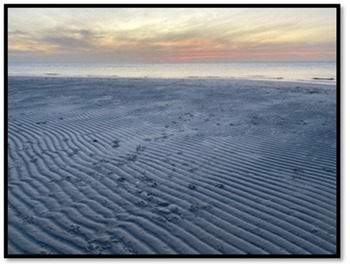
Earlier in the study, I tended to equate dust with pollution. Fieldwork, listening and children’s inquiries shifted this view. I now think dust as a collection of microscopic particles made of “everything and everyone,” including affects and connections. It becomes hard to draw a firm line between sand and dust (Figure 1). In the days that followed, children often used dust when playing in the sandpit: in their language, sand became dust. These experimental intra-actions with dust created conditions for wondering; asking whether sand is dust shows children are already thinking with dust, challenging binary logics and human-centred pedagogy.
Sand-dust.

Barad (Reference Barad2020) reminds us that there is no tidy line “in the sand” between micro and macro, only ongoing reconfigurings of spacetimemattering (714). Children’s question invited sand to share the stage with dust, opening spaces for other possibilities of sensing, caring and knowing. Dust activated different potentials and reconfigurations of matter, forms, directions, times and places.
The question also travelled with me to my new beach home. Grains of sand inhabit shoes, clothes, floors – each walk sounding different as weather, wind and sea continually re-make the beach (Barad, Reference Barad2007, 170). Thick wind lifts clusters of sand into storms; sun and moisture alter texture and weight. Eyes irritate easily; human vision is vulnerable here. If bodily boundaries are inherently ambiguous (Barad, Reference Barad2007, p. 155), then defining sand or dust solely through sight is limiting. Diffracting beach images with experience, the distinction blurs; size, perspective and affective becoming matter. Following Tsing’s (Reference Tsing2015) arts of noticing, I learn to touch with sand, less privileging sight. Sometimes sand feels larger, thicker, rougher than dust; touch is sticky and porous. As Hackett and Rautio (Reference Hackett and Rautio2019) write, touch is “both unique and shared,” never fully within human control (1024). Relations with the more-than-human are rich, complex, and not innocent by default.
The haunted dusty sand
Gan et al. (Reference Gan, Tsing, Swanson and Bubandt2017) suggest every landscape is haunted by more-than-human histories (Figure 2). On the beach, sand and dust carry fragments of past lives – Ice-Age shells, plant traces, industrial residues – gathered and dispersed by Anthropocene winds. Engaging with dust invites remembrance and responsibility. It is not enough to admire lively bodies or pristine scenes; we must walk with assemblages of the dead, the living and the never-alive, acknowledging human-shaped, polluted landscapes (Gan et al., Reference Gan, Tsing, Swanson and Bubandt2017). Dust helps disclose micro-, macro- and wild stories that disrupt separations of life and death.
More-than-human histories.

Murris et al. (Reference Murris, de Souza, da Silva, Reynolds, Simon, Ärlemalm-Hagsér and Sandberg2022) remind us that beaches are also places of violence. Even where surfaces appear “clean,” hidden flows of chemicals, sewage, and microplastics persist. What is not easily visible to the human eye still matters environmentally. Attending to these less perceptible presences re-situates the beach within broader conditions of inequality, extractivism and waste.
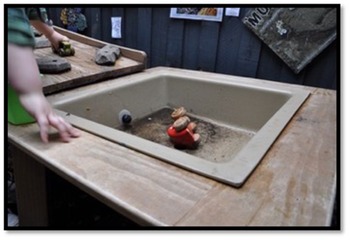
Sand often appears in posthuman early-childhood accounts (Hackett et al., Reference Hackett, MacLure and Pahl2020). In practice, sand and children meet across trays, pits and patches, engaging sensory and imaginative play. Yet sand can either be domesticated into developmental narratives or approached with the arts of noticing (Tsing, Reference Tsing2015), attending to geo-material histories and to sand’s lively excess beyond mastery (Hackett et al., Reference Hackett, MacLure and Pahl2020). One morning, children gathered at the mud/dirt patch (sandpit). A child released a feather, a small ceremony as it met the sand. Moist, versatile texture invited hands and tools; trucks and diggers filled and refilled. Children variously named the matter sand, dirt, mud, attuning to moisture and feel. As Brigstocke (Reference Brigstocke2021) notes, sand is “a semi-chaotic mixture of heterogeneous materials,” infinitely malleable and generative (4–6). With a sound recorder and headphones, children co-mapped the scene sonically. Scuffing and stomping on timber made “loud dust.” They increased pressure on vehicles to feel/hear changes, experiencing the fine-grained matter and experimenting with patterns, flows and rhythms (Figures 3 and 4). Human voices receded on playback; squeaks and rasps of granular matter took centre stage. What sounded like wind proved to be sand. Later, rain composed another register. Through a posthuman lens and the arts of noticing, these encounters are understood not as isolated moments but as ongoing material processes. Sand is not simply a passive resource for play, but an active participant in shaping sensory, relational and ecological experience.
Fine-grained intra-actions.

Dusty intra-actions.

Dusting off the granular matter
Most sand lies in deserts and on coasts; dunes house snakes, lizards, spiders and insects. Sand is the world’s second most used natural resource after water (Beiser, Reference Beiser2018), furnishing concrete, asphalt, glass and silicon – the infrastructures of modernity (Brigstocke, Reference Brigstocke2021). Despite abundance, usable construction sand is scarce: wind-eroded desert sand is often unsuitable for concrete, pushing extraction into rivers, lakes and seashores and fuelling black markets (Beiser, Reference Beiser2018). Intensive removal threatens riverine and marine ecosystems; roads themselves are mostly sand and gravel (Brigstocke, Reference Brigstocke2021).
Coastal change is accelerating under sea-level rise and storm regimes; modelling indicates substantial retreat of sandy coasts by 2100, with uneven regional burdens and socio-ecological risks (Vousdoukas et al., Reference Vousdoukas, Ranasinghe, Mentaschi, Plomaritis, Athanasiou, Luijendijk and Feyen2020). Popular summaries emphasise how coastal squeeze and erosion jeopardise habitats and settlements (Valentino, Reference Valentino2020). These trends foreground sand as political geology, not a limitless resource.
Dusty re-turning
Rather than a yes/no, Is the sand dust? opens complexity. It threads the Anthropocene, extractivism and inequality through children’s everyday encounters. Sand and dust are fragments of human bodies and of past lives; they also carry pollutants that demand action. Thinking with dust and sand, not merely about them, invites noticing, theorising and materialising our relations with the more-than-human. In this event, children connected dust with other nonhuman matter, engaging visually, texturally and sonically. Dust pedagogies helped convert a small question into a scale device, linking micro-encounters with macro structures and cultivating safe-and-just imaginaries in early learning spaces.
Small matter matters, planetary justice
This study demonstrates that small matter matters, doing significant pedagogical work within early childhood environments. Beginning with dust – tiny, lively, and often overlooked matter – this paper shows how relational, ethical and political learning can emerge without reducing environmental education to behaviour change or distant catastrophe. Dust operates as a scale device: when children look, listen and map together, local sensations loop into atmospheric, infrastructural and geological processes, returning to the here and now as new ways of noticing, moving and caring. These loops render Earth system dynamics sensible in developmentally responsive ways and cultivate distributed, rather than individualised, responsibility.
From this perspective, planetary (Earth system) justice begins with what already moves through children’s hands, breath and shared air, inviting attention to exposure, ventilation, procurement and the everyday infrastructures that organise livability in early learning spaces.
Dust pedagogies travel as modest, repeatable practices woven through everyday rhythms. They emerge when matter (re)patterns attention: when a dusty sill pulls thought toward wind and season; when a rasping grain invites bodies to move differently; or when a sudden dust flare in sunlight reveals a threshold moment requiring collective response. Rather than positioning learning as problem-solving, these pedagogical encounters draw children and educators into situated, sensory and more-than-human relations. They cultivate attunement, curiosity and co-composition, where care arises through intra-action rather than individual intention. In this sense, pedagogy becomes less a set of moral instructions and more a choreography of shared noticing and collective response.
These orientations depend on environments that make space for slow, sustained noticing. Time to pause, listen and follow how matter shifts across surfaces enables children and educators to experience how dust modulates and reorganises place. Attending to traces – marks, sounds, accumulations – keeps material agency perceptible. Revisiting images, maps and recordings supports ongoing collective meaning-making, where matter participates as an active collaborator. In practice, this may involve replaying sound recordings, revisiting microscope images, or extending children’s interpretations into documentation and planning, allowing small encounters to persist and accumulate across time.
Methodologically, this study contributes a creative microecologies approach that holds analytic work close to lived encounters. By composing multivocal accounts from fieldnotes, images and sounds, the research maintains openness while allowing children’s descriptors – such as loud dust or sticky dust – to shape pedagogical practice. This approach formalises a repertoire that includes diffractive analysis, sonic co-listening, low-power microscopy and inefficient mapping, enabling educators to work with particulate matter rather than simply teaching about it.
Conceptually, the paper refigures dust as a scale device linking micro encounters to Earth system dynamics and planetary justice, shifting responsibility from individual children toward collective, infrastructural and historical relations. Pedagogically, it identifies three repeatable heuristics – scale loops, threshold storytelling, and commons-making – that render planetary processes perceptible and discussable without instrumentalising children.
In conclusion, dust pedagogies reorient early childhood environmental education toward more-than-human co-composition, where learning emerges through entanglements of bodies, matter and place. Safe and just futures are not only imagined in distant policy arenas but are composed in the micropolitics of everyday life – in how air circulates, how materials gather and how shared spaces are negotiated. Attending to what small matter does makes planetary processes tangible, debatable and open to collective care, offering educators a grounded yet expansive way to engage young children with the complexities of the Anthropocene.
Acknowledgments
I acknowledge the children, the early learning centre and the more-than-human participants whose presence, relations and intra-actions made this research possible. Their contributions – human and nonhuman-were central to the co-creation of knowledge, pedagogical encounters and ecological attunements explored in this study. I also acknowledge my PhD supervisors, Professor Daniel X. Harris and Professor Linda Knight, for their generous intellectual guidance, critical provocations and sustained support throughout this research journey.
Ethical statement
Ethical approval for this research was obtained from the research ethics committee (HREC) of RMIT university (ethics application 24151).
Financial support
Yanina Carrizo was the recipient of an Australian Government Research Training Program (RTP) Scholarship, which supported the doctoral research underpinning this study.
Use of AI tools
Parts of this document were drafted with the assistance of Microsoft 365 Copilot and subsequently reviewed and edited for accuracy.
Author Biography
Yanina Carrizo is a Senior Lecturer in Early Childhood Education at Central Queensland University, based in Australia, and a registered early childhood teacher with over 18 years of experience in Australian and international contexts. She holds a Doctorate in Education from RMIT University. Her research investigates posthuman, new materialist and more-than-human approaches to early childhood education, focusing on environmental justice, sustainability and experimental pedagogies. Using multispecies ethnography and multisensory inquiry, she explores child–earth relations and microworlds, such as dust, as collaborators in ecological learning. Yanina is a member of the CREATE research centre and the LIFEE research cluster.



 Open access

