





Introduction
Native to arid areas of southwestern United States and northern Mexico (Sauer Reference Sauer1957), Palmer amaranth was first listed as a problem weed in 1989 in South Carolina in a survey conducted by the Southern Weed Science Society (Webster and Coble Reference Webster and Coble1997). In 2009, it was ranked as the most problematic weed in cotton (Gossypium hirsutum L.) production fields in the southern United States (Webster and Nichols Reference Webster and Nichols2012). By 2016, Palmer amaranth was ranked as the most troublesome weed in agronomic crops in the United States (WSSA 2016). Other species from the pigweed family, such as prostrate pigweed (Amaranthus graecizans L.), redroot pigweed (A. retroflexus L.), tumble pigweed (A. albus L.), and waterhemp [A. tuberculatus (Moq.) Sauer] have been reported to occur in Nebraska (Stubbendieck et al. Reference Stubbendieck, Friisoe and Bolick1994); however, Palmer amaranth infestation is comparatively recent. Widespread occurrence of Palmer amaranth has been observed in the last 5–7 yr in Nebraska, particularly in agronomic crop fields in south central, west central, and panhandle counties (Vieira et al. Reference Vieira, Samuelson, Alves, Gaines, Werle and Kruger2018).
Palmer amaranth is a summer annual broadleaf weed with an erect growth habit. It can reach up to 2.0 m tall, has an inflorescence 0.5 m long (Elmore Reference Elmore1990), and can produce up to 613,000 seeds per female plant (Keeley et al. Reference Keeley, Carter and Thullen1987). Palmer amaranth can emerge throughout the crop growing season (Jha and Norsworthy Reference Jha and Norsworthy2009) and has a vigorous growth rate (Jha et al. Reference Jha, Norsworthy, Riley, Bielenberg and Bridges2008b). Palmer amaranth has a greater plant volume, dry weight, and leaf area, as well as a 24%–62% higher growth rate than other pigweed species (Horak and Loughin Reference Horak and Loughin2000). Thus, Palmer amaranth is a competitive weed and can cause significant yield reductions in agronomic crops. For example, Massinga et al. (Reference Massinga, Currie, Horak and Boyer2001) reported yield losses of 11% and 91% with Palmer amaranth at densities of 0.5 and 8.0 plants m−2, respectively, in corn (Zea mays L.) in multiyear field experiments in Kansas. Klingaman and Oliver (Reference Klingaman and Oliver1994) reported soybean-yield losses of 17%–68% with Palmer amaranth density of 0.33–10 plants m−2 in Arkansas. Palmer amaranth is a dioecious species (i.e., male and female plants are separate), which results in wide genetic diversity, due to pollen-mediated gene flow (Oliveira et al. Reference Oliveira, Gaines, Patterson, Jhala, Irmak, Keenan and Knezevic2018) and rapid spread of herbicide-resistance alleles (Jhala et al. Reference Jhala, Norsworthy, Ganie, Sosnoskie, Beckie, Mallory-Smith, Liu, Wei, Wang and Stoltenberg2021).
The repeated use of the same herbicide or herbicides with the same site of action (SOA) resulted in the evolution of Palmer amaranth biotypes resistant to several herbicide SOAs, including inhibitors of microtubule polymerization (Group 3), acetolactate synthase (Group 2), photosystem II (Group 5), 5-enolpyruvylshikimate-3-phosphate synthase (Group 9), hydroxyphenylpyruvate dioxygenase (Group 27), protoporphyrinogen oxidase (PPO; Group 14), long-chain fatty acid inhibitors (Group 15), and synthetic auxin herbicides (Group 4) (Chahal et al. Reference Chahal, Aulakh, Mithila, Jhala, Price, Kelton and Sarunaite2015; Heap Reference Heap2020). The first case of glyphosate-resistant (GR) Palmer amaranth was confirmed in 2004 in Georgia (Culpepper et al. Reference Culpepper, Grey, Vencill, Kichler, Webster, Brown, York, Davis and Hanna2006). In Nebraska, a GR Palmer amaranth was confirmed in 2015 in south-central Nebraska in a field with repeated use of glyphosate in a GR corn–soybean crop rotation (Chahal et al. Reference Chahal, Varanasi, Jugulam and Jhala2017); as of 2020, it is widespread in several Nebraska counties (Vieira et al. Reference Vieira, Samuelson, Alves, Gaines, Werle and Kruger2018).
Management of GR Palmer amaranth in no-till corn and soybean production systems is primarily dependent on sequential herbicide programs of residual herbicides applied at planting, followed by a POST herbicide when plants are less than 15 cm tall (Chahal et al. Reference Chahal, Varanasi, Jugulam and Jhala2017; Chahal and Jhala Reference Chahal and Jhala2018; Sarangi and Jhala Reference Sarangi and Jhala2019). Most weed management decisions are based on potential yield loss compared to the cost of weed management; however, weed escapes from POST herbicide and late-season weed emergence are usually ignored once normal yield has been achieved (Bagavathiannan and Norsworthy Reference Bagavathiannan and Norsworthy2012). Considering the late-season emergence pattern and prolific seed production of Palmer amaranth, seeds from a few late-emerged female plants can contribute substantially to the seedbank (Jha and Norsworthy Reference Jha and Norsworthy2009). Therefore, labeled late-season herbicides should be investigated, particularly in soybean fields where no PRE herbicide was applied and POST herbicide is the only option in a no-till production system. Furthermore, late-season, sequential herbicide applications would not only suppress weed cohorts (Walker and Oliver Reference Walker and Oliver2008) but also diminish the seed production of the surviving plants, leading to a reduction in seedbank replenishment (Bennett and Shaw Reference Bennett and Shaw2000). For example, Jha and Norsworthy (Reference Jha and Norsworthy2012) reported 95%, 95%, 94%, and 81% reduction in seed production of GR Palmer amaranth by late-season application of dicamba, 2,4-D, glufosinate, and glyphosate, respectively, in bare-ground field experiments in Arkansas.
Dicamba- and glyphosate-resistant (DGR) soybean came to the market in the 2017 growing season in the United States. Growers in Nebraska and several other states have adopted DGR soybean primarily for control of GR weeds such as waterhemp and Palmer amaranth with single or sequential applications of dicamba (Chaudhari et al. Reference Chaudhari, Jordan, York, Jennings, Cahoon, Chandi and Inman2017; Meyer et al. Reference Meyer, Norsworthy, Young, Steckel, Bradley, Johnson, Loux, Davis, Kruger, Bararpour, Ikley, Spaunhorst and Butts2015; Norsworthy et al. Reference Norsworthy, Griffith, Scott, Smith and Oliver2008). Low-volatility formulations of dicamba can be applied in single or sequential applications from preplant up to R1 (i.e., the first fully open flower) in DGR soybean (Anonymous 2017b). The U.S. Environmental Protection Agency recently approved registration of three dicamba products (Engenia®, BASF, Research Triangle Park, NC; Tavium®, Syngenta Crop Protection, Greensboro, NC; and XtendiMax®, Bayer CropScience, St. Louis, MO) for 5 yr with the nationwide cutoff date of June 30 regardless of soybean growth stage (SGS) (USEPA 2020).
Dicamba should be applied when Palmer amaranth is less than 10 cm tall to achieve optimal control; however, soybean growers often apply POST herbicides when Palmer amaranth is variable in height, including taller than 10 cm. When Palmer amaranth is taller than label-recommended height, the efficacy of POST herbicides can be compromised (Crow et al. Reference Crow, Steckel, Mueller and Hayes2016). The effect of herbicides applied late in the season on Palmer amaranth inflorescence development and fecundity in DGR soybean is not understood. In addition, PPO-inhibiting herbicides such as acifluorfen, fomesafen, and lactofen have been used for control of GR waterhemp and Palmer amaranth in soybean (Chaudhari et al. Reference Chaudhari, Jordan, York, Jennings, Cahoon, Chandi and Inman2017, Norsworthy et al. Reference Norsworthy, Griffith, Scott, Smith and Oliver2008). The PPO-inhibiting herbicides can be applied late in the season in soybean, depending on product used. Lactofen and acifluorfen can be applied as late as 45 d and 50 d prior to harvest, respectively (Anonymous 2015, 2019b). A premix of fomesafen and fluthiacet-methyl (Marvel®, FMC Corporation, Philadelphia, PA) can be applied up to R3 or up to 60 d prior to harvest (Anonymous 2017a).
The effect of labeled POST herbicides on Palmer amaranth seed production and seed viability is not known when the herbicides are applied late in the season in single or sequential applications in DGR soybean. The objectives of this study were to evaluate single or sequential applications of labeled POST herbicides such as acifluorfen, dicamba, fomesafen and fluthiacet-methyl (referred to as fomesafen/fluthiacet hereafter), glyphosate, and lactofen on control, biomass, density, seed production, and seed viability of GR Palmer amaranth in DGR soybean as well as their effect on soybean yield in Nebraska.
Materials and Methods
Site Description
Field experiments were conducted in 2018 and 2019 growing seasons near Carleton, NE (40.31°N, 97.67°W), in a grower’s field under dryland conditions with confirmed GR Palmer amaranth. The level of glyphosate resistance in this biotype is 37- to 40-fold compared with susceptible biotypes (Chahal et al. Reference Chahal, Varanasi, Jugulam and Jhala2017). Palmer amaranth was the predominant weed species at the research site. The soil at the experimental site was silt loam with 63% silt, 19% sand, 18% clay, 2.63% organic matter, and pH of 4.8. The previous crop was soybean and the field was historically in a GR corn–soybean production system with reliance on glyphosate for weed control.
Experiment Design and Treatments
The experiment was laid out in a randomized complete block design with four replications. Herbicide programs consisted of single or sequential POST applications of acifluorfen, dicamba, fomesafen and fluthiacet premix, glyphosate, and lactofen at different SGS and a nontreated control for comparison (Table 1). Herbicide application timings were selected on the basis of label cutoffs as well as to keep a meaningful interval between sequential applications. For example, dicamba can be applied at a maximum up to R1 in DGR soybean (Anonymous 2017b), so we selected V4 or R1 SGS for a single application and V4 followed by R1 for sequential applications. Dicamba at R3 is not labeled and it was included for research purposes. Glyphosate was applied at V4 or R1 in a single application and V4 followed by R1 in sequential applications. In contrast, PPO inhibitors in soybean can be applied late in the season as long as 45–55 d of harvest interval is maintained, depending on product (Anonymous 2015; 2017a; 2019b). Therefore, acifluorfen or fomesafen was applied at R1 or R6 in a single application and R1 followed by R6 in sequential applications (Table 1). Herbicides were applied at V4, V5, R1, R3, and R6 SGS, and corresponding Palmer amaranth height at the time of herbicide application was 9–12 cm, 12–20 cm, 30–40 cm, 45–55 cm, and 75–90 cm, respectively. Individual plot dimensions were 3 m wide and 9 m long, accommodating four rows of soybean.
List of herbicide products, rates, manufacturers, and adjuvants used in field studies to evaluate effect of late-season herbicide application on seed production of glyphosate-resistant Palmer amaranth at Carleton, NE, in 2018 and 2019.
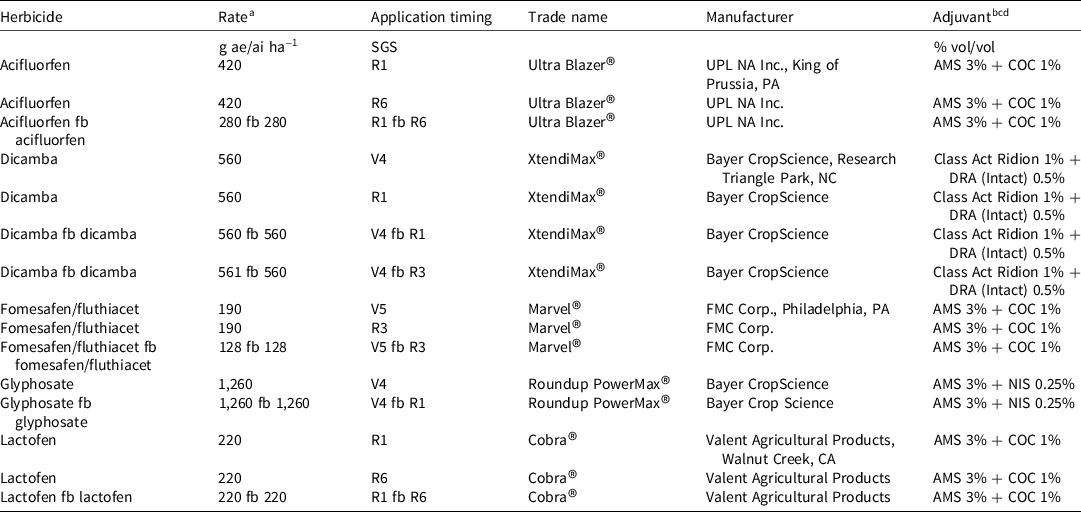
aAbbreviations: AMS, ammonium sulfate; COC, crop oil concentrate; DRA, drift-reducing agent; fb, followed by; NIS, nonionic surfactant (Induce Helena Chemical Co., Collierville, TN); SGS, soybean growth stage.
bAmmonium sulfate source was DSM Chemicals North America Inc., Augusta, GA.
cIntactTM; Precision Laboratories LLC, Waukegan, IL.
dNonionic surfactant was Induce (Helena Chemical Co., Collierville, TN).
The DGR soybean (S29 K3X; Syngenta, Greensboro, NC) was no-till planted on May 10, 2018, and May 16, 2019. Palmer amaranth was allowed to coexist with soybean until the respective herbicide application time. No PRE herbicide was applied in this study. Herbicide applications were made with a handheld CO2-pressurized backpack sprayer equipped with five nozzles spaced 51 cm apart and calibrated to deliver 140 L ha−1 at 276 kPa at a constant speed of 4.8 km h−1; TTI 11005 flat-fan nozzles (TeeJet® Technologies; Spraying Systems Co., Wheaton, IL) were used for dicamba applications, and AIXR 110015 flat-fan nozzles (TeeJet® Technologies) were used for all other herbicides.
Data Collection
Visual estimates of Palmer amaranth control were completed weekly after herbicide application until the end of season, using a scale 0% to 100%, with 0% representing no control and 100% representing complete control. Soybean injury was accessed on a scale of 0% to 100%, with 0% representing no injury and 100% representing plant death at 7, 14, and 28 d after treatment (DAT). At 21 d after the single or sequential herbicide application, a 1-m2 quadrant was randomly placed between the middle two soybean rows within the corresponding plot, and Palmer amaranth density, height, and biomass data were collected. Aboveground biomass was obtained by clipping surviving Palmer amaranth plants at the soil surface; harvested plants were then oven-dried in paper bags at 65 C for 10 d, and dry weight was recorded.
When Palmer amaranth reached maturity, data on density, height, and biomass were collected from a randomly placed 1-m2 quadrat within each plot, and up to 10 female plants were collected from each plot. Plants were clipped at the soil surface and dried at 25 C for 14 d and weighed. Seed heads were stripped from plant stems, and seeds were separated by passing the threshed material through a series of standard laboratory sieves with mesh size ranging from 0.5 to 3.35 mm. Material collected from the 0.50-mm sieve was further processed using a seed cleaner that used air to remove the lighter floral chaff from Palmer amaranth seeds (Sosnoskie et al. Reference Sosnoskie, Webster, Grey and Culpepper2014). Seeds were thoroughly cleaned, and the seed weight and number of seeds per female plant were determined. Temperature and rainfall data for the 2018 and 2019 growing seasons were obtained from the nearest High Plains Regional Climate Center, located near Hebron, NE (Table 2).
Average monthly air temperature and total precipitation during 2018 and 2019 growing seasons (May to September) compared with the 30-yr average at Carleton, NE.

a Air temperature and precipitation data were obtained from the High Plains Regional Climate Center located in Hebron, NE (https://hprcc.unl.edu/).
Seed Viability Test
A subsample of 100 seeds of Palmer amaranth was randomly selected from each plot and placed on two layers of filter paper (Whatman No.2; Fisher Scientific, Suwanee, GA) soaked in deionized water in a 10-cm-diam Petri dish (Fisher Scientific). The seed incubator was set in a 16-h photoperiod with 30 C/24 C day/night temperature for 14 d. Germination was evaluated on the basis of radicle protrusion from the seed (Jha and Norsworthy Reference Jha and Norsworthy2012; Jha et al. Reference Jha, Norsworthy and Bridges2010; Steckel et al. Reference Steckel, Sprague, Stoller and Wax2004), and germinated seeds were counted and removed from the Petri dish on alternate days. By the end of the incubation period, nongerminated seeds were subjected to a crush test (Sawma and Mohler Reference Sawma and Mohler2002) to determine viability. Seed viability was calculated as a percentage of total seeds that germinated plus the seeds that tested positive in the crush test.
Statistical Analysis
Data were subjected to ANOVA to test for significance of fixed and random effects. Statistical analysis was performed in R, using the base package (R Core Team 2018). ANOVA was performed using the aov function with treatment and year as fixed effects. Replication nested within years were considered a random effect in the model. If year-by-treatment interactions were significant, data were analyzed separately among years. Palmer amaranth control, biomass, density, plant height, seed production, and seed viability data were square-root transformed before analysis to improve the homogeneity of variances and normality of the residuals. Back-transformed mean values are presented on the basis of interpretation from the transformed values. Treatment means were separated at P ≤ 0.05 using Fisher protected LSD tests with the LSD.test function.
Results and Discussion
Palmer amaranth density, biomass, height, seed production, and soybean yields were different between years; therefore, data are presented separately. No soybean injury was observed from dicamba or glyphosate applications; however, PPO inhibitors resulted in 10%–20% soybean injury at 14 DAT and no injury 28 DAT (data not shown).
Temperature and Precipitation
Temperature in the 2018 and 2019 growing seasons was mostly similar to the 30-yr average at the research site; however, early-season temperatures varied between years (Table 2). The growing season in 2018 started off warmer, with average temperatures of 20.6 C and 25.0 C compared with 14.5 C and 21.8 C in 2019 in May and June, respectively. Monthly precipitation varied from the 30-yr average during both years of the study. In contrast, above-average precipitation was observed throughout the 2019 growing season (Table 2).
Palmer Amaranth Control
Dicamba applied at V4 or in sequential applications (V4 followed by R1 or R3) controlled GR Palmer amaranth 93%–97% in 2018 and 86%–95% in 2019 at 21 DAT (data not shown). A single application of dicamba at R1 controlled Palmer amaranth 75%–6%. This might be due to increased plant height at the time of application that resulted in less coverage. Dicamba is labeled for application until R1 in DGR soybean (Anonymous 2017b) or the end of June from 2021 growing season (USEPA 2020); therefore, dicamba application at R3 in this study was off-label and included for research purpose. Norsworthy et al. (Reference Norsworthy, Griffith, Scott, Smith and Oliver2008) reported that dicamba applied POST when GR Palmer amaranth was 94 cm and 64 cm tall provided 40% and 52% control, respectively. Delayed application of dicamba, however, might reduce the efficacy. For instance, Jha and Norsworthy (Reference Jha and Norsworthy2012) reported 40%–62% GR Palmer amaranth control when plants were sprayed at first sight of inflorescence.
Sequential applications of acifluorfen or lactofen provided 76% and 78%, and 82% and 75% control of GR Palmer amaranth 21 DAT in 2018 and 2019, respectively, compared with 80% and 72% control with fomesafen/fluthiacet (data not shown). As expected, the delay in herbicide application resulted in reduced Palmer amaranth control. Mayo et al. (Reference Mayo, Horak, Peterson and Boyer1995) reported a similar decline in Palmer amaranth control from 35% to 18% and 99% to 56% when acifluorfen and lactofen were applied at 14 and 28 d after soybean planting, respectively. Furthermore, Franca et al. (Reference Franca, Dodds, Butts, Kruger, Reynolds, Mills, Bond, Catchot and Peterson2020) reported 52%–67% control of Palmer amaranth with lactofen or acifluorfen when plants were 15 cm tall at the time of application. Similarly, Gizotti de Moraes (Reference Gizotti de Moraes2018) reported 40% and 54% control of Palmer amaranth with fomesafen and lactofen, respectively, when plants were at flowering stage (15–58 cm tall).
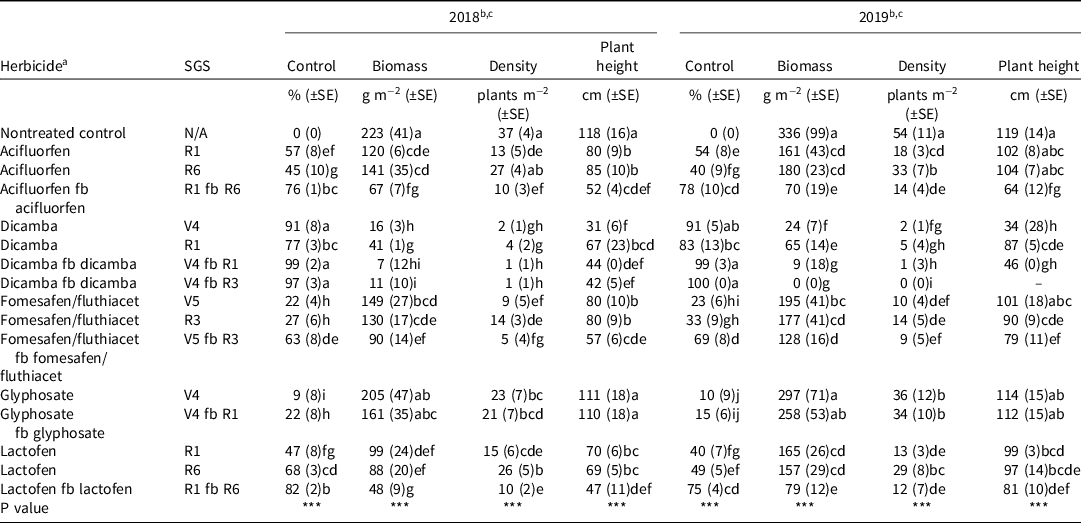
Glyphosate applied in a single or sequential applications resulted in 9%–22% control of GR Palmer amaranth before soybean harvest, indicating uniform presence of predominantly GR Palmer amaranth at the research site (Table 3). Dicamba applied at V4 was as effective as sequential applications at V4 followed by R1 or R3 and resulted in 91%–100% control of GR Palmer amaranth during both years. A single application of dicamba at R1 provided 77% and 83% control in 2018 and 2019, respectively, and it was comparable with sequential applications of acifluorfen (76% and 78%, respectively) or lactofen (82% and 79%, respectively). Reduced Palmer amaranth control when dicamba was applied at R1 compared with V4 can be attributed to increased Palmer amaranth height at herbicide application timing.
Glyphosate-resistant Palmer amaranth control, biomass, density, and height at soybean harvest applied as single or sequential application of POST herbicides applied in field experiments conducted at Carleton, NE in 2018 and 2019. Year by treatment interaction was significant; therefore, data were analyzed separately for both years.
a Abbreviations: N/A, not applicable; R1, soybean with at least one flower on any node; R3, pods with 5 mm at one of the four uppermost nodes; R6, pod containing a green seed that fills the pod capacity at one of the four uppermost nodes on the main stem; SGS, soybean growth stage; V4, soybean at fourth trifoliate stage; V5, soybean at fifth trifoliate stage.
b Means presented within the same column and with no common letter(s) are significantly different according to Fisher protected LSD test.
c Significance level: ***P ≤ 0.001.
Palmer Amaranth Density and Biomass
At soybean harvest, a single application of dicamba at V4 or sequential applications reduced Palmer amaranth density as low as 2 or fewer plants m−2 compared with 5 or fewer plants m−2 with dicamba in a single application at R1 (Table 3). Similarly, Coffman et al. (Reference Coffman, Barber, Norsworthy and Kruger2020) reported Palmer amaranth densities of 7% and 19% of the nontreated control 21 d after dicamba application at 560 g ae ha−1. The PPO inhibitors acifluorfen, lactofen, or fomesafen and fluthiacet applied in a single application at early SGS or in sequential applications were usually comparable and reduced Palmer amaranth density to not more than 15 plants m−2. Palmer amaranth densities in the nontreated control were 37 and 54 plants m−2 in 2018 and 2019, respectively, indicating that most herbicide programs tested in this study reduced Palmer amaranth density (Table 3).
Sequential dicamba applications at V4 followed by R1 or R3 resulted in Palmer amaranth biomass of less than 20 g m−2 21 DAT during both years (data not shown). Similarly, Norsworthy et al. (Reference Norsworthy, Griffith, Scott, Smith and Oliver2008) reported 70% reduction in GR Palmer amaranth shoot biomass compared with the nontreated control after a single dicamba application at 280 g ae ha−1 when plants were at 6-leaf stage. In addition, Chahal et al. (Reference Chahal, Varanasi, Jugulam and Jhala2017) reported an 87% GR Palmer amaranth biomass reduction with dicamba when plants were 8–10 cm tall. Lillie et al. (Reference Lillie, Giacomini and Tranel2020) reported that Palmer amaranth height at the time of POST application of PPO inhibitors can affect their efficacy. For example, Palmer amaranth shoot biomass was 30% of the nontreated control when plants were sprayed at 8–10 cm height, compared with 70% from plants sprayed at 13 to 15 cm height. Similarly, Gossett and Toler (Reference Gossett and Toler1999) reported 75%–81% and 85%–91% Palmer amaranth control with acifluorfen (280 g ai ha−1) and lactofen (220 g ai ha−1), respectively, when plants were 4–8 cm tall at the time of application. Jhala et al. (Reference Jhala, Sandell, Rana, Kruger and Knezevic2014) reported 99% Palmer amaranth control in a greenhouse study when 10- to 12-cm tall plants were sprayed with lactofen (210 g ai ha−1). In addition, Chahal et al. (Reference Chahal, Varanasi, Jugulam and Jhala2017) reported 71%, 49%, and 62% GR Palmer amaranth biomass reduction with fomesafen and fluthiacet, acifluorfen, and lactofen, respectively, in a greenhouse study.
Palmer amaranth biomass at the end of the season was higher in nontreated control compared with herbicides, with the exception of glyphosate applied in single or sequential applications (Table 3). Dicamba applied at V4 or sequential applications at V4 followed by R1 or R3 were the most effective at reducing Palmer amaranth biomass to less than 24 g m−2. Sequential applications of acifluorfen or lactofen were comparable with less than 70 g m−2 Palmer amaranth biomass in 2018 and less than 80 g m−2 in 2019. Single application of PPO-inhibiting herbicides were mostly similar throughout the study, with Palmer amaranth biomass ranging from 88 to 149 g m−2 in 2018 and 157 to 195 g m−2 in 2019. Similarly, Gossett and Toler (Reference Gossett and Toler1999) reported 37% Palmer amaranth biomass reduction at soybean harvest with acifluorfen applied 21 d after soybean planting.
Palmer Amaranth Height
Dicamba applied alone or in sequential applications reduced Palmer amaranth height 34–87 cm compared with 119 cm in nontreated control at soybean harvest (Table 3). Glyphosate applied at V4 or V4 followed by R1 did not reduce Palmer amaranth height. Although most of the studies for management of GR Palmer amaranth did not present the effect of herbicides on plant height, late-season herbicide application is known to affect weed height. For instance, Ganie et al. (Reference Ganie, Kaur, Jha, Kumar and Jhala2018) observed that GR giant ragweed (Ambrosia trifida L.) height decreased from 61 cm in the nontreated control to 23 cm and 24 cm after single and sequential dicamba applications, respectively..
Palmer Amaranth Seed Production
The highest Palmer amaranth seed production was in the nontreated control in 2018 (25,800 seeds per female plant) and 2019 (34,300 seeds per female plant) (Table 4). Webster and Grey (Reference Webster and Grey2015) reported that a single female Palmer amaranth plant can produce 832,000 seeds without crop competition; however, seed production was reduced by 50% when plants were competing with cotton in a field study in Georgia. Single or sequential glyphosate applications did not reduce GR Palmer amaranth seed production; it was similar to the nontreated control in 2018 (Table 4). This was expected because of the presence of a GR Palmer amaranth at the research site. In contrast, Jha and Norsworthy (Reference Jha and Norsworthy2012) reported up to 81% reduction in GR Palmer amaranth seed production, with a single glyphosate application at 870 g ae ha−1.
Glyphosate-resistant Palmer amaranth characteristics affected by POST herbicides in field experiments conducted at Carleton, NE, in 2018 and 2019. a

a Year-by-treatment interaction was significant; therefore, data were analyzed separately for both years.
b Abbreviations: N/A, not applicable because of no plant survival; R1, soybean with at least one flower on any node; R3, pods with 5 mm at one of the four uppermost nodes; R6, pod containing a green seed that fills the pod capacity at one of the four uppermost nodes on the main stem; SGS, soybean growth stage; V4, soybean at fourth trifoliate stage; V5, soybean at fifth trifoliate stage.
c Means presented within the same column and with no common letter(s) are significantly different according to Fisher’s protected LSD test.
d Significance level: –, nonsignificant at α = 0.05; ***P ≤ 0.001.
Dicamba applied at V4 followed by R3 resulted in zero Palmer amaranth seed production (Table 4); however, dicamba application at R3 is not labeled, so it cannot be recommended and it was included for a comparison. Dicamba applied in single or sequential applications reduced GR Palmer amaranth seed production to the range of 557–2,911 seeds plant−1; however, it was comparable with a sequential applications of acifluorfen, fomesafen/fluthiacet, or lactofen during both years (Table 4). Influence of dicamba on seed production of Palmer amaranth was similar to previous studies indicating dicamba resulted in a greater than 75% reduction in seed production (Jha and Norsworthy Reference Jha and Norsworthy2012). Fawcett and Slife (Reference Fawcett and Slife1978) reported that 2,4-D applied at 1,100 g ae ha−1 at the early flowering stage reduced seed production of redroot pigweed by 84%. Thus, 2,4-D or dicamba can significantly reduce broadleaf weed seed production even if applied late in the season.
Palmer Amaranth Seed Viability
Palmer amaranth seed viability was in the range of 87% to 97%, with no difference among treatments and similar to the nontreated control (Table 4), indicating that single or sequential herbicide applications had no effect on seed viability. Similarly, Taylor and Oliver (Reference Taylor and Oliver1997) reported that seed viability of sicklepod [Senna obtusifolia (L.) Irwin & Barneby] was at least 90% with dicamba, glyphosate, glufosinate, or paraquat applied at bud formation, flowering to 9-cm pod, or 15- to 30-cm pod stages. In contrast, Jha and Norsworthy (Reference Jha and Norsworthy2012) reported that GR Palmer amaranth seed viability was 52% and 61% with dicamba and glyphosate, respectively, when plants were sprayed at first sight of inflorescence compared with 97% seed viability in a nontreated control.
Soybean Yield
Soybean yield was dramatically less in 2018 compared with 2019, most likely because of the drier weather in 2018 (Table 2). A single application of dicamba at V4 or sequential applications resulted in the highest soybean yield during both years of the study (Table 4). In 2018, soybean yield in nontreated control was 492 kg ha−1, which was comparable to yield after a single application of glyphosate or PPO inhibitors. Overall, the lowest soybean yields were observed with a single herbicide application compared with sequential applications. Similarly, Jha et al. (Reference Jha, Norsworthy, Bridges and Riley2008a) reported that a single glyphosate application at V6 resulted in 1,850 kg ha−1 soybean yield compared with 2,020 and 2,490 kg ha−1 when glyphosate was applied at V3 and at V3 followed by V6, respectively.
Practical Implications
Management of GR Palmer amaranth is challenging for soybean growers, particularly with POST herbicides, because effective herbicide options available are limited compared with those in corn. From the results of this study, we conclude that when dicamba was applied to DGR soybean in a single or sequential applications, it provided effective control of GR Palmer amaranth and reduced biomass, density, and seed production; however, sequential applications of dicamba should not be a regular practice and should only be considered where a PRE herbicide is not applied. This is because relying only on dicamba increases the selection intensity for the evolution of dicamba-resistant weeds. For instance, dicamba-resistant Palmer amaranth has been confirmed in Kansas (Peterson et al. Reference Peterson, Jugulam, Shyam and Bortago2019) and recently in Tennessee. The 2020 registration of three dicamba products [(Engenia®, Tavium®, and XtendiMax®) require that they cannot be applied after June 30 (USEPA 2020); therefore, application of these products at R1 would not be possible unless DGR soybean is planted early. A premix of dicamba and S-metolachlor (Tavium®) has been labeled and can be applied in DGR soybean up to V4 (Anonymous 2019a).
The PPO-inhibiting herbicides such as acifluorfen, lactofen, or fomesafen were not as effective as dicamba for control of GR Palmer amaranth in this study; however, they were effective when applied in sequential applications for reducing Palmer amaranth seed production. This is because PPO-inhibiting herbicides were applied late in the season (at R1 or R6), compared with dicamba (V4 or R1), when Palmer amaranth was relatively tall to be effectively controlled. Therefore, if growers are not able to apply PRE herbicide at soybean planting for GR Palmer amaranth control, they can consider sequential applications of a PPO-inhibiting herbicide that would reduce Palmer amaranth seed production because PPO-inhibiting herbicides can be applied in all type of soybean, including conventional soybean (Sarangi and Jhala Reference Sarangi and Jhala2019). This should be considered as a rescue plan to reduce Palmer amaranth seed production and seedbank replenishment and should not be implemented in each field, because repeated application of herbicide with the same SOA increases the selection pressure. In fact, a PPO-inhibiting herbicide–resistant Palmer amaranth (Oliveira et al. Reference Oliveira, Giacomini, Arsenijevic, Vieira, Tranel and Werle2020) and waterhemp (Sarangi et al. Reference Sarangi, Stephens, Barker, Patterson, Gaines and Jhala2019) have been confirmed in Nebraska and a few other states in the United States (Heap Reference Heap2020).
Acknowledgments
The authors acknowledge the help of Irvin Schleufer, Shawn McDonald, Jasmine Mausbach, Will Neels, and Adam Leise. This project was partially supported by the Nebraska Agricultural Experiment Station with funding from the Hatch Act through the U.S. Department of Agriculture (USDA) National Institute of Food and Agriculture Project No. NEB-22-396. This project was also supported by the USDA National Institute of Food and Agriculture’s Nebraska Extension Implementation Program, and the Nebraska Soybean Board. No conflicts of interest have been declared.


 Open access

