

Introduction
In times of ageing workforces, strategies to extend the working life gain in importance. Currently, early exit routes from employment are reduced in many countries as a reaction to the demographic change. Moreover, older workers are encouraged to work longer (Conen et al., Reference Conen, Henkens and Schippers2014). While today more employers are promoting sustainable employability (Pak et al., Reference Pak, Kooij, Lange and van Veldhoven2019), the responsibility for maintaining the employability still largely rests with the workers themselves. The rapid changes in today's labour market and working life bring about new needs for adjustment among older workers, to guard against risks for an increasing person–job misfit and earlier exit from working life (Wong and Tetrick, Reference Wong and Tetrick2017). Active strategies to maintain or promote person–job fit, health, work ability, motivation and – subsequently – employment participation of older workers may be occupational changes (Moen et al., Reference Moen, Kojola, Kelly and Karakaya2016; Canivet et al., Reference Canivet, Aronsson, Bernhard-Oettel, Leineweber, Moghaddassi, Stengård, Westerlund and Östergren2017).
Various disciplines, such as psychology, sociology, economics and occupational health, deal with occupational change – all from their own perspective. Therefore, reviewing occupational change literature offers different understandings and operationalisation of occupational changes (Bailey and Hansson, Reference Bailey and Hansson1995; Liljegren and Ekberg, Reference Liljegren and Ekberg2008; Nouri and Parker, Reference Nouri and Parker2013; Mantler et al., Reference Mantler, Godin, Cameron and Horsburgh2015; Canivet et al., Reference Canivet, Aronsson, Bernhard-Oettel, Leineweber, Moghaddassi, Stengård, Westerlund and Östergren2017; Fernet et al., Reference Fernet, Trépanier, Demers and Austin2017; Hom et al., Reference Hom, Lee, Shaw and Hausknecht2017; Rubenstein et al., Reference Rubenstein, Eberly, Lee and Mitchell2018). Three forms of occupational change may be differentiated:
(1) A change of profession, meaning a change from one profession to another, which is often accompanied by retraining or further education and may end in a changed professional identity. An example is a change from salesperson to bus driver.
(2) A change of employer, meaning a change from one employer to another, typically while continuing to practise the same profession. Depending on the discipline, researchers use alternative terms such as turnover, transition, (external) job mobility or career change (Trevor, Reference Trevor2001; Morris, Reference Morris2009; Hom et al., Reference Hom, Mitchell, Lee and Griffeth2012; Alcover and Topa, Reference Alcover and Topa2018).
(3) A change of work tasks, meaning a change of work tasks within the workplace without changing profession or employer, e.g. by adding, omitting or modifying tasks.
The comparative investigation of these three forms of occupational change is rare. The only scientific publication differentiating between these forms known to the authors is provided by Feldman and Ng (Reference Feldman and Ng2007), who review factors that enable or discourage employees to change profession, employer or jobs. With this broad conception of occupational change in mind, occupational changes may today be the rule rather than the exception among workers, not least in times of ageing work forces.
However, occupational changes pose a greater challenge for older workers than for younger workers. With increasing age, employees face age-related individual alterations in, for example, health, work ability or motivation, with work constituting one of the many underlying causes (Crawford et al., Reference Crawford, Graveling, Cowie and Dixon2010; Kenny et al., Reference Kenny, Groeller, McGinn and Flouris2016). Furthermore, there is a range of obstacles to occupational changes in later working life such as reduced envisaged pension entitlements, risk of wage loss, fear of insufficient qualifications, work identity, age stereotypes, being in a safe employment position or high security needs. Not least, the devaluation of experience, specific knowledge and skills acquired over years makes a change of profession or employer difficult (Bailey and Hansson, Reference Bailey and Hansson1995). Even if wanted, many older workers may not initiate a change or retraining anymore, considering it to be ‘too late’. They then tend to stay in the (potentially inappropriate) work situation or consider retiring earlier (Canivet et al., Reference Canivet, Aronsson, Bernhard-Oettel, Leineweber, Moghaddassi, Stengård, Westerlund and Östergren2017). Thus, older workers may be reluctant to such changes, although research findings indicate that occupational change may sustain health and motivation (Canivet et al., Reference Canivet, Aronsson, Bernhard-Oettel, Leineweber, Moghaddassi, Stengård, Westerlund and Östergren2017; Wong and Tetrick, Reference Wong and Tetrick2017).
The three types of occupational change differ in their ways as to how they contribute to the sustainable employability of older workers. Changes of profession have the potential to leave professions with characteristic high mental or physical work demands, such as roofing, construction work or nursing, and workers may change to professions with a less-demanding work content (Aleksandrowicz et al., Reference Aleksandrowicz, Zieschang, Bräunig and Jahn2014). In contrast, job factors more related to work organisation, such as the quality of leadership and of social relations at work, are approved drivers for employer changes (De Raeve et al., Reference De Raeve, Jansen, van den Brandt, Vasse and Kant2008); this includes work–family incompatibilities (van Hooft et al., Reference van Hooft, Born, Taris and van der Flier2005). Here, a change of employer may bring along the improvement of such job factors without the need for a change of profession. While the first two forms of change require substantial efforts and individual risk taking, the third form, change of work tasks at the current workplace, may constitute low-risk – often stepwise and even reversible – solutions when the workers’ resources and/or interests do not fit to the work demands. Such adaption of the work tasks on their own initiative may, for example, be part of a job crafting behaviour (Wong and Tetrick, Reference Wong and Tetrick2017).
In the context of extending working lives, there is a need to understand better occupational changes of older workers. In today's research we find both – much scientific evidence on occupational change, but also evident research gaps. Most research and most theory is about changing employers. Here, cross-sectional studies are particularly common (Allen et al., Reference Allen, Hancock, Vardaman and Mckee2014), the use of samples of specific occupational groups or employees of a particular organisation (Liljegren and Ekberg, Reference Liljegren and Ekberg2008; Morris, Reference Morris2009; Simon et al., Reference Simon, Müller and Hasselhorn2010; Jahn and Ulbricht, Reference Jahn and Ulbricht2011; Reineholm et al., Reference Reineholm, Gustavsson, Liljegren and Ekberg2012; Nouri and Parker, Reference Nouri and Parker2013; Mantler et al., Reference Mantler, Godin, Cameron and Horsburgh2015; Fernet et al., Reference Fernet, Trépanier, Demers and Austin2017), the investigation of determinants of employer changes (Rubenstein et al., Reference Rubenstein, Eberly, Lee and Mitchell2018) and investigations focusing on younger employees (Nouri and Parker, Reference Nouri and Parker2013) or explicitly excluding older workers from the sample, because diverging causes and mechanisms are assumed (Adams, Reference Adams2004). Voluntary employer changes were found to have the potential to improve adverse psycho-social working conditions as well as health and work ability for the workers (Liljegren and Ekberg, Reference Liljegren and Ekberg2009; Garthe and Hasselhorn, Reference Garthe and Hasselhorn2020). Other researchers found a positive effect of voluntary employer changes on the workers’ job satisfaction (Boswell et al., Reference Boswell, Shipp, Payne and Culbertson2009; Chadi and Hetschko, Reference Chadi and Hetschko2014). For Germany, Grund (Reference Grund2009) confirmed that an employer change often resulted in a higher income level, more appropriate working hours, more job security, better possibilities for promotion, and a better match between person and work tasks. Significantly less research is found on changing the profession at higher working age; a focus lies on the nursing profession (Simon et al., Reference Simon, Müller and Hasselhorn2010; Fernet et al., Reference Fernet, Trépanier, Demers and Austin2017), qualitative investigations (Jahn and Ulbricht, Reference Jahn and Ulbricht2011) and only a few studies address older workers (e.g. Carless and Arnup, Reference Carless and Arnup2011). Australian researchers found that older workers and workers with a high tenure are less likely to change professions and that changes resulted in higher job satisfaction and reduced working hours (Carless and Arnup, Reference Carless and Arnup2011). Research from Germany showed that a change of profession resulted in a higher income level (Nisic and Trübswetter, Reference Nisic and Trübswetter2012). Canivet et al. (Reference Canivet, Aronsson, Bernhard-Oettel, Leineweber, Moghaddassi, Stengård, Westerlund and Östergren2017) investigated another aspect of changes of profession. They confirmed that continued work in a non-desired profession has negative effects on mental health. Research on changes of work tasks usually takes place as part of research on job crafting (Tims et al., Reference Tims, Bakker and Derks2013; Wong and Tetrick, Reference Wong and Tetrick2017). Job crafting encompasses changes of tasks as well as social and cognitive aspects of the job which are initiated by the employee in order to improve the person–work fit and work motivation (Wong and Tetrick, Reference Wong and Tetrick2017). Studies on job crafting interventions found that job crafting even has the potential to increase the work engagement of older workers, especially among workers with a high workload (Kooij et al., Reference Kooij, Nijssen, Bal, van der Kruijssen and Truxillo2020; Kuijpers et al., Reference Kuijpers, Kooij and van Woerkom2020).
Considering the risks and obstacles for change among older workers, two aspects may be particularly important to investigate: whether a change occurs voluntarily or involuntarily (Hom et al., Reference Hom, Lee, Shaw and Hausknecht2017) and whether a change is desired or not (Huysse-Gaytandjieva et al., Reference Huysse-Gaytandjieva, Groot and Pavlova2013). The voluntariness is considered in a few studies on employer changes only (Allen et al., Reference Allen, Hancock, Vardaman and Mckee2014). Desired changes are studied by research on job lock or stuck at work (Stengård et al., Reference Stengård, Bernhard-Oettel, Berntson, Leineweber and Aronsson2016) and by using indicators such as willingness or intention to change and job search (Otto et al., Reference Otto, Dette-Hagenmeyer and Dalbert2009; Simon et al., Reference Simon, Müller and Hasselhorn2010; Weng and McElroy, Reference Weng and McElroy2012; Nouri and Parker, Reference Nouri and Parker2013; Mantler et al., Reference Mantler, Godin, Cameron and Horsburgh2015; Alcover and Topa, Reference Alcover and Topa2018). Whether the gap between desired and actual change is especially prominent among older workers remains open and deserves increased scientific attention.
In summary, occupational change research usually uses small and selected, often cross-sectional samples and it is mostly focused on a specific concept of change. So far, a broad empirical overview and comparison of the three different forms of occupational change, their underlying causes, and the differentiation between merely desired and actual changes among older workers is lacking.
Aim of the study
Taking advantage of data from a large and representative cohort study of older workers, we want to contribute to a better understanding of occupational change among older workers in Germany by (a) depicting the frequencies of changes of profession, employer and work tasks among older workers considering possible overlaps of changes; (b) characterising change groups considering both socio-demographic, health and job factors, and also the degree of voluntariness/desire of the changes; (c) presenting self-reported main reasons for voluntary and desired occupational changes; and (d) discussing the obstacles and risks for change and the heterogeneity of the change groups among older workers. The conceptual basis of this paper is the theory on motivational states of staying and leaving by Hom et al. (Reference Hom, Mitchell, Lee and Griffeth2012).
Theoretical background
In their theory on motivational states of staying and leaving, Hom et al. (Reference Hom, Mitchell, Lee and Griffeth2012) define four employee groups, which in theory cover the complete range of actual and desired occupational changes. The authors combine the two dimensions (a) desired staying or leaving and (b) high or low perceived control of this preference. This results in four motivational states: enthusiastic leavers (EL), reluctant leavers (RL), enthusiastic stayers (ES) and reluctant stayers (RS), which are characterised by Hom et al. (Reference Hom, Mitchell, Lee and Griffeth2012) as follows:
(1) EL are characterised by having the desire and opportunity to change, leading to voluntary changing. Common reasons for the voluntary change are related to the job, such as adverse working conditions, conflicts with supervisors or colleagues, and outside job offers, as well as to the private life, such as relocating spouses or other family obligations. The typical EL is described as a low performer who often shows negative job attitudes resulting in a change of employer. Another type of EL is pulled away by attractive alternatives rather than pushed away from the previous job.
(2) RL have to leave against their will because they are forced to. They are also described as poor performers or having conflicts with supervisors while lacking job protections such as high tenure or contract obligations. Also, the combination of obsolete skills and high salaries are prominent among RL.
(3) ES are employees with high job satisfaction and commitment to their job, who neither want to change nor feel pushed to do so. ES remain with their employer as long as they can or until they retire, mostly because they are highly embedded in the job, for example, due to strong workplace links or sharing the employer's values and goals. However, some ES only stay because they are satisfied with their pay and job security or having a stress-free work situation.
(4) RS are those who stay because they feel they cannot leave although they would prefer to. They are characterised by the personal inability and/or the lack of alternatives to change although desired. Furthermore, some RS stay because otherwise they would face sacrifices such as giving up pension entitlements. Sometimes the desire to change does not even lead to an attempt to change. RS often have a person–job misfit as their skills do not match the job or the employer's values clash with their own. They do not just meet the minimum performance requirements; they also show work avoidance or counterproductive workplace behaviours.
Although the categorisation by Hom et al. (Reference Hom, Mitchell, Lee and Griffeth2012) is based on reviewing employee turnover, i.e. the change of employer, it may be expanded to all three forms of occupational change and provides a theory-based structure to our analyses.
Method
Data and sample
The analyses are based on data from the German lidA Cohort Study on Work, Age, Health and Work participation, a representative cohort study of socially insured older employees in Germany (www.lida-studie.de). The aim of lidA is to investigate work and employment in the ageing workforce. The study population consists of employees born in either 1959 or 1965 who were employed subject to social security contributions as of 31 December 2009. Thus, sworn civil servants (German: Beamte) and self-employed workers are not included. The social insured employees make up the largest part of the German labour force (about 86%) (Hasselhorn, Reference Hasselhorn2020). At 222 randomly chosen sample points across Germany, 26,697 randomly selected people were approached to participate in the study. In the first wave in 2011, 6,585 interviews were realised, resulting in a response rate of 27.3 per cent (Schröder et al., Reference Schröder, Kersting, Gilberg and Steinwede2013; The American Association for Public Opinion Research, 2016), which is similar to that of other German surveys of comparable study design (e.g. Klaus et al., Reference Klaus, Engstler, Mahne, Wolff, Simonson, Wurm and Tesch-Römer2017). Participants are interviewed in their homes by computer-assisted personal interviewing (CAPI). The data used in this article derive from the second wave in 2014 and the third wave in 2018 with 4,244 and 3,586 participants, respectively. A more detailed description of the lidA Cohort Study and its design has been given elsewhere (Hasselhorn et al., Reference Hasselhorn, Peter, Rauch, Schröder, Swart, Bender, Du Prel, Ebener, March, Trappmann, Steinwede and Müller2014). The lidA Study received ethical approval from the Ethics Commission of the University of Wuppertal dated from 5 December 2008 and 20 November 2017.
In order to focus on occupational changes between the two waves, study participants were excluded if they – in either wave – were not employed full time, part time or marginally, or if they were self-employed. The final sample consists of 2,835 participants aged 53 or 59 in 2018.
Measures
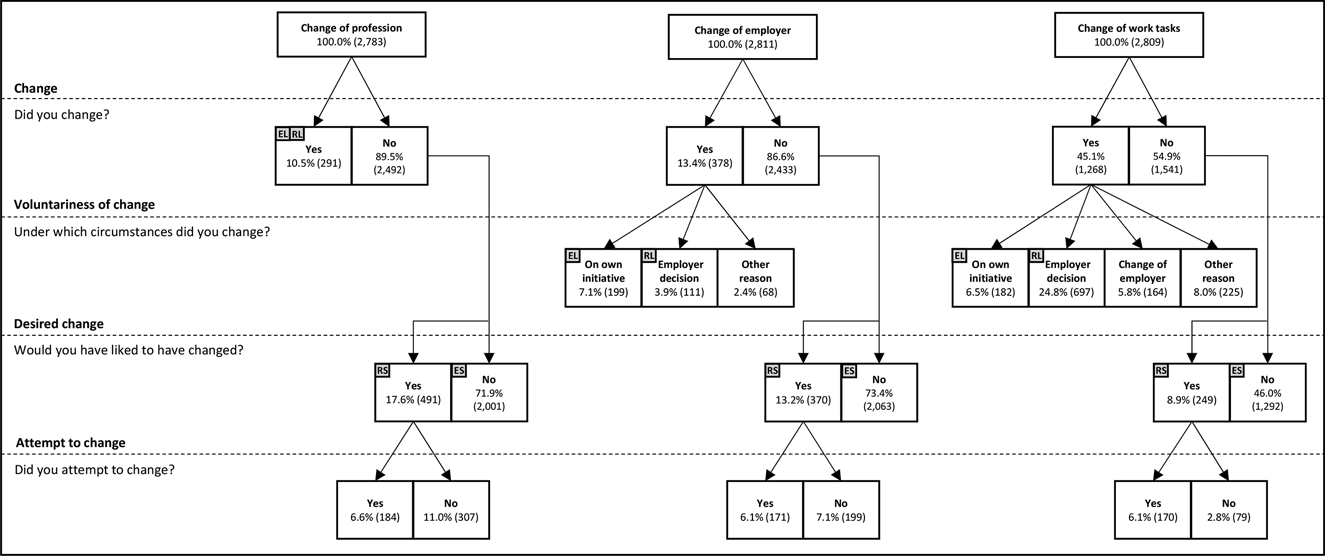
In the lidA Study (Wave 3, 2018), questions to assess and examine the three different forms of changes (profession, employer, work tasks) were used in a specific succession (see Figure 1).
Empirical overview of occupational changes in later working life.
Notes: EL: enthusiastic leavers. RL: reluctant leavers. ES: enthusiastic stayers. RS:reluctant stayers.
Change
To assess change of profession, participants were asked: ‘In the last interview you said that your profession is [information from previous wave]. Is this still the case? (yes/no)’. Change of employer was assessed by the question: ‘Have you changed your employer since the last interview? (yes/no)’. Change of work tasks was assessed by: ‘Have your work tasks changed significantly in the last three years? (yes/no)’.
Voluntariness of change (EL and RL)
For change of employer and work tasks, the participants were asked whether they changed on their own initiative, on the initiative of the employer or under other circumstances. This question allows distinguishing between EL and RL. The question was not asked in the case of change of profession.
Desired change (ES and RS)
Where there was no change, the participants were asked whether they would have liked to have changed since the last study interview. The responses enable us to identify ES and RS.
Attempt to change
Finally, if participants would have liked to have changed, they were asked if they had attempted to change. This gives further insight to the group of RS.
Main reason for change or desired change
If the participants had changed on their own initiative (EL) or if participants had not changed, but would have liked to have changed (RS), they were asked to select a main reason for the change, or for the desire to change, from a list. The lists of potential main reasons differed slightly between the three forms of change, but were identical for actual and desired changes. Response options were: better working conditions, better salary, better working hours, occupational career, accident at work, health reasons, work–family conflict, avoiding unemployment (not for change of work tasks), another profession after retirement (only for change of profession), want to do something new (only for change of work tasks), other reason.
Socio-demographic factors, health and job factors
Socio-demographic background information, health measures and job factors assessed in Wave 2 (2014) were used to characterise the change groups in their previous job situation. The socio-demographic factors include gender (male, female), year of birth (1959, 1965), partner status (yes, no) and the job task requirement level of task complexity and occupational area (un-/semi-skilled task, skilled task, complex task, highly complex task).
Mental and physical health was assessed with the established Short Form Health Survey, SF-12 (Ware et al., Reference Ware, Kosinski and Keller1995, Reference Ware, Kosinski and Keller1996; Nübling et al., Reference Nübling, Andersen and Mühlbacher2006). Component scores ranging from 0 to 100 were calculated for each health indicator; high values indicate better health.
The job factors include weekly working time (full time, part time, marginal employment), seniority (length of affiliation to the employer in years), individual income level (up to €450, €450–1,499, €1,500–2,999, €3,000 and more), and physical workload which includes three factors: (a) crouching, kneeling, lying or working overhead, (b) lifting or carrying heavy loads and (c) one-sided physical activity (never, up to one-quarter of the time, more than one-quarter of the time). Furthermore, four psycho-social work factors were assessed with scales from the Copenhagen Psychosocial Questionnaire (COPSOQ-II, middle version; Pejtersen et al., Reference Pejtersen, Kristensen, Borg and Bjorner2010): leadership quality, influence at work, possibilities for development and work–family conflict. Scores range from 0 to 100 with high scores indicating a high expression of the concept. Distributions and means of socio-demographic factors, health measures and job factors for the full sample are shown in Table 1.
Socio-demographic factors, health and job factors in the full sample in 2014

Notes: SD: standard deviation. 1. Range from 0 to 100. High scores indicate a high expression of the concept or good health.
Analysis
In line with our research aims, we provide descriptive information on the prevalence of the three forms of occupational change, the overlap of changes, their voluntariness, desired changes, possible attempts and the most frequent main reasons (for actual changes on own initiative (EL) and desired changes (RS)). Multinomial logistic regression analyses were performed for each of the three forms of occupational change in order to characterise the change groups in their previous job situation, considering socio-demographic background information, health measures and job factors assessed in Wave 2 (2014). The highest significant correlations between the independent variables were found for weekly working time and individual income level (r = 0.615), weekly working time and gender (r = 0.540), and gender and individual income level (r = 0.394). In each of the three models, the group of ES served as the reference group. All statistical analyses were performed using SPSS version 26.0.
Results
Figure 1 gives an overview of the proportions of EL, RL, ES and RS among older workers, aged 53 or 59 in 2018, for the three forms of occupational change: change of profession, employer and work tasks. The most common changes are changes of work tasks (45.1%), 13.4 per cent reported a change of employer and 10.5 per cent a change of profession. There were more EL (7.1%) than RL (3.9%) among employer changers, but considerably more RL (24.8%) than EL (6.5%) among work task changers. However, for all forms of occupational change the majority of older workers were stayers. Yet, within this group, considerable numbers of RS were found. With regard to changes of profession, employer and work tasks, the proportions of RS (17.6, 13.2 and 8.9%, respectively) were higher than the respective proportions for EL. About every third RS (unsuccessfully) attempted to change profession, about every second RS attempted to change employer and two out of three RS attempted to change work tasks.
Figure 2 depicts the overlap of occupational changes. Here, only participants with valid responses to all change questions could be included. Most of the changes of profession went along with changes of employer or work tasks. Only a few participants changed employer without changing work tasks and/or profession. Expectedly, a change of profession or employer usually implied a change of work tasks; 33.5 per cent of all participants reported changes of work tasks without a change of profession or employer. Further, 49.0 per cent of all employed participants reported no change whatsoever within the past four years.
Combinations and overlap of occupational changes between 2014 and 2018.
Notes: N = 2,781. T: change of work tasks. P: change of profession. E: change of employer.

The results of the three multinomial logistic regression analyses are shown in Table 2. Overall, each of the change groups, EL, RL and RS, showed patterns of socio-demographic factors, health and job factors which were different to those of the reference group of ES. Most pronounced were the differences in terms of birth year, seniority, income level and leadership quality. Below, each group of EL, RL and RS is briefly characterised in contrast to the ES.
Multinomial logistic regression

Notes: Values are odds ratios/Exp(B). EL: enthusiastic leavers. RL: reluctant leavers. RS: reluctant stayers. ES: enthusiastic stayers. Ref.: reference group. The change groups refer to changes between 2014 and 2018. ES was the reference group in all three models. Socio-demographic factors, health and job factors were surveyed in 2014. 1. Range from 0 to 100. High scores indicate a high expression of the concept or good health.
Significance levels: * p < 0.05, ** p < 0.01, *** p < 0.001.
Change of profession
The leavers of profession (EL and RL) were younger, had more un-/semi-skilled tasks or highly complex tasks, less often worked part time, had a shorter seniority and more often had a lower income level. The RS showed a different pattern as they were younger, had poorer mental health, a shorter seniority, lower leadership quality and a higher work–family conflict.
Change of employer
The EL were younger, more often had a partner, had better physical health, a shorter seniority, more often had a lower income level and a lower leadership quality. The EL (employer) were the only group having more often a partner and reporting better physical health than the respective ES. Like the EL, the RL were less often part-time workers, had a shorter seniority and more often a lower income level, and they reported lower leadership quality. The RS (employer) showed the same pattern as the RS (profession).
Change of work tasks
The EL more often were female workers, had a shorter seniority, reported more possibilities for development and a higher work–family conflict. It was the only group more often reporting higher income levels than the respective ES. The large group of RL showed another noticeable pattern as they more often reported both poorer mental and physical health, a longer seniority, a high physical workload, lower leadership quality, more possibilities for development and a higher work–family conflict. This group was the only one reporting significantly poorer physical health, a longer seniority and more often performing physical work than the reference group. Also, the RS exhibited a characteristic pattern: although they less often reported lower income levels, many work indicators were rated adversely: lower leadership quality, less possibilities for development (only significant in this group) and a higher work–family conflict.
The underlying main reasons for all voluntary and desired changes are presented in Table 3. Responses in italics are in concordance with findings from the multinomial logistic regression analyses. Here, three aspects stand out. First, some main reasons were mentioned frequently such as better working conditions (especially among RS), better salary and occupational career. Second, the most frequent main reasons for the three types of occupational change differ clearly. While the reasons better working conditions and better salary are prominent among employer changes, the reason avoiding unemployment is common among change of profession and the reason want to do something new is common among changes of work tasks. Last, the most frequent main reasons for EL and RS differ in some respect. For example, while avoiding unemployment is common among EL of profession, only few RS aimed to change profession to avoid unemployment.
Main reasons for change among enthusiastic leavers and reluctant stayers

Notes: Values are percentages. The first six most frequent main reasons are displayed. 1. No differentiation between enthusiastic and reluctant leavers. 2. Missing responses = 74. Italic: In concordance with findings from the multinomial logistic regression analyses.
Discussion
Our results showed that in Germany, occupational change is common among older workers. In the period of four years, almost half of the participants had changed work tasks, and even the proportions of participants who had changed employer or profession were considerable. In many cases the occupational changes coincide. Most changes of profession were accompanied by employer changes, while changes of work tasks often took place without further occupational changes. In addition to actual changes, however, it was also shown that many workers often would have liked to have changed without doing so. Our results confirm that the occupational change groups EL, RL and RS differ from the ES with respect to socio-demographics, job factors and health. Additionally, the self-reported main reasons for realised or wanted changes highlight differences between the three types of change and the stayers and leavers investigated in this study. In the following, we will discuss the results structured by the three types of occupational change.
Change of profession
In our study, changes of profession were the least common type of change (10.5% of all participants). According to Blau and Lunz (Reference Blau and Lunz1998), older workers are likely to have found jobs with a high work–life balance, they are more committed to their profession and have less need to change. Their mobility self-efficacy, i.e. the perceived ability to change profession, may decrease with age and seniority, which may explain the relatively few changes of profession and why only one-third of all RS attempted to change profession (Otto et al., Reference Otto, Dette-Hagenmeyer and Dalbert2009). This is also in line with our findings that EL/RL and RS have a significantly shorter seniority than the ES. Thus, changers of profession are a special group often driven by financial aspects of the job, which is reflected by the main reasons better salary and by the fact that leavers more often reported a lower income level. Further, the group is characterised by employment security needs, expressed in the main reasons occupational career and avoiding unemployment.
Of all three forms of occupational change, the proportion of RS was clearly highest (17.6%). The reluctance to change profession seems justified as older workers are faced with limited opportunities to change; a change of profession is a greater step than an employer change and bears substantial risks for employment, finances and professional identity (Bailey and Hansson, Reference Bailey and Hansson1995). Although the propensity to change profession may be low among older workers, they may find themselves forced to change profession when the person–job fit becomes low, be it because of age-related changes in health and functioning or changes in work demands (Trinczek, Reference Trinczek2011; Huysse-Gaytandjieva et al., Reference Huysse-Gaytandjieva, Groot and Pavlova2013). In our sample, the RS reported poorer mental health while wanting a change due to health reasons and reported lower leadership quality and a higher work–family conflict, which reflects the person–job misfit which, indeed, Hom et al. (Reference Hom, Mitchell, Lee and Griffeth2012) have attributed to the RS. Also their predominantly selected main reasons for the desire to change better working conditions and work–family conflict correspond to the results in the regression analysis and the motivational states by Hom et al. (Reference Hom, Mitchell, Lee and Griffeth2012). Our findings are in line with Canivet et al. (Reference Canivet, Aronsson, Bernhard-Oettel, Leineweber, Moghaddassi, Stengård, Westerlund and Östergren2017), who showed that older workers in secure employment are often reluctant to change profession, despite possible negative impacts of their current jobs on their mental health.
Change of employer
In relation to changes of profession, employer changes seem to be more common in Germany: 13.4 per cent of all participants changed employer, 7.1 per cent voluntarily. According to research, these voluntary employer changes (EL) are associated with positive consequences for the individual: increase in work ability, leadership quality, social support from colleagues, possibilities for development, and a decrease in work–family conflict and quantitative demands (Garthe and Hasselhorn, Reference Garthe and Hasselhorn2020), an increase of status and self-esteem, decreased physical strain, less burnout, better psycho-social health (Canivet et al., Reference Canivet, Aronsson, Bernhard-Oettel, Leineweber, Moghaddassi, Stengård, Westerlund and Östergren2017) and higher job satisfaction (Chadi and Hetschko, Reference Chadi and Hetschko2014). In line with Hom et al. (Reference Hom, Mitchell, Lee and Griffeth2012), who assumed that EL may change to follow relocating spouses and who have conflicts with supervisors, in our study, the EL more often had a partner and reported lower leadership quality. Moreover, the misfit between the former jobs and the workers is reflected by the most frequently reported main reason for changing: better working conditions. As reviewed by Hom et al. (Reference Hom, Mitchell, Lee and Griffeth2012), EL need to have the physical capacity to change, e.g. health resources. Indeed, our results showed that the EL were the only group who reported better physical health than the respective ES. Additionally, financial reasons were prominent among the EL, who often had a lower income and changed to increase their income.
However, our results also show that many workers would like to change their employer (RS), but apparently cannot. They may find themselves in a ‘locked’ work situation (Huysse-Gaytandjieva et al., Reference Huysse-Gaytandjieva, Groot and Pavlova2013), e.g. due to restrictive external factors such as family-related immobility, a temporary employment contract (Hom et al., Reference Hom, Mitchell, Lee and Griffeth2012) or because changes remain risky as it is difficult for older workers to find a new job (Heywood and Jirjahn, Reference Heywood and Jirjahn2016). However, reluctant staying bears personal risks for motivation, work performance (Hom et al., Reference Hom, Mitchell, Lee and Griffeth2012) and mental health (Canivet et al., Reference Canivet, Aronsson, Bernhard-Oettel, Leineweber, Moghaddassi, Stengård, Westerlund and Östergren2017). These findings are in line with our results as the RS had poorer mental health and lower leadership quality. However, although they had significantly poorer mental health, only few RS wanted to change for health reasons. The most frequently reported main reason, better working conditions, rather reflects a person–job misfit.
While many older workers wanted to change their employer, our data also indicated that a considerable degree of older workers in Germany were forced to change due to dismissal (RL). Such a reluctant change is usually preceded by conflicts with supervisors, poor performance or when an entire company is affected, such as layoffs, or when a company closes down (Canivet et al., Reference Canivet, Aronsson, Bernhard-Oettel, Leineweber, Moghaddassi, Stengård, Westerlund and Östergren2017). Here, the analysis confirms that the RL reported a significantly lower leadership quality than the ES, which may represent these conflicts.
Change of work tasks
The fact that in our study almost every other worker reported significant work task changes during the past three years indicates that work is in constant change – requiring older workers to apply individual adaptation strategies (Ng and Law, Reference Ng and Law2014). The high proportion of workers with employer-induced changes is striking (RL, 24.8%). A crucial question is whether these changes occurred with or without considering the individual workers’ needs. Job enrichment, job rotation or job enlargement are positive examples of how employers may change the work tasks of their employees to improve their work and professional development (Chung and Ross, Reference Chung and Ross1977). However, the high proportion of employer-induced changes may in part also be due to organisational restructuring, where the single worker will find less consideration (Jimmieson et al., Reference Jimmieson, Terry and Callan2004). Our analysis allows more insight into this probably heterogeneous group of RL and shows that they clearly differ from RL of profession and employer. RL (work tasks) reported both poorer mental and physical health while more often having high physical workload. One interpretation of these findings is that the employers reacted to the reduced physical and mental resources of the workers and attempted to alleviate the physically demanding job situation by adapting the work tasks. Although the RL reported lower leadership quality, they apparently had more possibilities for development in their jobs, which may be indicative of a supportive work organisation. The group also stands out because they had a significantly longer seniority than the ES, thereby possibly constituting a core workforce in the organisation with strong ties to the employer. This may also contribute to why their employers would rather change their work tasks than dismiss them.
However, many older workers changed work tasks on their own initiative (EL) to do something new, for better working conditions or health reasons, which is in line with the theory on job crafting, where workers are regarded as active constructors of their work (Wrzesniewski and Dutton, Reference Wrzesniewski and Dutton2001) and where workers improve and adjust their work with the aim of improving their work ability (Tims et al., Reference Tims, Bakker and Derks2013). Our findings, that EL more often had a higher income level, had more possibilities for development and changed to promote the occupational career and to do something new, indicate that EL (work tasks) have more flexibility to initiate work task changes within their jobs. They may constitute a somewhat privileged group with a higher status within the organisation, more income, and more flexibility and possibilities to adapt their work tasks. Such flexibility increases the structural and social resources of the employees, their wellbeing, engagement and job satisfaction (Tims et al., Reference Tims, Bakker and Derks2013), and the motivation to work longer among older workers (Moen et al., Reference Moen, Kojola, Kelly and Karakaya2016). It is noticeable that this group reported a higher work–family conflict, while this conflict was a rarely mentioned main reason for the change.
With respect to the RS, a range of obstacles for work task changes may be thought of. Some types of jobs are difficult to change, such as assembly-line work or jobs requiring high task interdependence with co-workers (Wrzesniewski and Dutton, Reference Wrzesniewski and Dutton2001). For workers in low hierarchy levels and/or with low decision latitude, changes on their own initiative may be more difficult to realise although they may exhibit the highest need, due to poorer working conditions, higher work strain and lower wages (Siegrist et al., Reference Siegrist, Wege, Pühlhofer and Wahrendorf2009). These assumptions are supported by our analyses as the RS had fewer possibilities for development, reported a lower leadership quality and would like to change to improve their working conditions. Yet, they reported higher income levels.
Like the EL and RL, the RS (work tasks) reported higher work–family conflicts, but did not mention it as reason for their desire to change. This follows a certain logic as – in contrast to changes of profession or employer – work task changes may have less potential to improve a work–family conflict. However, the significantly higher work–family conflict in the three groups EL, RL and RS may also be indicative of a specifically low work–family conflict in the reference group, the ES (work tasks). The latter may constitute a selective group of workers in the organisations who are widely satisfied with their work situation, just as the typical ES as characterised by Hom et al. (Reference Hom, Mitchell, Lee and Griffeth2012).
In summary, our results provide a broad empirical overview of changes of profession, employer and work tasks, and a characterisation of the enthusiastic as well as reluctant stayers and leavers among older workers. Each change group revealed a characteristic pattern in terms of socio-demographic background, health and work situation. Most of our findings on the three forms of occupational change could be plausibly explained on the basis of existing theoretical and empirical literature. Interestingly, the different occupational change groups for all three forms of occupational change were in line with the group descriptions by Hom et al. (Reference Hom, Mitchell, Lee and Griffeth2012), although their motivational states of staying and leaving are based on reviewing employer changes.
Strengths and limitations
Strengths of our study are the large size allowing for in-depth sub-group analyses, the age-homogenous sample, the longitudinal study design and the representativeness for the German socially insured working population of similar age. Another strength of this study is that we could measure actual changes rather than using proxy measures such as change intentions or job search.
Limitations to our study are that we were not able to measure multiple changes, only the last change was registered, that we could not differentiate between voluntary and involuntary changes of profession, and that we cannot exclude misclassification of occupational change in our study.
Conclusions
Occupational changes are a normal part of the working life. The results of the lidA Cohort study indicate that this is also the case for older workers in Germany: in the course of four years, every second older employee had an occupational change. Our findings indicate that these changes are multifaceted. Employees change profession, employer and/or work tasks to a different degree, under different circumstances, among different groups of employees and for different reasons. While in most of the cases the older workers change profession and employer voluntarily, changes of work tasks happen predominantly involuntarily due to an employer's decision.
However, occupational changes do not only happen, they are even more often desired and unfulfilled. Changes in later working life are risky and opportunities as well as resources may be lacking. Our data show that there are more older workers with a wish to change profession, employer or work tasks (RS) than those who are actually changing on their own initiative (EL). The RS stand out due to poorer mental health and lower leadership quality than the ES. Thus, there is a risk that desired and yet unfulfilled changes have negative consequences for older workers, e.g. on health, wellbeing and motivation, and for the organisation, because they may constitute a risk group to poor performance and low work motivation.
Yet, occupational changes – when successful – may provide substantial chances for the worker, the enterprise and even the national economy. It is surprising that in times of ageing populations, the topic of occupational change among older workers and its potential for employment participation does not receive much attention in society, policy and research.
So far, empirical research in the field of occupational change has largely focused on employer changes, however, a stronger focus on the other forms of occupational change is needed. Further, more evidence is needed on immediate, medium- and even long-term effects of occupational changes among older workers, with respect to wellbeing, health, work ability, wealth and employment participation in later working life. Finally, the group of RS requires more scientific attention. There is a need to investigate what prevents these older workers from attempting and realising a desired change, how reluctant staying will affect the older workers’ personal and work situations in the long run, and how these needs and desires for change can be met by human resource management and social policies.
Author contribution
NG and HMH designed the study, NG performed the analyses, NG wrote the first draft of the manuscript, and HMH and NG critically reviewed and revised the manuscript and approved the final article.
Financial support
This work was supported by the Ministry of Culture and Science of the German State of North Rhine-Westphalia; and the German Social Accident Insurance, DGUV (FP 403). The funding institutions did not have any influence on the design of the study, the data collection, analysis and interpretation of the data nor on the writing of the manuscript.
Conflict of interest
The authors declare no conflicts of interest.
Ethical standards
Design and conduct of the lidA study have been approved by the Ethics Committee of the University of Wuppertal dated from 5 December 2008 and 20 November 2017 (MS/BB 171025 Hasselhorn). Participants were fully informed about the aim and procedure of this study prior to giving consent to participate. All procedures performed in studies involving human participants were in accordance with the ethical standards of the institutional and/or national research committee and with the 1964 Helsinki declaration and its later amendments or comparable ethical standards.


 Open access

