





Introduction
Climate change is increasingly disrupting education systems worldwide, threatening progress made in educational access, equity and quality. Schools and children, particularly in vulnerable communities and nations, face increased exposure to extreme weather events and environmental stressors that undermine safe, continuous and quality learning (Thapa, Reference Thapa2026; UNESCO, 2021a). Despite these growing challenges, the education sector remains insufficiently examined within climate risk analysis. Current debates often portray education as passively affected by climate change, overlooking the broader role of schools as institutions capable of supporting adaptation, mitigation and societal resilience.
This paper argues that climate risk in education should be understood not only in terms of physical disruption to schooling but also as a multidimensional challenge shaped by the interaction of climate hazards, exposure, institutional capacity and children’s developmental vulnerabilities. Understanding these interconnected risks requires an integrated, sector-specific approach that considers both the direct impacts of climate hazards and the wider social, economic and governance conditions that shape vulnerability and resilience. Within education systems, adaptation strategies may comprise climate-resilient infrastructure, disaster preparedness and continuity planning, while mitigation efforts can support sustainable resource use and environmentally responsible practices. Equally important is the development of climate literacy, enabling learners to understand the anthropogenic drivers of climate change and participate meaningfully in individual and collective responses.
Drawing on the Intergovernmental Panel on Climate Change’s (IPCC) Integrative Climate Risk Management (CRM) framework, this paper examines how hazards, exposure and vulnerability interact to generate climate-related risks for schools and children. It conceptualises schools not only as sites of climate risk exposure, but also as critical governance infrastructures through which risk can be interpreted, mediated and reduced through education, behavioural change and institutional adaptation. The paper first outlines key concepts within climate risk assessment before analysing their implications for the education sector and identifying priorities for strengthening climate resilience in schools and learning systems.
Climate change risk management framework
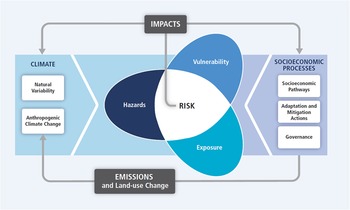
The Intergovernmental Panel on Climate Change (IPCC, 2014a) propounded an integrative CRM framework (Figure 1), which has since been widely used in understanding, assessing and responding to climate-related risks. More recent assessments in the IPCC Sixth Assessment Report (AR6) further emphasise that climate risk is systemic, dynamic and socially constructed rather than simply the outcome of isolated environmental events (IPCC, Reference Masson-Delmotte2021; IPCC, 2022). This perspective highlights that climate risks are shaped not only by physical hazards but also by socio-economic inequalities, governance systems, institutional capacities and development pathways. In the context of education as well, this broader understanding is imperative because climate impacts on schools and children are influenced by both environmental exposure and pre-existing social and institutional vulnerabilities.
Climate change risks, impacts, and response framework (IPCC, 2014a).

Figure 1. Long description
A diagram representing the framework of climate change risks, impacts, and response processes. The diagram is divided into three main sections: Climate, Impacts, and Socioeconomic Processes. The Climate section includes Natural Variability and Anthropogenic Climate Change. The Impacts section is represented by a Venn diagram with three intersecting circles labeled Hazards, Vulnerability, and Exposure, which together form Risk. The Socioeconomic Processes section includes Socioeconomic Pathways, Adaptation and Mitigation Actions, and Governance. Arrows indicate the flow from Emissions and Land-use Change to Climate, then to Impacts, and finally to Socioeconomic Processes, showing the interconnected nature of these elements.
Within the CRM framework, as human influence on the climate system continues, climate change presents significant risks to human and natural systems through complex interactions among hazards, exposure and vulnerability. Hazards are climate-driven physical events or trends influenced by both anthropogenic climate change and natural variability. Exposure concerns the presence of people, assets or ecosystems in places that could be adversely affected, often shaped by socio-economic development, while vulnerability is the susceptibility to harm, including sensitivity and lack of capacity to cope or adapt. Risks, therefore, emerge from the interaction among these factors and reflect the likelihood and severity of climate impacts. Increasing attention is therefore placed on risk analysis to support decision-making on climate effects and broader sustainability challenges. Assessing and managing risk is therefore crucial for understanding current and future impacts and developing appropriate actions to prevent or reduce them.
Exposure, vulnerability and hazards are influenced by climatic changes and socio-economic processes such as development, governance and response strategies. Reducing risk involves complex approaches, including low-regret measures that provide benefits regardless of climate change and addressing social inequalities to enhance adaptation effectiveness and equity (IPCC, 2014b).
Socio-economic pathways in the framework highlight the need to incorporate diverse values, climate-resilient development and transformational strategies. Because climate change continuously alters risk profiles, both adaptation and mitigation efforts are vital. Adaptation must be progressive and include transformational strategies tailored to specific contexts, while mitigation focuses on reducing greenhouse gas emissions. Coordinated efforts need to consider synergies, trade-offs and mutual benefits across adaptation, mitigation and broader development goals. Governance plays a critical role by supporting decision-making under uncertainty, enhancing adaptive capacity, coordinating actions and monitoring progress. Likewise, effective climate risk management requires comprehensive risk data and assessments to address root vulnerabilities and reduce impacts (Menk et al., Reference Menk, Terzi, Zebisch, Rome, Lückerath, Milde and Kienberger2022; UNDRR, 2020a).
In the education sector, climate change remains a source of hazards, vulnerabilities and risks affecting schools’ operations, infrastructure and students’ learning. Thus, understanding exposure and vulnerability is central for minimising risks and developing relevant policy instruments for risk management, especially to address inevitable losses and other risk drivers. Factors such as geography, physical environment, economic conditions and institutional practices determine exposure to climate risks (IPCC, Reference Masson-Delmotte2021; OECD, 2021). Autonomous adaptation, usually unplanned, reactive actions at individual or private levels, offers some resilience. However, planned adaptation, often government-led, develops systemic resilience by addressing residual risks not managed through autonomous responses (Martens & Chang, Reference Martens and Chang2017).
Although adaptation and mitigation were once treated separately, the framework acknowledges their increasing synergies and trade-offs. For instance, ecosystem-based strategies like tree plantation simultaneously mitigate climate change by sequestering carbon and help adaptation by reducing runoff, protecting ecosystems and lowering local temperatures (Locatelli et al., Reference Locatelli, Fedele, Fayolle and Baglee2016; Smith & Olesen, Reference Smith and Olesen2010). Education, such as climate change education, resilience education and sustainability practices, will be critical for enabling effective climate risk governance. Schools likewise play a central role in shaping adaptive capacities through risk literacy, institutional preparedness, behavioural norms and intergenerational knowledge transfer, while also supporting broader policy and infrastructural adaptation efforts.
The CRM framework provides a valuable lens for understanding how hazards, exposure and vulnerability combine to create risks. In education, these risks present unique challenges for students, educators and institutions. The following section explores these sector-specific dynamics in detail.
Climate change and the education sector
Education systems are not only vulnerable to climate change but are also central to enabling effective climate risk governance and long-term societal resilience. Climate change presents numerous challenges to the education sector due to its complex system and the involvement of multiple stakeholders. These challenges underscore the need to embed climate resilience and sustainability education into school systems as proactive measures to allow learners to understand growing risks and build adaptive capacities. Its implications extend to students, teachers, parents, school communities, infrastructures and the overall functioning of the education system. Climate-related disruptions increase the need for new policies, specialised expertise and educational programmes, while also raising financial costs for governments (Hanna & Oliva, Reference Hanna and Oliva2016; Kousky, Reference Kousky2016; UNICEF, 2019a). In addition, the destruction of schools and infrastructure necessitates comprehensive climate adaptation and disaster risk reduction planning. Climate change may also exacerbate existing inequalities in education, including food and water insecurity (UNESCO, 2020). It is therefore important to examine its impacts through the lens of children’s learning and well-being, as they are key stakeholders in the education system. Integrating disaster risk reduction education into formal and non-formal settings can help equip children, teachers and communities with the knowledge and preparedness skills needed to respond to hazards. Accordingly, approaches to addressing climate change in education should be child-centred (Choi & Joshi, Reference Choi and Joshi2022; Treichel, Reference Treichel2020).
Climate hazards and their consequences for schools
Extreme weather events such as droughts, floods, cyclones and heatwaves have had profound and often long-lasting impacts on the education sector. For instance, in 2000, severe flooding in Cambodia damaged approximately 1,000 schools – about 18% of the country’s total -affecting around 500,000 children and resulting in an estimated economic loss of US$161 million (Asian Disaster Preparedness Center [ADPC], 2008). This disaster disrupted schooling and led to widespread closures, particularly in flood-prone areas, where absenteeism and dropout rates increased significantly.
Hurricane Katrina in 2005 similarly disrupted education in the United States. Over one million children were affected, with approximately 300,000 school-aged children in Mississippi, Louisiana and Alabama displaced from their schools (Hunter, 2005, as cited in Fothergill & Peek, Reference Fothergill and Peek2006). More recently, in 2022, floods in Pakistan damaged or destroyed nearly 19,000 schools, disrupting the education of 670,000 students (Save the Children, 2022). These examples demonstrate how climate hazards severely damage educational infrastructure, interrupt learning continuity and force prolonged school closures. Rather than representing temporary disruptions, they expose structural weaknesses in educational continuity planning and reveal how disaster impacts accumulate unevenly across already vulnerable systems. These disruptions also generate substantial rehabilitation costs that strain already limited education budgets and risk reversing gains in educational access and quality.
Such events underline the need for resilient infrastructure alongside strengthened climate change and disaster risk reduction education. This would enable students, educators and communities to better anticipate hazards, reduce vulnerability and respond effectively. As children’s access to safe learning environments becomes increasingly threatened, targeted risk assessments and adaptation strategies are becoming essential components of education system planning.
Exposure of children and schools at risk
Children and schools, particularly in low-income, hazard-prone regions, are increasingly exposed to the impacts of climate change. According to Theirworld (2018), nearly 37.5 million learners face educational disruption annually due to climate-related disasters, a figure expected to rise. This exposure is especially concerning for children, with an estimated one billion potentially affected by natural hazards and climate impacts in the coming decades (UNICEF, 2021). Regions such as Asia and Africa, which host a large proportion of the world’s child population, are identified as highly exposed (UNESCAP, 2022).
The physical location of schools often contributes to this vulnerability, with many situated in floodplains, coastal zones or drought-prone areas and lacking infrastructure capable of withstanding extreme events. While it may appear that exposure could be reduced through relocation, this assumption overlooks the structural and historical factors shaping settlement patterns in many contexts. In emerging nations, as well as marginalised communities globally, populations often reside in high-risk areas due to poverty, land scarcity, colonial legacies and rapid urbanisation. Schools are therefore established within these communities to ensure access to education, rather than as a result of poor planning alone. Moreover, global inequalities in greenhouse gas emissions mean that those least responsible for climate change are often the most affected by its impacts.
Reducing risk in the education sector, therefore, cannot rely solely on relocation strategies; it must also address systemic inequalities, strengthen climate-resilient infrastructure and integrate adaptation with broader mitigation efforts. This underscores the importance of combining climate risk reduction education with structural and policy-level interventions that address both root causes and immediate vulnerabilities. Limited access to safe facilities, poor structural integrity of school buildings and insufficient early warning systems further compound these risks (Thapa et al., Reference Thapa, Gough and Cooper2024a). In this context, integrating environmental and climate literacy into curricula in high-risk regions can strengthen early warning systems, promote safer behaviours and support community-based resilience.
Vulnerabilities of schools and children
Children face greater vulnerability to climate change due to their biological development, psychological fragility and socio-economic disadvantages. These vulnerabilities intersect and intensify during and after disasters. Climate change threatens children’s survival, development and well-being (UNICEF, 2019b). It affects children through direct impacts, such as injury, heat stress, infectious diseases, and malnutrition and indirect consequences, such as family displacement, food insecurity and economic hardship (Anderko et al., Reference Anderko, Chalupka, Du and Hauptman2020; Bartlett, Reference Bartlett2008; Sheffield et al., Reference Sheffield, Uijttewaal, Stewart and Galvez2017). Children’s immature physiology, higher sensitivity to pollutants and heat and dependency on adults make them less able to cope with environmental stressors (Akachi et al., Reference Akachi, Goodman and Parker2009; Ebi & Paulson, Reference Ebi and Paulson2007). For example, studies have linked extreme heat events with increased hospital admissions for children and have documented higher risks of waterborne diseases, including diarrhea and cholera, during floods (Fanzo et al., Reference Fanzo, Davis, McLaren and Choufani2018; Rocklöv & Dubrow, Reference Rocklöv and Dubrow2020).
The mental health consequences of climate change on children remain under-researched but are deeply concerning. Climate-induced trauma has been linked to anxiety, depression and post-traumatic stress disorder (Chemtob et al., Reference Chemtob, Nakashima and Carlson2002; Lai et al., Reference Lai, Kelley, Harrison, Thompson and Self-Brown2015). Children separated from their families during disasters or living in damaged communities are especially prone to emotional and behavioural issues (Fothergill & Peek, Reference Fothergill and Peek2006). These psychological effects can hinder learning and cognitive development, with potential lifelong repercussions (Vergunst & Berry, Reference Vergunst and Berry2022).
Children from poor households, marginalised communities and those with disabilities or special needs are disproportionately affected by climate impacts (Lawler, Reference Lawler2011; Mitchell & Borchard, Reference Mitchell and Borchard2014). About 85% of the world’s 2.2 billion children and youth live in developing countries (UNICEF, 2014), where education systems are less resilient and resources for adaptation are limited.
Changes in the environment also affect family livelihoods. In rural communities, declining agricultural productivity due to heat and drought has been linked to reduced school attendance, higher dropout rates and decreased investment in education (Adeleke, Reference Adeleke2018; Agamile & Lawson, Reference Agamile and Lawson2021; Fuller et al., Reference Fuller, Clee, Njabo, Tróchez, Morgan, Meñe and Smith2018). In Central Africa, for instance, decreasing crop yields have been associated with a six-month decline in school attendance over the past two decades (Fuller et al., Reference Fuller, Clee, Njabo, Tróchez, Morgan, Meñe and Smith2018). Similarly, prenatal and early-childhood exposure to extreme heat has been linked to fewer years of schooling later in life (Randell & Gray, Reference Randell and Gray2019). Climate change and resilience education will be critical to serve as protective measures by equipping children with coping skills, awareness of environmental stressors and the ability to participate in resilience-building practices at home and school.
All of the above dimensions illustrate that children’s vulnerability to climate change is multidimensional, encompassing physical safety, psychosocial well-being and educational continuity. Within the IPCC risk framework, this suggests that vulnerability in the education sector cannot be understood solely in terms of infrastructure or economic capacity, but must also incorporate developmental sensitivity and long-term cognitive impacts. The child-centred perspective is essential in advancing strategies through explicitly linking climate risk to learning outcomes and life-course trajectories, thereby broadening the conceptualisation of risk in education beyond immediate disruption to include enduring developmental consequences.
Risk interactions
These risks can be understood as cascading impacts of risk over time (Thapa, Reference Thapa2024b). In the short term, climate hazards can lead to school closures, infrastructure damage and displacement. Overtime, these disruptions may translate into learning loss, reduced academic performance and increased dropout rates. Interrupted education can also contribute to diminished livelihood opportunities, reinforcing cycles of poverty and inequality.
Risks to education emerge from the convergence of climate hazards, high levels of exposure and the compounded vulnerabilities of children and educational systems. Together, these factors disrupt learning continuity through damaged infrastructure, displacement and prolonged interruptions to schooling. Such disruptions can contribute to lower academic achievement, reduced educational attainment and increased dropout rates, particularly among children affected during critical developmental stages (Kousky, Reference Kousky2016; Randell & Gray, Reference Randell and Gray2019). They may also generate secondary impacts, including increased child labour, early marriage and mental health challenges, creating cycles of disadvantage that can persist into adulthood (UNICEF, 2019c; Plan International, 2022).
Furthermore, repeated exposure to climate-related disasters can erode the resilience of students, families and institutions, reducing their capacity to recover from and adapt to future shocks (IPCC, 2022; UNDRR, 2020b). These impacts are disproportionately experienced by children from marginalised backgrounds, further compounding existing social and economic inequalities (Lawler, Reference Lawler2011; Mitchell & Borchard, Reference Mitchell and Borchard2014). Without timely and inclusive adaptation measures, the consequences may extend across generations, limiting opportunities for learning, development and socio-economic mobility.
Capacity and preparedness: Gaps in school and teacher readiness
Although awareness of climate change’s impact on education is increasing, significant gaps persist in institutional readiness. With a worsening climate situation, climate change, risk reduction and sustainability education have become vital components of systemic adaptation, equipping learners and school communities with the knowledge, skills, values and practices required to anticipate and respond to climate risks (Boon, Reference Boon2016; Nicholls, Reference Nicholls2017; Stevenson et al., Reference Stevenson, Nicholls and Whitehouse2017). Schools and teachers often lack the training, infrastructure and support systems to respond effectively to climate-related disruptions (Thapa et al., Reference Thapa, Gough and Cooper2024a). Evidence across countries shows that many educators acknowledge the threat climate change poses to education, yet few have access to curricula, teaching materials or disaster preparedness plans to respond appropriately (Thapa et al., Reference Thapa2024b; UNESCO, 2021a). The lack of integration between education policy and climate adaptation planning further hampers coordinated action.
Investments in climate-resilient infrastructure, school safety protocols, psychosocial support systems and capacity-building for teachers are urgently needed to close these preparedness gaps and safeguard educational continuity. Despite global commitments to advancing climate change, environmental and sustainability education, many countries lack structured programmes or professional training that translate scientific knowledge into age-appropriate, context-specific learning (Nicholls, Reference Nicholls2017; Paci-Green et al., Reference Paci-Green, Varchetta, McFarlane, Iyer and Goyeneche2020; UNESCO, 2021b). This gap weakens institutional preparedness and inhibits the potential of education as a tool for climate resilience.
Managing climate risk in education
Operationalising climate risk assessment in the education sector requires translating the hazard, exposure and vulnerability framework into measurable indicators. For example, hazard exposure can be assessed through the proportion of schools located in flood or heat-prone zones; vulnerability can be evaluated through indicators such as infrastructure quality, student socio-economic status and access to health and psychosocial services; and adaptive capacity may include teacher training levels, availability of disaster preparedness plans and early warning systems. Applying such indicators enables more systematic identification of at-risk school populations and supports evidence-based planning and resource allocation.
To address the risks identified, the IPCC framework offers a comprehensive, integrative CRM approach, which entails (a) Risk assessment – mapping hazard-prone school zones, assessing exposure and vulnerability of school-aged populations, (b) Risk reduction and preparedness – upgrading school infrastructure, developing climate-responsive curricula and training teachers for crisis response, and (c) Resilience building – embedding climate adaptation in national education planning, investing in mental health and psychosocial services and ensuring inclusive support for the most vulnerable children, (d) Response and recovery - establishing early warning systems, ensuring rapid school reconstruction post-disaster and integrating education into emergency response frameworks. Instituting climate change, risk reduction and sustainability education within these CRM components is essential. Climate-responsive curriculum and teacher professional development can operationalise risk awareness, strengthen behavioural adaptation and mainstream resilience expertise across education systems.
Importantly, climate risks are not produced solely by environmental hazards but are rooted in broader political, economic and developmental systems. Fossil-fuel dependence, unsustainable consumption patterns, deforestation, unequal development and weak climate governance contribute both to the acceleration of climate change and to the unequal distribution of climate vulnerability. Within education systems, these structural conditions shape where schools are located, the quality of infrastructure and the adaptive capacity of communities. Addressing climate risks in education, therefore, requires not only adaptation measures but also broader mitigation efforts and climate-just development pathways, including advancement in green infrastructures and technologies.
Conclusion
Climate change continues to pose escalating risks to education, particularly in vulnerable communities and regions. Using the IPCC’s CRM framework, the paper has shown how hazards, exposure and vulnerability could interact to threaten children’s safety, well-being and learning continuity. Climate extremes increasingly disrupt schooling, damage infrastructure and deepen inequality, especially for marginalised groups, while also causing long-term health and psychosocial impacts. These growing impacts demand urgent systemic action. Schools should be understood as critical infrastructure requiring robust risk assessment and adaptive planning.
Key responses include localised risk assessments, climate-resilient infrastructure, integrated policy planning and teacher training. Access to early warning systems, emergency protocols and psychosocial support is also essential. Adaptation efforts must be paired with mitigation and climate justice. Many highly affected education systems are in regions with minimal historical emissions yet high climate risk exposure. Cross-sector collaboration and the meaningful inclusion of children in climate planning are also crucial. Strengthening education on climate change, sustainable development and disaster risk reduction will further equip future generations to navigate and respond to these challenges.
Future research should examine localised impacts, evaluate adaptation strategies and explore the mental health effects of climate-related disasters on children. Ultimately, safeguarding educational continuity is both a policy priority and a moral imperative. Ensuring all children can access safe, uninterrupted education must be central to climate-resilient development. Long-term protection of education systems ultimately depends not only on adaptation and resilience measures but also on addressing the drivers of climate change through rapid emissions reduction, equitable development and climate-just governance.
Acknowledgements
I would like to thank my colleagues, reviewers and editors for their valuable feedback and critical insights, which significantly improved the clarity of this manuscript.
Financial support
This research received no specific grant from any funding agency, commercial or not-for-profit sectors.
Ethical statement
Nothing to note.
Author Biography
Ramesh Thapa (PhD), is a researcher in climate change, education, and social policy and an R&D administrator with decades of dedication across the education, health, and higher education sectors in Australia, Bhutan, and the Asia-Pacific region. He currently serves in academic and research administration at the Centre for Palliative Care, a collaborative research centre of St Vincent’s Hospital Melbourne and the University of Melbourne.

 Open access

