





Introduction
Becoming literate is a long-lasting and complex process. It comprises multiple, interrelated aspects, including reading, writing, vocabulary, spelling and reading comprehension. Becoming literate in a foreign language is even more complex, since it by definition involves at least two languages and hence cross-linguistic processes (Koda, Reference Koda2007). Nevertheless, an increasing number of people master one or more foreign language(s). Interesting insights in the processes involved in foreign language acquisition have come from research on underlying cognitive skills (Chiappe & Siegel, Reference Chiappe and Siegel1999; Cisero & Royer, Reference Cisero and Royer1995; Comeau, Cormier, Grandmaison & Lacroix, Reference Comeau, Cormier, Grandmaison and Lacroix1999; Durgunoğlu, Nagy & Hancin-Bhatt, Reference Durgunoğlu, Nagy and Hancin-Bhatt1993; Geva & Yaghoub-Zadeh, Reference Geva and Yaghoub-Zadeh2006; Geva, Yaghoub-Zadeh & Schuster, Reference Geva, Yaghoub-Zadeh and Schuster2000; Lindsey, Manis & Bailey, Reference Lindsey, Manis and Bailey2003; Morfidi, van der Leij, de Jong, Scheltinga & Bekebrede, Reference Morfidi, van der Leij, de Jong, Scheltinga and Bekebrede2007).
Remarkably, despite the conventionality of including multiple aspects of literacy in foreign language programs (i.e., reading, vocabulary, writing), research thus far primarily focused on solely one aspect of literacy at a time. In addition, most studies focus on one foreign language only. This leaves questions open about the degree to which certain cognitive skills underlie literacy acquisition in general, or specific aspects of literacy in particular and the degree to which the skills that underlie literacy development are universal or language specific. These questions were addressed in the current study in students with fluent literacy skills in a transparent alphabetic orthography (Dutch, their native language), who simultaneously acquired three foreign languages in school: Spanish, a transparent alphabetic orthography, French, a nontransparent alphabetic orthography, and Chinese, a nonalphabetic orthography. A strength of the design was that all participants were followed from the first day of secondary school, where they acquired all three foreign orthographies, starting from the same, beginner, level. This allowed assessing the influence of the same set of cognitive skills on three different foreign languages within the same sample. The study adopted a longitudinal design, measuring the effect of cognitive skills at the start of foreign language literacy acquisition on the attained level of literacy acquisition in each of these languages two years later, through structural equation regression models. Thereby, the study aims to shed light on the processes that are involved in the broad and complex task of foreign language literacy acquisition. Insight into these processes is important both for theories about foreign language development and educational practices in foreign language programs.
One important literacy skill, that is often studied, is word reading. Research on the cognitive skills underlying children's word reading in the native language indicates that two cognitive skills are most important for word reading across orthographies: phonological awareness, the sensitivity to the sound structure of words; and rapid automatized naming (RAN), which denotes the speed of naming a set of highly familiar stimuli (e.g., Caravolas, Lervåg, Mousikou, Efrim, Litavsky, Onochie-Quintanilla, Salas, Schöffelová, Defior, Mikulajová, Seidlová-Málková & Hulme, Reference Caravolas, Lervåg, Mousikou, Efrim, Litavsky, Onochie-Quintanilla, Salas, Schöffelová, Defior, Mikulajová, Seidlová-Málková and Hulme2012; McBride-Chang & Kail, Reference McBride–Chang and Kail2002; Moll, Ramus, Bartling, Bruder, Kunze, Neuhoff, Streiftau, Lyytinen, Leppänen, Lohvansuu, Tóth, Honbolygó, Csépe, Bogliotti, Iannuzzi, Démonet, Longeras, Valdois, George, Soares-Boucaud, Le Heuzey, Billard, O'Donovan, Hill, Williams, Brandeis, Maurer, Schulz, van der Mark, Müller-Myhsok, Schulte-Körne & Landerl, Reference Moll, Ramus, Bartling, Bruder, Kunze, Neuhoff, Streiftau, Lyytinen, Leppänen, Lohvansuu, Tóth, Honbolygó, Csépe, Bogliotti, Iannuzzi, Démonet, Longeras, Valdois, George, Soares-Boucaud, Le Heuzey, Billard, O'Donovan, Hill, Williams, Brandeis, Maurer, Schulz, van der Mark, Müller-Myhsok, Schulte-Körne and Landerl2014; Pan, McBride-Chang, Shu, Liu, Zhang & Li, Reference Pan, McBride-Chang, Shu, Liu, Zhang and Li2011; Zhou, Duff & Hulme, Reference Zhou, Duff and Hulme2015; Ziegler, Bertrand, Tóth, Csépe, Reis, Faísca, Saine, Lyytinen, Vaessen & Blomert, Reference Ziegler, Bertrand, Tóth, Csépe, Reis, Faísca, Saine, Lyytinen, Vaessen and Blomert2010). Despite the universal importance of these two skills, it has been suggested that phonological awareness is more important in nontransparent than transparent orthographies, whereas RAN is more important in transparent orthographies (Georgiou, Parrila & Papadopoulos, Reference Georgiou, Parrila and Papadopoulos2008; Mann & Wimmer, Reference Mann and Wimmer2002; Moll et al., Reference Moll, Ramus, Bartling, Bruder, Kunze, Neuhoff, Streiftau, Lyytinen, Leppänen, Lohvansuu, Tóth, Honbolygó, Csépe, Bogliotti, Iannuzzi, Démonet, Longeras, Valdois, George, Soares-Boucaud, Le Heuzey, Billard, O'Donovan, Hill, Williams, Brandeis, Maurer, Schulz, van der Mark, Müller-Myhsok, Schulte-Körne and Landerl2014). In addition, the influence of phonological awareness may be slightly smaller in nonalphabetic orthographies than in alphabetic orthographies (Song, Georgiou, Su & Hua, Reference Song, Georgiou, Su and Hua2016). Research on foreign language learning indicates that both phonological awareness and RAN are involved in children's word reading in a second language as well (Geva et al., Reference Geva, Yaghoub-Zadeh and Schuster2000; Geva & Yaghoub-Zadeh, Reference Geva and Yaghoub-Zadeh2006; Gottardo, Yan, Siegel & Wade-Woolley, Reference Gottardo, Yan, Siegel and Wade-Woolley2001; Lindsey et al., Reference Lindsey, Manis and Bailey2003; Pan et al., Reference Pan, McBride-Chang, Shu, Liu, Zhang and Li2011; Wang, Perfetti & Liu, Reference Wang, Perfetti and Liu2005).
Other cognitive skills that have been found to contribute to children's word reading in the native language are verbal short-term memory (Landerl & Wimmer, Reference Landerl and Wimmer2008; So & Siegel, Reference So and Siegel1997; Swanson, Zheng & Jerman, Reference Swanson, Zheng and Jerman2009), and in alphabetic orthographies also vocabulary (Nation & Snowling, Reference Nation and Snowling2004; Ziegler et al., Reference Ziegler, Bertrand, Tóth, Csépe, Reis, Faísca, Saine, Lyytinen, Vaessen and Blomert2010), letter-sound knowledge (Caravolas et al., Reference Caravolas, Lervåg, Mousikou, Efrim, Litavsky, Onochie-Quintanilla, Salas, Schöffelová, Defior, Mikulajová, Seidlová-Málková and Hulme2012; Foulin, Reference Foulin2005) and orthographic processing skill (Cunningham, Perry & Stanovich, Reference Cunningham, Perry and Stanovich2001; Leslie & Thimke, Reference Leslie and Thimke1986). Moreover, some additional skills have been found to be important in nonalphabetic orthographies such as visual skills, including visual discrimination, visual-spatial attention and visual form, for early word reading (Huang & Hanley, Reference Huang and Hanley1995; Liu, Chen & Chung, Reference Liu, Chen and Chung2015; Siok, Spinks, Jin & Tan, Reference Siok, Spinks, Jin and Tan2009), and morphological skills and subcharacter processing in somewhat later stages of reading development (Tong & McBride-Chang, Reference Tong and McBride-Chang2010). Studies on foreign language acquisition have indicated that verbal memory (Comeau et al., Reference Comeau, Cormier, Grandmaison and Lacroix1999; Geva & Siegel, Reference Geva and Siegel2000), orthographic knowledge (Leong, Hau, Cheng & Tan, Reference Leong, Hau, Cheng and Tan2005; Sun-Alperin & Wang, Reference Sun-Alperin and Wang2011), vocabulary and letter knowledge (Lindsey et al., Reference Lindsey, Manis and Bailey2003) are important for acquiring reading skills in a foreign language as well. In addition, word reading skills in the native language are generally directly related to word reading in the foreign language (Geva & Siegel, Reference Geva and Siegel2000; Lindsey et al., Reference Lindsey, Manis and Bailey2003; Wang, Cheng & Chen, Reference Wang, Cheng and Chen2006).
Notwithstanding the importance of word reading, becoming literate in a foreign language comprises more than reading single words. In the current study we included word level reading, sentence level reading, word level vocabulary and sentence level vocabulary. The focus is on reading and vocabulary as these two skills are essential for written communication in a foreign language, are central elements in foreign language classes, and are considered the key components of reading comprehension, the ultimate goal of literacy development (Gough & Tunmer, Reference Gough and Tunmer1986). By assessing both reading and vocabulary at the word and sentence level, similarities and differences between the cognitive skills underlying elementary (word level) literacy skills, and more complex (sentence level) literacy skills can be investigated.
Reading and vocabulary are related skills, mutually reinforcing each other during development (Verhoeven, van Leeuwe & Vermeer, Reference Verhoeven, van Leeuwe and Vermeer2011). Therefore, it is not surprising that the cognitive skills that underlie vocabulary and reading development are to some extent similar. As was found for word reading, phonological awareness and verbal memory were shown to be related to vocabulary development in the native language (e.g., Gathercole, Willis & Baddeley, Reference Gathercole, Willis and Baddeley1991; Gathercole, Willis, Baddeley & Emslie, Reference Gathercole, Willis, Baddeley and Emslie1994; Jarrold, Baddeley, Hewes, Leeke & Phillips, Reference Jarrold, Baddeley, Hewes, Leeke and Phillips2004; Majerus, Poncelet, Greffe & van der |Linden, Reference Majerus, Poncelet, Greffe and van der Linden2006). The most widely reported skill underlying vocabulary development is verbal memory, which influences vocabulary in native as well as foreign languages in both children and adults (e.g., Bowey, Reference Bowey1996; Gathercole, Service, Hitch, Adams & Martin, Reference Gathercole, Service, Hitch, Adams and Martin1999; Hummel, Reference Hummel2009; Majerus et al., Reference Majerus, Poncelet, Greffe and van der Linden2006; Nicolay & Poncelet, Reference Nicolay and Poncelet2013; Papagno & Vallar, Reference Papagno and Vallar1995).
Nevertheless, some differences between vocabulary and reading development are also reported with respect to underlying cognitive skills. In native readers of English, vocabulary development was consistently influenced by both phonological awareness and phonological memory, whereas reading development was initially only influenced by phonological awareness. Phonological memory became involved after one year of reading instruction (Gathercole et al., Reference Gathercole, Willis and Baddeley1991). Moreover, McBride-Chang, Cho, Liu, Wagner, Shu, Zhou, Cheuk, and Muse (Reference McBride-Chang, Cho, Liu, Wagner, Shu, Zhou, Cheuk and Muse2005) compared children who learned to read in their native language in either English, Chinese or Korean. They showed that English vocabulary development was influenced by both phonological and morphological skills, whereas for English reading development only phonological skills were involved. By contrast, in Chinese and Korean, both phonological and morphological skills played a role in reading as well as vocabulary. This study thus indicates that the pattern of skills underlying reading and vocabulary may be different, yet also suggests that differences between the skills underlying reading and vocabulary are language specific. Accordingly, research on Luxembourgish foreign language learners indicated that verbal memory was important for vocabulary development in the transparent alphabetic native language and transparent alphabetic L2 (German), but not in the nontransparent alphabetic L3 (French), whereas phonological awareness was involved in vocabulary acquisition in all three languages (Engel de Abreu & Gathercole, Reference Engel de Abreu and Gathercole2012). Reading development was only assessed in L2. In contrast to L2 vocabulary, L2 reading was influenced by phonological awareness, but not verbal short term memory.
Previous studies thus suggest that the processes involved in the development of foreign language vocabulary and reading skills, as assessed by underlying cognitive skills, may differ across foreign languages. However, the array of cognitive skills assessed in most studies of vocabulary development is limited. Therefore, there is currently no clear understanding of the similarities and differences between the processes involved in vocabulary and reading acquisition in foreign languages, let alone of the extent to which these similarities and differences are universal or language specific.
Previous studies in which skills underlying literacy at the word and sentence level are compared are scarce. In fact, to our knowledge no previous studies focused on vocabulary at the word and sentence level. Also, the studies that focused on reading at the word and sentence level were mainly conducted in the native language. In general, word reading is considered the foundation for sentence and text level reading (Hudson, Torgesen, Lane & Turner, Reference Hudson, Torgesen, Lane and Turner2012). Accordingly, reading skills at the word and sentence level are reported to be strongly related (Ahmed, Wagner & Lopez, Reference Ahmed, Wagner and Lopez2014; Biemiller, Reference Biemiller1977). However, findings from eye-tracking and neurological paradigms suggest that the processes involved in reading at the word and sentence level may be somewhat different (Cutting, Clements, Courtney, Rimrodt, Schafer, Bisesi, Pekar & Pugh, Reference Cutting, Clements, Courtney, Rimrodt, Schafer, Bisesi, Pekar and Pugh2006; Haberlandt, Reference Haberlandt, Kieras and Just1984; Xu, Kemeny, Park, Frattali & Braun, Reference Xu, Kemeny, Park, Frattali and Braun2005). Specifically, in Korean children with one year of reading instruction, word reading fluency was uniquely predicted by skills in letter naming, phonology, orthography and RAN, whereas sentence reading fluency was uniquely predicted by phonological skills and vocabulary. The authors suggest that, although reading at the word and sentence level are highly related, sentence level reading involves meaning comprehension in addition to word level reading processes (Kim, Reference Kim2015). Relatedly, in children reading English, sentence reading was more strongly related to reading comprehension than word reading (Jenkins, Fuchs, Espin, van den Broek & Deno, Reference Jenkins, Fuchs, Espin, van den Broek and Deno2000). Furthermore, for Chinese readers, both RAN and phonological skills were related to word reading (character recognition), whereas only RAN, and not phonological skills, was related to sentence level reading (Pan et al., Reference Pan, McBride-Chang, Shu, Liu, Zhang and Li2011).
Some research has also focused on word and sentence level reading in a foreign language. Geva and Yaghoub-Zadeh (Reference Geva and Yaghoub-Zadeh2006) studied word and sentence level reading in children who learned to read in English as a second language. They report that although both phonological awareness and RAN were involved in word and sentence level reading for foreign language readers, only RAN played a role in word and sentence level reading for native English readers of the same age. The involvement of underlying skills was largely similar for word and sentence level reading in both groups. A longitudinal study following native and foreign readers of English did find differences between word and sentence level reading though. Geva and Farnia (Reference Geva and Farnia2012) showed that word and sentence level reading formed one construct in Grade 2, but separate factors in Grade 5, where sentence level reading became more strongly related to reading comprehension. This developmental process was similar for native and foreign language readers.
Although the findings from previous studies are somewhat inconclusive, they indicate that reading at the word and sentence level may involve somewhat different processes in native readers. Little is known about reading in a foreign language, but some findings suggest that word and sentence reading develop somewhat differently over time and that findings for native speakers do not fully apply to foreign language learners. As such, it is unclear whether differences between word and sentence level reading in a foreign language are present across orthographies, and require the same underlying skills. Moreover, insight in the cognitive skills underlying vocabulary across different foreign languages, especially differences between word- and sentence level vocabulary, is currently nonexistent.
The current study therefore aims to specify whether different cognitive skills underlie literacy acquisition in general, or underlie specific aspects of literacy in particular. In addition, we investigate to what degree the importance of the skills that underlie literacy acquisition is universal or language specific. In a previous study (Zeguers, van den Boer, Snellings & de Jong, Reference Zeguers, van den Boer, Snellings and de Jong2018), we addressed the question whether skills underlying literacy acquisition are universal or language specific, by focusing specifically on word reading. Results indicated that when fluent readers of a transparent alphabetic orthography (Dutch) started learning to read in Spanish (transparent, alphabetic), French (nontransparent alphabetic) and Chinese (nonalphabetic), the skills underlying foreign language word reading were largely language specific. Word reading acquisition in transparent alphabetic Spanish depended mainly on reading skills in the native language. In contrast, in nontransparent alphabetic French and nonalphabetic Chinese, word reading was mainly influenced by cognitive skills: French word reading by phonological awareness and verbal intelligence, and Chinese word reading by verbal and nonverbal intelligence. These results thus indicated that the processes underlying foreign language word reading are mainly language specific.
The study provided interesting findings on similarities and differences in the cognitive skills underlying foreign language literacy acquisition between different foreign languages. However, the study included only one aspect of literacy, i.e., word reading. This leaves it unclear to what extent findings relate to other aspects of literacy. Therefore, in the current study, we investigated the cognitive skills underlying word level reading, word level vocabulary, sentence level reading and sentence level vocabulary in the same sample of Dutch children. They were now in their second year of acquiring literacy skills in three foreign languages simultaneously: transparent alphabetic Spanish, nontransparent alphabetic French and nonalphabetic Chinese. Most studies comparing literacy acquisition across orthographies adopt group-comparisons, which entail the clear disadvantage that groups may differ on variables other than the language(s) under study. In the current study we were able to compare literacy acquisition in different orthographies in the same sample of participants.
Cognitive skills were selected based on previous research on reading acquisition in native speakers of languages with alphabetic orthographies and Chinese as well as in foreign languages (for a review see Zeguers et al., Reference Zeguers, van den Boer, Snellings and de Jong2018). In addition to cognitive skills, we included native language reading skills as a predictor, based on previous studies showing that native language skills are an important source of individual differences in foreign language literacy acquisition (e.g., Bialystok, Luk & Kwan, Reference Bialystok, Luk and Kwan2005; Geva & Siegel, Reference Geva and Siegel2000; Sparks, Patton, Ganschow & Humbach, Reference Sparks, Patton, Ganschow and Humbach2009). We aimed to answer two research questions:
1) What are the similarities and differences between the cognitive skills underlying reading and vocabulary at the word and sentence level in a foreign language?
2) To what extent are differences between the cognitive skills underlying reading and vocabulary at the word and sentence level universal or language specific?
Method
Design
In this longitudinal study, all students attending the first year of secondary education (Grade 7) at a high school in the Netherlands participated. In addition to receiving Dutch–English bilingual education, these students received classes in three foreign languages: Spanish, French and Chinese. These languages were all part of the standard curriculum and were each taught for two 50-minute lessons a week. The current study comprised two measurement points. In the first week of Grade 7, students’ native language and cognitive skills were examined. At this moment, a vocabulary task was also administered for each of the three foreign languages under study, to identify participants who were already familiar with one of these languages. By the end of Grade 8, we examined students’ foreign language skills on a broader range of literacy tasks, including word reading, sentence reading, word vocabulary and sentence vocabulary. This study was approved by the ethics review board of the faculty of social and behavioral sciences of the University of Amsterdam, under the name ‘Do you parlez la idioma Chino?’ (number: 2014-DP-3749).
Participants
At the start of Grade 7, 185 students (102 girls) with a mean age of 12 years 4 months (SD = 5.19 months) participated in the study. In the Netherlands, secondary education is provided in different levels. The participating school provided education at the highest two levels, so all participants were average to above average students (top 50%). All participants were fluent in Dutch and most participants (97.8%) spoke Dutch at home, although many students (40.5%) also spoke another language with their families. In total, 29 different languages were spoken in the sample. In addition to Dutch, the three languages that were most commonly spoken at home were English (19.5%), Turkish (7.0%) and Arabic (3.8%). The other languages were all spoken by fewer than 5 children (less than 2.8%).
By the end of Grade 8, 159 students (92 girls) participated again. Their mean age at that time was 14 years 1 month (SD = 5.16 months). The remaining 26 students were unable to participate, because they no longer attended the school (N = 22) or were absent during testing (N = 4). Proficient speakers of Spanish (N = 4), French (N = 5), or Chinese (N = 5), identified with the vocabulary measures at the start of Grade 7 and students’ report of their home language(s) were left out of the analyses for the language they already mastered, as they were not expected to learn new words or vocabulary from these basic level courses. Furthermore, 46 students dropped Chinese by the end of Grade 7. In all, language skills by the end of Grade 8 were assessed for 155 participants for Spanish, 154 participants for French, and 113 participants for Chinese.
Measures and procedure
Foreign language reading and vocabulary
Four foreign language literacy tasks were administered each for Spanish, French and Chinese. These tasks were all designed for the current study. Stimuli were selected from the study materials used in class. The words in the word reading and translation tasks were supposed to form a representative sample of the words studied in class. Therefore, an equal number of words was selected from each chapter in the study book. Items included nouns, verbs, and adjectives. If multiple conjugations of the same word were taught, only one form was included. The selected items were evenly divided over the word reading and translation tasks. The sentences for the reading and translation tasks were selected and/or designed for the current study on the basis of the words, sentences and texts presented in the study books. As for the word tasks, the stimuli used for the sentence-level tasks were selected from all chapters of the study books.
Sentence reading, word vocabulary and sentence vocabulary, preceded by a warm-up task (i.e., listening to a song in the language at hand), were all administered in a classroom session of 45 minutes per language. The word reading tasks were administered individually. The Chinese tasks were administered and scored by the teachers. For all tasks, the Chinese version comprised fewer items than the Spanish and French versions, as the students had acquired fewer words in Chinese than in the other foreign languages and because reading and writing in Chinese was more time consuming.
Word reading
Word reading fluency tasks were administered in Spanish, French and Chinese. The tasks were modelled after the standardized test for word reading fluency in Dutch (Brus & Voeten, Reference Brus and Voeten1995; described below). Students were asked to read aloud a list of words of increasing length and difficulty as quickly and accurately as possible for 1 minute. The Spanish and French versions consisted of 96 words each. The Chinese version consisted of 60 single or multi-character words in simplified script. The score for each task was the number of words read correctly within 1 minute. Parallel forms reliability (at the end of Grade 8) in the current sample was .88 for Spanish, .89 for French, and .75 for Chinese.
Sentence reading
The sentence reading tasks were modelled after a standardized test for silent reading fluency (TOSREC; Wagner, Torgesen, Rashotte & Pearson, Reference Wagner, Torgesen, Rashotte and Pearson2010). For Spanish and French students were presented with sentences that were either true or false. An example from the Spanish task is: ‘Un perro es más grande que un elefante.’, followed by the choice ‘verdadero / falso’ (‘A dog is bigger than an elephant’, ‘true / false’). An example from the French task is: ‘La sœur de ma mère est ma tante.’, followed by the choice ‘vrai / faux’ (‘The sister of my mother is my aunt’, ‘true / false’). Students were asked to read the sentences and circle the correct answer. They were presented with 50 items in each task and were asked to work as quickly and accurately as possible for five minutes. For both French and Spanish, two example sentences were presented and discussed with the class. The scores consisted of the number of correct judgements. For Chinese the task was slightly different, because students had not yet acquired enough characters to form a set of true/false sentences. Instead, students were presented with four stories of 11 or 12 short sentences each, followed by four or five questions about the text (18 in total). Students were instructed to read each text and indicate whether the following sentences were true or false (对/不对).They were instructed to work as quickly and accurately as possible for five minutes. The score consisted of the number of correct judgments.
Word vocabulary
Word vocabulary tasks were administered in Spanish, French and Chinese. The tasks were modelled after common classroom practice of foreign words. For each language, students were presented with a list of words of increasing difficulty. They were asked to read the words and write down the Dutch translation. Students were instructed to correctly translate as many words as possible within 3 minutes. The Spanish and French versions consisted of 96 words each. The Chinese version consisted of 60 single or multi-character words in simplified script. The score for each task was the number of words correctly translated to Dutch. Parallel forms reliability (at the end of Grade 8) in the current sample was .85 for Spanish, .80 for French, and .80 for Chinese.
Sentence vocabulary
In the absence of previous research on the acquisition of sentence level vocabulary, the vocabulary tasks at the sentence level were modelled after common classroom practice of foreign sentences. For Spanish and French, students were presented with eight sets of three to five sentences to be translated from Dutch to either Spanish or French. Sentences within one set focused on the same topic. For Chinese, students were presented with 10 sentences to be translated from Dutch to Chinese. For all languages students were instructed to work as quickly and accurately as possible for 10 minutes. The tasks were preceded by one example sentence that was discussed with the class. Each correct word or character in the sentences was awarded a point. The maximum score was 120 points for Spanish and French and 40 points for Chinese.
Predictors
Reading fluency in Dutch as well as seven cognitive skills were included as predictors of foreign language literacy skills. Two or three measures were used per skill, amounting to a total of 18 tasks. These tasks are briefly described below (see also Zeguers et al., Reference Zeguers, van den Boer, Snellings and de Jong2018). The tasks were all administered in Dutch during one classroom session and one individual test session of 45 minutes each, except for two of the intelligence tests. The NIO test was administered group-wise at the school by the end of Grade 6 as part of the school's registration procedure. The Cito tests were administered group-wise at the school, in the first week of Grade 7, as the first of a sequence of curriculum based measurements to follow students’ progress in Dutch, English and mathematics. The scores on these tasks were provided by the school principal.
Dutch reading fluency
Word reading fluency in Dutch was measured with standardized word (One Minute Test; Brus & Voeten, Reference Brus and Voeten1995; r = .89-.92) and pseudoword (Klepel; van den Bos, lutje Spelberg, Scheepstra & de Vries, Reference van den Bos, lutje Spelberg, Scheepstra and de Vries1994; r = .91) reading tasks. Students read aloud lists of 116 words or pseudowords of increasing difficulty for one and two minutes respectively. The scores were the number of items read correctly.
Verbal intelligence
Verbal intelligence was assessed with subtests of three different standardized tests: the verbal scale of the ‘Dutch intelligence test of educational level’ (NIO; van Dijk & Tellegen, Reference van Dijk and Tellegen2004; λ2 = .91), ‘Dutch vocabulary’ from the Cito Test 0 (van Til & van Boxtel, Reference van Til and van Boxtel2015; α = .73), and ‘verbal reasoning’ from the General Aptitude Test Battery (GAT-B, van der Flier & Boomsma-Suerink, Reference van der Flier and Boomsma-Suerink1990; r = .74−.78). The verbal scale of the NIO includes the subtests synonyms, analogies, and categories. For each subtest, students answered multiple choice questions for five minutes, resulting in a standardized score with a mean of 100 (SD = 15). Dutch vocabulary consists of 50 multiple choice items to be completed in 50 minutes. The number of items correct is reflected in a scaled score that takes into account the difficulty of the items to enable comparison of scores across schoolyears. Verbal reasoning contained 50 items of four words each. Students chose the two words that were either synonyms or antonyms for as many items as possible within four minutes. Scores were the number of items correct.
Nonverbal intelligence
Nonverbal intelligence was assessed with subtests from the same standardized tests used for verbal intelligence: the symbolic scale from the NIO (van Dijk & Tellegen, Reference van Dijk and Tellegen2004, λ2 = .92), the subtest ‘Mathematics’ from the Cito Test 0 (van Til & van Boxtel, Reference van Til and van Boxtel2015; α = .87), and the subtest ‘Spatial reasoning’ from the GAT-B (van der Flier & Boomsma-Suerink, Reference van der Flier and Boomsma-Suerink1990; r = .74–.75). The symbolic scale of the NIO includes the subtests numbers, math, and figures. For each subtest students answer multiple choice questions for 10 minutes (15 for math), resulting in a standardized score with a mean of 100 (SD = 15). Mathematics consists of 68 multiple choice items. Similar to Dutch vocabulary, the number of items correct was converted to a scaled score. Spatial reasoning contained 40 multiple choice items in which a two-dimensional target picture, including folding lines, needed to be matched to the corresponding three-dimensional figure. The score was the number of items correct within four minutes.
Phonological awareness
Phonological awareness was assessed using a computerized version of a phoneme deletion task (de Jong & van der Leij, Reference de Jong and van der Leij2003). Students heard a bisyllabic nonword, and were asked to delete a phoneme once (e.g., what is memslos without ‘l’) or twice (e.g., what is gepgral without ‘g’). The experimenter registered both reaction time and accuracy. The task included nine items with one and two deletions each. Scores consisted of the median reaction times, converted to the number of items answered per minute and multiplied by the proportions of items correct. Internal consistency was .64 for accuracy, and .83 for speed in the current sample.
Alphanumeric RAN
Naming speed of alphanumeric stimuli was assessed with subtests Digits (r = .78-.91) and Letters (r = .82-.85) of the Test of Continuous Naming and Word Reading (Continu benoemen en woorden lezen; van den Bos & lutje Spelberg, Reference van den Bos and lutje Spelberg2007). Students were asked to name as quickly and accurately as possible 50 repeating digits (2, 4, 5, 8, 9) and letters (a, d, o, p, s) presented in five columns of 10 items. Scores consisted of the number of items named per second.
Nonalphanumeric RAN
Naming speed of nonalphanumeric stimuli was assessed with the subtests Colors (black, blue, green, red, yellow; r = .71-.82; van den Bos & lutje Spelberg, Reference van den Bos and lutje Spelberg2007) and Pictures (bike, chair, duck, scissors, tree; r = .78-.82) following the same procedure as for alphanumeric RAN. Both alphanumeric and nonalphanumeric RAN were assessed as previous research has indicated that performance on these two types of RAN tasks diverge after the age of 10 (van den Bos, Zijlstra & lutje Spelberg, Reference van den Bos, Zijlstra and lutje Spelberg2002), and that both represent different components of lexical access with differential effects on reading outcomes (Poulsen & Elbro, Reference Poulsen and Elbro2013).
Visual processing speed
Visual processing speed was assessed with coding and symbol search, two subtests of the Wechsler Intelligence Scale for Children (WISC-III-NL; Kort et al., Reference Kort, Schittekatte, Dekker, Verhaeghe, Compaan, Bosmans and Vermeir2005; α = .86 for the combination of these subtests). The tasks were administered group-wise. Coding consisted of a key of digits 1 through 9 each paired with a unique symbol. Students were asked to write down the corresponding symbol for 119 randomly ordered digits. Symbol search consisted of strings of two symbols on the left and five symbols on the right. Students were asked to cross ‘yes’ or ‘no’ depending on whether one of the symbols on the left appeared in the string on the right. Students worked two minutes on each task. Scores consisted of the number of items correct.
Verbal memory
Verbal memory was assessed with digit span from the WISC-III-NL (Kort et al., Reference Kort, Schittekatte, Dekker, Verhaeghe, Compaan, Bosmans and Vermeir2005; r = .63). Students were presented with digit sequences, increasing in length from two to nine with two sequences of each length. They were asked to repeat the digits in the same or reversed order until they repeated both sequences of the same length incorrectly. Scores consisted of the number of sequences repeated correctly.
Analyses
To answer the research questions the data was analyzed using Structural Equation Modeling. Three regression models were specified, one for each of the languages under study (see Figure 1). In these simultaneous regression models, the effect of each predictor reflects the unique contribution of the predictor to the dependent variable, controlled for the (relations with) other predictors in the model. The predictors in the model were eight latent variables – that is, Dutch reading fluency, verbal intelligence, nonverbal intelligence, phonological awareness, alphanumeric RAN, nonalphanumeric RAN, visual processing speed, and verbal memory. The factor structure was the same as in Zeguers et al. (Reference Zeguers, van den Boer, Snellings and de Jong2018), so has already been shown to fit the data. The dependent variables were the four foreign language literacy skills. Because the latent factors do not contain error variance, regression analysis within SEM is less vulnerable to Type I errors (Westfall & Yarkoni, Reference Westfall and Yarkoni2016).
Example of the structural equation model fitted to the data for each language. Standardized factor loadings and residual variances for the predictors are taken from the model for Spanish. Estimates varied slightly for the other models. Standardized direct effects on and explained variance of the outcome measures are presented in Table 5. Correlations among the predictors and among the literacy skills were included in the analyses but are not presented for clarity purposes

The models were fitted with Mplus Version 7.11 (Muthén & Muthén, Reference Muthén and Muthén1998–2012), using full information maximum likelihood estimation. To evaluate model fit we looked at the chi-square statistic of overall goodness of fit, the comparative fit index (CFI), the root mean square error of approximation (RMSEA), and the standardized root mean square residual (SRMR). A chi-square p-value larger than .05 indicates exact fit (Hayduk, Reference Hayduk1996). A CFI larger than .95 in combination with a SRMR below .08 indicates good approximate fit (Hu & Bentler, Reference Hu and Bentler1999). Values of the RMSEA below .05 indicate close fit, below .08 satisfactory fit, and values over .10 indicate poor fit (Browne & Cudeck, Reference Browne, Cudeck, Bollen and Long1993).
Results
Foreign language literacy skills
Before running analyses, data were inspected for missing values and outliers. Some scores were missing due to the exclusion of native speakers from the analyses. In addition, some scores were missing because students were absent during one of the sessions. Scores that were more than three standard deviations from the group mean were considered outliers and were therefore coded as missing. The number of observations is different for each task, so the exact N for each task is presented with the descriptive statistics. In total, 1.7% of the data was missing for the tasks tapping literacy skills (ranging from 0.6% to 4.5% per task), and 2.8% for the predictors (ranging from 0.5 to 11.4% per task).
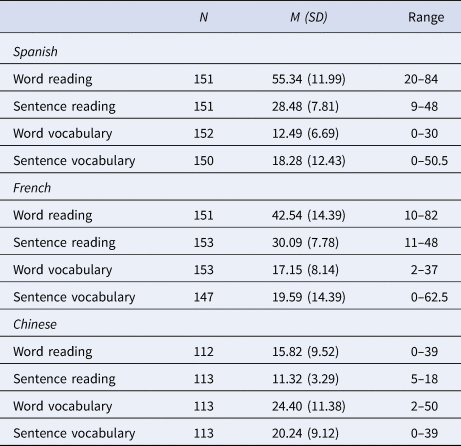
Descriptive statistics for the foreign language literacy skills are presented in Table 1. The mean scores on the foreign language literacy tasks differed across languages. In particular, scores tended to be higher for Spanish and French than for Chinese. In this study, however, we do not analyze the means, but aim to interpret individual differences through correlations between these literacy tasks and of these literacy tasks with the predictors. As there was sufficient variation in scores for all tasks, no floor or ceiling effects were observed, and the scores on all tasks were normally distributed, correlations can be estimated reliably.
Descriptive Statistics for the Literacy and Vocabulary Tasks in Spanish, French and Chinese
The correlations between the foreign language literacy tasks are presented in Table 2. Within each language the various literacy tasks were moderately correlated (r's between .40 and .60), with the exception of word and sentence vocabulary, which were correlated more strongly (r's > .70). Also, word reading in Chinese correlated strongly with vocabulary of both words and sentences in Chinese. Across languages, the literacy tasks were in general moderately correlated. Correlations tended to be highest between the same tasks in different languages, especially performance on the vocabulary tasks correlated strongly across languages. Surprisingly, word reading in Chinese was found to correlate moderately with the vocabulary tasks in the other languages and these correlations were higher than with word reading in the other languages.
Predictors of foreign language literacy skills
Descriptive statistics and correlations for the predictors of foreign language literacy skills are presented in Table 3. Scores on all tasks were normally distributed. As expected, the strongest correlations were found between tasks used to measure the same skill. The correlations of the predictors with the foreign language literacy skills are presented in Table 4. These correlations are discussed per language and per literacy skill.
Correlations Among the Literacy and Vocabulary Tasks in French, Spanish and Chinese

Descriptive Statistics and Correlations for the Predictors

Correlations of Cognitive Skills with Literacy and Vocabulary Tasks in French, Spanish and Chinese

Note. **p < .01; * p < .05.
For Spanish, word reading correlated with Dutch reading fluency, phonological awareness, RAN, verbal memory, and one of the visual processing speed tasks. Sentence reading correlated with Dutch reading fluency, but in addition with two of the three verbal and nonverbal intelligence tasks. Word vocabulary also correlated with Dutch reading fluency, and the majority of verbal and nonverbal intelligence tasks. Sentence vocabulary correlated with verbal and nonverbal intelligence, verbal memory, and specifically with Dutch word reading. Surprisingly, both vocabulary tasks correlated significantly with RAN pictures. Significant correlations were also found for word vocabulary with coding and the backward task of verbal memory.
For French, word reading fluency correlated with Dutch reading fluency, verbal intelligence, and phoneme awareness. Weak correlations were also found with two of the three nonverbal intelligence tasks. Sentence reading fluency correlated weakly with two of the three verbal and nonverbal intelligence tasks. For vocabulary of words and sentences, verbal and nonverbal intelligence were again the strongest correlates, although for word vocabulary, weak correlations were also found with word reading in Dutch and with the backward task of verbal memory.
For Chinese, word reading correlated with at least one of the tasks of all the predictors included, but especially with Dutch reading fluency, verbal intelligence, and RAN. Sentence reading correlated only with visual processing speed. Word vocabulary correlated mainly with nonalphanumeric RAN and visual processing speed, but also with Dutch word reading, several intelligence tasks and the backward task of verbal memory. Finally, sentence vocabulary correlated with two of the three nonverbal intelligence tasks, with symbol search and with the backward task of verbal memory.
To examine the effects of these predictors on the various foreign language literacy outcomes, while controlling for their interrelations, we fitted three regression models to the data (see Figure 1). For Spanish, the model provided a good approximate fit to the data: χ2(147) = 197.475, p = .004, RMSEA = .043 [.026-.058], CFI = .960, SRMR = .055. The standardized direct effects are presented in Table 5. Dutch reading fluency was the only significant predictor of Spanish word reading fluency, whereas sentence reading fluency was predicted by both Dutch reading fluency and nonverbal intelligence. For word vocabulary, none of the predictors contributed significantly, whereas sentence vocabulary was predicted by nonverbal intelligence and verbal memory.
Standardized Direct Effects in the Final Models

Note. ** p < .01; * p < .05
For French, the model provided a good approximate fit to the data: χ2(147) = 202.076, p = .002, RMSEA = .045 [.028-.060], CFI = .956, SRMR = .055. For sentence reading in particular, and for the other outcomes to a lesser extent, alphanumeric RAN had an effect on literacy skills that was in the unexpected direction; stronger alphanumeric RAN was associated with poorer literacy outcomes. This appeared to reflect a suppression effect, which can occur when a variable does not correlate with the dependent variable, but does correlate with one of the other independent variables (Maassen & Bakker, Reference Maassen and Bakker2001). Suppression effects are reflected both in the regression coefficient of the suppressor variable, and in the regression coefficients of the predictors that are correlated with the suppressor variable. Since the correlations (Table 4) indicated that RAN did not correlate significantly with any of the literacy outcomes in French, alphanumeric RAN was excluded from the model, to avoid suppression effects and obtain reliable estimates of the effects of the other predictors. This alternative model also provided a good approximate fit to the data: χ2(119) = 155.988, p = .013, RMSEA = .041 [.020-.058], CFI = .962, SRMR = .052. The standardized direct effects of this model are presented in Table 5. Dutch reading fluency and verbal intelligence were significant predictors of French word reading fluency, whereas nonverbal intelligence was the only significant predictor of sentence reading fluency. For vocabulary, verbal intelligence was the only significant predictor of word vocabulary, whereas sentence vocabulary was predicted by both verbal and nonverbal intelligence.
For Chinese, the model provided a good approximate fit to the data: χ2(147) = 197.776, p = .003, RMSEA = .043 [.026-.058], CFI = .959, SRMR = .056. Also for Chinese, significant suppression effects were found for alphanumeric RAN. This variable was therefore left out of the analysis. This alternative model also provided a good approximate fit to the data: χ2(119) = 154.427, p = .016, RMSEA = .040 [.018-.057], CFI = .963, SRMR = .053. The standardized direct effects of this model are presented in Table 5. When the suppression effects were controlled, Chinese word reading fluency was predicted by nonverbal intelligence and verbal memory, whereas sentence reading fluency was predicted by visual processing skills. Word vocabulary was not predicted significantly by any of the variables in the model, although the effect of verbal memory almost reached significance (p = .053). Sentence vocabulary was predicted significantly by nonverbal intelligence.
Discussion
In the current study we examined predictors of foreign language word reading, sentence reading, word vocabulary and sentence vocabulary in Dutch students who simultaneously acquired three foreign languages: transparent alphabetic Spanish, nontransparent alphabetic French, and nonalphabetic Chinese. We assessed their reading and cognitive skills at the start of foreign language acquisition and their performance on literacy skills after two years of foreign language instruction. The main research questions addressed similarities and differences in the influence of language and cognitive skills for the four different literacy skills, as well as the degree to which these are universal or language specific.
The effects of underlying language and cognitive skills on the different literacy skills, yielded three main conclusions. First, verbal and nonverbal intelligence were the strongest predictors of foreign language literacy skills. This finding may point out that foreign language literacy was taught in school and assessed with schoolrelated tasks and may therefore measure, at least partly, schoolrelated abilities. Alternatively, intelligence is specifically important in the initial stage of the acquisition of new skills. After one year of reading acquisition, intelligence appeared to have an important influence on the simple literacy skill word reading in all three foreign languages (Zeguers et al., Reference Zeguers, van den Boer, Snellings and de Jong2018). Current findings indicate that one year later, the influence of intelligence on word reading was less pronounced, but intelligence was of major importance for the more advanced literacy skills sentence reading and vocabulary. In line with this assumption, intelligence has been found to be involved in early reading development in the native language (de Jong & van der Leij, Reference de Jong and van der Leij1999).
Second, our results point to intelligence as a predictor of foreign language sentence reading. This is in line with findings from native readers, indicating that the more complex task of sentence reading, as compared to word reading, requires comprehension in addition to word identification (Jenkins et al., Reference Jenkins, Fuchs, Espin, van den Broek and Deno2000; Kim, Reference Kim2015). In both French and Spanish, sentence reading was mainly predicted by nonverbal intelligence (i.e., reasoning skills), in addition to Dutch reading fluency for Spanish. In Chinese, there was an interesting difference between word and sentence reading, with word reading depending most strongly on verbal memory and text reading on visual processing. This suggests that the simpler task of reading individual words allows addressing phonological properties of the characters, whereas the more complex task of reading whole sentences requires resorting to more superficial visual strategies.
Third, the processes underlying vocabulary acquisition seem different from the processes underlying reading in the three languages. In Spanish and French, phonological processes were found to be important for word reading, but not for word vocabulary, in line with previous findings for native as well as foreign readers (Engel de Abreu & Gathercole, Reference Engel de Abreu and Gathercole2012; Gathercole et al., Reference Gathercole, Willis and Baddeley1991). These previous studies indicated that the relatively limited influence of phonological processing on vocabulary is accompanied by a relatively large influence of verbal memory. In the current study, verbal memory was indeed more strongly related to word vocabulary than word reading. However, verbal memory only had a unique effect on sentence level vocabulary in Spanish. Effects of intelligence appeared to be of greater importance than memory skills in the current sample, which may stem from the students’ still limited foreign language experience. Possibly, the importance of verbal memory increases in later phases of literacy acquisition, when more word representations are stored in memory. Alternatively, the effect of verbal memory might become more visible in oral vocabulary tasks, rather than the written tasks used in the current study.
Furthermore, two findings relate to cross-linguistic differences. First, the relation between the Chinese literacy tasks and those in the other languages. Not only was the correlation between word reading and word vocabulary higher in Chinese than in the other languages, Chinese word reading also correlated more strongly with word vocabulary in French and Spanish than with word reading in those languages. In other words, word reading in Chinese acted more like a vocabulary task than a reading task. This might indicate that for native speakers of an alphabetic language who learn to read in a nonalphabetic language, literacy may develop in a character-by-character style – that is, learners either do or do not know a character. Once a character is known, all aspects, including visual, orthographic, phonological and semantic representations, are stored in memory. Consequently, the abilities to read and translate a given character could develop simultaneously.
Second, we observed clear cross-linguistic differences for one of the literacy measures, word reading. Spanish word reading correlated with several underlying language and cognitive skills, but only Dutch reading fluency had a unique effect. This suggests that when students learn to read words in a foreign language with a similar (alphabetic, transparent) structure as their native language, they can use the reading skills they had already acquired in Dutch to decode words in Spanish. In nontransparent alphabetic French, reading fluency and verbal intelligence exerted unique effects, indicating that when students are learning to read words in an orthography with a less transparent orthographic structure than their native language, they can use their native language reading skills, but also need to involve reasoning skills to decipher the unfamiliar letter-sound correspondences. For word reading ability in Chinese, a language with a nonalphabetic orthography, only verbal memory and nonverbal intelligence had a unique contribution. This suggests that when skilled readers in an alphabetic orthography learn to read in a nonalphabetic orthography, they use both linguistic and visual reasoning skills to make sense of the complex visual symbols. In sum, findings seem to indicate that the skills that exert unique contributions to foreign language word reading are largely language specific.
Interestingly, the current findings on word reading skills after two years of reading instruction could be related to previously reported outcomes for word reading by the same participants at an earlier stage (i.e., after one year) of foreign language instruction (Zeguers et al., Reference Zeguers, van den Boer, Snellings and de Jong2018). For Spanish, current findings were highly similar to the findings on word reading one year earlier. At both stages of language acquisition, word reading in Spanish is predominantly affected by language skills in the native language. Since the way speech sounds are represented in letters is quite similar in Spanish and Dutch, students may quickly be able to decode Spanish words rather efficiently. Consequently, they start to acquire orthographic knowledge of Spanish and start to identify words by sight, similar to the native language (Share, Reference Share1995).
For nontransparent alphabetic French, phonological awareness becomes less important, whereas Dutch reading fluency becomes more important after two years of reading instruction as compared to one year. This suggests that word reading in French initially relies heavily on decoding to acquire and use unfamiliar letter-sound connections. Yet with increasing foreign language skills, students increasingly employ direct word recognition, which means that their reading skills in a foreign language become more similar to the reading skills they already developed in their native language Dutch (e.g., Caravolas, Lervåg, Defior, Málková & Hulme, Reference Caravolas, Lervåg, Defior, Málková and Hulme2013; Geva et al., Reference Geva, Yaghoub-Zadeh and Schuster2000; Share, Reference Share1995).
For word reading ability in Chinese, the influence of verbal intelligence is smaller after year two as compared to year one, whereas the influence of verbal memory is more pronounced. The increasing use of verbal memory skills for word recognition might be indicative of an enhanced ability to store Chinese words’ phonological representations, or to utilize phonological processing skills, though not yet at the level of phonemes (i.e., no contribution was found of phonological awareness). These findings do align with the hypothesized developmental shift in Chinese reading processes, shown in native as well as foreign readers, from predominant visual-graphical processing in the initial learning phase, to the use of phonological cues when reading proficiency increases (Liu, Perfetti & Wang, Reference Liu, Perfetti and Wang2006; Liu, Wang & Perfetti, Reference Liu, Wang and Perfetti2007; Zhang & Perfetti, Reference Zhang and Perfetti1993). However, nonverbal intelligence also remained important, the learners in the current study seem to not yet have developed enough proficiency in Chinese to allow word recognition through phonological processes without interpretation of the visual cues of the characters.
These findings and interpretations should be viewed in the light of some important limitations to the current study. This study is one of the few studies that examine cognitive predictors of literacy outcomes in foreign language learners and is unique in studying three different foreign languages that are acquired simultaneously by the same group of participants. However, as a result, the study is mostly exploratory in nature, as few specific hypotheses could be deduced from the literature and no standardized tests were available to measure the foreign language skills of this particular group of participants. Consequently, we chose latent variable multiple regression, as this procedure allows to minimize error variance (i.e., decrease the chance of a type I error) and take into account interrelations among language and cognitive predictors, when determining which skill(s) is/are most important for the acquisition of foreign language literacy skills. Future studies are needed to develop standardized, more validated tests to measure foreign language literacy skills in teenagers, as these would allow the comparison of mean scores or growth rates across different languages, in addition to the individual differences in learning central to the current study. Moreover, with increasing knowledge of the acquisition of literacy skills across languages, future studies could test directly and more specifically crosslinguistic differences, as well as individual differences – using, for example, Bayesian or linear mixed effects models.
Additionally, knowledge about the processes involved in the acquisition of sentence level reading and vocabulary across foreign languages is scarce. The current study shows that predictors selected on the basis of literature on word reading are of limited importance for other literacy skills – specifically, vocabulary. Previous studies on predictors of vocabulary development focused mainly on young children both in the native language (e.g., Fernald, Marchman & Weisleder, Reference Fernald, Marchman and Weisleder2013; Hoff, Reference Hoff2003; Rowe, Reference Rowe2012) and foreign language (e.g., Duursma et al., Reference Duursma, Romero-Contreras, Szuber, Proctor, Snow, August and Calderón2007; Leseman, Reference Leseman2000; Poulin-Dubois, Bialystok, Blaye, Polonia & Yott, Reference Poulin-Dubois, Bialystok, Blaye, Polonia and Yott2013; Uchikoshi, Reference Uchikoshi2006). Consequently, characteristics of caretakers and the home environment are predominantly examined as predictors. This is very different from the situation of the large and increasing group of learners who learn foreign languages at a later age. Although the development of vocabulary itself is sometimes studied for this population (e.g., David, Reference David2008; Laufer, Reference Laufer1998), little is known about the cognitive predictors influencing vocabulary development. Therefore, it seems highly relevant to devote future studies to skills involved in the development of broad literacy skills in different foreign languages.
Moreover, it is difficult to study emerging literacy skills in foreign languages as these skills build on existing language and literacy skills in the native language, in the specific foreign language and in other foreign languages mastered. It seems important to account explicitly for these native language as well as foreign language skills. In the current study we included only a basic measure of reading fluency in the native language. We did not take into account proficiency in other literacy skills in the native language(s), thereby preventing conclusions about the impact of native language literacy on the development of foreign literacy skills. Students in the current study all spoke Dutch, but often also spoke another language at home. In addition, they all spoke English and were being offered classes in German, Latin and/or Greek at school in addition to the languages under study. Previous research suggests that processes involved in foreign language acquisition are different for learning a second language, than for learning a third, or fourth language (e.g., Adesope, Lavin, Thompson & Ungerleider, Reference Adesope, Lavin, Thompson and Ungerleider2010; Cenoz, Reference Cenoz2013; Dewaele, Reference Dewaele, Cenoz, Hufeisen and Jessner2001). It seems important, yet hardly possible, to account explicitly for skills in all these other languages.
To conclude, different foreign language literacy skills, including sentence reading and vocabulary at the word and sentence level, appeared to be scarcely influenced by the cognitive skills involved in word reading. The relatively large importance of intelligence for these skills might indicate the involvement of academic reasoning for the acquisition of new knowledge and skills. In light of the large and increasing group of people that acquire literacy in one or more foreign languages after achieving proficient literacy skills in their native language, current knowledge of these foreign language literacy acquisition processes is remarkably scarce. Hence the current findings may function as a starting point for future studies that focus on multiple foreign languages and various literacy components, including a broader range of predictors in the native as well as foreign languages.
The findings on word reading were most clear. Word reading in foreign languages seems to be increasingly based on native language reading skills. Although this developmental pattern appears to be universal, the stage at which native language reading skills can be effectively employed for foreign language word reading seems to be reached earlier for foreign languages with a smaller orthographic distance to the native language (in line with Cummins, Reference Cummins2000, Reference Cummins2007). For languages with a large orthographic distance, i.e., with a completely different script, native language reading skills are still of limited importance after two years of instruction and general reasoning skills remain most influential. Findings thus underscore the importance of studying different stages of foreign language acquisition and suggest that teaching strategies may need to be adapted to the specific learning stage of students.
Acknowledgements
Both authors contributed equally. We would like to thank Peter F. de Jong and Patrick Snellings for comments on an earlier version of this paper. We thank Lisanne Naaktgeboren, Maaike Vertregt and the other assistants who helped with the collection of the data. Thanks to Arnold Koot, Jessica Paardenkoper, and other members of staff at the school for the valuable collaboration. Above all, thanks to the students for their enthusiastic participation in this project.


 Open access

