


 = 0.42 and an abundance estimate of
  = 19 (9.65) tigers. The sampled area of
  = 477.2 (58.24) km
 = 3.98 (0.51) tigers per 100 km
Introduction
The tiger Panthera tigris is categorized as Endangered on the IUCN Red List (IUCN, 2006) and during the past 3 decades substantial efforts have been invested in tiger conservation by governments and non-governmental agencies. However, these efforts are constrained by a lack of reliable data on the distribution as well as densities of wild tiger populations. Furthermore, dissemination of putative ‘tiger numbers’ (Jackson, Reference Jackson1993), often based on guesswork or demonstrably faulty methods (Karanth, Reference Karanth, Tilson and Seal1987, Reference Karanth1988; Karanth et al., Reference Karanth, Nichols, Seidensticker, Dinerstein, Smith, McDougal, Johnsingh, Chundawat and Thapar2003) masks a real scarcity of reliable data. Therefore, there is an urgent need to obtain reliable estimates of tiger densities at a large number of sites across the 1.2 million km2 geographic range of the species (Seidensticker et al., Reference Seidensticker, Christie, Jackson, Seidensticker, Christie and Jackson1999).
Thailand is a key tiger range state, with 25% of its land area under forest cover, 16% of it being managed under wildlife and national park protection legislation (Pattanavibool & Dearden, Reference Pattanavibool and Dearden2002). In addition, increasing societal wealth and an official commitment to science-based tiger conservation (Tunhikorn et al., 2004) make Thailand a critical region for tiger conservation. Consequently, attempts have been made to map accurately the distribution of tiger populations in Thailand from field surveys (Rabinowitz, Reference Rabinowitz1993, Reference Rabinowitz, Seidensticker, Christie and Jackson1999; Smith et al., Reference Smith, Tunhikorn, Tanhan, Simcharoen, Kanchanasaka, Seidensticker, Christie and Jackson1999; Tunhikorn et al., Reference Tunhikorn, Smith, Prayurasiddhi, Graham, Jackson and Cutter2004; WEFCOM, 2004). However, to use such maps for managing wild tiger populations there is an additional need to estimate densities and sizes of individual tiger populations at specific sites. This critical need has been enunciated in Thailand's national action plan for tigers (Tunhikorn et al., Reference Tunhikorn, Smith, Prayurasiddhi, Graham, Jackson and Cutter2004). The national plan also identifies the 18,000 km2 Western Forest Complex, which contains 17 protected areas, including Huai Kha Khaeng Wildlife Sanctuary, as the most important tiger conservation area in the country.
Although reliable estimation of tiger abundance is difficult because of their elusive behaviour and naturally low densities, recent development of automated camera traps and their application within a formal framework of capture-recapture population sampling (see Karanth et al., Reference Karanth, Nichols, Kumar and Thompson2004b, for a review) have enabled investigators to obtain rigorous density estimates in India (Karanth & Nichols, Reference Karanth and Nichols1998; Karanth et al., Reference Karanth, Chundawat, Nichols and Kumar2004a,c), Nepal (Wegge et al., Reference Wegge, Pokheral and Jnawali2004), Malaysia (Kawanishi & Sunquist, Reference Kawanishi and Sunquist2004) and Indonesia (O'Brien et al., Reference O'Brien, Kinnaird and Wibisono2003). Unlike previous tiger monitoring approaches based on footprint total counts (Panwar, Reference Panwar1980), radio-telemetry (Sunquist, Reference Sunquist1981; Smith, Reference Smith1993) or raw photographic trapping rates (Carbone et al., Reference Carbone, Christie, Conforti, Coulson, Franklin, Ginsberg, Griffiths, Holden, Kawanishi, Kinnaird, Laidlaw, Lynam, MacDonald, Martyr, McDougal, Nath, O'Brien, Seidensticker, Smith, Sunquist, Tilson and Wan Shaharuddin2001), capture-recapture methods can effectively deal with the typical inability of surveys to detect all individual tigers present in an area (i.e. detection probability P <1; Williams et al., Reference Williams, Nichols and Conroy2002). Photographic capture-recapture sample surveys of tigers conducted in habitats ranging from evergreen, semi-deciduous and deciduous forests to alluvial grasslands (O'Brien et al., Reference O'Brien, Kinnaird and Wibisono2003; Karanth et al., Reference Karanth, Chundawat, Nichols and Kumar2004a; Kawanishi & Sunquist, Reference Kawanishi and Sunquist2004; Wegge et al., Reference Wegge, Pokheral and Jnawali2004) show that reliable estimates can be generated at relatively low densities of 2-3 tigers per 100 km2, although their variances tend to be large because of the small number of traps typically deployed in such studies. A recent study (Karanth et al., Reference Karanth, Nichols, Kumar and Hines2006) that integrated photo-capture data across space and time employing the Robust Design (Pollock et al., Reference Pollock, Nichols, Brownie and Hines1990; Lebreton et al., Reference Lebreton, Burnham, Clobert and Anderson1992; Kendall et al., Reference Kendall, Nichols and Hines1997; Williams et al., Reference Williams, Nichols and Conroy2002) demonstrated the power of capture-recapture analyses to detect changes in the temporal dynamics of a tiger population.
However, prior to this study, there has not been an estimate of tiger abundance in Thailand based on capture-recapture analyses. Here we present the results of a post hoc capture-recapture analysis of camera trap survey data collected in Huai Kha Khaeng Wildlife Sanctuary during 2004-2005. The objectives of our analysis were to: (1) Assess the potential for employing camera trap surveys in the semi-deciduous forests that form a large proportion of tiger habitat in Thailand (Tunhikorn et al., Reference Tunhikorn, Smith, Prayurasiddhi, Graham, Jackson and Cutter2004). (2) Analyse the tiger photo-capture data in a formal capture-recapture sampling framework (Otis et al., Reference Otis, Burnham, White and Anderson1978; White et al., Reference White, Anderson, Burnham and Otis1982; Williams et al., Reference Williams, Nichols and Conroy2002) to generate estimates of capture probability, population size, effectively sampled area and tiger density based on survey protocols developed in India (Karanth et al., Reference Karanth, Kumar, Nichols, Karanth and Nichols2002; Nichols & Karanth, Reference Nichols, Karanth, Karanth and Nichols2002). (3) Assess whether tiger densities in Huai Kha Khaeng are comparable to densities recorded in ecologically similar semi-deciduous forest sites in India (Karanth et al., Reference Karanth, Nichols, Kumar, Link and Hines2004c). (4) Examine the general implications of our results for understanding tiger ecology and monitoring wild tiger populations in Thailand.
Study area
This study was carried out in the forests around Khao Nang Rum research station within the 2,780 km2 Huai Kha Khaeng Wildlife Sanctuary (Fig. 1). The area is rugged and hilly over altitudes of 200-1,600 m, has an annual temperature range of 10-35°C and annual precipitation of c. 1,500 mm. It supports four vegetation types: dry deciduous dipterocarp forests, mixed deciduous forest, dry evergreen forest, and hill evergreen forest, depending on rainfall patterns and edaphic factors (Srikosamatara, Reference Srikosamatara1993; Tunhikorn et al., Reference Tunhikorn, Smith, Prayurasiddhi, Graham, Jackson and Cutter2004; WEFCOM, 2004). From earlier food habit studies in the area (Petdee, Reference Petdee2000), principal prey species of tigers are wild pig Sus scrofa, sambar Cervus unicolor, common muntjac Muntiacus muntjac, banteng Bos javanicus and gaur Bos frontalis. Other potential tiger prey include wild buffalo Bubalus bubalis and Malayan tapir Tapirus indicus.
The Khao Nang Rum camera-trap survey area in Huai Kha Khaeng Wildlife Sanctuary. Inset shows the Sanctuary's location (HKK) in Thailand.

Methods
Field methods
The original goal was to document the presence of tigers and other mammals in the area using camera-trap techniques. Therefore, trapping was done on an ad hoc basis without employing recommended survey protocols (Karanth et al., Reference Karanth, Kumar, Nichols, Karanth and Nichols2002; Nichols & Karanth, Reference Nichols, Karanth, Karanth and Nichols2002). Twelve Trailmaster (Goodson & Associates, Lenexa, USA) and 10 CamTrakker (CamTrakker, Georgia, USA) units were deployed to cover a 211 km2 area using 103 trap locations (Fig. 1).
Trapping was carried out from 9 February 2004 to 1 February 2005 using 14 clusters of trap locations. These clusters are analogous to trapping blocks (Nichols & Karanth, Reference Nichols, Karanth, Karanth and Nichols2002), with each block consisting of c. seven trap locations. The sampling effort varied among blocks: eight locations were trapped for >20 days, 49 locations for 16-19 days, 12 locations for c. 15 days and the remaining 34 locations were trapped for <15 days. On average there were c. 15 trap-days at each location, and this trapping effort was uniform across the study area. The moving of traps among blocks did not follow a strict pre-designed sequence and was driven by logistics as well as opportunities for setting traps at tiger kill sites. However, in combination, data from all these blocks covered the area evenly (Fig. 1).
Of particular concern for the analysis was the long survey duration of 12 months, resulting in the possibility of the sampled tiger population being demographically open (Otis et al., Reference Otis, Burnham, White and Anderson1978). Given the high turnover of individuals in tiger populations (Karanth et al., 2006), such lack of closure could bias estimates of population size. However, the following aspects of the survey encouraged us to attempt a post-hoc statistical analysis of these data under a formal capture-recapture sampling framework: (1) There were two opposing cameras at each trap location, at a distance of c. 3-5 m from the anticipated path of moving tigers at c. 45 cm height, which obtained good photographs of both flanks, enabling unambiguous identification of individuals. (2) The camera trap locations were selected based on signs of past tiger activity to maximize capture probabilities, resulting in a relatively large number (n = 17) of individual tigers being photo-captured. (3) The maximum spacing between any two trap locations was <2.3 km, thus ensuring that there were no holes in the sampled area and that every tiger in the sampled population had a non-zero probability of being photo-captured during each sampling occasion.
Analysis
Given the potential for lack of demographic closure (Karanth et al., Reference Karanth, Kumar, Nichols, Karanth and Nichols2002; Williams et al., Reference Williams, Nichols and Conroy2002) in the data we would have preferred to use open model analyses (Karanth et al., Reference Karanth, Nichols, Kumar and Hines2006). However, the lack of simultaneous natural temporal coverage of the entire survey area (because we had to construct our sampling occasions as described above) precluded this option. Therefore, we constructed closed model capture histories following survey design 4 of Nichols & Karanth (Reference Nichols, Karanth, Karanth and Nichols2002), ensuring that capture data from well spaced locations were included in every sampling occasion. We constructed five sampling occasions based on the calendar dates on which each location was trapped (Otis et al., Reference Otis, Burnham, White and Anderson1978; Karanth & Nichols, Reference Karanth and Nichols1998). Because of low capture rates, tiger photo-capture data from three successive calendar dates at each trapping location were combined before being assigned to a specific sampling occasion. We thus ensured that equal trapping effort was expended and the entire area was sampled during each of the sampling occasions.
The individual tiger capture histories in the standard X-matrix format (Otis et al., Reference Otis, Burnham, White and Anderson1978; White et al., Reference White, Anderson, Burnham and Otis1982) were analysed using models developed for closed populations (Otis et al., Reference Otis, Burnham, White and Anderson1978; White et al., Reference White, Anderson, Burnham and Otis1982) implemented in the software CAPTURE (Rexstad & Burnham, Reference Rexstad and Burnham1991). We tested the population closure assumption against our data. The closure test (Otis et al., Reference Otis, Burnham, White and Anderson1978; White et al., Reference White, Anderson, Burnham and Otis1982) implemented in CAPTURE is based on the number of sample periods separating the times of first and last capture for each animal caught at least twice. If animals are entering and/or leaving the sampled population during the survey period, the time between first and last captures should be shorter on average than if all animals were present during the entire survey period.
The capture-recapture models implemented in CAPTURE consider potential effects of behavioural response of tigers to camera trapping (e.g. trap-avoidance: model Mb), time-specific variation (e.g. weather changes over the 3-day sampling occasions: model Mt), and heterogeneity among individual animals (e.g. caused by factors such as territorial status or trap access: model Mh), as well as more complex models such as Mbh, Mth, Mtb and Mtbh that incorporate occurrence of the effects of heterogeneity, trap response and time in different combinations.
We fitted the null model M0 and each of the above seven models to our data using CAPTURE (Rexstad & Burnham, Reference Rexstad and Burnham1991) and examined results of goodness-of-fit and between- model tests, and the overall discriminant function, to guide the selection of an appropriate model for the data. The selected model was then used for estimating capture probabilities  and abundance
  . We estimated the effectively sampled area using an approach evaluated by Wilson & Anderson (1985), and computed tiger densities by dividing the population size by the sampled area. This computational approach is fully described elsewhere (Karanth & Nichols, 1998; Nichols & Karanth, 2002).
Results
Photographic captures of tigers
In a total sampling effort of 1,509 trap-days we obtained 124 tiger photographs (59 right flanks, 57 left flanks, four frontal, four rear) of 15 individual tigers judged to be >12 months of age (10 females, four males, one of unknown sex). Individual tigers could be clearly identified from stripe patterns (Karanth et al., Reference Karanth, Kumar, Nichols, Karanth and Nichols2002) and were given unique identification numbers (HKT-101-HKT-117). We obtained both left and right profile photos for 12 individuals, and three more animals were identified from only left profiles. Capture data for two cubs were excluded from the analysis.
The capture histories generated from the field survey (Table 1) show that the number of individuals caught was small (Mt+1=15), as expected in a low to medium density tiger population (Karanth et al., Reference Karanth, Nichols, Kumar, Link and Hines2004c). Four animals were caught in all five sampling occasions, one was caught in four occasions, two animals were caught thrice, two others twice and six individual tigers were caught only once. We expected this low recapture rate for several individuals to induce substantial uncertainty in our estimates.
Capture histories of tigers photo-trapped in Huai Kha Khaeng Wildlife Sanctuary, Thailand, during 2004-2005.

* F, female >12 months; M, male >12 months; U, unknown sex >12 months; C, cubs <12 months (not included in the capture-recapture analysis).
Estimates of effectively sampled area
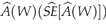
The polygon formed by the outer-most camera traps (Fig. 1) was 211 km2. For the 10 individual tigers that were caught more than once, the maximum distance between photo-captures was 0.90-16.05 km, with a mean value of 7.11 km. Using the approach described more fully elsewhere (Karanth & Nichols, Reference Karanth and Nichols1998; Nichols & Karanth, Reference Nichols, Karanth, Karanth and Nichols2002), we estimated the effectively sampled area as ![$\widehat{A}(W)(\widehat{SE}[\widehat{A}(W)])$](https://static.cambridge.org/binary/version/id/urn:cambridge.org:id:binary:20180418092722550-0738:S0030605307414107:S0030605307414107_eqn07.gif?pub-status=live) = 477.2 (58.24) km2.
= 477.2 (58.24) km2.
Tests for population closure and model selection
The statistical test for population closure implemented in CAPTURE (Rexstad & Burnham, Reference Rexstad and Burnham1991) was consistent with the assumption that our tiger population was closed during the survey period (z = 0.39, P = 0.65). Because of the long (12 months) survey period, we would have liked to consider open models as well but the ad hoc field sampling design precluded this possibility. We assumed that our data supported the closure assumption, albeit not strongly.
The test for presence of individual heterogeneity in capture probabilities showed that the null model M0 was rejected in favour of the model incorporating heterogeneity Mh (χ 2 = 10.07, df = 1, P <0.002). The goodness-of-fit test results for models Mh and Mb (incorporating trap-response behaviour) provided no evidence of lack of fit (χ 2 = 3.85, df = 4, P = 0.43 and χ 2 = 2.57, df = 4, P = 0.64, respectively). The tests also did not reject the null model M0 in favour of alternative models Mb (χ 2 = 0.77, df = 1, P = 0.38) or Mt (time-specific variation in capture probabilities; χ 2 = 2.86, df = 4, P = 0.58). Model Mbh, which accommodates heterogeneity as well as trap response was not favoured over the more parsimonious Mh model (χ 2 = 0.67, df = 2, P = 0.72).
The overall discriminant function model selection algorithm in CAPTURE (Rexstad & Burnham, Reference Rexstad and Burnham1991) scored the competing models as: M0 = 0.88, Mh = 1.00, Mb = 0.38, Mbh = 0.57, Mt = 0.0, Mth = 0.41, Mtb = 0.37, Mtbh = 0.64. The higher scoring model Mh is more likely to have generated the observed capture history data in comparison to lower scoring models. This choice of model Mh in statistical tests reported above is consistent with past results (Karanth et al., Reference Karanth, Nichols, Kumar, Link and Hines2004c) as well as aspects of tiger biology. Resident breeding tigers maintain home ranges that overlap between the sexes. Additionally, some individuals in the population are non-breeding ‘floaters’, which may not have stable home ranges (Sunquist, Reference Sunquist1981; Smith, Reference Smith1993; Karanth & Sunquist, Reference Karanth and Sunquist2000). These space use patterns, as well as location of our camera traps in relation to home ranges of individuals, were likely to induce differences in capture probabilities among individual tigers.
Estimates of capture probability, tiger population size and density
The tiger capture histories (Table 1) were used to generate parameter estimates under model Mh using the jackknife estimator (Burnham & Overton, Reference Burnham and Overton1978; Otis et al., Reference Otis, Burnham, White and Anderson1978) implemented in CAPTURE, which performed well in earlier photographic capture studies of tigers (Karanth & Nichols, Reference Karanth and Nichols1998; Karanth et al., Reference Karanth, Nichols, Kumar, Link and Hines2004c). The estimated average capture probability per sampling occasion ( ) was 0.42. The total population size estimate (
 ) was 19 tigers with a standard error
 ![$(\widehat{SE}[\widehat{N}])$](https://static.cambridge.org/binary/version/id/urn:cambridge.org:id:binary:20180418092722550-0738:S0030605307414107:S0030605307414107_eqn10.gif?pub-status=live) of 3.9 tigers. Based on the sampled area
of 3.9 tigers. Based on the sampled area ![$\widehat{A}(W)(\widehat{SE}[\widehat{A}(W)])$](https://static.cambridge.org/binary/version/id/urn:cambridge.org:id:binary:20180418092722550-0738:S0030605307414107:S0030605307414107_eqn11.gif?pub-status=live) = 477.2 (58.24) km2, the estimated density of tigers in the area was
= 477.2 (58.24) km2, the estimated density of tigers in the area was ![$\widehat{D}(\widehat{SE}[\widehat{D}])$](https://static.cambridge.org/binary/version/id/urn:cambridge.org:id:binary:20180418092722550-0738:S0030605307414107:S0030605307414107_eqn12.gif?pub-status=live) = 3.98 (0.51) tigers per 100 km2. These estimates exclude cubs <12 months in age, which generally comprise 20-25% of wild tiger populations (Smith, 1993; Kenny et al., 1995).
= 3.98 (0.51) tigers per 100 km2. These estimates exclude cubs <12 months in age, which generally comprise 20-25% of wild tiger populations (Smith, 1993; Kenny et al., 1995).
Discussion
We have demonstrated in this study that non-invasive photographic sampling is a potentially useful method for estimating densities of tigers in the tropical forests of the Western Forest Complex in Thailand and therefore probably for other similar areas in South-east Asia. Ecological factors, such as climate, topography and present tiger density levels permit the application of this method. The overall probability of capturing a tiger present in the sampled area during the entire survey (Mt+1/ = 0.79) was <1. Therefore, it is critical to use the capture-recapture sampling-based approach (Williams et al., 2002) to deal with the fact that not all tigers present in the study area are likely to be detected.
Based on comparisons of this ad hoc study with earlier surveys in India that employed more rigorous field protocols (Karanth et al., Reference Karanth, Kumar, Nichols, Karanth and Nichols2002; Nichols & Karanth, Reference Nichols, Karanth, Karanth and Nichols2002), we recommend the following modifications to future camera trap studies of tigers in the area: (1) The number of camera traps employed in this study was small (10-15). To improve robustness of the statistical inferences of tiger abundance we recommend deployment of at least 40-50 traps, so that the sampled area, the potential number of tiger-exposed traps, and recapture rates can all be increased. (2) The camera trap survey duration should be shorter, preferably <6 weeks, to avoid potential violation of population closure assumptions. Furthermore, a pre-designed field survey protocol (Nichols & Karanth, Reference Nichols, Karanth, Karanth and Nichols2002), which can generate data amenable to straightforward construction of capture histories, should be employed. A larger number of traps would make it easier to implement such a survey design. (3) It would be useful to sample this tiger population photographically on an annual basis to estimate its size and density, as well as other parameters such as longer term rates of survival, recruitment, and permanent and temporary emigration. Robust Design and other recent refinements in capture-recapture analyses (Pollock et al., Reference Pollock, Nichols, Brownie and Hines1990; Lebreton et al., Reference Lebreton, Burnham, Clobert and Anderson1992; Kendall et al., Reference Kendall, Nichols and Hines1997; Williams et al., Reference Williams, Nichols and Conroy2002) facilitate such analyses (Karanth et al., Reference Karanth, Nichols, Kumar and Hines2006). Reliable monitoring of the responses of tiger population dynamics to threats and conservation interventions can be an effective component of long-term adaptive management.
The observed mean density of c. 4 tigers per 100 km2 in this study was comparable to the density of 3.3-7.3 tigers per 100 km2 measured in ecologically similar disturbed semi-deciduous forests such as Tadoba, Bhadra, Melghat, Pench and Panna reserves in India (Karanth et al., Reference Karanth, Nichols, Kumar, Link and Hines2004c). However, better protected Indian reserves that are ecologically comparable to Huai Kha Khaeng, such as Kanha, Bandipur and Nagarahole, support tiger densities that are thrice as high (c. 12 tigers per 100 km2). The Huai Kha Khaeng landscape lacks an abundant, social cervid such as the chital Axis axis that accounts for 13-95% of prey numbers recorded in Indian reserves. However, Eld's deer Cervus eldi, which was extirpated from Huai Kha Khaeng in historical times, is such a species.
Our study area of 477 km2 around Khao Nang Rum research station forms 17% of the area of Huai Kha Khaeng Wildlife Sanctuary and 2.7% of the Western Forest Complex. Prima facie, this area appears to support low densities of ungulate prey (Srikosamatara, Reference Srikosamatara1993), and consequently a relatively low density of c. 4 tigers per 100 km2. If the entire landscape surrounding Khao Nang Rum research station supports comparable tiger densities, Huai Kha Khaeng Sanctuary could hold 113 tigers, and the entire Western Forest Complex c. 720 tigers.
Given the similarity of vegetation types, climate and prey composition between semi-deciduous forests of India and Thailand, their ecological productivities should be comparable. Furthermore, given the similarity in composition of their ungulate prey assemblages, potential maximum prey densities and hence tiger densities should also be similar. Based on tiger density data from well protected Indian reserves (Karanth et al., Reference Karanth, Nichols, Kumar, Link and Hines2004c), we speculate that Huai Kha Khaeng Sanctuary could potentially hold 338 tigers, and the entire Western Forest Complex >2,000 tigers, highlighting the importance of this area for global tiger conservation. Major new conservation initiatives followed on from this study, in particular improved law enforcement under the joint initiatives of the Thailand government and the Wildlife Conservation Society, and we have also implemented an improved camera-trap monitoring system that employs standard closed model photographic capture-recapture sampling of <60 days duration (Karanth et al., Reference Karanth, Kumar, Nichols, Karanth and Nichols2002) using 136 trap sites to sample effectively an area of 1,260 km2.
Acknowledgements
We are grateful to the Department of National Park, Wildlife, and Plant Conservation, Government of Thailand, for supporting this work. We gratefully acknowledge encouragement received from the following officials of the department: Chatchawan Pisdamkhom, Soontoon Chaiwattana, Kalyanee Boonkerd, Boosabong Kanchanasakha, and Suchitra Changtragoon. We thank the Wildlife Conservation Society, New York, for supporting the involvement of AP, KUK and NSK in this study and for partial funding, and the US Geological Survey's Patuxent Wildlife Research Center for supporting the involvement of JDN. We acknowledge WWF–Thailand for providing 10 camera traps to start the study. We are grateful to our enthusiastic team of research assistants, Boonyang Srichan, Sompoad Daungsirichantra and Somporn Pakpein for their dedicated fieldwork. We are particularly grateful to James E. Hines for assistance with data analysis.
Biographical sketches
Saksit Simchareon's area of interest is the study of tigers and leopards in the dry forests of Thailand using radio telemetry and camera trapping. He has carried out intensive ecological studies on these species over the past 3 years. Anak Pattanavibool is interested in examining large mammal ecology and conservation issues in Thailand within a landscape ecological framework. K. Ullas Karanth developed camera trap surveys in India with a focus on integrating them with modern animal sampling methods. James D. Nichols works on development of rigorous sampling and analytical methodologies for assessing wildlife populations. N. Samba Kumar specializes in developing field protocols for surveying large mammals in Asian forests.



