

10.1 Introduction
For many years, scholarship in transition studies has primarily focused on the emergence of innovations and the associated transformation of a socio-technical system such as electricity, transport or agri-food. This is reflected in key conceptual frameworks such as the multi-level perspective (Geels, Reference Geels2019) and technological innovation systems (Markard, Reference Markard2020) that typically portray transitions as unfolding around a specific set of technologies in a focal socio-technical system. Influences from outside the focal system were treated as landscape developments, or context factors.
However, many real-world transitions are increasingly characterised by change processes that span across multiple systems. The net-zero energy transition, for example, involves transitions in heating, industry and transport, which again rely on low-carbon electricity and the transition of the electricity system (Andersen, Geels, Coenen, et al., Reference Andersen, Geels, Coenen, Hanson, Korsnes, Linnerud, Makitie, Nordholm, Ryghaug, Skjolsvold, Steen and Wiebe2023; Markard & Rosenbloom, Reference Markard, Rosenbloom, Rogge, Kern and Meadowcroft2022). Similarly, multi-purpose technologies such as ICT, batteries or carbon capture affect many different socio-technical systems (creating new interdependencies), and the circular economy transition could transform entire value chains across different sectors (Decourt, Reference Decourt2019; Finstad & Andersen, Reference Finstad and Andersen2023; John et al., Reference John, Wesseling, Worrell and Hekkert2022; Kern et al., Reference Kern, Sharp and Hachmann2020).
Transition scholars have worked on multi-system interactions in the past (Konrad et al., Reference Konrad, Truffer and Voß2008; Papachristos et al., Reference Papachristos, Sofianos and Adamides2013; Raven & Verbong, Reference Raven and Verbong2007; Sutherland et al., Reference Sutherland, Peter and Zagata2015). This early wave of multi-system interaction analysis generated first ideas about how to approach the topic but also left many questions open (Andersen & Geels, Reference Andersen and Geels2023; Bakhuis et al., Reference Bakhuis, Kamp, Barbour and Chappin2024; Rosenbloom, Reference Rosenbloom2020). Our existing knowledge about multi-system phenomenaFootnote 1 thus needs to be widened in a new wave of conceptual developments and empirical studies to meaningfully grasp currently unfolding multi-system dynamics (Andersen et al., Reference Andersen, Steen, Mäkitie, Hanson, Thune and Soppe2020; Kanger et al., Reference Kanger, Schot, Sovacool, van der Vleuten, Ghosh, Keller, Kivimaa, Pahker and Steinmueller2021; Rosenbloom, Reference Rosenbloom2020).
To provide an overview and orientation, we review existing work on multi-system interactions in transition studies. We look into three strands of the transitions literature: technological innovation systems (TIS), multi-level perspective (MLP) and deep transitions (DT). We discuss phenomena of interest, types of systems and interactions analysed, and main insights from each framework, see Table 10.1. Subsequently, we discuss differences, similarities and open issues across the frameworks to articulate a research agenda, see Table 10.2.
| Multi-system dynamics phenomena of interest | |
|---|---|
| TIS |
|
| MLP |
|
| DT |
|
| Main types of systems considered in multi-system dynamics | |
| TIS |
|
| MLP |
|
| DT |
|
| Types of interactions studied | |
| TIS |
|
| MLP |
|
| DT |
|
| Main insights | |
| TIS |
|
| MLP |
|
| DT |
|
| Observation | Key learnings | Research needs | |
|---|---|---|---|
| Systems | Many types | Different types of systems and boundaries required for different research questions |
|
| Interactions | High diversity of concepts Analysis often descriptive and abstract | Couplings as a shared concept but more synthesis work required Better understanding of coupling processes needed |
|
| Phenomena | Most focus on ‘bilateral’ multi-system dynamics | Exploration of processes of change in multi-system settings is central, especially when studying complexes of systems |
|
We focus on interactions between socio-technical systems in different domains (e.g. energy, transport), whereas we mention interactions between systems in different places (e.g. national, global), or between socio-technical and e.g. political, financial or educational systems only in passing. Socio-technical systems include interrelated actors, institutions and technologies (Rip & Kemp, Reference Rip, Kemp, Rayner and Malone1998) and they typically provide key societal functions such as energy, transport or food (Konrad et al., Reference Konrad, Truffer and Voß2008). Note that readers should have a good understanding of transition studies, and the individual frameworks discussed in this chapter to fully comprehend the text. An obvious starting point would be chapters on MLP, DT and innovation systems in this book (Davies & Schot, Reference Davies, Schot, Wesche and Hendriks2024; Geels, Reference Geels and Hendriks2024; van der Loos, Reference van der Loos, Wesche and Hendriks2024). Also note that multi-system dynamics as a research topic and related concepts are rapidly evolving which implies that our review and discussions merely reflect how we currently perceive the topic.
10.2 Brief Literature Review
We distinguish four generic settings of increasing complexity for multi-system interactions to occur, see Figure 10.1. The first Figure 10.1(a) is about interactions between two or more stable systems, e.g. through the exchange of resources (input–output relations). For instance, the supply of gasoline (oil and gas system) and conventional cars (vehicle manufacturing system) in the past to the transport system (focal system on the left). This reminds us that multi-system interactions are ubiquitous in modern economies because systems exchange resources all the time. Second Figure 10.1(b), a focal system is in transition (circular arrow) with interactions to one or more stable systems. For example, the electrification of car-based personal transport in Norway (left) by connecting to an electricity system that was already fully renewable.
Different settings for multi-system interactions. Interactions of two systems in transition. An example is the electrification of road transport in places where both the electricity and the transport system were originally based on fossil fuels. Fourth (Figure 1(d)), interactions of several socio-technical systems in transition that together make up a complex of systems. For example, net-zero, digital or circular economy transitions affecting multiple systems through a shared directionality and interdependent resource exchanges. While multi-system analysis in the second and third setting typically has a focal system as the main unit of analysis, the fourth setting may also come with a shift in the unit of analysis from a focal system towards sets or complexes of interdependent systems
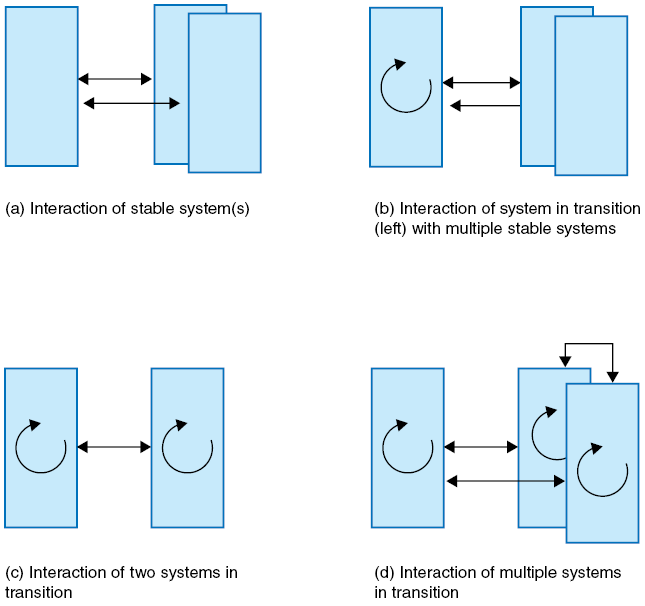
We further distinguish between multi-system interactions, referring to different types of couplings and resource flows between systems, and multi-system dynamics, which refer to socio-technical change processes (of varying depth) significantly influenced by other systems (i.e. Figure 10.1(b)–(d)). Although interactions and dynamics obviously are closely related, we make the distinction to emphasise that zooming in on the interactions and couplings (e.g. how to design or create them) is only one part of the broader research topic of multi-system dynamics. The distinction also highlights that different multi-system dynamics phenomena may involve similar types of multi-system interactions.
10.2.1 Technological Innovation System Perspective
The technological innovation system (TIS) perspective places a selected technology center stage with the idea to analyse its prospects, often including drivers and barriers (Bergek et al., Reference Bergek, Jacobsson, Carlsson, Lindmark and Rickne2008; Hekkert et al., Reference Hekkert, Suurs, Negro, Kuhlmann and Smits2007). The focus is typically not only on early stages of innovation but also diffusion of innovations from small to mass markets as well as mature technologies and those in decline have been studied (Andersen & Gulbrandsen, Reference Andersen and Gulbrandsen2020; Carlsson & Jacobsson, Reference Carlsson and Jacobsson1994; Markard et al., Reference Markard2020).
Types of systems: From the outset, it was acknowledged that TIS necessarily interact with other systems in its context (Carlsson & Stankiewicz, Reference Carlsson and Stankiewicz1991; Edquist, Reference Edquist and Edquist1997; Markard & Truffer, Reference Markard and Truffer2008). These systems include other technological innovation systems (Bergek, Hekkert, Jacobsson, Markard, Sanden, & Truffer, Reference Bergek, Hekkert, Jacobsson, Markard, Sandén and Truffer2015), established socio-technical systems (Markard et al., Reference Markard, Wirth and Truffer2016) different systems in a technology value chain (Andersen & Markard, Reference Andersen and Markard2020; Mäkitie et al., Reference Mäkitie, Hanson, Steen, Hansen and Andersen2022; Stephan et al., Reference Stephan, Schmidt, Bening and Hoffmann2017) and systems at other spatial scales (Binz & Truffer, Reference Binz and Truffer2017). This shows that there is a broad range of systems whose interactions we can study. We will get back to this in Section 10.3.
Types of interactions: Bergek et al. (Reference Bergek, Hekkert, Jacobsson, Markard, Sandén and Truffer2015) distinguished two types of interactions between a focal TIS with systems in its context: links and structural couplings (Bergek, Hekkert, Jacobsson, Markard, Sanden, & Truffer, Reference Bergek, Hekkert, Jacobsson, Markard, Sandén and Truffer2015). The former capture uni-lateral influences (i.e. context systems affecting the TIS but not vice versa), whereas the latter capture bi-lateral interdependencies. Structural couplings are understood as elements (e.g. actors, networks, institutions, technologies) shared by the focal TIS and context systems. The same actors, for instance, may operate in multiple systems, technologies may be used in multiple systems and systems may also have similar institutions (e.g. mass production logic) (Bergek, Hekkert, Jacobsson, Markard, Sandén, & Truffer, Reference Bergek, Hekkert, Jacobsson, Markard, Sandén and Truffer2015). For example, some oil companies diversified into offshore wind creating new structural couplings between the oil and gas system and the offshore wind TIS (Mäkitie et al., Reference Mäkitie, Andersen, Hanson, Normann and Thune2018). Scholars have also referred to functional couplings (see below) between the systems involved in a TIS value chain to describe the flows of material resources between them (Gong & Andersen, Reference Gong and Andersen2024). A TIS may also have linkages to context systems as finance, education or science (Fontes et al., Reference Fontes, Bento and Andersen2021; Malhotra et al., Reference Malhotra, Schmidt and Huenteler2019).
Main insights: In our reading, TIS studies have made at least three contributions to multi-system dynamics. First, novel technologies need to be embedded into a wider context of existing systems and structures: to obtain resources, to benefit from complementary innovations, to attract firms, to receive policy support or to create legitimacy (Binz et al., Reference Binz, Harris-Lovett, Kiparsky, Sedlak and Truffer2016; Binz & Truffer, Reference Binz and Truffer2017; Karltorp et al., Reference Karltorp, Guo and Sandén2017; Wirth & Markard, Reference Wirth and Markard2011). For this embedding, an emerging TIS must adapt (to a certain extent) to the structures of existing systems in its context, e.g. by addressing context problems. For our review, it is important to note that there can be a wide range of different systems to interact with, plus a wide range of interactions.
Second, the interactions between systems change over time. As a technology matures and the associated TIS grows, it starts to increasingly influence context systems, potentially also creating conflicts (Markard, Reference Markard2020; Markard et al., Reference Markard, Wirth and Truffer2016). The result is a shift from dependence to interdependence (or integration) between focal TIS and context systems. Also, resource flows change. While knowledge flows across systems might dominate in early stages of TIS development (Malhotra et al., Reference Malhotra, Schmidt and Huenteler2019), later stages increasingly demand additional flows of resources such as materials (e.g. minerals for batteries), skilled labor and capital for upscaling (Jacobsson & Karltorp, Reference Jacobsson and Karltorp2013). The new demand for resources might be a source of competition and conflict with other systems (Wirth & Markard, Reference Wirth and Markard2011). For our review, we note that system interactions and interdependencies may change as systems transform.
Third, TIS studies have highlighted the relevance of a technology value chain perspective, which widens the focus from a selected part of an innovation to broader up- and down-stream developments (Andersen & Markard, Reference Andersen and Markard2020; Sandén & Hillman, Reference Sandén and Hillman2011; Stephan et al., Reference Stephan, Schmidt, Bening and Hoffmann2017). The value chain approach therefore divides a TIS into various subsystems corresponding to different parts of the value chain including upstream (produce important materials and components of the technology), midstream (integration of components and manufacturing of technology units) and downstream (where technology is used). Each subsystem is embedded in different institutional environments and actor-networks. For example, for electric vehicles, the subsystem related to raw materials (e.g. lithium or graphite) is embedded in the mining system, the subsystem related to integration and manufacturing is embedded in the automotive industrial system, the utilisation subsystem is embedded in the wider transportation system and subsystem related to recycling is embedded in the waste management system (Gong & Andersen, Reference Gong and Andersen2024). A key issue for TIS value chain performance is to achieve sufficient institutional alignment and actor coordination across the heterogeneous systems involved to avoid bottlenecks (Malhotra et al., Reference Malhotra, Schmidt and Huenteler2019; Stephan et al., Reference Stephan, Schmidt, Bening and Hoffmann2017). This perspective is particularly helpful for grasping widespread diffusion of a focal technology where establishing and upscaling a value chain is important (Markard, Reference Markard2020). For multi-system dynamics, we note that heterogeneity of sectoral systems in the value chain can complicate actor collaborations and lead to bottlenecks in resource flows in the TIS.
10.2.2 Multi-level Perspective
The multi-level perspective (MLP) was developed to study transitions of socio-technical systems, juxtaposing the emergence of novelty in niches and the persistence of existing structures in regimes, both affected by exogenous developments at the so-called landscape level (Geels, Reference Geels2002, Reference Geels2006, Reference Geels and Hendriks2024).
Multi-system interactions in the MLP have played some role early on. Examples include niche innovations such as combined heat and power plants or biorefineries: they affect, interact with and potentially bridge different socio-technical systems (Raven & Verbong, Reference Raven and Verbong2007; Sutherland et al., Reference Sutherland, Peter and Zagata2015). Similarly, landscape developments such as market liberalisation affect multiple socio-technical systems, creating similarities across systems (Konrad et al., Reference Konrad, Truffer and Voß2008).
Types of systems: The MLP literature focuses on socio-technical systems. Recent MLP split up socio-technical systems into production, distribution and consumption subsystems, which means that also the relationships between these subsystems can be studied as multi-system interactions (Bauknecht et al., Reference Bauknecht, Andersen and Dunne2020; McMeekin et al., Reference McMeekin, Geels and Hodson2019). Others differentiate subsystems according to technologies (e.g. car, train and airplane regimes and car-sharing, mobility as a service and electric vehicle niches within the whole system of transportation) and study interactions between these (Geels, Reference Geels2018; van Welie et al., Reference van Welie, Cherunya, Truffer and Murphy2018). The most common approach is to study regime–regime interaction (e.g. oil and gas with internal combustion engine vehicles), regime–niche interactions (e.g. hydropower regime and electric vehicle niche) and niche–niche interactions (e.g. electric vehicles and roof-top solar), for niches and regimes located in different socio-technical systems (Haley, Reference Haley2015; Papachristos et al., Reference Papachristos, Sofianos and Adamides2013; Raven & Verbong, Reference Raven and Verbong2007).
Types of interactions: Konrad et al. (Reference Konrad, Truffer and Voß2008) distinguishes between functional and structural couplings as main types of multi-system interactions. Functional couplings refer to flows of resources across systems (e.g. materials, energy, financial resources) that create functional interdependencies. Structural couplings refer to overlaps in the elements of two or more socio-technical systems, i.e. actors, technology or institutions (Konrad et al., Reference Konrad, Truffer and Voß2008; Sutherland et al., Reference Sutherland, Peter and Zagata2015; van der Vleuten, Reference van der Vleuten2019). Another distinction is about modes of system interactions where scholars have suggested various types: (1) competition, (2) symbiosis, where systems develop functional relationships (Nykamp et al., Reference Nykamp, Andersen and Geels2023), (3) integration, where separate systems become integrated via a new innovation (Bakhuis et al., Reference Bakhuis, Kamp, Barbour and Chappin2024), (4) spillover, where elements from one systems are taken up within another (Konrad et al., Reference Konrad, Truffer and Voß2008; Mäkitie et al., Reference Mäkitie, Hanson, Steen, Hansen and Andersen2022) and (5) niche interference, in which niche-innovations in different systems interact and co-evolve (Papachristos et al., Reference Papachristos, Sofianos and Adamides2013; Verbong et al., Reference Verbong, Geels and Raven2007).
Main insights: The MLP holds three main insights for understanding multi-system dynamics. First, transitions in one system can be constrained by inertia in other systems, thereby making transition processes more complex (Bakhuis et al., Reference Bakhuis, Kamp, Barbour and Chappin2024). Required changes in other systems may be a mix of minor (e.g. expanding biomass production in agriculture) or major changes (e.g. shifting to renewables in electricity supply for low-carbon electric vehicles) that can result in coupled transitions across multiple systems (Nykamp et al., Reference Nykamp, Andersen and Geels2023).
A second insight is that inherent differences between socio-technical systems (e.g. system architecture, regulations, culture, business models, user practices) may complicate creating new interactions and halt unfolding multi-system dynamics. Even when new interactions could benefit both systems, we might see disagreements, misunderstanding and conflicts between central actors (Andersen, Geels, Steen, & Bugge, Reference Andersen, Geels, Steen and Bugge2023; Ertelt & Kask, Reference Ertelt and Kask2024; Raven & Verbong, Reference Raven and Verbong2007; Sutherland et al., Reference Sutherland, Peter and Zagata2015).
Third, multi-system interactions may be uneven or asymmetric. For example, systems may differ in terms of resources and power, or exposure to external pressure to change. Such asymmetries can result in one-sided solutions, or disruptions (e.g. new electrifying sectoral systems critical depend on grid access but grid actors are not dependent on new users reflecting markedly different incentive structures) (Nykamp et al., Reference Nykamp, Andersen and Geels2023; Rosenbloom, Reference Rosenbloom2019). The challenges from system differences often surface once a focal innovation starts to diffuse widely and incumbent actors rather than pioneers need to change (Andersen, Geels, Steen, & Bugge, Reference Andersen, Geels, Steen and Bugge2023; Geels, Reference Geels2021). Multi-system interactions are thus also about power and politics.
10.2.3 Deep Transitions Perspective
The DT perspective looks at large-scale, fundamental and long-term socio-economic transformations (Schot & Kanger, Reference Schot and Kanger2018). A central concept is surges of development which refers to major transformations such as the age of Steel, Electricity and Heavy Engineering (Perez, Reference Perez2009). Each surge involves transitions in individual socio-technical systems and the emergence of a new ‘multi-system complex’ (i.e. a novel configuration of multiple systems that interact in a coordinated manner). DT suggests that surges typically share common directionality because they are guided by a macro-level selection environment creating between-surges continuity (Davies & Schot, Reference Davies, Schot, Wesche and Hendriks2024).
A deep transition is viewed as a series of connected and fundamental transitions in multiple socio-technical systems in a similar direction that involves discontinuity in the macro-level selection environment (Schot & Kanger, Reference Schot and Kanger2018). The DT framework builds on the multi-level perspective and on the techno-economic paradigm framework (Davies & Schot, Reference Davies, Schot, Wesche and Hendriks2024; Perez, Reference Perez2009). The idea is to better understand the larger context (or landscape), in which contemporary transitions unfold, and how this context changes. The perspective is particularly interested in the emergence of overarching structures (e.g. production and consumption practices) that guide and affect multiple socio-technical systems (Kanger & Schot, Reference Kanger and Schot2019). Key concepts include meta-rules (norms and institutions that span multiple systems) and meta-regimes (sets of rules that span multiple systems) (Kanger, Reference Kanger2022).
The process of DT involves several steps. New rules emerge in niches in individual socio-technical systems in response to (meta-)regime problems. The new rules compete with incumbent rules, and eventually, they replace existing rules and create a new regime. New rules increasingly cross system boundaries, thereby turning into meta-rules. They might lead to cross-system alignments although variety and contestations may still occur. Subsequently, new meta-rules combine in a new meta-regime which spreads across different socio-technical systems. Finally, the new meta-regime acts as a selection environment for new niches and diffuses to more and more systems, ultimately changing the landscape (Kanger & Schot, Reference Kanger and Schot2019; Schot & Kanger, Reference Schot and Kanger2018). Industrial mass-production, digitalisation or servitisation can serve as examples here.
Types of systems: The DT perspective looks at socio-technical systems. Its primary interest is in the diffusion of meta-rules and meta-regimes across different socio-technical systems and how these systems become aligned and connected in a complex of systems as a consequence.
Types of interactions: A key form of interaction in the DT perspective is that socio-technical systems develop common features over time through the presence and workings of meta-rules and meta-regimes – similar to the idea of isomorphism in institutional theory (DiMaggio & Powell, Reference DiMaggio and Powell1983). As underlying mechanisms, DT also mentions functional and structural couplings. They are regarded both as transmission channels of and as means for consolidating meta-rules. DT also discusses the role of organisations (e.g. consultancies, international organisations) in creating and shaping couplings between meta-regimes (Schot & Kanger, Reference Schot and Kanger2018; van der Vleuten, Reference van der Vleuten2019). To emphasise flows of ideas or legitimacy, the notion of rhetorical couplings is used. It refers to cross-system discourses, i.e. referring to an activity/rule in one system to legitimise an activity in another system (Kanger & Sillak, Reference Kanger and Sillak2020).
Main Insights: First, the DT perspective broadens the scope of analysis to a broad range of interconnected socio-technical systems. In fact, the framework theorises the interplay of transition processes at the level of individual socio-technical systems and larger complexes of systems (Kanger & Schot, Reference Kanger and Schot2019; Schot & Kanger, Reference Schot and Kanger2018). In MLP terms, it can be viewed as a theory of landscape changes, which is mindful about the directionality of multi-system dynamics.
Second, DT is concerned with similarities across systems and how they emerge. It shows how transformations of individual systems may generate new meta-rules (or change existing ones) and how these may combine into meta-regimes and diffuse across multiple systems (Kanger, Reference Kanger2022).
Third, the framework points to agency and the role different kinds of actors play in the creation and diffusion of meta-rules (Kanger et al., Reference Kanger, Schot, Sovacool, van der Vleuten, Ghosh, Keller, Kivimaa, Pahker and Steinmueller2021; van der Vleuten, Reference van der Vleuten2019). However, this aspect has not been elaborated systematically yet and empirical studies are required here.
Finally, the DT perspective highlights the importance of directionality (and potential lock-ins) created by meta-rules. As such the perspective enables transition scholars to examine issues around deep-rooted societal values, conventions and practices associated with capitalism, equality, our relationship with nature or the exploitation of resources (Kanger et al., Reference Kanger2022).
10.3 Discussion and Outlook
A general feature of multi-system perspectives is that elements, which were treated as context or landscape before, are now integrated into the analysis (endogenised). This allows for more encompassing analyses of (new) multi-system phenomena, but it also makes the conceptual frameworks more complex. Our review shows that there is so far not one dominant approach to study multi-system interaction phenomena. Instead, multi-system dynamics have been analysed with different frameworks and at different levels of aggregation. Multiple systems are at the core of the DT framework and have also gained more attention recently for TIS and MLP. There are some conceptual overlaps among the frameworks but also many differences. In this section, we share reflections and discuss future research needs that can aid cross-framework synthesis and advance our knowledge about multi-system dynamics. We focus on three topics: (i) systems, (ii) interactions and (iii) phenomena, see Table 10.2.
10.3.1 Systems
Our review revealed that scholars have analysed interactions between a broad range of different systems. So, a key task for future studies will be to be explicit about the type of systems studied, about which analytical boundaries were set and why, and what multi-system phenomena are in the focus. On this basis, we can start to analyse why, how, when and where interactions take place or change.
In the review, we observed four ways of delineating a socio-technical system: (a) complexes of systems comprised of various socio-technical systems that are functionally interdependent, exchange resources and may be coordinated by shared (meta) rules such as the complex made up by oil and gas, oil-based transport, fossil-based energy and petrochemical systems emerging in the early twentieth century, (b) socio-technical systems in the traditional sense, providing societal services such as energy, water or transport and covering production, distribution and consumption domains. (c) sub-systems of socio-technical systems or sectors (e.g. power supply, distribution systems, chemicals or mining) and (d) systems associated with specific technologies e.g. windmills or electric vehicles which are applied in yet other systems/sectors to generate their key service.Footnote 2 Reminiscent of this, we note a tendency to narrow system boundaries for analysing multi-system dynamics, e.g. focusing on production, distribution or consumption sub-systems rather than the larger socio-technical system as one. Splitting up ‘whole systems’ to better characterise subsystems and technologies as well as how they differ and interact is one way of handling the growing complexity of multi-system dynamics and real-world transitions. Regardless of these different system delineations, it is worthwhile to remember that some flexibility in boundary setting remains and that different research questions require different system boundaries.
We also observe that multi-system dynamics may unfold ‘horizontally’ or ‘vertically’ (also see Bergek et al., Reference Bergek, Hekkert, Jacobsson, Markard, Sandén and Truffer2015 for similar observation). Horizontal multi-system dynamics may refer to relationships between production, distribution and consumption domains in the provision of a societal service or between distinct systems of provision (e.g. water, energy, transport) (McMeekin et al., Reference McMeekin, Geels and Hodson2019). Vertical multi-system dynamics may refer to the systems connected via value chains covering mining, materials, manufacturing and use of a particular technology or product (Andersen et al., Reference Andersen, Steen, Mäkitie, Hanson, Thune and Soppe2020; Stephan et al., Reference Stephan, Schmidt, Bening and Hoffmann2017). These types of multi-system dynamics are rarely considered in an integrated way which arguably obscures some aspects of transitions. Think of how limited critical minerals and underwhelming manufacturing capacity in Europe influence further developments in production (renewable energy diffusion), distribution (power cables, transformers and battery systems) and consumption (batteries and electric vehicles) (Andersen et al., Reference Andersen, Mäkitie, Steen and Wanzenböck2024; Edler et al., Reference Edler, Blind, Kroll and Schubert2023).
In addition, there is so far limited attention to describing and analysing system differences (e.g. structures or business cultures) and how these influence system interactions (Miörner et al., Reference Miörner, Binz and Fuenfschilling2021; Nykamp et al., Reference Nykamp, Andersen and Geels2023). Indeed, understanding the combination of cross-system (inter)dependencies and system differences is a basic rationale for multi-system analysis.
We also observe that although interacting systems can be spatially delineated (e.g. local vs. global) and multi-system interactions unfold across different places (e.g. electricity systems in Germany and Denmark), that area of multi-system analysis merits more attention to connect the geography of transitions (Binz et al., Reference Binz, Coenen, Murphy and Truffer2020).
10.3.2 Interactions
In terms of types of interactions, we noted a significant variety in the literature (modes and types), but also that the concept of structural couplings has received attention in all three perspectives, and it might be promising to study and develop further.
As also noted by Rosenbloom (Reference Rosenbloom2020), interaction concepts are, across the three frameworks, mostly applied descriptively and in an abstract and macroscopic manner which leads to a limited understanding of local, micro-level accounts of how system interactions are created and changed in practice (Andersen & Geels, Reference Andersen and Geels2023; Breitschopf et al., Reference Breitschopf, Grimm, Billerbeck, Wydra and Köhler2023; Rosenbloom, Reference Rosenbloom2020). This is important because the emergence and scaling of new low-carbon value chains, sustainable transitions of systems and of complexes of systems all involve the creation of many new interactions.
We acknowledged that transition scholars have recently made efforts to address this issue by identifying structural coupling mechanisms related to the dimensions of technology (technological complementarities such as the need for particular inputs or complementary innovations), actors (e.g. company diversification across systems creates organisational couplings and capability or value changes in multi-system consumers can transmit these across systems) and institutions (e.g. actors can build cross-system institutional couplings to overcome system differences, and similar changes in cultural conventions in distinct systems can lead to new institutional couplings) (Andersen & Geels, Reference Andersen and Geels2023; Andersen, Geels, Steen, & Bugge, Reference Andersen, Geels, Steen and Bugge2023; Ertelt & Kask, Reference Ertelt and Kask2024; Käsbohrer et al., Reference Käsbohrer, Hansen and Zademach2024; Löhr & Chlebna, Reference Löhr and Chlebna2023; van der Vleuten, Reference van der Vleuten2019).Footnote 3 A related proposal is to shift analytical focus from individual couplings to multi-system sites or interfaces that encompass multiple different couplings and their interrelations (Andersen, Geels, Steen, & Bugge, Reference Andersen, Geels, Steen and Bugge2023; Löhr & Chlebna, Reference Löhr and Chlebna2023; Rosenbloom, Reference Rosenbloom2020). An interface approach draws attention to how inter-system domains are created and associated tensions and conflicts. Despite these suggestions, the analysis of multi-system interactions and multi-system dynamics more broadly would benefit from more attention to the role of actor strategies and of politics, i.e. how actors and coalitions work to influence the pace and directionality of multi-system dynamics (see Löhr et al., Reference Löhr, Markard and Ohlendorf2024; Ohlendorf et al., Reference Ohlendorf, Löhr and Markard2023).
In terms of the content of interactions, we note that for TIS and MLP, multi-system interactions are often about flows of (tangible and intangible) resources across system boundaries (e.g. electricity, fuels, data, materials, finances). DT, however, focus on diffusion of rules, ideas and principles which often is a precursor to tangible resource flows that, in turn, require new structural couplings to consolidate. While resource flows are facilitated by specific structural couplings (Andersen & Geels, Reference Andersen and Geels2023), our understanding of how meta-rules travel across systems is less clear. DT suggests rhetorical couplings as transmission mechanism, but this concept remains rather unexplored, e.g. how are they created and how do they relate to structural couplings.
Lastly, we note that multi-system interactions are almost exclusively studied in relation to the emergence or diffusion of new technologies or practices. However, as highlighted by DT, existing, unsustainable systems are already connected via bundles of functional and structural couplings. Such couplings may imply greater resilience to external pressures for change and suggest that incumbency is inherently a multi-system phenomenon (Andersen & Gulbrandsen, Reference Andersen and Gulbrandsen2020; Johnstone et al., Reference Johnstone, Stirling and Sovacool2017). It is therefore important for future studies to explore the role of multi-system interactions in destabilisation and decline of systems or complexes of systems.
10.3.3 New Multi-system Dynamics Phenomena
From our review, we note that TIS and MLP studies largely focus on ‘bilateral’ multi-system dynamics, i.e. between a focal technology or system, and context systems (Figure 10.1(b) or (c)). DT, however, considers deep transitions across most if not all socio-technical systems in the economy (Figure 10.1(d)). DT does apply the notion of a complex of systems which is used to describe clusters of co-evolving systems (or surges) around particular impactful technologies or energy carriers which is seen as a mechanism for bringing about DT. However, from a sustainability transitions perspective, the emergence of complexes is an important phenomenon in its own right. While DT does provide an abstract account of how such complexes emerge and transform, it remains quite ’broad-brushed’ and insufficient with respect to e.g. diffusion and coupling mechanisms, actor strategies, system properties, tensions and conflicts as well as governance issues (Kemp et al., Reference Kemp, Pel, Scholl and Boons2022).
Many currently unfolding multi-system transition processes such as net-zero, circular economy or digitalisation resemble multi-system complexes ‘in the making’. To better grasp such multi-system dynamics, we need more conceptual exploration of the emergence and transformation of system complexes as this currently escapes existing frameworks.
Contemplating the example of low-carbon electrification reveals some of the limitation of existing frameworks. While there are several studies of low-carbon electrification, these tend to focus on a focal innovation and/or bi-lateral multi-system dynamics (see e.g. Andersen, Geels, Steen, & Bugge, Reference Andersen, Geels, Steen and Bugge2023; Käsbohrer et al., Reference Käsbohrer, Hansen and Zademach2024; Löhr & Chlebna, Reference Löhr and Chlebna2023). However, low-carbon electrification as phenomenon exhibits dynamics that merit a multi-system complex approach (see e.g. Markard & Rosenbloom, Reference Markard, Rosenbloom, Rogge, Kern and Meadowcroft2022; Nykamp et al., Reference Nykamp, Andersen and Geels2023; Ryghaug & Skjølsvold, Reference Ryghaug and Skjølsvold2023), see Text Box 10.1.
Low-carbon electrification involves interdependent changes in production (decarbonise electricity generation), consumption (use clean electricity where possible) and distribution domains (adapt the grid system to facilitate generation and consumption changes). Some also include the production, distribution and consumption of green hydrogen in (indirect) low-carbon electrification which further expands the complex of involved systems (BNEF, 2020; ETC, 2021).
Systems: In Norway, for example, low-carbon electrification is established in the electricity production system which is fully decarbonised. In terms of consumption, low-carbon electrification is already well-established in personal car transportation (EVs). Driven by climate policy, direct electrification has in recent years continued to spread to maritime transport, buses, heavy transport, construction, industry and oil and gas systems. Indirect electrification via green hydrogen, ammonia and other e-fuels is also receiving increasing interest in systems as chemicals and shipping (Hansen et al., Reference Hansen, Andersson, Finstad, Hanson, Hellsmark, Mäkitie, Nordholm and Steen2024). To stimulate economic development around the electrification efforts, policymakers and companies try to build new upstream sectors within strategic technology value chains including battery manufacturing, low-carbon mining for critical materials, electric vessels, smartgrid systems and manufacturing electrolysers (Bugge et al., Reference Bugge, Andersen and Steen2021; Ryghaug & Skjølsvold, Reference Ryghaug and Skjølsvold2023). The scope of the complex thus covers an array of different systems and sectors, and thus include both horizontal and vertical multi-system dynamics.
Interactions: Key resource flows between these systems include electricity, fuels, materials and technology components. However, the success of electrification in personal transport spurred electrification of other systems – legitimacy around the idea of ‘electrify everything’ diffused across multiple systems and applications (Mäkitie et al., Reference Mäkitie, Hanson, Steen, Hansen and Andersen2022; Ryghaug & Skjølsvold, Reference Ryghaug and Skjølsvold2023). In the process, several new interface actors and roles emerged to connect these new systems and sectors via structural couplings and help mitigate inherent institutional differences and outlooks. For example, electric utilities developed new electrification divisions, start-ups provided mobile battery systems for temporary use in construction, port organisations did intermediation between maritime and land-based transport as well as energy and industrial systems, and environmental NGOs created new cross-system meeting places (Andersen, Geels, Steen, & Bugge, Reference Andersen, Geels, Steen and Bugge2023; Bjerkan et al., Reference Bjerkan, Ryghaug and Skjølsvold2021).
Several tensions and bottlenecks in the complex were also observed. For example, growing new consumption requires that generation capacity must expand significantly which, especially for wind power, is challenged by low social acceptance (Korsnes et al., Reference Korsnes, Loewen, Dale, Steen and Skjølsvold2023). Also, the speed and scale of planned new electricity production and consumption (e.g. energy-intensive processing sectors, oil and gas, hydrogen and data centers) overwhelmed actors in the electricity grid system resulting in major interconnection queues (Nykamp et al., Reference Nykamp, Andersen and Geels2024). In this context, new tensions emerge about who should get priority access to low-carbon electricity (oil and gas or green hydrogen projects?). Tensions and delays also created new uncertainty about the boundary between electrification versus other options such as carbon capture and storage in industry, blue hydrogen or even bioenergy (Inderberg et al., Reference Inderberg, Nykamp, Olkkonen, Rosenberg and Taranger2024).
Our general understanding of the processual aspects of how multi-system complexes change (emerge, contract/expand or decline) is still limited. More knowledge is needed e.g. about how new systems become included, whether and how complexes can build momentum (e.g. successful electrification in one system creates resources and support for electrification in other systems), the relation between horizontal and vertical multi-system dynamics within complexes, to what extent new meta-rules and -regimes are critical to complex development (in the electrification example it was not immediate clear) or which strategies actors pursue to navigate or expand complexes.
The questions raised above, will also be relevant for related phenomena. One example is about transitions from linear technology value chains to a circular economy, which depends on institutional alignments across interdependent actors and systems that often lead to tensions and conflicts (Kuhlmann et al., Reference Kuhlmann, Meuer and Bening2023), as well as changes in functional and structural couplings (Gong & Andersen, Reference Gong and Andersen2024; Magnusson et al., Reference Magnusson, Zanatta, Larsson, Kanda and Hjelm2022). The complex of systems perspective can also be useful for thinking about the challenges of multi-purpose technologies such as mobile phones, carbon capture or batteries. Such technologies take part in the transitions of multiple systems at the same time and connect them in a complex (see e.g. Decourt, Reference Decourt2019; Finstad & Andersen, Reference Finstad and Andersen2023). Next to these, phenomena as digitalisation (Andersen et al., Reference Andersen, Frenken, Galaz, Kern, Klerkx, Mouthaan, Piscicelli, Schor and Vaskelainen2021; John et al., Reference John, Wesseling, Worrell and Hekkert2022) or the bio-economy (Wirth & Markard, Reference Wirth and Markard2011) also seem to exhibit multi-system complex dynamics. Surely each of these evolving complexes have their own particularities that are waiting to be explored.
10.4 Conclusions
In this chapter, we have reviewed how three central transition studies frameworks conceptualise and analyse multi-system interactions and dynamics in transitions and discussed similarities and differences. We also outlined a research agenda for multi-system dynamics in transition studies building on opportunities for synthesising insights across the reviewed frameworks to better address new and emerging empirical multi-system dynamics phenomena.
An important omission from our chapter is methods for studying multi-system dynamics. It is easy to be fascinated by the interconnectedness a multi-system perspective reveals, but one should always critically ask what value-added to answering a specific question or understanding transition phenomena such a perspective brings. We noted the need to be careful about system boundaries but also the discussion about methods is still immature. Another omission from our review is policy and governance in relation to multi-system dynamics. Despite recent advances (Kanger et al., Reference Kanger, Sovacool and Noorkõiv2020; Rogge & Goedeking, Reference Rogge and Goedeking2024), the topic is rather novel, and we hope that our discussion of systems, interactions and phenomena can support future work on policy and governance (Rogge et al., Reference Rogge, Goedeking, Girones, Wesche and Hendriks2024).
Despite its limitations, our review aims to provide a starting point and an introduction to multi-system analysis in transition studies that we hope will inspire more scholars to engage with this rapidly emerging topic.

 Open access