





Non-technical Summary
Organismal metabolic rate is linked to environmental temperature and oxygen consumption and thus may be a useful predictor of extinction risk, especially during major climate-driven extinctions, given the combined stressors of warming and hypoxia. However, metabolic rate can be quantified in different ways, each with differing implications. Here, we estimate resting whole-body and mass-specific metabolic rates in bivalves using body size and temperature to assess whether metabolic rate predicts survival, particularly during intervals of rapid climate warming, or “hyperthermals.” Bivalves with lower total calorific needs are generally more likely to go extinct, which reflects an overall evolutionary increase in body size and energetics over geologic time. Conversely, bivalves with higher metabolic rates per gram of tissue are more likely to go extinct during hyperthermals relative to baseline conditions, particularly in well-sampled tropical environments, emphasizing the impact of warming on active animals living close to their thermal limits. When standardized by mass, metabolic rate may represent a useful metric with which to predict the effects of anthropogenic climate change on modern marine faunas.
Introduction
Rapid climate warming stresses marine organisms through the combined effects of warming, deoxygenation, CO2 saturation, and ocean acidification, potentially leading to species’ range shifts, population declines, and extinctions (IPCC 2021). Due to its dependence on environmental temperature and oxygen supply, metabolic rate may play a key role in determining an organism’s vulnerability to warming (Pörtner Reference Pörtner2002; Peck et al. Reference Peck, Webb and Bailey2004; Deutsch et al. Reference Deutsch, Ferrel, Seibel, Pörtner and Huey2015), and is therefore hypothesized to influence taxon extinction rates (Deutsch et al. Reference Deutsch, Ferrel, Seibel, Pörtner and Huey2015; Clapham Reference Clapham2017). The fossil record of hyperthermal events, defined as intervals during which average sea-surface temperatures in the tropics increased by 2°C or more over a period of less than 100,000 years (Foster et al. Reference Foster, Hull, Lunt and Zachos2018), offers a way to test theories of how extinction vulnerability is linked to metabolic rate. Experimental responses of modern marine organisms to climate-related stressors align with patterns of extinction, particularly during hyperthermals, wherein climate sensitivity at the individual level matches patterns of extinction selectivity in higher taxa (Reddin et al. Reference Reddin, Nätscher, Kocsis, Pörtner and Kiessling2020). Because hyperthermals approximate the environmental consequences of anthropogenic climate change, understanding how hyperthermals impacted organisms and biotas in the past with respect to metabolic rate can provide insight into how ongoing warming is likely to affect them into the future (Vermeij Reference Vermeij2015; Kiessling et al. Reference Kiessling, Smith and Raja2023).
Bivalves are diverse and abundant in both the fossil record (Sepkoski Reference Sepkoski1984; Alroy Reference Alroy2010) and modern oceans (Appeltans et al. Reference Appeltans, Ahyong, Anderson, Angel, Artois, Bailly and Bamber2012), and the completeness of their fossil record is high in comparison with other clades (Foote and Sepkoski Reference Foote and Sepkoski1999). Many extinct bivalve taxa have close living relatives for which metabolic rates and activity levels have been measured. Thus, bivalves can serve as a useful model taxon with which to study geohistorical trends in extinction based on metabolism. Many bivalves also support important fisheries and ecosystem services (Wijsman et al. Reference Wijsman, Troost, Fang, Roncarati, Smaal, Ferreira, Grant, Petersen and Strand2019; van der Schatte Olivier et al. Reference Schatte Olivier, van der, Vay, Christie, Wilson and Malham2020; Huang et al. Reference Huang, Edie, Collins, Crouch, Roy and Jablonski2023), the likes of which are threatened by anthropogenic warming and hypoxia today.
Here, we calculate resting metabolic rates for fossil bivalves based on body size and environmental temperature (Gillooly et al. Reference Gillooly, Brown, West, Savage and Charnov2001) to (1) assess how metabolic rate influences the probability of extinction for post-Carboniferous genera and (2) determine whether extinction selectivity regimes change during hyperthermal events. We show that bivalve genera with higher calculated metabolic rates are less likely to go extinct in general, but that the direction and magnitude of extinction selectivity during hyperthermals is dependent upon the chosen metric of metabolic rate analyzed (whole body vs. mass specific). During rapid climate warming, the extinction rates for taxa with higher mass-specific metabolic rates are significantly higher than at other times, offering a potential means by which to identify the marine taxa most at risk under anthropogenic warming.
Thermal Tolerance and Metabolism in Animals: The Conundrum
Tolerance of climate-related stress in experiments is highly variable across taxa and ecologies (Reddin et al. Reference Reddin, Nätscher, Kocsis, Pörtner and Kiessling2020), and explaining this variability is important for predicting how taxa will respond to anthropogenic warming. A variable often invoked to account for some of this variance is metabolic rate; however, metabolism is quantified in multiple ways in living organisms and can only be approximated for those in the fossil record, making evaluation of a potential link with survivorship during warming difficult to assess. An organism’s activity level, which can be observed or inferred for living and fossil taxa, is intuitively related to metabolic rate, because being active requires expending more energy. Peck et al. (Reference Peck, Clark, Morley, Massey and Rossetti2009) semiquantitatively measured activity levels through aspects of feeding and movement, finding that more active (and smaller) Antarctic bivalves are more likely to survive short-term warming during experiments. Clapham (Reference Clapham2017) found that more active marine organisms were also more likely to survive during the Permian–Triassic and Triassic–Jurassic extinctions, both trends associated with ocean warming, acidification, and hypoxia.
Metabolism is more specifically quantified in terms of an organism’s measured metabolic rate—its rate of energy expenditure per unit time. At higher temperatures, aerobic metabolism proceeds faster and requires more oxygen, with the temperature-dependent balance between oxygen supply and demand likely setting the thermal and hypoxic tolerances of organisms (Pörtner Reference Pörtner2010; Pörtner et al. Reference Pörtner, Bock and Mark2017). To project how anthropogenic warming might change the geographic distribution of metabolically viable habitat, Deutsch et al. (Reference Deutsch, Ferrel, Seibel, Pörtner and Huey2015) defined the metabolic index ( $ \Phi $
) as the ratio of the temperature-dependent O2 supply in the environment to an organism’s resting O2 demand. Conditions where demand exceeds supply (i.e.,
$ \Phi $
) as the ratio of the temperature-dependent O2 supply in the environment to an organism’s resting O2 demand. Conditions where demand exceeds supply (i.e., $ \Phi $
is less than 1) are considered to be metabolically nonviable (Deutsch et al. Reference Deutsch, Ferrel, Seibel, Pörtner and Huey2015). Although organisms can survive these conditions temporarily, they must employ tolerance mechanisms, including anaerobic metabolic pathways, heat shock proteins, and suppression of aerobic activity, which are not energetically sustainable in the long term (Pörtner et al. Reference Pörtner, Bock and Mark2017). The metabolic index predicts, for example, that polar taxa are especially vulnerable to warming due to experiencing greater losses of metabolically viable habitat (Deutsch et al. Reference Deutsch, Ferrel, Seibel, Pörtner and Huey2015), a finding consistent with observations of increased extinction intensity at higher latitudes during the end-Permian extinction (Penn et al. Reference Penn, Deutsch, Payne and Sperling2018; Reddin et al. Reference Reddin, Kocsis and Kiessling2019). If metabolic rate and oxygen demand increase with warming while oxygen supply decreases, one might predict more active organisms to be more susceptible to warming, as their higher oxygen needs become increasingly difficult to meet. However, this prediction runs counter to observed patterns of selectivity based on activity level, where high-activity (and presumably high metabolic rate) taxa preferentially survive warming events (Peck et al. Reference Peck, Clark, Morley, Massey and Rossetti2009; Clapham Reference Clapham2017). However, more metabolically active organisms generally have higher CO2 tolerance (Melzner et al. Reference Melzner, Gutowska, Langenbuch, Dupont, Lucassen, Thorndyke, Bleich and Pörtner2009), potentially making them less vulnerable to hypercapnia as a result of CO2 buildup in the oceans during rapid climate warming (Knoll et al. Reference Knoll, Bambach, Canfield and Grotzinger1996). The multiple environmental stressors associated with hyperthermal conditions are complex, not independent, and can act on different temporal scales (Reddin et al. Reference Reddin, Nätscher, Kocsis, Pörtner and Kiessling2020). As such, the links between activity level, metabolic rate, and extinction risk during periods of rapid climate warming need greater clarity to help identify the mechanisms leading to organism vulnerability.
$ \Phi $
is less than 1) are considered to be metabolically nonviable (Deutsch et al. Reference Deutsch, Ferrel, Seibel, Pörtner and Huey2015). Although organisms can survive these conditions temporarily, they must employ tolerance mechanisms, including anaerobic metabolic pathways, heat shock proteins, and suppression of aerobic activity, which are not energetically sustainable in the long term (Pörtner et al. Reference Pörtner, Bock and Mark2017). The metabolic index predicts, for example, that polar taxa are especially vulnerable to warming due to experiencing greater losses of metabolically viable habitat (Deutsch et al. Reference Deutsch, Ferrel, Seibel, Pörtner and Huey2015), a finding consistent with observations of increased extinction intensity at higher latitudes during the end-Permian extinction (Penn et al. Reference Penn, Deutsch, Payne and Sperling2018; Reddin et al. Reference Reddin, Kocsis and Kiessling2019). If metabolic rate and oxygen demand increase with warming while oxygen supply decreases, one might predict more active organisms to be more susceptible to warming, as their higher oxygen needs become increasingly difficult to meet. However, this prediction runs counter to observed patterns of selectivity based on activity level, where high-activity (and presumably high metabolic rate) taxa preferentially survive warming events (Peck et al. Reference Peck, Clark, Morley, Massey and Rossetti2009; Clapham Reference Clapham2017). However, more metabolically active organisms generally have higher CO2 tolerance (Melzner et al. Reference Melzner, Gutowska, Langenbuch, Dupont, Lucassen, Thorndyke, Bleich and Pörtner2009), potentially making them less vulnerable to hypercapnia as a result of CO2 buildup in the oceans during rapid climate warming (Knoll et al. Reference Knoll, Bambach, Canfield and Grotzinger1996). The multiple environmental stressors associated with hyperthermal conditions are complex, not independent, and can act on different temporal scales (Reddin et al. Reference Reddin, Nätscher, Kocsis, Pörtner and Kiessling2020). As such, the links between activity level, metabolic rate, and extinction risk during periods of rapid climate warming need greater clarity to help identify the mechanisms leading to organism vulnerability.
Quantifying Metabolism in Fossil Organisms
Although activity levels are related to metabolic rate, a roadblock to studying how metabolism influences extinction risk is our inability to directly measure metabolic rates in extinct organisms. Resting whole-body metabolic rate, in watts (joules per second), can be estimated from temperature and biomass using a model originally derived by Gillooly et al. (Reference Gillooly, Brown, West, Savage and Charnov2001) as follows: an organism’s whole-body metabolic rate ( $ B $
) scales with its body mass (
$ B $
) scales with its body mass ( $ M $
) with an exponent close to 3/4, in other words,
$ M $
) with an exponent close to 3/4, in other words, $ B\propto {M}^{3/4} $
. The relationship between body size, temperature, and resting whole-body metabolic rate can be approximated by the expression,
$ B\propto {M}^{3/4} $
. The relationship between body size, temperature, and resting whole-body metabolic rate can be approximated by the expression,
 $$ B={B}_0{M}^{3/4}{e}^{-{E}_i/ kT} $$
where $ {e}^{-{E}_i/ kT} $
is the Boltzmann’s factor, with
$ {e}^{-{E}_i/ kT} $
is the Boltzmann’s factor, with $ {E}_i $
being the average activation energy of rate-limiting biochemical reactions,
$ {E}_i $
being the average activation energy of rate-limiting biochemical reactions, $ k $
being Boltzmann’s constant, and
$ k $
being Boltzmann’s constant, and $ T $
being temperature in Kelvin.
$ T $
being temperature in Kelvin. $ {B}_0 $
is a taxon-specific metabolic rate scaling constant, equivalent to the average resting metabolic rate of the higher-order taxon to which the organism belongs. This assumes that resting metabolic rate is generally taxonomically conserved, an assumption supported by, for example, Saupe et al. (Reference Saupe, Hendricks, Portell, Dowsett, Haywood, Hunter and Lieberman2014), who found that thermal tolerances in mollusks were stable over millions of years covering substantial environmental change. Note that the Gillooly et al. (Reference Gillooly, Brown, West, Savage and Charnov2001) model estimates resting metabolic rate and does not explicitly account for variations in activity levels or growth rate except coarsely through the taxon-specific (generally at the ordinal or class level) adjustment of the
$ {B}_0 $
is a taxon-specific metabolic rate scaling constant, equivalent to the average resting metabolic rate of the higher-order taxon to which the organism belongs. This assumes that resting metabolic rate is generally taxonomically conserved, an assumption supported by, for example, Saupe et al. (Reference Saupe, Hendricks, Portell, Dowsett, Haywood, Hunter and Lieberman2014), who found that thermal tolerances in mollusks were stable over millions of years covering substantial environmental change. Note that the Gillooly et al. (Reference Gillooly, Brown, West, Savage and Charnov2001) model estimates resting metabolic rate and does not explicitly account for variations in activity levels or growth rate except coarsely through the taxon-specific (generally at the ordinal or class level) adjustment of the $ {B}_0 $
coefficient. Previous applications of the Gillooly et al. (Reference Gillooly, Brown, West, Savage and Charnov2001) model to the fossil record have generally focused on the total energy use of populations and ecosystems, without reference to extinction risk. The three-quarters power scaling of metabolic rate with body mass was used by Finnegan and Droser (Reference Finnegan and Droser2008) to estimate population energy use, with temperature held constant. Finnegan et al. (Reference Finnegan, McClain, Kosnik and Payne2011) assessed changes in the energy consumption of marine gastropod assemblages over the Mesozoic marine revolution and found that mean per capita metabolic rates of gastropod assemblages rose between the Triassic and Cretaceous, largely driven by increases in body size. Payne et al. (Reference Payne, Heim, Knope and McClain2014) used the Gillooly et al. (Reference Gillooly, Brown, West, Savage and Charnov2001) model to establish that, despite being less diverse and abundant, bivalves accounted for a much greater share of energy metabolism than brachiopods in Paleozoic oceans.
$ {B}_0 $
coefficient. Previous applications of the Gillooly et al. (Reference Gillooly, Brown, West, Savage and Charnov2001) model to the fossil record have generally focused on the total energy use of populations and ecosystems, without reference to extinction risk. The three-quarters power scaling of metabolic rate with body mass was used by Finnegan and Droser (Reference Finnegan and Droser2008) to estimate population energy use, with temperature held constant. Finnegan et al. (Reference Finnegan, McClain, Kosnik and Payne2011) assessed changes in the energy consumption of marine gastropod assemblages over the Mesozoic marine revolution and found that mean per capita metabolic rates of gastropod assemblages rose between the Triassic and Cretaceous, largely driven by increases in body size. Payne et al. (Reference Payne, Heim, Knope and McClain2014) used the Gillooly et al. (Reference Gillooly, Brown, West, Savage and Charnov2001) model to establish that, despite being less diverse and abundant, bivalves accounted for a much greater share of energy metabolism than brachiopods in Paleozoic oceans.
Whole-body metabolic rate can be divided by the mass of the organism to yield mass-specific metabolic rate ( $ B/M $
), the metabolic rate of one unit mass of tissue. Mass-specific metabolic rate allows for comparisons of energy expenditure across orders of magnitudes of variation in body size (Makarieva et al. Reference Makarieva, Gorshkov, Li, Chown, Reich and Gavrilov2008). Mass-specific resting metabolic rate can be approximated by the expression,
$ B/M $
), the metabolic rate of one unit mass of tissue. Mass-specific metabolic rate allows for comparisons of energy expenditure across orders of magnitudes of variation in body size (Makarieva et al. Reference Makarieva, Gorshkov, Li, Chown, Reich and Gavrilov2008). Mass-specific resting metabolic rate can be approximated by the expression,
 $$ B/M={M}^{-1}\bullet {B}_0{M}^{3/4}{e}^{-{E}_i/ kT}={B}_0{M}^{-1/4}{e}^{-{E}_i/ kT} $$
Whole-body metabolic rate $ \propto $
(is proportional to)
$ \propto $
(is proportional to) $ {M}^{3/4} $
, whereas mass-specific metabolic rate
$ {M}^{3/4} $
, whereas mass-specific metabolic rate $ \propto {M}^{-1/4} $
. Assuming consistent values for
$ \propto {M}^{-1/4} $
. Assuming consistent values for $ {B}_0 $
and
$ {B}_0 $
and $ T $
, a larger organism will have a higher whole-body metabolic rate, but a smaller mass-specific metabolic rate. Whole-body and mass-specific metabolic rates should therefore be inversely correlated with one another. Given that mass-specific metabolic rates are consistently optimized across the major domains of life (Makarieva et al. Reference Makarieva, Gorshkov, Li, Chown, Reich and Gavrilov2008), we also assess mass-specific metabolic rate as a potential predictor of extinction selectivity.
$ T $
, a larger organism will have a higher whole-body metabolic rate, but a smaller mass-specific metabolic rate. Whole-body and mass-specific metabolic rates should therefore be inversely correlated with one another. Given that mass-specific metabolic rates are consistently optimized across the major domains of life (Makarieva et al. Reference Makarieva, Gorshkov, Li, Chown, Reich and Gavrilov2008), we also assess mass-specific metabolic rate as a potential predictor of extinction selectivity.
Body size is the primary factor governing resting whole-body metabolic rate (Gillooly et al. Reference Gillooly, Brown, West, Savage and Charnov2001). Hence, we expect an overall pattern of extinction selectivity similar to that found by Payne and Heim (Reference Payne and Heim2020), wherein organisms with larger body sizes and thus higher whole-body metabolic rates are generally less likely to go extinct. Reddin et al. (Reference Reddin, Kocsis, Aberhan and Kiessling2021) observed extinction selectivity for body size in line with Payne and Heim (Reference Payne and Heim2020) but detected a relative shift against larger body sizes in bivalves during hyperthermal-associated stages. Peck et al. (Reference Peck, Clark, Morley, Massey and Rossetti2009) likewise found in experiments on modern marine animals that smaller species were able to survive to higher temperatures than larger ones, Thus, we expect similar relative shift against higher metabolic rates in bivalves during hyperthermal-associated stages.
In contrast, mass-specific metabolic rate may provide a unique insight into how physiology can influence extinction risk. The narrow range of variation in $ B/M $
across the major domains of life suggests maintenance by strong selective pressures (Makarieva et al. Reference Makarieva, Gorshkov, Li, Chown, Reich and Gavrilov2008), potentially including extinction. Per the oxygen- and capacity-limited thermal tolerance hypothesis, the difference between maximum and resting metabolic rate, or aerobic scope, is highest within species-specific optimum temperatures. While the metabolic rate of an organism at rest is generally far below its maximum, at high temperatures, an organism’s resting metabolic rate approaches this maximum (Pörtner Reference Pörtner2010). Therefore, organisms living in warmer environments, which force higher mass-specific metabolic rates, may already live close to their upper pejus temperatures, where physiological performance rapidly decreases (Pörtner et al. Reference Pörtner, Bennett, Bozinovic, Clarke, Lardies, Lucassen, Pelster, Schiemer and Stillman2006). With such narrow thermal safety margins, further increases in temperature such as heat waves could have disastrous effects on survival. Penn and Deutsch (Reference Penn and Deutsch2022) found that projected extirpation risk in modern marine organisms is higher where species are living close to their ecophysiological thresholds (
$ B/M $
across the major domains of life suggests maintenance by strong selective pressures (Makarieva et al. Reference Makarieva, Gorshkov, Li, Chown, Reich and Gavrilov2008), potentially including extinction. Per the oxygen- and capacity-limited thermal tolerance hypothesis, the difference between maximum and resting metabolic rate, or aerobic scope, is highest within species-specific optimum temperatures. While the metabolic rate of an organism at rest is generally far below its maximum, at high temperatures, an organism’s resting metabolic rate approaches this maximum (Pörtner Reference Pörtner2010). Therefore, organisms living in warmer environments, which force higher mass-specific metabolic rates, may already live close to their upper pejus temperatures, where physiological performance rapidly decreases (Pörtner et al. Reference Pörtner, Bennett, Bozinovic, Clarke, Lardies, Lucassen, Pelster, Schiemer and Stillman2006). With such narrow thermal safety margins, further increases in temperature such as heat waves could have disastrous effects on survival. Penn and Deutsch (Reference Penn and Deutsch2022) found that projected extirpation risk in modern marine organisms is higher where species are living close to their ecophysiological thresholds ( $ \Phi $
= 1). Additionally, due to the exponential scaling of basal metabolic rate with temperature, a 1°C increase in environmental temperature would more intensely shift the metabolic rate of an organism that already lives at a warm baseline temperature (Dillon et al. Reference Dillon, Wang and Huey2010). In sum, the implication of the temperature dependency of mass-specific metabolic rate is that a higher mass-specific metabolic rate has more severe implications for population survival during rapid warming, which increases risk of extinction during hyperthermals.
$ \Phi $
= 1). Additionally, due to the exponential scaling of basal metabolic rate with temperature, a 1°C increase in environmental temperature would more intensely shift the metabolic rate of an organism that already lives at a warm baseline temperature (Dillon et al. Reference Dillon, Wang and Huey2010). In sum, the implication of the temperature dependency of mass-specific metabolic rate is that a higher mass-specific metabolic rate has more severe implications for population survival during rapid warming, which increases risk of extinction during hyperthermals.
Methodological Approach
We downloaded a dataset of Phanerozoic marine animal occurrences from the Paleobiology Database (PBDB, www.paleobiodb.org) on October 18, 2023. We binned each occurrence to its respective chronostratigraphic stage, as detailed in the vignette accompanying the R package divDyn (Kocsis et al. Reference Kocsis, Reddin, Alroy and Kiessling2019), and excluded any unbinned occurrences. We then calculated three-timer sampling completeness of Alroy (Reference Alroy2008) and range-based sampling probability using divDyn (Kocsis et al. Reference Kocsis, Reddin, Alroy and Kiessling2019), removing any singletons (taxa with fewer than two occurrences). As the order Unionida is nearly completely composed of freshwater bivalves, all genera from this order were excluded from the dataset. We then calculated genus stratigraphic ranges, including last-appearance date, by stage using divDyn::modeltab().
Because geographic range size has a known effect on extinction risk (e.g., Payne and Finnegan Reference Payne and Finnegan2007), we incorporated range size as a genus’s subsampled maximum great-circle distance (GCD) (Foote et al. Reference Foote, Ritterbush and Miller2016). Specifically, we took the mean over 100 iterations of the largest GCD between each genus’s occurrences in a random subset of 600 occurrences from a stage. Because geographic range size is strongly skewed, we followed Reddin et al. (Reference Reddin, Kocsis, Aberhan and Kiessling2021) to bin geographic range into ordinal levels based on the GCD values of each stage. Here, the first bin represents genera with no empirical occurrences during a particular stage (i.e., those interpolated by range-through occurrences), the second representing genera with maximum GCDs of 0 (i.e., those with only a single locality during the stage), the third representing everything else up to the third GCD quartile, and the fourth representing everything above the third quartile. Removing geographic range size from the analysis did not significantly affect our results.
Body-size estimates at the genus level were provided by the supplementary data files of Payne and Heim (Reference Payne and Heim2020), as measurements of the longest linear dimension (in millimeters) of the largest specimen of each genus. Maximum linear dimensions of bivalve shells are strongly correlated with both shell volume and biomass (Powell and Stanton Reference Powell and Stanton1985). Per Payne et al. (Reference Payne, Heim, Knope and McClain2014), bivalve ash-free dry mass ( $ M $
), in grams, scales with the maximum linear dimension of the shell (
$ M $
), in grams, scales with the maximum linear dimension of the shell ( $ L $
) via the following function:
$ L $
) via the following function:
 $$ M=1.0\times {10}^{-5}\times {L}^{2.95} $$
Thus, we estimated $ M $
for each genus (in grams) using measurements of maximum shell length.
$ M $
for each genus (in grams) using measurements of maximum shell length.
Based on the compilation of Brey (Reference Brey2001), Payne et al. (Reference Payne, Heim, Knope and McClain2014) used $ {B}_0 $
constants of 1.4 × 10¹¹ W kg−3/4 for heterodont bivalves, and 1.3 × 10¹¹ W kg−3/4 for all other bivalves. We follow this approach, as did Strotz et al. (Reference Strotz, Saupe, Kimmig and Lieberman2018). We define heterodont bivalves as those included in the molecular phylogeny of Taylor et al. (Reference Taylor, Williams, Glover and Dyal2007) along with the extinct orders Actinodontida, Hippuritida, and Megalodontida.
$ {B}_0 $
constants of 1.4 × 10¹¹ W kg−3/4 for heterodont bivalves, and 1.3 × 10¹¹ W kg−3/4 for all other bivalves. We follow this approach, as did Strotz et al. (Reference Strotz, Saupe, Kimmig and Lieberman2018). We define heterodont bivalves as those included in the molecular phylogeny of Taylor et al. (Reference Taylor, Williams, Glover and Dyal2007) along with the extinct orders Actinodontida, Hippuritida, and Megalodontida.
Paleotemperature estimates were obtained for each taxon based on its observed distribution over paleogeographic maps. The modern latitude and longitude coordinates associated with each bivalve occurrence listed in the PBDB were used to reconstruct paleolatitude and paleolongitude coordinates for each occurrence via the R package rgplates (Kocsis et al. Reference Kocsis, Raja, Williams and Dowding2024) with the GPlates desktop application (Müller et al. Reference Müller, Cannon, Qin, Watson, Gurnis, Williams, Pfaffelmoser, Seton, Russell and Zahirovic2018), using the PaleoMAP model (Kocsis and Scotese Reference Kocsis and Scotese2021). We used these paleo-coordinates to retrieve the corresponding annual mean sea-surface paleotemperature outputs from HadCML3 climate models run every 5 Myr (data from Valdes et al. [Reference Valdes, Armstrong, Badger, Bradshaw, Bragg, Crucifix and Davies-Barnard2017]; interpolated by Kocsis et al. [Reference Kocsis, Reddin, Scotese, Valdes and Kiessling2021]). We then calculated the median of all paleotemperature estimates associated with each bivalve genus, irrespective of time, as a relative measure of its thermal preference, which can be done for nearly the entire dataset.
In our estimates of metabolic rate, we keep $ {E}_i $
(the average activation energy of rate-limiting biochemical reactions) constant, at 0.65 eV, an approach also used by Finnegan et al. (Reference Finnegan, McClain, Kosnik and Payne2011) and Payne et al. (Reference Payne, Heim, Knope and McClain2014). This is likely an oversimplification: as discussed in Deutsch et al. (Reference Deutsch, Ferrel, Seibel, Pörtner and Huey2015), the temperature sensitivity of metabolic rate (in other words,
$ {E}_i $
(the average activation energy of rate-limiting biochemical reactions) constant, at 0.65 eV, an approach also used by Finnegan et al. (Reference Finnegan, McClain, Kosnik and Payne2011) and Payne et al. (Reference Payne, Heim, Knope and McClain2014). This is likely an oversimplification: as discussed in Deutsch et al. (Reference Deutsch, Ferrel, Seibel, Pörtner and Huey2015), the temperature sensitivity of metabolic rate (in other words, $ {E}_i $
) does vary among taxa and physiologies. However, accounting for this variation is not feasible within the scope of this study, so we assume that
$ {E}_i $
) does vary among taxa and physiologies. However, accounting for this variation is not feasible within the scope of this study, so we assume that $ {E}_i $
is conserved within Bivalvia.
$ {E}_i $
is conserved within Bivalvia.
We conduct a series of logistic regression models of bivalve genus extinction odds as a function of log metabolic rate and geographic range size, by stage, for each post-Carboniferous stage. To account for the effects of sampling bias on the empirical selectivity of extinction, following Reddin et al. (Reference Reddin, Kocsis, Aberhan and Kiessling2021), the estimated stage of extinction is considered probabilistic (survival represented by 0, extinction represented by value 0.5 < x < 1) rather than definite (survival represented by 0, extinction represented by 1), based on the mean of the three-timer sampling completeness of the temporal stage and of the clade over all stages. The remainder extinction probability (1 − x) falls into the following stage, acknowledging that the youngest known fossils typically fail to represent the true timing of extinction (Signor and Lipps Reference Signor and Lipps1982; Marshall Reference Marshall1990). The resulting extinction selectivity coefficients indicate the mean effect of increasing metabolic rate on extinction risk, in log-odds, during a given stage. Positive values indicate that increasing metabolic rate increases the risk of extinction, while negative values indicate that bivalves with higher metabolic rates are less likely to go extinct than those with lower metabolic rates.
Because clades and traits have different background rates of extinction (Stanley Reference Stanley1985; Raup and Boyajian Reference Raup and Boyajian1988), we also calculate relative hyperthermal vulnerability (RHV), following Reddin et al. (Reference Reddin, Kocsis, Aberhan and Kiessling2021), to quantify the significance of any hyperthermal-unique change in extinction rate relative to the group’s background rate of extinction. To do this, extinction selectivity coefficients from the logistic regression were synthesized via meta-regression for stages associated with the onset of hyperthermal conditions and, separately, for all other (non-hyperthermal) stages. The use of meta-regression separates variance in the relationship between metabolic rate and extinction risk within a stage and among stages. Stages associated with the continuation rather than onset of hyperthermal conditions were excluded from the calculation of RHV, as the first pulse of hyperthermal-associated extinction is likely to be the most analogous to modern climate change. For the purpose of this study, we focused on the six major post-Paleozoic hyperthermal events identified by Foster et al. (Reference Foster, Hull, Lunt and Zachos2018), these being the Permian–Triassic (~252 Ma), Triassic–Jurassic (~201.3 Ma), the end-Pliensbachian–early Toarcian (~183 Ma), the Aptian (~120 Ma), Cenomanian–Turonian (~94 Ma), and Paleocene–Eocene thermal maximum (~55.5 Ma). We calculated RHV as the difference between the average metabolic rate–based extinction selectivity of stages associated with hyperthermal onsets and of stages not associated with hyperthermals. We follow Reddin et al. (Reference Reddin, Kocsis, Aberhan and Kiessling2021) by using 90% confidence intervals when calculating RHV, as the small sample size of six hyperthermals means that the likelihood of a type II statistical error is high relative to the type I error when using 95% confidence intervals (Cohen Reference Cohen1982). Regardless, the significance of our result is preserved even when a 95% confidence interval is used instead (Supplementary Table S2). Positive RHV values indicate that selectivity against higher metabolic rates is stronger during hyperthermal conditions than during other intervals. We follow this procedure for both whole-body and mass-specific metabolic rates. Because latitudinally selective extinction patterns have been detected over hyperthermal events, only some aspects of which may be linked to thermal stress (Penn et al. Reference Penn, Deutsch, Payne and Sperling2018; Reddin et al. Reference Reddin, Kocsis and Kiessling2019, Reference Reddin, Aberhan, Raja and Kocsis2022), we repeat the analysis restricting the data solely to tropical bivalve genera (i.e., those with mean paleolatitude of occurrences falling between −30° and 30°), and again for polar genera (mean paleolatitude of occurrences falling outside −60° and 60°). All analyses were performed in R using the packages metafor (v. 3.8-1) (Viechtbauer Reference Viechtbauer2010), divDyn (v. 0.8.2) (Kocsis et al. Reference Kocsis, Reddin, Alroy and Kiessling2019), and lme4 (v. 1.1-35.1). Figures were created using the packages ggplot2 (v. 3.4.2) (Wickham Reference Wickham2016) and deeptime (v. 1.0.1) (Gearty Reference Gearty2024).
Results
Our PBDB dataset includes 138,419 bivalve occurrences over a total of 1919 genera. Pectinida, Ostreida, Venerida, and Cardiida are the most well-represented orders in the dataset, both by occurrences and number of genera. Pectinida dominates the Mesozoic, Venerida and Cardiida dominate the Cenozoic, and Ostreida is common throughout (Supplementary Figs. S1, S2).
To assess the relative importance of the standard metabolic rate scaling coefficient ( $ {B}_0 $
), body mass (
$ {B}_0 $
), body mass ( $ M $
), and average sea-surface temperature (
$ M $
), and average sea-surface temperature ( $ T $
) in estimating metabolic rate using the Gillooly et al. (Reference Gillooly, Brown, West, Savage and Charnov2001) model, we fit multiple linear regressions to whole-body and mass-specific metabolic rates as a function of each of these parameters, standardized. For whole-body metabolic rate, the coefficient for body mass is by far the largest, indicating that estimates of resting whole-body metabolic rate are largely controlled by body mass; conversely, mass-specific metabolic rate is moderately driven by ambient environmental temperature and uncorrelated with mass (Table 1). However, bivalves with higher total calorific needs tend to have relatively lower per-gram calorific needs (Fig. 1, Supplementary Table S1).
$ T $
) in estimating metabolic rate using the Gillooly et al. (Reference Gillooly, Brown, West, Savage and Charnov2001) model, we fit multiple linear regressions to whole-body and mass-specific metabolic rates as a function of each of these parameters, standardized. For whole-body metabolic rate, the coefficient for body mass is by far the largest, indicating that estimates of resting whole-body metabolic rate are largely controlled by body mass; conversely, mass-specific metabolic rate is moderately driven by ambient environmental temperature and uncorrelated with mass (Table 1). However, bivalves with higher total calorific needs tend to have relatively lower per-gram calorific needs (Fig. 1, Supplementary Table S1).
The influence of standard metabolic rate scaling coefficients ( $ {B}_0 $
), body mass (
$ {B}_0 $
), body mass ( $ M $
), and average sea-surface temperature (
$ M $
), and average sea-surface temperature ( $ T $
) on whole-body and mass-specific metabolic rates. Standardized coefficients are from multiple linear regressions, one regression per row.
$ T $
) on whole-body and mass-specific metabolic rates. Standardized coefficients are from multiple linear regressions, one regression per row. $ {B}_0 $
values are either sourced from (A) Brey (Reference Brey2001) or (B) Vladimirova et al. (Reference Vladimirova, Kleimenov and Radzinskaya2003) or (C) are alternatively set constant at 9.91 × 10⁷ W g−3/4, the average
$ {B}_0 $
values are either sourced from (A) Brey (Reference Brey2001) or (B) Vladimirova et al. (Reference Vladimirova, Kleimenov and Radzinskaya2003) or (C) are alternatively set constant at 9.91 × 10⁷ W g−3/4, the average $ {B}_0 $
of multicellular ectotherms given by Gillooly et al. (Reference Gillooly, Brown, West, Savage and Charnov2001) for all genera. Whole-body metabolic rate is mainly determined by body mass, whereas mass-specific metabolic rate is more temperature dependent. The data here are post-Carboniferous genera that had all variables calculated (n = 1111)
$ {B}_0 $
of multicellular ectotherms given by Gillooly et al. (Reference Gillooly, Brown, West, Savage and Charnov2001) for all genera. Whole-body metabolic rate is mainly determined by body mass, whereas mass-specific metabolic rate is more temperature dependent. The data here are post-Carboniferous genera that had all variables calculated (n = 1111)

Relationship between log whole-body and log mass-specific metabolic rate in bivalves (R = −0.56, p < 0.0001). The data here are post-Carboniferous genera that had all values calculated (n = 1111). Bivalves with larger body sizes and thus higher total calorific needs tend to have lower per-gram calorific needs.

Whole-body and mass-specific metabolic rates each show a significant relationship with genus age, with total metabolic rate increasing (Fig. 2A, Supplementary Table S1) and per-gram metabolic rate decreasing (Fig. 2C, Supplementary Table S1) over the course of the post-Cambrian Phanerozoic. A relationship between metabolic rate and paleolatitude is also evident, with taxa living closer to the tropics tending to have higher total and per-gram calorific needs compared with higher-latitude taxa (Fig. 2B,D, Supplementary Table S1).
Relationships between metabolic rate and genus age (first-appearance datum) or absolute paleolatitude. A, Whole-body metabolic rate vs. genus age (R = −0.079). B, Whole-body metabolic rate vs. absolute genus median paleolatitude (R = −0.20). C, Mass-specific metabolic rate vs. genus age (R = 0.15). D, Mass-specific metabolic rate vs. absolute paleolatitude (R = −0.50). Whole-body metabolic rate decreases and mass-specific metabolic rate increases with genus age. Both whole-body and mass-specific metabolic rates decrease with absolute paleolatitude. The data here are post-Carboniferous genera that had all values calculated (n = 1111). O, Ordovician; S, Silurian; D, Devonian; C, Carboniferous; P, Permian; Tr, Triassic; J, Jurassic; K, Cretaceous; Pg, Paleogene.

Overall, bivalves with higher whole-body metabolic rates are less likely to go extinct in most post-Carboniferous stages (Fig. 3). An exception is the Santonian (Late Cretaceous)—where only 5 of the 277 bivalve genera in this stage for which we can estimate metabolic rate went extinct, and the whole-body metabolic rates of those 5 genera were higher than average. Conversely, bivalves with higher mass-specific metabolic rates are generally more likely to go extinct during the post-Carboniferous (Fig. 3). Similar trends are observed when the analyses are restricted to tropical (Supplementary Fig. S3) and polar (Supplementary Fig. S4) bivalve genera, albeit not as significant in the latter.
Regression coefficients from logistic regression analyses of extinction as a function of whole-body (above) and mass-specific (below) metabolic rate in bivalves. Error bars indicate 90% confidence intervals. Stages associated with the onset (red) or continuation (orange) of hyperthermal conditions are colored. Data points whose error bars intersect the x-axis (statistically insignificant selectivity) are grayed out. A higher whole-body metabolic rate is generally associated with a reduced risk of extinction in the post-Paleozoic. The inverse trend is observed when basal metabolic rate is standardized by mass, with a higher mass-specific metabolic rate generally associated with an increased risk of extinction in the post-Paleozoic. P, Permian; Tr, Triassic; J, Jurassic; K, Cretaceous; Pg, Paleogene; N, Neogene.

Extinction selectivity based on whole-body metabolic rate is not significantly different during hyperthermals compared with baseline conditions (Fig. 4A). This is the case even when restricting our analysis to the tropics (Fig. 4B). However, extinction selectivity based on mass-specific metabolic rate is stronger during hyperthermal conditions in the tropics (Fig. 4C,D). When considering only polar taxa as well, RHV values were in the same direction as in the tropics but no longer significant (Supplementary Fig. S5).
Relative hyperthermal vulnerability (RHV) of increasing whole-body and mass-specific metabolic rates in bivalves, showing any deviation of hyperthermal extinction selectivity (individual events in black and mean across all events in gray) from baseline selectivity (i.e., RHV = 0). A, Whole-body metabolic rate. B, Whole-body metabolic rate, tropical genera only. C, Mass-specific metabolic rate. D, Mass-specific metabolic rate, tropical genera only. Positive RHV values indicates that bivalves with higher metabolic rates are more vulnerable to extinction during hyperthermals relative to baseline conditions, while negative RHV values indicate that they are less vulnerable during hyperthermals. Mean extinction risk for bivalves with higher whole-body metabolic rates is decreased during stages associated with hyperthermal onset compared with baseline conditions among tropical bivalves, although not significantly so. Mean extinction risk during stages associated with hyperthermal onset for bivalves with higher mass-specific metabolic rates is increased compared with baseline conditions, significantly so when considering solely genera with median paleolatitudes within 30° of the equator and occurrences within this range. PETM, Paleocene–Eocene thermal maximum.

Discussion
The term “metabolic rate” is used variably in the paleobiological literature. Descriptive categories associated with motility and feeding (e.g., relative activity levels) are thought to reflect metabolic rate in some way, but comparisons among taxa can be difficult to interpret, in part due to wide variation in the frequency and intensity of such behaviors. We show how resting metabolic rate enables quantified comparisons among taxa in terms of either (1) the calorific demands of the organism as a whole (whole-body metabolic rate, driven by body size) or (2) calorific needs standardized per gram of tissue (mass-specific metabolic rate). Smaller bivalves, with lower whole-body metabolic rates, are more likely to go extinct during post-Carboniferous stages, which appears to be increasing mean whole-body metabolic rates in bivalves over time. Meanwhile, bivalves with higher mass-specific rates are generally more likely to go extinct, decreasing mean mass-specific metabolic rates in bivalves over time. Hyperthermals may play a particularly important role in this trend, with elevated extinction risk in bivalves with higher mass-specific rates being particularly evident during hyperthermals in the tropics. For each of the two calculated metabolic estimates, we explore biases that might influence our results and then discuss their potential implications for ancient and present-day biodiversity alike.
Extinction Selectivity Based on Whole-Body Resting Metabolic Rate
Whole-body resting metabolic rate is governed primarily by body mass (Gillooly et al. Reference Gillooly, Brown, West, Savage and Charnov2001; Table 1), so our observed pattern of extinction selectivity against lower whole-body metabolic rate (Fig. 3) mirrors the findings of Heim et al. (Reference Heim, Knope, Schaal, Wang and Payne2015) and Payne and Heim (Reference Payne and Heim2020) for body size. Bivalves that are larger, and therefore process more energy per unit time, are less likely to go extinct, and small ones are more likely to go extinct, during most stages (Payne and Heim Reference Payne and Heim2020; Malanoski et al. Reference Malanoski, Farnsworth, Lunt, Valdes and Saupe2024). Although this overlap makes it difficult to discriminate between the evolutionary and ecological influences of body size and calorific needs, it does highlight the mechanistic linkage between these factors that are often considered in isolation. Selectivity in favor of larger bivalves with greater calorific needs is consistent with the “seafood through time” hypothesis of Bambach (Reference Bambach1993), which posits that increases in resting metabolic rates and the innovation of more active modes of life led to a ramping up of overall ecosystem energetics and biomass over time. During the proposed Mesozoic marine revolution (Vermeij Reference Vermeij1993), larger body sizes alongside heightened activity aided both predator and prey in the race for survival. Consistent with these notions, Finnegan et al. (Reference Finnegan, McClain, Kosnik and Payne2011) found that mean whole-body metabolic rate in gastropods rose by 150% between the Late Triassic and Late Cretaceous, a trend driven largely by increases in body size. The observed increase in whole-body metabolic rate runs counter to expectations of preservation bias based on size in the fossil record (Cooper et al. Reference Cooper, Maxwell, Crampton, Beu, Jones and Marshall2006; Valentine et al. Reference Valentine, Jablonski, Kidwell and Roy2006), in which smaller taxa are expected to be vastly underrepresented in the fossil record, particularly in older stages (Hendy Reference Hendy, Allison and Bottjer2011).
Body size is closely linked to dispersal ability and geographic range size, with larger organisms generally inhabiting larger ranges (Brown et al. Reference Brown, Stevens and Kaufman1996). Although a larger geographic range is associated with a reduced risk of extinction (Payne and Finnegan Reference Payne and Finnegan2007), which we attempted to account for in our logistic regression analyses, the effects of body size and geographic range size on extinction risk are clearly interwoven (Harnik Reference Harnik2011). The observed pattern of selectivity in favor of larger sizes and higher calorific requirements in bivalves persists when considering solely tropical genera and occurrences, where predation levels are likely to be more intense (Freestone et al. Reference Freestone, Torchin, Jurgens, Bonfim, López, Repetto, Schlöder, Sewall and Ruiz2021). In apparent contradiction to our results, Strotz et al. (Reference Strotz, Saupe, Kimmig and Lieberman2018) found that Pliocene to Recent bivalve and gastropod species with higher whole-body metabolic rates were more likely to go extinct over that interval. While we do observe a positive—albeit not significant—extinction selectivity coefficient for the Pleistocene stage, we found most stages to be in opposition to this result. The inclusion of Recent (Holocene) molluscan faunas in the analysis of Strotz et al. (Reference Strotz, Saupe, Kimmig and Lieberman2018) might account for that difference, in that smaller species are easier to recover and identify in the Recent, but are less likely to preserve or subsequently be recovered and identified in older fossil assemblages (Behrensmeyer et al. Reference Behrensmeyer, Kidwell and Gastaldo2000; Hendy Reference Hendy, Allison and Bottjer2011). Acknowledging the excellent preservation and recovery potential in unlithified Pliocene fossil assemblages of the western Atlantic, this tendency might nonetheless have skewed their results toward smaller, and hence lower metabolic rate, taxa in the Holocene in comparison to extinct taxa. Alternatively, the pattern found by Strotz et al. (Reference Strotz, Saupe, Kimmig and Lieberman2018) is entirely consistent with the postulated drop in production on the Florida platform and western Atlantic between the Pliocene and today (Allmon et al. Reference Allmon, Emslie, Jones and Morgan1996; Tao and Grossman Reference Tao and Grossman2010). Their results could reflect a regional shorter-term environmental shift rather than the global average pattern we document over a much longer time span.
Save for the end-Pliensbachian–early Toarcian hyperthermal, during which bivalves with higher whole-body metabolic rates are significantly less likely to go extinct than normal, we find no obvious difference in extinction selectivity based on whole-body metabolic rate between stages associated with hyperthermal conditions and those that are not (Fig. 4A). Reddin et al. (Reference Reddin, Kocsis, Aberhan and Kiessling2021) found a relative increase in extinction risk for bivalves with larger body sizes during hyperthermals, but whole-body metabolic rate evidently did not mirror this tendency as we might expect it to. Although strongly correlated with bivalve body size, whole-body metabolic rate is affected by other factors (e.g., environmental temperature, taxon membership) that may be important. Our results show no clear support for bivalves with higher whole-body calorific needs being at greater risk of extinction during past hyperthermal conditions than during other times in the fossil record.
Extinction Selectivity Based on Mass-Specific Resting Metabolic Rate
Mass-specific metabolic rate is influenced more by environmental temperature than by body mass (Table 1), but temperature still only explains a maximum of 26% of the variance in mass-specific metabolic rate. The observed trend of selectivity against bivalves with higher mass-specific metabolic rates throughout much of the post-Paleozoic may therefore be correlated with heightened rates of extinction in warmer, low-latitude environments relative to cooler ones during times of global climate warming (Reddin et al. Reference Reddin, Kocsis and Kiessling2019), which were more common before the Neogene (Scotese et al. Reference Scotese, Song, Mills and van der Meer2021). A similar relationship between temperature and extinction risk was observed by Malanoski et al. (Reference Malanoski, Farnsworth, Lunt, Valdes and Saupe2024), who found that marine invertebrates with higher realized thermal preferences were more likely to go extinct on macroevolutionary timescales. Higher rates of extinction in the tropics may seem counterintuitive given the latitudinal diversity gradient observed in many groups of organisms, including bivalves (Jablonski et al. Reference Jablonski, Roy and Valentine2000), but they could be balanced by similarly higher origination rates in the tropics (Stenseth Reference Stenseth1984). Flessa and Jablonski (Reference Flessa, Jablonski, Jablonski, Erwin and Lipps1996) found that the median age of recent bivalve genera in the tropics is significantly lower than the median age of contemporary genera from higher latitudes. Jablonski et al. (Reference Jablonski, Roy and Valentine2006) argued for an “out of the tropics” model of taxon originations in the tropics and subsequent expansion toward the poles. A relationship between mass-specific metabolic rate and extinction risk may thus be part of the puzzle underlying high rates of tropical turnover. Smaller organisms with lower whole-body (and higher mass-standardized) metabolic rates generally have shorter life spans (Speakman Reference Speakman2005), which may contribute to more rapid evolution and turnover of individuals, populations, and species.
During the majority of the studied hyperthermal intervals, selection against bivalves with higher mass-specific metabolic rates was stronger than during other time intervals, especially in tropical paleolatitudes. Poor sampling complicates the evaluation of this relationship at extratropical latitudes. As mass-specific metabolic rate is more temperature-dependent than whole-body metabolic rate, this result is consistent with a higher risk of extinction for tropical taxa during hyperthermal conditions in particular (Reddin et al. Reference Reddin, Aberhan, Raja and Kocsis2022). This suggests that the same factors that elevate turnover in warm-water habitats, and in particular the pervasive effects of thermodynamics on biological rates, may be at play globally during hyperthermal events. Per-gram metabolic rate is potentially more physiologically relevant when considering the consequences of warming on marine organisms. Organisms with higher mass-specific resting metabolic rates may be living close to their physiological limits, with narrow safety margins, such that further increases in temperature cause a reduction in performance, and ultimately, population loss. The metabolic index (Φ) places constraints on the thermal tolerances of ectotherms in that if Φ falls below a critical threshold, organisms must suppress aerobic activity or initiate anaerobic metabolism, a strategy that is ultimately unsustainable in the long term (Deutsch et al. Reference Deutsch, Ferrel, Seibel, Pörtner and Huey2015). The more active an organism is and the higher its metabolic rate, the less effectively it is able to suppress aerobic activity and maintain its lifestyle in warm, low-oxygen conditions, and the shorter the length of time it can endure anaerobiosis, ultimately yielding less energy per oxidized molecule of, for example, glucose. This tolerance of suboptimal conditions is conditional upon oxygen supply, which reflects both environmental oxygen and the organism’s capacity to deliver it to respiring tissues. Thus, all else being equal, more metabolically active organisms should be increasingly restricted under warmer environmental conditions. Animals living close to their upper thermal limits are more susceptible to experimental increases in temperature (Nguyen et al. Reference Nguyen, Morley, Lai, Clark, Tan, Bates and Peck2011). Additionally, because metabolic rate scales exponentially with temperature, an increase in environmental temperature will more rapidly raise the resting metabolic rate of an organism that already lives at high baseline temperatures (Dillon et al. Reference Dillon, Wang and Huey2010), which may explain why this pattern is more significant when considering tropical bivalve genera. Models of the effects of climate warming on physiology imply the most severe impacts among tropical animals, particularly those that are physiological specialists (Tewksbury et al. Reference Tewksbury, Huey and Deutsch2008). Minimal change in extinction selectivity observed across the Paleocene–Eocene thermal maximum could be attributed to the low level of mollusk extinctions overall (Ivany et al. Reference Ivany, Pietsch, Handley, Lockwood, Allmon and Sessa2018), implying that bivalves were not particularly affected by the environmental change during this hyperthermal.
To investigate the potential for higher evolutionary turnover in taxa with higher mass-specific metabolic rates, we quantified bivalve origination selectivity with respect to mass-specific metabolic rate. Using the same approach as our analysis of extinction selectivity, we employ a probabilistic definition of a genus’s stage of origin to account for sampling bias affecting first-appearance dates. We observe preferential origination of bivalves with higher mass-specific metabolic rates from the mid-Jurassic onward, lending further support to the hypothesis of faster turnover among bivalves with higher per-gram metabolic demands (Supplementary Fig. S6). Our results are consistent with those of Monarrez et al. (Reference Monarrez, Heim and Payne2021), who found differences in both origination and extinction selectivity with respect to body size during the “big five” mass extinctions compared with baseline conditions. This suggests that high evolutionary turnover of tropical taxa may involve the effects of temperature on mass-specific metabolic rate.
An Alternative Source of $ {\mathbf{B}}_{\mathbf{0}} $
Values
$ {\mathbf{B}}_{\mathbf{0}} $
Values

The $ {B}_0 $
standard metabolic rate coefficient is a taxon-specific normalization constant that attempts to account for physiological differences between different higher-order clades. Payne et al. (Reference Payne, Heim, Knope and McClain2014) and Strotz et al. (Reference Strotz, Saupe, Kimmig and Lieberman2018) used
$ {B}_0 $
standard metabolic rate coefficient is a taxon-specific normalization constant that attempts to account for physiological differences between different higher-order clades. Payne et al. (Reference Payne, Heim, Knope and McClain2014) and Strotz et al. (Reference Strotz, Saupe, Kimmig and Lieberman2018) used $ {B}_0 $
constants of 7.87 × 10⁸ W g−3/4 for heterodont bivalves, and 7.31 × 10⁸ W g−3/4 for all other bivalves, based on the compilation of Brey (Reference Brey2001). An alternative source of standard metabolic rate constants for gastropods was used by Finnegan et al. (Reference Finnegan, McClain, Kosnik and Payne2011), taking the average
$ {B}_0 $
constants of 7.87 × 10⁸ W g−3/4 for heterodont bivalves, and 7.31 × 10⁸ W g−3/4 for all other bivalves, based on the compilation of Brey (Reference Brey2001). An alternative source of standard metabolic rate constants for gastropods was used by Finnegan et al. (Reference Finnegan, McClain, Kosnik and Payne2011), taking the average $ {B}_0 $
of multicellular ectotherms of 9.91 × 10⁷ W g−3/4 given by Gillooly et al. (Reference Gillooly, Brown, West, Savage and Charnov2001) and multiplying by experimentally derived standard metabolic coefficients for higher-order gastropod taxa provided by Vladimirova (Reference Vladimirova2001). Strotz et al. (Reference Strotz, Saupe, Kimmig and Lieberman2018) applied this method instead in their analysis of Pliocene to Recent gastropods. Equivalent standard metabolic coefficients for bivalves are provided by Vladimirova et al. (Reference Vladimirova, Kleimenov and Radzinskaya2003), and applying these coefficients does not affect the overall patterns of extinction selectivity based on whole-body and mass-specific metabolic rates (i.e., the trends through time and with latitude). However, estimating resting metabolic rate using
$ {B}_0 $
of multicellular ectotherms of 9.91 × 10⁷ W g−3/4 given by Gillooly et al. (Reference Gillooly, Brown, West, Savage and Charnov2001) and multiplying by experimentally derived standard metabolic coefficients for higher-order gastropod taxa provided by Vladimirova (Reference Vladimirova2001). Strotz et al. (Reference Strotz, Saupe, Kimmig and Lieberman2018) applied this method instead in their analysis of Pliocene to Recent gastropods. Equivalent standard metabolic coefficients for bivalves are provided by Vladimirova et al. (Reference Vladimirova, Kleimenov and Radzinskaya2003), and applying these coefficients does not affect the overall patterns of extinction selectivity based on whole-body and mass-specific metabolic rates (i.e., the trends through time and with latitude). However, estimating resting metabolic rate using $ {B}_0 $
coefficients from Vladimirova et al. (Reference Vladimirova, Kleimenov and Radzinskaya2003) removes the difference between hyperthermal and baseline extinction selectivity based on mass-specific metabolic rate.
$ {B}_0 $
coefficients from Vladimirova et al. (Reference Vladimirova, Kleimenov and Radzinskaya2003) removes the difference between hyperthermal and baseline extinction selectivity based on mass-specific metabolic rate. $ {B}_0 $
values sourced from Brey (Reference Brey2001) and Vladimirova et al. (Reference Vladimirova, Kleimenov and Radzinskaya2003) show no correlation (Supplementary Fig. S7), meaning that that these two sources likely measure different things.
$ {B}_0 $
values sourced from Brey (Reference Brey2001) and Vladimirova et al. (Reference Vladimirova, Kleimenov and Radzinskaya2003) show no correlation (Supplementary Fig. S7), meaning that that these two sources likely measure different things.
Because whole-body metabolic rate is so heavily dependent on body mass, the sourcing of $ {B}_0 $
values was of little consequence for previous work focusing on whole-body metabolic rate. However, because the alternative metric of mass-specific metabolic rate significantly reduces the importance of body mass in the Gillooly et al. (Reference Gillooly, Brown, West, Savage and Charnov2001) equation, the influence of the
$ {B}_0 $
values was of little consequence for previous work focusing on whole-body metabolic rate. However, because the alternative metric of mass-specific metabolic rate significantly reduces the importance of body mass in the Gillooly et al. (Reference Gillooly, Brown, West, Savage and Charnov2001) equation, the influence of the $ {B}_0 $
coefficient increases. Brey (Reference Brey2001) consists of a compilation of resting metabolic rates for marine invertebrates where
$ {B}_0 $
coefficient increases. Brey (Reference Brey2001) consists of a compilation of resting metabolic rates for marine invertebrates where $ {B}_0 $
values are determined by controlling for latitude, depth, and body mass, ultimately splitting the dataset into heterodont and non-heterodont bivalves. Vladimirova et al. (Reference Vladimirova, Kleimenov and Radzinskaya2003) instead combined experimental rates of oxygen consumption for select bivalve taxa with published data on energy metabolism to obtain clade-specific mass-dependent coefficients of resting metabolic rate.
$ {B}_0 $
values are determined by controlling for latitude, depth, and body mass, ultimately splitting the dataset into heterodont and non-heterodont bivalves. Vladimirova et al. (Reference Vladimirova, Kleimenov and Radzinskaya2003) instead combined experimental rates of oxygen consumption for select bivalve taxa with published data on energy metabolism to obtain clade-specific mass-dependent coefficients of resting metabolic rate. $ {B}_0 $
values from Vladimirova et al. (Reference Vladimirova, Kleimenov and Radzinskaya2003) provide greater taxonomic resolution that might better reflect variation in resting metabolic rates within Bivalvia. Using these values results in the
$ {B}_0 $
values from Vladimirova et al. (Reference Vladimirova, Kleimenov and Radzinskaya2003) provide greater taxonomic resolution that might better reflect variation in resting metabolic rates within Bivalvia. Using these values results in the $ {B}_0 $
coefficient having a much larger effect on mass-specific metabolic rate (Table 1). However, the relatively low number of measurements combined with the limited number of orders and families represented means that we have less confidence in assigning
$ {B}_0 $
coefficient having a much larger effect on mass-specific metabolic rate (Table 1). However, the relatively low number of measurements combined with the limited number of orders and families represented means that we have less confidence in assigning $ {B}_0 $
values from Vladimirova et al. (Reference Vladimirova, Kleimenov and Radzinskaya2003) in our dataset.
$ {B}_0 $
values from Vladimirova et al. (Reference Vladimirova, Kleimenov and Radzinskaya2003) in our dataset.
Given the uncertainty associated with assigning $ {B}_0 $
values, we can alternatively ignore the effects of the taxon-specific normalization coefficient altogether and simply run the analysis holding
$ {B}_0 $
values, we can alternatively ignore the effects of the taxon-specific normalization coefficient altogether and simply run the analysis holding $ {B}_0 $
constant for all bivalves. This approach yields a pattern of RHV resembling that obtained from our initial approach using values from Brey (Reference Brey2001) for heterodont and non-heterodont bivalves, with mass-specific metabolic rate being a significant predictor of hyperthermal vulnerability. Future analyses must take care when choosing which method to employ in estimating resting metabolic rate. Additional experimental constraints on
$ {B}_0 $
constant for all bivalves. This approach yields a pattern of RHV resembling that obtained from our initial approach using values from Brey (Reference Brey2001) for heterodont and non-heterodont bivalves, with mass-specific metabolic rate being a significant predictor of hyperthermal vulnerability. Future analyses must take care when choosing which method to employ in estimating resting metabolic rate. Additional experimental constraints on $ {B}_0 $
for a range of taxa would be welcome in the effort to link extinction risk to metabolic rate.
$ {B}_0 $
for a range of taxa would be welcome in the effort to link extinction risk to metabolic rate.
Potential Sources of Bias
Preservation biases are well known in the fossil record, including the preferential loss of, for example, small, fragile, and aragonitic shells both before and after burial (Hendy Reference Hendy, Allison and Bottjer2011). This likely manifests in our dataset as the dominance of calcite-shelled ostreids and pectenids, particularly in the pre-Cretaceous. Given the minimal effect of $ {B}_0 $
values from Brey (Reference Brey2001) on resting metabolic rate, the effect of this overrepresentation of non-heterodont bivalves is likely to be minimal. Conversely, the experimental metabolic rates of Vladimirova et al. (Reference Vladimirova, Kleimenov and Radzinskaya2003) indicate that the subclass Pteriomorphia, including the families Ostreidae and Pectinidae, has the overall highest level of energy metabolism standardized by mass, and hence using its coefficients could skew the calculations of extinction selectivity based on metabolic rates. Independent of taxonomy, the relationships among metabolism, life span, and growth rates in bivalves (e.g., Ridgway et al. Reference Ridgway, Richardson and Austad2011; Moss et al. Reference Moss, Ivany, Judd, Cummings, Bearden, Kim, Artruc and Driscoll2016) mean that the effects of size bias on whole-body metabolic rate cannot be ignored. Payne and Heim (Reference Payne and Heim2020) found that the preferential extinction of smaller-bodied taxa persists even when accounting for a size bias using a capture–mark–recapture analysis. Thus, the observed higher risk of extinction in bivalves with lower whole-body metabolic rates, largely controlled by body size, is likely accurate.
$ {B}_0 $
values from Brey (Reference Brey2001) on resting metabolic rate, the effect of this overrepresentation of non-heterodont bivalves is likely to be minimal. Conversely, the experimental metabolic rates of Vladimirova et al. (Reference Vladimirova, Kleimenov and Radzinskaya2003) indicate that the subclass Pteriomorphia, including the families Ostreidae and Pectinidae, has the overall highest level of energy metabolism standardized by mass, and hence using its coefficients could skew the calculations of extinction selectivity based on metabolic rates. Independent of taxonomy, the relationships among metabolism, life span, and growth rates in bivalves (e.g., Ridgway et al. Reference Ridgway, Richardson and Austad2011; Moss et al. Reference Moss, Ivany, Judd, Cummings, Bearden, Kim, Artruc and Driscoll2016) mean that the effects of size bias on whole-body metabolic rate cannot be ignored. Payne and Heim (Reference Payne and Heim2020) found that the preferential extinction of smaller-bodied taxa persists even when accounting for a size bias using a capture–mark–recapture analysis. Thus, the observed higher risk of extinction in bivalves with lower whole-body metabolic rates, largely controlled by body size, is likely accurate.
Our analysis uses maximum shell length as a proxy for body size, so in effect it considers only fully mature, adult shells. However, metabolic rate and energy use vary considerably over the course of an organism’s life span (Pörtner Reference Pörtner2010), and many bivalves, for example, Pacific oysters (Crassostrea gigas) exhibit some degree of plasticity in terms of metabolic rate over ontogeny (Dupoué et al. Reference Dupoué, Mello, Trevisan, Dubreuil, Queau, Petton and Huvet2023). Larval and juvenile life stages may be at particular risk from the effects of warming, acidification, and hypoxia (Guinotte and Fabry Reference Guinotte and Fabry2008; Stevens and Gobler Reference Stevens and Gobler2018; Dahlke et al. Reference Dahlke, Wohlrab, Butzin and Pörtner2020), suggesting that a more complete understanding of the interplay between life history and resting metabolic rate is important. However, such an analysis is unfortunately limited by the availability of requisite data over large taxonomic groups.
We use sea-surface temperature as the input for environmental temperature in the Gillooly et al. (Reference Gillooly, Brown, West, Savage and Charnov2001) metabolic rate model, despite the fact that bivalves are benthic organisms and temperature generally decreases with depth on the shelf. However, sea-surface temperature is strongly correlated with marine diversity (Tittensor et al. Reference Tittensor, Mora, Jetz, Lotze, Ricard, Berghe and Worm2010) and serves as a proxy for the distribution of energy on the planet. Sea-surface temperature values from HadCML3 climate models (Valdes et al. Reference Valdes, Armstrong, Badger, Bradshaw, Bragg, Crucifix and Davies-Barnard2017) are readily available and can be assigned easily for bivalve occurrences using only paleolatitude, paleolongitude, and age. In contrast, incorporating temperature variation with depth would require also incorporating either local bottom depth or genus depth preference, which are at best complicated to estimate in fossils. While not an exact match for the true environmental temperature at which the organisms were living, variation in sea-surface temperature over occurrences and averaged for genera should nonetheless approximate the geographic component of environmental temperature. Moreover, most of our occurrences represent shallow-water environments, minimizing the difference between sea-surface temperature and temperature at depth. Future work could potentially incorporate average thermocline depth and estimated habitat depth to better capture the effect of water depth.
Geographic sampling bias in our dataset poses particular concern for the determination of last-appearance dates. Taxa with wider geographic ranges are both less likely to go extinct and more likely to be sampled independent of any real difference in extinction risk (Payne and Finnegan Reference Payne and Finnegan2007). The inclusion of geographic range size in our logistic regression analyses may reduce the confounding effects of range size on extinction risk. Nevertheless, geographic sampling biases remain strong in the fossil record, heavily influencing observed patterns of diversity and turnover (Alroy Reference Alroy2008; Vilhena and Smith Reference Vilhena and Smith2013; Close et al. Reference Close, Benson, Saupe, Clapham and Butler2020; Antell et al. Reference Antell, Benson and Saupe2024). The strong relationship between metabolic rate and paleolatitude (Fig. 2D) agrees with observed trends of shorter life spans and faster growth rates among lower-latitude bivalves (Moss et al. Reference Moss, Ivany, Judd, Cummings, Bearden, Kim, Artruc and Driscoll2016), but time-variable oversampling of the tropics could nonetheless influence our results. Because mass-specific metabolic rate has a clear relationship with absolute latitude, undersampling of high-latitude bivalves might be impactful on per-stage logistic regressions. This might cause RHV to be overstated if high-latitude bivalves actually survived, and understated if they actually went extinct. Restricting our analysis to the more consistently well-sampled tropical bivalves avoids this potential problem, where RHV based on metabolic rate shows even stronger and more distinct trends.
The Utility of Metabolic Rate for Predicting Extinction Risk
Prior work on assessing metabolism and extinction selectivity in the fossil record has investigated metabolic rate and energetics in a variety of ways. Using activity-level scoring based on styles of feeding and movement, Clapham (Reference Clapham2017) argued that more active organisms were more likely to survive during climate-driven extinctions. Using the same measures of activity, Reddin et al. (Reference Reddin, Kocsis, Aberhan and Kiessling2021) found that higher activity levels were associated with higher survival odds in general, but this effect was less pronounced during hyperthermals than non-hyperthermals. These results imply that raw extinction selectivity in the fossil record may not be the best indicator of changes in extinction risk associated specifically with warming, whereas relative changes in extinction risk during past hyperthermals could be more useful. Our findings expand upon this to argue that an individual’s total calorific needs (whole-body metabolic rate) do not significantly affect its extinction risk during hyperthermal intervals, whereas selection against higher calorific needs per gram of tissue is indeed stronger during hyperthermal conditions. We also correlated our metabolic rate estimates for bivalves with the activity quotient calculated by Peck et al. (Reference Peck, Clark, Morley, Massey and Rossetti2009) and used by Clapham (Reference Clapham2017). The activity quotient is not strongly correlated with either whole-body (R = −0.31, p < 0.0001) or mass-specific metabolic rate (R = 0.12, p = 0.00032) as calculated here, although these studies were done at a coarser taxonomic resolution than ours—Clapham (Reference Clapham2017) assigned activity quotients at the ordinal level for bivalves, whereas our metabolic rate estimates are calculated at the genus level. As a measure of feeding and movement (i.e., sporadic expenditures of energy), the activity quotient likely does not reflect resting conditions to the extent that basal metabolic rate does. Organisms score high in the activity quotient if they are capable of large bursts of energy, irrespective of their resting metabolic rate. In laboratory experiments on modern marine animals, Peck et al. (Reference Peck, Clark, Morley, Massey and Rossetti2009) found both that smaller species were able to survive to higher temperature than larger ones and that the smallest species also had the highest activity quotients, which may further explain why a higher activity quotient appears to confer resistance to warming.
The metabolic index (Deutsch et al. Reference Deutsch, Ferrel, Seibel, Pörtner and Huey2015) quantifies the ratio of oxygen supply in the environment to an organism’s temperature-dependent resting metabolic demand for oxygen. The thermal and hypoxic tolerances of organisms can subsequently be placed within the context of changing environmental conditions in order to assess shifts in the availability and distribution of “metabolically viable” habitat (Deutsch et al. Reference Deutsch, Ferrel, Seibel, Pörtner and Huey2015; Penn et al. Reference Penn, Deutsch, Payne and Sperling2018). Using a set of modeled ecophysiotypes in a simulated Permian ocean, Penn et al. (Reference Penn, Deutsch, Payne and Sperling2018) found that high-latitude taxa experienced increased extinction risk due to a complete loss of favorable conditions, although Reddin et al. (Reference Reddin, Aberhan, Raja and Kocsis2022) suggested that this can also be explained by thermal habitat loss. We find that low-latitude bivalves with higher mass-specific metabolic rates are more likely to go extinct during hyperthermals. Penn and Deutsch (Reference Penn and Deutsch2022) found that the risk of extirpation, but not full extinction, in modern marine organisms is highest close to species’ ecophysiological thresholds, typically at low latitudes. These predictions for local extinctions based on ecophysiological habitat loss are in alignment with our observed patterns for mass-specific metabolic rate. Future work on metabolic rate as a predictor of extinction risk could incorporate changes in temperature and oxygen supply during these hyperthermals to assess impacts on organisms with different metabolic demands.
Body size and environmental temperature affect extinction selectivity in opposite directions: a larger body mass decreases extinction risk (Payne and Heim Reference Payne and Heim2020), while warmer environmental temperatures increase it (Mayhew et al. Reference Mayhew, Bell, Benton and McGowan2012; Reddin et al. Reference Reddin, Kocsis and Kiessling2019, Reference Reddin, Aberhan, Raja and Kocsis2022). Although metabolism in the fossil record has previously been assessed solely via whole-body metabolic rate, mass-specific metabolic rate shows a clearer and more interpretable pattern of extinction selectivity during hyperthermal events. Mass-specific metabolic rate is strikingly similar across the major domains of life (Makarieva et al. Reference Makarieva, Gorshkov, Li, Chown, Reich and Gavrilov2008), and warming events might play an important role in maintaining this “metabolic optimum.” Correcting for mass may make estimates of metabolic rate more directly relevant for predicting the consequences of warming, anoxia, acidification, and hypercapnia for organisms during periods of rapid climate warming. Laboratory studies on modern snow crabs (Chionoecetes opilio) show that energetic needs increase with both mass and temperature, while energetic input (i.e., calorific consumption) also increases with mass but displays a unimodal peak with regard to temperature, decreasing especially rapidly as temperatures get too hot (Foyle et al. Reference Foyle, O’Dor and Elner1989). Because mass increases both energetic need and input, the effects on net energy flow are minimal in comparison to temperature. In contrast, the combination of simultaneously high energetic needs and low energetic input as organism performance (e.g., feeding success) decreases at high temperatures may be what drives population loss during rapid warming. Snow crabs experienced a major population collapse in 2021 linked to mass starvation as a consequence of a marine heat wave (Szuwalski et al. Reference Szuwalski, Aydin, Fedewa, Garber-Yonts and Litzow2023). Similar temperature-dependent energetic misbalances may explain why increasing mass-specific metabolic rate might increase extinction risk during hyperthermal conditions. Organisms with higher mass-specific metabolic rates are potentially already close to their maximum metabolic rate, even while at rest. For them, further increases in temperature would cause their metabolic demands to outstrip their ability to sustain themselves through continued feeding and respiration, ultimately leading to mortality. Alaska’s Bering Sea snow crab season was recently closed for the second year in a row (Alaska Department of Fish and Game 2023) as a direct result of these die-offs, banning the harvesting of this commercially important taxon. Such examples of lost ecosystem services highlight the importance of understanding metabolism-driven responses to climate change.
Conclusion
As human activity continues to influence the Earth’s climate, marine organisms will increasingly face climate-related stressors that threaten their survival. Our results suggest that bivalves with higher mass-specific metabolic rates, particularly those that live in warmer environments, are at greater risk of extinction than lower mass-specific metabolic rate bivalves. Moreover, this distinction becomes more pronounced during hyperthermals. Our findings are consistent with the existing body of literature relating body size, temperature, and extinction rates, but provide a more direct link between metabolic rate and survival. The effects of climate change on metabolic rate selectivity may be even more severe among taxa less resilient than bivalves. Future work should consider mass-specific metabolic rate as a relevant predictor for how marine ectotherms will perform in conditions of warming, anoxia, and acidification.
Acknowledgments
S.G. and L.C.I were funded by the Syracuse University Department of Earth and Environmental Sciences. C.J.R. was supported by grants from the Deutsche Forschungsgemeinschaft (DFG: AB 109/11-1) and the Helmholtz Information & Data Science Academy (HIDA). Special thanks to M. Chipman, C. Downs, Z. Lu, and the members of the PaleoX research group at Syracuse University for insightful comments and feedback. Two anonymous reviewers offered suggestions that substantially improved the clarity of the article. This work would not be possible without the many PBDB data authorizers and enterers, to whom we are truly grateful. This is Paleobiology Database Publication 510.
Competing Interests
The authors declare no competing interests.
Data Availability Statement
Data and code are archived at Zenodo: https://doi.org/10.5281/zenodo.11321797.


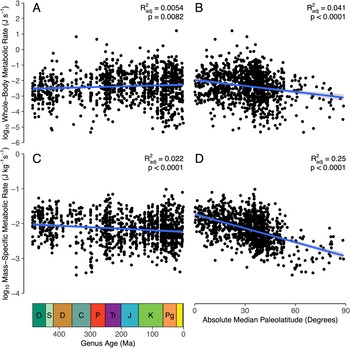
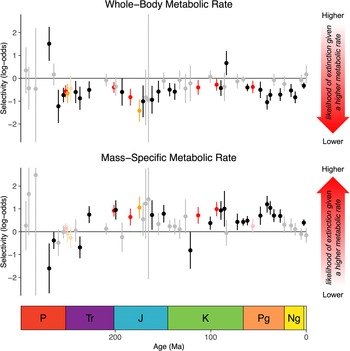


 Open access

