


The UNSC imposed sanctions on the Democratic People’s Republic of Korea (DPRK, commonly known as North Korea) in response to its nuclear tests of 2006, 2009, 2013, 2016, and 2017, and missile development program.Footnote 1 Initially, economic sanctions targeted individuals and institutions associated with the military, defense, and nuclear sectors. In 2016 and 2017, however, the UN expanded sanctions so they no longer distinguished between the civilian and military economy; they did not exclude food production or the health and education sectors from their remit.Footnote 2 The misleadingly termed “humanitarian exceptions” provisions of the sanctions resolutions were not designed to protect the population of 26 million people from the impact of sanctions. The provisions in this regard were restricted to providing a bureaucratic channel through which international humanitarian agencies could filter applications for activities in North Korea. The stringent and time-consuming process, requiring written justification – for example, for every item that contained metal, including every screw and nail – served to further limit what was already, by the mid 2010s, in both absolute and relative terms, a tiny international aid program.Footnote 3 The “humanitarian exceptions” were updated in 2023 after humanitarian organizations had repeatedly complained about the unprecedented restrictive provisions that prevented the provision of aid to attested vulnerable groups in need. The amended version did not, however, repeal the administrative provisions that meant every agency had to argue in writing for why each and every component of a prospective aid project that included metals, that is to say, every box of nails, every screw, every blood pressure monitor, and so on should be exempt from the sanctions.Footnote 4 In terms of meeting objectives, the expansion of UN sanctions to the civilian sector did not end the nuclear and missile program, which in fact accelerated.Footnote 5
In 2020, as a Covid-19 pandemic prevention measure, the DPRK government closed its border with China, via which the DPRK conducts almost all its trade. Border closures were not causative of food shortages, but they narrowed the mitigation measures available to the government and the population. They inhibited trade, especially imports, and shuttered the gray area trade which, since the late 1990s, had fueled North Korea’s burgeoning marketization and provided an income and food safety net for the population. Border closures also prevented international officials from carrying out the in-country food security surveys and analyses that had been a feature of UN activity in the DPRK since the mid 1990s.Footnote 6
Fortunately, lack of access to the country does not mean that we must resort to speculation to evaluate the extent and impact of reduced food availability on the North Korean population. Since the border closures, both the FAO,Footnote 7 and South Korea’s respected South Korea’s Rural Development Administration (RDA) continued to produce food supply analyses based on historic data, government supplied information, remote sensing, satellite data, weather pattern analysis, and sophisticated modeling techniques.Footnote 8 Standardized international methodologies provide reliable, detailed, and disaggregated crop production data. Demand data is also not difficult to calculate as it derives from a simple multiplication of the population number by a minimum calorific requirement for survival. That is then translated into how much basic grain, the cheapest food, is required to fulfil those basic needs. In North Korea it amounts to around 5.5–6 million metric tons of grain per year.Footnote 9
In 2018, domestic food production plummeted and had not recovered by 2022.Footnote 10 UN agencies, including the FAO and the World Food Programme (WFP), reported that UN sanctions were consequential in the decrease in food production.Footnote 11 What has been little reported, however, is the scale of damage to the DPRK food economy from sanctions. The vast majority of the population of 26 million rely on domestic food production to survive. Without access to essential agro-industrial imports, including oil, fertilizer, and technology, domestic food production cannot recover. This was not a new scenario for North Korea. In the 1990s, Russia and China started to charge market prices for these exports to North Korea. The subsequent decrease in imported inputs was the proximate cause of a rapid fall in domestic food production that resulted in a famine that killed around half a million people.Footnote 12 The UN sanctions of 2016 and 2017 reproduced the conditions that had generated famine in the 1990s.Footnote 13
“The Most Comprehensive, Legally-Binding, Sanctions Program Imposed against a State since Iraq in the 1990s”
Between 2006 and 2016, UN sanctions on North Korea were in line with UN policy of targeted measures, aimed at the military and defense sectors and government institutions tied to the nuclear and missile program. After research that found comprehensive sanctions had contributed – in Iraq (1990–2003) and Haiti (1993–1994) – to increased levels of child malnutrition and child mortality, UN decision-makers had since the early 2000s eschewed the use of comprehensive sanctions in favor of targeted or “smart” sanctions.Footnote 14 The UN DPRK resolutions of 2016 and 2017, however, expanded sanctions to no longer differentiate between the military and civilian sector economies.Footnote 15 According to one international legal analyst, even before the implementation of further expansion of the DPRK sanctions regime in 2017, the 2016 UNSC resolutions “created the most comprehensive, legally-binding, sanctions program imposed against a state since Iraq in the 1990s.”Footnote 16 The DPRK resolutions of 2016 and 2017 marked not just the intensification of sanctions on one country but also a major shift in UN global policy.
A Total Blockade
In 2016, the Obama administration initiated UNSC Resolution 2270. The resolution introduced export bans on coal, iron, iron ore, gold, and rare earth minerals but permitted “livelihood” exemptions. There was a recognition that at least some of these exports could legitimately be understood as part of a civilian sector economy and that hardship was likely if these export activities were completely curtailed.Footnote 17 In 2017, a Trump administration initiative eradicated such exemptions, irrespective of whether production was part of the civilian or military economy.Footnote 18 Sanctions severely restricted DPRK shipping, forbade DPRK joint ventures with overseas firms, prevented North Koreans working abroad, and stopped DPRK use of foreign banks.Footnote 19 Expanded sanctions aimed to shutter the entire economy, not just its military components.
One goal was to ban all DPRK exports. According to the U.S. Department of State, “over 90% of North Korea’s publicly reported exports of $2.7 billion” had been banned by December 2017.Footnote 20 The December 2017 resolution targeted “North Korea’s last remaining exports.”Footnote 21 These included the “DPRK’s export of food and agricultural products, machinery, electrical equipment, earth and stone including magnesite and magnesia, wood and vessels … [The resolution] also prohibits the DPRK from selling or transferring fishing rights.”Footnote 22
Import bans and restrictions followed a similarly expansive path. The December 2017 resolution banned “the supply, sale or transfer to the DPRK of all industrial machinery, transportation vehicles, iron, steel and other metals with the exception of spare parts to maintain DPRK commercial civilian passenger aircraft currently in use.”Footnote 23 These were total bans; with the exception of support for North Korea’s Air Koryo national airline, all imports of spare parts, metals, and anything containing metals were now illegal. The US government clarified that expanded sanctions forbade the export to the DPRK of “all transportation vehicles (including motor vehicles, trucks, trains, ships, aircraft, helicopters) and industrial machinery.”Footnote 24 The 2017 sanctions also banned the import into North Korea of natural gas and condensates and imposed quantitative caps on oil imports.Footnote 25
Following the implementation of expanded sanctions, North Korea’s global trade diminished sharply. Research from South Korea’s premier economic research institutions differ slightly on the actual figures, but coincide on the scale and rapidity of the downward trend between 2017 and 2021 and the small-scale uptick in 2022. An early study from the South Korean government economics think tank, the Korea Development Institute (KDI), reported that DPRK exports to China, with which it conducted almost all its trade, fell from $2.6 billion in 2016 to $50 million in 2020.Footnote 26 Imports from China over the same period fell from an already low level of $3.2 billion to $491 million.Footnote 27 In 2020, therefore, total trade with China amounted to $541 million.Footnote 28 A later report from the (South) Korea Trade-Investment Promotion Agency (KOTRA) reported a slightly higher total for North Korea’s total trade with China for 2020 at around $760 million.Footnote 29 KOTRA reported that North Korea–China trade had fallen 10.4 percent in 2021 compared to 2020, resulting in a total of $682 million for 2021.Footnote 30 North Korea–China trade rose to $1.53 billion in 2022, reflecting the easing of Covid-19 restrictions on the North Korea–China border.Footnote 31 The 2022 uptick, however, still brought total trade between the two countries to less than 60 percent of what it had been in 2016.
The Impact of Sanctions on the DPRK Food Economy
The main impact of sanctions on the food economy was in the domestic food production sector. Food exports to North Korea were not directly prohibited, but were made more difficult as, among other things, ships and vehicles necessary to transport food and the machinery to unload food were sanctioned. Diminished export earnings also reduced the capacity to purchase food imports.Footnote 32
In North Korea, the agricultural sector is more or less synonymous with food production, unlike the US, for instance, where nonfood crops like cotton are important components of agricultural production. North Korean food production had always been import-dependent.Footnote 33 The DPRK does not produce natural gas nor oil. Natural gas is a crucial component in the production of nitrogen, which is in turn an essential component of fertilizer.Footnote 34 Oil and refined oil products like diesel and kerosene are essential non-substitutable commodities in food production, not just in North Korea but everywhere in the world.Footnote 35 Oil products fuel agricultural and irrigation machinery, crop drying and storage facilities, provide the means to transport crops, seeds, food and labor, and comprise a necessary component of fertilizer and agricultural chemical production. North Korean farmers were therefore dependent on adequate oil imports as well as imported technology.
The U.S. Department of State reported that prior to the 2017 sanctions, North Korea was receiving 4 million barrels of crude oil and 4.5 million barrels in refined petroleum imports per annum. The December 2017 resolution capped crude oil imports at 4 million barrels per year and refined petroleum imports at 0.5 million barrels a year.Footnote 36 Even prior to oil sanctions, these were already low import levels in world terms and compared to the needs of the economy. The sheer scale of oil poverty in North Korea can perhaps best be illustrated by a comparison with its rich and successful neighbor. In 2021, the annual cap on DPRK refined petroleum product imports was equivalent to less than a fifth of one day’s consumption of those same products in South Korea.Footnote 37
Even before the expansion of sanctions, domestic manufacturing could not provide adequate substitutes, in quantity or quality, for the imported goods required by North Korea’s farming sector, including farm and irrigation equipment, and vehicles, including basic level tractors and trailers. After the expansion of sanctions, domestic agro-industrial manufacturing capacity was further handicapped, as North Korea was no longer allowed to import equipment, spare parts and vehicles, and anything with a metal component, like screws, nails, and hammers, because of the outright UN ban on exports of all these items.
In 2021, agriculture comprised about 23.8 percent of DPRK GDP, up from about 22.4 percent in 2020.Footnote 38 If agro-industries like food processing, the production of fertilizer, agricultural chemicals, spare parts and machinery, as well as transportation are included, the proportion of GDP constituted by the food economy overall increases to probably around a third of DPRK GDP. While direct data is not available, given that all sectors of the food economy rely on banned imports including machinery, spare parts, and vehicles, as well as the heavily restricted oil and oil product imports, and given that the food economy is not exempt from sanctions, it would be defying logic if the food economy had not been negatively impacted by expanded UN sanctions.
The Collapse of Domestic Food Production
The main source of food for North Koreans is domestic production, not imports. Household food security depends, therefore, on the maintenance of enough domestic grain production to meet the nutritional requirements of the 26 million population for physical survival. Food imports provide a secondary source of supply. The exception was in the immediate post-famine years of the very early 2000s, when humanitarian food aid (free food imports) filled the food gap. Between 2008 and 2016, domestic food production recovered, to achieve around 5 million metric tons a year. This had left the DPRK with a manageable grain import requirement of around 0.5 million metric tons, which was procured on both concessional (food assistance) and commercial terms (food purchases).Footnote 39
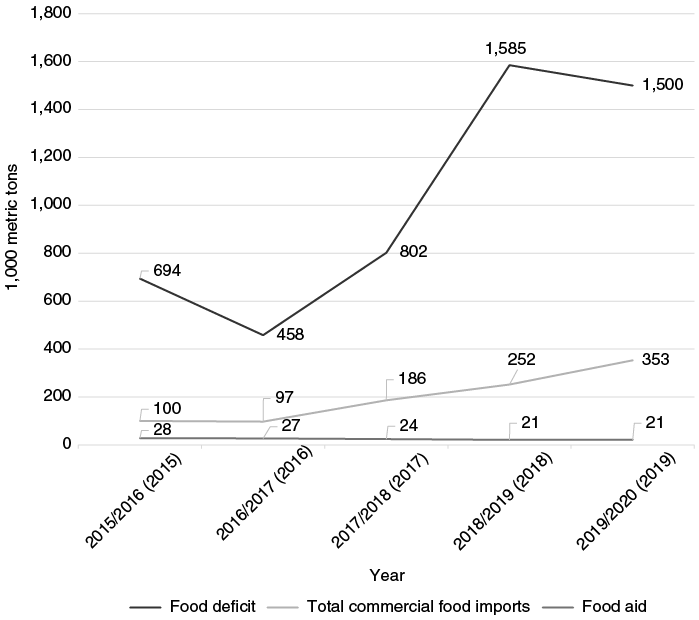
In 2017, domestic food production fell to 4.72 million metric tons, leaving what was seen at the time as an alarmingly high import requirement, of 802,000 metric tons.Footnote 40 In 2018, after the implementation of Resolutions 2371 (August 2017), 2375 (September 2017), and 2397 (December 2017), domestic food production fell substantially again, to just under 4.2 million metric tons.Footnote 41 To cover basic needs, 5.75 million metric tons of food needed to be produced in 2018 for consumption in 2019. The 2019 food import requirement therefore rose by an enormous 1.55 million metric tons.Footnote 42
Figure 2.1 indicates the existence of a systemic food crisis between 2017 and 2020, with commercial food imports unable to fill persistently high food gaps.Footnote 43
Food import requirements (deficit), commercial food imports, and food aid, 2015/2016 to 2019/2020 (in 1,000 metric tons).
1. Grain deficit data from the FAO for 2015–2018. RDA data is used for 2019/2020 because, although the FAO published government figures for 2019/2020 figures, the FAO never confirmed their accuracy.Footnote 44
2. FAO marketing year data runs from November to October. The main crop produced in, for example, 2018, is consumed in the following year, that is, 2019. By contrast, U.S. Department of Agriculture reporting uses calendar years. The Department of Agriculture reported crop production attributed to a calendar year is, however, identical to FAO marketing year totals.
3. Commercial food import and food aid data is from U.S. Department of Agriculture. Commercial food import data, 2019, from China is only for the period January–September 2019; from other countries it is for the period January–October 2019. U.S. Department of Agriculture food aid data for 2019 is for January–October 2019.
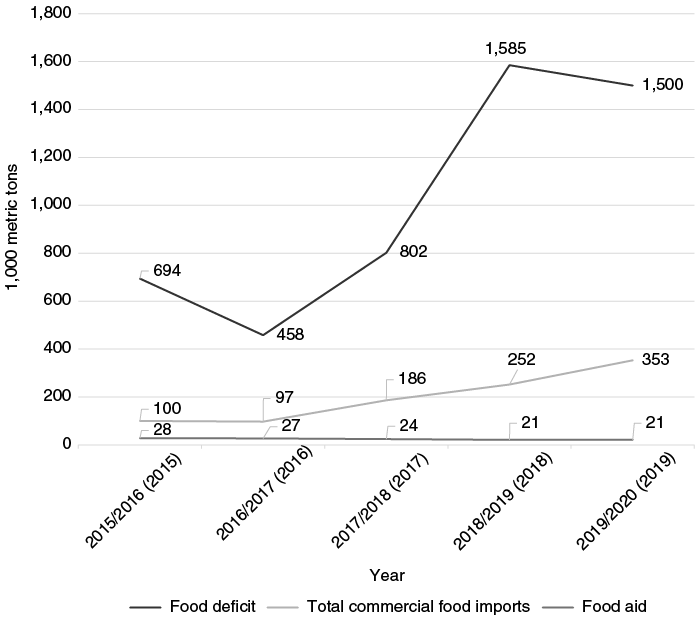
The food import requirement has remained high, at over a million metric tons in each of the years 2020, 2021, and 2022.Footnote 45 One million metric tons is a very large amount of food; it is sufficient to feed 8 million people at a basic calorie intake of around 1,640 calories a day for an entire year.Footnote 46 Such a large food deficit is far too big to be filled by nongovernmental organizations (NGOs). The UN WFP and/or countries with very large cereal surpluses, like China or the USA, could potentially fill this level of food gap, but to do so would entail very large commitments and large-scale operations. To put the numbers in perspective, the 2018 grain deficit of 1.5 million metric tons was equivalent to approximately two-thirds of the US’s annual food aid donations for the entire world.Footnote 47 Not only was the volume of grain required to fill North Korea’s food gap exceptionally high but the cost was also prohibitive. As an indication, USAID reported that in 2019 it paid $2.3 billion for 1.7 million metric tons of food aid.Footnote 48
Food Imports and Stocks: Unable to Fill the Food Gap
Official and gray area food import availability was constrained by trade sanctions and, after 2020, the Covid-19 border closures which, among other things, limited the possibilities of illicit cross border trade.Footnote 49 DPRK imports from China, including food imports, are difficult to evaluate accurately, partly because border trade is sometimes unrecorded.Footnote 50 UPI reported that in 2019, the Chinese government donated 1 million metric tons of rice and corn to the DPRK.Footnote 51 KDI reporting drawing on Chinese trade statistics shows a smaller import volume in 2019, of around 410,000 metric tons, comprised of wheat flour, rice, and corn from China.Footnote 52 In 2019, therefore, even if Chinese food aid did not amount to a million metric tons, recorded Chinese food imports were probably large enough to have helped to avert famine. In 2019, although the FAO reported that national food stocks were zero, given the then access to informal market channels before the government closed the border in 2020, some households would likely have accrued personal food stocks.Footnote 53 In 2020, food production shortfalls may also have been mitigated by substantial food imports from China.Footnote 54
In 2021, there were no recorded corn and rice imports from China and non-grain food imports were reduced to tiny amounts.Footnote 55 This is not surprising, as throughout 2021, rail connections remained closed and shipping was curtailed while both the Chinese and North Korean governments battled to control the spread of Covid-19. Rail and freight links between the two countries were slowly reopened from September 2022 but not fully normalized even by February 2023.Footnote 56 In July 2023, the South Korean Minister of Unification, Kwon Young-se, reported an increase in food imports from China into North Korea, but stated that these had not been sufficient to prevent deaths from starvation amid a deteriorating “grave” and “serious” food crisis in North Korea.Footnote 57
Sanctions and the Impact on Child Nutrition
In 2019, an FAO in-country assessment, based on household survey data, reported geographically widespread deteriorating food access; North Korean households faced “an overall alarming situation.”Footnote 58 These conclusions were disturbing in themselves, but they also reflected a major negative shift in trends in child nutrition. Between 1998 and 2017, the nutritional status of North Korean children and adults had improved substantially, to the extent that from the mid 2000s, no international aid organization considered the DPRK to be facing a humanitarian food emergency.Footnote 59 Post-famine nutritional improvements had been a result of the recovery of domestic food production, the growth of gray-area marketization, and a modest economic stabilization, at least until 2016.Footnote 60 Child nutritional improvements had taken place in every province, although the aggregate figures masked differentials between rural and urban areas, with the former much worse off than the latter.Footnote 61 Not surprisingly, malnutrition figures in the capital, Pyongyang, remained lower than in other provinces.Footnote 62
Tables 2.1 and 2.2 demonstrate the large scale of improvements in chronic and acute child malnutrition between 1998 and 2017. Stunting, a sign of chronic malnutrition, decreased from 64 percent to 19 percent between 1998 and 2017. In the same period, wasting, an indication of severe malnutrition that without medical intervention is likely to be fatal, decreased from 21 percent to 2.5 percent.
| Year | Stunting Height/Age (%) | Wasting Weight/Height (%) |
|---|---|---|
| 1998 | 64 | 21 |
| 2000 | 51 | 12 |
| 2002 | 45 | 9 |
| 2004 | 43 | 8.5 |
| 2009 | 32 | 5 |
| 2012 | 28 | 4 |
| 2017 | 19 | 2.5 |
| YearFootnote a | Stunting Height/Age (%) | Wasting Weight/Height (%) | |
|---|---|---|---|
| North Korea | 2017 | 19 | 2.5 |
| India | 2017 | 35 | 17 |
| Nepal | 2019 | 31.5 | 12 |
| Pakistan | 2018 | 38 | 7 |
| Philippines | 2018 | 30 | 6 |
Note:
a Reporting year is the most recent available.
What is also notable was the scale of improvement in nutritional status of North Korea’s children in comparison to some other countries in Asia. Table 2.2 shows that by 2017, the nutritional status of North Korean children had improved to such an extent that it was, on average, better than for children living in India and other middle-income Asian countries.
In 2019, the FAO reported that “the food security situation is clearly worsening … with poor food consumption rising and acceptable consumption diminishing.”Footnote 63 In 2019, UNICEF also reported that over half of children under two did not have adequate diets in terms of access to diverse food groups, including meat, eggs, fruit and vegetables.Footnote 64 Over two-thirds of children did not receive what UNICEF classed as a minimum acceptable diet – calculated as a matrix of amount and type of food eaten by the child.Footnote 65
Families coped with food shortages by spending savings, borrowing money, bartering and selling household goods, and sending children to eat at relatives’ homes or in public institutions.Footnote 66 Households reported reducing the number of meals, restricting adult intake and portion sizes so children could eat, and borrowing food from neighbors.Footnote 67 These coping methods were not elastic. In a contracting economy, savings become depleted, debts need to be paid with interest, household goods are finite, and relatives and public institutions have reduced capacity to feed extra mouths. By 2023, given continued food shortages and that the DPRK economy is in a sixth year of recession, it is likely that these coping methods have been exhausted.Footnote 68 In the absence of reporting from international officials in the DPRK, the outside world has had to rely on clandestine reporting from within the DPRK.Footnote 69 Since 2019, these outlets have consistently and repeatedly reported instances of starvation.Footnote 70
Not every population group suffers equally in periods of food shortage and famine. In 2022, the most vulnerable in North Korea included those who have the least ability to help themselves, including the 3.5 million people over the age of sixty and the 2 million children under the age of five.Footnote 71 Those who rely completely on government-provided food are the worst off. They include those without family support and living in residential institutions, for example the elderly, people with disabilities, and children.Footnote 72 North Korea’s vulnerable population also includes an estimated 150,000–200,000 prisoners and the 700,000 young conscript soldiers living away from home in military camps.Footnote 73 While little direct data is available, it would defy logic if malnutrition had not worsened and child mortality had not risen.
Government Food Security Policies
The major problem with DPRK food policy was that it was founded on the denial of reality; especially that of systemic import dependence. The policy of food self-sufficiency was not of itself strategically illogical or physically unattainable, although it can be criticized as economically suboptimal.Footnote 74 It is entirely possible to increase yields in the DPRK to achieve food self-sufficiency, given access to sufficient inputs, including fertilizer, chemicals, modern irrigation and agricultural machinery, and sufficient energy supplies. Nor is it uncommon for countries to regard food (and energy) supply as a strategic good and aim for self-sufficiency as a response to security priorities. As UN sanctions intensified, however, the DPRK government insisted that self-sufficiency was not a goal but was reality; the message was that the DPRK could resist any and all economic pressures from abroad as the entire economy met all its needs from domestic resources.Footnote 75
In 2021, the DPRK government had publicly recognized an ongoing food crisis. In April 2021, the North Korea leader, Kim Jong Un, in a speech to the Sixth Conference of Cell Secretaries of the Workers’ Party, reminded Party workers that they faced “another more difficult ‘Arduous March.’”Footnote 76 In the DPRK, the term “arduous march” is a synonym for the famine of the 1990s.Footnote 77 Yet government pronouncements did not indicate any new policies that might have been able to respond to the scale of the new food crisis. Instead, the government retrenched around its long-standing policy of food self-sufficiency, that is to say, growing enough food at home to minimize reliance on imports.Footnote 78
The government continued to rely on extended compulsory mass labor mobilizations, especially during the transplanting and harvesting parts of the agricultural cycle to try to substitute for imports.Footnote 79 Increased labor intensity on its own without adequate fertilizer, chemicals, and technology cannot, however, increase yields. Mass-labor activities that were nominally “voluntary” but, in practice, entirely compulsory also had natural limits. The already overextended workforce suffered twice over from the impact of the new sanctions; food security diminished as the physical demands on them increased.
Ideological claims to the contrary, in practice the government made attempts to mitigate the import dependence they denied, providing de facto recognition of the economic importance of imports. It promoted the development of alternative energy resources, including hydropower and solar panels. These efforts might have been useful as part of a realistic energy plan, but the government failed to acknowledge that these projects also relied on imports of technology, machinery, and parts, most of which were banned by sanctions. Solar panels, for example, were imported from China.Footnote 80 Small-scale import-substitution projects also could not make much of an inroad into the large problems facing the interrelated energy and agriculture sectors. In 2015, for instance, hydropower provided an ostensibly large 76 percent of DPRK electricity production – but this was in the context of a huge drop in capacity; between 1990 and 2015, electricity consumption fell from 33 billion kilowatt hours (BkWh) to 11 BkWh.Footnote 81
Other “self-sufficiency” measures included campaigns to collect human waste or “night soil,” as a substitute for commercially produced fertilizer. As with the hydropower projects, even the best case outputs from these small-scale electricity projects and labor-intensive practices could never realistically respond to the large-scale energy requirements of a food production system designed to feed 26 million people.
The government failed to acknowledge how important marketization had been to recovery of the food economy in the post-famine years.Footnote 82 Marketized dynamics in North Korea had incentivized households, in urban as well as rural areas, to raise small livestock, like rabbits and chickens, to trade but also for consumption of eggs and meat.Footnote 83 A faltering gray-area economy therefore resulted in decreasing the food supply and dietary diversity, as well as reducing income opportunities.
Sanctions and Starvation
In 2019 and 2020, mass starvation was likely avoided due to the utilization of household food stocks and massive food and fertilizer aid from China.Footnote 84 Gray-area economic activities, by their nature, are difficult to quantify but they may have filled some of the food import gap until the border closures of 2020. There is no evidence of further deliveries of the massive food aid that would have been needed to fill the large food gap arising from consecutive shortfalls of around a million metric tons of food in 2021 and 2022. Quantitative and qualitative research over the last nearly thirty years of international organization activity in the DPRK shows, however, that most of the 26 million population have limited resilience to sustained food shortages, with few assets, generally poor living conditions, and precarious income.Footnote 85 That the DPRK population is one the poorest in the world is undisputed. In 2021, the UN ranked the DPRK as the 15th poorest of 213 countries in the world, with GDP per capita at $654.Footnote 86 Neither is the scale of food insecurity unacknowledged within specialist communities. The U.S. Department of Agriculture, in its authoritative global review, the International Food Security Assessment, 2022–23, reported that 68.6 percent of North Korea’s population – that is 17.8 million people – were food insecure in 2022.Footnote 87 U.S. Department of Agriculture reported an increase from already very high totals of 63.1 percent and 16.3 million in 2021.Footnote 88
North Koreans are acknowledged throughout the UN system, especially within the humanitarian and human rights agencies, as facing starvation precipitated by UN sanctions. In 2021, the UN Special Rapporteur on human rights in the DPRK, Tomás Ojea Quintana, called for sanctions to be reviewed “and eased when necessary to both facilitate humanitarian and lifesaving assistance and to enable the promotion of the right to an adequate standard of living of ordinary citizens.”Footnote 89 Even the UN Panel of Experts for the DPRK sanctions regime, whose main responsibility is to enforce sanctions, noted in a September 2022 report that “there can be little doubt that UN sanctions have unintentionally affected the humanitarian situation.”Footnote 90
The Policy Choice
The extensive sanctions of 2016 and 2017 were designed to damage the DPRK economy with the aim of pressuring the DPRK government to give up its nuclear and missile program. UNSC policy has not achieved its aim of stopping DPRK nuclearization, which has instead accelerated since the implementation of the expanded UN sanctions of 2016 and 2017. The Security Council’s sanctions were successful in degrading the economy, including the food production sector that constitutes about a third of the civilian economy. Those who suffer most from UN sanctions, however, are North Korea’s 8 million children. North Korea’s elites do not go hungry; they access imported food and have enough hard currency to buy what they want, when they want. North Korean children do not have any responsibility for the nuclear activities of their government. They have no say in government policies and by definition, as non-adults, have limited capacity to help themselves in terms of obtaining food and health support.
The government of the DPRK has the primary responsibility for the welfare of its people but that does not mean that outside actors, like the UN, do not also have ethical and legal responsibilities to consider the impact of their actions on the most vulnerable, especially North Korea’s 8 million children.Footnote 91 The UN did not conduct a review of the potential impact of expanded sanctions prior to their implementation, nor has it carried out such a review since. Nevertheless, it would not be difficult to devise a sanctions regime that would exclude food production and health from its remit. It is a policy choice by the UNSC not to do so.

 Open access