


Introduction
Education consistently emerges as a significant predictor of positive attitudes toward immigration (e.g., Hainmueller and Hopkins, Reference Hainmueller and Hopkins2014). Various theoretical mechanisms explain how this crucial institution and resource fosters tolerance and positive views toward immigrants and ethnic minorities. Education in democracies is believed to transmit democratic values and norms (e.g., Coenders and Scheepers, Reference Coenders and Scheepers2003) and to create a social sphere that encourages the broadening of perspectives (e.g., Napier and Jost, Reference Napier and Jost2008), thereby cultivating tolerance toward diverse social groups. Education may enhance a set of cognitive abilities that allow individuals to absorb abstract concepts and acquire more accurate information and perceptions (e.g., Bobo and Licari, Reference Bobo and Licari1989). Moreover, education can increase competence in the labor market. Motivated by economic concerns, low-skilled natives could attribute labor market competition to immigrants and consequently oppose immigration (e.g., Mayda, Reference Mayda2006). More profoundly, education represents a potential social cleavage in advanced democracies undergoing structural changes due to globalization and industrial transformations (e.g., Ford and Jennings, Reference Ford and Jennings2020). The divide can amplify feelings of insecurity and perceived threats among low-educated natives, leading to negative sentiments and preferences for restrictive immigration policies (e.g., Cavaille and Marshall, Reference Cavaille and Marshall2019).
Nonetheless, to what extent is there a causal relationship behind this descriptive pattern? The accumulated evidence on this question is mixed. Research based on compulsory education reforms in Europe confirms the long-term positive effects of education, though effect sizes vary by country (Cavaille and Marshall, Reference Cavaille and Marshall2019; D’Hombres and Nunziata, Reference D’Hombres and Nunziata2016; Margaryan et al., Reference Margaryan, Paul and Siedler2021). Finseraas et al. (Reference Finseraas, Skorge and Strøm2018), however, find no effect of the education reform in Norway and propose that education beyond the basic level may be more consequential.
Research utilizing within-individual changes in educational trajectories with longitudinal data often finds little effect, pointing instead to significant prevalent self-selection (Lancee and Sarrasin, Reference Lancee and Sarrasin2015; Weber, Reference Weber2020). One main implication is that many attitudinal differences emerge before individuals progress through education stages, including prior to secondary education. This suggests numerous potential confounders in the relationship, which might encompass unmeasured or unobserved factors such as parental socialization (e.g., Jennings et al., Reference Jennings, Stoker and Bowers2009), exposure to ethnically diverse neighbors (e.g., Brown et al., Reference Brown, Enos, Feigenbaum and Mazumder2021), as well as other early-life conditions. However, these confounding factors may not be adequately captured by standard survey variables (Ahlskog and Oskarsson Reference Ahlskog and Oskarsson2023). An often-neglected confounder is genetic confounding. That is, without appropriate designs to account for it, spurious associations could emerge due to genetics linked to both focal variables (see e.g., Rohrer, Reference Rohrer2018). This is pertinent to the association between education and immigration attitudes, as genetic factors, to varying extents, have been shown to account for individual variations in educational outcomes and various political attitudes (e.g., Hatemi and McDermott, Reference Hatemi and McDermott2012; Kleppesto et al., Reference Kleppestø, Czajkowski, Vassend, Røysamb, Eftedal, Sheehy-Skeffington, Kunst and Thomsen2019; Polderman et al., Reference Polderman, Benyamin, De Leeuw, Sullivan, Van Bochoven, Visscher and Posthuma2015; Willoughby et al., Reference Willoughby, Giannelis, Ludeke, Klemmensen, Nørgaard, Iacono, Lee and McGue2021).
However, classical twin and family studies designed to investigate genetic influence can be limited in their ability to elucidate intricate mechanisms, and certain key modeling assumptions may be violated (e.g., Willoughby et al., Reference Willoughby, Polderman and Boutwell2023). Footnote 1 Recent advancements in statistical genetics have heralded new approaches that bypass some of these constraints, paving the way for investigations into the genetic foundations and complex social mechanisms underlying human behavior (Harden and Koellinger, Reference Harden and Koellinger2020; Mills and Tropf, Reference Mills and Tropf2020; Pingault et al., Reference Pingault, O’Reilly, Schoeler, Ploubidis, Rijsdijk and Dudbridge2018). Of particular significance are polygenic indices (PGIs). In essence, a PGI for a specific trait represents a DNA-based measure for genetic predispositions toward that particular trait, calculated as a weighted sum of an individual’s relevant genetic variants (Becker et al., Reference Becker, Burik, Goldman, Wang, Jayashankar, Bennett, Belsky, Karlsson Linn´er, Ahlskog, Kleinman, Hinds, Agee, Alipanahi, Auton, Bell, Bryc, Elson, Fontanillas, Furlotte and Okbay2021). PGIs can be integrated as standard variables in analyses, allowing for more flexible designs in exploring causal mechanisms. The application of PGIs has become more prominent in human health research and, to a more limited degree, in psychology and economics. Among the handful of political behavior studies incorporating PGIs (e.g., Aaroe et al., Reference Aarøe, Appadurai, Hansen, Schork, Werge, Mors, Børglum, Hougaard, Nordentoft, Mortensen, Thompson, Buil, Agerbo and Petersen2021; Ahlskog, Reference Ahlskog2023), Dawes et al. (Reference Dawes, Okbay, Oskarsson and Rustichini2021) identified significant effects of the PGI for education on turnout in the United States and Sweden. They also demonstrated that the education-related genetic effects might be influenced by the information richness of electoral contexts, enriching our understanding of political participation and inequality.
To deepen our understanding of the relationship between education and attitudes toward immigration, this research adopts a novel methodological triangulation approach and utilizes three distinct natural experiments. All three studies employ Swedish twin samples, comprising individuals who participated in a large-scale survey between 2009 and 2010. The first two studies aim to identify the effects of education by leveraging different sources of variation in educational attainment. Study 1 exploits differences in education within monozygotic twins (MZ twins) and uses the discordant twin design to account for confounders arising from genetics and pertinent environmental exposures. Study 2 examines the impact of the Swedish compulsory education reform during the 1950s on attitudes toward immigration. Overall, while Study 2 does not reveal significant effects of the reform on attitudes toward immigration, potentially due to limited power, Study 1 on MZ twins concludes that education exerts a significant, though modest, influence on pro-immigration attitudes. Moreover, it indicates that a considerable portion of the descriptive association can be attributed to factors shared by MZ twins.
To delve deeper into these twin-shared factors, Study 3 investigates the role of genetic factors with a sample of dizygotic twins (DZ twins) and uses the PGI for education (EA PGI) as a measure for genetic predispositions related to education. This study demonstrates that EA PGI significantly affects immigration attitudes, and a majority of these genetic influences might be mediated through channels other than realized education.
This research contributes to the line of research in multiple ways. First, it employs within-twin-pair variation in education, which differs from the education reform-induced variation predominantly found at the lower end of the educational ladder. Second, unlike classical twin models that demonstrate the relative genetic and environmental contributions to the association, this study employs the EA PGI to directly investigate the degree to which genetic predispositions for educational attainment influence immigration attitudes. Additionally, the research replicates the impact of compulsory education reform in Sweden. However, given that the analysis might be underpowered, the result should be approached with caution. Despite this limitation, by combining natural experiments of distinct nature with corresponding designs, this research provides a methodological triangulation practice to probe the relationship under scrutiny.
Research designs
The triangulation approach adopts the following structure: Studies 1 and 2 focus on identifying the effects of education on immigration attitudes, leveraging variations in education across two distinct settings. Linked to Study 1, Study 3 shifts its attention to the role of genetic predispositions for education.
All three studies use samples of adult twins from the Swedish Twin Registry (STR). During 2009 and 2010, the SALTY survey (Screening across the Life-Span Twin Cohort Study) was administered to twins born between 1943 and 1958 (Magnusson et al., Reference Magnusson, Almqvist, Rahman, Ganna, Viktorin, Walum, Halldner, Lundström, Ullén, Långström, Larsson, Nyman, Gumpert, Råstam, Anckarsäter, Cnattingius, Johannesson, Ingelsson, Klareskog and Lichtenstein2013). All studies here use cross-sectional data from the SALTY survey, specifically respondents’ preferences on migration-related policy proposals. The respondents can be linked to administrative records on their highest education degree and other relevant sociodemographic information.
Study 1: Discordant monozygotic twins
Study 1 is based on a sample of 922 MZ twin pairs. The idea behind the discordant twin design is to simply test whether the identical twin with higher education exhibits more positive immigration attitudes than the co-twin. This automatically controls for a range of unobserved/unobservable confounders, encompassing genetic factors, familial background and socialization, neighborhood effects, intergroup interactions, and various relevant predispositions. By focusing on differences within pairs ( $j$
), the model can be specified as
$j$
), the model can be specified as
 $${\rm{\Delta }}{Y_j} = {\beta _{edu}}{\rm{\Delta }}Ed{u_j} + \gamma {\bf{\Delta }}{\boldsymbol X_j} + {\epsilon _j}$$
Shared environment and genetic confounding are differenced out. ${\rm{\Delta }}{X_j}$
represents twin differences in control variables. I include education orientations as a control which has been overlooked in previous research. I also present results from between-family models with municipality fixed effects for baseline comparisons, with age, sex, and their interaction terms as controls.
${\rm{\Delta }}{X_j}$
represents twin differences in control variables. I include education orientations as a control which has been overlooked in previous research. I also present results from between-family models with municipality fixed effects for baseline comparisons, with age, sex, and their interaction terms as controls.
Study 2: Swedish education reform
Study 2 examines the impact of a Swedish educational reform that began in the 1950s. A primary change introduced by this reform was the extension of compulsory schooling from 7 or 8 years to 9 years. As with similar educational reforms in other European countries, the Swedish reform was rolled out in a staggered manner across municipalities. This setting introduced plausibly exogenous variation in exposure to the new schooling system, thereby enabling researchers to compare outcomes across different birth cohorts and municipalities.
The reform started with an assessment program in 1949 (initially impacting grade 1, 5) and was rolled out nationally after the parliamentary decision in 1962. Consequently, the cohorts exposed to the staggered implementation stages were born between 1938 (who started grade 5 in 1949) and 1955 (who started grade 1 in 1962), covering a subset of SALTY respondents who were born between 1943 and 1955. The key reform treatment variable is determined by matching information on a respondent’s birth year and residence municipality with the start year of the reform in the respective municipality. The reform treatment indicator for individuals from birth cohort $b$
in municipality
$b$
in municipality $m$
is defined as
$m$
is defined as
 $$ReformTrea{t_{bm}} = 0,{\rm{\;\;\;\;}}birth{\rm{\;\;}}yea{r_{bm}} - first{\rm{\;\;}}cohor{t_m} \lt 0$$
 $$ReformTrea{t_{bm}} = 1,{\rm{\;\;\;\;}}birth{\rm{\;\;}}yea{r_{bm}} - first{\rm{\;\;}}cohor{t_m} \ge 0$$
where $first{\rm{\;\;}}cohor{t_m}$
is the birth year of the first cohort affected by the reform. The reform timings across municipalities were collected and evaluated by Holmlund (Reference Holmlund2007) and have been employed in multiple research studying the reform (e.g., Lindgren et al., Reference Lindgren, Oskarsson and Dawes2017). Information on residence municipality is sourced from bi-decennial censuses for year 1960 and 1965. Finally, the main sample for Study 2 comprises 3755 individuals, of whom approximately 40% are identified as belonging to the treatment group.
Footnote 2
$first{\rm{\;\;}}cohor{t_m}$
is the birth year of the first cohort affected by the reform. The reform timings across municipalities were collected and evaluated by Holmlund (Reference Holmlund2007) and have been employed in multiple research studying the reform (e.g., Lindgren et al., Reference Lindgren, Oskarsson and Dawes2017). Information on residence municipality is sourced from bi-decennial censuses for year 1960 and 1965. Finally, the main sample for Study 2 comprises 3755 individuals, of whom approximately 40% are identified as belonging to the treatment group.
Footnote 2
The identification of the reform effects hinges on the assumption that, conditional on covariates, the timing of the reform was uncorrelated with unobserved factors that might also influence immigration attitudes. A main concern is that municipalities might not have been randomly selected into each experimentation round. In Appendix A3.3, I discuss several lines of evidence from previous research and own analysis, suggesting that the assumption of exogenous reform timing is likely valid.
To estimate the effects of the education reform, I use the following model specification to compare outcomes of the treatment and control groups within birth cohorts and municipalities. $BirthYea{r_b}$
captures differences in cohort experiences, whereas the municipality fixed effects
$BirthYea{r_b}$
captures differences in cohort experiences, whereas the municipality fixed effects $Municipalit{y_m}$
account for time-invariant differences between municipalities. Sex is included as a control to increase precision. Standard errors are clustered at the municipality level to account for the reform assignment structure.
$Municipalit{y_m}$
account for time-invariant differences between municipalities. Sex is included as a control to increase precision. Standard errors are clustered at the municipality level to account for the reform assignment structure.
 $${Y_{ibm}} = {\beta _0} + {\beta _{reform}}ReformTrea{t_{bm}} + BirthYea{r_b} + Municipalit{y_m} + \gamma {\boldsymbol X_{ibm}} + {\epsilon _{ibm}}$$
The Swedish education reform also had significant pedagogical content changes. Notably, the placement into differentiated academic and non-academic tracks was postponed, and English was introduced as a compulsory subject in the new school system (Holmlund, Reference Holmlund2007; Meghir et al., Reference Meghir, Palme and Simeonova2018). These changes are likely to contribute to the overall effects of the reform on attitudes towards immigration. However, as detailed further in Appendix A3.1, these changes only impacted a minority of all birth cohorts exposed to the reform. Therefore, the primary influence on any effect would likely stem from the increased educational attainment. Footnote 3 Additionally, Appendix A3.5 corroborates the significant effects of the reform on education, with the estimates aligning with the range suggested by prior population-wide studies (around 0.2–0.7 years of education).
Study 3: Dizygotic twins and polygenic index for education
To further explore the role of genetics, Study 3 is based on a sample of 1584 DZ twin pairs and employs the polygenic index for educational attainment (EA PGI).
Before explaining how DZ twins can elucidate the causal effects of genetic predispositions, it is essential to briefly expound on PGIs. PGI is fundamentally based on the understanding that individual differences in complex traits, such as behaviors, are influenced by numerous genetic variants across the genome, each exerting a small effect (Chabris et al., Reference Chabris, Lee, Cesarini, Benjamin and Laibson2015). Genome-wide association studies (GWASs) have been extensively conducted to discern associations between millions of genetic variants and the traits in question. In an OLS-based GWAS, this entails executing millions of regressions, each regressing a specific trait, such as height, onto each genetic variant, while controlling for other necessary covariates. Only those genetic variants that meet a pre-established, multiple-testing-adjusted significance threshold are considered for PGIs. A PGI is, in essence, a weighted sum of genetic variants tied to the target trait, with weights (or effect sizes) derived from the GWAS results.
PGIs serve to partially capture genetic predispositions, but associations between PGIs and traits can arise through environmental pathways. For example, through a mechanism known as genetic nurture, parental genes can influence their offspring – not directly through genetic transmission, but by shaping the environment in which the offspring are raised, such as fostering supportive conditions (Kong et al., Reference Kong, Thorleifsson, Frigge, Vilhjalmsson, Young, Thorgeirsson, Benonisdottir, Oddsson, Halldorsson, Masson, Gudbjartsson, Helgason, Bjornsdottir, Thorsteinsdottir and Stefansson2018). Other notable environmental confounding mechanisms include population stratification and assortative mating (e.g., Selzam et al., Reference Selzam, Ritchie, Pingault, Reynolds, O’Reilly and Plomin2019). Crucially, because the transmission of alleles from parents to offspring is randomized during meiosis, variations in PGIs within DZ twins are effectively quasi-exogenous, so any genetic difference within DZ twin pairs is free of shared environmental factors. Consequently, a relationship between their genetic differences and trait differences provides evidence for a causal effect of the measured genetic difference (Selzam et al., Reference Selzam, Ritchie, Pingault, Reynolds, O’Reilly and Plomin2019).
Within-family analysis of DZ twins with EA PGI can be specified as
 $${\rm{\Delta }}{Y_j} = {\beta _{EAPGI}}{\rm{\Delta }}EAPG{I_j} + \gamma {\bf{\Delta }}{\boldsymbol X_j} + {\epsilon _j}$$
The resultant within-family estimates of ${\beta _{EAPGI}}$
constitute the causal effects of the EA PGI.
${\beta _{EAPGI}}$
constitute the causal effects of the EA PGI.
To examine the role of EA PGI in relation to realized educational attainment, I estimate 1) the effects of education and 2) the effects of the EA PGI, respectively, as baselines, and subsequently include both variables in the model to compare with the baseline estimates. These comparisons aid in discerning potential genetic confounding and the extent to which genetic influences are mediated through education.
It is important to note that a PGI does not fully capture all genetic variations related to its target trait and contains measurement errors due to limitations in current PGI construction. While EA PGI demonstrates relatively higher predictiveness among PGIs for behavioral traits, its explanatory power remains limited. In addition to the explanations provided below when interpreting the results, a more extensive introduction to PGIs and GWASs, including their limitations and implications, is given in Appendix A4.
Measures
Immigration attitudes
The SALTY survey covers the following four items on immigration policy preferences. Participants were asked to indicate their preferences on a five-level scale, ranging from “very bad” to “very good” (coded as 1 to 5).
-
Increase labor immigration to Sweden;
-
Introduce a language test to become a Swedish citizen (reverse coded);
-
Accept fewer refugees in Sweden (reverse coded);
-
Increase the economic support to immigrants so that they can preserve their own culture.
Immigration attitudes are operationalized in two ways. First, the four responses are averaged to produce an additive index. The Cronbach’s $\alpha $
for these items is around 0.73, suggesting reasonable inter-item reliability. Second, the IRT-graded response model is used to obtain a latent variable. A higher index value indicates a more positive attitude toward immigration. Both indices are standardized.
$\alpha $
for these items is around 0.73, suggesting reasonable inter-item reliability. Second, the IRT-graded response model is used to obtain a latent variable. A higher index value indicates a more positive attitude toward immigration. Both indices are standardized.
Educational attainment
Two measures of educational attainment are constructed: years of education and a binary variable indicating tertiary education. Years of education are calculated based on the highest level of education obtained as of 2009, ranging from 7 to 20 years. Tertiary education corresponds to 15 years of education.
As highlighted above, notable differences in the variation of education exist between Study 1 and 2. Figure 1 illustrates this more vividly. The reform led to a marked increase in education at the lower margin for the treatment group, and previous studies suggest minimal spill-over effects beyond secondary education (Holmlund, Reference Holmlund2007). Discordance in education among MZ twins can be observed at various levels. For instance, in approximately 22% of twin pairs, one twin completed a 12-year education, whereas the other achieved a higher level. Around 53% of all twin pairs show discordance.
Variation in education in Study 1 and 2.
Notes: The upper figure shows the distribution of twin differences in years of schooling. For each vertical bar, the lower point represents the lower level, and the higher point represents the higher level of education within each pair. The sample size, mean, and standard deviation of twin differences in education are shown at the bottom of the figure. The lower figure shows the distribution of years of schooling by reform treatment status. The sample sizes, means, and standard deviations of education are shown at the bottom.
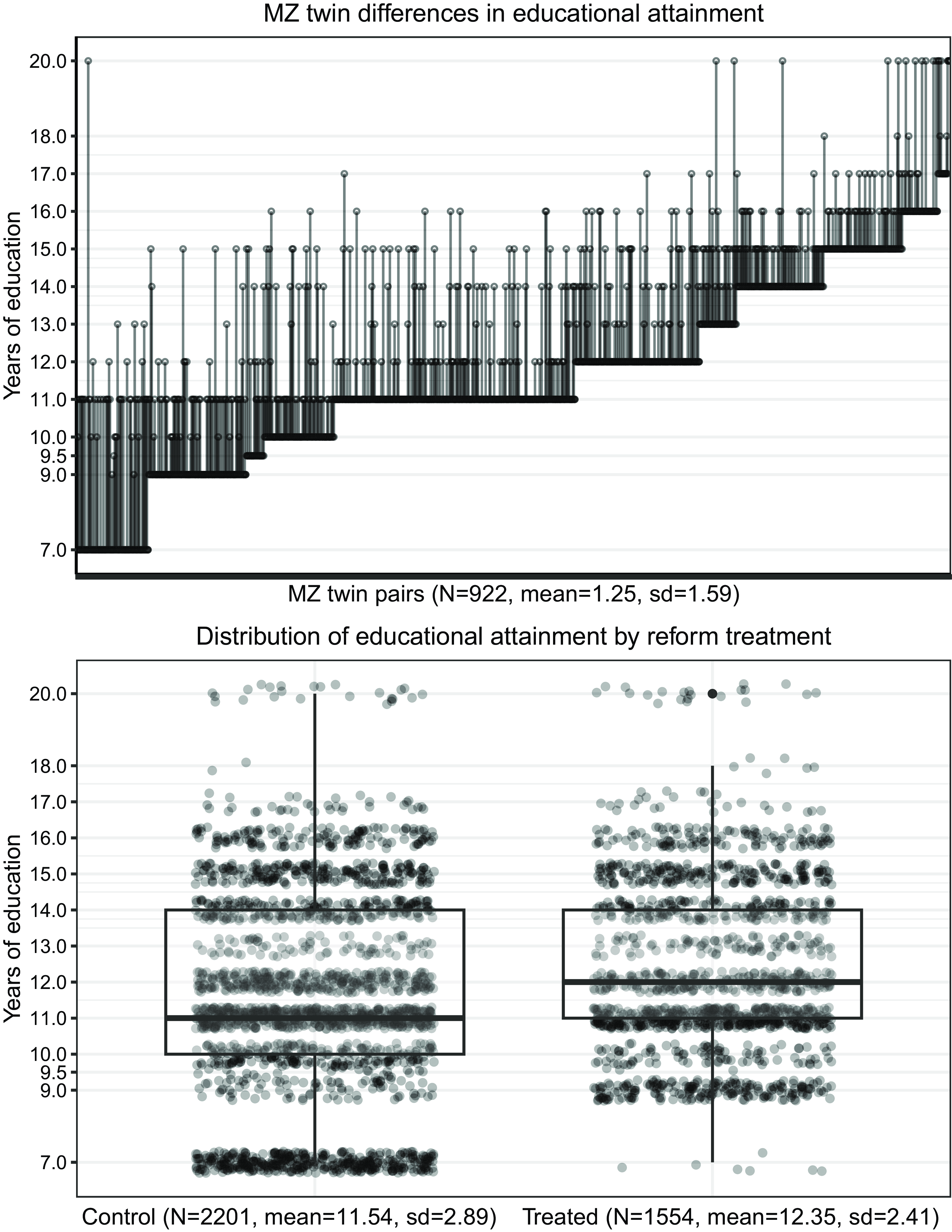
Given that higher education levels are recognized to be particularly instrumental in promoting openness, tolerance, and cosmopolitan attitudes (e.g., Hainmueller and Hiscox, Reference Hainmueller and Hiscox2007; Velásquez and Eger, Reference Velásquez and Eger2022), I thus expect that the effects of education observed in MZ twins might be more pronounced than that of the reform.
Polygenic index for education (EA PGI)
This study uses EA PGI from the polygenic index repository (Becker et al., Reference Becker, Burik, Goldman, Wang, Jayashankar, Bennett, Belsky, Karlsson Linn´er, Ahlskog, Kleinman, Hinds, Agee, Alipanahi, Auton, Bell, Bryc, Elson, Fontanillas, Furlotte and Okbay2021). The repository contains PGIs for 47 phenotypes and is based on meta-analyses with data from 11 participating datasets, including STR. The repository is established with a uniform methodology and is made available to help overcome obstacles faced by researchers (e.g., administrative hurdles in accessing data). More details about the repository and the procedures used for constructing PGIs are given in Appendix A4.1. EA PGI is standardized by batch to account for differences in sample processing and genotype calling.
Results
MZ twins
The MZ twin study suggests modest but significant effects of education. As shown in the left panel of Figure 2, the within-family estimates indicate that a one-year increase in education increases pro-immigration attitudes by approximately 4.5–5% of the standard deviation for both attitude indices. In the right panel, tertiary education increases about 10% of the standard deviation for both attitude indices, although these estimates are not statistically significant. This lack of significance may result from the limited within-pair variation in this binary variable of tertiary education. It is worth noting that the causal interpretation of the within-family could still be subject to bias from individual-specific confounders, such as personalities and differential environmental exposures.
The effects of educational attainment on immigration attitudes.
Notes: Bars represent 95% confidence intervals. Standard errors are clustered at twin-pair level.
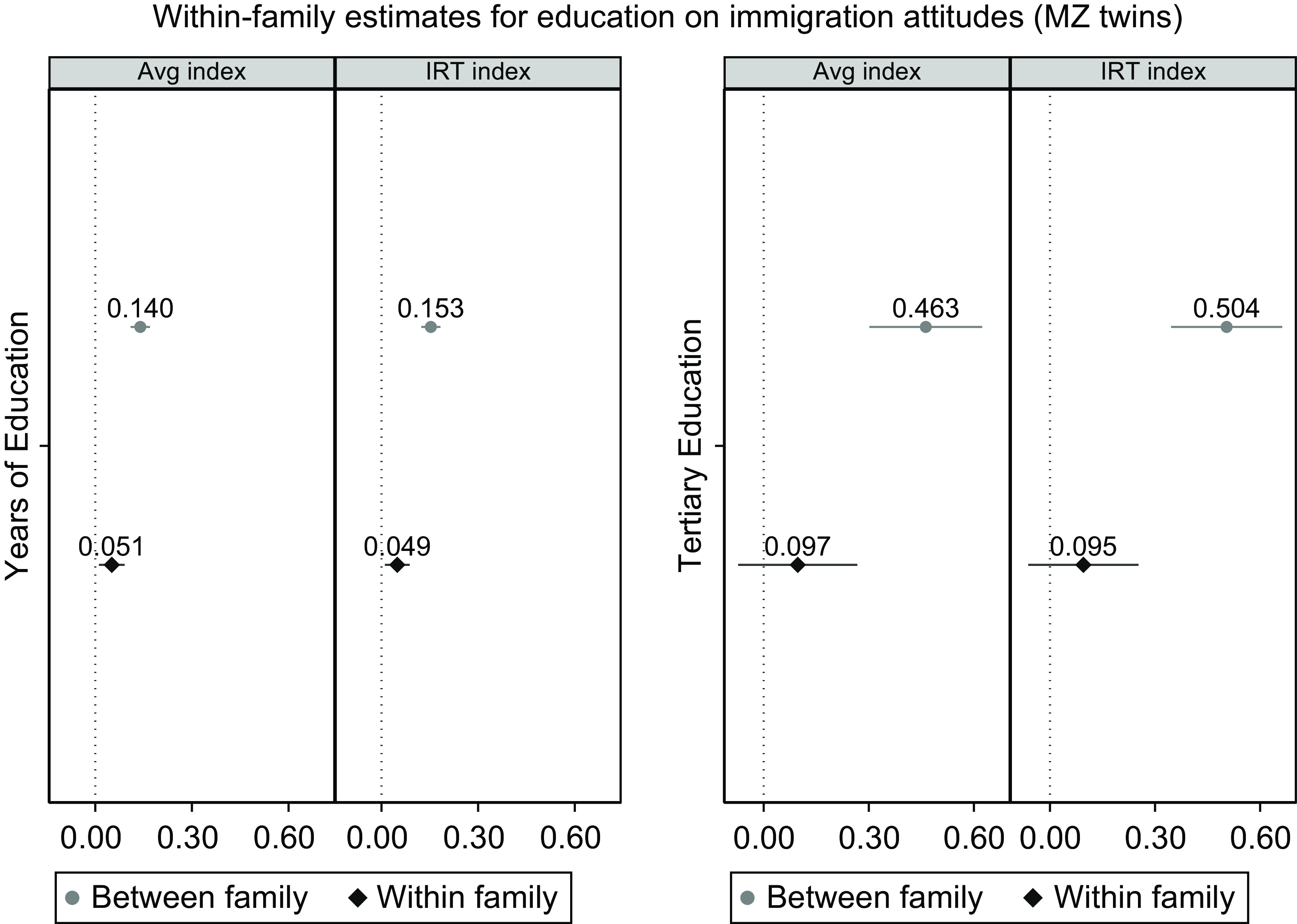
The discrepancy between within-family and between-family estimates for education is considerable: the estimates decrease by about 60–70% for years of schooling and around 80% for tertiary education. These reductions should primarily reflect the influence of confounding factors shared by twins, rather than a compound attenuation bias resulting from measurement error in the independent variable (Griliches, Reference Griliches1979). Using administrative records to obtain educational information, coupled with a consistent definition of the education variable for all individuals, minimizes the potential for measurement error, thus alleviating concerns regarding attenuation bias.
Reform effects
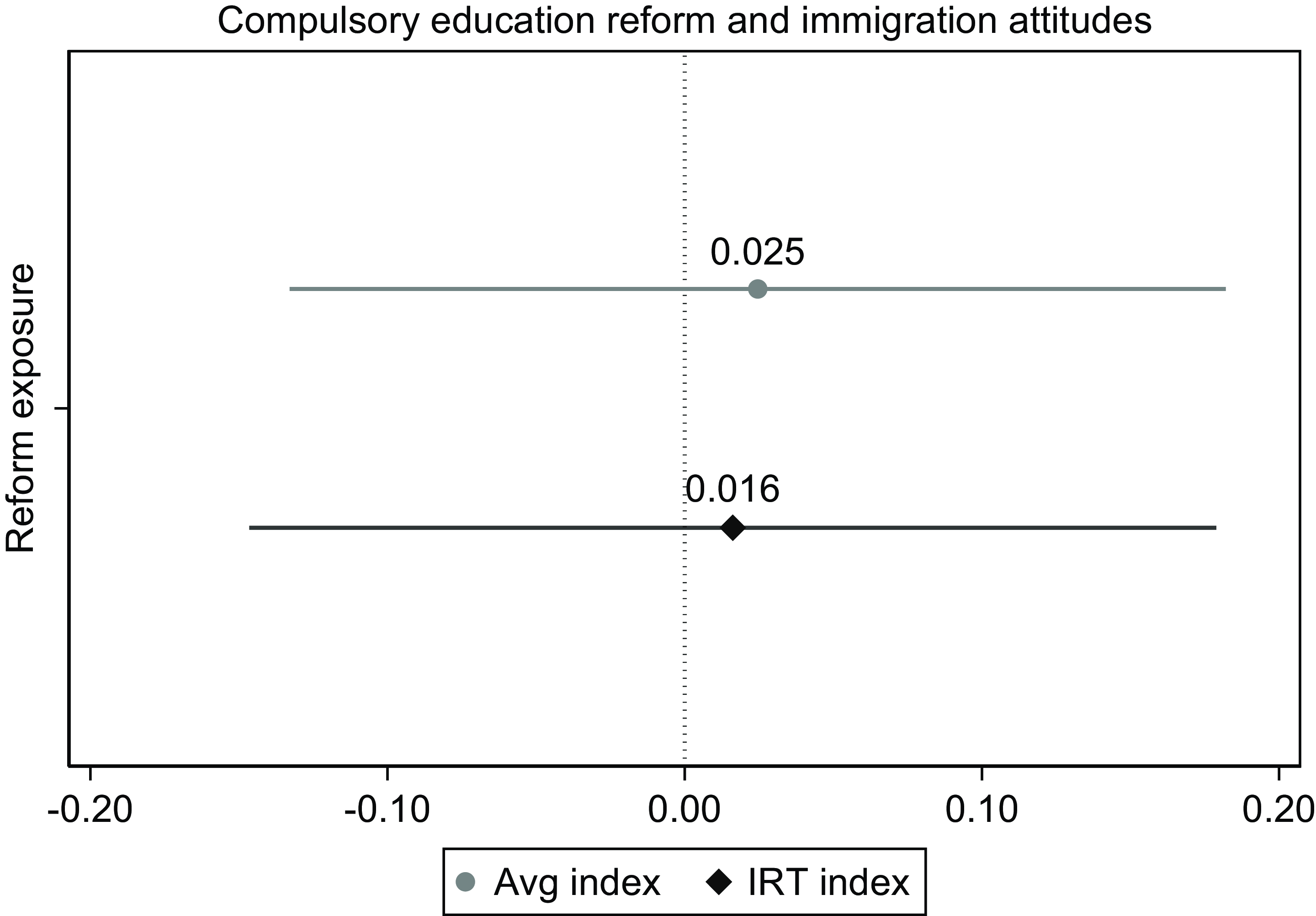
Study 2 does not find that the education reform has significant effects on immigration attitudes, but the insignificance could be due to the moderately sized sample lacking sufficient power to detect the reform effects. As shown in Figure 3, the estimated effects of the reform suggest an insignificant increase of approximately 2.5% and 1.6% of the sample standard deviation for the attitude indices, respectively. The large confidence intervals that overlap with zero indicate that these effect estimates are imprecise. Additionally, when narrower window widths are used to include only individuals born within specific years before or after the first affected cohorts, the point estimates of reform effects remain insignificant and show inconsistent directions (Appendix A3.6). Thus, although I anticipate the reform effects to be smaller than the effects of education in the MZ-twin study, the evidence is not solid.
DZ twins and EA PGI
While the MZ-twin study demonstrates the presence of confounding shared by twins in the education–attitude association, the role of genetics is still ambiguous. The DZ-twin study aims to provide further clarity on it.
In Figure 4, the left panel displays the estimates for EA PGI, and the right panel shows the estimates for education. The upper subfigure presents the estimates from models that include only educational attainment or EA PGI, while the lower subfigures illustrate the estimates from models that incorporate both independent variables.
The effects of the Swedish education reform on immigration attitudes.
Notes: Bars represent 95% confidence intervals. Standard errors are clustered at the municipality level.
The effects of EA PGI and education on immigration attitudes.
Notes: Bars represent 95% confidence intervals. Standard errors are clustered at the twin-pair level.
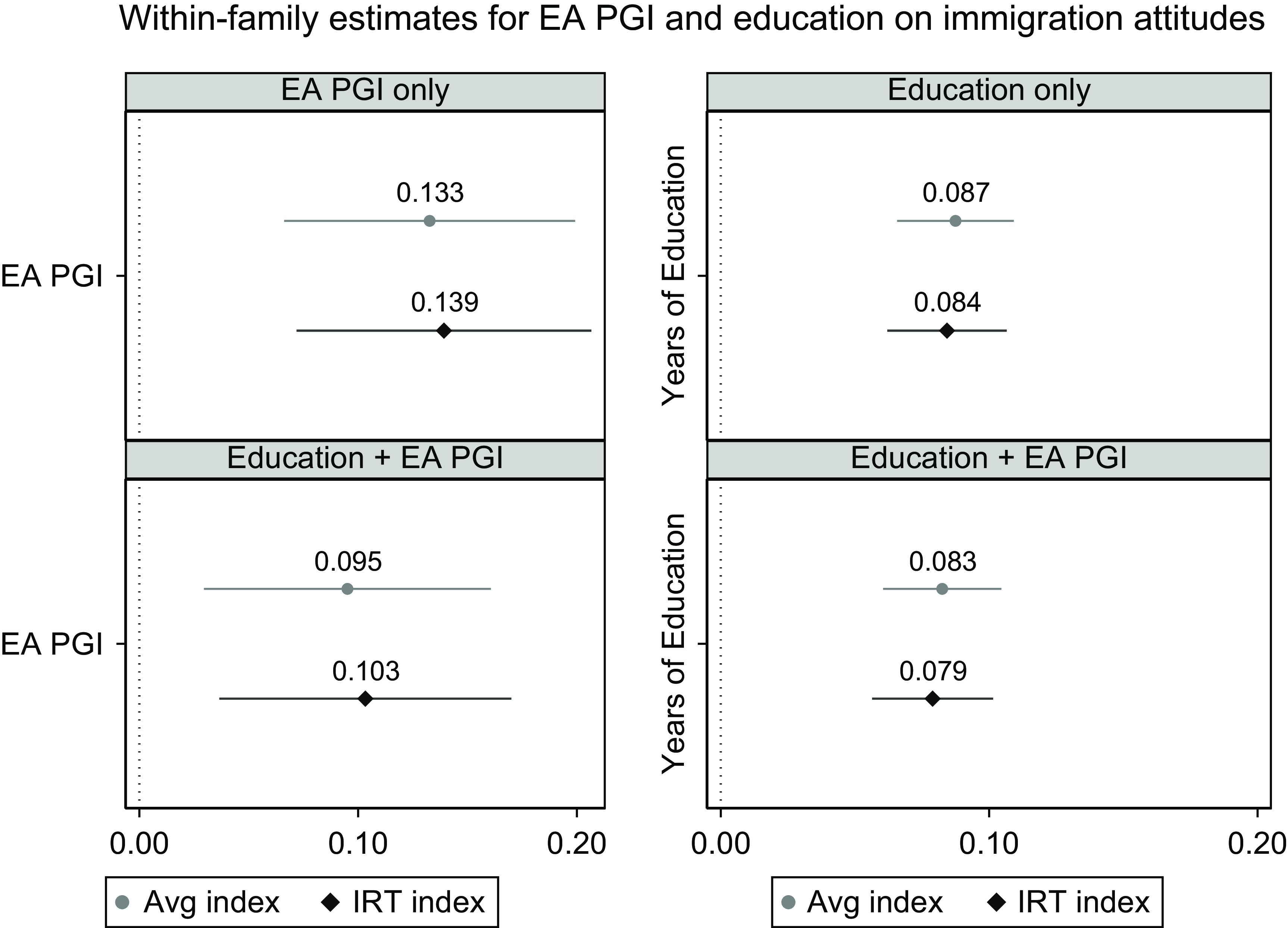
The left panel provides direct evidence on the effects of EA PGI and indicates that the genetic influences are partially mediated through phenotypic education. Specifically, a one-standard-deviation increase in PGI corresponds to an increase of 13–14% of the standard deviation in immigration attitudes, which is relatively larger than the effects of one year of schooling (as shown in the right panel). The estimates of EA PGI decrease by over a quarter in models that include educational attainment, the target trait of the PGI, and a plausible mediator between genetic predispositions and immigration attitudes. Given the likely prevalent pleiotropy in human complex traits (Watanabe et al., Reference Watanabe, Stringer, Frei, Umi´cevi´c Mirkov, De Leeuw, Polderman, Van Der Sluis, Andreassen, Neale and Posthuma2019), where one gene influences multiple traits, it is unsurprising that the total effects of EA PGI are not fully mediated by education. Importantly, EA PGI partially contributes to various cognitive and socioeconomic-related outcomes (e.g., Okbay et al., Reference Okbay, Wu, Wang, Jayashankar, Bennett, Nehzati, Sidorenko, Kweon, Goldman, Gjorgjieva, Jiang, Hicks, Tian, Hinds, Ahlskog, Magnusson, Oskarsson, Hayward, Campbell and Young2022). Thus, a plausible interpretation is that genetic predispositions linked with education can influence immigration attitudes by affecting various relevant downstream traits. Footnote 4
Turning to the right panel, the within-family estimates of education, while still significant and substantial, are slightly attenuated by approximately 4.5–6% when EA PGI is considered. Since the within-family estimates for education have already accounted for confounding factors shared by DZ twins, this might have indicated that DZ-twin differences in EA PGI contribute to individual-specific confounding. However, the small coefficient difference is not statistically significant. This might reflect the limited explanatory power of EA PGI, especially within DZ twins. With more powerful PGIs available in the future, it may be possible to discern such differences significantly. Meanwhile, the sample size of DZ-twin pairs might not have sufficient power to detect minor differences between coefficients, even though it permits adequate power to detect a small main effect.
As noted above, similar to many measures in the social sciences, PGI contains measurement error and offers a noisy measure of genetic effects. Consequently, the effects of genetic predisposition for education in within-family analysis with conventional PGIs are likely to be downward biased (e.g., Becker et al., Reference Becker, Burik, Goldman, Wang, Jayashankar, Bennett, Belsky, Karlsson Linn´er, Ahlskog, Kleinman, Hinds, Agee, Alipanahi, Auton, Bell, Bryc, Elson, Fontanillas, Furlotte and Okbay2021; Trejo and Domingue, Reference Trejo and Domingue2018).
Discussion
The findings collectively suggest that both genetic and social pathways, with education as a focal one, play a role in shaping immigration attitudes. Although Study 2 on the reform may be underpowered thus compromising the result comparison between the reform and MZ-twin studies, contrasting the significant effects observed in the MZ-twin study with the null effect of high school and university in longitudinal studies with adolescents and young adults suggests that education may have more political significance in midlife. This implies that theories concerning long-term downstream mechanisms, such as “education-as-cleavage” and educational disparities in receptivity to elite messaging (Cavaille and Marshall, Reference Cavaille and Marshall2019, p. 262), may be more plausible. Another limitation is the potential lack of generalizability from the unique twin sample, which is characteristic of family-based genetically informative data. While the SALTY sample has a slightly higher average education compared to the Swedish population of similar ages, using samples from the same source can help reduce some systematic sample differences that might skew result interpretations.
It is essential to emphasize that the EA PGI does not fully capture the genetic propensity for education. As advances in GWASs and PGI constructions unfold, it is expected that the explanatory power and precision of PGIs will further improve, bolstering future applications. Regarding potential valuable applications in the social sciences beyond this research, I reference several recent studies in Appendix A4.3. These studies innovatively combine PGIs with various designs (family and unrelated individuals) to shed light on pivotal mechanisms such as genetic nurture, assortative mating, and gene–environment correlations, which are fundamentally environmental and socially based mechanisms or contexts.
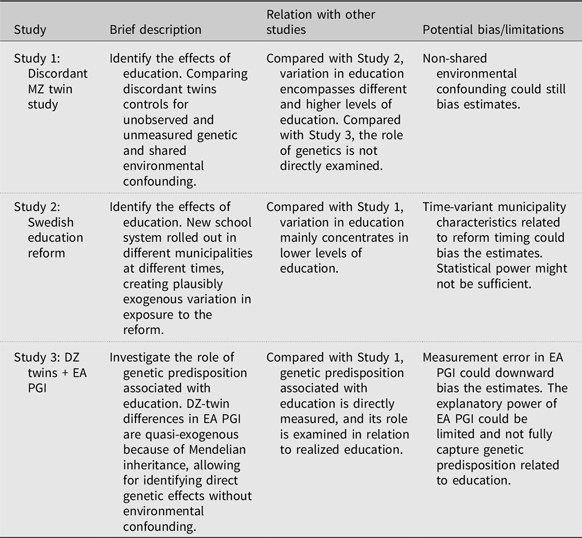
The triangulation approach is a novel component of the overarching research design. To illustrate the principles and practicalities of triangulation, Table 1 provides a concise summary of the three studies, outlining their methods, rationales, connections with other studies, as well as potential biases and limitations. While each study may have its own potential biases, these biases are largely unrelated due to the distinct natural experiments and designs, aligning with a desirable characteristic of methodological triangulation (Lawlor et al., Reference Lawlor, Tilling and Davey Smith2017). Drawn from the present research, I also highlight a few challenges within the triangulation approach that could be informative for future research: providing clear explanations of the core identification assumptions and potential biases in different designs; elucidating the sources of variation in key variables; and ensuring adequate statistical power for each design to prevent compromised result comparisons. Addressing these areas can hopefully enable us to fully realize the value of triangulation in our inquiries.
A summary of the studies
Supplementary material
To view supplementary material for this article, please visit https://doi.org/10.1017/XPS.2024.7
Data availability
Support for this research is provided by Vetenskapsrådet (2019-00244). This research uses proprietary register data. The data can be ordered from Statistics Sweden and the Swedish Twin Register with requisite ethics approval. The code and log files and additional descriptions for the data and analyses are available at the Journal of Experimental Political Science Dataverse within the Harvard Dataverse Network, at: https://doi.org/10.7910/DVN/897XEW (Feng, Reference Feng2024).
Acknowledgments
The author would like to thank the reviewers, Rafael Ahlskog, Sven Oskarsson, Karl-Oskar Lindgren, and participants at the European Social Science Genetics Network Conference II.
Competing interests
The author declares no conflicts of interest.
Ethics statements
This study was approved by the Uppsala Regional Ethics Board (protocol number 2017/ 083). This study adheres to APSA’s Principles and Guidance for Human Subjects Research.


 Open access

