

You’re making a statement that, hey, we’re going to do everything we can to deter and impede folks from crossing, to include building wall in areas where it may not be the most effective tool.
— Raul L. Ortiz, Retired Chief of the US Border PatrolFootnote 1
As international borders have hardened over the last decades, they have increasingly become sites of contestation. On the one hand, states’ efforts to filter people, goods, and violence at the border seems to be a reasonable security move. On the other hand, one of the most serious consequences of border hardening may be the violation of human rights, of which the right not to be tortured is one of the most fundamental. Border barriers—walls and fences—are a particularly controversial bordering strategy. As stationary structures that block cross-border movement, they have been criticized as costly, ineffective, and damaging to trade and the environment. We know relatively little about how human physical integrity rights are impacted by border barriers. This is a major shortcoming in the literature both on borders and on human rights.
Our research is motivated by an empirical puzzle: while reports of torture by states around the world have generally declined over the past several years, allegations of torture by Border and Immigration Officials (or BIOs) have trended upward. What explains this divergent trend? We theorize that constructing border barriers transmits meaning to two distinct audiences: residents and citizens on the one hand, and BIOs on the other. Unlike much of the political science and international relations literature, we do not assume that these audiences respond to border barriers in the same way, nor do we assume that states can fully control how messages are received. Walling programs may reflect citizens’ demands for security but are also likely to be interpreted by BIOs as a signal of growing external threat, elevated national enforcement priority, and BIO empowerment to stringently control the border. Such a signal increases the probability of human rights violations by agents charged with border control. We theorize that, whether intended or not, when a state initiates construction of walls or fences, there is an added risk that BIOs interpret such projects as license to enforce the border by all necessary means. If this is the case, then it may help explain why torture by BIOs is moving in the opposite direction of torture by other state agents.
To test this possibility, we have developed a twenty-six-year database of Ill-Treatment and Torture Allegations by Border and Immigration Officials for 152 states with international land borders.Footnote 2 We first demonstrate that allegations of BIO torture—by which we mean any credible allegation of torture perpetrated by such agents, whether at the border or within state territory, while acting in their official capacity—do not correlate with general levels of torture within a state nor with allegations of torture by other state agents specifically. BIOs respond to a distinct set of conditions that communicate danger and urgency surrounding border security. We find that the initiation of border barriers is indeed positively and robustly related to allegations that BIOs have gone too far by engaging in torture. Textual analysis of nearly two decades of European border agency press releases are also consistent with our theory that border barriers convey leadership’s tolerance for the lower priority given to human rights relative to security.
This research contributes to a growing literature that considers the consequences of extreme forms of border security.Footnote 3 It has become common to discuss the symbolic nature of border walls and fences, but to our knowledge this is the first effort to systematically explore the relationship between initiating border barriers and the human rights violations of state agents. Critical literature often propounds the inherently repressive nature of international borders.Footnote 4 We do not characterize all borders in this way. But when states invest in major infrastructural efforts to block transborder movements, BIOs are more likely to infer they have a responsibility to respond with commensurate force, raising the probability of acts that may constitute torture.
We also contribute to the human rights literature about torture, which has focused largely on internal repression and terrorism rather than the treatment of border crossers. This is important because many of the dominant theories linking human rights to domestic sources of accountabilityFootnote 5 will not be as relevant for realization of migrants rights, on whose behalf domestic rights pressures are more likely to be weak. Our theory helps explain why it is that even though torture practices have on average improved worldwide over the past two decades,Footnote 6 as borders harden, the right to not be tortured is increasingly likely to be at risk.
Background
Border Hardening
State efforts to harden international borders have accelerated in many parts of the world. The most visible form of such hardening is the astounding increase in walls and fences at or near borders in recent years. Several data sets confirm that physical border barriers are on the rise,Footnote 7 even in parts of the world where they are culturally foreign (for example, the Arabian Peninsula) or where liberal ideas of free movement tend to prevail (for example, within Europe).Footnote 8 Simmons and Kenwick have recently developed the concept of “border orientation” defined as “the extent to which the state is committed to the public, authoritative, and spatial display of control over territorial entry and exit at its national borders,” and offer a latent measure based on border crossings, walls, fences, and border zone police stations to demonstrate its generally upward trend.Footnote 9
The literature has come to no clear consensus about what is driving the trend toward more controlling border infrastructure. Wendy Brown theorizes border walls as efforts to reassert the sovereignty of the state in response to hard-to-define challenges by external nonstate actors and forces.Footnote 10 Others highlight border barriers’ symbolic role.Footnote 11 Terrorist fears lingering from 9/11,Footnote 12 unwanted migration,Footnote 13 and counterinsurgency strategiesFootnote 14 all likely play some role in various parts of the world. Border hardening may even reflect a vague sense of “border anxiety,” which has intensified over the past decade.Footnote 15 These accounts all emphasize the growing securitization of international borders in recent years.
Meanwhile, recent research on international borders emphasizes some concerning and potentially related trends. For example, crisis language often describes border challenges.Footnote 16 Dehumanization of non-national migrants is not uncommon.Footnote 17 From the Americas to Africa, migrant detention practices that are essentially arbitrary are increasingly justified on the basis of national security and public order.Footnote 18 Yet careful monitoring of border control agents is often thin.Footnote 19 In short, while demands for border security are on the rise, conditions that give rise to rights violations are flourishing in bordering spaces.
Human Rights
There are many reasons to be concerned about human rights violations at borders. Border crossers have historically experienced racial discrimination,Footnote 20 arbitrary detention,Footnote 21 denial of proper medical care,Footnote 22 and violations of family rights through forced separation in the name of border security.Footnote 23 Procedural violations, such as a right to claim asylum, a right to be heard at a fair tribunal, and a right not to be returned to a dangerous setting are also at stake.Footnote 24 Although there is no generally recognized human right to enter another state, human rights have come into tension with expanding border enforcement efforts in recent years.Footnote 25
We focus on an especially egregious and widely condemned human rights violation: the right not to be tortured. “Torture” is legally defined as any act committed by a state agent that intentionally inflicts severe pain or suffering—physical or mental—on a person, to coerce, punish, or intimidate them.Footnote 26 Experimental research has documented that support for torture is more likely in “crisis” scenarios thought to threaten national security.Footnote 27 Torture is associated with group dynamics, in which “out-groups” can be seen as deservingFootnote 28 of harsh treatment and “in-groups” are seen as justified in inflicting it.Footnote 29 Controlling torture involves massive principal agent problems.Footnote 30 Taken as a whole, the literature on torture suggests that discourses of threat, crisis, and dehumanization of out-groupsFootnote 31 are associated with a heightened risk of torture, especially in unmonitored and decentralized settings.
None of these studies are specific to border and migration control settings,Footnote 32 underscoring a crucial contribution of this article. Social and behavioral scientists have studied tolerance for and backlash against torture in the context of war,Footnote 33 policing,Footnote 34 domestic repression,Footnote 35 and foreign terrorism.Footnote 36 Border and immigration control have not yet received dedicated attention in either the literature on tortureFootnote 37 nor that on human rights,Footnote 38 despite the fact that allegations of torture by BIOs around the world are hardly rare. A recent meta-study found that roughly one in four adults who were forced to migrate and then attempt to enter wealthy countries has likely endured torture.Footnote 39 Many states have tried to deter entry by raising the “costs” of such attempts.Footnote 40 Border walls and fences are vivid symbols of such a strategy. All of this suggests that rights violations by BIOs might follow a different logic than repressive tactics by state agents focused on domestic law enforcement. If so, then this would imply that violence by border and immigration officers should be unrelated to violence by other state agents or the general level of violence in a state. This underscores the urgent need to develop clear theoretical explanations for the behavior of state agents dedicated to the enforcement of international borders.
Theory: From Barriers to Abuse in the Case of Border Control
States: The Dilemma of Signaling Security
We develop a theory linking border hardening with a growing risk of torture by specific state agents: BIOs. States have motives to signalFootnote 41 that they are serious about providing a high level of security, even if the nature of the “threat” is contested or ill-defined. This signal is often received by at least two audiencesFootnote 42 that tend to draw distinct inferences. On the one hand, domestic civilian constituencies want to feel secure, and states are motivated to send a message that they take popular security concerns seriously.Footnote 43 Theorists have explored how securitization of space underpins feelings of identity, permanence, and safety.Footnote 44 Empirical studies have found that border controls induce a sense of security.Footnote 45 Kilburn Jr. and Costanza note that feelings of security can be induced at least in part by symbolic measures,Footnote 46 as emphasized in the border walls literature.Footnote 47 Experimental evidence shows that general populations in three very different countries—Ireland, the United States, and Turkey—associate border walls with enhanced border security, even without any additional justificatory framing by the state.Footnote 48 Building on these findings, we theorize that states are motivated to harden borders because domestic civilians are likely to conclude that the state is working to make them safer.
On the other hand, BIOs, by virtue of their professionalization and training, tend to infer heightened threat and elevated national priority that they perceive empowers them to secure the border at all costs. Like militaries and police forces, BIOs are trained to operate in the “domain of violence.”Footnote 49 They are “force actors,” meaning they are typically authorized to use force to ensure order, repel threats, and to police the boundaries of the community itself.Footnote 50 As the literature on force agents shows,Footnote 51 BIOs are sensitive to border threats and seek to understand and act on national priorities in the performance of their professional responsibilities. Many operate under the assumption that their duty is to do what the nation requires to deter unwanted border crossings, largely by raising the costs to undocumented or illicit crossers.Footnote 52 Given the pervasiveness of this framework for migration control,Footnote 53 BIOs are likely to interpret border hardening as license or even encouragement to escalate their contribution to deterrence.
Importantly, we do not assume that states fully intend or even expect that security signals will lead to torture. After all, most of the states in our sample have made public commitments to refrain from torture. Their BIOs are constrained by international law,Footnote 54 some by national constitutions,Footnote 55 and by agency rules. For example, the United States Department of Homeland Security has articulated an “objectively reasonable” standard requiring the use of safe tactics, de-escalation, and respect for human life, depending on the context and situation.Footnote 56 In South Africa, border guards are required to take “due regard of the fundamental rights of persons.”Footnote 57 In Europe, Frontex agents are subject to relatively detailed human rights regulations, and are authorized to use force only with the consent and in the presence of border guards on whose territory they are operating.Footnote 58 It cannot be said that torture is a routine way to enforce most borders of the world.Footnote 59
It is useful, therefore, to theorize the potential dilemma a state faces when they attempt to signal their commitment to border security to domestic citizens on the one hand and BIOs on the other. But we do not assume that states are homogenous. Some states are naive: they may genuinely be unaware of how BIOs will interpret their messages of the need for heightened border security. Many, however, are strategic: they may knowingly run some positive risk of eliciting BIO torture, but decide the risk is worth the political benefit of sending the security signal to its citizens.Footnote 60 Yet others place almost no value on preventing torture; for them, there is no dilemma at all. Our theory suggests that regardless of the intent of the state, the security signal meant for domestic audiences turns out to be very difficult to separate from the signal of tolerance of extraordinary force to BIOs. This is because, regardless of their state of knowledge or level of intent, a signal sender cannot completely control how the signal will be interpreted by various observers.Footnote 61 States genuinely opposed to torture face a problem of crafting the security signal to the public without triggering the deterrence through force signal to BIOs. In general, the stronger the impulse to signal safety domestically, the greater the (possibly unintended) risk of potential torture.Footnote 62
Wall Construction as Signaling
How can states message security to domestic audiences and their border hardening priorities to BIOs? BIOs look for clear policy démarches as signals of their mandates. They interpret border barriers as informative, as the epigraph quoting a border security agent at the beginning of this article suggests. As nonverbal signals,Footnote 63 barriers cater to securitization concerns and communicate extenuating circumstances, often by overriding normal rules and procedures.Footnote 64 Border barriers are visible, salient, and expensive manifestations of an extraordinary policy commitment. Wall construction is hard to reverse, and difficult to back away from without incurring audience costs.Footnote 65 For these reasons, border walling sends a clear and credible signal about state priorities and threat concerns, with the potential to satisfy both a domestic demand for security and influence BIO behavior.
States have a choice of signals, of course. Leaders can use strongly worded policy announcements to express their border policies.Footnote 66 Rhetorical signals alone are changeable and often costless. Leaders could tighten up visa restrictions to demonstrate their commitment to control the border. But formal immigration policy stringency can be temporary and hard to observe. They could fortify ports of entry with infrastructure to facilitate inspection of commercial transactions, but these routine structures do not in themselves signal threat of illegal entry in the same way that border barriers do. Building border barriers is not the only way to communicate. We concentrate on border barriers because they are exceptional, salient, and credible policy shifts that are more likely than traditional border management tools to convey that border security is an elevated national priority in the face of threat. Without issuing explicit commands, wall building signals security to civilians, but also a degree of tolerance to use of harsh measures to BIOs, who are professionally primed to detect threats and have incentives to respond forcefully.
What BIOs Infer: Priorities, Threat, and Empowerment
Our theory differs from other approaches to signaling by emphasizing the importance of how the message is received. There are three reasons in our case to concentrate on message interpretation. First, the dual audience problem (civilians and BIOs) means that we cannot make clear assumptions about state intent, since that would require a complex accounting of how leaders balance communication with each. Second, leaders constrained by the rule of law may indeed have different behavioral preferences than unaccountable leaders, as we alluded to earlier. This preference is the traditional focus of the human rights literature which is often embedded in regime type explanations. We black-box regime variations theoretically and to hold regime type constant in our empirical tests to understand the special case of BIOs. Third, message receivers—BIOs—are multiple and decentralized. How individual BIOs interpret a border wall is at best probabilistic. We therefore theorize BIOs’ inferences in greater detail than leaders’ intentions.
There are at least three kinds of inferences BIOs are likely to draw from a major program of wall building. Most immediately, they are likely to infer that border security is an elevated national priority. Independent of whether a wall is effective against various threats, it does convey the message that the state supports a policy of sealing off the border to unwanted crossers. And a major infrastructural program is much more likely to signal policy change than incremental programmatic adjustments or by announcements without subsequent implementation. Border barrier investments are taken by BIOs as authoritative policy signals to guide their organizational and individual behaviors to achieve their newly elevated mission.
Second, when border barriers start to go up, BIOs are likely to infer heightened border threats. It is in the nature of their work to do so. Border patrol agents characterize their work as uniquely dangerous.Footnote 67 Their training emphasizes danger assessment, both to themselves and to others.Footnote 68 They adapt their work routines to signals of danger and uncertainty.Footnote 69 A review of policing and border control studies concluded that increased security measures tend to trigger officers’ hypervigilance, and often a sense of exaggerated threat.Footnote 70 According to the findings of an interview-intensive study, “Irregular migrants, including those with legitimate protection needs, are therefore first and foremost defined through their risk qualities—as threats—rather than through their vulnerability.”Footnote 71 We expect that investments in border security infrastructure can encourage heightened threat assessments, which can be further amplified by political messaging justifying securitization.Footnote 72
Threat hypervigilance may further be heightened by some of the dynamics that initiation of wall construction itself sets in train. Barrier construction can be expected to affect a third audience—unauthorized border crossers. Migrants who are undeterred will be increasingly diverted to more dangerous routesFootnote 73 where women and children will be least able to survive.Footnote 74 This creates a migrant pool disproportionately comprised of young men, whom barriers have incentivized to rely on traffickers and smugglers.Footnote 75 The indirect result of the policy is something of a self-fulfilling prophecy: demographic selection and logistical exigencies encourage BIOS to perceive borders crossers as more dangerous when a barrier is erected than without it, adding to their sense of threat and hypervigilant response.
Finally, when a state initiates border barriers, it stimulates an empowerment mechanism. Border barriers signal that the state—and perhaps society—place extraordinary value on performing border security duties. A substantial literature on domestic policing finds that the public is willing to empower the police to take extraordinary actions when they feel they are contributing to an important priority, such as countering terrorismFootnote 76 or stabilizing a conflict zone.Footnote 77 Building on this finding, we theorize an indirect empowerment effect supported by broader public acceptance of extreme border security measures. BIOs may infer from changes in the built environment that they are legitimately empowered by the state (and possibly even society) to expand the means used to enforce the border. On average, initiating border structures affects BIO assumptions about how national priorities and threat expand their discretion, potentially including tactics that shade into torture.
For these reasons, we hypothesize that:
H1: Torture by BIOs is a special type of torture by state agents: We expect to be unable to confirm a relationship between torture by BIOs and state practices generally.
H2: Allegations that BIOs have committed torture are likely to increase as states begin to harden their borders by erecting walls and fences.
In addition, a border walling program may be accompanied by strong political rhetoric that could also affect BIO behavior. In fact, that is probable since leaders need to justify expensive border fortification. Words may bolster the message, but wall construction is still expected to send a strong and independent message of threat and empowerment for border officials. In that case, we would expect interactive effects between walling and rhetoric. Thus we hypothesize that:
H3: The likelihood of torture reports associated with commencing a border wall increases when walling is combined with leaders’ increasingly anxious and angry border-relevant rhetoric.
Finally, our theory suggests another observable implication: the border security agencies’ attention to security and human rights will shift according to the threat implied by barrier building. Thus we expect that:
H4: When walls and fences are erected:
-
4a: BIOs’ self-reported attention to human rights decreases.
-
4b: BIOs’ self-reported attention to threats increases.
A few final comments bear emphasis. First, the mechanisms that theoretically connect border hardening with allegations of torture are plausible even where torture is not openly encouraged. Second, this theory is not about “bad apples;” it is about how signals influence populations in specific professional roles on average, and not as individuals.Footnote 78 We believe that the most plausible interpretation of the data points to BIO torture as a tragic effort to “do their job.” They are incentivized in part by demonstrating to their superiors and to political actors that they are working hard to ensure border security.Footnote 79 Third, we recognize that threat perception and empowerment ultimately operate at the level of individual psychology, but they may also be affected by organizational culture,Footnote 80 monitoring,Footnote 81 and better accountabilityFootnote 82—possibilities well worth pursuing in future research. Finally, there is nothing inevitable about a link between starting to build a border wall and a heightened risk of torture. How a state responds is important. A state that genuinely does not tolerate torture can observe and work to counter it with other messages and programs. Our communication theory therefore has another empirical implication: there is no reason to expect the effect of walling to endure. Leaders who observe effects they did not intend can reverse them through training and clear countermessaging. As we will see, the “wall effect” on torture fades in about four years, which could indicate that some states learn to offer countermessaging to their border agents. BIO training and other pro-human-rights programming are important issues, but beyond the scope of this article.
Torture by Border and Immigration Officials: The Data
The Data
We focus here on torture by BIOs acting in their official capacities. Would-be border crossers often face a broad range of human rights violations, but not all fit the definition of torture developed by Conrad, Haglund, and Moore’s (CHM’s) Ill-Treatment and Torture (ITT) Data Collection Project,Footnote 83 on which we build. The ITT Project uses content analysis of Amnesty International’s (AI’s) annual human rights reports to code the level of reported torture on a six-point scale, from no allegations (0) to allegations of systematic torture (5). Allegations are then classified into six categories of state agents responsible for torture practices: police, prison, military, intelligence, BIOs (our focus), and paramilitary agents.
We expanded CHM’s data set for the period 2006 to 2020 and focus only on allegations of torture by BIOs in countries with land borders.Footnote 84 Our researchers followed CHM’s codebook to determine an act of torture, whether a BIO is responsible for a given allegation, and the intensity of torture.Footnote 85 To assess whether our researchers were consistent with CHM, they were asked to code all countries with land borders for 2004 and 2005, the last two years covered by the ITT Project data set. Our coders agreed with the original ITT data at a 91.8 percent rate. In 7.7 percent of cases, our coders disagreed with CHM’s data, but disagreement was not systematically biased.Footnote 86 We then combined CHM’s data with ours for the period 1995 to 2020 and imputed missing values following Honaker, King, and Blackwell.Footnote 87
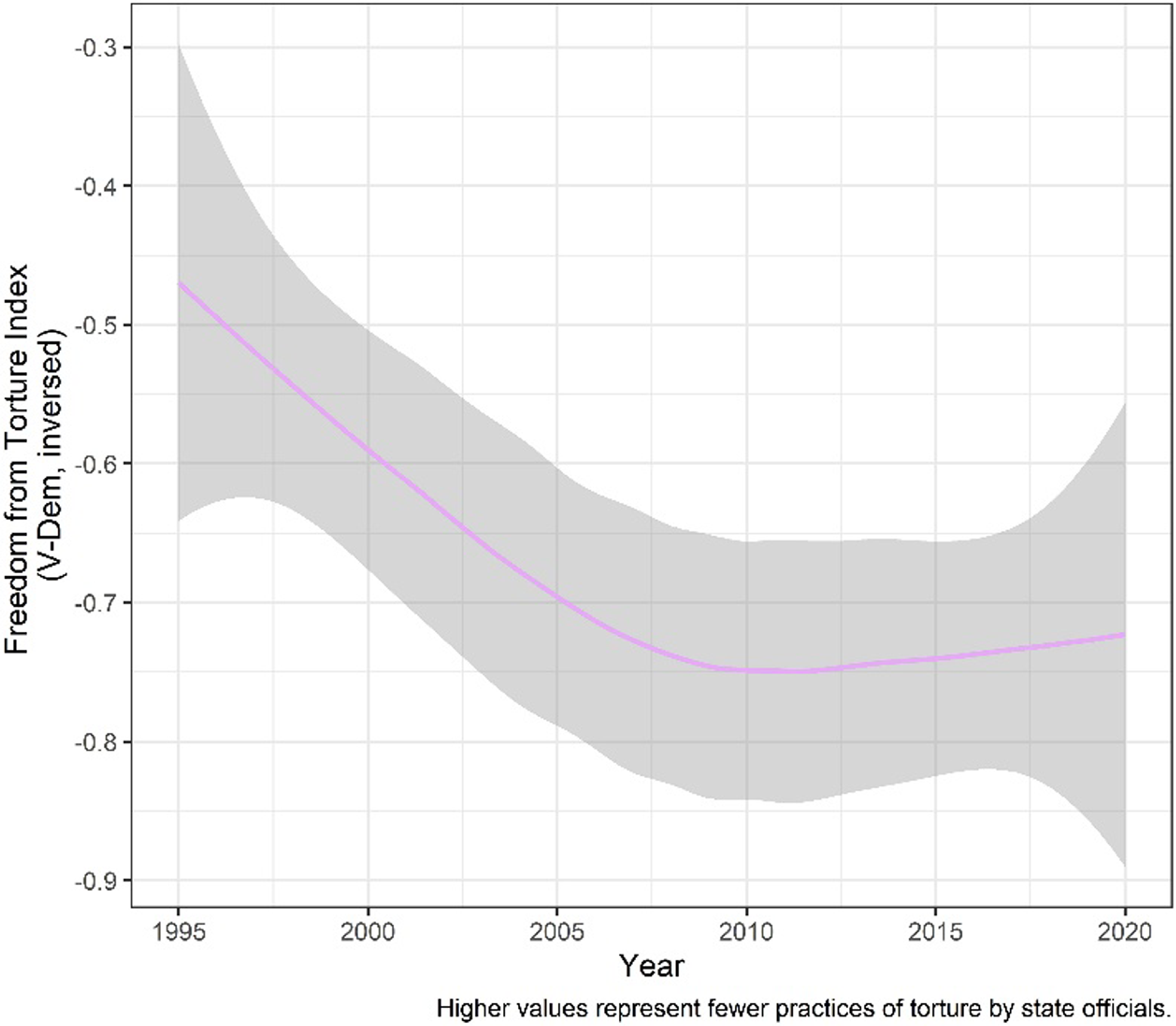
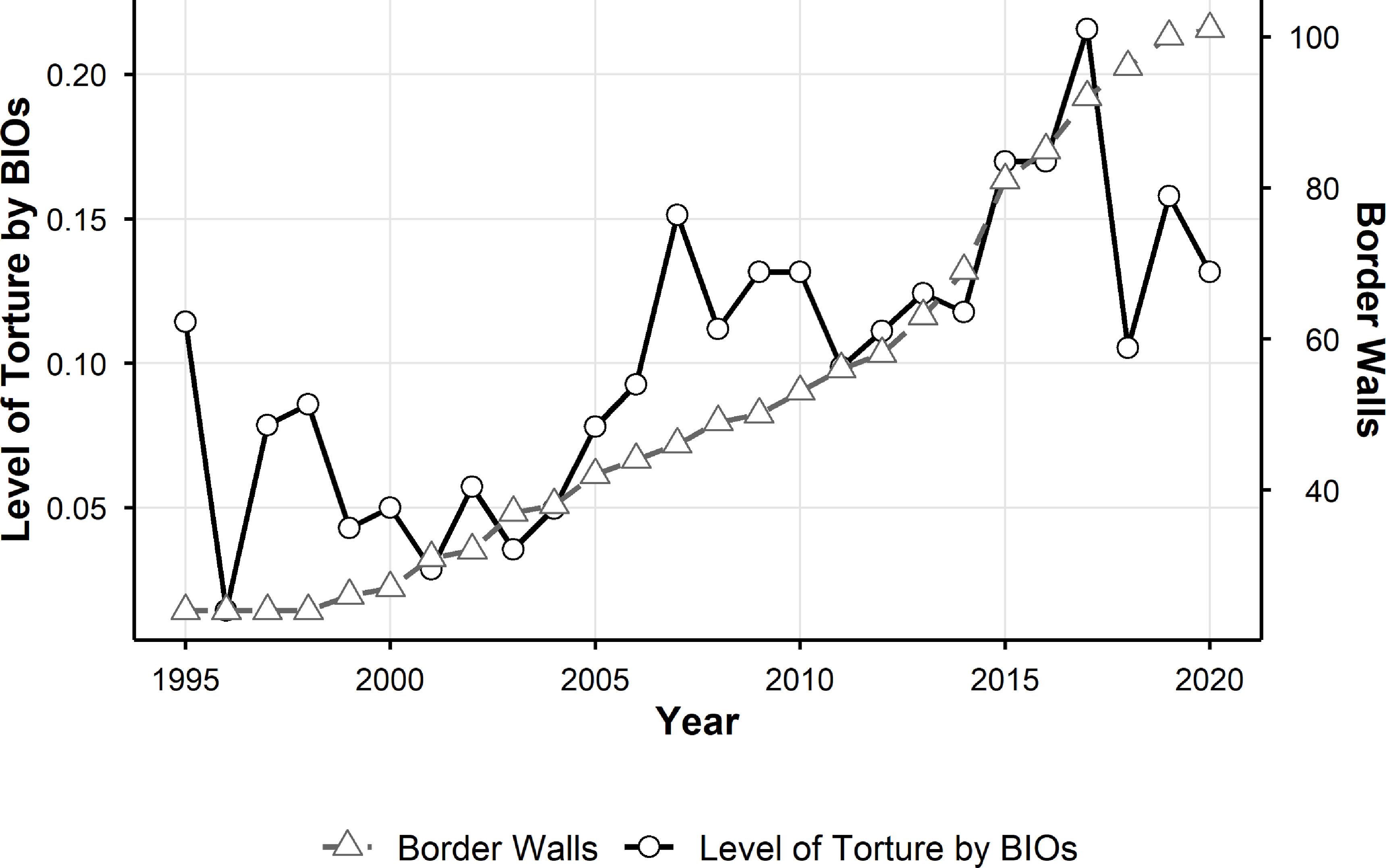
The descriptive data themselves are revealing. While overall torture incidence has been falling in the past twenty-six years (see Figure 1), the opposite is true for torture practices by BIOs and border walling. Both the intensity of torture by BIOs (Figure 2, right axis) and the number of border walls (Figure 2, left axis) have increased on average.
Evolution of the freedom from torture index
Note: V-Dem, inverted; land border countries only, 1995–2020.

Figure 1 Long description
The line graph illustrates the evolution of the freedom from torture index from 1995 to 2020. The x-axis represents the years, ranging from 1995 to 2020, while the y-axis represents the freedom from torture index, inverted, with values ranging from -0.9 to -0.3. The graph shows a general downward trend from 1995 to around 2010, indicating a decrease in torture practices. After 2010, the trend stabilizes and slightly increases towards 2020. The shaded area around the line represents the confidence interval, which narrows as the years progress, indicating more precise data over time. Higher values on the y-axis represent fewer practices of torture by state officials. All values are approximated.
Torture by BIOs and border walls, 1995–2020
Notes: Left axis: Average level of torture allegation scores across all countries. Right axis: Total number of border walls in stock (Kenwick, Pauselli, and Simmons Reference Kenwick, Pauselli and Simmons2025).

Figure 2 Long description
A two line graph presents data on the level of torture by BIOs and the number of border walls from 1995 to 2020. The x-axis represents the years, ranging from 1995 to 2020. The left y-axis measures the level of torture by BIOs, ranging from 0.00 to 0.20. The right y-axis measures the number of border walls, ranging from 0 to 100. The graph shows two data series: one represented by triangles for border walls and the other by circles for the level of torture by BIOs. The level of torture by BIOs fluctuates over the years, with notable peaks around 2000 and 2015. The number of border walls shows a general upward trend, with significant increases around 2010 and 2015. All values are approximated.
Are Torture Practices by BIOs Any Different from General Practices in a Country?
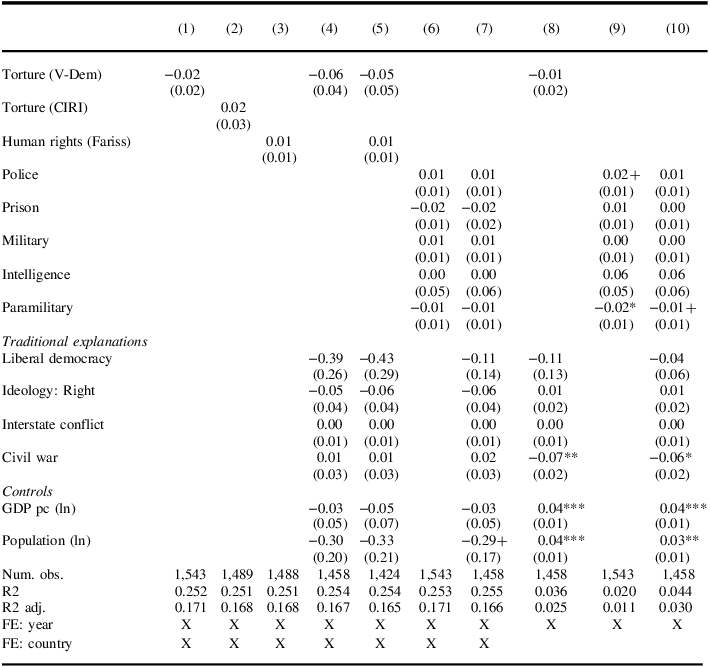
Our first hypothesis is that general torture incidence in a country does not correlate with torture by BIOs. Table 1 reports the results of a decade-long time series cross-sectional OLS analysis using country and year fixed effects with the country-year as the unit of analysis. BIO practices are not convincingly related to the overall intensity of torture in a given country, whether measured using the inverted freedom from Torture (V-Dem) index,Footnote 88 the Torture (CIRI) index,Footnote 89 or a general measure of Human rightsFootnote 90 (models 1 to 3). There is virtually no relationship between BIO torture behavior and that reported for other state agents (models 6 and 7).Footnote 91
OLS regressions to predict level of torture by BIOs (1995–2005)

Table 1 Long description
The table presents OLS regression results predicting the level of torture by BIOs from 1995 to 2005. It includes ten columns labeled (1) to (10) and multiple rows with various variables such as Torture (V-Dem), Torture (CIRI), Human rights (Fariss), Police, Prison, Military, Intelligence, Paramilitary, Traditional explanations, Controls, and additional statistical data. The table also lists the number of observations, R-squared values, and fixed effects for year and country. Key variables include measures of torture, human rights, and traditional explanations like liberal democracy and ideology. Controls include GDP per capita and population. The table aims to analyze the relationship between BIO practices and overall torture intensity in countries.
Notes: To include data on other state agents, this table covers only the decade of the original CHM (2014) database, which accounts for fewer observations compared to Table 2. Robust standard errors are clustered by country. p < .10; *p < .05; **p < .01; ***p < .001.
Models 4 to 5 and 7 include common predictors for human rights violations and torture incidence found in the literature,Footnote 92 such as liberal democracy,Footnote 93 and leader’s ideology: right.Footnote 94 Since much of the literature suggests interstate conflict,Footnote 95 civil war,Footnote 96 population (ln),Footnote 97 and GDP/capita Footnote 98 are associated with state torture,Footnote 99 we control for these as well. None of the traditional predictors of state torture predicts BIO torture reports, with the marginal exception of population (ln) in model 7 (and only at p < .1).Footnote 100 These mostly null results are consistent with H1.Footnote 101 Models 8 to 10 remove country fixed-effects to analyze the cross-sectional relationship between torture by BIOs and general levels of torture or torture by other state agents. Interestingly, and even though the theoretical focus of our study is on within-country variation in torture, it seems that physical violence by BIOs does not correlate with other forms of physical violence across countries.
We also analyze the goodness of fit of these models compared to using a random variable in section A.2 of the appendix and found essentially no difference.Footnote 102 Finally, we also considered whether factors emanating from the other side of the border might affect BIOs practices and we find no relationship between BIOs torture and neighbors’ characteristics.Footnote 103 We present this analysis in section A.3 of the appendix. To understand these puzzling “non-results,” a different approach is needed.
Torture by BIOs: The Role of Border Wall and Fence Construction
We contend that torture by BIOs is explained in part by border hardening policies themselves, and the sense of threat that accompanies them (H2). We use data collected by Kenwick, Pauselli, and Simmons, who define border walls as structures (including fences) intended to deny entrance by land to unwanted actors.Footnote 104 Their data were generated according to a protocol using news reports, official descriptions, and visible evidence using imagery from Google Earth and Google Maps.Footnote 105 This is the most appropriate data set for our purposes, since walls are decomposed into discontinuous segments when possible, allowing a test for the effects of constructing new segments at different points in time. It is also the most complete, detailed, and contemporary data available (1990–2020).
To test H2, we predict the reported level of torture by BIOs using a set of OLS regressions including Wall to indicate the date wall construction commenced, lagged one year. For example, Myanmar began distinct construction projects in both 2004 and 2010. We include an indicator for each of those lagged construction start dates.
Clearly, leaders signal their border priorities and concerns in ways other than walling. Rhetorical signals may be especially important in conveying anxiety and outrage about border conditions. We include two border rhetoric variables culled from speeches given by state leaders at the United Nations. We use measures of “anxious rhetoric” (anxiety) which captures a vague, hard-to-pin-down sense of risk or danger, and a measure of “angry rhetoric” (anger) about border issues from border-relevant portions of leaders’ annual speeches in the General Assembly.Footnote 106 Importantly, we do not believe that border agents necessarily listen to their leader’s UN speeches, although we do not rule this out. Instead, the rhetoric used in such speeches is a proxy for the official border rhetoric in which BIOs are likely to marinate and to which they respond. These rhetorical scores are interpreted as indicative of the broad array of border-relevant messages that national leaders are likely to send.
Recognizing the possibility that migration and/or refugee arrivals may affect BIO behaviors, we control for migrationFootnote 107 and a measure of refugeeFootnote 108 arrivals as well. These variables are meant to strengthen our confidence in the wall effect independent of human mobility pressures. Both are expected to be positively correlated with allegations of BIO torture. Migration is measured as a proportion of the total population in the host country.
We control for the “traditional” predictors of torture as well, but to economize on space do not report results that include the CIRI torture index, logged GDP per capita, or interstate armed conflict. These are never significant and never affect the results for BIO torture reports in important ways. We do control for civil war in the walling country and political violence in the neighboring country to account for a possible risk of violent overflow. To capture other signals state leaders may emit, we again include an indicator for Heads of State that are ideologically to the right (ideology right),Footnote 109 since it is possible such leaders emit nationalist or populist rhetoric that could affect BIO behavior. Finally, we include country and year fixed effects in all models. We considered the potential moderating effect of civil society in section A.8 of the appendix.
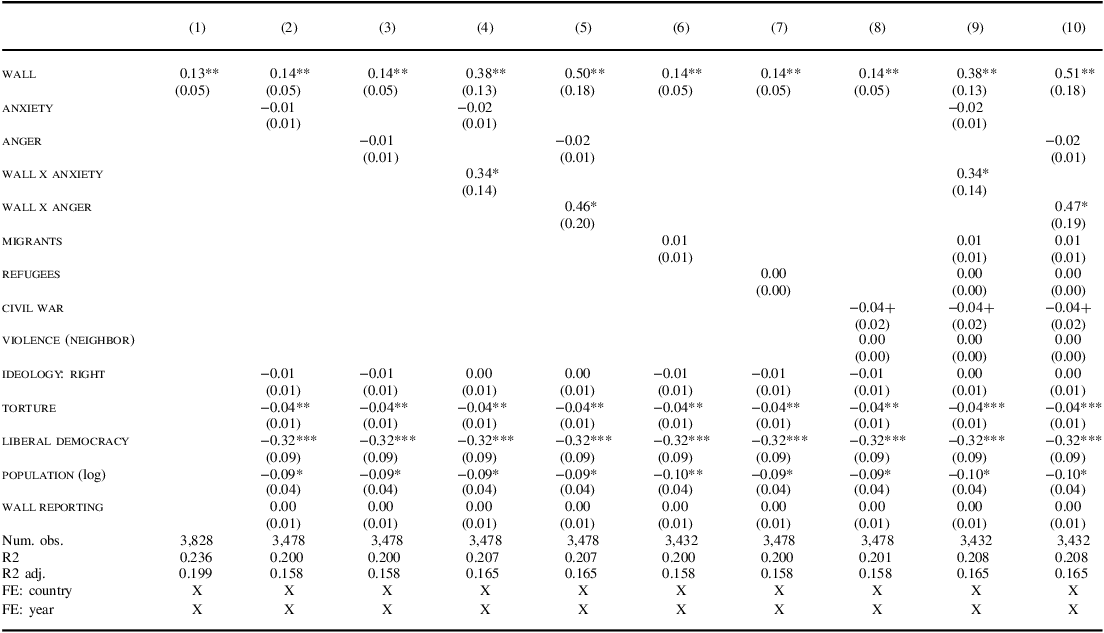
The results of the OLS analysis are presented in Table 2. All models show that the presence of a border wall correlates with increased reports of torture by BIOs in the following year. This relationship is statistically significant at p = 0.01 in every model, and the estimates are strikingly consistent across models. Wall construction is a strong predictor of torture reports, increasing the probability of a categorical increase in intensity by between 13 and 14 percent for the models without interactions. This estimate does not change much even when controlling for leadership’s anxious or angry border-relevant rhetoric and migration or refugee inflows (models 2, 3, 6, and 7).Footnote 110 None of these variables themselves appear to be significantly correlated with torture allegations. The top-line finding is strong support for H2.
OLS regressions to predict level of torture by BIOs, 1995–2020

Table 2 Long description
The table presents OLS regressions to predict the level of torture by BIOs from 1995 to 2005. It includes ten columns, each representing a different regression model, and rows for different variables such as torture measures, human rights, police, prison, military, intelligence, paramilitary, liberal democracy, ideology, interstate conflict, civil war, GDP per capita, and population. Each cell contains the coefficient value and standard error for the respective variable in the regression model. Notable trends include significant positive coefficients for civil war in models 8 and 9, and significant positive coefficients for GDP per capita and population in models 4 and 5. The table also includes the number of observations and R-squared values for each model, indicating the fit of the models.
Notes: This table covers a longer time period (twenty-five years) compared to Table 1, increasing the number of observations by approximately 150%. Robust standard errors are clustered by country. Country and Year FE included. +p < .10; *p < .05; **p < .01; ***p < .001.
Although anxious or angry leader rhetoric did not systematically impact BIO behavior on its own, rhetoric does have a notable interaction with wall building. Wall construction has a growing effect on BIO torture as leader rhetoric surrounding border-related issues becomes more anxious (models 4 and 9) and angry (models 5 and 10). This result suggests that words go a long way toward reinforcing policies, which supports H3.
We continue to find that many of the traditional explanations for torture associated with state violence and repression do not explain BIO behaviors. We found weak evidence that allegations of torture by BIOs are related to a civil war in the builder state (p < .1), but in a nonintuitive direction. There is no evidence of a link to political violence in neighbors. We expected there might be a difference in torture allegations based on the ideological orientation of the Head of State but found none. A country’s “overall” torture index is now significant at conventional statistical levels, but, reaffirming that BIOs behavior is distinct from general state repression, the correlation is negative. As we would expect, more liberal democracies have lower levels of allegations of torture by BIOs. Surprisingly, in bigger countries, BIOs are less alleged to torture. These results reaffirm H1 and support H2 and H3. Moreover, by including regime, ideological, and rhetorical controls we minimize the possibility that the strong positive walls effects merely reflect the repressive intentions of the state.
Potential Threats to Inference
Observational data are naturally subject to inferential threats. We consider several such threats in this section.
Torture by BIOs as a Function of Overall Violence by State Agents
Does wall construction predict higher levels of torture by other state agents—police, prison workers, the military, intelligence, paramilitaries—who are outside the scope of our theory? If so, then the data analysis may explain too much. To confirm the unique effect of wall building on BIOs we performed a “placebo test” (see section A.13 of the appendix). Our analysis reveals that wall building does not predict increases in torture allegations by other state agents. BIOs, uniquely, seem to receive and internalize the empowering signal of a hardened border, which is precisely what our theory predicts.
Spuriousness Arising from a Broader Set of Border Policies
It is also possible that constructing a border wall is part of a broader policy shift that is not primarily about signaling threats, but rather “filtering” travel or commerce. Such policies may increase the state presence—including physical infrastructure and personnel—at the border without emphasizing threats. If increased personnel alone accounts for increased torture allegations, we would expect an increase in guarded border stations to predict torture allegations.Footnote 111 We investigate this possibility using global data on border crossing infrastructure including buildings, inspection lanes, and gates.Footnote 112 We find that investments in border facilities unconnected to wall construction do not predict higher levels of BIO torture (section A.7 of the appendix). Our findings suggest that infrastructure can be nonthreatening, and that increased state border presence alone does not predict changes in torture by BIOs.
Additionally, some border restrictions may target the prevention of unauthorized entry through much less visible legal measures rather than physical barriers. We examine less visible policies using Mau and colleague’s data on visa requirements.Footnote 113 Specifically, we test whether the proportion of countries against which the state has implemented visa restrictions correlates with its own BIO’s torture allegations. BIOs of states with restrictive visa policies have no greater propensity to torture than do those where visa requirements are lax (section A.7 of the appendix). These results suggest that it is not restrictive border policies in general, but rather the visible and symbolic nature of border walls that signal priorities, affect perceptions of threat, and induce behavioral change.
Spuriousness Due to the Data Generation Process
One such threat could be that Amnesty International applies particular scrutiny to BIOs because a leader has commenced a border fortification program. If wall building triggers heightened scrutiny, then the data generation process rather than the signaling mechanism could account for the results. To address this possibility, we control for wall reporting, which is a count of the total number of times Amnesty used the words “wall,” “barrier,” or “fence” to describe the human rights situation in a country in its annual reports and include it in every model in Table 2. The idea is to capture the “scrutiny effect” that wall construction might trigger. This count variable is never significant and does not disturb the wall result.
Bias Due to Unobserved Variables
The estimated effect of commencing to build a wall can be biased if torture allegations by BIOs in countries doing so would have continued pretreatment trends in the absence of wall building. We address this concern by using a difference-in-differences (DiD) designFootnote 114 that estimates the average treatment effect for units (states) that are treated (commence wall construction). This “cohort average treatment effect” is then aggregated across states, with treatment fixed at time 0.
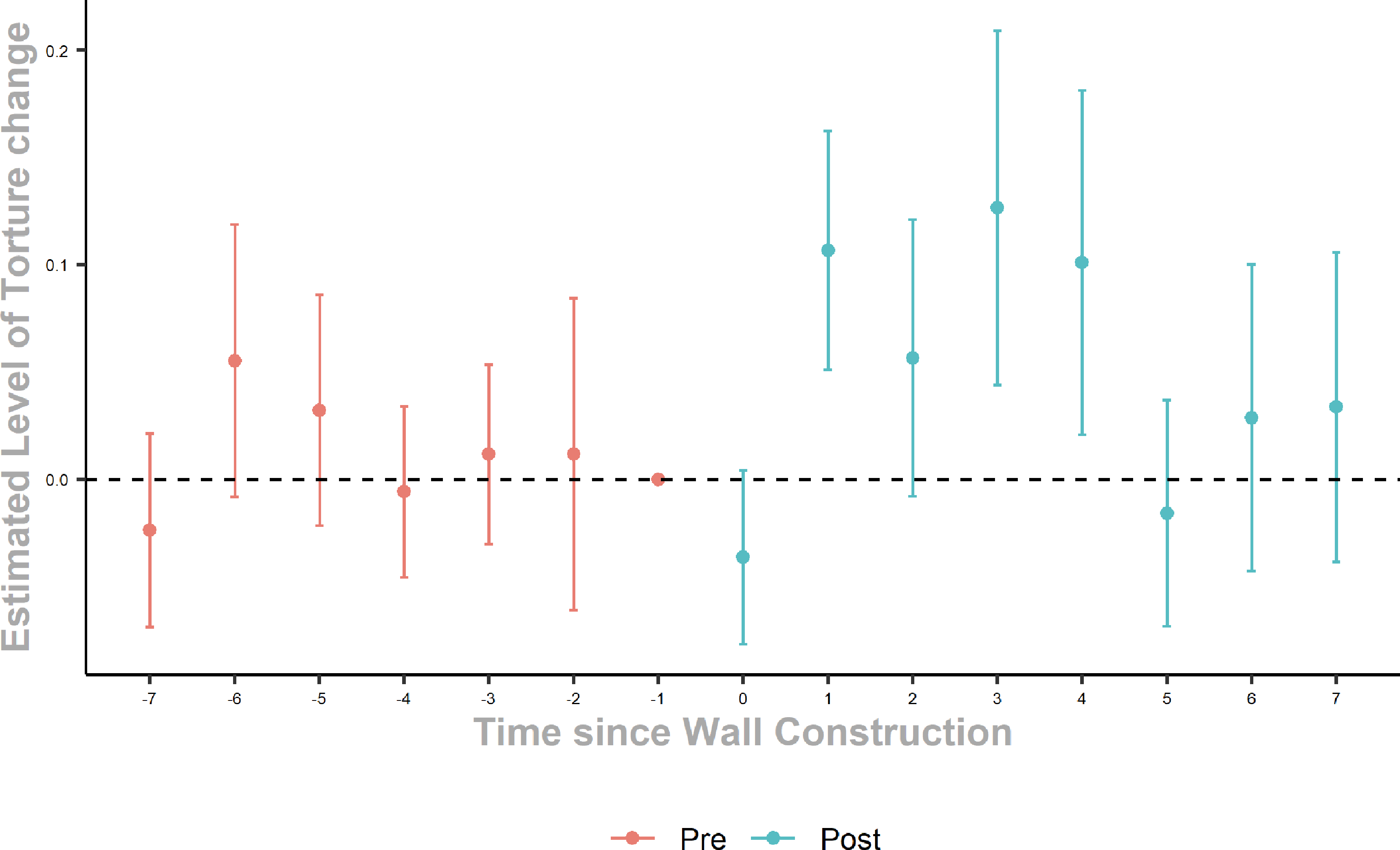
A key identifying assumption of the DiD design is that, in the absence of wall construction, treated and untreated states would have followed parallel trends in torture levels reported by BIOs. We assess this assumption using an event-study specification that plots the dynamic treatment effects in the years before and after wall construction (see Figure 3). The pretreatment coefficients are small and statistically indistinguishable from zero, suggesting that treated and untreated states exhibited similar trajectories before wall construction, and supporting the parallel trends assumption.
Staggered difference-in-differences on the level of torture by BIOs
Note: Treatment: wall start year.

Figure 3 Long description
A line graph displays the estimated level of torture change over time since wall construction. The x-axis represents the time since wall construction, ranging from negative seven to positive seven years. The y-axis represents the estimated level of torture change, ranging from negative zero point one to positive zero point two. The graph includes two data series: pre and post wall construction. The pre data points are marked in red, and the post data points are marked in blue. Each data point includes error bars indicating the variability or uncertainty of the estimates. The pre-construction data points show relatively small changes in the estimated level of torture, fluctuating around zero. Post-construction data points show a more significant increase in the estimated level of torture, particularly noticeable from year zero to year three. The error bars for post-construction data points are generally larger, indicating higher variability in the estimates. All values are approximated.
Figure 3 shows the estimated effect of a border wall on the level of torture by BIOs with 95 percent confidence intervals.Footnote 115 Importantly, before treatment, the differences in level of torture between treated and nontreated countries are never statistically different than zero, suggesting little reason to think that BIO torture in states that would soon build barriers was on a “pretreatment” upswing. However, after one, three, and four years of building a wall, there is a significant increase in the difference in the level of torture by BIOs compared to the no wall case (H2). Within five years, however, BIO behaviors revert to the prewall trend. The short-term effects of wall commencement also seem more consistent with unintended effects that could later be countered with better training or human rights messaging rather than a programmatic drive to increase BIO torture as a permanent strategy of border control.
Confounding Effects
We recognize the possibility that border walls may be endogenous to factors that explain BIO behavior, raising the risk of confounding the wall effect with conditions that explain walling in the first place. We already demonstrated that more built up border crossings, stringent visa requirements, and personnel deployments alone are unlikely to account for higher levels of torture. Nonetheless, wall building may be endogenous to other factors that explain torture; that is, they may correlate with the error term in the original regression, potentially biasing the results, though in which direction is difficult to know a priori.Footnote 116 To address this concern, we implement an instrumental variable (IV) approach. An appropriate instrument should predict wall building, but without signaling border threats or security priorities, or in any other way affecting BIOs’ propensity to torture.
One possible instrument is each state’s overall investment in infrastructure. Infrastructural investments generally involve many of the same budgetary, legal, administrative, and engineering capacities that are needed for border-related investments. These investments are fixed, long-term, and capital-intensive, unlike other public expenditures like personnel that are continuous and operational. We therefore expect the total amount of investment in infrastructure to predict wall construction, since both reflect the “institutional capacity of a state … to … logistically implement decisions.”Footnote 117 To capture this idea, we use data on public and public-private nonfinancial investmentFootnote 118 (transportation, energy, water, and information and communication technology, or ICT) from the World Bank and impute missing values.Footnote 119
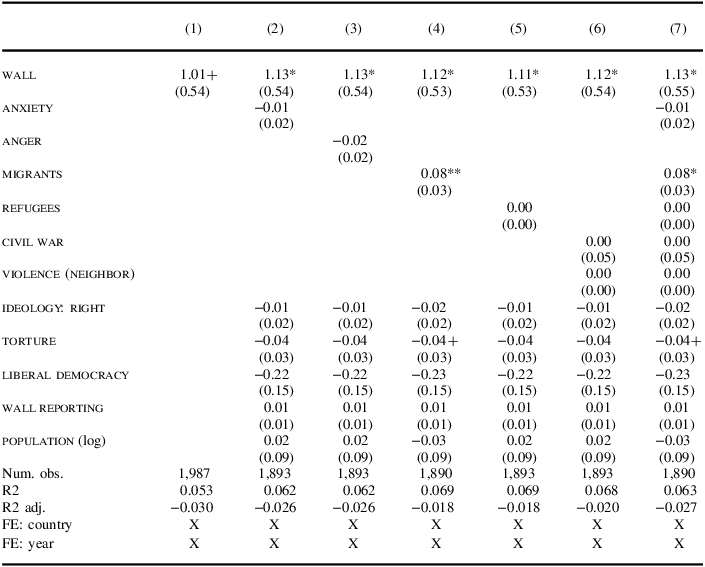
Results from the first stage are reported in section A.15 of the appendix. This infrastructure measure is indeed strongly associated with border walls but does not correlate with reports of BIO torture. Moreover, traditional tests support the conclusion that the instrument is strong.Footnote 120 Results from the second stage of the instrumental variable design are presented in Table 3. The instrumented measure of walls is strongly and consistently associated with increased allegations of torture by BIOs. This relationship is significant (mostly at the p < .05 level) in different model specifications controlling for potential observable confounders. The coefficient predicting BIO torture has now increased significantly in size. We did not estimate the interaction between wall and anger/anxious speech since the interaction would include the endogenous term.
Second stage instrumental variable models predicting torture allegations by BIOs

Table 3 Long description
The table presents results from the second stage of instrumental variable models predicting torture allegations by BIOs. It includes seven columns labeled (1) through (7) and multiple rows with variables such as WALL, ANXIETY, ANGER, MIGRANTS, REFUGEES, CIVIL WAR, VIOLENCE (NEIGHBOR), IDEOLOGY: RIGHT, TORTURE, LIBERAL DEMOCRACY, WALL REPORTING, and POPULATION (log). Each column shows coefficients and standard errors for these variables. Notable trends include the strong and consistent association of the instrumented measure of walls with increased allegations of torture by BIOs, significant mostly at the p < .05 level. The coefficient predicting BIO torture has increased significantly in size. The table also includes the number of observations, R-squared values, and adjusted R-squared values for each model specification, with fixed effects for country and year.
Notes: Robust standard errors included. Country and year FE included. +p < .10; *p < .05; **p < .01; ***p <.001.
The IV regression affects the results in another respect: whereas previously we found no detectable relationship between migration and torture reports, the results are now more aligned with intuition. Total migration (though not admitted refugees) as a proportion of population is now strongly positively correlated with torture on the part of BIOs. Even so, border walls continue to be strongly associated with BIO torture.
Sensitivity to Model Specification
Finally, it is possible our results are sensitive to modeling specifications or to particularly influential outliers (section A.9 of the appendix). A jackknife test suggests that there is no country influential enough to reduce the significance of the wall coefficient globally (see Figure A.2 in the appendix). Additionally, we run a set of robustness checks with alternative model specifications that address concerns about the distribution of the dependent variable (sections A.10 and A.11). To ascertain whether the results are driven by extreme outliers, we dichotomize the dependent variables, such that 1 denotes the presence of any allegation of torture, while 0 indicates the absence of such allegations, and re-run the model using logistic regression. Results remain consistent with our argument (Table A.10). Furthermore, the results remain robust if we treat the six-point dependent variable as a count variable and use Poisson (Table A.11) or negative binomial regressions (Table A.12). We also found the same strong positive effects of walls on torture allegations when coding for three-year effects rather than just one (section A.12, Table A.13). Moreover, returning to the original OLS models, sensitivity analysis demonstrates that the null hypothesis of zero wall effect on torture allegations would still be rejected given confounders as strong as one, twenty, and fifty times the effect of the measured confounders (Figure A.3 in the appendix), suggesting that the results are not likely to be easily disturbed by unobservable factors.
Corroboration Using BIOs’ Own Words: The Relative Importance of Security versus Human Rights under Different Threat Signals
If the signaling theory captures an important phenomenon, then building a border wall should be expected to change the language BIOs themselves use to report and justify their work. Specifically, we expect to observe more security-related language after wall building commences relative to human rights language, reflecting an attention shift (H4). Such a shift would constitute corroborating evidence of the concerns of BIOs as security signals change.
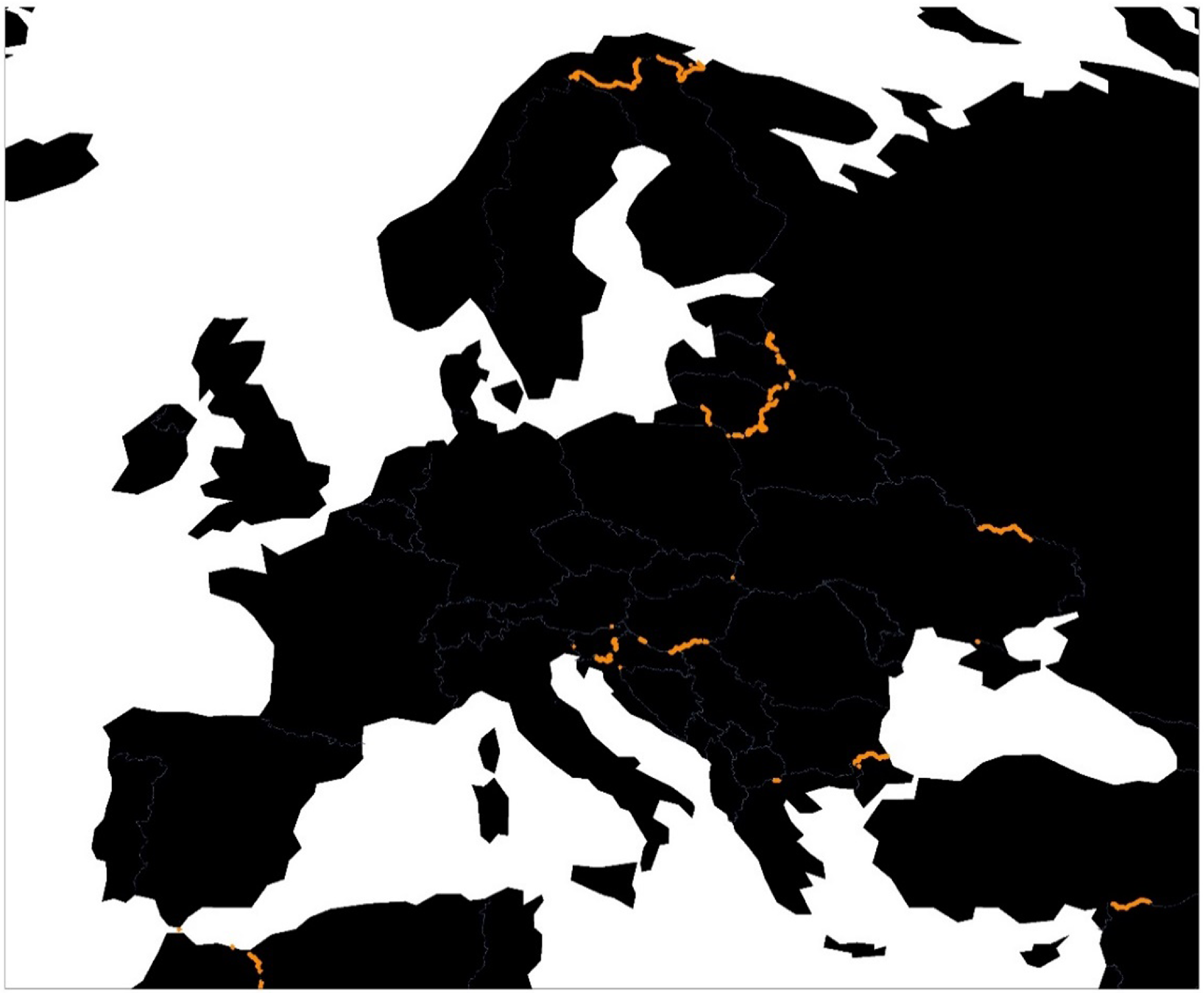
We use press releases issued by the European Border and Coast Guard Agency (Frontex) to test this idea. These documents are a trove of highly suggestive evidence of what BIOs prioritize, their perceptions, and how they carry out their work. Frontex was established in 2004 to coordinate the external border control efforts of the Schengen Area. Since 2006, Frontex has published press releases that provide a window into how Frontex interprets Schengen border security policies, the nature of border-related threats, and how they are called upon to respond. Figure 4 maps the location of border wall segments in the European region.
Border walls in and around Frontex area

Figure 4 Long description
The map of Europe shows regions with border walls in and around the Frontex area, marked in orange. The highlighted areas include parts of the northern, eastern, and southern borders of Europe. The map uses black and white to differentiate countries, with orange lines indicating the locations of border walls. This visual representation emphasizes the strategic placement of border security infrastructure within the Frontex operational zone.
We scraped all news articles published by Frontex on its website (n = 793) between 2006 and 2023 and coded the date that each document was published. We then ran a structural topic model which identified fifteen topics.Footnote 121 These topics describe Frontex’s activities responding to border issues such as illegal migration, human trafficking, and rescue operations. Figure A.6 in the appendix shows all fifteen topics sorted by their predicted weight in the corpus of press releases.
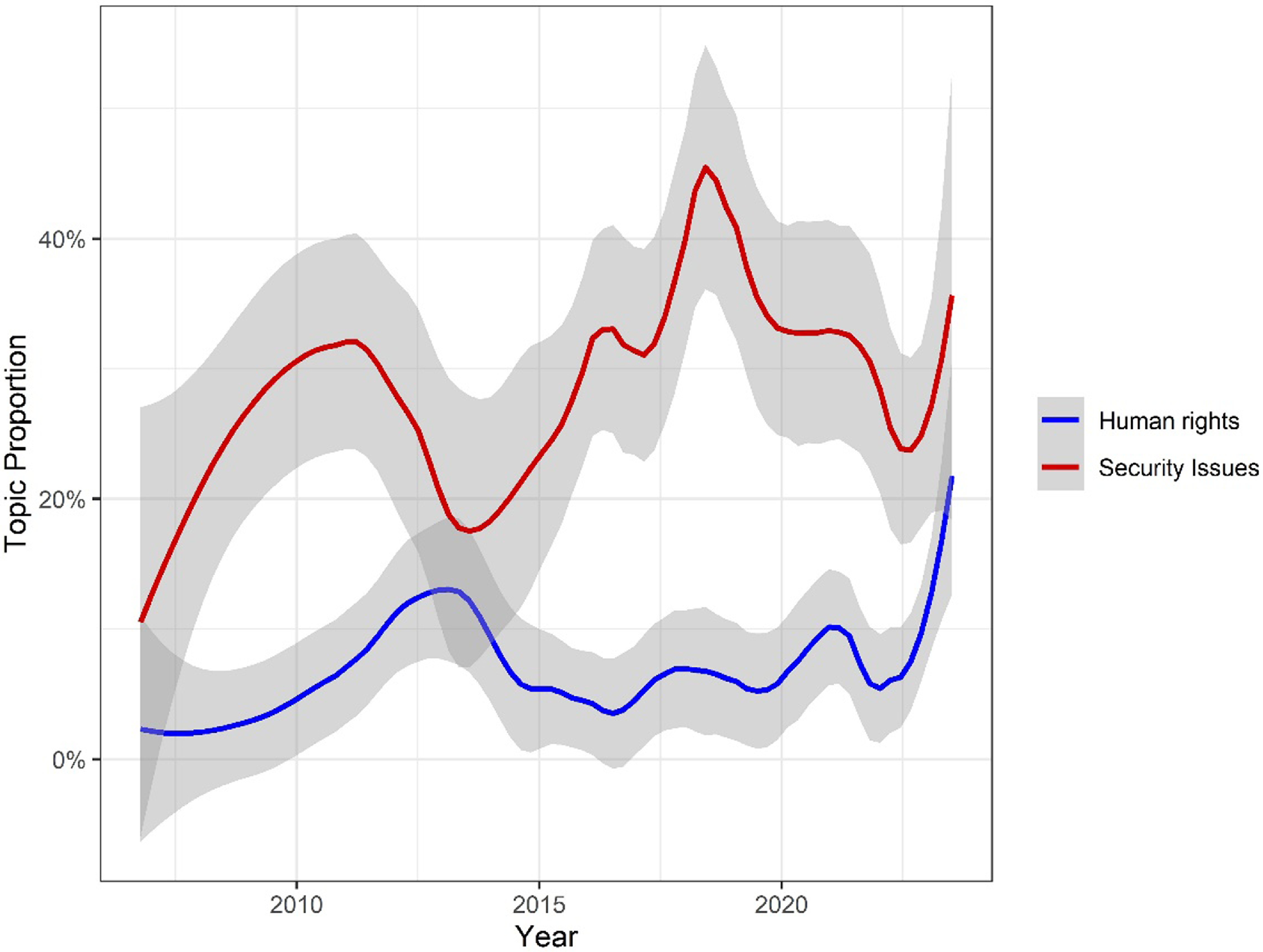
We combined the topics on illegal migration, illegal crossing, smuggling, and trafficking into a single measure of “security concerns.” This measures the amount of text in Frontex press releases related to security and threat issues. We also used the estimated proportion of text corpora on the human rights topic to measure how much Frontex talks about “human rights.” Figure 5 plots the proportion of text retrieved from Frontex’s press releases identified over time with security and human rights topics. Unsurprisingly for a border security organization, Frontex reports much more often on security topics than on human rights topics. We are interested, though, in what explains spatial variation and change over time in the relative prominence of these topic clusters. Note that there is no necessary tradeoff between these categories—both can and do increase at the expense of uncategorized discourse, as appears to be the case after 2022. Perhaps the most notable trend in topics comes between 2014 and 2018, around the height of the migrant influx from the Middle East and North Africa, for which we attempt to control using temporal fixed effects. Our expectation is that when walls and fences are erected, BIOs’ attention to human rights decreases, while their attention to security threats increases. Quite clearly, shifting attention away from human rights when walls go up is not at all the same as committing torture. Our claim here is more modest but highly corroborative: BIOs’ attitudes and perceptions change in response to wall construction, for which we expect to see evidence when BIOs describe their own work and working environment.
Text proportion on topics related to security issues or human rights in Frontex’s articles

Figure 5 Long description
A two line graph depicting the proportion of topics related to security issues and human rights in Frontex's articles from 1995 to 2020. The x-axis represents the years from 1995 to 2020, while the y-axis represents the topic proportion in percentage. The red line represents security issues, and the blue line represents human rights. The red line shows fluctuations in the proportion of security issues, peaking around 2015 and 2020. The blue line shows a relatively stable proportion of human rights topics with a slight increase towards 2020. The shaded areas around the lines indicate the confidence intervals. All values are approximated.
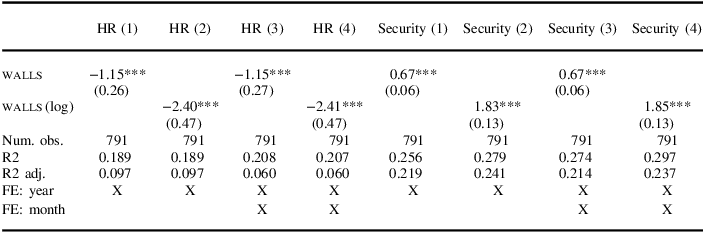
We also manually coded the countries and borders mentioned in each document. A mention of walled states suggests BIOs are describing a situation with awareness of any newly constructed border barriers. This serves as a proxy for perceived threat levels. We expect articles about places where states have begun wall construction to reflect heightened security concerns, and to downplay human rights compared to states that are mentioned in the article but have not constructed walls. To test this, we ran a set of logistic and OLS regressions, where the dependent variable, discourse, is the proportion of security concerns/human rights material in a document. The explanatory variable is a count of the number of countries with a wall (Wall) mentioned in the text. We also ran the same models with the log of the number of countries with a wall that Frontex mentions in each press release (Wall (log)). The results of these statistical models are presented in Table 4. They show that Frontex reports that mention a country with a wall are associated with a smaller proportion of the text with words related to the human rights topic and higher use of words associated with the security issues topics—a shift that is consistent with the theory developed earlier (H4).
Frontex press releases: human rights, security, and border walls. Results of logistic and OLS regressions on topic prevalence

Table 4 Long description
The table presents results of logistic and OLS regressions analyzing the prevalence of human rights and security topics in Frontex press releases. It includes data on the impact of mentioning countries with border walls. The table has 8 columns and 10 rows, with columns labeled HR (1), HR (2), HR (3), HR (4), Security (1), Security (2), Security (3), and Security (4). Each row provides regression coefficients for variables related to walls and their logarithmic values. The data shows negative coefficients for human rights topics when walls are mentioned and positive coefficients for security topics. The number of observations is 791 for each regression, with varying R-squared and adjusted R-squared values. Fixed effects for year and month are included in the models.
Note: Robust standard errors reported and clustered by country mentioned. +p < .10; *p < .05; **p < .01; ***p < .001.
One might object that the real challenges for Frontex between 2014 and 2018 were refugees arriving by sea rather than by land.Footnote 122 But this fact does not make our mechanism of perceived threat any less relevant. Frontex’s system of integrated information sharing is comprehensive among states and across state agencies.Footnote 123 It is plausible that threat perceptions can be shaped by signals from a variety of geographic sectors. Thus when countries with a border wall are mentioned, this increases security and reduces human rights topics relative to all other Frontex press releases. Moreover, this finding is robust to the inclusion of mentions to the Mediterranean Sea, where front-line migration has been most significant (see section A.16 of the appendix). Walls appear independently to signal priority and threat. In Frontex documents, they are associated with significantly more security discourse and much less human rights discourse, even when accounting for the migratory points of access along Mediterranean shores and the time periods of intense migration (which are at least partially absorbed by the year and month fixed effects).
Overall, this evidence demonstrates that agents concerned with border security themselves communicate a heightened security threat when reporting on situations in border states with border walls. Otherwise, they are more willing to attend to human rights. This evidence is consistent with our theory that wall building signals an intensified priority, resulting in more attention to security issues than to human rights protections (H4).
Conclusion
At a time of accelerating border hardening, it is crucial to understand how border security measures affect human rights practices. Reports of rights violations at the hands of BIOs are not uncommon.Footnote 124 And yet they bear no clear relationship with torture committed by other state actors that have been at the center of most research on torture in political science.
We have advanced an agency-specific theory of torture that responds to highly visible state commitments to secure the border in extraordinary ways. Our approach is compatible with existing theories of securitization linking perceptions of threat to exceptional policy responses.Footnote 125 The claim is not that states intentionally generate vicious torture practices by prioritizing border security. Rather, we contend that highly visible border barriers cue BIOs that they indeed are empowered to secure the border and to detain or deport offenders at (nearly) all costs. These perceptions raise the risk that BIOs will inflict physical and psychological pain, whether at the border or deep within a destination/host state.
Twenty-six years of empirical evidence from around the world is highly consistent with this theoretical account. Using newly extended data on allegations of torture by border and immigration officials, we demonstrated a strong correlation between the commencement of a border wall and reports of torture by BIOs. The results were robust to a wide range of controls and specifications, including difference-in-difference and instrumental variable analyses. We also controlled for border barrier mentions in the coded Amnesty International Country reports, since this might capture “scrutiny” and weaken the wall result. This did not happen.Footnote 126
The central mechanism linking border walls with torture allegations is not directly observable. Our difference-in-difference findings show border walls are unlikely to be responses to conditions that are already conducive to rights violations. Walls are likely endogenous to security or migratory crises, although results of the instrumental variable model suggest the size of observed effects of walling were, if anything, underestimated in Table 2. The Frontex evidence is consistent with the theorized mechanism. As corroborative evidence, it demonstrates a telling shift in relative attention away from human rights where border walls are built.
Finally, there are reasons to suspect that the paper’s findings are, if anything, conservative estimates of the deleterious consequences for human rights of border hardening. It is implausible that rights organizations have been able to detect all torture incidents; false negatives seem far more likely than false positives. These results also exclude extraterritorial human rights violations of wall-building countries. Most importantly, these results include only allegations of abusive behaviors that constitute traditional understandings of torture, especially beatings, burnings, etc. We do not analyze the many violations of rights—from arbitrary detentions to inappropriate privacy violations to disappearances to family separations—committed against vulnerable migrating populations that can also meet the international definition of torture.Footnote 127
Future research should build on these initial findings to develop more fine-grained investigations. Our conclusions could be more nuanced with specific information on the structure of border agencies, the extent to which they are monitored, and how, if at all, they are held accountable. Future research could test theories that might address spatial subnational variations in rights violations depending on border or wall proximity, size and location of vulnerable communities, or risk-amplification by local authorities. Research could also usefully investigate whether BIO torture becomes a substitute or a complement to other enforcement behaviors such as arrests and detentions. And finally, it would be useful to investigate how and to what extent states learn and adjust their policies toward border security. We think it likely that some will train their BIOs to follow specific rights-protecting protocols, while others will tolerate, perhaps even encourage torture, as a useful deterrence tool.
We acknowledge the well-known shortcomings of even the most rigorously analyzed observational data. Experimental research should be designed to reveal the conditions under which border agents and the population at large would be willing to tolerate torture in the name of border security. Such studies flourished after 9/11. To what extent do border “crises” soften resistance to torture as well? There is also a need to go beyond border walls as signals. If border walls become the new normal, researchers should be attuned to emerging modes of political communication that can spur exceptional (and illegal or immoral) enforcement at international borders.
While more work remains to be done, this research should prompt some serious reconsideration about border-hardening policies that aim, but fail, to deter.Footnote 128 The evidence produced here suggests that torture practices are not cultural givens; instead, they can be induced by messages that prioritize outcomes other than, or even at the expense of, rights protection. At the very least, this research suggests states should strengthen human rights messaging and training and hold torturers accountable for violations. It also suggests that institutional safeguards, including monitoring and accountability mechanisms, should be given close attention as well. Very few commentators have questioned sovereign states’ right to build border walls within their own territories. Nor do we. Yet it is worthwhile considering these structures through a human rights rather than a strictly sovereigntist lens.
Data Availability Statement
Replication files for this article may be found at <https://dataverse.harvard.edu/dataset.xhtml?persistentId=doi:10.7910/DVN/USKLU0>.
Supplementary Material
Supplementary material for this article is available at <https://doi.org/10.1017/S0020818326101350>.
Acknowledgments
We thank Zuha Noor, Noah Ryan, Brandon Kanell, Fariha Nawar, Joao Estaca, Luke Coleman, Alex Norris, Imani Miller, Jade Akhras, Selena Rosario, and Michael Huang for their excellent research assistance. All errors are the responsibility of the authors. The authors benefited from comments from Alex Braithwaite, Sarah Bush, Adam Chilton, Alyssa Prorok, David Richards, Burcu Savun, Anton Strezhnev, Ezgi Yildiz, the Yale international relations workshop, the Georgetown BMW Center, the Stanford Human Rights Center, the Arizona State University’s workshop on Human Rights and Democratic Backsliding, the North American Meeting of the Peace Science Society, St. Louis, 2023, American Society of International Law and the Social Science and International Law of the European Society of International Law speaker series, and the 2025 Southern Political Science Association Meeting.
Funding
Research was funded in part by the National Science Foundation and the Carnegie Foundation, and with the support of Penn Carey Law and Perry World House.
AI Statement
The authors used R code that has been previously debugged with the assistance of ChatGPT and DeepSeek, and ChatGPT to explore the communications literature and the policing literature.


 Open access

