




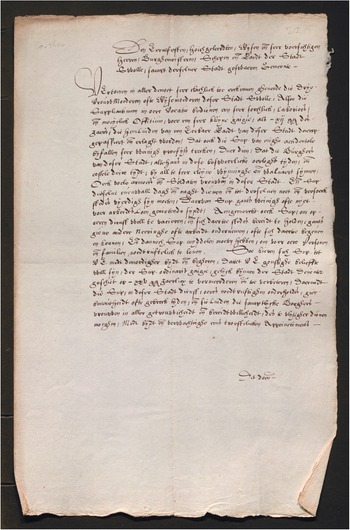
In the early 1590s, the three midwives employed by the town of Zwolle approached their magistrates with a financial request. To serve the citizens to the best of their abilities, the suppliants explained, they required the means to provide for their own and their families’ necessities. Currently, however, they faced difficulties making ends meet since their clients, suffering from war and inflation, were struggling to adequately compensate the midwives for their services. Even less could be expected from the many paupers and soldiers’ wives residing in the town. At the same time, the suppliants continued, the work of a midwife required them to be ready to answer calls day and night, making it impossible for them to take up additional occupations. The twelve gold guilders that each of them received as a fixed annual salary from the magistrate insufficiently reflected the value and effort of their “responsible, laborious, and difficult office”. For these reasons, the three petitioners asked the magistrate to raise their annual salaries to twenty-five gold guilders, the remuneration received by their colleagues in the neighbouring town of Deventer.Footnote 1
In their petition, Zwolle’s midwives combined their request for a moral recognition of their work’s value to society with the demand that their remuneration should both reflect this value and ensure their livelihood. Although 400 years old, the suppliants’ narrative sounds familiar. The popularity of books like Michael Sandel’s The Tyranny of Merit and David Graeber’s Bullshit Jobs points to a widely perceived discrepancy between what a vocation contributes to the common good and its financial, social, and moral valuation.Footnote 2 The COVID-19 pandemic of 2020–2023 presented a particularly prominent episode, in which healthcare workers in “essential jobs” received widespread praise, while many complained that their income scarcely covered the rising costs of living. The request of Zwolle’s midwives is part of a collection of sources that allows us to add a historical perspective to these current debates. For the period c.1550–1700, the city’s archive has preserved a collection of about 200 petitions from suppliants applying for employment in the town’s services or requesting the town government to improve their employment conditions. Their requests provide insights into the value that early modern public servants attached to their work.
As one of the most urbanized regions of premodern Europe, the Low Countries present a particularly advantageous opportunity to explore the history of public work. Over the course of the early modern period, the region’s numerous larger and smaller cities employed increasing numbers of people for a wide variety of public facilities. Among them was the town of Zwolle (Figure 1), which, in the context of the northern Netherlands, was a medium-sized city, its population fluctuating between 7,000 and 12,000 inhabitants between 1500 and 1800.Footnote 3 As we explain in more detail below, there are different ways to apply the concept of “public servants” to these early modern cities. For the purpose of this article, we define as “public servants” all those employed in the service of the urban government, thus excluding from our analysis the urban political elite or regenten who worked for the city as part of a “civic duty”. Compared to the latter, the town’s employed officials have received relatively little attention from historians but, as we aim to demonstrate, studying them adds new perspectives both to the history of work and to the history of urban governance. Taking the short episode from Zwolle as our point of departure, this article zooms in on the “voices” of applicants and officeholders in their relation to urban governments. Foregrounding individual public servants such as the three midwives enables us to complement the more institution-centred focus of existing studies.Footnote 4
Map of Zwolle from Joan Blaeu, Toonneel der steden van de Vereenighde Nederlanden, Met hare beschrijvingen (Amsterdam, c.1652).

Figure 1 Long description
The map depicts the city of Zwolle with intricate details, including streets, canals and fortifications. The city is surrounded by a star-shaped fortification with multiple bastions. Within the city, various buildings and streets are visible, organized in a dense layout. Two coats of arms are present in the corners, adding decorative elements. A legend at the bottom left lists names or descriptions related to the map. The map is bordered by artistic elements, enhancing its historical and aesthetic appeal.
This article thus examines public servants through the lens of petitions in which individual suppliants requested the magistrates of Zwolle to provide them with employment or to ameliorate working conditions in the town’s service. This perspective offers rare insights into how premodern people related to their daily work. Why did people work for the city, and what was the attraction of public work in this period? To what extent do urban attitudes to the status and value of public work correspond to or diverge from the existing general image of work in premodern cities? In answering these questions, we want to show that, at least to some, working in public service constituted an alternative to the guilds and the urban crafts sector that dominate the study of premodern lower- and middle-class labour. Urban attitudes to the status and value of public work, this article argues, provide a new perspective on the study of premodern working identities.
First, we discuss our source material and its relevance to the existing historiographical debates. Second, we delineate the type of urban officials we define as “public servant” and what distinguishes them from other urban officeholders. Third, we discuss application practices and competition between individual applicants. Fourth, we zoom in on public workers’ scope for personal initiative, by focusing on remuneration practices and salary negotiations. Finally, this allows us to reflect on contemporaries’ ideas about the status, attractiveness, and value of work as part of urban public services.
Working for the City: Debates and Sources
This article aims to shed light on the conditions under which people decided to work in urban public services between 1550 and 1700. In doing so, it engages with two major lines of historiography: the history of public services, and the history of urban work. At least for the early modern period, these two fields have seldom overlapped. However, as this article aims to demonstrate, both stand to benefit from being analysed together.
For much of the late medieval and early modern period, the main providers of institutionalized communal services were to be found in cities.Footnote 5 Studying the many towns and cities of the late medieval and early modern Low Countries, historians have thus been able to shed light on the individuals and institutions who organized and financed public facilities as well as on the multifaceted communal ideologies that informed them. More recent studies focus especially on the “communal” or “corporatist” character of these urban communities and highlight the fluid borders between private and public providers of services for the common good. They demonstrate that, in premodern towns, both individual citizens and religious congregations contributed to public facilities, most prominently in the areas of healthcare and poverty relief.Footnote 6 At the same time, historians have shown that, between the fourteenth and eighteenth centuries, urban governments assumed more public functions and, consequently, expanded their staff of public servants.Footnote 7 These authors share an institutional and government-centred perspective. They often employ quantitative methodologies to track the trajectories of professionalization and bureaucratization as well as the changing scale of public services over time. On the rare occasions when historians have paid closer attention to those employed to serve the town, they have often focused on specific offices, such as secretaries or midwives.Footnote 8
We find more interest in the attitudes of premodern historical actors to jobs and employment conditions in the history of work. Studies of premodern work migration and labour markets integrate individual voices in their larger analyses. According to a recent volume on early modern European industry, the empirical study of the “lived experience of labour” serves to counterbalance grand theories of economic development.Footnote 9 For the premodern period in particular, scholars predominantly concentrate their efforts on classic fields of work: agriculture, trade, and, most prominently, the organization of urban craft guilds. Tellingly, specialist volumes on urban labour and labour markets feature no contribution on urban public services.Footnote 10 In their magisterial study of attitudes to work and workers in the pre-industrial world, Catharina Lis and Hugo Soly explicitly mention “civil servants” as a regrettable lacuna in their analysis.Footnote 11 In an important intervention, Maria Ågren’s study on premodern Swedish state servants utilizes the perspectives of gender and social history to demonstrate the mutual dependence between public servants and their masters. Her study, however, also skips over the more multifaceted urban public services that preceded the state.Footnote 12
Besides the conceptual approaches of historians, a major reason for the common neglect of “voices from below” is the available source material, which usually carries a strong hierarchical-institutional bias. Historians of public services predominantly base their work on urban financial accounts and normative texts, while scholars such as Lis and Soly seek to reconstruct attitudes to work through prescriptive and authoritative texts written by reformers, theologians, and philosophers.Footnote 13 In contrast, this article utilizes letters of application for urban offices, as well as requests for salary raises that aspiring and current public servants sent to their magistrates. Handled carefully, these documents offer the potential to provide complementary insights into the perspectives of past urban public servants on the value of their daily work, from secretary to gatekeeper.
In terms of typology, applications and requests for improved working conditions belong to the overarching category of petitions or supplications, in Dutch known as rekwesten or rekesten. Petitions were almost ubiquitous in premodern Europe and, in the broadest sense, contain pleas for mercy, favour, or assistance, directed by subjects to the authorities. Andreas Würgler counts them “among the most important sources not generated but dealt with by the state”, which offer at least some counterbalance to the top-down bias of normative sources created by secular and ecclesiastical authorities.Footnote 14 In Dutch historiography, for instance, the study of rekesten has shed light on the participatory elements of politics in the early modern Dutch Republic but also provided insights into the life of women in urban societies.Footnote 15
In contrast, petitions containing job applications have seldom drawn the attention of historians and are virtually absent in the history of work. In general, historians of work in pre-industrial Europe tend to focus on forced labour, patron–client relations, and the entry barriers raised by corporatist organizations such as craft and merchant guilds.Footnote 16 As an important exception, Ariadne Schmidt uses applications and supplications for improved working conditions to study the midwives in the service of early modern Leiden.Footnote 17 Only recently, however, have scholars singled out petitions for employment as a genre of its own. They have traced how written job applications developed during the sixteenth century as a new cultural practice in the context of an increasingly competitive market for urban and courtly offices in the Holy Roman Empire.Footnote 18 These petitions provide an opportunity to include individual voices in studies of attitudes to labour and, thus, bridge the conceptual gap between the history of premodern public services and the history of labour. By exploring why people strove to work for the town and what tactics they employed to do so, we aim to add a new facet to the field of premodern work outside the established grand narratives of guild labour and serfdom.
The study of petitions requires certain caveats. Although supplications were less standardized than other genres of formal, especially legal, writing, suppliants enlisted the service of specialized scribes, who could influence the petition’s content, and in the seventeenth century could resort to writing manuals.Footnote 19 However, even if the petition’s text was the result of a collaboration in which a scribe provided the formal framework, it still needed to provide a convincing story.Footnote 20 The use of topical phrases, for instance, does not mean that applicants invented the financial hardship and familial situations that they so frequently cited to explain their need for employment.Footnote 21 In early modern Zwolle, applications still seem to have contained a variety of narratives, and do not yet appear to have become fully standardized. The same is true for the closely related petitions for salary raises, as illustrated by the introductory case of the town’s three midwives.
While some early modern urban governments copied incoming supplications into registers that provide historians with large amounts of unsorted serial data, many contemporary authorities or nineteenth-century archivists disposed of petitions that they considered worthless.Footnote 22 In contrast, the archives of Zwolle contain a substantial number of rekesten, which modern archivists have organized by topic. For the period c.1550–1700, we have thus been able to utilize a sample of 213 petitions related to approximately forty of the town’s offices.Footnote 23 Of these petitions, ninety-eight contain applications; eighty pertain to requests for improved terms of employment, such as a raise in salary or subsidized clothing and housing; thirty-five supplications concern adjacent topics such as complaints about unpaid or reduced salaries. While few of these petitions were dated, we can infer an approximate date of submission from the script, information in the text, and cross-referencing with other sources. As the numbers indicate, this collection has survived only in a dramatically reduced form, which substantially limits the potential to draw conclusions from a quantitative approach. However, these documents do present a rare opportunity for a qualitative inquiry across a broad cross-section of public servants. Based on Van Nederveen Meerkerk’s categorization of civil servants in the city of Dordrecht, Table 1 demonstrates that applications and requests for improved working conditions were submitted by all spheres of the town’s public services.Footnote 24 Therefore, the petitions in the archives of Zwolle offer a distinct perspective on negotiations surrounding early modern urban offices. They constitute an intriguing starting point for exploring the attitudes of the men and women seeking employment, and those who already worked for the city.
Petitions according to working sphere of civil servants

Table 1 Long description
The table categorizes petitions related to civil servant employment, improvement, and other requests across various office categories. Law enforcement and social care sectors have the highest number of employment petitions, each with 27, while education has the fewest with no petitions for employment. Petitions for improvement are most frequent in law enforcement, with 25, followed by social care with 20. The 'Others' category shows a more balanced distribution across all office types. Notably, the education sector has minimal activity, with only two improvement petitions and one other petition. This data suggests a higher demand for employment and improvements in law enforcement and social care sectors compared to others.
Categorization of offices based on Elise van Nederveen Meerkerk, “Professionalization of Public Service: Civil Servants in Dordrecht, 1575–1795”, Journal of Urban History, 36:3 (2010), pp. 345–367, 349.
Public Servants?
Before we delve into the sources, we need to explore the nature and classification of the offices that our applicants aspired to. “Public servant” is a modern concept and applying it to early modern societies requires some explanation. By the sixteenth century, urban governments in the Low Countries had created a sizeable apparatus of employees (often referred to as “urban servants” (stadsdienaren)) to support the different types of urban public facilities.Footnote 25 Historians have suggested several ways to classify the different offices of this early modern public service, sometimes according to their general function (public administration, law enforcement, health, education, welfare, culture and religion, infrastructure – particularly economic infrastructure), but also according to rank or status (higher, middling, lower).Footnote 26 Clerks and secretaries managed the town’s proliferating administration and archives; physicians, midwives, barber-surgeons, and apothecaries offered citizens medical services; pavers and builders constructed and maintained the town’s material public infrastructure; gatekeepers, criers, ushers, and executioners acted as the magistrates’ executive arm to keep security and peace; messengers maintained the flow of information and the legal and political relations with towns, rulers, and governments; and a variety of musicians and teachers educated and entertained the urban community.Footnote 27 We have opted to denote the occupants of these offices in general as “public servants”, who differ from other contemporary urban offices in two crucial ways. The term “public servants” thus serves as a heuristic tool rather than as an attempt to shoehorn sixteenth- and seventeenth-century governance into modern categories.
First, the modern connotations of terms like “public servant” and “public service” are difficult to square with late medieval and early modern concepts of governance. As indicated above, European societies in the sixteenth and seventeenth centuries did not neatly differentiate between “private” and “public”, and urban governments continued to share many social and political functions with other corporate institutions and individual citizens far into the early modern period.Footnote 28 Conversely, the close ties between the Church and the municipal authorities made many ecclesiastical officers employees of the city. Churchwardens and organists, for instance, received their office and salary from the urban government.Footnote 29 This article zooms in on those workers who fulfilled public functions, and were employed or admitted by the urban government. This includes members of the so-called transport guilds, such as Zwolle’s peat carriers, whose availability at all times was important for the common good. The public carriers, for instance, also fulfilled ancillary tasks such as firefighting. They were considered urban officials while the other – private – carriers worked as day labourers.Footnote 30
Second, we need to contextualize these “public servants” in the frame of urban governance. In the Overijssel region, cities were ruled by a body of magistrates who stemmed from a limited number of aristocratic “regent” families. In Zwolle, this ruling body comprised sixteen members, divided into eight aldermen (schepen), responsible for day-to-day government, and eight supporting councillors (raden). By monthly rotation, two aldermen assumed the title of burgomaster, who presided over the magistrates. Furthermore, the aldermen divided among themselves administrative offices like that of the treasurer, who managed the town’s finances, or the “town carpenter” (stadstimmermeester), who was responsible for the urban infrastructure. These were the ruling offices that carried formal political power.Footnote 31 Additionally, historians have identified a number of so-called subaltern offices, which controlled many urban institutions, for instance those related to civic poverty relief. Such offices often served as stepping stones in the careers of regents wishing to pursue higher political office. For the purposes of this article, we distinguish all these “political” or “civic duty” officials, such as burgomasters, treasurers, or orphans’ masters, from proper “public servants”, such as secretaries, clerks, midwives, and all others appointed by the city.Footnote 32 In choosing the term “public servant” to describe those employed by the city, we emphasize both elements of their role: they worked for the urban community, but were also formally “employed” by the magistrate rather than being elected or co-opted by their peers.Footnote 33
This is not to say that early modern public servants formed a uniform group. Socially and economically, public servants formed a heterogeneous body, and it is highly unlikely that, for instance, secretaries and streetcleaners considered themselves part of the same social group or class. A few, like the town’s executioner, could even suffer social exclusion.Footnote 34 We must also consider the differing degree to which officials depended on their employment. If a pharmacist or midwife were rejected by the magistrates, they could still gain admission to practice for their own account. In contrast, a position such as that of the town’s rod-carrying ushers (roedendragers), who combined duties as guards, messengers, and beadles, existed exclusively as a public office. Furthermore, Van Nederveen Meerkerk has demonstrated that between the sixteenth and eighteenth centuries the different offices varied substantially in their degree of professionalization. While administrative and medical offices became more specialized and required increasing levels of formal qualifications, jobs such as those of the gatekeepers remained only loosely regulated.Footnote 35
Despite these differences, public servants shared important formal commonalities. Generally, they swore an oath of office to the magistrates, who stipulated the level of compensation, duration, and other terms of appointment in a letter of employment.Footnote 36 Particularly relevant for this article is the fact that all sorts of public servants applied for their job in writing. The magistrates of Zwolle do not appear to have differentiated between categories of public servants in their hiring procedure until 1692. At this point, the magistrates divided the urban offices “dependent on the city” (“van dese stadt dependerende”) into three classes. Yet, rather than relating to social or economic status, the partition served to establish who could select the replacement candidate if a position became vacant due to the death, promotion, or resignation of its former incumbent.Footnote 37 The fact that both academically educated doctors and lawyers as well as modest guardsmen sought employment by the city in similar ways indicates that people from a wide range of social backgrounds considered it worthwhile to “depend” on a public office, as the magistrates of Zwolle put it. What did the urban magistrates expect from their employees, and vice versa? How were successful candidates selected? Zwolle’s collection of petitions offers the potential to learn more about contemporary attitudes to these questions.
Competing to Serve the Town
Before they were able to apply for an office, petitioners first had to learn of a relevant job opening. A few scattered notes in the records of Zwolle’s neighbouring city of Kampen suggest that certain offices were advertised via bulletins posted in public spaces. Thus, in 1558 and 1569, the magistrates posted a notice at the local wine cellar to fill the vacancy of dike reeve.Footnote 38 Evidence of such notifications, however, is sparse. Instead, our sources point us to the individual initiatives of applicants. They frequently prefaced their request for an office by explaining how they had learned of the vacant position in the first place. Many vacancies resulted from the death of the previous office holder, which appears to have quickly become public knowledge in a city, opening up the position to a broad group of potential applicants.Footnote 39 Retirements, on the other hand, provided opportunities to a more limited “inner circle” of candidates. Family members learned of such upcoming vacancies before others and, in some cases, the retirees themselves applied on their children’s behalf.Footnote 40
We even find examples of unsolicited applications, for instance in the contentious case of Zwolle’s resident apothecaries, Henrick Jacobsz. Gaesdey and Berent Busch, who vied for the public office of town pharmacist. On 14 February 1590, Gaesdey handed in his petition in which, after outlining his eligibility for the position, he alleged he had heard Busch profess disinterest in the office. It took Busch eleven days to hand in his own application, in which he denounced claims of his indifference, such rumours being “against the truth or [made] out of severe ignorance”. Instead, he professed to have considered the office inactive before he had been made aware of his competitor’s application. The magistrate had not advertised the position of the town’s apothecary, but Gaesdey, according to his own words, had spotted an opportunity to spontaneously apply to the office when the town hired a new physician.Footnote 41
The case of the two competing apothecaries constitutes an outlier in terms of detail, since the frequent lack of dating of Zwolle’s rekesten makes it difficult to discern when two applications were linked to the same vacancy.Footnote 42 Nevertheless, it directs attention to the wider topic of competition: petitions contain sufficient traces for us to conclude that applicants were aware that the town’s offices constituted a limited but desired resource. Some candidates already anticipated the possibility of losing the contest for the desired position and in their petition requested to be favoured the next time the office should fall vacant.Footnote 43 Several suppliants, however, asked the magistrate to “prefer [them] over others”, a phrase commonly used in applications throughout the contemporary German-speaking regions.Footnote 44 To convince the magistrates that they were indeed the right candidate to fill a vacant position, suppliants utilized a variety of tactics. Studying the applicants’ arguments provides us with insights into what candidates knew and expected of their aspired-to office or, at least, what they anticipated the urban magistrates to expect of them.
A crucial factor for gaining a position in the town’s service was citizenship. Being a burgher was a necessary condition for filling a political office or joining one of the town’s guilds.Footnote 45 In the same vein, therefore, citizens who applied for the town’s salaried offices claimed that customary rights “from times immemorial” should give them preference over others when seeking to be employed in public service.Footnote 46 Other applicants invoked their status in a less formal way, indicating that citizenship marked them as a trustworthy member of a face-to-face community. When applying for the local surgeon’s office, Zwolle’s burgher Johan ten Oever, for instance, demanded precedence over “someone else immigrating from abroad whose person, art, and experience are still untested and unknown” in the town.Footnote 47 The burghers’ demands for preferential treatment echo a custom and sentiment that is common among early modern Dutch elites. However, considering the need for qualified professionals in “higher” offices such as secretary or surgeon, it is questionable how strict this provision was enforced in practice.Footnote 48 In the sixteenth century, many secretaries of Zwolle took their oath of citizenry only two to four years after assuming office.Footnote 49 In 1659, the town’s physician Dr Henricus Fisscher complained that he received a smaller salary than his two colleagues, even though he was a native burgher and they had “immigrated from outside”.Footnote 50 Neither of his two peers, Dr Schagen and Dr Vastenau, was recorded as having taken the oath of citizenship, and the former terminated his contract and left the town after just five years of service.Footnote 51
Especially in the competition for the higher echelons of urban offices, citizens thus continued to face competition from foreigners or recently settled immigrants. In this field, therefore, suppliants began to highlight their technical qualifications for the desired position, as well as relevant auxiliary skills. Applicants for positions in the town’s medical, administrative, or educational sectors referred to their secondary education and university degree, practical experience, and language proficiency. When competing for the office of town pharmacist, for instance, Berent Busch listed attendance at a Latin School, an apprenticeship in Utrecht, as well as work experience in France (where he also learned French) before, finally, having opened his apothecary shop in Zwolle.Footnote 52 Academic credentials played a particularly prominent role in applications for the offices of secretary and physician, with the latter usually carrying a doctoral degree. Suppliants to other offices put more weight on their practical experience. An applicant for the position of urban messenger in Zwolle highlighted his horsemanship and Claes Dercksz. van Haarlem invoked his service as executioner for the town of 's-Hertogenbosch and for the Lord of Brederode when applying for the respective post in Zwolle.Footnote 53 Local candidates, in particular, could point to their history of work, highlighting the role ascribed to trustworthiness in urban communities. Thus, in two applications, Gerryt Wonnemers van Schuttrup supported his aspiration to become Zwolle's town surgeon by reference to his past treatment of specific cases that other surgeons in the city had allegedly abandoned as hopeless.Footnote 54
Highlighting formal qualifications, however, constituted only one of the tactics utilized by applicants for urban offices. Many suppliants also invoked family relations. First, parents frequently suggested their children as successors to their own offices, while sons and daughters applied for the position held by their late father or mother. In his study of applications to the courtly staff of Rudolf II, Kevin Klein points out that such representative applications by family members tended to highlight the services provided and the trustworthiness of the current office-holder rather than their offspring’s own capabilities.Footnote 55 In part, the rekesten of Zwolle confirm Klein’s findings, but suggest that suppliants could also refer to family relations for more pragmatic reasons. Just as in other preindustrial vocations, children supported their parents in their office and thus received specific training from early on.Footnote 56 Thus, when Lueyne Janssen applied for the position of the council’s servant, he referred to his father, who had already faithfully served in this office, and who would continue to train him if the magistrate accepted his application.Footnote 57 In the same vein, midwife Geertyen Jansen suggested her daughter Anneken for the position vacated by her colleague by spotlighting Anneken’s long practical experience in the profession.Footnote 58 Suppliants, therefore, combined arguments of trustworthiness with those of aptitude. Zwolle’s magistrates appear to have valued this combination of trust and qualification highly, since, around 1600, they purposefully facilitated dynastic continuity in the secretary’s office by financially supporting the education of the scribes’ offspring.Footnote 59
The relationship between kin and office went beyond biological ties. Throughout the early modern period, as van der Heijden and Schmidt demonstrate, widows took over their late husbands’ public offices in a wide variety of professions.Footnote 60 Examples from the rekesten of Zwolle support these findings, while shedding more light on the process of succession. On the one hand, petitions show that it was far from self-evident that they could assume their late husband’s office; targeted argumentative strategies might also be required. Thus, Berentgen Jansen, the widow of Zwolle’s glazier, argued that she could find many apprentices who were able to do the job of the master, which would make it feasible for her to formally retain her late husband’s office by supervising such a journeyman.Footnote 61 At the same time, the supplications also demonstrate that widows possessed a strong position vis-à-vis male competitors. When applying for the office of Zwolle’s equerry (stalmeester), for instance, Christian van Gent took great pains to assure the magistrates that his request was not an attempt to force the widow of his predecessor out of her office, but merely a request to take him into consideration if they considered the office vacant.Footnote 62
While the applications for higher offices provide more extensive arguments and explicit examples of competition, we should be cautious about inferring from this stronger competition at the top than at the bottom of the employment ladder. The academically educated were mobile and could choose between employers in different towns, while those in need were desperate for employment and often dependent on their status as citizens.Footnote 63 Applicants for lower offices, therefore, frequently stressed their poverty and large families. They appealed to the magistrate’s duty to provide for their citizens, at times leading to surprising arguments. Thijs Berendtsz., for instance, supported his request for employment as Zwolle’s town crier with the “severe rupture […] and subsequent weakness of his body”, which made him unfit for other, manual labour.Footnote 64 Given the prevalent contemporary socio-political discourse that required everyone to work and showed disdain for “useless bodies” in society, disability could strengthen an application rather than disqualify one from an office.Footnote 65
In contrast, some applicants could demonstrate remarkable confidence and initiative when attempting to convince the magistrate of their services. Around the middle of the seventeenth century, Pieter Heyd and Jan Roemswinckel justified their unsolicited application for the office of town musician with a comparison to the neighbouring towns. The magistrates of Zwolle “without doubt do not want to embellish this town less with daily [performance of] music in a public place than those of Deventer and Kampen”.Footnote 66 In the same vein, Johannes Cock, headmaster of Zwolle’s Latin School, approached the council with a request to employ a sixth teacher. After arguing that foreign students would provide a boost to the local economy, Cock suggested that the magistrates would not want their city to fall behind Deventer, Kampen, and Zutphen.Footnote 67 Public offices and their holders contributed to the reputation of the citizenry and its government, a fact applicants strove to take advantage of.
Due to the limitations of the available source material, we can only speculate which of the applicants’ argumentative tactics played a role in the decision-making process of the urban magistrates. Nevertheless, the petitions suggest broad opportunities for individual initiative by suppliants for vacancies in the urban public service. Unsolicited applications and, at times, remarkably self-confident proposals demonstrate that applicants thought carefully about potential competitors, and which factors the hiring magistrates might consider to be most relevant. Rather than following a strict separation of formal and informal qualifications, arguments linked to education, trust, and loyalty overlapped when applicants sought a job as a public servant in early modern Zwolle.
Negotiating the Value of Work
Petitioning did not stop at the moment of employment. Public servants such as Zwolle’s midwives mentioned in the introduction approached the urban government with requests for their employment conditions to be ameliorated. Some suppliants asked for housing or clothing to be provided, but the majority of the requests to the urban magistrates preserved concerned a raise in annual salary. We will demonstrate that the negotiations for increases in salary provide insight into the value – monetary as well as social – that both urban authorities and their public servants attributed to these offices.
This requires a short introduction regarding the financial conditions attached to working in urban public service. In early modern Dutch cities, the income of public servants usually comprised several parts.Footnote 68 Most officials received a fixed annual salary, but this was not sufficient to cover a household’s existential minimum. In 1600, for instance, the secretaries and physician of Zwolle each received 125 gold guilders, but the majority of public servants received an annual salary of between twenty and fifty gold guilders.Footnote 69 In cities in the Western part of the Dutch Republic, 200 guilders was regarded as the minimum income for a contemporary urban household. Taking into account differences in both household incomes and prices between the West and an Eastern city such as Zwolle, this would translate to about 100 gold guilders.Footnote 70 In 1600, the midwives’ annual salary of twenty gold guilders covered only a fifth of this sum. Usually, therefore, public servants also relied on fees that urban residents were required to pay for their use of particular services.Footnote 71 Furthermore, public servants could receive a variety of so-called emoluments: compensation for clothing, fuel (turf, wood, and coal), writing utensils, or travel costs, and at times even enjoyed “secondary labour conditions” such as housing or pension schemes. Originally, formal emoluments had been provided in kind, but from the late medieval period onwards they were increasingly transformed into regular cash payments.Footnote 72
To sustain themselves, many public servants relied on the fees citizens paid for their services, a secondary vocation, or on the contributions of other members of their household. Zwolle’s rekesten, however, suggest that contemporaries attached particular value to the regular part of their income, as illustrated by the two following examples. In 1586, Peter ten Broecke applied for the office of Zwolle’s apothecary, explaining that a fixed income would alleviate the high costs of his vocation and the uncertainty of compensation. First, he had to stockpile expensive herbs and medicines without knowing when and if they would be needed. Furthermore, Christian ethics required him to provide his services to people who were too poor to pay for them, an argument we often encounter among the town’s medical professionals.Footnote 73 The second example stems from around the middle of the seventeenth century, when violinist Peter Heyd petitioned Zwolle’s magistrates for employment as the town’s musician (Ordinaris Musicant). Until that time, the suppliant explained, he had earned his livelihood by teaching music to the town’s children as well as being occasionally hired by the magistrates and community to play at festivities. Currently, however, a lack of students threatened his livelihood and had put him in need of an annual salary (jaerlijcks tractament).Footnote 74
Suppliants argued that, to serve the town’s citizens to the best of their ability, they needed a certain level of financial security. In our introductory example, Zwolle’s midwives stressed that their work required constant availability, which hindered them from taking up additional employment (Figure 2). Similar claims were made by the town’s rod-bearers, messengers, watchmen, and even teachers.Footnote 75 Individually, such propositions must be taken with a pinch of salt, since they also served as an argumentative tactic in the competition for offices. Collectively, however, they support Ariadne Schmidt’s similar analysis of Leiden’s midwives: the stable yearly salary of urban offices provided a basic income and a small financial safeguard against the contingency of the market.Footnote 76 This factor was of particular importance when the time required to carry out the duties connected to an office did not allow officials to take up supplementary professional activities.
This written request by three midwives, addressed to Zwolle’s urban authorities in the early 1590s, provides a good impression of a typical petition from our primary source sample.

Figure 2 Long description
The document contains handwritten text in cursive script on aged paper. The text is arranged in paragraphs, with a decorative initial at the beginning. The paper shows signs of wear, particularly at the edges, with a corner missing. A signature is present at the bottom right of the document, indicating the author or signatory. The overall appearance suggests historical significance.
Applications and salary negotiations also provide insight into the petitioners’ sense of their work’s worth. The town’s medical professionals, in particular, legitimized their requests for higher salaries with references to merit and their contribution to the common good. Their contracts required them to provide aid to the town’s paupers free of charge and, in some cases, even set an upper limit to their fees, making them more dependent on their regular salary.Footnote 77 Compared to their colleagues who lacked an urban office and thus worked only in the “private sector”, this was a potential disadvantage, which had to be compensated for by proper remuneration from the urban government. Thus, Dr Wernerus Ladinx, Zwolle’s town physician, asked the magistrate to raise his salary to the level of his predecessor. Ladinx stressed the number of patients he had to treat, his care for the poor, as well as his supervision of the town’s barbers. To instruct the latter, he also planned to compile a Pharmacoraeam Zwollensem, a register of the local plants and herbs.Footnote 78 Others highlighted their care of the town’s poor and, occasionally, the risks and efforts they had taken when working in times of plague.Footnote 79 Some public servants also highlighted their selfless service for their own city, borne mainly out of a sense of the common good. Thus, Petrus Broverus, the headmaster of Zwolle’s Latin School, claimed that he had had many opportunities to find better employment elsewhere and had, until now, only stayed in Zwolle out of patriotic feelings for his hometown.Footnote 80
Especially through comparison with their fellow officeholders, suppliants developed a clear sense of what they were entitled to. As we have shown above, Dr Henricus Fisscher complained that Zwolle’s two other physicians received the same salary as he did, despite his caring for the many poor and those with foreign status, while he was a citizen’s son. Now, however, one of his colleagues had even received a yearly bonus of fifty Carolus guilders, which “put [Fisscher] in a bad light and caused prejudice with many people” since they had to assume that the magistrates thought less of him.Footnote 81 Similarly, suppliants like midwives Reintier Willems and Anna van Berckum pointed to their experience and long service when comparing their salary to that of their colleagues.Footnote 82 Although these requests for improved remuneration maintained the subordinate style of the rekesten, the tone and arguments used made evident that suppliants possessed a clear sense of the value and merit of their services.
The petitions by occupants of offices for which no formal qualifications were required correspond more to Kirill Levinson’s characterization of urban offices as part of poverty relief. Working in the town’s service, he argues, provided an alternative to receiving alms (Ersatzalmosen) and, thus, enabled recipients to maintain their honour.Footnote 83 Thus, suppliants justified their requests for higher salaries or for employment by claiming necessity. Inflation (dure tijden) and the size of their families constituted the most frequently cited motives for applications for offices as gatekeepers, cleaners, and servants.Footnote 84 Citizenship proved a much more important argument in these cases than for well-paid offices such as that of secretary, since sixteenth-century Dutch magistrates signalled in no uncertain terms that they considered their public welfare responsibilities to be limited to the town’s own citizenry.Footnote 85 These arguments also played a role in petitions by the higher ranks of urban officials, but much less consistently and often connected to a sense of status. Zwolle’s physician Henrich Bogerman claimed that “many a doctor would not be able to live half [befittingly]” from the insufficient salary granted to him by the council.Footnote 86 And while the town’s musician Mathijs Sekeler complained that his family and servants lived without proper bedding and heating, he explicitly justified his demands for a raise by arguing that his salary should reflect his status as a Master.Footnote 87
Even the lower ranks of urban public servants had more ways to request a raise than just pointing to their lamentable living conditions. Some combined their pleas with accounts of their long and faithful service; others motivated their requests for improved salaries by reference to their work expenses. For instance, the cleaner of Zwolle’s guard houses, Willem Hendricksz., explained that he spent five of the thirty gold guilders he received annually on brooms.Footnote 88 But the difficulties and challenges of their tasks could also justify suppliants’ demands. In a particularly poignant case, the scribes at the gates of Zwolle explained their request for a raise by reference to the unpopularity of their office. Since the magistrates tasked them with stopping their fellow citizens at the gates, they suffered “great contempt and dismay from many burghers and country folk” for serving the town.Footnote 89 With a stronger focus on physical challenges, several of the town’s messengers and gatekeepers asked for subsidies to pay for their clothing and footwear, which were strained by their service in the open air.Footnote 90 The occupants of seemingly unskilled jobs, too, could take pride in their work, and demanded appropriate compensation.
The petitions for higher salaries point us to the attraction of working for the town. Annual salaries and other benefits provided a basic security against the vagaries of the market. Suppliants also demonstrated confidence in the value of their work when entering negotiations with the urban magistrates. Public servants may have “depended” on the city, but the city was just as much “dependent” on them.Footnote 91
Conclusion
Viewed through the lens of petitions, it becomes clear that public services in early modern Zwolle formed a competitive labour market.Footnote 92 Unsolicited applications as well as attempts to oust rivals show that applicants were aware that urban offices were highly coveted but limited in number. The petitioners’ different application tactics, however, mirror the broad scope of “professionalization” characteristic of early modern public services.Footnote 93 Predominantly in the case of administrative and medical offices, applicants stressed their formal qualifications and suitability. The archive of Zwolle has not preserved working instructions for the town’s offices in the period analysed, but the contracts of the town physicians, for instance, suggest that the magistrates ascribed increasing relevance to formal training. They obliged the office holder to report to the authorities any practitioners “who pretend to be medicis and have not received a medical degree”.Footnote 94 At the same time, other factors remained relevant for those who aspired to be employed in urban public service. Suppliants continued to evoke their family relations and status as burgher to support their claims of trustworthiness. Furthermore, the extensive applications for high-ranking offices should not distract us from the competition for the less well-paid offices. For the large pool of poor citizens, posts as guardsman or cleaner promised at least some secure income while avoiding the social stigma of receiving alms or begging.
Once having obtained an office, late medieval and early modern public servants were well-aware of the value of their contributions to the urban community. They did not shy away from formally confronting the urban magistrates if they felt their remuneration had become insufficient due to external circumstances. Far from being restricted to a local context, some of the petitions also reveal an astute awareness of salaries and working conditions in neighbouring cities. Given the source material, it is often difficult to ascertain how successful the petitioners were. However, circling back to our introduction, we want to provide at least one example. In 1595, the magistrates of Zwolle raised the salary of the three midwives from twelve to sixteen gold guilders, followed by a further increase to twenty gold guilders in 1596.Footnote 95 While the burgomasters and councillors stopped short of fully meeting the midwives’ demands (twenty-five gold guilders), they acknowledged the validity of the suppliants’ arguments and their contribution to the common good. We lack sources that tell us why the magistrates acceded to their request, but the story of Zwolle’s midwives indicates that urban governments were receptive to such petitions, even if they were only the starting point for further negotiations rather than being accepted or rejected outright.
We hope this article demonstrates the potential of the study of the work and working conditions of premodern public servants. By zooming in on one city and a specific source corpus, we have chosen to highlight individual voices and favoured a clearly delimited qualitative analysis. The institutional history of public services has already demonstrated the potential of a broad comparative approach, and we expect that expanding the scope of both sources and case studies of public servants will similarly offer new insights into the history of work, relations between government and citizen, and the tensions and connections between public and private initiatives. In the following, we outline two lines of research in the history of work as well as in the history of governance that we believe stand to benefit from the inclusion of public servants.
First, we argue that the study of “public servants” adds another perspective to current debates around premodern working identities.Footnote 96 Recent research has shed more light on the different ways work influenced social identities in societies before industrial capitalism. Historians argue that to grasp how work contributed to people’s self-perception and social role requires us to abandon the concept of static “occupational identities”. Commonly, early modern men and women pursued several occupations and by-employments at the same time, changed jobs over the course of their life and, thus, preferred to place themselves under the collective umbrella of “tradesman”, “labourer”, and “servant”. Despite the substantial social, financial, and occupational differences between the different offices, public servants provide an interesting group to take into consideration here. Maria Ågren has demonstrated that, over time, employees of the Swedish state began to identify as state servants.Footnote 97 Can we see similar trajectories among urban officials? After all, in several petitions to the Zwolle magistrates, public servants claimed that their employment did not leave them with time for a secondary vocation, while others invoked their long (sometimes lifelong) employment in the town’s service to gain a pension. Seen in this light, the salaried employees of early modern cities may provide an opportunity to further nuance our understanding of work in the premodern urban environment, complementing the literature on guilds and the urban crafts sector.
Second, we see potential for the study of premodern governance. Urban government in the early modern era has been characterized by its “relative failure and ineffectiveness”, and public servants as “amateurs”, who were prone to corruption.Footnote 98 Current research thus emphasizes the role of patrimonialism and clientelism as the main motive behind hiring procedures in early modern Dutch cities. Regents headed a wide-ranging patronage network of friends and clients, who also included people from lower social classes.Footnote 99 Read with this historiography in mind, references to patronage are surprisingly absent from the application letters analysed here. While applicants were quick to emphasize family continuity within the office to which they aspired, they hardly ever referred to potential relations with the magistrates. The absence of direct patrimonial clientelism does not, of course, disprove the widely documented existence of patronage.Footnote 100 However, one might very well wonder why individuals seeking employment by the city would bother writing petitions to address the authorities in the first place. How significant should we estimate the practical relevance of a simple gatekeeper who owed his job to one of Zwolle’s magistrates for such a member of the local elite? At best, networks and personal connections would have helped in obtaining an office when facing competitors of equal skill and suitability. Applications of those working for the city, therefore, offer intriguing possibilities to re-evaluate the prevalence and real effects of patrimonialism in early modern Dutch cities.
In conclusion, the collection of petitions by those employed or seeking to be employed by the city of Zwolle reveals that public servants from a broad range of urban offices valued their contribution to the urban community. This contribution could be monetized, by clear reference to working conditions and remuneration in neighbouring cities. Offices with little in common in terms of social and economic status were all subject to petitions from interested candidates seeking to be employed in an office matching their skillset. Further study of urban petitions relating to public work offers the potential to enrich our understanding of both premodern public services and contemporary attitudes to working for the city.
Acknowledgments
Research for this article was made possible through the Starter Grant project “Professionals and the People”, awarded by Tilburg Law School. The authors thank Executive Editor Aad Blok, the anonymous reviewers, and copy-editor Chris Gordon for their helpful comments and support.



 Open access

