


In the late 1960s and 1970s, several thousand Yugoslav men spent time as labor migrants in Zambia, Yugoslavia’s closest ally in Sub-Saharan Africa.Footnote 1 This essay uses masculinities as a lens to better understand contradictions between Yugoslavia’s role as committed socialist and non-aligned ally of the newly independent Zambian state, and the hypermasculine behavior of Yugoslav men during periods spent working in Zambia.Footnote 2 While conducting social historical research in Lusaka and Belgrade alike, I was struck by the ubiquity of stories of the sexual escapades of Yugoslav men and other tales of hypermasculine bravado that were fundamental to their accounts of being young men in Africa. At the same time, however, most of these men were (and still remain) committed to a benevolent vision of Yugoslav assistance to the postcolonial Zambian state. The Yugoslav authorities were officially opposed to hypermasculine activities like excessively fast driving, engaging in the purchase of sex, and heavy alcohol consumption, although diplomatic and company sources as well as oral history interviews indicate that such behavior was prevalent and tolerated by the Yugoslav party-state and companies operating in Zambia.
Masculinity is a socially constructed and fluid cluster of norms, values, and patterns of behavior that express explicit and implicit expectations of the ways in which men should act and represent themselves. It is neither a collective gender identity nor a natural attribute.Footnote 3 There is not one universal Yugoslav masculinity, but many masculinities which, as Raewyn Connell reminds, are “not fixed character types but configurations of practice generated in particular situations in a changing structure of relationships.”Footnote 4 Modes of masculinities at home in Yugoslavia, never static nor fixed, were further complicated following labor migration in Africa.Footnote 5 Providing a gendered, bottom-up account of Yugoslav non-aligned connections pertaining to race, labor, and intimate, intercultural encounters in Zambia, this essay proceeds from the observation of Kristin Roth-Ey that gender and race were “integral to the on-the-ground experiences of socialist solidarity in multiple ways and settings” yet remain to be fully explored.Footnote 6 Gendered experiences of participation in non-alignment, as Chiara Bonfiglioli argues, have also only been “marginally explored.”Footnote 7 Race has become more central than gender in recent debates on Yugoslav anticolonial solidarity and non-aligned entanglements but remains to be more fully explored though social historical research conducted in the Global South.Footnote 8 Approaching east-south (and non-aligned) connections in terms of masculinities is all but absent in the literature thus far, but as the case of Yugoslav male labor migrants in Zambia attests, it is a productive framework to understand some of the contradictions and tensions inherent to postcolonial and state-socialist collaboration from the perspective of its protagonists, Yugoslavs and Zambians alike.
This article is based on oral history accounts, print media, visual sources, ethnographic observations, and archival documents accessed in Zambia and former Yugoslav states since 2022 in the frame of the research project, “A Socialist Workplace in Postcolonial Africa: A Connected History of the Yugoslav Workforce in Zambia.”Footnote 9 The central argument that follows is that Yugoslav men’s engagement with postcolonial Zambian society was simultaneously conditioned both by state socialist, non-aligned solidarities and the recent legacies of colonialism which granted Yugoslavs, racialized as white Europeans, a degree of privilege they had not experienced prior to their migration to Zambia. Thus, postcolonial Zambia is a space that complicates understandings of socialist masculinities. Migration brought Yugoslav men into a qualitatively different setting with novel risks, challenges, opportunities, and constraints. In unpacking some of the patterns of behavior of Yugoslav men while at work and at leisure in Zambia, I argue that Yugoslav engagement with postcolonial allies like Zambia should not be disregarded as a cosmetic, inauthentic performance of solidarity. However, neither can it be exalted to a coherent and consistent adherence to the lofty principles of equality, non-alignment, and internationalism. Yugoslav men certainly internalized many of the core values of the respective Zambian and Yugoslav political projects of the day and subscribed to the principles of Pan-Africanist anticolonialism, but many men simultaneously behaved in ways that transgressed progressive political values in their daily lives.
Non-aligned Yugoslavia and Its Workforce in Postcolonial Zambia
The late 1960s and 1970s were a high point for Yugoslav-Zambian relations, as evidenced by economic exchange, well publicized political alliances, and Yugoslav military assistance to the former British colony. The Zambian press reported that Yugoslavia became the country’s “foremost trading partner among the Socialist countries of Eastern Europe.”Footnote 10 Similarly, in Yugoslav public life, numerous contemporaneous reports cite Zambia as Yugoslavia’s largest trading partner south of the Sahara, and emphasize that Zambia was a very close ally, bravely opposing colonialism and racist white minority regimes in the broader southern African region.Footnote 11 This was noted by other observers, such as British diplomats in Zambia who declared 1970 to have “been the year of the Yugoslavs, whose influence in the political, social, economic and defence fields has greatly strengthened.”Footnote 12 Zambian-Yugoslav connections went far deeper than trade and were facilitated by the personal friendship of President Kenneth Kaunda of Zambia and President of Yugoslavia, Josip Broz Tito, and a common commitment to non-alignment that can be traced back to the anti-colonial struggle of the 1950s and early 1960s.Footnote 13 Zambia hosted the Third Conference of the Non-Aligned Movement on September 8–10, 1970 in Lusaka, and the fast-paced construction of the venue was led by Yugoslavia through the company Energoprojekt, representing the apex of Yugoslav-Zambian cooperation.Footnote 14
In 1973, the Energoprojekt periodical noted a recent dam construction in Zambia was the pride of the company. “The hitherto greatest business success was actually achieved by Energoprojekt in Zambia. In this friendly country, our company built the large hydroelectric plant, Kafue Gorge, with a capacity of 900 megawatts, the largest such object in this part of the world.”Footnote 15 Furthermore, the Zambian-Yugoslav joint venture ZECCO, founded with capital from the ruling United National Independence Party and Energoprojekt, “represents the most serious building firm in this part of Africa,” having constructed a range of important buildings including the stadium in Lusaka, numerous residential neighborhoods, hospitals, libraries, and other important buildings in Lusaka and elsewhere in the country.Footnote 16
Yugoslavia also played an important role in providing defense and security for the young Zambian state. British diplomatic sources noted in 1971 that “Yugoslavs replace the British” following antipathy to the British decision to sell arms to South Africa, “made all the more natural by the already well-entrenched position that the Yugoslavs had achieved in the Zambian economy since 1969.”Footnote 17 As Kaunda recalled in 1978, “as far as defence and security matters are concerned, we have benefitted a great deal from what Yugoslavia has done with our fighters in this country.”Footnote 18 With Zambia as a “frontline state,” under pressure from the racist minority-white ruled states of Rhodesia and South Africa to the south, and Portuguese colonies of Angola and Mozambique to the west and east, Yugoslavia provided military as well as economic assistance, and moral and practical support to Zambia and a number of liberation movements in neighboring states leading the Times of Zambia to report bombastically in 1978 that “Tito is an inspiration for [the] enslaved.”Footnote 19
Significant numbers of Yugoslavs spent time working in the country, particularly in the first half of the 1970s. The Yugoslav embassy in Lusaka reported that by 1973, some 2,000 Yugoslav citizens were living and working in Zambia.Footnote 20 Energoprojekt employed 2,824 workers in total in 1973. 1,104 were stationed abroad, 405 of whom were in Zambia. In other words, almost one in seven of all Energoprojekt workers were to be found at the company’s Zambian building sites. They worked alongside local Zambian workers, training them as part of a broader strategy to promote the industrialization of the country. Of the 8,176 local workers subcontracted by Energoprojekt at their building sites around the world, the largest proportion (3,540) were to be found in Zambia.Footnote 21 These workers were trained by their Yugoslav colleagues in line with the state policy of Zambianization—the official strategy of developing the capacities of Zambian cadres so that positions of authority in industry, defense, and finance would be held by Zambian citizens rather than expatriates from Britain and its former colonies like India and Sri Lanka.Footnote 22 Indeed, Zambianization was a process which occurred primarily at the expense of Rhodesian and South African financial interests.Footnote 23
Of the Yugoslav workers resident in Zambia during the late 1960s and 1970s, the majority were young men who came to work for Yugoslav companies like Energoprojekt, Partizanski put, and Intereksport, Zambian-Yugoslav joint ventures like ZECCO, or on temporary postings through state bodies and the Yugoslav People’s Army. Many were young, single men, others were in relationships or perhaps had already married, but in most cases, at least at the beginning of their stay in Zambia, Yugoslav men would typically travel to the country alone. They came from a range of backgrounds and class positions. Some Yugoslav men were white-collar university educated experts, others were engaged in mid-level desk jobs or supervisory roles in construction sites, but the largest number were semi-skilled or unskilled blue-collar workers engaged at construction projects such as Kafue Gorge (Figure 1).Footnote 24 Women were also represented in the Yugoslav workforce in Zambia, though in far smaller numbers. Female professionals like architects and accountants moved to Zambia from Yugoslavia, as did a number of cooks and other blue-collar female workers. Male blue-collar workers drafted on shorter-term contracts were discouraged from bringing their wives and families with them. Longer term white-collar workers were encouraged to migrate as full family units with women taking up employment in Zambia also, or alternatively, confining their activities to the home.Footnote 25
Kafue Gorge construction site c. 1970 (ZANIS Archives, Lusaka).

For many Yugoslavs, it was their first time abroad, or at least outside of Europe. Most did not initially even speak proficient English, Zambia’s official language. Indeed, the Zambian Review of Industry, Commerce and Communication observed in 1968 that Yugoslavs working on the Kafue hydroelectric scheme “seem to pick up Bemba much easier than English” though the journal also noted that Yugoslavs had the reputation “of being friendlier with Zambians than other Europeans” which was deemed a more important factor in fostering good working relations than language.Footnote 26 Upon arrival in Zambia, young Yugoslav men were suddenly far from the familiar trappings and social expectations of Yugoslav self-managing socialism. The recent legacy of British colonialism predisposed Zambians to racialize Yugoslavs as white Europeans which was a novel experience for the vast majority of Yugoslav workers from monoracial communities who had not previously worked in the Global South.
Yugoslav male labor migrants in Zambia arguably held positions of privilege in several ways. Their earnings, paid partly in hard currency, were higher than they were used to at home and companies would provide housing and meals, lowering living costs further. The experience of being a young male worker in a liminal setting like Zambia was thus markedly different to their compatriots starting work in industrial communities in Yugoslavia.Footnote 27 Normative expectations placed on young men, such as settling down and starting a family upon serving the army and finding a job, were greatly lessened, and young male workers in Zambia enjoyed a far greater sense of freedom and adventure, most already having completed their military service in the Yugoslav People’s Army.Footnote 28 Branka Maksimović, an Energoprojekt psychologist tasked with preparing workers for foreign service, observed that in accounting for the motivations of men to work on building sites abroad, the biggest pull factor was the prospect of higher wages, while the desire to travel and explore was also cited.Footnote 29 With more disposable income than their peers in Yugoslav factories, workers in Zambia had greater opportunities to engage in hypermasculine behaviors like buying a new car to explore the country, drinking and gambling in Lusaka hotels and private residences, and procuring sex workers.
In common with other east European socialist states engaged in Sub-Saharan Africa, Yugoslavs presented themselves as different Europeans unburdened by a colonial past and claiming to offer a vision of modernity that transcended racial difference.Footnote 30 On the ground in Zambia, however, Yugoslav workers could encounter everyday life as Europeans “sojourning in Africa” and many reaped the material and symbolic benefits of this position. The lures of assuming part of the privilege of whiteness accumulated under British colonial rule is palpable from my experience of historical research in both Zambia and (former) Yugoslavia. As white Europeans with high personal incomes by local standards, many Yugoslav workers had access to luxuries like upmarket hotels, cheap and abundant domestic labor, and Yugoslavs could fraternize with counterparts from developed Western capitalist states and local elites, all points regularly narrated in oral history interviews.Footnote 31 Privilege was also acknowledged in reports of the Yugoslav embassy in Lusaka, which noted in 1977 that “the living standards of our workers and citizens is high. Like all foreigners who live and work in Zambia, our citizens are significantly better paid than the local population,” while the higher-level functionaries enjoyed houses with swimming pools, gardens, and flats in the city, described ruefully as “living standards above the Yugoslav norm.”Footnote 32 As one Zambian former worker of ZECCO recalled in an interview with a knowing smile, “the Yugoslavs loved the Intercontinental Hotel.”Footnote 33 Yugoslav Embassy reports, however, viewed their citizens’ predilection for Lusaka’s upmarket hotels, casinos, and heavy drinking with apprehension, noting that it was a form of “alienation from their homeland” and was particularly regretful that some of the regular gamblers at Lusaka’s casinos were from the ranks of the League of Communists.Footnote 34
Unlike their counterparts from western capitalist states active in Zambia at the time (chiefly expatriates from Britain, its former colonies, and European countries such as Italy and Sweden, who would also patronize Lusaka’s more luxurious hotels) Yugoslavia actively positioned itself as a key supporter of independent Zambia and the progressive anticolonial movements in neighboring states who received logistical support from Lusaka. James Mark reminds us that east Europeans “thought racially” and reflected upon their position in a global racial order in which their “commitment to an anti-colonial internationalism had rendered them the better kind of white.”Footnote 35 This is certainly the case with Yugoslavs in postcolonial Zambia who were keenly aware of their whiteness but emphatically delineated this from the whiteness of former colonial Europeans, above all, the British. Yugoslav workers perceived themselves as benevolent trainers and facilitators of the Zambian workforce with a sensitivity to colonial legacies of exploitation and overt racism. They understood their role as that of sympathetic allies who could draw upon their own experience of recent and rapid industrialization in difficult post-World War II circumstances and assist Zambians in developing as industrial workers.
It is evident from empirical sources gleaned in Zambia—ranging from accounts of members of the contemporaneous Zambian political elite to reports in Zambian newspapers and archival documents—that Yugoslavs working in Zambia were considered differently from other Europeans.Footnote 36 While Yugoslavs were racialized as white Europeans, there was clearly a gradation of attitudes on the part of the Zambian state and society with Yugoslavs emerging on top of an imagined hierarchy. Politically, Yugoslavia was a close ally that could be counted upon in a crisis. As individuals, Yugoslavs were regarded as having fostered much closer and more intimate relations with Zambians in their everyday lives than other Europeans tended to do, regularly eating and socializing together in a manner that many Zambians who worked with Yugoslavs recall fondly.Footnote 37 These kind of quotidian, intimate, and affective connections are indicative of the “past decolonial practices that were intrinsic to the history of the 20th century alternatives and practices of solidarity” that Ana Hofman and Tanja Petrović argue have often been rendered invisible in scholarship, which prioritizes teleological narratives of failure and structurally-based arguments about race and Non-Alignment.Footnote 38
Yugoslavs, in turn, claim to have received preferential treatment in their dealings with the Zambian state. This could range from being able to avoid fines from traffic police to having an insider track when regulating paperwork connected to immigration status or business activities. One Zambian-based Yugoslav recalls that when driving to Victoria Falls, close to the tense border region with Rhodesia in the 1970s, the Zambian security forces might have been suspicious of a car full of white foreigners, but attitudes would change when Yugoslav passports were handed over. “When they saw that we were white but with the red [Yugoslav] passport, it was a different story. They [the security forces] would always find someone among them who spoke Serbian, the police or army [who had trained in Yugoslavia]—‘where are you my countryman, have you rakija [brandy], cigarettes?’”Footnote 39 Such accounts cohere with travel writings by east Europeans in which scholars like Eric Burton and his collaborators identify fantasies of becoming a “new type of white man whose progressive commitments would confer them privileges once confined to high class Western colonials.”Footnote 40
On Socialist Yugoslav Masculinities
Peter Hallama writes that in the context of socialist eastern Europe, “most studies dealing with gender in socialist societies have concentrated on women” and for a long time have “not questioned the role of men and of masculinities.”Footnote 41 Hallama considers this to be partly reflective of “the communists’ failure to see men as gendered beings and by their lack of interest in modifying masculinities.”Footnote 42 In Yugoslavia, as per other state-socialist societies, the “new socialist person” was ontologically male whereas top-down Marxist conceptions of emancipation sought to transform femininities, primarily through inclusion of women in the labor market and public life.Footnote 43 Thus, the “woman question” was often regarded as of no concern for men, or, as legal scholar Barbara Havelková put it, “men were completely left out of the picture.”Footnote 44 In Yugoslav socialism, as Wendy Bracewell has written, gender equality was always treated “in terms of ‘the woman problem’; it had never questioned an ideal masculinity defined in terms of physical prowess, heterosexual virility and financial success.”Footnote 45 Yet despite the party-state’s lack of attention towards men and masculinities, Marko Dumančić us reminds that shifts in socialist masculinities were shaped “also by everyday negotiations taking place in both homogenously male and mixed gender contexts.”Footnote 46 Studies of men and masculinities can challenge essentialist conceptions of patriarchy “with a dynamic and relational one.”Footnote 47
One social anthropological conceptualization of masculinities is particularly productive in accounting for the shifting modes of Yugoslav masculinities in postcolonial Zambia. Stef Jansen has developed the notion of two motifs of masculinity—the “frajer” and father. The father is “a provider to a household constituted through patriarchal kinship” while the “frajer” is “a stylized subject of heterosexual desire.”Footnote 48 It “usually refers to a form of youngish, irresponsible, ostentatious, yet nonchalant heterosexual masculinity,” which as the next section of this article demonstrates, was extremely resonant among Yugoslav men working in Zambia.Footnote 49 Jansen suggests the terms “frajer” and father “can be analyzed as variations on a hegemonizing theme of normative expectations of heterosexual patriarchal masculinity.”Footnote 50 While these may be sometimes biographically and temporally ordered (“sowing wild oats” before settling down) these terms can also be seen as different subject positions expressed in particular situations and exist on a continuum with individuals moving between both typologies depending on the particular context.
Jansen is concerned with the mutual recognition through the motifs of hegemonizing masculinities in postwar Bosnia-Herzegovina, yet I consider that a comparable normative framework of hegemonizing masculinities is also evident among Yugoslav male workers in postcolonial Zambia. The framework relies on the transmission of “common sense” social values over the long durée, based on family, kinship, patriarchy, and traditional masculinity that was enmeshed in socialist Yugoslav society and its institutions, such as the army.Footnote 51 Yugoslav men in Zambia invoked an ostentatious heterosexual masculinity in a manner that was far more pronounced than at home and often drew upon colonially inflected themes like exploration and adventure.Footnote 52 Simultaneously, the motif of “father” is also regularly invoked, not only in terms of a provider of an individual household and broader community, but also as a benevolent teacher and father-figure for Zambian workers who were trained and socialized according to the logic of the Yugoslav socialist self-managing workplace. While regularly emphasizing hypermasculine behaviors in ways particular to their understandings of the Sub-Saharan African context (drawing upon tropes like danger, open space, and sexual prowess), Yugoslav men also commonly presented themselves as competent, hardworking, and responsible and believed it was their moral duty or even “mission,” to assist ordinary Zambian women and men to develop as modern, industrial workers.
“The Frajer”: Sex, Hedonism, and Bravado in Africa
Yugoslav workers in Zambia offer an instructive case of hypermasculinity in a distinctly more inflated form than at home. Young Yugoslav men were often in Zambia unaccompanied by family members, usually with more hard currency than their peers at home, approaching the move with an adventurous and hedonistic spirit and in a country where opportunities to engage with sex workers were prolific.Footnote 53 Many narrative accounts of Yugoslavs moving to Zambia for the first time in the 1970s allude to transactional sex and sex work (but they typically gloss over sexual violence, coercion, and rape and ignore fundamental inequalities inherent to many sexual encounters). For example, in conversation with an economist who had moved to Zambia in 1975, I asked him what his first impressions and memories of Zambia were upon his arrival. We were sitting in the bar of the hotel where he had coincidentally spent his first weeks in Zambia. He responded “When I go out here [in the bar of Hotel Ridgeway] to walk around, there were all these women in the evening, all trying to take me by the hand. Those were my first impressions,” he said knowingly.Footnote 54 Another narrator, a driver, told an explicit anecdote of engaging with a sex worker on the beach with his friends after having driven a truck from Zambia to Dar es Salam.Footnote 55 The homosocial account borders on the homosexual with three friends engaging the service of the sex worker simultaneously. The narrator recalls “the black lady [sex worker] tells us that we three can do it together. We tried but it didn’t work. [But] it was all so nice and interesting that you cannot believe, drugarstvo [friendship/comradeship].”Footnote 56 Regarding socialist comradeship, Petrović writes that heavily ideologized Yugoslav infrastructures like Youth Labor Actions led to “a qualitatively new mode of friendship (drugarstvo), which transcended the limits of communities defined by language, origin, or class.”Footnote 57 In the case of Yugoslavs in Sub-Saharan Africa, drugarsko could also be formed by intimate sexual experiences and articulated using terms from the sociolect of Yugoslav socialism.
Sex work in Zambia in the twentieth century has been widespread. Research by Kaonga Walya Mazala explores the phenomenon in the context of the changing political economy in which sex work and transactional sexual relationships were deeply intertwined with British colonial rule and waged labor connected to the mining industry.Footnote 58 Through detailed empirical accounts, Mazala stresses the ubiquity of unmarried Zambian and European men buying sexual services. She notes the contradictions between the colonial government and the mining companies. Attempts to curb sex work by the authorities were frequently thwarted by mining interests who tolerated the presence of sex workers to “stabilise the labour force.”Footnote 59 Despite efforts of the authorities to prevent sex work in beer halls and other public places, accounts from Yugoslav labor migrants and printed sources suggest that sex work remained widespread and was tolerated by large Yugoslav companies like Energoprojekt.Footnote 60
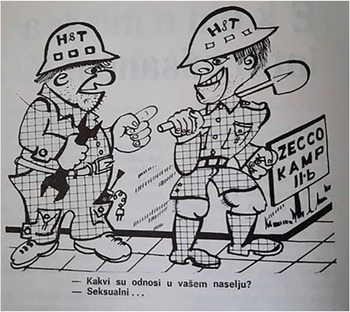
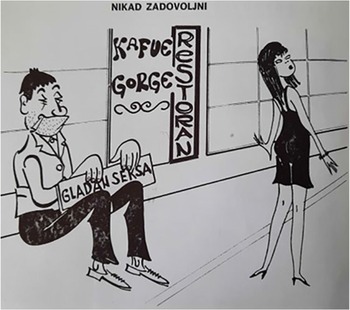
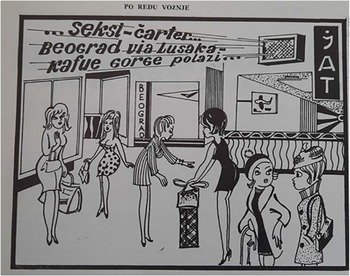
In addition to narrative accounts, documentary evidence from Energoprojekt alludes to the ubiquity of sex and sex work for young Yugoslav men. As Energoprojekt psychologist Branka Maksimović recalled, “švalerisanje [extramarital sexual relations, understood broadly] was ubiquitous” among the Yugoslav workers.Footnote 61 In the periodical of Energoprojekt most of the texts (as per similar publications from large social sector enterprises) focused on business activities, large scale projects and issues of concern to the workforce such as housing, wages, political participation, and productivity.Footnote 62 Yet, in this publication one can find consistent references to sex and sex work for Yugoslav male workers, particularly in the less formal parts of the periodical punctuated with jokes and cartoons. Figure 2, for example, depicts a cartoon of two workers in front of ZECCO Camp 2B. One asks the other “How are relations in your neighborhood” to which he responds, “sexual” (Figure 2). Figure 3, a cartoon from 1970 published in the back pages of the Energoprojekt periodical, shows a Yugoslav worker in front of a restaurant at Kafue Gorge camp holding a sign announcing that he is “hungry for sex” while a woman wearing a short skirt walks by (Figure 3). Another cartoon (Figure 4) depicts the departure gate of Belgrade Airport with young Yugoslav women in short skirts preparing to board a plane. An announcement booms from the loudspeaker: “The sexy charter flight, Belgrade via Lusaka to Kafue Gorge, is now departing.” The ideas communicated in such cartoons clearly align with a heteronormative framework that regards men as deserving of, even biologically requiring, female sexual companionship.Footnote 63 It is also significant that such cartoons were included in the official publication of the company, implying a degree of tacit approval by Energoprojekt regarding the purported sexual desires of its male workforce.
Energoprojekt, December 1970, 22.

Energoprojekt, September-October 1970, 16.

Energoprojekt, June 1971, 8.

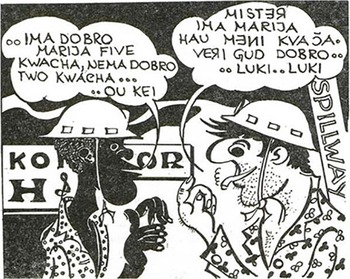
Another cartoon from Energoprojekt (Figure 5) depicts a Yugoslav worker discussing the purchase of sex from a woman called Maria through a Zambian colleague acting as an intermediary or pimp. The Yugoslav and Zambian colleagues communicate in a mix of broken Serbo-Croatian and English as they discuss the price. The publication of such a cartoon implies that such relations were sufficiently commonplace as to be recognizable to both the readership of the periodical and the editors alike. Zambian oral history narrators also suggested that their local colleagues were active in facilitating liaisons between Yugoslav men and Zambian sex workers. A former ZECCO worker recalls how “The Yugoslavs wanted to socialize with the Zambians, they would ask the Zambian foremen to take them to hotels, bars, and even ask them to find Zambian women for them.”Footnote 64 Yugoslav-Zambian socialization during the procurement of sex workers can be interpreted as an example of convergent masculinities whereby both black and white men asserted performative dominance over Zambian women, reaffirming one another’s hegemonic masculinity in the process.Footnote 65
Energoprojekt, July-August 1971, 8.

Of course, it would be inaccurate to reduce intimate relations between Yugoslav men and Zambian women to sex work, coercive, transactional sex, or domination. Mixed Zambian-Yugoslav marriages were by no means a rarity among the Yugoslav community in Zambia, and the Yugoslav party-state maintained a benevolent attitude to interracial marriage.Footnote 66 Some Yugoslav men took Zambian citizenship and considered themselves part of transnational nuclear family units, demonstrating both a political and affective commitment to the Zambian state and society. Zambian men in Yugoslavia for military training or university studies also formed durable relationships and families with Yugoslav women, some of whom would return to Zambia with them. In other instances, however, more casual relationships would lead to children being born outside of a stable partnership. Documents from the Yugoslav embassy in Lusaka point to a trend of Yugoslav labor migrants having children with Zambian women and subsequently leaving the country without providing for them financially (and thus failing to live up to the role of the “father”).
A certain amount of our people who have worked in Zambia, cohabitated with Zambian citizens. From these relationships, children were born. Our citizens then returned [to Yugoslavia] without any obligations or responsibilities towards those children. In the last year some Zambian citizens, mothers of these children, came to the Embassy with requests that we find those citizens, fathers of the children … They sought to inform those fathers that they have children and requested that they send them some material help for maintenance or the schooling of the children. Also, connected to traditional habits, that the men provide statements that they do not wish to enter marriage with the women because … only with [such a statement] could she enter into marriage with another man.Footnote 67
Casual sexual activity was often linked to issues of health as sexually transmitted diseases were endemic on construction sites. A handbook on worker health published by Energoprojekt stresses that “prostitution is extremely developed” in foreign constructions sites.Footnote 68 In the peak years of the Yugoslav presence in Zambia in the decade leading up to the HIV/AIDS epidemic, a former Energoprojekt worker who wrote a colorful memoir of company life abroad, explained that “from unprotected sex, partners would only pick up ‘the clap’ [triper, gonorrhea], or more rarely syphilis which could be successfully cured with penicillin.”Footnote 69 The first confirmed cases of HIV/AIDS in Zambia in 1985 changed the calculus and led to a greater awareness of the necessity of safer sex with condoms, abstinence, and other strategies to mitigate the risk of HIV infection.Footnote 70
Issues of health and masculinities also arose in other contexts beyond sexuality. As a country in the tropics, Zambia was affected by serious diseases such as malaria and dengue fever that Yugoslavs would not encounter at home. Recollections of battling such illnesses feature frequently in bravado-fueled recollections of adventuring in Zambia as a young man. Deployment to building sites in Zambia and elsewhere in the Global South certainly came with an increased risk to the health of the workforce. In 1973, over 100 Energoprojekt workers contracted to sites abroad were repatriated to Yugoslavia due to illness or injury sustained in the workplace.Footnote 71 This amounts to almost one in ten workers, indicating that the prospect of facing illness or injury was a perennial (and justified) issue of concern for Yugoslav workers in Zambia and elsewhere.
An even greater risk to life and limb than tropical diseases or sexually transmitted infections, however, was road accidents. In the narratives of Yugoslav workers, the purchase of their first car and macho accounts of driving in Zambia represent a leitmotiv and emerge in nearly all interviews. The owner of a private transportation company based in Zambia since 1975 recalls his first purchase upon receiving his initial monthly salary. “I got my first pay on 1 November 1975. 850 Kwacha. I went to Kitwe and from an English man there I bought an Opel Cadet, second hand, for 800 Kwacha. With the remaining 50, I lived in the YMCA for a month.”Footnote 72 Many of the personal accounts and pictures of Yugoslav labor migrants from the 1970s feature their cars prominently (Figure 6) and some even capture images of dramatic road accidents and depict the treacherous driving conditions in the African bush (Figure 7). According to Yugoslav reports, a combination of speed, bravado, poor road conditions and excessive alcohol consumption caused most road accidents. Indeed, such accidents were the most common cause of death for Yugoslav workers in Zambia.Footnote 73 In his memoir, Janeski Šarski recalls: “Our workers in Africa and in other parts of the world died most often in car accidents. So many of those who drove fast there, and usually under the influence of alcohol on unpaved side roads, would tragically finish in some canal or against a hard African tree.”Footnote 74
Car purchase in mid-1970s Zambia (Private archive of narrator “M.F.”).

The aftermath of a crash in mid-1970s Zambia (Private archive of narrator “M.F.”).

Documents from the Yugoslav embassy in Lusaka reflect upon the reasons for the many road deaths suggesting that boredom coupled with excessive alcohol consumption was chiefly to blame.
Workers came [to Zambia] mostly without their families and considering the poor cultural and leisure options, this induced them to often go out to hotels and nightclubs where alcohol is consumed. That caused overconsumption and [resulted in] accidents at work and on the roads. From 1968 to 1971, on the roads and building sites, around 40 Yugoslavs were killed. A letter from the [Zambian] Ministry of Health to our embassy stresses that Yugoslavs, of all foreigners in Zambia, were in the first position regarding deaths in the country.Footnote 75
The specter of hypermasculine behaviors like fast driving, paying for risky sex, gambling and excessive alcohol consumption are just one side of the “masculinity coin” for Yugoslav workers in Zambia. The roles of the patriarchal father and family provider, responsible worker or business owner also feature prominently. In the life course of many Yugoslav men, initial accounts of bravado as young, adventuring arrivals to Zambia are often later supplanted by a transition to becoming a more responsible family man after marriage. One narrator described how the discovery of HIV/AIDS in the 1980s caused widespread concern and coincided with his own decision to get married to a woman from his home region of Serbia. “If there was AIDS before 1980, we would not be sitting here speaking to one another. Thank the Lord.”Footnote 76 Upon marriage the narrator evidently shifted from “frajer” to father, becoming a more responsible person, and recalls these life stages openly and without shame to a foreign male researcher.
As a Yugoslav community developed, reaching its numerical peak in the early 1970s, a (hetero)normative framework for Yugoslav family life in Zambia emerged with the establishment of a Yugoslav camp in the Lusaka suburb of Lilanda, a school, and the Yugoslav club beside the embassy offering sports facilities and other family-oriented activities around which the Yugoslav community coalesced. The notion of a Yugoslav father figure, however, held weight not only in regard to individual nuclear families, kin, and regional ties that were remapped in Zambia, but vis-à-vis Zambian society more broadly.Footnote 77 This is closely related to the dominant ideological framework of how Yugoslavs conceived of their role in Zambia, which is unpacked in the next section.
The Yugoslav Father Figure: Facilitating Industry through Benevolent Paternalism
Historian of late colonial and postcolonial labor in Africa, Frederick Cooper, considers that “Colonial officials in the 1940s and early 1950s were not satisfied with the actual African men they saw in places of work; they believed that their vision of African men socialized and acculturated to the demands, rhythms, and values of industrial labor was an attainable one, but that it had yet to be achieved. Culture, not race, was the basic problem.”Footnote 78 This culturally framed understanding remained salient for Cold War-era east European involvement in Africa and Yugoslavia, and was no exception in engaging in what James Mark terms a “paternalistic vision of a socialist civilizing mission to aid benighted African blacks stuck in backwardness.”Footnote 79
Yugoslav authorities were committed to instilling industrial culture both at home and abroad in non-aligned allies like Zambia, informed by the tenets of workerist socialist self-management. They often invoked their own relatively recent experience of the industrialization of a largely peasant society that could be emulated in Zambia through collaboration and the transfer of practical skills.Footnote 80 Unlike the British specialists of labor that Cooper refers to, Yugoslavs gave great importance to taking account of the exploitative nature of the colonial experience and approaching the unique contexts of African societies analytically but with empathy. Through collaboration and mentorship, Zambians were expected to be transformed into an industrial workforce analogous to the newly urbanized and industrialized segments of the Yugoslav peasantry after World War II. As Radovan Dimitrijević, an Energoprojekt construction worker tasked with setting up a camp in a remote area of Zambia, recalled upon encountering the local people for the first time, “I am from a peasant family myself. I understood them well and I helped them.”Footnote 81
Ljubiša Krstić, a skilled plumber working in Zambia, stated in an interview for the Energoprojekt periodical: “we know so much about the history of this part of Africa that we can now understand them. If we do not teach them the work, we will fail in our mission [sic.], that cannot be allowed.”Footnote 82 A Belgrade radio program featuring Energoprojekt leaders indicates this analytical empathy succinctly. Director Dimitrije Gončarov stressed how before the company entered a market, “I explore the history, religion, traditions, social and political conditions, and in the colonial context, what the former colonial powers in the past did to impact the economic outlook of those countries.” Gončarov also emphasized the need for closeness as a means to bridge possible distrust. “For small and large achievements in those countries it is necessary to have much love, understanding and special enthusiasm. Those are all qualities and strengths that our people [Yugoslavs] possess.”Footnote 83 Engineer Slavko Štrbac, taking stock of Energoprojekt’s work in Kafue Gorge seven or eight years prior, recalls Yugoslavs and Zambians working closely together and Zambians developing as workers.
Together with our construction sites, the Zambian worker progressed, learned how to mine, concrete, build, to handle machines, drive trucks, to lead other Zambian workers. I met them on the building site, shoulder to shoulder with our workers. They greeted each other like people who were aware of their new skill and new values, they waved to me from high cabins of bulldozers, heavy trucks and cranes. We sat in our restaurant together, we even ate Yugoslav food … and due to mutual weak knowledge of English [… we] communicated in a happy mix of Serbo-Croatian, English and Nyanja languages.Footnote 84
A young Yugoslav architect, Ivan Petrović, the leader of a building site in Kitwe, confidently maintained to the Energoprojekt periodical that “Zambians as workers learned the most from Yugoslav instructors. In comparison with instructors from other countries, ours have more patience and persistence (upornost), they succeed in getting closer to the Zambian man so that he, through working together, gives more.”Footnote 85
Reflecting on racialized imaginaries on Yugoslav construction sites in Zambia, Goran Musić stresses that Yugoslavs presented themselves as “benevolent, socialist modernizers in the Global South” and distanced themselves clearly from the “whiteness” of western colonizers.Footnote 86 Though the Yugoslavs presented Zambia through Orientalizing cliches, they did not perceive Zambians as passive actors but rather as individuals who could transform into “modern people” through industrial labor.Footnote 87 Yugoslav men remain attached to the idea that their workforce instilled a variety of skills among Zambians, some of whom were transformed into modern workers due to the hands-on experience of working alongside Yugoslavs. One narrator, the owner of a transport company, claims that around a thousand Zambians learned from him and his firm over the years working as drivers and mechanics and look at Yugoslavia in positive terms due to this experience. “They adored us because we looked at them as equals, not like other people and nations did. There was racial discrimination [from others] but we looked at them like we were equals. They really respected that. They socialized with us a lot and learned a lot from us. Many Zambians learned our language very well.”Footnote 88 Narratives like those of “M.G.” demonstrate that the understanding of Yugoslavia as a benevolent, socialist modernizer was shared not only by skilled workers and managers in firms like Energoprojekt, but was also salient among ordinary Yugoslav workers and their families. Such a view is also shared by many Zambians who worked alongside Yugoslavs, as the next and section of the article demonstrates.
Zambian Memories of their Male Yugoslav Colleagues
While there are ample columns extolling the virtues of Tito’s self-managing socialism and Yugoslav engagement with Zambia in newspapers like the Times of Zambia and Daily Mail of Zambia, what is perhaps more illuminating are oral history interviews with Zambians who had lived experience of working alongside Yugoslavs. Sets of interviews conducted by Zambian research assistants in English and town-Nyanja, without the presence of Yugoslav-associated researchers, offer some valuable insights.Footnote 89 Tropes that emerge consistently cohere with the dominant Yugoslav self-perceptions of the day. Yugoslavs, compared to other Europeans, treated Zambians more as equals and tended to be patient and forgiving trainers and colleagues, and are remembered fondly. While a close reading of Yugoslav sources does reveal routinely patronizing and prejudiced attitudes towards societies in the Global South in general, and Zambia in particular, this pales in comparison to the virulently racist views in circulation in British diplomatic sources, for example. Concluding a diplomatic report on Zambia in 1970, in which the activities of Yugoslavia feature prominently, J. L. Pumphrey of the British High Commission in Lusaka describes the Zambian people as “still in general indolent, ignorant, drunken, xenophobic, fractious and irresponsible.”Footnote 90
“M.P.,” a former worker at the joint venture company ZECCO, born in 1955, had worked with British and Italians firms before starting work alongside Yugoslavs. He recalls, “compared to other Europeans, Yugoslavians were the best because I also worked with the British and Italians. They [Yugoslavs] would correct you nicely without yelling or embarrassing you.”Footnote 91 He stressed that he was thankful that Yugoslavs “did not segregate anyone” and through ZECCO, they taught him a lot of skills in the workplace even though he had not completed primary education. Referring to the kind of pedagogy practiced at his workplace, he recalls how Yugoslavs at ZECCO would regularly dismantle new machines, engines for example, to teach the Zambian employees how it worked. According to “M.P.,” the result was that ZECCO workers were more skilled than employees at similar firms and could easily find decent work elsewhere by applying their Yugoslav imparted “know how” at future workplaces. Furthermore, Yugoslavs were considered fairer, more empathetic colleagues, and superiors than any other Europeans. “M.P.” recalls in another anecdote how ZECCO had built frames for the Kafue bridge. During construction, one of the frames fell in the river almost killing nine people. As the frame could not be retrieved, the workers, who had narrowly escaped death, were now worried they would be fired for causing the accident. Instead, “M.P.” recalls that the Yugoslav bosses comforted these workers and assured them they would not be blamed for the incident.Footnote 92
“M.P.” also recalls that his Yugoslav colleagues were very sociable and would encourage their Zambian colleagues show them around town in the evening. Another Zambian former worker with ZECCO, “C.T.,” also emphasizes Yugoslav sociability, recalling that Yugoslavs were “very social and they learnt to speak a bit of Nyanja. They could not speak English so they would sometimes speak through another person. The Yugoslavs would even sing a vernacular song popularized by Kenneth Kaunda called Tiyende Pamodzi (Let’s go Together).”Footnote 93 The song called on Zambians and other Africans to march together to liberate southern Africa. As well as being gregarious according to dominant social norms like singing regime-approved songs, narrators also recall some Yugoslavs being heavy drinkers, living the high life in Lusaka’s luxury hotels and asking the Zambian foremen on construction sites to facilitate liaisons with local sex workers.Footnote 94 Yet it is the memories of Yugoslavs as benevolent leaders in the workplace that appears to be most enduring.
“C.T.” adds, like his former colleague “M.P.,” that ZECCO was better than other companies because of the way they trained workers. “They would teach people skills like bricklaying, carpentry, joinery, driving and they would get licenses after learning… . Yugoslavs were very hardworking and experts at what they did. They were not jealous, but they wanted to teach people skills. These skills helped people become bosses at other companies.”Footnote 95 Not all Zambians hold the view that Yugoslav efforts in the workplace were always effective, however. “R.M.,” who worked as an engineer at ZECCO, believes that while Yugoslavs were “hard workers,” their “systems were poor, especially financial systems, very poor. I think that prompted the government to bring in ZIMCO [another parastatal company] to try and introduce systems, financial systems. Sometimes the contracts manager would not know what he was doing.”Footnote 96 Despite his view that Yugoslav financial management was not the most adept, “R.M.” nevertheless considered that Yugoslavs were “very welcome in Zambia.” He was aware of the support given for the Zambian military, air force, and in development, and that at the same time, the “British were looking down at them suspiciously, as Yugoslavia was a communist country … Yugoslavs were giving aid to Third World.”Footnote 97
“C.M.,” formerly an accounts worker in the head office of the parastatal bus company, United Bus Company of Zambia, also worked alongside Yugoslavs. She maintains very positive memories of her Yugoslav colleagues.
They were very friendly people in the workplace. [You] never feel bullied, or as an African [put down in some way] … You are working together; they are molding you … we don’t even know what the benefit was [for them] … but it was like they were just giving it. Yes, the general picture you had of a Yugoslavian, is not that one where … there is intimidation … You had this unity with them, you were intertwined, not separated… . It is a pity they disappeared just like that, they were very good people, it is a good country.Footnote 98
Like other Zambian workers who had experienced working alongside Yugoslavs in the 1970s, “C.M.” emphasizes the sense of unity that Yugoslav labor migrants sought to foster, observing, in a positive sense, that Yugoslavs were “molding you.” She was uncertain as to the benefit Yugoslavs had from training Zambians who would later work for, and lead, Zambian firms according to the policy of Zambianization.
This article has stressed the utility of applying social historical research of state socialist engagement in postcolonial Africa through the example of Yugoslav men and masculinities in newly independent Zambia. This empirically driven perspective informs upon gendered aspects of postcolonial solidarities by centering masculinities as an analytical lens. It is an attempt to move debate beyond a facile emphasis on the performative and symbolic aspects of Yugoslav postcolonial and non-aligned solidarities. This approach simultaneously seeks to transcend epistemologies that interpret solidarity with decolonizing countries in the Global South as a priori emancipatory and transformative, without ever looking seriously at the domain of the everyday experiences of the protagonists involved.
Ultimately, socialist Yugoslav masculinities were complicated by the experience of labor migration in Zambia. In a liminal space like newly independent Zambia, Yugoslav men occupied flexible, context-dependent positions. They would in some instances enthusiastically experience life in Zambia as hedonistic white Europeans, demonstrating hypermasculine behaviors out of sync with the normative political values of the day. On other occasions, however, they could understand their role as a responsible ally of Zambia, informed by benevolent though paternalistic notions that Yugoslavs were capable of interacting with Zambian colleagues and friends with more empathy, understanding, and solidarity than European counterparts, both from capitalist liberal democracies and the socialist bloc. Zambians who worked alongside Yugoslavs in turn tend to reflect these ambivalent and sometimes contradictory positionings. They remember Yugoslav men as often being hedonistic—heavy drinkers, fast drivers, gamblers, and womanizers—but also as allies who shared many of their political beliefs and demonstrated a greater degree of empathy and solidarity, both at work and at leisure, than other Europeans for reasons that, upon reflection, are still not entirely clear to them.
With the scholarship of socialist Yugoslav masculinities still rather patchy and virtually absent in the postcolonial African migration context, this contribution has attempted to draw upon vernacular understandings of hegemonizing themes of masculinities that can help in understanding the often-contradictory roles and behavior of Yugoslav male labor migrants in Zambia during the peak of Yugoslav engagement in the 1970s. The modes of “frajer” and “father,” understood as a flexible continuum, is a productive way to move away from binary thinking of Yugoslav men as either occupying a definitively non-aligned, socialist, anti-racist position or alternatively, one in which they draw upon the privilege associated with their position as affluent white men in postcolonial Africa. Values and attitudes with their origins in modernistic Yugoslav self-managing socialism and moral economies based on kinship, mutual aid, and community loyalty could coalesce with the legacies of postcolonial prestige and become reimagined and reframed in the context of labor migration in Zambia.
While race was just one structural factor conditioning Yugoslav-Zambian relations, it has been an extremely salient one. Zambians racialized Yugoslavs as white Europeans and the novel experience of living in a majority black African society necessarily induced Yugoslavs to think racially. Perhaps the most important way that the racialization of Yugoslavs manifested was based on the perennial comparisons made by Zambians between their white Yugoslav allies and the former British colonial rulers and the dwindling but influential postcolonial white Zambian elite which was perceived as an adversary in the context of decolonization. Yugoslavs and Zambians alike considered Yugoslavs to be a “different kind of white.”
Rory Archer is a social historian of the Balkans whose research focuses on socialism, gender, labor, migration, and everyday life in twentieth century Yugoslavia. He currently works as a researcher at the University of Ljubljana, Slovenia, and lectures at the University of Graz, Austria. Research for this article was undertaken while working at the University of Vienna (2022–25).




 Open access

