


In September 1888, William Westgarth, the owner and manager of the London Stock Exchange brokerage firm W. Westgarth and Co. that specialized in colonial bonds arrived in Auckland, New Zealand. This was the beginning of a “road show” that took him through British Australasian possessions, where he met with local government treasurers, and ended in London with a crowded meeting at the Royal Colonial Institute. The motive was a wide-sweeping reorganization of colonial borrowing on the London Stock Exchange. Westgarth's main insight was that the regard London investors had for colonies credit was already “high,” but that colonial bonds liquidity was desperately “dry.” As a result, colonies paid too much to borrow, contrasting with sovereign borrowers such as Turkey, which had not such a good credit but highly liquid bonds.
The problem identified by Westgarth seems merely technical. However, his solution “to consolidate all [Australian] debts into one uniform stock” issued by a politically unified Australian Federation that included New Zealand involved nothing short of a reshuffle of imperial architecture.Footnote 1 The reward from such an institutional transformation would have been large. According to his counterfactual estimate (Figure 1), the price of the newly-created perpetual 3 percent Australasian bond would have been between 11 percent (New South Wales) and 25 percent (New Zealand) higher than that similar 3 percent loans issued independently by the individual colonies. Expressed otherwise, this would have amounted to a reduction of borrowing costs from 33 to 75 basis points.Footnote 2
WESTGARTH'S TABLE OF COLONIAL 3 PERCENT BOND PRICES UNDER ALTERNATIVE COUNTERFACTUALS (PRICE IN POUND STERLING FOR A £100 NOMINAL BOND)

Westgarth was not the only contemporary observer to see a direct link between colonial illiquidity and the grander question of the design of empire. In 1895, a few years after Westgarth's proposals, the newly appointed Colonial Secretary, Joseph Chamberlain, took up Westgarth's idea and suggested the launch of a “Colonial Consol,” in essence a fund which would borrow and then re-lend to colonies.Footnote 3 Chamberlain speculated that the Colonial Consol would secure terms as good as those enjoyed by the British Consol since the two bonds would be equally liquid. The proposal was opposed by the Treasury Secretary, Edward Hamilton, and eventually shelved (although a variant of it re-emerged in 1899 to assist Crown colonies borrowing, known as the Colonial Loan Act) because Hamilton was wary that the arrangement would encourage colonies to take up too much debt.Footnote 4
The question of liquidity has been ignored in existing research on foreign and colonial debt, despite Charles Goodhart's warning that early twentieth century British bankers worried that colonial bonds might have lacked “marketability” (Goodhart Reference Goodhart1972, p. 132). Grand narratives of empire are silent on the subject. Peter Cain and Anthony Hopkins (Reference Cain and Hopkins2001) emphasize the City's concern with credit but ignore liquidity. Lance Davis and Robert Huttenback (Reference Davis and Huttenback1986) quantitative study does the same. Ron Alquist (Reference Alquist2010) focuses on the question of liquidity in the late nineteenth century and early twentieth century but he claims that liquidity did not matter for colonial bonds because, he suggests, political subjection would have made those bonds “immune” to liquidity shocks (Alquist Reference Alquist2010, p. 220).
Although neglected in research on empire, liquidity has received substantial attention with the subprime and Eurozone crises after 2007. Modern policy makers are well aware of the economic importance of liquidity, while economists have become sensitive to the methodological challenges involved in separating liquidity and credit premia. We argue that the context of empire is particularly apt to solve the conundrum. The bonds of British colonies were (implicitly) backed by their “parent” government and thus faced negligible credit risk. This means that colonial spreads might largely have reflected a pure liquidity risk (Accominotti, Flandreau, and Rezzik Reference Accominotti, Flandreau and Rezzik2011).Footnote 5
To test this hypothesis, we develop a framework that permits us to separate liquidity from credit. First we show how the framework of the existing macro-financial history literature can be adapted to deal with liquidity. Second, we show how an indicator of liquidity (or rather illiquidity) can be inferred from London market's official price list. This list was known at the beginning of our period as the London Daily Stock and Share List and after 1899 as the London Stock Exchange Daily Official List. We refer to it from now on as the Official List. Third, we construct a database for secondary market prices and the indicator of (il)liquidity for all bonds issued by sovereign and colonial borrowers reported in the Official List for the period 1872–1909. As a result, we can demonstrate quantitatively the importance of liquidity in the market for colonial debts, and explain why it became a source of political concern.
MODELLING LIQUIDITY
Modern asset pricing literature has accumulated comprehensive evidence on the role of liquidity in asset prices, especially for U.S. Treasuries. Yakov Amihud and Haim Mendelson (Reference Amihud and Mendelson1986) first defined asset liquidity as the costs of immediate execution incurred by an investor. In practice, executing transactions requires resorting to a broker. Thus, an asset's liquidity is best captured by its bid-ask spread, that is, the difference between the price at which a broker accepts to buy the asset from the seller and the one at which he sells it to a buyer. Transaction costs mechanically diminish the investor's expected return. Thus, investors should be compensated by earning higher yields from less liquid assets. Amihud and Mendelson (Reference Amihud and Mendelson1991) confirm that U.S. Treasury bills with higher bid-ask spreads have higher expected returns.Footnote 6 Identifying liquidity effects in bond markets where both credit risk and illiquidity are present has proved more challenging, as exemplified by the inconclusive literature on Eurozone government spreads.Footnote 7
One reason is that the standard measure of bond illiquidity—the bid-ask spread—may in some circumstances be observationally correlated with credit risk because the bid-ask spread not only compensates the broker for the cost of processing orders, but also for “inventory” costs (holding a sub-optimal portfolio of bonds while waiting for a buyer) and “adverse selection” costs (transacting with a party better informed about the true value of the asset) (Stoll Reference Stoll1989). In a sovereign debt crisis for instance, a broker finds fewer buyers, leading the bid-ask spread to increase as liquidity deteriorates. Simultaneously however, both the broker's cost of holding to a portfolio of sovereign bonds (or the average duration thereof) and the risk of dealing with a better-informed counterparty increase as well. Brokers may thus widen bid-ask spreads to deter trading in questionable sovereigns, generating a spurious correlation between liquidity and credit risk. This does not mean that the bid-ask spread is not the best available proxy for bond liquidity, but it is a reminder that one needs to control for both credit risk and liquidity risk when regressing bond yields on bid-ask spreads.
MACRO-ECONOMETRIC LITERATURE ON GOVERNMENT BOND SPREADS IN THE LATE NINETEENTH CENTURY
The modern literature on pre-1914 government bond spreads has focused on two aspects of the determination of government borrowing spreads. First, research has sought to determine which variables affected credit risk. This literature uses panel or cross-section analyses to identify the effects of alternative candidates such as debt, fiscal policy, or monetary policy.Footnote 8 The upshot of this literature, as distilled for instance in Marc Flandreau and Frédéric Zumer (Reference Flandreau and Zumer2004) is that government credit risk is well proxied by credit variables such as the debt burden. Second, a separate question is that of the relation between credit risk and empire. Davis and Huttenback (1986, p. 171) suggested that imperial subjection had a “favorable” effect on colonial borrowing costs (it reduced them) and they sought to construct a measure of this effect by matching similarly developed sovereign and empire countries and comparing borrowing costs. Subsequent analyses of the empire effect included empire as treatment (Obstfeld and Taylor (Reference Obstfeld and Taylor2003); Ferguson and Schularick (Reference Ferguson and Schularick2006)). As shown in Olivier Accominotti, Marc Flandreau, and Riad Rezzik (Reference Accominotti, Flandreau and Rezzik2011), they are severely biased by model mis-specification, because if investors looked at empire as a credit risk-reducing technology, similar changes in variables affecting credit risk did not have the same effect for colonies and sovereigns. A British investor believing that Britain stands by its colony will not be as wary of a drift in the government debt of New Zealand as he or she would be of the same taking place in Argentina. Therefore, in order to price the risk of colonial bonds, investors had just to turn to the risk of the metropolitan government, as opposed to investigating local factors (Flandreau Reference Flandreau2006).
In summary one should never pool colonies and sovereigns in the same model unless different sensitivities to fundamentals are allowed. This leads us to the following workhorse model where the borrowing cost (yield spread) of country c in year t is explained as a function of a set of fundamentals Xc,t . The model allows for different sensitivities depending on whether the country is a colonial subject or not. This specification is shown in equation 1 (Yieldc,t is the yield on one representative bond issued by country c and YieldUK,t is the yield on the British Consol, the British benchmark long-term bond):

Liquidity in Panel Regressions
Equation (1) can be expanded to deal with liquidity effects. Formally the equation we consider is the following:

This model contains two main innovations. First, it considers the entire set of securities (indexed by i) issued by each country, rather than one unique bond per country. The reason for our choice is that liquidity is predominantly an asset-specific factor, so that averaging out bonds or picking a benchmark security entails erasing relevant information.Footnote 9 The second innovation allows colonial spreads to react differently to credit risk (as recommended by Accominotti, Flandreau, and Rezzik (Reference Accominotti, Flandreau and Rezzik2011)) and also to liquidity. There are theoretical and historical motivations for this choice. While implicit metropolitan guarantee eliminated information asymmetries in the colonial market, such asymmetries persisted in the sovereign debt market, resulting in segmentation, as reflected in different types of intermediaries (underwriters) and bond clienteles.Footnote 10 Different underwriting techniques may have led to different levels of bond liquidity, while different clienteles may also have had different preferences for bond liquidity. Thus, this second innovation allows us to capture segmentation—the likely effect of institutional heterogeneity on information asymmetries and investors characteristics.
MEASURING LIQUIDITY
Modern research emphasizes the so-called relative bid-ask spread as the preferred proxy for the liquidity of a bond i at time t (Fleming Reference Fleming2003). It is the ratio between the bid-ask spread and the bond price:

Operationalizing bid-ask spreads historically is not straightforward. At first sight, something similar does exist for the historical context under study. Informed contemporary sources emphasize the significance of what they describe as the “dealer's (or jobber's) turn” in effect the spread between a broker's buying and selling prices (Westgarth Reference Westgarth1889a, p. 250). However, to date, there is no evidence of the dealer's turn having been recorded.
What does exist, however, is a different concept which has been mistaken for a bid-ask price.Footnote 11 The “Official List” does provide so-called “closing quotations” in the shape of an interval (e.g., “90–91” or “66–68”). But the closing quotations bracket was not the dealer's turn. Rather it reflected a loosely defined trading range as certified by the authority printing the Official List. Contemporary experts explicitly stated that the closing quotations were not to be confused with true dealer's turns. Charles Duguid (Reference Duguid1905) emphasizes this and states that buying and selling could occur at prices substantially within those posted in the (sometimes extremely large) “closing” bracket. Likewise, George Clare (Reference Clare1898, p. 5) writes that the closing quotation “is frequently quite nominal and only to be looked upon as an expert's opinion of the price at which business might perhaps be done” and adds that anyone concerned with getting a given valuation right (such as trustees involved in assessing the value of an estate for probing inventories) should “not […] trust the [closing prices bracket in the] List quotation, but seek the advice of a broker or other expert.”
Contemporary testimony suggests that, while the closing quotations were not a bid-ask spread, they did contain valuable information regarding liquidity. For instance, Duguid (Reference Duguid1905, pp. 65–66) claims that “the width of the [closing quotations] margin” enabled investors “to form an idea of the condition of the market” for a given security. He notices that “[brackets for the] quotations of securities which are very actively dealt in are narrow, whilst those of the out-of-the-way securities are wide. It is naturally the case that the [price brackets] of stocks which, because of the limited market, cannot easily be bought or sold, are less favorable, or wider, than the prices of those in which the market is free.” Further, he suggests that the time series behavior of the closing quotations could be informative too, because in periods of “nervousness or panic” intermediaries were reluctant to commit to “deal except at a wide margin” and this was reflected in wider closing quotations. In other words, the closing quotations may not be the dealer's turn, but they may correlate with liquidity.
It is in fact possible to test this claim. We cannot observe the “true” bid-ask spread, but we can examine whether the size of closing quotations does correlate with recognized correlates of liquidity. According to the modern literature, these correlates chiefly consist in the volume of the issue, trading activity and age (because bonds closer to issuance have fewer buy-and-hold investors and are traded more actively).Footnote 12 We sorted colonial and sovereign bonds at each point in time into five portfolios according to the size of the closing quotations bracket and then report the group average for four variables available in our data and close to the modern correlates of liquidity: (1) Volume, (2) % Non-Zero (a variable that reflects whether reported closing prices did exhibit changes compared to previous month), (3) % Business Done (which takes value one if there is evidence of transactions in the “business done” column, and thus captures more active trading/reporting), and finally, (4) Age, the age of the security issue in years. Closing quotations brackets, loan volumes, evidence of trading activity, and bond age have been hand-collected from the Official List. Under the assumption that the closing quotations bracket is truly informative of underlying liquidity, we should observe that bonds with smaller brackets (more liquid bonds) tend to be associated with larger issues, more frequent changes of closing prices, more frequent evidence of activity (“business done”) and younger issues.
The results in Table 1a strongly support the hypothesis that closing quotations brackets have informational value for liquidity (especially clear in the case of colonials). Bonds with higher liquidity (lower closing price bracket) tend to exhibit a larger volume, more frequent closing price updates, greater evidence of business done and are also younger. Consider the group of colonial securities with the largest brackets (by assumption, the most “illiquid” ones): for this category, the incidence of business done reports is only 20 percent but it rises gradually to 46 percent for the securities with the lowest closing quotations brackets (the most “liquid” ones). There is therefore a tight correspondence between the information in the closing quotations bracket and extraneous measures of market liquidity. Table 1b provides a matrix of covariance between the liquidity indicator (closing quotations) and alternative measures of liquidity, further supporting our claims. In other words, closing quotations are not bid-ask spreads but they are an indicator of liquidity. Therefore, we will rely on closing quotations as our individual asset-specific liquidity indicator. Note that by construction, a larger indicator means a less liquid security, because it is associated with a wider bracket of the closing quotation.Footnote 13
BOND CHARACTERISTICS, BY CLOSING QUOTATIONS SORTED PORTFOLIOS

Notes: This table shows mean characteristics of colonial (top panel) and sovereign bonds (bottom panel). Characteristics are averaged in five portfolios assembled at the beginning of each year depending on a bond's closing quotations. Liquid and Illiquid are the portfolios with lowest and highest closing quotations, respectively. Illiq−Liq corresponds to the difference between these two portfolios. Yield is the coupon-price ratio, in percentage. Closing Quot. is the difference between high and low closing prices. Volume is the bond's initial issue size, in pounds. Non-Zero is one if the bond price changed between t and t-1, and zero otherwise. Done is one if the “business done” column shows trading activity, and zero otherwise. Age is the time elapsed since bond issue, in years.
Source: Authors' calculations based on the Official List and Burdett's (various issues).
CORRELATIONS BETWEEN EXPLANATORY VARIABLES

Notes: This table shows pairwise correlations between characteristics of colonial (top panel) and sovereign bonds (bottom panel). Closing Quot. is the difference between high and low closing prices. Volume is the bond's initial issue size, in pounds. Non-Zero is one if the bond price changed between t and t-1, and zero otherwise. Done is one if the “business done” column indicates some trading activity, and zero otherwise. Age is the time elapsed since bond issue, in years.
Sources: Authors' calculations based on the Official List and Burdett's (various issues).
The Liquidity of Government Debt: Statistical Features
In Figure 2 we show the distribution of our liquidity indicator for alternative groups of securities during the period 1872 to 1909 (see Appendix 1 in the Online Appendix for the behavior of the indicator for individual countries). Figure 2 follows the presentation of bond prices in the Official List. The left panel shows the distribution for securities listed under the “British Stocks” entry (typically Consols and British-guaranteed bonds such as the securities of India). The center panel shows the distribution for securities under “Colonial Stocks.” The right panel shows the distribution for securities under “Foreign Stocks” (non-colonial foreign government debt). The general message is that British bonds tended to be more liquid (they concentrated in the high liquidity bracket) than both colonial and sovereign bonds. Within British bonds (where the Consol reigned supreme as the most liquid investment), indicators clustered around 0.125, 0.25, and 0.5 percent. In contrast, liquidity indicators for colonials and sovereigns hovered around 2 percent.
DISTRIBUTION OF LIQUIDITY INDICATORS (RATIO OF CLOSING QUOTATIONS BRACKET TO BOND PRICE)

We plotted indices of average liquidity of colonial and sovereign securities over time in Figure 3. This is only a heuristic exercise because the composition of the indicator changes as new bonds are issued and old ones retired, and no effort is made to control for those changes. Accordingly, one should not try to read anything in the long run trends; however, over the short run, because the composition of the indicators changes little, the indicators provide valuable information. As an eyeball test shows, correlation between the colonial and sovereign indicators is positive, but far from perfect and the two indices exhibit occasional “de-coupling,” that is, they suddenly diverge from their previous apparent pattern of correlation. Characteristically, this happened in episodes of market turbulences, such as during the Egyptian debt crisis of 1876 or the “Baring crisis” in 1890 (Argentina's default in 1889 and the failure of the House of Barings). We see that in both cases the liquidity indicator for sovereigns shot up, not so for colonials. This is consistent with the fact that during episodes of sovereign default, brokers in foreign debt markets reacted strongly to the risk of adverse selection. But brokers in colonial debt knew that the instruments they dealt in were immune from default.
MEAN LIQUIDITY INDICATOR (RATIO OF CLOSING QUOTATIONS BRACKET TO BOND PRICE)

This does not mean that colonies were simply insulated from the shocks affecting the liquidity of bond markets in general. Rather, the evidence suggests that they could be subjected to their own turbulences. This is quite visible during the banking crisis of 1878, when a scramble for liquid assets by British banks took place (Collins Reference Collins1989). One should expect that the demand for safe but illiquid instruments (such as colonial debts) prompted leading dealers in colonial debt markets to protect themselves from the consequences of this scramble for liquidity by increasing spreads just as seen. As Figure 3 shows, this widening of spreads affected colonials, but not sovereigns. We interpret this as reinforcing our argument that colonial and sovereign markets were segmented.
CREDIT, LIQUIDITY AND THE YIELD ON GOVERNMENT BONDS: EMPIRICAL EVIDENCE
Baseline Estimates
We now use equation 2, the benchmark model, to study the effect of our illiquidity indicator on individual yields. Our prior is that illiquidity was priced, less liquid bonds commanding a higher yield. Yield spreads were hand-collected from the Official List. Illiquidity is computed as the closing quotations bracket divided by the price (itself proxied by the average between the upper and lower bracket). Credit Risk is the classic debt service ratio extensively used in the literature, taken from Flandreau and Zumer (Reference Flandreau and Zumer2004). Volume and Age were collected from the Official List as described previously. (Online Appendix 2 contains further details on sample, data, and sources). To prevent abnormal observations from driving results, observations during a time when a country is in default were excluded from the benchmark regression.
The results from estimation of different variants of equation 2 are shown in Table 2.Footnote 14 To better identify the contribution of the different variables, we first estimate minimalistic variants. We start with a model that only includes liquidity, credit as well as an issuer-fixed effect, which we run separately for colonial and sovereign issuers (results given in columns 1 and 2). Liquidity and credit are correctly signed for both groups, with higher illiquidity and credit risk being associated with higher yield spreads. However, liquidity is only significant for colonials: In this market, investors demand a positive premium for holding illiquid bonds because of their higher transaction costs (Amihud and Mendelson Reference Amihud and Mendelson1986). Point estimates suggest that a one basis point deterioration of liquidity results in a 0.127 basis point increase in spreads. Alternatively, a one-standard deviation change in the liquidity indicator (2.74 basis points) would result in a 0.35 basis point increase in spreads. This is a substantial change, amounting to 26 percent of the average colonial yield spread (1.35 percent). In other words, liquidity matters a great deal. To enable us to assess the overall explanatory power of liquidity, columns 3 and 4 show the results from a regression of spreads on liquidity alone. At 22 percent, the R 2 of this liquidity-only model for colonial spreads is larger than that found in modern studies.Footnote 15 Another suggestive result can be seen by comparing columns 1 and 3: the point estimate of liquidity remains remarkably stable for colonials regardless of whether credit risk is controlled for, indicating negligible contamination through multi-collinearity. The opposite holds for sovereigns, comparing columns 2 and 4. This is consistent with the fact that dealers reacted to an increase in sovereign credit risk by posting larger “turns” reflected in wider closing quotations.
YIELD SPREADS, LIQUIDITY AND CREDIT: PANEL EVIDENCE

∗ = Significant at the 10 percent level.
∗∗ = Significant at the 5 percent level.
∗∗∗ = Significant at the 1 percent level.
Notes: This table shows results of an OLS regression of bond yield spreads against different sets of explanatory variables and using different samples for the 1880–1909 period (yearly frequency). Columns 1 and 3 use colonial bonds only. Columns 2 and 4 use sovereign bonds only. Columns 5 and 6 use the entire sample. Yields are measured as coupon-price ratio in excess of the yield on the benchmark British Consol. Illiquidity is measured by the ratio of closing quotations bracket to bond price. Credit Risk is measured by the debt service-to-revenues ratio. Volume is the bond's initial issue size, in pounds. Age is the time elapsed since bond issue, in log years. All regressions feature bond-level clustered standard errors. Illiquidity if Colony and the respective standard errors add the Liquidity and Illiquidity x Colony parameter estimates and test the hypothesis that the sum is zero. Credit Risk if Colony, Volume if Colony and Age if Colony are defined analogously.
Source: Author's database as collected from the Official List.
In columns 5 and 6, we report estimates pooling colonials and sovereigns, but allowing for different sensitivity of yield spreads to credit and liquidity, respectively. Column 5 reports results for the stripped-down model while column 6 includes the bond's current volume and age, the latter a proxy for time-to-maturity.Footnote 16 To facilitate comparison between sovereign and colonial elasticities, the bottom of the regression tables reports the sensitivity of spreads to credit and liquidity for colonies.Footnote 17 As in Accominotti, Flandreau, and Rezzik (Reference Accominotti, Flandreau and Rezzik2011), being a colony resulted in considerably lower sensitivity of interest spreads to credit. The colonial parameter is only 0.29 (column 5) or 0.49 (column 6) compared to 4.04 and 3.43 for sovereigns, a 20 and 10-fold difference, respectively.
As in columns 2 and 4, liquidity for sovereigns is insignificant in column 5 (but it is significant in columns 6). However, a formal test shows that the size of liquidity premia may not have been significantly different in the two markets (Colony x Illiquidity is not statistically significant in both columns 5 and 6); but the conclusion still remains that liquidity premia were unambiguously significant for colonials only. Results in column 6 show that this conclusion survives the introduction of additional explanatory variables (bond age and volume), which may be correlated with liquidity (as noted earlier). Bond age and volume are significant for colonies only. Older and smaller bonds bear higher yield spreads, credit and liquidity being equal, but these effects are muted for sovereign bonds. However, other results remain qualitatively similar.Footnote 18
Finally, using results from the regression in column 1 of Table 2, we document in Table 3 the economic significance of colonial liquidity premia. Column 1 gives the average yield spread (over the British Consol) of the individual colonies. Columns 2 and 3 report each colony's average liquidity premium in basis points and percentage of mean yield spreads, respectively.Footnote 19 The contributions of liquidity premia are always very large—peaking at 39 percent for South Australia. Excluding Egypt (a largely sovereign part of the Ottoman Empire that became a British colony), liquidity explains 19.6 percent of yield spreads for the average colony. Column 4 gauges the economic importance of liquidity premia from the vantage point of colonial treasurers. Results show that liquidity premia translate into 5 percent of yearly fiscal expenses for the average colony (ex-Egypt). The number is always equal to or larger than 2 percent, and peaks above 10 percent (13.1 percent for South Australia). Although the exercise is illustrative only because the secondary market yield and liquidity premia used here may not correspond one-to-one to the primary market costs faced by colonial treasurers, estimates do suggest that the problem of colonial liquidity was material. They also rationalize why liquidity became an important political issue.
ECONOMIC IMPORTANCE OF COLONIAL LIQUIDITY PREMIA
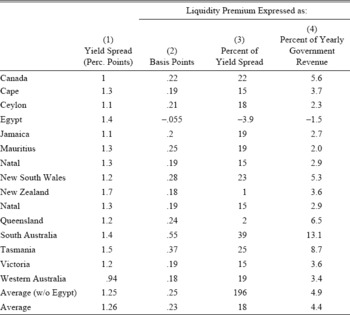
Notes: This table shows the mean colonial bond yield (coupon-price ratio, column 1) and estimates of liquidity premia for colonies (columns 2 to 4). Premia are calculated by multiplying the parameter estimates from an OLS regression of colonial yield spreads on an indicator of illiquidity (ratio of closing quotations spread to bond price) for the 1880–1909 period (yearly frequency) with each colony's mean liquidity indicator during the same period. In column 2, the premium is expressed in basis points. In column 3, the premium is expressed as percentage of the mean yield (column 1). In column 4, the premium is expressed as percentage of government revenue (as collected from Flandreau and Zumer (Reference Flandreau and Zumer2004)). Specifically, we multiply the ratio of interest service expenses to total government expenses with the ratio of liquidity premium to total yield (column 3).
Source: Author's database as collected from the Official List.
Robustness
We now perform a number of robustness checks to ensure that our measurement of the effect of liquidity is not contaminated by credit. We start by purging out all variations in credit risk through the use of country-time dummies. The intuition is as follows: the liquidity risk for two different New Zealand bonds in 1892 can differ, but their credit risk must be the same because they are issued by the same authority. Introducing country-time fixed effects allows one to abstract completely from credit risk and to focus on liquidity. The procedure is applied to both colonials and sovereigns, and results are presented in columns 1 and 2 of Table 4. We find that illiquidity is strongly significant for colonials, even when credit risk is controlled for in this way. This bolsters our conclusion that illiquidity determines colonial yields. By contrast, the same procedure yields insignificant effects of liquidity for sovereigns suggesting that it is more difficult to separate liquidity from credit for sovereigns.
YIELD SPREADS, LIQUIDITY AND CREDIT: ROBUSTNESS CHECKS

∗ = Significant at the 10 percent level.
∗∗ = Significant at the 5 percent level.
∗∗∗ = Significant at the 1 percent level.
Notes: This table shows results of an OLS regression of bond yield spreads against different sets of explanatory variables and using different samples for the 1880–1909 period (yearly frequency). Columns 1 and 2 feature issuer × year fixed effects. In columns 3 and 4, Illiquidity is measured by the absolute closing quotations bracket. Columns 5 and 6 use dependent and independent variables averaged by issuer. All regressions feature bond-level clustered standard errors.
Source: Author's database as collected from the Official List.
Another potential source of contamination of our liquidity indicator by credit risk is that its numerator—the bond's closing quotations bracket—should reflect only liquidity, but its denominator—the bond's price—may reflect both liquidity and credit. A natural test of whether this is an issue consists in replacing our indicator of liquidity with the absolute value of the closing quotations bracket (i.e., using the numerator only). Columns 3 and 4 show that this substitution leaves earlier results unaffected.
Another potential problem is that some countries (those issuing a large number of bonds) are over-represented in our sample. This could bias results if those large issuers also display idiosyncratic risk behavior, being for instance high credit risks (like Argentina) or low ones (like Canada). To see if this matters, we assemble a new sample, which includes only one bond per country. (To ensure that this bond is representative, we construct a synthetic bond by taking the average yield and closing quotation for each country at each point in time.) As seen in columns 5 and 6, qualitative conclusions do not change, albeit with a somewhat lower statistical significance level.
A final potential problem with our liquidity indicator is that closing brackets tend to be highly auto-correlated, which may generate spurious estimates. Clustering standard errors by bond as we do throughout the article should address that concern. Here we mitigate further concerns by re-estimating the benchmark equation 2 for colonies separately for each year. Figure 4 plots the resulting liquidity (left panel) and credit (right panel) parameter estimates and confidence bands. Liquidity is significant for all years, which excludes the possibility that our results are spurious. Moreover, point estimates are remarkably stable over time. They are larger only from 1880 to 1884. In contrast, the right panel confirms that credit is insignificant for the vast majority of years.
EFFECT OF ILLIQUIDITY (LEFT) AND CREDIT RISK (RIGHT) ON COLONIAL BOND YIELD

Comparing with Alquist
Our results thus far invariably point to the importance of liquidity in the pricing of colonial bonds. However, the exact opposite has been argued by Alquist (Reference Alquist2010, p. 227). He claims that “the implicit guarantee [enjoyed by colonial bonds] immunized colonial bond returns against fluctuations in market liquidity.” While we refer the reader to Online Appendix 3 for a thorough discussion of the matter, the reason for our different results boils down to alternative assumptions regarding the segmentation of the two markets. According to Alquist, colonial and sovereign debt markets were integrated, because colonial and sovereign debts “were traded in a single, centralized market [the London Stock Exchange]” (Alquist Reference Alquist2010, p. 220). We argue by contrast that they were segmented, because of differences in asymmetries of information, which conjured up differences in intermediaries and clienteles. In other words, it is one thing to trade securities in the same building. It is another thing to ensure that colonial and sovereign debt markets were integrated in the sense of being subjected to the same laws of motion. Because of his unwarranted assumption, Alquist goes on to construct a measure of “market liquidity” which averages out both colonial and sovereign bid-ask spreads. But this is essentially like averaging out the two lines in Figure 3, although they exhibit very different behaviors. What the results we report in Online Appendix 3 show is that the implicit imperial guarantee did not immunize colonial returns at all against market liquidity shocks: colonial returns did react to colonial market illiquidity. What imperial subjection did was mitigating credit risk, not immunizing against fluctuations in market liquidity. In fact, as we now suggest, it made the liquidity prospects of colonial bonds much worse.
THE CREDIT CURSE: MICRO-STRUCTURES AND INSTITUTIONAL ARRANGEMENTS
Imperial subjection was both a blessing and a curse for colonial finance. Because default was not an option, information on the fundamentals of colonies was not as relevant as it was for sovereigns. This reduced the credit risk—the “blessing.” However, this absence of credit risk affected colonial liquidity—the “curse”—via two main channels. First, the absence of asymmetric information deterred aggressive traders (in particular, merchant banks), which dominated the sovereign bond market, from engaging in active trading in colonial bonds. The lack of such agents impaired colonial liquidity. Second, the absence of asymmetries invited a clientele of investors looking for risk-free assets such as commercial banks, insurance companies, or “ordinary” investors, all typically not very active traders.
Market Micro-Structures: Risk, Empire and Liquidity
We claim that the ways in which market intermediaries handled information asymmetries cast a long shadow on the liquidity of foreign government debt. Different regimes of information asymmetries gave rise to different market micro-structures and these contributed to the results reported in previous sections. Consider first foreign sovereign debts introduced in the London Stock Exchange. This was done through underwriting banks and underwriting syndicates (Suzuki Reference Suzuki1994). Underwriting acted as a signal of credit worthiness. The reputation of the bankers substituted for the reputation of the borrowing government, and because they wanted to maintain the reputation of their securities, prestigious underwriters also stood ready to re-purchase these bonds from their clientele (Flandreau and Flores Reference Flandreau and Flores2009). This promoted liquidity. At the other end of the spectrum, less credit-worthy borrowers were underwritten by less prestigious banks who did not offer liquidity services. But because such governments were serious credit risks, they invited a whole set of active traders who specialized in volatile instruments. Paolo Mauro, Nathan Sussman, and Yishay Yafeh (Reference Mauro, Sussman and Yafeh2002) have documented the existence of large potential trading gains from substantial volatility due to political and other news. This encouraged traders to invest in information acquisition (Flandreau Reference Flandreau, Flandreau, Holtfrerich and James2003). As a result, a considerable amount of information was collected and divulged, promoting liquidity (see Veldkamp (Reference Veldkamp2006) for a theoretical discussion of this mechanism).
Just like the existence of substantial credit risks and asymmetries of information in the sovereign debt market prompted the emergence of an underwriting ecology with consequential effects on liquidity, the safer character of colonies, and the political and legal remedies that existed against colonial delinquents, also invited a different set of intermediaries with consequences on liquidity. Reflecting the more limited reputational risks involved with colonies, the Bank of England, while virtually absent from the sovereign debt market (except when it was issuing a foreign loan fully guaranteed by the British state) often acted as the banker for colonies (Sayers Reference Sayers1976). Unlike sovereign debt, colonial debt also involved London Stock Exchange brokers as originators. Evidence in Alan Hall (Reference Hall1963, p. 75 ff.) and Bernard Attard (Reference Attard, Dejung and Petersson2013, pp. 105–7) underscores the early involvement of brokers, in the 1870s at least, in conjunction with the colonial agent for the loan issue (such as colonial banks). Unlike what happened with foreign government debt, colonial brokers did not fully underwrite the issue, but instead pledged to do their best to find buyers. As described by Hall (Reference Hall1963, p. 101) lack of “formal” underwriting meant that shocks affecting the money market could temporarily impair the distribution of colonial debt and lead to the failure of some issues, although in general the “unallotted balance was successfully reissued shortly afterwards.”
There is anecdotal evidence that the key problem in colonial issues was how to handle liquidity shocks. It is reported that brokers speculated in new issues, leveraging themselves and taking advantage of liquidity shocks to trade profitably. This was not without dangers. A few months after the Baring crisis, Westgarth & Co. failed, having found itself holding securities of the state of Victoria it could not sell in the new market conditions. The Sydney Morning Herald (13 October 1890) states that a total of nine brokers failed at that point. The article speculates that the event will “undoubtedly have the effect of making syndicates more cautious in future. We do not apprehend, however, that syndicates will not be formed to take up our loans.” This makes sense, since dealing in colonial debt remained attractive. But the episode helps to explain why operators in colonial debt worried about illiquidity.
In this situation of chronic colonial illiquidity lies the origin of what we call the “credit curse.” The sound but dull colonies were penalized by their unexciting nature. They were initially sponsored by agents with less financial means, eager to sell the bonds to a clientele of buy-and-hold investors. It is possible that the growing importance of large commercial banks in this market owed to their superior knowledge of the amount of potential savings available at any point in time, information they acquired as main deposit-takers for middle-class savers. Also, it is easy to see why illiquidity was a chronic disease. Once the bonds had reached the pocket of the buy-and-hold investor, they were unlikely to be quickly resold which did nothing to promote liquidity. Summing up, we suggest that the features observed in previous sections can be accounted for by emphasizing the microeconomic consequences of the difficult enforcement of sovereign debts and the safer character of colonial securities. Everything happened as if the smaller colonial credit risks “caused” their more substantial liquidity risks.
Liquidity and Cross-Listing
We now turn to the apparent insensitivity of foreign sovereign debt to illiquidity observed in Table 2. Our discussion of the role of intermediaries and information explains why sovereigns exhibited greater liquidity than colonials. But it does not fully explain why a holder of sovereign bonds should not have required compensation for illiquidity, however small. A possible explanation is that foreign debt traded in London really comprised two subsets. For some borrowers, the market was predominantly located in London but for others, the bulk of holdings and trading was located in the issuing country. In such cases, it might have been that liquidity in London was a less significant factor in explaining (internationally priced) yields. In other words, owing to relatively cheap arbitrage between London and the home market, London prices were set by arbitrage with foreign prices, regardless of London illiquidity. If they could not buy or sell a given security in London, sophisticated London traders could buy or sell it abroad. Table 5 lends some support to this view. In column 1, we report the results from the sovereigns-only regression shown in column 2 of Table 2, showing liquidity to be insignificant. In column 2, we run the same regression, but this time excluding the countries for which the “home” market was known to be located abroad: the Netherlands (Amsterdam), Portugal (Paris and Lisbon), Spain (Paris and Madrid), and Russia (Paris and Saint-Petersburg). As can be seen, illiquidity now shows some significance (at the 10 percent threshold). This implies a different interpretation of the apparent insensitivity of sovereign yield spreads to measures of liquidity: it is not that the London market for foreign sovereigns did not care about illiquidity, but rather that, for some sovereigns, a London-based measure of liquidity is not informative of true “global” liquidity.Footnote 20
SOVEREIGN YIELD SPREADS, LIQUIDITY AND CREDIT: WITH AND WITHOUT NON- LONDON BASED ISSUERS

∗ = Significant at the 10 percent level.
∗∗ = Significant at the 5 percent level.
∗∗∗ = Significant at the 1 percent level.
Notes: This table shows results of an OLS regression of sovereign bond yield spreads against a liquidity and credit proxy for the 1880–1909 period (yearly frequency). Column 1 uses all sovereign issuers. Column 2 only includes issuers using London as prime issuing market, thus excluding the Netherlands, Portugal, Spain, and Russia. Yields are measured as coupon-price ratio in excess of the yield on the benchmark British Consol. Illiquidity is measured by the ratio of closing quotations bracket to bond price. Credit Risk is measured by the debt service-to-revenues ratio. All regressions feature bond-level clustered standard errors.
Source: Author's database as collected from the Official List.
COLONIAL BONDS AND THEIR CLIENTELES
Bankers and Widows
We continue our foray by investigating the role of clienteles. Given that colonial bonds were devoid of asymmetric information, they were sought after by investors in need of risk-free stores of value, be it because of the nature of their business (such as banks) or because of limited information and/or legal constraints and norms of prudent investment (as was the case for “ordinary” investors). The late Victorian era saw a formidable surge in the resources of both types of investors (Feinstein and Pollard Reference Feinstein and Pollard1988). Several scholars have emphasized that, in the late nineteenth century, colonial bonds featured prominently in British banks' rapidly growing investment portfolios (Goodhart Reference Goodhart1972; Cassis Reference Cassis2002; Collins and Baker Reference Collins and Baker2003). About 35 percent of the Metropolitan Bank of England and Wales' investment portfolio consisted of colonial bonds in 1889 (Goodhart Reference Goodhart1972, pp. 469–78). Likewise, 21 percent of London and Midland Bank's head office investment portfolio consisted in colonial bonds in 1890 (Goodhart Reference Goodhart1972, pp. 483–90). Importantly, Goodhart (Reference Goodhart1972, p. 132) adds that there was “little switching between [these] stocks. […] The large London banks at this time were long-term holders of the very best grade securities.” Banks would thus hardly trade their bonds, which is consistent with our hypothesis that colonial bonds suffered from a lack of liquidity. But as Goodhart explains, they also worried about the risks of this illiquidity in crisis times.
Another increasingly significant market agent was as we said, the prudent buy-and-hold investor epitomized by the English “widow.” With the growth in the wealth of individual investors came a growing number of manuals and publications addressing the concerns of the layman investor. A common view of those manuals was that colonial bonds were perfect for the prudent investor. William Cotton (Reference Cotton1898, pp. 56–57) claimed that British colonial loans “have always been a favorite mode of investing money,” and that “experience has shown that, so far, the investment has been a safe one” despite occasional and temporary price fluctuations. Duguid (Reference Duguid1905, p. 52) notes that “colonial [bonds] are almost without exception solid investment.”
In Online Appendix 3, we show results from an asset pricing model that lends support to the notion that colonial bonds were sought after by clienteles with different appetite for illiquidity. Specifically, we find that less liquid colonial bonds are less sensitive to colonial market liquidity than more liquid ones. This is the reverse of the classic scramble for liquidity effect (Acharya and Pedersen Reference Acharya and Heje Pedersen2005), which we find to hold in the sovereign debt market. We suggest that this arose because “widows” favored the least liquid colonial bonds (because they offered a higher coupon) while bankers favored the most liquid ones (being more easily sellable in crisis times). Widows would hold to their bonds in crisis times while bankers might liquidate them, explaining the greater sensitivity of more liquid colonials to liquidity shocks.
Bonds for Widows: The Colonial Stock Acts of 1877 and 1900
The potential for colonial bonds to cater to the needs of an expanding population of “ordinary” Victorian investors did not go unnoticed by experts, financiers, and colonial leaders. As they reasoned, increased demand for colonial bonds would raise their price, reducing colonies' interest expenses. In addition, unlike banks, “widows” would not have to liquidate bonds in times of liquidity crises. Ensuring a steady increase of the share of “pensioners” within colonial bond purchasers would thus lower the premium paid by colonies to compensate investors for liquidity risk. For this to happen, legal hurdles had to be overcome. One key signal to convince prudent investors to purchase colonial bonds was whether the said investments were eligible as so-called Trustees or trust fund investment. Intermediaries thus set their mind to devising ingenious institutional or legal solutions that would encourage savers to hold colonial securities. The result was the Colonial Stock Acts of 1877 and 1900.Footnote 21
The Colonial Stock Act of 1877 was promoted by New Zealand's former Premier Julius Vogel, then agent-general for New Zealand in London. This Act sought to give a boost to the popularity of colonial bonds by allowing colonies to issue so-called “inscribed stocks.” Inscribed stocks had their ownership registered at the Bank of England or at a major bank (known as the “registrar”), thus protecting the owner of the bond against loss or fraud. In contrast, bonds to bearer—the most common type of bonds until then—were more easily bought and sold, making them a favorite of speculators or bankers (Duguid Reference Duguid1905). This very convenience represented a significant risk for the prudent buy-and-hold investor and for reasons of liability, trustees typically preferred inscribed stocks. The permission given to colonies to issue inscribed bonds had therefore the potential to enable colonial borrowers to fully avail themselves of the clientele of ordinary investors.
Some imperial hopefuls such as George Baden-Powell (Reference Baden-Powell1889), M.P., brother of Robert Baden-Powell, felt that inscription was not enough. The ultimate prize was the much-coveted status of Trustee investment—the inclusion in the Trustee list. The effect of including colonial bonds in the Trustee list was for trustees (but also for institutional investors constrained by norms of prudence such as insurance companies) in case where the trust deed had not formally authorized the trustees to undertake such investments, to nonetheless be able to invest in colonial bonds without incurring personal liability. Thus, inclusion in the Trustee list was expected to increase the demand for colonial bonds and reduce colonial borrowing costs. The plan was supported in the colonies and in the London Stock Exchange.Footnote 22
The Act of 1900 eventually satisfied these demands but, in return, required reductions in colonial legislative sovereignty in financial matters. These were intended to address the problem of moral hazard. One condition for Trustee status was that the colony would show that funds for payment of the coupon and amortization had been provided for. Another was that the colony should place on record “a formal expression of their opinion, that any Colonial legislation which appears to the Imperial Government to alter any of the provisions affecting the stock to the injury of the stockholder, or to involve a departure from the original contract in regard to the stock, would properly be disallowed” (Baster Reference Baster1933, p. 603). Colonial financial legislation thus received a junior status vis-à-vis courts in Britain where bondholders could secure remedies (Accominotti, Flandreau, and Rezzik Reference Accominotti, Flandreau and Rezzik2011).
Although generally amicable to the notion that the Act of 1900 was a milestone, previous appraisal has struggled with finding any hard evidence of a substantial effect of the Act. An early assessment was provided by William Stevens Fielding, Canadian finance minister of the time who claimed the Act might increase the price of colonial securities by 2 or 3 percent (a reduction of yields between 7 and 10 basis points).Footnote 23 Using bond price data and a primitive form of structural break analysis, Albert Baster (Reference Baster1933) argued that the yield reduction had been of 12 to 37 basis points at most and wondered whether the Act of 1900 had brought a “real saving.” Davis and Huttenback (Reference Davis and Huttenback1986) compared average spreads before and after the Act of 1900 and concluded that they were actually larger after.
An Empirical Exploration of the Stock Acts of 1877 and 1900
We use equation 2 to revisit the impact of the Colonial Stock Acts of 1877 and 1900. Previous studies have simply compared colonial bond prices before and after the adoption of the Acts. This obscures the fact that the Acts did not apply uniformly to all colonial securities. We construct instead a set of dummy variables that take value 1 when a given bond i is covered by one of the Acts. Specifically, Inscribedi,c,t is 1 if i is an inscribed bond as per the Act of 1877, and Trusteei,c,t is 1 if i belongs in the Trustee list by virtue of the Act of 1900.Footnote 24 Moreover, while previous writers assumed that the Acts were meant to bring a transformation in colonial credit prospects, we consider the possibility that they brought a transformation in clientele. Specifically, our analysis recognizes that the effect of the Acts for bond pricing could have been twofold. First, it could have increased demand for those bonds falling within the remit of the Acts, while leaving the effects of credit and liquidity on the pricing of bonds unchanged. Second, it could have attracted a clientele with different preferences, resulting in a different sensitivity of the concerned bonds to both liquidity and credit. We thus add Inscribedi,c,t and Trusteei,c,t to the previous model as dummy variables (to test the first hypothesis) and as interaction terms with Illiquidityi,c,t and Creditc,t (to test the second hypothesis).Footnote 25
THE ACT OF 1877
In Table 6 we provide the result of a set of regressions, starting with the Act of 1877 (columns 1 and 2). Column 1 probes whether inscription increased demand while leaving investors' tolerance to illiquidity and credit risk unchanged. Thus, we allow for inscribed stocks to have a different risk-adjusted yield spread (intercept), but not a different sensitivity to liquidity and credit. Results suggest that issuing inscribed stocks secured a significant interest reduction (a “bonus”) of 46.5 basis points on average. This is substantial, given that average colonial spread was 1.5 per cent (150 basis points) in 1885, the year inscribed stocks started to become popular for new issues (Figure 5).
OUTSTANDING VOLUME OF ISSUED COLONIAL BONDS, BY YEAR (£MIO.)

YIELD SPREADS, LIQUIDITY, CREDIT AND INSTITUTIONAL ARRANGEMENTS

∗ = Significant at the 10 percent level.
∗∗ = Significant at the 5 percent level.
∗∗∗ = Significant at the 1 percent level.
Notes: This table shows results of an OLS regression of bond yield spreads against different sets of explanatory variables and using a pooled sample of colonial and sovereign bonds for the 1880–1909 period (yearly frequency). Yields are measured as coupon-price ratio in excess of the yield on the benchmark British Consol. Illiquidity is measured by the ratio of closing quotations bracket to bond price. Credit Risk is measured by the debt service-to-revenues ratio. Colony is 1 if issuer is a colony, and 0 otherwise. Inscribed is 1 if bond is an inscribed stock, and 0 otherwise. Trustee is 1 if bond is eligible as trustee investment, and 0 otherwise. Volume is the bond's initial issue size, in pounds. Age is the time elapsed since bond issue, in log years. All regressions feature bond-level clustered standard errors.
Source: Author's database as collected from the Official List.
In column 2, we allow inscribed stocks to have different sensitivity to credit and liquidity by introducing interaction terms. If, as envisioned by supporters of the Act, inscribed stocks attracted a new buy-and-hold clientele, then the Act should make yields less sensitive to illiquidity. Results support this. They show that stock inscription almost halved the pricing of liquidity: the sensitivity of inscribed colonial stocks to illiquidity is 7.4 (=13.6-6.2), against 13.6 for non-inscribed colonial stocks consistent with the hypothesis that inscription worked by attracting long-term, patient investors. The table further shows that inscribing a bond also results in reduced sensitivity to credit risk, but the effect is not statistically significant. Overall, this suggests that, while the Act of 1877 has been previously discussed as a signal about the existence of an implicit metropolitan credit guarantee, the main effect of inscription operated through enhanced insensitivity to illiquidity.Footnote 26 This is consistent with our view that the Act brought a transformation in clientele rather than a transformation in colonial credit prospects. This suggests that the technical innovation of inscription was important, aside and beyond yet-to-come institutional innovations pertaining to colonial control.
THE ACT OF 1900
We perform a similar analysis for the Act of 1900. Column 3 in Table 6 suggests that inclusion in the Trustee list following the Act of 1900 resulted in a risk-adjusted (intercept) yield spread lower by 22.3 basis points. In column 4, as we allow Trustee investment status to have an effect on liquidity and credit risk sensitivity (via interaction terms), the significance of the intercept vanishes. Again, as we found for inscription, the results suggest that the main effect of Trustee investment status was a lower sensitivity of spreads to liquidity. But this result is obtained only if we omit to control for inscription. If this is done (column 5), the effect of inclusion in the Trustee list becomes statistically insignificant.
In summary, we find significant effects for the Act of 1877, but no separate effect for the Act of 1900. While our results for 1900 are not inconsistent with the conventional view that the Act had a limited impact, we argue that they also explain why contemporaries placed so much faith in such legal innovations: In fact, the “disappointing” outcome of the Act of 1900 stems from the fact that its effects had been already secured by the process of inscription. Indeed, before we control for inscription, we find a significant effect of the Act of 1900. In other words, the conclusion is that the behavior of investors anticipated the Act of 1900.Footnote 27 A possible interpretation is provided by legal historian Chantal Stebbings (Reference Stebbings2002, pp. 145–46). Trustee status operated principally as a default clause in case the deed had imposed no instruction. In such cases, Trustees had to abide by rules of prudence, which required them to follow the Trustee list. But it was possible for deeds to allow for investment in colonial bonds despite the absence of a formal Trustee investment status. As Stebbings explains, such provisions became increasingly popular in the context of the late nineteenth century capital export boom.Footnote 28 Our evidence suggests that inscription was the signal that set the process in motion. According to this interpretation, colonial markets had largely anticipated the Act of 1900. This final conclusion underscores the importance in interpreting bond price and bond yields, of looking closely at market structures and clienteles, as we have done in this article.
CONCLUSION
This article explores the role of liquidity in late nineteenth century government bond markets. We have found that illiquidity premia represented a substantial share of colonial spreads (between a quarter and a half). According to our computations, the economic costs of colonial illiquidity represented an average 4.5 percent of colonial government revenues. We argued that the magnitude of these costs explains the recurring concerns raised by contemporaries and why colonial illiquidity attracted the attention of leading policy makers such as Joseph Chamberlain. We put the concern to promote colonial liquidity at the heart of several famous reform proposals of the late nineteenth century, such as the Colonial Stock Acts of 1877 and 1900 and measured the effects of these Acts. The conclusion that liquidity was important both in policy and in practice is opposite to Alquist (Reference Alquist2010) who has argued that imperial subjection rendered colonial bonds immune to liquidity problems. We found they were not and we explained why. We have shown that the difference between the two sets of results arises from taking in account the segmentation that existed between colonial and sovereign debt markets. We also explained the macroeconomic origin of this segmentation (the implicit British guarantees) and its microeconomic corollaries (different intermediaries and clienteles).
A striking contrast between colonial and sovereign debt markets our study highlights is that as a pricing factor, liquidity mattered less for sovereigns than it did for colonial bonds. This provides a kind of mirror image for the (already established) finding that credit risk mattered much more for sovereign than colonial borrowers. We explained that these results have to do with the different nature of sovereign and colonial debts. Empire cast a long shadow on the severity of information asymmetries in the two markets, which can be read in their respective micro-structure and clienteles. Imperial control—or anticipations thereof—limited colonial bond price gyrations. The resulting stability deterred more prestigious underwriters and active investors from participating in the colonial market. The result was to make the colonial market a very dull one. This dullness—along with legal reforms—allowed colonial bonds to attract a clientele of “buy-and-hold” investors such as joint-stock banks or “ordinary” investors. The consequence was illiquidity. In return, colonies incurred substantial payments to London investors in the form of liquidity premia. The growing importance of the “ordinary” clientele had a second-round effect that somewhat reduced the cost for colonies by raising demand for colonial bonds. However, this second-round effect was never strong enough to eliminate liquidity premia altogether.
From the vantage point of the historical literature on bond spreads, a major contribution of this article is not solely to show why and when liquidity mattered, but to demonstrate the advantage of integrating a better understanding of the operation of the foreign debt markets into the study of government bond prices. In other words, we need to combine micro- and macro-economic insight. This is a novel point in historical bond spread analysis, which has remained thus far purely macro-historical. We argue it should be micro-historical too. In particular, a contribution of our analysis is to encourage future researchers to integrate carefully the operation of markets into traditional bond spread regressions. In this instance, we argued that imperial control, far from simply removing the default risk of colonies, actually encouraged the emergence of a specific market set-up. And we showed that this set-up had consequences on market liquidity.
At the end of the day, what our study calls for is a revisiting—or at least an update—of some older ideas on the effects of empire for colonies and investors. Following Davis and Huttenback (Reference Davis and Huttenback1986), it has become common to interpret empire as a system of subjection whose main effect was to reduce the cost of colonial borrowing at the expense of the British taxpayer. In effect, the argument goes, colonies enjoyed a credit guarantee for which they paid no premium. This article nuances this view: our findings confirm that empire lowered colonial credit risk, but it also suggests that this very safety proved to be a mixed blessing for colonial liquidity. While more research is needed to evaluate which of these effects weighed more in each colonial budget, our findings suggest that the financial impact of empire for both colonial budgets and British investors was more subtle than commonly thought. The absence of colonial credit risk, by deterring speculators and merchant banks alike from doing significant business in colonial debt, allowed banks and “widows” in search of safe assets to do so while earning a premium for shouldering liquidity risks, a combination they would never have received from British Consols.
All this may explain what we described in the introduction: why seemingly dry pieces of legislation like the two Colonial Stock Acts summoned passions, why some contemporaries became obsessed with colonial illiquidity and why their reform plans met resistance. Indeed, while the likes of Westgarth and Chamberlain thought that colonial illiquidity could be addressed through institutional reform, they encountered the hostility of the British Treasury who felt that with no credit or liquidity risk left, there would be very little to stand in the way of a colonial borrowing binge. The conclusion to all this may be that liquidity is always and everywhere a political phenomenon. This should come as no surprise to observers of the recent European debt crisis.



