


Increasing fruit and vegetable (F&V) consumption among children and adults continues to be a public health priority in the USA( 1 ). Unfortunately, studies continue to report that most people fail to meet federal recommendations for F&V intake( 2 – Reference Moore, Dodd and Thompson 4 ). Research has shown that low-income individuals often consume lower amounts of F&V compared with higher-income individuals( Reference Moore and Thompson 3 , Reference Moore, Dodd and Thompson 4 ), a fact which may contribute to the socio-economic disparities in diet-related chronic diseases observed in the USA( Reference Boeing, Bechthold and Bub 5 , Reference Braveman, Cubbin and Egeter 6 ). Affordability of F&V and accessibility of healthy food retailers are the barriers to F&V consumption most often reported by research studies that have targeted low-income populations( Reference Zenk, Odoms-Young and Dallas 7 – Reference Mook, Laraia and Oddo 10 ). Strategies to address these issues are being proposed and implemented at the national and local levels( 11 , Reference Story, Kaphingst and Robinson-O’Brien 12 ).
Farmers’ markets (FM) are considered a promising strategy to increase F&V accessibility and purchasing in underserved communities( 11 – Reference McCormack, Laska and Larson 14 ). Monetary incentive programmes implemented at FM make locally grown foods more affordable by offering a bonus or matching food assistance programme benefits( Reference Payne, Wethington and Olsho 15 , Reference Young, Aguilante and Solomon 16 ). Several FM incentive programmes have been introduced throughout the country( 11 – Reference Freedman, Mattison-Faye and Alia 20 ); in Illinois, the largest FM incentive programme is LINK Up Illinois( 21 ). Since 2011, LINK Up Illinois has offered a one-to-one dollar match (up to $US 25) to Supplemental Nutrition Assistance Program (SNAP) recipients if they purchased food at participating FM in Illinois using their SNAP benefits( 21 ).
Despite the introduction of incentive programmes, low F&V consumption among low-income individuals persists as a public health concern( Reference Lin, Morrison and Anekwe 22 ). The purpose of the present research was to assess barriers to F&V consumption among LINK Up Illinois users and determine how these barriers are associated with frequency of F&V consumption. Studying this population presents the unique opportunity to examine underlying barriers to F&V consumption (e.g. cooking skills, family food preferences) that exist among a subgroup of low-income individuals who are motivated to take advantage of FM incentive programmes and patronize retail outlets that sell locally grown foods. Thus, the research will contribute to the existing scientific literature on barriers to F&V consumption and the growing body of literature on the nutritional implications of FM incentive programmes( Reference Savioe-Roskos, Durward and Jeweks 23 – Reference Wetherill and Gray 27 ). We hypothesized that barriers will exist among LINK Up Illinois users and that the number of barriers reported will be significantly associated with F&V consumption.
Methods
Study design and data collection
The present research was approved by the Institutional Review Board of the University of Illinois at Chicago. We conducted a cross-sectional survey at six FM in Illinois between September and November 2016. At the end of the survey period, 140 SNAP recipients volunteered to participate. Participating markets were located in Chicago, Urbana, Aurora, Northbrook, Springfield and Woodstock, IL. Market staff approached prospective participants at the designated section of the market where SNAP recipients exchange their SNAP benefits for LINK Up Illinois coupons. All SNAP recipients over the age of 18 years were eligible for participation.
The self-administered survey was developed by researchers at the University of Illinois at Chicago and staff at Experiment Station in Chicago, the community-based organization that manages LINK Up Illinois. It featured twenty-four questions organized into four sections (i.e. demographics, FM shopping, attitudes towards F&V purchasing and F&V consumption). Several of the survey measures were adapted from previously validated instruments( 28 , 29 ). F&V consumption measures were adapted from the Behavioral Risk Factor Surveillance System (BRFSS); barrier measures were adapted from the Food Attitudes and Behaviors (FAB) Survey( 28 , 29 ).
Measures
Frequency of F&V consumption in the previous month was self-reported by participants and categorized as ≤2 times/week, 3–4 times/week, 5–6 times/week 1–2 times/d and ≥3 times/d. Participants who consumed fruits and/or vegetables ≥3 times/d were considered high consumers. Measures on attitudes towards F&V purchasing and consumption were also collected. Participants reported, on a scale of 1 (=‘disagree’) to 5 (=‘agree’), if they agreed with the following statements: ‘I eat enough F&V to keep me healthy’, ‘I often encourage my family to eat F&V’, ‘My family often encourages me to eat F&V’, ‘My family eats F&V when we are together’, ‘Coming to the FM has positively affected my health’, ‘LINK Up Illinois is important when deciding to spend my SNAP benefits’ and ‘LINK Up Illinois has positively affected my F&V consumption’. Each measure was categorized to compare participants who agreed with the statement (responded 4 or 5) and others (responded 1, 2 or 3).
For barrier measures, participants reported, on a scale of 1 (=‘disagree’) to 5 (=‘agree’), if they agreed that any of the following were reasons why they do NOT eat F&V more often: ‘They cost too much money’, ‘They spoil before I get a chance to eat them’, ‘They take too long to cook/prepare’, ‘I don’t know how to cook/prepare them’, ‘I don’t know how to choose fresh F&V, ‘I’m still hungry after I eat them’, ‘I don’t think about them when I’m hungry’ and ‘My family doesn’t like them’. Each barrier measure was categorized to compare participants who agreed with the statement (responded 4 or 5) and others (responded 1, 2 or 3).
Other measures collected included age (in years), gender (male or female), race/ethnicity (non-Hispanic White, non-Hispanic Black, Hispanic or Latino, and other), number of household members, BMI, current health status (excellent, very good, good, fair or poor) and frequency of FM shopping each month (less than once/month, once/month, every other week, once/week, more than once/week). Self-reported height and weight measures were used to calculate BMI (kg/m2). BMI was categorized as underweight (<18·5 kg/m2), normal weight (18–25 kg/m2), overweight (25–30 kg/m2) and obese (>30 kg/m2).
Statistical analysis
Data analysis was performed with the statistical software package SAS version 9.4. Descriptive statistics (i.e. means and frequencies) were calculated for all measures. The total number of barriers reported was tabulated for each participant. Multivariable logistic regression models were used to determine if reporting barriers to F&V consumption (any number) was associated with the following outcomes: consumption of fruits ≥3 times/d, consumption of vegetables ≥3 times/d, and consumption of both fruits and vegetables ≥3 times/d. Regression models were adjusted for market location, current age, gender and race/ethnicity.
Results
Descriptive characteristics of survey participants are provided in Table 1. Mean age was 42·1 years and 81·8 % of participants were female. Approximately 46·9 % of participants were non-Hispanic White, 28·5 % were non-Hispanic Black and 16·9 % were Hispanic. Mean BMI was calculated to be 29·2 kg/m2 and 44·0 % of participants were obese. Most participants (46·0 %) shopped at a FM once weekly. The percentage of participants reporting they consumed fruits ≥3 times/d and vegetables ≥3 times/d was tabulated to be 22·0 and 23·2 %, respectively.
Descriptive characteristics of the volunteer sample of LINK Up Illinois users (n 140) from six farmers’ markets in Illinois, USA, September–November 2016
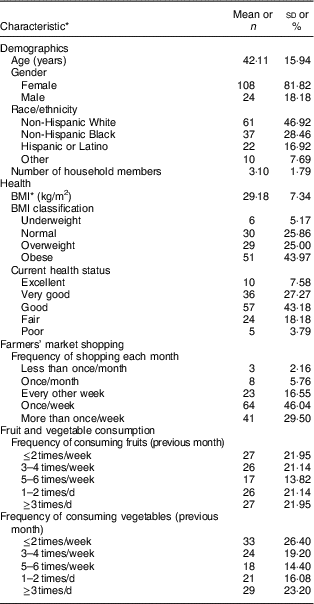
Frequencies may not total the sample size due to missing data.
* Data are presented as mean and sd for continuous variables (age, number of household members and BMI); otherwise as n and % for categorical variables.
Table 2 presents information on attitudes towards F&V consumption and purchasing as well as barriers to F&V consumption. At least 60 % of study participants agreed with each of the following statements on consumption: ‘I eat enough F&V to keep me healthy’, ‘I often encourage my family to eat F&V’, ‘My family often encourages me to eat F&V’ and ‘My family eats F&V when we are together’. Approximately 82·2 % of participants agreed that going to the FM has positively affected their health and 95·7 % agreed that the LINK Up Illinois has positively affected their F&V consumption. The mean number of barriers reported was calculated to be 0·83 and 48·0 % of participants reported at least one barrier. Approximately 29·5 % of participants agreed with the statement ‘They cost too much money’ and 18·6 % agreed with ‘They spoil before I get a chance to eat them’. Furthermore, 8·7 % agreed with the statement ‘I don’t know how to cook them’ and 8·6 % agreed with the statement ‘I don’t think about them when I’m hungry’.
Attitudes towards fruit and vegetable (F&V) purchasing and consumption and barriers to F&V consumption among the volunteer sample of LINK Up Illinois users (n 140) from six farmers’ markets in Illinois, USA, September–November 2016
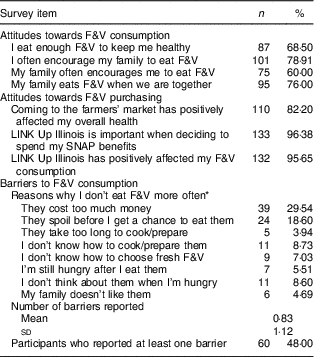
SNAP, Supplemental Nutrition Assistance Program.
* Participants could record more than one response for this survey item.
Crude and multivariable-adjusted odds ratios and 95 % CI assessing associations between reporting barriers and F&V consumption are recorded in Table 3. After adjusting for covariates, reporting one or more barriers was associated with reduced odds of consuming F&V ≥3 times/d (OR=0·22; 95 % CI 0·06, 0·81). When analysed separately, reporting one or more barriers was associated with reduced odds of consuming vegetables ≥3 times/d (OR=0·26; 95 % CI 0·08, 0·81), but not fruits (OR=0·40; 95 % CI 0·09, 1·73).
Crude and multivariable-adjusted associations between reporting barriers and fruit and vegetable consumption among the volunteer sample of LINK Up Illinois users (n 140) from six farmers’ markets in Illinois, USA, September–November 2016

* Logistic regression model adjusted for market location.
† Logistic regression model adjusted for market location, age, gender and race/ethnicity.
Discussion
The present research aimed to assess barriers to F&V consumption among users of the largest FM incentive programme in Illinois, USA: LINK Up Illinois. Approximately 48 % of survey participants experienced at least one of the barriers to F&V consumption listed on the survey. The barriers selected most often by participants included ‘They cost too much money’, ‘They spoil before I get a chance to eat them’ and ‘I don’t know how to cook them’. Furthermore, participants who reported one or more barriers had reduced odds of consuming F&V ≥3 times/d.
These finding align with previous research on perceived barriers to F&V consumption among low-income populations( Reference Zenk, Odoms-Young and Dallas 7 – Reference Mook, Laraia and Oddo 10 , Reference Savoie-Roskos, Wengreen and Gast 24 – Reference Wetherill and Gray 27 ). Several studies have reported that the price of fresh F&V is a perceived barrier( Reference Zenk, Odoms-Young and Dallas 7 – Reference Mook, Laraia and Oddo 10 , Reference Savoie-Roskos, Wengreen and Gast 24 , Reference Haynes-Maslow, Auvergne and Mark 25 , Reference Wetherill and Gray 27 ). Price was perceived as a barrier to consumption in a study by Zenk and colleagues conducted in Chicago( Reference Zenk, Odoms-Young and Dallas 7 ). A recent study by Savoie-Roskos and colleagues found that cost was the most cited barrier to F&V consumption among SNAP participants prior to receiving FM incentive programme benefits( Reference Savoie-Roskos, Wengreen and Gast 24 ). We did not compare the price of F&V at our participating FM with that at nearby grocers, so we were unable to assess whether price is an actual barrier. However, it is important to acknowledge that price continues to be perceived a barrier despite the incentives. Future efforts to increase F&V consumption should consider this issue when developing programming.
Premature spoilage of F&V and knowledge of cooking have also emerged as a barrier to F&V consumption among low-income populations in prior research( Reference Yeh, Ickes and Lowenstein 9 , Reference Haynes-Maslow, Auvergne and Mark 25 – Reference Wetherill and Gray 27 ). A study by Haynes-Maslow and colleagues found that perishability of F&V and cooking/nutrition knowledge emerged as key barriers to F&V purchasing( Reference Haynes-Maslow, Auvergne and Mark 25 ). Furthermore, Wetherill and colleagues reported that a large percentage of SNAP recipients in their FM coupon intervention study had little knowledge of vegetable preparation( Reference Wetherill, Williams and Gray 26 ); those participants with preparation knowledge were more likely to redeem FM coupons( Reference Wetherill, Williams and Gray 26 ). Considering low-income individuals often experience strained financial resources, they might consider fresh F&V a poor investment of their resources because they spoil quickly. Today, most Americans consume the majority of their food away from home and cooking at home has been linked to better diet quality( Reference Beydoun, Powell and Wang 30 , Reference Wolfson and Bleich 31 ). Developing mechanisms to help low-income individuals learn how to cook healthy, low-cost and quick meals that comprise fresh F&V might be a promising approach to improving consumption.
The present research has strengths and limitations. The study population was a strength because it included a diverse group of SNAP recipients from urban and rural areas of Illinois. Since our survey participants consisted solely of volunteers, our findings might not be generalizable to other LINK Up Illinois users or FM incentive programme users in other states. The small sample size was a key limitation; however, it did not prevent us from observing a statistically significant association between reporting barriers and frequency of F&V consumption. While the survey featured measures adapted from previously validated tools, we were unable to pilot test the survey for validity or reliability prior to this project. The lack of a proper comparison group was also a limitation. We do not know how barriers to F&V consumption reported by LINK Up Illinois users compare with those of demographically similar SNAP recipients who do not utilize the incentive programme.
In summary, we found that barriers to F&V consumption persist among LINK Up Illinois users and these barriers are associated with reduced odds of consuming F&V. Despite these findings, the majority of our participants (>80 %) believed that patronizing FM and the incentive programme have had a positive influence on their F&V consumption and health. The current study provides valuable information to organizations and stakeholders, particularly in Illinois, who are invested in addressing barriers to F&V consumption that persist among low-income FM incentive programme users. Future educational programming that aims to increase F&V consumption among low-income populations should target price perception, cooking skills and knowledge of food storage to prevent premature spoilage.
Acknowledgements
Acknowledgements: The authors would like to acknowledge the participating farmers’ markets and their market staff for helping collect the data presented in this paper. Financial support: The research reported herein was supported the National Cancer Institute of the National Institutes of Health (C.R.S., grant number R25CA057699) and the US Department of Agriculture (C.R.S., grant number 2016-67012-24705), (C.S., grant number 2016-70025-25234). The funders had no role in the design, analysis or writing of this article. Conflict of interest: The authors have nothing to disclose. Authorship: C.C., C.S. and C.R.S. were involved with conceptualizing the research project. C.R.S., S.F. and R.D. completed the data entry, cleaning and analysis. C.R.S. led the writing of the manuscript. All authors were involved in the editing process and approved the final version of the manuscript to be submitted for publication. Ethics of human subject participation: This research was approved by the Institutional Review Board at the University of Illinois at Chicago.



