





Healthy development during adolescence is associated with a normative degree of risk-taking behaviors, which often include experimentation with drugs and alcohol (Moffitt, Reference Moffitt1993). A subset of adolescents, however, engage in substance use that persists into adulthood and escalates in severity. Identification of risk and protective factors for adolescent substance use is needed to improve understanding of the development of substance use disorders (SUDs) and to inform prevention and intervention efforts for substance use-related problems.
Symptoms of psychological disorders, many of which first occur during adolescence, are significant risk factors for initiation and escalation of substance use (Swendsen et al., Reference Swendsen, Conway, Degenhardt, Glantz, Jin, Merikangas and Kessler2010). Externalizing symptoms (e.g., conduct disorder) are well-established predictors of substance use (Colder et al., Reference Colder, Scalco, Trucco, Read, Lengua, Wieczorek and Hawk2013; King et al., Reference King, Iacono and McGue2004), whereas internalizing symptoms (e.g., anxiety and depression) are less consistently associated with substance use (Hussong et al., Reference Hussong, Ennett, Cox and Haroon2017). The present study aimed to increase understanding of the unique associations of internalizing symptoms, and anxiety symptoms in particular, with substance use, independent of the relationship with externalizing symptoms. Specifically, developmental period and sex were examined as moderators of anxiety-specific influences on substance use. We tested a priori hypotheses that anxiety would protect against substance use in adolescence, but would be associated with greater risk for substance use in adulthood, and that the association between anxiety and substance use would be stronger in girls/women compared to boys/men.
Internalizing and externalizing pathways to substance use
Two broad dimensions that account for the co-occurrence of psychological disorders are commonly referred to as internalizing and externalizing (Lahey et al., Reference Lahey, Krueger, Rathouz, Waldman and Zald2017; Lilienfeld, Reference Lilienfeld2003). Externalizing disorders (e.g., conduct and antisocial personality disorders) are characterized by the outward expression of distress, whereas internalizing disorders (e.g., anxious and depressive disorders) encompass internal manifestations of distress. In contrast to the externalizing pathway to adolescent substance use, the internalizing pathway is less understood. A few studies provide evidence that internalizing problems in childhood are associated with increased risk for substance use in adolescence and early adulthood (e.g., Marmorstein et al., Reference Marmorstein, White, Loeber and Stouthamer-Loeber2010; Sihvola et al., Reference Sihvola, Rose, Dick, Pulkkinen, Marttunen and Kaprio2008), and internalizing disorders co-occur with substance use more often than expected by chance (e.g., Lai et al., Reference Lai, Cleary, Sitharthan and Hunt2015; Vorspan et al., Reference Vorspan, Mehtelli, Dupuy, Bloch and Lépine2015). This pathway may be driven by motives to self-regulateFootnote 1 or alleviate distress associated with internalizing symptoms (Hussong et al., Reference Hussong, Jones, Stein, Baucom and Boeding2011). Adolescents and young adults who cited using drugs and alcohol to cope with negative affect were more likely to exhibit problematic substance use and SUDs (Gillen et al., Reference Gillen, Barry and Bater2016; Hides et al., Reference Hides, Lubman, Cosgrave, Buckby, Killackey and Yung2008).
Others found no association between adolescent internalizing symptoms and substance use (Hussong et al., Reference Hussong, Ennett, Cox and Haroon2017; Miettunen et al., Reference Miettunen, Murray, Jones, Mäki, Ebeling, Taanila and Moilanen2014). Because internalizing and externalizing symptoms often co-occur (Lilienfeld, Reference Lilienfeld2003), it can be difficult to gauge the role of an internalizing-specific pathway to substance use unless studies address the influence of internalizing symptoms on substance use while controlling for externalizing symptoms. Internalizing and externalizing symptoms may have an additive effect on substance use; for example, co-occurring depression and conduct symptoms were associated with increased risk for substance use compared to either depression or conduct symptoms alone (Stone et al., Reference Stone, Vander Stoep and McCauley2016). Alternatively, internalizing symptoms may be a protective factor against alcohol use among adolescents high in externalizing symptoms (Colder et al., Reference Colder, Shyhalla, Frndak, Read, Lengua, Hawk and Wieczorek2017); that is, internalizing symptoms may counteract the risk effects of externalizing symptoms to some degree.
An anxiety-specific pathway to substance use
Another complication in understanding the internalizing pathway to substance use is that depression and anxiety symptoms may be differently associated with substance use, so it is important to examine the independent effects of these two constructs. In a review of the independent association between internalizing and substance use (controlling for externalizing), depression was more consistently associated with substance use than anxiety (Hussong et al., Reference Hussong, Ennett, Cox and Haroon2017), although not all of these studies examined depression after controlling for co-occurring anxiety symptoms. Depressive symptoms are associated with increased risk for earlier onset and greater frequency of substance use (Pang et al., Reference Pang, Farrahi, Glazier, Sussman and Leventhal2014), and this effect persists over and above externalizing symptoms (Hussong et al., Reference Hussong, Ennett, Cox and Haroon2017; Khoddam et al., Reference Khoddam, Jackson and Leventhal2016; King et al., Reference King, Iacono and McGue2004; Maslowsky & Schulenberg, Reference Maslowsky and Schulenberg2013). However, depression may protect against substance use in pre and early adolescence, then become a risk factor for substance use as individuals transition into adulthood and substance use becomes more prevalent and normalized (Mason et al., Reference Mason, Hitchings and Spoth2007).
The relationship between anxiety and substance use is in need of clarification, as studies provide conflicting evidence about the role of anxiety symptoms in risk for substance use above and beyond conduct symptoms (Hussong et al., Reference Hussong, Ennett, Cox and Haroon2017). Anxiety symptoms may predict earlier initiation of substance use after controlling for delinquent behaviors (Marmorstein et al., Reference Marmorstein, White, Loeber and Stouthamer-Loeber2010), and distress associated with anxiety symptoms may negatively reinforce the effects of some substances. Though the literature examining this association is limited, a related construct, anxiety sensitivity, has been associated with problematic substance use and higher expectancies that substances would reduce negative affect (Guillot et al., Reference Guillot, Blumenthal, Zvolensky and Schmidt2018).
There is also evidence that anxiety may protect adolescents from substance use (e.g., Colder et al., Reference Colder, Scalco, Trucco, Read, Lengua, Wieczorek and Hawk2013; Khoddam et al., Reference Khoddam, Jackson and Leventhal2016; Myers et al., Reference Myers, Tomlinson, Aarons and Stein2003). Although this association is not well understood, two potential mediators suggested by the literature include lack of social connection and greater harm avoidance. First, initiation of use during adolescence tends to occur in social contexts (Fujimoto & Valente, Reference Fujimoto and Valente2012; Hussong, Reference Hussong2000). Internalizing psychopathology, including anxiety symptoms, was associated with fewer affiliations with rule-breaking peers (Fite et al., Reference Fite, Colder and O’Connor2006), although this literature is mixed (Scalco et al., Reference Scalco, Colder, Hawk, Read, Wieczorek and Lengua2014) and in need of further investigation. Rule-breaking peers may facilitate exposure to substance use in early adolescence, whereas substance use and drinking in particular may become more normative and less associated with having “delinquent” peers with increasing age (Colder et al., Reference Colder, Shyhalla, Frndak, Read, Lengua, Hawk and Wieczorek2017). According to social learning theory, peers’ attitudes and behaviors related to substance use play significant roles in an adolescent’s own substance use (Kruis et al., Reference Kruis, Seo and Kim2020). Anxious adolescents may lack social connections and/or avoid social gatherings, and consequently have fewer opportunities to be exposed to substance use (Zehe et al., Reference Zehe, Colder, Read, Wieczorek and Lengua2013). Moreover, although anxious individuals are less likely to initiate substance use in adolescence, once they have initiated substance use, they are at increased risk for subsequent use (Colder et al., Reference Colder, Scalco, Trucco, Read, Lengua, Wieczorek and Hawk2013).
Second, fear of potential negative consequences may deter adolescents from engaging in risky or illegal behaviors such as substance use (Fite et al., Reference Fite, Colder and O’Connor2006). Harm avoidance is a personality trait strongly associated with anxiety (Cervin et al., Reference Cervin, Perrin, Olsson, Claesdotter-Knutsson and Lindvall2020; Faytout et al., Reference Faytout, Tignol, Swendsen, Grabot, Aouizerate and Lépine2007) and negatively correlated with externalizing symptoms (Schmeck & Poustka, Reference Schmeck and Poustka2001). If anxious adolescents are also more harm-avoidant, they may be less likely to engage in substance use due to worries of potential negative consequences, especially given that a greater perceived risk of a substance is associated with lower rates of use (Johnston et al., 2018). High harm avoidance coupled with low novelty seeking in preadolescence was predictive of later onset of substance use (Masse & Tremblay, Reference Masse and Tremblay1997) and high harm avoidance was associated with less frequent drinking (Galen et al., Reference Galen, Henderson and Whitman1997).
Potential moderators of an internalizing and anxiety-specific pathway to substance use
Developmental period (i.e., adolescence vs. adulthood) may moderate internalizing and anxiety-specific pathways to substance use. Adolescents with internalizing symptoms may initiate substance use at older ages but escalate to problematic use more quickly (Hussong et al., Reference Hussong, Jones, Stein, Baucom and Boeding2011). As substances such as tobacco, alcohol, and cannabis become more accessible (e.g., can be obtained legally) and substance use becomes normalized, anxiety may no longer serve as a barrier to use. Once initiated, substance use may be reinforced by alleviating anxiety symptoms. As few studies span the development from adolescence to adulthood, it is unclear how associations between psychopathology and substance use change across these different developmental periods, as substances increase in accessibility.
Sex may moderate associations between internalizing symptoms, externalizing symptoms, and substance use. In adolescents, the associations between psychopathology and substance use do not consistently differ between boys and girls; however, there is evidence that externalizing symptoms are more strongly associated with substance use in boys compared to girls; conversely, internalizing disorders are more likely to be associated with substance use in girls (King et al., Reference King, Iacono and McGue2004; Mason et al., Reference Mason, Hitchings and Spoth2007; Wu et al., Reference Wu, Goodwin, Fuller, Liu, Comer, Cohen and Hoven2010). Others have found sex differences in associations between substance use and specific subsets of internalizing symptoms; for example, anxiety was associated with SUDs among adolescent girls only, whereas depression was associated with SUDs in boys, but not in girls (Sung et al., Reference Sung, Erkanli, Angold and Costello2004). In contrast, adult women are more likely to cite coping motives for substance use compared to men (Dunne et al., Reference Dunne, Galatopoulos and Schipperheijn1993), and some studies have suggested that associations between anxiety and substance use are stronger in women than in men (Burns & Teesson, Reference Burns and Teesson2002; De Graaf et al., Reference De Graaf, Bijl, Smit, Vollebergh and Spijker2002).
Adolescents tend to experiment with a variety of substances rather than use one drug exclusively, and the adolescent literature typically focuses on the most prevalent substances used by this age group: tobacco, alcohol, and cannabis (Johnston et al., Reference Johnston, O’Malley, Miech, Bachman and Schulenberg2017). As substances vary in their biological effects, there may be unique pathways to developing the use of a specific substance (e.g., anxiety more strongly associated with use of anxiolytic drugs). Alternatively, there may be underlying common risk factors for substance use in general, regardless of the type of drug (Han et al., Reference Han, McGue and Iacono1999; Young et al., Reference Young, Rhee, Stallings, Corley and Hewitt2006). Most studies examining the internalizing-specific pathway to substance use, controlling for externalizing symptoms, have examined specific substances (Hussong et al., Reference Hussong, Ennett, Cox and Haroon2017). The adolescent literature reports a range of substance-specific relationships with depression (Johnson et al., Reference Johnson, Cohen, Pine, Klein, Kasen and Brook2000; Saban & Flisher, Reference Saban and Flisher2010), and mixed results regarding the association between anxiety and specific substances, with anxiety associated with both higher (Deas, Reference Deas2006; Johnson et al., Reference Johnson, Cohen, Pine, Klein, Kasen and Brook2000; Saban & Flisher, Reference Saban and Flisher2010) and lower (Hussong et al., Reference Hussong, Ennett, Cox and Haroon2017; Wolitzky-Taylor et al., Reference Wolitzky-Taylor, McBeth, Guillot, Stone, Kirkpatrick, Zvolensky, Buckner and Leventhal2016) risk for tobacco, alcohol, and cannabis use.
The present study
To increase the transparency of the present investigative process, preliminary versions of the introduction and method sections of this study were preregistered at the Open Science Framework and can be accessed at https://osf.io/f8se6.
Although there is clear evidence of a bidirectional association between anxiety and substance use in adults, the literature on the association between anxiety symptoms and substance use in adolescence, particularly after controlling for externalizing and depressive symptoms, is less clear. The research questions posed in the present study are important, as addressing them will clarify how anxiety symptoms are associated with substance use at different life stages, independent from co-occurring externalizing and depression symptoms. Our specific research questions addressed whether anxiety is independently associated with substance use, and if so, whether this association differs by developmental period and sex. We predicted that anxiety would be associated with less frequent substance use in adolescence, yet associated with more frequent substance use in adulthood. Further, we expected the association between anxiety and substance use to be stronger in girls and women compared to boys and men. We conducted exploratory analyses examining whether the association between anxiety and substance use differs by specific substance category.
Q1: Are anxiety symptoms associated with substance use over and above externalizing and depression symptoms? If so, does this association differ between adolescents and adults?
The present study aimed to understand whether there is an anxiety-specific association with substance use that does not overlap with the shared variance with externalizing and depression. We examined associations between internalizing (MDD and/or GAD) symptoms and substance use, controlling for externalizing (Conduct Disorder and Antisocial Personality Disorder) symptoms. Given the evidence that depression is more consistently associated with substance use than anxiety after controlling for externalizing (Hussong et al., Reference Hussong, Ennett, Cox and Haroon2017), we examined the independent association between anxiety and substance use after controlling for depression and externalizing.
Using a longitudinal sample, we compared these associations in adolescence (ages 13−18) and early adulthood (ages 19−30) to examine whether anxiety symptoms are differently associated with adolescent versus adult substance use. Given the reviewed literature, we hypothesized that anxiety, controlling for externalizing problems and depression, may act as a protective factor from substance use in adolescence, but will be associated with greater risk for substance use in adulthood, as substances become more accessible and substance use becomes more normative.
Q2: Do associations between anxiety symptoms and substance use vary between sexes?
The present study also examined whether these associations are moderated by sex. Prior research reports inconsistent findings regarding sex differences in adolescents. Among adults, associations between anxiety and substance use tend to be stronger in women compared to men (Burns & Teesson, Reference Burns and Teesson2002; De Graaf et al., Reference De Graaf, Bijl, Smit, Vollebergh and Spijker2002), possibly due to sex differences in motives for substance use (Dunne et al., Reference Dunne, Galatopoulos and Schipperheijn1993). Thus, we hypothesized that the positive association between anxiety and substance use would be stronger in women than men. However, sex differences in associations between internalizing and externalizing disorders and substance use are less consistent in adolescence (Chen & Jacobson, Reference Chen and Jacobson2012; Johnston et al., Reference Johnston, O’Malley, Miech, Bachman and Schulenberg2017; Palmer et al., Reference Palmer, Young, Hopfer, Corley, Stallings, Crowley and Hewitt2009), so we expected sex differences to be more evident in adults compared to adolescents.
Q3: Is the anxiety-specific pathway substance-specific, or associated with general substance use?
It is important to assess adolescent substance use and misuse rather than SUDs, which may manifest later in life (Deas, Reference Deas2006). Adolescents may be in the early stages of SUD development and do not meet full criteria for SUDs, yet initiation in early adolescence is a risk factor for future problematic use and SUDs (Lopez-Quintero et al., Reference Lopez-Quintero, Cobos, Hasin, Okuda, Wang, Grant and Blanco2011; Magid & Moreland, Reference Magid and Moreland2014). Thus, the present study assessed substance use frequency instead of SUD symptoms and diagnoses. Although adolescents are less likely than adults to exhibit substance-specific preferences (Moss et al., Reference Moss, Chen and Yi2014), alcohol and cannabis use in adolescence predicted both substance-specific and general substance use problems in adulthood (Palmer et al., Reference Palmer, Young, Hopfer, Corley, Stallings, Crowley and Hewitt2009). Because there is evidence for both common and specific processes in the development of substance use (Han et al., Reference Han, McGue and Iacono1999; Palmer et al., Reference Palmer, Young, Hopfer, Corley, Stallings, Crowley and Hewitt2009; Young et al., Reference Young, Rhee, Stallings, Corley and Hewitt2006), we examined a general substance use factor as well as independent associations with specific substances.
Additional questions
We aimed to conduct longitudinal analyses to examine the potential influences of adolescent psychopathology and substance use variables on adult substance use. To address potential bidirectional relationships between psychopathology and substance use, we tested the influence of adolescent substance use on adult psychopathology, after controlling for adolescent psychopathology.Footnote 2 We also conducted genetically informed analyses, including twin correlations and genetic Cholesky decompositions,Footnote 3 to assess the contributions of genetic, shared environmental, and nonshared environmental influences on associations between psychopathology and substance use. Descriptions of these genetic analyses and figures and tables of the results are presented in Supplemental Online Materials (pages 12−26).
Method
Participants
The present study examined twin pairs from the Colorado Longitudinal Twin Study (LTS) and the Community Twin Sample (CTS), recruited through the Center for Antisocial Drug Dependence (CADD) at the Institute for Behavioral Genetics in Boulder, Colorado. Specific recruitment procedures and sample descriptions are detailed in Rhea et al. (Reference Rhea, Gross, Haberstick and Corley2006, Reference Rhea, Gross, Haberstick and Corley2013) and Corley et al. (Reference Corley, Reynolds, Wadsworth, Rhea and Hewitt2019). Study procedures and measures relevant to the present study were identical across the two samples.
Data were collected longitudinally, with the same participants assessed at three waves of data collection throughout adolescence and adulthood (1997−2014). Due to continuous recruitment across the three waves, some participants met the age inclusion criteria for adolescence and early adulthood at waves one and two, and others at waves two and three. The current sample was comprised of 2845 total individuals with data at either time point (1421 twin pairs and three singletons; 1494 girls/women and 1351 boys/men), with 1381 twin pairs and 8 singletons assessed during adolescence (n = 2770; ages 13 through 18 years; M = 16.6, SD = 1.5) and 1290 twin pairs and 75 singletons assessed during adulthood (n = 2655; ages 19 through 33 years; M = 22.8, SD = 2.3). Age 18 was selected as the cutoff for adolescence because participants were administered different versions of a diagnostic interview through age 18 and above age 18, and individuals typically finish high school and start living independently from their parents around age 18. In the adolescent sample, 9.9% identified as Hispanic and 86.0% classified their race as White. In the adult sample, 9.3% identified as Hispanic and 86.9% as White.
Two hundred participantsFootnote 4 (7.2%) who were assessed in adolescence were not assessed in adulthood. Results of attrition analyses suggested that adolescent MDD predicted missing data in adulthood for girls only; otherwise, adolescent substance use and psychopathology variables did not significantly predict missingness in adulthood (see Supplemental Online Materials Table S1).
Procedure
Two methods were utilized to assess the zygosity of the same-sex twin pairs. Interviewers completed an assessment of physical characteristics and twins’ genotypes at 11 short-tandem repeat polymorphisms were compared. Twins with similar physical characteristics and concordant genotypes were categorized as MZ and twins with differing physical characteristics and/or genotypes were deemed DZ. Any inconsistencies were re-examined and resolved.
Measures
Descriptive statistics for the measures described below are presented in Tables S2 and S3 in Online Supplemental Materials.
Internalizing and externalizing psychopathology
Adolescents living with their parents were administered the DISC-IV (Shaffer et al., Reference Shaffer, Fisher, Lucas, Dulcan and Schwab-Stone2000), which assesses symptoms and diagnoses for DSM-IV Axis 1 disorders (American Psychological Association, 1994). The DISC has been established as a valid (Schwab-Stone et al. Reference Schwab-Stone, Shaffer, Dulcan, Jensen, Fisher, Bird, Goodman, Lahey, Lichtman, Canino, Rubio-Stipec and Rae1996) and reliable (Shaffer et al., Reference Shaffer, Fisher, Dulcan, Davies, Piacentini, Schwab-Stone, Lahey, Bourdon, Jensen, Bird, Canino and Regier1996, Reference Shaffer, Fisher, Lucas, Dulcan and Schwab-Stone2000) measure across multiple diagnoses. The present study examined past-year MDD, GAD), and CD symptoms and diagnoses in the adolescent sample. Adult participants and any 18-year-olds living on their own were interviewed using the Diagnostic Interview Schedule IV (DIS-IV; Robins et al., Reference Robins, Cottler, Bucholz, Compton, North and Rourke2000), the adult analog of the DISC-IV. The present study examined past-year MDD, GAD, and ASPDFootnote 5 using the DIS-IV.
Due to the skewed distribution of internalizing and externalizing symptoms, ordinal variables were created to group participants in one of three categories for each diagnosis: no symptoms, subthreshold symptoms (endorsed one or more symptoms, but did not meet DSM-IV criteria for the disorder), and diagnosis (meeting DSM-IV criteria for the disorder). Analyzing non-normally distributed variables as ordinal variables assuming a continuous normal liability distribution leads to unbiased estimates (Derks et al., Reference Derks, Dolan and Boomsma2004).
Substance use frequency
Participants were administered the Composite International Diagnostic Interview - Substance Abuse Module supplement (CIDI-SAM supplement; Salomonsen-Sautel et al., Reference Salomonsen-Sautel, Sakai, Thurstone, Corley and Hopfer2012), a structured interview that assesses substance use diagnoses and behaviors. The CIDI-SAM supplement asked, “Have you ever used _____?” and “How many days have you used _____ in the past six months (180 days)?”. The present study examined responses to these questions for tobacco, alcohol, cannabis, and a combined ‘other drug’ category, operationalized as the illicit drug class used most frequently. If participants said no to ever having used a substance, they received a 0 for the number of days of use in the past 6 months. Due to the low prevalence of use endorsed by adolescents, substance use frequency was transformed to create ordinal variables with the goal of maximizing the number of categories, while maintaining sufficient sample sizes in each cell. Ordinal variables were categorized differently across substance categories, due to variations in distribution of frequency of use, but categorized consistently for adolescents and adults. The proportion of subjects in each ordinal category is reported in Supplemental Online Materials Table S3.
Analyses
Mplus version 8 (Muthén & Muthén, Reference Muthén and Muthén1998–2017) was used for statistical analyses. The chi-square statistic was used to assess model fit. In conjunction, the CFI and the RMSEA accounted for the chi-square statistic’s sensitivity to sample size with values of CFI > 0.95 and RMSEA < 0.06 as indications of good fit (Hu & Bentler, Reference Hu and Bentler1998). To address nonindependence of twin pairs in the phenotypic analyses, the TYPE = COMPLEX function was used to compute corrected standard errors and scaled chi-squares with a sandwich estimator. Because all analyses included categorical variables, we used the WLSMV estimation method, which addresses missing data using pairwise deletion. Statistical significance was determined with an alpha level of .05. Statistical significance of individual parameters was determined by examining the p-value of the z-statistic, which is the ratio of each parameter estimate to its standard error, and in genetic models, with chi-square difference tests examining the statistical significance of dropping a parameter from the full model.
Primary analyses tested models using a general substance use latent factor, with loadings on alcohol, tobacco, cannabis, and other illicit substance use, and primary analyses were conducted with this latent factor, using a structural equation modeling framework. A model with a single latent substance use factor fit the data well; factor loadings and model fit statistics are reported in Supplemental Online Materials Table S4. In addition, we tested models examining specific substance classes (tobacco, alcohol, cannabis, and other illicit drugs) to assess whether results are comparable across substance type. Phenotypic correlations assessed associations between CD/ASPD, MDD, GAD, and substance use in adolescents and adults. Multiple regression analyses estimated the independent contributions of CD/ASPD, MDD, and GAD on substance use (Figure 1).
Multivariate Regressions in Adolescents and Adults. Adolescents (girls/boys). Model fit: χ2(37) = 71.28, RMSEA = 0.03, CFI = .98. Adults (women/men). Model fit: χ2(28) = 85.08, RMSEA = 0.05, CFI = .92. Note. Standardized parameters are shown. Although factor loadings and thresholds were invariant across sex in adolescents, the standardized parameters are different for girls and boys because the variance of the latent substance use variable was allowed to differ by sex. Parameter estimates are displayed separately by sex (girls/boys and women/men). * p < 0.05.

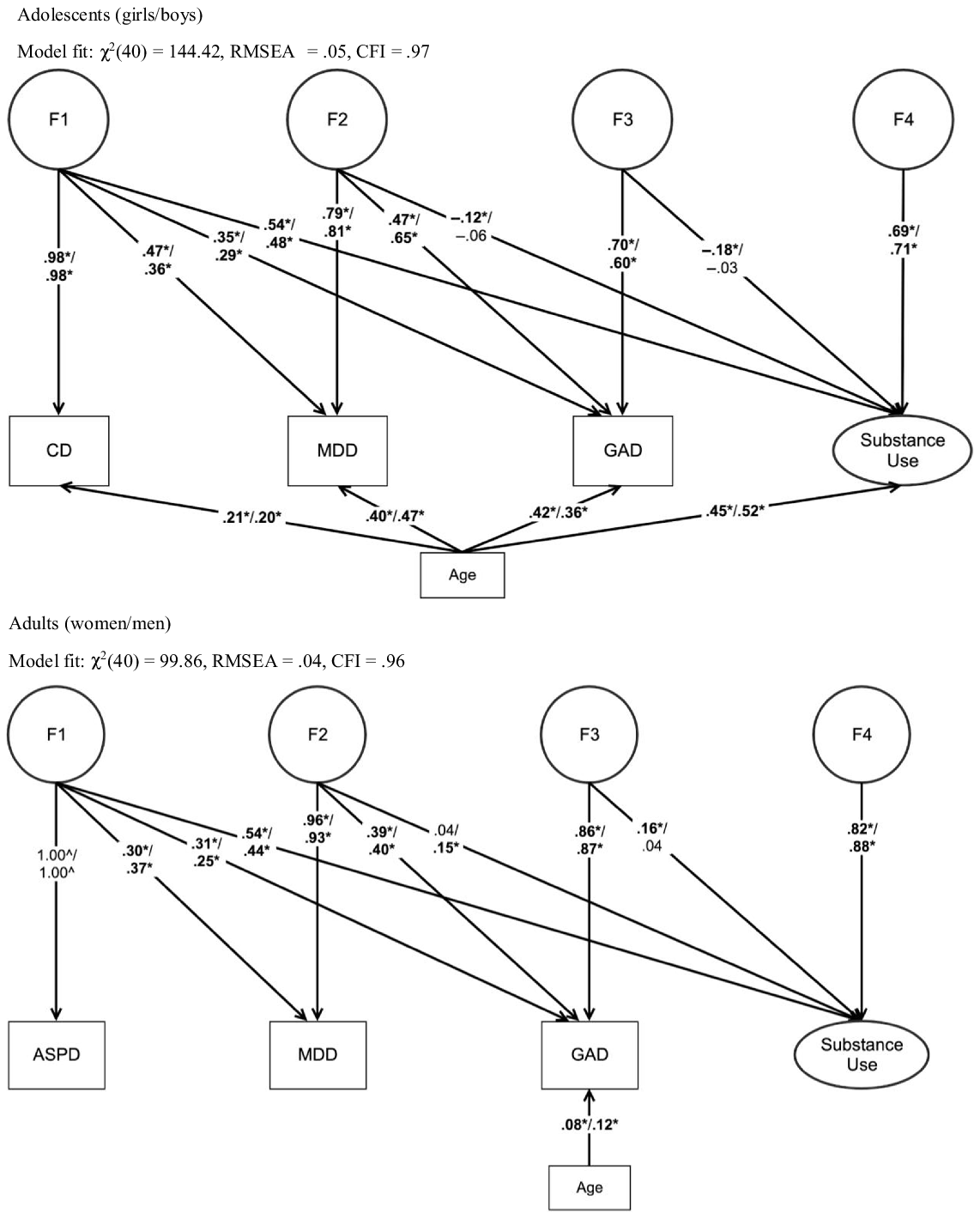
Multivariate phenotypic Cholesky decomposition analyses modeled common and unique influences on externalizing (CD/ASPD), internalizing (MDD and GAD), and substance use (Figure 2). The Cholesky method decomposes covariance between GAD and substance use into four components. Specifically, Cholesky decomposition was used to estimate the covariance between internalizing disorders and substance use due to influences shared in common with CD/ASPD (path from F1 to substance use in Figure 2), the covariance between internalizing disorders and substance use controlling for CD/ASPD (F2 to substance use), the covariance between GAD and substance use, controlling for CD/ASPD and MDD (F3 to substance use), and the influences unique to substance use (F4 to substance use). Covariances were estimated by controlling for age and separately by sex.
Quadrivariate Phenotypic Cholesky Decompositions in Adolescents and Adults. Adolescents (girls/boys). Model fit: χ2(40) = 144.42, RMSEA = 0.05, CFI = .97. Adults (women/men). Model fit: χ2(40) = 99.86, RMSEA = 0.04, CFI = .96. Note. Factor 1 (F1) represents common influences on externalizing, depression, and anxiety that also influence substance use. Factor 2 (F2) represents influences on internalizing symptoms that also influence substance use, controlling for externalizing symptoms. Factor 3 (F3) represents influences on anxiety symptoms that also influence substance use, controlling for externalizing and depression. Factor 4 (F4) represents influences unique to substance use. Standardized parameters are shown. Paths are displayed separately by sex. For the sake of clarity, the measurement model for the latent substance use variable is not displayed here. ^Variance explained by F1 is fixed to 1.00 in adults, because F1 is the only predictor of ASPD in adults, whereas age predicts CD in the adolescent model. *p < .05.
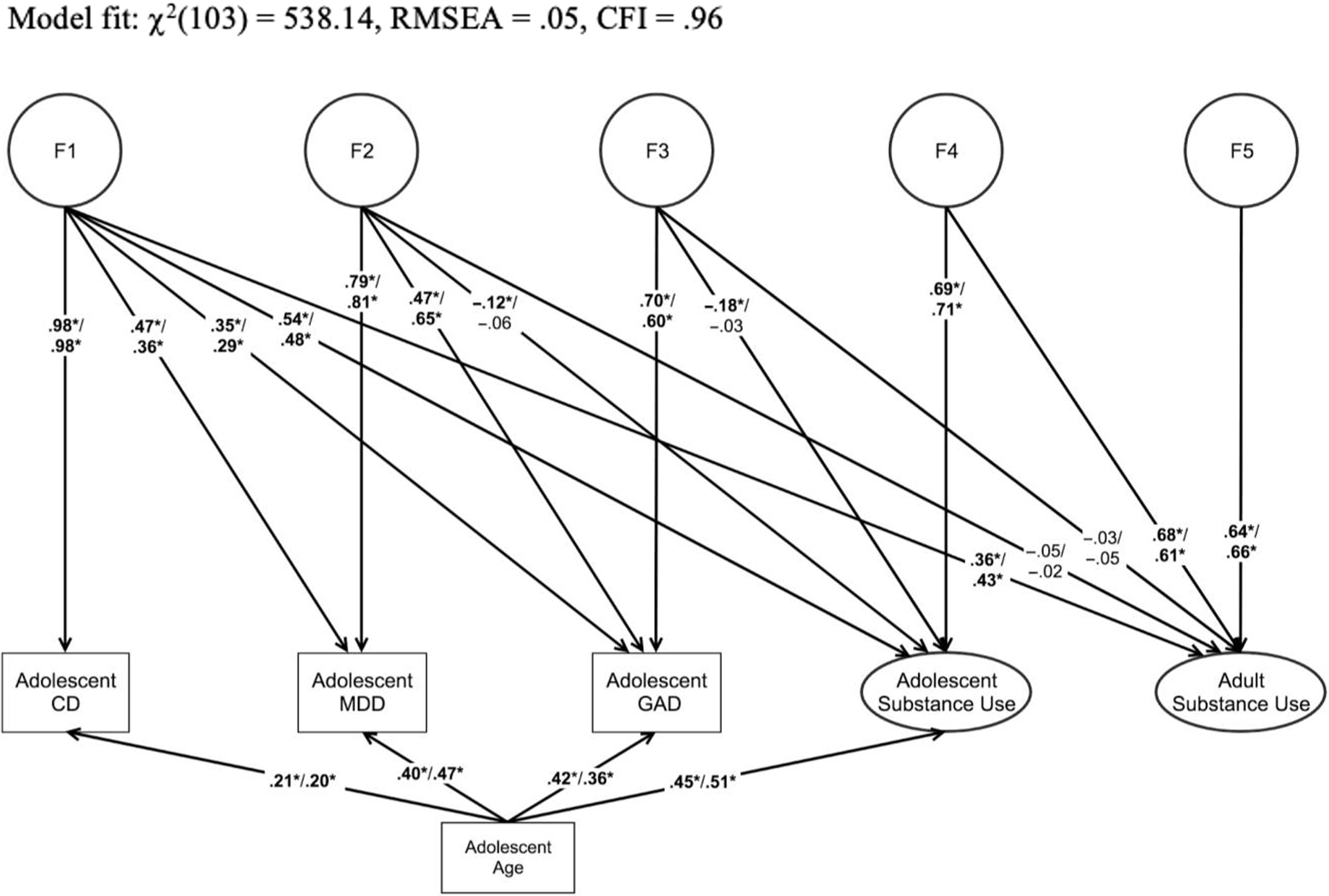
Finally, we tested adolescent predictors of adult substance use with a five-variable phenotypic Cholesky decomposition, which assessed whether adolescent psychopathology predicts adult substance use and whether adolescent substance use is associated with adult substance use after controlling for adolescent psychopathology (Figure 3). Cholesky decompositions were used to supplement multiple regressions, allowing simultaneous examination of internalizing-specific and anxiety-specific (after parsing out influence of depressive symptoms) influences on substance use.
Quintivariate Phenotypic Cholesky Decomposition with Adolescent Variables and Adult Substance Use. Model fit: χ2(103) = 538.14, RMSEA = 0.05, CFI = .96. Note. Standardized parameterizations are shown, presented separately by sex (girls/boys and women/men). For the sake of clarity, measurement models for the adolescent and adult latent substance use variables are not displayed here. *p < .05.
To test whether associations of internalizing and externalizing symptoms with substance use differed between adolescence and adulthood, a chi-square difference test compared a model where the key parameters were allowed to differ between adolescence and adulthood to a model that constrained parameters to be equal across developmental periods. Chi-square difference tests also assessed sex differences in the parameters.
There was a wide age range included in each developmental period (i.e., adolescents ranging in age from 13 to 18 and adults ranging in age from 19 to 33) and we included age at the time of assessment as a linear covariate in all analyses. However, the targeted age of assessment for approximately half of the participants was 17 years during adolescence and 22 years during adulthood. Given our goal of examining the role of developmental period as a moderator of the association between internalizing symptoms and substance use, main analyses were repeated in a smaller subsample of participants who were assessed during adolescence between age ≥ 16 and ≤ 19 (50% of participants) and during adulthood between age ≥ 21 and ≤ 24 (52% of participants), with 4–6 years between assessments.
Results
Age was a significant predictor of all adolescent variables, but was only associated with GAD in adults. Therefore, in the following analyses, we included age as a covariate for all adolescent variables, and for GAD in adult variables.
Tests of measurement invariance showed significant sex differences in factor loadings and thresholds for the latent drug use factor in adults, χ2(10) = 40.97, p < 0.01, but not in adolescents, χ2(10) = 12.65, p = 0.24. Accordingly, factor loadings and thresholds were fixed to be equal in girls and boys and factor means were allowed to differ in adolescent analyses, whereas factor loadings and thresholds were free to vary across women and men in analyses examining adults (Supplemental Online Materials Table S4).
To address the possibility of Type I errors leading to false positives in the results, we used the Benjamini–Hochberg method (Benjamini & Hochberg, Reference Benjamini and Hochberg1995) to estimate FDR. After calculating adjusted p-values, all of the statistically significant findings remained significant (p < 0.05).
Phenotypic correlations
We examined phenotypic correlations between CD/ASPD, MDD, GAD, and substance use separately by developmental period and sex (Table 1). Collinearity statistics indicated that multicollinearity between CD/ASPD, MDD, and GAD was not a concern (Tolerance > .01; VIF < 10). Adolescent phenotypic correlations were positive and significant except for a nonsignificant correlation between GAD and substance use in girls. Adult phenotypic correlations were all positive and significant. Positive correlations between depression/anxiety and substance use may be due to overlap between internalizing and externalizing symptoms. It is possible that anxiety-specific associations with substance use, after controlling for depression and externalizing symptoms, may be nonsignificant or even negative.
Phenotypic correlations in adolescents and adults

* p < 0.05.
Primary analyses
Q1: Are anxiety symptoms associated with substance use over and above externalizing and depression symptoms? If so, does this association differ between adolescents and adults?
To assess whether GAD is associated with general substance use over and above CD/ASPD and MDD symptoms, we conducted multivariate regression (Figure 1) and phenotypic Cholesky decomposition (Figure 2) analyses. The multivariate regression in adolescents showed a significant, independent association between CD and substance use in both girls, β = 0.42, p < 0.01, 95% CI [0.38, 0.48] and boys, β = 0.40, p < 0.01, 95% CI [0.35, 0.45]. The independent association between MDD and substance use was nonsignificant in girls, β = 0.05, p = 0.17, 95% CI [−0.02, 0.11] and boys, β < 0.01, p = 0.99, 95% CI [−0.07, 0.07]. The independent association between GAD and general substance use was significant and negative in girls, β = −0.15, p < 0.01, 95% CI [−0.22, −0.08], and nonsignificant in boys, β = −0.02, p = 0.54, 95% CI [−0.09, .05] (Figure 1).
The quadrivariate phenotypic Cholesky decomposition in adolescents produced similar results. In adolescent girls, Factor 2 (F2; influences on internalizing symptoms that also influence substance use, controlling for externalizing symptoms) and Factor 3 (F3; influences on anxiety symptoms that also influence substance use, controlling for externalizing and depression symptoms) to substance use parameters were both negative and significant (β = −0.12, p < 0.01, 95% CI [−0.19, −0.04] and β = −0.18, p < 0.01, 95% CI [−0.26, −0.10], respectively), although effect sizes were relatively small. In adolescent boys, neither the F2 to drug use nor the F3 to drug use parameter was statistically significant (β = -0.06, p = 0.21, 95% CI [−0.14, 0.03] and β = −0.03, p = 0.56, 95% CI [−0.12, .07], respectively) (Figure 2).
The multiple regression results in adults showed a small, significant, and positive independent association between GAD and substance use in women, β = 0.12, p < 0.01, 95% CI [0.05, 0.18] and a nonsignificant association in men, β = 0.05, p = 0.13, 95% CI [−0.02, 0.12]. The independent association between ASPD and substance use was positive and significant in both women, β = 0.40, p < 0.01, 95% CI [0.34, 0.46] and men, β = 0.33, p < 0.01, 95% CI [0.26, 0.40]. The independent association between MDD and substance use was positive and significant in men, β = 0.12, p < 0.01, 95% CI [0.06, 0.19] and nonsignificant in women, β = 0.03, p = 0.44, 95% CI [−0.04, 0.09] (Figure 1).
The phenotypic Cholesky decomposition showed a significant positive F3 to drug use association in women, β = 0.16, p < 0.01, 95% CI [0.06, 0.26]; this parameter was not significant in men, β = 0.04, p = 0.48, 95% CI [−0.08, 0.17]. Conversely, the F2 to drug use parameter was not significant in women, β = 0.04, p = 0.30, 95% CI [−0.04, 0.13], but was positive and significant in men, β = 0.15, p < 0.01, 95% CI [0.05, 0.24] (Figure 2). Importantly, effect sizes of the associations between internalizing symptoms and substance use were relatively small when compared with those between externalizing symptoms and substance use.
Because the two timepoints compared included age ranges that were quite broad, we replicated multiple regression and phenotypic Cholesky decomposition analyses in a subset of the sample, including only individuals assessed in adolescence at ages ≥ 16 and ≤ 19 and in adulthood at ages ≥ 21 and ≤ 24. Results from this subset of participants were highly consistent with results for the full sample and are reported in Tables S5 and S6 of the Online Supplemental materials.
Central to the main aim of this study, we examined whether the associations between GAD and substance use in adolescents and adults were significantly different. Anxiety-specific influences on substance use differed significantly between adolescent girls and adult women, χ2(1) = 27.20, p < 0.01, but not between adolescent boys and adult men, χ2(1) = 0.779, p = .38. Internalizing-specific influences on substance use differed significantly between adolescents and adults in both girls/women (χ2(1) = 8.28, p < .01) and boys/men (χ2(1) = 4.88, p < .05).Footnote 6
Q2: Do associations between anxiety symptoms and substance use vary between sexes?
The independent association between anxiety symptoms and substance use could not be constrained to be equal for girls and boys, χ2(1) = 4.15, p < 0.05. In addition, the anxiety-specific path to substance use (F3 to drug use) in the Cholesky decomposition differed significantly by sex, χ2(5) = 14.07, p < 0.05. In contrast, the internalizing-specific path to substance use (F2 to drug use) could be equated in boys and girls, χ2(5) = 6.53, p = 0.26.
In adults, the association between anxiety symptoms and substance use also did not significantly differ by sex, χ2(1) = 0.65, p = 0.42. For the Cholesky decomposition, neither the internalizing-specific (F2 to drug use) nor the anxiety-specific (F3 to drug use) parameter significantly differed by sex (χ2(1) = 1.50, p = 0.22 and χ2(1) = 2.51, p = 0.11, respectively). However, because the substance use factor was noninvariant in adult women and men, we cannot conclude that the factor structure is equivalent across sex, and these different test results should be interpreted with caution.
Q3: Is the anxiety-specific parameter substance-specific, or associated with general substance use?
In addition to analyses including the latent substance use variable, we examined substance-specific relationships with anxiety, controlling for externalizing and depression. These results are presented in Tables S7 and S8 in the Online Supplemental Materials. Overall, substance-specific results were consistent with results examining the general substance use factor. In adolescent girls but not boys, GAD symptoms were independently associated with less frequent tobacco, alcohol, and cannabis use. In adult women, GAD symptoms were significantly associated with increased tobacco, cannabis, and other substance use; in adult men, GAD symptoms were significantly associated with increased tobacco use only. Phenotypic Cholesky decomposition parameter estimates in girls were negative and significant for paths from F2 and F3 to each specific substance category except “other illicit drug”, whereas boys’ F2 and F3 to specific substance paths were all nonsignificant except for a negative path from F2 to alcohol use. In women, F2 to other illicit drug use, F3 to cannabis use, and F3 to other drug use paths were positive and significant, and F2 to alcohol use was negative and significant. In men, F2 to tobacco use and F2 to other drug use were positive and significant; none of the F3 to specific substance paths were significant.
Additional analyses
To examine the influence of adolescent psychopathology on adult substance use, we tested a phenotypic Cholesky decomposition that included adolescent CD, MDD, GAD, adolescent substance use, and adult substance use (Figure 3). Adolescent MDD and GAD symptoms were not associated with adult substance use over and above adolescent CD, indicated by nonsignificant F2 and F3 to adult substance use parameters, although adolescent MDD and GAD were significantly associated with decreased adolescent use after accounting for CD in girls. Adolescent CD and substance use were significantly associated with adult use. There was significant covariation between adolescent and adult substance use after controlling for adolescent psychopathology.
To assess the influence of adolescent substance use on adult psychopathology, we conducted phenotypic Cholesky decompositions for adult GAD, MDD, and ASPD. These Cholesky decompositions included adolescent psychopathology (adolescent GAD, MDD, and CD), adolescent substance use, and adult psychopathology (adult GAD, MDD, and ASPD). Results suggest a consistent, positive, and significant association between adolescent substance use and adult psychopathology after controlling for adolescent psychopathology (see Results in Supplemental Online Materials Table S9).
Discussion
Externalizing symptoms are well-established risk factors for substance use across development (Armstrong & Costello, Reference Armstrong and Costello2002; Eaton et al., Reference Eaton, Rodriguez-Seijas, Carragher and Krueger2015; King et al., Reference King, Iacono and McGue2004; Miettunen et al., Reference Miettunen, Murray, Jones, Mäki, Ebeling, Taanila and Moilanen2014). In contrast, it is unclear whether internalizing symptoms are risk or protective factors for substance use independent from externalizing (Hussong et al., Reference Hussong, Ennett, Cox and Haroon2017). The present study aimed to clarify the association between internalizing symptoms and substance use, over and above the previously established association with externalizing symptoms.
First, we addressed whether anxiety symptoms are associated with substance use over and above externalizing and depression symptoms, and whether this association differs between adolescents and adults. Results showed limited evidence for an internalizing pathway to substance use that is independent of the influence of externalizing symptoms. Although previous research has demonstrated a high genetic correlation between GAD and MDD (Middeldorp et al., Reference Middeldorp, Cath, Van Dyck and Boomsma2005), our results suggest anxiety-specific associations with substance use in adolescent girls and adult women, over and above the shared variance with depression.
Specifically, results suggested a protective role of anxiety on substance use in adolescent girls that did not persist in adulthood; rather, anxiety was associated with more frequent substance use in adult women. In contrast, there was no evidence for an anxiety-specific association with substance use in boys and men, although in adult men, depression was associated with increased substance use. Finally, adolescent externalizing psychopathology, but not adolescent internalizing psychopathology, had a significant positive association with adult substance use. Together, these findings help to clarify an equivocal body of literature regarding the associations between internalizing symptoms and substance use, and anxiety in particular, and offer future directions towards understanding why a protective influence of anxiety might be limited to adolescence, and adolescent girls in particular.
Our results support suggestions that the mechanisms through which internalizing symptoms impact substance use may differ depending on the symptom type (anxiety versus depressive symptoms) and developmental stage (adolescence versus adulthood). In the present study, participants were living at home with parents when assessed during adolescence (although they weren't necessarily living outside of their parents’ home when assessed during adulthood). Although we cannot conclude that this specific environmental factor is accounting for the present findings, living with parents may pose barriers to accessing substances. Parental autonomy granting is more strongly associated with anxiety compared to depression and to a greater degree for younger children and adolescents compared to adults (McLeod et al., Reference McLeod, Weisz and Wood2007a, Reference McLeod, Wood and Weisz2007b). Additional parenting factors, such as parental overprotection and parental control, are also strongly associated with childhood anxiety, and children of more restrictive parents may have fewer opportunities for substance use (Clarke et al., Reference Clarke, Cooper and Creswell2013; McLeod et al., Reference McLeod, Weisz and Wood2007a; Rapee, Reference Rapee2009).
The present study’s findings are also consistent with social learning theory, which posits that social factors and peer influences are particularly relevant for adolescent substance use (Fujimoto & Valente, Reference Fujimoto and Valente2012; Kruis et al., Reference Kruis, Seo and Kim2020). Adolescents tend to initiate substance use in peer contexts and rely more on peers to obtain substances than adults (Fujimoto & Valente, Reference Fujimoto and Valente2012; Hussong, Reference Hussong2000). Socially anxious adolescents may spend less time with peers, and thereby have reduced exposure to environments where substances are used; although the present study did not examine symptoms of Social Anxiety Disorder (SAD), SAD and GAD are highly correlated (Koyuncu et al., Reference Koyuncu, İnce, Ertekin and Tükel2019). In addition, adolescent anxiety is correlated with harm avoidant traits and anxious teens may be less likely to engage in substance use due to worries of potential negative consequences. Harm avoidance may limit access to substances for adolescents given the legal risk in accessing alcohol and other drugs in adolescence, whereas it may no longer serve as a barrier to use in adulthood, when substances are easier to obtain legally.
Second, we addressed whether anxiety-specific associations with substance use vary between sexes, given previous findings of sex differences in the prevalence and etiology of psychopathology and substance use (Armstrong & Costello, Reference Armstrong and Costello2002; Hussong et al., Reference Hussong, Ennett, Cox and Haroon2017; Kramer et al., Reference Kramer, Krueger and Hicks2008; Sung et al., Reference Sung, Erkanli, Angold and Costello2004). The present study found that anxiety is independently associated with substance use in girls and women only; the associations between anxiety and substance use in boys and men were the same in direction (negative association in adolescents and positive association in adults) but not statistically significant. Perhaps a significant anxiety-specific pathway was only detectable in girls and women because of lower anxiety levels in boys/men in this sample. It is also possible that internalizing symptoms manifest differently in girls and boys; for example, internalizing symptoms in girls are associated with increased risk for interpersonal vulnerabilities, including loneliness and social isolation (Leadbeater et al., Reference Leadbeater, Kuperminc, Blatt and Hertzog1999). Another possible explanation is that anxiety may be more associated with harm avoidance and/or fear in girls than in boys (Ryan, Reference Ryan2009), with anxious girls being more deterred by potential negative consequences of substance use.
Third, we addressed whether anxiety-specific associations with substance use are generalizable across substance type. Adolescents are less likely to exhibit drug-specific preferences (Moss et al., Reference Moss, Chen and Yi2014), so our primary analyses focused on a latent substance use factor capturing tobacco, alcohol, cannabis, and other illicit drug use. We also examined substance-specific relationships with anxiety, and in adolescents, found similar associations with specific substance categories as observed with the general substance use factor. Influences specific to internalizing (depression and anxiety) were associated with decreased alcohol use in adolescent boys, whereas in adolescent girls, we found negative associations between internalizing symptoms and tobacco, alcohol, and cannabis use. These findings suggest that a protective effect of internalizing symptoms may be specific to drinking in boys but applies to a wider range of substances in girls; however, it may have been easier to detect an effect for alcohol use, which is more prevalent than use of other substances in this sample. Further, anxiety-specific influences were associated with decreased tobacco, alcohol, and cannabis use in adolescent girls and were not protective against any substance use in adolescent boys.
We also observed substance-specific associations that differed between women and men in adults. The positive association between internalizing and substance use in men appeared to be driven by increased tobacco and illicit drug use. Although there was not evidence of an internalizing-specific path to substance use in women, internalizing symptoms were negatively associated with alcohol use and positively associated with “other illicit drug” use. These contrasting influences of internalizing on specific substance use may explain why the association with the latent substance use factor was not significant in women. Anxiety-specific influences were associated with increased cannabis and other illicit drug use in women, but not with tobacco or alcohol use. As in adolescent boys, there was no evidence for an anxiety-specific pathway to any specific substance in men.
Limitations
The results presented here should be interpreted carefully, taking into consideration the following limitations. Because we examined a community sample, the number of individuals meeting criteria for the psychological disorders relevant to this study was low, with a particularly low prevalence of GAD in adolescent boys, which may have contributed to observed sex differences. Importantly, our sample was homogeneous in regard to race and ethnicity, over-representing White, non-Hispanic participants and thus, our results are limited in generalizability to other racial and ethnic groups. Socioeconomic status information was not available for the entire sample, which also limits generalizability and the demographic context of the sample. Associations between psychopathology and substance use are likely influenced by contextual factors, including racial and ethnic identity, SES, and cultural norms surrounding substance use. For example, Black, Hispanic, and Indigenous people face more severe consequences for substance use (Farahmand, et al. Reference Farahmand, Arshed and Bradley2020; Stewart et al., Reference Stewart, Moise-Campbell, Chapman, Varma and Lehinger2017), which may influence how anxiety symptoms impact substance use.
Use of substances other than tobacco, alcohol, and cannabis was relatively rare in our sample, particularly among adolescents, so we combined any other substances into an “other illicit drug” category. Different illicit substances may have unique associations with psychopathology, which would be valuable to assess in future studies. Our operationalization of substance use was limited to the frequency of use in the past 6 months. Additional measurements of substance use (e.g., quantity and frequency of use, motives for use) could be informative in clarifying associations between substance use and psychopathology at different developmental stages. For example, adults are more likely to use substances to cope with negative affect, whereas adolescents may be more likely to use for social reasons (Hussong et al., Reference Hussong, Jones, Stein, Baucom and Boeding2011); internalizing symptoms may be more relevant in influencing use behavior for coping motives than other motives.
The present study examined data from two waves: once in adolescence and once in early adulthood. Given this limitation, we were unable to address when anxiety changes from a protective to a risk factor during the transition from adolescence to adulthood. Studies with more frequent assessments from adolescence to adulthood would be useful in addressing how the association between anxiety and substance use changes as a function of age. For example, anxious individuals may be less likely to initiate substance use at young ages but more likely to escalate to problematic use quickly upon initiation (e.g., Hussong et al., Reference Hussong, Jones, Stein, Baucom and Boeding2011; Needham, Reference Needham2007). The present study also could not address the interaction between internalizing and externalizing psychopathology or the co-occurrence of internalizing and externalizing psychopathology across age during adolescence. For example, Colder et al. (Reference Colder, Frndak, Lengua, Read, Hawk and Wieczorek2018) concluded that internalizing symptoms was protective against alcohol use for youth with high externalizing symptoms in early adolescence, whereas there was a general protective effective of internalizing symptoms in later adolescence. Also, a recent study (Scalco et al., Reference Scalco, Colder, Read, Lengua, Wieczorek and Hawk2021) concluded that chronically elevated internalizing symptoms were not a prominent pathway to alcohol use, whereas a pure externalizing pathway starting in early childhood and a stable co-occurring internalizing and externalizing pathway were associated with risk for adolescent alcohol use and alcohol-related problems. These findings highlight the benefit of multiple waves of data in the examination of the association between psychopathology and substance use.
Although not the main focus of this study, the lack of a depression-specific association with substance use in adult women is unusual, given that prior research suggests that depression tends to be more strongly associated with problematic substance use in women compared to men (Gratzer et al., Reference Gratzer, Levitan, Sheldon, Toneatto, Rector and Goering2004; Zilberman et al., Reference Zilberman, Tavares, Blume and El-Guebaly2003). This finding,Footnote 7 while potentially interesting, should be replicated before making any broader conclusions.
Results of attrition analyses suggest that girls who reported more symptoms of depression in adolescence were more likely to have missing data in the subsequent wave (Supplemental Online Materials Table S1). It is possible that the results presented here are biased by the loss of female participants who were at greater risk for MDD.
Our assessment of anxiety symptoms was limited to GAD. Both symptoms and diagnoses of GAD are prevalent among adult and adolescent populations, and GAD is highly correlated with other anxiety disorders (Burstein et al. Reference Burstein, Beesdo-Baum, He and Merikangas2014; Kessler & Wittchen, Reference Kessler and Wittchen2002), so GAD symptoms are a useful indicator of general worry in a community sample (Burstein et al. Reference Burstein, Beesdo-Baum, He and Merikangas2014; Gordon & Heimberg, Reference Gordon and Heimberg2011). However, the association between anxiety and substance use may differ depending on varying presentations of anxiety (e.g., social anxiety, panic symptoms). For example, a comparison of generalized and separation anxiety symptoms found that the former was associated with greater substance use, whereas the latter was associated with reduced use (Kaplow et al., Reference Kaplow, Curran, Angola and Costello2001). Social anxiety symptoms may be uniquely protective from adolescent substance use (Colder et al., Reference Colder, Shyhalla, Frndak, Read, Lengua, Hawk and Wieczorek2017; Wu et al., Reference Wu, Goodwin, Fuller, Liu, Comer, Cohen and Hoven2010); conversely, socially anxious adolescents may be less likely to refuse substances and thus be at greater risk for substance use (Weymouth et al., Reference Weymouth, Fosco and Feinberg2017). It is possible that other subtypes of anxiety disorders and symptoms are differently associated with substance use; thus, future research comparing these anxiety subtypes would directly be an important addition to the literature.
The focus of this study was the examination of psychological symptoms as risk and/or protective factors for substance use. We acknowledge the ample evidence that substance use may also impact subsequent mental health symptoms. For example, longitudinal studies examining the relationship between alcohol use and anxiety have found evidence supporting causality in both directions (Vorspan et al., Reference Vorspan, Mehtelli, Dupuy, Bloch and Lépine2015). The present study also supported the bidirectional hypothesis, as adolescent substance use is associated with higher risk for internalizing and externalizing symptoms in adulthood after controlling for adolescent psychopathology. Thus, the positive association between anxiety and substance use in adult women may be explained partly by earlier substance use contributing to worsening anxiety. However, the cross-sectional nature of the primary analyses within adolescence is a limitation, and longitudinal studies with more frequent assessments will be helpful in answering the remaining questions regarding the bidirectional influence between anxiety and substance use during adolescence.
Finally, although we found evidence for significant shared environmental influences on the protective effect of internalizing symptoms on substance use in adolescent girls, there was a lack of power to distinguish between genetic and environmental influences on the anxiety-specific protective effect in adolescent girls. Larger genetically informative samples would be useful in clarifying common influences on both internalizing symptoms and substance use.
Conclusions and future directions
Controlling for externalizing psychopathology and depression, anxiety was associated with reduced substance use in adolescent girls and increased substance use in adult women. This result poses many important questions, including why this protective effect is limited to adolescence, and why the anxiety-specific pathway is only observed in girls and women. Additional evidence is needed to understand how anxiety impacts substance use differently in girls/women compared to boys/men. As discussed above, sex differences in socialization and/or harm avoidance may underlie observed differences in internalizing and anxiety pathways to substance use, and mediation models would be useful in testing these hypotheses. Future studies should address whether anxiety is also protective against other risk-taking behaviors, such as dangerous driving, unsafe sex, and thrill-seeking activities (e.g., cliff jumping). Additionally, it would be important to assess if the protective effects of anxiety in adolescent girls have additional positive impacts, such as fewer legal problems or more positive social and educational outcomes. Accounting for social factors (e.g., time spent with peers) may help clarify whether anxiety might limit access to substances during adolescence.
Supplementary material
The supplementary material for this article can be found at https://doi.org/10.1017/S0954579422000232
Funding statement
This work was supported by National Institute of Health Grants AG046938, DA011015, DA038504, and DA017637.
Conflicts of interest
None.


 Open access

