





Non-technical Summary
We report two assemblages of early Paleozoic trilobites from the Peruvian Altiplano: one Cambrian and the other Ordovician. The Cambrian assemblage represents the oldest record of trilobites in the Central Andean Basin of western Gondwana and includes taxa (aphelaspidids and parabolinoidids) that were previously described from Antarctica, Australia, North America, and other regions; whereas the Ordovician trilobites (Neseuretus, Annamitella, Suriaspis?) are more clearly Gondwanan to peri-Gondwanan. These new assemblages from Peru were deposited in different tectonic environments separated by an erosional unconformity. The Cambrian trilobite assemblage was likely deposited in a wider and more open basin that contributed to effective dispersal of cosmopolitan genera; in contrast, the Ordovician assemblage was likely deposited in a more restricted basin including trilobites that were endemic to western Gondwana.
Introduction
The Central Andean Basin exhibits strong peri-Gondwanan faunal affinities during the Cambrian–Ordovician. These are better known in the southern part of the basin (northwestern Argentina, southern Bolivia, and northeastern Chile) than in the northern area (Peru and northern Bolivia), due to the general lack of well-documented northern fossil assemblages (Benedetto et al., Reference Benedetto, Vaccari, Waisfeld, Sánchez, Foglia and Bassett2009; Waisfeld et al., Reference Waisfeld, Benedetto, Toro, Voldman, Rubinstein, Heredia, Assine, Vaccari, Niemeyer, Servais, Harper, Lefebvre and Percival2023). However, recent research in the Eastern Cordillera of Peru shows both the continuity of the Ordovician faunas described in the Argentine-Bolivian Eastern Cordillera (Colmenar et al., Reference Colmenar, Chacaltana and Gutiérrez-Marco2024; Gutiérrez-Marco et al., Reference Gutiérrez-Marco, Romero, Rábano, Chacaltana, Waisfeld and Vaccari2024; Waisfeld et al., Reference Waisfeld, Vaccari, Rábano, Chacaltana and Gutiérrez-Marco2024), and the record of new Ordovician brachiopod faunas in the Peruvian Altiplano. The latter demonstrates connections with the Famatina System and the Argentine Puna, as well as affinities with Celtic faunas also recorded from island arcs (Ganderian and Monian composite terranes) of the northern Iapetus (Villas et al., Reference Villas, Colmenar and Gutiérrez-Marco2015; Colmenar and Hodgin, Reference Colmenar and Hodgin2020).
With reference to the scarce fossiliferous localities known in the Peruvian Altiplano (see Laubacher, Reference Laubacher1974; Cerrón and Chacaltana, Reference Cerrón, Chacaltana, Dávila, Carlotto and Chalco2002; Chacaltana et al., Reference Chacaltana, Gutiérrez-Marco, Rábano, García-Bellido and Macharé Ordóñez2010; Villas et al., Reference Villas, Colmenar and Gutiérrez-Marco2015; Vinn and Gutiérrez-Marco, Reference Vinn and Gutiérrez-Marco2016; Ebbestad and Gutiérrez-Marco, Reference Ebbestad and Gutiérrez-Marco2020, almost all of them referring to the Upper Ordovician Calapuja Formation), recent new data from the Umachiri Inlier northwest of Lake Titicaca have proven to be of remarkable interest for the lower Paleozoic stratigraphy of the Central Andes (Hodgin et al., Reference Hodgin, Gutiérrez-Marco, Colmenar, Macdonald, Carlotto, Crowley and Newmann2021). The first mention of undeterminable trilobites—most probably Ordovician—in Umachiri was made by Flores and Rodríguez (Reference Flores and Rodríguez1999), later confirmed by the Cambrian and Ordovician specimens illustrated by Hodgin et al. (Reference Hodgin, Gutiérrez-Marco, Colmenar, Macdonald, Carlotto, Crowley and Newmann2021). Of these, the Cambrian occurrence is of particular interest because it represents the oldest trilobites recorded so far in the Central Andean Basin. It comprises a low-diversity lower Furongian assemblage that, according to Hodgin et al. (Reference Hodgin, Gutiérrez-Marco, Colmenar, Macdonald, Carlotto, Crowley and Newmann2021), allows comparisons with Paibian–early Jiangshanian records from other continents. Also, the two Ordovician trilobites illustrated in the same paper introduced preliminary links with the faunas of Famatina in northwestern Argentina.
The purpose of this paper is to review in detail the Cambrian and Ordovician trilobites of the Umachiri Inlier and discuss their stratigraphic and paleobiogeographic contributions with the aim of improving understanding of the northern part of the Central Andean Basin and paleobiogeographic linkages beyond the Central Andean Basin.
Geologic setting
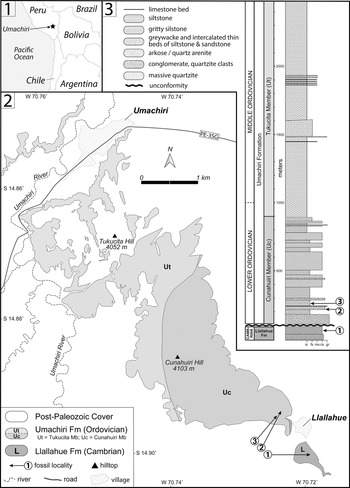
The studied area is situated in the western part of the Melgar Province in southern Peru (Puno Department), within the Andean Altiplano (= high plains morphotectonic region), ~ 130 km northwest of the city of Puno and 100 km northwest of Lake Titicaca. The Umachiri Inlier, covering an area of only ~ 16 km² and situated at an average altitude of 3,980 m above sea level, consists of lower Paleozoic rocks that outcrop mainly to the south of the town of Umachiri and to the east of the middle course of the river by the same name (Fig. 1). This inlier contains the oldest sedimentary units of the Peruvian Altiplano (Furongian to Middle Ordovician), which are partially covered by Miocene conglomerates (Tinajani Formation) and volcanics, as well as by various Quaternary surficial formations (Carlotto, Reference Carlotto2013).
Geological map and stratigraphic column of Paleozoic units in the vicinity of Umachiri, Peru. (1) The Umachiri District in southern Peru, indicated by a black star on a political map of western South America. (2) The geology of the Umachiri Inlier, simplified after Hodgin et al. (Reference Hodgin, Gutiérrez-Marco, Colmenar, Macdonald, Carlotto, Crowley and Newmann2021) to highlight exposure of trilobite-bearing strata from the Llallahue and Umachiri formations. (3) Lithostratigraphy of the Llallahue and Umachiri formations modified after Hodgin et al. (Reference Hodgin, Gutiérrez-Marco, Colmenar, Macdonald, Carlotto, Crowley and Newmann2021). Numbered white circles indicate fossiliferous localities and stratigraphic horizons: 1 = sample B1797; 2 = samples B1799 and B1806; 3 = field photo at sampling site B1808; Fm = Formation; L = Llallahue Formation; Mb = Member; Uc = Cunahuiri Member; Ut = Tukucita Member.

The Paleozoic succession comprises two formations separated by an erosional unconformity. The lower unit (Cambrian; Llallahue Formation of Hodgin et al., Reference Hodgin, Gutiérrez-Marco, Colmenar, Macdonald, Carlotto, Crowley and Newmann2021) crops out only in the southeasternmost part of the Umachiri Inlier and consists of 40 m of quartzite overlain by 60 m of sparsely fossiliferous arkose (Fig. 1.3). There is no exposure below the quartzite. The upper unit is the Umachiri Formation (Ordovician; Umachiri Series of Flores and Rodríguez, Reference Flores and Rodríguez1999; Carlotto et al., Reference Carlotto, Cárdenas, Bahlburg, Westervoss, Flores, Cerpa, Dávila, Carlotto and Chalco2004; and Ibarra et al., Reference Ibarra, Mamani, Rodríguez, Sempéré, Carlotto and Carlier2004; = Umachiri beds of Bahlburg et al., Reference Bahlburg, Carlotto and Cárdenas2006, Reference Bahlburg, Vervoort, DuFrane, Carlotto, Reimann and Cárdenas2011), which comprises ~ 2,400 m of conglomerate, sandstone, greywacke, siltstone, and rare limestone (Fig. 1.3). This unit was redescribed and formalized by Hodgin et al. (Reference Hodgin, Gutiérrez-Marco, Colmenar, Macdonald, Carlotto, Crowley and Newmann2021) and subdivided into a lower coarse-grained member (Cunahuiri Member) and an upper fine-grained member (Tukucita Member). The base of the formation (= base of the Cunahuiri Member) is a conglomerate unit with a minimum thickness of 80 m composed of quartzite and arkose clasts. Interbeds of siltstone and arkose to 1 m thick occur near the top of the conglomerate unit. These interbeds represent a gradational transition into an overlying siltstone unit, which is ~ 150 m thick. This siltstone-dominated unit contains conglomerate beds ranging 1–30 m thick and rare limestone beds < 1 m thick. Fossiliferous horizons occur 40–70 m above the base of the siltstone unit within lithologies of conglomerate, blue limestone, and green siltstone. The siltstone unit is overlain by 600 m of predominantly arkosic quartz arenite, which makes up the uppermost unit of the Cunahuiri Member. Subordinate lithologies include siltstone and greywacke. These lithologies occur within the quartz arenite as meter-scale interbeds and as intervals to 40 m thick. The transition to the overlying siltstone-dominated Tukucita Member (= upper Umachiri Formation) is gradational and includes greywacke and sandstone beds interbedded with siltstone at scales ranging from ~10 cm to several meters.
The trilobite material studied in this work comes from three fossiliferous horizons located south and west of Llallahue village (Fig. 1). The oldest fossils come from a single stratigraphic horizon within the upper arkosic unit of the Llallahue Formation, and the remaining two trilobite fossil horizons come from near the base of the middle siltstone unit of the Cunahuiri Member of the Umachiri Formation (Fig. 1.3). The lowermost assemblage was preliminarily dated as Furongian (= upper Cambrian) by Hodgin et al. (Reference Hodgin, Gutiérrez-Marco, Colmenar, Macdonald, Carlotto, Crowley and Newmann2021), whereas the other two horizons, placed 120–150 m above the base of the Umachiri Formation, are associated with and overlap stratigraphically with brachiopods of Floian–Dapingian? (Early Ordovician to earliest Middle Ordovician?) age (Colmenar and Hodgin, Reference Colmenar and Hodgin2020).
Biostratigraphic results
Figure 1 shows the location of the studied trilobite localities, both on the map (Fig. 1.2) and in the stratigraphic column (Fig. 1.3).
Cambrian assemblage
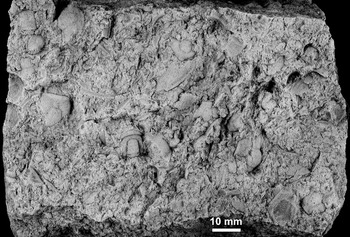
The single fossiliferous interval identified in the Llallahue Formation corresponds to a coquina of disarticulated trilobite remains (mainly cranidia, with rare pygidia, librigenae, and fragments of thoracic segments) that forms a small, thin, fossiliferous arkosic sandstone lens near the top of the arkose unit. Within this bed, most of the trilobite remains are highly fragmented and unrecognizable, but a coquinoid layer toward the middle of the sandstone intercalation shows more complete trilobite sclerites, preserved as unsorted, randomly oriented molds with a mixture of different species (Fig. 2). The location of this coquina was ~ 700 m south of the Llallahue village on the northeastern shoulder of a small hill (14.9008°S; 70.7175°W). The rock residue lacking identifiable fossils was processed by Hodgin et al. (Reference Hodgin, Carlotto, Macdonald, Schmitz, Crowley, Hynes and Murphy2023) to search for detrital zircons. LA-ICP-MS analyses of the corresponding sample (B1797), resulted in a broad dominant population from 1450–850 Ma and minor populations occurring at ~ 1650, 750–700, and ~ 500 Ma. The youngest detrital zircons from the ~ 500 Ma population were dated by CA-ID-TIMS, yielding a youngest 206Pb/238U age of ~ 497 Ma. This would be equivalent to a Guzhangian (late Miaolingian) age rather than the Miaolingian–Furongian boundary, because the age of the base of the Furongian Epoch has been recently revised and is now constrained at 495–494 Ma (Cothren et al., Reference Cothren, Farrell, Sundberg, Dehler and Schmitz2022; Farrell et al., Reference Farrell, Cothren, Sundberg, Schmitz, Dehler, Landing, Karlstrom, Crossley and Hagadorn2025) instead of the previously considered age of 497.0 Ma (Peng et al., Reference Peng, Babcock, Ahlberg, Gradstein, Ogg, Schmitz and Ogg2020).
Plan view of arkosic sandstone lens in locality 1, showing a coquina of disarticulated and fragmentary Furongian trilobite specimens occurring in the upper part of the Llallahue Formation, southern Peru; CPI 10200 (upper side).

The Cambrian trilobites recorded in the assemblage were represented by a few olenid forms belonging to the families Parabolinoididae (76% of the identified specimens) and Aphelaspididae (Peng et al., Reference Peng, Babcock, Ahlberg, Gradstein, Ogg, Schmitz and Ogg2020; 24%). The preservation in medium-grained sandstone prevents the preservation of fine morphological details in the external and internal molds, so none of the specimens have been identified at the species level, and doubts persist regarding the generic assignment of many of them. Nevertheless, among the aphelaspidids, we have recognized the presence of one species, which was identified and described in open nomenclature (as Aphelaspis sp. indet. 1), along with a second form (Aphelaspididae gen. indet. sp. indet.). Among the parabolinoidid trilobites, there appears to be only a single species, described here as Parabolinoididae? gen. indet. sp. indet. due to the relatively poor preservation already mentioned.
Despite the poor preservation and low diversity of the trilobite assemblage, the cosmopolitan early late Cambrian (early Furongian) genus Aphelaspis Resser, Reference Resser1935 has special biostratigraphic importance. Many of the Aphelaspis species are known from North America, among which there are numerous examples from the early Paibian Aphelaspis Biozone (e.g., Resser, Reference Resser1938; Nelson, Reference Nelson1951; Palmer, Reference Palmer1954, Reference Palmer1962, Reference Palmer1965; Shaw, Reference Shaw1956; Rasetti, Reference Rasetti1965; Pratt, Reference Pratt1992; Stitt and Perfetta, Reference Stitt and Perfetta2000; Schwimmer and Montante, Reference Schwimmer and Montante2012) but also a number of records from overlying units of middle to late Paibian (Olenaspella regularis and Olenaspella evansi biozones) and even early Jiangshanian ages (Proceratopyge rectispinata fauna and Elvinia Biozone; e.g., Palmer, Reference Palmer1965; Pratt, Reference Pratt1992). Outside Laurentia, Aphelaspis has been recorded from the: (1) Glyptagnostus reticulatus and Proceratopyge cryptica biozones (early to middle Paibian) of Australia (Henderson, Reference Henderson1976; Shergold, Reference Shergold1982); (2) Proceratopyge cryptica, Erixanium sentum, and Stigmatoa diloma biozones (middle–late Paibian) of south Tasmania (Jago, Reference Jago1987), and the early Jiangshanian of northwestern Tasmania (Jell et al., Reference Jell, Hughes and Brown1991); (3) Glyptagnostus reticulatus-Chuangia wulingensis Biozone (early Paibian) and the Pseudoglyptagnostus clavatus-Irvingella angustilimbata Biozone (early Jiangshanian) of South China (Peng, Reference Peng1992); (4) Aphelaspis Zone of Antarctica (Shergold et al., Reference Shergold, Cooper, Mackinnon and Yochelson1976; Shergold and Webers, Reference Shergold and Webers1992; Cooper et al., Reference Cooper, Jago and Begg1996); (5) Late Paibian–early Jiangshanian of Poland (Olenus scanicus and Parabolina brevispina subzones) and Wales (Olenus cataractes Subzone) (Żylińska, Reference Żylińska2001); (6) Early Jiangshanian of Spain (Shergold and Sdzuy, Reference Shergold and Sdzuy1991; see Álvaro et al., Reference Álvaro, Elicki, Geyer, Rushton and Shergold2003); (7) Paibian–early Jiangshanian of Kazakhstan and Siberia (Ivshin, Reference Ivshin1956, Reference Ivshin1962; Ivshin and Pokrovskaya, Reference Ivshin and Pokrovskaya1968; Rozova, Reference Rozova1968), and (8) Aphelaspis Zone of the Argentinian Precordillera (Bordonaro and Banchig, Reference Bordonaro and Banchig1996). In addition, it can be noted that the specimens referred to herein as Parabolinoididae? gen. indet. sp. indet. are comparable with material from the early Furongian (Elvinia Zone?) of Antarctica (Shergold and Webers, Reference Shergold and Webers1992).
Based on its trilobite record, the upper unit of the Llallahue Formation is regarded herein as early Furongian and more precisely as Paibian to early Jiangshanian (= Steptoean) in age. This dating clarifies and is consistent with the slightly older age of the youngest detrital zircon (~ 497 Ma; Guzhangian/late Miaolingian) recorded in the fossiliferous rock. The ~ 497 Ma radioisotopic age constraint from a detrital zircon is considered a maximum depositional age that predates the age of the trilobite assemblage.
Ordovician trilobite records
Two fossiliferous horizons (localities 2 and 3) containing trilobites were examined from the lower part of the siltstone unit of the Cunahuiri Member of the Umachiri Formation (Fig. 1.1, 1.2). These horizons range from 120 m (locality 2) to 150 m (locality 3) above the base of the Umachiri Formation and occur with coeval brachiopods present in the same strata.
The samples collected from locality 2 (samples B1799 and B1806) contained a monospecific assemblage of brachiopods with some scattered trilobites. All brachiopods in the horizon were identified by Colmenar and Hodgin (Reference Colmenar and Hodgin2020) as Paralenorthis cf. Paralenorthis carlottoi Villas in Gutiérrez-Marco and Villas, Reference Gutiérrez-Marco and Villas2007, a species that occurs with other brachiopod taxa immediately upsection between localities 2 and 3. The only trilobite remains identified at locality 2 consisted of a cephalon of the calymenine Neseuretus sp. indet. and two pygidia of the same genus plus a single pygidium of the leiostegiid Annamitella sp. indet. (sample B1806). These trilobite identifications align in age and paleobiogeographic framework with data derived from the brachiopod assemblage, which Colmenar and Hodgin (Reference Colmenar and Hodgin2020) correlated very precisely with various sections of the Puna (= Altiplano) of northwestern Argentina (see below).
On the other hand, the single asaphid pygidium found at locality 3 represents the first global record of a species related to Suriaspis? trumpyi (Harrington and Kay, Reference Harrington and Kay1951) [= ex Basiliella trumpyi Harrington and Kay, Reference Harrington and Kay1951], which was originally described in Colombia from beds attributed to the late Tremadocian. However, in this study, we have revised the stratigraphic context of its type locality based on association with other species, resulting in its reassignment to the early Floian, comparable with the most likely dating for its finding in the Peruvian Altiplano.
More than 1,500 m upsection from these fossiliferous horizons and located in the middle unit of the Cunahuiri Member, the next well-dated interval is Middle Ordovician (Darriwilian) and corresponds to the fossil occurrence of graptolites previously documented by Cerrón and Chacaltana (Reference Cerrón, Chacaltana, Dávila, Carlotto and Chalco2002) and discussed by Hodgin et al. (Reference Hodgin, Gutiérrez-Marco, Colmenar, Macdonald, Carlotto, Crowley and Newmann2021, fig. 6).
Materials and methods
The material for this study was collected by one of us (EBH) during field campaigns in 2017 and 2018 from the upper arkosic unit of the Llallahue Formation (locality 1) and from the lower Cunahuiri Member of the Umachiri Formation (localities 2 and 3) (Fig. 1.2, 1.3). The specimens are mostly preserved as internal and external molds in arkosic sandstones and dark siltstones. Fossils have been prepared using mechanical methods in the labs of the Universidad Complutense of Madrid. Latex casts of the specimens were subsequently prepared to replicate the internal and external features. Before photography, fossils and latex casts were coated with vapors of magnesium oxide. Photographs were taken with a digital camera Canon EOS 5D with a Canon Compact-Macro 100 mm EF. The images were subsequently processed and assembled in figures using Adobe Photoshop CS6 Extended, to enrich focus, brightness, contrast, shadows, highlights and saturation.
Repository and institutional abbreviation
All illustrated specimens are housed in the paleontological collection of the Peruvian Geological Survey (INGEMMET: Geological, Mining, and Metallurgical Institute) in Lima, under the accession numbers CPI 10200 (which includes 26 specimens numbered CPI 10200-1 through 10200-26) plus CPI 10201 through 10206.
Systematic paleontology
Terminology
The morphological terms used below were mostly defined by Whittington and Kelly (Reference Whittington, Kelly and Kaesler1997). Abbreviations: sag., sagittally; exs., exsagittally; long., longitudinally; tr., transversally.
Classification
The classification of Fortey (Reference Fortey and Kaesler1997, Reference Fortey2001) has been followed, with modifications proposed by Adrain (Reference Adrain and Zhang2011) for the redefined order Olenida.
Class Trilobita Walch, Reference Walch1771
Order Olenida Adrain, Reference Adrain and Zhang2011
Family Aphelaspididae Palmer, Reference Palmer1960
Genus Aphelaspis Resser, Reference Resser1935
Type species
Aphelaspis walcotti Resser, Reference Resser1938 from the lower Furongian of Virginia, USA, by original designation.
Remarks
Palmer (Reference Palmer1953, Reference Palmer1954, Reference Palmer1962, Reference Palmer1965), Rasetti (Reference Rasetti1965), Henderson (Reference Henderson1976), Shergold (Reference Shergold1982), Jago (Reference Jago1987), and Pratt (Reference Pratt1992) discussed in detail the scope of Aphelaspis, which is characterized by the presence of a subtrapezoidal cranidium; a frontal area divided into distinct anterior border and preglabellar field; a straight-sided, forwardly tapered glabella with a truncate or bluntly rounded anterior end; weak or imperceptible lateral glabellar furrows; faint eye ridges; distinctive arcuate palpebral lobes situated approximately opposite midlength of glabella; a transverse pygidium showing curved or angular posterolateral corners; and a prominent backwardly tapered pygidial axis with a variable number (1–5) of axial ring furrows. Aphelaspis has been recognized on different continents (Henderson, Reference Henderson1976; Shergold, Reference Shergold1982). The characters used for discrimination of its species were fully discussed by Rasetti (Reference Rasetti1965).
Aphelaspis sp. indet. 1
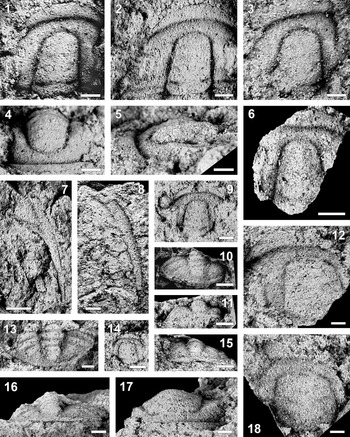
Figure 3.1–3.11, 3.13, 3.15, 3.16
(1–11, 13, 15, 16) Aphelaspis sp. 1: (1–5) cranidium CPI 10200-1 in dorsal (1–3), anterior (4), and lateral (5) views, before (1) and after (2) preparation of the internal mold, and latex of the external mold of same (3, CPI 10200-1b) (illustrated previously by Hodgin et al., Reference Hodgin, Gutiérrez-Marco, Colmenar, Macdonald, Carlotto, Crowley and Newmann2021, fig. 7R); (6) cranidium CPI 10202; (7, 8) librigenae CPI 10200-18 and CPI 10203, respectively; (9) small cranidium CPI 10200-23; (10, 11) pygidium CPI 10200-19a and b (latex cast) in dorsal (10) and posterior (11) views; (13, 16) pygidium CPI 10200-2 in dorsal (13) and posterior (16) views; (15) pygidium CPI 10200-13b (latex cast) in oblique-posterior view. (12, 14, 17, 18) Aphelaspididae gen indet. sp. indet.: (12, 17, 18) cranidium CPI 10200-15 internal mold (12, 17) and latex cast (18, CPI 10200-15b) in dorsal (12, 18) and anterior (17) views; (14) small cranidium CPI 10200-3. Upper Llallahue Formation (lower Furongian), Umachiri inlier, southern Peru. Scale bars = 2 mm.

vReference Hodgin, Gutiérrez-Marco, Colmenar, Macdonald, Carlotto, Crowley and Newmann2021 Aphelaspidinae gen. indet. sp. indet.; Hodgin et al., p. 210, fig. 7R (no description).
Description
Cranidium slightly convex, subtrapezoidal in outline, with strongly rounded anterior margin and somewhat downsloping fixigenae. Glabella elongate, much longer than wide, slightly tapered forward and bluntly rounded anteriorly, clearly delimited by straight axial furrows, moderately elevated above genal region, showing weak indications of lateral glabellar furrows; it occupies approximately two-thirds of total cranidial length (sag.); occipital ring with slightly curved posterior margin, occupying ~ 20% of the total glabellar length, without signs of a median node; occipital furrow distinct, shallow, and slightly bowed forward on midline, and deepest and somewhat oblique forward laterally; lateral furrows extremely faint, subequal in development, slightly arcuate, directed obliquely inward and backward, disconnected medially. Anterior cranidial border upturned, widest (sag.) on midline, clearly delimited by well-incised border furrow that is sinuous in small specimens (Fig. 3.6, 3.9) and curved in a later holaspis stage (Fig. 3.1); preglabellar field slightly convex, downsloping, subequal in length to a little shorter (sag.) than anterior cranidial border; angle formed by the border with respect to the preglabellar field in lateral view sharp; anterior facial suture diverging at an angle of ~ 45º to the exsagittal line; eye ridge faint, slightly oblique backward; palpebral lobe large, subsemicircular in outline, ~ 35% length (exs.) relative to the total cranidial length (sag.), situated approximately opposite glabellar midlength, delimited by a shallow but distinct arcuate palpebral furrow; posterior section of facial suture transverse, sinuous; posterior fixigena narrow (exs.) and sharply pointed, having a fine posterior border furrow and a narrow (exs.), convex border. Librigena with long, weakly curved genal spine continuing curvature of lateral margin; lateral and posterior furrows joined at genal angle and extended short distance onto base of genal spine.
Pygidium transversely elongate, semielliptical in outline, much wider than long, with slightly angular anterolateral corners and convergent lateral margins, transverse posteriorly, showing indications of a weak median indentation. Axis long, convex, elevated above level of pleural fields, slightly tapered backward, rounded at posterior end, composed of three rings and a terminal piece defined by transverse ring furrows (first two ring furrows more distinct than third one); axis occupies approximately four-fifths of total pygidial length (excluding articulating half ring); articulating half ring well developed (sag.), clearly delimited by a transverse articulating furrow. Pleural field narrowed backward, downsloping distally, crossed by two noticeable pleural furrows (and traces of a third one in a relatively large specimen; Fig. 3.13); marginal border narrow, poorly defined but distinct.
Materials
Three cranidia, two librigenae, and three pygidia (CPI 10200-1, 10200-2, 10200-13, 10200-18, 10200-19, 10200-23, 10202, 10203) from the tan arkosic arenite bed (lower Furongian) of the upper part of the Llallahue Formation (locality 1; Fig. 1.2), Umachiri inlier, southern Peru.
Remarks
The cranidia described above are characterized by a straight-sided, slightly tapered glabella with bluntly rounded anterior margin and obscure lateral furrows, a frontal area consisting of discrete brim and border that are separated each other by a sharp break in slope, weak eye ridges, and distinctive semicircular palpebral lobes; these are characters that accord with the diagnosis of Aphelaspis (e.g., Palmer, Reference Palmer1954; Pratt, Reference Pratt1992). Two associated librigenae of the Strigambitus-Aphelaspis type (Palmer, Reference Palmer1965), as well as three transverse pygidia with a straight to slightly indented posterior margin (Fig. 3.11, 3.13, 3.15), are also compatible with Aphelaspis and are tentatively linked with these cranidia.
Aphelaspis sp. indet. 1 compares most closely with those forms of Aphelaspis that exhibit an anteriorly rounded rather than a truncate glabella. Aphelaspis ludvigsensis Pratt, Reference Pratt1992, from the upper Paibian–lower Jiangshanian (Parabolinoides calvilimbata and Proceratopyge rectimarginata faunas) of the Mackenzie Mountains, Canada (Pratt, Reference Pratt1992, pl. 15, figs. 14–25), is also very similar to Aphelaspis sp. indet. 1 in sharing a subequally developed anterior border and preglabellar field, strongly diverging anterior facial sutures, and broad and long genal spines; the former differs only by having slightly shorter (exs.) palpebral lobes and more distinct lateral glabellar furrows.
Aphelaspis sp. indet. 1 and Aphelaspis haguei (Hall and Whitfield, Reference Hall and Whitfield1877), from the Aphelaspis Zone of USA and the Glyptagnostus reticulatus and Olenaspella regularis zones of Canada (Palmer, Reference Palmer1962, pl. 4, fig. 25; 1965, pl. 8, fig. 23, pl. 9, figs. 19–26; Pratt, Reference Pratt1992, pl. 13, figs. 1–13 and references therein), share a wide (sag.) anterior cranidial border, large palpebral lobes, and indications of a third pygidial pleural furrow; however, the latter is differentiated by its slightly longer preglabellar field, and the presence of a conspicuous occipital node and shorter genal spines. Similarly, Aphelaspis longifrons Palmer, Reference Palmer1954, from the Aphelaspis Zone of Texas (Palmer, Reference Palmer1954, pl. 84, figs. 9, 12; pl. 85, figs. 2, 3), combines a large anterior cranidial border and a nontruncate glabella, but it is easily distinguished by having an extremely arched anterior cephalic margin and an exceptionally long frontal area.
Aphelaspis brachyphasis Palmer, Reference Palmer1962 from the Aphelaspis Zone of the Great Basin (Palmer, Reference Palmer1962, pl. 4, figs. 1–19; 1965, pl. 8, figs. 13, 17–21) and the southern Appalachians (Schwimmer and Montante, Reference Schwimmer and Montante2012, fig. 3.1–3.7) and from the Glyptagnostus reticulatus and Olenaspella regularis zones of the Mackenzie Mountains (Pratt, Reference Pratt1992, pl. 14, figs. 1–15), as well as Aphelaspis cf. Aphelaspis australis Henderson, Reference Henderson1976 from the Aphelaspis Zone of Antarctica (Shergold and Webers, Reference Shergold and Webers1992, pl. 7, figs. 9–13), are likewise comparable with the material studied herein, differing in having a proportionately shorter (sag.) anterior cranidial border, less divergent anterior facial sutures, and shorter genal spines. Aphelaspis australis from the lower Furongian (Glyptagnostus reticulatus and Proceratopyge cryptica zones) of Australia (Henderson, Reference Henderson1976, pl. 49, figs. 5–7) has, in addition, more distinct eye ridges and glabellar furrows.
Aphelaspis palmeri Rasetti, Reference Rasetti1965, from the Aphelaspis Zone of Tennessee (Rasetti, Reference Rasetti1965, pl. 14, figs. 13–19) has an anterior cranidial border that is very similar to that of Aphelaspis sp. indet. 1, but the former differs in having a truncate glabella, a proportionately longer preglabellar field, and more anteriorly located palpebral lobes. Aphelaspis cf. Aphelaspis walcotti, from the Aphelaspis Zone of Antarctica (Shergold and Webers, Reference Shergold and Webers1992, pl. 9, figs. 1–3), is differentiated by its subrectangular glabella and its shorter genal spines. The holotype of the type species, Aphelaspis walcotti, from the lower Furongian of Virginia (Palmer, Reference Palmer1962, pl. 4, fig. 24), shows, in addition, a flattened anterior border.
Like Aphelaspis sp. indet. 1, Aphelaspis buttsi (Kobayashi, Reference Kobayashi1936), from the lower Furongian of North America and South China (Palmer, Reference Palmer1962, pl. 4, figs. 23, 26, 31, 32; 1965, pl. 8, figs. 14–16; Rasetti, Reference Rasetti1965, pl. 16, figs. 1–7; Peng, Reference Peng1992, fig. 27H–J), exhibits conspicuous genal spines reaching posterior end of thorax; however, it is distinguished mainly by its narrow (sag.) anterior cranidial border, well-developed preglabellar field, straight preglabellar furrow, and eye ridges that are directed laterally at a right angle to the axial line. Many other species of Aphelaspis from different paleocontinents differ from the Peruvian specimens mainly by combining an anteriorly truncate glabella with a narrow (sag.) anterior cephalic border and a relatively long preglabellar field.
Aphelaspididae gen. indet. sp. indet.
Figure 3.12, 3.14, 3.17, 3.18
Description
Glabella large, subrectangular in outline, somewhat elevated above fixed cheeks, slightly tapered forward and truncate anteriorly, surrounded by narrow and deep axial and preglabellar furrows, showing indications of lateral furrows S1 and S2 that are slightly bowed forward, oblique backward, and disconnected medially. Anterior cranidial border well developed, convex, separated from the preglabellar field by a conspicuous, proportionately wide (exs.) border furrow; anterior border and preglabellar field seem to be of similar width (sag.); eye ridge long, oblique backward; ocular area of fixigena proportionately wide (tr.), representing approximately half of glabellar width; palpebral lobe crescentic, posteriorly situated; other characters not preserved for description.
Materials
Two fragmentary cranidia (CPI 10200-3 and 10200-15) from the tan arkosic arenite bed (lower Furongian) of the upper part of the Llallahue Formation (locality 1; Fig. 1.2), Umachiri inlier, southern Peru.
Remarks
The above description is based mainly on the late holaspid specimen CPI 10200-15 (Fig. 3.12, 3.17, 3.18), which attains a relatively large size. Although this cranidium is fragmentary and cannot be identified with confidence, it is worth noting that it has some resemblance with Elegantaspis Ivshin, Reference Ivshin1962, by virtue of the combination of a slightly tapering, subtruncate glabella, distinct and subequally developed anterior border and preglabellar field, and large palpebral lobes that are located slightly behind level of the centre of the glabella. It is comparable with Elegantaspis beta Ivshin, Reference Ivshin1962 from the lower Jiangshanian of Kazakhstan (Ivshin, Reference Ivshin1962, pl. 5, figs. 3, 4), as well as Elegantaspis cf. Elegantaspis beta from approximately contemporaneous strata of Spain (Shergold and Sdzuy, Reference Shergold and Sdzuy1991, pl. 3, figs. 36–42), in sharing a subquadrate glabella; however, the material from Peru differs by its wider (tr.) fixigenae and, consequently, its longer ocular ridges, which furthermore are more apparent, and its more distinct lateral glabellar furrows. In that regard, it mostly resembles Eugonocare? nebulosum Shergold and Webers, Reference Shergold and Webers1992, from the lower and upper Paibian (Aphelaspis and Dunderbergia biozones) of Antarctica (Shergold and Webers, Reference Shergold and Webers1992, pl. 8, figs. 3–10); the latter can hardly be distinguished by showing a slightly narrower (tr.) and less-tapering glabella.
Family Parabolinoididae Lochman, Reference Lochman1956
Parabolinoididae? gen. indet. sp. indet.
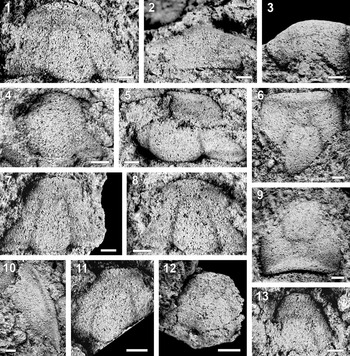
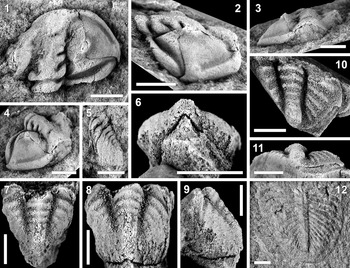
Parabolinoididae? gen. indet. sp. indet.: (1–3) cranidium CPI 10200-6 in dorsal (1), anterior (2), and lateral (3) views (illustrated previously by Hodgin et al., Reference Hodgin, Gutiérrez-Marco, Colmenar, Macdonald, Carlotto, Crowley and Newmann2021, fig. 7S); (4) cranidium CPI 10200-20; (5) cranidium CPI 10200-12; (6, 9) fragmentary cranidium CPI 10200-26 in dorsal (6) and oblique-anterior (9) views; (7) cranidium CPI 10200-5; (8) cranidium CPI 10200-16; (10) librigena CPI 10200-7b (latex cast); (11) cranidium CPI 10200-4; (12) cranidium CPI 10201; (13) fragmentary cranidium CPI 10200-11. Upper Llallahue Formation (lower Furongian), Umachiri inlier, southern Peru. Scale bars = 2 mm.

Reference Shergold and Webers1992 Parabolinoididid? gen. indet. sp. indet.; Shregold and Webers, p. 145, pl. 9, figs. 4–8.
vReference Hodgin, Gutiérrez-Marco, Colmenar, Macdonald, Carlotto, Crowley and Newmann2021 Parabolinoididae? gen. indet. sp. indet.; Hodgin et al., p. 210, fig. 7S (no description).
Description
Cranidium subtrapezoidal in outline, uniformly convex, with strongly to moderately rounded anterior margin and downsloping fixed cheeks. Glabella large, unfurrowed, conical in outline, with gently tapering sides and truncate anterior margin, poorly elevated above genal region, surrounded by faint axial furrows; it occupies approximately three-quarters of cranidial length (sag.) and 45–50% of cranidial width (tr.) at level of palpebral lobes; occipital ring with rounded posterior margin, smooth, occupying ~ 18–20% of total glabellar length, weakly defined by an almost imperceptible occipital furrow. Anterior cranidial border narrow (sag.), little upturned to almost flat, delimited by a delicate, shallow border furrow that is represented by a change in slope of exoskeleton; preglabellar field downsloping, wider (sag.) than anterior cranidial border; anterior facial suture subparallel to somewhat divergent; palpebral area of the fixigena moderately wide (tr.); ocular ridge transverse, very faint, not visible in all specimens; palpebral lobe situated well in front of level of cranidial midpoint, length ~ 15–18% of total cephalic length; posterior facial suture oblique backward and outward, slightly sinuous; posterior fixigena subtriangular in outline, with a shallow border furrow and a narrow (exs.) posterior border. Two specimens (Fig. 4.1, 4.5) show faint indications of bacculae. Librigena imperfectly preserved for description.
Materials
Thirteen cranidia and two fragmentary librigenae, all of them in samples CPI 10200 (10200-4 through 10200-12, 10200-14, 10200-16, 10200-17, 10200-20, 10200-26) and 10201, derived from the tan arkosic arenite bed (lower Furongian) of the upper part of the Llallahue Formation (locality 1; Fig. 1.2), Umachiri inlier, southern Peru.
Remarks
The morphology of the cranidia described above accords, in essence, with that of Parabolinoididid? gen. indet. sp. indet., from the lower Furongian (Elvinia Zone?; lower Jiangshanian) of Antarctica (Shergold and Webers, Reference Shergold and Webers1992, pl. 9, figs. 4–8), especially by sharing a truncatoconical glabella lacking lateral furrows, and small, anteriorly located palpebral lobes that are relatively far from the glabella; in addition they share a downsloping preglabellar field and indications of bacculae. The specimens from Peru differ from those of Antarctica just by showing more effaced dorsal furrows, and a less-defined occipital ring. All of these materials show close affinities with both Parabolinoididae and Olenidae Burmeister, Reference Burmeister1843 (see further discussion by Shergold and Webers, Reference Shergold and Webers1992, p. 145, which mostly applies here). As stated by Shergold et al. (Reference Shergold, Liñán and Palacios1983) and Shergold and Webers (Reference Shergold and Webers1992), Shirakiellidae Hupé, Reference Hupé1953 is also characterized by having a truncate-conical glabella, effaced lateral glabellar furrows and anteriorly situated palpebral lobes, but is distinguished from the material studied herein by having preglabellar fossulae and a more distinctive anterior border. Within Parabolinoididae, the genus Kendallina Berg in Moore, Reference Moore1959, from the Jiangshanian of North America (e.g., Westrop, Reference Westrop1986, p. 52), differs by showing a triangular anterior border, and palpebral lobes that are close to the glabella.
A fragment of a large cranidium in the sample studied (Fig. 4.6, 4.9) exhibits a preglabellar field that is proportionately longer than that of earlier holaspides; an intraspecific (ontogenetic) variation that was also documented in the ontogeny of other olenaceans [e.g., Orygmaspis (Parabolinoides) contracta (Frederickson, Reference Frederickson1949); Orygmaspis (Parabolinoides) spinula Westrop, Reference Westrop1986] (Westrop, Reference Westrop1986, p. 47).
Order Phacopida Salter, Reference Salter1864
Suborder Calymenina Swinnerton, Reference Swinnerton1915
Superfamily Calymenoidea Burmeister, Reference Burmeister1843
Family Calymenidae Milne Edwards, Reference Milne Edwards1840
Subfamily Reedocalymeninae Hupé, Reference Hupé1955
Genus Neseuretus Hicks, Reference Hicks1873
Type species
Neseuretus ramseyensis Hicks, Reference Hicks1873 from the Lower Ordovician (lower Arenig) of Wales, by original designation.
Neseuretus sp. indet.
(1–9) Neseuretus sp.: (1–4) latex cast of external mold of cephalon CPI 10204 in dorsal (1), lateral (2), anterior (3), and oblique anterolateral (4) views; (5) latex cast of left-lateral side of pygidium CPI 10205 with the external mold of last two thoracic segments; (6–9) internal mold of the same pygidium in ventral (6), dorsal (7), posterior (8), and left-lateral (9) views. (10, 11) Annamitella sp. indet., internal mold of pygidium CPI 10206 in dorsal (10) and posterior (11) views. (12) Suriaspis? cf. Suriaspis trumpyi (Harrington and Kay, Reference Harrington and Kay1951), field photograph of noncollected pygidium. Umachiri Formation (Lower Ordovician), Umachiri inlier, southern Peru. Scale bars = 5 mm; except 3 mm (7–9).

vReference Hodgin, Gutiérrez-Marco, Colmenar, Macdonald, Carlotto, Crowley and Newmann2021 Neseuretus sp. indet.; Hodgin et al., p. 210, fig. 7T (no description).
Materials
A single cephalon and one pygidium (CPI 10204 and 10205, respectively) from green siltstones in the lower half of the Cunahuiri Member of the Umachiri Formation (locality 2; Fig. 1.2). Lower Ordovician, imprecise ?Floian strata. Umachiri inlier, southern Peru.
Remarks
The available material consists of one isolated cephalon (Fig. 5.1–5.4) and two pygidia (Fig. 5.5–5.9), one of them (Fig. 5.5) conserving two thoracic segments. Despite the poor state of preservation of the material, the subtrapezoidal glabella, the glabellar furrows and lobes and, especially, the well-defined and broad (sag.) pre-glabellar area are diagnostic of Neseuretus, the identification of which is supported by the associated pygidia. The cephalon is, however, too deformed to properly evaluate specific diagnostic characters and thus it is better left in open nomenclature. The pygidia of the Peruvian specimens show at least five axial rings (and possibly this is the definite number) and a terminal piece that continues posteriorly as a postaxial ridge, but does not have a distinct outline, being the axial furrows straight posteriorly. There are four to five pleural furrows, and interpleural furrows are not preserved. One of the most distinctive features of this material is the glabella, which is quite long (sag.) with a truncated anterior margin, instead of evenly convex, which is the most common morphology in Neseuretus species (see Turvey, Reference Turvey2005 for a complete list). This glabellar outline, as well as the glabellar segmentation, recalls genera such as Salterocoryphe Hammann, Reference Hammann1977 and even Colpocoryphe Rouault, Reference Rouault1847, although the remaining cephalic characters (particularly the preglabellar morphology) are clearly distinct and Neseuretus-like. This preglabellar area is relatively flat but appears deformed and it is difficult to assess the role of deformation in its strange appearance. Nevertheless, the existence of several Lower Ordovician species with a flattened preglabellar area could support that this morphology is real, like N. arenosus Dean, Reference Dean1966 from the Montagne Noire or N. parvifrons (M‘Coy in Sedgwick and M’Coy, Reference Sedgwick and M’Coy1851), and N. monensis (Shirley, Reference Shirley1936) from Wales. Among the reported occurrences of Neseuretus from the Central Andean Basin, the Peruvian specimens recall N. kobayashii (Harrington and Leanza, Reference Harrington and Leanza1957) from the Lower Ordovician of Bolivia, described by Kobayashi (Reference Kobayashi1937) as Calymene (Synhomalonotus?) pompeckji Kobayashi, Reference Kobayashi1937 (compare glabellar and preglabellar morphology by Kobayashi, Reference Kobayashi1937, pl. 6, fig. 24), but both sets of material are too poorly preserved to allow further discussion. The pygidia of the Bolivian specimens are also more segmented and it is not clear if they will fit better in Aristocalymene Turvey, Reference Turvey2005 (as suggested by Turvey, Reference Turvey2005 for other Bolivian species, namely Neseuretus sanlucasensis Přibyl and Vaněk, Reference Přibyl and Vaněk1980). Neseuretus chaschuilensis Vaccari and Waisfeld, Reference Vaccari and Waisfeld1994 from the Floian Suri Formation of Catamarca Province, northwestern Argentina has a similar number of pygidial axial rings and pleural furrows, with a nonexpanded (tr.) terminal piece, but regardless the grade of deformation of the studied cephalon, the glabellar and the anterior area look distinct. In these characters, our specimen is more similar to Neseuretus lipanensis Waisfeld, Reference Waisfeld1997, from the Floian Acoite Formation of Eastern Cordillera, northwestern Argentina, the preglabellar area of which has a very similar outline and low profile. Nevertheless, the length (exsag.) of the frontal glabellar lobe (L4) in the Peruvian material is relatively longer. The deepness and course of the glabellar furrows, particularly the very well-incised S3, are, however, reminiscent of the studied specimens, and we cannot rule out the possibility that this material is conspecific with the Argentinian species, nor can we rule out the possibility that the strange glabellar morphology is real and represents an unknown form of these basal reedocalymenines.
Order Corynexochiida Kobayashi, Reference Kobayashi1935
Suborder Leiostegiina Bradley, Reference Bradley1925
Family Leiostegiidae Bradley, Reference Bradley1925
Subfamily Leiostegiinae Bradley, Reference Bradley1925
Genus Annamitella Mansuy, Reference Mansuy1920
Type species
Annamitella asiatica Mansuy, Reference Mansuy1920 from the Lower Ordovician of Vietnam, by original designation.
Annamitella sp. indet.
vReference Hodgin, Gutiérrez-Marco, Colmenar, Macdonald, Carlotto, Crowley and Newmann2021 Annamitella sp. indet.; Hodgin et al., p. 210, fig. 7U (no description).
Materials
One fragmentary internal mold of pygidium (CPI 10206) from green siltstones in the lower half of the Cunahuiri Member of the Umachiri Formation (locality 2; Fig. 1.2). Lower Ordovician, imprecise ?Floian strata. Umachiri inlier, southern Peru.
Remarks
Only one isolated pygidium is available, so in the absence of cephalic characters, it is not possible to make a specific assignment. Although incomplete, the pygidial morphology allows secure assignment to Annamitella (compare Fig. 5.10 with Waisfeld and Vaccari, Reference Waisfeld, Vaccari and Benedetto2003, pl. 15, fig. 7), a genus that has several coetaneous records in Argentina (see Vaccari and Waisfeld, Reference Vaccari and Waisfeld1994). These include Annamitella longulosa Vaccari and Waisfeld, Reference Vaccari and Waisfeld1994 from the Suri Formation of the Famatina Basin of Argentina, three species from the Precordillera Basin— Annamitella tellecheai (Rusconi, Reference Rusconi1951), Annamitella harringtoni Vaccari, Reference Vaccari1993, and Annamitella forteyi Vaccari, Reference Vaccari1993, mainly from different levels within San Juan Formation (see Waisfeld and Vaccari, Reference Waisfeld, Vaccari and Benedetto2003, pl. 3, figs. 1–12) and Annamitella sp. indet. from the Aguada de la Perdiz Formation, western Puna (Waisfeld and Vaccari, Reference Waisfeld, Vaccari and Benedetto2003). All of them are differentiated based mainly on cephalic characters, not available in the studied material. On the other hand, the lateral widening of the pygidial border described as distinctive of the species Annamitella longulosa is not possible to evaluate, being not preserved or fragmented in the single available specimen.
Order Asaphida Salter, Reference Salter1864
Suborder Asaphina Salter, Reference Salter1864
Superfamily Asaphoidea Burmeister, Reference Burmeister1843
Family Asaphidae Burmeister, Reference Burmeister1843
Genus Suriaspis Aceñolaza and Rábano, Reference Aceñolaza and Rábano1990
Type species
Suriaspis cachiyuyana Aceñolaza and Rábano, Reference Aceñolaza and Rábano1990, from the Suri Formation (Floian) of Sierra de Famatina, La Rioja, Argentina, by original designation.
Remarks
The genus Suriaspis is known from a limited number of specimens of its type species, which show a general resemblance to Merlinia Fortey and Owens, Reference Fortey and Owens1978, except for the absence of the lateral border furrow on the fixigenae and by the multisegmented, parabolic-shaped pygidium. According to Waisfeld and Vaccari (Reference Waisfeld, Vaccari and Benedetto2003, p. 313), the available material is still insufficient, and the genus requires revision, despite the fact that the holotype of Suriaspis cachiyuyana corresponds to a complete and very well-preserved individual (Aceñolaza and Rábano, Reference Aceñolaza and Rábano1990, fig. 2a).
We provisionally assign to Suriaspis a possible second representative of the genus, Basiliella trumpyi Harrington and Kay, Reference Harrington and Kay1951, described from the lower Floian of Colombia, but known only from two pygidia. These are key to rule out its relationship to the genus Basiliella Kobayashi, Reference Kobayashi1934, but the absence of an associated cephalon or cranidium prevents clarification of its true generic identity. The markedly parabolic outline of the pygidium, together with a high number of axial rings and pleural ribs, show some resemblance to Suriaspis cachiyuyana (even though the pygidial segmentation of the latter is lower), and constitute characters very different from other Ordovician asaphids of South America. Therefore, the species identified in the Umachiri Formation, related to the columbine species, is here tentatively assigned to Suriaspis? based only on the pygidial characters, but also taking into account the strong affinities shown by the brachiopods of this unit with those of the Suri Formation of the Sierra de Famatina, type-stratum of Suriaspis cachiyuyana, strengthened by the occurrence of the trilobites Neseuretus and Annamitella, to which this Suriaspis-like form could be added.
Suriaspis ? cf. Suriaspis trumpyi (Harrington and Kay, Reference Harrington and Kay1951)
cf.vReference Trumpy1943 Megalaspis cf. Megalaspis extenuata Dalman, Reference Dalman1827; Trumpy, p. 1287.
cf.vReference Harrington and Kay1951 Basiliella trumpyi Harrington and Kay, p. 665, 666, pl. 97, figs. 17, 18.
vReference Hodgin, Gutiérrez-Marco, Colmenar, Macdonald, Carlotto, Crowley and Newmann2021 unidentified asaphid; Hodgin et al., p. 210 (no description).
Holotype
Pygidium (American Museum of Natural History AMNH-CU 25944) from central Sierra de La Macarena, Colombia (Harrington and Kay, Reference Harrington and Kay1951, pl. 97, fig. 17; Fig. 6).
Suriaspis trumpyi (Harrington and Kay, Reference Harrington and Kay1951). Internal mold of the holotype pygidium, Güejar Group, Floian, central Sierra de La Macarena, Colombia. AMNH-CU25944, originally figured by Harrington and Kay (Reference Harrington and Kay1951, pl. 97, fig. 17). Scale bar = 5 mm.

Materials
One fragmentary internal mold of pygidium (field photograph, original specimen broken during extraction), from green siltstones in the lower half of the Cunahuiri Member of the Umachiri Formation (locality 3; Fig. 1.2). Lower Ordovician, imprecise ?Floian strata. Umachiri inlier, southern Peru.
Remarks
Only one pygidium is available, but its very characteristic morphology allows a safe approximation to the species originally described as ‘Basiliella trumpyi’ by Harrington and Kay (Reference Harrington and Kay1951) from supposedly upper Tremadocian strata of Colombia (see below). The parabolic outline, the axis occupying ~ 17% the anterior pygidial width, the seven or eight well-defined axial rings and indistinct segmentation in the posterior third of the pygidial axis, and the presence of ~ 13 pleural furrows, equally marked, defining 14 pleural ribs that end before reaching the border matches Columbian specimens of ‘B. trumpyi’ (Harrington and Kay, Reference Harrington and Kay1951, pl. 97, figs. 17, 18; Fig. 6). This species was originally assigned to Basiliella, later considered a subgenus of Basilicus Salter, Reference Salter1849 by Zhou and Fortey (Reference Zhou and Fortey1986) but being reinstated as a separated genus in later papers (see Smith and Laurie, Reference Smith and Laurie2021, and references therein).
Unfortunately, no cephala is known to further discuss the generic identity of the Columbian and Peruvian pygidia. In fact, they also resemble Basilicus type-species, Basilicus tyrannus (Murchison, Reference Murchison1839) from the Middle Ordovician of Wales, UK (see Fortey, Reference Fortey1980, fig. 6). Other records of Basiliella from South America, usually treated as a subgenus of Basilicus, include a small group of species from the Lower Ordovician of Argentina, like Basilicus (Basiliella) australis (Harrington and Leanza, Reference Harrington and Leanza1957) from the Suri Formation or Basilicus (Basiliella) leanzai Vaccari, Reference Vaccari2001 from the San Juan Formation (see also Waisfeld and Vaccari, Reference Waisfeld, Vaccari and Benedetto2003), but all of them differ from the Colombian and Peruvian pygidia in having a semicircular outline, with pleural furrows getting progressively indistinct posteriorly, the entire axis segmented, a broader unsegmented border, and a significantly lower number of pleural ribs.
To illustrate the morphological similarities between the Peruvian pygidium and the pygidium of the Colombian species, Figure 6 shows the holotype of Suriaspis? trumpyi, originally accessioned into the stratigraphical collection of Columbia University of New York and later transferred, along with the remaining specimens from the same paper, to the paleontological collection of the American Museum of Natural History.
Compared to Suriaspis cachiyuyana, Suriaspis? trumpyi has a more distinct parabolic pygidium, with a narrower (tr.) and less-elongated (long.) axis, and a higher number of pleural ribs.
Suriaspis? trumpyi was originally defined by Harrington and Kay (Reference Harrington and Kay1951) from the locality of ‘Caño 60 km’ (numbered as Hu-612) in the northern Sierra de La Macarena, located to the west of the Llanos Basin of Colombia. The argillaceous to silty fossiliferous bed within the Güéjar Group yielded an assemblage of five different trilobites, two mollusks, and a single echinoderm plate. It was considered as ‘probably Upper Tremadocian’ due to the supposed common record of two trilobites with the Apatokephalus Biozone (Tremadocian) of Baltica. The first of these is the genus Tropidopyge Harrington and Kay, Reference Harrington and Kay1951 (type species, Dicellocephalus broggeri Moberg and Segerberg, Reference Moberg and Segerberg1906, from the Upper Tremadocian of Sweden). However, the taxonomic revision by Ebbestad (Reference Ebbestad1999), as well as the previous ones by Henningsmoen (Reference Henningsmoen1959) and Peng (Reference Peng1992), concluded that the Colombian species ‘T.’ stenorhachis Harrington and Kay, Reference Harrington and Kay1951, is not congeneric with Tropidopyge, and its affinity might lie within the younger Ogygiocaridinae.
The second biostratigraphic argument proposed by Harrington and Kay (Reference Harrington and Kay1951) was the identification of the isoteline ‘Megalaspis sp. cf. M. planilimbata Angelin,’ which in their opinion supported a correlation with the Planilimbata limestone of Sweden, today formalized as the Köpingsklint Formation. Although Hoel (Reference Hoel1999, p. 1888) stated that “the poorly figured external mold of a pygidium in Harrington and Kay (Reference Harrington and Kay1951, pl. 97, fig. 21) from Colombia, seems to be rather similar” to Megistaspis (Paramegistaspis) planilimbata (Angelin, Reference Angelin1851), the homonymous trilobite biozone (= B1α2 regional trilobite bed) of Baltoscandia is of essentially early Floian in age (Pärnaste and Bergström, Reference Pärnaste and Bergström2013, fig. 2; Pärnaste et al., Reference Pärnaste, Bergström and Zhou2013) instead of Tremadocian.
Paleobiogeographical remarks
Implications of the fauna from the Llallahue Formation
In South America, Cambrian trilobites are especially abundant and diverse in the Precordillera of western Argentina (= Cuyania Terrane), where Cambrian-age (early Cambrian Olenellus Biozone to late Furongian Saukia Biozone), paleotropical, carbonate-dominated platform and slope rocks are broadly exposed (e.g., Bordonaro, Reference Bordonaro2003 and references therein; Astini, Reference Astini and Benedetto2003). The Cambrian trilobites from the Precordillera have a strong North American aspect, which has been argued to support an exotic Laurentian origin for this terrane (e.g., Astini et al., Reference Astini, Benedetto and Vaccari1995; Keller et al., Reference Keller, Buggisch, Lehnert, Pankhurst and Rapela1998; Keller, Reference Keller1999; Vaccari and Waisfeld, Reference Vaccari, Waisfeld, Rábano, Gonzalo and García Bellido2008; Benedetto et al., Reference Benedetto, Vaccari, Waisfeld, Sánchez, Foglia and Bassett2009; Martin et al., Reference Martin, Collins and Spencer2019); but see Aceñolaza and Toselli (Reference Aceñolaza and Toselli2000), Aceñolaza et al. (Reference Aceñolaza, Miller and Toselli2002), Finney et al. (Reference Finney, Peralta, Gehrels and Marsaglia2005), Finney (Reference Finney2007), and Finney and Gaucher (Reference Finney and Gaucher2022) for alternative interpretations.
For its part, records of Cambrian fossils from the lower Paleozoic Gondwana/peri-Gondwana siliciclastic-dominated successions along the Andean region of South America are relatively scarce, and almost restricted to the uppermost Furongian (upper Stage 10) of the Parabolina (Neoparabolina) frequens argentina Biozone, a unit dominated by olenids and agnostoids that is widely represented in the Central Andean Basin of northwestern Argentina (Salta and Jujuy provinces) and Bolivia, and also verified in the Famatina Basin (La Rioja Province, Argentina) and El Baúl, Venezuela (Harrington and Leanza, Reference Harrington and Leanza1957; Frederickson, Reference Frederickson1958; Branisa, Reference Branisa1965; Přibyl and Vaněk, Reference Přibyl and Vaněk1980; Tortello and Esteban, Reference Tortello and Esteban1999; Esteban and Tortello, Reference Esteban and Tortello2007; Waisfeld and Vaccari, Reference Waisfeld, Vaccari, Coira and Zappettini2008 and references therein; Tortello et al., Reference Tortello, Zeballo and Monti2018 and references therein). Older than latest Furongian Cambrian body fossils from the Andes are known only from occasional findings of fragmentary material; they comprise a middle Cambrian trilobite assemblage (Ehmania Resser, Reference Resser1935; Paradoxides Brongniart, Reference Brongniart, Brongniart and Desmarest1822; and Peronopsis Hawle and Corda, Reference Hawle and Corda1847) from ‘loose boulders’ of the Duda Formation (Moreno-Sánchez et al., Reference Moreno-Sánchez, Gómez-Cruz, Buitrago-Hincapié, Gómez Tapias and Mateus-Zabala2020) near La Uribe region, Eastern Cordillera of Colombia (Harrington and Kay, Reference Harrington and Kay1951; Rushton, Reference Rushton1963); and inarticulate brachiopods (Lingulepis sp.) from the middle to early late Cambrian quartzites of the Mesón Group in northwestern Argentina (Sánchez and Herrera, Reference Sánchez and Herrera1994; Sánchez and Salfity, Reference Sánchez and Salfity1999).
It is pointed out that the assemblage from the Llallahue Formation described here constitutes a unique record of lower Furongian trilobites in the Central Andean Basin. Among the taxa recognized, Aphelaspis is well represented in different areas of Laurentia (Great Basin, Arizona, Texas, southern Appalachians, Minnesota, South Dakota, Wyoming, Montana, British Columbia, and northwestern Canada), and is also known from Antarctica, Australia, Tasmania, South China, Siberia, Kazakhstan, Poland, Wales, Spain, and the Argentinian Precordillera (see Biostratigraphic results). As such, the occurrence in the Central Andean Basin is of limited biogeographic significance. This widespread, ecologically tolerant genus occurs in both carbonate and siliciclastic successions representing different environments, from subtidal shelf to deep-water facies (e.g., Palmer, Reference Palmer1965; Pratt, Reference Pratt1992; Stitt and Perfetta, Reference Stitt and Perfetta2000). Still, as stated by Pratt (Reference Pratt1992), it does not occur in the oxygen-depleted Alum Shale facies of Scandinavia (Nielsen et al., Reference Nielsen, Høyberget and Ahlberg2020).
In addition, specimens regarded herein as Aphelaspididae and Parabolinoididae? gen. indet. sp. indet. are close to Gondwana material from Ellsworth Mountains, West Antarctica, described from both limestone and green calcareous siltstone of the lower Furongian Minaret Formation (Shergold and Webers, Reference Shergold and Webers1992).
The trilobites from the Umachiri Formation
Despite the limited diversity of Ordovician trilobites known so far in the lower Cunahuiri Member of the Umachiri Formation—restricted to three genera—the biogeographic results align with those provided by the more abundant and varied brachiopods recorded in these same strata. According to Colmenar and Hodgin (Reference Colmenar and Hodgin2020), the brachiopod occurrences in the Peruvian Altiplano show a strong biogeographic affinity during the Early to possibly early Middle Ordovician with the Famatina and western Puna regions of northwestern Argentina, indicating their belonging to a well-differentiated biogeographical subprovince (in the sense of Servais et al., Reference Servais, Cecca, Harper, Isozaki, Niocaill, Harper and Servais2013) during the Early–?Middle Ordovician within the South American margin of Gondwana. The shared record of Neseuretus, Annamitella, and Suriaspis in the Suri Formation of the Sierra de Famatina (Aceñolaza and Rábano, Reference Aceñolaza and Rábano1990; Vaccari and Waisfeld, Reference Vaccari and Waisfeld1994; Waisfeld and Vaccari, Reference Waisfeld, Vaccari and Benedetto2003) seems to corroborate these affinities.
From a biogeographic perspective, Neseuretus is a well-known eurythermic genus characteristic of diverse shallow-water inshore communities around Gondwana (Cocks and Fortey, Reference Cocks, Fortey, Audley-Charles and Hallam1988, Reference Cocks, Fortey, McKerrow and Scotese1990; Turvey, Reference Turvey2005), and with scattered occurrences in Avalonian North America (Dean and Martin, Reference Dean and Martin1978; Landing et al., Reference Landing, Westrop and Kim2003). In addition to its previous records in the Ordovician of Argentina and Bolivia (see above), the abundant presence of this reedocalymenine in the Lower to Middle Ordovician of the Eastern Cordillera of Peru (unpublished data from the Apurímac and Inambari river valleys), currently under study (Waisfeld et al., Reference Waisfeld, Vaccari, Rábano, Chacaltana and Gutiérrez-Marco2024), adds to its known distribution.
The second widespread trilobite documented in the Umachiri Formation, but unusual for South America, is the leiostegiid genus Annamitella. This trilobite is typical of island faunas peripheral to both sides of Iapetus (Scoto-Appalachians, Avalonia, Baltica) but is unknown from platform faunas in Europe and Laurentia. It has also been recorded in some Kazakh, Sibumasu (= Shan-Thai), and Annamia (= Indochina) terranes, although its better-known normal platform occurrences are in eastern Gondwana (northwestern China, Australia, and Vietnam; see Fortey and Cocks, Reference Fortey and Cocks2003). This wide distribution was noticed by many authors, and Bruton and Harper (Reference Bruton and Harper1981) suggested that Annamitella could have been a planktic trilobite, but Fortey and Shergold (Reference Fortey and Shergold1984) attributed this to the probable efficiency of larval dispersal.
Finally, the single asaphid pygidium identified as Suriaspis? cf. Suriaspis trumpyi is poorly informative due to limited morphological information, but if the possible generic affinities suggested here are confirmed by new Colombian or Peruvian specimens, they would strengthen the faunal correlation with the Argentine section of the Sierra de Famatina, as already indicated by the brachiopods and the presence of Annamitella.
Conclusions and implications
The oldest Furongian trilobites of South America, located in the northern part of the Central Andean Basin, are described. Their preliminary discovery (Hodgin et al., Reference Hodgin, Gutiérrez-Marco, Colmenar, Macdonald, Carlotto, Crowley and Newmann2021) provided helpful biostratigraphic information in determining the age of upper Cambrian deposits on the Arequipa Terrane, which constitutes the pre-Paleozoic basement of the Peruvian Altiplano. The present study confirms the Paibian–early Jiangshanian age (~ 495–492 Ma; Cothren et al., Reference Cothren, Farrell, Sundberg, Dehler and Schmitz2022; Farrell et al., Reference Farrell, Cothren, Sundberg, Schmitz, Dehler, Landing, Karlstrom, Crossley and Hagadorn2025) of the trilobite assemblage of the Llallahue Formation; the youngest detrital zircon (~ 497 Ma dated by CA-ID-TIMS) recorded by Hodgin et al. (Reference Hodgin, Carlotto, Macdonald, Schmitz, Crowley, Hynes and Murphy2023) from the same fossiliferous rock sample provides a self-consistent maximum depositional age constraint.
The low diversity trilobite assemblage found in the overlying Cunahuiri Member of the Umachiri Formation is also of interest because it complements the data provided by the coeval brachiopod associations present in the same strata. According to Colmenar and Hodgin (Reference Colmenar and Hodgin2020), these are dominated by orthoids and polytoechioids, which indicate strong biogeographic affinities with the Famatina and western Puna regions of northwestern Argentina during the Early to possibly early Middle Ordovician. Among the trilobites, the record of Annamitella is particularly noteworthy, because this genus is broadly distributed in low latitudes but is also common on volcanic islands. Although Annamitella is absent among the well-diversified platform assemblages of the Eastern Cordillera of Argentina, Bolivia, and Peru, in the Central Andean Basin it has scattered records in the Sierra de Famatina and the western Argentine Puna, to which its punctual discovery in the Peruvian Altiplano is now added.
New early Paleozoic paleontological observations from the Altiplano of southern Peru can be integrated into a regional tectonostratigraphic framework of the Arequipa Terrane (Hodgin et al., Reference Hodgin, Gutiérrez-Marco, Colmenar, Macdonald, Carlotto, Crowley and Newmann2021, Reference Hodgin, Carlotto, Macdonald, Schmitz, Crowley, Hynes and Murphy2023), permitting the assessment of broader paleogeographic and tectonic implications. Recent geologic studies from the Arequipa Terrane have presented a new tectonic model wherein Arequipa accreted to western Gondwana ~ 540–530 Ma (Hodgin, Reference Hodgin2020; Hodgin et al., Reference Hodgin, Gutiérrez-Marco, Colmenar, Macdonald, Carlotto, Crowley and Newmann2021, Reference Hodgin, Carlotto, Macdonald, Schmitz, Crowley, Hynes and Murphy2023) and then reaccreted ~ 490–470 Ma following opening and closing of a Cambrian back-arc basin (Hodgin et al., Reference Hodgin, Gutiérrez-Marco, Colmenar, Macdonald, Carlotto, Crowley and Newmann2021, Reference Hodgin, Carlotto, Macdonald, Schmitz, Crowley, Hynes and Murphy2023). Cambrian opening and closing of back-arc basins are a common feature along the continuous convergent margin of the Terra Australis margin that encompassed western South America, Kalahari, Antarctica, Tasmania, New Zealand, and Australia (Münker and Crawford, Reference Münker and Crawford2000; Cawood, Reference Cawood2005; Weinberg et al., Reference Weinberg, Becchio, Farias, Suzaño and Sola2018).
The paleogeographic framework of the Terra Australis margin (Cawood, Reference Cawood2005) would have facilitated connectivity and dispersal between western and Eastern Gondwana. The affinity of early Furongian taxa from the Llallahue assemblage to trilobites from Antarctica (Shergold and Webers, Reference Shergold and Webers1992) is consistent with the Terra Australis tectonic framework. Additionally, taxonomic affinities of the cosmopolitan genus Aphelaspis can be traced to other localities outside of Antarctica. These localities include distant Eastern Gondwana, Laurentia, Baltica/Siberia, and intervening island arc terranes. The distant Eastern Gondwanan assemblages (South China, Korea) could have been linked along the Terra Australis margin (Cawood, Reference Cawood2005) and the Laurentian taxa could have been linked via peri-Gondwanan island arc terranes (Spain, Wales) that spanned the narrowest portion of the Iapetus Ocean (Keppie and Keppie, Reference Keppie and Keppie2014). Such peri-Gondwanan terranes also likely bridged Laurentia and Western Gondwana to Baltica and Siberia. Long-distance faunal linkages along the Terra Australis margin remained intact during the Early Ordovician, as supported by occurrences in the lower Umachiri Formation of the widespread Gondwanan genera Annamitella and Neseuretus, even as faunal connections with Laurentia became more severed, as suggested by the notable absence there of these cosmopolitan genera. Better-preserved and/or more-diverse trilobite assemblages from the Peruvian Altiplano will be required to further test specific tectonic models associated with the paleogeography of western Gondwana and the Arequipa Terrane during the late Cambrian to Early Ordovician.
Acknowledgments
We are grateful to L.M. Tejada Medina and C.A. Chacaltana (INGEMMET, Lima) for curatorial handling of the specimens in the Peruvian Geological Survey and by critical reading and constructive comments of an earlier version of the manuscript, respectively; also to M. Hopkins (American Museum Natural History, New York) for access to the Colombian Ordovician trilobites of Harrington and Kay (Reference Harrington and Kay1951), and to C. Alonso (Universidad Complutense de Madrid) for fossil photography. The authors want to acknowledge the reviewers E. Vaccari and S. Wernette, as well as to the associate editor S. Westrop, for careful reviews and constructive comments. EBH was funded by Brown University. This research is a contribution to Project PDI2021-125585NB-I00 of the Spanish Ministry of Science, Innovation and Universities (to JCG-M), and to the International Geoscience Programme (IGCP Project 735) of the IUGS-UNESCO.
Competing interests
The authors declare none.


 Open access

