Nutrients from feeding are essential for the growth and maintenance of animal and energy homoeostasis. The regulation of food intake is highly complex and controlled by both external and internal factors, such as nutrient sources, environmental conditions and physiological states(Reference Shouren, Mengqi and Shixi1). Increasing evidence suggest that the food intake in animals is regulated by both gastrointestinal endocrine system and central nervous system. Gut hormones transmit nutritional signalling perceived from the gastrointestinal tract to the appetite-regulating centre in the hypothalamus via vagal or non-vagal afferent nerve signals or blood circulation(Reference Buhmann, le Roux and Bueter2).
Hypothalamic neurons that express appetite regulatory neuropeptides act as critical regulators to control feeding behaviour and body weight (BW). The hypothalamus receives signals from gastrointestinal hormones that regulate the expression of hypothalamic agouti-related peptide (Agrp) and co-express neuropeptide Y (NPY) to stimulate food intake, whereas the activation of pro-opiomelanocortin (POMC), melanocortin receptor 4 (MC4R) and cocaine- and amphetamine-regulated transcript (CART) inhibits food intake(Reference Gregory, David and Denis3).Hypothalamic AMP-activated protein kinase (AMPK) signalling pathway has been shown to modulate food intake in response to nutrient signal(Reference Ulrika, Karin and Caroline4,Reference Yasuhiko, Thierry and Noboru5) . Several hypothalamic nuclei expressing orexigenic or anorexigenic neuropeptides that capable of regulating hypothalamic AMPK activity affect food intake and BW Reference Song, Lei and Yunshuang6). Elevated hypothalamic AMPK activity enhances food intake by decreasing anorexigenic signals(Reference Yasuhiko, Thierry and Noboru5). Moreover, the reciprocal relationship between AMPK and mammalian target of rapamycin (mTOR) in regulating food intake has also been documented(Reference Daniela, Karine and Kathi7). Increased hypothalamic mTOR signalling decreases food intake, and the mTOR activity can be inhibited by AMPK signalling pathway(Reference Daniela, Karine and Kathi7–Reference Ken, Tianqing and Kun-Liang9).
Multiple amino acids serve as appetite signals to modulate food intake in rodents(Reference Yasuhiko, Thierry and Noboru5,Reference Anne-Catherine, Alexandre and Anne10,Reference Dorothy, Shuzhen and Tracy11) . There are still limited studies about how dietary amino acids affect food intake in pigs. Dietary deficiency of limiting amino acids causes a rapid decline in food intake of pigs(Reference Eder, Peganova and Kluge12). Dietary supplementation of branched-chain amino acids improves pig growth under low-protein diets by targeting the mTOR activity(Reference Zheng, Wei and Cheng13). Changing dietary level of amino acids both in post-weaning and growing stages of pigs affects their growth performance. Tryptophan (Trp) is an essential animal amino acid and can be metabolised into various bioactive metabolites mainly by the kynurenine (KYN) and serotonin pathways. Trp metabolites are involved in regulating gastrointestinal motility and secretion, appetite and energy homoeostasis in both animals and humans(Reference Xue, Li and Zheng14,Reference Hu, Feng and Jiang15) . Additionally, serotonin has been reported to modulate food intake by acting on its downstream target melanocortin neurons in mice(Reference Shouren, Mengqi and Shixi1,Reference Lora, Erin and Gregory16) . However, the mechanism of how Trp metabolism regulate food intake in pigs remain largely unknown.
Based on the above studies, we hypothesised dietary supplementation of Trp may regulate food intake of pigs by modulating the AMPK–mTOR signalling pathway. To test this assumption, we examined the effect of dietary supplementation of different Trp levels on food intake of growing pigs and dissected the mechanism of how hypothalamic Trp metabolism modulates appetite regulatory signals to control food intake.
Experimental methods
Sampling size
To estimate the minimum sample size we needed, we performed the G * Power analyses according to the instruction from (https://www.biostathandbook.com/power.html) before starting our experiment. After statistical calculation, the suitable total sample size for our study was 36 when the input parameters were set as follows: alpha probability = 0·05, power (1-beta probability) = 0·95, effect size = 0·7 and number of groups = 3. Thus, we decided to choose 36 as the total sample size for further experimental design and analyses.
Experiment design, animals and dietary treatments
Thirty-six castrated male pigs (Durox × Landrace × Yorkshire) with an average initial BW of 75·0 (sd 2·0) kg (mean (sd)) were obtained from the Hunan New Wellful Co Ltd and randomly allotted to three groups based on BW, twelve pens in each group. Each pig was individually kept in pens in a mechanically ventilated and temperature-controlled room at 22–24°C, with humidity of 60–65 %, and all pigs had ad libitum access to drinking water and feed. The feed intake and BW of each pig were monitored and recorded for analyses of growth performance, accordingly. Three experimental diets were formulated based on maize and wheat bran to meet the recommended nutrient requirement from the National Research Council (2012) and consisted of regimens formulated to a standardised ileal digestibility (SID) Trp:lysine (Lys) ratio of 0·16, 0·18 and 0·20 (online Supplementary Table S1 and S2), respectively. The SID Lys was 0·85 % in all three groups. All pigs were fed for 49 d and each pig (twelve per group) was weighed and the feed disappearance was measured every week throughout the experimental trial to determine average daily food intake (ADFI), average daily body weight gain (ADG) and feed conversion (Feed/Gain = ADFI/ADG). At the last day of the experiment, all pigs were humanely slaughtered by electrical stunning, coupled with exsanguination after 12 h of fasting. Blood was collected through the anterior vena cava, centrifuged at 3000 r/min for 10 min at 4°C, and subsequently, serum was extracted from the supernatant. The serum samples were stored at –80°C for analysis. Within 20 min of slaughter, the hypothalamus and duodenum samples were collected, frozen in liquid N2 and then stored at –80°C for gene and protein expression analysis.
RT-qPCR
To avoid the variations among each individual pig, the total hypothalamic and duodenum RNA from two pigs from the same group were extracted and mixed as one biological sample. Based on this standard, each group (twelve pigs per group) consisted of six biological replicates. Then the RNA samples were purified, and their quality were measured by Thermo Scientific NanoDrop 2000 spectrophotometer (Thermo Scientific Nanodrop). Next, 1 ug total RNA of each sample was used for cDNA synthesis according to the instructions of the PrimeScript RT Master Mix Kit (Takara, RR047A). Finally, transcripts of interest were amplified using 1·1 × EasyQ SYBR qPCR Mix (Tsingke, TSQ0102) on the Roche Lightcycler 480 machine. All experiments were analysed in at least three biological replicates, and the detected mRNA expression levels were normalised to β-actin and relative gene expression was analysed using the 2−ΔΔCT method(Reference Pfaffl, Horgan and Leo17). Primers were synthesised by Tsingke, and their sequences are listed in online Supplementary Table S2.
Enzyme-linked immunosorbent assay
Serum ghrelin (procine, HZE0204Po), appetite-regulating peptide YY (PYY) (procine, HZE5062Po) and leptin (procine, HZE5081Po) levels from six biological replicates were measured by double-antibody sandwich ELISA. Referring to the operating instructions, the standard product provided by the kit, with a concentration of 1000 pg/ml, was diluted into 7 concentrations using the standard diluent. The absorbance was measured at 450 nm, and the standard curve was drawn to calculate the concentration of the target protein in the sample. Minimal detection limit was 12·6 pg/ml for ghrelin, 5·25 pg/ml for PYY and 3·75 pg/ml for leptin.
Western blotting
To avoid the variations among each individual pig, the total hypothalamic protein from two pigs from the same group were extracted and mixed as one biological sample. Based on this standard, each group (twelve pigs per group) consisted of six biological replicates. Then the hypothalamus samples were used to detect the levels of the abundance of phosphorylated and total AMPK, mTOR and S6 kinase 1 (S6K1). The frozen hypothalamus samples were homogenised in 0·15 ml lysis buffer (Epizyme, PC101) supplemented with 6 μl of protease and phosphatase inhibitors mixture (Beyotime, P1045). The protein concentration was determined by bicinchoninic acid assay (Beyotime, P0010) according to the manufacturer’s instructions. A total of 60 μg of protein were electrophoresed in 7·5%–10% sodium dodecyl sulfate-polyacrylamide gels and electrotransferred to a polyvinylidene difluoride membrane (Millipore). The membranes were blocked in 5 % bovine serum albumin in TRIS-buffered saline containing 0·1 % Tween-20 (TBST) for 1·5 h and covered with primary antibodies at 4 °C overnight: anti-AMPKα antibody (1:1000, Cell Signaling Technology, 5831), anti-p-AMPKα Thr172 antibody (1:500, Cell Signaling Technology, 2535); anti-S6K1 (1:1000; Cell Signaling Technology, 2708), anti-p-S6K1T389(1:2000; Proteintech Group, 28735); anti-mTOR (1:1000; Cell Signaling Technology,2983), anti-p-mTORser2448 (1:500; Cell Signaling Technology, 5536) and anti-β-actin (1:5000; ZEN-BIOSCIENCE, 700068). After being washed three times with TBST, the membranes were incubated at room temperature for 1·5 h with secondary antibodies diluted 1:10 000 in 5 % bovine serum albumin TBST. The membranes were washed three times with TBST. And visualised by using ECL solutions (Glpbio, GK10008) according to the manufacturer’s instructions. Band intensities were measured and quantified using ImageJ software, and the β-actin was set as internal control.
Statistical analysis
The growth performance, serum biochemical indicators, hypothalamic gene and protein expression data were analysed using one-way ANOVA with SPSS 25.0. Duncan’s multiple range analysis was used for Tukey’s test under post hoc tests. The results were shown as mean values with their sem. GraphPad Prism 9 (GraphPad Software Inc.) was used for data visualisation. P value was used as the judgement criteria for significant differences. Statistical significance was set at P < 0·05, a trend was considered when 0·05 < P < 0·10.
Results
Dietary tryptophan supplementation increases the food intake of growing pigs
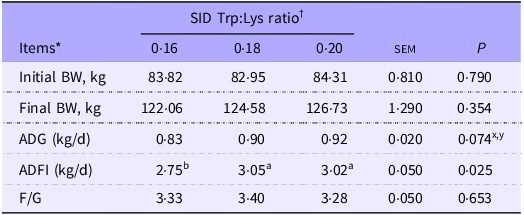
To investigate the effect of dietary Trp inclusion on growth performance of growing pigs, we measured the final BW, the ADG and ADFI after dietary supplementation of Trp with the SID Trp:Lys ratio at 0·16, 0·18 and 0·20, respectively. As shown in Table 1, increasing the SID Trp:Lys ratio above 0·16 significantly increased the ADFI of growing pigs and also exhibited an increasing trend of ADG and final BW when compared with control. The feed conversion rate in three groups did not show significant P value.
Effect of dietary supplementing Trp (SID Trp:Lys ratio) on growth performance of growing pigs

BW, body weight.
*ADG, average daily body weight gain; ADFI, average daily food intake; F/G, feed intake/ gain.
Results were presented by mean (sed) (n 12/group).
†SID, standardised ileal digestible; Trp, tryptophan; Lys, lysine.
a,bMean values within a row with unlike superscript letters were significantly different (P < 0·05).
x,yMean values within a row were not significantly different but exhibited a trend (0·05 < P < 0·10).
Dietary tryptophan supplementation regulates appetite regulatory genes expression in the hypothalamus
The NPY/AgRP neurons and the POMC neurons are two core appetite-sensing neurons located in arcuate nucleus of the hypothalamus to control food intake behaviour(Reference Gregory, David and Denis3,Reference Daniela, Karine and Kathi7) .Therefore, we sought to examine whether dietary Trp supplementation increase food intake by regulating appetite regulatory genes expression in the hypothalamus. As shown in Fig. 1(a), the expression of orexigenic gene AgRP was significantly increased in the Trp-supplemented group with the SID Trp:Lys ratio at 0·18 when compared with control (SID Trp:Lys0·16), and another Trp-supplemented group with the SID Trp:Lys ratio at 0·20 showed an increasing trend of AgRP expression. The expression of another orexigenic gene NPY in two Trp-supplemented groups were comparable to control (SID Trp:Lys = 0·16) (Fig. 1(a)). By contrast, hypothalamic expression of anorexigenic genes POMC, MC4R and CART were drastically decreased in both two Trp-supplemented groups when compared with control (SID Trp:Lys = 0·16) (Fig. 1(b)).
Dietary supplementation of tryptophan (Trp) activates the food intake by modulating appetite regulatory genes expression in the hypothalamus. (a) and (b) The mRNA expression of (a) orexigenic genes co-express neuropeptide Y (NPY) and agouti-related peptide (AgRP) and (b) anorectic genes pro-opiomelanocortin (POMC), cocaine-amphetamine-regulated transcript (CART) and melanocortin receptor 4 (MC4R) in the hypothalamus of growing pigs fed with Trp-supplemented diets with the standardised ileal digestibility (SID) Trp:Lys ratios at 0·16(■), 0·18 (■) and 0·20 (■), respectively. n 6 replicates per group. Statistical analysis: multiple unpaired t test. a,b Mean values with unlike letters were significantly different (P < 0·05). Error bars denote s em.

Dietary tryptophan supplementation modulates the secretion of appetite-regulating hormones in the duodenum and serum
Periphery tissues are capable of generating peptide hormones, including anorexigenic peptides leptin, PYY and orexigenic hormone ghrelin, reaching the brain to control food intake(Reference Shouren, Mengqi and Shixi1). Next, we measured the level of these hormone peptides in the duodenum and serum in all three groups. Two Trp-supplemented groups exhibited an increasing trend of ghrelin expression when compared with control (SID Trp:Lys = 0·16) group (Fig. 2(a)). Strikingly, both PYY and leptin receptor (LepR) expression were greatly decreased in the duodenum of two Trp-supplemented groups when compared with control (SID Trp:Lys = 0·16) (Fig. 2(b) and (c)). Similarly, the serum level of PYY was also significantly reduced in two Trp-supplemented groups when compared with control (SID Trp:Lys = 0·16) (Fig. 2(e)). However, there were no significant changes in the serum level of ghrelin and leptin in all three groups (Fig. 2(d) and (f)).
Dietary tryptophan (Trp) supplementation modulates the secretion of appetite-regulating hormones in the duodenum and serum. (a)–(c) The mRNA expression of ghrelin (a), appetite-regulating peptide YY (PYY) (b) and leptin receptor (LepR) (c) in the duodenum of growing pigs fed with Trp-supplemented diets with the standardised ileal digestibility (SID) Trp:Lys ratios at 0·16(■), 0·18 (■) and 0·20 (■), respectively. n 6 replicates per group. (d)–(f) The measurement of ghrelin (d), PYY (e) and leptin (f) levels in the serum of growing pigs fed with Trp-supplemented diets with the SID Trp:Lys ratios at 0·16(■), 0·18 (■) and 0·20 (■), respectively. n 6 replicates per group. Statistical analysis: multiple unpaired t test. a,b Mean values with unlike letters were significantly different (P < 0·05). Error bars denote s em.

Both the serotonin and kynurenine pathway are activated in the hypothalamus to modulate food intake
Trp is able to cross the blood–brain barrier and metabolised into various bioactive metabolites in the brain(Reference Xue, Li and Zheng14). Then we examined the expression of key enzymes related to Trp metabolic pathways in the hypothalamus. Tryptophan hydroxylase (TPH) is a key rate-limiting enzyme in the serotonin (also known as 5-hydroxytryptamine (5-HT)) pathway and consists of two isoforms, TPH1 and TPH2 (Fig. 3(a)). As shown in Fig. 3(b), the expression of brain-enriched TPH2, but not gut-enriched TPH1, was significantly increased in the hypothalamus of two Trp-supplemented groups when compared with control (SID Trp:Lys = 0·16), suggesting the activation of the serotonin pathway in the brain. Additionally, the expression of aromatic-L-amino acid decarboxylase, which converts the 5-hydroxytryptophan into 5-HT, was significantly decreased in the Trp-supplemented group with the SID Trp:Lys ratio at 0·18 (Fig. 3(b)), indicating less conversion of 5-HT in the hypothalamus. It has been shown that 5-HT1B, the main target of 5-HT, inhibits the activity of orexigenic peptide NPY/AgRP to induce satiety in the body(Reference Shouren, Mengqi and Shixi1).Then we measured the expression of 5-HT1B in two Trp-supplemented groups and found that 5-HT1B was significantly decreased in one Trp-supplemented group (SID Trp:Lys = 0·18) when compared with control (SID Trp:Lys = 0·16), and another Trp-supplemented group (SID Trp:Lys = 0·20) showed a decreasing trend of 5-HT1B expression (Fig. 3(c)).
Both the serotonin and kynurenine pathways are activated in the hypothalamus to modulate food intake. (a) Schematic presentation of the serotonin and kynurenine (KYN) pathways. (b) The mRNA expression of key enzymes related to serotonin pathway in the hypothalamus of growing pigs fed with tryptophan (Trp)-supplemented diets with the standardised ileal digestibility (SID) Trp:Lys ratios at 0·16 (■), 0·18 (■) and 0·20 (■), respectively. (c) The expression of 5-hydroxytryptophan (5-HT) target gene (5-HT1B) in the hypothalamus of growing pigs fed with Trp-supplemented diets with the SID Trp:Lys ratio at 0·16(■), 0·18 (■) and 0·20 (■), respectively. (d) The mRNA expression of key enzymes related to KYN pathway in the hypothalamus of growing pigs fed with Trp-supplemented diet with the SID Trp:Lys ratios at 0·16 (■), 0·18 (■) and 0·20 (■), respectively. (E) The expression of aryl hydrocarbon receptor (AhR) in the hypothalamus of growing pigs fed with Trp-supplemented diets with the SID Trp:Lys ratios at 0·16(■), 0·18 (■) and 0·20 (■), respectively. (F) Illustration of the AhR/ARNT binding sites in the promote region of melanocortin receptor 4 (MC4R) gene. n 6 replicates per group. Statistical analysis: multiple unpaired t test. a,b Mean values with unlike letters were significantly different (P < 0·05). Error bars denote s em.

Indoleamine 2,3-dioxygenase (IDO) and tryptophan 2,3-dioxygenase (TDO2) catalyse the initial rate-limiting step in the degradation of Trp towards the kynurenine pathway (KP) (Fig. 3(a). Next, we examined a subset of enzymes related to KP in the hypothalamus upon dietary Trp supplementation. Our data showed that the expression of TDO2, but not IDO1 or IDO2, was significantly increased in the Trp-supplemented group with the SID Trp:Lys ratio at 0·18, and another Trp-supplemented group (SID Trp:Lys = 0·20) exhibited an increasing trend of TDO2 expression when compared with control (SID Trp:Lys = 0·16) (Fig. 3(d)). Moreover, the downstream catalytic enzymes kynureninase (KYNU), but not the kynurenine hydroxylase (KMO) and kynurenine aminotransferase (KAT), was drastically upregulated in two Trp-supplemented groups, suggesting the conversion of kynurenine into anthranilic acid (AA) (Fig. 3(a)). Interestingly, the 3-hydroxy anthranilate 4,3 dioxygenase expression was only significantly increased in the Trp group with the SID Trp:Lys ratio at 0·20.
KP metabolites serve as aryl hydrocarbon receptor (AhR) ligands and promote the formation of the AhR/ARNT complex, which then translocates into nucleus to initiate transcription of target genes via binding to the canonical xenobiotic response element (XRE) sites (5’-GCGTG-3’)(Reference Xue, Li and Zheng14). Next, we found a significantly increased expression of AhR in the Trp-supplemented group (SID Trp:Lys ratio = 0·18), and another Trp-supplemented group (SID Trp:Lys = 0·20) exhibited an increasing trend of AhR expression when compared with control (SID Trp:Lys = 0·16) (Fig. 3(e)). Furthermore, by searching and analysing the JASPAR database, we identified several XRE sequences (5’-GTGTG-3’ and 5’-GCTTG-3’) in the promoter regions of MC4R gene (Fig. 3(f)), suggesting that AhR may directly bind to MC4R to modulate its transcription.
Dietary tryptophan supplementation increases food intake by activating the AMP-activated protein kinase signalling pathway and inhibiting the mammalian target of rapamycin activity in the hypothalamus
MC4R has been reported to inhibit the AMPK signalling pathway to induce satiety signalling(Reference Yasuhiko, Thierry and Noboru5). Next, to examine whether dietary Trp supplementation affects the AMPK signalling pathway, we analysed the phosphorylated and the total protein level of AMPK in the hypothalamus of Trp-supplemented groups. As shown in Fig. 4(a) and (b), the expression of phosphorylated AMPK (p-AMPK) protein and p-AMPK/AMPK ratio were significantly increased in the Trp-supplemented group (SID Trp:Lys ratio = 0·18), and another Trp-supplemented group (SID Trp:Lys = 0·20) exhibited an increasing trend of AMPK and p-AMPK/AMPK expression when compared with control (SID Trp:Lys ratio = 0·16), indicating that dietary Trp supplementation activates hypothalamic AMPK signalling pathway. Hypothalamic mTOR/S6K1 activity inhibits food intake, and its activity is repressed by the AMPK signalling pathway(Reference Daniela, Karine and Kathi7,Reference Ken, Tianqing and Kun-Liang9) . Therefore, we further measured the phosphorylated and the total protein level of hypothalamic mTOR and S6K1 in two Trp-supplemented groups. As expected, both phosphorylated mTOR (p-mTOR) and phosphorylated S6K1 (p-S6K1) proteins, and the p-mTOR/mTOR and p-SK61/S6K1 levels were drastically decreased in two Trp-supplemented groups when compared with control (SID Trp:Lys ratio = 0·16) (Fig. 4(c)–(f)), suggesting that dietary Trp inclusion inhibits the mTOR/S6K1 activity in the hypothalamus. Taken together, dietary supplementation of Trp increases food intake of growing pigs by activating the AMPK signalling pathway and inhibiting the mTOR/S6K1 activity in the hypothalamus (Fig. 5).
Dietary tryptophan (Trp) supplementation increases food intake by activating AMP-activated protein kinase (AMPK) signalling pathway and inhibiting mammalian target of rapamycin (mTOR) activity in the hypothalamus. (a)–(f) The abundance of phosphorylated and total AMP-activated protein kinase (AMPK) (a) and (b), mTOR (c) and (d) and S6 kinase 1 (S6K1) (e) and (f) in the hypothalamus of growing pigs fed with tryptophan (Trp)-supplemented diets with the standardised ileal digestibility (SID) Trp: Lys ratios at 0·16 (■), 0·18 (■) and 0·20 (■), respectively. Values were normalised using β-actin or relative to the total protein of target proteins. (a) and (c) shared the identical actin bands because they were developed from the same membrane after cutting and stripping. n 6 replicates per group. a,b Mean values with unlike letters were significantly different (P < 0·05). Error bars denote s em.

Model of hypothalamic tryptophan (Trp) metabolism in the regulation of food intake. Both the hypothalamic KYN and 5-hydroxytryptophan (5-HT) pathways were activated to modulate downstream AhR and 5-HT1B expression, respectively, upon dietary Trp supplementation. Meanwhile, the decreased level of periphery hormones PYY and leptin reduced the anorexigenic POMC activity. By contrast, the increased level of ghrelin induced orexigenic AgRP activity. The changed activities of appetite regulatory neurons reduced the MC4R expression, which activated the AMPK signalling pathway in the hypothalamus. Next, the activation of AMPK pathway further inhibited the mTOR/S6K1 activity to stimulate food intake. KYN, kynurenine; 5-HTTP, 5-hydroxytryptophan; AA, anthranilic acid; 5-HT, serotonin; 5-HT1B, 5-hydroxytryptamine receptor 1B; AhR, aryl hydrocarbon receptor; PYY, appetite-regulating peptide YY; POMC, pro-opiomelanocortin; MC4R, melanocortin receptor 4; NPY, co-express neuropeptide Y; AgRP, agouti-related peptide; AMPK, AMP-activated protein kinase; mTOR, mammalian target of rapamycin.

Discussion
This study showed that dietary supplementation of Trp at small gradient levels, with the SID Trp:Lys ratio at 0·18 or 0·20, significantly increased food intake of growing pigs by activating the expression of orexigenic gene AgRP and inhibiting the expression of anorectic genes POMC, CART and MC4R in the hypothalamus. Mechanistically, both the serotonin and KYN pathways, two major metabolic pathways of Trp, were activated in the hypothalamus to downregulate MC4R expression. The reduction of MC4R further activated the AMPK signalling pathway, which in turn inhibited the mTOR/S6K1 activity to stimulate food intake. Together, our study has unraveled a novel finding that the increased food intake of growing pigs upon dietary Trp supplementation is linked to the hypothalamic AMPK–mTOR–S6K1 signalling axis.
There are increasing evidences of dietary change of Trp levels in improving growth performance of pigs. Feeding weaned piglets with small gradients of Trp, from 0·21 %, to 0·28 % and to 0·35 %, significantly increased the ADFI and ADG(Reference Rao, Li and Shi18). Dietary supplementation of 0·2 % and 0·4 % Trp also increased the ADG(Reference Liang, Dai and Liu19). Similarly, increasing the dietary Trp levels also improved the ADFI and ADG of grower-finisher pigs both under normal and stress/infection conditions(Reference Liu, Yan and Cao20,Reference Gonçalves, Melo and Yang21) . But the effect of small adjustments of Trp level on growth performance of growing pigs and the mechanistic study of how Trp modulates feed intake still lack investigation. Our study clearly and firstly found that hypothalamic Trp metabolism stimulates food intake of growing pigs by modulating appetite regulatory gene expression through the KYN and 5-HT signalling pathway. Moreover, the appetite regulatory signalling AMPK–mTOR–SK6 axis was also regulated upon dietary Trp supplementation.
Interestingly, recent reports showed that dietary addition of high level of Trp had no clear effects on ADFI and ADG and even produced negative effects on intestinal epithelium function(Reference Hu, Feng and Jiang22,Reference Tossou, Liu and Bai23) . It is likely that dietary Trp affects growth performance of pigs in a dosage-dependent manner. When the dietary Trp level reached the maximal requirement of pigs, the growth performance of pigs may not be further improved after further increasing the Trp levels. Higher or excessive Trp may antagonise with other rate-limiting amino acids and disrupt the balance of amino acid, thus affecting the growth performance of pigs. Our study found that dietary addition of Trp with the SID Trp:Lys ratio at 0·18 yielded better outcomes compared with the ratio of 0·20. The possibility might be due to the different utilisation efficiency of Trp in these two groups. The growth performance of pigs is generally positively correlated with dietary Trp levels(Reference Eder, Nonn and Kluge24,Reference Lin, Jiang and Yu25) . It is possible that 75–120 kg of growing pigs exhibit the dominant effects on ADFI when the dietary SID Trp:Lys ratio reached 0·18, and further increasing the Trp:Lys ratio to 0·20 may slightly exceed the maximal Trp requirement of pigs at this stage, which may result in less effective outcomes when compared with that of in 0·18 group. Whether the change of Trp levels exhibit similar effects in other developmental stages of pig awaits further investigation.
Despite the increased ADFI was not significantly and positively correlated with the final BW and ADG of growing pigs in our study, we still observed an increasing trend of final BW and ADG after dietary Trp addition (BW = 124·58 kg and 126·73 kg, ADG = 0·90 and 0·92, respectively) when compared with control (BW = 122·06 kg, ADG = 0·83) as shown in Table 1. It is likely that the insignificance of ADG and BW calculated in our experiment may be due to individual variations. Increasing the number of sample size in each group may produce much better statistically significance. In terms of the practical implications of our finding for pig production, the number of pigs used in actual pig production is generally much larger than that of in our experimental setting (n 12 per group), suggesting the possible improvement of statistically significance during practical application. Additionally, increased ADFI is not always associated with increased final BW because of the different efficiency of feed convention. In the side of pig production, increased ADFI may act as the primary effector on BW gain. An increasing trend of final BW and ADG upon small gradients of dietary Trp supplementation is still benefit for pig production, as it suggests the improvement of growth performance by nutritional intervention. Moreover, the cost of adding large amount of synthetic Trp in pig production is very expensive. Adding relative less amount of synthetic Trp in the diet but still exhibiting its positive effects on the growth performance of growing pigs would be beneficial for a production setting.
Finally, regarding the mechanism of how Trp modulates feed intake of pigs, our study has revealed two layers of Trp metabolism-mediated appetite regulation in pigs. First, dietary Trp addition reduces the level of anorexigenic hormone PYY and LepR in the duodenum to attenuate the feeling of satiety by downregulating the expression of anorexigenic genes POMC, CART and MC4R in the hypothalamus. This finding is in agreement with previous studies showing that periphery signals from the gut or adipose tissue are directly involved in the regulation of food intake by modulating the activity of appetite neurons in the brain(Reference Shouren, Mengqi and Shixi1,Reference Friedman and Mantzoros26,Reference Lafferty, Flatt and Irwin27) . Second, we also found that both the KYN and serotonin pathways were activated in the hypothalamus after dietary Trp inclusion, generating anthranilic acid (AA) and 5-HT, respectively. Dietary addition of 0·04 % AA in mice has been shown to increase food intake of mothers during their first lactating stage(Reference Nagasawa, Suzuki and Sakagami28). AA also serves as one of AhR ligands to activate the AhR pathway to modulate various biological processes(Reference Xue, Li and Zheng14,Reference Hubbard, Murray and Perdew29) . In our study, we found the increased expression of AhR and the decreased expression of anorectic gene MC4R upon dietary Trp addition and also identified several AhR binding sites on the upstream promote region of MC4R. Therefore, it is possible that AA generated by the KYN pathway activates the downstream AhR pathway to bind to the promoter region of MC4R to suppress its transcription, thus sensing the orexigenic signalling to the brain for food intake.
In addition, the effect of 5-HT on modulating feeding behaviour has also been increasingly recognised. Both intestinal and brain 5-HT are capable of inducing satiety signalling to constrain food intake(Reference Holst and Deacon30–Reference Voigt and Fink32). Arcuate nucleus expressing various 5-HT receptors including 5-HT1AR, 5-HT1BR, 5-HT2AR and 5-HT2CR to act on anorexigenic neurons upon binding to 5-HT(Reference Shouren, Mengqi and Shixi1,Reference Voigt and Fink32,Reference Tiligada and Wilson33) . MC4R acts as a downstream target of 5-HT1B agonist-induced hypophagia(Reference Voigt and Fink32). Our data found the decreased expression of both 5-HT1B and MC4R in the hypothalamus after Trp addition. Thus, the 5-HT pathway may stimulate food intake by reducing the synthesis of 5-HT and decreasing its binding to 5-HT1B and reducing the expression of downstream anorectic gene MC4R. Meanwhile, we cannot exclude the possibility that other 5-HT receptors may be activated in arcuate nucleus upon Trp supplementation, and which receptor play the major role, and how these receptors act together to modulate food consumption awaits further validation.
In conclusion, our study shows that dietary supplementation of Trp at small gradients level significantly stimulates food intake of growing pigs by modulating the expression of appetite regulatory genes in the hypothalamus. Importantly, our data for the first time indicate the function of the hypothalamic KYN and 5-HT metabolic pathways in the regulation of food intake through the AMPK–mTOR–S6K1 signalling axis. The current findings will expand our understanding of Trp metabolism-mediated food intake and provide its application in developing nutrition intervention strategy in pig production.
Supplementary material
For supplementary material/s referred to in this article, please visit https://doi.org/10.1017/S0007114524003210
Acknowledgements
We thank Lang Huang, Junhao Deng, Zian Yuan from Hunan Agricultural University for their help in sample collection.
This work was supported by Hunan Provincial Department of Education Scientific Research Project (23B0220) and the National Natural Science Foundation of China (32330098).
J. F., Y. Y. and X. T.: conceptualisation; J. F., Y. Y. and X. T.: data analyses; J. F., Y. Y. and X. T.: writing – original draft; J. F., Y. Y., L. W., F. C., Z. H., K. X., S. J. and X. T.: review and editing.
The authors declare that they have no conflict of interest.
Ethics approval and consent to participate the animal study was reviewed and approved by the Institution Animal Care and Use Committee of college of Animal Science and Technology, Hunan Agricultural University (No.43321809) (Changsha, China).