


Introduction
Documenting plant diversity was the first of the 16 targets for 2010 (Callmander et al., Reference Callmander, Schatz and Lowry2005) adopted by the sixth Conference of the Parties to the Convention on Biological Diversity. The total number of identified vascular plant species is estimated to be between 310,000 (Prance et al., Reference Prance, Beetje, Dransfield and Johns2000) and 420,000 (Bramwell et al., Reference Bramwell, Raven and Synge2002). The 2010 Red List (IUCN, 2010) contains > 12,000 plant taxa but < 1,000 are properly documented (< 8.3% of global plant diversity). The process of conservation assessments clearly needs to be accelerated.
A total of 1,572 genera and 5,521 species of flowering plants have been documented for Pakistan (Ali, Reference Ali2008) but there is no comprehensive national Red List. The pressures on plants and other wildlife are, however, considerable, with a human population increasing annually at a rate of 2.1% (The World Bank, 2011), unplanned urbanization, deforestation and overexploitation of natural resources (Ali, Reference Ali2000; Anon., 2000; Sheikh et al., Reference Sheikh, Ahmad and Khan2002; Ahmad et al., Reference Ahmad, Mian, Hai, Khurshid, Qadir, Noor-Un-Nisa, Wood, Stedman-Edwards and Mang2005; Eberhardt et al., Reference Eberhardt, Dickore, Miehe and Kreutzmann2006; Schickhoff, Reference Schickhoff and Kreutzmann2006). There has been little research on the threatened plants of Pakistan (Alam & Ali, Reference Alam and Ali2009; Ali & Qaiser, Reference Ali and Qaiser2010a,Reference Ali and Qaiserb). A herbarium-based study (Nasir, Reference Nasir, Ali and Ghafaar1991) suggested that 580–650 species of flowering plant (i.e. c. 12% of the total flora) are threatened nationally. However, this assessment was not based on any criteria. Fourteen flowering plant species were listed as threatened in Pakistan by Walter & Gillet (Reference Walter and Gillet1998). In the 2010 Red List (IUCN, 2010), only 26 species of plants are listed from Pakistan. This is almost certainly an underestimate.
Ibrar (Reference Ibrar2003) assessed the conservation status of eight Himalayan medicinal plants in Pakistan but his approach was based on availability in markets and consumption (i.e. data on population size, extent of occurrence and area of occupancy was not obtained). To determine the conservation status of a taxon it is necessary to monitor population size, determine the extent of occurrence and area of occupancy, and the nature and extent of any threats (IUCN, 2001). Endemic taxa merit special attention because of their limited geographical distribution; any unfavourable change in habitat may cause the rapid extinction of such species (Callmander et al., Reference Callmander, Schatz and Lowry2005). In addition, endemic and rare species are of particular value from an evolutionary point of view.
There is a particular need for botanical research in the biodiverse mountain areas of Pakistan. About 80% of the endemic flowering plants of the country (of a total of 410 taxa) are confined to the northern and western mountains of Pakistan and Kashmir (Ali, Reference Ali2008). Within this region the area of Chitral has 34 known endemic species and is recognized as a centre of plant radiation (Ali & Qaiser, Reference Ali and Qaiser1986).
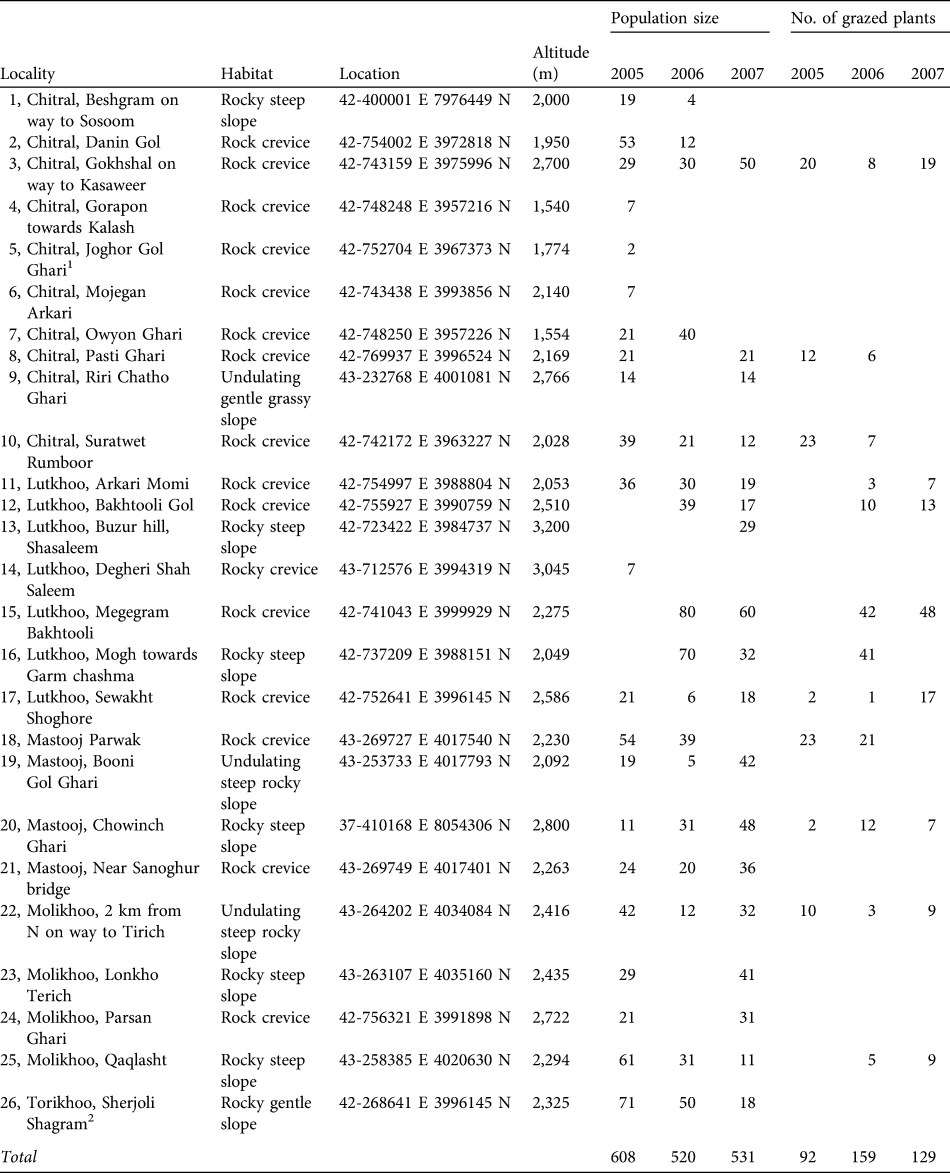
One of these endemic plant species is Silene longisepala E. Nasir of the family Caryophyllaceae. The species was previously known from only three collections in two localities (Table 1). The aim of the present study was to determine the geographical distribution of S. longisepala, evaluate its conservation status, identify any threats, and recommend conservation measures.
The 26 localities (see Fig. 1 for the 18 numbered locations in which the species was found in 2007) in which we found Silene longisepala, with habitat, location in UTM coordinates, altitude, and population size and number of grazed plants in 2005, 2006 and 2007. The two footnotes indicate the three collections, in two localities, from which the species was previously known.
1 Chitral, Bowes Lyon 890 (BM; all from Ghazanfar & Nasir, Reference Ghazanfar, Nasir, Nasir and Ali1986: 80)
2 Chitral, Turikho river, 9,000 feet, 23 May 1958, J.D.A. Stainton 2505 (isotype RAW; G); Turikho river, Stainton 2449 (RAW; BM)
Methods
Field studies were conducted during 19 May 2005 to 30 September 2005, 1 May to 30 September 2006 and 1 June to 30 September 2007. Chitral, with an area of 14,850 km2, is the largest district of the North-West Frontier Province of Pakistan (Anon., 1998). We carried out field surveys in lower Chitral in May and June and upper Chitral from July to the end of September. In excursions of 7–10 days we visited localities from where the taxon had previously been collected and localities that had not previously been surveyed but that lie within the altitudinal range and habitat typical of S. longisepala. The excursions were conducted with the help of local guides and porters, using horses or yaks for transportation. The routes followed were recorded with a global positioning system, altimeter and 1:50,000 maps from the survey of Pakistan.
When a population of the species was located 1–2 days were spent in the location to determine the extent of the population by walking within an area of at least 1–2 km2 in each locality. The number of mature individuals (i.e. with fruits or flowers) was counted. Comprehensive field notes on habit, habitat, life form, phenology and altitudinal range of the species were recorded. Any anthropogenic threats (grazing, expansion of agriculture, road building and deforestation) were recorded, and the number of individual plants apparently grazed was counted. Plant specimens collected were deposited at Karachi University Herbarium (KUH).
To determine the extent of occurrence (the area contained within the shortest continuous imaginary boundary that can be drawn to encompass all the known sites of occurrence of a taxon, excluding cases of vagrancy) of the species the geographical coordinates of each S. longisepala located were plotted on georeferenced imagery, obtained from Google (2009), using ArcView v. 3.2 (ESRI, Redlands, USA) and a polygon drawn to encompass all the known localities of the taxon. Area of occurrence (the area within the extent of occurrence that is occupied by a taxon) was calculated by overlaying a grid of 2 x 2 km squares on the distribution map and summing the area of the squares in which the species was located. The conservation status of S. longisepala was assessed using the IUCN Red List criteria (2001).
Results
We found S. longisepala in 24 previously unrecorded localities (Table 1), mostly in rock crevices (Plate 1), at altitudes of 1,554–2,416 m. We observed that the species is a chamaephyte (following Raunkiaer, Reference Raunkiaer1934), with a height of 20–30 cm (Table 1). We observed flowering and fruiting in August. We found only one small population of S. longisepala in a protected area (Location 3, Chitral Gol National Park; Fig. 1, Table 1). Although Chitral Gol is a National Park of IUCN category II (IUCN, 2000) we found that S. longisepala had been grazed there (Table 1). Considering all 26 sites, 15, 31 and 24% of the plants we located were grazed in 2005, 2006 and 2007, respectively (Table 1). We observed the plants being grazed by goats and sheep.
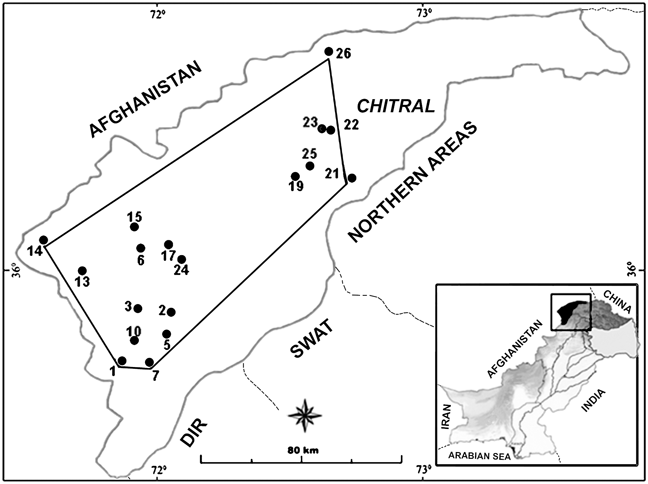
The 18 numbered locations, of a total of 26 (Table 1), in which we found Silene longisepala in 2007; the polygon delimits the extent of occurrence (see text for details) of the species, which is 3,587 km2. The inset indicates the location of the main map in the North-West Frontier Province of Pakistan.
(a) Habit and (b) flower of Silene longisepala. (c) Expanding cultivation on marginal lands is a threat to the wild flora in general and to S. longisepala in particular.

Road construction and subsequent soil erosion is a threat to the habitat of S. longisepala. In the two locations where we observed such construction (Plate 2) the populations decreased by 69% from 2005 to 2007 in Suratwet-Rumboor (Location 10) and by 25% from 2006 to 2007 in Megegram-Bakhtooli (Location 15; Fig. 1, Table 1). Because of the mountainous topography and narrow valleys land for agriculture is limited in this area but new areas are still being cleared and brought under cultivation. In Owyon Ghari (Location 7), where we found S. longisepala in 2005 and 2006, land clearance (Plate 1b) later destroyed the population and we could not locate any plants in 2007.
The people of Chitral use forest trees as fuelwood, particularly during winter, and during our surveys in 2007 we counted a total of 310 felled trees of Pinus gerardiana, Pinus wallichiana, Picea smithiana, Fraxinus excelsior, Betula utilis and Juniperus excelsa in the habitat of S. longisepala, awaiting collection.
We calculated the extent of occurrence and area of occurrence to be 3,587 and 104 km2, respectively, with a total of 531 individuals in 18 localities in 2007, our most recent survey (Fig. 1). Based on this low population size and apparent decline (from 620 individuals in 2005) we recommend that the species should be categorized as Endangered on the IUCN Red List based on the criteria (IUCN, 2001) B1ab(ii,iii,iv,v)+2ab(ii,iii,iv,v); C2a(i).
Discussion
Adequate plant collections with good notes of field observation can play a critical role in assessing the conservation status of species, in setting conservation priorities and monitoring population changes (Burgman et al., Reference Burgman, Grimson and Ferson1995; MacDougall et al., Reference MacDougall, Loo, Clayden, Goltz and Hinds1998; Funk et al., Reference Funk, Zermaglio and Nasir1999; Steege et al., Reference Steege, Jansen-Jacobs and Datadin2000; Golding & Smith, Reference Golding and Smith2001; Hedenas et al., Reference Hedenas, Bisang, Tehler, Hamnede, Jaederfelt and Odelvik2002; Schatz, Reference Schatz2002; Willis et al., Reference Willis, Moat and Paton2003; Ungricht et al., Reference Ungricht, Rasplus and Kjellberg2005). However, various collection biases (such as collections having been made in accessible areas) may lead to misinterpretation, and it is possible that populations documented in herbarium collections may no longer exist. In particular, conservation assessments based principally on herbarium collections may be misleading (Randrianasolo et al., Reference Randrianasolo, Miller and Consiglio2002). This is especially true for a relatively inaccessible area such as Chitral. Our surveys of S. longisepala over 3 consecutive years, however, demonstrated the value of long-term field monitoring.
The major threat to S. longisepala is habitat loss from expansion of agriculture on marginal land. Such land clearance results in considerable soil erosion because of the generally steep topography of this mountainous area. We observed that the uppermost soil layer in such areas is usually lost within a few years and the land abandoned. In some localities, however, S. longisepala is fortuitously protected by the general inaccessibility of its habitat. There is no legal framework in Pakistan for the protection of rare and endemic plant taxa on private lands and therefore ex situ conservation may be required for narrow endemics such as S. longisepala. In addition, the Ministry of Environment should require ecological impact assessments before issuing permits for road construction.
The fragmentation of the distribution of S. longisepala appears to be a characteristic typical of narrow endemics (Ashton, Reference Ashton and Synge1981; Fenu et al., Reference Fenu, Mattana and Bacchetta2011; Martinell et al., Reference Martinell, López-Pujol, Blanché, Molero and Sàez2011). Such species are susceptible to extinction from a variety of causes but especially from the destruction of their habitat (Lande, Reference Lande1988; Romeo et al., Reference Romeo, Ramil and Rubinos1994; Schemske et al., Reference Schemske, Husband, Ruckelshaus, Goodwillie, Parker and Bishop1994; Bernardos et al., Reference Bernardos, Amado and Amich2006).
Our methodology in this study, in which we combined detailed field surveys with monitoring, could form a model for conservation research on rare and endemic plant taxa in Pakistan and elsewhere. In Pakistan this approach needs to be repeated for other species, and particularly for the endemic plant taxa.
Acknowledgements
The article is part of the PhD research of HA. The Higher Education Commission of Pakistan is acknowledged for financing the project.
Biographical sketches
Haidar Ali is currently carrying out research on extinction risk analysis for plants, and biodiversity monitoring. Muhammad Qaiser is the co-editor of the Flora of Pakistan and carries out research on plant diversity and the conservation of the flowering plants of Pakistan.



