





Highlights
-
• High- and low-literate bilinguals use languages as per interlocutors’ L2 proficiency.
-
• High- and low-literate bilinguals did a voluntary object-naming task in visual world.
-
• Visual world consisted of four interlocutors with varied L2 proficiency.
-
• High-literate participants made referral gazes to high-L2-proficient interlocutors and named in L2.
-
• Low-literate participants looked at low-L2-proficient interlocutors while naming in L1.
1. Introduction
Bilingualism evolved as a function of social, cultural and geographical movements. Two individuals speaking various languages adapt to each other by speaking each other’s language. As bilingualism occurs in a socio-interactive context, recent research on understanding bilingual language use and control has moved from individual control settings to social and contextual influences (Green & Abutalebi, Reference Green and Abutalebi2013). In a country like India, most speakers are bi- or multilingual – they speak and understand many languages, are bi-cultural and can use many dialects of those languages. Moreover, the interactive contexts comprise bilinguals with varied first language (L1) and second language (L2) proficiencies and literacy levels. In everyday scenarios, when a highly proficient bilingual person interacts with another proficient bilingual interlocutor, they can easily communicate in either language. Given the fundamental nature of bilingual language switching, these bilinguals might switch between the two languages at times. However, if a high-L2-proficient bilingual interacts with a low-L2-proficient interlocutor or a low-literate interlocutor, the former might inhibit L2 actively and limit their use of L2. There is no clear understanding of how functionally low-literate bilinguals use language. It is essential to consider literacy as a variable in understanding sociolinguistic awareness, as it has long-term consequences for the brain and behavior. Learning to read and write sustainably changes the brain in numerous ways (Hervais-Adelman et al., Reference Hervais-Adelman, Kumar, Mishra, Tripathi, Guleria, Singh and Huettig2022). The minds of individuals who can read and write exhibit superior cognitive skills in domains such as metacognition, language, executive control and social cognition. Many researchers have investigated how literates and illiterates differ in cognitive control (Huettig & Mishra, Reference Huettig and Mishra2014; Bulajić et al., Reference Bulajić, Despotović and Lachmann2019; Rüsseler et al., Reference Rüsseler, Arendt, Münte, Mohammadi and Boltzmann2021). Recently, researchers have shown that illiterates exhibit increased phonological awareness and visual recognition skills following literacy training (Araújo et al., Reference Araújo, Fernandes and Huettig2019). However, it is unclear how low-literate individuals with 5–8 years of formal education employ cognitive and linguistic control, as they may or may not use reading and writing skills regularly. This study examined whether high-literate and low-literate participants show strategic differences in a task that explores skills related to social cognition, language tagging and production.
It is one thing to study bilingual populations who have never had literacy or formal schooling and another to examine those bilinguals who have had some years of literacy training and then dropped out for various reasons. The latter are called functional illiterates or low-literate individuals, since they do not use reading or writing daily. In India, these low-literate individuals, who are usually bi- or multilingual, demonstrate excellent proficiency in verbal communication. Evidence suggests that formal literacy influences the analytical aspects of cognition and broader social-affective dimensions. For example, in a seminal experiment on Indian functional illiterates, (Mishra et al., Reference Mishra, Singh, Pandey and Huettig2012) observed that low-literate participants were slower at anticipatory language-mediated visual orienting than high-literate ones. Anticipatory mechanisms require the timely retrieval of concepts in response to linguistic input. They used the visual-world paradigm to explore the nature of predictive processing: participants listened to sentences with target words while looking at four objects on the screen. The visual world consisted of a target object and three distractors. The purpose of the spoken sentences was to promote anticipatory eye movements to look at the target object. It was found that low-literate participants were significantly slower in making anticipatory eye movements to the target object than high-literate participants. These experiments suggest that literacy plays a definitive role in concept retrieval, prediction and core cognitive abilities, such as visual search and selective attention, which are responsible for sociolinguistic awareness and language use. Such findings from monolingual low-literate participants help formulate the experimental hypothesis of our current study, which examines interlocutor awareness and language production in a bilingual context.
Studies using bilingual contexts demonstrated that bilinguals tag languages to faces, and these tags serve as cues for lexical retrieval (Kapiley & Mishra, Reference Kapiley and Mishra2018, Reference Kapiley and Mishra2019). Studies with Indian bilinguals have revealed a much more complex relationship between perceptions of interlocutors and their languages and how this information modulates behavior. L2 (English) remains the dominant L2 in India and serves as a medium for the economy, trade and intellectual exchange. Although India implements an L2-only education policy in higher education, one can easily find both high- and low-proficient L2 speakers in any social domain, such as a university. Earlier studies demonstrated that bilingual speakers use this discriminative information about interlocutors’ L2 proficiency when planning their language use with other bilinguals (Kapiley & Mishra, Reference Kapiley and Mishra2019). For example, if someone is introduced as a fluent L2 speaker, higher L2 activation is observed in their presence. When encountering a less fluent L2 speaker, people tend to activate their L1, often an Indian language. Bilingual speakers use information about their interlocutors’ linguistic abilities to use appropriate language when interacting with them. The adaptive control hypothesis (Green & Abutalebi, Reference Green and Abutalebi2013) proposes that language control is linked to critical dimensions of social awareness that bilinguals use when choosing their language. Therefore, bilinguals know which of the two languages to activate in a given social context and the extent of language activation. Such fine-tuned metacognitive awareness is the foundation to link executive control, language activation and interlocutors’ identity (Tomić & Kaan, Reference Tomić and Kaan2022; Vaughan-Evans, Reference Vaughan-Evans2023).
The studies discussed so far have shown that the interlocutor effect influences bilinguals’ language activation or executive control in university participants, who are primarily highly literate. In India, many people are low-literate yet are fluent in both languages. They do not need to be fluent speakers of English. Therefore, given the everyday reality of the Indian context, both highly literate and low-literate people work together and cooperate in many social situations, such as universities and schools. Knowing how they use awareness of others’ language abilities in social situations is essential. In sociolinguistic contexts, speakers and their interlocutors access each other’s linguistic abilities and predict the appropriate language. During this process, speakers might look at non-linguistic cues such as faces (Martin et al., Reference Martin, Molnar and Carreiras2016), cultural icons (Kapiley & Mishra, Reference Kapiley and Mishra2018; Zhang et al., Reference Zhang, Morris, Cheng and Yap2013) and national flags (Grainger et al., Reference Grainger, Declerck and Marzouki2017) that facilitate their language activation.
Spoken words activate lexical concepts that meditate eye movements to visual referents (Chabal et al., Reference Chabal, Hayakawa and Marian2022; Griffin, Reference Griffin2001). This could be interpreted as both automatic and unconscious, and many theorists consider this an excellent example of multimodal integration in the brain. One such integration, demonstrated by speech production and eye movement studies, shows that we quickly look at the objects to be named (Griffin, Reference Griffin2001). A study by Griffin and Block (Reference Griffin and Bock2000) observed that when participants were asked to produce simple sentences with the objects presented on the screen, they fixated on the objects about to be named. During object naming, the time-course analysis indicated a temporal relationship between the number of looks at the object before naming. This shows that looking at an object helps select lexical items from the conceptual store until articulating speech/word (Meyer et al., Reference Meyer, van der Meulen and Brooks2004). Participants use visual attention to map visual arrays, facilitating language planning before naming. Therefore, we used the visual-world paradigm to investigate whether bilingual participants would look at interlocutors (tagged to a particular language) while naming objects. It is unclear whether the interlocutor’s knowledge influences critical mechanisms, such as language-mediated eye movements.
1.1. Current study
High-literate and low-literate participants performed a voluntary object-naming task in the visual world in the presence of a high-L2-proficient interlocutor, a low-L2-proficient interlocutor and neutral interlocutors. It is also worth noting that bilingual speakers consider their own linguistic competence when judging someone else’s language ability. For example, L2-proficient speakers are competent L2 users and can evaluate whether other speakers are proficient L2 speakers. Meanwhile, low-literate participants have minimal L2 vocabulary and no formal education. They may be unable to judge whether the other speaker is proficient in L2. As in previous studies on this theme (Kapiley & Mishra, Reference Kapiley and Mishra2019, Reference Kapiley and Mishra2024, Reference Kapiley and Mishra2025), we introduced interlocutors as high or low in L2 proficiency. We tested the hypothesis that high-literate and low-literate participants would use the interlocutor’s information differently during a visual-world task.
The experiment consisted of two types of trials: experimental and filler. The experimental trials consisted of high- and low-L2-proficient interlocutors (one each) and neutral interlocutors. Neutral interlocutors acted as a control for the interlocutor type. An object-naming image was presented at the center of the screen. Producing a word involves the intention to communicate, which occurs at two levels – prelinguistic and linguistic. The prelinguistic level involves selecting concepts, while the linguistic level involves selecting lemmas and phonological coding. This process requires great flexibility in planning, coordinating, lexical access and fluency. The general tendency is to generate names in the dominant language during voluntary language choice. Often, we also generate language in the presence of a speaker. Interlocutors’ presence could unconsciously influence language planning. Inspection of faces and other cultural objects just before language planning may indicate an evolutionary link between looking and speaking. Speakers’ glance at a particular interlocutor just before choosing a specific language to name an object may indicate indexing of visual cues to language activation. In naturalistic settings, it is a common observation that people look at the faces of their own “type” of interlocutor before and during speech planning. These referral looks and speaking behaviors could be entirely unconscious and form the foundation of complex linguistic behavior. This is even more fascinating, unlike earlier studies where people had to generate language for a particular interlocutor.
If we assume that the presence of interlocutors would lead to higher activation of L2, further leading to voluntary language choice to name the object in the planned language, then we would predict that during experimental trials, high-literate participants would name the objects in L2 a higher number of times compared to L1 (Figure 1). They would prefer making eye movements to the quadrant where the high-L2-proficient interlocutor is present. Similarly, these participants might refer to the low-L2-proficient interlocutor when naming in L1. On the contrary, low-literate participants would choose to name the objects in L1 and make more fixations on the low-L2-proficient interlocutor while doing so (Figure 2).
Schematic representation of predictions for high-literate bilingual.

Schematic representation of predictions for low-literate bilingual.

The filler trials consisted of four neutral interlocutors; these trials were considered a control for the experimental trials. We predicted that literate participants would choose L2 more often than L1 and that low-literate participants would name objects in L1 rather than L2. The number of looks at four interlocutors would be similar.
1. Method
1.2. Participants
Forty high-literate Telugu (L1)–English (L2) bilinguals (33 female, age = 22.31 years, SD = 1 year) with an average of 18–19 years of education participated in the experiment with an average of 14 years. Thirty-two low-literate Telugu (L1)–English (L2) bilinguals (5 female, mean age = 23.91 years, SD = 2.5 years) participated in the experiment. Low-literate bilinguals reported that they discontinued their education during schooling, and the average years of education was 5.7–6 years. All the participants were from the University of Hyderabad and provided written consent stating that their participation was voluntary. The Institutional Ethics Committee (IEC) at the University of Hyderabad approved the study.
1.3. Control tasks
Semantic fluency and language questionnaires were administered to measure participants’ language proficiency. The semantic fluency test was conducted to assess proficiency in L1 and L2. Participants were instructed to name as many words as possible for the given categories – vegetables, birds, fruits and animals – in 1 minute each. The categories for each language were counterbalanced. The average number of words produced per language was calculated. Semantic fluency scores revealed that high-literate participants produced a significantly higher number of words in L2 (M = 13.18, SD = 1.39) than in L1 (M = 12.21, SD = 1.44), t(1, 39) = −3.94, p < 0.01. In comparison, low-literate participants recorded higher semantic scores in L1 (M = 6.48, SD = 1.05) than in L2 (M = 5.61, SD = 1.88), t(1, 29) = −2.58, p = 0.05. A language questionnaire was used to collect demographic details, age of acquisition, self-rated language proficiency (L1, L2) and language use (Table 1).
Characteristics of the participants

Note: Comparisons between L2 and L1. **p < 0.001; *p < 0.05.
1.4. Stimuli used for the visual world
The visual-world stimuli consisted of 120 object-naming stimuli and images of ten cartoon interlocutors. The experiment was composed of 90 experimental trials and 30 filler trials. Each experimental trial consisted of four images of the interlocutors, each in a different screen quadrant. One image was of a high-L2-proficient interlocutor, one of a low-L2-proficient interlocutor and two neutral interlocutors. An object-naming picture was presented at the center of the screen. The filler trials consisted of four images of neutral interlocutors in four different screen quadrants, with an object-naming picture at the center. The positions of the interlocutors were randomized in every trial.
1.5. Stimuli for object naming
One hundred and fifty black-and-white line drawings of objects were selected from Snodgrass and Vanderwart (Reference Snodgrass and Vanderwart1980) and Google Images. Each object measured 300 × 300 pixels. Stimuli for object naming did not have multiple names or were phonological cohorts. Previously used stimuli for objects by Kapiley and Mishra (Reference Kapiley and Mishra2019) were used in this study. Forty bilinguals rated the stimuli on naming agreement, frequency of use in L1 and L2, and object familiarity on a 10-point scale (1 – lowest; 10 – highest). A total of 120 pictures with average ratings above 7 were chosen (out of 10).
1.6. Images and videos of interlocutors
For the familiarization phase, the audiovisual stimuli were created by superimposing the recorded audio samples over animated cartoon videos mimicking human speech through lip movements and eye blinks. Two high-L2-proficient and two low-L2-proficient bilingual speakers provided a monologue in L1 and L2 for the audio samples. The bilingual speakers were asked to give a monologue on a topic they were confident about. Audacity 2.0 was used to record their monologues. To further validate the bilingual speakers’ proficiency, ten Telugu–English bilinguals rated the monologues on the fluency/proficiency of speech in L1 and L2 on a 5-point scale (1 – low proficient; 5 – high proficient). The bilinguals rated high-L2-proficient speakers as proficient in both L1 and L2 and low-L2-proficient speakers as proficient in L1 but not in L2. The ratings indicated that the L1 proficiency of bilingual speakers did not differ significantly. The animated cartoons were grouped as “high-L2-proficient interlocutors” (1 male, 1 female) and “low-L2-proficient interlocutors” (1 male, 1 female). Six images of cartoons (3 male, 3 female) were sketched out to account for neutral interlocutors. The images were not accompanied by audiovisual monologues, as high- and low-L2-proficient interlocutors did. In the visual world, color-muted images of cartoon interlocutors in grey tones (600 × 400 pixels) were used.
2. Procedure
In the familiarization phase, participants were presented with the cartoon-interlocutor videos, which delivered a monologue in L1 and L2. Participants were not informed whether a particular interlocutor was high- or low-L2-proficient. A brief interaction phase between the interlocutor and participants was administered, during which interlocutors (high and low) asked ten scripted questions in both L1 and L2, to which participants responded in the language of their choice. After the interaction, participants were given a questionnaire to rate interlocutors’ perceived L1 and L2 proficiency on a scale of 10 (1 = low proficiency, 10 = high proficiency). Low-L2-proficient interlocutors (M = 4.05, SD = 0.60) were rated as less proficient in L2 compared to high-L2-proficient interlocutors (M = 8.61, SD = 0.64), t(1, 69) = 36.84, p < 0.00). However, the ratings on L1 proficiency did not differ (p = 0.2). Among participants, 87% reported that low-L2-proficient interlocutors were less fluent when speaking in L2 and made language errors. To investigate whether participants associate a language with the interlocutor, we presented only the interlocutor’s images during the experiment.
The stimuli were presented using SR Research Experiment Builder software. Participants sat and placed their chins on the chinrest, 50 cm from an eye-tracking camera and LCD monitor with a screen resolution of 1024 × 768 pixels and a refresh rate of 60 Hz. Each trial began with a fixation cross at the center of the screen for 1000 ms. Four interlocutors’ images were presented in each quadrant with an object-naming picture at the center of the screen. The image of interlocutors (visual world) and object naming were presented simultaneously, and the trial ended after 3000 ms Figure 3. Participants were asked to name the objects in the language of their choice. Audio responses were recorded using the experiment builder software. Eye movement data were collected using a computer running Eyelink 1000 software at a sampling rate of 1000 Hz (SR Research Ltd, Ontario, Canada).
Schematic representation of an experimental trial.

The experiment consisted of 120 trials, of which 90 were experiment trials and the rest were filler trials. Three blocks of the experimental trial (30 trials) were presented alternatively with three blocks of filler trials (10 trials). Participants performed twenty practice trials before the main experiment and were given breaks after every 40 trials.
2.1. Data analysis
Eye movement and reaction time data were obtained using DataViewer (SR Research, Ontario). The following analysis was performed on experimental trials and filler trials. SPSS version 20 was used for statistical analysis.
2.2. High-literate bilinguals
2.2.1. The proportion of fixations – time-course analysis
The proportion of fixations for each interlocutor was computed by taking the total number of fixations in the quadrant that the interlocutor consisted of by the total number of fixations on the screen for 28000 ms. Time-course analysis was performed to investigate whether participants preferred looking at the interlocutor associated with L2 or L1 before and during object naming. If there was higher activation of either one of the languages, participants would look at the quadrant with the interlocutor associated with that language. For example, if participants choose to name in L2, they would make more fixations to the location where the high-L2-proficient interlocutor is presented. Time-course analysis was performed on filtered trials. Trials with no responses/delayed responses/word errors were discarded (2.5%). We discarded the trials with means (naming latencies) above or below two standard deviations (1%). We calculated the proportion of fixations to each interlocutor type: high-L2-proficient, low-L2-proficient and neutral interlocutors (the proportion of fixations to neutral interlocutors 1 and 2 was averaged).
The time course from 0 to 2800 ms was divided into three phases: language planning phase, naming phase and post-naming phase. The language planning phase was the time spent naming the object. The upper limit was calculated by computing the average naming latencies in L2 and L1 (experimental trial – 0–1400 ms; filler trials 0–1600 ms). The naming phase was the average duration of word articulation, which was 800 ms after the language planning phase (experimental: 1400–2200 ms; filler: 1600–2400 ms). The post-naming phase is the time window from the end of word articulation until the trial ends (experimental: 2200–2800 ms; filler: 2400 ms−2800 ms). Repeated-measures ANOVA by item and by the subject were performed on the proportion of fixation, taking the language choice, interlocutor type (high-L2-proficient, low-L2-proficient and neutral interlocutors) and time bin (language plan, naming and post-naming) as factors.
2.3. Experimental trial
2.3.1. Time-course analysis 0–2800 ms
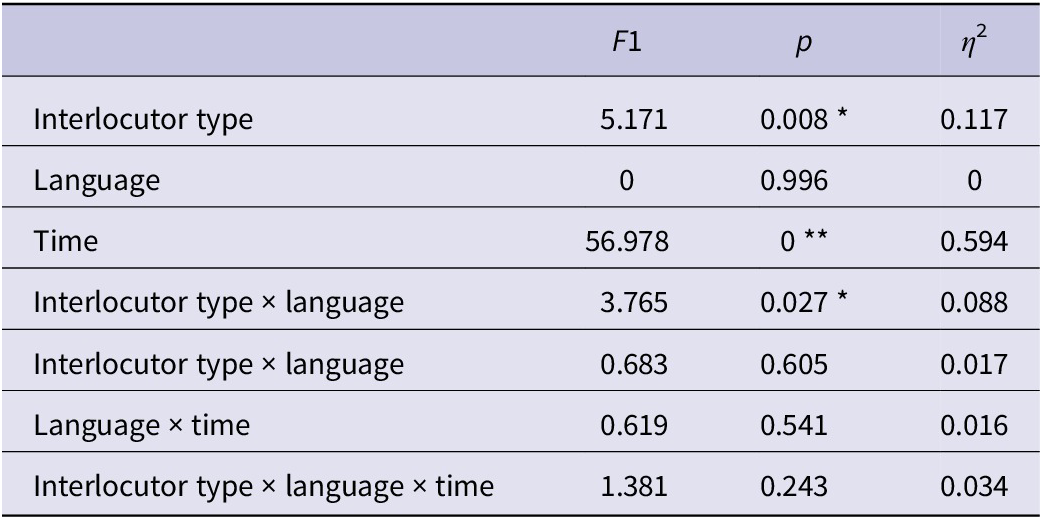
The analysis revealed that, after the onset of the stimuli, participants made a higher number of looks at the high-L2-proficient interlocutor (M = 0.11, SE = 0.01) compared to the low-L2-proficient (M = 0.07, SE = 0.01) and neutral interlocutors (M = 0.06, SE = 0.009) as indicated by the main effect of interlocutor type F1(1, 39) = 5.17, p = 0.008, n 2 = 0.11; F2(1, 89) = 86.44, p < 0.001, n 2 = 0 9. The average number of fixations increased significantly over the period. The highest number of fixations was observed during the naming phase (M = 0.10, SE = 0.01), and the least number of fixations occurred during the language plan phase (M = 0.06, SE = 0.008), F1(1, 39) = 56.97, p < 0.001, n 2 = 0.59; F2(1, 89) = 236.44, p < 0.001, n 2 = 0.72.
The interaction between the interlocutor type and language F1(1, 39) = 3.76, p = 0.02, n 2 = 0.08; F2(1, 89) = 7.12, p < 0.001, n 2 = 0.07, indicated that participants looked at high-L2-proficient interlocutor while naming in L1 (M = 0.12, SE = 0.02) and L2 (M = 0.11, SE = 0.01) and the number of fixations to low-L2-proficient (L1 M = 0.06, SE = 0.02, p = 0.04; L2 M = 0.07, SE = 0.01, p = 0.01) and neutral interlocutor (L1 M = 0.06, SE = 0.009, p = 0.01; L2 M = 0.06, SE = 0.01, p = 0.005). However, other interactions and main effects did not attain the level of statistical significance (F < 1) (Table 2).
The main effects and interactions of factors – language choice, interlocutor type (high-L2-proficient, low-L2-proficient and neutral interlocutors) and time bin (language plan, naming and post-naming) – on the proportion of fixations during the experimental trials by high-literate bilinguals

Note: ** p < 0.001; * p < 0.05.
Based on the visual inspection of the time-course graph, we observed an interesting pattern during the language planning phase. In this phase, the proportion of fixations directed at the interlocutor differs, for which a time-course analysis was performed on “six” 200-ms time bins. Repeated-measures ANOVA by item and by subject were performed on the proportion of fixation, with language, interlocutor type and time bins as factor (Figure 4).
The graph reveals the time course of the proportion of fixations to interlocutors (percentages) during object naming. Error bars represent standard errors. During the experimental trials, the high-literate bilinguals looked at high-L2 proficient interlocutors during the language planning phase.

2.3.2. Time-course analysis – language plan phase (200–1400 ms)
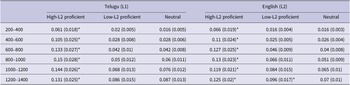
Subject and item analysis revealed a main effect of interlocutor type F1(1,39) = 9.45, p < 0.001, η 2 = 0.19; F2(1,89) = 160.86, p < 0.001, η 2 = 0.64; participants looked at the high-L2-proficient interlocutors (M = 0.11, SE = 0.02) more often compared to low-L2-proficient interlocutors (M = 0.05, SE = 0.01, p = 0.003) and neutral interlocutors (M = 0.04, SE = 0.007, p = 0.00). Participants looked at the neutral interlocutors the least number of times. The main effect of time bins F1(1,39) = 23.06, p < 0.001, η 2 = 0.37; F2(1,89) = 245.47, p < 0.001, η 2 = 0.73, indicated that the proportion of fixations to the interlocutors increased over time. The significant main effect of language of object naming was absent F1(1,39) = 0.92, p = 0.34, η 2 = 0.02, but was present by item type F2(1,89) = 3.23, p = 0.001, η 2 = 0. 7. The interaction of interlocutor type and time bin was significant F1(1,39) = 3.23, p = 0.001, η 2 = 0.07; F2(1,89) = 7.96, p < 0.001, η 2 = 0.08, and the number of fixations to the high-L2-proficient interlocutor and low-L2-proficient interlocutors increased as the time bins increase (Table 3).
Means and standard errors (in parentheses) of the proportion of fixations to the interlocutors by high-literate bilinguals during the language plan phase

Note: *p < 0.05.
The three-way interaction between interlocutor type, language and time bin was significant F1(1,39) = 2.59, p = 0.005, η 2 = 0.06; F2(1,89) = 1.52, p = 0.10, η 2 = 0. 1. ANOVA was performed for each time bin with interlocutor type and language as factors to simplify this interaction. Other interactions were not significant (F < 1).
2.3.3. Time bin 200–400 ms
The main effect of interlocutor type was significant F1(1,39) = 5.99, p = 0.004, η 2 = 0.13; F2(1,89) = 68.94, p < 0.001, η 2 = 0.43. Participants made higher number of fixations to the high-L2-proficient interlocutor (M = 0.063, SE = 0.01) compared to low-L2-proficient interlocutor (M = 0.018, SE = 0.004, p = 0.01) and neutral interlocutors (M = 0.016, SE = 0.004, p = 0.01). Fixations to low-L2-proficient and neutral interlocutors did not differ (p = 0.7). The main effect of language and its interaction with object type did not reach statistical significance (F < 1).
2.3.4. Time bin 400–600 ms
Similar to the previous time bins, participants looked at low-L2-proficient (M = 0.027, SE = 0.006) and neutral interlocutors (M = 0.027, SE = 0.005) significantly lower number of times compared to the number of looks at high-L2-proficient interlocutors (M = 0.108, SE = 0.02, p = 0.002; p = 0.002) F1(1,39) = 10.28, p < 0.001, η 2 = 0.20; F2(1,89) = 136.24, p < 0.01, η 2 = 0. 0. Other effects were not significant (F < 1).
2.3.5. Time bin 600–800 ms
The number of fixations to the high-L2-proficient interlocutor (M = 0.130, SE = 0.02) was significantly higher compared to low-L2-proficient (M = 0.044, SE = 0.009, p = 0.002) and neutral interlocutors (M = 0.041, SE = 0.008, p = 0.001) F1(1,39) = 10.82, p < 0.001, η 2 = 0.21; F2(1,89) = 120.77 p < 0.001, η 2 = 0.57. Other effects were not significant (F < 1).
2.3.6. Time bin 800–1000 ms
There was a significant main effect of the interlocutor type F1(1,39) = 10.38, p < 0.001, η 2 = 0.21; F2(1,89) = 99.38, p < 0.001, η 2 = 0.52. Overall, fixations to the high-L2-proficient interlocutor (M = 0.140, SE = 0.02) were higher compared to neutral (M = 0.056, SE = 0.009, p = 0.001) and low-L2-proficient interlocutors (M = 0.058, SE = 0.01, p = 0.002). There was an interaction between language and interlocutor type F1(1,39) = 5.50, p = 0.006, η 2 = 0.12; F2(1,89) = 3.96, p = 0.02, η 2 = 0.04. When participants were preparing to name the object in L2, they looked at the high-L2-proficient interlocutor (M = 0.130, SE = 0.02) more often than the low-L2-proficient interlocutor (M = 0.066, SE = 0.01, p = 0.005) and neutral interlocutors (M = 0.051, SE = 0.009, p = 0.00). Similarly, while participants were planning to name in L1, they looked at high-L2-proficient interlocutors (M = 0.150, SE = 0.02) a higher number of times than other interlocutors (low-L2-proficient – M = 0.050, SE = 0.01, p = 0.005; neutral – M = 0.060, SE = 0.01, p = 0.001).
2.3.7. Time bin 1000–1200 ms
Similar to the previous bin, the proportion of fixations was significantly higher for the high-L2-proficient interlocutor (M = 0.131, SE = 0.02) than for neutral (M = 0.071, SE = 0.01, p = 0.009) and low-L2-proficient interlocutors (M = 0.076, SE = 0.01, p = 0.014) F1(1,39) = 6.31, p = 0.003, η 2 = 0.13; F2(1,89) = 45.43, p < 0.001, η 2 = 0. 3. The interaction between interlocutor type and language was significant F1(1,39) = 5.38, p = 0.006, η 2 = 0.12; F2(1,89) = 3.18, p = 0.044, η 2 = 0.035. Interestingly, the proportions of looks at high-L2-proficient interlocutors (M = 0.119, SE = 0.02) and low-L2-proficient interlocutors (M = 0.084, SE = 0.01, p = 0.101) did not differ when participants planned to name the object in L2. However, participants looked at the high-L2-proficient interlocutor (M = 0.144, SE = 0.01) more often than low-L2-proficient (M = 0.068, SE = 0.01, p = 0.004) and neutral interlocutors (M = 0.076, SE = 0.01, p = 0.008) while planning to name in L1.
2.3.8. Time bin 1200–1400 ms
The proportion of fixations to low-L2-proficient (M = 0.091, SE = 0.01) and high-L2-proficient interlocutors (M = 0.128, SE = 0.02, p = 0.08) did not differ significantly. However, the difference in the proportion of fixations toward high-L2-proficient and neutral interlocutors (M = 0.079, SE = 0.01, p = 0.00) was significant F1(1,39) = 3.82, p = 0.026, η 2 = 0.08; F2(1,89) = 24.74, p < 0.001, η 2 = 0.21. The main effect of language and its interaction with interlocutor type was insignificant (F < 1).
2.4. Filler trial analysis
2.4.1. Time-course analysis 0–2800 ms
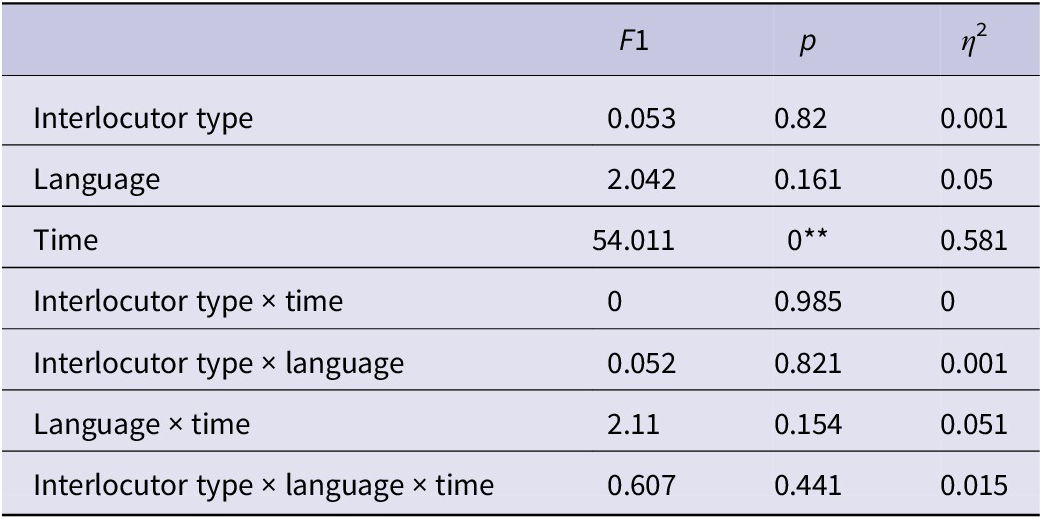
The same procedure was followed for filtering and analyzing the filler trials. The variable interlocutor type in filler trials denotes the four neutral interlocutors (interlocutors 1, 2, 3 and 4) presented in four quadrants. Results from repeated-measures ANOVA (by subject and item) indicated only a significant main effect of time bin F1(1, 39) = 54.01, p < 0.001, n 2 = 0.58; F2(1, 29) = 318.89, p < 0.001, n 2 = 0. 1. This indicated that there was a higher proportion of fixations during the post-naming phase (M = 0.159, SE = 0.02) compared to the language plan (M = 0.043, SE = 0.006, p < 0.001) and naming phase (M = 0.083, SE = 0.01, p < 0.00). The significant main effect of language and interlocutor type was absent. Other interactions were not statistically significant (F < 1) (Table 4).
The main effects and interactions of factors – language choice, interlocutor type (high-L2-proficient, low-L2-proficient and neutral interlocutors) and time bin (language plan, naming and post-naming) – on the proportion of fixations during the experimental trials by low-literate bilinguals

Note: **p < 0.001.
Time-course analysis for the language-planning phase was not performed because the main effect of interlocutor type and its interaction with other variables were not significant. Additionally, a visual inspection of the time-course graph did not indicate higher fixations on any particular interlocutor.
2.5. Object-naming responses – the percentage of language choice and naming latencies
2.5.1. Experiment trials
The percentages of L1 and L2 choices were calculated as the number of L1/L2 trials divided by the total number of experimental trials. Paired t-test was performed for the percentage of choice, and the results revealed that participants chose L2 (M = 58.76, SD = 9.79) to name the objects more often than L1 (M = 41.23, SD = 9.79), t(1, 39) = 5.59, p < 0.01. Naming latencies for L2 and L1 were determined from the onset of the stimuli till the voice trigger. Subject- and item-wise paired t-tests were performed on the naming latencies. The analysis indicated that there was no significant difference between the latencies obtained for L2 (M = 1424.54, SD = 259.74) and L1 (M = 1420.43, SD = 266.62), t 1(1, 39) = 0.21, p = 0.82; t 2(1, 89) = 1.12, p = 0.26.
2.5.2. Filler trials
The data analysis procedure for filler trials was identical to that for experimental trials. The percentage of language choice was significantly higher for L2 (M = 69.32, SD = 12.48) compared to L1 (M = 30.67, SD = 12.48), t(1, 39) = 9.61, p < 0.01. The naming latencies for L2 (M = 1520.42, SD = 271.95) and L1 (M = 1583.37, SD = 285.55) did not differ significantly, t 1(1, 39) = −1.63, p = 0.11; t 2(1, 89) = −0.86, p = 0.39.
2.6. Low-literate bilinguals
Two participants’ data were discarded due to a technical glitch. The procedure used for filtering and analyzing the data for high-literate bilinguals was followed. No responses, delayed responses, word error trials (3.5%) and trials with means (naming latencies) above or below two standard deviations (2%) were discarded. Time-course analysis and analysis of behavioral reaction times (RTs) were performed on filtered data.
2.7. Experimental trial
2.7.1. Time-course analysis 0–2800 ms
Participants made a marginally significant higher number of fixations to the low-L2-proficient interlocutor (M = 0.035, SE = 0.007) than the high-L2-proficient interlocutor (M = 0.020, SE = 0.005, p = 0.063) and neutral interlocutors (M = 0.021, SE = 0.004, p = 0.08) as indicated by the main effect of interlocutor type F1(1, 29) = 12.05, p < 0.001, n 2 = 0.29; F2(1, 89) = 22.65, p < 0.001, n 2 = 0. 0. The language plan phase (M = 0.020, SE = 0.005) had the lowest number of fixations compared to the naming phase (M = 0.03, SE = 0.004, p < 0.001) and the post-naming phase (M = 0.03, SE = 0.004, p < 0.001) F1(1, 29) = 16.31, p < 0.001, n 2 = 0.36; F2(1, 89) = 72.23, p < 0.001, n 2 = 0.4. The main effect of language and other interactions were not significant (F < 1).
2.7.2. Time-course analysis – language plan phase 200–1600 ms
The time-course analysis was performed on the language plan phase (200–1600 ms – average of naming latencies), and the proportion of fixations was collapsed into “seven” time bins of 200 ms each. Subject- and item-wise repeated-measures ANOVA was performed on interlocutor type, language and time as factors. The analysis revealed a significant main effect of time F1(1, 29) = 3.18, p = 0.049, n 2 = 0.09; F2(1, 89) = 72.23, p < 0.001, n 2 = 0.44. The proportion of fixations increased over time. The interaction between interlocutor type and time was significant F1(1, 29) = 16.31, p < 0.001, n 2 = 0.36; F2(1, 89) = 5.396, p < 0.001, n 2 = 0.05.
Participants looked at the low-L2-proficient interlocutor (M = 0.018, SE = 0.006) more often than the high-L2-proficient interlocutor (M = 0.004, SE = 0.001, p = 0.043) during the first time bin. In the second time bin, the proportion of fixations to the low-L2-proficient interlocutor (M = 0.024, SE = 0.005) was significantly higher than the high-L2-proficient (M = 0.006, SE = 0.002, p = 0.005) and the neutral interlocutor (M = 0.008, SE = 0.002, p = 0.012) (Table 5) (Figure 5). Language and time interacted significantly F1(1, 29) = 3.11, p = 0.006, n 2 = 0.09; F2(1, 89) = 0.879, p = 0.41, n 2 = 0.01. The proportion of fixations while naming in L2 (M = 0.031, SE = 0.005) was significantly higher than in L1 (M = 0.023, SE = 0.003, p = 0.040) during the seventh time bin. Other interactions were not significant (F < 1).
Means and standard errors (in parentheses) of the proportion of fixations to the interlocutors by low-literate bilinguals during the language plan phase

Note: *p < 0.05.
The graph reveals the time course of the proportion of fixations to interlocutors (percentages) during object naming. Error bars represent standard errors. During the experimental trials, the low-literate bilinguals made significantly more looks at low-L2 proficient interlocutors than at high-L2 proficient or neutral interlocutors while naming the objects.

2.8. Filler trial analysis
2.8.1. Time-course analysis 0–2800 ms
The main effect of time was significant F1(1, 29) = 11.64, p < 0.001, n 2 = 0.28; F2(1, 29) = 25.54, p < 0.001, n 2 = 0.46; the proportion of fixations during the language plan phase (M = 0.013, SE = 0.002) was significantly lower than the naming phase (M = 0.029, SE = 0.005, p < 0.001) and the post-naming phase (M = 0.029, SE = 0.004, p < 0.00). The interaction between language and time was significant F1(1, 29) = 3.62, p = 0.46, n 2 = 0.11; F2(1, 29) = 8.09, p < 0.001, n 2 = 0.21. Participants made more fixations during the naming phase, especially in L2 (M = 0.038, SE = 0.008) than in L1 (M = 0.02, SE = 0.004, p < 0.00). Other main effects and interactions were insignificant (F < 1).
2.8.2. Time-course analysis – language plan phase 200–1600 ms
The proportion of fixations significantly increased after the fourth time bin till the seventh time bin, as indicated by the main effect of time F1(1, 29) = 12.05, p < 0.001, n 2 = 0.29; F2(1, 29) = 318.89, p < 0.001, n 2 = 0. 1. The interaction between interlocutor type and time was significant F1(1, 29) = 12.05, p < 0.001, n 2 = 0.29; F2(1, 29) = 318.89, p < 0.001, n 2 = 0.91. The proportion of fixations to the neutral interlocutors significantly increased from the first to the seventh time bin. However, there was no significant difference between the proportion of fixations to different interlocutors across the language plan phase.
3. Object-naming responses – the percentage of language choice and naming latencies
3.1. Experimental trials
Participants named the objects in L1 (M = 72.78, SD = 19.17) more often than in L2 (M = 27.21 SD = 19.17), t(1, 29) = −6.50, p < 0.001. The analysis indicated that there was no significant difference between the latencies obtained for L2 (M = 1528.31, SD = 248.23) and L1 (M = 1598.58, SD = 189.86), t 1(1, 29) = −1.70, p = 0.09; t 2(1, 89) = −1.80, p = 0.07.
3.2. Filler trials
The percentage of language choice was significantly higher for L1 (M = 77.30, SD = 22.01) compared to L2 (M = 22.69, SD = 22.01), t(1, 29) = −6.79, p < 0.0 1. The naming latencies for L2 (M = 1409.90, SD = 559.79) were faster than L1 (M = 1634.02, SD = 240.97), t 1(1, 29) = −2.24, p = 0.03; t 2(1, 89) = −0.41, p = 0.67.
4. Discussion
This study explored how high- and low-literate bilinguals plan their language when presented with interlocutors of varying L2 proficiency. Bilingual participants named objects in the presence of interlocutors in the background, as in a visual-world paradigm. Results indicate that participants’ literacy level and interlocutors’ language profiles modulated their language choices and the proportion of looks for different interlocutors. During the experimental trials, high-literate bilinguals named objects in L2 more often than in L1. While naming in L2, they looked at a highly proficient L2 interlocutor. Meanwhile, low-literate bilinguals looked more at the low-L2-proficient interlocutor and named the objects in L1. This indicates that high- and low-literate bilinguals make referential looks to interlocutors, facilitating their language planning.
The results obtained during experimental trials are contrary to the predictions; that is, high-literate participants would name the objects in L2 and L1 an equal number of times. While naming, they would make more looks at high-L2-proficient interlocutors in L2 and at low-L2-proficient interlocutors in L1. The time-course analysis revealed that high-literate participants were more inclined to look at high-L2-proficient interlocutors than at low-L2-proficient interlocutors, irrespective of their language choice during naming. Both language choice and eye-tracking data indicate that participants chose L2 significantly more often than L1. Before naming in L2, time-course analyses across the 200–2800-ms time window indicated that high-literate participants looked at high-L2-proficient interlocutors. The number of looks at high-L2-proficient interlocutors was significantly high from 200 ms to 1000 ms; however, during milliseconds before object naming, that is, 1000–1600 ms, the number of looks at low-L2-proficient interlocutors significantly increased. These looks at low-L2-proficient interlocutors were not as predicted. Interestingly, high-literate participants did not make eye contact with low-L2-proficient interlocutors while naming L1.
This pattern can be attributed to high-literate participants’ perception of interlocutors’ language profile. High-L2-proficient interlocutors spoke fluent L2 and L1 during the monologue and interaction phases, and participants perceived and associated L2 and L1 with interlocutors. However, on interlocutors’ language profile assessment questionnaire, participants reported that they would prefer to speak L2 to high-L2-proficient interlocutors, as it would be less effortful for them. It is observed that when high-literate participants were planning to name the objects in L2, a significant number of looks were made at low-L2-proficient interlocutors just a few milliseconds before articulating the object names in L2. Though we are not sure why these fixations occurred, it can be speculated that bilinguals are vigilant about the non-linguistic cues associated with language in their environment. Participants were familiar with interlocutors’ language profile during the familiarization phase. These referral looks do not occur as a function of lexical activation but occur due to “familiarity.” The significantly lower number of looks at neutral interlocutors can justify the above explanation. The time-course analysis of the filler trial indicates that the proportion of fixations to four neutral interlocutors did not differ significantly from the onset of stimulus presentation until object naming. These findings further support the finding that fixations on low-L2-proficient interlocutors are a function of familiarity. The influence of participants’ language dominance can be observed in their object-naming responses and latencies during filler and experimental trials. Participants chose L2 significantly more often and responded faster in naming. The percentage of L2 responses in filler trials was substantially higher than in experimental trials, indicating participants’ language preference and L2 dominance. Another possible explanation is that, since the task was voluntary naming, high-literate participants might have deliberately looked around the interlocutors as a form of social interaction (Gandolfi et al., Reference Gandolfi, Pickering and Garrod2023). If an experiment designed involved cued object naming in the presence of interlocutors with varied L2 proficiencies, we might observe that when the English cue is presented, the proportion of looks at the high-L2-proficient interlocutor would be higher; similarly, if a Telugu cue is presented, the proportion of looks at the low-L2-proficient interlocutor would be higher.
As expected, low-literate participants chose L1 more often when naming the objects. They made more referral gazes at low-L2-proficient interlocutors before naming the objects, that is, during the language planning phase (500–1500 m). Low-literate participants looked at the low-L2-proficient interlocutor while naming objects (object-naming phase) in L2 (1500–2000 m). However, the number of language choices in L2 was significantly lower than in L1. These observations are in accordance with our predictions. Communicative contexts demand more cognitive control and language monitoring. The preference is for the entity with bivalency; that is, the association of L2 and L1 can reduce cognitive/linguistic load. We speculate that both high-literate and low-literate participants preferred looking at the interlocutor whom they perceived as similar to their language profile (high L2–high L2; low L2–low L2). These results support the previous findings by Liu et al. (Reference Liu, Timmer, Jiao, Yuan and Wang2019), who investigated whether socio-cultural identity affects language control and production. They found that bilingual participants named faster in L1-congruent trials, in which participants were asked to name the object in Chinese in the presence of a Chinese face in the background. Moreover, they also incurred lower switch costs during congruent trials than incongruent trials. The authors attributed this finding to the “own-race effect,” which indicates that, upon seeing a face that was socio-culturally identical to participants (Chinese), they activated their Chinese lexical systems to facilitate naming. A study by Kapiley and Mishra (Reference Kapiley and Mishra2024) demonstrated that language choice/plan occurred as a function of the level of L2 proficiency of bilingual participants while interacting with high- or low-L2-proficient interlocutors. In the presence of high-L2-proficient interlocutors, high-L2-proficient bilingual participants used L2 more often. Low-L2-proficient bilingual participants chose their L1 more often in the presence of low-L2-proficient interlocutors. Previous research also depicted that perceived interlocutor language proficiency modulates cognitive control. The findings indicate that high-L2-proficient bilinguals perform better in the presence of high-L2-proficient interlocutors when given a high-monitoring task (Rafeekh & Mishra, Reference Rafeekh and Mishra2021). These effects could also result from participants perceiving specific interlocutors as similar to their language profile.
Findings from the present study show how high- and low-literate bilinguals plan language in an interactive social context by evaluating familiar cues and facilitating their language planning. Another aspect that affected the outcomes is preparation time. Most studies present a contextual linguistic/non-linguistic cue 500–2000 ms before the object-naming stimuli, resulting in faster responses. For example, Kapiley and Mishra (Reference Kapiley and Mishra2019) found that participants adhered to their study’s instructions to balance L2 and L1 language choices. With a given cartoon presentation for 2000 ms, participants could choose between L2 and L1 equally often; mean intensities were relatively equal to those obtained in this experiment. If the experimental design involved cued object naming in the visual world, we might observe that when the L2 cue is presented, the proportion of looks at a high-L2-proficient interlocutor would be higher; similarly, if an L1 cue is presented, the proportion of looks at a low-L2-proficient interlocutor would be higher. Previous experiments on interlocutors’ L2 proficiency effects on language choice (Kapiley & Mishra, Reference Kapiley and Mishra2019) indicated that when a single relevant interlocutor was presented in a trial, participants chose the language associated with the interlocutor to facilitate naming. In such cases, participants chose L1 for the low-L2-proficient interlocutor and L2 for the high-L2-proficient one. We assume that when bilinguals encounter a complex linguistic context, they prefer to select and produce the language in which they are proficient.
5. Conclusion
The study indicates that bilinguals’ literacy levels modulate sensitivity to non-linguistic cues. The overall fixations of low-literate participants on high-L2-proficient interlocutors in the visual world were significantly lower than those of high-literate participants. These results demonstrate that the higher the literacy level among bilinguals, the more vigilant and sensitive they are toward non-linguistic visual cues associated with a language in a communicative context.
Data availability statement
The data are available on the Figshare repository and can be accessed at https://figshare.com/s/b183680236699c89bf5a.
Acknowledgements
The authors acknowledge Manasa Padmanabhuni for assisting during data collection.
Competing interests
The authors declare none.





 Open access

