





Introduction
Depression is a common disease among young adults and a recognized leading cause of disability globally, affecting up to 21% individuals aged 18–25 years (Ferrari et al., Reference Ferrari, Santomauro, Mantilla Herrera, Shadid, Ashbaugh, Erskine, Charlson and Whiteford2022; Thapar et al., Reference Thapar, Eyre, Patel and Brent2022; Villarroel & Terlizzi, Reference Villarroel and Terlizzi2020; WHO, 2023). Symptoms of depression tend to emerge in childhood, to steadily increase during adolescence, and to peak in early adulthood (Thapar et al., Reference Thapar, Eyre, Patel and Brent2022).
Adverse life events, particularly childhood maltreatment, occurring in early life, are well-documented risk factors for depression (LeMoult et al., Reference LeMoult, Humphreys, Tracy, Hoffmeister, Ip and Gotlib2020). Childhood maltreatment, encompassing any form of abuse (e.g., physical, sexual, or psychological abuse) or neglect (e.g., physical, emotional neglect) by a caregiver (Leeb et al., Reference Leeb, Paulozzi, Melanson, Simon and Arias2008, p.11), has been prospectively associated with a range of mental health problems, including depression (Danese & Widom, Reference Danese and Widom2020; Kessler et al., Reference Kessler, McLaughlin, Green, Gruber, Sampson, Zaslavsky, Aguilar-Gaxiola, Alhamzawi, Alonso, Angermeyer, Benjet, Bromet, Chatterji, de Girolamo, Demyttenaere, Fayyad, Florescu, Gal, Gureje, Haro, Hu, Karam, Kawakami, Lee, Lépine, Ormel, Posada-Villa, Sagar, Tsang, Üstün, Vassilev, Viana and Williams2010; Spatz Widom et al., Reference Spatz Widom, DuMont and Czaja2007; Strathearn et al., Reference Strathearn, Giannotti, Mills, Kisely, Najman and Abajobir2020). Furthermore, individuals with a history of childhood maltreatment are more likely to be diagnosed with depression, to manifest more severe symptoms (Humphreys et al., Reference Humphreys, LeMoult, Wear, Piersiak, Lee and Gotlib2020), and to have more treatment-resistant depression (Nanni et al., Reference Nanni, Uher and Danese2012).
Gene–environment interactions
While some individuals report depressive symptoms following experiences of childhood maltreatment, others do not (Jaffee, Reference Jaffee2017). This interindividual variability may be partly accounted by genetically inherited vulnerability for depression (Kendall et al., Reference Kendall, Van Assche, Andlauer, Choi, Luykx, Schulte and Lu2021). Depressive symptoms have been found to be moderately heritable (ranging between 30-50%) (Kendall et al., Reference Kendall, Van Assche, Andlauer, Choi, Luykx, Schulte and Lu2021). This raises the possibility that interindividual variability may be a result of the interaction between genetic and environmental influences, such as genetic vulnerability for depression and childhood maltreatment (Arnau-Soler et al., Reference Arnau-Soler, Adams, Clarke, MacIntyre, Milburn, Navrady, McIntosh and Thomson2019; Belsky et al., Reference Belsky, Bakermans-Kranenburg and Van IJzendoorn2007). There is a need to further examine the potential role of genetic factors in either exacerbating or buffering the occurrence of depressive symptoms in the aftermath of adversity (i.e., gene–environment interactions: GxEs). Gene–environment interactions refer to the dynamic interplay between genetic factors and environmental influences, whereby the strength of the association linking pathogenic environments on disease varies according to individual’s genetic predispositions (Ottman, Reference Ottman1996). Among the many form GxEs may take (e.g., Differential Susceptibility, Social Push) (Boardman et al., Reference Boardman, Daw and Freese2013), the Diathesis-Stress model is the most commonly reported in the context of depression. This model proposes that mental health problems arise from the interaction between dispositional factors (diathesis, e.g., genes) and environmental factors (stress, e.g., maltreatment). Thereby, individuals with genetic vulnerabilities for depression may be more at-risk for the depressogenic effect of adverse environments. Yet, this diathesis is hypothesized to remain latent in the absence of adversity (Broerman, Reference Broerman, Zeigler-Hill and Shackelford2020).
Prior studies that examined the independent and joint roles of genetic vulnerability and childhood maltreatment in depressive symptoms have mainly focused on single candidate genes, with inconsistent findings (McIntosh et al., Reference McIntosh, Sullivan and Lewis2019; Ripke et al., Reference Ripke, Wray, Lewis, Hamilton, Weissman, Breen, Byrne, Blackwood, Boomsma, Cichon, Heath, Holsboer, Lucae, Madden, Martin, McGuffin, Muglia, Noethen, Penninx, Pergadia, Potash, Rietschel, Lin, Müller-Myhsok, Shi, Steinberg, Grabe, Lichtenstein, Magnusson, Perlis, Preisig, Smoller, Stefansson, Uher, Kutalik, Tansey, Teumer, Viktorin, Barnes, Bettecken, Binder, Breuer, Castro, Churchill, Coryell, Craddock, Craig, Czamara, De Geus, Degenhardt, Farmer, Fava, Frank, Gainer, Gallagher, Gordon, Goryachev, Gross, Guipponi, Henders, Herms, Hickie, Hoefels, Hoogendijk, Hottenga, Iosifescu, Ising, Jones, Jones, Jung-Ying, Knowles, Kohane, Kohli, Korszun, Landen, Lawson, Lewis, MacIntyre, Maier, Mattheisen, McGrath, McIntosh, McLean, Middeldorp, Middleton, Montgomery, Murphy, Nauck, Nolen, Nyholt, O'Donovan, Oskarsson, Pedersen, Scheftner, Schulz, Schulze, Shyn, Sigurdsson, Slager, Smit, Stefansson, Steffens, Thorgeirsson, Tozzi, Treutlein, Uhr, van den Oord, Van Grootheest, Völzke, Weilburg, Willemsen, Zitman, Neale, Daly, Levinson and Sullivan2013). For instance, a systematic review conducted by Li et al., (2020) on studies testing GxE between childhood maltreatment and candidate genes (i.e., SLC6A4, CRHR1, BDNF, FKBP5, CREB1, NTRK2, OXTR, IL 6, CRP, TNF, TNFR1, TNFR2, IL1B) in the prediction of depression showed mixed findings (n = 29 studies). For the serotonin transporter (i.e., 5-HTTLPR; n = 15 studies) gene, two out of five studies reported a significant interaction with childhood maltreatment predicting later depressive symptoms among those carrying the S allele, and eight of out ten studies reported such an interaction for a diagnosis of major depression. Other genetic variants more consistently interacted with maltreatment, including the variant CREB1-rs2253206 and the variant CRHR1 haplotypes, which respectively strengthened and attenuated depressive symptoms in the presence of childhood maltreatment. Candidate gene approaches have strengths, such as focusing on genes that are involved in known biological processes related to depression (i.e., hypothesis-driven approach); but indirectly exclude all other potential polymorphisms. The issues of limited power and low estimates of variance explained constraint current evidence related to the candidate gene approach in the prediction of complex polygenic disorders (i.e., involving several genes), such as depression (Belsky & Israel, Reference Belsky and Israel2014).
The consideration of genome wide association studies (GWAS) has become widespread to account for genetic variants associated to phenotypes of interest. Information derived from GWAS can be used to calculate polygenic risk scores (PGS), which address the highly polygenic nature of depression in GxEs. PGS represent the participants’ cumulative genetic propensity for a complex phenotype (e.g., depressive symptoms) encompassing several common single nucleotide polymorphisms (SNPs) located across the genome. These genetic variants are weighted according to the strength of their association with the phenotype according to previously documented GWAS (Abdellaoui et al., Reference Abdellaoui, Yengo, Verweij and Visscher2023; Howard et al., Reference Howard, Adams, Clarke, Hafferty, Gibson, Shirali, Coleman, Hagenaars, Ward and Wigmore2019; McIntosh et al., Reference McIntosh, Sullivan and Lewis2019). However, the few studies that have investigated the interplay between the polygenic risk for depression (PGSDEP) and childhood maltreatment in the prediction of depression found inconsistent results. For instance, Peyrot et al. (Reference Peyrot, Milaneschi, Abdellaoui, Sullivan, Hottenga, Boomsma and Penninx2014) reported that retrospective childhood maltreatment was associated with higher risk for major depressive disorder only for participants with higher PGSDEP scores, supporting the Diathesis-Stress model. Conversely, Mullins et al. (Reference Mullins, Power, Fisher, Hanscombe, Euesden, Iniesta, Levinson, Weissman, Potash and Shi2016) found that higher genetic risk was associated with major depression only in the absence, rather than in the presence, of childhood maltreatment. This result echoes the Social Push model (Boardman et al., Reference Boardman, Daw and Freese2013), whereby individuals carrying lower genetic risk for depression may lose their genetic advantage for lower levels of depression in the presence of childhood maltreatment. A meta-analysis of nine cohorts from the Psychiatric Genomics Consortium (n = 5765, <18 years), including those from Mullins et al. (Reference Mullins, Power, Fisher, Hanscombe, Euesden, Iniesta, Levinson, Weissman, Potash and Shi2016) and Peyrot et al. (Reference Peyrot, Milaneschi, Abdellaoui, Sullivan, Hottenga, Boomsma and Penninx2014), did not find a consistent pattern of an interactive contribution of retrospectively reported childhood maltreatment and the PGSDEP (i.e., diagnosed based on DSM-IV or self-reported symptoms) (Peyrot et al., Reference Peyrot, Van der Auwera, Milaneschi, Dolan, Madden, Sullivan, Strohmaier, Ripke, Rietschel and Nivard2018). However, the evidence of GxE (Mullins et al., Reference Mullins, Power, Fisher, Hanscombe, Euesden, Iniesta, Levinson, Weissman, Potash and Shi2016; Peyrot et al., Reference Peyrot, Milaneschi, Abdellaoui, Sullivan, Hottenga, Boomsma and Penninx2014) taking distinct forms (i.e., interactions in different directions) certainly complicates the overall interpretation of these findings.
Several factors may account for these inconsistencies. Earlier GWAS (Ripke et al., Reference Ripke, Wray, Lewis, Hamilton, Weissman, Breen, Byrne, Blackwood, Boomsma, Cichon, Heath, Holsboer, Lucae, Madden, Martin, McGuffin, Muglia, Noethen, Penninx, Pergadia, Potash, Rietschel, Lin, Müller-Myhsok, Shi, Steinberg, Grabe, Lichtenstein, Magnusson, Perlis, Preisig, Smoller, Stefansson, Uher, Kutalik, Tansey, Teumer, Viktorin, Barnes, Bettecken, Binder, Breuer, Castro, Churchill, Coryell, Craddock, Craig, Czamara, De Geus, Degenhardt, Farmer, Fava, Frank, Gainer, Gallagher, Gordon, Goryachev, Gross, Guipponi, Henders, Herms, Hickie, Hoefels, Hoogendijk, Hottenga, Iosifescu, Ising, Jones, Jones, Jung-Ying, Knowles, Kohane, Kohli, Korszun, Landen, Lawson, Lewis, MacIntyre, Maier, Mattheisen, McGrath, McIntosh, McLean, Middeldorp, Middleton, Montgomery, Murphy, Nauck, Nolen, Nyholt, O'Donovan, Oskarsson, Pedersen, Scheftner, Schulz, Schulze, Shyn, Sigurdsson, Slager, Smit, Stefansson, Steffens, Thorgeirsson, Tozzi, Treutlein, Uhr, van den Oord, Van Grootheest, Völzke, Weilburg, Willemsen, Zitman, Neale, Daly, Levinson and Sullivan2013) have tended to consider genetic variants associated with a diagnosis of major depressive disorder, while more recent GWAS (Howard et al., Reference Howard, Adams, Clarke, Hafferty, Gibson, Shirali, Coleman, Hagenaars, Ward and Wigmore2019; Wray et al., Reference Wray, Ripke, Mattheisen, Trzaskowski, Byrne, Abdellaoui, Adams, Agerbo, Air and Andlauer2018) have included continuously distributed depression phenotypes, especially in the general population (e.g., self-reported symptoms). The PGS derived from these more recent GWAS may be more predictive of the continuum of depressive symptoms, including subclinical levels. More recent GWAS also include a larger number of participants, increasing the power to detect variants with smaller effects (Howard et al., Reference Howard, Adams, Clarke, Hafferty, Gibson, Shirali, Coleman, Hagenaars, Ward and Wigmore2019; Wray et al., Reference Wray, Ripke, Mattheisen, Trzaskowski, Byrne, Abdellaoui, Adams, Agerbo, Air and Andlauer2018), including those that may interact with adverse experiences. For instance, Wray et al. (Reference Wray, Ripke, Mattheisen, Trzaskowski, Byrne, Abdellaoui, Adams, Agerbo, Air and Andlauer2018) (135, 458 cases and 344, 901 controls) uncovered 44 genetic variants (SNP-based heritability = 0.087, SE = 0.004) associated with major depression based on self-reported depressive symptoms in the general population. Howard et al. (Reference Howard, Adams, Clarke, Hafferty, Gibson, Shirali, Coleman, Hagenaars, Ward and Wigmore2019) (246, 363 cases and 561, 190 controls) found 102 genetic variants (SNP-based heritability = 0.089, SE = 0.003) associated with diagnosed major depression, self-reported depressive symptoms, or help-seeking for depressive symptoms. One study investigating the GxE between PGSDEP (based on Wray et al., Reference Wray, Ripke, Mattheisen, Trzaskowski, Byrne, Abdellaoui, Adams, Agerbo, Air and Andlauer2018) and childhood abuse on depression in clinical and epidemiological adolescent cohorts found independent effects of childhood abuse and PGSDEP to depression, but no significant interaction effect (Halldorsdottir et al., Reference Halldorsdottir, Piechaczek, Soares de Matos, Czamara, Pehl, Wagenbuechler, Feldmann, Quickenstedt-Reinhardt, Allgaier and Freisleder2019). More studies relying on recent GWAS are needed to further examine if GxE arise between PGSDEP and childhood maltreatment in the prediction of depressive symptoms.
Assessment and types of childhood maltreatment
Another factor contributing to the inconclusive set of findings in GxE studies is the inconsistency in measuring childhood maltreatment (e.g., single vs. repeated, dimensional vs cumulative, and types of maltreatment). Prior studies that have investigated the role of polygenic risk in the context of maltreatment (Mullins et al., Reference Mullins, Power, Fisher, Hanscombe, Euesden, Iniesta, Levinson, Weissman, Potash and Shi2016; Peyrot et al., Reference Peyrot, Van der Auwera, Milaneschi, Dolan, Madden, Sullivan, Strohmaier, Ripke, Rietschel and Nivard2018) have exclusively relied on retrospective reports. However, associations between maltreatment and psychopathology have been shown to differ depending on whether maltreatment was evaluated through prospective versus retrospective reports (Baldwin et al., Reference Baldwin, Reuben, Newbury and Danese2019; Danese & Widom, Reference Danese and Widom2020). Notably, retrospective reports are more strongly associated with psychopathology, including depression, than prospective reports, perhaps due to the retrospective evaluation being done in temporal proximity to the outcome, in addition to potential methodological biases (e.g., shared method variance) (Danese & Widom, Reference Danese and Widom2020). In addition, a weak concordance between prospective and retrospective estimates has been reported (continuous or dichotomous) (Baldwin et al., Reference Baldwin, Reuben, Newbury and Danese2019; Danese & Widom, Reference Danese and Widom2020; Scardera et al., Reference Scardera, Langevin, Collin-Vézina, Cabana, Pinto Pereira, Côté, Ouellet-Morin and Geoffroy2023), which raises the question on whether we should anticipate differential GxE findings with these distinct measures. To the best of our knowledge, no studies have tested this possibility.
Childhood maltreatment encompasses several subtypes (e.g., physical abuse, sexual abuse, and neglect). However, existing studies have typically focused on cumulative maltreatment (Lacey et al., Reference Lacey, Pereira, Li and Danese2020; Putnam et al., Reference Putnam, Harris and Putnam2013), while others investigated isolated subtypes (Jackson et al., Reference Jackson, McGuire, Tunno and Makanui2019). More recently, a dimensional model of adversity and psychopathology proposes to examine subtypes according to two dimensions: deprivation and threat (McLaughlin et al., Reference McLaughlin, Sheridan and Lambert2014; Sheridan & McLaughlin, Reference Sheridan and McLaughlin2014). While deprivation refers to the “absence of expected environmental inputs” (e.g., neglect), threat refers to the presence of “an atypical or unexpected experience characterized by actual or threatened death, injury […] or other harm to one’s physical integrity” (e.g., abuse) (McLaughlin et al., Reference McLaughlin, Sheridan and Lambert2014). Both dimensions are hypothesized to affect development through distinct cognitive, emotional, and neurophysiological mechanisms (McLaughlin et al., Reference McLaughlin, Weissman and Bitrán2019). While both deprivation- and threat-based exposures have been associated with mental health outcomes, including depression (Geoffroy et al., Reference Geoffroy, Pinto Pereira, Li and Power2016; Humphreys et al., Reference Humphreys, LeMoult, Wear, Piersiak, Lee and Gotlib2020; Lin et al., Reference Lin, Cao, Chen, Li, Zhang and Guo2023; Schäfer et al., Reference Schäfer, McLaughlin, Manfro, Pan, Rohde, Miguel, Simioni, Hoffmann and Salum2023; Wang et al., Reference Wang, Lu, Liu, Yu, Fan, Gao, Han, Liu, Yao and Zhu2022; van Dam et al., Reference Van Dam, van Nierop, Viechtbauer, Velthorst, van Winkel, Bruggeman, Cahn, de Haan, Kahn, Meijer, Myin-Germeys, van Os and Wiersma2015), many studies found stronger associations for threat-based (e.g., (Schäfer et al., Reference Schäfer, McLaughlin, Manfro, Pan, Rohde, Miguel, Simioni, Hoffmann and Salum2023; Wang et al., Reference Wang, Lu, Liu, Yu, Fan, Gao, Han, Liu, Yao and Zhu2022)), but not all (Lin et al., Reference Lin, Cao, Chen, Li, Zhang and Guo2023). Moreover, experiences of threat and deprivation may differentially affect gene expression, including DNA methylation (Parade et al., Reference Parade, Huffhines, Daniels, Stroud, Nugent and Tyrka2021; Sarro et al., Reference Sarro, Sullivan and Barr2014; Sumner et al., Reference Sumner, Colich, Uddin, Armstrong and McLaughlin2019). To the best of our knowledge, no prior studies have yet tested whether differential GxE findings emerge in the prediction of depressive symptoms according to these two dimensions of childhood maltreatment.
The objectives of this study were threefold: (1) to test whether prospective and retrospective measures of childhood maltreatment (i.e., cumulative maltreatment, threat or deprivation) and PGSDEP independently predict depressive symptoms in young adults, (2) to examine whether associations differ by threat and deprivation experiences, and (3) examine whether PGSDEP moderated the association between childhood maltreatment and depressive symptoms. Since no prior studies had examined this GxE according to prospective and retrospective, as well as threat and deprivation, no a priori hypothesis were posited.
Methods
Participants
Participants were from the Québec Longitudinal Study of Child Development (QLSCD), an ongoing population-based cohort, managed by Institut de la Statistique du Québec, collecting data annually or biennially from 2120 singletons born in the Canadian Province of Québec in 1997–1998. When the participants were 10 years old, blood or saliva samples were collected from 992 participants and 978 were successfully genotyped, from which 721 passed quality control and could be used for the calculation of the PGSDEP score (see Appendix S1 for further details). From those 721 individuals, participants with measures of childhood maltreatment and depressive symptoms were included in the final analyses (n ranging from 541 to 617). Each data collection was approved by Ethical committees of Institut de la Statistique du Québec and the CHU Sainte-Justine Hospital Research Centre. The 2021 Special Round data collection (23 years) was also approved by the Douglas Research Center Ethics Committee. Written informed consent or assent was obtained from participants (and/or their parents, when minor) at each data collection. Further details about the cohort can be found online at https://jesuisjeserai.stat.gouv.qc.ca (Orri et al., Reference Orri, Boivin, Chen, Ahun, Geoffroy, Ouellet-Morin, Tremblay and Côté2021).
Measures
Childhood maltreatment
Prospective measures
The QLSCD did not administer an existing childhood maltreatment questionnaire to assess prospective childhood maltreatment. Our prospective indices of childhood maltreatment relied on information collected prospectively, from infancy to the end of adolescence (14 time points), across multiple informants (mothers, children, teachers, and home observations) regarding the many experiences the child may have been subjected to. Following a procedure described by Scardera et al. (Reference Scardera, Langevin, Collin-Vézina, Cabana, Pinto Pereira, Côté, Ouellet-Morin and Geoffroy2023), relevant information collected over time was first screened by two independent raters based on definitions from the Quebec Youth Protection Act (2021) and supporting resources (Grounds for Reporting a Situation, 2022). From the 462 items considered for inclusion, two maltreatment experts independently selected these items and identified cutoffs for dichotomization, while considering the developmental period of the child. The process of item selection and identifying cutoff scores was guided by the premise that a single item could signal concerns about potential maltreatment. For example, the question “how often do you tell him/her that he/she is bad or not as good as others?” was recoded at 5 months as “absence” if parents replied “never” or “about once a week or less,” while responses of “a few times a week” or more were deemed “probable maltreatment.” At 17 months, however, the same item was recoded as “absence” if parents answered “never,” “about once a week or less,” or “a few times a week,” and considered “probable maltreatment” if parents reported saying it “once or twice a day” or more (Scardera et al., Reference Scardera, Langevin, Collin-Vézina, Cabana, Pinto Pereira, Côté, Ouellet-Morin and Geoffroy2023). Any disagreements between the maltreatment experts were then resolved, and 251 items were included. Three indicators of probable maltreatment have been selected for this study, including (1) cumulative maltreatment by the end of adolescence represented the exposure to various types of maltreatment (physical abuse, sexual abuse, psychological abuse, emotional neglect, physical neglect, and family violence; 0, 1, 2, or 3+ types of maltreatment); (2) the presence (vs. absence) of maltreatment taking the form of threat (physical, sexual, or psychological abuse, and family violence from birth to 17 years); and (3) the presence (vs. absence) of maltreatment taking the form of deprivation (emotional or physical neglect). The category of supervisory/educational neglect was excluded from our indicators given the high rate of endorsement (Scardera et al., Reference Scardera, Langevin, Collin-Vézina, Cabana, Pinto Pereira, Côté, Ouellet-Morin and Geoffroy2023).
Retrospective measures
Self-reported childhood maltreatment was collected at age 23 years using a seven-item scale assessing physical abuse, sexual abuse, psychological abuse, emotional neglect, physical neglect, and exposure to domestic violence. All subtypes of retrospective maltreatment, except sexual abuse, were measured using items from the Adverse Childhood Experiences International Questionnaire (ACE-IQ) (Christoforou & Ferreira, Reference Christoforou and Ferreira2020), developed by the World Health Organization to measure adverse experiences that occur before 18 years of age. Exposure to sexual abuse was evaluated using two items derived from the recombination of the six items from the Early Trauma Inventory Self-Report Short Form (ETI) (Bremner et al., Reference Bremner, Bolus and Mayer2007). The ACE-IQ and ETI reliably measure childhood maltreatment (Bremner et al., Reference Bremner, Bolus and Mayer2007; Tarquinio Camille et al., Reference Tarquinio Camille, Christine, Elise, Charles, Marion and Cyril2023). Similar coding procedures for the retrospective variables (cumulative, threat, deprivation) as for the prospective measures.
Polygenic risk score for depression
We calculated a PGSDEP based on previously reported GWAS (Howard et al., Reference Howard, Adams, Clarke, Hafferty, Gibson, Shirali, Coleman, Hagenaars, Ward and Wigmore2019) using PGS-CS software. PGS-CS is a Bayesian estimation method that applies a continuous shrinkage prior to SNP weighting (Ge et al., Reference Ge, Chen, Ni, Feng and Smoller2019). The PGS-CS approach has been shown to be superior to other methods (e.g., clumping and thresholding) (Ge et al., Reference Ge, Chen, Ni, Feng and Smoller2019). We used a global shrinkage parameter phi set to 0.01. PGSDEP was computed by using a linear combination of the genotype data and the adjusted summary statistics in PLINK 1.90 (Chang et al., Reference Chang, Chow, Tellier, Vattikuti, Purcell and Lee2015). PGSDEP was adjusted for population stratification using the first ten principal factor components derived from the pairwise genetic relationship matrix during quality control. The resulting standardized residuals were used in all analyses.
Depressive symptoms at 20–23 years
Past-week depressive symptoms were evaluated at 20, 22, and 23 years using the Center for Epidemiological Studies-Depression scale (CES-D) short-form (Poulin et al., Reference Poulin, Hand and Boudreau2005; Radloff, Reference Radloff1977) administered through a web-based questionnaire link. The CES-D short form includes 12 statements (e.g., “I felt depressed”). Response options ranged from 0 = rarely/none of the time to 3 = most/all of the time with total scores ranging from 0-36. Higher response options indicated higher symptom severity. Cronbach’s alpha was .85, .87 and .87 at 20, 22 and 23 years, and correlations across measurement points were moderate to high (r s = .511–.667 p < .001). To capture overall depressive symptoms in early adulthood, we computed a mean score, which serves as our primary outcome variable.
Potential confounders
All regression analyses were adjusted for sex and socioeconomic status (averaged from 5 months to 5 years; 6 assessments) (Willms & Shields, Reference Willms and Shields1996), known for its association with childhood maltreatment (Table S1) (Gallo et al., Reference Gallo, Munhoz, de Mola and Murray2018; Merrick et al., Reference Merrick, Ports, Ford, Afifi, Gershoff and Grogan-Kaylor2017; WHO, 2022). To account for possible gene–environment correlations (rGE), whereby genetic influences may be confounded with the exposure to specific environments (Quinn & D'Onofrio, Reference Quinn, D'Onofrio and Benson2020), we also examined whether each of the maltreatment indicators was associated with the PGSDEP according to a liberal threshold (p < .10). When associations were detected, standardized residuals accounting for this covariance were derived prior to the main analyses.
Statistical analyses
First, we used t-tests and chi-square tests to evaluate if mean differences on key child/family characteristics were present between participants with and without a valid PGS score. Second, we examined the bivariate associations between the childhood maltreatment indicators, PGSDEP, and depressive symptoms, which allowed to examine for the presence of possible gene–environment correlations. Third, independent hierarchical linear regressions tested the main and interaction effects of the maltreatment indicators and PGSDEP on depressive symptoms by first including one of the maltreatment indicators (step 1), PGSDEP (step 2), and their interaction term (step 3). Analyses were performed separately for each prospective and retrospective indicator of maltreatment, and all analyses were adjusted for sex and socioeconomic status. All continuous variables were converted into z-scores to ease interpretation. Significant interactions were illustrated by using the simple slopes analysis, which depicts the association between childhood maltreatment and depressive symptoms at the mean and at one standard deviation above and below the sample’s PGSDEP mean.
Results
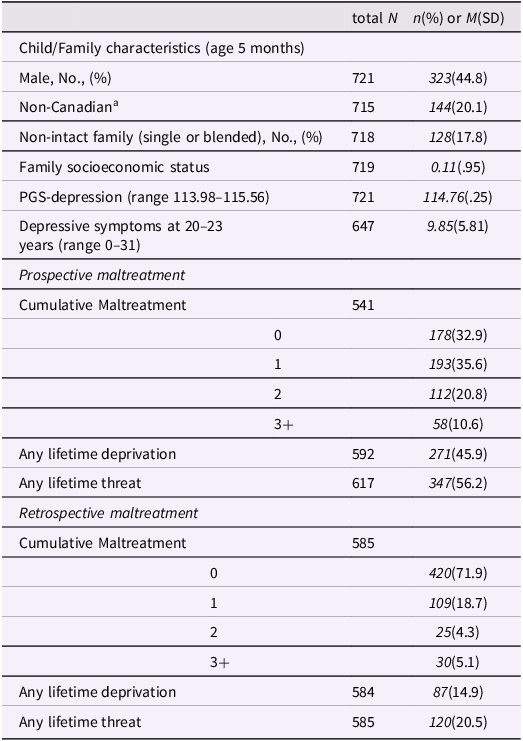
Participants excluded (vs. included) in the study subsample were more likely to be males, have higher internalizing symptoms at 29 months, have younger mother at birth, come from non-intact families of lower socioeconomic status at age 5 months (Table S2). To adjust for selective attrition that may have affected our study sample, we conducted analyses with and without inverse probability weights, representing participants’ probabilities of being included in the study sample conditional on sex, socioeconomic status, family structure, internalizing symptoms at 29 months, and maternal age at birth. The general pattern of results with and without weights did not differ (data not shown); thus, only the weighted results are presented here. The descriptive characteristics for key variables of interest (child/family characteristics, prospective and retrospective maltreatment indicators, PGSDEP, and depressive symptoms from 20 to 23 years) are presented in Table 1. Overall, our participants came from an intact family of average socioeconomic status and were of Canadian descent. Interestingly, 67% of the sample was flagged as exposed to any type of prospectively measured maltreatment. Specifically, about one third of sample was flagged as exposed to one type of maltreatment, and another third was flagged as exposed to 2, 3 or more types of maltreatment (cumulative score distribution: 0 (32.9), 1 (35.6), 2 (20.8), 3+ (10.6)) (Table 1). Retrospective self-reports were obtained across seven items and had lower estimates of any maltreatment (cumulative distribution score: 0 (71.9), 1 (18.7), 2 (5.1), 3+ (5.1)) compared to prospective reports.
Descriptive statistics for study’s key variables

Data were compiled from the final master file of the Quebec Longitudinal Study of Child Development (1998–2021), © Gouvernement du Quebec, Institut de la Statistique du Quebec.
All variables are based on maximum available samples.
a Non-Canadian refers to ancestry of non-Canadian descent.
Bivariate associations showed that PGSDEP had a low correlation with each prospective maltreatment (cumulative: r = .162, p < .001; deprivation: r = .122, p = .002; threat: r = .084, p = .029) and retrospective maltreatment indicator (cumulative: r = .138, p < .001; deprivation: r = .108, p = .008; threat: r = .104, p = .010), suggesting the possibility of rGE and the need to account for them in analyses. PGSDEP was also significantly associated with depressive symptoms at age 20–23 years (β = .146, p < .001, adjusted r 2 = .019). Finally, the associations between prospective maltreatment and depressive symptoms were small and non-significant (r s = .040–.074, p s = .022–.444), while moderate significant associations were noted for retrospective maltreatment (r s = .262–.369, p s < .001).
Additional analyses revealed low correlations between deprivation and threat when prospectively recorded (r = .171, p < .001) and retrospectively recorded (r = .295, p < .001), suggesting distinct experiences. Similarly to what was shown in the larger QLSCD sample (Scardera et al., Reference Scardera, Langevin, Collin-Vézina, Cabana, Pinto Pereira, Côté, Ouellet-Morin and Geoffroy2023), the agreement between the prospective and retrospective reports of maltreatment were generally small and varied in magnitude across indicators: cumulative maltreatment (κ = .056, p = .020), deprivation (κ = .056, p = .097), and threat (κ = .083, p < .001).
Main and interaction effects of cumulative maltreatment with the PGS DEP
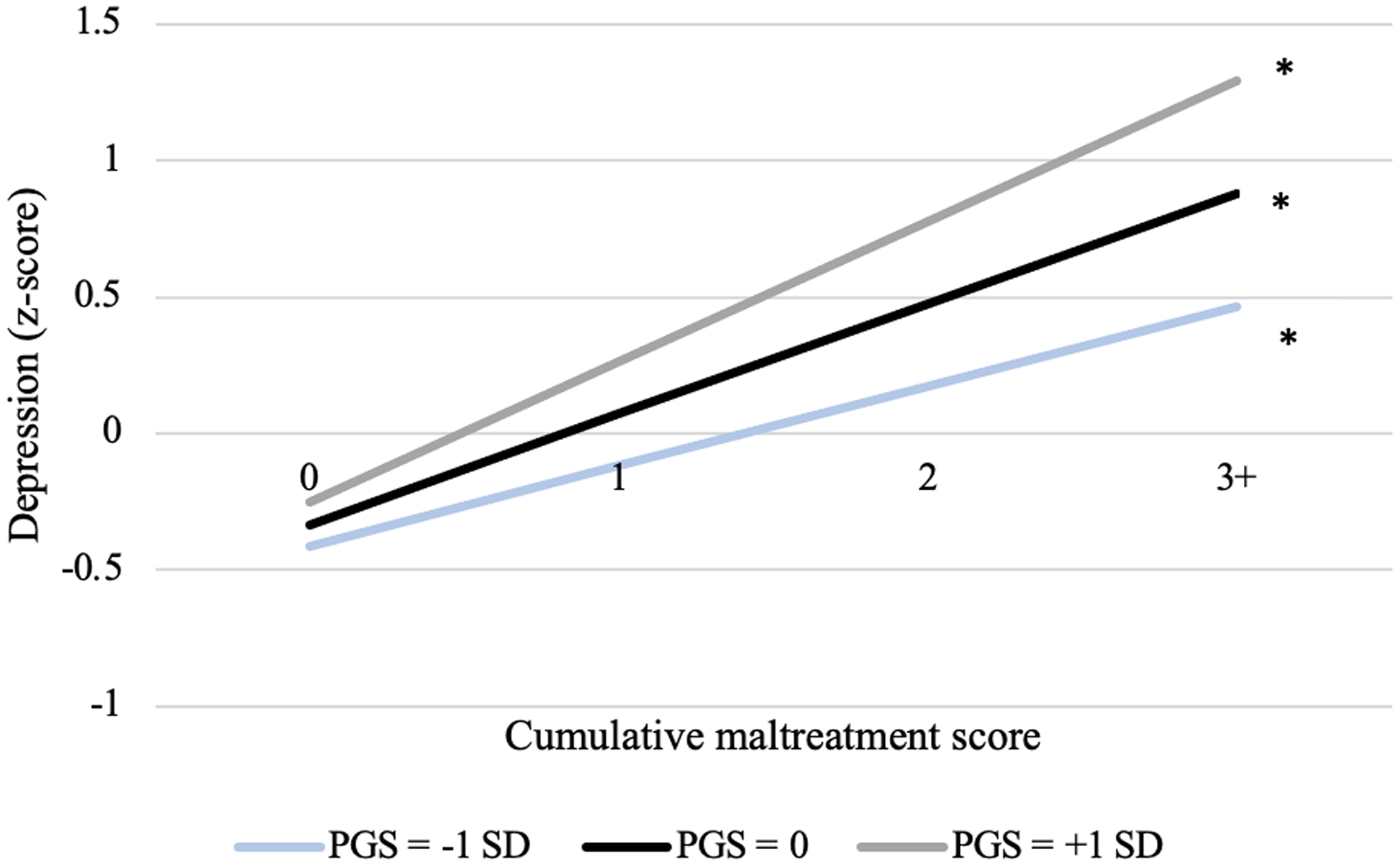
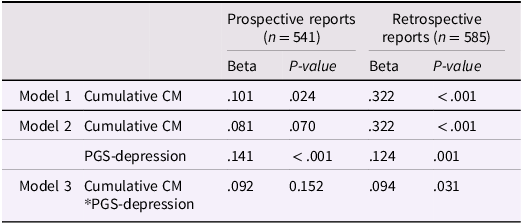
Prospective reports of cumulative maltreatment significantly predicted depressive symptoms at 20–23 years (β = .101, p = .024), while controlling for socioeconomic status and sex (Table 2). This association was also significant and stronger in magnitude when maltreatment was reported retrospectively (β = .322, p < .001). However, only retrospective reports of cumulative maltreatment remained significantly associated with depressive symptoms once PGSDEP was added to the regression model (β = .322, p < .001). A significant interaction between the retrospective cumulative maltreatment and PGSDEP was also found (β = .094, p = .031). That is, as participants’ scores of cumulative maltreatment increased, their depressive symptoms showed a steeper increase if they carried a high genetic risk for depression (at + 1 SD) in comparison to those who were at the sample’s mean or lower levels (–1 SD) (see Figure 1). No significant interaction was noted for prospective cumulative maltreatment (β = .092, p = .152).
Association between the retrospectively reported presence of cumulative maltreatment and depressive symptoms (20–23 years), according to the PGS-depression. PGS “Polygenic risk score”; SD “Standard deviation”. The asterisk indicates a significant (simple slope) association between childhood maltreatment and depressive symptoms at each level of PGS. Data were compiled from the final master file of the Quebec longitudinal study of child development (1998–2021), © gouvernement du Quebec, institut de la statistique du Quebec.

Hierarchical linear regression predicting depressive symptoms (20–23 years) according to cumulative childhood maltreatment, prospective and retrospective reports, and PGS-depression
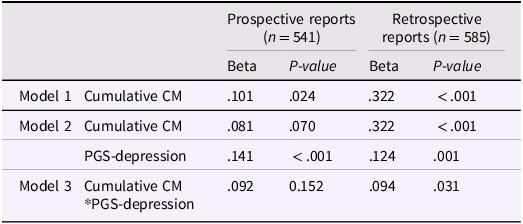
Note. Max N based on data available for reports of prospective (birth to 17 years) and retrospective maltreatment, PGS-depression and depressive symptoms. Cumulative child maltreatment (CM) was coded as 0, 1, 2, 3+ types. Data were compiled from the final master file of the Québec Longitudinal Study of Child Development (1998–2021), © Gouvernement du Québec, Institut de la Statistique du Québec. For PGS-depression we used the standardized residual scores that account for the 10 principal components and covariance with childhood maltreatment. All models were adjusted for sex and socioeconomic status. The main effects of Cumulative CM and PGS-depression are not presented in Model 3 but were included.
Main and interaction effects of deprivation with the PGS DEP
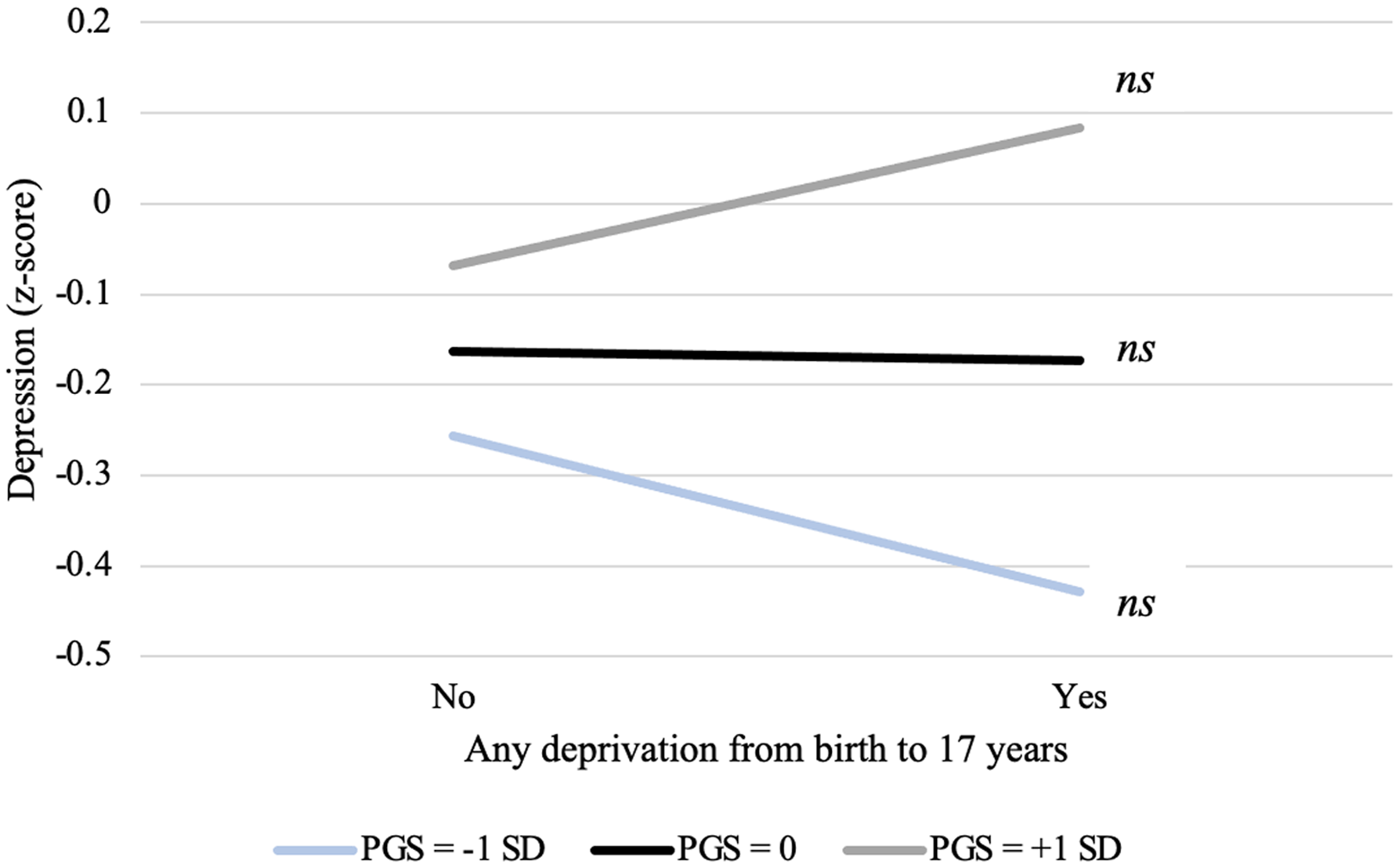
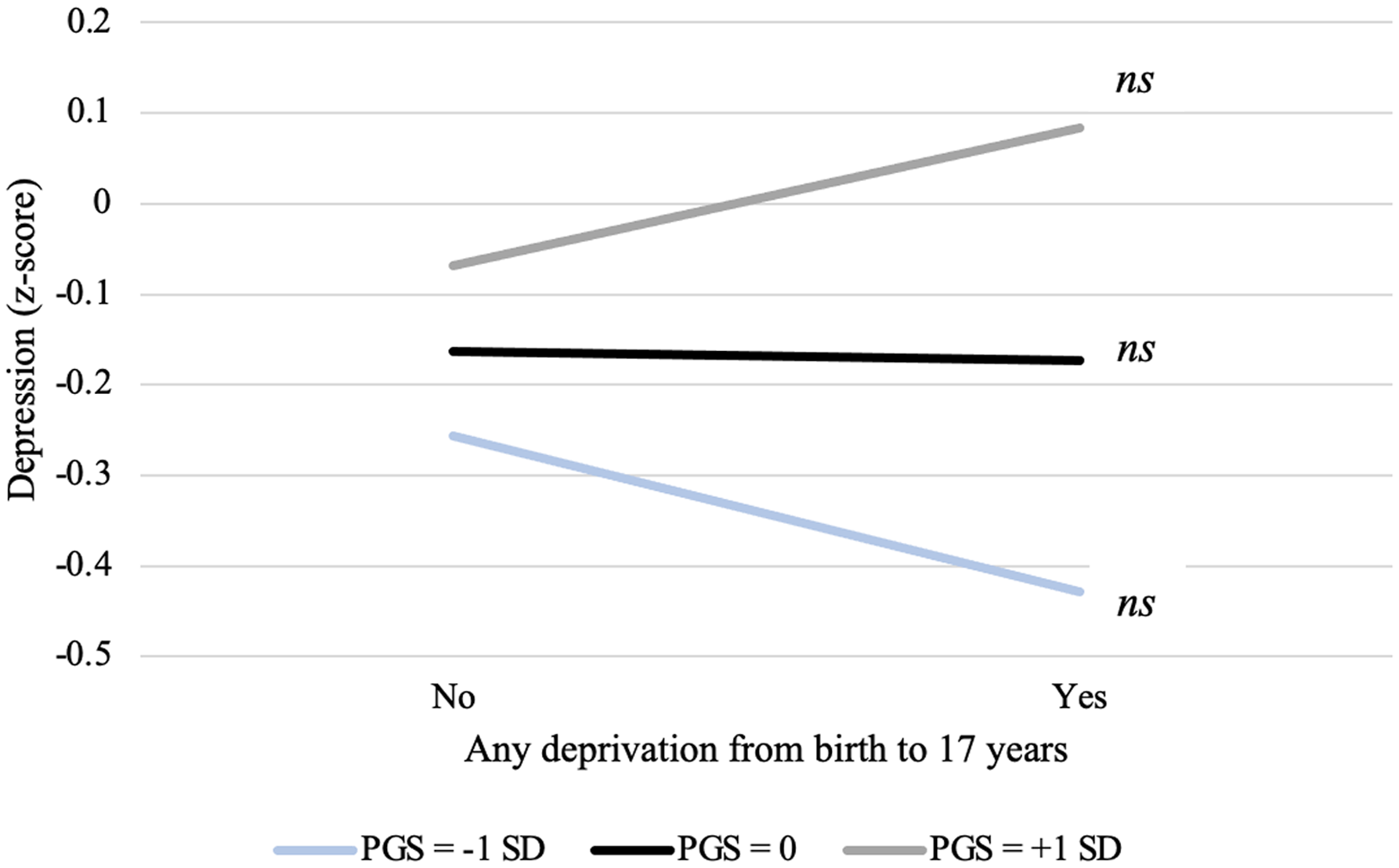
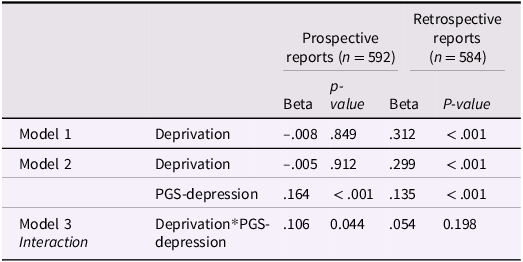
The presence of any experiences of deprivation, as measured retrospectively, was associated with depressive symptoms at 20–23 years (β = .312, p < .001), an association that remained significant when PGSDEP was included in the model, of which the main effect was also significant (β = .299, p < .001). The prospective measure of deprivation, however, did not predict depressive symptoms (β = –.005, p = .912; Table 3). Only the interaction between PGSDEP and the prospective measure was significant (β = .106, p = .044; retrospective measure: β = .054, p = .198). While none of the simple slopes were significant, the decomposition of this significant interaction suggested that participants identified as having experienced prospective deprivation (vs. no deprivation) seemed to have higher depressive symptomatology at higher levels of genetic risk. Meanwhile, those identified as having deprivation had decreasing depressive symptoms at low PGSDEP levels. Individuals carrying mean levels of genetic risk had stable depressive scores across both groups (deprivation vs absence) (see Figure 2). However, none of the simple slopes were significant (see Figure 2).
Association between the prospectively reported presence of deprivation and depressive symptoms (20–23 years), according to the PGS-depression. PGS “Polygenic risk score”; SD “Standard deviation”. ns indicates that the (simple slope) association between childhood maltreatment and depressive symptoms are non-significant at each level of PGS. Data were compiled from the final master file of the Quebec longitudinal study of child development (1998–2021), © gouvernement du Quebec, institut de la statistique du Quebec.
Hierarchical linear regression predicting depressive symptoms (20-23 years) according to prospective and retrospective reports of deprivation and PGS-depression
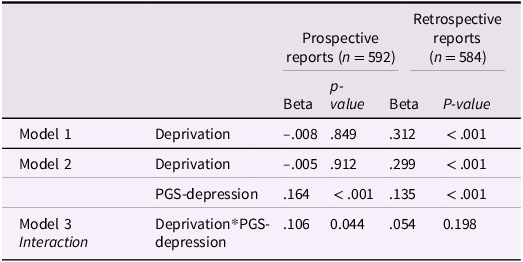
Note. Max N based on data available for reports of prospective (birth to 17 years) and retrospective maltreatment, PGS-depression and depressive symptoms. Any deprivation was coded as “yes” or “no”. Data were compiled from the final master file of the Québec Longitudinal Study of Child Development (1998–2021), © Gouvernement du Québec, Institut de la Statistique du Québec. For PGS-depression we used the standardized residual scores that account for the 10 principal components and covariance with childhood maltreatment. All models were adjusted for sex and socioeconomic status. The main effects of deprivation and PGS-depression are not presented in Model 3 but were included.
Main and interaction effects of threat with the PGS DEP
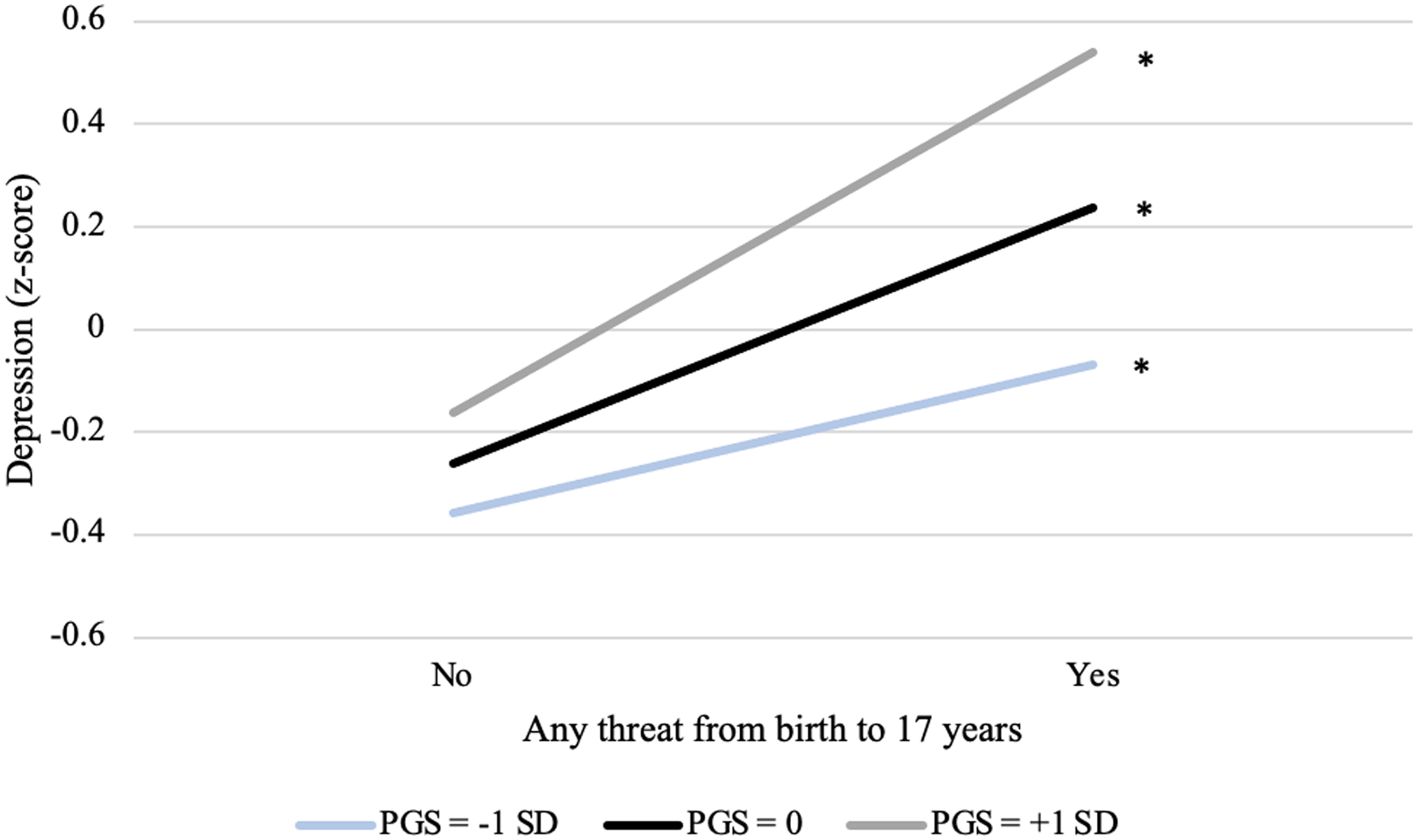
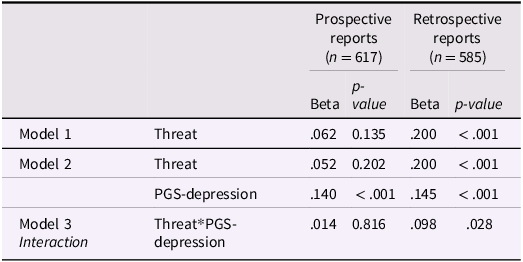
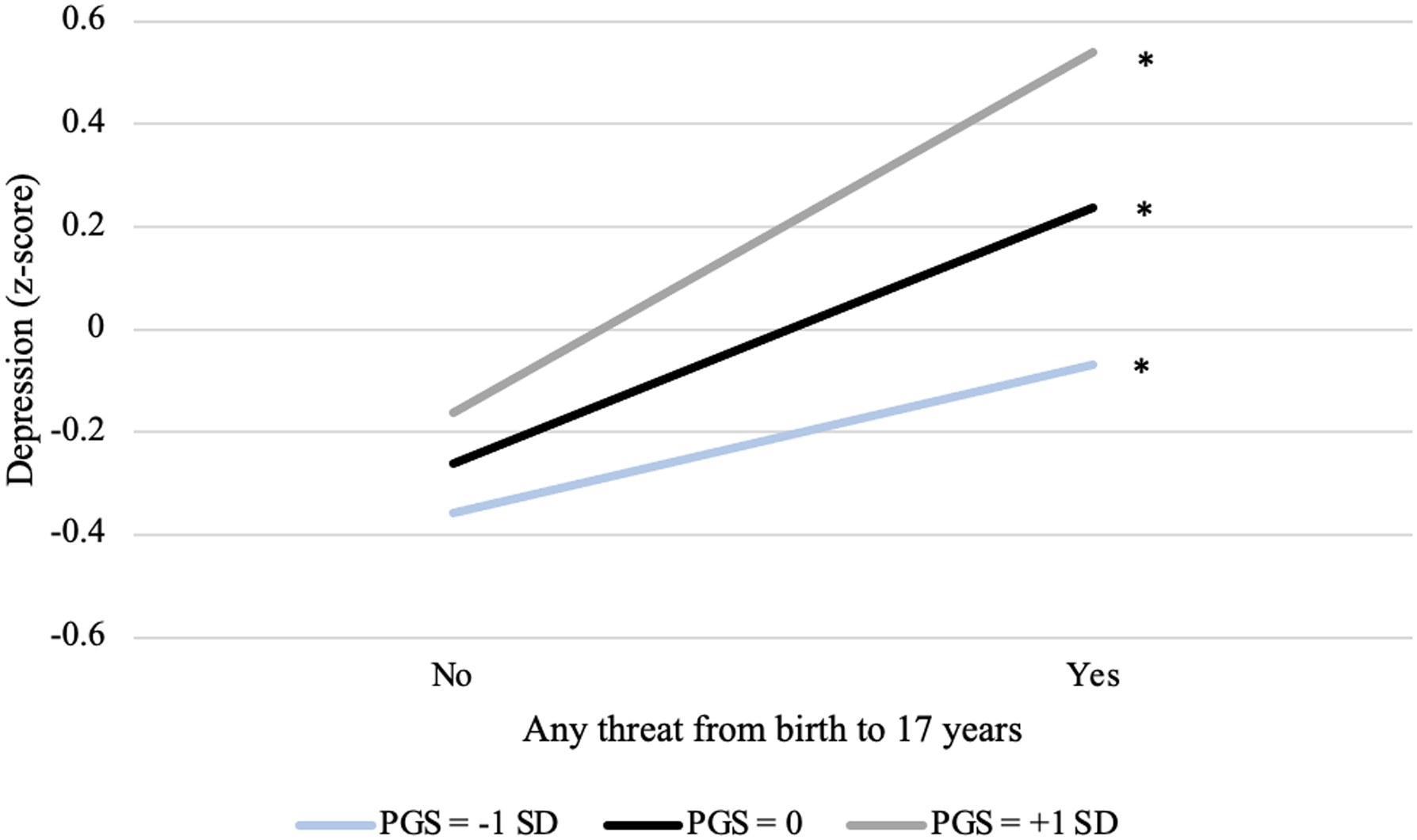
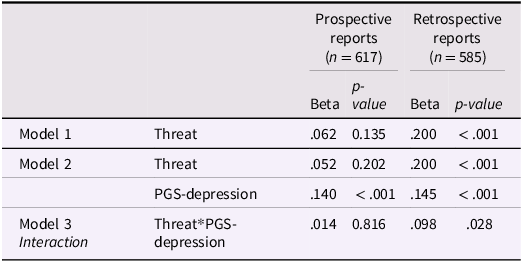
The presence of any threat, as measured retrospectively, was associated with depressive symptoms at 20–23 years (β = .200, p < .001) and remained significant when the PGSDEP was simultaneously considered (β = .200, p < .001; Table 4). A significant interaction between retrospective reports of threat and PGSDEP was also found (β = .098, p = .028). That is, individuals perceiving exposure to any threat (birth to 17 years) had a higher level of depressive symptoms when they carried a higher genetic risk for depression (+1 SD) in comparison to those who were at the sample’s mean and lower levels (–1 SD) (see Figure 3). No significant main and interaction contribution were detected for prospective reports of maltreatment (main: β = .052, p = .202; interaction: β = .014, p = .816). Since small but significant associations were noted between deprivation and threat using prospective (r = .171, p < .001) and retrospective (r = .295, p < .001) indices, we reran the analyses while statistically controlling for the deprivation in the models conducted for threat. The patterns of findings for main effects and interactions remained unchanged.
Association between the retrospectively reported presence of threat and depressive symptoms (20–23 years), according to the PGS-depression. PGS ‘Polygenic risk score’; SD ‘Standard deviation’. *indicates a significant association between childhood maltreatment and depressive symptoms at each level of PGS. Data were compiled from the final master file of the Quebec longitudinal study of child development (1998–2021), © gouvernement du Quebec, institut de la statistique du Quebec.
Hierarchical linear regression predicting depressive symptoms (20-23 years) according to prospective and retrospective reports of threat and PGS-depression
Note. Max N based on data available for reports of prospective (birth to 17 years) and retrospective maltreatment, PGS-depression and depressive symptoms. Any threat was coded as “yes” or “no”. Data were compiled from the final master file of the Québec Longitudinal Study of Child Development (1998–2021), © Gouvernement du Québec, Institut de la Statistique du Québec. For PGS-depression, we used the standardized residual scores that account for the 10 principal components and covariance with childhood maltreatment. All models were adjusted for sex and socioeconomic status. The main effects of threat and PGS-depression are not presented in Model 3 but were included.
Discussion
Childhood maltreatment is one of the most studied and robust risk factors for depression (Jaffee, Reference Jaffee2017; Kessler et al., Reference Kessler, McLaughlin, Green, Gruber, Sampson, Zaslavsky, Aguilar-Gaxiola, Alhamzawi, Alonso, Angermeyer, Benjet, Bromet, Chatterji, de Girolamo, Demyttenaere, Fayyad, Florescu, Gal, Gureje, Haro, Hu, Karam, Kawakami, Lee, Lépine, Ormel, Posada-Villa, Sagar, Tsang, Üstün, Vassilev, Viana and Williams2010; Nanni et al., Reference Nanni, Uher and Danese2012). However, our understanding of the interplay between genetic risk for depression and childhood maltreatment in predicting depressive symptoms remains limited. Given prior evidence for associations of distinct magnitude between prospective and retrospective reports of maltreatment with mental health (Baldwin et al., Reference Baldwin, Reuben, Newbury and Danese2019; Danese & Widom, Reference Danese and Widom2020; Reuben et al., Reference Reuben, Moffitt, Caspi, Belsky, Harrington, Schroeder, Hogan, Ramrakha, Poulton and Danese2016), we also tested the moderating role of a PGS for depression (Howard et al., Reference Howard, Adams, Clarke, Hafferty, Gibson, Shirali, Coleman, Hagenaars, Ward and Wigmore2019) on depressive symptoms in young adults according to threat and deprivation experiences prospectively and retrospectively reported.
Retrospective versus prospective maltreatment measurements
First, the prevalence of exposure to at least one type of maltreatment varied depending on prospective vs. retrospective reports, with approximately two-thirds (67%) of participants being assigned to probable maltreatment according to the prospective measures, as compared to one third (29%) for the retrospective measure. We speculate that the use of prospective reports relying on multiple informants and timepoints (n = 14) across several items (n = 251) may partly account for these higher rates in comparison to measures derived from seven items completed retrospectively by only one informant at only one timepoint. This additional difference in the measures of maltreatment obtained from retrospective versus prospective reports provides another argument for examining GxEs according to both types of measure.
Second, as previously mentioned, several studies and a meta-analysis have shown a low concordance between prospective and retrospective maltreatment (Baldwin et al., Reference Baldwin, Reuben, Newbury and Danese2019; Danese & Widom, Reference Danese and Widom2020; Scardera et al., Reference Scardera, Langevin, Collin-Vézina, Cabana, Pinto Pereira, Côté, Ouellet-Morin and Geoffroy2023). Indeed, the poor agreement between these measures in this study (k = 0.056), as well as in a meta-analysis (k = 0.19) conducted by Balwin et al (2019), indicates that prospective and retrospective maltreatment measures, to a certain extent, identify different groups of individuals, and thus cannot be used interchangeably, but rather in a complementary approach. Further findings from Danese & Widom (Reference Danese and Widom2020) showed that subjective accounts of maltreatment may help to study the association between maltreatment and psychopathology. To illustrate, participants with retrospective reports of maltreatment only were more likely to meet diagnostic criteria for a psychopathology, along with participants with both court-recorded maltreatment and retrospective reports. However, participants with court-recorded maltreatment only were not at higher risk of psychopathology (Danese & Widom, Reference Danese and Widom2020). This may be partly due to a recall bias, which refers to a negative bias on autobiographical memory related to one’s current mental health. Retrospective reports may also provide additional insight through the subjective account of the childhood environment, which may be relevant to understand the etiology of depression.
Prospective versus retrospective maltreatment and depression
Our first objective was to investigate the associations between retrospective and prospective indicators of maltreatment with later depressive symptoms. Our findings indicate that retrospective reports of maltreatment were consistently associated with depressive symptoms in young adulthood, even after controlling for the potential confounding effects of sex and parental socioeconomic status. Specifically, young adults who retrospectively reported a history of childhood maltreatment (according to all three indicators) were more likely to also report depressive symptoms in later years. Meanwhile, prospective reports of cumulative maltreatment only modestly predicted higher levels of depressive symptoms (and only marginally after controlling for PGSDEP). These results are consistent with previous studies showing stronger associations between maltreatment reported retrospectively and mental health problems, including depression, in comparison to prospective official records (Baldwin et al., Reference Baldwin, Reuben, Newbury and Danese2019; Humphreys et al., Reference Humphreys, LeMoult, Wear, Piersiak, Lee and Gotlib2020; Newbury et al., Reference Newbury, Arseneault, Moffitt, Caspi, Danese, Baldwin and Fisher2018). Associations between prospective reports and psychopathology is generally weak (Danese & Widom, Reference Danese and Widom2020).
Given the previously reported low agreement between the retrospective and prospective reports (Baldwin et al., Reference Baldwin, Reuben, Newbury and Danese2019; Danese & Widom, Reference Danese and Widom2020; Scardera et al., Reference Scardera, Langevin, Collin-Vézina, Cabana, Pinto Pereira, Côté, Ouellet-Morin and Geoffroy2023), one could speculate that the stronger associations between retrospective maltreatment and depressive symptoms may partly arise due to differences in cognitive appraisal of life experiences. Notably, depressive symptoms can induce or exacerbate negative biases, attributions, and ruminations about oneself, including one’s past experiences (Mennen et al., Reference Mennen, Norman and Turk-Browne2019), which in turn increases or maintains depressive symptomatology (i.e., reciprocal effects). The hopelessness theory of depression further postulates that the experiences of repeated exposure to adverse or inescapable life circumstances, such as childhood maltreatment, leads to negative inferential styles (Liu et al., Reference Liu, Kleiman, Nestor and Cheek2015). As such, experiences of maltreatment may induce or exacerbate cognitive vulnerabilities for depression through a general negative outlook on past, present, and future life (Liu et al., Reference Liu, Kleiman, Nestor and Cheek2015). It is thus difficult to tease apart these genuine sources of influence from the bias (e.g., shared methods and informants) that may inflate the estimates of the association between maltreatment and depression. Furthermore, in the absence of a significant association with prospective measures, these findings provide limited support for a causal relationship between maltreatment exposure and depression. Additional studies including both prospective and retrospective measures of maltreatment would help further understand this discrepancy in findings.
Threat versus deprivation and depression
The significant main effects noted between the retrospective indicators of deprivation and threat with depressive symptoms are consistent with another study showing that both types of experiences retrospectively reported in adulthood are associated with depressive symptoms (Lin et al., Reference Lin, Cao, Chen, Li, Zhang and Guo2023). However, we did not find that retrospectively reported threat was more associated to depressive symptoms, as other studies have (Schäfer et al., Reference Schäfer, McLaughlin, Manfro, Pan, Rohde, Miguel, Simioni, Hoffmann and Salum2023; Wang et al., Reference Wang, Lu, Liu, Yu, Fan, Gao, Han, Liu, Yao and Zhu2022). Some differences in our study designs may partly explain this inconsistency. For example, Schäfer et al. (Reference Schäfer, McLaughlin, Manfro, Pan, Rohde, Miguel, Simioni, Hoffmann and Salum2023) reported an association between parent reports of threat and internalizing symptoms (including depressive symptoms), but not with deprivation. Their measure of deprivation did not include accounts of emotional deprivation (Schäfer et al., Reference Schäfer, McLaughlin, Manfro, Pan, Rohde, Miguel, Simioni, Hoffmann and Salum2023), even though emotional neglect has been shown to more robustly associated with depression than physical neglect (Grummitt et al., Reference Grummitt, Kelly, Barrett, Lawler, Prior, Stapinski and Newton2022). Conversely, Wang et al. (Reference Wang, Lu, Liu, Yu, Fan, Gao, Han, Liu, Yao and Zhu2022) described high rates of retrospectively reported threat experienced in childhood which were associated with depression measured in college students, although the difference between the magnitude of the association between threat/deprivation and depression was not formally tested. Thus, we remain cautious in the interpretation of the distinct findings related to deprivation vs. threat and suggest that future studies investigate these experiences more systematically with depression.
PGS DEP and depressive symptoms
Our study showed that the retrospective reports of childhood maltreatment were significantly associated with depressive symptoms in early adulthood, above and beyond the genetic vulnerability captured by our PGSDEP indicator (Howard et al., Reference Howard, Adams, Clarke, Hafferty, Gibson, Shirali, Coleman, Hagenaars, Ward and Wigmore2019). Inversely, and similarly to all other studies that controlled for adverse experiences (e.g., peer victimization, childhood abuse, trauma) (Halldorsdottir et al., Reference Halldorsdottir, Piechaczek, Soares de Matos, Czamara, Pehl, Wagenbuechler, Feldmann, Quickenstedt-Reinhardt, Allgaier and Freisleder2019; Perret et al., Reference Perret, Boivin, Morneau-Vaillancourt, Andlauer, Paquin, Langevin, Girard, Turecki, O'Donnell and Tremblay2023; Thorp et al., Reference Thorp, Gerring, Colodro-Conde, Byrne, Medland, Middeldorp and Derks2023), PGSDEP also predicted depressive symptoms after controlling for all childhood maltreatment indicators. However, the PGSDEP alone accounted for only 1.9% of variance in depressive symptoms measured in young adulthood (20–23 years). This estimate is similar to the variance in depression accounted for by this PGS in previous studies conducted in adolescence and adulthood (∼1.0%–2.0%) (Halldorsdottir et al., Reference Halldorsdottir, Piechaczek, Soares de Matos, Czamara, Pehl, Wagenbuechler, Feldmann, Quickenstedt-Reinhardt, Allgaier and Freisleder2019; Perret et al., Reference Perret, Boivin, Morneau-Vaillancourt, Andlauer, Paquin, Langevin, Girard, Turecki, O'Donnell and Tremblay2023; Wray et al., Reference Wray, Ripke, Mattheisen, Trzaskowski, Byrne, Abdellaoui, Adams, Agerbo, Air and Andlauer2018). This contrasts with the variance related to the genetic factors estimated using twin and family study designs (∼40%) (Kendler et al., Reference Kendler, Gatz, Gardner and Pedersen2006; Ormel et al., Reference Ormel, Hartman and Snieder2019). In light of this “missing heritability” problem, Matthews and Turkheimer (Reference Matthews and Turkheimer2022) highlight the need to better understand how and in which contexts genes translate into a greater proportion of the targeted phenotype (e.g., depression). Advances made on these complementary fronts will help to further elucidate the complexity underlying the unfolding of the genetic etiology of depressive symptoms.
Interaction between PGS DEP and childhood maltreatment
Our second objective was to investigate the moderating role of PGSDEP in the association between childhood maltreatment and depressive symptoms. In this study, we present some evidence for GxEs emerging between childhood maltreatment and PGSDEP in the prediction of depressive symptoms in young adulthood. These interactions are in line with the Diathesis-Stress model (Broerman, Reference Broerman, Zeigler-Hill and Shackelford2020), whereby individuals who had (retrospectively) reported a history of maltreatment (cumulative maltreatment and threat) reported more depressive symptoms if they had a higher genetic predisposition for depression. Nevertheless, it is important to note that significant associations between these indicators of childhood maltreatment and depressive symptoms are reported at all levels of genetic vulnerability; the magnitude of these associations only varying in strength. Our findings thus align with a study by Peyrot et al. (Reference Peyrot, Milaneschi, Abdellaoui, Sullivan, Hottenga, Boomsma and Penninx2014) who showed that individuals with a history of childhood trauma, measured using the Childhood Trauma Questionnaire (i.e., retrospective report), were at a higher risk for major depressive disorder if they had a higher PGSDEP (calculated based on Ripke et al. (Reference Ripke, Wray, Lewis, Hamilton, Weissman, Breen, Byrne, Blackwood, Boomsma, Cichon, Heath, Holsboer, Lucae, Madden, Martin, McGuffin, Muglia, Noethen, Penninx, Pergadia, Potash, Rietschel, Lin, Müller-Myhsok, Shi, Steinberg, Grabe, Lichtenstein, Magnusson, Perlis, Preisig, Smoller, Stefansson, Uher, Kutalik, Tansey, Teumer, Viktorin, Barnes, Bettecken, Binder, Breuer, Castro, Churchill, Coryell, Craddock, Craig, Czamara, De Geus, Degenhardt, Farmer, Fava, Frank, Gainer, Gallagher, Gordon, Goryachev, Gross, Guipponi, Henders, Herms, Hickie, Hoefels, Hoogendijk, Hottenga, Iosifescu, Ising, Jones, Jones, Jung-Ying, Knowles, Kohane, Kohli, Korszun, Landen, Lawson, Lewis, MacIntyre, Maier, Mattheisen, McGrath, McIntosh, McLean, Middeldorp, Middleton, Montgomery, Murphy, Nauck, Nolen, Nyholt, O'Donovan, Oskarsson, Pedersen, Scheftner, Schulz, Schulze, Shyn, Sigurdsson, Slager, Smit, Stefansson, Steffens, Thorgeirsson, Tozzi, Treutlein, Uhr, van den Oord, Van Grootheest, Völzke, Weilburg, Willemsen, Zitman, Neale, Daly, Levinson and Sullivan2013)). Similar evidence of GxEs has also been reported while using general trauma exposure (i.e., beyond youth) (Coleman et al., Reference Coleman, Peyrot, Purves, Davis, Rayner, Choi, Hübel, Gaspar, Kan, Van der Auwera, Adams, Lyall, Choi, Ripke, Mattheisen, Trzaskowski, Byrne, Abdellaoui, Adams, Agerbo, Air, Andlauer, Bacanu, Bækvad-Hansen, Beekman, Bigdeli, Binder, Bryois, Buttenschøn, Bybjerg-Grauholm, Cai, Castelao, Christensen, Clarke, Coleman, Colodro-Conde, Couvy-Duchesne, Craddock, Crawford, Davies, Deary, Degenhardt, Derks, Direk, Dolan, Dunn, Eley, Escott-Price, Kiadeh, Finucane, Foo, Forstner, Frank, Gaspar, Gill, Goes, Gordon, Grove, Hall, Hansen, Hansen, Herms, Hickie, Hoffmann, Homuth, Horn, Hottenga, Hougaard, Howard, Ising, Jansen, Jones, Jones, Jorgenson, Knowles, Kohane, Kraft, Kretzschmar, Kutalik, Li, Lind, MacIntyre, MacKinnon, Maier, Maier, Marchini, Mbarek, McGrath, McGuffin, Medland, Mehta, Middeldorp, Mihailov, Milaneschi, Milani, Mondimore, Montgomery, Mostafavi, Mullins, Nauck, Ng, Nivard, Nyholt, O’Reilly, Oskarsson, Owen, Painter, Pedersen, Pedersen, Peterson, Pettersson, Peyrot, Pistis, Posthuma, Quiroz, Qvist, Rice, Riley, Rivera, Mirza, Schoevers, Schulte, Shen, Shi, Shyn, Sigurdsson, Sinnamon, Smit, Smith, Stefansson, Steinberg, Streit, Strohmaier, Tansey, Teismann, Teumer, Thompson, Thomson, Thorgeirsson, Traylor, Treutlein, Trubetskoy, Uitterlinden, Umbricht, Van der Auwera, van Hemert, Viktorin, Visscher, Wang, Webb, Weinsheimer, Wellmann, Willemsen, Witt, Wu, Xi, Yang, Zhang, Arolt, Baune, Berger, Boomsma, Cichon, Dannlowski, de Geus, DePaulo, Domenici, Domschke, Esko, Grabe, Hamilton, Hayward, Heath, Kendler, Kloiber, Lewis, Li, Lucae, Madden, Magnusson, Martin, McIntosh, Metspalu, Mors, Mortensen, Müller-Myhsok, Nordentoft, Nöthen, O’Donovan, Paciga, Pedersen, Penninx, Perlis, Porteous, Potash, Preisig, Rietschel, Schaefer, Schulze, Smoller, Stefansson, Tiemeier, Uher, Völzke, Weissman, Werge, Lewis, Levinson, Breen, Børglum, Sullivan, Dunn, Vassos, Danese, Maughan, Grabe, Lewis, O’Reilly, McIntosh, Smith, Wray, Hotopf, Eley and Breen2020; Thorp et al., Reference Thorp, Gerring, Colodro-Conde, Byrne, Medland, Middeldorp and Derks2023). However, other studies have reported GxE in opposite directions (Mullins et al., Reference Mullins, Power, Fisher, Hanscombe, Euesden, Iniesta, Levinson, Weissman, Potash and Shi2016; Peyrot et al., Reference Peyrot, Milaneschi, Abdellaoui, Sullivan, Hottenga, Boomsma and Penninx2014), or no interaction at all (Halldorsdottir et al., Reference Halldorsdottir, Piechaczek, Soares de Matos, Czamara, Pehl, Wagenbuechler, Feldmann, Quickenstedt-Reinhardt, Allgaier and Freisleder2019). This falls in line with a meta-analysis indicating no robust evidence for a genetic moderation (although no studies based their PGS on the most recent GWAS (Howard et al., Reference Howard, Adams, Clarke, Hafferty, Gibson, Shirali, Coleman, Hagenaars, Ward and Wigmore2019)) (Peyrot et al., Reference Peyrot, Van der Auwera, Milaneschi, Dolan, Madden, Sullivan, Strohmaier, Ripke, Rietschel and Nivard2018). Another study that relied on a GWAS including self-reported depressive symptoms (Wray et al., Reference Wray, Ripke, Mattheisen, Trzaskowski, Byrne, Abdellaoui, Adams, Agerbo, Air and Andlauer2018) also did not detect a GxE between the PGS and childhood maltreatment in an epidemiological sample of adolescents (Halldorsdottir et al. (Reference Halldorsdottir, Piechaczek, Soares de Matos, Czamara, Pehl, Wagenbuechler, Feldmann, Quickenstedt-Reinhardt, Allgaier and Freisleder2019)). Testing GxE associations using more recent GWAS building on more participants and a greater variety of measures of depression may help to clarify this finding.
Although we found significant GxEs across retrospectively reported cumulative maltreatment and threat, this genetic moderation was not detected in the context of past deprivation. The only significant GxE for deprivation was uncovered for prospective reports and the simple slopes were not significant (i.e., individuals within each PGSDEP level did not report more depressive symptoms when exposed to deprivation versus those who did not). We speculate that these distinct results between retrospective versus prospective deprivation can be attributed to the specific items used via both methods and the saliency of experiences. For the derivation of the prospective measure, there were more items covering acts of deprivation, emotional and physical neglect, compared to the information comprised in self-report items (Scardera et al., Reference Scardera, Langevin, Collin-Vézina, Cabana, Pinto Pereira, Côté, Ouellet-Morin and Geoffroy2023). It is possible that the informants, including the caregivers, are more willing to disclose omission acts than commission acts (i.e., threat). In comparison, self-reported deprivation may be less accurate (or refer to less salient experiences) than self-reported threat compared to adult prospective reports. Thus, the saliency of threat experiences ultimately increases recall of events and the power to detect interactions with retrospective reports, compared prospective reports. More studies investigating GxE according to prospective and retrospective CM for both threat and deprivation experiences may shed more light on these preliminary findings.
The main effects noted between the retrospective indicators of both deprivation and threat with depressive symptoms are consistent with another study showing that both threat and deprivation are associated with depressed mood (Wang et al., Reference Wang, Lu, Liu, Yu, Fan, Gao, Han, Liu, Yao and Zhu2022). However, only (retrospective) threat significantly interacted with PGSDEP, which aligns with prior evidence that threat and deprivation affect later functioning through distinct pathways (Milojevich et al., Reference Milojevich, Norwalk and Sheridan2019; Sheridan & McLaughlin, Reference Sheridan and McLaughlin2014). For example, in a brain imaging study involving young adults, distinct brain reactivity patterns were observed for retrospectively reported threat and deprivation. Threat was associated with higher activity in the ventral amygdala, while deprivation was linked to higher reactivity in the cortical fronto-parietal network, as well as in the dorsal amygdala (Puetz et al., Reference Puetz, Viding, Gerin, Pingault, Sethi, Knodt, Radtke, Brigidi, Hariri and McCrory2020). Another study found that deprivation can result in major structural changes to the brain, which can lead to impaired executive functioning (Milojevich et al., Reference Milojevich, Norwalk and Sheridan2019; Sheridan & McLaughlin, Reference Sheridan and McLaughlin2014). Meanwhile, early threat exposure is proposed to induce changes in neural circuits responsible for threat detection and emotional learning, which may further align to and exacerbate the genetic vulnerability for depression captured in Howard et al. (Reference Howard, Adams, Clarke, Hafferty, Gibson, Shirali, Coleman, Hagenaars, Ward and Wigmore2019) GWAS. Milojevich et al. (Reference Milojevich, Norwalk and Sheridan2019) showed that individuals exposed to childhood threat are more likely to engage in avoidance strategies in adolescence which, in turn, partially mediated the association between threat and later internalizing problems. This association was not detected for deprivation. Previous studies have also suggested that avoidance strategies, common among people experiencing depressive symptoms, carry a genetic basis (Fleurkens et al., Reference Fleurkens, van Minnen, Becker, van Oostrom, Speckens, Rinck and Vrijsen2018; Smederevac et al., Reference Smederevac, Sadikovic, Colovic, Vucinic, Milutinovic, Riemann, Corr, Prinz and Budimlija2022). Moreover, Sumner et al. (Reference Sumner, Colich, Uddin, Armstrong and McLaughlin2019) found that exposure to threat, not deprivation, was associated with altered gene expression (i.e., DNA methylation) and accelerated biological aging (Sumner et al., Reference Sumner, Colich, Uddin, Armstrong and McLaughlin2019). Furthermore, the indicator of accelerated biological aging moderated the association between threat exposure and later depression (Sumner et al., Reference Sumner, Colich, Uddin, Armstrong and McLaughlin2019). While we cannot rely on prior GxE studies that have specifically examined threat in the prediction of depressive symptoms, our preliminary findings suggest that threat, vs deprivation, and genes involved in the risk of depression exacerbate more robustly (or homogeneously) the risk of depression. Replication studies should therefore systematically examine this possibility rather than relying on broader indices of maltreatment.
Gene–environment correlation
We uncovered associations between PGSDEP and all our retrospective and prospective maltreatment indicators, pointing to possible gene–environment correlations (rGE) that can, if overlooked, increase the risk of inflated error rate (i.e., type 1 or type 2) in the test of GxE interactions. Although indications of gene–environment correlations were not found in Peyrot et al. (Reference Peyrot, Milaneschi, Abdellaoui, Sullivan, Hottenga, Boomsma and Penninx2014)’s meta-analysis and in Mullins et al. (Reference Mullins, Power, Fisher, Hanscombe, Euesden, Iniesta, Levinson, Weissman, Potash and Shi2016), other studies (Perret et al., Reference Perret, Boivin, Morneau-Vaillancourt, Andlauer, Paquin, Langevin, Girard, Turecki, O'Donnell and Tremblay2023; Peyrot et al., Reference Peyrot, Van der Auwera, Milaneschi, Dolan, Madden, Sullivan, Strohmaier, Ripke, Rietschel and Nivard2018) have found significant (albeit weak) indications of association between PGSDEP and retrospective measures of childhood neglect and abuse, as well as peer victimization. We extend these findings by showing that these patterns of covariance are also detected in prospective measures of maltreatment. These findings indicate that maltreatment experiences may not be random. Genetic vulnerabilities may be passed down from parents to children, along with the risk of facing neglectful or hostile environments (i.e., passive rGE), or to trigger negative patterns of interaction with caregivers (i.e., evocative rGE; (Quinn & D'Onofrio, Reference Quinn, D'Onofrio and Benson2020)). Future studies are needed to examine how these processes unfold during development and contribute to explain the intergenerational transmission of depression.
Methodological considerations
Our study’s strengths include the use of a contemporary cohort followed from birth to 23 years, with prospective childhood maltreatment data across multiple informants (e.g., mother, teacher, self, observations). While several studies rely on strictly official records, less than 10% of maltreatment cases are reported to authority, to which cases not severe enough to be flagged are also missed (Statistics Canada, 2021). Our approach complemented the use of retrospective reports to test whether distinct pattern of GxE would emerge according to prospective measures of maltreatment.
Although we did not have access to depression diagnostics, depressive symptoms were measured at three occasions according to continuously distributed self-reports, aligning with the broad assessment of depression in Howard et al.’s (Reference Howard, Adams, Clarke, Hafferty, Gibson, Shirali, Coleman, Hagenaars, Ward and Wigmore2019) GWAS. Second, we did not account for the severity, chronicity, or timing of maltreatment experiences even though these characteristics have been shown to modulate the estimated effect of maltreatment on development (Cicchetti & Toth, Reference Cicchetti and Toth1995; Li et al., Reference Li, Gao, Su, Zhang, Yang, D’Arcy and Meng2022). Indeed, Peyrot et al. (Reference Peyrot, Milaneschi, Abdellaoui, Sullivan, Hottenga, Boomsma and Penninx2014) found that those exposed to more severe maltreatment while carrying higher genetic susceptibility had higher depression scores. While our cumulative maltreatment indicator encompassed various types of maltreatment experiences, it did not specifically assess severity. Third, our sample was relatively small to test interactions, which may have led to higher risk of type II error, considering the small predictive capacity of the PGS further constrained by variable patterns of interaction across the genome. Nonetheless, we detected several interactions, pointing to the relevance of GxE in the etiology of depression. Fourth, our results may not be generalizable to diverse populations as our sample was primarily composed of White European descendants. Finally, while our sample suffered from non-random longitudinal attrition, the use inverse probability weighting limited its impact on the generalization of our finding to the population.
Conclusion
Our study replicated earlier findings showing that retrospective reports of childhood maltreatment were consistently associated with depressive symptoms in early adulthood, beyond the estimated genetic vulnerability for depression, as well as sex and parental socioeconomic status. We found evidence for gene–environment interactions between two of three retrospective indicators of maltreatment. Consistent with the Diathesis-Stress model, participants exposed to maltreatment reported higher depressive symptoms if they had a higher genetic risk for depression. Although a similar pattern of GxE was uncovered with the prospectively measured deprivation, caution is warranted in the interpretation of this isolated finding. Future studies using both prospectively and retrospectively measured maltreatment experiences could help to further examine the distinct patterns of GxE arising in the context of threat vs deprivation, as well as for retrospective vs. prospective measures of maltreatment. If replicated, our findings may indicate that some children possess a heightened genetic susceptibility to the depressogenic effects of maltreatment, and that self-reported experiences may better capture these joint negative sources of influence. Research on the interplay between genetic and environmental factors is crucial in gaining a more comprehensive understanding of the complex nature of depression and eventually guide prevention efforts to offset this psychopathology in the context of childhood maltreatment.
Supplementary material
For supplementary material accompanying this paper visit https://doi.org/10.1017/S0954579424001688
Acknowledgments
The QLSCD is conducted by the Institut de la Statistique du Québec. Data were compiled from the final master file of the Québec Longitudinal Study of Child Development (1998–2021), Québec Government, Institut de la Statistique du Québec. Mrs Scardera received a doctoral award from the Social Sciences and Humanities Research Council (SSHRC). Dr Geoffroy holds a Canada Research Chair in Youth Mental Health and Suicide Prevention. Dr Langevin is supported by a Chercheur-Boursier Award from the Fonds de recherche du Québec - Santé. Dr Lea C Perret received a doctoral award from Fonds de Recherche du Quebec. Dr Collin-Vezina holds the Nicolas Steinmetz and Gilles Julien Chair in Community Social Pediatrics. Dr Voronin holds a postdoctoral scholarship from Fonds de recherche du Québec - Societé et cultuture. Drs Boivin and Ouellet-Morin respectively hold a Canada Research Chair Child Development and in the Developmental Origins of Vulnerability and Resilience. No other disclosures were reported.
Funding statement
The Québec Longitudinal Study of Child Development was supported by funding from the Ministère de la Santé et des Services Sociaux, Ministère de la Famille, and Ministère de l’Éducation and Ministère de l’Enseignement Supérieur (Québec Ministries), the Lucie and André Chagnon Foundation, the Institut de Recherche Robert-Sauvé en Santé et en Sécurité du Travail, the Research Centre of the Sainte-Justine University Hospital, the Ministère du Travail, de l’Emploi et de la Solidarité Sociale, and the Institut de la Statistique du Québec. Additional funding was received from the Canadian Institutes of Health Research awarded to Dr Geoffroy.
Competing interests
None.


 Open access

