


In today’s digital economy, hype is no longer adrift and untamed – it is actively steered. Market actors increasingly seek to catch the rising tide of expectations at precisely the right moment, harnessing structured tools and expertise to avoid being swept away or left behind. We distinguish between ‘hype in the wild’ and ‘tamed hype’, a framing used throughout this book. We have argued that tamed hype now permeates the chaotic sea of unruly claims. This chapter analyses how hype’s new actors have created managed channels within the wild sea of hype, potentially reconfiguring how market actors navigate this phenomenon. One early attempt to structure the chaos of hype was the creation of the Hype Cycle Chart (HCC).
9.1 A Pivotal Moment in Hype’s Evolution
One key turning point in taming hype came in 1995, when Gartner analyst Jackie Fenn introduced the HCC. This trend-analysis tool would reshape how expectations around emerging technologies are visualised and managed. Before its introduction, there was no clear framework to make sense of hype’s trajectory; it was considered ‘random’, as ‘noise’ and ‘ever accelerating’ (Edgerton, Reference Edgerton1997), but not as cyclical and with predictable stages. Fenn, however, developed and offered a structured framework for understanding hype’s temporal progression.
Initially, the HCC functioned as a cautionary device, grounded in the principle of ‘caveat emptor’. As Fenn herself explained, ‘[w]hen it first came out, it was more of a statement, the recognition that this is a pattern that happens … an adopter beware type of message’ (Fenn, interview). Adopter organisations were warned not to ‘fall victim to the hype cycle’, as premature adoption of unproven technologies could result in catastrophic failure. Yet Fenn also warned against the dangers of excessive caution. ‘Serious threats to survival’, she stressed, ‘are probably cases when companies don’t move soon enough’ – leading to irrelevance or missed opportunity. In short, the HCC framed the strategic dilemma at the heart of hype: act too early and risk failure; wait too long and risk being left behind.
Over time, however, the HCC’s message evolved. While it first encouraged restraint, it later promoted the idea that hype could be embraced and strategically leveraged as a resource. Alongside other promissory products – categories, rankings, and Cool Vendor designations – the HCC began guiding organisations on how to time their investments and respond to emerging innovations. It thus shifted from warning against hype to embracing and capitalising on it, recognising innovation’s potential to transform industrial landscapes.
This reframing highlighted not only the ‘threats’ posed by disruptive innovations but also the ‘opportunities’ available to those who can time their moves effectively. Many still interpret the HCC as a warning against speculative bubbles – an instrument to tell managers to ‘get in while the hype is rising and get out before the disappointment sets in’ (Rip, Reference Rip, Fisher, Jones and von Schomberg2006, p. 353). However, this common interpretation neglects the more subtle strategic sensibility embedded in the HCC: it not only counsels caution in periods of accelerating hype but also reframes phases of waning enthusiasm – exemplified by the ‘Trough of Disillusionment’ – as potentially advantageous moments for intervention rather than simply phases to be avoided.
But the shift was not merely rhetorical. The HCC began to inform concrete practices and decisions, equipping organisations with new ways to assess and act on emerging technologies. The HCC can be seen as operationalising Levitt’s (Reference Levitt1965) ‘used apple’ thesis. As discussed in Chapter 3, the dilemma of when to ‘bite’ – whether early, at the peak of freshness, or later with greater certainty but reduced reward – was previously more theoretical than actionable. By rendering the dilemma in a visual format, the tool allows actors to ‘see better’ the problem, and thus to deliberate and act more effectively (Quattrone, Reference Quattrone2015, Reference Quattrone2017). As Fenn explained in our interviews, ‘aggressive companies can investigate more technologies earlier as they are comfortable with more risk’, while ‘more conservative companies should only adopt early if the potential benefit justifies the additional risk’ (Fenn, interview).
What began as a cautionary visualisation evolved into a cornerstone of this analyst firm’s product suite, eagerly anticipated by clients each year. It functions as an organisational – and arguably industrial – change agent, prompting market actors to reconsider how they might respond to hype and position themselves in relation to emerging technologies.Footnote 1 It contributes to a reconceptualisation of the technology adopter – from a passive and cautious actor (Karahanna et al., Reference Karahanna, Straub and Chervany1999) to what could be termed the ‘Schumpeterian adopter’ – a technology adopter behaving more like an investor: proactive, risk-taking, and opportunity-seeking. This reframing has two consequences.
First, it creates ‘animal spirits’ (Keynes, Reference Keynes1936) as a new object of managerial attention. Decision-makers are encouraged to consider their emotional responses – excitement, fear, uncertainty – and evaluate whether they are being ‘lured out of their comfort zones by market hype’ or prepared to move beyond them in pursuit of strategic advantage (Gartner Research, 2018). The HCC not only introduces self-awareness about hype-induced emotions, but it also attempts to tame the animal spirits by channelling them into a risk profile framework, prompting them to self-identify as Type A (aggressive), Type B (moderate), or Type C (conservative) in terms of their disposition towards hype. While such risk profiling is common in venture capital (Birch & Muniesa, Reference Birch and Muniesa2020), the HCC extends this mindset to technology adopters, now encouraged to ‘think like an investor’ (Chiapello, Reference Chiapello2023), representing a shift from the conventional view of technology adopters as inherently ‘cautious’, ‘risk-averse’ actors requiring ‘strong evidence’ before adoption (Karahanna et al., Reference Karahanna, Straub and Chervany1999).
Second, Fenn reframed hype as something that not only rises and crashes but also matures over time. Unlike economic cycles, which comprise a series of up-and-down movements, hype cycles include a resurrection (towards the ‘Slope of Enlightenment’ and the ‘Plateau of Productivity’). Transforming hype from a random spike into a predictable cycle is significant. It offers a more positive rendering. The focus moves from viewing hype solely in terms of its ‘dangers’ to recognising its ‘opportunities’, which influences both our present approach to it and our future understanding of hype. Where hesitation once prevailed, there now exists the potential for proactive engagement. In this way, the HCC helped shift the organisational disposition towards hype, from inaction and caution to strategic experimentation and calculated risk-taking.
9.2 Taming Hype and the Structuring of Expectations
From the viewpoint of this book, the HCC illustrates the taming of hype in the digital economy, signalling a shift from unregulated narratives towards structured and institutionalised forms of expectation. In the conventional view, the digital economy is often portrayed as a turbulent sea of hype, where charismatic entrepreneurs such as Elon Musk unleash bold visions that ripple across markets (Goldfarb & Kirsch, Reference Goldfarb and Kirsch2019). These figures correspond to the ‘promise entrepreneur’ (Joly & Le Renard, Reference Joly and Le Renard2021) introduced in Chapter 2 – individuals renowned for crafting compelling, future-oriented narratives. Such unregulated, viral storylines – what we term ‘hype in the wild’ – have long dominated both scholarly and popular accounts of innovation.
This framing views hype as generic promissory narratives designed to capture attention and inspire interest. Such claims circulate through dispersed discourse coalitions (Hajer, Reference Hajer1995) – customers, investors, or the public – and are often described as self-fulfilling or performative (Goldfarb & Kirsch, Reference Goldfarb and Kirsch2019). Promise entrepreneurs typically evade accountability when their claims fail to materialise. According to this view, hype fosters radical uncertainty (Felt et al., Reference Felt, Wynne, Callon, Gonçalves, Jasanoff, Jepsen, Joly, Konopasek, May, Neubauer, Rip, Siune, Stirling and Tallacchini2007), undermines established evaluation frameworks (McBride et al., 2023), and renders expectations ungovernable (Grodal & Granqvist, Reference Grodal, Granqvist, Ashkanasy, Zerbe and Härtel2014). Market actors thus experience hype as ‘difficult, if not impossible, to control’ (Bakker & Budde, Reference Bakker and Budde2012, p. 560), often reduced to a passive ‘waiting game’ (Robinson et al., Reference Robinson, Le Masson and Weil2012). Proactive responses appear rash, driven by unchecked ‘animal spirits’ rather than strategic calculation.
However, this picture is changing – and the HCC provides one vivid but not the only example of this shift. We have shown that similar dynamics can be seen around Cool Vendor appellations, Magic Quadrant rankings, market categories, analyst briefings, etc. This points to how hype is no longer confined to untamed, spontaneous expressions; it increasingly circulates through structured, institutionalised processes of taming. Hype’s new actors have built managed channels that reshape how market participants engage with expectations. We present our argument about tamed hype in contrast to this dominant portrayal of hype in the wild, which, we argue, rests on an overly unitary conception of hype as a single, undifferentiated phenomenon (Goldfarb & Kirsch, Reference Goldfarb and Kirsch2019; Bourne, Reference Bourne2024). Despite its prominence, hype remains under-theorised, with little attention to its heterogeneity or modes of circulation. By foregrounding taming, we show how hype is actively structured, mediated, and made actionable.
Tamed hype arises from the work of hype’s new actors – in our case, industry analysts and analyst relations experts – who design, deploy, and respond to promissory products that evaluate and steer emergent narratives. Our analysis reveals a growing interplay between these actors and the broader circulation of hype, showing that hype is no longer merely driven by entrepreneurs or vendors but is increasingly co-produced within formal systems of evaluation.
This evolving dynamic transforms the character of hype itself. It is no longer just a matter of open-ended narratives: hype is now often crafted with an eye towards recognition and validation within evaluative frameworks. From this perspective, promissory work increasingly involves cultivating ‘evaluability’ – narratives designed to be legible, assessable, and endorsable by market gatekeepers. Much of today’s hype is strategically crafted to resonate with these evaluations. Hype is not simply speculative; it has become reflexive, shaped by the very mechanisms designed to judge it. Ventures are not only pitching a future but performing it in recognisable ways – learning how to look like a Cool Vendor, or how to frame themselves for the next Magic Quadrant. Innovators calibrate their claims to align with, and sometimes to influence, a market category or the journey of an innovation through the HCC. This marks a fundamental shift: hype is no longer just performative future-making but a strategic response to how future-making is itself structured and assessed.
The turn to taming can be traced to the aftermath of the dotcom bubble (Garud et al., Reference Garud, Lant and Schildt2021). In response, market gatekeepers developed mechanisms to stabilise and steer hype, making it more predictable and actionable. ‘After Hype’ thus does not mark hype’s disappearance, but its reconfiguration within structured, device-mediated systems of evaluation. It signals a shift from spontaneous speculation to a formalised landscape, where actors align promissory claims with evaluative infrastructures.
Taming makes hype tractable and actionable. Promissory products do not eliminate uncertainty; they create structured channels – both analytical and practical – within the chaotic sea of speculation. These channels subject bold claims to scrutiny and evaluation, offering navigability amid uncertainty. In practice, they take the form of concrete techniques – such as rankings, Cool Vendor designations, and analyst briefings – that serve as an infrastructure for filtering and interpreting hype.
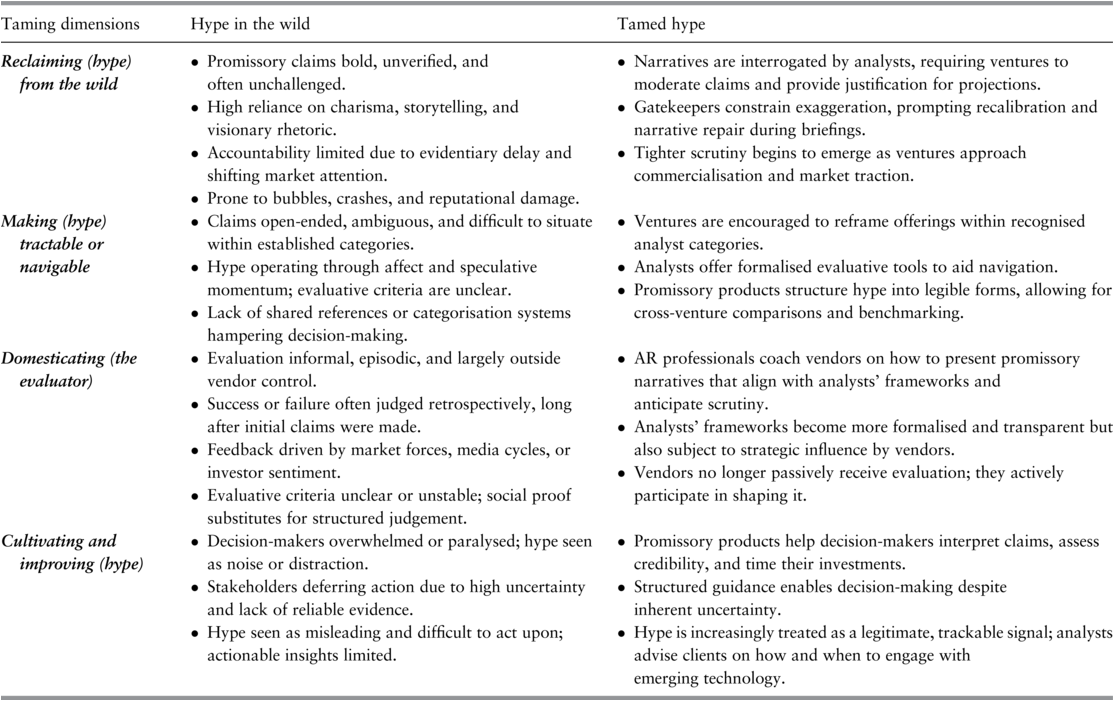
Taming is not about dampening excitement but operationalising it – transforming hype from a volatile force into a strategic resource. These processes are central to how promises and expectations are now curated and controlled in the digital economy (see Table 9.1). This table synthesises the key differences between unregulated ‘hype in the wild’ and institutionalised ‘tamed hype’, using the four taming dimensions introduced earlier. As the table shows, tamed hype involves greater scrutiny, structure, and guidance, fundamentally altering how hype is produced and consumed.Footnote 2
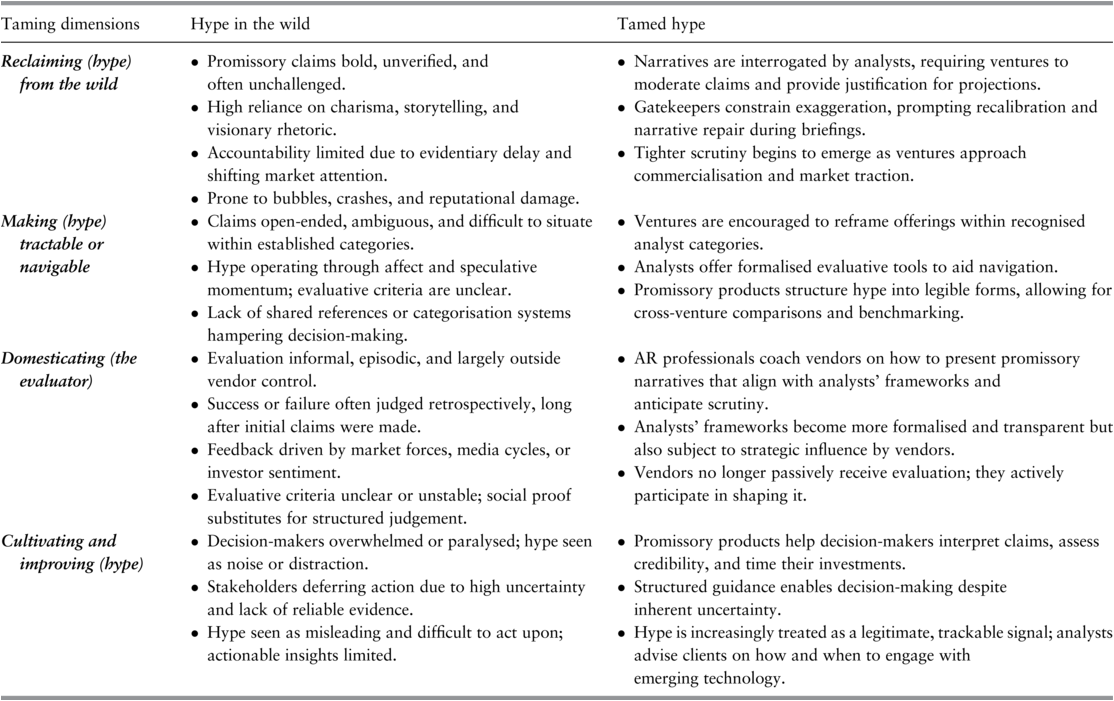
Table 9.1 Long description
The table has three columns titled Taming dimensions, Hype in the wild, and Tamed hype.
Row 1 column 1 reads. Reclaiming, hype, from the wild.
Row 1 column 2 reads. Promissory claims bold, unverified, and often unchallenged.
High reliance on charisma, storytelling, and visionary rhetoric.
Accountability limited due to evidentiary delay and shifting market attention.
Prone to bubbles, crashes, and reputational damage.
Row 1 column 3 reads. Narratives are interrogated by analysts, requiring ventures to moderate claims and provide justification for projections.
Gatekeepers constrain exaggeration, prompting recalibration and narrative repair during briefings.
Tighter scrutiny begins to emerge as ventures approach commercialisation and market traction.
Row 2 column 1 reads. Making, hype, tractable or navigable.
Row 2 column 2 reads. Claims open-ended, ambiguous, and difficult to situate within established categories.
Hype operating through affect and speculative momentum; evaluative criteria are unclear.
Lack of shared references or categorisation systems hampering decision-making.
Row 2 column 3 reads. Ventures are encouraged to reframe offerings within recognised analyst categories.
Analysts offer formalised evaluative tools to aid navigation.
Promissory products structure hype into legible forms, allowing for cross-venture comparisons and benchmarking.
Row 3 column 1 reads. Domesticating, the evaluator.
Row 3 column 2 reads. Evaluation informal, episodic, and largely outside vendor control.
Success or failure often judged retrospectively, long after initial claims were made.
Feedback driven by market forces, media cycles, or investor sentiment.
Evaluative criteria unclear or unstable; social proof substitutes for structured judgement.
Row 3 column 3 reads. A R professionals coach vendors on how to present promissory narratives that align with analysts’ frameworks and anticipate scrutiny.
Analysts’ frameworks become more formalised and transparent but also subject to strategic influence by vendors.
Vendors no longer passively receive evaluation; they actively participate in shaping it.
Row 4 column 1 reads. Cultivating and improving, hype.
Row 4 column 2 reads. Decision-makers overwhelmed or paralysed; hype seen as noise or distraction.
Stakeholders deferring action due to high uncertainty and lack of reliable evidence.
Hype seen as misleading and difficult to act upon; actionable insights limited.
Row 4 column 3 reads. Promissory products help decision-makers interpret claims, assess credibility, and time their investments.
Structured guidance enables decision-making despite inherent uncertainty.
Hype is increasingly treated as a legitimate, trackable signal; analysts advise clients on how and when to engage with emerging technology.
Our book has introduced the concept of tamed hype as a novel framework for understanding the institutionalisation of promissory narratives in the digital economy. We have traced the transformation of hype from being dismissed as ‘noise’ (Jordan, Reference Jordan2020) or condemned as ‘dangerous’ (Nightingale & Martin, Reference Nightingale and Martin2004) into a deliberately managed and institutionalised process. This mirrors what Latour (Reference Latour2004) described as a shift from a debated ‘matter of concern’ to an accepted ‘matter of fact’, and echoes Martin’s (Reference Martin2015) observation of a broader shift from a speculative ‘regime of hope’ to an evidence-based ‘regime of truth’. In short, we are witnessing the institutionalisation of hype as a structured and governable element of the digital economy. Recognising this emerging conception of tamed hype opens up new lines of enquiry. One such enquiry is how organisations might make decisions through hype rather than despite it, as we explore next.
9.3 Making Decisions through Hype, Not despite It
We examine how the emergence of tamed hype is reshaping adoption decisions in the digital economy. A crucial question follows: Are organisations now leveraging hype as part of decision-making, rather than working around or against it?
We have argued that hype is no longer a uniform force. It varies in form, structure, and degree of institutionalisation, and these variations are consequential. If distinct forms circulate – whether as tamed hype, hype in the wild, or other emerging configurations – then each shapes how technological futures are interpreted, evaluated, and acted upon. These differences influence what actors notice, how they interpret developments, and when and how they act. In other words, they affect how innovation is governed, which futures attract investment, and how opportunities and risks are understood.
A highly institutionalised hype may prompt adopters to act sooner on a technology than they would under hype in the wild. Rather than chasing every novelty or ignoring hype, adopters may now time moves strategically – for instance, targeting technologies just emerging from the HCC’s ‘Trough of Disillusionment’ to outpace competitors (see Chapter 6). Yet these dynamics remain under-theorised and empirically underexamined, highlighting the need for systematic comparative and longitudinal research.
There are growing signs that market actors no longer treat hype as something to be screened out or ignored. Instead, they appear increasingly inclined to make decisions through the lens of tamed hype. If so, hype ceases to be mere background noise and becomes a form of market intelligence to monitor, leverage, and act upon. This possibility invites further research into how organisations develop capabilities to interpret and use hype – and the organisational and market consequences that follow.
This challenges the dominant scholarly view that the distinction between hype and ‘fundamentals’ can only be made in hindsight, once outcomes have materialised (van Lente, Reference Van Lente2012; Master & Resnik, Reference Master and Resnik2013). We suggest that hype’s new actors are reshaping how decision-makers approach, evaluate, and act on technological futures in real time (or at least within organisational decision-making cycles). As recent work shows (Beckert, Reference Beckert2016, Reference Beckert2021; Logue & Grimes, Reference Logue and Grimes2022), not all hype is equal: some expectations are more plausible than others or backed by more credible expertise, while others remain speculative. Building on this insight, we argue that market gatekeepers – such as industry analysts – while unable to verify promissory claims, can systematically evaluate them and offer informed judgements about which narratives are more likely to be realised.
This marks a subtle but important shift. Hype’s new actors do more than temper hype: they reshape how it is consumed and acted upon, steering attention away from overblown claims and towards more grounded opportunities. As a result, decisions may increasingly be made through, rather than despite, hype. In short, hype may be transforming from a distraction into a decision-making tool – though the extent of this shift remains to be demonstrated empirically.
Promissory products such as the HCC, Magic Quadrants, categories, and Cool Vendor reports do not merely track hype; they structure, filter, and operationalise it in ways that vary across domains and over time. Where decision-making once relied heavily on informal judgement and ‘gut feel’ (Karahanna et al., Reference Karahanna, Straub and Chervany1999), it is now often decomposed into modular, manageable steps – each supported by specific promissory products that enable continuous benchmarking, tracking, and recalibration. This ‘salami slicing’ of decision-making – breaking big, risky decisions into smaller, manageable ones – may not eliminate speculation, but it redistributes and repackages it.
Market gatekeepers have also created new organisational arenas – such as analyst briefings – where promissory claims can be tested, revised, and provisionally endorsed. Such spaces encourage decision-makers to act more reflexively and strategically in the face of uncertainty. As our analysis across the book suggests, taming has not only made hype more navigable – it is elevating it into a central object of managerial attention. In doing so, it is reshaping the very infrastructure through which emerging technologies are evaluated, legitimated, and acted upon. Mapping these infrastructures, their evaluative criteria, and their consequences for innovation outcomes is a central agenda for future research.
9.4 Wild Hype Not Diminished
Our account of taming is intended as a complement – not replacement – for the prevailing hype in the wild perspective, and we see scope for examining how these perspectives interact across different technological and organisational settings. Crucially, wild hype has not disappeared (at least in the digital economy). Tamed forms of hype now circulate within the promissory arena alongside more unregulated and charismatic narratives. The relationship between these two forms of hype – tamed and wild – remains a rich and underexplored terrain, ripe for comparative study. One might conjecture that taming could eventually shape, constrain, or even discipline wild hype. However, we have not yet found substantial empirical evidence of this dynamic, beyond suggestive anecdotes. In many respects, wild hype continues to thrive unchecked by the tools and actors associated with taming.
Nor does our focus on taming dismiss the concerns raised by hype in the wild scholarship. We do not, for instance, downplay the importance of studying sensational episodes, such as the Theranos scandal (Cheney-Lippold, 2024). These moments continue to play a significant role in shaping public discourse and institutional responses. Indeed, such scandals often catalyse the emergence or refinement of taming practices – triggering calls for greater oversight, regulation, and evaluative rigour (Zankl & Grimes, Reference Zankl and Grimes2024). The nature and extent of tamed hype’s influence on wild hype, therefore, remain open and important questions for future research, including whether scandal-induced reforms diffuse or stay local.
That said, while the prevalence of wild hype remains high, its overall effectiveness in the digital economy may be uneven (and possibly in decline). Where once it dominated unchallenged, wild hype now appears increasingly marginalised. For instance, the once-unquestioned authority of high-profile ‘promise entrepreneurs’ is now met with growing public criticism – the so-called ‘techlash’ (Weiss-Blatt, Reference Weiss-Blatt2021). This shift suggests a subtle (and still poorly mapped) reconfiguration of the promissory landscape. Alternative valuation frameworks and evidence-based tools may now be gaining ground, enabling market actors to bypass – or at least bracket – some of the more hyperbolic claims. We might be witnessing a new hierarchy of promissory narratives, in which wild hype is increasingly devalued and tamed hype carries greater weight. Future research should examine if and how such a hierarchy is taking shape.
At the same time, our model of taming prompts further reflection on its boundaries. What cannot be tamed? What resists structuring? We do not claim that the digital economy is moving towards better, more calculated decision-making. On the contrary, our research highlights the persistent volatility, ambiguity, and fragility of innovation evaluation – even when supported by increasingly sophisticated tools, suggesting that any attempt to tame it has its limits. It is crucial to clarify that taming does not imply more control. The mechanisms designed to manage hype – such as rankings, categories, and briefings – can themselves generate new speculative dynamics. Taming is not an endpoint but a recursive process that often creates new forms of second-order hype. As Stirling (Reference Stirling2020) reminds us, control is frequently an illusion; what appears to be management may, in fact, be amplification under different guises.
Thus, the idea of ‘purifying’ hype (Chapter 6) is both epistemologically flawed and practically implausible (Latour, Reference Latour2012a). Uncertainty remains irreducible: no evaluative framework, however robust, can fully predict which technologies will succeed, which vendors will deliver, or which futures will materialise. Promising innovations may stall; breakthroughs may render existing categories obsolete. Start-ups, in particular, often outpace the evaluative models used to assess them, revealing the limitations of existing evaluative infrastructures and exposing blind spots in established analyst processes – patterns that future work could document more systematically across innovation cycles.
These potential ‘breakdowns’ (Jackson, Reference Jackson, Wajcman and Dodd2017) underscore a crucial insight: the taming of hype is always partial and contingent. It is vulnerable to failure, overreach, and misalignment with fast-moving innovation landscapes. Future studies could examine the limits of taming more explicitly, asking: Under what conditions do evaluative frameworks break down? And what unintended consequences might arise when taming tools are over-applied or misapplied? Addressing these questions will help specify when taming moderates, magnifies, or merely redistributes hype, and with what implications for innovation outcomes.
9.5 Mechanisms of Taming Hype
The four taming dimensions in Table 9.1 offer a high-level account of how hype is progressively tamed. Another of the book’s contributions has been to demonstrate how these taming dimensions are materially enacted. We identified four core taming mechanisms: (i) briefings, (ii) calculative triaging, (iii) prerequisites for success, and (iv) trajectory of evidence.
9.5.1 Briefings
The first mechanism, briefings, represents a critical arena for the production, shaping, and evaluation of hype, where wild claims are systematically tamed through scrutiny. Drawing on insights from Valuation Studies (Helgesson & Muniesa, Reference Helgesson and Muniesa2013), we show how briefings create structured encounters in which vendors present their promissory narratives to market gatekeepers (Antal et al., Reference Antal, Hutter, Stark, Antal, Hutter and Stark2015). These are not merely passive exchanges. As our fieldwork shows, briefings are often sites of active negotiation, scrutiny, and recalibration.
Analysts often approach vendors with scepticism, assuming some degree of exaggeration – if not outright misrepresentation. As one analyst noted, ‘vendors were exaggerating’ (A7, interview); another went further, calling some claims ‘lies’ (A1, interview). In response, analyst relations experts are increasingly coaching vendors to substantiate their narratives with credible evidence and to avoid making speculative claims.
As Chapter 4 demonstrates, requests for proof have become increasingly standard, and vendors must learn to speak in terms that align with analysts’ evaluative frameworks. Thus, success in the briefing process depends not only on a venture’s potential but also on its ability to navigate and adapt to this structured and evaluative space. Our findings hint (Chapters 4 and 5), for instance, that a vendor’s willingness to incorporate analyst feedback in subsequent meetings can gradually build credibility. Future studies could investigate how such alignment is learned, negotiated, and rewarded; how coaching practices are disseminated; and whether they impact the content and credibility of hype over time.
These dynamics create a ‘tension’ (Boltanski & Thévenot, Reference Boltanski and Thévenot1999) among vendors, analysts, and analyst relations professionals. Whilst analysts come armed with scepticism and probing claims, vendors (often coached by AR) attempt to anticipate and address these doubts. When vendor narratives fall short, AR experts often step in to ‘repair’ the narrative, as one noted: ‘You would not believe the number of conversations we start where … we’re repairing relationships’ (AR6, interview). The credibility of AR experts is also at stake, as they must carefully balance loyalty to clients with maintaining trust among analysts.
9.5.2 Calculative Triaging
The second mechanism, calculative triaging, can be understood as the systematic sorting and prioritisation of innovations based on criteria such as credibility, market potential, and alignment with client interests. Analysts use increasingly sophisticated promissory products to determine which technologies deserve attention and investment. We define calculative triaging as the provisional deployment of evaluative frameworks that immediately distinguish between overhyped and substantiated innovations. Examples include the HCC, which situates technologies along a lifecycle of expectations; Magic Quadrants, which translate subjective assessments into quantifiable, comparative ratings; and Cool Vendor designations, which act as signals of endorsement and redirect attention to emerging players deemed credible and promising. These tools not only structure attention – they shape it, offering interpretive and practical frameworks through which hype becomes actionable. For instance, by spotlighting certain Cool Vendors, analysts redirect industry investment towards those firms. Through such calculative triaging, analysts impose structure and order on the chaos of emerging innovations, effectively taming the hype by foregrounding some technologies and sidelining others (which may then struggle to attract attention or capital).
9.5.3 Prerequisites for Success
A third taming mechanism involves identifying prerequisites for success – baseline conditions that ventures must meet to be deemed credible by market gatekeepers. For instance, analysts develop checklists of credibility (e.g. does the start-up have paying customers? Have these customers experienced visible benefits? Can they be a demonstrable ‘use case’?). While analysts cannot predict which innovations will succeed, they can use structured frameworks to flag warning signs of fragility (e.g. reliance on social proof or vague promises) and highlight positive indicators (e.g. proven traction, coherent vision). These prerequisites serve two functions. First, they act as filters, helping analysts and clients identify which ventures possess the necessary fundamentals to move forward and flag those that lack them (e.g. ventures relying solely on vague promises or social proof are marked as fragile). Second, they operate as implicit guidelines for vendors: knowing these criteria, vendors are encouraged to align their strategies and narratives with what evaluators expect to see. In short, these criteria tame hype by embedding evaluator expectations into the innovation process (ventures must check certain boxes to be taken seriously).
9.5.4 Trajectory of Evidence
The fourth mechanism, the trajectory of evidence, provides a longitudinal approach for taming hype. While industry analysts cannot predict outcomes with certainty, their tools trace the ‘trajectory of evidence’ (Kruse, Reference Kruse2015), the evolution of proof points, and credibility signals over an innovation’s lifespan.Footnote 3
For example, industry analysts – tasked with identifying potential disruptors – engage in repeated briefings with ventures over extended periods to monitor a venture’s progress and consistency of story. At the outset, many ventures appear similar, as their evidence and discourse follow comparable arcs, making it difficult to discern whether a venture has genuine disruptive potential or is merely overclaiming (Garud et al., Reference Garud, Phillips, Snihur, Thomas and Zietsma2025). Although analysts are inundated with a constant stream of new ventures, genuine disruptors remain rare (Zankl & Grimes, Reference Zankl and Grimes2024). Yet, they cannot risk overlooking or dismissing a potential disruptor in their domain, as they can be damaged by missing a vital innovation or innovator (Chapter 6).
To navigate this, analysts evaluate the trajectory of evidence – they look at how a venture’s story and proof points evolve over multiple interactions. Analysts look for positive momentum: Is the start-up backing its claims with increasingly concrete evidence each time we meet? By evaluating the trajectory, therefore, analysts identify patterns and assess whether ventures are maturing towards credible innovation or failing to substantiate their claims. Thus, venture narratives are eventually either substantiated, refined, or discredited, depending on how ventures respond to evaluation processes. Repeated briefings, follow-up calls, ‘proxy-ethnographies’ (Knorr Cetina, Reference Knorr Cetina2010), and finding and assessing ‘customer use cases’ (Smith, Reference Smith2009) provide data points that either build credibility or raise red flags. This trajectory-based approach does not eliminate uncertainty but helps analysts make more confident judgements about who is maturing towards genuine innovation.
Together, these four mechanisms create a multi-layered system for managing hype. They channel hype in the wild into formal routines, creating feedback loops and criteria that keep hype in check and make it more predictable. Having described how hype is tamed in practice, we now ask: How did these practices arise and change over time?
9.6 The Managed Spiral of Promissory Products
Studying the digital economy for over two decades has provided a unique vantage point to observe how hype has evolved into a distinct domain of economic activity – a business in its own right. From selling hype evaluations to offering specialised advisory services to producing rankings and visual tools for navigating expectations, a commercial infrastructure has emerged around the production and governance of hype. This perspective reveals not only how this business has emerged but also how the various promissory products shift and adapt in response to new challenges, reflecting the changing dynamics of innovation and uncertainty in the digital economy.
A central question arises: How do promissory products evolve in tandem with innovation, ensuring that hype remains governable over time? The promissory products developed by analysts are not static instruments tied to a single technological moment. Instead, they have proven highly adaptable, evolving to remain relevant as new technologies emerge and older ones become obsolete. We argue that this adaptability reflects not just innovation in isolation but a managed spiral of promissory products, sustained through processes of entrainment whereby evaluative tools reinforce and extend one another across technological domains.
Here we build on the spiral metaphor introduced in Chapter 3. Whereas there we emphasised its role in explaining the proliferation of promissory products, here we develop it further to show how the spiral is actively managed – through adaptation and entrainment – to tame hype over time.
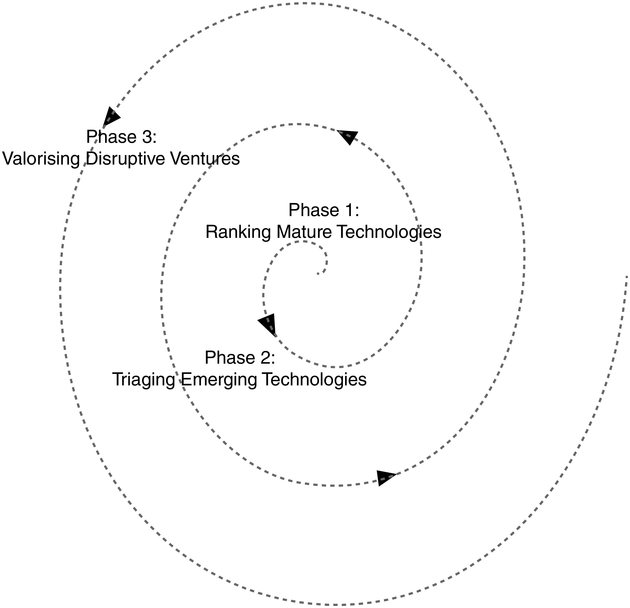
The taming of hype is best understood as a recursive spiral in which one evaluative tool opens space for the development of others (MacKenzie, Reference Mackenzie2000; Beunza, Reference Beunza2019). Each innovation in evaluation lays the groundwork for subsequent adaptations, creating a cumulatively emerging pattern of elaboration and refinement. Our analysis has identified three overlapping phases in this evolution, each marking a shift in how hype’s new actors manage hype and tailor their approaches to technological complexity and changing client needs (see Figure 9.1):
Phase 1: Ranking Mature Technologies (Late 1990s): The first phase centred on evaluating and ranking established technologies within relatively mature and well-defined markets. At this time, the digital economy lacked mechanisms to moderate inflated claims. Hype circulated largely unchecked – a phenomenon we have termed ‘hype in the wild’. The dotcom boom – and its bust – exposed the risks of unregulated hype. In response, market gatekeepers developed tools to introduce order, the earliest and most influential being Gartner’s Magic Quadrant. Rival analyst firms quickly followed, and today, hundreds of similar ranking products circulate in the market, fundamentally shifting industry practices (Pollock et al., Reference Pollock, D’Adderio, Williams and Leforestier2018). This illustrates how a single promissory product can catalyse widespread shifts in how innovation is assessed.
Phase 2: Triaging Emerging Technologies (Early 2000s): As attention shifted towards emerging and less proven technologies, existing ranking tools struggled to accommodate the uncertainty surrounding early-stage innovations. In this second phase, new evaluative instruments emerged to support technology adopters in navigating immaturity and volatility. The HCC, introduced during this period, became a central tool for helping organisations decide when and how to engage with emerging technologies (Dedehayir & Steinert, Reference Dedehayir and Steinert2016). Importantly, these new tools did not replace earlier analyst frameworks but extended and modified them. The evaluative remit expanded beyond large firms to include start-ups and nascent ventures. This phase marked the beginning of a more diversified landscape, where traditional performance measures were adapted to fit the innovation dynamics of early-stage technologies.
Phase 3: Valorising Disruptive Ventures (2010 Onwards): The third phase focused on identifying and endorsing potentially disruptive start-ups. The introduction of the Cool Vendor label was pivotal. It allowed analysts to draw attention to ventures seen as capable of ‘challenging long-held assumptions’ and ‘transforming business operations’ (Shimel, Reference Shimel2013). This phase also saw the rise of dedicated evaluation formats such as start-up briefings – what we have called the ‘Second Most Important Pitch’ after investor presentations. These briefings were designed to capture the specific needs and capacities of start-ups while maintaining links to established evaluative frameworks. As one analyst noted, ‘We use some of the criteria for innovation from [large vendor] reports to actually look and evaluate some of the younger, smaller vendors’ (A2, interview). This repurposing of existing criteria allowed analysts to extend their authority to new domains (without sacrificing credibility). Since the introduction of the Cool Vendor designation, competing analyst firms have launched parallel labels – such as Hot Vendors, Innovators, and Market Disruptors – reflecting a growing emphasis on valorising early-stage innovation.
The evolving spiral of promissory products continues to adapt, signalling ongoing experimentation in the evaluative infrastructure of the digital economy. For example, this third phase remains in flux. It is unclear how stable or enduring these new evaluative forms surrounding start-ups will prove to be. What is clear is that we are still in the early stages of a broader transformation in how emerging ventures are identified, classified, and made investable.
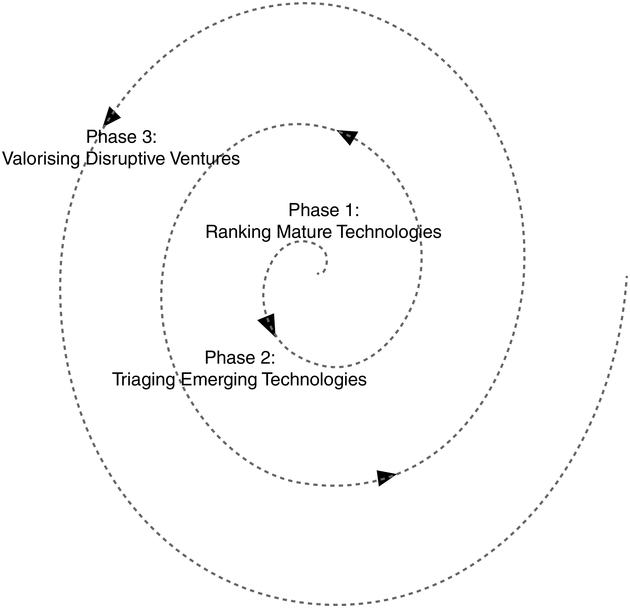
Figure 9.1 Long description
The diagram has an outward spiral with three rings representing the three phases of taming hype. Phase 1 at the center or origin of the spiral is labelled, Ranking Mature Technologies. Phase 2 is labelled, Triaging Emerging Technologies. Phase 3 is labelled, Valorising Disruptive Technologies.
We now consider one factor that underpins this spiral: the role of entrainment.
9.6.1 The Role of Entrainment
The evolving spiral of promissory products is sustained not just by innovation but by a process of entrainment – the synchronisation of evaluative routines across different domains. Entrainment refers to how distinct evaluation tools build upon and reinforce each other, creating a rhythm and continuity that enables further elaboration (Biesenthal et al., Reference Biesenthal, Sankaran, Pitsis and Clegg2015). In this way, promissory products do not operate in isolation. Instead, their power stems from how they interact and align with existing frameworks, enabling analysts to extend their cognitive authority across both mature and emerging technology domains.
A clear example of entrainment can be seen in the development of the HCC. Jackie Fenn did not invent the model from scratch. She adapted it from the pre-existing Enterprise Technology Adoption (ETA) profiles already used within Gartner, which categorised organisations into risk types – Type A, B, or C. As Fenn explained, ‘Type A, B, C actually was there when I joined Gartner … I found it useful to apply it … as a very simple way that organisations are prepared to self-identify’ (Fenn, interview). This illustrates entrainment: the new HCC gained quick acceptance because it was entrained with an existing categorisation that clients already understood.
Entrainment may be central to understanding why some evaluative frameworks gain traction while others fade. Synchronisation with broader industry norms and technological shifts enhances their adoption. However, entrainment also introduces risks. Misalignment may occur when tools designed for mature markets are applied to emerging domains. Applying a Fortune-500-style ranking to a seed-stage start-up can do more harm than good. As one analyst remarked, ‘I am a big believer that if you are a small venture, you don’t really want to be on [a major analyst ranking] at all. You are not going to look good’ (A1, interview). Such mismatches can distort the visibility and perceived viability of promising innovations.
The spiral of promissory products reflects how market gatekeepers have strategically worked to maintain their epistemic authority. Through constant adaptation – from the Magic Quadrant and categories to the HCC and Cool Vendor reports – they have responded to shifts in the innovation landscape and the rising complexity of technology markets. Yet this expansion has also opened space for other actors to gain influence, notably rival analyst firms and analyst relations specialists. What was once a closed dialogue between an analyst and a vendor has evolved into a complex evaluative ecosystem (Pollock et al., Reference Pollock, D’Adderio, Williams and Leforestier2018) populated by diverse tools, institutions, and gatekeepers.
9.6.2 Pluralism in Promissory Products
Recognising this spiralling of promissory products is crucial for understanding how promissory economies are now sustained and institutionalised over time. As promissory products proliferate, so too do the methods and criteria for evaluating, legitimising, or contesting hype. This diversity matters. Drawing on MacKenzie’s (Reference MacKenzie2011) notion of evaluative cultures, we argue that different evaluative infrastructures generate different hype dynamics. MacKenzie’s study of the subprime mortgage crisis offers a cautionary parallel: when rating agencies and investors relied on the same flawed risk models – creating a closed feedback loop – the result was systemic misjudgement on a catastrophic scale.
The same logic applies to hype. In tightly coupled systems – such as those in which ‘hype in the wild’ proliferates – hype enactors (entrepreneurs, innovators) and hype selectors (analysts, adopters, investors) often share assumptions, criteria, and expectations. This close alignment amplifies hype: limited evaluation standards and strong social consensus can create feedback loops that reinforce optimistic projections and foster localised bubbles of expectation (Floridi, Reference Floridi2024). It is in such contexts that boom-and-bust collapses are most likely, as inflated claims spiral unchecked until punctured.
By contrast, pluralistic evaluative ecosystems – characterised by diverse tools, metrics, and gatekeepers, such as those in which ‘tamed hype’ proliferates – introduce friction and contestation. As Stark (Reference Stark2009) suggests, rather than relying on a single metric, the coexistence of multiple evaluative principles can act as a check and balance. In such contexts, no single hype narrative goes unchallenged; competing perspectives disrupt groupthink and temper runaway optimism. For instance, as shown in Chapter 6, internal debates among analysts about where to position technologies on the HCC – described as moments to ‘negotiate’, ‘haggle’, ‘argue’, and even ‘fight’ – reveal that consensus is actively fought over and has to be worked out rather than assumed. These deliberative practices, while messy, ensure that evaluations are not mere reflections of dominant narratives but are subject to scrutiny, collective judgement, and recalibration.
While the spiral of promissory products cannot eliminate boom-and-bust dynamics, it does appear to reconfigure them. By establishing multiple mechanisms for testing, revising, and refining promissory claims, these products reduce the likelihood of decisions being made on predictably unreliable evidence. They do not provide absolute certainty or ‘truth’ (Thompson & Byrne, Reference Thompson and Byrne2022) about the prospects of emerging technologies, but they can eliminate some foreseeable sources of error and reshape the structure of unknowns. In this way, the proliferation of promissory products is beginning to reshape speculative dynamics in the digital economy. We return in Chapter 10 to examine more closely how the HCC, in particular, participates in this reshaping.
***
These findings extend and complicate existing research on managing expectations and hype, as we explore next.
9.7 Hype Management
The concept of ‘hype management’ – recently articulated by Logue and Grimes (Reference Logue and Grimes2022) – describes how market actors seek to shape and sustain attention, legitimacy, and credibility in the face of uncertainty. It highlights the deliberate, often strategic efforts to navigate the volatile dynamics of expectations – turning what might be fleeting enthusiasm into more durable support. How, then, do our findings on taming hype speak to and revise this concept? We develop the notion in three ways. First, we build on but complicate Logue and Grimes’ (Reference Logue and Grimes2022) distinction between ‘material proof’ and ‘social proof’. Second, we demonstrate that evaluation unfolds longitudinally, not well captured by short-term snapshot studies. Third, we theorise ‘trajectories of evidence’ (Kruse, Reference Kruse2015) as a mechanism through which hype is tamed over time.
The etymology of ‘management’ – from the Italian maneggiare, meaning ‘to handle’ (Barnhart, Reference Barnhart1999) – underscores hype management’s affinity with our notion of taming: both evoke deliberate control and the careful steering of something potentially unruly. Applied to hype, the term suggests that expectations can be guided and stabilised through ongoing evaluation, as market actors decide what, and whom, to believe.
Logue and Grimes (Reference Logue and Grimes2022) implicitly develop this taming view in their study of the impact investment sector. They demonstrate how organisations strive to convert hyped claims into ‘material proof’ (measurable evidence, performance metrics) and ‘social proof’ (endorsements, third-party validations), arguing that when ‘hard’ evidence is scarce, social proof becomes especially important for maintaining legitimacy and stakeholder engagement.
We build on this insight, yet we contend that treating material and social proof as a stable dualism obscures how evidentiary forms intermingle and shift in weight over time. Particularly in fast-moving domains such as the digital economy, artefacts, metrics, endorsements, and narratives migrate across the material–social divide; evidence first received as reputational markers may later solidify into performance benchmarks, and vice versa. To capture these movements, we theorise proof gradients – degrees of materialisation and social endorsement that can thicken, thin, or reverse – and we link these gradients to temporally extended ‘trajectories of evidence’ (Kruse, Reference Kruse2015) through which hype is incrementally tamed.
Chapter 4 illustrated this blurring in the case of vendor ‘customer use cases’. Vendors routinely mobilise such cases to demonstrate deliverability. Yet, as Smith (Reference Smith2009) shows, adopter endorsements often reflect strategic positioning: a customer with sunk investments in a technology has incentives to present its deployment as successful. What appears as objective performance data (material proof) may simultaneously function as reputational evidence (social proof). Evidence, in other words, rarely fits neatly into one category. Indeed, industry analysts labour to disentangle these layers from one vendor briefing to the next – a dynamic visible in our longitudinal archive of briefing transcripts and follow-up interactions (Chapter 4).
Recognising this entanglement pushes us towards a temporally attuned account of evaluation. Prior work (e.g. Logue & Grimes, Reference Logue and Grimes2022) captures a ‘snapshot’ of evidentiary practice. Yet hype rarely stands still, as argued in Chapter 2. Claims are reiterated, challenged, reframed, abandoned, or re-substantiated as markets, technologies, and competitive reference points evolve. Treating hype as a short-term resource that is either validated or discarded understates the ongoing work of narrative adjustment and expectations management (Garud et al., 2014) and obscures how legitimacy can be rebuilt after early scepticism or disappointment (Hampel & Dalpiaz, Reference Hampel and Dalpiaz2025).
Our extension draws on Kruse’s (Reference Kruse2015) notion of a ‘trajectory of evidence’ mentioned above – the unfolding path along which claims accumulate, mutate, or erode supporting proof. A trajectory view treats material and social proof not as endpoints but as momentary configurations within a broader sequence of evaluation episodes. Across that sequence, indicators can be upgraded, downgraded, reinterpreted, or supplanted; what counts as credible evidence is negotiated afresh as additional actors, artefacts, and data enter the frame.
The analysts in our study routinely approach early vendor briefings as first data points, not verdicts. One analyst, after several interactions, challenged a start-up: ‘I asked people at [BigTech] about you … and no one’s even heard of you!’ At that moment, the venture’s claims appeared to fail both material validation (no evidence of a partnership) and social validation (no awareness among a key ecosystem player). The start-up responded by refining its narrative and producing new artefacts – evidence of ‘joint pitches’, publicity material, and material highlighting the relationship. Subsequent briefings registered movement along the evidentiary trajectory: from initial scepticism to contingent recognition as proof accumulated.
This episode exemplifies how evaluation unfolds as a process of mutual adjustment, narrative repair, and trajectory building (Garud et al., 2014). In this way, our taming perspective moves beyond the simple snapshot view. It shows that hype is not simply accepted or rejected but tracked, tested, and transformed over time – shaped by evolving evaluative infrastructures and the situated practices of actors such as analysts, analyst relations professionals, and vendors. Identifying the mechanisms that enable these shifts – and their consequences for adoption, investment, and legitimacy – remains an important agenda for future research (Hampel & Dalpiaz, Reference Hampel and Dalpiaz2025).
9.8 Fictional Expectations
Our exploration of taming hype builds on Beckert’s (Reference Beckert2016, Reference Beckert2021) influential concept of fictional expectations – the idea that expectations mobilise investment, coordinate action, and shape economic trajectories (see also Beckert & Bronk, Reference Beckert and Bronk2018). Tracing how particular expectations travel, stick, or fade across evaluative settings remains an open empirical agenda. While Beckert captures their generative power, his account leaves key questions unresolved: How do certain expectations gain traction? What makes some narratives more plausible or persuasive than others? And through what mechanisms are these visions translated into action or held accountable?
We extend Beckert in two moves. First, although Beckert (Reference Beckert2021) recognises that expectations must be judged credible, he does not trace how such judgements are operationalised in practice. We show that structured evaluative systems actively sort, filter, and reshape fictional expectations. Promissory products create selective visibility: they define what counts as credible, timely, and investable. As discussed in Chapter 5, the Cool Vendor designation and its associated analyst briefing process filter ventures through explicit criteria. Many technically promising start-ups fail to qualify because their narratives do not fit the required evaluative format; ventures that do align are flagged and valorised, gaining broader attention and market legitimacy.
Second, we argue that fictional expectations are not merely ‘imaginative projections’ – as emphasised by Beckert – but increasingly formatted futures. While Beckert foregrounds narrative creation, we add the formats that render those narratives legible and actionable. Promissory products encode expectations into routinised evaluative frames (Thévenot, Reference Thévenot1984) that structure how futures can be articulated, compared, and acted upon.Footnote 4 For instance, to be flagged as a Cool Vendor, a start-up must fit its story into the template analysts expect – framing its innovation in terms of market relevance, differentiation, and potential impact, while supplying just enough evidence to make the promise appear both credible and exciting. To appear in a Magic Quadrant, a vendor must present both its ‘vision’ and proof of its ‘ability to execute’ – for example, through client references, product demonstrations, and other credibility markers. Thus, ventures can no longer simply invent their own future stories: the projection of futures has become increasingly standardised. To be taken seriously, one must project in an accepted format – otherwise the vision will not even register on the evaluative radar. This helps explain why some narratives, no matter how compelling, never gain traction.
Investments in form (Thévenot, Reference Thévenot1984) are not only stabilising; they are generative. The institutionalisation of promissory formats has produced a class of specialists – analyst relations experts – meaning that a whole new professional class now thrives on teaching ventures how to fit their story to these formats. As hype work becomes professionalised, analyst relations specialists coach vendors on crafting claims that satisfy formal tools and evidence protocols. In this way, fictional expectations are not simply narrated; they are formatted into being – the shape of the story can matter as much as its substance for an expectation to take hold. Ventures must learn to perform to these schemas not only to attract attention but also to become legible within an evaluatively saturated marketplace. This formatting work is central to our broader argument about taming hype: it shows that expectations thrive only when they can be encoded, evaluated, and iteratively adjusted via promissory infrastructures. In short, hype in the wild must enter these managed channels to gain traction.
***
The transformation from wild to tamed hype signals a broader institutionalisation of promissory narratives in the digital economy. As hype becomes more structured, evaluable, and routinised, new forms of expertise, legitimacy, and strategic influence emerge. In Chapter 10, we argue for a dedicated research agenda – Hype Studies – to investigate this institutionalisation and its implications for innovation and the economy.

 Open access