





1. Introduction
The transfer of optical angular momentum plays a critical role in diverse research areas, ranging from the precise control of nanoparticle motion (Porfirev, Khonina & Kuchmizhak Reference Porfirev, Khonina and Kuchmizhak2023) to the generation of substantial axial magnetic fields (Talin, Kaftandjian & Klein Reference Talin, Kaftandjian and Klein1975; Najmudin et al. Reference Najmudin2001; Shi et al. Reference Shi, Vieira, Trines, Bingham, Shen and Kingham2018), the development of compact accelerators for twisted electron beams with relativistic energies (Vieira, Mendonça & Quéré Reference Vieira, Mendonça and Quéré2018) and the emission of radiation with angular momentum from the spiral motion of high-energy electrons (Seipt, Surzhykov & Fritzsche Reference Seipt, Surzhykov and Fritzsche2014; Katoh et al. Reference Katoh, Fujimoto, Kawaguchi, Tsuchiya, Ohmi, Kaneyasu, Taira, Hosaka, Mochihashi and Takashima2017; Luís Martins et al. Reference Luís Martins, Vieira, Ferri and Fülöp2019).
Optical angular momentum transfer in underdense plasmas has been studied in the context of the inverse Faraday effect, which was initially explored using circularly polarised lasers (Talin et al. Reference Talin, Kaftandjian and Klein1975; Sheng & Meyer-ter Vehn Reference Sheng and Meyer-ter Vehn1996; Gorbunov & Ramazashvili Reference Gorbunov and Ramazashvili1998; Haines Reference Haines2001; Kostyukov et al. Reference Kostyukov, Shvets, Fisch and Rax2001; Najmudin et al. Reference Najmudin2001; Frolov Reference Frolov2004; Naseri, Bychenkov & Rozmus Reference Naseri, Bychenkov and Rozmus2010; Liu, Jia & Zheng Reference Liu, Jia and Zheng2023). Later studies included lasers with orbital angular momentum (Allen et al. Reference Allen, Beijersbergen, Spreeuw and Woerdman1992), relying on the direct absorption of laser angular momentum (Ali, Davies & Mendonca Reference Ali, Davies and Mendonca2010; Nuter et al. Reference Nuter, Korneev, Dmitriev, Thiele and Tikhonchuk2020; Longman & Fedosejevs Reference Longman and Fedosejevs2021). Moreover, angular momentum transfer to plasma waves and energetic charged particles has been demonstrated using lasers with orbital angular momentum (Baumann & Pukhov Reference Baumann and Pukhov2018), spatio-temporally coupled beams forming light springs (Vieira et al. Reference Vieira, Mendonça and Quéré2018) and twisted beat waves (Saberi, Vieira & Silva Reference Saberi, Vieira and Silva2017; Shi et al. Reference Shi, Vieira, Trines, Bingham, Shen and Kingham2018).
So far, optically induced plasma electron rotation has primarily been associated with circularly polarised lasers and lasers with orbital angular momentum. These lasers exhibit distinct types of angular momentum – spin and orbital – which enable the angular motion of electrons through direct absorption or higher-order nonlinearities (Sheng & Meyer-ter Vehn Reference Sheng and Meyer-ter Vehn1996; Haines Reference Haines2001; Frolov Reference Frolov2004). The time-averaged angular momentum density of an electromagnetic wave is given by $ \langle \mathcal{L}\rangle = 1/(4 \pi c)\boldsymbol{r} \times \langle \boldsymbol{E} \times \boldsymbol{B} \rangle$
, where
$ \langle \mathcal{L}\rangle = 1/(4 \pi c)\boldsymbol{r} \times \langle \boldsymbol{E} \times \boldsymbol{B} \rangle$
, where $ \boldsymbol{E}$
and
$ \boldsymbol{E}$
and $ \boldsymbol{B}$
are the electric and magnetic field vectors, expressed in Gaussian CGS units, and
$ \boldsymbol{B}$
are the electric and magnetic field vectors, expressed in Gaussian CGS units, and $ c$
is the speed of light. A laser beam carries angular momentum when the time-averaged momentum density
$ c$
is the speed of light. A laser beam carries angular momentum when the time-averaged momentum density $ 1/(4 \pi c)\langle \boldsymbol{E} \times \boldsymbol{B} \rangle$
has an azimuthal component.
$ 1/(4 \pi c)\langle \boldsymbol{E} \times \boldsymbol{B} \rangle$
has an azimuthal component.
Here, we demonstrate that the plasma can gain angular momentum from lasers without angular momentum, such as azimuthally polarised lasers. Azimuthally polarised laser pulses consist of two orthogonally polarised transverse electromagnetic (TEM $_{01}$
) modes, i.e.
$_{01}$
) modes, i.e. $ \text{TEM}_{01 (x)} \hat {e}_y - \text{TEM}_{01 (y)} \hat {e}_x$
(Nesterov & Niziev Reference Nesterov and Niziev2000; Oron et al. Reference Oron, Blit, Davidson, Friesem, Bomzon and Hasman2000). At focus, the vector potential is described by
$ \text{TEM}_{01 (x)} \hat {e}_y - \text{TEM}_{01 (y)} \hat {e}_x$
(Nesterov & Niziev Reference Nesterov and Niziev2000; Oron et al. Reference Oron, Blit, Davidson, Friesem, Bomzon and Hasman2000). At focus, the vector potential is described by $\boldsymbol{A}(r) = a_0 (r/w_0) \exp (-r^2/w_0^2) \hat {e}_\theta$
, where
$\boldsymbol{A}(r) = a_0 (r/w_0) \exp (-r^2/w_0^2) \hat {e}_\theta$
, where $ w_0$
is the beam waist and
$ w_0$
is the beam waist and $\hat e_\theta = -\sin \theta \hat e_x + \cos \theta \hat e_y$
is the unit vector in polar direction with
$\hat e_\theta = -\sin \theta \hat e_x + \cos \theta \hat e_y$
is the unit vector in polar direction with $\theta = \tan ^{-1} (y/x)$
. This configuration exhibits a hollow intensity profile and corresponds to a transverse electric (TE) mode, featuring an electric field component,
$\theta = \tan ^{-1} (y/x)$
. This configuration exhibits a hollow intensity profile and corresponds to a transverse electric (TE) mode, featuring an electric field component, $ E_\theta$
, oriented in polar direction and perpendicular to the propagation direction, with radial
$ E_\theta$
, oriented in polar direction and perpendicular to the propagation direction, with radial $ B_r$
and axial
$ B_r$
and axial $ B_z$
components of the magnetic field. As a result, its time-averaged momentum density is directed along the z-axis,
$ B_z$
components of the magnetic field. As a result, its time-averaged momentum density is directed along the z-axis, $ 1/(4 \pi c)\langle \boldsymbol{E} \times \boldsymbol{B} \rangle = 1/(4 \pi c)\langle E_\theta B_r \rangle \hat {e}_z$
, similar to radial polarisation and linearly polarised Gaussian beams (Volke-Sepulveda et al. Reference Volke-Sepulveda, Garces-Chavez, Chavez-Cerda, Arlt and Dholakia2002). Therefore, these lasers have zero angular momentum density and thus have not been previously associated with optically induced electron rotation.
$ 1/(4 \pi c)\langle \boldsymbol{E} \times \boldsymbol{B} \rangle = 1/(4 \pi c)\langle E_\theta B_r \rangle \hat {e}_z$
, similar to radial polarisation and linearly polarised Gaussian beams (Volke-Sepulveda et al. Reference Volke-Sepulveda, Garces-Chavez, Chavez-Cerda, Arlt and Dholakia2002). Therefore, these lasers have zero angular momentum density and thus have not been previously associated with optically induced electron rotation.
Through analytical considerations and one- and three-dimensional particle-in-cell (PIC) simulations using OSIRIS (Fonseca et al. Reference Fonseca2002), we show that plasma rotation arises from canonical momentum conservation and is facilitated by a non-vanishing vector potential that trails the main laser pulse, a phenomenon that develops during local pump depletion (Decker et al. Reference Decker, Mori, Tzeng and Katsouleas1996). We further demonstrate the conservation of total angular momentum and that the mechanism can be tuned, mainly through the laser polarisation and the laser-to-plasma frequency ratio.
In the following, we normalise the electric $\boldsymbol{E}$
and magnetic fields
$\boldsymbol{E}$
and magnetic fields $\boldsymbol{B}$
to
$\boldsymbol{B}$
to $m_e c \omega _p / e$
. The vector potential
$m_e c \omega _p / e$
. The vector potential $A$
is normalised to
$A$
is normalised to $m_e c / e$
, where the dimensionless vector potential is given by
$m_e c / e$
, where the dimensionless vector potential is given by $a_0 = e A / m_e c$
. Distances
$a_0 = e A / m_e c$
. Distances $\boldsymbol{x}$
, velocity
$\boldsymbol{x}$
, velocity $v$
, and time
$v$
, and time $t$
are normalised to
$t$
are normalised to $c / \omega _p$
,
$c / \omega _p$
, $c$
and
$c$
and $1 / \omega _p$
, respectively. The plasma frequency is defined as
$1 / \omega _p$
, respectively. The plasma frequency is defined as $\omega _p = \sqrt {4 \pi n_e e^2/m_e}$
, where
$\omega _p = \sqrt {4 \pi n_e e^2/m_e}$
, where $n_e$
is the background plasma density and
$n_e$
is the background plasma density and $m_e$
is the electron mass.
$m_e$
is the electron mass.
2. One-dimensional analysis of local pump depletion and transverse momentum gain of electrons
It is instructive to review the self-consistent laser-plasma dynamics in one dimension to study how the mechanism works. We simulate an ultra-intense short laser pulse with a dimensionless amplitude $a_0 = 6$
(
$a_0 = 6$
( $I \approx 8\times 10^{19}$
W cm
$I \approx 8\times 10^{19}$
W cm $^{-2}$
) and full-width at half-maximum (FWHM) pulse duration
$^{-2}$
) and full-width at half-maximum (FWHM) pulse duration $\tau = 3 / \omega _p$
(
$\tau = 3 / \omega _p$
( ${\sim}10$
fs). The laser is linearly polarised (in
${\sim}10$
fs). The laser is linearly polarised (in $y$
-direction) with a central frequency
$y$
-direction) with a central frequency $\omega _0 = 8 \, \omega _p$
. Initially, the laser pulse’s vector potential
$\omega _0 = 8 \, \omega _p$
. Initially, the laser pulse’s vector potential $\boldsymbol{A}$
vanishes (nearly zero) outside the laser pulse. The underdense plasma starts at
$\boldsymbol{A}$
vanishes (nearly zero) outside the laser pulse. The underdense plasma starts at $z = 34 \, c/\omega _p$
and is homogeneous with a density of
$z = 34 \, c/\omega _p$
and is homogeneous with a density of $n_e = 1/64 \, n_{cr} \approx 2.7 \times 10^{19} \, \text{cm}^{-3}$
, where
$n_e = 1/64 \, n_{cr} \approx 2.7 \times 10^{19} \, \text{cm}^{-3}$
, where $n_{cr} \approx 1.7 \times 10^{21} \, \text{cm}^{-3}$
corresponds to the critical density for a laser wavelength of
$n_{cr} \approx 1.7 \times 10^{21} \, \text{cm}^{-3}$
corresponds to the critical density for a laser wavelength of $\lambda = 800 \, \text{nm}$
. The ions are assumed to be static. The simulation is performed in a moving window that travels at the speed of light
$\lambda = 800 \, \text{nm}$
. The ions are assumed to be static. The simulation is performed in a moving window that travels at the speed of light $c$
. The simulation box is
$c$
. The simulation box is $68 \, c/\omega _p$
long, divided into
$68 \, c/\omega _p$
long, divided into $6800$
cells and one particle per cell.
$6800$
cells and one particle per cell.
One-dimensional OSIRIS simulation results at time $t \approx 116/\omega _p$
showcase the frequency downshift of the laser electric field
$t \approx 116/\omega _p$
showcase the frequency downshift of the laser electric field $E_y$
, which manifests in the vector potential
$E_y$
, which manifests in the vector potential $A_y$
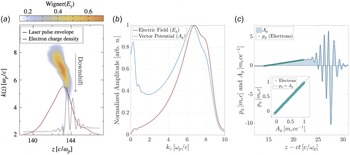
amid local pump depletion, enabling the plasma electrons to acquire transverse momentum in the nonlinear wakefield behind the main laser pulse. (a) Frequency of the laser electric field (envelope of
$A_y$
amid local pump depletion, enabling the plasma electrons to acquire transverse momentum in the nonlinear wakefield behind the main laser pulse. (a) Frequency of the laser electric field (envelope of $E_y$
in red) dropping at the leading edge (Wigner distribution of
$E_y$
in red) dropping at the leading edge (Wigner distribution of $E_y$
), which resides in a steep electron charge density spike (grey line). (b) Normalised amplitude of the low
$E_y$
), which resides in a steep electron charge density spike (grey line). (b) Normalised amplitude of the low $k$
-spectrum of the vector potential
$k$
-spectrum of the vector potential $A_y$
(blue line) surpassing that of the laser’s electric field
$A_y$
(blue line) surpassing that of the laser’s electric field $E_y = -\partial A_y/\partial t$
(red line). (c) Vector potential
$E_y = -\partial A_y/\partial t$
(red line). (c) Vector potential $A_y$
(blue line) exhibiting a long wavelength offset trailing the laser pulse (
$A_y$
(blue line) exhibiting a long wavelength offset trailing the laser pulse ( $(z-ct) \lesssim 25 \, c/\omega _p$
in the co-moving frame), where the electrons acquire transverse momentum, following canonical momentum conservation
$(z-ct) \lesssim 25 \, c/\omega _p$
in the co-moving frame), where the electrons acquire transverse momentum, following canonical momentum conservation $p_y = A_y$
(highlighted in the inset).
$p_y = A_y$
(highlighted in the inset).

Figure 1 illustrates how local pump depletion enables the plasma electrons to acquire transverse momentum in a nonlinear wakefield behind the main laser pulse. This process is driven by a localised frequency downshift at the high-intensity laser pulse front (figure 1 a), the formation of a long-wavelength offset in the laser’s vector potential (figure 1 b), which manipulates the electrons’ transverse momentum through canonical momentum conservation (figure 1 c).
The laser pulse front pushes electrons away from regions of high intensity, thereby modifying the refractive index through electron density modulation and relativistic mass increase,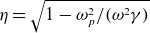 $\eta = \sqrt {1-\omega _p^2/(\omega ^2 \gamma )}$
, where
$\eta = \sqrt {1-\omega _p^2/(\omega ^2 \gamma )}$
, where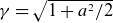 $\gamma = \sqrt {1+a^2/2}$
for a linearly polarised laser (Esarey et al. Reference Esarey, Sprangle, Krall and Ting1996). This interaction ensures that the laser front continuously encounters a positive gradient of the refractive index,
$\gamma = \sqrt {1+a^2/2}$
for a linearly polarised laser (Esarey et al. Reference Esarey, Sprangle, Krall and Ting1996). This interaction ensures that the laser front continuously encounters a positive gradient of the refractive index, $\partial \eta / \partial \xi$
, where
$\partial \eta / \partial \xi$
, where $\xi = t-z/c$
is the speed of light variable. As a result, the laser frequency (and thus the axial wavenumber
$\xi = t-z/c$
is the speed of light variable. As a result, the laser frequency (and thus the axial wavenumber $k_z$
) shifts down via phase modulation (Mendonça & Silva Reference Mendonça and Silva1994; Silva & Mendonça Reference Silva and Mendonça1998, Reference Silva and Mendonça2001), where the frequency change can be described by
$k_z$
) shifts down via phase modulation (Mendonça & Silva Reference Mendonça and Silva1994; Silva & Mendonça Reference Silva and Mendonça1998, Reference Silva and Mendonça2001), where the frequency change can be described by $ (1/\omega ) (\partial \omega /\partial t) = - (1/c) (\eta ^{-2}) (\partial \eta /\partial \xi )$
(Mori Reference Mori1997; Tsung et al. Reference Tsung, Ren, Silva, Mori and Katsouleas2002). The plasma frequency
$ (1/\omega ) (\partial \omega /\partial t) = - (1/c) (\eta ^{-2}) (\partial \eta /\partial \xi )$
(Mori Reference Mori1997; Tsung et al. Reference Tsung, Ren, Silva, Mori and Katsouleas2002). The plasma frequency $\omega _p$
marks the smallest frequency that can propagate. This localised frequency downshift is observable in the Wigner transform of the laser’s electric field
$\omega _p$
marks the smallest frequency that can propagate. This localised frequency downshift is observable in the Wigner transform of the laser’s electric field $E_y$
in figure 1(a). The position of the frequency downshift overlaps with the electron density spike (grey line) and the steepened leading edge of the laser pulse’s electric field (envelope in red line) (Silva & Mendonça, Reference Silva and Mendonça2001; Vieira et al. Reference Vieira, Fiúza, Silva, Tzoufras and Mori2010).
$E_y$
in figure 1(a). The position of the frequency downshift overlaps with the electron density spike (grey line) and the steepened leading edge of the laser pulse’s electric field (envelope in red line) (Silva & Mendonça, Reference Silva and Mendonça2001; Vieira et al. Reference Vieira, Fiúza, Silva, Tzoufras and Mori2010).
The frequency downshift manifests in an increase of the vector potential, which acquires a substantial long-wavelength offset while the electric field appears eroded (Bulanov et al. Reference Bulanov, Inovenkov, Kirsanov, Naumova and Sakharov1992; Decker et al. Reference Decker, Mori, Tzeng and Katsouleas1996; Tsung et al. Reference Tsung, Ren, Silva, Mori and Katsouleas2002). This is due to the conservation of the total wave action, $\mathcal{N} \sim \vert A_y \vert ^2 \omega = \text{constant}$
(Bulanov et al. Reference Bulanov, Inovenkov, Kirsanov, Naumova and Sakharov1992; Tsung et al. Reference Tsung, Ren, Silva, Mori and Katsouleas2002); the vector potential increases while the laser frequency decreases. As a result, the
$\mathcal{N} \sim \vert A_y \vert ^2 \omega = \text{constant}$
(Bulanov et al. Reference Bulanov, Inovenkov, Kirsanov, Naumova and Sakharov1992; Tsung et al. Reference Tsung, Ren, Silva, Mori and Katsouleas2002); the vector potential increases while the laser frequency decreases. As a result, the $k_z$
-spectrum of the vector potential
$k_z$
-spectrum of the vector potential $A_y$
is increased for low wavenumbers, peaking at a few of the plasma wavenumber
$A_y$
is increased for low wavenumbers, peaking at a few of the plasma wavenumber $k_p = \omega _p/c$
(see figure 1
b).
$k_p = \omega _p/c$
(see figure 1
b).
The longer wavelength components travel with a smaller group velocity, where the group velocity can be approximated by $v_g \simeq c (1 - \omega _p^2/(2\omega ^2))$
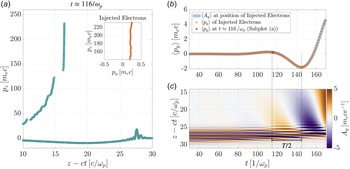
(Mori Reference Mori1997). Thus, in figure 1(c), we observe a long wavelength offset trailing the main part of the laser pulse. The finite vector potential behind the laser pulse gradually decreases until it vanishes at the back of the wakefield. The electrons (blue dots) acquire a finite transverse momentum
$v_g \simeq c (1 - \omega _p^2/(2\omega ^2))$
(Mori Reference Mori1997). Thus, in figure 1(c), we observe a long wavelength offset trailing the main part of the laser pulse. The finite vector potential behind the laser pulse gradually decreases until it vanishes at the back of the wakefield. The electrons (blue dots) acquire a finite transverse momentum $p_y=A_y$
, following the conservation of canonical momentum (see inset in figure 1
c).
$p_y=A_y$
, following the conservation of canonical momentum (see inset in figure 1
c).
This mechanism has been related to pulse compression (Silva & Mendonça Reference Silva and Mendonça1998; Tsung et al. Reference Tsung, Ren, Silva, Mori and Katsouleas2002; Gordon et al. Reference Gordon, Hafizi, Hubbard, Penano, Sprangle and Ting2003; Faure et al. Reference Faure, Glinec, Santos, Ewald, Rousseau, Kiselev, Pukhov, Hosokai and Malka2005) and proposed as a diagnostic for wakefields (Dias, Silva & Mendonça Reference Dias, Silva and Mendonça1998; Murphy et al. Reference Murphy2006; Shiraishi et al. Reference Shiraishi2013; Downer et al. Reference Downer, Zgadzaj, Debus, Schramm and Kaluza2018). In addition, the concept has been extended to explore the generation of mid-infrared to infrared pulses (Chen & Pukhov Reference Chen and Pukhov2015; Nie et al. Reference Nie2020; Pai et al. Reference Pai2010; Schreiber et al. Reference Schreiber, Bellei, Mangles, Kamperidis, Kneip, Nagel, Palmer, Rajeev, Streeter and Najmudin2010; Zhu et al. Reference Zhu, Palastro and Antonsen2012, Reference Zhu, Palastro and Antonsen2013; Zhu et al. Reference Zhu, Weng, Chen, Sheng and Zhang2020) and betatron-like radiation from energetic electrons (Lu et al. Reference Lu2021).
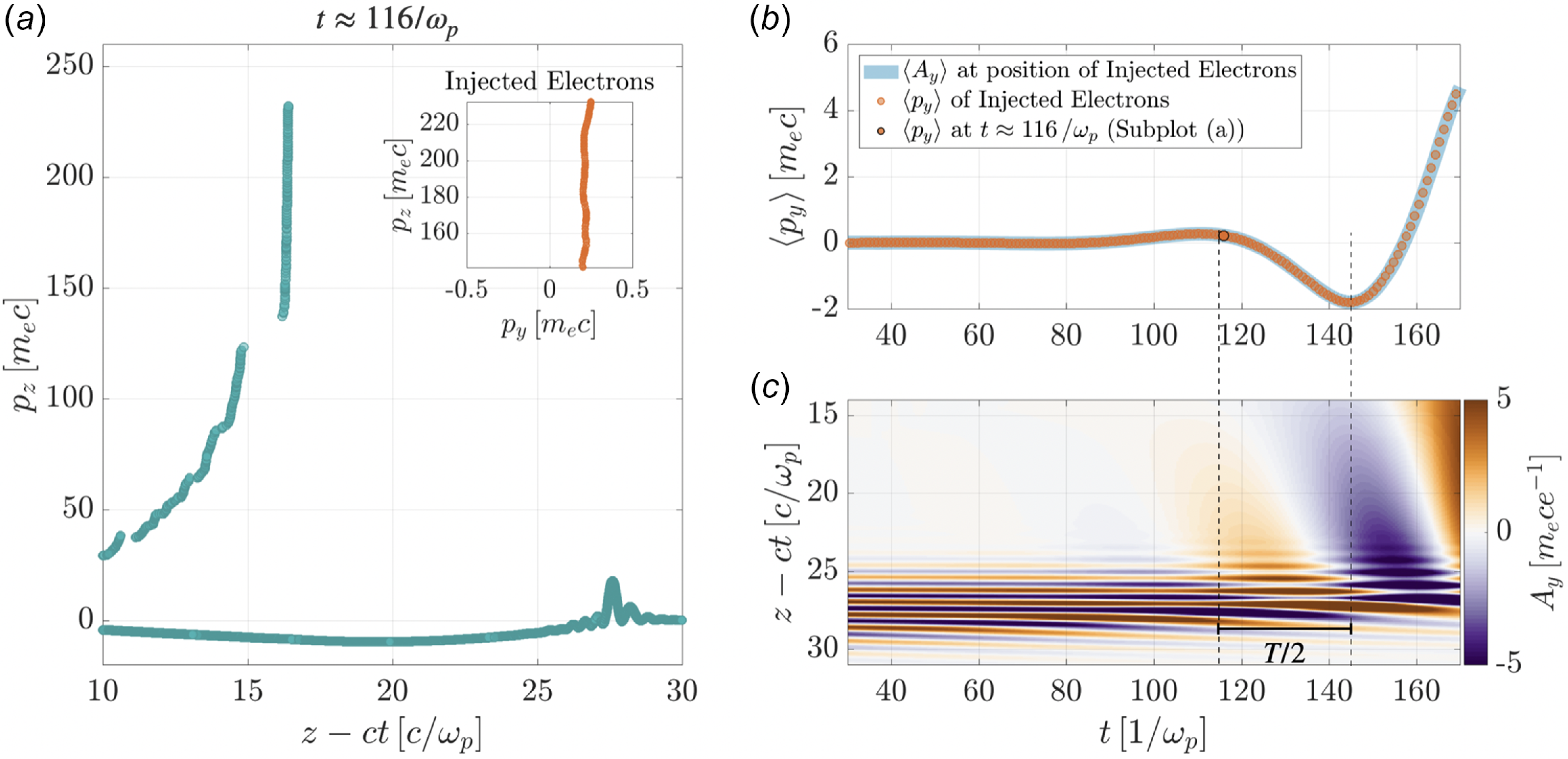
In this set-up, electrons can be efficiently accelerated due to the high accelerating gradients within the nonlinear wakefield, reaching gradients of GV m−1 (Esarey et al. Reference Esarey, Sprangle, Krall and Ting1996). Within short propagation distances and times, self-injected electrons become trapped in the wakefield and are accelerated to high energies ( ${\gtrsim}100 \, \text{MeV}$
). In figure 2(a), we demonstrate that in addition to their longitudinal acceleration, the high-energy electrons acquire transverse momentum. Specifically, the self-injected electrons with
${\gtrsim}100 \, \text{MeV}$
). In figure 2(a), we demonstrate that in addition to their longitudinal acceleration, the high-energy electrons acquire transverse momentum. Specifically, the self-injected electrons with $p_z \gtrsim 140 \, m_e c$
localised around the same axial position
$p_z \gtrsim 140 \, m_e c$
localised around the same axial position $(z-ct) \approx 16 \, c/\omega _p$
within the nonlinear wakefield all contain similar transverse momentum
$(z-ct) \approx 16 \, c/\omega _p$
within the nonlinear wakefield all contain similar transverse momentum $p_y \approx 0.25 \, m_e c$
(highlighted in the inset of figure 2
a).
$p_y \approx 0.25 \, m_e c$
(highlighted in the inset of figure 2
a).
Furthermore, during local pump depletion, the transverse momentum of the injected electrons oscillates with increasing magnitude (Nerush & Kostyukov Reference Nerush and Kostyukov2009), matching the long wavelength offset of the vector potential, as shown in figures 2(b) and 2(c). The oscillation period of the long-wavelength offset of the vector potential is closely linked to the etching velocity – the rate at which the laser’s leading edge erodes, defined as $ v_{\text{etch}} \approx c (\omega _p^2 / \omega _0^2$
) (Decker et al. Reference Decker, Mori, Tzeng and Katsouleas1996). The oscillation period can be approximated as
$ v_{\text{etch}} \approx c (\omega _p^2 / \omega _0^2$
) (Decker et al. Reference Decker, Mori, Tzeng and Katsouleas1996). The oscillation period can be approximated as $ T \sim \lambda / v_{\text{etch}}$
, where
$ T \sim \lambda / v_{\text{etch}}$
, where $ \lambda$
is the laser wavelength inside the plasma. In figure 2(c), we demonstrate an agreement between the oscillation of the long-wavelength offset and the erosion of the leading edge of the vector potential. The observed period of the oscillation, highlighted by dashed lines
$ \lambda$
is the laser wavelength inside the plasma. In figure 2(c), we demonstrate an agreement between the oscillation of the long-wavelength offset and the erosion of the leading edge of the vector potential. The observed period of the oscillation, highlighted by dashed lines $ T/2 \approx 25 / \omega _p$
, matches the theoretical estimate
$ T/2 \approx 25 / \omega _p$
, matches the theoretical estimate $ T/2 \approx (\lambda /2)\times \omega _0^2/(c \omega _p^2) \approx (\pi / 8) \times 64 / \omega _p \approx 25 / \omega _p$
.
$ T/2 \approx (\lambda /2)\times \omega _0^2/(c \omega _p^2) \approx (\pi / 8) \times 64 / \omega _p \approx 25 / \omega _p$
.
This section presents key results, demonstrating that the transverse momentum of plasma electrons is tuneable according to the laser’s polarisation and through the laser-to-plasma frequency ratio, which governs the gradual erosion of the laser’s leading edge. This enhances the control of plasma electron dynamics through the wide range of accessible laser polarisation states, e.g. linear, circular, radial, azimuthal and even spatially varying polarisation profiles.
One-dimensional OSIRIS simulations show self-injected electron transverse momentum oscillations in a nonlinear wakefield, with increasing magnitude and a period linked to the laser’s leading-edge erosion. (a) Electrons’ position, $z - ct$
in the co-moving frame and longitudinal momentum,
$z - ct$
in the co-moving frame and longitudinal momentum, $p_z$
, at time
$p_z$
, at time $\approx 116/\omega _p$
, showing high-energy electrons with
$\approx 116/\omega _p$
, showing high-energy electrons with $p_z \gt 140 \, m_e c$
concentrated at
$p_z \gt 140 \, m_e c$
concentrated at $(z-ct) \approx 16 \, c/\omega _p$
, with their transverse momentum around
$(z-ct) \approx 16 \, c/\omega _p$
, with their transverse momentum around $p_y \approx 0.25 \, m_e c$
, as highlighted in the inset (orange dots). (b) Time evolution of the mean transverse momentum of the high-energy electrons,
$p_y \approx 0.25 \, m_e c$
, as highlighted in the inset (orange dots). (b) Time evolution of the mean transverse momentum of the high-energy electrons, $\langle p_y \rangle$
, represented by orange dots, aligning well with the corresponding vector potential at their position,
$\langle p_y \rangle$
, represented by orange dots, aligning well with the corresponding vector potential at their position, $\langle A_y \rangle$
, shown as a blue line. The black-circled position corresponds to the time step of panel (a). (c) Time evolution of the vector potential
$\langle A_y \rangle$
, shown as a blue line. The black-circled position corresponds to the time step of panel (a). (c) Time evolution of the vector potential $A_y$
in the co-moving frame illustrating the erosion of the leading edge and the development of an oscillating long-wavelength offset. The oscillation half-period,
$A_y$
in the co-moving frame illustrating the erosion of the leading edge and the development of an oscillating long-wavelength offset. The oscillation half-period, $T/2 \approx 25/\omega _p$
, is highlighted by dashed lines, illustrating the connection between the erosion of the leading edge, the long-wavelength offset and the transverse momentum of the electrons shown in panel (b).
$T/2 \approx 25/\omega _p$
, is highlighted by dashed lines, illustrating the connection between the erosion of the leading edge, the long-wavelength offset and the transverse momentum of the electrons shown in panel (b).
3. Three-dimensional analysis of angular momentum gain of electrons
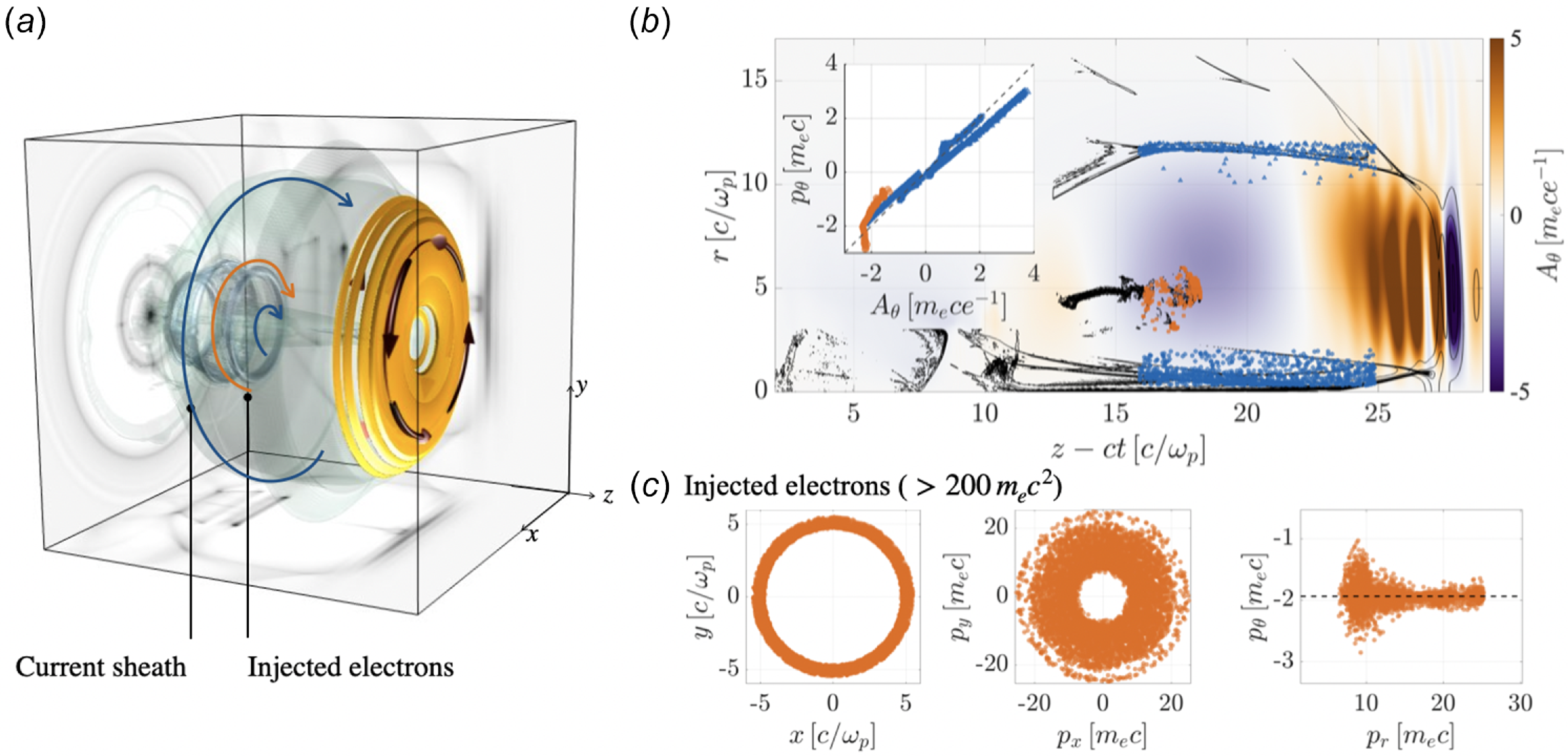
Building on our one-dimensional analysis, we extend our study to three dimensions, confirming the robustness of electron transverse momentum gain. In this context, we show that plasma electrons acquire angular momentum from a high-intensity azimuthally polarised laser pulse in underdense plasma, driving a nonlinear wakefield in the bubble regime (Pukhov & Meyer-ter Vehn Reference Pukhov and Meyer-ter Vehn2002). Figure 3 shows the angular momentum of electrons from the bubble’s current sheath and injected electrons.
We simulate an azimuthally polarised laser pulse with a dimensionless amplitude of $a_0 = 6$
, FWHM pulse duration
$a_0 = 6$
, FWHM pulse duration $\tau = 3 / \omega _p$
, a central frequency
$\tau = 3 / \omega _p$
, a central frequency $\omega _0 = 8 \, \omega _p$
and a laser spot size
$\omega _0 = 8 \, \omega _p$
and a laser spot size $w_0 = 5.5 \,c/\omega _p$
. Considering a wavelength of
$w_0 = 5.5 \,c/\omega _p$
. Considering a wavelength of $\lambda = 800$
nm, this corresponds to a laser with approximately
$\lambda = 800$
nm, this corresponds to a laser with approximately $600\, \text{mJ}$
,
$600\, \text{mJ}$
, $w_0 = 5.6 \, $
μm and with pulse duration
$w_0 = 5.6 \, $
μm and with pulse duration $\tau \approx 10$
fs propagating in a plasma with density
$\tau \approx 10$
fs propagating in a plasma with density $n_e = 2.7\times 10^{19}\,\text{cm}^{-3}$
. The simulation is performed in a moving window that travels at the speed of light
$n_e = 2.7\times 10^{19}\,\text{cm}^{-3}$
. The simulation is performed in a moving window that travels at the speed of light $c$
. The simulation box has the dimensions
$c$
. The simulation box has the dimensions $34\times 34\times 34 \, (c/\omega _p)^3$
, divided into
$34\times 34\times 34 \, (c/\omega _p)^3$
, divided into $1700\times 1700\times 1700$
cells and 4 particles per cell.
$1700\times 1700\times 1700$
cells and 4 particles per cell.
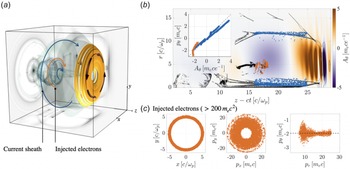
In figure 3(a), we present simulation results of an azimuthally polarised laser pulse driving a doughnut-shaped plasma bubble, reflecting the laser’s hollow intensity distribution (Vieira & Mendonça Reference Vieira and Mendonça2014). The electrons comprising the bubble and the self-injected electrons have angular momentum, as indicated by the arrows in blue and orange. Figure 3(b) shows the driver’s vector potential at $ t \approx 150 / \omega _p$
, undergoing local pump depletion and developing a substantial long-wavelength offset that remains confined within the bubble structure. The electrons from the inner and outer current sheaths (highlighted in blue) and the high-energy self-injected electrons (highlighted in orange) possess angular momentum in agreement with canonical momentum conservation,
$ t \approx 150 / \omega _p$
, undergoing local pump depletion and developing a substantial long-wavelength offset that remains confined within the bubble structure. The electrons from the inner and outer current sheaths (highlighted in blue) and the high-energy self-injected electrons (highlighted in orange) possess angular momentum in agreement with canonical momentum conservation, $ p_\theta = e A_\theta$
(see inset in figure 3
b). Here,
$ p_\theta = e A_\theta$
(see inset in figure 3
b). Here, $p_\theta = m_e \gamma r \dot \theta$
is the angular momentum, where
$p_\theta = m_e \gamma r \dot \theta$
is the angular momentum, where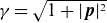 $\gamma = \sqrt {1 + \vert \boldsymbol{p} \vert ^2}$
is the relativistic factor,
$\gamma = \sqrt {1 + \vert \boldsymbol{p} \vert ^2}$
is the relativistic factor, $\dot \theta$
is the electron’s angular frequency and
$\dot \theta$
is the electron’s angular frequency and $A_\theta$
is the laser’s azimuthal vector potential at the position of the electrons (see more on angular momentum conservation in the Appendix). In figure 3(c), we highlight the high-energy (
$A_\theta$
is the laser’s azimuthal vector potential at the position of the electrons (see more on angular momentum conservation in the Appendix). In figure 3(c), we highlight the high-energy ( $ {\gt} 200 \, m_e c^2$
) self-injected electrons, forming a ring structure in physical and transverse momentum space. The electrons carry a well-defined angular momentum, with a mean value of
$ {\gt} 200 \, m_e c^2$
) self-injected electrons, forming a ring structure in physical and transverse momentum space. The electrons carry a well-defined angular momentum, with a mean value of $ \langle p_\theta \rangle \approx -2 m_e c$
. The total charge of these high-energy electrons is
$ \langle p_\theta \rangle \approx -2 m_e c$
. The total charge of these high-energy electrons is $ {\approx} 212 \, \mathrm{pC}$
.
$ {\approx} 212 \, \mathrm{pC}$
.
Three-dimensional OSIRIS simulation results at $ t \approx 150/\omega _p$
illustrate the angular momentum gain of plasma electrons in a nonlinear wakefield, driven by an azimuthally polarised laser pulse – facilitated by the development of a long-wavelength offset in the laser’s azimuthal vector potential due to local pump depletion. (a) Hollow intensity laser pulse (orange isosurfaces) with azimuthal polarisation (black arrows) driving a doughnut-shaped nonlinear wakefield in the bubble regime (grey isosurfaces). Projections show the spatial distribution of the electron charge density, highlighting increased density at the laser pulse front. The blue and orange arrows indicate the direction of rotation of the electrons belonging to the electron sheath comprising the doughnut-shaped bubble (blue) and the injected electrons inside the bubble (orange). The illustrated box dimensions are
$ t \approx 150/\omega _p$
illustrate the angular momentum gain of plasma electrons in a nonlinear wakefield, driven by an azimuthally polarised laser pulse – facilitated by the development of a long-wavelength offset in the laser’s azimuthal vector potential due to local pump depletion. (a) Hollow intensity laser pulse (orange isosurfaces) with azimuthal polarisation (black arrows) driving a doughnut-shaped nonlinear wakefield in the bubble regime (grey isosurfaces). Projections show the spatial distribution of the electron charge density, highlighting increased density at the laser pulse front. The blue and orange arrows indicate the direction of rotation of the electrons belonging to the electron sheath comprising the doughnut-shaped bubble (blue) and the injected electrons inside the bubble (orange). The illustrated box dimensions are $ 20 \times 20 \times 20 \, (c/\omega _p)^3$
. (b) Vector potential
$ 20 \times 20 \times 20 \, (c/\omega _p)^3$
. (b) Vector potential $ A_\theta$
(yellow–purple colourmap) exhibits a long-wavelength offset trailing the laser pulse (
$ A_\theta$
(yellow–purple colourmap) exhibits a long-wavelength offset trailing the laser pulse ( $ z \lesssim 25 \, c/\omega _p$
). Electrons in the inner and outer current sheaths (blue dots) and the self-injected electrons (orange dots) acquire azimuthal momentum following canonical momentum conservation,
$ z \lesssim 25 \, c/\omega _p$
). Electrons in the inner and outer current sheaths (blue dots) and the self-injected electrons (orange dots) acquire azimuthal momentum following canonical momentum conservation, $ p_\theta = A_\theta$
, (see inset). (c) High-energy (
$ p_\theta = A_\theta$
, (see inset). (c) High-energy ( ${\gt}200 \, m_e c^2$
) injected electrons form a ring in both configuration and transverse momentum space, exhibiting a well-defined angular momentum with a mean value of
${\gt}200 \, m_e c^2$
) injected electrons form a ring in both configuration and transverse momentum space, exhibiting a well-defined angular momentum with a mean value of $\langle p_\theta \rangle \approx -2 m_e c$
(dashed line).
$\langle p_\theta \rangle \approx -2 m_e c$
(dashed line).
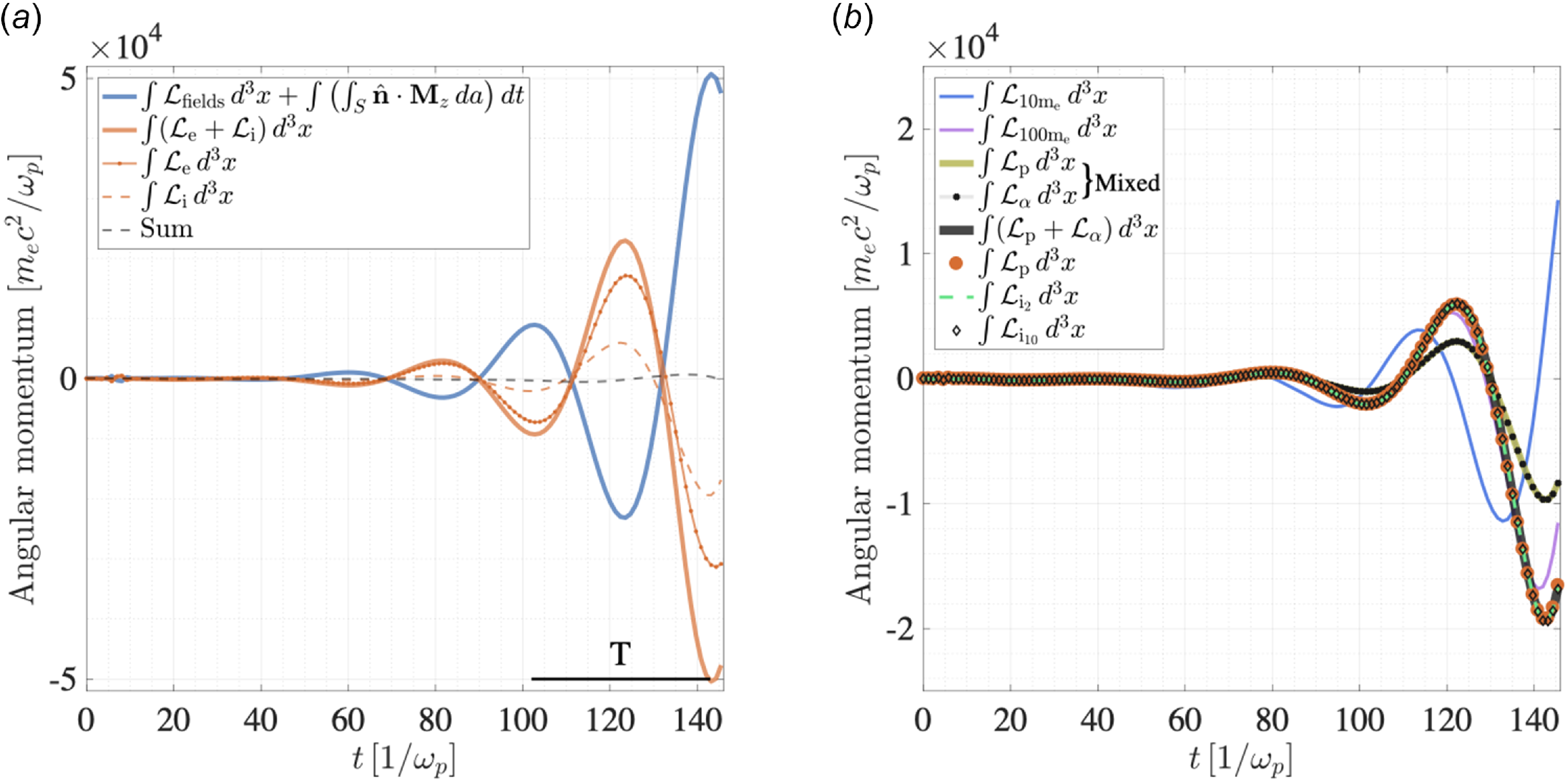
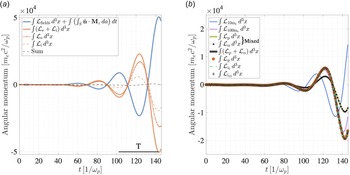
Three-dimensional OSIRIS simulation results showing the evolution of angular momentum components, as defined in (3.1). (a) Angular momentum gained by the plasma electrons and ions (orange line) is compensated by that of the combined wakefield and laser fields (blue line). Individual contributions from electrons and ions are indicated in orange by crosses and a dashed line. The horizontal black line labelled ‘T’ indicates the oscillation period. (b) Angular momentum acquired by protons and heavier ions is independent of their mass. This trend deviates for lighter species, as their motion influences local pump depletion and wakefield formation. We compare positively charged species with ten (blue line) and one hundred (purple line) times the electron mass, a mixed gas of protons (green line) and alpha particles (grey-dotted) and their sum (black line), protons (orange-dotted), ions with twice the proton mass (green dashed line), and ions with ten times the proton mass (black diamonds).
Consistent with angular momentum conservation, the angular momentum gained by the plasma electrons is compensated by the ions and by the combined electromagnetic fields of the laser and the nonlinear plasma wave. To show this, we consider the integral form of the angular momentum conservation law for a closed system, without particle loss, given by (Jackson Reference Jackson1998)
 \begin{equation} \int _V \left ( \mathcal{L}_{\mathrm{mech}} + \mathcal{L}_{\mathrm{field}} \right ) \, \text{d}^3x + \int \left ( \int _S \hat {n} \boldsymbol{\cdot }\boldsymbol{M} \, \text{d}a \right ) \,\text{d}t = 0, \end{equation}
where $ \mathcal{L}_{\mathrm{mech}} = n_e \boldsymbol{r} \times \boldsymbol{p_e} + n_i \boldsymbol{r} \times \boldsymbol{p_i}$
is the mechanical angular momentum density of the electrons and ions, and
$ \mathcal{L}_{\mathrm{mech}} = n_e \boldsymbol{r} \times \boldsymbol{p_e} + n_i \boldsymbol{r} \times \boldsymbol{p_i}$
is the mechanical angular momentum density of the electrons and ions, and $ \mathcal{L}_{\mathrm{field}} = 1/(4 \pi c) \boldsymbol{r} \times (\boldsymbol{E} \times \boldsymbol{B})$
represents the angular momentum density carried by the fields. Here, the electric and magnetic fields are the combined wakefields and laser fields. The term
$ \mathcal{L}_{\mathrm{field}} = 1/(4 \pi c) \boldsymbol{r} \times (\boldsymbol{E} \times \boldsymbol{B})$
represents the angular momentum density carried by the fields. Here, the electric and magnetic fields are the combined wakefields and laser fields. The term $ \boldsymbol{M} = \boldsymbol{r} \times \boldsymbol{T}$
stands for the angular momentum flux, with
$ \boldsymbol{M} = \boldsymbol{r} \times \boldsymbol{T}$
stands for the angular momentum flux, with $ \boldsymbol{T}$
being the Maxwell stress tensor normal to the closed surface
$ \boldsymbol{T}$
being the Maxwell stress tensor normal to the closed surface $S$
.
$S$
.
Figure 4(a) illustrates the individual and combined angular momentum contributions from the electrons, the ions and the electromagnetic fields, as expressed in (3.1) (see supplementary movie 1 available at https://doi.org/10.1017/S0022377825101062 for the full evolution). The mechanical angular momentum of the electrons and ions is balanced by the angular momentum of the electromagnetic fields. The electrons’ angular momentum exceeds that of the ions, which can be attributed to electron accumulation in regions of enhanced vector potential, where they naturally acquire more angular momentum. Figure 4(b) shows that the angular momentum acquired by ions is mass independent, consistent with canonical momentum conservation, $p_\theta = -e A_\theta$
. This is evident from the overlapping curves for the protons, the heavier ions and the proton–alpha mixture, with the mixture’s angular momentum dividing evenly between the two species. Only the curves for the lighter positively charged species (
$p_\theta = -e A_\theta$
. This is evident from the overlapping curves for the protons, the heavier ions and the proton–alpha mixture, with the mixture’s angular momentum dividing evenly between the two species. Only the curves for the lighter positively charged species ( $10\,m_e$
and
$10\,m_e$
and $100\,m_e$
) deviate from this trend, as their motion influences local pump depletion and wakefield formation. The period of the angular momentum oscillation can be approximated as
$100\,m_e$
) deviate from this trend, as their motion influences local pump depletion and wakefield formation. The period of the angular momentum oscillation can be approximated as $ T \sim \lambda / v_{\text{etch}}$
, similar to the one-dimensional discussion around figures 2(b) and 2(c). To our knowledge, this is the first quantitative verification of angular momentum conservation in a PIC simulation.
$ T \sim \lambda / v_{\text{etch}}$
, similar to the one-dimensional discussion around figures 2(b) and 2(c). To our knowledge, this is the first quantitative verification of angular momentum conservation in a PIC simulation.
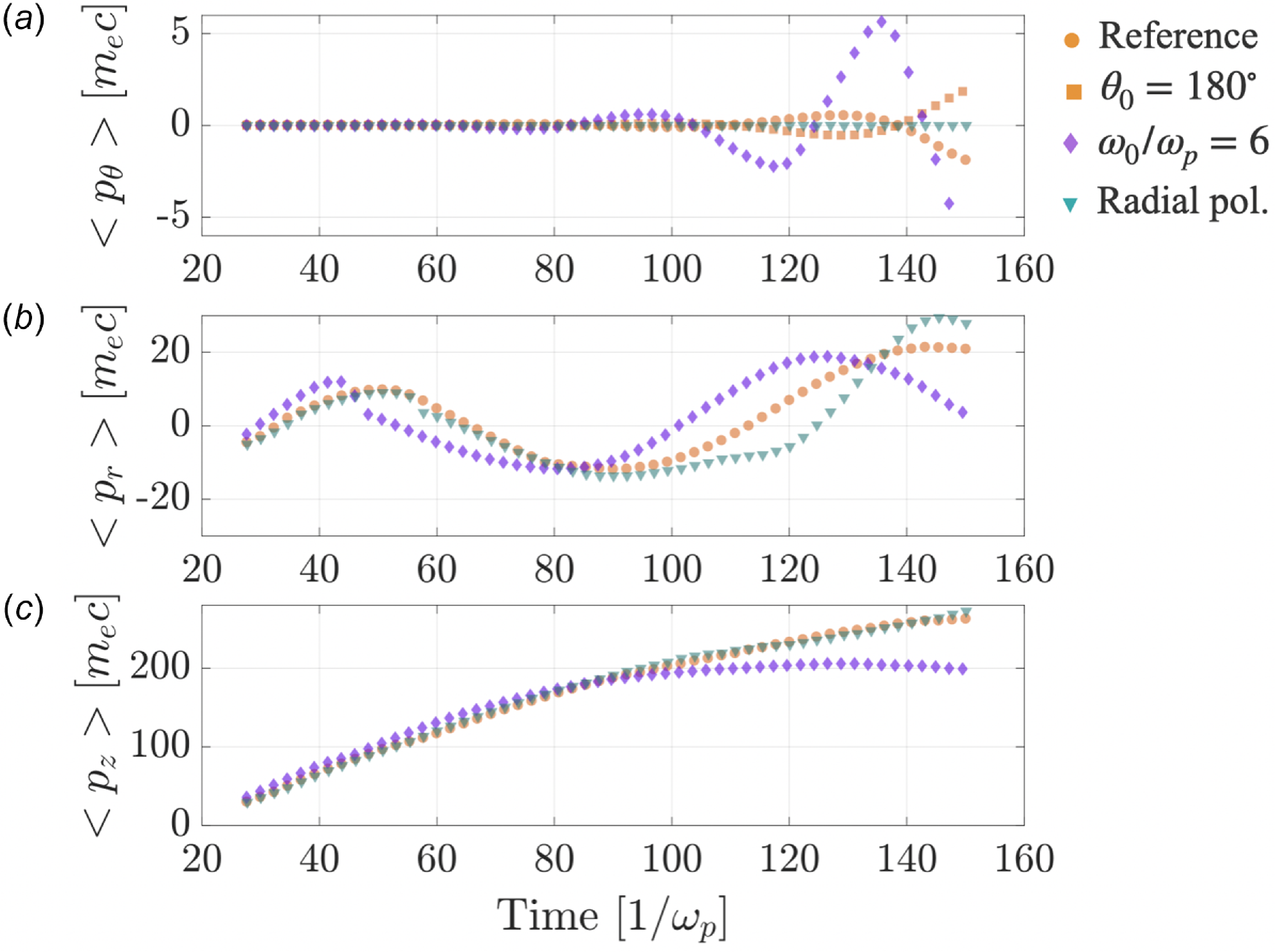
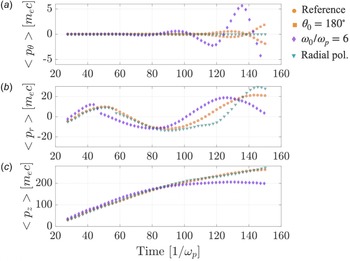
Three-dimensional OSIRIS simulation results demonstrate how adjustments of laser parameters allow for the control of angular (transverse) momentum of high-energy electrons ( ${\gt}80\,\%$
of the maximum energy) under local pump depletion. (a)–(c) Time evolution of the (a) mean azimuthal momentum
${\gt}80\,\%$
of the maximum energy) under local pump depletion. (a)–(c) Time evolution of the (a) mean azimuthal momentum $ \langle p_\theta \rangle$
, (b) mean radial momentum
$ \langle p_\theta \rangle$
, (b) mean radial momentum $ \langle p_r \rangle$
and (c) mean longitudinal momentum
$ \langle p_r \rangle$
and (c) mean longitudinal momentum $ \langle p_z \rangle$
for different laser and plasma parameters. Orange dots correspond to the reference case with
$ \langle p_z \rangle$
for different laser and plasma parameters. Orange dots correspond to the reference case with $\theta _0 = 0$
,
$\theta _0 = 0$
, $\omega _0/\omega _p = 8$
and azimuthal polarisation; orange squares correspond to a change in the initial laser phase,
$\omega _0/\omega _p = 8$
and azimuthal polarisation; orange squares correspond to a change in the initial laser phase, $ \theta _0 = 180^\circ$
; purple diamonds represent a change in the laser-to-plasma frequency ratio,
$ \theta _0 = 180^\circ$
; purple diamonds represent a change in the laser-to-plasma frequency ratio, $ \omega _0 / \omega _p = 6$
; and blue triangles illustrate the transition to radial polarisation. Note that the phase change affects only
$ \omega _0 / \omega _p = 6$
; and blue triangles illustrate the transition to radial polarisation. Note that the phase change affects only $p_\theta$
, such that the points overlap in panels (b) and (c).
$p_\theta$
, such that the points overlap in panels (b) and (c).
The mechanism is robust and tuneable, primarily governed by the laser-to-plasma frequency ratio and the laser intensity, which must be sufficiently high ( $ a_0 \gt 3$
, Tsung et al. Reference Tsung, Ren, Silva, Mori and Katsouleas2002) for local pump depletion to occur. Other influencing factors include the laser phase, polarisation, chirp and pulse duration.
$ a_0 \gt 3$
, Tsung et al. Reference Tsung, Ren, Silva, Mori and Katsouleas2002) for local pump depletion to occur. Other influencing factors include the laser phase, polarisation, chirp and pulse duration.
Figure 5 shows a parameter scan on the tunability of angular (transverse) momentum under local pump depletion, focusing on the momentum space evolution of self-injected high-energy electrons. We examine the effect of three key parameters on the high-energy electrons ( ${\gt}80\,\%$
of the maximum energy) – the initial phase of the laser, which we vary from
${\gt}80\,\%$
of the maximum energy) – the initial phase of the laser, which we vary from $ \theta _0 = 0^\circ$
to
$ \theta _0 = 0^\circ$
to $ 180^\circ$
(depicted by orange squares in figure 5), the laser-to-plasma frequency ratio, which we vary from
$ 180^\circ$
(depicted by orange squares in figure 5), the laser-to-plasma frequency ratio, which we vary from $ \omega _0 / \omega _p = 8$
to
$ \omega _0 / \omega _p = 8$
to $ 6$
(depicted by purple diamonds), and the laser polarisation where we change from azimuthal to radial polarisation (depicted by blue triangles). Radial polarisation is composed as
$ 6$
(depicted by purple diamonds), and the laser polarisation where we change from azimuthal to radial polarisation (depicted by blue triangles). Radial polarisation is composed as $ \text{TEM}_{01 (x)} \hat {e}_x + \text{TEM}_{01 (y)} \hat {e}_y$
(Nesterov & Niziev Reference Nesterov and Niziev2000; Oron et al. Reference Oron, Blit, Davidson, Friesem, Bomzon and Hasman2000).
$ \text{TEM}_{01 (x)} \hat {e}_x + \text{TEM}_{01 (y)} \hat {e}_y$
(Nesterov & Niziev Reference Nesterov and Niziev2000; Oron et al. Reference Oron, Blit, Davidson, Friesem, Bomzon and Hasman2000).
Figure 5(a) shows the evolution of the mean electron angular momentum $ \langle p_\theta \rangle$
, which exhibits oscillations with increasing amplitude, consistent with the etching-driven dynamics discussed around figures 2 and 4. Given the multidimensional structure and transverse focusing fields, the electrons also undergo betatron oscillations with a frequency
$ \langle p_\theta \rangle$
, which exhibits oscillations with increasing amplitude, consistent with the etching-driven dynamics discussed around figures 2 and 4. Given the multidimensional structure and transverse focusing fields, the electrons also undergo betatron oscillations with a frequency $ \omega _\beta = \omega _p / \sqrt {2 \gamma }$
(Tajima & Dawson Reference Tajima and Dawson1979; Esarey, Schroeder & Leemans Reference Esarey, Schroeder and Leemans2009), as observed in the radial momentum
$ \omega _\beta = \omega _p / \sqrt {2 \gamma }$
(Tajima & Dawson Reference Tajima and Dawson1979; Esarey, Schroeder & Leemans Reference Esarey, Schroeder and Leemans2009), as observed in the radial momentum $ \langle p_r \rangle$
in figure 5(b). The longitudinal momentum
$ \langle p_r \rangle$
in figure 5(b). The longitudinal momentum $ \langle p_z \rangle$
increases steadily before eventually saturating, as shown in figure 5(c). Adjustments to laser parameters influence the polarity, magnitude and distribution of angular (transverse) momentum of the injected electrons. In figure 5(a), we see that varying the laser’s initial phase influences the polarity of the angular momentum
$ \langle p_z \rangle$
increases steadily before eventually saturating, as shown in figure 5(c). Adjustments to laser parameters influence the polarity, magnitude and distribution of angular (transverse) momentum of the injected electrons. In figure 5(a), we see that varying the laser’s initial phase influences the polarity of the angular momentum $ \langle p_\theta \rangle$
, but has no influence on the radial and axial momentum. Reducing the laser-to-plasma frequency ratio impacts the oscillation period and magnitude of the angular momentum, due to the increased etching velocity
$ \langle p_\theta \rangle$
, but has no influence on the radial and axial momentum. Reducing the laser-to-plasma frequency ratio impacts the oscillation period and magnitude of the angular momentum, due to the increased etching velocity $ v_{\text{etch}} \approx c(\omega _p^2 / \omega _0^2)$
. It also allows for increased angular momentum, but the longitudinal momentum saturates more quickly. This can be seen in figure 5(c). However, radial polarisation does not lead to the angular motion, but introduces significant modifications to the radial momentum
$ v_{\text{etch}} \approx c(\omega _p^2 / \omega _0^2)$
. It also allows for increased angular momentum, but the longitudinal momentum saturates more quickly. This can be seen in figure 5(c). However, radial polarisation does not lead to the angular motion, but introduces significant modifications to the radial momentum $ \langle p_r \rangle$
, adding a distinct modulation on top of the betatron oscillations, which becomes prominent as pump depletion progresses (
$ \langle p_r \rangle$
, adding a distinct modulation on top of the betatron oscillations, which becomes prominent as pump depletion progresses ( $ t \gt 120/\omega _p$
), as shown in figure 5(b). Experimental diagnostics of this mechanism could rely on the rotating high-energy electrons, which emit betatron radiation with spatial or polarisation features that reflect their angular momentum (Luís Martins et al. Reference Luís Martins, Vieira, Ferri and Fülöp2019). While this effect was not modelled in our simulations, the resulting X-rays could be measured using standard betatron radiation diagnostics (Phuoc et al. Reference Phuoc, Corde, Shah, Albert, Fitour, Rousseau, Burgy, Mercier and Rousse2006; Corde et al. Reference Corde, Thaury, Lifschitz, Lambert, Ta Phuoc, Davoine, Lehe, Douillet, Rousse and Malka2013; Thaury et al. Reference Thaury, Guillaume, Corde, Lehe, Le Bouteiller, Ta Phuoc, Davoine, Rax, Rousse and Malka2013).
$ t \gt 120/\omega _p$
), as shown in figure 5(b). Experimental diagnostics of this mechanism could rely on the rotating high-energy electrons, which emit betatron radiation with spatial or polarisation features that reflect their angular momentum (Luís Martins et al. Reference Luís Martins, Vieira, Ferri and Fülöp2019). While this effect was not modelled in our simulations, the resulting X-rays could be measured using standard betatron radiation diagnostics (Phuoc et al. Reference Phuoc, Corde, Shah, Albert, Fitour, Rousseau, Burgy, Mercier and Rousse2006; Corde et al. Reference Corde, Thaury, Lifschitz, Lambert, Ta Phuoc, Davoine, Lehe, Douillet, Rousse and Malka2013; Thaury et al. Reference Thaury, Guillaume, Corde, Lehe, Le Bouteiller, Ta Phuoc, Davoine, Rax, Rousse and Malka2013).
Additionally, the electromagnetic field structure from the downshifted azimuthally polarised laser fields, particularly $ E_\theta$
,
$ E_\theta$
, $ B_r$
and
$ B_r$
and $ B_z$
, inside the bubble is orthogonal to that of conventional wakefields, offering a measurable signature, for example, via electron probing (Zhang et al. Reference Zhang2016; Raj et al. Reference Raj2020; Wan et al. Reference Wan, Tata, Seemann, Levine, Kroupp and Malka2024).
$ B_z$
, inside the bubble is orthogonal to that of conventional wakefields, offering a measurable signature, for example, via electron probing (Zhang et al. Reference Zhang2016; Raj et al. Reference Raj2020; Wan et al. Reference Wan, Tata, Seemann, Levine, Kroupp and Malka2024).
4. Conclusions
In conclusion, we demonstrated that plasma electrons and ions can acquire substantial angular momentum via canonical momentum conservation, driven by a high-intensity azimuthally polarised laser pulse undergoing local pump depletion in underdense plasma. Through a combination of analytical considerations and particle-in-cell simulations, we explored the mechanism of transverse momentum gain of electrons in one-dimensional scenarios and extended our analysis to three dimensions, obtaining consistent results. This mechanism relies on local pump depletion of the laser pulse, which facilitates the development of a long-wavelength offset in the vector potential trailing the pulse. This offset enables the rotation of the wakefield’s sheath currents and the self-injected electrons. The highest-energy electrons exhibit angular momentum with a small spread and undergo characteristic oscillations linked to the erosion of the laser pulse front. We found that the angular momentum gained by the electrons is compensated by that of the ions and the combined fields of the laser and the nonlinear plasma wave. Finally, we highlighted the controllability of angular and transverse momentum gain under local pump depletion by varying key laser parameters, including the initial phase, laser-to-plasma frequency ratio and polarisation. A more systematic parametric study, including variations in laser pulse shape and intensity, and electron density, would help further characterise the robustness and scaling of this mechanism regarding potential experimental realisation, and is left for future work.
Future work will also aim to test the limits of this scheme, explore exotic laser polarisations, investigate radiation emitted by high-energy electrons and incorporate ionisation effects. Finally, the presented mechanism potentially impacts set-ups involving lasers with angular momentum, such as circularly polarised Gaussian and Laguerre–Gaussian beams, which merits further investigation.
Acknowledgements
We would like to acknowledge the anonymous reviewer for their valuable and constructive comments, which helped us to improve the quality of this work. The authors used AI tools to assist with copy editing (improvements on readability and style, and to ensure that the texts are free of errors in grammar, spelling and punctuation).
Editor Victor Malka thanks the referees for their advice in evaluating this article.
Funding
We gratefully acknowledge EuroHPC for awarding us access to LUMI-C at CSC (Finland) and FCT (Portugal) for access to Marenostrum V at the Barcelona Supercomputer Center [https://doi.org/10.54499/2024.06987.CPCA.A3]. This work was supported by the EuPRAXIA-PP under grant agreement No. 101079773 and FCT under the projects No. X-MASER-2022.02230. PTDC [https://doi.org/10.54499/2022.02230.PTDC], UID/FIS/50010/2025 [https://doi.org/10.54499/UID/50010/2025], and IPFN-CEEC-INST-LA3/IST-ID [https://doi.org/10.54499/LA/P/0061/2020]. This work was also supported by la Caixa' Foundation (ID 100010434), under fellowship code LCF/BQ/DI19/11730025.
Supplementary movie
Supplementary movie is available at https://doi.org/10.1017/S0022377825101062.
Declaration of interests
The authors report no conflict of interest.
Appendix. Angular momentum conservation
The Lagrangian for an electron in an electromagnetic wave in a wakefield can be written as (Jackson Reference Jackson1998)
 \begin{equation} L = -m_e c^2 \left (1 - \frac {\boldsymbol{v} \boldsymbol{\cdot }\boldsymbol{v}}{c^2} \right )^{1/2} + \frac {e}{c} \boldsymbol{v} \boldsymbol{\cdot }\boldsymbol{A} - e \phi , \end{equation}
where $\boldsymbol{v}$
is the velocity vector,
$\boldsymbol{v}$
is the velocity vector, $c$
is the speed of light,
$c$
is the speed of light, $\boldsymbol{A}$
is the laser’s vector potential,
$\boldsymbol{A}$
is the laser’s vector potential, $\phi$
is the scalar potential (here, the wakefield potential), and
$\phi$
is the scalar potential (here, the wakefield potential), and $m_e, e$
are the electron’s mass and charge, respectively. Our system is cylindrically symmetric and, for this purpose, we write the Lagrangian in cylindrical coordinates as
$m_e, e$
are the electron’s mass and charge, respectively. Our system is cylindrically symmetric and, for this purpose, we write the Lagrangian in cylindrical coordinates as
 \begin{equation} L = -m_e c^2 \left ( 1-\frac {\dot z^2}{c^2}-\frac {r^2 \dot \theta ^2}{c^2}-\frac {\dot r^2}{c^2}\right )^{1/2} - e \left ( \dot z A_z + r \dot \theta A_\theta + \dot r A_r \right ) + e \phi , \end{equation}
where $\dot z = dz/dt$
is the axial velocity,
$\dot z = dz/dt$
is the axial velocity, $\dot \theta = d\theta /dt$
is the angular velocity and
$\dot \theta = d\theta /dt$
is the angular velocity and $\dot r = dr/dt$
is the radial velocity. To determine whether angular momentum is conserved in this system, we calculate the generalised angular momentum
$\dot r = dr/dt$
is the radial velocity. To determine whether angular momentum is conserved in this system, we calculate the generalised angular momentum
 \begin{equation} P_\theta = \frac {\partial L}{\partial \dot \theta } = m_e \gamma r^2 \dot \theta -e A_\theta r, \end{equation}
where $\gamma = 1/\sqrt {1-(\dot z^2 + r^2 \dot \theta ^2 + \dot r^2)/c^2}$
. Here,
$\gamma = 1/\sqrt {1-(\dot z^2 + r^2 \dot \theta ^2 + \dot r^2)/c^2}$
. Here, $ m_e \gamma r \dot \theta = p_\theta$
is the azimuthal momentum and there is no angular velocity dependence on the wakefield potential, i.e.
$ m_e \gamma r \dot \theta = p_\theta$
is the azimuthal momentum and there is no angular velocity dependence on the wakefield potential, i.e. $\partial \phi /\partial \dot \theta = 0$
. The generalised angular momentum is conserved when the Hamiltonian, given by
$\partial \phi /\partial \dot \theta = 0$
. The generalised angular momentum is conserved when the Hamiltonian, given by
 \begin{equation} H = \sqrt {\left (c \boldsymbol{P} - e \boldsymbol{A} \right )^2 + m_e^2 c^4} + e\phi , \end{equation}
has no angular dependence, i.e.
 \begin{equation} \frac {{\rm d} P_\theta }{{\rm d}t} = -\frac {\partial H}{\partial \theta } = 0. \end{equation}
This results in $P_\theta = 0$
, because there is no initial angular momentum in the system, such that
$P_\theta = 0$
, because there is no initial angular momentum in the system, such that $p_\theta = e A_\theta$
.
$p_\theta = e A_\theta$
.
This condition holds for a cylindrical vector beam with azimuthal polarisation, where the laser pulse has no angular dependence and the vector potential has only an azimuthal component, $\boldsymbol{A} = A_\theta (r,z) \hat {e}_\theta$
, where at focus,
$\boldsymbol{A} = A_\theta (r,z) \hat {e}_\theta$
, where at focus, $A(r,0)_\theta = a_0 (r/w_0) \exp (-r^2/w_0^2)$
. In this case, plasma electrons can only acquire angular momentum through canonical momentum conservation,
$A(r,0)_\theta = a_0 (r/w_0) \exp (-r^2/w_0^2)$
. In this case, plasma electrons can only acquire angular momentum through canonical momentum conservation, $p_\theta = e A_\theta$
.
$p_\theta = e A_\theta$
.








 Open access

