





Childhood obesity is a worldwide health issue that disproportionally affects certain ethnic groups(Reference Swinburn, Sacks and Hall1), and its prevalence in Asian is rising(2). In China, childhood overweight prevalence increased from 11·7 % to 25·2 % and obesity prevalence increased from 2·8 % to 10·1 % from 1991 to 2011(Reference Jia, Xue and Zhang3). The overall rate of overweight and obesity among children in China is lower than that of Western countries, but the rate of increase over the last 30 years has not been slower in China(Reference Zhang and Ma4).
Parental feeding practices may influence the eating habits of young children, and thus appropriate feeding strategies are critical to prevent and control childhood obesity(Reference Golan and Crow5,Reference Moore, Tapper and Murphy6) . Feeding practices refer to specific practices or strategies that parents employ to manage what, when and how much their children eat and shape their children’s eating patterns(Reference Boots, Tiggemann and Corsini7–Reference Vaughn, Tabak and Bryant9). Several feeding practices, such as applying pressure to eat, restricting food, monitoring consumption and using food as a reward(Reference Vaughn, Tabak and Bryant9), have been most frequently studied(Reference Harris, Mallan and Nambiar10–Reference Stang and Loth13).
Many studies have identified factors related to feeding practices(Reference de Souza Rezende, Bellotto de Moraes and Mais14–Reference Warkentin, Mais and Latorre18). Among these factors, child weight has been an important factor(Reference de Souza Rezende, Bellotto de Moraes and Mais14,Reference Powers, Chamberlin and van Schaick16–Reference Warkentin, Mais and Latorre18) . Longitudinal studies indicated that mothers of children with higher BMI Z-scores were more likely to apply restrictive feeding practices(Reference Eichler, Schmidt and Poulain19–Reference Quah, Ng and Fries21) and monitor their children’s diet(Reference Eichler, Schmidt and Poulain19) and less likely to apply pressure to eat(Reference Eichler, Schmidt and Poulain19,Reference Quah, Ng and Fries21) than mothers of children with lower BMI Z-scores. However, it has been reported that parental perception of and concern about child weight (weight perception and weight concern) rather than actual child weight are associated with parental feeding practices(Reference Gregory, Paxton and Brozovic22–Reference Yilmaz, Erkorkmaz and Ozcetin25). For instance, Payne et al. (Reference Payne, Galloway and Webb24) found that parents who were highly concerned about their child’s weight were more likely to use restrictive feeding than parents with lower levels of concern, while there was no significant association between child weight and feeding practices. Yilmaz et al. (Reference Yilmaz, Erkorkmaz and Ozcetin25) found that parents were less likely to encourage their children to eat if they perceived them as overweight than if they perceived them as normal weight or underweight. In comparison, Freitas et al. (Reference Freitas, Moraes and Warkentin26) recently reported that maternal restrictive feeding practices were independently associated with mothers’ weight perception and concern as well as their child’s weight status. Overall, current evidence of the relationships between maternal weight perception and concern, actual child weight, and maternal feeding practices has been inconsistent. The inconsistent findings might be due to differences in factors included in the analyses (especially weight-related variables). Some studies did not examine maternal weight perception and/or weight concern and accordingly discovered only correlations between maternal feeding practices and child weight(Reference Powers, Chamberlin and van Schaick16,Reference Brann and Skinner27) . Other studies performed univariate analyses to investigate associations between factors of interest and parental feeding practices(Reference Powers, Chamberlin and van Schaick16,Reference Yilmaz, Erkorkmaz and Ozcetin25,Reference Lydecker and Grilo28,Reference Payas, Budd and Polansky29) .
The above evidence is mainly from developed countries. The relationships between feeding practices, maternal weight perception and child weight may be very different between developed and developing countries given the differences in feeding cultures and beliefs. In developing countries (e.g. China) or low social economic settings(Reference Black, Park and Gregson30), parents do not often perceive overweight or obesity as a health issue(Reference Doolen, Alpert and Miller31,Reference Rietmeijer-Mentink, Paulis and van Middelkoop32) . Notably, most families only have one child due to the One-Child Policy in China(Reference Feng, Poston and Wang33). Chinese caregivers (parents/grandparents) tend to overfeed their children or feed them with energy-dense food as they believe that higher weight indicates better health(Reference Zhou, Cheah and Van Hook34,Reference Li, Adab and Cheng35) . They have the tendency to use food as a symbol for their love for their children, or as an educational and emotional tool for shaping their children’s behaviours(Reference Jiang, Rosenqvist and Wang36). Since parental feeding practices carry cultural variations, there is a need to examine the correlations in the Chinese background, which may add unique contributions to the current knowledge base.
Evidence-based theories of information processing and behaviourism learning, such as Gagne’s Information Processing Model(Reference Gagne and Driscoll37), have suggested that cognitive changes (e.g. perception or concern) occur only when an objective stimulus (e.g. child weight) exists. The changes may then lead to specific behaviours (e.g. feeding practices). Similarly, Mareno proposed a middle-range explanatory theory in which the following elements occurred in order: parental beliefs and values about child body weight, parental perception of child weight, parental concern and family lifestyle changes(Reference Mareno38). Therefore, caregivers’ weight perception and weight concern might mediate the association between child weight and feeding practices. A study of 7- to 9-year-old children in the UK reported that maternal concern about overweight fully mediated the relationship between child adiposity and the use of restrictive feeding practices(Reference Webber, Hill and Cooke39). In addition, previous research has indicated that child weight plays an important role in caregivers’ feeding practices(Reference de Souza Rezende, Bellotto de Moraes and Mais14,Reference Powers, Chamberlin and van Schaick16–Reference Warkentin, Mais and Latorre18,Reference Freitas, Moraes and Warkentin26) .
Based on the above theories and empirical evidence, we proposed a hypothesised model (Fig. 1). In this model, (1) child weight had a direct effect on four common feeding practices, and (2) the associations between child weight status and these feeding practices were mediated by maternal weight perception and weight concern. To explore the relationships proposed in the hypothesised model, we used structural equation modelling while controlling for potential covariates, such as child age(Reference Lo, Cheung and Lee15,Reference Russell, Haszard and Taylor17) and sex(Reference Lo, Cheung and Lee15,Reference Russell, Haszard and Taylor17) . We also controlled for caregivers’ age(Reference Russell, Haszard and Taylor17,Reference Moreira, Severo and Oliveira40) and weight classification based on BMI(Reference Russell, Haszard and Taylor17,Reference Warkentin, Mais and Latorre18) , education level(Reference Lo, Cheung and Lee15,Reference Warkentin, Mais and Latorre18) and family income(Reference Moreira, Severo and Oliveira40,Reference Yang, Burrows and MacDonald-Wicks41) .
Hypothesised model for relationships between variables of interest. Weight perception: maternal perception of child weight; weight concern: maternal concern about child overweight

Materials and methods
Study design and participants
A correlational and cross-sectional design was used. This study was conducted between December 2017 and May 2020 in Shanghai, China. A convenience sample was selected from three public kindergartens located in three areas representing different economic levels in Pudong District, Shanghai. Only mothers were recruited because they are the primary caregivers of children typically in China. The required minimum sample size was 346, calculated using the formula below(Reference Kim42):
 $${N_\varepsilon } = {{{\delta _{1 - \beta }}} \over {{\varepsilon ^2}df}} + 1$$
where α = 0·05, β = 0·90, ϵ = 0·05, δ 1–β ≈ 33·6 and df = 39.
A total of 1164 mothers were recruited. We excluded unqualified questionnaires, mothers who were not the primary caregivers and children with diseases related to nutrition or extreme age-standardised BMI Z-scores. Finally, 1106 (95·02 %) responses were included in this report.
Demographic and socio-economic data
Demographic and socio-economic data, including children’s age, sex and mothers’ age, weight, height, education level, and annual household income, were measured using a self-reported questionnaire. Children’s weight and height were measured and collected by trained health teachers in the kindergartens. Maternal weight status was classified as underweight (BMI < 18·5 kg/m2), normal weight (18·5kg/m2 ≤ BMI < 24·0 kg/m2), or overweight or obese (BMI ≥ 24·0 kg/m2)(Reference Zhou43). According to the WHO guidelines, child age-standardised BMI Z-scores were calculated using the software WHO Anthro (for 2- to 5-year-old children) and Young Growth Curve (for 5- to 6-year-old children). BMI Z-scores were categorised into three groups: underweight (Z-score < –2), normal weight (–2 ≤ Z-score ≤ 1), and overweight or obese (Z-score > 1)(Reference de Onis, Garza and Onyango44).
Maternal feeding practices
Maternal feeding practices were evaluated using the Chinese version of the Child Feeding Questionnaire (C-CFQ)(Reference Zheng, Song and Chen45). The culture-specific feeding items to assess parental using food as a reward were added to the C-CFQ, which has showed better factor structures than the initial instrument developed by Birth et al. (Reference Birch, Fisher and Grimm-Thomas46) among Chinese samples. The C-CFQ assesses four types of feeding practices: four items of monitoring (the extent to oversee their child’s eating(Reference Birch, Fisher and Grimm-Thomas46)), six items of restriction (strict limitations on the child’s access to foods or opportunities to consume unhealthy foods(Reference Vaughn, Ward and Fisher47)), four items of pressure to eat (insists, demands or physically struggles with the child in order to get the child to eat more food(Reference Birch, Fisher and Grimm-Thomas46–Reference Arlinghaus, Hernandez and Eagleton48)) and two items of food as a reward (use of desired foods as a way to regulate the child’s eating or behaviours(Reference Arlinghaus, Hernandez and Eagleton48)). Each item was rated on a five-point Likert scale. The response options for each item were ‘always,’ ‘usually,’ ‘sometimes’, ‘almost never’ and ‘never’. Each subscale was calculated by averaging the scores of all the items in that subscale. The C-CFQ demonstrated good internal consistency reliability in the current study (Cronbach’s α = 0·748–0·890). The questionnaire also showed good construct validity(Reference Hu and Bentler49,Reference Byrne50) .
Maternal perception of child weight (weight perception) and concern about overweight (weight concern)
Weight perception was assessed by asking ‘How would you describe your child’s weight?’. The responses included ‘very underweight’, ‘slightly underweight’, ‘normal weight’, ‘slightly overweight’ and ‘very overweight.’ Weight concern was assessed by asking ‘How concerned are you about your child becoming or staying overweight in the future’. The responses included ‘unconcerned’, ‘slightly concerned’, ‘concerned’, ‘fairly concerned’ and ‘very concerned.’ Both items have been used and validated in previous studies(Reference May, Donohue and Scanlon23,Reference Webber, Hill and Cooke39) .
Statistical analysis
SPSS Statistics 24·0 and SPSS Amos 24.0 for Windows (IBM Corp) were used for data coding, cleaning and analysis. Descriptive statistics were used to describe the participants’ characteristics. The agreement between maternal weight perception and reported child weight was assessed using the Kappa statistic. Pearson’s correlation analysis was used to explore the relationships between continuous variables. All the studied variables were approximately normally distributed with skewness and kurtosis below 2·0. Parameters for the hypothetical path model were estimated using structural equation modelling via maximum likelihood estimation. The path analysis was conducted, and goodness of fit of the models was evaluated using the following indices and cut-offs: χ2 between 1·0 and 2·0, goodness-of-fit index (GFI) and comparative fit index (CFI) > 0·90, root mean square error of approximation (RMSEA) < 0·06, root mean square residual (RMR) < 0·08, and a small Akaike information criterion (AIC)(Reference Hu and Bentler49,Reference Byrne50) . In the final model, we controlled for demographics that were significantly associated with maternal feeding practices (P < 0·05). The bootstrap method was used to examine the mediating effect of weight perception and weight concern. This method has been suggested the most effective way of assessing indirect effect as it could reduce type I errors(Reference Hayes51). This method has been used in previous studies(Reference Park and Park52,Reference Yan, Wen and Li53) . Statistical significance was set at P < 0·05 (two-sided).
Results
Demographic and socio-economic characteristics
The demographic characteristics of the participants are shown in Table 1. Two hundred nineteen (19·8 %) preschool children were reported to be overweight or obese. A few demographic variables were statistically significantly related to mothers’ feeding practices (Table 4). Maternal age was negatively associated with the use of food as a reward (r = –0·099, P < 0·001). Maternal educational level was positively associated with maternal monitoring of the child’s diet (r = 0·064, P = 0·033) and restriction of food (r = 0·130, P < 0·001). Child age was negatively associated with maternal monitoring of the child’s diet (r = –0·111, P < 0·001), applying pressure to eat (r = –0·067, P = 0·025) and restriction of food (r = –0·060, P = 0·045). Annual household income showed a positive relationship with maternal monitoring of the child’s diet (r = 0·084, P = 0·005). These variables were added to the model as covariates.
Demographic characteristics of the participants (n 1106)
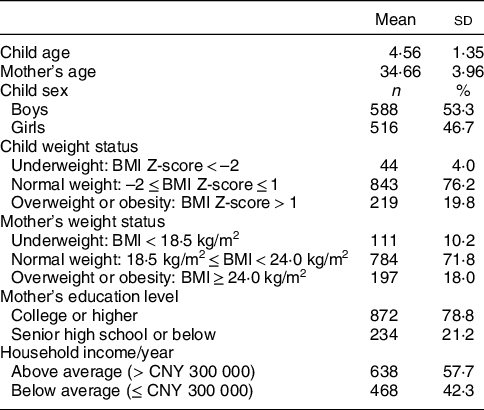
CNY: Chinese Yuan.
Agreement between maternal perception of child weight (weight perception) and actual child weight status
Since few mothers perceived their children’s weight as very overweight or very underweight, these two statuses were combined with overweight and underweight, respectively. Three categories (perceived underweight, normal weight and overweight) were used in the final analysis. 14·1 % of mothers felt that their children weighed too much, 59·0 % reported that their children weighted a normal weight and 26·9 % felt that their children were underweight. The agreement between maternal weight perception and actual child weight status was weak (Kappa = 0·212, P < 0·001) (Table 2). A total of 660 (59·67 %) mothers properly perceived their children’s weight status, and 378 (34·18 %) mothers underestimated their children’s weight status. Most mothers of overweight/obese children felt their children were normal weight (n 106, 48·4 %) or even underweight (n 9, 4·1 %) (Table 2).
Agreement of actual child weight status with maternal weight perception

Weight perception: maternal perception of child weight; Kappa = 0·212, P < 0·001.
Description of variables included in the path analysis
Of the mothers, 74·1 % were not concerned about their child becoming overweight, 18·4 % reported some concern and 7·5 % reported great concern. The descriptions of weight perception, concern and feeding practices are shown in Table 3. The mean scores of weight perception (2·84) and concern (1·85) were both lower than the median level of 3. Pressure to eat and food as a reward were approximately at the median level. Slightly higher mean scores were reported for restriction and monitoring.
Description of weight perception, concern and feeding practices (n 1106)

Weight perception: maternal perception of child weight; Weight concern: maternal concern about child overweight.
Relationships between variables in the path analysis
The bivariate associations between the four feeding practices (monitoring, pressure to eat, use food as a reward and restriction), BMI Z-score, and weight perception and concern are shown in Table 4. Most of the associations were statistically significant.
Path analysis
Based on the hypothesised model (Fig. 1) and the above bivariate correlation analyses, the following variables were included in the initial model: BMI Z-score, weight perception and concern, monitoring, restriction, pressure to eat, food as a reward, child age, maternal age, maternal education level, and annual family income (Fig. 2). Two pairs of error terms (restriction and monitoring, restriction and pressure to eat) were allowed to correlate as this strategy resulted in a substantial improvement in model fit. Similar approach has been used in previous studies(Reference Ek, Sorjonen and Eli54,Reference Nowicka, Sorjonen and Pietrobelli55) . The structural model revealed a good fit of the data: χ 2 (32) = 86·297 (P < 0·001), GFI = 0·987, CFI = 0·961, RMSEA = 0·046, RMR = 0·035 and AIC = 176·297. In this model (Fig. 2), two direct paths were non-significant. We removed the two non-significant paths, respectively, to obtain the most parsimonious model. After simplifying the model, all the remaining statistically significant paths were entered into a final model to assess the relative importance of the direct and indirect effects of BMI Z-score on maternal feeding practices.
Initial model of the relationships between the study variables. Paths were adjusted for child age, maternal age, maternal education level and annual household income. Arrows represent directions. Significant paths are shown as solid lines, and non-significant paths are shown as dashed lines. ***P < 0·001; **P < 0·01; *P < 0·05

The final model is illustrated in Fig. 3. It showed a better fit than the initial model, with the following parameters: χ 2 (34) = 89·109 (P < 0·001), GFI = 0·986, CFI = 0·960, RMSEA = 0·038 and RMR = 0·046. The AIC value was lower in the current model (153·109) than in the previous model. The model accounted for 1·5 %, 4·1 %, 3·4 % and 1·5 % of the variance in food as a reward, monitoring, restriction and pressure to eat, respectively. All the direct paths in the final model were statistically significant. Specifically, weight concern was associated with monitoring (standardised β = 0·13, P < 0·001), restriction (standardised β = 0·12, P < 0·001) and food as a reward (standardised β = –0·07, P < 0·05). The standardised β of the direct path from weight perception to pressure to eat was −0·10 (P < 0·001).
Final model of the relationships between the study variables. Paths were adjusted for child age, maternal age, maternal education level and annual household income. ***P < 0·001; **P < 0·01; *P < 0·05

Indirect effects of child weight and maternal perception of child weight (weight perception) on maternal feeding practices
The indirect effects of child weight and weight perception on maternal feeding practices are presented in Table 5. When all the variables were included in the model, both paths through a single mediation (indirect effects 1–4 in Table 5) and a serial mediation (indirect effects 5–7 in Table 5) were statistically significant. The total indirect impact on maternal feeding practices was also statistically significant (P < 0·05). The mediation of weight concern between weight perception and food as a reward, restriction and monitoring was also statistically significant.
Correlations of the key variables (n 1106)

Weight perception: maternal perception of child weight; Weight concern: maternal concern about child overweight.
*P < 0·05, **P < 0·01, ***P < 0·001, †P = 0·086, ‡P = 0·160.
Indirect effects of child weight and weight perception on maternal feeding practices

n 1106. Number of bootstrap samples for bias-corrected bootstrap CI: 10 000. Weight perception: maternal perception of child weight; Weight concern: maternal concern about child overweight.
*P < 0·05, **P < 0·01, ***P < 0·001.
Discussion
In this study, we examined the mediating roles of maternal perception of child weight and concern about overweight on the association between child weight and four common feeding practices. The results from the structural equation modelling largely supported our hypotheses.
In this study, although the child BMI Z-score was significantly related to pressure to eat in the bivariate analysis, it was not a direct predictor in the structural equation modelling. Based on the bootstrapping results, child BMI Z-score influenced mothers’ feeding practices via three paths: two full single mediating effects of weight perception and concern and a serial multiple mediating effects of weight perception and concern. Specifically, the relationship between child BMI Z-score and pressure to eat was fully mediated by weight perception. This finding suggested that mothers of children with higher BMI Z-scores were more likely than those of children with lower BMI Z-scores to perceive their children as having a high weight, which in turn decreased the likelihood of them forcing their children to eat. Additionally, weight concern fully mediated the associations between child BMI Z-score and maternal restriction, monitoring, and use of food as a reward. In this case, mothers whose children were overweight or obese were more likely than those whose children were normal or underweight to report concerns and monitor or restrict their children’s intake rather than reward them for eating. In addition, mothers of children with higher BMI Z-scores were more likely to perceive their children as having a high weight status and express concern about their children being overweight or obese, which ultimately affected their feeding practices, such as restricting the consumption of unhealthy food.
Previous studies have assessed the correlations between caregivers’ feeding practices and weight-related variables(Reference de Souza Rezende, Bellotto de Moraes and Mais14,Reference Gregory, Paxton and Brozovic22,Reference Yilmaz, Erkorkmaz and Ozcetin25,Reference Lydecker and Grilo28) ; however, few have explored their interrelationships. A population-based cohort study showed that mothers’ concerns about their children’s weight mediated the relationship between child BMI Z-score at 4 years and restrictive feeding at 10 years(Reference Derks, Tiemeier and Sijbrands56). Our findings are consistent with previous evidence(Reference Gregory, Paxton and Brozovic22,Reference May, Donohue and Scanlon23,Reference Webber, Hill and Cooke39) and in accordance with Costanzo and Woody’s suggestion(Reference Costanzo and Woody57) that parents should use controlled feeding practices when they are concerned about their child’s weight. Therefore, although the results of this study supported our hypotheses, the mediating effect of weight perception and concern warrants further investigation.
In the current study, maternal perception of child weight was a mediator of child BMI and maternal feeding practices. This finding emphasises the importance of accurate perception of child weight. Only when mothers recognise their preschool children’s weight problems do they implement effective feeding practices to control their children’s weight. In this study, we found a high percentage of misperception of child weight, with mothers tending to underestimate their children’s weight. The results are consistent with recent findings(Reference AlHasan, Breneman and Lynes58,Reference Berggren, Roswall and Alm59) . The inability to accurately identify child overweight/obesity is problematic given that substantial evidence suggests that weight perception is critical in motivating health-related behavioural changes(Reference Almoosawi, Jones and Parkinson60–Reference Rhee, De Lago and Arscott-Mills62). Thus, mothers who consider their overweight/obese children as normal weight or even underweight might not be concerned about their children being overweight or obese and therefore adopt inappropriate feeding practices, such as forcing children to eat more. This practice may further influence a child’s development and growth, especially their weight.
Although our model showed a good fit of data, the variance in feeding practices accounted for by the predictors was low and the correlations between them were weak in this study. However, our findings are consistent with previous ones(Reference Gregory, Paxton and Brozovic22,Reference Webber, Hill and Cooke39) . For example, Gregory et al. (Reference Gregory, Paxton and Brozovic22) reported that maternal concern about child overweight only explained 2 % of the variance in restriction. This weak correlation could be due to the fact that the percentage of overweight or obese children in our study (19·8 %) were less than that in Western countries(Reference Chen, Jin and Yang63,Reference Ogden, Carroll and Lawman64) . In addition, chubby children are considered healthy in traditional Chinese culture or low social economic settings(Reference Zhou, Cheah and Van Hook34,Reference Jiang, Rosenqvist and Wang36,Reference Gupta, Goel and Shah65,Reference Hossain, Siddiqee and Ferdous66) . Parents are usually more concerned about underweight than overweight. It is likely that mother in this study did not consider overweight a problem and thus showed a low level of concern about child overweight when compared to mothers in other countries(Reference Warkentin, Mais and Latorre18,Reference Freitas, Moraes and Warkentin26,Reference Webber, Hill and Cooke39) . It is also possible that maternal concern is more strongly related to other feeding strategies that Chinese mothers use but cannot be captured by C-CFQ (e.g. encouraging healthy eating)(Reference Yuan, Zhang and Xu67,Reference Yuan, Zhang and Lu68) .
To the best of our knowledge, this study was among the first to examine the structural relationships between child weight, mothers’ weight perception and weight concern, and caregivers’ feeding practices. The significant paths and well-fitted model provided further empirical support for the hypothetical model. However, this study has limited generalisability because of the sampling method used (e.g. a convenience sampling of only mothers). Related, mothers included in this study were typically college educated, and thus cannot present those from rural areas who are less educated. Although the prevalence of overweight or obese children in our study was similar to that in a large-scale study conducted in Shanghai, China(Reference Chen, Jin and Yang63), random samples from multiple sites are needed in the future. Another limitation was the correlational design, which precluded us from making causal inferences. Additionally, self-reported information may be subject to recall bias. Finally, we focused on four common feeding practices, whereas other positive approach of feeding (e.g. rules, limits and modelling) were not assessed. Thus, longitudinal studies using comprehensive questionnaires are needed to confirm findings from this study.
Conclusion
The model analysed in this research help to explain the interrelationships between the variables related to child weight. The results of the present study suggest that maternal perception of child weight and concern about overweight may be crucial mechanisms though which actual child weight affects mothers’ feeding practices. With respect to mothers’ feeding practices, maternal perception of child weight and concern about overweight are more relevant than actual child weight. Thus, feeding practices associated with childhood obesity should first address maternal perception of child weight. Managing concern about child overweight may be a potential intervention. Future studies should focus on correcting caregivers’ misperception about child weight. Interventions designed to improve caregivers’ accurate assessments of child weight are needed so that they can adopt appropriate feeding practices, thereby optimising child health.
Acknowledgements
Acknowledgements: We would like to thank all of the child healthcare workers at Jinyang Community Health Service Center for their help with data collection. Financial support: D.Z. and J.W.’s work was supported by a grant from the National Social Science Foundation of China (No.: 19BSH070). The funding body was not involved in the design of the study, data collection or analysis, interpretation of the results, or writing of the manuscript. Conflicts of interest: The authors declare no conflicts of interest. Authorship: Data collection X.C., Y.C., L.Z. and D.Z.; Formal analysis: J.W.; Investigation: X.C., Y.C., L.Z. and D.Z.; Methodology: D.Z. and Y.C.; Project administration: D.Z.; Resources: D.Z.; Software: J.W.; Supervision: D.Z., S.M. and Y.C.; Visualisation: J.W.; Writing – original draft: D.. Z., J.W. and Y.C.; and Writing – review and editing: J.W., X.C., B.Z., D.Z., S.M. and Y.C. Ethics of human subject participation: This study was conducted according to the guidelines laid down in the Declaration of Helsinki and all procedures involving research study human participants were approved by the the Research Ethics Committee of Shanghai Jiao Tong University (No.: SJUPN-201908). This article does not contain any studies with animals performed by any of the authors. Written informed consent was obtained from all individual participants included in the study and was formally recorded.


 Open access

