




Introduction
In the soil, organic matter has a fundamental role in the formation and advancement of soil physical properties, such as its bulk density, water retention capacity and molecular aggregation capacity (Angst et al., Reference Angst, Mueller, Nierop and Simpson2021). The organic substance has an amending function and is necessary to preserve the fertility of the soil, understood as a complex of chemical, physical, biological and mechanical characteristics favourable to the physiological functions of plants (Schröder et al., Reference Schröder, Beckers, Daniels, Gnädinger, Maestri, Marmiroli and Sæbø2018; Picariello et al., Reference Picariello, Pucci, Carotenuto, Libralato, Lofrano and Baldantoni2020).
The use of composted soil improvers favours an increase in soil porosity, structural stability, water retention and the reduction of erosion as well as an increase in organic matter content and providing a source of nutrients for production (Gurmu, Reference Gurmu2019; Usharani et al., Reference Usharani, Roopashree and Naik2019; Aytenew and Bore, Reference Aytenew and Bore2020). In the land destined for the cultivation of vines, anthropic interventions, such as trenching and excavation, that involve the displacement of large quantities of land, often induced a loss of fertility due to a reduction in the presence of microbial populations (Costantini et al., Reference Costantini, Castaldini, Diago, Giffard, Lagomarsino, Schroers, Priori, Valboa, Agnelli, Akça, D'Avino, Fulchin, Gagnarli, Kiraz, Knapič, Pelengić, Pellegrini, Perria, Puccioni, Simoni, Tangolar, Tardaguila, Vignozzi and Zombardo2018; Garcia et al., Reference Garcia, Celette, Gary, Ripoche, Valdés-Gómez and Metay2018; Pandey et al., Reference Pandey, Tripathi, Srivastava, Choudhary and Dikshit2019; Jakšić et al., Reference Jakšić, Ninkov, Milić, Vasin, Banjac, Jakšić and Živanov2020).
The conventional agriculture trend to maximize yields, through intensive cultivation techniques, together with the use of chemical fertilizers, has progressively compromised the fertility of agricultural land (Bonanomi et al., Reference Bonanomi, De Filippis, Zotti, Idbella, Cesarano, Al-Rowaily and Abd-ElGawad2020; Saffeullah et al., Reference Saffeullah, Nabi, Liaqat, Anjum, Siddiqi and Umar2021). Furthermore, the separation of livestock activities from cultivation has reduced the availability of organic matter, such as manure, within farms (Takahashi et al., Reference Takahashi, Nomura, Son, Kusudo and Yabe2020; Valve et al., Reference Valve, Ekholm and Luostarinen2020).
Modern winegrowing must address the issue of vineyard fertility in the sustainability context (Burg et al., Reference Burg, Masan, Cizkova and Badalikova2019). Currently greater attention is being paid to replacing conventional and synthetic fertilizers, such as urea, mineral superphosphate and potassium chloride (Roig et al., Reference Roig, Montull, Llenes and A2018; Ollanazarovich, Reference Ollanazarovich2021; Pisciotta et al., Reference Pisciotta, Di Lorenzo, Novara, Laudicina, Barone, Santoro, Gristina and Barbagallo2021) with different types of fertilizers (source of organic matter) in the form of compost, organic manure or digestate (Ronga et al., Reference Ronga, Francia, Allesina, Pedrazzi, Zaccardelli, Pane, Tava and Bignami2019; Pizzeghello et al., Reference Pizzeghello, Bellin, Nardi, Francioso, Squartini and Concheri2021). The new trends aimed at sustainable vineyard management lead to safeguarding soil fertility by preserving non-renewable resources and making the most of territorial resources (Cataldo et al., Reference Cataldo, Fucile and Mattii2021a; Rusch et al., Reference Rusch, Beaumelle, Giffard and Ugaglia2022). Viticulture conducted without the use of synthetic chemicals is based on agronomic management that observes the physiology and phenological rhythms of plants, in order to make them less demanding and less susceptible to pathogen attacks, as well as making the agroecosystem more resilient. Furthermore, a vineyard that is correctly stabilized from the point of view of additional contributions to the soil allows harmonious berry ripening without imbalances deriving from biotic (pathogenic attacks) or abiotic (climate change) factors (Tangolar et al., Reference Tangolar, Tangolar, Torun, Ada and Göçmez2020; Cataldo et al., Reference Cataldo, Salvi, Paoli, Fucile, Masciandaro, Manzi, Masini and Mattii2021b; Hooper and Grieshop, Reference Hooper and Grieshop2021).
It has been shown that a recycling integrated system recuperates nutrients and energy from the waste flow and decreases landfill disposal of recyclable and organic waste by reducing greenhouse gas (GHG) emissions, in comparison with conventional landfill disposal (Menikpura et al., Reference Menikpura, Sang-Arun and Bengtsson2013). In addition, the effect of soil organic matter on soil respiration has not only agronomic but also environmental relevance due to their contribution to both emissions and removals of GHGs (carbon fluxes) (Montanaro et al., Reference Montanaro, Amato, Briglia, Russo and Nuzzo2021). Composting from organic municipal solid waste (MSW), such as a separate waste collection, is a valid tool for eliminating a considerable amount of waste that would otherwise be destined for landfills and incinerators, thus representing an effective complement to traditional forms of recycling (Richard Reference Richard1992; Garcıa-Gil et al., Reference Garcıa-Gil, Plaza, Soler-Rovira and Polo2000). It allows the recovery of organic substance to reintegrate it into the soil, thus preventing erosion phenomena, increasing the biological fertility of the soil and contributing significantly to the restoration of impoverished sites (Farrell and Jones, Reference Farrell and Jones2009).
However, it is well known that the addition of composted soil improvers can block the loss of organic matter and restore soil fertility by compensating for humus deficit, improving soil structure even in the long term and increasing plant performance through a better balance of the source-sink ratio (Sánchez-Monedero et al., Reference Sánchez-Monedero, Cayuela, Sánchez-García, Vandecasteele, D'Hose, López, Martínez-Gaitán, Kuikman, Sinicco and Mondini2019).
In vineyards, the use of MSW and composted sewage sludge has been a source of research and monitoring (Siles-Castellano et al., Reference Siles-Castellano, López-González, Jurado, Estrella-González, Suárez-Estrella and López2021). However, owing to the poor quality of the compost deriving from MSW (i.e. heavy metals, glass and plastic), alarm for the health of living beings and the environment and related marketing issues have occurred over time (Wei et al., Reference Wei, Li, Shi, Liu, Zhao and Shimaoka2017).
For this reason, MSW composting was embellished by an arrangement in which organic waste is divided at the beginning (source) and stockpiled independently before being composted to guarantee better compost production (fewer impurities and contamination) (Stunzenas and Kliopova, Reference Stunzenas and Kliopova2018; Edo et al., Reference Edo, Fernández-Piñas and Rosal2022).
Organic waste (MSW) contains a high amount of organic carbon (30–50%) and easily available nitrogen (N) and thus can be efficiently used in viticulture (Weber et al., Reference Weber, Kocowicz, Bekier, Jamroz, Tyszka, Debicka, Parylak and Kordas2014). On one hand, during the composting process, organic matter undergoes stabilization, humification and the matured compost (final product) is described as a good amendment to enhance the physicochemical and biological soil properties (Yu et al., Reference Yu, Ding, Chen, Zhang, Luo and Bolan2015). But on the other hand, MSW compost may contain different concentrations of potentially harmful elements, such as metals and metalloids (subjected to limitations by law) causing adverse effects on the environment (i.e. soil and water contamination and phytotoxicity to plants) (Illera et al., Reference Illera, Walter, Souza and Cala2000; Dercová et al., Reference Dercová, Makovníková, Barančíková and Žuffa2005). In fact, most studies point to the MSW composting process and degree of maturity of the final product as basic conditions for its safe utilization, indicating its components and criticalities (Jamroz et al., Reference Jamroz, Bekier, Medynska-Juraszek, Kaluza-Haladyn, Cwielag-Piasecka and Bednik2020).
The aim of the work was to improve knowledge of MSW composting in viticulture through the study of its application on grapevines soil analysing the main parameters of leaf gas exchange and the quality of the grapes.
Materials and methods
Temperature, experiment location and compost analysis
The experiment was carried out in the municipality of Pontassieve in the Sieci area (43°47′18.49″N–11°23′40.02″E). The area is located along the banks of the Arno River, at the point where the Sieci stream of the same name enters (4 km), on the slopes of the Remole hill (249 m a.s.l.). The climatic zone for the Pontassieve territory (assigned by Decree of the President of the Republic n. 412 of 26 August 1993 and subsequent updates until 31 October 2009) is D with 1928 degree days.
Vitis vinifera L. Sangiovese cv./SO4 was planted in 2013. Vines were planted at 2.8 m × 1 m (row × vine) spacing in north-south orientated rows. All the vines were trained on a vertical upward single cordon positioning system. The vineyard was managed under a semi-mechanized management system.
The geological material underlying the soil is a group of calcareous sands, silts and argillites originating from the Myocene. Red calcareous argillites are interspersed with isolated sand levels. Generally speaking, the vineyard soil had a high pH (over 8.3), carbonate content (over 37%) and active lime content of over 13.30% with some rock fragments (Dane and Topp, Reference Dane and Topp2020; Sparks et al., Reference Sparks, Page, Helmke and Loeppert2020). The physico-chemical analysis of the soil was performed by an external laboratory (Table 1) (Demetra di Landi Stefano & Baroncelli Paolo SNC, Pescia, PT, Italy).
Physical (sand, silt and clay) and chemical (total nitrogen, assimilable phosphorus, exchangeable potassium, exchangeable calcium, exchangeable magnesium, assimilable ferrum, organic substance, C/N ratio, total limestone, active limestone and cation exchange capacity) analysis of vineyard soil

An automated weather station (Ecotech, Germany) located in the vineyard, was used to record total rainfall (mm) and maximum, mean and minimum air temperature (°C). The climate was the semiarid Mediterranean according to the Papadakis classification (Arshad and Rawayau, Reference Arshad and Rawayau2016), with a mean annual rainfall of 760 mm and a mean annual temperature of 13.5°C. Climatic conditions varied during the two vintages studied: the 2019 vintage was slightly dry (740 mm) and the 2018 was exceptionally wet with respect to the average (1290 mm).
The experiment was arranged with a complete randomized block design, consisting of five experimental plots and one factor (soil treatment). Each experimental plot consisted of three parallel rows per treatment, with only the central row sampled to limit edge effects. Four soil treatments were applied (three compost rates and a control): municipal solid waste compost (40 tons per hectare – MSW40), municipal solid waste compost (15 tons per hectare – MSW15), municipal solid waste compost (2.5 tons per hectare – MSW2.5) and no compost (CTRL). The vines had received basic fertilization during the installation of the vineyard (50 tons of manure; 300 kg K; 200 kg P; 200 kg Mg; 10 kg B); during the following years, no fertilization was applied to the soil. The treatments were applied in autumn 2017 and autumn 2018 with a manure spreader machine. Compost was applied on a per hectare basis, with a single application in bands that were lightly incorporated (10–20 cm) into the soil directly under the interrow (Wilson et al., Reference Wilson, Lambert and Dahlgren2021).
At the composting Center of Faltona (Alia Servizi Ambientali SpA, Borgo San Lorenzo, Italy), with the technical and scientific supervision of the Agricultural School (DAGRI, University of Florence, Italy), in a specially set up area tests were carried out to obtain quality compost, derived from organic waste matrices selected from separate collection from MSW, agri-food waste, etc. The obtained compost was subjected to analysis (Table 2), by an external laboratory, for the verification of the qualitative standard parameters required by current legislation on fertilizers, before being used for agronomic experimentation.
MSW compost analysis

Biological parameters (Salmonella spp., total Enterobacteriaceae, Streptococcus faecalis, Nematoda, Cestoda and Trematoda), unwanted materials (plastic materials ≤ 3.33 mm, plastic materials > 3.33 × ≤ 10 mm, other inert materials ≤ 3.33 mm, other inert materials > 3.33 × ≤ 10 mm and plastic and inert materials > 10 mm), heavy metals (Zn, Cu, Pb, Ni, Hg, Cd and Cr) and agronomic characteristics (humidity, N, P, K, organic carbon, pH, conductivity, Mg, Mn, Fe, bulk density, total porosity and H2O)
Briefly, the composting plant in Faltona foresees three macro phases (Diaz et al., Reference Diaz, Savage, Eggerth and Golueke2020; Miller, Reference Miller2020; Siles-Castellano et al., Reference Siles-Castellano, López, López-González, Suárez-Estrella, Jurado, Estrella-González and Moreno2020):
(i) Mechanical treatment of incoming materials and preparation of the mixture; shredding and/or screening and/or mixing in order to first remove foreign materials, to obtain the correct porosity and humidity of the mixture, and to balance the nutrients.
(ii) Biostabilization of the mixture; series of technologies (temperature control, oxygen level, humidity) to obtain the optimal conditions for microorganisms in order to stabilize the organic substance, accelerating natural processes and eliminating potential pathogens.
(iii) Final refining of the stabilized material (screening and iron removal), for the definitive removal of foreign materials to obtain a compost that fully complies with the standard (annex 2 of Legislative Decree 75/10), which can be used directly in the field or in the production of other fertilizers.
Shoot growth, number of leaves per sprout, stomatal conductance, net photosynthesis, transpiration, and water use efficiency, midday stem water potential and chemical analysis of leaves
Shoot growth and leaves number per shoot were measured every 2 weeks until the vegetative canopy was mechanically topped by sampling ten shoots per treatment chosen in the tagged vines. Leaf gas exchange measurements were taken to assess leaf photosynthetic activities by using a portable infrared gas analyser CIRAS-3 (PP Systems, Amesbury, MA, USA). The measurements were assessed three times per season (full bloom: 25 May 2018–24 May 2019, veraison: 13 August 2018–7 August 2019 and harvest: 15 September 2018–10 September 2019). Ten sun-exposed leaves were selected from the main shoot axis in each experimental unit. Gas exchange measurements were taken when the sunlight condition was close to saturating in both years (average PARi = 1728 ± 211 μmol/m2s in 2018, 1742 ± 236 μmol/m2s in 2019). The relative humidity was set at 40%, the reference CO2 concentration was set at 400 μmol CO2/mol as the standard environmental condition setting in CIRAS-3. Net carbon assimilation rate (Pn, μmol CO2/m2s), transpiration (E, mmol H2O/m2s) and stomatal conductance (gs, mmol H2O/m2s) were obtained. Intrinsic water use efficiency (WUEi) was calculated as the proportion of Pn over gs (μmol CO2/mmol H2O). Extrinsic water use efficiency (WUEe) was calculated as the proportion of Pn over E (μmol CO2/mmol H2O) (Yu and Kurtural, Reference Yu and Kurtural2020).
In parallel with leaf gas exchange measurements, at the same dates and phenological stages, midday stem water potential (Ψstem) was measured in 2018 and 2019 to assess plant water status. Ten leaves in the shade were selected from the main shoot axis on the grapevines and were concealed in pinch-sealed dark Mylar® bags for about 1.30 h prior to the measurements in each experimental unit. A pressure chamber (Model 615D, PMS Instrument Company, Albany, OR, USA) was used to take the measurements.
The leaf samples (five samples per treatment chosen in the tagged vines) for determining the concentrations of microelements (Fe, B, Cu, Zn, Mn and Mo) and trace elements (Al, Ba, Cd, Cr, Pb and Ni) of grapevines were taken from the opposite sides of clusters at veraison times (13 August 2018–7 August 2019) and their leaf blades were used in the analysis (Ozdemir et al., Reference Ozdemir, Tangolar, Gursoz, Cakir, Tangolar and Ozturkmen2008). Plant samples were washed in distilled water before forced-air oven drying at 60°C. Samples were ground before extraction. After wet microwave digestion in HNO3 (CANDY – MIC 201 EX, 1000 watt microwave), the samples were analysed using the ICP-OES technique (Prodigy Teledyne, Leeman Labs. spectrometer, Mason, OH, USA) (Domagala-Swiatkiewicz and Gastol, Reference Domagala-Swiatkiewicz and Gastol2013).
Berry analysis and production data
Ten samples of 100 berries per treatment were taken at veraison (13 August 2018 and 7 August 2019), full maturation (31 August 2018 and 28 August 2019) and harvest (15 September 2018 and 10 September 2019) for technological analysis. Berry weight was determined with a digital scale (Pts3000-Bs Pesola, Schindellegi, Switzerland). The berries were hand-pressed in a stainless-steel juicer to yield about 30 ml of juice that was centrifuged at 1800 g for 3 min and used for pH, titratable acidity and °Brix determination. The pH was measured using Seven Compact pH/Ion meter S220 (Mettler Toledo, MI, Italy). Titratable acidity was automatically titrated (Mettler Toledo ET18 titrator, Mettler Toledo Instruments) with a solution of 0.05 M NaOH to a final pH of 7.0, expressed as g/l of tartaric acid (Shi et al., Reference Shi, Li, Chen, Song, Meng, Xi and Zhang2017). °Brix was determined from the juice of 10 ml per sample per treatment, using a 55586-Refractometer (Fernox, NO, Italy).
The procedure for anthocyanins and polyphenols extraction developed by Glories (Reference Glories1984 was implemented with the method by Kontoudakis et al. (Reference Kontoudakis, Esteruelas, Fort, Canals and Zamora2010). Briefly, 100 g of berries were put into a kitchen blender (BOSCH MMB6141S, 1200 watt, MI, Italy) and blended on a low pulsed level to homogenize pulp and skin. Two different pH solutions were prepared:
(A) a pH 1 solution with 0.3M C₂H₂O₄ (oxalic acid) adjusted with HCl (hydrochloric acid);
(B) a pH 3.2 solution with 0.3M H₃PO₄ (phosphoric acid) adjusted with 10 M NaOH (sodium hydroxide).
Solution A (50 ml) was added to grape mash (50 g) and solution B (50 ml) was added to the remaining 50 g of the grape mash. These were incubated for 4 h at ambient temperature with agitation every 35 min and centrifuged at 4200 RPM for 8 min.
Extraction solvent (21 ml comprising 5 ml ethanol + 16.7 ml 12% HCl in 100 ml H2O) was added to 1 ml of each pH sample supernatant. In total, 4 ml of a 15% (w/w) SO2 were added to 10 ml of each sample (sulphured samples), while 4 ml H2O were added to an additional 10 ml of each sample (native samples). All samples were incubated for 15 min and analysed at 520 nm against the dilution solution (C₂H₆O + HCl in H2O) as a blank reagent. Extractable and total anthocyanins were calculated using the following formulas (Sommer and Cohen, Reference Sommer and Cohen2018):
(a) ${\rm Potential}\;{\rm anthocyanins}\,( {\rm mg/L}) {\rm} = [ {{\rm A520}\,( {\rm pH}\;1) -{\rm A520} \,( {\rm pH}\;{\rm 1; \;}\;{\rm S}{\rm O}_ 2) } ] {\rm \;\times\; 875}$

(b) ${\rm Extractable}\;{\rm anthocyanins}\,{\rm ( mg/L) } = [ {{\rm A520\; ( pH\;3}{\rm .2) }-{\rm A}520( {\rm pH}\;3.2; \;\;{\rm S}{\rm O}_ 2) } ] {\rm \;\times\; 875}$


Ten samples of 100 berries per treatment were taken at veraison (13 August 2018 and 7 August 2019), full maturation (31 August 2018 and 28 August 2019) and harvest (15 September 2018 and 10 September 2019) and frozen at −20°C. In order to thaw for spectrophotometric analysis (Spectrophotometer UV/VIS Mettler-Toledo S.p.A., MI, Italy), they were left at 4°C for 24 h.
Statistical analyses
Laboratory and field data were analysed with a one-way analysis of variance to test treatment effects. In all analyses, means were separated by Tukey's honest significant difference for post hoc comparisons where significant effects were observed. All analyses were conducted in R version 3.4.0 (R Foundation for Statistical Computing, Vienna, Austria) using a P < 0.05 significance level.
Results
The overall weather of the vineyard: temperature and rainfall
The climate during the 2 years of the experiment was characterized by Mediterranean trends; from the point of view of precipitation, there were considerable differences (Fig. 1). The 2018 season (March–October 1297.1 mm) was characterized by a uniform rain distribution with a dry period in September. The 2019 season (March–October 747.1 mm) was characterized by an uneven distribution of rain, in particular there was a peak during May month (243.0 mm of rain) and a dry period in June (10.0 mm of rain) and July (76.0 mm of rain).
Colour online. The overall weather of the vineyard. Daily total rainfall (mm) and mean, maximum, minimum temperature (°C) of 2018 (a) and 2019 (b). All data refer to the hottest central months of each year (from June to September). The days are expressed in day of the year (DOY) as follows: June 2018 (152–181), July 2018 (182–212), August 2018 (213–243), September 2018 (244–263) and June 2019 (152–181), July 2019 (182–212), August 2019 (213–243), September 2019 (244–263).
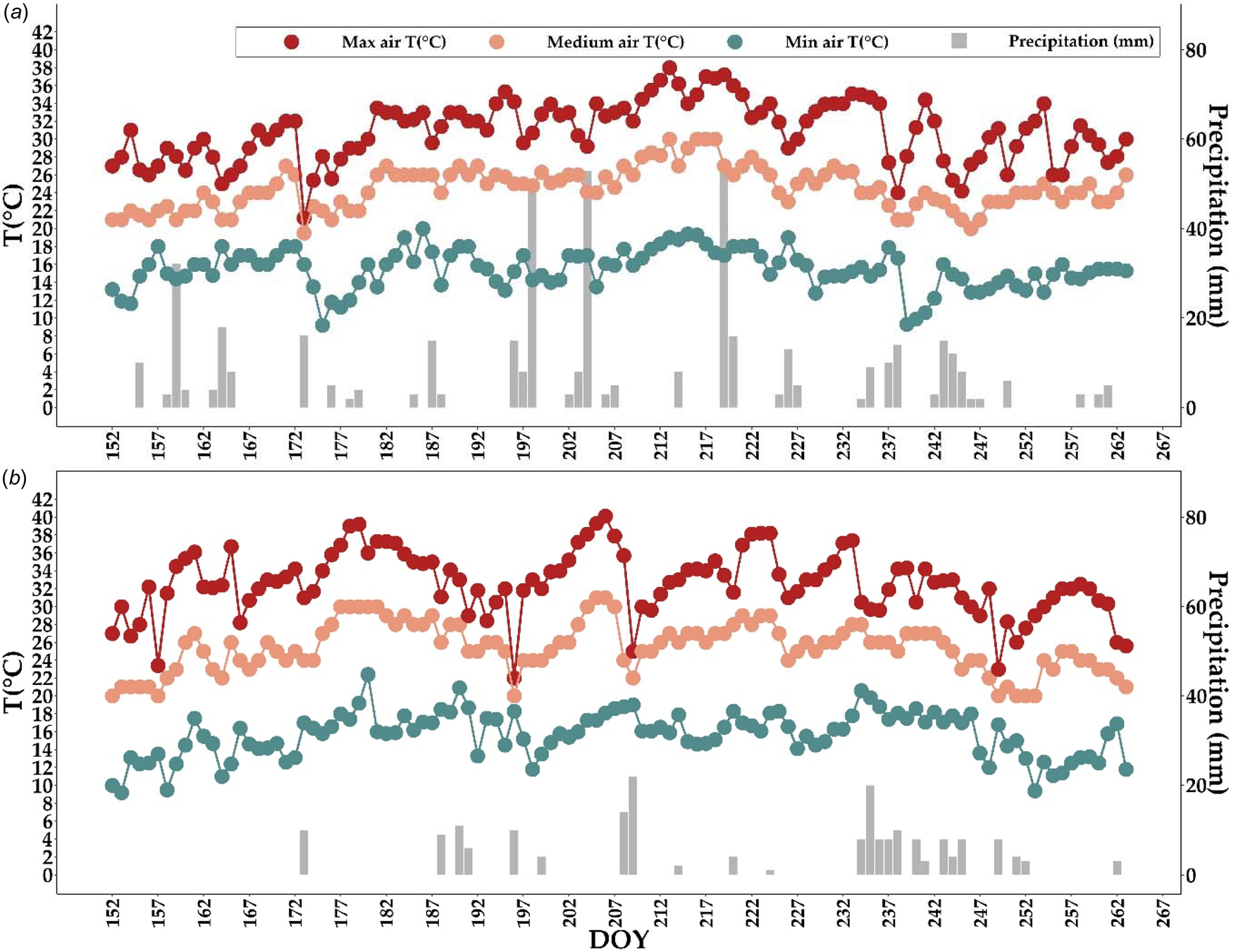
As reported in Fig. 1, maximum temperatures exceeded 32°C on the following days (2018 season): from 30 June to 2 July (181–183 day of the year (DOY)), from 13 to 15 July (194–196 DOY), from 18 to 21 July (199–202 DOY), from 24 July to 12 August (205–224 DOY), from 17 to 24 August (229–236 DOY), 29 August (241 DOY), 11 September (254 DOY). In addition, maximum temperatures exceeded 32°C on the following days (2019 season): from 7 to 14 June (158–165), from 18 to 21 June (169–172), from 24 July to 6 July (175–187 DOY), from 8 to 9 July (189–190 DOY), from 17 to 27 July (198–208 DOY), from 1 to 7 August (213–219 DOY), from 9 to 13 August (221–225 DOY), from 16 to 21 August (228–233 DOY), from 26 to 27 August (238–239 DOY), from 25 August to 1 September (241–244 DOY).
Furthermore, while only 3 days were with extreme temperatures in 2018 (1 August 38°C, 5 August 37°C and 7 August 37.2°C), in 2019 15 days with severe temperatures were recorded (26 June 39°C, 28 June 39.2°C, 30 June 37.3°C, 1 July 37.3°C, 2 July 37.1°C, 22 July 37.2°C, 23 July 38.1°C, 24 July 39.3°C, 25 July 40.1°C, 26 July 37.9°C, 10 August 38.1°C, 11 August 38.2°C, 12 August 38.2°C, 20 August 37.1°C and 21 August 37.4°C).
Shoot growth, number of leaves per shoot, stomatal conductance, net photosynthesis, transpiration, water use efficiency, midday stem water potential and chemical analysis of leaves
The shoot length of grapevines was significantly affected (P < 0.05) by the MSW applications in both years (Tables 3 and 4). MSW40 treatment significantly reduced the shoot length, which was 112.00 cm in the 2019 season (by failing to reach the last wire of the plant system). Prior to topping, MSW2.5 and MSW15 treatments turned out a greater length and number of leaves (i.e. on 29 May 123.22 and 126.45 respectively).
Sprout growth (cm) and number of leaves per sprout (2018 season)

Data (mean ± s.e., n = 10) were subjected to one-way ANOVA. Different letters within the same day and rows indicate significant differences among treatments (LSD test, P ≤ 0.05).
Sprout growth (cm) and number of leaves per sprout (2019 season)

Data (mean ± s.e., n = 10) were subjected to one-way ANOVA. Different letters within the same day and rows indicate significant differences among treatments (LSD test, P ≤ 0.05).
Single leaf net CO2 assimilation at saturating light (Pn) decreased during the season from values ranging between 8 and 10 μmol/m2s to values between 2 and 6 μmol/m2s in treatments (Fig. 2). Leaf net assimilation was significantly influenced by MSW treatment. MSW40 treatment showed significantly lower values (i.e. 3.07 μmol m2/s on 15 September 2018 and 3.35 μmol/m2s on 10 September 2019). In most cases, the reduction in photosynthesis was due to a stomatal mechanism as emerges from the comparison with the stem water potential data.
Colour online. Net photosynthesis (Pn) (a–b 2018–2019), stomatal conductance (gs) (c–d 2018–2019), intrinsic water use efficiency (iWUE) (e–f 2018–2019), extrinsic water use efficiency (eWUE) (g–h 2018–2019), transpiration (E) (i–l 2018–2019) and midday stem water potential (Ψstem) (m–n 2018–2019) of Sangiovese vines treated with three compost rates and a control: municipal solid waste compost (40 tons per hectare – MSW40), municipal solid waste compost (15 tons per hectare – MSW15), municipal solid waste compost (2.5 tons per hectare – MSW2.5) and no compost (CTRL). Data (mean ± s.e., n = 10) were subjected to one-way ANOVA. Different letters within the same parameter and columns indicate significant differences (LSD test, P ≤ 0.05).

Leaf stomatal conductance (gs) also decreased during the hottest 2019 season from maximum morning values ranging between 110 and 180 mmol/m2s to values between 70 and 120 mmol/ m2s in treatments. The gs drop was quite consistent in MSW40 treatment that not fully recovered to the gs levels recorded in the previous season (i.e. 104.00 mmol/m2s on 15 September 2018 v. 75.00 mmol/m2s on 10 September 2019).
Leaf water potential (Ψ) was significantly affected by temperature, seasonal rainfall and MSW treatment. As shown in Table 3, during the hottest days (13 August 2018, 7 August 2019 and 10 September 2019), MSW2.5 and MSW15 plants showed higher mean values (no water stress) than MSW40 and CTRL plants. The mean values of Ψ for MSW2.5 were between −1.20 and −1.55 MPa while those for MSW15 were between −1.17 and −1.39 MPa.
Leaf boron (B) and manganese (Mn) concentrations showed an increasing trend during the two seasons in treated vines (Tables 5 and 6). Soil application of 40 q/ha MSW enhanced the negative effect of accumulation on the leaf of copper (Cu), nickel (Ni) and lead (Pb); the concentration of these elements was higher in MSW40-treated vines compared to untreated plants (i.e. during 2019 season Cu 22.71 mg/kg v. 10.03 mg/kg; Pb 3.10 mg/kg v. 1.25 mg/kg; Ni 2.33 mg/kg v. 2.00 mg/kg). No difference was found in both years for the concentrations of chromium (Cr) and cadmium (Cd).
Content of micro-elements (B, Cu, Fe, Zn, Mn and Mo; mg/kg d.m.) and trace elements in the leaves (Al, Ba, Cd, Cr, Ni and Pb; mg/kg d.m.) (2018 veraison)

Content of micro-elements (B, Cu, Fe, Zn, Mn and Mo; mg/kg d.m.) and trace elements (Al, Ba, Cd, Cr, Ni and Pb; mg/kg d.m.) in the leaves (2019 veraison)

Berry analysis and production data
Figure 3 indicates the Sangiovese grape's composition under four different soil management approaches in the 2018 and 2019 years in terms of technological maturity. During the 2018 season, significant differences at mid-maturation and harvest were noted in sugar content while during the 2019 season, significant differences at all stages were noted in sugar content. CTRL had the highest values of °Brix than other treatments. Furthermore, at harvests, lower acidity values were found for the CTRL treatment.
Colour online. Technological maturity of the grapes. Sugar content (°Brix) (a–b 2018–2019), titratable acidity (TA) (c–d 2018–2019), pH (e–f 2018–2019) and berry weight (g–h 2018–2019) of Sangiovese berries treated with three compost rates and a control: municipal solid waste compost (40 tons per hectare – MSW40), municipal solid waste compost (15 tons per hectare – MSW15), municipal solid waste compost (2.5 tons per hectare – MSW2.5) and no compost (CTRL). Data (mean ± s.e., n = 10) were subjected to one-way ANOVA. Different letters within the same parameter and columns indicate significant differences (LSD test, P ≤ 0.05).

As shown in Fig. 4, significant differences in phenolic maturity were found (extractable and total anthocyanins). As for the 2018 season, at full maturation and harvest, CTRL berries showed significantly higher total anthocyanin content compared to treated grapes. The lowest values in extractable anthocyanins were recorded for the MSW40 treatment at harvest stages. Optimal and balanced parameters were found in MSW15 treatment (i.e. at 2018 harvest 701.75 mg/l and at 2019 harvest 929.83 mg/l).
Colour online. Phenolic maturity of the grapes. Total (a–b 2018–2019) and extractable (c–d 2018–2019) anthocyanins, total (e–f 2018–2019) and extractable (g–h 2018–2019) polyphenols of Sangiovese berries treated with three compost rates and a control: municipal solid waste compost (40 tons per hectare – MSW40), municipal solid waste compost (15 tons per hectare – MSW15), municipal solid waste compost (2.5 tons per hectare – MSW2.5) and no compost (CTRL). Data (mean ± s.e., n = 10) were subjected to one-way ANOVA. Different letters within the same parameter and columns indicate significant differences (LSD test, P ≤ 0.05).
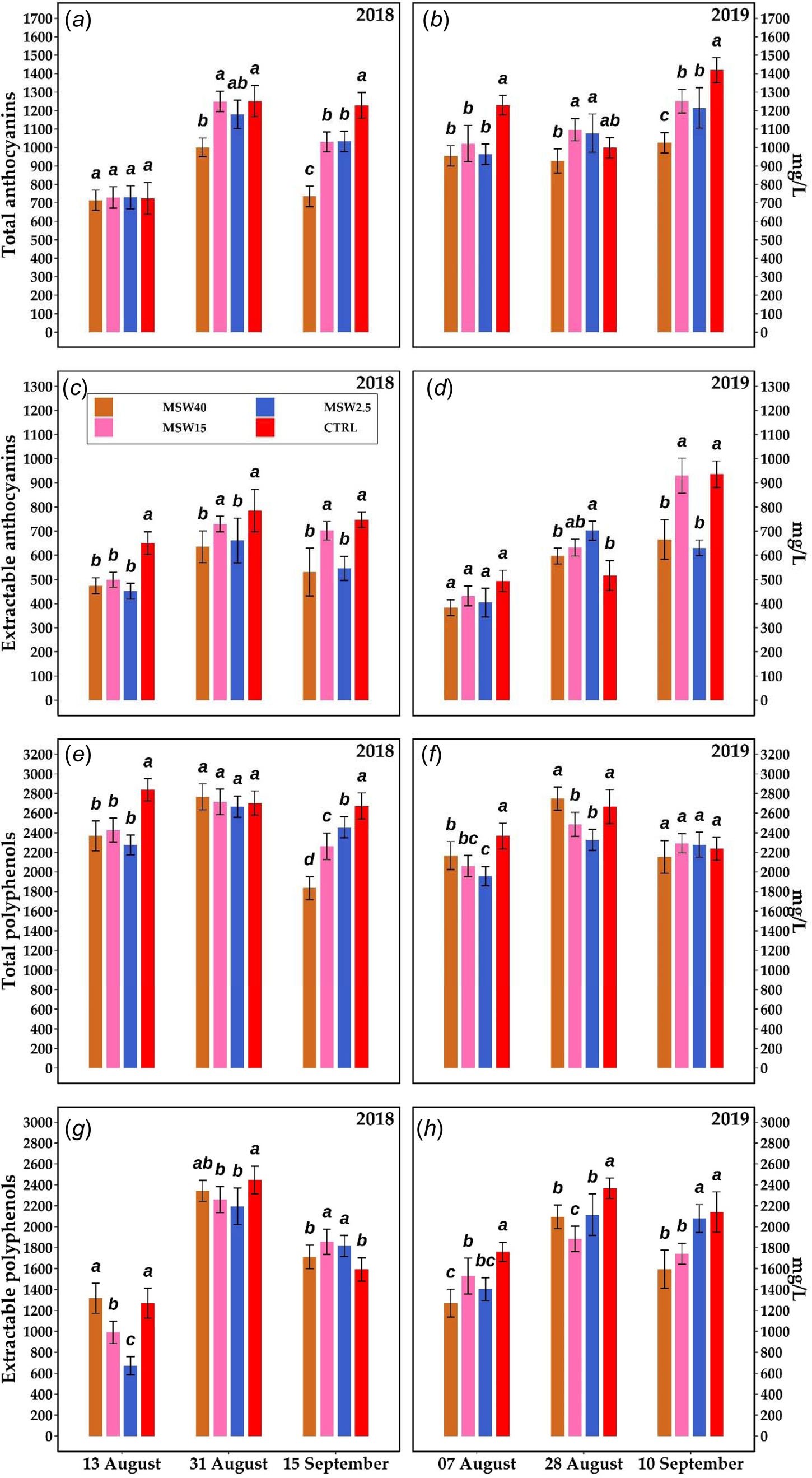
At the 2019 harvest, no differences in total polyphenols were found, while during the 2018 harvest CTRL berries showed significantly higher total polyphenol content compared to the other treatments. In both seasons, significant differences were found in the production parameters at harvest (Table 7). MSW15 and MSW2.5 treatments, in general, had a higher weight of the bunches and yield per plant compared to MSW40 treatment and CTRL.
Harvest production data (15 September 2018 and 10 September 2019)

Data (mean ± s.e., n = 10) were subjected to one-way ANOVA. Different letters within the same day and rows indicate significant differences among treatments (LSD test, P ≤ 0.05).
Discussion
The threats to the vineyard (e.g. soil compaction or erosion, reduced fertility and lower agricultural productivity) are associated with climate change's negative effects (e.g. extreme weather events, droughts, frosts and increases in temperature) (Hamidov et al., Reference Hamidov, Helming, Bellocchi, Bojar, Dalgaard, Ghaley, Hoffmann, Holman, Holzkämper, Krzeminska, Kværnø, Lehtonen, Niedrist, Øygarden, Reidsma, Roggero, Rusu, Santos, Seddaiu, Skarbøvik, Ventrella, Żarski and Schönhart2018). These climate-related risks raise major concerns regarding the vineyard ecosystem as a balanced resource for wine production. This study emphasizes the importance of compost application in the Mediterranean vineyard for maintaining and progressively increasing organic fertility in order to obtain a balanced and qualitatively satisfactory production.
The length and number of leaves were influenced by the amount of compost provided. The control together with the MSW40 treatment recorded lower values compared to doses 2.5 and 15 t/ha. This is probably due to the more abundant presence of copper (Cu) in the MSW400 treatment. Copper element converts the toxicity above a threshold level based on the type of crop plants (An, Reference An2006); on average 1 kg of dry plant tissue contains around 10 mg of Cu (Rawat et al., Reference Rawat, Pullagurala, Hernandez-Molina, Sun, Niu, Hernandez-Viezcas, Peralta-Videa and Gardea-Torresdey2018). The toxic effects of Cu on cultivated crop plants such as mungbean (Vigna radiate L.), rice (Oryza sativa L.), lettuce (Lactuca sativa L.), mustard (Brassica nigra L.) and kidneybean (Phaseolus vulgaris L.) are denoted by inhibiting seed germination, decreases in the shoot and root lengths and morphological as well enzymatic changes; in addition, Cu toxicity has been shown to reduce the content of macronutrients in the shoot (Ca, Mg, K and P) most likely due to an interference with the uptake and translocation of the ions (Shaw and Hossain, Reference Shaw and Hossain2013; Gopalakrishnan Nair et al., Reference Gopalakrishnan Nair, Kim and Chung2014; Mustafa et al., Reference Mustafa, Oraibi, Ibrahim and Ibrahim2017; Zafar et al., Reference Zafar, Ali and Zia2017; Shams et al., Reference Shams, Yildirim, Guleray, Ercisli, Dursun, Ekinci and Raziye2018; Marastoni et al., Reference Marastoni, Sandri, Pii, Valentinuzzi, Brunetto, Cesco and Mimmo2019a, Reference Marastoni, Sandri, Pii, Valentinuzzi, Cesco and Mimmo2019b).
The vines subjected to MSW2.5 and MSW15 treatments benefited from the contribution of compost and showed an increase in the growth of the sprout, similar to the results reported by Machado et al. (Reference Machado, Alves-Pereira, Robalo and Ferreira2021). The amendment had a substantial influence on shoot biomass, which underwent an increase of about 12.53% in 2018 and 14.54% in 2019. A similar effect of promoting biomass accumulation was also observed by Garau et al. (Reference Garau, Castaldi, Patteri, Roggero and Garau2021) on the Cynara cardunculus.
The concentration of the leaf element levels was influenced by the treatments, especially in the second year of the experiment. Significant differences were found between soil fertility treatments for Fe, Cu and Zn in treated vines. In the 2 years, the highest rates of MSW compost produced the highest levels of leaf Cu, Fe and Zn.
The fertilizer plots induced less Mn uptake in the plant probably through the effect of fertilizer additions which increased the soil pH and reduced the availability of Mn (Warman et al., Reference Warman, Rodd and Hicklenton2009). In fact, although the soil type has some influence, exchangeable Mn is generally the dominant below pH 5.2, while at higher pH values Fe-oxide bound forms are dominant (Sims, Reference Sims1986). As found for tomato crops by Radin and Warman (Reference Radin and Warman2011), no significant differences in heavy-metal (Ni, Cr and Cd) tissue concentrations were found among treatments.
From the point of view of net photosynthesis, the treatment with 40 t/ha underwent a decrease in photosynthesis in both seasons compared to the CTRL (−60.00% on 13 August 2018, −32.41% on 15 September 2018, −12.07% on 24 May 2019, −36.64% on 7 August 2019 and −38.16% on 10 September 2019). Probably due to its functions as a reducing (Cu1+) or oxidizing (Cu2+) agent in biochemical reactions, Cu becomes potentially toxic as Cu ions which can catalyse the production of free radicals (Ivask et al., Reference Ivask, Bondarenko, Jepihhina and Kahru2010), induce oxidative stress (Thounaojam et al., Reference Thounaojam, Panda, Mazumdar, Kumar, Sharma, Sahoo and Sanjib2012) and convert as genotoxic substances (Chelomin et al., Reference Chelomin, Slobodskova, Zakhartsev and Kukla2017) altering the process of photosynthesis, transpiration rate and enhancing chromatin condensation and lipid peroxidation (Rajput et al., Reference Rajput, Minkina, Suskova, Mandzhieva, Tsitsuashvili, Chapligin and Fedorenko2018). MSW2.5 and MSW15 treatments increased the photosynthetic efficiency of the monitored plants probably owing to an increase in all chlorophyll fluorescence indices (Qui et al., Reference Qiu, Esan, Ijenyo, Gunupuru, Asiedu and Abbey2020), as demonstrated by Srivastava et al., (Reference Srivastava, Gupta, Singh, Sharma and Singh2018) where a Pn increase of 14–15% was recorded at a 40–100 t/ha application rate, followed by a progressive decline in total chlorophyll content at higher doses (200 or 300 t/ha).
It was found that the addition of MSW compost surcharged the soil water holding capacity without an enhancement in the estimated available water (Mamo et al., Reference Mamo, Moncrief, Rosen and Halbach2000). This is in accordance with this study where MSW compost application (2.5 and 15 t/ha) dwindled the water stress in vines. The two intermediate treatments both reduced water stress compared to the control during the hottest days; with the MSW2.5 treatment, there was a reduction of 11.53% on 13 August 2018, 12.58% on 7 August 2019 and 10.32% on 10 September 2019 while with the MSW15 treatment, there was a reduction of 9.02% on 13 August 2018, 15.83% on 7 August 2019 and 8.23% on 10 September 2019. This effect was probably associated with compost incorporation, which increases water retention, carbon mineralization and most enzyme activities (Paradelo et al., Reference Paradelo, Basanta and Barral2019).
During 2018, significant differences in maturation and harvest were found in sugar content, whilst during 2019, significant differences in veraison, maturation and harvest were distinguished in sugar content. The CTRL treatment had the highest values compared to all treatments. At the time of harvest, CTRL increased the °Brix by 7.55% in 2018 and 8.68% in 2019 compared to MSW40. We hypothesize that the higher sugar content of control-treated plants was due to their berry size (dehydration accumulation; Jamaly et al., Reference Jamaly, Parent and Parent2021) and to a productive shift towards vegetative growth by the treated vines (Oliveira et al., Reference Oliveira, Silva Ferreira, Mendes Pinto, Hogg, Alves and Guedes de Pinho2003).
The berry size (enhanced in MSW2.5 and MSW15 treatments) is probably ascribed to the uptake of mineral nutrients upgrade by the grapevines (Ferrara Brunetti, Reference Ferrara and Brunetti2010) and to the possible hydration activity enhanced by the best vine water status (Sadras et al., Reference Sadras, Collins and Soar2008).
No statistical differences were observed in both years for the pH parameter.
Regarding phenolic maturity, differences were found in the composition of total and extractable anthocyanins. In fact, it was demonstrated that the total anthocyanins were directly related to sugars in the must and closely related to the derivatives of peonidin, and the sugars in the skin were closely correlated to each of the anthocyanins and to the other phenolic compounds present in the skin (González-Sanjosé and Diez, Reference González-Sanjosé and Diez1992). Additionally, phosphate deprivation can enhance the dihydroflavonol 4-reductase (DFR) activity significantly and correspondingly increase anthocyanin accumulation (He et al., Reference He, Mu, Yan, Liang, Pan, Wang, Reeves and Duan2010). At harvest, CTRL berries showed significantly higher extractable and total anthocyanins content compared to other treatments (2018–19). However, MSW15 treatment noted optimum values compared with a view to quality red winemaking (1250.25 mg/l total anthocyanins and 929.83 mg/l extractable anthocyanins on 10 September 2019).
During the 2019 season, no differences in total polyphenols at harvest were found. At the 2018 harvest, MSW2.5 and MSW15 treatments showed significantly higher extractable polyphenol content, while at the 2019 harvest MSW2.5 and CTRL treatments showed significantly higher extractable polyphenol content compared to the other applications.
Significant differences (P ≤ 0.05) were found in the production parameters at harvest (Ponchia et al., Reference Ponchia, Bozzolo, Tateo and Concheri2010). MSW15 and MSW2.5 treatments had generally increased the weight of bunches, yield by vine (2018, 2019) and their number (2019) (higher crop production), reducing evaporation and increasing nutrient uptake by plants (Nguyen et al., Reference Nguyen, Fuentes and Marschner2013).
In general, the data were consistent with the climatic trend; the 2018 season was characterized by greater rainfall which could have influenced the increase in production and berry size, creating a dilution effect in °Brix and anthocyanins (lower skin-to-pulp ratio), while the 2019 season was characterized by less rainfall and higher temperatures which led to concentration sugar and colour with less production (higher skin-to-pulp ratio) (Santesteban and Royo, Reference Santesteban and Royo2006).
Conclusion
Incorrect fertilization is a major threat that could lead to an unbalanced yield in viticultural production. Adaptation and soil management are important to manage the risks and utilize the benefits of climate change. The results of this experiment provide some general insights showing that MSW compost options are expected to reduce water stress, improve vine performance and provide sustainable recirculation of organic matter. MSW compost is a true agronomic and environmental resource. Its application improves the structure and workability of the soil, allowing less energy for ploughing and complementary tillage, increases the water retention capacity of the soil with less energy consumption for irrigation, and improves soil aggregation (lower soil loss due to erosion). The production of compost from the organic fraction of the waste represents an effective recovery of matter, which can be considered a valid tool for a balanced vineyard.
However, more studies are needed in the future to support this strategy given the uncertainties inherent to the market, stakeholders, climate change, long-term soil process dynamics and the multiple interacting factors affecting the agricultural practices.
Acknowledgements
The authors thank Filippo Rossi for the technical assistance; Gmr Strumenti Sas Via Roma 101, 50018 Scandicci (FI), Italy. The authors also thank Isobel Lucy Pollard, a native English speaker-professional reviewer, for improving the writing.
Author contributions
EC and GBM conceived and designed the study. EC and MF conducted data gathering. EC performed statistical analyses and graphs. EC wrote the article. GBM supervised the work.
Financial support
This research received no specific grant from any funding agency, commercial or not-for-profit sectors.
Conflict of interest
None.
Ethical standards
Not applicable.


 Open access

